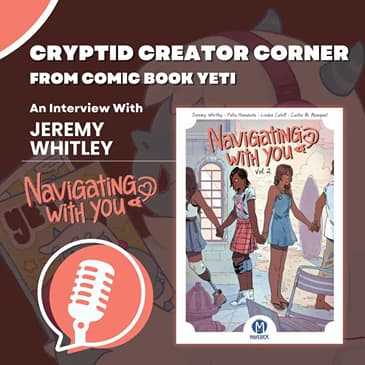

Jeremy Whitley returns to the podcast to discuss Navigating with You vol. 2. The book will be out November 24th from Maverick (an imprint of Mad Cave Studios). Jeremy teamed up with Felia Hanakata for this volume and the artwork is wonderful. Jeremy discusses what he wanted to explore with Neesha and Gabby's relationship as they are now in different schools, and he discusses what was important to him as he fleshed out the other characters in Neesha's and Gabby's lives. I am delighted to report that volume 2 is just as amazing as volume 1!

“It’s not that Neesha is in any way ashamed of her disability, or that she has a problem with people knowing she’s disabled. What she has a problem with is the assumptions people make when they see her as a disabled person.” — Jeremy Whitley
WATCH THE VIDEO VERSION OF OUR CHAT ON YOUTUBE!
Navigating with You Volume 2

From the publisher
Can the love that blossomed in their junior year survive a senior year that's pulling them in different directions?
A month ago, Gabby Graciana and her family left Durham, North Carolina to return back to their lives in Miami, Florida. For Gabby, that meant leaving behind her girlfriend Neesha Sparks. But they swore to keep up the tradition that brought them together—their manga book club.
But not every manga can be the right one at the right time, and they find themselves flailing for a next book. They discover that their favorite mangaka is working with a studio to produce an anime of one of her other stories, so book club chats become anime watch parties. But that's not the only thing in their lives that is changing.
An ex from Gabby's past returns to her life in an unexpected way as Neesha, finally comfortable in her North Carolina town, rediscovers her passion for activism—and a new group of activist friends that she might have more in common with than her now long-distance girlfriend.
Follow Comic Book Yeti
🔗 Comic Book Yeti LinkTree: https://linktr.ee/ComicBookYeti
For partnership and ad inquiries, please contact: thecomicsyeti@gmailcom
Follow your hosts
ARKENFORGE
Play TTRPG games? Make sure to check out our partner Arkenforge. Use the discount code YETI5 to get $5 off your order.
Make sure to check out our sponsor 2000AD.
[00:00:00] Your ears do not deceive you. You have just entered the Cryptid Creator Corner, brought to you by your friends at Comic Book Yeti. So without further ado, let's get on to the interview. The future is calling! 2000AD is the galaxy's greatest comic with new issues published every single week. Every 32-page issue of 2000AD brings you the best in sci-fi and horror featuring characters like Judge Dredd, Rogue Trooper, and more.
[00:00:28] Get a print subscription to 2000AD and it'll arrive to your mailbox every week. And your first issue is free. Or, subscribe digitally and you can download DRM-free copies of each issue for only $9 a month. That's 128 pages of incredible comics every month for less than $10. Head to 2000AD and click on subscribe now. Or download the 2000AD app and start reading today.
[00:00:54] Hello and welcome to Comic Book Yetis Cryptid Creator Corner. I am one of your hosts, Jimmy Gasparo, and I am very happy to welcome back to the podcast a comic creator that I am a huge fan of. And he has a volume 2 coming out on November 24th of 2026 with Maverick, which is an imprint of Mad Cave Studios.
[00:01:16] It is navigating with you volume 2 when we get to see what is going on with Nisha and Gabby since we left them at the end of volume 1. But please, welcome back to the podcast, Jeremy Whitley. Jeremy, how are you doing today? I'm great, Jimmy. Thanks so much for having me. No, it is my pleasure. I am such a fan of navigating with you. I was so glad we got to talk about it.
[00:01:43] And yeah, I was excited to hear that there was going to be a volume 2. I was excited to catch up with Nisha and Gabby and see what is going on with them. And happy to report to listeners that it is just wonderful. Like, it is just one of those stories that I feel like it really captures that feeling of being in a new relationship,
[00:02:11] like being a young person and trying to figure out who you are and what your life looks like, you know, with another person in it. I mean, you showcase a very diverse cast, both in terms of ethnicity and in terms of sexuality, gender identity. It really is a group of young people that are they're just kind of fun to be around and to get to know and to learn about and spend time with.
[00:02:39] And yeah. And also, once again, it is it is it is peppered throughout. There's almost like chapter breaks again with this this anime that that they are into. And again, I just loved it. I absolutely love volume two and I'm excited to talk about it. So for listeners who maybe didn't hear your earlier episode, why don't you just tell us a little bit about volume one and then we'll get into, you know, volume two.
[00:03:06] Yeah. So volume one is all about Nisha and Gabby, who are two teenage girls that have both moved to Durham, North Carolina, my hometown. And they're they're in the same class, some of the same classes in high school. But they are both coming from different places and having experienced different sorts of trauma and or drama recently that have led them to be here.
[00:03:35] Gabby is a super happy, super friendly, you know, kid from Florida who's who's sort of mixed Cuban and Mexican and is trying to be friends with Nisha. Nisha is very resistant to being friends at all. She is a New Yorker and in more ways than one, I think. And and she is not really looking to be friends, just sort of looking to get through the rest of school.
[00:04:02] But ends up they end up bonding over this shared love of a manga called Super Navigator Nozomi that both of them started reading at one point, but it never finished. Because as as it is, it was so many mangas, you know, you don't get the last couple volumes or you you miss one and then you can't find it. So can't ever finish the thing.
[00:04:26] So they decide to put together their own little book club to find and read all these volumes of this book together and become sort of an adventure to track down all of these volumes during which they begin to become, you know, much closer. They begin to become friends and then they begin to become more than friends and, you know, start a romance that sort of lines up a little bit along with the manga they're reading.
[00:04:54] So that was sort of volume one up to, you know, the end of that story. Gabby, unfortunately, has to move back to Florida. Her home is repaired. Her dad's work is moving them back there. So they decide to have a long distance relationship and they're going to figure everything out from there. And then volume two picks up from from where we've left off with with Gabby returning to school in Florida and he's just starting her new her new school year without Gabby there in Durham.
[00:05:24] I thought you really handled well. I said this before we started recording that it's been a long time since I was in a new relationship, but I feel like you really did capture that sense of what it was like to be young. And in love, you know, and just the way they they talk to each other through text and through FaceTime and the things they say, you know what they miss about the other.
[00:05:47] It is very still even after a few months like that, you know what they call the honeymoon period of a relationship. I just I just love the two of them together. They're dynamic. They're they're they're very supportive of one another. Yeah, it's just it's really fun and and lighthearted to to read and to see.
[00:06:11] We see that that Gabby has a lot of trauma associated with driving because we learned, you know, and we learned in book one, I think what happened to her mother and there was a terrible car accident. And we knew that Nisha has cerebral palsy and the two of them are just so supportive of each other. They have in a very short period of time, I feel like have learned, you know, a lot of the the things that that trigger the other.
[00:06:38] And they are very much still there, even long distance for the other to lean on. And it's it's very sweet. Yeah, thank you. My my goal, I think, with book one was very much to, like, make these characters complex, have all these like distinctive things about them. You know, Nisha's disability, Gabby's PTSD, you know, their their sort of mutual queerness because Nisha is lesbian and Gabby is bisexual. Their cultural identities, all this stuff.
[00:07:08] And then just make the movie not about or the book not about that. Right. You know, yeah, it's those are just sort of things that inform who they are. And it's not a not a coming out thing. It's not a specifically cultural thing. It's just about how these, you know, two people meet through this this shared love of this pop culture thing and how that relationship, you know, gives them both what they need in that moment.
[00:07:33] And allows them to support each other and have this this great relationship that, you know, ends up becoming a romantic relationship. And yeah, it's it was a lot of fun to just sort of like play around in both that space of writing a romance story, but also in the space of, you know, North Carolina and getting to write people doing stuff where I live and getting to include bits of of my world and their world.
[00:08:02] And so what was it like as you approach volume two and you're working with illustrator, Ophelia Hanakata? And as you're putting volume two together, what was important to you to try and incorporate? Because now where you have the two of them at their different schools and you now have a new kind of like cast of characters.
[00:08:22] We learn that Nisha gets involved with this like troublemaker society because there is a group of students that were very impressed that we see in the very beginning of volume one. And she stands up to the principal and Gabby kind of reconnects with someone that she she was involved with, but then also reconnects with with her old friends.
[00:08:46] And so what was important in terms of the the other individuals in Gabby and Nisha's separate lives? Like, was there particular, you know, types of individuals or characteristics or what did you think was important in terms of fleshing out the story? Yeah. Yeah. It was really neat to get to work with this this new art team.
[00:09:11] I mean, Cassie, it was wonderful on the first book and he would have come back for the second book, except for that. He got a book signed that he both wrote and illustrated. So he was working on that, which is a great reason to, you know, not be able to come back to this. Thelia is really wonderful. And Linda, who did our colors, is really great. It gives a very different feel to this book, I think, makes them feel a little more grown up, which they are a little more grown up. And it's a little more of a grown up story than the first one. Yeah.
[00:09:40] So it was nice to have that tone shift a little bit in there already. But I think what I wanted to do was explore a little bit of like who they are without the other person and how that's different from the person that they are with the other person.
[00:09:56] You know, Nisha talks a lot about in in the first volume about how she is really involved in or was very involved in local politics in New York and had a lot of like did a lot of protesting, did a lot of like going to, you know, city council meetings and things like that. And really like especially for disability rights and LGBT rights and things like that is very involved.
[00:10:24] And we don't get to see a lot of that in the first volume, partially because she's so sort of wrapped up in Gabby during that year together. And once, you know, she's still got this relationship with Gabby, but it's not as immediate and not as close by. She really gets this opportunity to go like, oh, wait, what what have I not been doing that I should be doing or that I want to be doing?
[00:10:48] And it gets a chance to meet this whole new group of friends who share a lot more in common with her from just like what's really important to her on a day to day basis than maybe Gabby does, which is sort of an interesting thing to realize about, you know, your relationship. This relationship has been very consuming to you. And then, you know, in Gabby's case, she gets to reconnect with all these these people who were part of her life before that she had left behind,
[00:11:15] not even just when she moved, but when she had this bad relationship that precedes her relationship with with Nisha, where she had this, you know, boyfriend, bad boyfriend, Josh, who is, you know, out of the picture now. And she remembers, oh, she had these great friends that she's she's missed. But also we get it. You get a chance.
[00:11:39] I wanted to bring in because there's a lot of like little bits of their backstory that we we threw into the first volume about other people that they dated or previous relationships. They'd had. I wanted to bring back somebody from that. I didn't want it to be Josh because Josh is not a pleasant character. Yeah, no, he yeah. Josh does does not seem pleasant at all. So, yeah.
[00:12:06] If it tells you anything, our first or my first draft of the first navigating with you, Josh actually appeared at one point. And then when we were editing down and trying to figure out what we wanted to absolutely have in this book, they originally was contracted for 200 pages and wrote it at 300. So we had to we ended up at 220. Thankfully, you know, Mad Cave let us bump those extra 20 pages in there.
[00:12:31] But one of the big things that went was just a whole scene in which Josh had come to visit and was in town in North Carolina. And I was like, no, it's I think Josh doesn't really matter to this story. It's it's it matters that Josh sucks and it matters that like Nisha is supportive of of Gabby in this. She doesn't like push into that space and be like, he sucks. You should date me.
[00:12:59] But is is like, no, like you're you're better than how he is treating you. And I think makes Gabby reevaluate how she sees herself. So, yeah, Josh had to go. But we did have this sort of existing story about the first girl that Gabby dated. And Carrie dad, who was, you know, in her surf class and was just like, you know, this.
[00:13:26] I think a lot of us have, you know, a relationship with somebody who was like, they're cooler than you. Right. Like they're like it's you're very you're surprised that they want anything to do with you. And it makes you feel cool sort of like being in the same space as them. But ultimately, Carrie dad sort of and the breaking up with Gabby via text, which is perhaps the worst way to get broken up with.
[00:13:50] It's it's like really up there, at least for me, especially in the case of Carrie dad's where it was very vague text that said, like, oh, this got too real for me, which like, yeah, that even mean. Yeah. But yeah, I wanted to bring Carrie dad back into this and have a chance for us to like see the other side of this. Like what is going on in that person's life that they ended up making this decision have been through this?
[00:14:18] And then how have they changed in the past year? Well, Gabby's whole life and who she is has changed. And how do those two things mesh? So it was it was fun to have this sort of challenge of since Gabby was going back, bringing other people that, you know, we had mentioned or at least thought about into that story and then get a chance to expand Nisha's cast there in North Carolina as well.
[00:14:43] Yeah, I really like the character of Carrie, Carrie dad and eventually Carrie, because it's interesting to, you know, the idea of you have somebody in your life, they do treat you what you think is terribly. Now some time has gone by and how that can go.
[00:15:03] And especially interesting seeing it from Gabby's perspective as to how like the way it went that we see in volume two is it never crossed Gabby's mind as to that's what was going to happen in terms of Carrie basically apologizing and kind of asking for an opportunity to explain to Gabby, you know, what happened.
[00:15:28] And, you know, ultimately, it's just when you introduce a new character in volume two and you already have these set relationships, I think it can be tough to like win over a reader. But I think, I mean, at the end, I just thought Carrie was such an interesting kind of an interest.
[00:15:50] Interesting is the word I keep coming back to like an interesting character was, you know, had such depth and yeah, really like rooting for the character. And also towards like the end of volume two, I really love how Gabby's dad kind of like embraces their friendship.
[00:16:12] I mean, it is so good to see a book like this where you do have a lot of people that are supportive. Because especially reading it, if you're if you're you're someone who doesn't have that support in your life, it is really nice to see that. Oh, it is possible. Like you read you read you read your book and you're like, it doesn't seem that hard. This is nice.
[00:16:37] Yeah, I think that's that's something I've always made a point of, even when like there is a contrast, a parent that isn't good and helpful and caring or has, you know, prioritizes. Their own interests and their own feelings. I did it a bit in an unstoppable wasp as well, where, you know, we we have one one parent who's very supportive of their kid and another parent who who isn't.
[00:17:06] But in this case, I really wanted to, like, make sure we had this, like, example of parents that are are very supportive and are and know how to be supportive and know how to just be there. And it's not like it's not an extremely difficult thing to do. It's not something that, you know, Gabriel, who is named after my my own grandfather, has to go out of his way to do.
[00:17:30] He's just he's just there when, you know, when Gabby needs him, is supportive of what she needs. And then, you know, is respectful and supportive of the people that matter to her as well. And that's like, I think, you know, something that's it's fairly easy for a parent to do. And he he does go, you know, a little bit out of his way to be like extra helpful and caring because he knows some of what Carrie is going through at home.
[00:17:59] And, you know, it's I don't know. It's how I'd like to see how I'd like to see more masculinity modeled because we talk a lot about like toxic masculinity, but like also taking care of people and teaching teaching people how to do masculine things, whether it's, you know, whether it's looking out for people or whether it's just like putting on a boutonniere, like things like that.
[00:18:27] It's those are also masculinity. And I think it's important to show, you know, characters and dads, especially like doing things that are are still masculine, but also supportive and caring. Yeah, that was a that was a big thing for me with with him. And it was it was nice to sort of like have have a chance to model a little bit of that in the story as well. Yeah, I I absolutely I agree.
[00:18:55] One of the things I wanted to ask, you know, because we we got so used to at least I did. I won't speak for everybody, but I got, you know, so used in terms of seeing Nisha and how she presented with her cerebral palsy and how, you know, she she I think came, you know, from a place. She didn't want anybody to to feel bad about her to to to to really help her.
[00:19:24] We know that she doesn't like anybody like picking her up. And we kind of see an interesting scene where her and Gabby get back together and she kind of does like it when when Gabby kind of, quote unquote, you know, sweeps her off her feet. But there's like a very interesting dynamic when she meets Gabby's friend and she falls and one of Gabby's friends go and help her.
[00:19:43] And we see what is a, you know, Nisha has a very like strong reaction to being in that situation, which I think has been somewhat uncharacteristic from, you know, what we got used to by the end of volume one. And certainly it's so so far from what we've seen in volume two.
[00:20:05] But it is, I feel, a very realistic, you know, portrayal of of of somebody who maybe has a disability, is differently abled and is very, you know, protective of themselves and their own independence.
[00:20:26] What was it, you know, important to show that, you know, that Nisha still has some issues is the wrong word, but some like strong feelings about it and how her and Gabby's worlds are not like quite meshing once they they kind of try to blend them together when they visit each other.
[00:20:49] Yeah, that was really important to me because I think with Nisha, the I think it's always been important to me to note that, like, it is not that Nisha is in any way ashamed of her disability or that she is has a problem with people knowing that she's disabled. What she has a problem with is the assumptions that people make when they see her as a disabled person.
[00:21:14] Most people don't understand cerebral palsy and the various ways that it affects people differently. Yeah. And, you know, from the very beginning of volume one, there's, you know, a principle that makes an assumption about what her, you know, what her level of of intelligence and scholastic ability will be given that she has a disability and she gets fair to say bristles at that. Yeah.
[00:21:41] But, but yeah, it's, you know, and it's important to me that in this she gets a little more out there. She's because she's doing a lot to represent people and represent herself as well. And in this that she is more open about showing her braces and, you know, wearing skirts and shorts and things like that. Yeah. Yeah.
[00:22:05] And that this is, I think it really demonstrates that like the problem is not the disability. The problem is the way other people perceive her. And I wanted to like really give us a chance to have this moment of like Nisha is always a person who is, or I guess generally a person who is very like thoughtful and caring about how she responds to people and how she deals with things.
[00:22:33] And she just really has this moment of like both somebody, somebody doing something that makes her upset and uncomfortable. But also really the like New York and her coming out and in this, this thing of like, I just, you know, for having this moment that's like, no, don't like, don't touch me. Like get off of me. Like, this is not, I'm not playing with you.
[00:22:59] You know, I'm because she is as much of an adult woman as anybody else in this story. You know, she is 18, just like the rest of them. Um, and so she just sort of has to, has this moment where she feels like she has to let them know, like she has to assert herself and let, let people know who she is. And she's also in, in sort of pain and in other issues at that point.
[00:23:23] Um, and it was, it was funny for me because like I had sort of figured out that we were going to have a moment like this in this part of the story. And, um, my editor and I were discussing cuss words in this book and what, what cuss words we could use and should use. Um, and it was, a lot of it was a discussion around, um, or at least started out as a discussion around the word hoo-ha.
[00:23:50] Um, which, uh, Nisha's mom says to her at one point, she's talking about showing her hoo-ha on the internet. Um, I, that, that was a real heat, a really funny scene. Uh, I feel like that's a very real conversation. Like there's a lot of parents that have had a very similar conversation to, to that bit. Especially like Nisha's mom is like very, like she's, she's very down to earth.
[00:24:16] Um, she's very involved in Nisha's life, but she also gives Nisha her space. Like, again, this is another very supportive parent. Um, you know, one of my favorite parts in the book when we see, you know, kind of, there's some problems between Nisha and Gabby are starting to develop. And Nisha doesn't like how she reacted to something that Gabby did.
[00:24:40] And, you know, and, uh, when she's talking to her mom about it and her mom is just, um, like you look, you still have a lot of growing to do. You know, Gabby's great. Like, it's just very, you know, refreshing, but I, Nisha's mom, I, I love. Um, but yeah, when she's like, don't go showing your hoo-ha over the internet, it's a genuinely funny scene. Yeah.
[00:25:04] I mean, that's, um, she's, she's based very much on a combination of, of my wife and my wife's mom, who is, who is herself a nurse. Uh, which Nisha's mom is. Um, so, you know, she's, she's very busy. She's a single mom who is a nurse who works crazy hours as all nurses do. Um, but also is like, is a good mom and a little bit of a weirdo in her own right.
[00:25:32] She has, um, she, she has other interests and things going on in the background. Um, but I, I really like, we had this conversation about like what words we could say and what, what stuff was okay. And, uh, Lauren of, of all things that said, oh, you know, they have said that it's okay for you to use the F word once in, in any, in any volume for it to still be YA.
[00:25:59] And I was like, I know where I'm using the F word in this book. Yeah. Well, it's like the old MPAA rating system, right? You can still go to PG 13 if you used to want F word. Yeah. So that was like a, a moment where I was like, oh, I like, they don't, there's not a lot of cussing in this book or in the first book. It's, it's not really the way either of them talk.
[00:26:21] Um, but like, yeah, there was just this moment where I was like, yeah, this makes sense for me to be a moment that Nisha just like snaps on some people. Um, and you know, it's, uh, I think honestly for, you know, either of them, I, I tried to like put myself in that situation.
[00:26:41] And it's like, if, if, you know, the thing that Nisha is, is most worried about is people perceiving her as being weak or perceiving her as being lost then. Um, and she's just having this moment where she's, you know, meeting all these people who are important to Gabby. And, you know, there's this, she has this moment of weakness and the way they react is not the way she wants them to react.
[00:27:04] And, uh, you know, it's just a, like, it's like, uh, you know, with, with the exception of, of the girl who picks her up, like nobody else is really wrong in this moment that you shouldn't pick up a person without, you know, asking them regardless of who they are. Yeah. Yeah. But like, yeah, it's just a moment where all these things collide and it's like, yeah, like that. I, you know, I want you to be able to like understand where everybody's coming from there.
[00:27:33] Um, and, uh, yeah, get to, get to use it, get to throw in an F bomb in there to make sure that really this drove the point home. Yeah. And I mean, you're, you know, yeah, you shouldn't just, you know, scoop, scoop somebody up, um, but without asking them, but, uh, you know, the, the Gabby's friend that does that, you know, she's not like ill intentioned.
[00:27:57] Like she thinks that Nisha might be hurt and, you know, and we see Gabby try to say, oh no, don't do that. You know? Um, and, and, and Nisha again goes to that place where she feels like somebody, you know, she, she just fell. I'm sure she feels embarrassed in front of her friends. Not, not that she has cerebral palsy, but just embarrassed that she fell and, uh, is hurt.
[00:28:22] Um, yeah, it's, it's, it's, it's, it's very interesting when they start to, you know, now that they're apart, start to come out of that bubble and, and, and try to meld their, you know, their two worlds in this long distance relationship. And I just, I think the, the, the problems that they have, I think are very relatable to anybody, you know, like regardless of age, um, there's going to be issues with family. There's going to be issues with friends.
[00:28:51] There's going to be issues with like things you just assumed about a person, um, because maybe you were just too busy looking at them with hard eyes, which, you know, if you've ever felt that way, we're all. Anybody who's ever felt that way is, is, is, is, uh, guilty of looking at somebody else with rose colored glasses. And it's not that either of them is like bad, you know, they're kids. Um, and they're trying to figure stuff out.
[00:29:19] And, uh, yeah, I just, I, I just really liked the both of them. And I, I just was, um, I really, I'm not surprised, but you know, I maybe surprised like how much I really, I liked all of the, the, the other cast of characters. Um, you know, Nali, I think is, is how it's pronounced.
[00:29:43] Like is introduced as one of the, the, the members of the troublemaker society that, um, has, has, has lost a leg. And we see kind of her dealing with that where someone says, oh, isn't she so brave? And she just, she hates that. She hates that. That's what people think about her. And so it's very interesting kind of watching her and, and Nisha bond.
[00:30:05] And they kind of have a very, Nali seems like cold to her in the beginning, but then they have a very fun kind of like flirtatious relationship. And it's very interesting to see Nisha and Gabby talk about the other, when they're with new people, whether it's not Gabby, uh, with Carrie and then Nisha with, with Nali, how they're there, you know, they talk about their girlfriend with the other person. It's, it's, it's still, it's very sweet.
[00:30:33] It's a very, very wonderful story. Yeah. I, um, I think, um, so it's, it's funny actually, cause Nali would be the correct, correct way to pronounce it in the context of her full name. And she, in, in the story, I wrote it as Noli and that's like how she, how she tells, uh, Nisha is the correct way to do it, which like is, is based on like me actually working with her.
[00:31:00] Working with a lot of like Indian folks at the, uh, at a call center that I used to work at. And, uh, there being a close friend of mine that was just like, she had a name that was difficult to pronounce. So she just told everybody the incorrect pronunciation was, was the right way. And then like, after knowing her for six months, she was like, Oh no, it's actually, I was like, wait, is your name pronounced this way? And she was like, Oh yeah, that's, that's the right way to say my name. I just don't bother telling people anymore.
[00:31:29] Like they can't get it right. Um, and like, yeah, she has a, a name that is, is very difficult to pronounce. It's longer than that, but she cuts it down to Noli. Um, and yeah, she's, she's one of my favorite characters in this story to write just because she is, um, she's much more like forward and says what she's thinking.
[00:31:52] And, and, uh, there's this sort of double thing between her and Nisha where like, she is much more confident in just like, uh, just going for things, just sort of like putting herself out there and, um, saying what she wants and doing what she wants.
[00:32:11] And, and, but at the same time, she is really having difficulty with, uh, her, uh, with her disability, which is a recent thing for her that she, you know, lost one of her legs, um, in an accident. And, uh, is sort of like in awe of Nisha's ability to just sort of navigate this world and, and deal with, um, all the stuff that she has to deal with every day.
[00:32:39] And Noli is just sort of like stressed out and trying to figure out how to do this and, and like seeing the way that Nisha, uh, goes about things and, and who she, who she is, uh, is very like, Noli is, is sort of revolutionary and exciting. Um, I mean, they become friends very quickly. Um, but also Noli is, is a character who, uh, has several of my own interests. She's very into pro wrestling and horror movies.
[00:33:10] Um, I, you know, I wanted to give her like things that I could talk about and were, were exciting and fun that weren't things that were far enough away from the things that Nisha and Gabby are into that like, it would be like, Oh, but I don't know that thing that you like is weird. Whereas, you know, we've been talking about manga this whole time. Um, you know, and, and manga is definitely on a lot of people's lists of things that are weird. Yeah.
[00:33:38] Well, no, it's great to see them like when they, they, like sharing each other's interests or at least being like open to that. Those scenes are really fun. Noli takes, um, or Noli takes, uh, uh, Nisha to a, like a, like a wrestling match. And, you know, um, yeah, it's, it's, it's, it's very fun to kind of see them in, be interested or at least curious about what the other, um, is into.
[00:34:06] But again, the other thing I really liked about the story is that, you know, uh, Noli and, uh, Carrie, like both of them in another, in another version of this could have been like the person. Like really be like tempting Nisha and, and Gabby. And that have been the, the conflict of the book. Yeah.
[00:34:32] But even though there are times when they are flirtatious, they're both like really respectful. Like Noli comes over once on Christmas thinking Gabby left with like a present for Nisha and said, and then, and then immediately goes to the bathroom and texts Nisha and says that don't open it in front of Gabby. If you haven't told her this thing that is, is, is, is going on in the story. And it's like, there's no villain in this really other than the fact that like, oh, relationships are really hard.
[00:35:02] You know, Relationships are hard and people are complicated. Like that's, yeah. That's what I loved about it. There's no, there's no villain. Noli isn't, isn't the bad guy. Isn't the villain. And, and neither is Carrie. Like, I just, I really, really like that. Sometimes people work for a little bit of time and sometimes they keep working. Sometimes they don't.
[00:35:25] It's just very interesting watching really Nisha and Gabby trying to figure out what their relationship looks like now. Yeah. Yeah. Yeah. That was, that was one of the big things I wanted to do with this. Cause like, you know, I had a lot of obviously leftover material. Like I talked about from volume one of things that I had an idea for.
[00:35:47] Um, and I, I feel like a lot of people's reaction to volume one, like a lot of people love it, but I think a lot of people, um, very, I think realistically said, you know, oh, it's a very cozy cut and dry romance. It's like, as complicated as the characters are, the romance is sort of uncomplicated in some ways.
[00:36:09] Um, it was like, well, you know, that's, that's the way it is when you're falling in love with somebody, but the process of being in a relationship and being in love with somebody is much more difficult.
[00:36:19] And I think, you know, this gave us a chance to sort of, um, go more into that because I do think in some ways in our, our rush to have better representation in stories that sometimes we, uh, make it seem like the first, the first queer relationship you're ever in is going to be the one that lasts forever. They're your true love. Um, and everything's going to be great when that's no more true for queer relationships than it is for straight relationships.
[00:36:48] Yeah. I mean, sorry, everybody, but queer folks are as just as messy as heterosexual ones. Yeah. Uh, people still have, uh, people are still complicated and relationships are still difficult. Yeah, absolutely. No matter what your identity or sexuality is, it's pretty much true across the board in my experience. They say, you know, the old writing adage is like, write what you know, but I mean, you have very diverse characters.
[00:37:18] Do you use, um, sensitivity readers like for any aspects of this? Oh yeah. Um, absolutely. In fact, part of, part of my motivation in creating Nisha as a character with cerebral palsy was, um, you know, when I, when I wrote Unstoppable Wasp, I had a supporting character in that who had CP. I wanted to have somebody who had, you know, visible representation of, of a disability, um, Taina Miranda.
[00:37:48] And that has, you know, arm crutches that she uses to get around. Um, and when I, uh, when I was writing that book, I made friends with a reader who was also a writer themselves, um, who has CP, who was excited about giving feedback and helping us to make that better, uh, representation.
[00:38:08] Um, my name is Quaid Reed and, uh, Quaid is really great. And when I got this, uh, chance to do this, this story for a romance story, I was like, I really want to have a central character in this, this comics romance who is visibly disabled because I think comics has, uh, isn't a unique position to show a character as being disabled without having to like constantly reinforce, you know, it,
[00:38:38] that things are difficult and that, uh, you know, they have to keep that thing in people's minds about how a person moves around the world and looks comics can just show you. Um, and I think we so rarely do with disabilities, both in comics and in romance, um, that having, you know, a disabled character at this central, at the center of this romance, um, it was really, it was really exciting opportunity to me.
[00:39:03] So I, I talked to Mad Cave and they were excited about having Quaid on board to do, uh, sensitivity reading for this and make sure that, um, we, we got it right. Um, and that was, that was really exciting. Um, and I, I try to like, when I'm writing characters who are not like myself to do whatever research I can and or base them in things,
[00:39:28] not necessarily things that I know what they're like so much as people that I know, um, you know, things from my real life. Um, and you build people out of those things, uh, to start with before they get more and more complicated as you go.
[00:39:44] So, but I always try to like, not go for, I think it's important when you do, when you're thinking about representation, not to go as broad. Um, which I, I think a lot of people are, are compelled to is they think they want to try and represent everybody by creating a character who is all things to all people. Um, and I, I don't think that's the way to go.
[00:40:09] I think so often that makes people feel at a distance from that character. If they're too broad of a stereotype or an archetype of what any group of people are like. Um, but to just make characters very specific and get the, get the details right and figure out who they are and what their voices. And then like, I think that is the type of character that people attach to the most and that they, they feel the most represented by is, you know, people who are really filled out.
[00:40:39] And, and, and complicated and complicated and not just like any one person, but you know, very much like themselves. Yeah. Yeah. I, you know, I, I agree. Um, I just don't think you often see, I mean, I, I, I mean, I'm hard pressed to, to think of any story or movie or television where you really have somebody with cerebral palsy at the, uh, you know, as a, a central, uh, as a central character.
[00:41:07] I mean, I, I, other than, you know, navigating with you and unstoppable wasp, I, I think there's, uh, uh, there's only one other graphic novel I can think of, which I, I think it's space chasers, which, uh, I want to say his name is Leland Melvin, who was an actual astronaut has written.
[00:41:27] I know Joe, Joe Caramagna was involved. And I think one of the kids in that has cerebral palsy, but it's just not something that you see a lot represented, especially in a way like this where, you know, Nisha's, you know, yeah, she's called hot. She's called sexy. She, you know, she wears skirts, uh, and, and, and, and her anime outfits where, you know, her, her mom talks to her about making sure she has a pushup bra to show cleavage.
[00:41:56] Like she's dressing the way, like she wants, like she's fighting the, the uniform dress code at, at her school. And yeah, you just don't, you just, there are many things in terms of, uh, where, where I can think of a character having cerebral palsy, like being able to be front and center.
[00:42:17] And have this, the type of relationships that, that, that Nisha has. Um, and yeah, it's, uh, you know, she's a fantastic character. Oh, thank you. Yeah. I think it's, you know, it's one of those things, cerebral palsy in particular is a, is a disability that affects everybody that has it a little bit differently.
[00:42:41] Um, you know, some people, it, it, uh, affects their whole body. Some people, it affects one or two limbs. Some people's on one side or the other top or bottom. Um, it, it varies a great deal from person to person. Um, and so, you know, with, with Nisha, it was just a matter of like, we wanted to make sure if we did it, we were specific about in what way it affected her and that it was consistent throughout.
[00:43:07] Um, but yeah, I think it's, uh, I, I try to, when I'm on panels and people ask about, you know, writing diversity and writing different types of characters, I always say like, you want to do the same amount of research for aspects of a character that you would do if you were writing a historical novel, right? Like you want to talk to people and listen to people who have this disability or who are part of this, uh, you know, this race or this social group or, or whatever.
[00:43:37] Um, and like, you know, do that same research that you would do if, if you were writing a character was in world war two, right? Like you wouldn't, um, you know, no, nobody that's writing now was there in world war two. So they, you do research and you look things up and you make sure you get it right.
[00:43:55] Right. And I think people, Oh, if, if they want to, if they really do want to represent other types of people, they owe those people that amount of, of work to get it right. Yeah. I, I, uh, I, I agree. And, um, uh, yeah, I, I don't think my, my brother, Bobby, who I mentioned in, in every episode, Bobby is, uh, the cryptid creator quarters, number one, most dedicated fan.
[00:44:20] And, uh, I, I, I, I don't, I think he'd be all right with, with me saying, and I think I've probably mentioned it before, but Bobby has four kids and, um, he has identical for, he has a daughter, uh, uh, who's 14 on this 15 and identical triplet boys.
[00:44:38] Uh, I think the boys are, gosh, sorry, Bob, they're 12 or 13 now, but what, one of the triplets, uh, Cooper, right. My Godson Cooper has cerebral palsy and, um, uh, yeah, uh, Cooper, he's, um, wheelchair bound and, um, but this sweet kid and Cooper's absolutely fantastic.
[00:45:00] And, you know, having, you know, Cooper, you know, is certainly in my life and my, I'm very close to my brother. And, uh, it's one of those things you notice that like, yeah, well, there's not a lot of, not a lot of stories out there, you know, about that, that are focused on something other than how difficult it is to kind of navigate this world. Um, and that's why I just think navigating with you is very special.
[00:45:29] Well, thank you. Yeah. I, I think it's important to leave the stories about like what it's like to be disabled or about coming out to the people who experienced those things. Um, and you know, in this case, it's a story that happens to include characters who are, are dealing with those things, but that's not what the story is about. Um, and yeah, I think it's, it's interesting. I think thinking about being like our age and the, the things that were,
[00:45:59] attempted as, as, as inclusion in cartoons and things in the eighties and nineties, it was usually just like, you know, you have the character who is in a wheelchair, like you don't know anything about their disability. They don't, you know, there's no, no diagnosis, no complication. They're just like, Oh yeah, that fifth character, he is, he's in a wheelchair. Um, and that's as far as the, the representation and the thought behind it went.
[00:46:25] Um, and yeah, it's, it's, it's a good try, but not much more than that. Yeah, no, I, yeah, I agree. But, um, I, I love volume one. I absolutely love volume two. Um, I just think these are just, I don't know. There aren't many romance comics there. I like what Maverick is doing.
[00:46:48] Like in this, like in this space to kind of have these, uh, these, these YA books that like some of them are kind of fantastical, but like they, they are, they're really letting creators kind of tell very interesting stories. And, um, yeah, I just, I just hard pressed to think of anything, especially in Western comics that are like navigating with you volume one or volume two.
[00:47:13] And yeah, listeners, uh, you got to check it out. Volume two is, uh, going to be out November 24th, 2026. So you'll have plenty of time to get it from, um, when this episode comes out, uh, but you, you should be able to get it from Maverick's website or anywhere you get your books. And I'll put a link in the show notes. Um, but Jeremy, thank you so much for coming back on the podcast.
[00:47:38] I always love chatting with you and yeah, I just thought, uh, navigating with you might do was, was, uh, uh, a very, um, worthy followup to volume one. Oh, thank you. Yeah. I, um, I really love what we're getting to do there and it, it's, it's great to get to put that out. And, um, if it is something that people enjoy, I highly recommend they go ahead and pre-order it.
[00:48:06] Those numbers mean a lot to how a book is produced and, and how a book is promoted and you know, how much it, uh, it pre-sells. So, uh, if, if you want to support it, you can order pre-order it through, uh, through Maverick's website or through bookshop or, or any, wherever books, uh, are sold. If you have a local shop, they can pre-order it as well. Um, those numbers are all very helpful and help more stuff like this to, to get greenlit and get made.
[00:48:35] Yeah, absolutely. I mean, you know, until we come up with a better system, the best way to let publishers know that, uh, you like this type of stuff and want to see more of it is to buy it. So, uh, you know, or, and if you're, if you're somebody that you're like, I would love to get this, but I can't buy it. Most libraries have a form where you can fill it out and your library will get it and you will have a chance to take it out from your local library.
[00:49:03] So, you know, look into that because libraries are wonderful and they do those types of things and they will go and order and buy books so that you can check it out. You and anybody else in your community can check it out from your local library. It's a fantastic way to make sure that you're able to read the books that you want to read. If you can't, if you can't buy them all. Yeah. I do that all the time to order the, uh, to catch up with any of the, you know, manga that I'm reading and things that I want to, um,
[00:49:32] um, check out. And so it's, it's nice cause you, not only do you get to read it, but then you put it on that shelf. So any number of other people can find it and read it as well. Um, it doesn't cost you, at least not for my library more than, you know, maybe four or five minutes time to fill out the form. And, um, that's it. Yep. Absolutely. Uh, well, listeners, thank you so much for listening. Uh, you know, rate and review us if you can. It really does help us, uh, you know, in, in terms of the podcast and, uh,
[00:50:02] uh, thank you to my guest tonight, uh, Jeremy Whitley. Um, make sure you, you go and get navigating, uh, with you volume one and volume two, November 24th, 2026. Uh, thank you so much, uh, for listening. Good night. And I'll see you next time. Jimmy is too humble to do this. So as his stalwart, ride or die, I wanted to tell you about his new graphic novel, Penny and the Yeti with artist Amber Akin. What started as a comic short with his daughter that I've known about for ages now,
[00:50:32] and it's evolved and has become one of those annoying can't talk about it in comics things for too damn long. Yes, I'm predisposed to be supportive, but after reading an advanced copy of it, I have to admit it's way better than I anticipated. No shade, but it's really good. Remarkably so. Does it have a Yeti? Yeah. Is it cute and adorable? Yeah. But it's street flies in effectively tapping into the all too familiar family dynamics that we all are facing in 2026
[00:51:00] and approaching it in a way that doesn't insult the book's target audience. Kids! They are way smarter and perceptive than we adults give them credit for, so I really appreciated Jimmy's narrative approach tapping into his own experiences as a dad and a spouse. I can hear his wife saying, Get off your phone, Jimmy, through the pages. She's gonna kill me for saying that. It's hitting shelves on April 21st, and I dropped a link in the show notes where you can pre-order a copy today. Yeti or not, here we come with Penny, Perry, Fenton, Maxine,
[00:51:31] and the magical, mythical, magnificent Yeti. On behalf of us both, we appreciate your support. Woohoo! Yahoo! Yuhu! Yuhu! Yuhu! Yuhu! This is Byron O'Neal, one of your hosts of the Cryptid Creator Corner, brought to you by Comic Book Yeti. We hope you've enjoyed this episode of our podcast. Please rate, review, subscribe, all that good stuff. It lets us know how we're doing, and more importantly, how we can improve. Thanks for listening.
[00:52:01] If you enjoyed this episode of the Cryptid Creator Corner, maybe you would enjoy our sister podcast, Into the Comics Cage. Listen and subscribe wherever you get your podcasts. Happy days. Wagx Woohoo! Woohoo! Woohoo! Bye love news. Bye. I feel welcome.