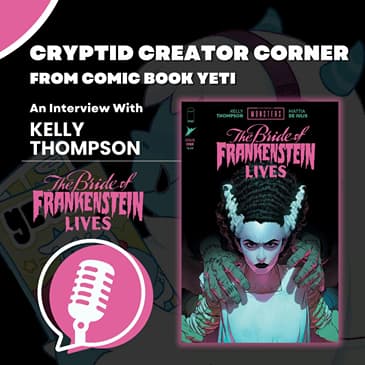

One of my favorite people in comics, Kelly Thompson (Absolute Wonder Woman, Jeff the Land Shark), is back on the show to talk about her new Skybound Universal Monsters project The Bride of Frankenstein Lives with artist Mattia De Iulis.
In 1935, The Bride of Frankenstein spent 75 minutes building to a woman with no lines, one scream, and the most iconic hair in horror film history. That scream has echoed for 90 years. Going into the conversation, I expected an exploration about the queer identity themes in the original film and its stance against heteronormativity, but Kelly delivered a very modern story about the struggle of women. We get into the Bride's battle with bodily autonomy, the cost of being built for someone else's purpose, and how Kelly found her way into the character.
Kelly also discusses what Absolute Wonder Woman and The Bride have in common and teases her future Dynamite project Buffy the Vampire Slayer.
“She’s sort of every woman. Even though she’s the creature and she’s unique, she’s all of us. She’s carrying all the same scars that we all carry because she comes from us. She’s born of us.” - Kelly Thompson
⚠️ Content note: this conversation touches on consent, sexual assault, and women's safety.
LISTEN TO OUR CHAT ON YOUTUBE!
The Bride of Frankenstein Lives

From the publisher
Born in the heart of a thunderstorm, made of stolen flesh, electricity, and monstrous desperation, The Bride lives! With no memory of her past or understanding of what she is, The Bride took her first steps into the world and was...displeased. Now, she must discover where and who she came from and begin what every living thing begins...the process of staying alive.
Follow Comic Book Yeti
🔗 Comic Book Yeti LinkTree: https://linktr.ee/ComicBookYeti
For partnership and ad inquiries, please contact: thecomicsyeti@gmailcom
Follow your hosts
ARKENFORGE
Play TTRPG games? Make sure to check out our partner Arkenforge. Use the discount code YETI5 to get $5 off your order.
Make sure to check out our sponsor 2000AD.

[00:00:00] Your ears do not deceive you. You have just entered the Cryptid Creator Corner brought to you by your friends at Comic Book Yeti. So without further ado, let's get on to the interview. The future is calling! 2000AD is the galaxy's greatest comic with new issues published every single week. Every 32-page issue of 2000AD brings you the best in sci-fi and horror featuring characters like Judge Dredd, Rogue Trooper, and more.
[00:00:28] Get a print subscription to 2000AD and it'll arrive to your mailbox every week. And your first issue is free. Or subscribe digitally and you can download DRM-free copies of each issue for only $9 a month. That's 128 pages of incredible comics every month for less than $10. Head to 2000AD and click on subscribe now. Or download the 2000AD app and start reading today.
[00:00:54] In 1935, The Bride of Frankenstein debuted on the silver screen. It spent 75 minutes building up a scene with a woman with no lines, one scream, and the most iconic hair in a horror movie of all time. That scream has echoed for over 90 years now and today I'm sitting down with writer Kelly Thompson, who is giving voice to her in the new Skybound Universal Monsters franchise series.
[00:01:20] This is an excellent start, Kelly. It's not at all what I expected, but I absolutely loved it. Well, I'm sort of dying to know what you expected now. Oh, there's my lead in as if I did this on purpose. So I was looking back, right? So I was anticipating a conversation about queer identity. You had James Whale, who's openly gay, living with his partner, who's the film's producer, David Lewis.
[00:01:46] You know, you've got a shun monster. He's hunted as an outsider, you know, and poking fun at heteronormativity in the 1930s. But what you ended up serving us was a very modern struggle of women, you know, which I probably should have seen coming. Well, I think, I mean, your take is super interesting, but that's all meta, right?
[00:02:11] I mean, that's, that's our knowledge after the fact of, and I agree that those messages are there. And through that lens, it's all more, all the more interesting, right? This lens of the creature being othered and being, you know, outcast from society, like all of that stuff tracks even harder for me when, when you know, sort of the history of some of those creators and what they were doing.
[00:02:37] But for me, like, we have to take the subject matter a bit, like, like, I don't, I don't want to look outside that for the creators beyond maybe Shelley and like how they play with that within, within that film.
[00:02:59] And I think part of that comes from, I really respect the film, like the film is brilliant and super interesting and strange and unique for its time and what it's trying to do. And I have no issues with the original film. I just, it's not about the bride. It's about the creature. It's about the creature's sense of self and search for belonging and search for companionship and all these things, right? It's not about her.
[00:03:30] And so this story, which is more a sequel to The Bride of Frankenstein than a retelling of, that's why we called it Liz, rather than a retelling of the original. I mean, I just didn't, I love, Frankenstein is, the creature is probably one of my favorite fictional creations of all time. Not least, not least ways from, from being made by a young Mary Shelley, which just seems incredible.
[00:03:56] Like the idea that you could be a teenager and just sort of invent science fiction on a lark and, and that this would come of it is incredible. So I love it in all the layers, the meta textual and the literal. But I do think bride is a particularly unique idea that really ties into the eternal struggle of women, right?
[00:04:23] Almost since time immemorial, it's this, will we have our rights? Will we have control of our body? Will we be in control of the world or even our own worlds? It's, it's a, it's a crazy thing to, you know, walking around as just a American woman who has, for the most part, all the rights I could want for most of my life.
[00:04:47] Um, it's crazy that there are a whole, there's just, there's just so many people that just don't think I'm equal to, you know, other people. And it blows my mind because we all walk around with that confidence. You know, your value, you're a human being. Your value is the same as everyone else's. Like we're born with that innate feeling that our life is important, that we'll fight for it, that it, that it, that matters to us.
[00:05:16] And we're born free or we should be all creatures are. And so I think there's something like almost feral inside it. Uh, this idea of being born created to be bound to something is, I see eternal problem for women. And so to see it told in this monster narrative is really powerful to me.
[00:05:42] And I wanted to give it, it's room to breathe and room to discuss it more openly in a way that the movie is not concerned with. Because as I said, again, the movie makes no judgment really about the creature's search because it's about the creature. It's not about the woman. So it's not a criticism of that. It's just here, let's do that. Let's do the other part, you know, let's get into it. Well, absolutely. Kind of unpack it.
[00:06:11] You pick up on the last few minutes of the movie, which the bride's only screen time. Yeah. Replaying her resurrection. She's unwrapped, sees Frank, realizes her fate is to be passed on from one man to another. And then comes the famous primal screen, which I guess supposedly was like modeled after a swan. That's kind of wild. Oh, that's amazing. Yeah. It's like the scariest thing in the Universal Monsters canon came with something you could find at a duck pond.
[00:06:41] Like that's kind of wild. But, you know, it quickly pointed out these issues of bodily autonomy and consent, you know, which is something that we're all sort of grappling with right now in this moment with the Cornell case in the headlines. Yeah. Yeah. Yeah. I mean, I think sometimes things you really care about other people are also really caring about and that feels good because that's what you want.
[00:07:09] I mean, I do think change only comes through. It just, the things that we think come easily. There are so many people like fighting on every day to make those things happen where it's, whether it's through the courts and legal or protesting or whatever it is.
[00:07:31] It's like so many people fall on, fall on the field trying to make these things happen that then the rest of us just hugely benefit from. And so it, it's really been rough to be a woman in the world of late reading the news and seeing, but it has been encouraging to see the pushback in the conversation,
[00:07:53] to see people not giving up on it and people fighting back and refusing to continue accepting these, these old narratives that we've just been fed and that used to work on us and that are stopping.
[00:08:07] But I would encourage us to keep it going and to also be wary of whatever the new narrative will be because there will be a new one to, to, to, to find a new way to, you know, oh, it's, it's, we have to protect these boys' future. Oh, we, we can't believe some of these things because other things are lies and we can't, I mean, it's just, it's a house of cards and we have to, we have to push through. We have to push through.
[00:08:34] I hope we, you know, it's like, it feels like when something like this happens, it feels a little bit like, well, this is how you have to do it. You have to do it in stages. Like it's like a rocking a boat over. Right. So it's like the me too movement. Like maybe we almost got there, but like maybe now this one we can get, but like, you gotta keep going. You have to keep going. Um, I have to believe in a better world. We all should. What do we do if we stop?
[00:09:04] Right. That's the danger. That's the end. If we stop hoping that it can come. So. Well, I feel like you've connected to this character in a, in a very different way. You've written tons of big IPs with female leads from Captain Marvel to Jim and the Holograms. Maybe it's just how it hit me in the moment is I'm kind of enduring it, but this very much feels like the rawest emotional character reflection. I think I've ever seen you. Wow. Thank you. I, I hope that that's true.
[00:09:34] I do think it comes from a very raw place. Um, I think, you know, I don't, we taught, we were talking a little bit before. I mean, I think most women have a story. Um, I, I don't, I don't know any women that don't, that don't have a story. Uh, quite frankly, like some of them are very mild and some of them are the night things, nightmares are made of. Um, but none of them are good. None of them are okay.
[00:10:00] None of them are a story you want anyone you care about to have ever, um, endured. And everyone cares about, you know, every woman has someone that cares about her and, uh, and mostly she cares about herself. And we just, why don't we care about that? Why don't we care about destroying women? I, I don't know. I don't know. I don't know how. It's, it's so hard for someone like me. I mean, I'm no genius.
[00:10:30] I, I, I ingest a lot of media. I read what I can. I don't think I'm an idiot, but you know, I have no real, it's, it's hard for my brain to even conceive of the way things were in a different time. Like to really put yourself in those shoes. I only live in my time, but it's appalling what I've even seen just in my years on earth.
[00:10:50] Like, um, you know, when the Brett Kavanaugh stuff had happened, when they were, when Blasey was talking and they were doing all that stuff with the, I had like really horrible flashbacks to what happened to me, which was incredibly mild. Like, just like, you know, I got the luckiest. Like I got, I got the path. Every woman hopes she'll get. And I still have a story, you know?
[00:11:18] And I remember when that happened with Kavanaugh, I was just sort of in tears. And my partner was like, what's going on? And I'm like, I'm having this horrible reaction to this Kavanaugh testimony and Blasey's testimony. I was like, and all I can think about is if that's happening to me, what's happening to so many women who are watching this, who are being triggered by this, who have stories, many, many factors worse than what happened to me. Like, I just, I was just sort of, I was like weeping for myself.
[00:11:48] I was weeping for all the women out there that were, you know, just being like re-traumatized by this guy who was then going to ascend to a position of power over us, like, like everything else, you know? And I couldn't help flashing back to the Anita Hill stuff, which I was just a kid then. I barely remember. But yeah, of course we didn't listen to her. Of course. And here we are. Here we are. I don't know, man.
[00:12:16] It's hard. So I do think I connected more with her. I think some things helped there. I mean, almost never before have I, I mean, Wonder Woman is maybe the only other time where I've really done origin story stuff, where I've been there at the beginning of a creature's life. I guess Jeff the land shark is another example, but certainly from a far. A little bit different.
[00:12:45] It's a very distant vibe. But yeah, I mean, I think maybe that's part of it is that I'm getting to craft from the very beginning rather than having to come in and, you know, I take it very seriously in comics. I've talked about this.
[00:12:59] I've talked about this a lot, but I do a lot of research and due diligence because I see my job as not undoing everything that came before and doing my own thing, but finding a way to bring that stuff together and then also add myself to it and hopefully add something that not every other person could add. Like I, that's why I'm there, right? Is it supposed to be something I can do?
[00:13:21] I mean, I think it's the right move.
[00:13:51] Like we get here, where you're getting to really chart exactly what it is, you know? And I feel like they did have some of that ownership with absolute wonder woman too, because of the way we got to build. It's still standing on the shoulders of so many great things, but we did really get to make some core choices about that early stuff that maybe gives it more of an ownership or more of a connection. But yeah, I relate to her.
[00:14:17] I think she's sort of every woman, like even though she's the creature and she's unique, she's all of us. She's carrying all the same scars that we all carry because she comes from us. She's born of us. Like I would say that that's the big thing that we featured. I mean, Dr. Frankenstein features almost not at all in this book. He's almost a non-entity. He is whatever he did for the creation.
[00:14:45] And then it's just about those women that she's made of. What were their lives? What did they lose in order for her to be born? It's sort of an accounting of the cost, right? Yeah. Well, I think that's one of the things that's really special about all the universal monsters kind of as a group is that they're exploring these different facets of fragility, you know, of the human condition.
[00:15:11] So with something that is this personal is, you know, how do you find your way in? Like I was talking to Joshua Williamson about with the wolf man and, you know, how does he get into a character's head? And he said he puts them on a couch and he asks them questions, you know. So did you have some sort of framework or something for getting into the bride? No, I do the same thing.
[00:15:36] I do the same thing I always do, which is so. I didn't I didn't need to reread Frankenstein because I read it pretty frequently. OK, so I've read it within the last couple of years. I'd already reread it. So I didn't feel like I needed to reread Frankenstein. But I did rewatch the film, the Bride of Frankenstein film, and I read a lot online.
[00:16:06] I did a lot of research more about the time period. We're keeping it in a sort of vague area of time. But I wanted it to feel I mean, it's both science fiction and a little bit like dark fantasy fairy tales. So I don't need it to feel completely accurate, but I need it to feel like not jarring to pull you out of it. Like, oh, they wouldn't have that there, you know, like so we want to get it vaguely right. So that's part of it, too.
[00:16:34] But a lot of it happens for me in dialogue, which I always hesitate to say to people because that sounds so like surface and not like you're exploring the interiors. But how people talk to me is how they think and how they think is how they feel. And so that's sort of how I get there.
[00:16:55] So usually the first thing that will start happening for me while I'm thinking about a project is that while I'm writing something else and in the back of my mind thinking about a new project, I just start writing little snippets of dialogue. And those usually come with like visual ideas for a scene. Matia or whoever I'm working with might end up drawing it completely differently than what I'm thinking.
[00:17:18] But like, for example, that scene with her where she hears that snap that's just this beautiful her walking around in the in the woods or the pasture or whatever. And then she hears that snap like in my mind, like, you know, that was all very quiet and serene and these blues and greens. And then it was going to turn. Right. So a lot of that comes with dialogue.
[00:17:42] I would say that one of the things that was tricky in this one was initially we thought she would talk more like as dialogue. And the the pitch was asking for her to have fairly complex conversations at some point. And that felt wrong to all of us when we started working, when we started doing it.
[00:18:06] And so we decided on a sort of future narrative caption where it says if she's narrating this from the future. And that was incredibly freeing in thinking about the character, because then I could treat her both like. This brand new creature who's trying to understand who and what she is, what the world is, where she fits inside it.
[00:18:31] And it was able to contrast that with an older and wiser version of her who knows the world much better and has words for the more complicated things she was already feeling but couldn't express. Right. So those contrasts really helped. And they helped in part because a lot of those reflections were some of the things I was first typing for her.
[00:18:58] You know, like in my little notes, they were the things that were first coming out about the character. And so doing that, contrasting her limited dialogue here versus older, wiser narrative captions helped me like bridge the gap of that character of who she was going to become versus who she is. And that was really helpful in figuring out where that goes. Yeah, it felt like as a former, you know, nature photographer here.
[00:19:25] So I'm going to use a nature analogy here, but it felt very much like she was in a chrysalis, right? She's going through this metamorphosis of having an awakening, you know, that POV of being a child, experience the world in a new way. You know, you're clearly setting up that change. You know, you talked about the perspective of her being older and how that informs that. But I have no idea where this is going as a series after issue one.
[00:19:53] So is it about vulnerability as we move along the story or is it leaning into an empowerment arc? I would say empowerment. And I think the clue for that is in that attack scene and the way it turns. And that was a big, you know, that was a big discussion point. Like we really had to talk that out with Universal. Not so much Skybound.
[00:20:21] I think Skybound really got it from the gist that like that kind of violence is like a coiled spring. And there has to be a release on the other side or. Well, we're failing in our storytelling, but it's also like not rewarding. And I think that while that scene in issue one has its own coil and release, there's a larger coil and release of like the whole story. Right. The whole story.
[00:20:50] The whole five is sort of pulling and then we'll need a release on that as well. So I think that that's the clue is in that first attack scene about the direction we're pushing and the kind of character she is and will become. I think her vulnerability is at its peak in the beginning. And the more she learns, she's unique. And she's as by being the special thing that she is, she's naturally less vulnerable.
[00:21:17] The more she learns, the more she's able to accept the advantages she does have and use them to make herself into something formidable. But I honestly think that's what women do every day. I mean, most of us don't have superpowers and a lot of us are struggling. But I do think women are very specifically like that, where they gather these things together and then come out stronger the other side.
[00:21:48] Really just shocking me all the time, whether it's they're able to gather women to them and so collectively together, like with that community, help each other. I just think women are incredibly resilient creatures that probably our resilience has hurt us a little bit, maybe allows us to be, you know, really treated poorly, I guess. I don't know.
[00:22:16] I just think of her as being like really representative of all of us, I think a little bit. I definitely wish I had superpowers, though. But it is a superpower. It is, but it's real high press, man. Yeah. I mean, it's absolutely what she's channeling, though, right? Her defining act is refusal. You know, she says no. Her power is defiance. Yes. Yes. Yeah. Yes.
[00:22:43] And I did have to argue that a couple points where they're like, is this too? I was like, watch yourself. I was like, it's not too anything. I was like, it's exactly what you should do. Yeah. I was like, it is still a horror comic book. Right, guys? Anyway. It was fun. No. The thing that I kept getting was, as a fan of sort of Frankenstein's monster myself, there's also a very familiar blueprint. You've got the mob scene of sorts.
[00:23:13] There's a hermit-like scene. So you get sort of these same beats as the film and the novel, though a very different filter. So like you could have gone in any direction. So what was important for her to walk on that same ground? I think maybe not important so much as I think it makes sense. Like, you know, it's thematically all those things work. Like, why would you try to reinvent the wheel?
[00:23:40] These are scenes that work and that people recognize and that they'll recognize even if we tweak it a little bit and make it more this thing. Like, there is a familiarity. Also, I'm not interested in running away from the source material. Like, I'm not opposed to adapting it in different ways. And I, like, applaud adaptations that really swing for the fences a lot of times. But, you know, I'm also, I like living in that space that's pretty close to the original stuff.
[00:24:09] I'm pretty into it. I do think that, I'm losing my train a little bit here. I had a thing I was going to say about. Sorry, I've lost. No, I've lost it. Fuck, I'm sorry. No, I mean, no, you're good. There's like the connectivity points between, you know, that same footprint.
[00:24:29] Oh, I was just going to say that we do have, and I think you can feel it a little bit in the captions, but at the very end of 4, there's also like a sort of little nod to the framework of the meta-ness, like that you were sort of talking about with some of the creators. Less about me, but more about Shelley and like the way we sort of tie it together is, I don't know, maybe it's a little too wink-wink, nudge-nudge.
[00:24:56] But I think it's thematically really fitting for the story we're telling and the story that it comes from that we've sort of, you know, stood on the shoulders of to do it. So, yeah, I'm not opposed to any of those themes. I mean, listen, you're writing Frankenstein stuff. You want to lean on all of that iconography and that power as much as you can. It's stood the test of time for a reason, you know.
[00:25:23] But I think it's interesting to take those elements and then, of course, that's what is interesting about it, is interpreting it in a new way. Like, while I was reading this, I had never processed it like this, but you're using basically her body as this visual metaphor in a way that was never done with Frankenstein because we're talking about what society blueprints onto women and these pieces, right? Yeah.
[00:25:46] So you have the hands that are the labor that you're never given credit for or the heart as the expected emotional caretaker. The face is the object of a male gaze, you know. And it was this, I had this moment where I was like, whoa, that is super, super powerful. And I'm a dummy for never having thought of this before. I mean, hearing you articulated that is a thrill. It's really great. Yes. Like, that's what you hope people are getting. Like, you're like, yes. I did.
[00:26:15] I mean, I don't mind if not everybody gets that, but it's truly rewarding when you know some people are. It's awesome. Thank you. Good. Yeah, you're welcome. Well, as everyone has, every one of these universal monsters comes with legacies. So Frankenstein monster carries decades upon decades of expectation. You know, the bride, you had that blank sort of blueprint. You had a scream and you had the hair, you know, so you have a look without a lot of canonical weight.
[00:26:45] So where you're thinking about her legacy, you know, was that a blank page or did that feel like freedom? Well, it's funny you mention the hair because the hair was a bit of a point of contention. Interesting. Okay. Because to me, you know, if she's trying to blend it, like it's a part of her, she doesn't want to cover it up. She doesn't want to be told to restrain herself. And we play with that very literally. And I think it's in issue three.
[00:27:14] But also, she's not a dummy. Nobody else has this hair and you want to blend in to survive or whatever. Right. So I, you know, she sort of ends up with normal looking hair, barring the white stripes because she's in the rain a lot. So a lot of, she's, there are a lot of storms in the book, like the idea both thematically and also just because, I mean, I guess I wanted to torture Mattia with a lot of rain.
[00:27:40] But, you know, but we had to bring it back because Universal does feel that that's like a core iconic part of her. And I don't disagree. It's a, it's a fundamental, fundamental identifying thing. And it's iconically incredible, but it was important to me for us to see her sort of moving beyond it in a way because she can't let that continue to define her as it will make her too vulnerable, which is also thematic. Right.
[00:28:10] So, yeah, I mean, we really play with it directly in both a serious and a comedic way. Um, but a lot of the scenes, a lot of the issues, she's either wearing a hat to like restrain it, to hide it, to contain it, or she's in the rain and sort of disheveled and whatever.
[00:28:33] Um, but I, you know, I can't, I can't tell you what it looks like at the very end because Mattia hasn't drawn it yet, but there are some ideas about the end that I hope will be fun too. So, um, yeah, it's, it's been, it's hard to play with something else. Something that iconic. And I was very insecure about it at different points when we were doing it, like, oh, is this too much or too little? Are people going to be frustrated? But I think we landed in a good place.
[00:29:00] Well, I think we got a, since we're talking about Mattia, we need to praise Mattia because so well executed what they were trying to throw down there. Like, I think what made it an uncomfortable read in a good way was how, how her positioning, right? So you've got multiple large hands on her face, which creeped me out. When he did that first shot for that's in the preview that people can see now of the hands on her bound face.
[00:29:28] I was like, okay, that we're, this is going to have some heat to it because that's exactly what I wanted. And like, he just nailed it. And he keeps that sort of claustrophobia and that, that, that overreach. He, he does that so well. And also just, you know, his, the emotions, like there's this final, the final panel of the issue is a huge shot of her head.
[00:29:53] And it basically entirely relies on Mattia, just perfecting that expression. And you can just feel everything she feels. It's incredible. It's an incredible work. I sometimes Alex sends notes in our, in our email thread with pages where he's like, you don't even need any words. And I'm like, Hey, now we've, we definitely need some words, I think. But you don't, you don't, he's so good. You can just read what people are thinking from looking at his illustrations.
[00:30:22] It's an incredible superpower that I'm glad that he's willing to share with us. Well, there, there's an old photography trick in portraiture where you make the eyes three to 4% larger. You know, in my area, you're just doing it with Photoshop, you know, usually this is something that pulls you in in a positive way. Like it's a beauty element, but here it really puts you inside her terror. It's really fascinating. Yeah. Yeah.
[00:30:52] It's, uh, one of my favorite shots of the book is, uh, toward the end when they're in that hotel room. And he's like, so Pickwick, the assistant guy is like, do you know what that might be? And she just raises her chin. And then the, just the reactions of when they see what she's shown them. Like I just, Matias acting is just so strong. I just, it like made me gasp to see their reactions because I was like, yeah, that's what you would do. That is exactly right.
[00:31:21] Uh, it was incredible. It's incredible to have him doing it. Yeah. It all circles back to the concept of like safety is the word that I kept going to. And I, it's where I connected with it. Yeah. It's as somebody, as you know, who has a like debilitating autoimmune condition, you know, and I recently got my like handicap hang tags. And that was a real moment of vulnerability for me because, you know, disability is largely invisible and the hand tag takes away my ability to hide, you know? Yeah.
[00:31:48] And safety, you know, prior to my condition as a white male, it's not something I really had to think about. And now I do. And it's made me a more, you know, empathetic person to what other people are carrying around with them. And it illustrated just how shielded men are from that, you know? Yeah. Yeah. I think, like, I'm sorry that you have to deal with that, but I do think there's no way it doesn't make you a better person.
[00:32:17] I say the same for me, like things I have to deal with. Like, I, I, they're, they're shitty things. I don't want them to be true or them to be the reality that I deal with. But I cannot deny that I'm a different, better, more thoughtful person as a result. Well, there's so many examples of using a historical setting to talk about feminism, which makes me wonder why we can't confront these issues more directly.
[00:32:41] So is that historical mirror actually better or is it just safer? I definitely don't think it's better. Okay. I think, I don't, I don't know.
[00:32:59] I mean, I think it's powerful in this narrative to see her struggling with the same shit that could, I mean, I think that's why the Cornell thing is so, like, that could just be her. And what are we saying if, if Kelly Thompson is saying, Hey, in this science fiction thing in like around 1880, this is happening and we're still doing this in 2025, 2026, 2020. Are we going to be doing it in 30, 20? Like, are you fucking kidding me?
[00:33:29] Like what, how will we push this forward? And so I think it's powerful in that respect because it makes you think about it differently. It makes you think about the comparisons to now and why things haven't changed as much as they should.
[00:33:42] So I think it's useful in that way, certainly, but it would, you know, I mean, you know, I, I did not set out to, you know, attach this narrative to a preexisting character in hopes that it would get more attention on it. Right. I just said, this is what she is and has always been.
[00:34:08] And a lot of narratives don't really talk about this so literally, or they sort of brush it aside because it's not part of the narrative they're interested in. And we're not going to do that. And so if, because it's attached to a famous, iconic monster character, if that helps, great. I am over the moon that that can do that.
[00:34:35] That's not why I told the story this way, but I'm certainly overjoyed if, if we can start pushing in that direction and like, and it's going to wake more people up to it. That would be the dream. But I didn't attach it there willy nilly. I just looked at what was already there and went, it's weird that we don't really address this for directly more often. Yeah. Yeah.
[00:35:03] Well, you've certainly very much challenged yourself with the series, you know, the bride screamed once and the monster blew up the lab. And after, after issue one, I'm curious if we're going to end up back to the lab, you know, but, uh, anyway, I'm, I'm quite impressed with it. and it will be hitting shelves at the end of October. So everybody make sure to add that to your pull list. And you've also got Buffy coming out with Dynamite, but I'm afraid I can't speak to that very well. You know, I was on the road working with rock bands, I'm afraid, during that time frame.
[00:35:33] Were you taping it each week? I was taping it. Once I became aware of it, I think my first episode was the finale of season one. So I came to it even a little late. I was obsessed with it. I'm still obsessed with it. I love it. It's probably my favorite IP. That's how I signed on for so much. And I will say that I just saw the announcement today that they're saying March. So I did know that.
[00:36:02] I was not allowed to say that publicly, but yeah, March of 2027. There are some good news in that date, even though it seems really far away. I think the first good news is that I never wanted the Buffy number one and Angel number one to be so separated. Like when they first were coming out, it was like July for Buffy and then August for Angel. And I'm like, I need people to pick both of these issues up. Like the closer we can get them together so people can feel like it's a part one and a part two,
[00:36:32] the better off we're going to be. If people skip Buffy number one, which is less likely, they're going to miss all the setup and all the setup for the story to the setting of the table and then the inciting incidents that spins everything off into this direction. And if they skip Angel number one, they're going to miss all the emotional fallout of what that means and all the planning and the decisions
[00:37:01] and all that important stuff as they decide what to do about this situation and then begin addressing it. So you really, you got to read them both. So if nothing else, us moving the dates gets those two books closer together and helps more people have a better reading experience, that will be worth it. But it's been a bit frustrating, but I'm glad to see we're finally getting things taken care of. I don't know. Question mark.
[00:37:28] Hey, I've trusted in your work and I'm a fan. So I will pick it up even though I am not, you know, a Buffy person myself. So we'll check it out. Well, I hope you'll like it, but I also hope you'll finish Bride and let me know what you think. Either way, whether it's staying up to your standards of the first issue or not, I'd love to hear what you think. I will. I'll let you know. Everything doesn't have to be the bride. It's okay.
[00:37:55] But let's try to wrap this up on a lighter note. It's something that inspired you recently or somebody you'd like to thank or whatever. And I'll go first to give you a minute to consider. And I think you'll actually enjoy this one. I get loads of solicitation emails and one this past week was a French fan film called Wonder Woman 1944. And it hit me like a total blast from the past. It's got this great John Williams style musical score to it with Diana punching Nazis.
[00:38:24] And the team is rounded out with like Vixen and Dr. Fate, who has this really amazing jump scare that sort of reminded me of like something out of Ghostbusters. So it was like dirty dozen. And I know you'll appreciate this as a Val Kilmer fan, top secret, you know, but it was like super campy and just like loads of fun. So I recommend people check it out. I'll put a link in the show notes so people can find it. Well, that's super interesting.
[00:38:53] So what's the, I think I maybe have a good idea, but what's the, tell me the criteria again. Oh, it's just like if there was somebody you want to thank and if it's your editor, I'm afraid I have to ask you to do it twice because everybody cheats and says they're editor, which is fine. Editors need their love too, but it's kind of against the spirit of it. This is going to reveal me as a real piece of shit I've never thought about. Thank you, my editor. On a podcast. I'm sorry, Chris. I'm sorry, everybody. I'm sorry, Alex.
[00:39:22] I'm a jerk. Quack, quack. So what I was going to say is something I've been obsessively reading over the last couple of days and now I can't find it. Hold on. Here it is. Dignity in ink is the Instagram handle and it's a person question mark. Maybe it's multiple people. I think it's one person though because it's the style
[00:39:50] and they basically highlight horrible cases of injustice, which are sort of all of them. I don't recommend reading all of them at a, at a, I was reading all of them this weekend and I was really upset later and Adam's like, you're in a terrible mood and I'm like, you know, it's probably because I've been reading these horrible stories of miscarriages of justice. Anyway, a lot of the people involved, a lot of the people who get freed eventually are like the Innocence Project funds them
[00:40:19] and things like that. It's basically about people who are falsely imprisoned, often losing decades of their life. Many of them, many of the stories on there are people who are still in prison and it's appalling. It's appalling. You know, I think there's a real, what's happening in this country was like a real wake up call to me. Nothing really changed about my politics.
[00:40:49] I've always been progressive or liberal or left or whatever the fuck you want to call it. Sure. But, you know, I, what's happening now, I don't feel safe either, which made me realize for a woman, I felt pretty safe before things got so scary. But that was so myopic because so what? It was only safe
[00:41:18] because like I had people and maybe I had access to money even if I didn't have money. You know, if I was in an absolute dire situation, I could get a loan from my parents or, you know, something, something could be done. If I was arrested for something I didn't do, I would have options. And it's not a great country or a free place or a wonderful civilized world if that's not true for everyone. And we are so far from that
[00:41:47] fucking being true for everyone. I can't even really, I can't even really express it. So I don't know. Yeah. People like that who are, you know, bringing attention in like a positive way to horrible injustices. I don't know. I'm really grateful for people like that right now. Yeah. Anyway. Me too. Yeah. Dignity in Ink on Instagram. Worth a follow. I'll check it out. Yeah. I would be remiss if I didn't actually follow it up by saying
[00:42:16] we're really approaching the voting period, folks. So please, please, please register. I know it seems crazy and you think like it doesn't matter, but I've heard that from a lot of people. And if all those people got out and voted, we wouldn't be. It matters so much. I will bring up Absolute Wonder Woman. I think it's issue five when Diana is saved from the Medusa transformation by Steve and repeats to him what she said
[00:42:45] when she cut off her arm to send him back to the service world, which is one good man can save the world. And she doesn't just mean through, you know, shooting people, which is what guys always think that means. I can defend my... No. How about voting? How about voting for progressive causes? How about helping your neighbor? How about, you know, yes, helping. Let's do more helping. It's so important. It's so important.
[00:43:16] That's an interesting way to put that, guys thinking about shooting and stuff. That's not my default, but it wasn't. No, but there's... A lot of it's like that meme stuff, right? I'm not trying to pretend this is my own thought. No, no, no. They're like, I'll do anything to protect you and it's all about, you know, guns and keeping foreigners away from young women or some whatever, whatever the narrative of the day is. And people are like, how about just picking up the prescription at the pharmacy for the kid that has the thing?
[00:43:45] Like, there's a lot of little things we can be doing here that are also ways of saving the day, of helping people, of making your community and your family and your neighbors better. We all need to be more like that. I include myself. Yeah, I had a moment. My son just left for college a couple of months ago and it was, you know, that inevitable, they're leaving and there's all this emotion that are tied to it and everything. But, you know, he looked at me and, you know, he said that
[00:44:14] I was the strongest person he's ever met just by watching the struggle that I've gone through with my condition and everything and knowing that that helps like motivate him and catapult him because he's in biomedical engineering and he wants to help kids. Yeah, so I'm like, oh. That's incredible. That's incredible. Yeah. Yeah. That was the thing. That's amazing. I'm so happy for you and for your son. Thank you. Glad he has that. Yeah. But we need more of that in the world. Yes.
[00:44:43] Yes. Way more of that. Yeah. If all dads imprinted like and I'm not this is not me blowing my toot my own horn in or anything like that but like if all dads imprinted like that it would be a much better world for sure. Yeah. Yeah. Yeah. Yeah. All right. Well, as always love hanging out with you, Kelly. It's always a pleasure to have you on. I had a great time. Thank you. Keep writing great shit. Thank you. Please let me know what you think of the rest of this series. I'll be on pins and needles now.
[00:45:12] I will let you know. This is Byron O'Neal and on behalf of all of us at Comic Book Yeti thanks for tuning in and we'll see you next time. Take care everybody. Bye. This is Byron O'Neill one of your hosts of the Cryptid Creator Corner brought to you by Comic Book Yeti. We hope you've enjoyed this episode of our podcast. Please rate, review, subscribe, all that good stuff. It lets us know how we're doing and more importantly how we can improve. Thanks for listening.
[00:45:41] If you enjoyed this episode of the Cryptid Creator Corner, maybe you would enjoy our sister podcast Into the Comics Cave. Listen and subscribe wherever you get your podcasts. Sparen? Mit Azubi-Gehalt oder BAföG? Klingt utopisch, ist es aber nicht. Mit ETFs im Sparkassen-Sparplan reichen schon kleine Beiträge, um von Anfang an was aufzubauen. Und das Beste? Du musst dafür kein Finanzprofi sein. Wir zeigen's dir, easy und ohnefach jinesisch.
[00:46:11] Tippe jetzt auf das Banner und sichere dir deinen kostenlosen ETF-Vorsorgecheck.