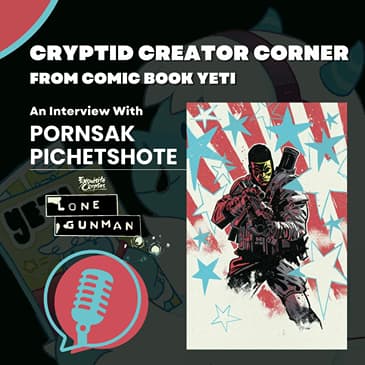

Comics writer Pornsak Pichetshote (Absolute Green Arrow, The Good Asian) returns to the show to talk about his new Tiny Onion/Image Comics project Exquisite Corpses: The Lone Gunman.
We take a panel plunge recapping Laura's story after the tragedy in Oak Valley and where she is now, delve into this spin on the final girl trope, and take a look at the conspiracy tied to the original thirteen families from Season One.
We also touch on why The Lone Gunman plays more like a conspiracy thriller than a straight backstory book, how Laura handles duty and trauma when she can't afford to be passive in the mini-series, how the Exquisite Corpses writers' room changed the way Pornsak writes comics, compare and contrast DC's Absolute Universe with creator-owned horror, talk about the development of his blog Day 2, and look ahead to Absolute Green Arrow and Absolute Black Canary.
We'll see if my suggestion for the inclusion of Washington's Barista makes it into Season Two.
Exquisite Corpses: The Lone Gunman hits shelves on November 4th, 2026.
“Horror gives us comfortable parameters to feel scared where we still feel in control of our fear.” - Pornsak Pichetshote

WATCH THE VIDEO VERSION OF OUR CHAT ON YOUTUBE!
The Lone Gunman

From the publisher
In this can’t-miss follow-up to the first EXQUISITE CORPSES series, Laura and her fellow survivors, Xavi and Jason, have attempted to carve out an existence with her winnings, far away from the evil machinations of the 13 Families. But, two years after the unfathomable events unleashed in their hometown and Laura’s game-winning performance as the Last Gunman, all that they did to survive still haunts them. Now, the legacy of the golden mask refuses to stay silent…and their lives are in danger once again.
Uncover the history of the Lone Gunmen and find out what’s next for EXQUISITE CORPSES from breakout star PORNSAK PICHETSHOTE (Absolute Green Arrow), and acclaimed creators ALBERTO PONTICELLI (Unknown Soldier), JORDIE BELLAIRE (Absolute Wonder Woman), and BECCA CAREY (RADIANT BLACK)!
Follow Comic Book Yeti
🔗 Comic Book Yeti LinkTree: https://linktr.ee/ComicBookYeti
For partnership and ad inquiries, please contact: thecomicsyeti@gmailcom
Follow your hosts
ARKENFORGE
Play TTRPG games? Make sure to check out our partner Arkenforge. Use the discount code YETI5 to get $5 off your order.
Make sure to check out our sponsor 2000AD.

[00:00:00] Your ears do not deceive you. You have just entered the Cryptid Creator Corner brought to you by your friends at Comic Book Yeti. So without further ado, let's get on to the interview. The future is calling! 2000AD is the galaxy's greatest comic with new issues published every single week. Every 32-page issue of 2000AD brings you the best in sci-fi and horror featuring characters like Judge Dredd, Rogue Trooper, and more.
[00:00:28] Get a print subscription to 2000AD and it'll arrive to your mailbox every week. And your first issue is free. Or subscribe digitally and you can download DRM-free copies of each issue for only $9 a month. That's 128 pages of incredible comics every month for less than $10. Head to 2000AD and click on subscribe now. Or download the 2000AD app and start reading today.
[00:00:55] Sometimes comics can surprise you. You think you've seen it all and then somebody comes along with a new approach and expands the horizons of where the medium can go. That's exactly what happened with Tiny Onion's Exquisite Corpses universe. It reportedly sold over 600,000 copies in 2025. The crowdfunding tabletop game pulled in nearly a quarter of a million dollars from backers this past summer. Now it's being developed into a movie which is giving me total ice tea surviving the game flashbacks.
[00:01:25] Look it up kids if you haven't heard of that one. And soon we get the third miniseries spinning out of season one, The Lone Gunman. No, not those three dudes from the X-Files. I've got one of my favorite folks in the medium hanging out with me today to tell us all about it. I feel like I'm introducing James Brown here because he's the hardest working man in comics in 2026. Somebody get this man a cape or maybe a cot, maybe a bed. A bed would be nice. A bed would be nice. Yeah. Horn sack pichetcho. It's good to see you, man.
[00:01:55] Good to see you, man. Thank you for having me on. It's great to see you again. Yeah, absolutely. Always a pleasure. When I interviewed you before about Absolute Green Arrow, this was prior to release. You said you were terrified. Yeah, it is. You've been in the trenches. You've been to, I think, every con that's imaginable that's happening in 2026, except for New York, of course. Except for New York. So you're getting out, you're meeting fans. How are you doing now? Has the feeling changed? Oh my God. Uh, no, no. Well, so, okay.
[00:02:21] So inside baseball a little bit, peek behind the curtain, like we're recording this the day before issue six comes out. And so issue six reveals everything. It explains everything and teases some more, but mostly explains everything. And also I'm so nervous. I'm so, you know, I am so nervous that people be like, what the hell was this? And oh my God, it doesn't make sense. And all the things. Um, I don't know. I don't know what people are going to think. So, so yeah. So yeah, I, yeah, I'm, I'm just as terrified. I bet.
[00:02:52] So here it goes. The imposter syndrome has certainly not gone away. No, no, no, definitely not. Definitely not. Oh, well, let's dig into the loan government. It's fair to say Exquisite Corpses started as an experiment of sorts. Yeah. You, you recently used the analogy of building a car and now you're driving it and you've got this blueprint. You're running off of it. The engine's running. What surprised you about the process? Oh, well, so the series in general. Yeah.
[00:03:22] I mean, I think the series in general, I, and I think I can speak for everybody. I'm like that. Like we were all proud of what we did, but the fact that it's become like, like you said at the top, like it sold over 600,000 copies of the comic, you know, it's a tabletop game, you know, there's an option news on it.
[00:03:37] The fact that it was such an overwhelming success and pretty much what James imagined it was going to be, you know, like the fact it was all those things so resoundingly was probably the biggest surprise because usually things don't work out as well as you hope they will. And so, and, and, but, you know, that's why James is so good at what he does. He was able to calculate everything to sort of make it work. Yeah.
[00:04:01] That man is incredibly good, not just at writing, but at like picking talent at picking friends. Yeah. He just surrounds himself with like incredible people. And I think that is definitely the key to success for all of us, at least somewhere I'm standing. No, no, a hundred percent. A hundred percent. Well, to finish that analogy, you said readers have no idea what this thing can really do. Yeah. I don't know if y'all truly know yet either. And I think that's really, really exciting.
[00:04:28] I think, well, I, I, what was fun is, and again, I feel, it feels weird to say this because I'm, I'm hyping something that it won't come out for like at least another year. But like, we stepped in the room in C for season two. And I think we all, we're all kind of like, can we put lightning in a bottle? What is this going to be? And all this kind of stuff. And then I think season two is us realizing what this can really do and realizing what we can do together.
[00:04:52] I think the first season was very much all of us meeting, all of us, you know, learning how to work in tandem. And then the second season is, oh, wow. Now that we know how to work in tandem, we can operate, we can do some really ambitious, really fun things. And that was a really cool thing, I think, for us to discover as a room. And, and again, it makes me really psyched for season two. And, and it definitely left me a lot of excitement.
[00:05:19] Like I had already started writing Lone Gunman, but it definitely left me a lot of excitement with Lone Gunman being like, okay, I know what we're, I know what we're gearing up towards. I can really push, push the pedal to the metal to sort of get us there. Okay. And you and Jay and Tyler were all sort of sitting in a room trying to figuring out what character you kind of wanted to focus on. And both Rascal Randy and Fox mask are both backstory focused.
[00:05:44] And I think that was my surprise by sort of reading the preview for issue one here, because the gunman is not, you know, it functions as a prequel and kind of a fulcrum connecting these, these two seasons. So was that originally what you wanted to do? That's what they, that's what they came to me. I mean, they knew how attached I was to the characters in the, of the series. And, and yeah, they knew how attached I was to the characters of the series.
[00:06:11] And so they kind of came to me. It's like, well, do you want to follow like what sort of what happens next? And they kind of, you know, it's me on just how like the Lone Gunman of it all and being able to be able to really explore that history and kind of, you know, put my own personal stamp on it. And all of that was really, really attractive.
[00:06:29] Um, and, but, but I'm curious, I guess, you know, um, you know, what, at what point did you, I, I'm curious in terms of your process of like discovering the books. Like, did you know Rascal Rondi was a preview coming in? Did you know Fox Mask Killer was a prequel coming in? Yeah. Was it only when you read the first issue of Lone Gunman that you realized it wasn't a prequel? Like all the, all those things.
[00:06:54] I'm curious how you, how your experience, I'm always curious about the reader's experience going through all this stuff. Well, I think it was, they're very, very different approaches to kind of how you guys are going about building a character. And I guess my, my initial interest in, I mean, aside from, okay, three of you are very talented people, but like, how are they going to go about doing this? You've got these, this group of, you know, 12, 13 here.
[00:07:23] And, um, how do you, how do you condense this? How do you pick the characters? How do you connect with certain people? And what really was interesting for me is that as I'm assuming anyway, given choice, uh, at least to some extent that you all pick the characters with masks, you know, or. That's a really good point. Randy might have a suit, right? But yeah, yeah, yeah, yeah. Yeah. You know, and so that, that is where I was coming in from. Like, how do you, yeah. How do you explore character in that way?
[00:07:53] And then we got backstory and then we got backstory and this was about, no, wait a minute. This, this really isn't that. And then there's all these people that are, excuse me, gunning. Yeah. Gunning for her, um, and her kind of settling into, or at least trying to settle into life, you know, afterwards. Yeah. And so, yes, it was a surprise. That's cool. That's very cool. That's very cool. Yeah.
[00:08:20] Well, one of the things that you, you did do, and I, it was very, very, very satisfying at least to see is one of my biggest questions. And I think for a lot of people who are reading this series is what about the rest of the country, right? Yeah. Wouldn't they be pissed off that you have the OG 13 colonies holding all the power? Absolutely. Of course they would.
[00:08:41] I think that is what's so interesting about what James has sort of created is that is such a big world with such complex, like inner feudal politics to kind of deal with. And the fact that you can go through all these different aspects of it, you know, like, um, box mass killer very much deals with sort of the tribe to tribe by tribe family by family sort of dynamics. We deal well in gunman is more of a macro historical sort of alt history kind of thing.
[00:09:11] You know, Randy is a little bit more intimate in terms of the mythology of just that, of just that killer that there's so many different way. I mean, you know, it really is true. Like it's a universe that is a universe and there's so many access points into that. And all really, I think, depends on what your flavor of it is. Yeah. Well, speaking of flavor as somebody from Washington state, um, that clearly the Washington state killer has to be the barista, right?
[00:09:38] This is not that I've thought a whole lot about this, but right. A former bikini barista who craves attention and poisons men by putting all kinds of terrible shit in their design. I love that. I love that. Hey, it came from a very legitimate place because when we lived in the Puget Sound, when Starbucks was putting, I don't know if you heard about this, but it was like car. Carmin, which is, um, they use them in their drinks as a red food coloring additive. So like the strawberry lattes and stuff would have this in it.
[00:10:07] What that is, is it's made from crushed insects and processed as an acid. So I was like, yeah, of course. Barista boising people with drinks. It made perfect sense. It makes perfect sense. Yeah. Feel free to steal it. I'd be happy if you did it. I will. I actually love that. Well, so you guys haven't, it clearly haven't had season two, the round table for season two. Yeah. No, no, no. We have, we have.
[00:10:36] That's how I know just how great we're, we're working together because eat out the entire season and all that and all that. And I don't know how much of this I'm supposed to be talking about, but yeah, we beat out the entire season. We're really, really jazzed about it. We're so jazzed about it. I can't stop talking about it. So, so yeah. Okay.
[00:10:53] Well, talk to me about approaching the script here, because when you have these three mini series, when I was talking to Tyler, he mentioned noticing that you approach your script, not with this one, but in the past, in twos and in pairs. It was something you just kept coming back to and reflecting on, on his read. So was that something you wanted to continue here? Oh, that's interesting. That's interesting.
[00:11:15] Tyler has pointed that out to me before, and I don't, and I think that might be an intuitive thing as opposed to, so I fucking love Tyler. Tyler and one of the things I love Tyler, things I love about Tyler is that he is, he loves comics so much. He's such a clear student of comics. And so he will remember a random issue of secret Avengers, but like the technique someone used in that random, like, like, that's one of the things I love about.
[00:11:42] So just like watching his brain as it breaks down comics, I love and I love talking to him about it in those very casual ways where he'll just like pick out this thing where I'm like, oh, I guess I do do that. Um, I think one of the things that, um, I, one of the things I think I've been to maybe it's the editor part of my brain. I'm not sure is I don't know if I think in store. I think I don't know if I think in story beats.
[00:12:10] I, or I don't know if I think in moments as much as I think in stories. So to me, a story is at a minimum of three beats. It's his beginning, middle and end. And sometimes you can strip out the in depending on certain things, you can strip out the middle and just go beginning to an end. So I'm constantly I am constantly looking to pair beats because if I throw a ball in the air, my first instinct is where when do I catch it? Should I catch it? Do I have the option of catching it? When should I catch it?
[00:12:37] And so those are the constantly things that that I'm that I'm thinking of. And so my first instinct is, you know, here's the thing that I do. Oh, is it interesting enough to pay off? Or does this exist sort of solo? But my instinct is always, oh, let, you know, can I pair these things? And I think that is, again, it may be the editor part of my brain of just like, OK, this is the beginning. What is the end? OK.
[00:13:01] Yeah, it's very interesting to hear you talk about it in that way, because Tyler, I think, has to come at it from a visual perspective. Yeah. Yeah. He's he's being an artist has an overwhelming advantage. Yeah. For that sort of thing. But seeing your approach as you're laying it out on your blog with with cards and how you write those cards, those cards almost as triggers. Yeah. And Tyler's understanding of kind of visual triggers as an artist.
[00:13:29] It's just I'm so fascinated how that works together in a room where, as you kind of described it, almost like, you know, a TV writer's room in this sort of exquisite corpses formatting. And I think one of the really smart things that James did is he put a bunch of very different ways. Most of the times when you have writers in those kind of rooms, you don't have writer artists in those rooms. And if you do have writer artists, it's usually they graduated past their their cartooning phase and it's just become a writer now.
[00:13:59] Right. Like Bendis is a cartoonist. But by the time he was at Marvel, he he wasn't drawing anymore. Chip Starsky is a cartoonist. But by the time he's up at Marvel, he's you know, he's writing more books than he's that he's drawn. Well, everyone writes more books than he's drawn, but he's known primarily for a writer as a writer now. What I think was so cool about what James did is he brought cartoonists, you know, Michael Walsh is a cartoonist. Tyler Boss is a cartoonist, you know, so they have different approaches into the thing.
[00:14:27] And Geordi as a colorist has a different approach then. And because of that, they look at how to construct a comics page differently than me and Che, who have a history not just in writing comics, but in writing, writing for live action or in world not maybe not live action, but like, but, you know, for animation and live action and all that kind of stuff. So we each approach it in in different ways.
[00:14:50] And that was I think what's so cool about what James did is because exactly like you say, being with Tyler in a room, I get the benefit of his perspective and it lets allows me to learn things, you know, every time I'm in one of those, those, it was a corpses. I learned something different about like, oh, this is a way I can kind of improve my game. This is a way so I can, I can approach something that I didn't know before. I, and that is definitely the case that every time I sit down and talk to James, he is so smart.
[00:15:16] And, but also the way he looks at comics is so distinct that I'm like, oh, well, I never really considered that. Like it was the very first and, and you, you can see this in my work. The very first, this was a corpses writer's room where James broke down like tiny onion, where it's just like, it's this triangle of horror, true, weird, like animated. And that kind of like something was just in that triangle is the tiny onion book. It looking at him and watching him talk about all that stuff.
[00:15:45] I kind of realized like, oh, wow, I, I had not, you know, and I had done a good number of comics at that point. And a lot of them are well regarded, but I realized like, oh, I wasn't really approaching things as a comic book writer. I was approaching things as a screenwriter and who was, who, who legitimately loved the grammar of comics, but I wasn't necessarily approaching things as a comic book writer.
[00:16:08] And part of approaching things as a comic book writer is, oh, you had this whole gear of character creation, iconic, iconic visuals within the protagonist and, and all that kind of stuff. And so working with James made me kind of realize like, oh, wow, you know, so much of my comics don't take advantage of that aspect of what comics can do.
[00:16:29] This heightened aspect, this heightened aspect that because it works visually, it allows you to, it gives you places you can't go if you're, if you're constrained to live, to live action thinking. And Absolute Green Arrow was a direct response of, result of that, you know, having work. And again, a lot of the bulk of that comes from working with Rafa.
[00:16:51] But I think there was a part of me before that, you know, before working with James and Exquisite Corpses, I've been like, and it's Green Arrow and make up a costume, you know? But after working that, I was like, all right, I have a vision for this costume because that's the thing about James, right? It's like, James doesn't come up with 13 characters and tell Michael to go. He's got vision for each of them and they're working on them together. I don't know if I would have done that before working on Exquisite, you know?
[00:17:16] I don't think I was thinking of story, but not thinking in terms of, you know, that kind of character creation, which James is so good at. And so taking that and being kind of like, okay, well, what, you know, how, what, what levers do I have in this, in this cart branch I'm going to give Raphael to say, you know, pull these particular levers, you know, which will give us a pop in story,
[00:17:44] but might also give us a pop on something distinctive and iconic, you know? Something like this, the bow made of swords, that's something I think comes from my influence of working with James. I mean, like, that's not something that works in the real world. It doesn't matter. You know, it looks cool and the energy of it will get readers to go along with it and will animate it in their brain. And that's something you can only do on a comic book page.
[00:18:07] And so I, you know, so working with these, because it's and working with all, all the, all the corpus crew, watching the different way that they approach their craft teaches me something different about, and it gives me a little extra tool that I can kind of bring in to work on, to work on the next thing. So I, it's a, it's a great experience and I learned so much from doing it. Yeah. When I was talking to Tyler, basically what you're describing is sort of just unlocking things.
[00:18:31] And he was talking about your, your admiration for his approach to Gamer Kid and sort of, sort of having this light bulb moment where it's like, oh, now we can do that. You know? Yeah. So did, did that open it up and for gunmen give you more of a, you know, like a fangs out, we're no longer hiding our teeth. Like, oh, we can do that now. Yeah. Yeah. Yeah. No, definitely. I mean, like, you know, by design, right.
[00:19:01] It's what the corpse is, is contained within that town. And so, you know, so that town is like, for lack of a better word, a house of a certain source. You know, it's, it's one location and, but you don't get to explore anything outside of it. You don't get flashback. You know, the rules of the, of the, of the book and the game for, I look at it as a game, but like part of the, the rules is that like you get no flashbacks. There's no first person narration captions and all that kind of stuff.
[00:19:28] So you have to kind of play everything out cinematically, but as a result, you're confined into the moment. So in a book where, oh, I get to go in the past, I get to dive into their, you know, their inner thoughts. I can use techniques to dive into their inner thoughts. I can, you know, not just go a month ago, a year ago, but I can go a hundred years back and all that kind of stuff. Like I can go all around America and not just stay to this one town.
[00:19:57] Like, again, what is so cool about Exquisite Corpses is it is this enormous world. And the way that book is set up is you get a tiny piece of it. And the thing I loved about these mini series, it gets to say, okay, there's a tiny piece. Let's unravel it and see what it encompasses. And the thing I think is so cool is what they let me do in Lone Gunman is they really let me unravel it. They really let me say like, okay, what does that mean for American history with what we're saying about the 13? And that's been really, I've really been drawn to that part and I found that part really fun.
[00:20:27] So I was talking to Steve Englehart recently about working in Doctor Strange in the 70s. And hearing you sort of talk about this almost echoes that period at Marvel when there was more of a golden age. Because you've been in those rooms, like DC summits, you know, Marvel summits, all that kind of stuff. But I don't get the flavor that the modern version, this is not to be disparaging of it,
[00:20:51] but it just was something about what Steve was talking about with the magic in the 70s there where you had Stan as stepping back. You know, he had so many things going on that just by necessity he couldn't control things as much. And how that just really kicked in the doors to exploring character in all kinds of different ways. You know, now, so what's the difference, right?
[00:21:13] You're working with absolute, within the more rigid confines of the DC universe, but because it's an absolute book, you get a lot more freedom. So what have you found sort of as the difference between those two worlds in terms of approach, you know, kind of between those groups? It's funny because, first of all, I would love to talk to, I didn't know any of that stuff that you mentioned about Steve in Marvel in the 70s or what that experience was like. So I find that fascinating.
[00:21:39] And I love to, so I didn't realize that was a thing and I'd love to learn more about that in general. So I, the difference I think is both are very unique and I, and I, I don't, I haven't done a ton of Marvel in DC world, so I can't say how typical or atypical either of these things are. All I know is they're very different than how I would expect these things to work.
[00:22:06] You know, something like the absolute, and I think this is a little bit of the magic of the absolute and it's a little bit of the genius on what Scott has done. And they really do feel like seven or eight or how many books there are. They took eight independent books and connected them into their own universe. And so like we coordinate in what we do. And, you know, as some, you know, as our, our friendships are, we say like, oh, we'd love to do this a little bit more together.
[00:22:36] We'd love to do that a little bit more together. But I do think in terms of absolute DC, it actually reminds me maybe at a more accelerated rate, how the DC universe was formed, where it was like, unlike Marvel, right? Marvel was always start off as a shared universe. DC was a bunch of separate books that they eventually tied all together. There's a much more planning than that for the absolute DC universe, but we are kind of given our leeway to just do our own thing. And then we just figure out like, all right, let's sort of slot it in.
[00:23:05] And again, I don't know how typically typical that is for other like sort of shared universes. Yeah. For, for explicit, it's very, very different in the sense of, you know, we're writing that fly trip book together. So we have the same vested interest in all of the characters and in the universe in and of itself. And so we, and, and the way everything is told is experimental, you know?
[00:23:31] So there, these things aren't, you know, because of production cycles, you have to be working simultaneously a lot of it. Like even, this was of course as a whole, right? The first half of that series, all of us are writing it simultaneously. The back half of that series, all of us are writing it simultaneously. We break it all together. But, you know, even like the moments you find along the way, and there are some, they, you need a certain amount of communication. And that's where I give all the credit to the editorial team to manage it.
[00:23:59] It's a very, it's very intricate communication and coordination that makes that, that sort of work. And it can be very tricky. So I think it's different in that sense. It is a, it is a writer's room as you will get for television, but it's a writer's room that's extended through an entire universe, through an entire franchise, as opposed to just one sort of specific piece of it. So it's, and I think it is different in, and this is one of the things I found in the season two room, in a TV writer's room, you're constantly cycling out writers.
[00:24:29] And that has to do with the logistics of the writer's room. Like, you can't hold 100% of the staff. For this, you can hold 100% of the staff. And because of that, the storytelling that comes out is different. The amount of trust each writer is given to do things is different because they've been there from the beginning. And you, because you have that ownership. Okay. Just trying to process that for a second. Yeah, yeah, yeah. It's really, it's really, it really is unique. Like, James very much is leading the way.
[00:24:58] But, you know, I feel like anyway, all of the Corpse Crew is kind of like, you know, piling it together in a very weird sense. Yeah. And that's, I guess that was the connection that I was making with talking to Steve because he was talking about he and Jim Starlin and, you know, Wolfman. And a bunch of these guys get together and how they just took a jaunt, in Steve's case, dropped acid. Right.
[00:25:28] And they're just walking around Brooklyn at night. Yeah. And they're absorbing things. Yeah. And in doing so, in that one, you know, evening, Shang-Chi is, comes about, right? And it feels, I guess, it feels very organic. I guess it just is kind of what I'm getting the flavor of. And, you know, this is me sort of vicariously trying to live through y'all's experiences a bit.
[00:25:56] But, you know, and in that way, it feels like a very special thing in comics right now to just be able to have the room because everything is so deadline based, you know, as you well know, to be able to get everybody together in a room and be like, okay, let's move this through. Yeah. And I think one of the fun of Lone Gunman, and again, I credit the Tony and you guys for letting me do this, is because everything is so coordinated.
[00:26:26] I kind of want Lone Gunman to feel messy. I kind of want it to feel a little chaotic. I want it to feel, I mean, the story is very much Laura, you know, the story is very much, Laura has survived the game. She's trying, she and Javi and Jason are trying to start their lives over. And then a piece of Massachusetts past comes in and, or her past, her and Massachusetts past comes in and then makes her realize that, oh, maybe she's not done with the game after all. And whatever the truth is, is going to involve the history of the game.
[00:26:55] Then we're going to see these, all these old killer, all old Massachusetts killers come out of the woodwork. They're all wearing the gold mask and who these different killers were in the different decades. Come after Laura. And I think part of it is, one of the things I really wanted to lean into was the messiness of it all. I wanted to invent a bunch of characters. I wanted to play with history. You know, it's all these things that you don't get.
[00:27:23] I think when you're in this Marvel and DC world where everything, they grip so closely to what everything is because everything needs to stick around, be there for like 50 years and all that kind of stuff. Whereas because it's just the four or the five of us. And I think this is to get back to what you were saying about Steve, because there's a four or five of us, we can actually, you know, do massive amounts of graffiti on the bathroom walls and make something that is going to sort of last.
[00:27:52] And I hope that is the fun of Lone Gunman. But I think all of them, you know, I'm enjoying reading what what Tyler's doing, Rascal Randy, what Che is doing on Fox Mass Killer with all that kind of stuff. So your connection to the Lone Gunman as a character, you said it was your favorite. You know, my wife is a trauma psychologist in the VA. She hears people's worst nightmares every single day. Laura has certainly been put through the ringer. She's experiencing her own aftermath of trauma here.
[00:28:17] So when I think of the Lone Gunman as an avatar, I'm thinking duty, you know, which applies to Laura. So that combination duty and trauma makes very like a lot of sense association with like a soldier figure. So how did you connect? How did you find your way in to the Gunman? Why are they special? Because we are talking about a plural here. It's not just a person. Yeah, I think you kind of landed on it with the sort of like duty and trauma.
[00:28:46] Like those were really interesting themes sort of for me. Like, you know, Laura in that way. Laura, you know, if you read it, it's because it's the corpses you are. Laura doesn't quite come to the realization, but she comes very, very close that she has not been aware that she's been driven by duty her entire life. And, you know, duty to the sacrifice that she feels like that her father made for her.
[00:29:13] And so as a result, she was a very organic person to come into the in the orbit of Lone Gunman, which is a character defined by duty. And so that, I think, was really interesting for me. That was really it's like, oh, that's a really rich place to start, especially if you add a sort of layer of trauma. You know, you know, how do you manage how, you know, in that Venn diagram of duty and trauma?
[00:29:40] Like, how do you sort of balance it all when your duty is also the source of your trauma? And I think that's what's kind of cool about Laura. And I think, again, the I've talked about this a lot, but like the final role trope is one of my favorite tropes in horror. You know, I love stories about the periphery of stories. And so getting a chance to sort of do that and tell its own story in and of itself, like, you know.
[00:30:09] The thing I kind of like about this is that it's a slasher movie, but it's also conspiracy thriller at the same time. And and I I I don't know if I've seen that before. And maybe I have and I I'm blanking on it. But but but I do think it's something that you only get. From from the benefit of living in sort of the franchise of sorts, I think I think I've seen maybe comics try to do versions of that.
[00:30:37] But I mean, maybe I mean, like, you know, the final girl support group, I think, does a version of that. But I don't know if that's a conspiracy thriller as much as is like a mystery. Yeah. And so to do like conspiracy throw onto that, like, I don't think I've really seen that before. And so that was really fun. Yeah. Having her and the gunman.
[00:30:59] And I think one of the things that I'm connecting to with this book is just how relevant it is, because first of all, billionaires got you pissed. And I think that was not intentional. That was not intentional. But but I do think it with the gunman, it does encapsulate that moment because we're talking about history and we're talking about duty and we're talking about the relationship to.
[00:31:25] Modern day and people struggling with, I mean, no matter which end of the political spectrum you're on, you know, your duty as applied to something that you just don't agree with. And and it being so much more amplified these days. And I guess before before we started, you were very curious about, you know, my read and like, oh, it's not like the other two.
[00:31:44] And I think that's that's really the nugget of it, because that that final girl trope that you're you're pulling at here, you know, you have the the whole it's weird because the exquisite corpses normally in horror jaunt. You're going to have some passive protagonist structure. Right. And I feel like we got that not just with somebody, but really the whole town, which I felt like was kind of a unique way to approach that, you know.
[00:32:12] But in this, I guess I expected Laura to be more passive, but she's very much, very much not. And I think that's where the surprise element was. Oh, that's cool. That is very cool. Yeah. I think one of the things and again, this is the cool aspects, the fun to me, the fun aspect of the final girl, a piece of it is that, you know, Laura, Javi, Jason, you know, they just lived through an experience, a very traumatic experience where they were passive. And so much of where they're at now is that we can't afford to be passive again.
[00:32:42] Even if we don't know what we're doing, we have to be active. And that is a fun. You're right. That is a very fun place to like be in a horror in a horror story, you know. Oh, I have to be active, but I don't really know what I'm being active against. I don't really know who's out to get me. I don't really know what the what the threat is. And so it's hard in a different in a different way, which I think is cool and fun. Yeah. What really stuck out to me.
[00:33:09] And I think this was the moment that really transcended and like shifted a gear for me. Yeah. Was how you made space. So with the characters, the young boy is talking about this sports manga that he is. Yeah. And I keep coming back to that because it's like, why is that in there?
[00:33:27] And it gave the characters relationship and space and that you don't you don't get that in a in a in a normal final girl thing where you're just absolutely fighting for your life. And you're trying to understand who's who's who's who's coming at me, you know, and just trying to survive. It gave it a bit to breathe. And I think that made it made it unique. Oh, thank you. Thank you. I'm glad I'm glad I worked for you. Thank you.
[00:33:54] So in on your blog, you were talking about exposition and basically building lore. Oh, yeah. And that was that I was I was trying to, you know, make that connectivity between what you were talking about and then an actual account, you know, in your in your work. And that's what stuck out to me right there. That was the one like you're you're building lore and you're building space. You're building an understanding and a connection, you know, between these characters. So, yeah. All right. I think so.
[00:34:23] I mean, I think, you know, there is a bunch of mystery is a great place to it's always funny, you know, especially now. Now, where. Everyone has this tendency to want to label sort of like the and I talk about this on my blog a little bit, like the storytelling techniques. And there is this sort of this weird undercurrent of if I can label the technique, then it doesn't work, you know.
[00:34:50] And so so especially someone who writes a lot of mysteries, I, you know, I'll hear a lot of people's like, well, you know, you know, this is the part with the exposition or this is the part with the exposition. It's like, yeah, but it's a mystery. It's what you're calling exposition is the revelation of the mystery. Like, but there is this sense that like, oh, you know, but I recognize what this is. So it's just this. I find that very interesting.
[00:35:13] And I think it's it, you know, and but I think part of, you know, how you build these things and how you make things feel less like exposition is they need stakes behind it. And mystery is part of giving the, you know, the history stakes. Like, I think one of the things that I love about comics is all this old history, this this the lore of it all. And then it's about how do you build that lore?
[00:35:40] So just it doesn't feel because even though sometimes it can be, it doesn't feel like this, this like this list, this this this dump of information. So as your career is kind of blowing up, I think it's safe to say it's doing that, at least from my perspective, it's doing that. You've got well, I mean, you've got the absolute the green arrow and you're working here with Lone Gunman.
[00:36:02] And I'm curious about that with what it what it has taught you, you know, working with horror and mainstream big two versus indie, you know, and and this is sort of a unique quote indie because, I mean, when you're talking about tiny onion, that's that's a big that's a big thing now.
[00:36:22] Yeah, I mean, there's, you know, the constraints, you know, and how you're you're going about and you're you're portraying that it's and how it informs your your your mental process, you know, as a writer. How have you found those two things to work? Are they are they congruous or is it very individualistic in terms of of how those things are kind of hammering out that that's a really good. It's a really big question. Yeah, that is big. I was.
[00:36:53] No, no, no, no. But I. I and I just say that because I don't have a satisfying answer for it, I think I I think I'm still learning, honestly, I think if anything, you know what the past year has done. I don't know if it's taught me lessons as much as it's put me in the vicinity of it's giving me the luxury of being the vicinity of people who are smarter and more successful than I am and to be able to tap their brains.
[00:37:20] And or even see their experiences to be able to look at them and be like, oh, wow, here are the different ways you handle the anxiety of success or. Oh, wow. You know, like this is how James approaches his approach approaches things and looking at this way leads to the next result or Y result. Oh, do I do the equivalent? Should I do the equipment? You know, you know, you know, working with I think part of. The.
[00:37:48] The place I've always existed is how do I tell the best story? Yeah. Um, now. I. I have the privilege of being in the. Vicinity of people who not only ask that question, but also ask the question, not nothing to ask the question, who know the answers to seemingly to me, know the answers to how do I get audiences excited?
[00:38:15] Like, I think that is a little bit of the thing, like I think working previously, I didn't really I wasn't really preoccupied with how do I get audiences excited? You know, I just wanted to tell a good story. Um, but part of being a successful commercial writers being able to do both.
[00:38:33] And so being able to and I think a lot of that comes with work for hire, you know, part of getting part of getting giving these toys that people love comes with the knowledge of, oh, this excites him and that doesn't excite him. You get to do this. It does that. Like, you know, I think famously, I think in the bridges of Madison County, Clint Eastwood cried, but he turned his back away. He turned his back to the camera when he's when he cried. And Meryl Streep sort of said, that's so interesting.
[00:38:57] Most actors, you know, would like if they get a tear, they're shoving their face right to the camera so that everyone knows that they're really crying. And Clint Eastwood was like, my fans don't want to see me cry. And, you know, so it's this knowledge of the audience of how you can excite them and what doesn't excite them. That's not something I've ever really had the luxury of of thinking about before.
[00:39:21] And so now that I'm around people who, you know, have made their livelihoods to think about that is really, really interesting. And I think I'm still trying to process. The degree to which it affects my writing. So what I'm hearing is we're kindred spirits on being a student for one. Yes, yes, yes. And because I was thinking about how all this stuff, you know, big picture kind of kind of works as your career as advanced. Yeah.
[00:39:46] And how it's all sort of playing into it, because you have one component here, which is the exposure to being around, you know, the corpse crew and everything. You have another component, which is you're getting out, I will say, into the field, if you will. And, you know, you're collecting data. You're meeting people because that gives you an immediate feedback from your readers on an everyday basis and a wide spectrum of people like, hey, I like this. I hated it. Yeah. But nobody's going to say too much. I hope. No, no, no. They do. Yeah. I hated it anyway, but you're getting out of these.
[00:40:16] That's what the internet's for, yeah. Exactly. And then you have, in my mind, which is your blog, which also coincided with the development of it with all of this. Yeah. And in sort of a sense, like, that was my curiosity. So you're writing a character with a mask that you're connecting to, and you're in a sense taking your own mask off. And it's quite personal. It's selectively so. But, you know, everybody has to, you know, have their own degree of comfort with how much they expose themselves online. Yeah.
[00:40:45] But there's a lot of vulnerability that you're laying bare there, you know. And that's why I'm curious. You know, all this opening yourself up and studying and, you know, coalescing and pulling information, you know, has that been freeing? And you're like, what's that taught you? Oh, God. Again, what has it taught me is an interesting thing because I think I'm still trying to work out the answer to that. Sure. Yeah. I think, I think, I hope.
[00:41:17] It was something that's very organic that I felt I needed to do for my own work and for my own sort of development as a person. But also, I think, too, and there's always this bigger question of, honestly, Logan Gunman's a little bit about this, too, of like, how much are we independent from sort of these cultural wins that are sort of pushing, that push all of us? And so, so it also seems to coincide with this need for all of us to find some more authenticity, some more vulnerability, you know.
[00:41:47] I think it's one of the reasons why I've chosen a blog as opposed to, you know, doing video, which I think, like, everyone is sort of seems to be doing, is just that how you make there so much performative and so much of the internet is performative that, like, okay, how can you do something that feels a little bit more authentic? And part of that authenticity is vulnerability.
[00:42:14] And, and I think for me, I can't, it's hard for me to be that vulnerable and have my face on in front of a camera at the same time. That's just my personal wiring. But I do think, so I, I think, again, you go back to sort of what it's taught me. I don't know if I know what it's taught me as much as it seems like there are all these cultural wins kind of pointing us in the same direction.
[00:42:39] And so I think doing the blog has at least positioned me to be attuned with that cultural wins a little bit. It's one of the things is I felt I needed to do it. But then I think the discovery, I don't know if it was I learned this, but the discovery was, oh, I think people want to hear, not necessarily me. I don't know if they want. I still, I do every, every chapter I do these things. I have no idea if anyone wants to hear anything I have to say. I'm surprised. There's like a thousand people who are subscribed.
[00:43:07] I'm surprised every time anyone, I'm surprised anyone says what they, they find them when anything I have to say helpful. But I do think there is something about the need for that, for vulnerability. And I think it is the success of the After Sleep books. It is the success of Tiny Onion. If my work is successful, it is because of that.
[00:43:35] Is I think one of the reasons why horror is doing so well right now is it gives us comfortable parameters to feel scared where we're still feeling control of our fear. And I think the flip side of that is we, because we are so scared, we are looking, we are looking and we are very willing to reward acts of courage.
[00:44:02] And I think the aspect of vulnerability in the work, in, you know, in, in the work, in the block and all that sort of stuff, but just in things in general. And I feel this is I want to reward things that I feel are courageous. I want to feel, I want to reward people who look out after each other.
[00:44:21] I want to reward people like, you know, I will, you know, I shouldn't name names because they're much bigger, but like, and this has nothing to do with comics, but like, there's a YouTube thing where one YouTube creator screwed out his co-creators and now their co-creators started a new channel. I wasn't that interested in the old channel, but I want to subscribe to the new channel because I want to support those people who suck together despite all that sort of things.
[00:44:46] Like, I want to reward these things. And, and I think all of this is all kind of connected. And I, and again, I don't know how much it's taught me as much as is there is a discovery of, I think some consciously or some unconsciously have this need for courage and vulnerability and empathy. And I think we're in this very cool place now where people are willing to show up for their dollars because they value it so much.
[00:45:15] I think what you just said right there to, to kind of turn that back to Lone Gunman really does encapsulate Laura's journey. You know, now kind of thinking of thinking about this because it has very much about people, everyday people and, and trying to respond to the oppression. Yeah. Of, of the world right now. Yeah. Yeah. I mean, so the book was, and this is something that was pitched from the get go.
[00:45:45] And it's the thing that I love about the book is that Laura is a person who has been traumatized by the callous action of billionaires. And Lone Gunman is a story. It tells that sort of how she gets past that drama in a world where we're all traumatized by the daily callous actions of billionaires. Right. And so, and that, again, it's one of the things I do love about Lone Gunman, you know, and I don't even know how well I've done to talk about what the book is about, you know, but it's, you know, it's Laura.
[00:46:13] Laura survived the game and then she finds out she's being targeted by more killers and she doesn't know, doesn't know why. And finding out why she's going to have to go into the history of Massachusetts, the Massachusetts line of the 13 and, and find out the sort of secret, the secret influence the 13 has had over America.
[00:46:34] And I guess I'd back up exclusive corpses for anyone who doesn't know is about, uh, there are 13 families that rule America and every five years they select a killer that go in a battle royale in a small secluded town. And, uh, the winning killer, the family of the winning killer gets to control America for the next five years. And exclusive corpses is, is a story that is from the perspectives of the civilians in that town trying to survive. So Lone Gunman has survived, uh, Laura has survived. Uh, but what does that mean?
[00:47:04] And again, it's because the corpses took place in this town and this one moment in time and Lone Gunman, I think is cool that let me do this. It expands the aperture. It says, okay, if this is true, what does that mean for our world? What does that mean for the people living in our world? What does that mean about American history? And so in that way, it is in that particular way, it is, it encompasses the most out of all of the three sort of spinoffs.
[00:47:29] But it does it hopefully in a way too, where, you know, you don't need to read the first, the exclusive corpses. It's designed to be a jumping on point. It's designed to be, if you don't know any of my exclusive corpses, then all you need to know is this is a final girl story. And a final girl who survived a bunch of serial killers now has discovered this conspiracy connecting all those serial killers and behind the forming of America. And that's all you need to know.
[00:47:54] But if you do know the series, then it, then it's kind of a exclusive corpse of the season 1.5, where it gives you more information about this world so that you can really enjoy the cool things where we've got planned for season two. And Pornseis gets to continue his Jalo Gremlin 2026. Yes, yes. I've done a lot of serial killer stories this year. I've had to think a lot about serial killers this year. So it's been very interesting. We won't get into all that.
[00:48:26] Well, I don't want to keep you too long. But as you mentioned before, the last issue of this, this first arc of Absolute Green Arrow is dropping tomorrow as a virtual. Tomorrow is April. Yes. Which is October 21st, which I have to assume is, is before this, this will release. Right? Yeah. Yeah. We're going to get out Friday. Yeah. Okay. Yeah. And then November 4th is when Lone Gun. Very, very exciting. I'm so excited that you and Rafa got a chance to kind of elaborate on this.
[00:48:54] And you've got an Absolute Black Canary. That's really fun. January. Yeah, yeah, yeah. January. It might be January 4th. I don't know if they've set the date on it yet. Okay. But, but yeah, yeah, yeah. Working with Belen. Oh, she's fantastic. Oh, my God. That book's fantastic. Yeah. I'm excited about it. It's going to be great. Well, folks, let me give you a pitch here. Exquisite Corpses Dome Gunman is a survivor with a past golden mask that isn't done talking.
[00:49:22] And a bridge between season one and season two. You don't need to have read the main series to jump in. And if you're a newbie, this will set the stage for the inevitable mayhem of the barista in season two. Order Deadlines have passed. So shops are working with what they have. So make sure to give them a shout and say you want that in your pull box. Let's wrap up with a shout out. Something that inspired you recently or someone you'd like to thank. I'll go first to give you a second to think about it. Yeah.
[00:49:52] I'm grateful for the early voter turnout here in North Carolina. Oh. Saw a video. Yeah. I saw a video yesterday. I don't know if you've seen it, of the A&T University march. Oh, yeah. Yeah. Yeah. That's amazing. Yeah. That was in downtown Greensboro. So that's just down the road for me. And that's one of the largest historical black schools in the country. Wow. They marched in response to the Guilford County Board of Elections shutting down their on-campus voting locations. Wow. Let's go kids.
[00:50:21] I'm proud of you kids. Yeah. That's great. That's great. Yeah. Yeah. So that's my reminder. Get out there and vote. I voted last Friday on early voting. Get out there and vote. Absolutely. Oh, God. Yeah. I talked about this in my blog. I had a family emergency recently. Because of that, I've spent a lot of time in the California Rehab Center. And the people there are absolutely fantastic. They are super compassionate.
[00:50:47] And I'm constantly sort of blown away by what a supportive atmosphere in that place is. I love that. That's really cool. All right. Well, it's always a pleasure getting to get a chance to hang out with you, man. Hopefully, I did an admirable job, at least a halfway decent job, focusing on low government. No, no. Yeah. I think you're great. If there's fault, it's on me. No, bro. So it's great. Yeah. Yeah. I think we did it. I think we did it. Hopefully so. Buy the book, people. Yeah. This is Byron O'Neill.
[00:51:16] And on behalf of all of us at Comic Book Yeti, thanks for tuning in. And we'll see you next time. Take care, everybody. Peace. Bye. This is Byron O'Neill, one of your hosts of the Cryptid Creator Corner, brought to you by Comic Book Yeti. We hope you've enjoyed this episode of our podcast. Please rate, review, subscribe, all that good stuff. It lets us know how we're doing and, more importantly, how we can improve. Thanks for listening.
[00:51:42] If you enjoyed this episode of the Cryptid Creator Corner, maybe you would enjoy our sister podcast, Into the Comics Cave. Listen and subscribe wherever you get your podcasts.