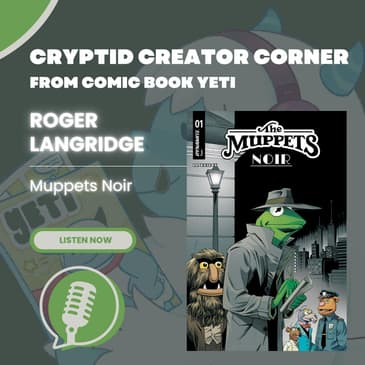

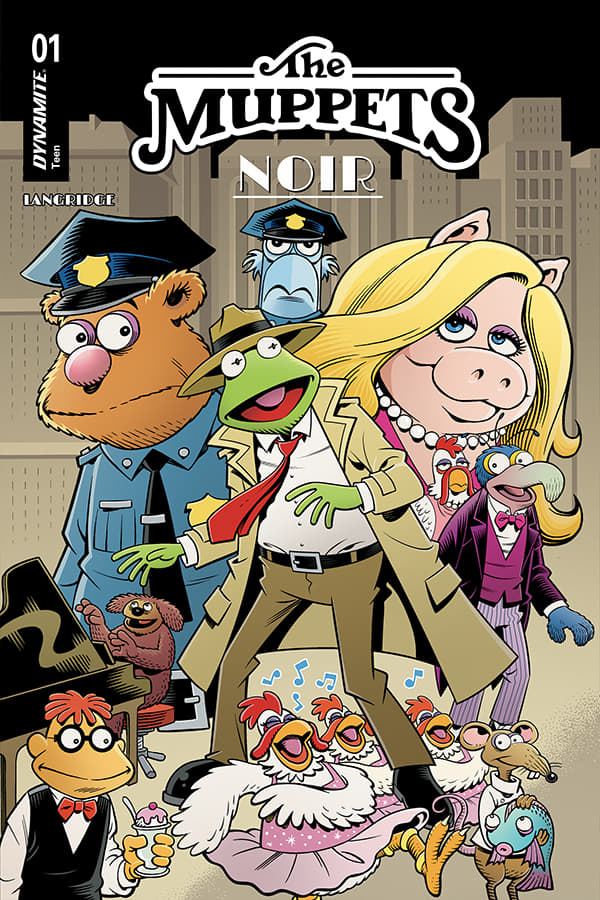
It's time to play the music...It's time to light the lights...It's time to meet Roger Langridge and The Muppets on the Cryptid Creator Corner tonight! That's right, Roger Langridge joins Jimmy on today's episode to chat about Dynamite Comics' The Muppets Noir. Roger returns to The Muppets for this tale that sees Kermit knocked into Dreamland to take up the mantle of his favorite P.I., Flip Minnow. Roger and Jimmy discuss what it was like for Roger returning to The Muppets, why noir is fitting for these characters, favorite Muppets, and Jimmy sneaks in some talk about Buster Keaton and Roger's character Fred the Clown. What an amazing episode!

WATCH ON YOUTUBE!
Check out Muppets Noir on Dynamite
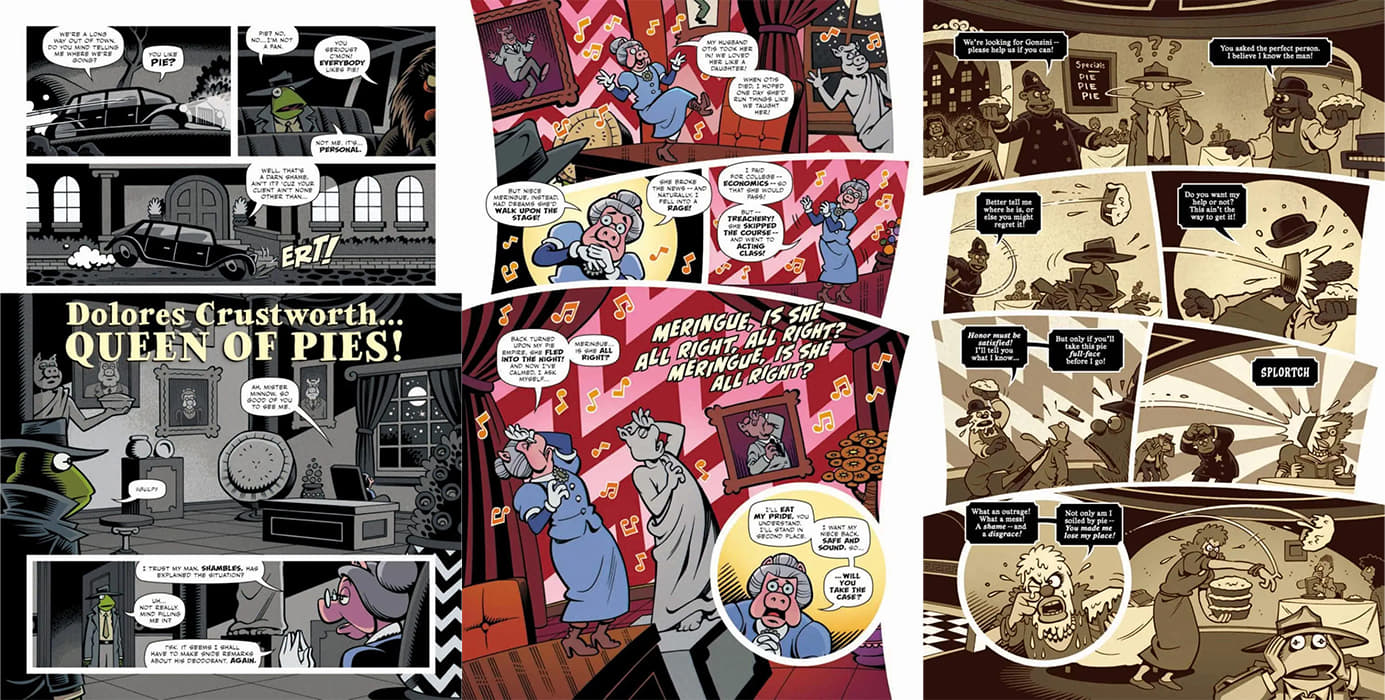
Preview pages
Follow Comic Book Yeti
🔗 Comic Book Yeti LinkTree: https://linktr.ee/ComicBookYeti
For partnership and ad inquiries, please contact: thecomicsyeti@gmailcom
Follow your hosts
🔗 Jimmy Gaspero: https://bsky.app/profile/jimmygaspero.bsky.social
🔗 Byron O’Neal: https://bsky.app/profile/byrononeal.com
ARKENFORGE
Play TTRPG games? Make sure to check out our partner Arkenforge. Use the discount code YETI5 to get $5 off your order.
Make sure to check out our sponsor 2000AD.

[00:00:00] Your ears do not deceive you. You have just entered the Cryptid Creator Corner brought to you by your friends at Comic Book Yeti. So without further ado, let's get on to the interview. The future is calling! 2000AD is the galaxy's greatest comic with new issues published every single week. Every 32-page issue of 2000AD brings you the best in sci-fi and horror featuring characters like Judge Dredd, Rogue Trooper, and more.
[00:00:28] Get a print subscription to 2000AD and it'll arrive to your mailbox every week. And your first issue is free. Or subscribe digitally and you can download DRM-free copies of each issue for only $9 a month. That's 128 pages of incredible comics every month for less than $10. Head to 2000AD and click on subscribe now or download the 2000AD app and start reading today.
[00:00:54] Hello and welcome to Comic Book Yeti's Cryptid Creator Corner. I am one of your hosts, Jimmy Gasparo. And man, I am so excited this morning because we are going to be talking about The Muppets. That's right, Dynamite has a brand new comic coming out, The Muppets Noir. It is written and drawn by legendary cartoonist Roger Langridge. And I am so excited to have Roger on the podcast today. Roger, it's so nice to meet you. Welcome to the Cryptid Creator Corner. How are you doing today?
[00:01:24] I'm good. Thank you, James. Good to meet you. Oh yeah. It's very, very good to meet you. I am a huge Muppets fan. I know you had a run on the Muppets when it was, I think with Boom, I guess through 2009 and 2011. And now you're back with this new series, Muppets Noir, which it looks fantastic. I've read the synopsis that Dynamite had put out with the solicits.
[00:01:51] But can you just tell listeners a little bit about what they can expect from Muppets Noir? Sure. It's, I mean, as the title suggests, it's sort of set in a film noir kind of environment. I guess the setup is that Kermit is sitting backstage at the Muppet Theatre. He's reading a detective novel and it gets clonked on the head by a brick by one of the acts.
[00:02:15] And while he's unconscious, he imagines himself in this film noir kind of world because, you know, he's inspired by what he was reading. And he imagines himself as a private detective called Flip Minnow. And he has to solve the mystery of a missing Miss Piggy who in the story is called, what's her name? Merang Crustworth. She's like a pie heiress who's gone missing.
[00:02:45] And yeah, that's that's basically the story. He bumps into all the usual people playing different roles in the story, you know, the the the artwork is sort of the characters are in color, but the the rest of the world that they're in is black and white. And yeah, we sort of dip in and out of that story and the real world story while we're waiting for Kermit to come out of his unconscious state.
[00:03:06] And within the world of the noir story, there's also an added element in that due to overeating pies as a child, he now passes out every time he smells a pie and he imagines himself in a big song and dance number. So that's when it gets a bit more spectacular. You know, it's it's it goes full color and the world becomes more sort of vibrant at that point.
[00:03:32] So, yeah, it's a way to get that kind of Muppet show song and dance energy into the story. Oh, that's it sounds fantastic. Fantastic. What was it? What was it like, you know, doing the Muppet the Muppet show comic at this point? I think that boom run ended like 2011. I know Marvel then picked it up and did a couple of issues with like the Muppets in 2012. But, you know, it's been 13 years.
[00:04:01] What was it like heading heading back into the world of the Muppets? And then in particular, kind of putting them in a, you know, a fun noir setting, which, you know, the Muppets have had been great for for years, kind of doing their parody or their take on what's been going on in pop culture. And noir seems kind of like a perfect setting for the Muppets.
[00:04:25] But what was your experiencing like, you know, going back, you know, 13 years or so later to do more Muppets? Well, I mean, the noir thing wouldn't have been, it wasn't my first idea. I initially wanted to do like the Muppet show comic, like I'd done previously with boom. And so I suggested that they weren't keen on that because they had something else in the works. I think they're doing a Muppet show special quite soon. You know, they've announced that already. So they wanted to do something else.
[00:04:53] So I made a list of sort of ideas. There was, I suggested a pigs in space comic. I suggested, what else? A newspaper room kind of thing like his girl Friday. Yeah, there were a few suggestions and Muppets noir was on the list. And that's the one they decided they wanted me to build up. So, yeah.
[00:05:15] So then there was this sort of added complication, I suppose, in that my initial idea was just to put them in that world and just have an adventure. But they wanted a framing sequence to suggest that the Muppet show was still a thing. So I had to figure out a way to transition from the real world of the Muppet show, real world, quote unquote, of the Muppet show into the Muppets noir kind of world. So that's when the framing sequence of Kermit getting knocked unconscious came about.
[00:05:44] But yeah, I mean, there's, you know, when you work with these big companies and they have these rules and guidelines and character guardrails, they call them, you have to work within them and make them work. But hopefully I've done that. Yeah, it's it's always a little bit different. I mean, it's a little bit more guided, I suppose, a little bit more controlled than it was the last time I did them. So there were a few more hoops to jump through. But, you know, nature of the beast, really.
[00:06:09] Oh, yeah. Yeah. Well, I mean, I guess it's coming up this year is, I guess, the 50th anniversary from when the Muppet show premiered. So whenever you have stuff like that, if they're they're doing other Muppet show stuff. And I know I think I don't know if it's ABC or one of the networks is now, I think, partnered with maybe Seth Rogen to do like a new Muppet show special or TV show or something.
[00:06:33] So, yeah, whenever whenever there's things gearing up in other media, whether or not it's a movie or television, I'm sure the powers that be tighten the controls a little bit. But I've never worked in like IP stuff. That's just my assumption. But, you know, yeah, that's pretty, pretty safe assumption. I think. Yes.
[00:06:54] In terms of like drawing the actual characters, like being, you know, away from them for that period of time, having, you know, maybe unless you were doing like some sketches or drawing them for fun, but not having to draw them for, you know, for a comic series. Was it was it difficult to get back into that at all? Or I mean, you've been cartooning and like illustrating things for so long.
[00:07:19] What was it just like, oh, I know what I'm doing here. I or was it a little tricky? Yeah, it's I've been continuing to do like sketches for people at conventions and things, you know, give out free head sketches to kids and whatnot. So I've been drawing them up. It's all that time. But I'd found that my interpretations had sort of drifted a bit from even from the versions I'd drawn in the boom series.
[00:07:43] So there was a bit of calibration to try and sort of get them back. Not exactly on model because, you know, I'm cartooning them up a bit, but, you know, something a little bit closer to on model. Yeah. Without making them look like they were stuffed felt creatures because, you know, they'll just be dead on the page if you do that. So you try and find out what, you know, between what they actually look like in real life and something that's a little bit more lively on the page. So, yeah, as I say, a bit of recalibration, a bit of trial and error and some corrections I had to do initially.
[00:08:13] But, you know, got back into the swing of it pretty quickly, I think. That's good. Do you have do you have a favorite Muppet? I mean, is that an unfair question to ask? Well, it's always a hard one and it changes from day to day, too. In terms of writing, I really enjoy Miss Piggy because she's so complex. You know, she's basically all subtext with occasional outburst text, you know. So that's really fun to write. That's a great way to describe Miss Piggy.
[00:08:43] To draw, I like the sort of gnarly looking ones. So like Gonzo, for example, is really fun. Uncle Deadly is fun, although he's a bit more work because I have to refer to it. I don't draw him so often, so I need reference for him. But, yeah, no, I mean, as I say, it changes from day to day and tomorrow might be something different. It might be fun to be. I will say I'm not saying this because of where you're originally from, but I've always been very partial to Lou Zealand.
[00:09:12] For listeners who might not be familiar, his act is throwing boomerang fish and Lou Zealand. I think he originally was supposed to be just like a one-off character in The Muppet Show, but they kept bringing him back. He has a great bit in The Great Muppet Caper, I think it is.
[00:09:31] And, yeah, not to get like too into the weeds with stuff, but I think his character was based off of Frankie Fontaine, who was like a performer that did stuff with like Jackie Gleason and Jack Benny. And, you know, so I'm digging back in. Yeah. Yeah, but that kind of like dopey voice, but they never had the character sing. But that was kind of the idea that I read about Lou Zealand.
[00:09:56] I got deep into The Muppet lore because I just, you know, I love, I've just always been like a huge fan of The Muppets. I've been trying to get my kids into The Muppets. I have two daughters who are 8 and 13, and they are not as keen on The Muppets, which I find shocking because I just loved them growing up. Like the last time we went to Disney World, nobody would go to the Muppet Vision 3D show with me. I had to go by myself, and I did.
[00:10:25] And I'm glad I went because it's now been shut down. Yeah, yeah. At Disney World. But I had, yeah, it was just me, just a 45-year-old man. I had sitting in Muppet Vision 3D by myself, but I did it. Big Muppet fan, so I'm very excited that there's going to be this new comic series. And I love the idea, you know, of whenever The Muppets do genre, and I think noir is such a fun choice.
[00:10:51] I like the framing device that you've, you know, kind of chosen, that something happens to Kermit, and he kind of goes into, like, a dream of being in a noir. I just think that's, you know, so fun. I think The Muppets do kind of lend themselves, because of the cast of characters, very easily to fitting a lot of the tropes of the noir, especially, you know, Miss Piggy's the perfect femme fatale, and, you know, such a great cast of characters.
[00:11:20] Did you find once you started, you know, actually writing it, that it fell together? Or did you still have some difficulty once you started to put, like, the noir mystery together to make it work? What you can do with The Muppets, because, you know, it's for a general audience. So, you know, you can't get too bloodthirsty, you can't have guns, you can't have anybody dying.
[00:11:44] So to fit that into a noir world, I mean, it's not going to be, you know, the lonely warrior, the lonely knight in a corrupted world, exactly. You can't go full Chandler. But you find ways to, it's more of an aesthetic appropriation, I suppose. You know, you've got the shadows and the costumes and, you know, the trappings of the world without necessarily having the gory details. I'm sorry, I've forgotten the question. No, you're fine.
[00:12:12] It was just like, did you find that The Muppets fit, like, easily into the noir? Like, it seems like they would be an easy fit or... But yeah, you're right. There are some things you can't do because it is a, you know, a general audience comic. You're right. You can't go full double indemnity or anything like that. I was trying to figure out ways to get in some of the characters because I couldn't quite figure out how to get in, for example. I wanted Bunsen and Beaker in there, but I couldn't quite work out how to do that to begin with. I think I found a way.
[00:12:41] But yeah, I mean, there are characters who aren't an obvious fit for that world, but you want them in there because if they're not in there, then, you know, fans are going to be disappointed. So, yeah, you have to be creative. But yeah, I think I've got all of everybody's sort of... The characters that people expect to see, I think, are all, you know, present and correct. And they've found some role there. Particularly Fozzie. I mean, Fozzie's like... He's in most of the story. He's like a police...
[00:13:11] He's like a cop, like Officer O'Bear. Officer O'Bear, I think he's called in the story, who's sort of partners up with Kermit for a lot of it. And I think he keeps appearing in different disguises. And Kermit is looking for her and, you know, he doesn't get it because he's not very good at his job, you know. But she's constantly popping in and out of the story as well, even though she's supposedly missing. So, yeah, hopefully everybody's going to be happy with, you know, seeing their favorites in there.
[00:13:39] Yeah, I mean, the preview pages I saw, it looks great. So I think folks are going to be very happy with it. I hope it does well. Like I said, I'm a big fan. So I'm going to be a big cheerleader for Muppets Noir. What do you think, you know, having done it before and returning to it, what do you think is one of the lasting appeals of the Muppets? That, you know, 50 years they're still around and, you know, you're still doing a new comic series.
[00:14:07] Well, I mean, the characters are really strong. And there's a sort of a family dynamic, I suppose, that is quite universal. I think people respond to that. Also, you know, the larger than life, sort of more cartoonish aspects of the characters means that they have a sort of crossover appeal. You know, kids will get them on one level and adults will get them on another level.
[00:14:32] You're not going to, you know, a small child isn't going to appreciate some of the nuances of Miss Piggy's personality, for example, whereas an adult will. But they'll get the sort of outbursts and grandstanding and that sort of thing. They'll respond to it on that level. So it's got, you know, it works on multiple levels for different ages, different audiences, I think. So that obviously helps that sort of universality of it.
[00:14:59] Were you a fan of The Muppets before you had gotten, before you ever drew and wrote comics for The Muppets? Well, I watched it when I was growing up. I was, you know, old enough to see The Muppet Show on original transmission in the 70s. And yeah, you know, watched that all the time. Tried not to miss one.
[00:15:25] Some of my favorite ones were with some comedians that I really loved already, like Peter Sellers and Spike Milligan. Oh, yeah. Yeah. And the Spike Milligan one I had, I actually made an audio cassette of it. I taped it off the television when it was broadcast. And I listened to that over and over. That's great. So I can still recite big parts of that off by heart, I think. Yeah. No, I mean, and, you know, saw the films when they came out.
[00:15:51] And yeah, tried to introduce, like we were saying with the kids, I tried to introduce my kids to The Muppet Show. They've watched some of it. You know, I don't think it grabbed them as much as it did me, but they certainly will not go at Christmas without watching Muppet Christmas Carol, for example. So, you know, it's obviously gone in on some level. Oh, yeah. Yeah. We watched, my family and I watched that this Christmas as well.
[00:16:18] When you are a fan of something and you get an opportunity to write and draw, is it easier to get into it, you know, because you're a fan and are familiar with the world, rather than some of the stuff that you've done in terms of like, you know, IP work or working for other companies where you might not have been familiar and you had to catch up? Because there's probably a certain type of pressure as well when you're a fan of something to do justice to it.
[00:16:48] I mean, you want to do a good job no matter what, but I'm just kind of curious as to, you know, being a fan, does that, what is the, does it help or hinder? Because I know you've done both. You've done stuff that you said you've been a fan of and stuff that you weren't familiar with before, you know, you got the gig. Yeah. Well, The Muppets, I was somewhere in between, I think. With something like Popeye, which I worked on, I was a huge Popeye fan. And, you know, I'd read all of the Seaguar stuff and it was just like a big influence on my work.
[00:17:19] And The Muppets, I wasn't, you know, I don't know sort of chapter and verse of The Muppets. I'm not like a super, super fan of The Muppets, but, you know, I just liked them. I just liked the characters. So I think that was a good place to be, actually.
[00:17:33] I was sort of, I had enough distance from it that I wasn't too intimidated about it, but I was familiar enough with it that I felt I could sort of imitate the rhythms of it and the kind of humor without having to do too much research, you know. So it was a good, you know, it was like a sweet spot, really. Other things that I've worked on, like, for example, Darkwing Duck, when I did the Justice Ducks comic. I'd never seen it, so I had to, you know, catch up really, really quickly.
[00:18:06] But yeah, The Muppets is a good place to be, you know, somewhere in the middle. All right. Well, that's a good, I think that's a good tip for working on stuff like that. It's good to be in the middle. Familiar, but not a... Not intimidated. Not intimidated, yeah. All right, everybody. We're going to take a quick break. We'll be right back. Y'all, Jimmy, the Chaos Goblin strikes again.
[00:18:29] I should have known better than to mention I was working on my DC Universe meets Ravenloft hybrid D&D campaign on social media. My bad. He goes and tags a bunch of comics creators we know, and now I have to get it in gear and whip this campaign into shape so we can start playing. Another friend chimes in, are you going to make maps? It's fair to say it's been a while since I put something together, so I guess, question mark? It was then that I discovered Arkenforge.
[00:18:55] If you don't know who Arkham Forge is, they have everything you need to make your TTRPG more fun and immersive. Allowing you to build, play, and export animated maps, including in-person Fog of War capability that lets your players interact with maps as the adventure unfolds while you, the DM, get the full picture. Now I'm set to easily build high-res animated maps, saving myself precious time and significantly adding nuance to our campaign. That's a win every day in my book.
[00:19:23] Check them out at arkhamforge.com and use the discount code YETI5 to get $5 off. I'll drop a link in the show notes for you, and big thanks to Arkham Forge for partnering with our show. I think I'm going to make Jimmy play a goblin warlock just to get even. Welcome back. One of the things I love about doing this podcast is because I liked comics as a kid.
[00:19:47] I was away from comics for a long time and got back into it because where I moved, I was right down the street from a comic book shop. I've told the story before on the podcast, but my oldest daughter is 13 now. We needed something to do because my wife is a professional photographer and works on the weekends. We would go to the library, go to the park, go to the comic book shop. The people were super nice at my local shop, the comic book shop in Wilmington, Delaware. And I kind of got back into reading comics, got back into comics, got back into it.
[00:20:17] It led to this podcast. And now I'm even, you know, writing some of my own, you know, short comics and stuff. So but I love this podcast because there's always there's I still have like huge blind spots in in my comic knowledge. And and unfortunately for me, one of those was Fred the Clown, which I did not discover until I started looking into your background to prepare for this.
[00:20:44] And I just have to say, I mean, I'm going to go and buy like every Fred the Clown I can find. I am a like a big as much as I love the Muppets. I'm like a big fan of Buster Keaton and and his his work from all of his silent films to even like his appearance in the movie version of a funny thing happened on the way to the forum.
[00:21:10] I love Buster Keaton. And so I was checking out some of the stuff for your Fred the Clown. And I mean, I loved it, like just instantly was like, how did I not know that this this was out there? And so, yeah, I I've been converted and I need to get all the Fantagraphics, whatever company put it out, Fred the Clown, I can find.
[00:21:34] What was it about, like, you know, Buster Keaton and that silent film era that like informed your work on on Fred the Clown and kind of doing that type of, you know, cartooning? Well, it's it's just good. That's basically it. Yeah, I discovered Buster Keaton when I was maybe 19 or 20. There was a at the Auckland Film Festival.
[00:22:03] They had Buster Keaton run. So and my brother worked for the festival. So he supplied me with loads of free tickets. So I managed to see a whole lot of Buster Keaton on a big screen. And that was really transforming for me. It was just, you know, he was so obviously a cut above most of the people who were around at the same time. And, you know, he was a director and writer and as well as a performer. So, you know, the triple threat, the awesome Wells triple threat.
[00:22:34] So, yeah. And I think it sort of dovetailed with my my feeling that the purest form of comics is without dialogue. So it was a really good fit to do a silent film kind of thing in comic book form. I'd done a few silent stories.
[00:22:55] I think the first first sort of sustained silent story I did was for Comics 2000, which was a big anthology that La Sociation in France put out. It was a Fred the Clown story. And when I did that, I thought, oh, yeah, I think I think I can do this. I really enjoyed doing stories without dialogue. I just found it was a good fit for my particular skills, I thought. So I did quite a bit more of that. And obviously, Fred the Clown, there's some other Fred the Clown stuff that isn't dialogueless.
[00:23:27] Sometimes, you know, I like to do different styles and approaches. Like, for example, in the Fred the Clown comics that I self-published, there would be stories that would be in the form of a board game or in the form of a Dr. Seuss story or, you know, all these other different kinds of things. Most of them, though, I had an idea at the time. I don't know if I still think this, but at the time I thought comics are more likely to reach a wider audience.
[00:23:52] If they don't look quite so obviously like a comic, if you don't use speech balloons, for example, if it looks like something else, if it looks like a children's book or it looks like a board game or something. That barrier that people have won't be there. That was the theory. So I did basically, I did five years of web strips of Fred the Clown with that theory in mind, which I then collected into self-published comics. And then Fantagraphics did a big book of them.
[00:24:20] So, yeah, that's, you know, Fred the Clown is kind of, I think of him as my signature character, really. Whenever I'm a bit lost and I'm not sure what I'm doing next, I go back to Fred the Clown, do a Fred the Clown story, and I feel like I've recalibrated him sort of back on the right track. Yeah, that's cool. Well, I just, some of the stuff I saw, which has only been like a little bit that I was able to find so far, you know, and get ready for this.
[00:24:47] I just, I loved it. I mean, I really thought you captured kind of that silent era as well. And I really like your cartooning. I mean, I'm not an artist. That's been like my biggest hurdle in terms of talking about comics, like going, like having like a, and education and talking to other creators and artists. But I feel like your line work is so strong.
[00:25:11] And you have such a fantastic understanding in terms of your pacing and like the comedy of it. Because I think, you know, sometimes comedy is really tough or humor is really tough in a comic. But I feel like you really, you're like Fred's, the situations Fred finds himself in.
[00:25:37] And especially to do mostly silent stuff and it still be really full of like humor and life. I just feel as, I just felt really good reading it. So. That's great. It's wonderful to hear. Thank you. But yeah. So big, big Fred the Clown fan. Being with a character like that for so long, how do you think your, your style has changed in, in drawing comics?
[00:26:06] I mean, if it, if it has at all. Well, I think, um, I think the, the sort of the surface elements of my style were locked in pretty early on, but I, having drawn a lot, you know, I've been doing this for professionally for 35 years. Um, I, hopefully my drawing has got more accomplished as I've, as I've done more of it. I look at my early stuff and it's pretty ropey.
[00:26:32] Some of it, you know, in terms of the, um, I, I had like a finished style sooner than I had, uh, the drawing chops to back it up really. Uh, well, okay. So I had, yeah, I had to, uh, work at that end of it to catch up really. Um, and you know, there are still big deficiencies in the way I draw, but, um, you know, a lot of, a lot of cartooning is problem solving. Um, you want to get something across.
[00:26:58] So you try and figure out a way that you can do it that is within your skillset. And sometimes that means you have to be more creative than somebody who can draw really, really well. Sometimes it means that you come up with a solution that nobody else has come up with before. And so that can be, you know, that's your style after that. But yeah, I think the basic drawing, I mean, I understand how structure works a lot better. Now I can do perspective better than I used to be able to do all these things, you know, which I should have had no doubt when I started, I picked up along the way. So, you know, definitely that side of it has improved.
[00:27:27] Well, I mean, look, whether or not you, you, you start that way or you get there along the way, um, it, it, however it happens, it happens. Right. Um, but, uh, yeah, so I'm very excited to, to discover and learn more Fred, the clown. Cause I, I, I think it's fantastic. Is there anything else that you've been like working on recently that you want to tell listeners about they should, uh, check out and pick up?
[00:27:54] Um, I've just, uh, well, it hasn't come out yet. It's going to be out in a little while. I think they're doing, there's a new, um, there was an anthology of the nineties in Britain called deadline. And, um, that has recently been revived. They did a Kickstarter at the end of last year. Uh, so I've got a couple of pages in that it's a, it's called the A1 deadline special. And I think it's going to be, you know, it's getting comic shop distribution.
[00:28:18] Um, and you know, that, that sort of, um, I had a really successful Kickstarter and it seems to be successful enough that they're going to do it as a quarterly magazine. So I've got, uh, a character called Buffes who's like, um, uh, mystical character who doesn't really exist, but kind of does. And, um, he's, uh, appearing in, in the next issue of that. I've just finished a story for that. So that's going to be hopefully a semi-regular thing.
[00:28:47] Um, what else have I done recently? Uh, yeah, I've, lots of short things, nothing, nothing major. Um, it's yeah, it's been, I've been, apart from the Muppets, I've had a, a sort of short story kind of a year. There was, there's, um, thing in an anthology, um, based on, uh, the doctor who comic strips from the 1960s, which were published. Okay. And, um, they had the rights to the doctor and the TARDIS, but they didn't have the rights to anything else.
[00:29:16] So they had to make up their own companions and their own monsters. And this anthology was able to get the rights to everything except the doctor and the TARDIS. So it's the companions that were made up and the monsters that were made up for the comic strip. So, uh, I did a short story for that. Um, yeah. Uh, yeah. That's a lot of fun. Yeah. Yeah. I mean, obviously it's a niche audience, but you know, they presumably the audience is out there and, uh, yeah, I'm doing stuff on my Patreon.
[00:29:44] I'm, I'm serializing a new Fred the Clown story on there at the moment. Um, and I post. Oh, fantastic. Sketches there every day as well. Um, which you get access for free. You don't have to sign up for that. Um, so yeah, that's what I'm working on. Awesome. Awesome. Well, I'll make sure that there's links in the show notes so, uh, listeners can let their local comic shop know that they want the Muppets Noir. And I'll put a link to your, to your Patreon. Um, and so folks can follow you on social media as well.
[00:30:11] And, uh, and as much as I can point folks in the direction of, um, uh, to, to tracking down, uh, Fred the Clown stuff, because like, um, I, I want to read all of it. I just want to try and track down as, as much as, uh, as I can. Um, was the original deadline, was that part of 2000 AD or now? No, no. It was a separate thing. It's where Tank Girl first came. Oh, okay. Yeah. Um, oh, okay.
[00:30:38] A hybrid comic magazine and a music magazine, really. Um, the new one is more. Um, but I think a few articles as well. So, yeah. Oh, nice. I'm nice. That'll, that'll, that'll be a lot of fun. So, yeah. So I'll, I'll listeners look for that when, when that comes out, if they're going to do that quarterly and I'll, uh, I'll, I'll track down whatever I can about the, um, the prior Kickstarter. So folks know that, you know, the group that's putting it out and they'll be able to check it out. So, um, awesome.
[00:31:07] Uh, well, Muppets Noir, uh, I think is out from Dynamite February 18th. That's what I'm understanding. Yeah. Yeah. Yeah. Doing a fine squash comics in London on the 21st. So. Awesome. We'll have a lot of fun with that. That sounds fantastic. Um, Roger, I really appreciate you taking the time out of your day to come on the podcast and talk to me about, uh, the Muppets. Uh, this is just, this has been delightful.
[00:31:36] I'm, I'm like, I cannot express how excited I am for a new Muppets comic. And I just, I, I think your work is tremendous and I'm very excited to see you back, uh, drawing the Muppets. So, uh, thank you very much for, for taking time out of your day to talk to me about it. I really appreciate it. Thank you. Very kind. Thank you very much. All right. So listeners, um, Muppets Noir, as I just said, it's going to be out through Dynamite February 18th. Uh, let your local comic shop know that you want it.
[00:32:05] Check out Roger's other work, check out his Patreon. There'll be links in the show notes. Uh, also for us rate and review the, um, the podcast that really does help us. Um, I, I thank you so much for, uh, taking the time to listen and, um, just a plug for my own book, but, uh, Penny and the Yeti with me and Amber Aiken is going to be out through Paper Cuts on April 21st. You could check out that all ages book. I think it's really fun. It's a, my, my debut graphic novel.
[00:32:35] Um, so if you're into that or if you have kids that might be into it and yeah, uh, thanks to my guest, Roger Langridge and, uh, I'll see you next time. Uh, good night. This is Byron O'Neill, one of your hosts of the Cryptid Creator Corner brought to you by Comic Book Yeti. We hope you've enjoyed this episode of our podcast. Please rate, review, subscribe, all that good stuff. It lets us know how we're doing and more importantly, how we can improve. Thanks for listening.
[00:33:04] If you enjoyed this episode of the Cryptid Creator Corner, maybe you would enjoy our sister podcast Into the Comics Cave. Listen and subscribe wherever you get your podcasts. Okay, Nicola, Quizfrage. Homeoffice-Bastade oder Fahrtkosten? Was bringt uns mehr? Moment, ich check das kurz. Oha, Homeoffice gewinnt. Bringt uns 150 Euro mehr im Jahr. Ja, richtig. Aber wieso weißt du sowas? Weil, wieso Steuer die Erstattung live anzeigt. Das ist einfach die Steuer-App für alle Fälle.
[00:33:34] Ja, und Fragen beantwortet sie auch. 24-7 und ohne Beamten-Deutsch. Das ist einfach die App, die uns versteht. Steuern erledigt. Safe. Mit wieso Steuer. Jetzt kostenlos ausprobieren.