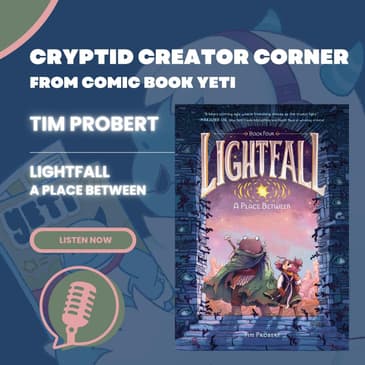

Comics creator Tim Probert is welcomed to the show for the first time to discuss his award-winning all ages fantasy graphic novel series Lightfall and its latest installment, A Place Between, book four of the series.
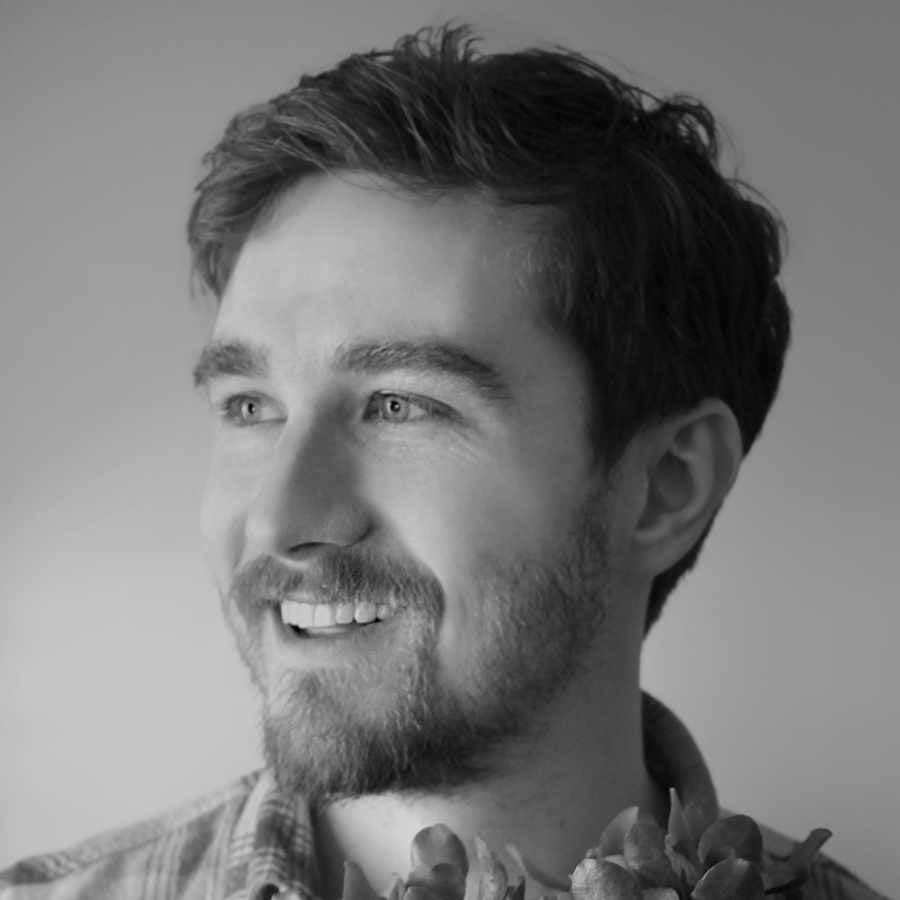
"I loved books growing up that didn't talk down to me as a kid and just talked to me as a person and that weren't afraid of being scary."
Conversation highlights
* Beginning the series as an animated pitch for Nickelodeon called The Ballad of Bea and Cad.
* Visual influences on the Lightfall world including Dinotopia and the Hudson Valley School of painters
* Narrative influences including Brian Jacques’ Redwall series, The Lord of the Rings, and Hayao Miyazaki’s Nausicaä of the Valley of the Wind
* Visualizing Bea's anxiety in comic book form
* Character maturation across the series and adapting to your audience
* Delving into workflow and advice for younger artists
WATCH THE VIDEO VERSION OF OUR CHAT ON YOUTUBE!
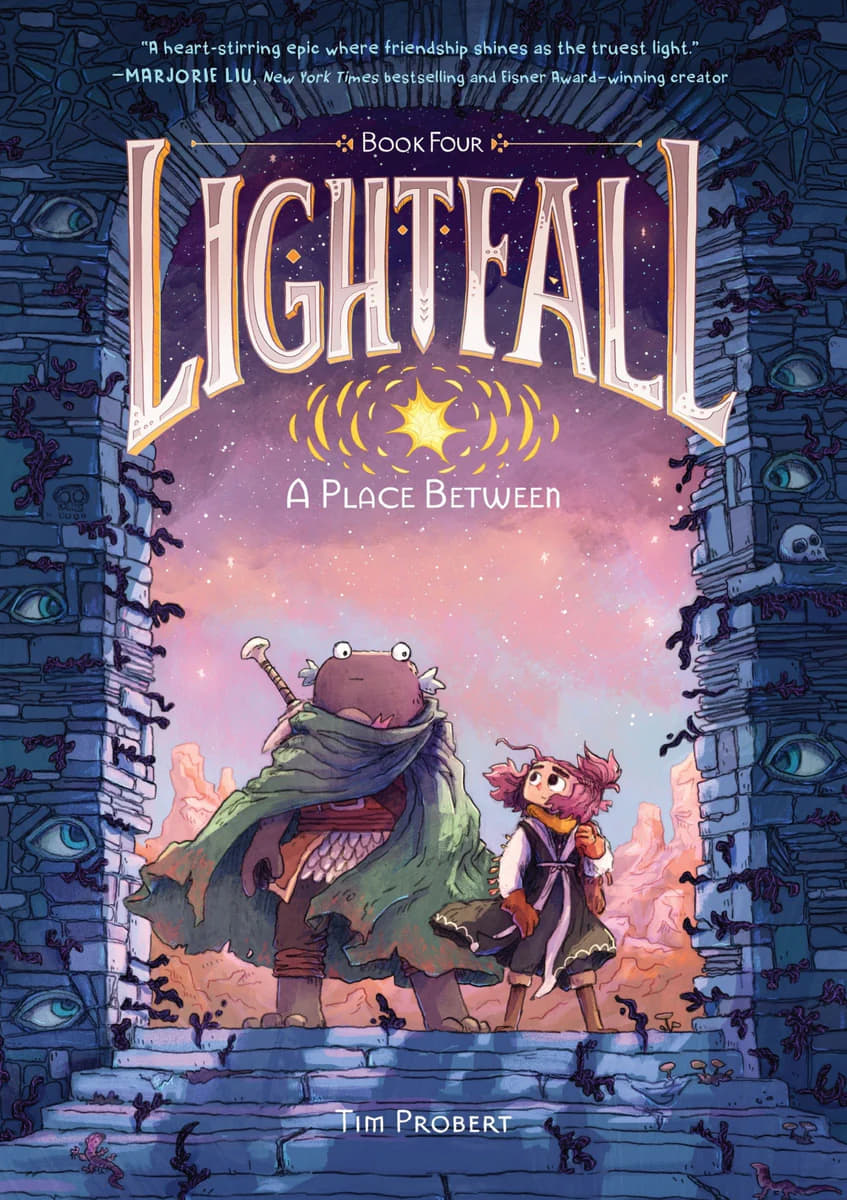
Lightfall: A Place Between
From the publisher
In the fourth installment of the award-winning, critically acclaimed Lightfall series, Bea, Cad, and their friends continue their quest to restore light on their dark world. Perfect for fans of Amulet and Avatar, this next book dives deeper into the magical world of Irpa, where ancient secrets and adventures abound.
After surviving a shipwreck on the Fuerre Sea, Cad washes ashore on the shores of Pellidyr. There, he searches for Lorgon, the Water Spirit, but instead finds the other spirits of Irpa who question if their planet can be saved. One of them offers to help Cad and transports him to A Place Between, a strange liminal realm between the living and the dead, where Cad works to uncover the reason Lorgon summoned them to Pellidyr in the first place.
Meanwhile, Bea awakens within the walls of the capital city. While Pellidyr’s leader has heard the tales of Bea’s derring-do and believes her to be a hero with all the answers, she’s never felt more uncertain about the future. What she does know is that she can’t accomplish anything without her crew. When Bea’s escape plan also brings her to A Place Between, she makes a shocking discovery that changes her understanding of everything that came before her…and what could soon follow.
Follow Comic Book Yeti
🔗 Comic Book Yeti LinkTree: https://linktr.ee/ComicBookYeti
For partnership and ad inquiries, please contact: thecomicsyeti@gmailcom
Follow your hosts
ARKENFORGE
Play TTRPG games? Make sure to check out our partner Arkenforge. Use the discount code YETI5 to get $5 off your order.
Make sure to check out our sponsor 2000AD.

[00:00:00] - [Speaker 0]
Your ears do not deceive you. You have just entered the cryptid creator corner brought to you by your friends at Comic Book Yeti. So without further ado, let's get on to the interview.
[00:00:11] - [Speaker 1]
The future is calling. 2,000 AD is the galaxy's greatest comic with new issues published every single week. Every 32 page issue of 2,000 AD brings you the best in sci fi and horror featuring characters like judge dread, rogue trooper,
[00:00:27] - [Speaker 2]
and more.
[00:00:28] - [Speaker 1]
Get a print subscription in 2,000 AD, and it'll arrive to your mailbox every week. And your first issue is free. Or subscribe digitally, and you can download DRM free copies of each issue for only $9 a month. That's 128 pages of incredible comics every month for less than $10. Head to 2,000 AD and click on subscribe now or download the 2,000 AD app and start reading today.
[00:00:54] - [Speaker 3]
Hello, everybody, and welcome to the Cryptid Creator Corner. I'm Byron O'Neil, your host for our comics creator chat. I probably have more pressure on me today than I usually do on the show because I posted that I was reading this series on Facebook a few weeks ago, and friends who have never paid attention to the podcast before said they were going to tune in for this one with their kids. No pressure. So it is my pleasure to introduce first time guest, Tim Probert, on with me to talk about his all ages fantasy graphic novel series, Lightfall, whose fourth volume, A Place Between, just hit shelves earlier in April.
[00:01:31] - [Speaker 3]
Tim, thanks for sitting down with me today. Yeah. Thank you for having me. I'm, very happy to be here. Absolutely.
[00:01:38] - [Speaker 3]
Well, people certainly have some feelings about the Lightfall series, and and I'm not surprised. Everyone enjoys it because it's legitimately wonderful, but I can't remember another post about something that I'm reading getting quite so many positive comments, you know? In what is usually a toxic social media landscape, you seem to have created something universally loved. So congratulations.
[00:02:02] - [Speaker 2]
Thank you. Thank you. It blows me away all the time. And, I don't know. That that fact makes me very happy to hear because I feel like I'm always hesitant to post or talk about things online because it is so heated all the time.
[00:02:15] - [Speaker 2]
So I I like that people are enjoying my book, and it seems to bring a a positivity around with it. I hope.
[00:02:25] - [Speaker 3]
Oh, yeah. Yeah. Yeah. I mean, I think so. Absolutely.
[00:02:29] - [Speaker 3]
And for myself, thank you for being a force of positivity, in the world, you know, as a creator. We need more of that because, I mean, that social media is awful right now. Yeah. Yeah. Not fun.
[00:02:42] - [Speaker 3]
Yeah. Well, I want to step back to the beginning of the series for a second. I'm dealing with, what came first, like a chicken or the egg scenario.
[00:02:50] - [Speaker 2]
Mhmm.
[00:02:50] - [Speaker 3]
Doing my research. The first iteration I found in the series was the animated short, The Ballad of Bee and Cat on Nickelodeon's Nicktoons YouTube channel.
[00:02:59] - [Speaker 2]
Yes. And
[00:02:59] - [Speaker 3]
that was like seven years ago, which seems like it predates the book maybe by a year or so. So you were a visual development artist for Nick. So how did this all start?
[00:03:09] - [Speaker 2]
Yeah. Yeah. So I had been doing some some work for Nickelodeon, way back, when I was, like, first starting out in, like, 2014, 2015 maybe. And I was working on their shorts program as a as a freelancer helping develop, backgrounds and characters for some different short films that they were making, and they were sort of, like, testing grounds for different show possibilities and stuff. And while I was doing that, they're like, hey.
[00:03:34] - [Speaker 2]
Do you have any ideas? And I had been kicking some ideas around, and I started developing these being cat characters. And, like, the world was very different. I didn't have all that stuff figured out, but I just had this idea of these the two characters were kind of always there. They came to me pretty quickly.
[00:03:52] - [Speaker 2]
And Yeah. While I was doing that, I started working at, Nathan Love, which is an animation studio that was in New York City. And, my boss there, like, ended up talking to me about it, and they were connected to Nickelodeon. And, like, long story short, we ended up developing it as an animated pitch that we pitched to Nickelodeon, and then we made that short. And that was kind of the culmination of that that initial process.
[00:04:18] - [Speaker 2]
The then they it didn't go anywhere, basically.
[00:04:22] - [Speaker 3]
Okay.
[00:04:22] - [Speaker 2]
Which happens in development all
[00:04:24] - [Speaker 3]
the Sure.
[00:04:25] - [Speaker 2]
But common common story. So after that, kind of sat with it while, and I I sort of took it back and thought about it for a little bit, and then started developing it as a comic, as a graphic novel instead. Which which led to the books.
[00:04:40] - [Speaker 3]
Okay. Yeah. I mean, the scale of capital investment for animation is is always pretty big. So Yeah. I mean, fairly familiar refrain.
[00:04:49] - [Speaker 2]
Yeah. Yeah. It's a lot. We had a big team. It was a great experience.
[00:04:52] - [Speaker 2]
We had, I did a ton of stuff on it, but we also, worked with a studio in France, La Cachette, who works on they did some Star Wars Vision shorts, and they animate Primal. Okay. Like Endy Tartakovsky show. And, they did all the character animation.
[00:05:08] - [Speaker 1]
So it was a it
[00:05:09] - [Speaker 2]
was a fun experience even though it didn't end up becoming an animated film.
[00:05:15] - [Speaker 3]
Well, one of the hallmarks of the series is how lushly you filled out the world with these visually stunning and magical locations. Mhmm. We were chatting before we started about you being from Upstate New York. I spent considerable time there myself. That first book, certainly from my vantage point, seems heavily coated with it, especially if you think about in the fall.
[00:05:37] - [Speaker 3]
So when everything kind of becomes a blanket of orange and red. So where are you pulling your inspiration from?
[00:05:43] - [Speaker 2]
Totally. That's definitely a thing. And, like, hiking in mountains in Upstate New York as a kid, we used to I was from Long Island originally, and we we used to drive up to, like, Bear Mountains. So all of all of those those places. I just always loved, woods and, like, finding ruins in the woods.
[00:05:59] - [Speaker 2]
Yep. So the first book especially has like a lot a lot of that kind of like seep through seeping through it. I also was able to take a trip to Iceland, right around the time I started the first book, and that was, I mean, it's like an amazingly It looks like you're walking into a Tolkien story. That was a big influence too. Yeah.
[00:06:19] - [Speaker 2]
So that that stuff is definitely, kind of always in the back of of my head, of all these like little little things that I could pull into the
[00:06:27] - [Speaker 3]
Okay. Okay. Are there other influences? Like I was, I was getting some Lord of the Rings, maybe, maybe even, I think I read somewhere there was Dinotopia was an influence on- Yeah. Yes, totally.
[00:06:41] - [Speaker 3]
I love Dinotopia. Me too. Me too. So it was it was a foundational visual blueprint for me as a kid. I saved up a really long time to buy a print of Waterfall City.
[00:06:52] - [Speaker 3]
So I had this huge print of Waterfall City. It was hanging over my bed until I graduated high school.
[00:06:57] - [Speaker 2]
So Totally. Yes. Yes. And the way that James Gurney created that that world, I just, like, I fell in love with it. And then, like, through his learnings, like, he talked a lot about the Hudson Valley painters, which sort of introduced me to this whole school of art in in classical art.
[00:07:14] - [Speaker 2]
So, yeah, I feel good that was a real door opener. That and the Red Wall series was, like, really big for me and just staring at those covers all the time. And I read those books, like, over and over. They were Oh, yeah. Definitely, yeah, influential, my young brain.
[00:07:33] - [Speaker 2]
Well, what about Cat and and Bea?
[00:07:36] - [Speaker 3]
So that's where I kind of get the Lord of the Rings stuff more is their Sam and Frodo type of relationship. So tell me about developing them as the core nucleus of the book.
[00:07:49] - [Speaker 2]
Yeah. Yeah. Totally. And and, yeah, like, Lord of the Rings is one of my favorite books, but I also love, you know, love, like, Star Wars and all of these things. And and, like, one thing that I would come back to when I was developing this story, was that something I I had trouble to connecting with some of those heroes was their readiness for the journey or readiness to accept going on the journey.
[00:08:10] - [Speaker 2]
Sure. And and I wanted to be that person, but didn't ever feel like I was. And as a kid, it was like, I wanna be Luke Skywalker. He's like, alright. And uncle, you're dead.
[00:08:20] - [Speaker 2]
Like, let's go. But I I wouldn't. So that was, like, where b came from for me was was this the place of anxiety and worry and, like, wanting to go out and see the world and do all these things, but, it's just, like, overwhelming. And but then she still goes. She does it, and she works through it and goes.
[00:08:38] - [Speaker 2]
And then Cad just kind of emerged, like, fully formed as this guy who wasn't worried about that stuff. So you have this nice foil there. But then, like, as I worked on him more developing his he's got his other feelings going on of, like, abandonment or loneliness or being the last of his kind. So I wanted to have that, like, hopefully relatable human core relationship at the heart of the story, so that you could hang on to that while the world can go, like, completely insane all around it.
[00:09:09] - [Speaker 3]
Yeah. I love the the expression, of anxiety. The way you've articulated that for Bee is, I think, just beautiful and very approachable
[00:09:17] - [Speaker 0]
able
[00:09:18] - [Speaker 3]
Mhmm. For for kind of the all ages material that you're you're trying to hit there, you know? And it's one of the things I love about comics. You can't imagine trying to do that with prose, take an immense amount of thought process and lots and lots of words to to basically describe what you did with these black tendril clouds that, sort of start surrounding her as she becomes anxious or overwhelmed. Mhmm.
[00:09:42] - [Speaker 3]
You know? And voila, you just draw some some tendrils, and and you're good to go.
[00:09:49] - [Speaker 2]
Yeah. Which was, kind of a breakthrough moment for me as I was working through the story, as as the working on the first book, and I was trying to show the anxiety just in her in her posture, in her body language, or And I was trying to not have like a constant internal monologue, but do it all via things the characters are saying, or the Or what you see. And I was struggling with like, how to how to show it, and I was just like scribbling over a drawing, and that's how the black lines came about, and I was like, oh, it's comics, you can show it visually, you can make up your own rules. I was like, it was like this drawing, and then I was just like scribbling and covering her in these things. And I was like, oh, there it is.
[00:10:29] - [Speaker 2]
That's the feeling. And I can just show it depicted visually. And then once I had that, it'll open up all these doors of like ways to show it and it creeping in or like completely absorbing her or like pulling her back. Yeah. Yeah.
[00:10:43] - [Speaker 2]
So it was like almost a happy accident.
[00:10:47] - [Speaker 3]
Those are the best kind.
[00:10:48] - [Speaker 2]
Yeah. Yeah.
[00:10:50] - [Speaker 3]
Well, there's been this kind of maturation may be the wrong word, but a change in the tone over the course of the four books. For example, in the third book, you have the pig wizard who has a broken leg, and in book four, without giving a whole bunch of stuff away, you know, you're dealing with the concept of death. So heroes obviously need peril, but the amplitude feels a bit more dialed up. So as you've developed this, as it's evolved over time as a storyteller, what's influencing that?
[00:11:22] - [Speaker 2]
I think, life in general, reflecting Okay. On reflecting on the world around us and and as things change and thinking about, kind of trying to think about bigger picture stuff as opposed to, like, just, like, individual goals or, like, these little steps that they have to do, but, like, I don't know. It's the world getting bigger and the problem is getting bigger, and it, you know, slowly growing into more of, like, fate of the planet or thinking about how we live in the world and, like, what can we do to, like, help the world heal from things we've done to it? And and having these characters who are only there because they wanna be there trying to help and and not because they were chosen or they were the, you know, the the chosen one or or prophecy or something. They're just just like having heroes that wanna help these things, but it it keeps growing all around them, both personally and and in the world.
[00:12:18] - [Speaker 2]
The problems are getting bigger, and their own problems are getting bigger. And they're, you know, growing up and growing a little older over the journey as well. And I like the idea of, the books kind of growing with readers too. Yeah. So especially if you pick it up as a younger reader and they're coming out every two years, you know, you're kinda growing with every book.
[00:12:37] - [Speaker 2]
So I I always like that idea of, you know, it's starting a little bit lighter and then ending, not darker, but just yeah. It's it's grown, hopefully.
[00:12:46] - [Speaker 3]
Yeah. It's kind of weird when you, when you think about it sequentially like that, where you may have had a seven year old who started reading it in 2020, who's now 13 or 14. So they're in a very different place.
[00:12:59] - [Speaker 2]
Yeah. And same, same with me, you know, I was like, not I was almost 30 when I started, and it's been many years. Like, I'm growing older too, and, you know, you want the story to to kinda grow with you as well as as you're telling it. Or I like that for myself.
[00:13:15] - [Speaker 3]
Yeah. Did you find that the whole experience of COVID changed the way you were approaching this as a storyteller?
[00:13:23] - [Speaker 1]
I don't know if it changed it.
[00:13:26] - [Speaker 2]
I don't know if it changed my writing because I did a lot of it during COVID, or a lot of the second book was almost entirely during COVID. I think what it did was lowered expectations on myself because once the book came out, there was nowhere for me to go except for starting the next book. Yeah. And it created this surreal experience of, like, my book being out in the world, but the world kind of, like, being a little being shut down. Yeah.
[00:13:54] - [Speaker 2]
And me not being out in it. And and in a way, was sort of nice because I was like, alright. I guess I'll just write the next one while while I'm here. And then things had opened up by the time this second book or more the third book was the first time I really got to go out, like, interact with the people who had been reading it. So I feel like that was, like, more the the effect of, like, oh, wow.
[00:14:16] - [Speaker 2]
People were reading this the whole time. That's crazy.
[00:14:20] - [Speaker 3]
I thought the expansiveness there with that was going on with book two. Book one, I mean and it's natural. It's a progression. Right? At least the world has to get bigger.
[00:14:29] - [Speaker 3]
Mhmm. But, you know, it is a I always am curious with with creators who have written stuff during that COVID period. You know? Is the grand adventure something that you were attracted to because you were stuck inside?
[00:14:40] - [Speaker 2]
Yeah, absolutely. It was it's a one big escape for sure.
[00:14:44] - [Speaker 3]
Yeah. Yeah. Well, I I found myself actually more connected to a place between as a reader, as someone who has a serious autoimmune condition and has found myself at more than one kind of dark crossroads, their struggle really resonated with me. I think too often all ages books have that tendency to shy away from more challenging topics.
[00:15:05] - [Speaker 2]
So, you know, thank you for assuming the intelligence and the self awareness of the readership. Yeah. Yeah. Absolutely. I I loved books growing up that didn't talk down to me as a kid, and just talk to me as a person, and that weren't afraid of of being scary.
[00:15:22] - [Speaker 2]
Yeah. You know, even like something like Where the Wild Things Are is like kind of a scary book.
[00:15:27] - [Speaker 3]
Very much so.
[00:15:29] - [Speaker 2]
And and there's lots of other examples of of things that are, like, slightly sinister or, you know, or do do touch on stuff like like death and life and and, you know, the the bigger things that you you kinda deal with the whole time you're alive. So, yeah, it's not not to make something super morbid, but something more that's just, connecting with those feelings for people.
[00:15:53] - [Speaker 3]
Yeah. Yeah. For sure. You know, it even even the cover of of book four feels emotionally purposeful as, you know, me and Kat are are looking at each other apprehensively.
[00:16:05] - [Speaker 2]
Mhmm. So it
[00:16:06] - [Speaker 3]
creates that emotional place between the two of Yeah.
[00:16:11] - [Speaker 2]
Totally. Totally. And and it it's also the first time on the cover that they're, like, looking at each other. Like, the first book, they're both looking off in different directions. And the second one, Bee's looking back and Cat's kind of off in the distance looking, like, looking off.
[00:16:25] - [Speaker 2]
And in the third book, Cat's, like, staring off into space while she's looking at him, and then this is the first time they're, like, looking at each other, which was I don't know. That was just fun for me to kind of play with their their different their relationship throughout the series kind of on the cover. But and then also this book dealing with them being separated for, the first Yeah. The first time, and and realizing their importance to each other and also what they can do on their own. Yeah.
[00:16:54] - [Speaker 2]
Yeah. So how did you approach that? Cause it does see them kind of going on their own side quests,
[00:17:01] - [Speaker 3]
you know, again, without giving too much away. Yeah. Was that dictated by this story or was your thinking this was just necessary for them to grow in a more organic way?
[00:17:10] - [Speaker 2]
Yeah. It was more the second one. It just felt like it felt like, I wanted to see where they were as individuals after having been together for so long or gone through these adventures together, and they've both grown in different ways. And they've been there for each other the whole time, and, like, what happens when you pull pull that chair out from under them? And they each have to Cad's been on his own for a long time before this, But, you know, all of a sudden, he's back to being on his own, which is, you know, jarring jarring for him.
[00:17:40] - [Speaker 2]
And then Bea's, like, never really had to do this level of of adventure on her own. So just seeing how she can handle it and how she's, like, developed her anxiety and and, you know, dealing with those things over the course of of this time. And then, like, by thinking it was also that Cad goes on more of, like, a bit of a, like, metaphysical fantasy adventure, whereas Bees takes her more towards, like, people, and, like Okay. The the the real, like, stuff going on on the ground. So it's sort of these also two two contrasts of things that they end up facing.
[00:18:14] - [Speaker 2]
As ways to approach
[00:18:17] - [Speaker 3]
kind of the difficult challenges that they're dealing with emotionally, like be forced to be more anxious, if you will, because she's put in a more physical confrontation with people. Well
[00:18:29] - [Speaker 2]
Yeah. Even like, as I was thinking about it and thinking about her, and she's grown up, like, in the woods with her grandfather, and like Yeah. Never like, even when she goes to the big town, Leland, in the first book, that's her first time in like a big town. And and then I was like, what if I dropped her off in a city? And she's, like, barely navigated them at all before, and now she's doing it also on her own.
[00:18:50] - [Speaker 2]
So it's it's like a whole new set of emotional challenges for her. Yeah. So, yeah, that was that was kind of the thinking there, of, like, why why I kinda ended up splitting them up.
[00:19:03] - [Speaker 3]
Jimmy is too humble to do this. So as his stalwart ride or die, I wanted to tell you about his new graphic novel, Penny and the Yeti with artist Amber Aiken. What started as a comic short with his daughter that I've known about for ages now and it's evolved and has become one of those annoying can't talk about it in comics things for too damn long. Yes. I'm predisposed to be supportive but after reading an advanced copy of it, I have to admit it's way better than I anticipated.
[00:19:31] - [Speaker 3]
No shade but it's really good, remarkably so. Does it have a yeti? Yeah. Is it cute and adorable?
[00:19:38] - [Speaker 2]
Yeah.
[00:19:38] - [Speaker 3]
But it streak lies in effectively tapping into the all too familiar family dynamics that we all are facing in 2026 and approaching it in a way that doesn't insult the book's target audience. Kids. They are way smarter and perceptive than we adults give them credit for. So I really appreciated Jimmy's narrative approach tapping into his own experiences as a dad and a spouse. I can hear his wife saying, get off your phone, Jimmy, through the pages.
[00:20:04] - [Speaker 3]
She's gonna kill me for saying that. It's hitting shelves on April 21, and I dropped a link in the show notes where you can preorder a copy today. Getty or not, here we come with Penny, Perry, Fenton, Maxine, and the magical, mythical, magnificent, Yeti. On behalf of us both, we appreciate your support. YOLOWA.
[00:20:27] - [Speaker 3]
Well, you were kind of getting into a little bit of it there with the on the covers and how they've changed. But, you know, it's not just the stories that have changed. It's also the character silhouettes. So although these are like minor shifts, you know, Cad wearing pants now, for instance.
[00:20:46] - [Speaker 2]
Right? It got cold. Okay. Fair enough.
[00:20:49] - [Speaker 3]
But as an artist working on this series for seven plus years now or so, have have you noticed your personal style shifting over time?
[00:20:57] - [Speaker 2]
Yeah. Yeah. I think so. I think so. And also, you know, when I'm doing these books and, you know, they're 250 pages, so many drawings, I like to change it up and and keep it Yeah.
[00:21:08] - [Speaker 2]
Keep it interesting. And also, I like the idea of the characters, like, getting new outfits. I don't know. Something about it is, like, fun of, like, they're not wearing the same thing for forever. They they got new clothes.
[00:21:20] - [Speaker 2]
They got new things. So, yeah, I did like the idea of them changing and getting more stuff. There's this Miyazaki talking about Nausicaa, which is like my favorite comic ever. I love that. And and how she's this princess at the beginning who's who's lighthearted, she flies on her glider and, like, isn't weighed down.
[00:21:42] - [Speaker 2]
And by the end of the story, she's on the ground. She's walking. She's got all these bags, and she's carrying a kid, and she's, like, weighed down by all of these, like, earthly worries and things. So I always love that idea that and trying to do it with my characters where they start off, you know, a bit lighter, and, like, as the books go on, they get, like, heavier and heavier and more things. And then factoring in also just the the the logical part of, like, it's getting colder and colder and colder, so they need, like, more clothes and to layer up.
[00:22:10] - [Speaker 2]
And yeah. So I I just like those those little changes that kind of keep it keep it going along
[00:22:16] - [Speaker 3]
I feel like we're building up to to inevitable snow here with at least the next book.
[00:22:21] - [Speaker 2]
Yeah. I think so too. I held off on it. I was like, if I bring snow now, there's nowhere to go but more snow. Holding off on it for a minute.
[00:22:31] - [Speaker 2]
But yeah. Yeah.
[00:22:33] - [Speaker 3]
Well, do you feel like it's harder to level up as an artist, working on the same characters over time, or does that familiarity allow you more creative experimentation in other ways?
[00:22:43] - [Speaker 2]
Yeah. Yeah. It's sort of a double edged sword, because you don't want to fall into the, like, knowing how to draw them by habit or routine, and then you're doing like lazy drawings, which is a very, like, easy trap to fall into. But then also keeping it interesting because you're drawing the same thing so many times. But I've I've tried my best to, like, every time I sit down to start drawing the next book, I'm like, I will draw this one better than the last one.
[00:23:08] - [Speaker 2]
Like, whatever it is, whether it's more detailed or the backgrounds are more interesting or the characters have more dynamic poses or or or whatever, I'm always, like, trying to level up every time. It's the goal.
[00:23:21] - [Speaker 3]
Do you have time to to analyze your work once you're done with a book or is it like, no, I'm onto the next one. We're we gotta keep going.
[00:23:27] - [Speaker 2]
It does move pretty fast.
[00:23:29] - [Speaker 3]
I bet.
[00:23:30] - [Speaker 2]
Yeah. And sometimes yeah. Sometimes I I just, like, put it in the rearview and don't look back at it for a couple months. And then, yeah, I don't know, sometimes I go back to the first book, I'm like, Hey, pretty good drugs in here. I did these.
[00:23:45] - [Speaker 2]
That's pretty cool.
[00:23:46] - [Speaker 3]
Got yourself onto that there?
[00:23:49] - [Speaker 2]
Yeah. Yeah. So, yeah, there's always always trying to get better, I think.
[00:23:54] - [Speaker 3]
Yeah. So what's your process look like? Are you working exclusively digitally then?
[00:23:57] - [Speaker 2]
Or No. No. So I do, I do my thumbnails digitally on a on an iPad just because it's it's faster. But I draw all the pages on paper. Wow.
[00:24:08] - [Speaker 2]
They're they're just done like eight and a half by 11. Yeah. It's actually I just packed them all away. This is the book four binder. Wow.
[00:24:16] - [Speaker 2]
These are That's a tome. Yeah. These are all the pages. So what I do is after I do the thumbnails, I I blow them up and print them out, and then I put them on a light table, and I roughly draw it in red pencil, and that's where I like really figure out everything, And then I ink it with a mechanical pencil, just like a regular mechanical pencil. And then I scan those, and I do all the panels and balloons in Photoshop, and then the painting is all in Photoshop.
[00:24:45] - [Speaker 2]
Okay. Yeah. Yeah. So it's kind of a it's kind of a back and forth, but it's been I think drawing on paper really helps me not like noodle and commit to stuff. Yeah.
[00:24:55] - [Speaker 2]
Not like zoom into these tiny details that get like blurred out when you print it anyway. Yeah. So yeah, I only I work slightly larger than the print size, just like a little bit bigger. Okay. So it gets scaled down a bit, but it just yeah.
[00:25:10] - [Speaker 2]
That's that's that's the way I've been doing it. So are
[00:25:13] - [Speaker 3]
you doing everything yourself? I thought, if I'm not mistaken, you had your brother doing flatting for you at one point.
[00:25:18] - [Speaker 2]
Yeah. My brother is held to be flat, and my wife is held to be flat. She flatted a lot of the fourth book, actually.
[00:25:24] - [Speaker 3]
Wow. Okay. Yeah. That's a that's a good partner right there.
[00:25:27] - [Speaker 2]
Yeah. Yeah. It was pretty great. We were here, the fourth one was a tough one for me to write. Okay.
[00:25:35] - [Speaker 2]
I think I think it was just a bit of burnout, honestly. I had done like Yeah. The three books in a row, COVID in the middle of it. I was working for most of it at a job, and also sometimes doing illustration for other books at the same time. And after Okay.
[00:25:52] - [Speaker 2]
Yeah, five or six years of that, I was like, woah, I'm really tired. So the writing, just like, I I got writer's block, I guess. I was just stuck for a bit. And it eventually came together, but because of that, it was like, I turned it in, like, and then it went to the printer, like, the next day. It was down to the wire.
[00:26:11] - [Speaker 2]
Woah. Yeah. Okay. I think it was like a week. I think they had a week of, like, when I turned the files into what it went to print.
[00:26:17] - [Speaker 2]
So, yeah, my wife was in the studio with me flatting, and I was painting, and we were just, like, hunkered down here for a couple months straight.
[00:26:25] - [Speaker 3]
Oh, your editor was like, hey. Do I need to fly out? Do I need to help you?
[00:26:30] - [Speaker 2]
Just gently nudging. He's like, you're okay. Right? Are you gonna are you gonna make it? He was very supportive.
[00:26:36] - [Speaker 2]
My editor is is great. He's been with me the the whole time, and and I they understand, but I also I know sometimes I've pushed the limits of the deadlines.
[00:26:47] - [Speaker 3]
So as a creator, I mean, you know, just speaking candidly, like, had this this thing come out where this past week, I don't know if if you've seen it, but on on Popverse, Jim Lee is talking about back in the day and finding that work life balance and how how much he relied on the, you know, the 4AM to 10AM just grind of just continually cranking and cranking and cranking. So, you know, based on your experience, what advice do you have for people to kind of balance those things?
[00:27:18] - [Speaker 2]
You know? It's hard. It is hard. It is hard. And I've gone through phases of of, like, the gym league, like, trying different people's schedules to see if they work for me.
[00:27:26] - [Speaker 2]
I'll, like, I'll do Stephen King's schedule, or I'll try out Ursula Le Guin's schedule. And and Okay. You know, it it helps to try them out and see what feels feels good. But in the end, it's also personal and based on, like, what is working for you. But I taking breaks is just so important, and I always forget.
[00:27:47] - [Speaker 2]
But it's like especially when you're stuck, it's like, just put it all down and, like, close the screen and walk and, like, look at a tree and, like, stop thinking about it, and come back to it. But, yeah, I think I was pushing the work part of the work life balance pretty hard for a while. So I'm I'm still trying to find it myself, I guess.
[00:28:09] - [Speaker 3]
It's it's hard. What is Stephen King's schedule? I I have no idea what this looks like.
[00:28:14] - [Speaker 2]
I don't I don't remember if his was, like, a super specific, like, daily schedule. I think there was one. It was in his on writing book, which I found to be a pretty helpful, very helpful book. But he just his thing was that he writes every day, and I think it was an amount of words, and he would like hit that amount every day no matter what, even like holidays, so like seven days a week. Oh wow.
[00:28:34] - [Speaker 2]
Even if it was stuff like he ended up throwing out, it was just like he would wake up and work until that was done at like two in the afternoon and then go like do the rest of his day. Which it's helpful when you're thinking of it in the job sense of you just need to get stuff done and like whatever it is, you have to like get it out and get it on paper and then you can edit it or fix it later. But I need days off, I think. Yeah. Yeah.
[00:29:01] - [Speaker 2]
I need to step away from the story sometimes and come back to it and see what what it was I was doing. So it wasn't quite right for me.
[00:29:08] - [Speaker 3]
Well, I I mean, I just picture him being in the house in Bangor, like, 2AM in the morning. Everything's dark. Maybe there's a light behind him, and he can barely see. And
[00:29:17] - [Speaker 2]
he's Yeah.
[00:29:17] - [Speaker 3]
Hunched over this, you know, tome of paper, you know, writing everything by hand or a typewriter.
[00:29:24] - [Speaker 2]
Totally. Totally. Yeah. Well, is
[00:29:28] - [Speaker 3]
there any advice you have to offer up to an up and coming young artists who might be listening in? Like, might know a few that are actually going to be doing this. Exactly that.
[00:29:39] - [Speaker 2]
One thing that that I've learned is to, not hold onto your ideas forever waiting for like the perfect time to use them.
[00:29:47] - [Speaker 3]
Okay.
[00:29:48] - [Speaker 2]
Yeah. It's I think it's so much better to like get it out and get it whatever it is, get it on paper and like start making it. And then even if it ends up not great and you don't go anywhere with it, you can come back to it later and like pull it back in. But, yeah, I used to, like, you know, I'd get this little idea. I'm like, I'm gonna save that for the perfect time or, like, the perfect project or the perfect place to insert that, like, little character I came up with.
[00:30:11] - [Speaker 2]
And sometimes you just hold on to them forever or even by the time you go to put them in, you're like, it wasn't that good of an idea anyway. I don't know. I was obsessing over it. So I feel like the process of getting them out, you learn so much from it. So the more you can, like, do that, you realize, like, more ideas are gonna come.
[00:30:27] - [Speaker 2]
Because I was I was like, I'll never have an idea again, so I need to use this one correctly. And that's not true. I think the more the more ideas they they perpetuate more ideas coming out. So it's sort of like it starts the the floodgates. So don't be too
[00:30:43] - [Speaker 3]
precious about it. It feels like your the way you're describing it is that your process isn't so dictated by the world. Like, you know, the let's okay, I'm gonna I have this and this and this and this and this I need to do with this particular fantasy world, and I need to shove that in here as much as a much more organic process. Yeah. Feeling it out as you go to some extent.
[00:31:05] - [Speaker 2]
Yeah. Yeah. A lot a lot of it is like that. I think of it more like sculpting, where in school, when I learned sculpture and we built clay figures and stuff, and you were putting clay on and pushing it around and then taking clay off, and it was this constant, like, push and pull of things as opposed to, like, carving something out of marble where you're getting to the point where you carved it and it's done. I it's always, like, much more malleable process for me.
[00:31:31] - [Speaker 2]
And my writing is definitely like that, where I'll put stuff in and I'll start trying it out, and then it's like, oh, this isn't really working. Let's pull it out or change it, or this character's gonna morph into something else, and just just trying to be a little bit looser with it. Okay. Yeah. That's that's what I have found works for me.
[00:31:47] - [Speaker 2]
I'm sure other people are like, straight ahead to the end of the story. I know exactly what I'm doing. But mine is a much more meandering process.
[00:31:56] - [Speaker 3]
So is that something that you've adapted? You're talking about sculpting there. You've you've worked in animation. Are you are those two things as a creator compatible? It just seems like the wrong word, but, you know, the creative process just seems very, very different Yeah.
[00:32:15] - [Speaker 3]
Between those two things.
[00:32:17] - [Speaker 2]
Yeah. Yeah. I guess the the physical process is different, but I guess for me, the mental process ends up being pretty similar.
[00:32:24] - [Speaker 3]
Okay.
[00:32:25] - [Speaker 2]
And a lot of it for me is is like editing. And, like, my first draft is never right, and my my biggest trouble is getting the first draft out, and then I can fix it. So for me, it's always that just like, put the clay on, and then I can make it look good. Or like, get the get the armature built, and I can make something. Or get the first draft out, and then I can edit it four or five times, and push things around until the story feels good.
[00:32:50] - [Speaker 3]
Okay.
[00:32:51] - [Speaker 2]
Yeah. Yeah. Same with the drawings. It's like, that's why I do the red pencil is because that's where I can be a lot looser and kinda move things around and still, like, erase and find the right poses and stuff as opposed to when I go to the the inking stage. It's like, a little bit more set in stone.
[00:33:08] - [Speaker 3]
Okay. Do you feel like having those two, two worlds that are creative outlets for you help you when you get in those creative ruts, you know? Can you, can you sort of shift back and forth, you know? And like, Oh, okay. Well, this, I'm doing this for a bit and it makes you, you know, sparks this idea.
[00:33:26] - [Speaker 3]
Oh, now I can reinterpret this in a very different way.
[00:33:29] - [Speaker 2]
Yeah. Yeah, I think so. I think so. Even just like not creative things, but, but just doing anything, I feel like some of my best ideas come when I'm like not trying to really hard to think of an idea. Or if I have a story part that's in my head and I'm thinking about it a lot, and then it's like out when I'm like trimming some branches on a tree that like inspiration strikes.
[00:33:49] - [Speaker 2]
I'm like, there it is. I got it. Okay.
[00:33:52] - [Speaker 3]
Yeah. I clearly needed to cut Kad's leg off, and that's exactly how this works.
[00:33:56] - [Speaker 2]
Yeah. Exactly. Exactly.
[00:34:00] - [Speaker 3]
Well, I wanted to ask too about Todd Beldenor, because this is a a new character in book four. We're all about promoting inclusion and diversity here on Comic Book Yeti. I I believe this is your first queer character in the series. So I'm curious, you know, kinda given the current landscape of what amounts to, in my mind, a witch hunt and with books in schools and public libraries, with this anti queer agenda currently, it was a risk. Right?
[00:34:25] - [Speaker 2]
You didn't
[00:34:26] - [Speaker 3]
have to do it. It's of minor narrative relevance. So so why was it important
[00:34:30] - [Speaker 2]
to you? I think because of all the things that you just said, that I think it's important for for characters of all different backgrounds and feelings that are represented in books for kids. Yeah. And there was a point where I was like, this is my world. I could do whatever I want with it.
[00:34:49] - [Speaker 2]
And if that makes you not wanna read it, I mean, I'm sorry. I guess. Don't
[00:34:56] - [Speaker 3]
Well, mean, bless you for doing it, because you you didn't have to.
[00:35:00] - [Speaker 2]
Yeah. Yeah. I mean, I yeah. I don't know. It didn't it felt right, I guess.
[00:35:07] - [Speaker 2]
I love that.
[00:35:09] - [Speaker 3]
No. I mean, I love that. Like
[00:35:11] - [Speaker 2]
Yeah. And I like, I guess I guess in a sense, it's a big deal, but it feels like it shouldn't be. And that's the world that I would like to have. So Right. So as long as I'm writing a world, it's like I I wanted to have representation in it that that hopefully, you know, just feels natural to the to the world and the people in it.
[00:35:30] - [Speaker 2]
Yeah. Which I hope we get to in our world one day. Absolutely.
[00:35:35] - [Speaker 3]
Yeah. Man manifest to towards reality. Yeah. Yeah. Yeah.
[00:35:41] - [Speaker 3]
Well, I don't think we're done. So based upon what I'm hearing and sort of what I've seen out there on the interwebs. So how many books are, are, are, do you even have an agenda? Like I'm going to stop. Do you know the end?
[00:35:53] - [Speaker 2]
I do. I do generally know the end. I will say every time I start a book, I feel like I know how that book's gonna end, and it tends to change along the way. But the plan is for six books. So there's two more coming.
[00:36:08] - [Speaker 2]
I'm working on the beginnings of book five now. Okay. And and yeah. So the idea is six books to kind of tell the whole story and have it wrapped up as a as a series. Yeah.
[00:36:22] - [Speaker 2]
So I've I've been working towards it. I think that was one of the tricky things with, the fourth book too of, like, for me knowing it's the back half of the story has begun, and like starting to lay the tracks for getting to the ending now without, but we're not at the ending yet, so you still want this book to be its own story that works as a whole, but doesn't, but you know, like getting us to to where things are gonna go, was sort of a tricky tricky type rope for me, I guess.
[00:36:51] - [Speaker 3]
So how comfortable are you with the idea of an ending? Given given your process and kind of what I've heard so far, like, I could see you being like, well, let's just keep this going. We're not we're
[00:37:00] - [Speaker 2]
not Yeah. Yeah. I mean, part of me wants to. It's gonna be very bittersweet. Even the fact that thinking about it now makes me kind of sad.
[00:37:09] - [Speaker 2]
But I like things that end, and I feel like a good ending is important Yeah. To a story. I don't wanna be one of those things that just kinda goes on forever and people dip out because it's, you know, meandering and wandering, and you're like, where is this going? Is this just gonna do this forever? So, I mean, in my in my heart, I'm always like, I could, like, pick out a character and do a side story or something if I, like, really needed to go back to this world.
[00:37:36] - [Speaker 2]
Yeah. But but, yeah, I feel like being Cad's journey needs to hit an a conclusion. And, hopefully, one that'll satisfy readers, especially I know sometimes people are like feel they don't love that the books kind of end with, a cliffhanger sometimes. Comics. Yeah.
[00:37:53] - [Speaker 3]
I mean, this is what it Right.
[00:37:55] - [Speaker 2]
And and this is what happens. Yeah. And I'm always trying to, like, wrap the story up emotionally and then, like, set up that we're continuing. So it's just like a little a little thing at the end of, like, stories aren't over. It's keep continuing.
[00:38:07] - [Speaker 2]
Which for me, I've always known when there's another book coming. So I'm like, I don't know. I'm just writing the beginning of the next book. It's fine.
[00:38:16] - [Speaker 3]
Well, think everybody will be fine as long as you don't pull a George R. R. Martin and just, like, stop.
[00:38:21] - [Speaker 2]
Know? Yeah. That's I don't wanna do that.
[00:38:25] - [Speaker 3]
I'm so like, my son just started reading those relatively recently, and I had to tell him, yeah, man, he's he's he said he's not writing anymore. He's like, what? No.
[00:38:37] - [Speaker 2]
I understand though that, you know, if they make a show of your books and they finish it before, it has the kind of reaction, like, it's gotta suck the joy out of it a little bit. I could see not wanting to not wanting to fish it off. And knowing that, like, no matter how you end it, like, the knives are coming out for you, like, it's not really, like doesn't seem that appetizing.
[00:38:58] - [Speaker 3]
Well, he was raised, I guess, would be the accurate way to put it on Jim Butcher because that was his first sort of real exposure to a more adult kind of fantasy. Mhmm. And he just dove into those with COVID and and read them all. Mhmm. And he's read the most recent one, which I haven't had a chance to yet because I bought it knowing, okay, I'm gonna let you read it first.
[00:39:19] - [Speaker 2]
Yeah. Yeah.
[00:39:19] - [Speaker 3]
But when you're used to that kind of level of serial storytelling and then you're told, hey, they're not gonna finish the the series. Yeah. Yeah. It's understandable.
[00:39:28] - [Speaker 2]
Yeah. Yeah. Totally. Yeah.
[00:39:31] - [Speaker 3]
Well, Lightfall book four, A Place Between is on shelves now. This is such a charming and delightful adventure series folks. So if you're unfamiliar with it, I encourage you to check it out. And it's not just for kids. You know, many of the people who are excited about me getting to talk to Tim today are adults.
[00:39:46] - [Speaker 3]
So don't let ever an all ages designation keep you from a satisfying read.
[00:39:53] - [Speaker 2]
Yes, please.
[00:39:55] - [Speaker 3]
Well, Tim, you're new here and I always like to sign off on a positive note and we do that with a shout out. So this can be something that inspired you recently or someone that did something nice for you that you just like to, you know, give them a mention. So I'll go first to give you a minute to think about it. Sure. Just wanted to say thank you to, to both, David Andrey and Matthew Rosenberg.
[00:40:17] - [Speaker 3]
They have both sent me signed copies of their books, knowing I can't travel and get out to cons. So I really, really appreciate that. And I put them, can't see it right now because I'm still getting over a lupus flare here. This is not my normal background folks, but, usually I have my, the people I've interviewed have signed books behind me and stuff. So I just wanted to say thank you to them and you should go buy their books.
[00:40:37] - [Speaker 3]
Not because they're nice, but because they are talented, but they are also nice. So, Tim, what you got?
[00:40:43] - [Speaker 2]
I would, I'd I'd like to shout out my editor, Andrew Arnold, who's Okay. Who's been on me been with me on this journey for a a really long time and has had incredible patience and guidance and wisdom the entire way. And I feel like our careers have been intertwined for many years, because we worked together on books before Lightfall. Okay. And so now, you know, we've we've just like kind of grown up together.
[00:41:11] - [Speaker 2]
And and I I just sent him like a brief outline for the for the next book. And the fact that our journey is just like being CAD, like reaching a conclusion is is very momentous for me. So yeah, I'd like to thank him for being there with me.
[00:41:27] - [Speaker 3]
If you've worked with him that long, I'm sure whatever you've got going on in the future, you'll be working
[00:41:32] - [Speaker 2]
together Yeah. Yeah. I think, I think so. I think we'll, we'll keep making stuff, but
[00:41:38] - [Speaker 3]
Awesome. Well, Tim, thanks so much for joining me on the show today. It's been a lot of fun.
[00:41:42] - [Speaker 2]
Yes. Thank you. Thank you for having me, and thanks to everybody out there. And, I hope you like the new book. And, yeah, I appreciate it.
[00:41:50] - [Speaker 3]
Yeah. Absolutely. We'll put a link in the show notes for everybody, so they can buy the book. Hopefully, at independent bookstores, that's just gonna I'll I'll put my pitch in there.
[00:42:00] - [Speaker 2]
You know? It's the best place to do it because people are wonderful.
[00:42:03] - [Speaker 3]
Yes. You don't have to buy it on Amazon.
[00:42:05] - [Speaker 2]
Yeah. Yeah. And they might recommend another book you would also like, which is great.
[00:42:11] - [Speaker 3]
Well, this is Byron O'Neil, and on behalf of all of us at Comic Book Yeti, thanks for tuning in, and we will see you next time. Take care, everybody. This is Byron O'Neil, one of your hosts of the Cryptic Creator Corner brought to you by Comic Book Yeti. We hope you've enjoyed this episode of our podcast. Please rate, review, subscribe, all that good stuff.
[00:42:32] - [Speaker 3]
It lets us know how we're doing and more importantly, how we can improve. Thanks for listening.
[00:42:39] - [Speaker 0]
If you enjoyed this episode of the Cryptid Creator Corner, maybe you would enjoy our sister podcast, Into the Comics Cave. Listen and subscribe wherever you get your podcasts.
[00:42:51] - [Speaker 4]
Looking for the best place to shop this Mother's Day? Go with the brand that makes it easy to send something thoughtful to everyone on your list, 1800flowers.com. Right now at 1800flowers, order one dozen roses and get another dozen free. More flowers mean more smiles, all backed by the quality, attention to detail, and trusted delivery experience that make $1,800 Flowers my top choice to send something beautiful mom will love. Make mom's day at 1800flowers.com/ Spotify.
[00:43:18] - [Speaker 4]
That's 1800flowers.com/ Spotify.