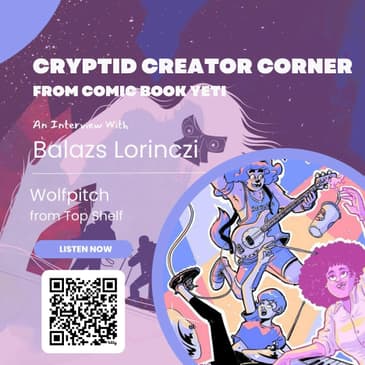

I adored Wolfpitch and was delighted to get to chat with Balazs Lorinczi about it. Wolfpitch is Balazs' follow-up to the GLAAD Media Award nominated Doughnuts and Doom. Balazs was born in Hungary and now lives in Scotland and I was fascinated to learn about his journey in comics as well as why he loves to combine the supernatural and music. Wolfpitch is published by Top Shelf Productions an imprint of IDW publishing. You can find it at your local comic shop on June 12th. I'm always interested in learning how creators got to where they are today and what has influenced them to make the comics they do. I found Balazs to be open and friendly and funny and I can't wait to read more of his comics.
Here is a synopsis of Wolfpitch: All's fair in love and music when this supernatural all-girl rock band must beat the odds and become the best band in town! Izzy's a bass-playing werewolf. Geraldine's the ghost of an amazing jazz pianist. Delilah's the meanest drummer in town. They'd be the perfect trio to win the Battle of Bands... except Geraldine can't play a solo since she passed away, and Izzy and Delilah are at each other's throats at every opportunity. Can they work through their problems to win the competition, or will they be defeated by Delilah's ex-band and their villainous frontman, Dylan? Sparks will fly, milkshakes will melt, and ears will ring in the latest delicious LGBTQ romp from graphic novelist Balazs Lorinczi.
Our episode sponsors
Transphoria Kickstarter
Make sure to check out the Kickstarter campaign for Transphoria, a new new 90 page graphic novel that collects 19 new short storeis about trans and non-binary experiences of gender euphoria.
Arkenforge
Play TTRPG games? Make sure to check out our partner Arkenforge. They have everything you need to make your TTRPG more fun and immersive, allowing you to build, play, and export animated maps including in person fog of war capability that let’s your players interact with maps as the adventure unfolds while you, the DM get the full picture. Use the discount code YETI5 to get $5 off your order.
[00:00:00] Your ears do not deceive you. You have just entered the Cryptid Creator Corner brought to you by your friends at Comic Book Yeti.
[00:00:07] So without further ado, let's get on to the interview.
[00:00:11] Hey, comics fam! Whether you are a long-time listener or a veteran catching the show today, all are welcome here.
[00:00:17] When we started this podcast, inclusion and diversity were at the forefront of what we wanted to cover and promote with it.
[00:00:23] So in June, we'll be celebrating Pride Month for our second year in a row featuring an amazing group of queer creators and their projects.
[00:00:30] One of those projects is from our friends at Lifeline Comics.
[00:00:34] Following their success with By Visibility Still By, Herology, and Rainbow Canvas,
[00:00:39] Lifeline Comics is launching their newest queer anthology, Transphoria, a trans and non-binary anthology on May 30th.
[00:00:47] The 90-page graphic novel will contain 19 stories all about trans and non-binary experiences of gender euphoria,
[00:00:54] crossing all genres like slice of life, supernatural, romance, science fiction, anime, and beyond.
[00:01:01] Featuring a vibrant display of artistic styles and storytelling techniques,
[00:01:05] Transphoria is a testament to the creativity and talent of its contributors.
[00:01:09] From sci-fi, striking stories to endearing romantic adventures,
[00:01:14] this graphic novel celebrates trans stories while delivering a powerful message of empowerment and affirmation.
[00:01:20] I'll put a link in the show notes so you can check it out.
[00:01:22] As always, thanks for listening and have a glorious Pride Month helping us celebrate!
[00:01:31] Y'all, Jimmy, the Chaos Goblin strikes again!
[00:01:34] I should've known better than to mention I was working on my DC Universe meets Ravenloft hybrid D&D campaign on social media.
[00:01:41] My bad.
[00:01:42] He goes and tags a bunch of comics creators we know,
[00:01:44] and now I have to get it in gear and whip this campaign into shape so we can start playing.
[00:01:49] Another friend chimes in, are you going to make maps?
[00:01:52] It's fair to say it's been a while since I put something together, so I guess?
[00:01:57] It was then that I discovered Arc and Forge.
[00:01:59] If you don't know who Arc and Forge is, they have everything you need to make your TTRPG more fun and immersive,
[00:02:06] allowing you to build, play and export animated maps, including in-person Fog of War capability
[00:02:12] that lets your players interact with maps as the adventure unfolds while you, the DM, get the full picture.
[00:02:19] Now I'm set to easily build high-res animated maps saving myself precious time and significantly adding nuance to our campaign.
[00:02:26] That's a win every day in my book.
[00:02:28] Check them out at arcandforge.com and use the discount code YETTI5 to get $5 off.
[00:02:34] I'll drop a link in the show notes for you and big thanks to Arc and Forge for partnering with our show.
[00:02:39] I think I'm going to make Jimmy play a goblin warlock just to get even.
[00:02:44] Hello and welcome listeners to another episode of Comic Book Yeti's Cryptid Creator Corner.
[00:02:49] I just got finished reading this book and I am so excited to talk to this creator.
[00:02:54] They are the mind behind the GLAD-nominated Donuts and Doom.
[00:03:01] They have a new graphic novel coming out through Top Shelf.
[00:03:05] I absolutely loved it.
[00:03:06] It was so delightful.
[00:03:07] I cannot wait to talk to them about it.
[00:03:10] It is called Wolf Pitch.
[00:03:11] I think it's going to be out June 11th and 12th and either in bookstores or local comic shops.
[00:03:18] You need to pick it up.
[00:03:19] We're going to hear all about it as well as finding out more about this creator, Balazs Lurenzi.
[00:03:29] Hopefully I said that name right.
[00:03:30] I was working on it before the podcast.
[00:03:32] Welcome to the podcast.
[00:03:35] Hey Jimmy.
[00:03:36] Yeah, that was absolutely perfect.
[00:03:39] Well good.
[00:03:40] Hopefully it'll be smooth sailing from here.
[00:03:44] I want to talk to you a little bit about your background because I haven't had a chance to read Donuts and Doom yet.
[00:03:51] But after looking into it a little bit in preparation for this, I cannot wait.
[00:03:56] I try to find out.
[00:03:58] I try to have a fairly broad range in terms of the stuff I read with comic books.
[00:04:03] I know I have a couple of blind spots that I'm working on.
[00:04:07] But after reading Wolf Pitch, I just want to know more about your style, your background.
[00:04:12] I understand you're from Hungary.
[00:04:14] You now live in Scotland.
[00:04:15] We'll talk about all of that.
[00:04:16] But I just want to dive right into Wolf Pitch.
[00:04:20] It is so good.
[00:04:23] I cannot wait for folks to get their hand on this and start reading it.
[00:04:29] But rather than me tell it, your three main characters are Izzy, Geraldine and Delilah.
[00:04:37] And why don't you just tell the listeners what is Wolf Pitch?
[00:04:41] What's the pitch for Wolf Pitch?
[00:04:44] Right. So that's the stuff that I'm horrible about because I spent 180 pages flushing out a story.
[00:04:49] So now I have to sum it up in like two sentences.
[00:04:52] But basically it's about Izzy, who is a werewolf who plays the bass.
[00:04:57] And there is Delilah, who is a human girl.
[00:05:00] She plays the drums.
[00:05:01] And Geraldine, who is a ghost, who used to be a really good jazz piano player, but she died, became a ghost.
[00:05:10] And now she works in a burger joint.
[00:05:13] And basically they slowly become a band, but they have some personal problems to work out.
[00:05:22] Mainly Izzy and Delilah just really hate each other.
[00:05:25] They have like long running beef.
[00:05:27] They're like kind of rivals.
[00:05:28] Delilah used to be in a different band, but she's not in that band after a while in the story.
[00:05:34] And then there is a battle of bands coming up, which they have some personal stake in winning.
[00:05:41] But they need to come over the personal problems first to become a fully functional band because they all have their own little baggages.
[00:05:51] I don't know if I summed it up right.
[00:05:53] Do you think I missed something crucial?
[00:05:55] No, other than there's a side character.
[00:05:58] Other than not just personally for me, there's a side character who I really liked, which you didn't mention at all.
[00:06:05] But I'd like to give a shout out for folks when you read the book.
[00:06:09] I really liked Ron.
[00:06:10] Ron shows up three or four times and I just thought, you know what?
[00:06:15] Ron's a good guy.
[00:06:16] I like Ron a lot.
[00:06:17] Yeah, Ron is in the rival band.
[00:06:20] They have a nemesis or like a villain in a different band.
[00:06:27] But Ron, who you liked is just a nice guy in that rival band.
[00:06:35] I enjoyed a couple of appearances from Ron, but I could just write a guy who's just there to support everyone.
[00:06:43] Yeah, I really like I really like whenever Ron showed up and it had something to say.
[00:06:49] I mean, one of the things I really liked is that sometimes with books that have our normal or supernatural characters or cryptids, if we're on the cryptid creator corner, there's a lot of like yes, there's very fitting.
[00:07:10] There's a lot of like, like explanation and sometimes in terms of like the rules of the world.
[00:07:17] And sometimes I like that.
[00:07:19] Sometimes I think it can be too much and get in the way of story just depends.
[00:07:24] And I feel like you didn't have a lot of that.
[00:07:27] This is just the world.
[00:07:28] These are just the characters.
[00:07:29] These are just the folks that live in it.
[00:07:32] There's no like exposition as to how things work.
[00:07:36] These are she's just a you know, is he's a werewolf and you know, Delilah's a ghost now.
[00:07:43] She has or I mean, Darrell is now and he does like like there's like one panel where she kind of like explains what happened in terms of why she's a ghost.
[00:07:53] There's you know, but they go through her thing and some of her baggage about what happened to her and how she died.
[00:07:59] But you don't need it in this.
[00:08:01] Like it's just this is the world.
[00:08:03] These are the characters and this is how they you know, they navigate more so their their their baggage as you said it or their their issues just like like anybody would.
[00:08:15] And I just I really it helped me get like like right in the world.
[00:08:22] I was like OK, this is like right off the beginning.
[00:08:24] This is just how things are.
[00:08:26] We're not getting bogged down in some like supernatural element.
[00:08:28] These are really just about characters and how they interact with each other, how they're overcoming some things in their own life.
[00:08:37] And like I really appreciated that I felt like we were just like right into the story and it just helps you accept like this is this is just the world as it is.
[00:08:46] And I really like that about it and thought that was like really smart.
[00:08:53] I mean, did you ever feel like writing characters like this that you would have to delve into more of why or did you have specific reasons as to why you just wanted to get into the story?
[00:09:03] That is a point I would really like that you raised because it's something that I actively thought about while writing this book and Donuts in Doom as well.
[00:09:15] Because both of those books, Wolf Pitch and Donuts in Doom, so they have supernatural elements in Donuts in Doom a witch and in this one were wolves and a ghost and playing music.
[00:09:25] And these supernatural elements just exist in the world.
[00:09:30] There is no hard rules.
[00:09:32] There is no rules basically.
[00:09:35] Which when I was writing the story, I thought if I eliminate all these, if I just say let's just roll with it, these people are integrated in society.
[00:09:44] We're not even going to mention it.
[00:09:45] No one says in the book werewolves are integrated in society.
[00:09:49] She's just there and no one reacts to her as like, oh my God, a werewolf.
[00:09:54] She's easy and everyone knows her as the bass playing werewolf.
[00:09:58] And if I do that, I can get rid of a huge chunk of like plot and dialogue and exposition that nobody needs or in this story specifically.
[00:10:08] Yeah.
[00:10:09] And that kind of liberated me as I was writing the story, especially when I did Donuts in Doom because I just carried this over to Wolf Pitch basically.
[00:10:21] Because before I did Donuts in Doom, I never ever managed to write a longer form story or even have like just a script off the ground because I always got bogged down in this.
[00:10:36] Because I grew up on a lot of comics that had like really elaborate world building, like just, you know, planetary from Warren Ellis, Jonathan Hickman stuff.
[00:10:47] Oh yeah.
[00:10:48] Grant Morrison.
[00:10:50] Like all those books when there's a lot of lore, a lot of mythology.
[00:10:55] I love that. I think that is great.
[00:10:57] But when I was growing up and reading these stories, they didn't have exposure to other type of stories.
[00:11:04] But not many of them that were similar to how I approached it.
[00:11:10] Or I just can't remember any of them.
[00:11:13] And I thought, okay, this is the way you have to do it.
[00:11:16] If you make a book that has a werewolf in it, you have to explain everything about the werewolves.
[00:11:21] Where do they come from? What's the mythology?
[00:11:24] How can they be killed?
[00:11:25] All the stuff that always comes up with werewolves, which is great.
[00:11:28] I love that.
[00:11:29] But for me, that did not work.
[00:11:32] It turns out I had to just get rid of all that and focus on why am I telling this story with a werewolf?
[00:11:40] So in my stories, in Donuts into Man's Wolf Pitch and future stories, because I have a third book coming out that's going to have a vampire, multiple vampires in it.
[00:11:51] That's never important.
[00:11:53] I only explain the background and the world building if it feeds into what the characters are going through.
[00:12:00] Otherwise, it's superfluous.
[00:12:02] We don't need it.
[00:12:04] Because I think that we just bog the story down.
[00:12:07] Izzy is a werewolf because her being a werewolf plays into her character arc.
[00:12:12] Geraldine is a ghost because it plays into her character arc.
[00:12:15] If I take that away, the story wouldn't be the same.
[00:12:19] That's how I try to approach it.
[00:12:22] Yeah.
[00:12:23] Yeah, I think that makes sense.
[00:12:25] Especially with Geraldine, who seems to have been a successful, when alive, jazz musician and dies, comes back as a ghost.
[00:12:40] She probably has the most in terms of exposition, and it really isn't a lot.
[00:12:48] She kind of goes through it with Izzy pretty quickly as to what happened to her and what some of her issues are now being a ghost.
[00:12:55] And there's a few things that are necessary to explain how she operates as a ghost.
[00:13:02] It has to do with milkshakes is all I'll say.
[00:13:07] It's really fun.
[00:13:09] You can say that because it's in the first 20, 30 pages.
[00:13:13] She is made out of milkshake.
[00:13:16] But it's really fun and adds for some interesting elements.
[00:13:22] But you're right.
[00:13:23] Stories not bogged down at all.
[00:13:25] All of that would be interesting stuff.
[00:13:30] But I find that interesting in terms of any type of world building and lore, but totally superfluous in this.
[00:13:39] Don't miss it at all.
[00:13:41] I feel like most of those stories that do that, and I might be wrong on this, I just thought about this.
[00:13:47] So those stories tend to be from the perspective of humans that explain the lore because we have the POV characters of other humans.
[00:13:54] So we experience that work through them.
[00:13:56] So, OK, like Dracula is from the perspective, but not the book.
[00:14:01] But most of the movies are not the first.
[00:14:03] They are not from the perspective of Dracula or werewolf movies are from the perspective of the victims or people who are about to turn into werewolves.
[00:14:11] And they need to figure out what's going on with them.
[00:14:13] While my books are more about the actual creatures were also just people basically.
[00:14:21] Right.
[00:14:22] And so there's and who are living their life or unlike in the case of Geraldine.
[00:14:29] Yeah.
[00:14:30] And so you don't need any of that.
[00:14:32] They don't every time they meet a new person who might be human, they don't explain how their world work.
[00:14:39] You know, it might have everyone.
[00:14:41] Everyone knows these issues.
[00:14:43] But like because Izzy literally says, oh, you're a milkshake ghost.
[00:14:49] Like that thing. Yeah, I didn't like that was just a small thing.
[00:14:53] But I deliberately like, yes, everyone knows what a milkshake ghost is in that way.
[00:14:59] Yeah. Right. It's just a thing that occurs.
[00:15:03] Yeah. And so in terms of the focus with the band and the battle of the bands and there's there's been stories like this before we got a four and we have to beat the battle of the bands.
[00:15:16] I but I really like your focus on, you know, on the characters and how each of their kind of like you said baggage and issue really like fits in like a neat little puzzle.
[00:15:32] You know how you've structured the story to lead up to the battle of the bands.
[00:15:37] I was in terms of like the focus on music.
[00:15:39] What is your own background with music?
[00:15:41] I mean, do you play instruments?
[00:15:43] Do you have, you know, was that something that was very important to you growing up that you now want to incorporate music and bands into your stories?
[00:15:52] Yes. Not as I was growing up.
[00:15:54] I only started to play music when I was like eight, 19, 18, 19.
[00:16:00] I used to be in bands when I was younger.
[00:16:03] Nothing notable.
[00:16:04] It was all bad, not bad stuff, but just like nothing.
[00:16:07] Nothing good basically.
[00:16:09] I've done it like eight years, I think.
[00:16:13] So the reason I included both in Dorit Sindum and Wolf Pitch music because you know they say write about what you know.
[00:16:21] You should write about something that you have experiencing because obviously that's how it's going to be authentic.
[00:16:27] Yeah.
[00:16:28] And I've just found that setting just attractive to me to put a story in it because again, as I was growing up, I mainly read stories about people punching each other basically.
[00:16:41] Because growing up in Hungary we mainly had superhero comics.
[00:16:44] I was born in the mid 80s, 86.
[00:16:46] So like 90s, early 2000s.
[00:16:49] There was not a lot of graphic novels around or just monthly comic books that were not about Spider-Man, the X-Men, Superman, etc.
[00:16:58] So for a while I really struggled to come up with a story that didn't revolve around just physical violence, like action basically.
[00:17:09] When I got into Doctor Who like over 10 years ago, that was kind of like a revelation where you can make an action story without having actual action in it.
[00:17:18] And then the last few years just kind of like tried to distance myself from it.
[00:17:23] And then when I feel like, okay, what can I do with a band?
[00:17:26] Battle of bands or the big dramatic set piece at the end of a story could be like a big concert and the drama around it basically.
[00:17:36] Because I used to be in bands, used to do live performances, used to record some stuff small scale, like not in big studios or anything or like stadium concerts.
[00:17:49] But you know going to clubs performing, that's something I knew.
[00:17:53] So I thought, okay, let's do that.
[00:17:55] Let's combine that with the magical stuff, the supernatural stuff that I like and what I was always interested in.
[00:18:04] I do still play, I play the bass.
[00:18:07] So I have a very similar bass to how I'd draw on Izzy's bass.
[00:18:14] Oh, all right.
[00:18:15] That makes sense.
[00:18:16] Yeah, it's good because I have the reference right next to me as well.
[00:18:22] Right. Yeah, that makes a lot of sense.
[00:18:26] And it makes a lot of sense in terms of why you would do this focus if that's something that you had done when you were 18, 19 and for a number of years playing in bands.
[00:18:38] Yeah.
[00:18:39] It's funny you mentioned Doctor Who in terms of storytelling.
[00:18:42] I was just watching one of the new episodes this morning.
[00:18:46] Did you watch the new one?
[00:18:48] I think I just started the new, the very newish season of Doctor Who with the episode Space Babies.
[00:19:00] Okay, okay.
[00:19:01] I've seen that one.
[00:19:02] I haven't seen the new episode that just came out.
[00:19:04] So I just want to spoil it for me because I'm watching.
[00:19:07] Oh no, I wouldn't.
[00:19:08] I won't spoil it for you or any listeners.
[00:19:10] Yeah.
[00:19:11] So I just started Space Babies.
[00:19:13] But yeah, I was but I came to Doctor Who very late.
[00:19:17] It was one of those things that I heard about from older kids when I was younger who would like stay up late and watch it on PBS over here in the States.
[00:19:26] That's the old stuff, right?
[00:19:28] Yeah, that would be like the old like Tom Baker and you know some of those some of the older doctors and then they had like a US TV movie on.
[00:19:39] The Paul McGann one.
[00:19:42] Yeah, the Paul McGann one in like the I guess the mid 90s and then it wasn't until 1996.
[00:19:48] Yeah, I think so.
[00:19:50] When they brought it back, I didn't start until I think like it was probably halfway through Matt Smith's run.
[00:20:02] Yeah, yeah.
[00:20:03] But I either I don't know if I found the DVDs or it was streaming somewhere by then and started watching it at Christopher Eccleston season and just like fell head over heels within the Doctor Who.
[00:20:17] I've done the exact same thing.
[00:20:20] Exactly.
[00:20:21] Same like I've seen.
[00:20:23] I've seen when I was a little kid on Hungarian HBO, they had it was one of the Peter Cushing.
[00:20:30] Do you know about those?
[00:20:31] The Peter Cushing Dalek movies?
[00:20:34] No, no.
[00:20:36] They like Peter Cushing like Grand Moff Tarkin from Star Wars.
[00:20:40] Yeah, yeah, yeah.
[00:20:41] And Van Helsing from the Hammer Dracula movies.
[00:20:44] Yeah, so he played Doctor Who, but he wasn't the Doctor Who.
[00:20:49] So they basically bought the rights for the Daleks.
[00:20:52] I can't remember what studio was it, but not to Doctor Who and they called them movies like Dalek Invasion of Earth and I can't remember what the other one was called.
[00:21:01] So it was an American remake of Doctor Who, but he wasn't an alien.
[00:21:05] He was just a guy called Doctor Who, but he had the card this and he had the granddaughter Susan.
[00:21:10] So it was a remake of the first.
[00:21:14] Okay.
[00:21:15] Yeah.
[00:21:16] First Doctor Blanking on.
[00:21:17] William Hartnell.
[00:21:18] William Hartnell.
[00:21:19] So embarrassing.
[00:21:22] I know all this stuff.
[00:21:23] I'm just blanking here now.
[00:21:24] Yeah, the first William Hartnell Dalek story and there was another one that they remade.
[00:21:28] I've seen one of them.
[00:21:29] I was like seven and they are like kind of comical.
[00:21:33] Like if you watch it now, they're funny.
[00:21:36] But when I was seven and I've seen a Dalek, I was scared to death of that thing.
[00:21:41] That was my first exposure to it.
[00:21:43] So I always knew that there is something with a guy with an umbrella, which was a Sylvester McCoy.
[00:21:48] I knew that he existed and I've seen bits and bobs from the Eccleston stuff on TV.
[00:21:53] But then I decided, okay, everyone is talking about this Matt Smith guy and Stephen Moffat's writing.
[00:22:00] What is this?
[00:22:01] And just like you, middle of Matt Smith tenure just went back to the very start with Eccleston and then just caught up with it.
[00:22:09] And I just fully immersed in it and became like a super fan.
[00:22:13] And I went back to the classic stuff.
[00:22:16] I don't know why I went on a tangent with the Peter Cushing stuff, but yeah, that's something.
[00:22:21] They released them on Blu-ray now, I think.
[00:22:24] That would be pretty cool.
[00:22:26] They are in color.
[00:22:28] So like you have the black and white, you know, William Hartnell stuff from 60s BBC that they made like with a budget of like five pounds and a Snickers bar.
[00:22:37] And then Peter Cushing stuff is like fairly high budget, like Technicolor.
[00:22:42] So it's kind of like pretty cool to see like a bit more higher budget, higher end production.
[00:22:47] I will have to crack those down and find them.
[00:22:51] So you mentioned something in terms of the comics that were around when you were growing up in Hungary.
[00:22:58] Yeah.
[00:22:59] And I mean, was there anything?
[00:23:02] I've talked to other folks who grew up outside of the States or and, you know, a lot of times you'll hear stories that like there was no new issues every week.
[00:23:14] Like sometimes a place near you would just have some comics that whatever they had gotten in, like was that what it was like Hungary?
[00:23:25] Yeah, very much so. Hungary doesn't.
[00:23:27] Okay, I'm going to say some things that probably if Hungarians listen to this, they might be angry at me.
[00:23:32] I haven't been back in the last 10 years, so I don't really know what the comic book industry is there now.
[00:23:36] I think it's much better than what it used to be.
[00:23:39] There are some things that are coming out and people are buying and reading them, which is, I think, great.
[00:23:44] But back in the days, Hungary never really had a comic book culture compared to like the United States or Belgium, France, Japan, obviously.
[00:23:56] Italy with the Fumati stuff.
[00:23:59] We mainly had like adaptations of like literature, like prose novels.
[00:24:06] That was probably the most well-known things and like newspaper strips.
[00:24:12] That was it.
[00:24:13] There was no...
[00:24:15] I'm thinking of like there is like, I think there's a Polish fairly well-known, like long running character.
[00:24:22] I can't remember.
[00:24:24] Do you know what I'm talking about?
[00:24:27] I think a guy is wearing like a red shirt or like Dylan Dog, for example.
[00:24:32] It's like a long running character from a certain country.
[00:24:35] We never had, as far as I can remember, we never had one of those.
[00:24:38] And then in the 80s, I think it was late 80s, they started licensing probably because of the end of the Soviet regime, because in 89 the Berlin Wall fell.
[00:24:50] And we were on the side of the Russian side of the Berlin Wall.
[00:24:54] So we didn't really get Western stuff in.
[00:24:57] We had some French comics, some like similar to Tom and Jerry, Dog and Cat, whatever.
[00:25:05] We got them because the French publisher, if I remember correctly, was like a communist publisher.
[00:25:11] So the Russians were like, OK, you can import that legally.
[00:25:14] But that was for kids.
[00:25:16] I think it was called PIF.
[00:25:18] I think it's called PIF.
[00:25:20] But when they started easing up all those restrictions and the Russians left, we had all the Western stuff coming in all of a sudden.
[00:25:29] So we got Superman, Batman, Spider-Man, and then X-Men after that, some Transformers.
[00:25:37] And then they experimented with other stuff here and there.
[00:25:41] We had like one magazine that was just a marvel, like everything.
[00:25:47] So for three months you're going to have this Daredevil story.
[00:25:50] Then after that, you're going to have an Avengers story for four months.
[00:25:54] And they just called it Marvel Extra or something, Marvel Plus or whatever it was.
[00:25:59] That was basically it.
[00:26:02] All right. Let's take a quick break.
[00:26:04] Hey, comics fam.
[00:26:06] indie comic book publisher Banda Bars just got a level up and announced it is now a cooperative.
[00:26:12] This heralds a new era for them, including a partnership with Dallas Stories.
[00:26:16] And they added several new members to the ownership group.
[00:26:19] Marcus Jimenez is now chief operating officer.
[00:26:22] Brent Fisher takes on the role of chief diversity officer.
[00:26:25] And Joey Galvez is introduced as head of Kickstarter Ops and social media manager, which is sure to increase their capabilities overall as a publisher.
[00:26:34] And it further promotes their mission statement of advancing representation, inclusion and diversity in the media.
[00:26:41] They also established a new board of directors to help chart the new path of their journey.
[00:26:45] With new projects in the works like Alaska by dropping in June, Unbroken soon launching on Kickstarter and Pond coming up with Dauntless.
[00:26:52] Stay tuned to this space for more exciting news from the growing Bars family.
[00:26:57] Let's get back to the show.
[00:27:02] What was it that attracted you in terms of like comics?
[00:27:07] Was it like, you know, typical kid power fantasy type of stuff or was it the colors?
[00:27:13] Was were you interested in art then in terms of like, you know, pursuing it more than I mean every kid I think is interested in like art to some degree.
[00:27:23] Right. Everyone is here. Color this, draw this that type of stuff.
[00:27:28] Was that something that you took too early on as well?
[00:27:31] I think in that order, as you mentioned it.
[00:27:34] So power fantasy, cool colors and then wanted to draw myself as well because I was like four, maybe four years old when I first.
[00:27:42] Seen a Batman comic. I have this memory that changed over time, but I thought I first comic I got was the killing joke, but it wasn't.
[00:27:51] I realized later.
[00:27:53] That's a heck of a comic to start with.
[00:27:57] So it was published around that time.
[00:27:59] But I remember my dad just bought me one to shut me up when we went on like a long bus ride.
[00:28:04] But later I remembered when I read that comic actually like 25 years after it was the Peter Milligan Dark Knight Dark City.
[00:28:13] Oh, that was your first comic?
[00:28:17] Yeah, it was the issue with the Riddler when he almost like chokes a baby with a ping pong ball.
[00:28:24] Do you know that one?
[00:28:26] I mean, I know that I know some of the Peter Milligan run.
[00:28:31] It's Peter Milligan, is it? Dark Knight Dark City.
[00:28:33] It was published in like a paper back not that long ago.
[00:28:36] Yeah, I think that's right.
[00:28:39] I'm looking up. But go ahead, tell me about it.
[00:28:41] Yeah, so it's fairly similar in tone to the killing joke.
[00:28:46] And for a four year old, I just I remember looking at like this is this is not for me.
[00:28:50] This is for adults, but also it's Batman because Batman was everywhere at the time.
[00:28:54] Eighty nine. The movie came out. So I was very well aware of that.
[00:28:57] I was three years old. And then after that, just just I don't know if I kept asking for it,
[00:29:03] but I've always been into comics and I've never been ashamed of it.
[00:29:08] Like even like it was like 13, 14 and all my friends were like, oh, that's lame.
[00:29:12] Spider-Man, that's for kids.
[00:29:14] I'm like, oh, man, that's cool because I feel like at the time up until like maybe maybe 12, 15 years ago,
[00:29:23] not not much in terms of like other mediums could match what comics would come in.
[00:29:29] Books could offer to people just the the the dynamism of the action, the scope of the stories.
[00:29:40] Like, you know, when you when you have the Avengers in space fighting aliens,
[00:29:45] like point me at a movie that at that time that could have done that or a TV show or a video game.
[00:29:53] But that would be that immersive without being like, you know, hokey, just kind of goofy.
[00:29:58] Some cartoons there. But at the time, the cartoons were like, you know, the He-Man,
[00:30:04] the Transformers that the mass produced like kind of advertisements for for toys, Teenage Mutant Ninja Turtles,
[00:30:11] which I loved. But it wasn't the same as the comics like the best and the more like the closest they got to me,
[00:30:19] to what like just the whole experience of reading a superhero comic was probably the end of the second season of the Justice League cartoon.
[00:30:30] Oh, OK. No, even the fourth. No, actually the end of Unlimited.
[00:30:33] Just how like it felt like, yes, this is what it feels like reading a comic book as a child.
[00:30:39] It gives you that like that rush.
[00:30:42] And until then, nothing like I do love movies like Star Wars was great.
[00:30:47] But I can't say like Star Wars is a similar experience than reading, you know, a Dark Phoenix saga as a nine year old.
[00:30:56] Yeah, I don't know if that makes sense.
[00:30:59] I'm saying right now. No, no, I think it does.
[00:31:02] I mean, you know, I liked comics as a kid and I've said it a million times on this podcast.
[00:31:07] I took like a long break really from comics while I was doing school stuff and then got back into it.
[00:31:12] And yeah, I was always a big movie fan. Love movies.
[00:31:17] Netflix came out. I was like the first to get the little red envelopes here in the States or the DVD DVDs in the mail.
[00:31:25] Yeah, I love movies.
[00:31:27] And then but when I got back into comics, I had like the same experience.
[00:31:31] I kind of got away from watching, you know, a lot of movies and TV.
[00:31:36] If somebody recommended something good or, you know, I have kids now.
[00:31:39] So we've seen all the kids movies and I've introduced them to or at least tried to introduce them to stuff that I liked as a kid, which sometimes is OK.
[00:31:47] And sometimes they're not interested in it.
[00:31:49] And that's fine. But I just I love the immersiveness of of comic and especially a whole storyline or a graphic novel.
[00:31:59] I don't know what it is now in my mid 40s.
[00:32:01] And that's been at least for the last 10 years.
[00:32:04] So that I really feel I can get like absolutely like lost in it.
[00:32:10] And I'm not an artist. I cannot. My 11 year old draws and I don't.
[00:32:14] The talent came from my wife side of the family, I think, because I have very little artistic ability whatsoever.
[00:32:23] But I love that she loves it.
[00:32:26] And I love the artwork. I love getting into it.
[00:32:29] And yeah, I just that ability to be able to really get like lost in something.
[00:32:35] And as a kid, I was always a fast reader.
[00:32:38] And I love that now as I'm getting older, like reading comics and really paying attention to the art kind of forces me to slow down as I read and really pay attention to everything on the page and everything, you know, on that panel in between those gutters.
[00:32:52] And yeah, it's what I prefer to do now in terms of consuming stories, I guess, or learning or really kind of getting into it and breaking stuff down.
[00:33:05] I love all the things that like, you know, comics can do to do some of the stuff in movies and TV have to have a huge budget.
[00:33:12] You know, yeah, computer graphics, anything like that are so expensive comics.
[00:33:16] There's hardly any limitations.
[00:33:17] Whenever I see somebody doing something new, whether or not it's storytelling, or whether or not it's in the artwork on the page or lettering, whatever it might be.
[00:33:24] I just like, get like obsessed with it.
[00:33:29] But yeah, I think what you're saying makes total sense.
[00:33:32] I did look it up. Dark Knight Dark City was Peter Milligan with illustrations by Kieran Dwyer and had a cover illustrations by Mike Mignola.
[00:33:41] Mike Mignola. Yeah, yeah.
[00:33:42] I didn't even remember that I got, but I don't know if we went with the Mike Mignola covers in Hungary actually.
[00:33:50] I can't remember the covers, but if they went with the Mike Mignola one, that's crazy that I get exposed to Mignola that early in life and I just forget about it until Hellboy basically.
[00:34:01] Yeah.
[00:34:03] Well, so, you know, having all of this stuff going on in terms of being exposed to comics and an interest in artwork.
[00:34:15] What, where did you get to a certain point that you were like, I'm gonna, I'm gonna pursue this.
[00:34:20] I'm really going to pursue art as not just a, you know, a pastime or something for fun, but like as a craft.
[00:34:28] When did that decision start to happen?
[00:34:30] Because you've already talked about, you know, 1819 you're playing in bands for a bit.
[00:34:34] Were you also pursuing art at that time as well?
[00:34:37] Yeah, yeah, yeah.
[00:34:38] That kind of started almost at, well, not almost at the same time.
[00:34:42] So I tried to keep this brief so not to bore anyone.
[00:34:45] But basically, I realized not that long ago that I think I'm the type of person if I like something, I want to try my hand at it.
[00:34:55] Whatever that is.
[00:34:57] I want to, you know, touch that thing.
[00:34:59] I want to do it myself.
[00:35:01] I don't know.
[00:35:02] I think it's just the personality type I am.
[00:35:04] So because I like comics, I always try to draw myself because even as a small child, like, oh, that's drawings.
[00:35:10] I can do drawings.
[00:35:11] And I remember trying to do my own comic when I was like six, seven.
[00:35:16] But I could read and write.
[00:35:17] So I was at least seven.
[00:35:19] It was obviously terrible, but I was a child.
[00:35:22] But I always, I always tried to do like little comics.
[00:35:26] And when I was in high school, I remember a point where I said to myself, I think I have some talent at drawing, but I need to like develop this because I'm not where I thought I would be.
[00:35:39] As a kid, I get told that I'm good at drawing because, you know, parents just tell you if they see that you like doing that.
[00:35:47] So I started like I started doing it.
[00:35:49] I started doing comics in high school, mainly about just my friend group.
[00:35:54] And then because in Hungary, there's not a lot of opportunities for comic book artists to do it as a professional.
[00:36:01] My mom told me to want to go to do animation, study animation, because I like that.
[00:36:07] So I went to do that.
[00:36:09] It was like a short little course and I went to do filmmaking because again, something I like movies.
[00:36:14] So I thought why not try my hand at it.
[00:36:16] So I've done a two year course on filmmaking.
[00:36:19] I realized I don't want that.
[00:36:21] I got a job at an animation studio for a bit after.
[00:36:25] And then I went to do freelancing because I just had no idea what to do with my life.
[00:36:32] So I don't like just, you know, like people on like these websites, like what was it called?
[00:36:38] Or desk and stuff like when you can hire artists like fiber, basically.
[00:36:42] OK, sure.
[00:36:43] Oh, make me a logo, do me a comic.
[00:36:46] So I've done there was a guy who hired me there to make his comic, draw his comic that he wrote.
[00:36:51] It wasn't great.
[00:36:52] And working with him wasn't great.
[00:36:54] But he paid me a bet.
[00:36:56] And then he gave me some really harsh feedback that I really hated, but actually made me somewhat of a better artist.
[00:37:03] But that thing never went anywhere as far as I know.
[00:37:06] I do like two or three, maybe 100 pages probably.
[00:37:10] Oh, wow.
[00:37:11] Yeah, it's bad.
[00:37:13] But I look at it now and not even his story like no disrespect to him.
[00:37:18] Like, you know, he just wanted his story to be drawn.
[00:37:21] He paid an artist who is me.
[00:37:23] It's not my place to criticize his story as far as my art.
[00:37:27] I look at it like, oof.
[00:37:29] Yeah, OK, I get it.
[00:37:31] I understand.
[00:37:32] But that's literally just what I've done as an artist before this.
[00:37:39] I moved to Scotland.
[00:37:41] I've worked for DC Thompson, which is a local publisher here in Dundee.
[00:37:45] They do the Beano and Desperate Den, which if you're local, if you're in the UK, basically, you know the Beano.
[00:37:53] And Danger Mouse.
[00:37:54] I drew one whole page of Danger Mouse on credit.
[00:37:58] OK.
[00:38:00] That was the first thing I've done for them.
[00:38:02] They were looking for an editor, assistant editor that I applied for.
[00:38:07] I don't know why, but they were like, well, we don't not going to hire you for that.
[00:38:10] But do you want to freelance for us?
[00:38:12] Sure. Yeah.
[00:38:13] A bit of extra money, you know, a bit of comic stuff.
[00:38:15] Thought maybe going to lead to something.
[00:38:17] Never let do anything.
[00:38:18] Dried up after a while.
[00:38:19] Got some money out of it.
[00:38:20] Not much.
[00:38:21] They don't like to pay.
[00:38:23] But you did a whole you did just you got to draw some Danger Mouse.
[00:38:27] And I'd done some kids WWE comics.
[00:38:32] OK.
[00:38:33] But not like comics.
[00:38:35] Yeah, but it was about a kid who really liked wrestling.
[00:38:37] I think I've done like the Rock once maybe or something like a couple of wrestlers.
[00:38:41] OK.
[00:38:42] Who's the guy who says woo a lot?
[00:38:45] Ric Flair.
[00:38:46] Yeah, I think I've done Ric Flair.
[00:38:47] I can't remember.
[00:38:48] It's been years now.
[00:38:49] But yeah, that's that's like the extent of it.
[00:38:52] And then I stopped doing all that for a while.
[00:38:55] And then the pandemic happened.
[00:38:57] And I was doing some illustrations here and there just for my own sake.
[00:39:02] So I'll draw a picture because I like to draw.
[00:39:05] Well, I was kind of giving up just like, OK, it's never going to amount to anything.
[00:39:08] I need to do a day job.
[00:39:11] You know, I need to support myself.
[00:39:12] I can't I can't just like screw around and just try to be an artist because I never I've done comics before for like small like online Hungarian publications and try to do my own story.
[00:39:25] You know, like a five, six issue on or whatever.
[00:39:28] But it's just never it's never been good.
[00:39:31] And it never really amounted to anything substantial, basically.
[00:39:35] And then the pandemic happened and I thought, OK, I'm off on furlough for two months at least.
[00:39:42] What am I going to do?
[00:39:43] I can't just sit like sit on the couch and watch movies.
[00:39:45] I've done that for one day.
[00:39:47] And I thought this no, this is not it.
[00:39:50] So I started doing a little comic.
[00:39:52] I was like 24 pages.
[00:39:54] And when I finished that, I thought, I don't want to stop.
[00:39:57] I don't want to stop drawing.
[00:39:59] I was drawing every day for two months.
[00:40:03] Give or take.
[00:40:04] Sometimes I took half a day off.
[00:40:06] But no, I don't want to stop.
[00:40:08] I need to go back to work.
[00:40:09] I worked in McDonald's at the time full time.
[00:40:12] And before that, I thought I'm never going to have time to do this because it's so exhausting to work an eight, nine hour shift in McDonald's and go home and then just try to work something else.
[00:40:22] But after the pandemic, I thought, no, this has to continue.
[00:40:26] I can't grow old working some job I don't care about.
[00:40:29] So I just started throwing donuts in doom.
[00:40:32] And then I finished that book and I sent it to publishers.
[00:40:38] And Chris Starros from Top Shelf, he replied to me, said we are interested in this.
[00:40:44] And I said, yes, please.
[00:40:48] So yeah, because my thinking was I have a story to tell.
[00:40:54] I thought it's going to be maybe 50 pages.
[00:40:57] And then as I started drawing it, I was 10, 12 pages in.
[00:41:01] I thought, yeah, that's that's I'm not going to finish this in 50 pages.
[00:41:04] This might be like 100 plus.
[00:41:07] I never thought I will have the willpower and the energy to do 100 plus page graphic novel, especially not with a full time job.
[00:41:15] I was very exhausting.
[00:41:17] But I had such a drive.
[00:41:20] And I was 34 years old as well.
[00:41:23] So obviously, you're not young anymore.
[00:41:28] But like when you're in your 20s and teens, you just have I don't know how old you are, but just you're not in your 20s.
[00:41:34] That's what I meant.
[00:41:35] Sorry.
[00:41:36] I am. I am 45.
[00:41:38] If you said you're 35, I would have believed you.
[00:41:41] Right. So no offense there.
[00:41:42] Just saying like we are not teenagers anymore.
[00:41:44] Like, you know, things are.
[00:41:47] Yeah, I totally.
[00:41:48] I totally get it.
[00:41:50] Like 20, 25 plus page, you know, 100 plus page graphic novel.
[00:41:55] Yeah.
[00:41:56] But 20, 25 years ago, it seems like we had time to do like four different things like in one day.
[00:42:02] Like you met with your friends and you drew your comics and then you went on a bike ride and then you went out partying.
[00:42:08] And now I'm just like, I can't do one of these properly.
[00:42:12] So how am I going to do like a full graphic novel while also flipping burgers in McDonald's and just, you know, taking care of myself because I'm a single man.
[00:42:21] I live alone.
[00:42:22] There's no family around me.
[00:42:23] So I'm kind of supporting myself fully not to complain.
[00:42:26] It's just a fact.
[00:42:27] Right.
[00:42:28] Sure.
[00:42:29] But I had for some reason just had this like the drive to finish this story.
[00:42:36] I just felt like I got something.
[00:42:38] And I thought, you know, even if, even if I don't have something, even if no one cares about this, at least I got this done and the next one's going to be better.
[00:42:48] And I feel really lucky that Chris opened that file, a PDF I sent him and he thought this is worthy of publication.
[00:42:58] Yeah.
[00:42:59] And then when that happened, I just, I felt like just a whole new, I don't even know how to put this, like just a word turned upside down in my head a bit.
[00:43:13] The thing is, oh, I've done this.
[00:43:15] I could, as a nobody, because all these like what I've done before, basically the reason I told you and the listeners, like what I've done before I've done Donuts and Doom.
[00:43:26] I've done nothing, nothing that you can show to people like, oh, this is my resume as a comic book artist.
[00:43:33] Yeah.
[00:43:34] I just, so after that, I just went and finished the whole graphic novel and sent it out to publishers.
[00:43:39] And one of them said, yeah, we're going to publish it.
[00:43:41] And that kind of changed my mindset of like, I can do this.
[00:43:45] I could try to do this proper.
[00:43:48] And that book allowed me to work less in McDonald's and I quit that job.
[00:43:52] I work a different job now.
[00:43:54] And then Wolf Pitch, I sold Wolf Pitch as well.
[00:43:56] And then my third book is just sold now, which allows me to work even less in my day job and focus more on comics.
[00:44:03] Yeah.
[00:44:04] I mean, that's it's just amazing.
[00:44:06] The more I talk to comic creators and I've done over 100 episodes of this podcast now, I mean, the more so than anything else is like is perseverance.
[00:44:20] Right.
[00:44:21] It's like, yeah, that's it.
[00:44:23] Like keep an added staying in the game, like work on your craft.
[00:44:28] That seems to be the number one thing.
[00:44:30] Like there's a number of creators who are like, I didn't think I could do this or I didn't think would be possible.
[00:44:36] And what do I know about this and that?
[00:44:38] And then it's just you just keep at it more so than anything else.
[00:44:44] You know, keep trying to do it.
[00:44:47] And, you know, Wolf Pitch, just to kind of turn back to that is, I was rambling.
[00:44:55] Sorry.
[00:44:56] No, you weren't rambling.
[00:44:57] I mean, these are the stories I like.
[00:44:59] I like to know about the folks that are making these things that I like.
[00:45:03] Look, when I said I'm 45, we talked about age and young 38 this year.
[00:45:09] So you're 38.
[00:45:11] So like when we were growing up and you found something that you like and if we're at least a little bit alike in terms of the type of people, when we found something that we loved, we kind of went all in on it.
[00:45:23] That's how I always was.
[00:45:25] When I found something like Doctor Who or when I was a kid, it was Star Wars.
[00:45:29] And I got a little bit, you know, obsessive about it in terms of I wanted to know everything about the world.
[00:45:36] I wanted to read all the stories.
[00:45:38] I wanted to do all of that.
[00:45:40] And, you know, but we had no connection to the people that were making the stuff right now.
[00:45:46] Nowadays, the one good thing is it can be a bad thing, of course, too, for certain fandoms and creators.
[00:45:54] But the one nice thing is that you can have kind of a connection to the people that are making the stuff now and especially doing this.
[00:46:02] It's one of the reasons I love this podcast so much is I want to know about the people making the stuff that I like.
[00:46:08] And so whenever I find, you know, I like to try and search out creators.
[00:46:12] If I read a comic, you know, we get plenty of emails from publishers or PR people trying to set up stuff.
[00:46:19] But when I read a comic that I really love, I love to search out and try and interview the writer, the artist or the colorist, the letterer, the editor, anybody involved in it just to kind of, you know,
[00:46:31] learn more about them, learn about their story.
[00:46:33] And it's amazing the number of times you'll hear from creators.
[00:46:37] It's not that, you know, I was born to do this and I was it's I worked at it over and over again.
[00:46:45] I kept trying. I kept failing.
[00:46:47] And I try some more.
[00:46:48] And, you know, and then what you're left with, then you look back at the work and you're like, gosh, this is just, you know, you're from Hungary now live in Scotland.
[00:46:59] You've done these different things, but you've created this like wonderful story about these three female characters who, as you said, all have their own little bit of baggage who have, you know, have to come together for this battle of bands.
[00:47:13] Like that's your premise.
[00:47:15] And you've created such a like such a rich, complex, interesting characters that I mean this, you know, for a younger audience.
[00:47:25] I think has so much to show, you know, in terms of some of the stuff that the characters are going through that I'm sure the younger people, the kids reading it are going to see a lot of themselves.
[00:47:39] There's a werewolf bassist who they are going to see part of themselves in, in terms of something that character is going through.
[00:47:48] And also adult readers like this is not like just YA type of type of book where I think sometimes why stuff gets like unfairly pigeonholed into like just for kids.
[00:48:01] Like I love this.
[00:48:03] I would I you know, I'd read Wolf Pitch Volume 2.
[00:48:07] I just thought it was, it was so good.
[00:48:10] There were moments of it.
[00:48:11] There were cute.
[00:48:12] There were times I was laughing.
[00:48:13] I just, I felt the connection with all the characters.
[00:48:16] Your side characters are so well fleshed out.
[00:48:18] Like I mentioned Ron again, but another side character, Geraldine's boss Kate shows up a couple of times and is just like she, I want to know more about her.
[00:48:30] And I think Terry is the guy that works in the back.
[00:48:32] Like I want to know more about.
[00:48:33] Terry is my little favorite character.
[00:48:37] Very, very like couple of appearances, but I just felt something to them.
[00:48:42] Kate and Terry.
[00:48:44] And I mean you use your side characters so well.
[00:48:48] You know, you have to flesh out your world with like other people and Geraldine has a job and she works at the burger joint, but she also wants to be in the band and she's dealing with her stuff about being a ghost.
[00:48:57] And, and, and you have all this, like all these things going on, but you have some of your side characters deliver such like great lines.
[00:49:06] I'm going to one in particular when Geraldine is talking to Kate about what's going on with the band and Kate has this line about Izzy where she says Izzy has big emotions that come with big gestures.
[00:49:20] Like what a simple line that says so much about your characters in terms of Kate and Geraldine, how she reacts to it and about Izzy.
[00:49:28] Like it's just great to give that type of like insight to like a side character.
[00:49:33] It feels so real.
[00:49:34] It feels so genuine.
[00:49:36] And it's also telling you a ton about, you know, the people that we've come to know over 100 some pages.
[00:49:43] I mean this is like 180, 192 pages.
[00:49:47] Yeah.
[00:49:48] I just just loved it.
[00:49:51] Love the love those little touches.
[00:49:53] But thank you.
[00:49:54] But again, as I mentioned before we started recording a very better taking compliments but I really are just satisfied of what you are saying because that's the stuff that I want people to take away from the story as well.
[00:50:08] I want to feel like they're just in that world with these people and not to feel like this is like a concept or this is like a project I'm doing or like showcase or whatever.
[00:50:19] You know what I mean?
[00:50:20] Like the story doesn't exist to pitch a movie or just to give me an excuse to draw a werewolf or whatever.
[00:50:28] It doesn't even look like a traditional werewolf.
[00:50:32] I just wanted people to get to hang out with my characters for 100 and plus pages.
[00:50:39] Yeah.
[00:50:40] And it will basically go through a character arc because there must be a story, must be some plot or a narrative there to keep people engaged.
[00:50:46] I tried my best at them but my main goal to be fair was to...
[00:50:51] It was a selfish goal.
[00:50:53] I wanted to hang out with these characters.
[00:50:56] And I wanted to transfer that feeling to the readers so I'm glad that it seems like it worked for you.
[00:51:02] Hopefully it's going to work for the readers as well.
[00:51:05] I feel like when they finish the book, because that's my favorite feeling when I finish the book, anything else like more than a good plot twist, more than a kickass action scene.
[00:51:15] I close the page or I finish a TV series or whatever and think I miss these guys.
[00:51:20] I want to be there in that world with them.
[00:51:24] Whatever that is, it can be a very dystopian world. It can be a sad story.
[00:51:29] But when I'm done, I just want to think, oh, I miss that guy.
[00:51:33] It was five minutes ago that I was with them in their own little world.
[00:51:36] I want to still be there so I hope that that transfers to my readers as well.
[00:51:41] They're going to think like, oh, that was a good...
[00:51:43] I don't know how long you're going to take them to read it.
[00:51:46] And I wish I could be there in that little burger joint drinking milkshake or whatever.
[00:51:51] Oh yeah.
[00:51:53] No, I think they will. I hope the readers find this.
[00:51:59] I think they're really going to love it.
[00:52:02] And yeah, I definitely finished reading it and I felt the same way.
[00:52:07] I was like, I want to go back and revisit it.
[00:52:09] This is the type of stuff now that I'm older where with my 11-year-old, with Charlotte, where I want her to read it so we can talk about it.
[00:52:22] Because I want to experience it again.
[00:52:25] It's like, well, I can't read it again for the first time.
[00:52:28] But I can ask her if she'll read it.
[00:52:31] And if she does, we can sit down and talk about it.
[00:52:35] And I've done that a few times with books that I've gotten to read or that I've interviewed some of the creators that I really love.
[00:52:42] And have asked her, can you read this so we can talk about it and get to say, didn't you like this part? Didn't you like that?
[00:52:47] What did you think of this character?
[00:52:49] And also, I like to see, you know, she's 11.
[00:52:53] Kind of like to see her insight in terms of the characters.
[00:52:55] It's just funny, like the things that...
[00:52:58] It's very different from your own.
[00:52:59] Oh yeah.
[00:53:00] Yeah.
[00:53:01] And what I read in it, by the way.
[00:53:03] What's her favorite stuff now?
[00:53:05] Like, what does she read?
[00:53:06] Like, what books that she really...
[00:53:09] You said manga, right?
[00:53:11] Like, she reads manga.
[00:53:12] Yes, she does.
[00:53:13] In terms of comic books and graphic novels.
[00:53:16] I mean, she reads what she has to read for school, which I think they're reading Where the Red Fern Grows, which I'm surprised schools are still reading that.
[00:53:22] Not that it's a bad book, but just it's...
[00:53:24] I don't think I ever read that.
[00:53:26] No, I don't know that one.
[00:53:27] Yeah, it's about a...
[00:53:30] I know the title, but I just don't know anything else.
[00:53:33] Her school is reading that right now.
[00:53:35] But in terms of graphic novels recently, she continues to read the Wings of Fire series, which are books.
[00:53:43] And they've also made some of the books into graphic novels.
[00:53:46] And she likes Warrior Cats.
[00:53:48] In terms of manga, she's read a lot of My Hero Academia.
[00:53:53] She right now, I think, is reading Demon Slayer.
[00:53:57] Oh really?
[00:53:58] Yeah.
[00:53:59] I mean, My Hero Academia, I love that.
[00:54:02] But some of the characters in it are questionable a bit.
[00:54:10] Yeah, we've had some discussions.
[00:54:15] Obviously, every kid is different.
[00:54:17] But sometimes I watch it and I'm like, why did you do it that way?
[00:54:21] There's a certain character, I think you know who I'm talking about.
[00:54:25] What's his name? Minata?
[00:54:28] Just get him out of that book, please.
[00:54:30] Yeah.
[00:54:31] But I'm watching the anime, but get him out of that series.
[00:54:34] So yeah, so...
[00:54:36] It's a really good series, to be fair.
[00:54:39] If I was 11 years old, I would be all over it.
[00:54:43] It's brilliant.
[00:54:45] So she...
[00:54:46] I think she's still reading Demon Slayer right now.
[00:54:50] Demon Slayer is great.
[00:54:51] Yeah, she's read some of that.
[00:54:52] And I haven't read a lot of manga at all.
[00:54:54] I have a huge manga-sized hole in my comics and I gotta try and catch up on...
[00:54:59] Go back and read some stuff.
[00:55:02] It's a completely different world to explore.
[00:55:06] You have a really vast universe of Western, American comics.
[00:55:12] Superhero stuff and then the graphic novels and independent stuff.
[00:55:17] And it feels overwhelming.
[00:55:19] And then you open this other door into Japan and it's even more.
[00:55:24] So yeah, I read a lot of manga and watch a lot of anime,
[00:55:28] but I've got so much to read and just to go through.
[00:55:32] The lifetime is not enough.
[00:55:34] Yeah, there's a ton of stuff.
[00:55:36] And I think that's part of what she likes about it.
[00:55:39] If I'll tell her about a graphic novel and she's like,
[00:55:44] how many are there?
[00:55:45] I'm like, one, maybe two.
[00:55:47] And we'll go to a shelf and she'll look at the manga and she's like,
[00:55:50] there's 34 of these.
[00:55:52] There is...
[00:55:53] For a child, that must be so great.
[00:55:56] I can read this to infinity because when you're a kid,
[00:55:59] reading 35 volumes feels like you're reading this forever.
[00:56:03] As an adult, I go to a bookshop and how many volumes of Haikyuu has?
[00:56:07] 38?
[00:56:09] I have no space for that.
[00:56:11] That's my first thought.
[00:56:13] There's no space on the bookshelf.
[00:56:15] As much as I would love to own all of Haikyuu, I cannot.
[00:56:18] I don't know if you know that one.
[00:56:20] I mean, I've never read it, but I've seen the title.
[00:56:23] Is that a sports one or a...
[00:56:25] It's a volleyball one. I'm a big fan of the anime.
[00:56:27] I just finished my rewatch on it and I'm just obsessed with it, basically.
[00:56:32] An interesting connection to my hero...
[00:56:34] Cut this out by the way if this is completely rambling and uninteresting.
[00:56:38] Everything's in.
[00:56:40] I watch a ton of anime.
[00:56:43] That's another thing that happened during the pandemic.
[00:56:45] Started drawing graphic novel and watched a lot of cartoons.
[00:56:50] Went from western cartoons, started with the Harley Quinn animated show,
[00:56:55] She-Ra and the Princesses of Power and The Owl House.
[00:56:59] Those actually really influenced my thinking.
[00:57:03] Let's tie it back to graphic novels and what I'm doing.
[00:57:08] I love that new She-Ra series.
[00:57:11] Oh my goodness.
[00:57:13] That was so good.
[00:57:15] I am...
[00:57:17] Well, I can't obviously be on a podcast, but I have a print just above me there of Ketra and She-Ra.
[00:57:23] When I'm writing every single book I write,
[00:57:28] one of the characters is going to have the voice of Ketra in my head.
[00:57:32] That's what I'm thinking because I love that character so much.
[00:57:35] I can't remember the voice actress' name.
[00:57:37] Just that's the voice I hear in my head.
[00:57:39] Okay.
[00:57:40] So when you read Wolfpitch, Delilah is.
[00:57:42] Delilah, right?
[00:57:43] Yeah, absolutely.
[00:57:45] The small feisty one.
[00:57:47] And after that I went through all the western shows.
[00:57:51] I was like, okay, let's just watch anime.
[00:57:52] And to this day I watch a ton of anime.
[00:57:54] I just finished my fourth season rewatching Haikyuu,
[00:57:57] which is just a volleyball anime, just a boys' high school volleyball team.
[00:58:02] That's it.
[00:58:03] And the composer who composes the music for the show is the same music composer who does My Hero Academia.
[00:58:10] Okay.
[00:58:11] So if you like the music in that, you watch Haikyuu and it's the same energy there.
[00:58:15] Okay, cool.
[00:58:17] That's...
[00:58:19] Anyway, I'm sorry.
[00:58:20] I just literally like last week finished it and my head is just volleyball.
[00:58:23] Anime volleyball.
[00:58:25] Right.
[00:58:26] In terms of... I wanted to ask you this.
[00:58:28] I know we're...
[00:58:29] Yeah.
[00:58:30] Before we wrap up, in terms of your art style,
[00:58:33] what do you think has been the biggest influence on it?
[00:58:37] Is it a particular artist or comic book artist or animation?
[00:58:41] But animation definitely because I studied that.
[00:58:44] So what the teachers like try to teach us, which was...
[00:58:49] I had like general art studies as well when we just sat down and done figure drawings and all that.
[00:58:56] But we had specific classes when they showed us like, okay,
[00:58:59] this is how you want to design a character for animation,
[00:59:02] which is different than comic books, but it has a similar principle,
[00:59:06] but you have to like draw the same thing repeatedly.
[00:59:09] So kind of... I felt like I should develop a style that would be suitable for that.
[00:59:15] And I very much feel like my character,
[00:59:19] how I build up a character is a bit similar to how you would build up and...
[00:59:24] Okay, this is in very general terms, but you know,
[00:59:26] like a character for an animated show.
[00:59:29] Like, especially if you look at anime, a lot of the characters are like blank slates
[00:59:33] and you have the different hair style, maybe different eye color.
[00:59:37] Obviously, my characters have some different shapes and etc.
[00:59:42] But I feel like my style developed a lot with LA.
[00:59:46] I have like the template almost.
[00:59:49] If I have to draw a blank character,
[00:59:51] like a way to draw the nose and the eyes, etc.
[00:59:55] And then that will be further.
[00:59:57] As far as artists go,
[01:00:01] a lot of specific artists that influenced me, most of them are comic book artists.
[01:00:05] So Mike Mignola, who I mentioned before,
[01:00:08] was another like life-changing experience when I first seen his Hellboy.
[01:00:16] I've just seen an advertisement in a German Spiderman, I think.
[01:00:21] My mom got it from me from Austria.
[01:00:23] They just went on a holiday and came back.
[01:00:25] I saw a couple of comics in German.
[01:00:27] Do you like Spiderman and X-Men?
[01:00:29] And I opened it up and there was an advertisement of a Hellboy.
[01:00:31] I'm like, what is this?
[01:00:33] This is like my first thought was,
[01:00:36] this is published in America next to Spiderman and it looks nothing like that.
[01:00:43] And the exact same issue was Umberto Ramos' Spiderman.
[01:00:49] I can't remember which run.
[01:00:51] Not amazing, maybe sensational.
[01:00:54] But I remember the Spiderman was just like punched over on top of a gargoyle, rain pouring over him.
[01:01:03] And everyone talks about how the anime influences Umberto Ramos.
[01:01:09] It looked like nothing I've seen before and it was Spiderman officially published.
[01:01:15] And this was like early 2000s Hungary.
[01:01:18] We did not have the internet.
[01:01:19] We didn't have Tumblr.
[01:01:21] We didn't have Twitter.
[01:01:22] So I have not seen thousands of fan artists doing everything in their own style.
[01:01:28] I was 16, 17 years old.
[01:01:31] First time ever seen Spiderman that wasn't drawn like John Romita or Mark Bagley or any of those.
[01:01:40] Jim Lee.
[01:01:41] Yeah.
[01:01:42] Getting within the same like five minutes hit in the face by Mike Mignot, Hellboy.
[01:01:48] And Umberto Ramos' Spiderman was just like, wow.
[01:01:53] It completely changed.
[01:01:54] Like, oh, you can do cartoonish stuff and do whatever story you want with it.
[01:02:01] Oh, yeah.
[01:02:02] Yeah.
[01:02:03] You had to see both of those.
[01:02:04] I can imagine that that, you know, anything like that.
[01:02:08] Yeah.
[01:02:09] Because we didn't have a lot of comics and because we didn't have like really have the internet culture we have nowadays.
[01:02:14] I have very limited exposure to stuff coming from the West that looked like the stuff I'm doing, like the X-Men.
[01:02:21] So it's different when you watch Dragon Ball and that looks a certain way because it's Japanese.
[01:02:26] So as a kid, you're thinking like, oh, that looks that way because it is Japanese.
[01:02:30] Yeah.
[01:02:31] If that makes sense.
[01:02:32] Yeah.
[01:02:33] But that's not the way I think, obviously.
[01:02:36] That's not the way how people think nowadays.
[01:02:38] But like in the mid 90s, early 2000s, you kind of had that like division in your head.
[01:02:44] Certain things have to look a certain way and certain narratives have to behave in certain art styles.
[01:02:49] I'm rambling again, but basically Mike Mignola and the later years, Brian O'Malley, Scott Pilgrim.
[01:02:58] Yeah, Scott Pilgrim.
[01:02:59] OK.
[01:03:00] That was another like super like eye-opening that you can do this stuff.
[01:03:05] Francis Menopoul really, really liked his ink-wash stuff as well.
[01:03:10] It was just like I tried to do that myself at the time.
[01:03:15] And then lately a lot of stuff like a lot of artists online, like five, six years ago,
[01:03:21] like just before I started working on Donuts in Doom,
[01:03:23] I made a conscious effort to kind of like make my art style a bit more rounded, less angular, friendly.
[01:03:33] Because I realized that everything I draw is from a perspective of a guy who grew up on Spiderman and Batman,
[01:03:41] aiming for other guys who grew up on Spiderman and Batman.
[01:03:45] If I show my stuff to a 12 year old girl, they would probably don't care.
[01:03:51] Like they're just like, whatever it's that, you know, all dude drawing, whatever old guys draw.
[01:03:58] So I kind of, but that's what I was thinking.
[01:04:01] So I thought, OK, let's kind of make my style a bit more palatable for everyone.
[01:04:08] A bit more like if I showed the six year old kid, maybe they would think, well, that's cute or that's good.
[01:04:13] But if I showed the 40 year old man, maybe it wouldn't be their thing because they're into like George Dredd, Simon Beasley.
[01:04:20] But at the same time, it still would be kind of like not like appealing to everyone because, you know,
[01:04:26] you try to appeal to everyone and then you're going to appeal to no one.
[01:04:29] No one. Sure.
[01:04:30] Yeah. But since I had like a decade plus of experience drawing in a certain style,
[01:04:37] if I add another element to it, that might amount to something.
[01:04:41] Yeah. That makes a lot of sense.
[01:04:43] I feel like I'm still on a journey.
[01:04:45] I'm probably going to be on a journey until I die because when you go back to Donuts and Doom,
[01:04:51] if you do, they're going to look a bit different than Wolf Pitch.
[01:04:53] And then the next book I drew after Wolf Pitch looks different as well.
[01:04:59] You draw like a hundred, 200 pages of something.
[01:05:03] The first page that you draw is not going to look like the last page.
[01:05:07] Unless you're just so experienced and such a good artist.
[01:05:11] Like obviously if you look at a Jim Lee, Walt Simonson comic book, every single page looks the same because they are like legendary professionals.
[01:05:19] Yeah. You can pick Walt Simonson's out of a lineup.
[01:05:23] Oh yeah. Oh yeah. Yeah, absolutely.
[01:05:26] Yeah, I tried to think of someone who is like just a legendary super expert, John Byrne.
[01:05:30] Like that type. But I have a bad habit of picking up stuff, getting influenced by stuff that I like all the time.
[01:05:37] So as I was drawing Donuts and Doom, I discovered artists and I'm like, oh, that's how they draw a nose.
[01:05:46] What if I tried that? And I started to include that in my art style and became something that I do all the time.
[01:05:55] It's loads of artists just online. Currently my favorite artist is Max Surin from Giant Days.
[01:06:05] Oh, okay.
[01:06:06] And Harley Quinn animated. I don't know what they're doing.
[01:06:11] They are doing something with John Ellison again, I think.
[01:06:14] Okay.
[01:06:15] But Max Surin is my latest big, big influence.
[01:06:19] Like every time I get stuck with a drawing, I basically think, what would Max Surin do?
[01:06:24] Obviously it's going to look nothing like their drawing, but that's the influence I incorporated into my style.
[01:06:33] All right. That's awesome. I mean, I'm fascinated by that and the adaptability of it.
[01:06:41] And yeah, I'm definitely going to check out Donuts and Doom.
[01:06:44] And I can't wait for, I think, you have Vampires up next.
[01:06:49] You do that with your new book whenever that comes out.
[01:06:54] It is announced.
[01:06:56] Oh, okay. Oh, I didn't realize that.
[01:06:58] Yeah, I didn't want to talk too much about it because obviously Wolfpitch is coming out now so I would like people to read Wolfpitch.
[01:07:05] Next, end of August or start of September, coming out from McElderry Publishing.
[01:07:11] It's called A Bite of Pepper and it's about a skateboarding vampire girl.
[01:07:18] All right. I can't wait.
[01:07:21] So just a year away. It's going to be a bit longer than this.
[01:07:25] I think every book I do, they're getting longer and longer.
[01:07:29] It's not going to be about music, but it's going to be about another thing that I've done as a kid skateboarding.
[01:07:35] Well, I can't wait for that one.
[01:07:39] If I'm still doing this in a year when it comes out, please reach out.
[01:07:44] Love to have you back.
[01:07:46] I would love to if you want to listen to my rambling again.
[01:07:49] I would love to be back.
[01:07:51] Yeah, we encourage rambling here.
[01:07:54] It's how we get through an episode.
[01:07:56] But Wolfpitch listeners, June 11th and 12th.
[01:08:01] I think it's in bookstores one day. Your local comic shop the next.
[01:08:04] Let them know it's coming out through Top Shelf Publishing.
[01:08:08] I can't say enough wonderful things about it.
[01:08:12] However old you are listening to this, but especially if you're older and have kids or if you just like a really great story.
[01:08:20] This is wonderful.
[01:08:22] I had a wonderful time with Izzy and Geraldine and Delilah.
[01:08:28] But I can't wait for listeners to read this one, to check out Wolfpitch.
[01:08:34] Go back like me. Read Donuts in Doom.
[01:08:37] It was nominated for a GLAAD Award.
[01:08:40] And we have just a wonderful story with Wolfpitch.
[01:08:45] I just thought it was great.
[01:08:47] And I can't wait for people to check it out and read it.
[01:08:50] And like I always say on the podcast, if you do, please let me know.
[01:08:54] Let me know if you enjoyed listening to the guest.
[01:08:56] Let me know if you like the comic.
[01:08:58] I like to hear it.
[01:09:01] And yeah, so Balazs, thank you so much for coming on the podcast.
[01:09:06] Thank you. Thank you for having me.
[01:09:08] This was a wonderful way to spend a Saturday early afternoon.
[01:09:12] I really appreciate it.
[01:09:14] Thank you very much.
[01:09:16] And I just wanted to point it out.
[01:09:19] I didn't do a lot of podcasts before this.
[01:09:21] I think I've done like two maybe three years ago.
[01:09:24] So if I was a bit too rambly, come back next time.
[01:09:28] And I think I'm going to be a bit more well put together.
[01:09:31] I don't think you have to worry about that.
[01:09:33] I think you did.
[01:09:34] I think you did great.
[01:09:35] I think listeners find Balazs social media.
[01:09:39] Tell me did a great job and tell them you're going to read Wolf Pitch because you definitely should.
[01:09:44] It's a fantastic, fantastic graphic novel.
[01:09:48] Shout out to my brother Bobby, the Cryptic Creator Corners, number one most dedicated listener.
[01:09:52] Bobby listens all my podcasts. Hey, Bobby.
[01:09:54] Hey, Bobby.
[01:09:56] And yeah, thanks for listening.
[01:09:58] And I'll see you all next time.
[01:10:01] Go out there and get Wolf Pitch.
[01:10:03] Yeah.
[01:10:04] This is Byron O'Neill, one of your hosts of the Cryptic Creator Corner brought to you by Comic Book Yeti.
[01:10:10] We hope you've enjoyed this episode of our podcast.
[01:10:13] Please rate, review, subscribe, all that good stuff.
[01:10:17] It lets us know how we are doing and more importantly, how we can improve.
[01:10:22] Thanks for listening.
[01:10:23] If you enjoyed this episode of the Cryptic Creator Corner, maybe you would enjoy our sister podcast, Into the Comic's Cave.
[01:10:31] Listen and subscribe wherever you get your podcasts.