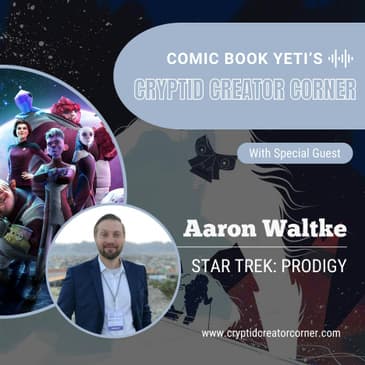
We have something a little different on today's Cryptid Creator Corner, but I think it's a conversation you are really going to enjoy. I'm chatting with Aaron Waltke, the Co-Executive Producer and Co-Head Writer for Season Two of Star Trek: Prodigy, which is available now on Netflix. I have been a fan of Star Trek for as long as I can remember. Star Trek: The Next Generation started when I was 8 years old and I was hooked. I started watching Star Trek: Prodigy with my 11 year old daughter Charlotte and we both loved it: the characters, the fun of it all, the adventure, so I was delighted to chat with Aaron about Prodigy and being in the writer's room and now co-Head Writer for Season Two. But don't worry if you tune in for comics talk because Aaron wrote one of the stories in this year's How to Lose a Guy Gardner in 10 Days and we discuss how that opportunity came about and how he approached writing Red Tornado.
I hope you give this one a listen and indulge me as I nerd out with a fellow Trekkie and be sure to watch Season One and Season Two of Star Trek: Prodigy now on Netflix.
From Netflix
After discovering an abandoned Starfleet ship, a ragtag crew of young adventurers unites to explore the galaxy and evade a ruthless overlord.
Our episode sponsors
Don't miss Eisner and Harvey award winning comics creator Michael Avon Oeming's newest crowdfunding project After The Realm. With over 300 pages of material and 22 new pages of story, this graphic novel collects issues 1-5 of this realm trotting dystopian fantasy adventure that follows young ranger Oona Lightfoot's travels and travails trying to find her best friend as the nine realms are torn asunder.
Arkenforge
Play TTRPG games? Make sure to check out our partner Arkenforge. They have everything you need to make your TTRPG more fun and immersive, allowing you to build, play, and export animated maps including in person fog of war capability that let’s your players interact with maps as the adventure unfolds while you, the DM get the full picture. Use the discount code YETI5 to get $5 off your order.
Learn more about your ad choices. Visit megaphone.fm/adchoices
[00:00:00] Your ears do not deceive you. You've just entered the Cryptid Creator Corner brought to you by your friends at Comic Book Yeti. So without further ado, let's get on to the interview.
[00:00:13] Hey, comics fam! Does a realm-trodding dystopian fantasy adventure that cleverly explores Norse mythology sound up your alley? It sure does mine!
[00:00:21] So I was excited to see one of my favorite comic creators, Eisner and Harvey Award-winning Michael Avon Oling, is launching a new Kickstarter project collecting issues 1 through 5 of his creator-owned series, After the Realm, in July.
[00:00:34] I just got a chance to get an early peek and it's fantastic! With over 300 pages of material including 22 new pages of story, it follows a young rebellious ranger named Una Lightfoot trying to find her best friend.
[00:00:46] As the tale of friendship and destiny unfolds, the Nine Realms are torn asunder, with Loki up to his usual troublemaking self of course.
[00:00:54] It should come as no surprise at this point that the cast of unusual characters Michael created in the book includes some anthropomorphic animals.
[00:01:02] But I can't say I've ever seen them riding roughshod across the land in mini tanks a la Mad Max Fury Road before, so I'm so here for it.
[00:01:10] Quirky, slightly beautifully unhinged and completely engrossing, the immediate analogues to me were The Legend of Zelda meets The Mighty Thor with Norse underpinnings for perspective.
[00:01:19] Michael is handling both the writing and the artwork duties with Takisoma on colors and Sean Lee lettering the project.
[00:01:25] Head on over to Kickstarter and make sure you back this cause it's epic!
[00:01:37] Y'all, Jimmy the Chaos Goblin strikes again! I should have known better than to mention I was working on my DC Universe meets Ravenloft hybrid D&D campaign on social media. My bad.
[00:01:48] He goes and tags a bunch of comics creators we know and now I have to get it in gear and whip this campaign into shape so we can start playing.
[00:01:55] Another friend chimes in, are you gonna make maps?
[00:01:57] It's fair to say it's been a while since I put something together so… I guess? Question mark?
[00:02:03] It was then that I discovered Arkhamforge. If you don't know who Arkhamforge is, they have everything you need to make your TTRPG more fun and immersive.
[00:02:12] Allowing you to build, play, and export animated maps including in-person Fog of War capability that lets your players interact with maps as the adventure unfolds while you, the DM, get the full picture.
[00:02:24] Now I'm set to easily build high-res animated maps saving myself precious time and significantly adding nuance to our campaign.
[00:02:32] That's a win every day in my book. Check them out at arkhamforge.com and use the discount code YETI5 to get $5 off.
[00:02:40] I'll drop a link in the show notes for you, and big thanks to Arkhamforge for partnering with our show.
[00:02:45] I think I'm gonna make Jimmy play a goblin warlock just to get even.
[00:02:49] Hello and welcome to Comic Book Yeti's Cryptid Creator Corner.
[00:02:53] I am one of your hosts, Jimmy Gasparo, and I have a fantastic guest on the podcast with me today.
[00:02:59] They are an Emmy-winning and Annie-nominated executive producer and showrunner.
[00:03:05] Currently, they are the co-executive producer and co-head writer for season two of Star Trek Prodigy.
[00:03:13] And they've been involved in some comics as well, which we're gonna talk about.
[00:03:18] But please, welcome to the podcast, Aaron Waltke. Aaron, how are you doing tonight?
[00:03:24] I'm great, Jimmy. Thanks for having me. Live Logs and Proper.
[00:03:28] Let me stay on the show. Or for people who haven't seen Prodigy yet, Live Logs and Prosper.
[00:03:34] Oh my God. Live Logs and Prosper.
[00:03:39] Oh, well, it's, it's, uh, you guys are, um, I'm sure you've been doing, you know, the, I guess all the press tours for season two now on, on Netflix, which just dropped on July 1st.
[00:03:54] As we were recording this, it's only about a week into it.
[00:03:57] I haven't even made my way through all of season two yet. I'm, I'm, um, I, I mean, I binge watch plenty of shows, but I feel that when I binge watch a show, I, I, I'm not able to remember it as well.
[00:04:12] So, uh, I still do try even for shows that I can binge to kind of like stretch it out.
[00:04:18] So I'm like five episodes into season two of Prodigy and, and, and loving it so far.
[00:04:24] Oh, thank you. Yeah. I, I think for, um, for me personally, when it comes to, you know, watching a show, I, I try, I also savor it a little bit.
[00:04:33] I find I'll do one or two a night and that's enough for me to like sort of percolate on.
[00:04:40] Right. Yeah.
[00:04:41] But there are, there were some fans when this show dropped, it's the first time that a Star Trek season has dropped.
[00:04:47] I think both this many episodes at once.
[00:04:50] So it's been a really interesting experience seeing the kind of like waves of fans as they catch up to certain big twists and moments in the season, uh, on social media.
[00:05:02] They're like, Oh my God, have you seen episode 10?
[00:05:06] Wow.
[00:05:07] They made me love Chakotay.
[00:05:09] You know, it's, it's been great.
[00:05:12] Uh, yeah, I imagine it, it, it has been, um, you know, as fans kind of discover when everything drops at once.
[00:05:20] Um, but for any listeners who aren't familiar, Star Trek Prodigy is an animated show.
[00:05:25] The first season, um, I think was out on Paramount plus, and then came out on Nickelodeon.
[00:05:32] And that's, I think when I, I first saw it and now, um, been season two, it's been picked up by Netflix.
[00:05:40] And now I think you can watch both season one and season two, um, on Netflix.
[00:05:44] Uh, I believe each season's 20 episodes.
[00:05:48] That's right.
[00:05:49] Yeah.
[00:05:49] So both season one and season two are 20, 20 episodes, uh, half hour.
[00:05:55] So if you're, if you're reminiscent of, or I, I, I should say if you're nostalgic rather of the, uh, the nineties Star Trek or, or TV series with their 20 plus episode seasons.
[00:06:07] Well, yeah, you're in for a treat with Star Trek, Bob G.
[00:06:10] Yeah.
[00:06:11] I mean, my, and well, I was going to say about my experience with Star Trek, but just, um, the, just to give a real quick kind of breakdown of the show.
[00:06:20] Uh, essentially the, the main characters are more or less, I mean, children, teenagers who are brought to this in season one, they're, they're kind of on this facility mining.
[00:06:32] They don't really know what they're mining.
[00:06:34] The, the guy who was overseeing it is not great.
[00:06:39] Um, and they end up discovering a new, uh, ship, the proto star and kind of take that ship, become its crew.
[00:06:49] And then it's like off from there.
[00:06:51] Uh, the first season saw some fantastic, uh, you know, Star Trek characters, including, uh, a hologram of, uh, Janeway, which, uh, on the proto star.
[00:07:02] It was absolutely wonderful.
[00:07:04] Uh, Kate Mulgrew, uh, I mean, just fantastic voicing that character.
[00:07:08] Oh yeah.
[00:07:09] Uh, Kate was fantastic and we were so, uh, lucky to get her, uh, aboard our little ship of a, of a show.
[00:07:19] Um, you know, obviously Kate Mulgrew and Captain Janeway, uh, have quite a, quite a, a, a, a, a, a, a presence in the Star Trek community.
[00:07:28] And in the, I would argue the TV sci-fi community at large, uh, you know, with Janeway being one of the first, you know, major female captains showcased in a sci-fi series.
[00:07:42] And certainly the first lead female, uh, captain in, um, in Star Trek.
[00:07:48] Um, and so Voyager, when it came out, I think, you know, it was out in the late nineties and whatnot, and it was just before Enterprise.
[00:07:57] But I think in the last 30 years, it has only grown with, and it's fan base.
[00:08:02] And I think everybody universally loves Janeway.
[00:08:05] So, um, the fact that we got Kate to come back for our show, we were so grateful and honestly lucky because, um, you know, she didn't have to say yes.
[00:08:16] And then we would have had to scramble and find some way to tell the story.
[00:08:21] But, um, thankfully, you know, understandably she was like, I'd like to see the scripts before I commit because Janeway was such a huge part of my life.
[00:08:30] And, uh, then when she actually saw the scripts that we were writing and saw that we were writing a story truly for all ages, not just for children or, or adults, but something that you could all watch together.
[00:08:42] And telling a story that was truly about the ideals of Starfleet, um, and that sort of hope for a better tomorrow and becoming our better selves.
[00:08:51] Um, she was absolutely on board and has become a huge champion for the series.
[00:08:56] So we're, we're, we're definitely grateful for her involvement.
[00:08:59] I mean, I, yeah, it's, she's fantastic.
[00:09:03] Um, and the, what you just said about the show being truly for all ages, um, I kind of discovered it when, like I said, when it was on.
[00:09:12] Nickelodeon and, uh, my oldest to my oldest daughter is 11 now, I think she was 10 at the time.
[00:09:19] And I was like, Oh, Star Trek, like, this looks great.
[00:09:22] You know, I, I always try and get her to see if she's at least interested in, in some of the stuff that I, I would like.
[00:09:28] And I watched, you know, plenty of things that she was into and always try and find something that we can enjoy together.
[00:09:35] And it was the first thing that was like, you know, uh, kind of real, really that, uh, meant something to me in terms of like Star Trek that we sat down and watched together.
[00:09:47] And we just loved it.
[00:09:49] The entire crew, you know, there are different races, uh, of aliens, uh, all working together.
[00:09:57] It, it has an underlying storyline, but it has those classic, you know, weekly episodes that Star Trek would have.
[00:10:05] Um, it's just, it's, it's so enjoyable.
[00:10:08] And so far a couple, you know, like five episodes into the second season.
[00:10:12] I'm just, um, loving it.
[00:10:14] I think the fourth episode, the third or fourth episode is called temporal mechanics 101.
[00:10:19] Um, and I always think of chief O'Brien, his line, I hate temporal mechanics.
[00:10:25] And I, yes, I just love the direction of the show.
[00:10:27] I love how I, I, I, inventive, I feel it is.
[00:10:31] And, uh, the character arcs from this first season carrying over into season two, I just think has been, you know, it's just fantastic writing.
[00:10:40] Well, thank you on behalf of the whole crew, you know, we, we, all of us love Star Trek and what it represents.
[00:10:47] Uh, and we, we really were pushing ourselves to our limits to try to live up to that kind of expectation of what we knew this show could be.
[00:10:56] So, uh, even, you know, season one was made as the pandemic was starting and that caused all the issues.
[00:11:03] So the fact that we're able to at least get the season across the finished line was a miracle.
[00:11:07] And then people really liked it.
[00:11:09] And then this season was the pandemic was still happening and we had to write it during COVID.
[00:11:15] So, so all of us were sort of, you know, locked in our, our little cells, you know, talking to each other over zoom like this, you know, dreaming of a better tomorrow that hopefully will be better than what we saw out the window.
[00:11:28] Yeah.
[00:11:29] The world was falling apart.
[00:11:30] So, so it's been such a, a joy, I guess, for it finally to kind of come out and have people start to see it and really embrace it in a way that, uh, I had always hoped it would be embraced as, you know, but I think.
[00:11:45] It's no secret that most Star Trek shows, you know, the, after their first season, it's like the second season is when they kind of hit their second stage booster rocket and truly find their place in the fandom.
[00:11:56] So, so yeah, I'm so grateful that everyone is really, uh, has embraced our show so thoroughly.
[00:12:03] Yeah.
[00:12:03] And now that it's on, you know, with it being on Netflix now and both season one and season two, you know, hopefully people will continue just to discover it and it'll just, you know, continue to grow.
[00:12:13] I mean, I feel like the other animated Star Trek show, like start to look lower decks was kind of like that.
[00:12:18] And I feel like the fan base for that has just continued to build, um, you know, which is very exciting for Star Trek, uh, in general.
[00:12:27] Um, I was familiar with the original series and saw a handful of episodes growing up.
[00:12:32] I think, uh, Star Trek, the next generation came out in 87 when I was eight or nine.
[00:12:40] And it was like that, like, that was it like Star Trek came and I was just like, Oh, this is me.
[00:12:46] This is my Star Trek.
[00:12:47] And I was, you know, totally into it.
[00:12:49] I watched a lot of the other series, um, but not completely.
[00:12:53] Uh, but I've always, uh, there was some type of Star Trek, you know, um, project coming out in terms of the movies or the novels or, you know, the comic books.
[00:13:07] Um, did you have like a relationship with Star Trek before, you know, becoming a writer and producer on Prodigy?
[00:13:15] Oh, absolutely.
[00:13:16] Yeah.
[00:13:17] Um, you know, I, I've said this elsewhere, but like, and, and I'm not exaggerating when I say like one of my earliest memories is like a cognizant human being is sitting on the couch with my dad as, you know, I didn't really know what was going on, but it was, I remember seeing the saucer separation from the pilot of TNG.
[00:13:39] Yeah.
[00:13:39] Unlike the fan fanfare playing and then they're, they're trying to escape.
[00:13:44] And then there was a big energy net that I think the queue or the board created it, but like, um, it, it was very exciting and I didn't know why.
[00:13:54] And then, um, you know, years later I realized I was watching, I was feeding off my dad's energy and I was watching Star Trek, the next generation, the pilot live as it premiered in 1987.
[00:14:06] And so I think that always has been kind of like, it warped me that day.
[00:14:12] Yeah.
[00:14:13] Never really stopped loving science fiction or fantasy because, you know, the, they allow you as almost like a metaphorical lens to tackle these really big ideas and, you know, social ills, but through a package that can sort of penetrate your shield, so to speak, and force you to sort of reconsider things from a different perspective.
[00:14:35] And so like that, that, that sensibility has always stuck with me.
[00:14:40] I definitely was a TNG baby.
[00:14:43] And then, um, and then I, I remember over the summers when my, my parents were both busy or, or working, uh, they dropped me off at my aunt's house and they, the local PBS affiliate of all places would play TOS reruns.
[00:14:58] And so my, my aunt would put it on thinking it would be educational.
[00:15:02] And then I, I get to see like, you know, these crazy, like Vulcan Caliphate death matches.
[00:15:08] Oh yeah.
[00:15:09] You know, space Lincoln fighting a mud man.
[00:15:12] It was great.
[00:15:12] Um, and, and, and, you know, uh, then when I went and got into like sort of high school, DS nine came on and, and they would air my local Fox station would air all of the, the deep space diet episodes in chronological order.
[00:15:31] Right.
[00:15:31] When I got home from school, like they do two a day.
[00:15:34] And so I, I basically got to binge watch deep.
[00:15:37] I like, I, I skipped to the first season cause I was, and then I started watching it when I came home and I basically got to binge watch deep space nine at a time that they didn't really have a word for that.
[00:15:48] Yeah.
[00:15:48] And, and so like, you know, I, I, all that criticism I kind of heard later of people's, you know, initially were like, it's not a real show is star Trek show.
[00:15:58] Like it's too heavily serialized.
[00:16:01] They're stuck on a station.
[00:16:02] Like I missed all of that.
[00:16:03] And I was like, are you guys kidding?
[00:16:04] This is some of the best star Trek I've ever seen in my life.
[00:16:07] Oh yeah.
[00:16:08] And I, it's interesting to look back and think and see how those things, you know, have, have aged.
[00:16:13] And you hear, like, I remember the criticism at the time when DS nine first came out, but you know, all the things that DS nine was able to do and Avery Brooks as, as Cisco.
[00:16:23] I mean, it really was just, it was doing something very different that I don't think.
[00:16:28] You know, uh, like fans of, of TSTNG or the original series were necessarily ready for, but I mean, it just, again, another show, just phenomenal writing, like really top notch actors.
[00:16:42] There's fantastic character actors that would pop up on that show.
[00:16:46] And like, what a story they put together.
[00:16:48] Oh, absolutely.
[00:16:49] And I think it, it's kind of a testament in some ways to a lot, to the longevity of star Trek, which I think is one of the, if not the longest running, maybe competing with like Dr.
[00:17:00] Who, uh, sci-fi franchise, but all ostensibly takes place in the same universe and continuity.
[00:17:06] Uh, you know, in, in the world, it's because they were willing to take those really bold swings.
[00:17:11] Like every time it came out, it wasn't just a rehash of the same thing.
[00:17:16] It was a stark reinvention and like further pushing the field, the boundaries of what star, Star Trek could encompass.
[00:17:24] And, you know, I, it, it happened with TOS going to then be animated series.
[00:17:29] That was a big swing.
[00:17:31] I just read some, uh, an interview with Gene Ronberry today from 1973, where he was like pushing this idea where in the age of like, where they had like 15 Scooby-Doo knockoffs.
[00:17:43] Right.
[00:17:44] Children's animated television.
[00:17:45] He was like, what are we just doing a fourth season of Star Trek using that?
[00:17:49] And which is crazy.
[00:17:51] That's a crazy idea, but it worked.
[00:17:53] Yeah.
[00:17:54] They got two seasons and it sustained interest enough that then they could get the movie franchise going.
[00:18:00] And then, you know, and the movies were bold swings under themselves.
[00:18:03] Like they really kind of reinvented all the characters, like Kirk's whole arc of like, kind of like confronting his own aging.
[00:18:12] And then, you know, and, and, and, and using a lot of like humor and adventure into it and giving it its own vibe.
[00:18:20] And then TNG comes along.
[00:18:21] He's like, Hey, you likes Kirk and Spock?
[00:18:23] Forget them.
[00:18:24] Right.
[00:18:25] Yeah.
[00:18:25] Let's jump a hundred years into the future and have a ship that looks nothing like the one that you remember.
[00:18:32] Yeah.
[00:18:32] But that was, then that was great.
[00:18:33] And like, I think that willingness to experiment is, is like baked into the Star Trek DNA and it absolutely like, you know, the cycle is always like surprise and then reluctant curiosity and then reassessment and then joy.
[00:18:52] And that is my favorite part of being a part of the Trek community is like, they're open-minded enough that eventually you can kind of get behind their defenses and you can do just about any story you'd like.
[00:19:05] Like, just like at Trae's New Worlds, they just had a musical episode and people loved it.
[00:19:10] Did they?
[00:19:11] I didn't know that.
[00:19:12] That's fantastic.
[00:19:15] All right.
[00:19:16] Let's take a quick break.
[00:19:18] Hey, comics fam.
[00:19:19] And the comic book publisher Band of Bars just got a level up and announced it is now a cooperative.
[00:19:25] This heralds a new era for them, including a partnership with Dauntless Stories.
[00:19:29] And they added several new members to the ownership group.
[00:19:32] Marcus Jimenez is now Chief Operating Officer.
[00:19:35] Brent Fisher takes on the role of Chief Diversity Officer.
[00:19:38] And Joey Galvez is introduced as Head of Kickstarter Ops and Social Media Manager, which is sure to increase their capabilities overall as a publisher.
[00:19:47] And it further promotes their mission statement of advancing representation, inclusion, and diversity in the media.
[00:19:54] They also established a new board of directors to help chart the new path of their journey.
[00:19:59] With new projects in the works like Alaska By dropping in June, Unbroken soon launching on Kickstarter, and Pawn coming up with Dauntless, stay tuned to this space for more exciting news from the growing Bards family.
[00:20:14] Let's get back to the show.
[00:20:43] Some phenomenal voice actors.
[00:20:45] But also you've created some wonderful characters.
[00:20:49] You know, Dow has a little bit, I think, of Kirk in him, but being like a teenager and trying to take on the mantle of a captain.
[00:20:58] And I just think you develop some really interesting backstories.
[00:21:05] Rock, I think, just to get this right out there, Rock is my favorite.
[00:21:10] There's a lot of people's favorites.
[00:21:12] Just absolutely phenomenal.
[00:21:15] The science, I assume that, you know, I guess would be science officer of the ship.
[00:21:21] One of the characters I wanted to ask you about, though, that I was most curious about is Murph.
[00:21:28] So, again, listeners, if you don't know, if you haven't seen it yet, and I know you're all going to go watch it, but Murph is like some type.
[00:21:36] He starts out as like a little blob, like a slime mold, and has like the wildest arc.
[00:21:44] I'm like five episodes into season two, like I said.
[00:21:47] No spoilers or anything, but nobody can still like understand him, but he has a definite communication.
[00:21:55] He's very protective of the crew.
[00:21:58] He seems somewhat indestructible.
[00:22:01] Yeah.
[00:22:03] But I don't know.
[00:22:04] I was curious because it almost seemed like in the beginning he was just something that might have been added.
[00:22:13] And like did the writers in the writer room find like it was fun to write for and like his character built?
[00:22:19] He definitely seemed like he was there in the beginning.
[00:22:22] Yeah.
[00:22:23] And his purpose kind of came along later and Murph got incorporated more into the crew.
[00:22:28] Was that planned from the beginning or did that like happen organically?
[00:22:31] Well, it definitely happened organically.
[00:22:34] I think anytime you're making a television show, when you start out, you have what we call a blue sky period, like wide open skies.
[00:22:43] Anything's possible.
[00:22:44] Let's just really break this down to what this series could be and explore all possibilities.
[00:22:50] And some of the feedback we got very early on, you know, especially when this started as a Nickelodeon show, which, you know, Nickelodeon, while ostensibly for kids, you know, they're not afraid to go some very amazing, intense or extravagant places like as seen in like Avatar The Last Airbender, which is, you know, one of the greatest animated shows ever made.
[00:23:15] I think.
[00:23:16] Oh, absolutely.
[00:23:17] And I mean, the first few episodes of Star Trek Prodigy do have its it's not all light action affair.
[00:23:23] Like it's pretty intense.
[00:23:24] There's some dark moments to it and some dark themes underneath everything.
[00:23:29] And so some of the feedback we got, which, you know, I think to their credit, it's understandable.
[00:23:35] They were like, can we have a little bit of levity in there just so it doesn't feel too grimdark?
[00:23:42] And we're like, well, we definitely don't want to make a grimdark show.
[00:23:46] We don't want that.
[00:23:47] That's not what Star Trek is about.
[00:23:49] Like, you know, Star Trek can explore some very, you know, dark places, but they always kind of bring this beacon of hope and possibility with them.
[00:23:57] But, you know, I think that they were like, is there a way we can inject any sort of humor in there?
[00:24:02] And they're like, well, why?
[00:24:04] What if they just encountered a very weird alien life form that they're not even sure is sentient or not?
[00:24:12] And that became Murph, this sort of like his melanoid slime worm who is like, is it a pet?
[00:24:17] Is it a crew member?
[00:24:18] We don't know.
[00:24:19] But he likes to eat chairs.
[00:24:22] Yeah.
[00:24:24] Yeah.
[00:24:26] I mean, I think he was the type of character that would quickly become both, you know, kids and adult like fan favorite.
[00:24:34] Like there's just something about Murph.
[00:24:36] He kind of became the mascot of the show.
[00:24:39] I think there's like everybody, even the skeptical ones were like, well, Murph's pretty cool.
[00:24:46] Yeah, absolutely.
[00:24:47] Yeah.
[00:24:48] And we love Murph.
[00:24:49] Who could hate that little word?
[00:24:52] And then as the series went on, I think it was Kevin Hageman, especially, you know, one of the creators who really kind of championed like I don't want him to just be, you know, this show has never been about just one dimensional characters.
[00:25:07] I would like to have something to do with Murph.
[00:25:11] Like, let's see Murph grow up along with the rest of the crew and evolve perhaps in a very literal sense.
[00:25:18] Right.
[00:25:18] And we had this crazy concept art that somebody had found.
[00:25:24] I can't remember if one of our artists had drawn it or if somebody just found it online of this like this like mercenary but had like a slug head.
[00:25:33] And we were like, what if he eventually becomes like a quadrupedic slug creature and like essentially humanoid.
[00:25:40] And this was his larval state.
[00:25:41] And everybody couldn't get that out of their head.
[00:25:45] He just kind of evolved with the show.
[00:25:50] Yeah.
[00:25:50] And, you know, as time went on, we knew from pretty early on that we wanted for Raktax character in particular, you know, she is a large what's called a Brickar or Brickarian in Star Trek lore.
[00:26:05] Originally from Beta Cannon, which was this large like sort of rock like kind of brutish species that almost like a golem.
[00:26:15] And, you know, we want it.
[00:26:18] We thought wouldn't be interesting if everyone just assumed she would be security officer because of her imposing size.
[00:26:24] But then she had an interest in science.
[00:26:26] And like, what better lesson is that, you know, of not judging someone by their cover, but actually letting them discover who they are.
[00:26:32] But that, interestingly enough, left a vacancy for, well, who is our security officer going to be?
[00:26:39] And very quickly, once we evolved Murph into this sort of humanoid form that also happened to be nigh indestructible, we were like, well, that's kind of the perfect security officer, isn't it?
[00:26:50] Yeah.
[00:26:51] And he became our weird little ninja worm guy.
[00:26:56] Yeah, he's great.
[00:26:58] I'm looking forward to more Murph as I make my way through the rest of season two.
[00:27:04] Yeah.
[00:27:05] So when you're, you know, you, I'll get into it a little bit because I just wanted to ask you about, you know, your background, your journey to Star Trek Prodigy.
[00:27:14] Um, but you've certainly written plenty of things, you know, on your own, whether or not it's a screenplay or, or episodes of TV or, you know, like we talk about comics.
[00:27:24] And, uh, for folks that don't know, you, you recently had a comic in the, how to lose a guy Gardner in 10 days, uh, robots are red, androids are blue for came out.
[00:27:35] I think this past Valentine's day, it was a red tornado story.
[00:27:38] Um, yeah.
[00:27:39] Uh, I want to talk about that, but when you're doing something on your own versus like in like the writer's room and kind of like in that blue sky period and pitching ideas, um, I'm always curious as to like different writers rooms.
[00:27:55] How does it get to that pitching stage to do?
[00:27:59] You're the person that pens the episode.
[00:28:04] Yeah.
[00:28:05] So, I mean, in, in TV, each, each room can be a little different, but typically, especially on Star Trek, the way we would always do it is we would, everybody would bring in their ideas, you know, sort of a no wrong answers kind of a situation.
[00:28:20] Like just bring us 15 ideas for cool episode ideas or character arcs or things that could, you know, whatever you think either would serve as character or the, the, the, what's called the promise of the premise.
[00:28:33] Like if, if, if this is a show about kids on a starship, what is a fun adventure that those they might encounter that also encapsulates, you know, exploring the greater Star Trek universe or Matthew.
[00:28:45] Um, and then we kind of put those all up on the board and then we just kind of, as we talk out character arcs and greater season plot arcs, something miraculous kind of happens where you start to realize that some of those random ideas you came up with might actually start to fit in.
[00:29:00] Like, oh, let's have a moment where Dal sort of come, has his sort of come to Jesus moment and realizes that, um, he can't just bluster his way into be, into being a captain.
[00:29:12] He actually has to learn how to put the crew first.
[00:29:15] And then, then another, uh, idea we had is like, what if we did a Kobayashi Maru simulation?
[00:29:22] And it's like, oh, that's what better way to test that than, than the ultimate captain's test from Star Trek lore.
[00:29:30] Uh, and see it break down and kind of rebuild him.
[00:29:33] And so, uh, once those are kind of determined, we kind of pick as a room, like, oh, we definitely want these episodes.
[00:29:42] And they kind of cover these elements of a character arc or theme or, or what have you.
[00:29:47] Then we will just have an open, at least in our room, we'll have an open vote of like, okay, what episodes is ever, are everyone gravitating towards that?
[00:29:55] You feel like you'd really like to write.
[00:29:58] And almost every time I can't remember very often ever of there not being a sort of a natural kind of gravitation where somebody, you know, if you pick like two episodes that you like to write, inevitably somebody will, there'll be an opening for you to, to do that one.
[00:30:13] And, and we always kind of, it's much easier, I think, to let people move towards the stuff they're already passionate about because you'll get better results.
[00:30:22] I found so.
[00:30:23] Oh, sure.
[00:30:24] Yeah.
[00:30:25] Very rarely do we like force somebody to write a script.
[00:30:28] They don't, don't want them interested in.
[00:30:30] And usually by the time we've broken the episode, it's cool enough anyway that I think even it'll be a fun, right?
[00:30:38] Fun to write anyway.
[00:30:39] Yeah.
[00:30:40] What do you think has been the most challenging aspect of tackling something like Star Trek prodigy?
[00:30:46] Has it been just getting the tone right or has it been, you know, coming up with an idea and you're like, you know, somebody at CBS or Paramount, like they, they did this already.
[00:30:58] You know, what I think it's been.
[00:31:01] The most challenging thing is telling worthy Star Trek episodes in half the time.
[00:31:08] Like, because.
[00:31:09] Yeah, sure.
[00:31:10] You have 44 minutes to just kind of hang out in the ready room and, you know, debate philosophically and then go have lunch and tend forward.
[00:31:19] But yeah, in, in, in our show, we're lucky if we get one ready room seat.
[00:31:26] A lot of it has to be like catching up on the fly or finding creative ways in the editing and montage or whatever to try to get you to the important moments to where we can slow down and enjoy the trekkiness of it all.
[00:31:39] Um, but you know, that, that would, that is the biggest challenge in my opinion of like telling a complete Star Trek story in 22, not even 22, 21.5 minutes.
[00:31:50] Cause there's 30 seconds of credits.
[00:31:51] Right.
[00:31:52] Um, you know, there, there certainly were some things here or there that we were like, we'd love to do this and that it couldn't happen for this, that, or the other reason.
[00:32:02] Like, I think at one point we were trying really hard to get a Picard cameo just because we were trying to, but we were starting to overlap in that particular period of time where, uh, Star Trek Picard season one was like, well, gosh, it'd be great to have a cameo with him.
[00:32:18] But you know, Patrick Stewart just wasn't available.
[00:32:21] You know, he was, he's, he's well into his eighties and I think he had just finished a TV show.
[00:32:26] So he was right on vacation.
[00:32:28] So, um, but you know, it was never, never anything fundamental that we couldn't, you know, pivot.
[00:32:36] Um, and we still found a way to acknowledge him in the second season, even though we couldn't get, get his voice.
[00:32:42] Um, you know, and there's been other things too.
[00:32:45] Like, I think there was an episode that we pitched that was like, Oh, what if like the Kelvin verse, you know, the JJ Abrams movies breaks in somehow to our show for ever an episode.
[00:32:56] Um, and we were like, we can, we can reach out to Chris Pine.
[00:32:59] Um, and, but, uh, I think for a number of logistical reasons, not the least of which they were still figuring out the Star Trek movie, they were like, maybe just hold off on that idea.
[00:33:11] For now.
[00:33:12] Uh, but that wound up becoming a really great episode called, uh, cracked mirror, which I won't spoil it for you because you haven't seen it yet, but that's okay.
[00:33:21] Later this season.
[00:33:21] Oh, good.
[00:33:22] Uh, well, I can't wait.
[00:33:24] Um, so I wanted to talk a little bit, you know, about, uh, kind of your journey here, uh, and doing my, my research.
[00:33:33] Um, I, I did want to bring up first before we, we, we get into too much detail.
[00:33:38] Um, other than you're from Greenwood, Indiana, that's where you grew up.
[00:33:42] Yeah.
[00:33:42] I, I grew up in Greenwood, Indiana.
[00:33:44] I also spent a lot of time, uh, in the Gulf of Mexico on an Island called, uh, Sanibel Captiva.
[00:33:50] Uh, uh, but, uh, yeah, much of my formative years, I, I grew up just South of Indianapolis.
[00:33:57] Okay.
[00:33:58] And, uh, I saw, uh, on your, I, I had to lay up on your, your IMDB page, um, which I, I wanted to bring up.
[00:34:10] It says as of December 9th of 2006, you have the Guinness world's record Guinness world's record for most t-shirts wore at once.
[00:34:20] Yes.
[00:34:21] Yeah.
[00:34:21] So, um, in college I was a member of a sketch comedy troupe, which is where I kind of cut my teeth and a lot of sort of comedy writing.
[00:34:29] Um, you know, we would do, um, we would put on a, a brand new two hour show every other week, which is kind of insane, but we didn't know any better.
[00:34:39] Right.
[00:34:40] Um, and it wound up being, um, good training for like a TV writer's room to be able to produce good content quickly, you know, and be judged by your peers immediately.
[00:34:51] Um, yeah.
[00:34:52] So, um, I really liked being part of that, that, uh, troop was called boy in the bubble.
[00:34:57] It was, I think the oldest, and I think still is the oldest sketch comedy troupe at Indiana university.
[00:35:02] Um, and, uh, I think upon my graduation, uh, as part of a publicity stunt to get people to come to our final year in best of show, I, we put up flyers everywhere that I would break a Guinness world record at the, uh, at the, the, the show just to kick it off.
[00:35:22] And sure enough, it worked.
[00:35:24] And there was like 400 people there to watch me put on like 160 t-shirts.
[00:35:30] That's a great audience for, for college sketch comedy.
[00:35:34] Yeah.
[00:35:35] Uh, it was, it was kind of surprising to be honest, but I, I guess if you're, if you promote something weird on a college campus, people will show up.
[00:35:44] Oh yeah.
[00:35:46] Um, and yeah, I, I, we took pictures.
[00:35:49] I contacted Guinness in advance and they gave me a whole set of rules and everything, uh, specifically for that world record.
[00:35:58] And, uh, and sure enough, I broke it by, I think five.
[00:36:02] And then my, I lost feeling in my hands cause there was so much, so much constriction from the t-shirts.
[00:36:08] They went up cutting them out of me backstage while I was like almost passing out from all the shirts that I was wearing.
[00:36:14] Oh, that's tremendous.
[00:36:16] Um, so doing sketch comedy in, in college writing for that group and, and performing, um, was, I mean, was that, you know, something you did that you had an interest in or did, did you have, you know, dreams of like SNL or something along those lines or like late night comedy TV writing at the time?
[00:36:37] I mean, I definitely had interest in it.
[00:36:40] Like I, I've all, you know, ever since I was like a really young kid, I had like a little VHS camera that my parents had bought to like film birthday parties or whatever.
[00:36:50] And my, my, me and my neighborhood friends realized that we could make movies with it and no one would stop us.
[00:36:57] So we started making these really insane, like, I guess you would call them sort of parody films, sort of like airplane, like Zucker brothers style, where it was just like a lot of like deep cut movie references.
[00:37:11] Like at one point, I think we had a, a short that we did that was like a parody of this.
[00:37:16] I was in middle school, but it was like a parody of star Wars and, um, marathon man at the same time.
[00:37:23] Some of them, like crazy stuff.
[00:37:26] Um, so I, I, I, but I, so I knew I wanted to make, tell stories in a visual medium, you know, I, I didn't, I, I did, I did a play in high school, but I, I didn't quite have like the confidence to be like an actor per se.
[00:37:43] Um, until I, in, in college when one of my best friends who, uh, uh, who had got into the troop encouraged me to, to, uh, apply.
[00:37:55] And I also got in.
[00:37:56] And so, uh, you know, I, I found like, for some reason I was like, I pushed myself out of my comfort zone and I'm so glad that I did because I was such an academic student and, you know, in the honors college or whatever, just trying to get my,
[00:38:09] my, my, you know, my coursework done.
[00:38:12] Yeah.
[00:38:12] And I, I kind of forgot to have like a social life a lot of the time.
[00:38:16] And so it was suddenly I had this instant group of friends, you know, that were all extremely talented.
[00:38:23] Some of them far more funny than I am.
[00:38:26] Um, and you know, just, we all just got to make stuff that people actually showed up and watched.
[00:38:31] And it really kind of, I, it, uh, I got the, the theater bug there.
[00:38:36] Um, and you know, I started writing and directing plays and short films, and then I had built up enough, uh, that I was able to put together a reel.
[00:38:45] Then I moved to Los Angeles.
[00:38:46] And, uh, one of my friends who has, I was in the sketch comedy troupe with had through some machination or another managed to get a sit, uh, what could essentially be considered like a, uh, minimum wage job writing comedy for a company called national lampoon.
[00:39:02] Oh yeah.
[00:39:03] A little, you might've heard of them.
[00:39:05] Yeah.
[00:39:06] Yeah.
[00:39:06] They did like animal house and the vacation movies and that sort of thing.
[00:39:10] Uh, so they were just starting to get into this, uh, newfangled thing called YouTube.
[00:39:15] And so they needed young, hungry comedy writers and performers and, and producers to like make content for their YouTube channel.
[00:39:25] And so I, I came out, shattered them for a couple of weeks.
[00:39:28] And it seemed pretty obvious to me that they, they had a lot of really talented writers and performers and stuff, but they didn't have anybody who could like cut it all together or put it into like short film form for the YouTube.
[00:39:41] And so I, I just went to them and said, look, you clearly need somebody to like do something with these stacks of mini TV tapes.
[00:39:49] There's what, which is what they filmed on back then.
[00:39:51] Um, uh, how about, how, how about you hire me?
[00:39:56] You don't have to pay me a lot.
[00:39:57] Just pay me something so I can live out here.
[00:40:00] And to their credit, they did.
[00:40:01] And that was my first job was as a writer producer out here at national.
[00:40:05] Oh, wow.
[00:40:07] And, um, so did you find that, uh, did you prefer one over the other?
[00:40:15] I mean, were you like, well, I'm good at putting things together.
[00:40:18] I'm good at producing or editing or cutting, cutting together.
[00:40:21] And I can do this while I write on the side.
[00:40:24] Or did you enjoy both of them?
[00:40:26] Um, I liked both for different reasons.
[00:40:29] I did find at a certain point that, um, I would, I got more joy out of writing because the actual grunt work of making a movie is so exhausting.
[00:40:42] And, and there's no guarantee that it will be good if you make it on your own.
[00:40:46] That, that I, I, I was like, oh, I can just write this stuff and then hire other people to, to make it.
[00:40:54] That's great.
[00:40:55] I like that.
[00:40:57] Um, and so I, you know, I had my day job where I got, you know, my, my, uh, interests of, of, you know, creating content, you know, YouTube videos, comedy shorts, that sort of thing.
[00:41:10] And then eventually I kind of, uh, want national lampoon went under briefly.
[00:41:16] And so I had to find a new job and then I wound up, uh, segueing into working in what's called docu series or reality TV.
[00:41:23] And I worked on the development side, uh, you know, putting together packages.
[00:41:28] And I also worked on a lot of, um, award shows and that sort of thing.
[00:41:32] But during that period nights and weekends, I basically treated writing as my second job.
[00:41:38] And, um, a friend of mine who I'd made some short films with in college, eventually became a, uh, a lit manager out here.
[00:41:46] And he said like, look, I don't do this with everybody, but I worked with you.
[00:41:50] You have a unique sensibility.
[00:41:52] How about I would do what's called hip pocket you and just kind of at any time, if something comes across my desk that I think meets your sensibilities of like sort of left of center, weird, high concept, science fiction or fantasy stuff.
[00:42:05] I'll send it your way.
[00:42:07] I'll send it your way.
[00:42:07] And then you can meet on it.
[00:42:08] And if you get a gig, then we'll work together.
[00:42:10] And, and then eventually, um, there was a project that came across my desk.
[00:42:17] It's what was called an open writing assignment with a company called Waterman entertainment that, uh, they did a number of things among them, like, um, the Stuart little movies with Michael J. Fox, like live action, live action, CGI type stuff.
[00:42:31] Yeah.
[00:42:32] And then they also did the live action Allen and the chipmunks movies, which made a bajillion dollars.
[00:42:38] And so, you know, they kind of got in on that IP, uh, re-imagining game pretty early.
[00:42:44] And they had a big binder of all these IPs that they had the rights to.
[00:42:49] And they were, they, I went in with my writing partner at the time and we kind of met, met with them.
[00:42:55] And originally they brought us in for something else, but then they, we saw that they had the rights to an old Disney film called the brave little toaster.
[00:43:02] And we were like, Oh man, I, I remember that.
[00:43:06] Yeah.
[00:43:07] Proceeded to just talk about how, you know, I had all these great themes that are relevant today about, you know, taking care of what you have and the evils of planned obsolescence.
[00:43:16] And so that sort of thing.
[00:43:17] And we walked out of that meeting and our reps called and said, I don't want you sitting there, but they want you to write the brave little toaster movie.
[00:43:23] So that was kind of our first foray into like, you know, film and TV and stuff.
[00:43:29] Um, so we wrote that.
[00:43:31] And then we also wrote, I think a Heathcliff movie treatment for them based on the comic strip Heathcliff.
[00:43:36] Yeah.
[00:43:37] Uh, and then, um, and then event we, then, you know, as you know, TV with, with, or with movies, it's the number of movies that actually get made are far fewer than the ones that get developed or.
[00:43:52] Oh yeah, absolutely.
[00:43:54] Yeah.
[00:43:54] And so we were like, I think I, at least was like, I would really like to get into TV where at least the stuff that we write actually is going to be made and people can look at it.
[00:44:06] And it's not just, no, really, we wrote this movie, you know?
[00:44:09] Yeah.
[00:44:10] Um, and so eventually a script, uh, that I had written, uh, wound up at DreamWorks Animation.
[00:44:17] Um, and that's where, um, they had a project there that, uh, was being made by Guillermo del Toro that turned out to be, uh, Troll Hunters, which is a show that they, that he created for Netflix.
[00:44:30] That was his first animated show.
[00:44:33] Um, and it, that, that was like Netflix had ordered 52 half hour episodes sight unseen because it was Guillermo involved.
[00:44:42] And it was a very small room.
[00:44:44] It was me, Chad Quant, uh, uh, Ash, Ashley Bradley, who created, um, Marvel's What If?
[00:44:52] Um, the Hageman brothers who at that time had created, uh, Ninjago and had written the Lego movie and Hotel Transylvania.
[00:45:01] Uh, Mark Guggenheim, who created the, the Arrowverse and who, you know, from comics out there.
[00:45:06] Yeah.
[00:45:07] I've, I've interviewed Mark, uh, cause he's also a lawyer like me.
[00:45:09] So I, I, I went through a series of interviewing lawyers who like comics.
[00:45:13] So yeah.
[00:45:14] He always talks about how he's a recovering corporate attorney.
[00:45:17] Yeah.
[00:45:17] Yeah.
[00:45:18] Um, yeah.
[00:45:20] Mark is, and Mark is wonderful.
[00:45:21] He's a very, very genuine guy.
[00:45:23] Um, and then Guillermo himself and, and, uh, and, you know, a lot of other great creatives like Rodrigo Blas, who is the supervising director and co-showrunner in Pixar.
[00:45:33] So I just, I got to work with all these really amazing, you know, top of their game talents.
[00:45:39] Yeah.
[00:45:40] Wow.
[00:45:40] On my first TV writing gig.
[00:45:42] And it was just like this masterclass clinic, you know, not only did they get to show me everything they know, but you know, I got to show off a little bit of my unique talents in that role as well.
[00:45:52] And it really felt like a great sort of like best idea wins kind of collaboration.
[00:45:58] And, you know, I couldn't have lucked out more.
[00:46:00] Um, and Guillermo himself was very hands-on on with that series.
[00:46:04] You know, if he wasn't shooting a movie, he would be in there every like three weeks.
[00:46:09] And we'd have what we call Guillermo days where he would come in for like eight to 10 hours and we just cancel everything that was on the calendar.
[00:46:17] Just spend time with him, reviewing animatics, reviewing artwork, uh, doing table reads of scripts.
[00:46:22] And he would give feedback notes.
[00:46:24] We'd pitch out the seasons with him and he'd get, you know, wow.
[00:46:27] And it was, it was very like creatively intimate in a way that I, I am profoundly grateful for.
[00:46:35] Um, and you know, it was, it was a really wonderful experience and, uh, you know, it, it, that, that kickstarted my TV career that I've been on for the past 10 years, 12 years.
[00:46:49] And that's, it just hasn't stopped since then.
[00:46:53] Wow.
[00:46:53] Yeah, I know.
[00:46:54] I was looking up, I mean, um, I mean, I think your work on troll hunters, uh, it was Emmy winning as well as I think Annie nominated.
[00:47:03] Yes.
[00:47:05] I think in total troll hunters got nominated for something crazy, like 15 Emmys or something like that.
[00:47:13] Maybe more than that.
[00:47:14] Wow.
[00:47:14] And I was nominated three times on that show, uh, or sorry on troll hunters.
[00:47:23] I was nominated twice.
[00:47:24] And then on wizards of wizard sales of Arcadia, which was the third chapter I was brought back to show run for, uh, I was nominated again.
[00:47:31] And so I got three, three Emmy nominations out of that, out of that.
[00:47:36] And I won once, uh, and Annie nomination, then star Trek, of course, uh, we were lucky enough to get nominated for best animated series, which is the big kahuna.
[00:47:46] Yeah.
[00:47:47] So that was my, that was my fourth Emmy nomination.
[00:47:49] Wow.
[00:47:50] It's absolutely incredible.
[00:47:52] Um, I, it's just so fascinating to hear like all those different steps that, you know, a career can take.
[00:48:00] I, I, you know, as, as it's why I do like the podcast.
[00:48:05] Sure.
[00:48:05] Because I'm always fascinated in terms of where you think your career might go, where it actually goes, how folks are able to pivot.
[00:48:14] But I think in, I've done like, I don't know, 130 episodes now.
[00:48:18] I think the main takeaway with any type of creative field seems to be persistence more so than, than, than anything else.
[00:48:26] Yeah.
[00:48:27] I, I would agree with that.
[00:48:29] I, you know, I think you have to, you have to be persistent, but you also have to be clever in how you find ways to survive.
[00:48:37] You know, cause I think there are so going to be so many instances where you're, where whatever path you thought you were on is just going to have be completely swept out from under you.
[00:48:47] And then you just have to find ways to, to, as you say, to pivot.
[00:48:51] I, people often think that like, oh yeah, there's just a big break.
[00:48:55] And some guy pulls up in a limousine and says, get in here, kid, we're going to Hollywood.
[00:48:59] Uh, but it's never that way.
[00:49:01] It's, it's, it's, I, I always describe it a little bit more of like trying to cross a river by leaping from one stone to the next.
[00:49:09] Right.
[00:49:09] And you, and like, it's never a straight line.
[00:49:11] And you kind of, you see where the opportunities are and you know, the collaborations and you, you kind of always have to do that mental calculus of what's, what's a, what's a risk worth taking.
[00:49:22] You know, where are you working for free on something that you have more equity in?
[00:49:26] Where are you making sure that you get paid for your work and credited properly?
[00:49:31] Yeah.
[00:49:31] It's it, you have to always kind of balance all of that in your head as you're trying to mush together something resembling a career, you know, and it does get a little easier.
[00:49:41] I think as time goes on and you have a few projects where people feel comfortable listening to what you have to say.
[00:49:48] Like when I first started, nobody cared what I had to say.
[00:49:52] Um, because I, I didn't have any TV experience and then it wasn't until I got on a few successful shows and was able to demonstrate that I knew what I was talking about from a story perspective that people started listening.
[00:50:03] And then, you know, that in turn gave me a little bit more flexibility to tell the stories the way I knew they would be great if they were told and, and that paid more dividends.
[00:50:14] So, you know, you always have to kind of hold on to whatever vision you have.
[00:50:18] And, and I always say like, you know, if you're hardworking, you're smart and you show up on time and you're nice, um, and you can get the work done.
[00:50:30] Then that you'll have a career forever because that's what all anybody wants out of somebody that they hire either to create something or to work on something they've created.
[00:50:42] Yeah. I mean, that's, uh, I mean, that's, that, that's the advice right there.
[00:50:46] That's there's our, those are the factors.
[00:50:48] Um, I, I real quick before I let you go, we've been, I've been, you know, enjoying so much listening to you talk about Star Trek prodigy and how you got there.
[00:50:58] But I did just briefly again, want to touch on how, um, how did it come about that you wrote, uh, the red tornado story for how to lose a guy Gardner in, in, in 10 days?
[00:51:10] And what was, it was, and if you could just talk a little bit about how that experience and writing was, and that type of comic collaboration was different from your, your other, uh, you know, the other things that you've written.
[00:51:21] Oh, sure. Yeah. Um, I, I mean, I've loved, I love Marvel and DC and I know it's, it's easier to be a Marvel fan sometimes, but I've always been a DC head.
[00:51:34] Like I, I love DC, you know, I, I grew up with Batman, the animated series and with, uh, uh, um, Bruce, Tim and, and, uh,
[00:51:46] Oh yeah. Yeah. I'm a big DC comic fan.
[00:51:48] And I, I even watched the reruns of like the, you know, the justice league friends or whatever, the super friends, super friends.
[00:51:56] Yeah. So like, it was like, so it was just so baked into my brain, you know, the, that, that whole greater justice league world that, um, I've always loved DC and those are the comics that I read.
[00:52:08] And then, um, a friend of, uh, a friend of ours just curiously, um, it happened to be one of the editors there, you know, the great Kate Hubert, um, of the Hubert family.
[00:52:21] Oh, sure.
[00:52:22] And, you know, she saw my wife's success as a writer and my success as a writer.
[00:52:27] And she said, Hey, you know, uh, you know, you guys are great storytellers in your own right.
[00:52:34] You know, we have these anthologies that are specifically to try out, you know, new comic writers.
[00:52:40] What would you, would you be interested in?
[00:52:42] And before she even like finished, I was like, yes.
[00:52:46] Uh, you know, it was a dream come true.
[00:52:50] And I've, I've always had a soft spot for red tornado.
[00:52:52] I think he has had a number of different ways he has been written over the years, but I always was kind of partial to the, the sort of stoic, you know, Android learning to feel kind of.
[00:53:05] And I was like, yeah, no, uh, Star Trek aside, you know, it's like, that's, that's very data of course.
[00:53:11] But I, I always felt had a soft spot for that.
[00:53:13] Um, but, but, you know, when, when she had the, um, when she said, Oh, it's a romance anthology.
[00:53:19] It kind of got my wheel spinning and just like how interesting, like love and loss.
[00:53:23] And, you know, and she said, you know, they're, they're essentially one-offs that aren't necessarily canon, but like, what, what, what if you told, uh, what, what you come up with.
[00:53:31] And I pitched five ideas.
[00:53:32] And one of them was the idea of red tornado would had sort of like, um, you know, he and his, his wife had kind of drifted apart because as, as his canon and in the, the comics, like it's very hard to be red tornadoes.
[00:53:52] And, uh, and, uh, and she loved it.
[00:53:57] And so, uh, she, she, she gave me, uh, a list of artists who she thought would be great with it.
[00:54:03] And, uh, Ivan Chavrin, who I think at the time had mostly done like covers for Marvel and DC, but he's really interesting artists.
[00:54:12] Um, what he wanted to do interiors.
[00:54:15] And I was like, this is great.
[00:54:16] Cause I think, because I wanted to tell a very sort of subdued, like internal kind of story.
[00:54:22] We need something that would be very visually poppy to kind of keep it interesting to look at.
[00:54:27] Um, you know, I, the biggest change I think from writing a screenplay to writing a comic book script is that, um, typically in a screenplay, you're not supposed to direct on the page.
[00:54:38] Like it's like almost insulting to the director to be like, you know, just tell us the mood and what they say, you know, writer.
[00:54:45] And in comic books is the opposite.
[00:54:48] You have to be hyper specific in every panel.
[00:54:51] You have to say exactly what's what's happening in it.
[00:54:55] Like, is it a medium shot?
[00:54:56] You know, and obviously the artists can have some leeway to adjust that, but you know, it's easier for them if you have that stuff thought out.
[00:55:06] So they at least can springboard off of that.
[00:55:09] Yeah.
[00:55:10] But it wound up being a very streamlined process.
[00:55:14] Maybe it's just because my screenwriting ability.
[00:55:18] I tend to think very visually anyway, like even if I don't always put it into my scripts that I, I got hardly any notes.
[00:55:26] From, from Katie and I, I had to give very few notes to Ivan as he was, as he was drawing it.
[00:55:33] And it was just a lovely experience all around.
[00:55:35] I was, I was so grateful for the opportunity to finally get to write a little bit of Justice League stuff.
[00:55:42] You know, it started with, I think the opening of my short starts in the, in the watchtower selfishly.
[00:55:47] Because I wanted like Supes and Batman and Booster Gold.
[00:55:54] It's a great story.
[00:55:56] I really enjoyed it.
[00:55:58] Yeah.
[00:55:58] I, I really liked it.
[00:55:59] I like Red Tornado.
[00:56:01] Um, uh, I think it was maybe two years ago, Mark Russell and Steve Lieber did one star squadron.
[00:56:07] That.
[00:56:08] Yeah.
[00:56:08] That's a really good one.
[00:56:09] Yeah.
[00:56:10] Featured Red Tornado and, and a bunch of other like C and D list, uh, DC characters.
[00:56:17] But, um, yeah, I really enjoyed it.
[00:56:19] I, I, I, Ivan's artwork is phenomenal.
[00:56:21] Um, I think it was Josh Reed that lettered it.
[00:56:25] Uh, yes.
[00:56:26] Josh was great too.
[00:56:27] Yeah.
[00:56:28] The, um, I mean, especially because you're kind of walking through at times Red Tornado's memories.
[00:56:35] Um, and those little like, you know, the, the, the, how the panels are done to kind of show those like scenes.
[00:56:42] Um, but yeah, visually I thought it was very interesting.
[00:56:45] I really liked the story.
[00:56:46] Uh, it was a bit, you know, introspective, which I, I liked.
[00:56:50] And I really fit the, the, the theme of the anthology.
[00:56:54] So yeah.
[00:56:55] Well done.
[00:56:56] Thank you.
[00:56:57] Yeah.
[00:56:57] I, you know, and just random, it was the weirdest thing.
[00:57:01] Like when they announced all the people that had written for that anthology, um, I, I, I looked at all the other names and I, I knew two of the other people that had written in the anthology randomly, like from completely different worlds.
[00:57:14] Like George.
[00:57:14] Oh, that's so funny.
[00:57:15] Yeah.
[00:57:16] Yeah.
[00:57:16] George, man.
[00:57:17] I, I knew because we had briefly, uh, works on an adult animated series together based on one of his novels.
[00:57:25] Okay.
[00:57:26] And then, um, uh, Brendan Hay, I had known because he had a show at DreamWorks at the same time I did.
[00:57:33] And, uh, so it was just, and I, I, so I messaged them both.
[00:57:36] I was like, Hey, I think we have DC comics coming out of the same anthology.
[00:57:41] So funny.
[00:57:43] Yeah.
[00:57:43] That, uh, that, that is pretty, uh, coincidental.
[00:57:48] It's bizarre actually like deeply strange.
[00:57:50] Like I had to think about it for a while.
[00:57:52] Like why of all the people in the universe?
[00:57:55] Why?
[00:57:55] Why?
[00:57:56] But it was cool.
[00:57:57] It was fun.
[00:57:58] Awesome.
[00:57:58] Well, um, I, uh, I, I won't keep you any longer, Aaron.
[00:58:03] I really appreciate you taking the time to come on the podcast and talk to me about Star Trek Prodigy, your, your journey to get there and a little bit about comics.
[00:58:12] Um, I'm such a huge fan of Star Trek Prodigy.
[00:58:16] I really think, especially now that it's on Netflix, um, listeners, if you haven't given it a chance yet, you should.
[00:58:24] If you're wary of something that's, you know, can be just like is said to be all ages and animated, don't be.
[00:58:31] It is, it's, it's a wonderful show.
[00:58:34] It is, has a real sense of adventure to it.
[00:58:37] The character arcs are phenomenal.
[00:58:39] It has just the right touches of humor.
[00:58:43] Um, if nothing else to, uh, you know, get to, uh, uh, see Murph's journey, uh, is, is worth the price of admission.
[00:58:54] Thank you.
[00:58:54] Yes.
[00:58:54] I, I encourage all of you, like, if you can't tell from this interview, I am a genuine Star Trek fan, uh, through and through.
[00:59:02] And, you know, I, and everyone else on the show really try to infuse that passion into the series.
[00:59:07] You know, it is, it is canon.
[00:59:10] It, it does tell the future adventures of many characters from the Voyager crew and beyond, uh, and takes place between Lower Decks and Picard.
[00:59:19] And, um, if you don't believe me, just go check out the Star Trek prodigy hashtag and see all the mini Trekkies that are raving about it right now.
[00:59:28] Like they can't all be wrong.
[00:59:30] Right.
[00:59:30] Yeah.
[00:59:31] Go check it out on Netflix.
[00:59:33] I don't think you'll be disappointed.
[00:59:34] No, I don't, I don't, I don't think listeners will either.
[00:59:37] Uh, it's, it's a really wonderful show.
[00:59:39] And I, I finally, I said five episodes into season two, cannot wait, uh, to see where it goes.
[00:59:45] And, um, yeah, Aaron, thank you again so much.
[00:59:48] I, uh, I really appreciate it.
[00:59:49] Uh, before we go, shout out to my brother, Bobby, the cryptic creator corner's number one, most dedicated fan.
[00:59:54] Bobby listens to all my episodes.
[00:59:56] Bobby, if you haven't watched Star Trek prodigy, uh, I'm, I'm going to make you next time you come over the house.
[01:00:01] We're going to sit down and throw on some episodes.
[01:00:02] Uh, so for comic book, I am Jimmy Gasparo.
[01:00:06] Thank you very much for listening and I'll see you next time.
[01:00:09] Thanks a lot, Aaron.
[01:00:10] Thanks for having me and live logs improper.
[01:00:16] This is Byron O'Neill, one of your hosts of the cryptic creator corner brought to you by comic book Yeti.
[01:00:22] We hope you've enjoyed this episode of our podcast.
[01:00:25] Please rate review, subscribe, all that good stuff.
[01:00:29] It lets us know how we're doing and more importantly, how we can improve.
[01:00:33] Thanks for listening.