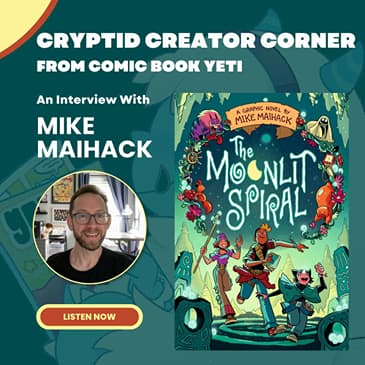

Mike Maihack, creator of Cleopatra in Space, sits down with Byron to talk about his new project The Moonlit Spiral from Candlewick Press, a Goonies-styled middle grade fantasy graphic novel focused on a treasure hunt in a world with no elves, no dwarves, and a whole lot of glowing snails. It's delightful.
There's something electric about picking up a book that feels like it was written just for you. That's how strongly I connected with this one, so I was thrilled to get Mike on the show. We talk about how a clear night of stargazing in the driveway sparked the story, how geocaching with his family shaped the treasure hunt aspects of the book, and the plethora (yes, I know what a plethora is El Guapo) of Easter eggs hiding in the names. We also get into the education of his Spider-Man: Mighty Marvel Team-Up books, why he drew the whole book without panel borders, what those colored word balloons are really for, the creatures that got cut, and why he keeps choosing joy in a genre that is currently leaning hard into trauma.
If your feed is as doom-heavy as mine, this one's an antidote. No cherry but a snail on top.
"If I can’t enjoy it, if it’s not fun, there’s really little use in doing it. If I’m not having fun, it’s going to come across in the story." - Mike Maihack

FIND MIKE MAIHACK
Patreon: https://www.patreon.com/cw/mikemaihack/home
Get Social: https://linktr.ee/mikemaihack
WATCH THE VIDEO VERSION OF OUR CHAT ON YOUTUBE!
The Moonlit Spiral

From the publisher
From the creator of the Cleopatra in Space series comes a wildly imaginative, enormously thrilling and deeply felt story of treasure-hunting friends
Best friends Rion and Zyla live in the fantastic world of Helix, where treasure hunting was once a way of life. Nowadays, though, it seems like people are more concerned with researching the past than looking for real treasure in the present. Life has gotten pretty dull, which is how Rion likes it. He lost his parents to adventure, so playing video games and hanging around his guardian Henry’s dusty, failing bookstore are all he wants to do. Then Rion discovers hidden pages in a cryptic journal left by his parents. They give clues to the biggest treasure of them all—the last prize of the famed treasure hunter Orion Flynn! It’s clear what Rion’s parents would have wanted him to do, plus Henry needs the money to stay in business. Fearless Zyla insists they have to act fast—the treasure can only be found during the once-a-decade Silver Moon, which will shine for the next six days. Accompanied by a magical fox girl, the friends make their way through twisting caves, colorful forests, and mountainous spires, encountering a host of fascinating creatures along their way to a discovery so great, it will unlock the past, present, and future.
Ask your local comic shop or favorite bookstore to get you a copy (Except Barnes and Noble cause they also sell AI slop)
Follow Comic Book Yeti
🔗 BlueSky: https://bsky.app/profile/comicbookyeti.com
🔗 Instagram: https://www.instagram.com/thecomicbookyeti/
🔗 Facebook: https://www.facebook.com/ComicBookYeti
🔗 TikTok: https://www.tiktok.com/@thecomicbookyeti
🔗 Threads: https://www.threads.com/@thecomicbookyeti
Follow your hosts
🔗 Jimmy Gaspero: https://bsky.app/profile/jimmygaspero.bsky.social
🔗 Byron O’Neal: https://bsky.app/profile/byrononeal.com
For partnership and ad inquiries, please contact: thecomicsyeti@gmail.com
ARKENFORGE
Play TTRPG games? Make sure to check out our partner Arkenforge. Use the discount code YETI5 to get $5 off your order.
Make sure to check out our sponsor 2000AD.

[00:00:00] Your ears do not deceive you. You have just entered the Cryptid Creator Corner brought to you by your friends at Comic Book Yeti. So without further ado, let's get on to the interview. The future is calling! 2000AD is the galaxy's greatest comic with new issues published every single week. Every 32-page issue of 2000AD brings you the best in sci-fi and horror featuring characters like Judge Dredd, Rogue Trooper, and more.
[00:00:28] Get a print subscription to 2000AD and it'll arrive to your mailbox every week. And your first issue is free. Or subscribe digitally and you can download DRM-free copies of each issue for only $9 a month. That's 128 pages of incredible comics every month for less than $10. Head to 2000AD and click on subscribe now. Or download the 2000AD app and start reading today.
[00:00:54] There's something electric about picking up a book for the first time and feeling like it was written just for you. The kind of story that you know will stick with you for years. That's exactly how I felt reading The Moonlight Spiral, a new fantasy adventure graphic novel from Mike Maihack. And I'm lucky enough to be sitting down with Mike today. Can I just say how much joy the doodles that you post on socials bring me because I get so tired of all the trauma of being online these days.
[00:01:23] So thank you so much, Mike. Oh, you're welcome. I mean, that's honestly the only reason I get on the socials these days is hopefully just to kind of spread a bit of cheer. And the only way I really know how to do that is by drawing, you know, and writing, you know, making the comics and making the art. So it means a lot, you know, that you said that because otherwise I don't know if I would I would get on it to get on there because it is it's a it's a it's a lot.
[00:01:51] You know, it's a lot of mind space game on the socials these days. So, yeah. Yeah. Yeah. Yeah. It's a weight. Right. You know, you feel like. Yeah. You go to connect and you leave feeling like, oh, well, I'm much heavier. Yeah. Right. Right. Yeah. I tend to, you know, regardless of what's going on on the socials, I tend just social media in general, just knowing that there's always something going on, something out there.
[00:02:16] My head tends to kind of go that direction and you start sort of living your, you know, your creativity in terms of of that world where I don't think that's really the best place for it. You know, it should be, you know, making graphic novels or making creative content and contributing, you know, to, you know, to the world in ways that are very positive and hopefully inspirational as well.
[00:02:42] So. So. But, yeah, regardless, it's I think it's a necessary evil sometimes. And to go down, especially if I have, you know, like in this case, I have a book that I have coming out. And so I need to let people know that there is a book coming out that I've done. And one of the ways I do that is just really just by by posting art and, you know, hopefully giving a smile or two. Yeah. Yeah. Well, it's appreciated. Let's get into the book.
[00:03:05] It's your first creator owned graphic novel in a while. And afterwards said that this all started from stargazing. Like it took me right back to this moment. Yeah. Like this moment, my wife pulled me out of like my standard sort of tunnel vision MO to throw a blanket on the driveway and count meteors in Washington in our sun, which has been like a decade now. So yours turned into a book. Mine turned into a picnic. What made that the catalyst moment for you of starting your next project?
[00:03:35] Well, I had just come off of working on Cleopatra in space, which was this it was like a web comic that turned into a graphic novel series. And it's a good decade of my life just pretty much in that world of Cleopatra in space. And that was I had finished the finished drawing the last book at the end of 2019. And so 2020 served like this fresh start. I didn't know exactly what I was going to do next. I honestly didn't think I was going to do another graphic novel.
[00:04:05] Cleopatra in space was so difficult towards the end. I thought I might just stop drawing comics altogether because there's just it's a it's a very consuming process. Yeah. It's a lot of energy. And I just didn't know if that's where I wanted my time spent. So I was thinking about children's books and other avenues I could still be kind of artistic with. But we were my your wife and mine must have a lot in common. She's really into stargazing. We both. That's one of the things that kind of drew us together.
[00:04:35] Oh, cool. And we at one point, I think it must have been like a new a new moon outside. So we had gone out to our driveway to just because sometimes I live in Tampa, Florida, and sometimes it's just so, so cloudy. You can't see the night sky. And in this case, it was just a clear night. And we so we brought the kids out and to look at the stars and just check these out.
[00:05:02] And I was holding my youngest in my arms and I'll mess up his age. But he was young, you know, because he's he's in it's been five years and now he's in he's in middle. He's just started sixth grade. So he you know, he was small enough where I was kind of holding him in my arms. And I was we had we had named him Orion after the constellation of Orion. And you see that that constellation in the sky.
[00:05:26] And I was pointed out to him. I said, like, look, that's that is who we named you after after this constellation. Orion, he was he was he was a hunter and you can see his bow and and all this stuff. And he just looks off into this night sky and at these stars. He's like, oh, I want to go there. And I was like, oh, yeah, that would be really cool, you know.
[00:05:50] And so sort of the inklings of of another because I just come off of Cleopatra in space of another science fiction story going off into this other galaxy. So the planet kind of started coming to my my mind of like where this constellation came from and a different type of Orion and using that namesake. And eventually that kind of found its way into becoming the Moonlight Spiral, which was more of a desire not to go back into sci fi, but kind of bring those sort of adventure qualities and fantasy elements of things I love back in the 80s.
[00:06:20] Like like the Goonies or like, you know, Indiana Jones, a little bit of that. Some a lot of Miyazaki things and stuff. I just kind of want to do something within that flavor of storytelling. And that's where it all sort of started from there. I just kind of started coming up with some some doodles and drawings, writing out some ideas. And it just sort of spiraled, spiraled out from there to be become the book that's coming out next week.
[00:06:50] Well, as an old school Goonies fan, thank you for that moment. We won't spoil anything, give anything away. But I was like, this is Goonies like that is so Goonies. Yeah, hopefully it doesn't. Yeah, I was it's very, you know, it was on my mind the entire time. I wanted to do something like that. It was such it made such a big impact on everything I've been into since. Just the way the characters interacted with each other.
[00:07:15] There sort of that, you know, the journey of discovery and just finding things and just right in your own backyard, you know, up in your own attic and stuff. And I love that. I think when I was young, I wanted that same feeling. I wanted to discover a treasure map and find my own treasure and stuff like that. And I think my friends did, too. And we would, you know, make up things, you know, when we were young, you know, just like the Goonies. But I want to hearken back to that.
[00:07:41] I want to say if I want to put a book out there, that's I didn't want to make the Goonies. But I want at least, yeah, that feeling I got from watching something akin to that. That's the feeling I was hoping I could capture with a different story, something new and something a little fresh. And sometimes maybe not quite what's on shelves a lot these days. So, yeah. Yeah, I haven't seen anything quite like this in a while. It's very interesting because it's a twist on like the classic treasure hunting.
[00:08:09] And it's very textbook monomyth story, right? You have Ryan? Is it Rian? Am I pronouncing that correctly first? Ryan. Yep. Oh, Ryan. Ryan. He's just sharring. Yep. Okay. Ryan. Okay. So he's kind of the reluctant hero being pulled into this treasure hunting adventure with a team of misfits using the MacGuffin of his parents' book, obstacles, team building, ordeal reward, you know, all on this celestial clock mechanism. So that's pretty blueprint. And you've got it.
[00:08:39] That's the tried and true thing. So which parts of that classic treasure hunt did you want to honor? And where did you want to bend the rules? You know, where did you see Mike in this? Yeah, that's a great question. I tend to, I usually start all my stories with usually like sort of the characters, the type of character you want to start writing. And then I sort of flesh out the world around that character, like what's going to sort of contrast with them, cause them obstacles and things like that.
[00:09:08] So that was really more on my forefront of like where that was going to go more than like sort of the treasure hunting stuff. was that kind of came like, well, if this is the way this character thinks, then these are the type of puzzles that he needs to solve. And if this is the way this character, this is the type of way that he's, you know, this character is going to push this other character and stuff like that. So when I was kind of coming up with sort of the idea of, you know, what the treasure was going to be,
[00:09:36] or if there even was going to be a treasure, it was always sort of skirted around the idea of it's got to be not just unexpected for the reader, but unexpected for the characters themselves. And so I just sort of just kind of went sort of teeter back and forth between a lot of different things.
[00:09:58] It's just, it's a hard, any type of treasure hunting mystery sort of adventure book, it's hard to really go into too much without spoiling it. Cause you don't want to ruin the surprise for anybody. Right. But I just kind of, I knew, I knew exactly what sort of the final treasure was going to be. I knew just right off the bat, what I, what, what was important to me, what would have been important to Ryan within the story.
[00:10:25] Um, but I didn't want that to be too obvious and I didn't want it to be like sort of the specific thing. And so then the idea of bringing this new character in to kind of lead into something different, um, sort of developed. And I just sort of followed that path of how they would sort of approach, uh, not just discovery of treasure,
[00:10:49] but discovery of maybe it's just a whole new way of discovering life and world and discovery and, um, you know, things that are just sort of new without maybe being new to others and use that as kind of my lead into creating the treasure hunting story. But yeah, yeah. It's a difficult question to ask if I want to spoil any parts of the book. Yeah, of course. Yeah. Yeah.
[00:11:12] But, uh, yeah, I was just really looking at, um, um, um, some of the, some of the movies and stories that I was, you know, reading as, as a kid. Um, obviously, um, Treasure Island, uh, factored in a little bit of that. Um, definitely Treasure Planet because I was more of the age of, you know, getting into that. Um, even National Treasure, anything that had treasure in it, I guess, in the title found its way a little bit into, into the story.
[00:11:40] And again, I was just really trying to capture the vibe of those things. I was, I didn't want to do, I didn't want to do the same exact type of story. I just wanted to capture the feeling of it. Um, and it ends up being, I think more, less a treasure hunting story. More, it's more of like a kind of a scavenger hunt, um, of, of a story. Um, and, um, that was fun too. Just, you know, my family and I, um, and forgive me if I start rambling on talking. You're good, no. You're fine.
[00:12:09] We used to, um, uh, we, I, I love, I love walking outside. I love going outside. I'm indoors all day long working on comics. So any chance I get to go outside, just kind of experience actual real air is amazing. And, um, my wife's the same. She, anytime we get to go on a hike, we're, we're off. Um, but our kids are a little bit reluctant. You know, they love to be on their, the devices, be inside. I love central air.
[00:12:34] And, um, one of the ways we used to get them outdoors is we, uh, discovered this thing called geocaching. Um, which is, uh, for those that aren't, okay. If you're familiar with it. For those that aren't, it's just this, you know, it's just people can go off and they can have little trinkets and little canisters around trails and hiking areas or, or, or wherever. Um, and you can, um, you know, follow this app and try to kind of find them. And that was one of those things that we used to kind of propel them outside the door. And I enjoyed it.
[00:13:02] We all enjoyed it because there was like this little treasure on it that we got on. And, um, that was right around the time I was writing the Moonlight Spiral. Um, and I was like, I used a lot of our experience of that, um, to try to put myself, to put those that real sort of ground sort of that story into what we experienced finding those little trinkets and stuff and try to bring that into it. So I think the treasure hunting aspect kind of came from that, just really from real life, more than thinking about other treasure hunters and stuff like that.
[00:13:30] Just how it was if we were out and about, you know, really looking for treasure, what would, what would be like, but, you know, putting it into more of this fancy environment. I'm not sure if you're familiar with it, but when I was reading it, it, it took me back to in Washington, they have a tradition where there's like painted rocks. And so it's that same kind of thing where you'll be walking down a trail and there was a trail that was close to the house. So I would get out and walk and like regularly, you just find this beautiful little painted
[00:13:58] rock that somebody else had just left there, you know, for, for anybody to pick up. And it was, it, it very much encapsulates just being a child and, you know, that, that hunting and finding and the satisfaction of, you know, discovering something for the first time. Yeah. I love that. And I love the idea of like, you know, others doing that just strictly for the point of like bringing joy to others. I mean, there's really no other reason. And, you know, the joy of painting the rocks, but also like sharing that, knowing that it's
[00:14:27] going to, this thing that I enjoy doing might bring joy to others. That's, I mean, that's, that's a theme, I think, in everything I do. And so I love hearing stories about that. And yeah, and we have a few painted rocks ourselves that we've, that we found. So yeah, absolutely. Very nice. Yeah. I mean, we always talk about inspirations and obviously, you know, we've talked about Goonies here, but there's some other stuff that you very much wear on your sleeve that I picked up on.
[00:14:56] Like there's Bardugo Valley, which I'm assuming was a nod to Leigh Bardugo, the writer. You know, you have Perot Inn with a proprietor named Agatha. And there's definitely a mystery component to the book as well, you know? And I don't want to get into spoilers, obviously, but, you know, it did make me think a lot about how we can inject those, those nostalgic moments into a story, you know, your core readers around nine to 12, you know, and most of them, you know, have never seen Perot or read Bardugo, not anytime soon, I hope.
[00:15:26] And those Easter eggs, you know, are they there for parents and fans like me? Or do you hope kids, you know, kind of go looking for the stores? Because it can be a great, like generational moment of connectivity to pull kids back to something, you know, like Goonies, like that we loved. Yeah. Yeah, absolutely. All of that. Yeah. I mean, everything you just said. Yeah. That's why it's in there. Those little Easter eggs, nostalgia, but also, yeah, also the point, you know, kids in new
[00:15:53] directions and their chance to discover things outside of the book and the influence that came from that. I was just chatting. I was on another show yesterday. I was chatting about how, what am I, I love creating things. I love drawing and stuff like that. But one of my biggest difficulties is just naming stuff. I have like a feeling of what I want, but just the actual concrete name of something. I always, it seems to be like the last thing I can kind of hone in on.
[00:16:23] And so I usually try to find some sort of convention to help me out with that. But, okay, Patch in Space was super easy because it was like, you know, Egyptian. So I could draw upon a lot of kind of Greek and Egyptian words. I've got a series of Spider-Man books. Didn't have to come up with a single name. The only name I did have to come up with was I had a pigeon character and I just named him Mark. If that gives any clue to my creativity when it comes to naming things, just Mark will work for this pigeon character.
[00:16:51] But for this one, you know, there's definitely a literary quality to the book and things. Books are very important within the story. Just stories in general are important within the story. And I thought it'd be really fun if I could kind of take a lot of these creators and literary figures that sort of got me to where I am to making this book, this Moodland Spiral, and just kind of give an homage a little bit to them, to those creators.
[00:17:21] And it's just a fun way to help me come up with some names for things so I could just kind of focus on more of the other, more overall elements. And then, again, yeah, just give some Easter eggs, point some kids to some other material. And I didn't always use, you know, I would, there's some in there that I changed the spelling a little bit or tweaked it. Only because, you know, I didn't want to be, I didn't want to take readers out of the
[00:17:50] story, you know, where I assume you're sort of like, oh, now you're thinking of this. And that always, whenever I'm reading something and something like that happens, it always kind of takes me out of the, you know, the world a little bit. But there's cases where I just straight up use, you know, like the Bloom Snails are named after Judy Blume. And, you know, I just used that name outright. And again, like the Perrine, like you said before. But yeah, that's basically why they're in there.
[00:18:18] I hope it's fun for readers to discover those things. Yeah, I had absolutely the opposite kind of experience doing it myself because it, when I'm reading something like that and I see an Easter egg, I feel like I want to know how it informs the rest of the story, if indeed it does. Like Doll City, I'm going to assume that was Roald Dahl, you know? Yeah. Yeah, yeah. And like The Witches was such a formative book for me. It absolutely terrified me as a kid.
[00:18:47] You know, I was afraid that the lady at the grocery store was going to turn me into a mouse, you know? So it immediately locked me into like, okay, so how is Mike maybe even putting more of that in there? So, you know. They're all little, yeah. I mean, I didn't just like name something, you know, pick and choose. There is, you know, there's actually reasons for all of it.
[00:19:10] And again, yeah, I like the readers sort of to sort of kind of imagine what that might be. And yeah, I have my reasons. And I think it's great when the readers have their own as well. So, yeah, I don't know. It's great. I love hearing that. Well, I mean, it is. It's fascinating, you know, because you're, you never can predict the experience of your readership or anything like that.
[00:19:36] But I'm sure it's nice to hear that something that like would pull you out in my case pulled me in, you know? Great. Good to hear. Yeah. Awesome. Yeah. Well, one of the things that really stuck out to me and that I loved about the book was that you skip the usual fantasy shorthand. There's no elves. There's no dwarves. Right. The typical tropes seem to be on vacation. So as I was learning Helix, one page turn at a time, you know, I was wondering, was that intentional from the start?
[00:20:04] Like you just wanted a blank slate and kind of wanted to let your mind just kind of run with creating this world? Yeah. I mean, I think it was intentional, but it wasn't like I was like, you know, zoned into being intentional. You know, it was just, I had, I had a, I had an idea, I had a vision of what the world in general, generally I have, when I'm writing it, I can just see the world, you know, and
[00:20:31] say, I just didn't, I just didn't, I didn't see, um, I didn't see elves in there. I didn't see orcs and other, you know, other fantasy things. I saw it sort of, um, kind of a combination of sort of modern and, you know, and not, you know, a world where, you know, there's video games, you know, obviously right at the beginning of it. Um, and, but then there's like, just, you know, a few miles away, there's, there's just
[00:20:59] forest and, and who knows what's in the forest. Um, and so I, it was sort of this desire to try to make something small and just kind of make, and then just keep, keep blowing it up and make it bigger and bigger and bigger as the story went on. Um, and in order to really focus on making that happen, I wanted the characters
[00:21:23] experiences and their wonderment to be what I was concentrating on and to add anything else into that would have just distracted from all of that. I think it would start feeling more small if I brought more into it, if that makes any sense. Um, so the less I brought in, the bigger, you know, the, the bigger, the eyes of the characters ended up being. Um, and so that was just kind of how I think that developed.
[00:21:51] Um, and, uh, yeah. And again, they're only, you know, they're in like, you know, one small chunk of what I, I kind of envisioned of Helix. Um, and so there's a lot, a lot more to it. And there's obviously things in the story where I kind of clue in, like there's more to certain areas that I don't actually, you know, you know, take readers directly to. Um, but I think that's what makes it, makes it fun. Cause I want not just the characters to think, you know, oh, there's more out there, but
[00:22:21] also I want the reader. I think the story sort of end if you answer every sort of question you can, uh, when it comes to story, you gotta leave a little, some doors sort of just creaked open a little bit, just so there's that, that, that chance for, for readers to know there's, there's more out there, you know? So, yeah. Yeah. One of the things I really connected with was how lush the backgrounds are and how much of an opportunity that gives the characters to play in it.
[00:22:49] And, and I play is, is the accurate word, you know, this is cause it, they provide a lot of different moments for, for these characters. You learn about the characters in a way that I don't think a lot of times you get the space to. And I w I was thinking about like when I was a kid, uh, Mercer Mayer, I don't know if you're familiar with Mercer Mayer. Okay. Um, but it was somebody whose work I could completely get lost in as a kid. They had this thing called the, uh, the wild and windy typhoonigator, uh, it was like in
[00:23:17] this book called one monster after another. And it was sucking up all the ocean and exposing everything, like all the flots and all the ships and everything that was on the bottom of the seabed. So it was almost like you had one page here and then there was this massive reveal of, again, it was like a treasure hunt, all that cool stuff that was on the bottom of the ocean floor. You know, did you draw all that small stuff, knowing readers to kind of in terms of pacing, right? Does it help people sort of slow down, you know, they have to hunt for it, you know? Okay.
[00:23:47] Yeah. I mean, that's exactly it. Um, I, I look at the way I write stories, um, and draw things almost, I listen to a lot of music. Um, though I, I, when I'm working on comics or I'm drawing, um, I, I, I can't listen to, um, I can't listen to audio books. I can't watch TV. I don't know if it's the podcast. Um, I, I'm just listening to music. And so I approach, I approach a lot of my work like I would a song. Um, and there's just a certain rhythm.
[00:24:16] There's a, there's a BPM to it and there's a pacing. And, um, uh, and so I, I'm very conscious of that throughout the entire story. I'm, I'm going back, I'm looking at it as a whole. Um, and I want that to be, you know, sort of, you know, this is where I want things to slow down. This is where things need to pick up and drawing those little elements where you, where things get a little bit more detailed in areas or a little less detail or a way to control that.
[00:24:45] Um, and we're curious there. So yeah, that's, yeah, that's, that's absolutely everything you said is correct. It's very intentional. It's one of my favorite things about, about making graph is, is being able to control sort of that, that rhythm, um, that you have in a story. Um, it's, that's the, that if there's one thing I could say, that's my favorite thing about, uh, telling stories, it's, it's that, you know, just, just trying to figure out the right pace.
[00:25:14] And then when you find it, it's just, I don't know, it's, it feels great. Yeah. Yeah. Yeah. I mean, I really, really appreciate it. It's definitely one of the things I locked onto, like I'm a, I'm a student of architecture and I appreciated how much just that alone added to the presentation of the book and kind of rounding out the world. You know, uh, you got like this, I guess, who they'll meets this Japanese temple village kind of thing going on.
[00:25:42] You know, I think it's the iconography of the snails that in that round shape that sort of echoes the outlines of Smurf. Yeah. But anyway, you know, why snails? Like what was the thing with snails? You, you talked about Judy Blume and I get that, but like snails? Yeah. It's funny. I was just, um, I was right before I, I got on, um, on my, uh, on my patron, I was actually writing out a post about the snails, uh, about why, why they're in the book and what, where they came about. Um, so I'll, I'll go a little bit in and if anybody wants to know a little bit more
[00:26:11] details, I'll, I'll, I'll have a post up either, um, either earlier to their tomorrow. So I get that written out, but, um, but yeah, it was, it kind of started, uh, I had, uh, drawn, um, this, um, uh, right after, you know, Cleopatra in space. I talked about maybe wanting to do maybe children's books or something like that. And so I had drawn the snail character kind of playing around with these different snot styles. Um, and in the pursuit of maybe doing a children's book or something out with it, which I never really did. I never really did much with it.
[00:26:40] Um, but it didn't make me want to do something with snails. It was, it was just something about the shape, those round, you know, you have that spiral as well, you know, that works. And, um, I had the idea of like, it would be really neat if, you know, they sort of had this, you know, bioluminescent quality, you know, the kind of glow. And what would that do? What would be, what, what, what are the effect of that? And that's where sort of them becoming sort of this power structure, uh, of, of Helix
[00:27:07] and the way that is sort of like using to, um, you know, power lamps and, and buses and things like that came about. Um, and, uh, just sort of the, uh, sort of that blooming nature of them just led it, you know, led into the fact of bloom snails, you know, and, you know, and she's got all these color variety of books, you know, that kind of fits really. Well, there's this, there's this coldness, you know, to, I think this peacefulness to them as well, um, to the snails.
[00:27:35] So, um, I just, that's when I, whenever I read, when I look back and think about reading Judy Blume books, there was always sort of like just this, you, you, you leave with sort of like a breath of fresh air, you know? And that's kind of the feeling I wanted the bloom snails to kind of give Helix. So that just kind of, okay. It's kind of the name and within, you know, the, the brightening of them and all, and all that. So that's, that's kind of how they found a way into the story. And then once I discovered, you did that, I was like, well, you know, there needs to be more of a reason while they're there.
[00:28:04] And so, you know, and that's how they kind of threaded their way into each of the pages and the characters lives. And, um, you know, Zyla being able to be able to communicate with them and stuff like that. Um, but yeah, I mean, it was starts like anything I've, I've, I've done is just because I thought they would be fun to draw and do something with. And, um, and so they find a way in the story because if I can't enjoy it, if it's not fun, it's, it was really little use in doing it.
[00:28:34] Uh, readers would hold in on that, you know, if the, if I'm not having fun doing it, like it's going to come across in the story. And so, um, yeah, I just, I wanted to do something with snails and that's where they ended up. So like with the snails and if I had to describe your work in one word, it'd be whimsy. So how do you keep with a, with this younger readers and you, you're, as we talked about, you're skipping the shorthand. So it's unfamiliar.
[00:29:03] So how do you make the unfamiliar welcoming to younger readers? Ooh, that's a great question. Um, I think at first you have to, you have to kind of fall into that headspace a little bit. You gotta, uh, you gotta welcome them. Um, you gotta, so you, you, you start off by giving them the familiar, um, and then, um, and then moving away from that, you know, subtly as you can.
[00:29:30] Uh, when the story starts off, it's just, you know, uh, Zyla, well, at least when chapter one starts off, it's, you know, Zyla and Ryan, you know, sitting there playing video games, which I think is something every kid these days can relate to. Um, I mean, that comes just from watching my, my kids, you know, play every day. And so I, I, I just sort of draw from those real life experiences, um, to, to start off and then go, well, where, you know, where can this take us? That's, uh, maybe a little away from real life.
[00:29:58] Um, I tend to not want to, uh, tell a story, uh, or show a story. Uh, if it's something I can actually, uh, really experience in real life. I mean, I think, I think that one of the ideas is that I want that escape. I want to put people into like a different world, somewhere that can just kind of travel to outside of the real world for just a little bit of time. Um, and so that's, that's kind of where I start from, you know, start with the familiar
[00:30:25] and then sort of like throughout, you know, thinking of what, how that character is going to sort of, um, react to the situations that are presented to them, uh, move them someplace that's a little more unfamiliar. Um, um, but it's a nudge, you know, it's not, it's not like you're not shoving, shoving them out on the first page because it can be very jarring and get hard. And sometimes too, it's hard to kind of fall into a story that way because you don't know
[00:30:54] what you're, you're actually getting into yet. Um, one of the, I mean, there's so many times where I'm like, I, I usually have to keep up with a, like a, um, uh, a book, uh, for like the first couple of chapters before I really find myself, finding myself immersed in it. Um, and that's, and, and same with TV shows, even video games, all those things. And so I always, I'm always thinking almost like a James Bond film with it.
[00:31:21] Let's just, you know, start, start with something that's really kind of interesting. Um, and then we will kind of, we'll, we'll kind of move into the unfamiliar territory after that. Um, because if we can kind of hook, you know, something within those, those, those, those first few moments, um, and Spielberg does it so well, you know, something like that. Um, just going back to the eighties nostalgic type of thing, but yeah, that's, that's, that's how I kind of look at it. Um, just okay.
[00:31:49] Generally what I'm into, you know, what, how I, how I get into things, um, is one of hoping, you know, works for other people as well. Yeah. I mean, the snail I felt was like a really clever, I don't know if that was conscious, but a really clever way to kind of do that soft introduction to a new sort of world that could be challenging and its complexity, because it's something that is one of those pieces.
[00:32:15] It's the same sort of discovery thing that, that you talk about in real life and wanting to get into in the book where every single kid, certainly myself, everybody I know, you go outside and you're just looking around and this, you'll lock onto snails. If they're there, you'll pick them up and they're strange, you know, but they're also very inviting. Yeah. I mean, they are. Yeah. Yeah. Hey, look, get out.
[00:32:41] I mean, that's, um, there, there's a, I don't know, there's, there's a mystery to them, you know, they've, they're, they're, they've got hard shells and, you know, but they're actually part of the body and they're kind of slithering around and they're, they pluck, you know, it's, it's a, it's a, it's a very, um, I mean, even as an adult, I find them just, just fascinating little creatures. And so, you know, just our whole family, we love, we love creature.
[00:33:10] We love finding new animals, um, going outside that if we, you know, if we have a chance to go to any sort of like wildlife place or stuff, I mean, we're looking at every little, little nook and cranny for these, for these creatures. And, um, and yeah, and snails are just, you know, they, they, there's so many varieties of them. It just, it just worked, you know, it just really worked well, uh, in terms of for this story and, um, yeah, I'm, yeah, I'm happy to hear that.
[00:33:41] Yeah. Well, they're the little discoverers of the like Lilliputian realm, right? They think, yeah, they have their, they have their house and they're, they're nomadic by nature and you just want to know, okay, where's this little guy been? And, and they sort of even operate in like the, the in between, like the, there's a liminal, I think element to picking one up and just pulling it. It's almost like a bridge between environments or, or world in a way. Yeah. I love that. Yeah. Yeah.
[00:34:09] You're just, yeah, you're, uh, yeah, it's a, it's a whole new, yeah, it's a, it's a whole new world right there for, especially for the snail who's just like lost, lost grip on what they were, thought was real. Snail trauma. Well, recently you've been working on Spider-Man. That's the mighty Marvel team-up books where the characters already have very defined rules working within that universe. Did that help or did that make, you know, the blank page feel even bigger when you're
[00:34:39] changing directions and gears and then building your own world? Yeah. And, you know, it's weird. I had, when I started Moonlight, um, I started developing it back in 2020. Then I started, once it got, you know, published, I started really going in on, you know, fleshing out that script and, and getting the whole, you know, structure of the skeleton of the book put together. Um, but there was this period where, uh, it's such a large, large book and it took a lot
[00:35:04] of, um, a lot of time in between for the editing it and, uh, and revising and things to just make sure we really got everything right. Um, and there was one part where there was like, uh, this, uh, Abrams came at me with the Spider-Man books. And, um, I was at this point where I had just kind of gotten to a point where I just needed sort of a, a break on Moonlight just to sort of reassess, make sure it was, I spent this much time on the book that I just really wanted to make sure I was, it was right.
[00:35:33] And sometimes the way to do that is just take a break from it and just step back from it for a little while and then come back to it later with fresh eyes. Um, and technically Spider-Man books and, um, Candid Walk was actually really, uh, really, um, accommodating. They let me take a year off from working on the Moonlight Spiral. And I'm trying to remember what exactly year, but it was somewhere in the, right in the middle of me working on it from, from there until now. Um, and I, and I did that first, I did that first, um, Spider-Man book.
[00:36:00] Um, and that's, I think work started working on the other two, um, after that. Um, and so I was actually working on those like right in the middle. Uh, so if anything, I think, uh, I approach the Spider-Man books less, um, less dramatically, I guess is, is, is, is the best way to, I guess, put it. Uh, Moonlight Spiral is definitely, yeah. Lows of humor, uh, within it. It's, it's one of my way, again, part of the, the pacing and the structure of things.
[00:36:27] Um, but Spider-Man is like, just basically like it's action, humor, Looney Tunes kind of stuff. So I think, um, like working on that in between and then coming back into Moonlight afterwards, I was able to sort of just some of the, like some of the humorous elements or some of the, I was able to just make those a little bit more snappier, you know? And so, uh, they kind of keep, keep the, keep the story progressing at a good level pace
[00:36:54] without losing, um, sort of, um, you know, some losing that humor, you know, without where it can almost become like, that's the focus instead of what the characters are actually going on. Um, and so I think that's how, that's mostly how I'm formed, but really I, I look at every project completely different. You know, I, I wasn't, uh, I knew what the Spider-Man books were going to be. I knew what Moonlight was going to be. Um, and I really, there wasn't really a lot of crossover in terms of the headspace.
[00:37:23] Um, the only thing is that usually I can only work on one at a time. I have a hard time working on multiple projects at once. Um, so I like to finish one, go on the next, you know, but when, once I'm into that project, I'm just in that world. Um, and what those characters are going to do, they're sort of informing me. I know them well enough. I know what, if I throw something at them, I know how they're going to react. Um, I know what the world looks like. So I know where I can put things and how I can design it. Um, but anytime I'm sort of like thrust into something else and torn away from it, um,
[00:37:52] that's just a distraction. And so I, yeah. Um, so it was, yeah, it was, it was fine. It was easy. And, um, yeah. And grateful that I was able to kind of actually put a few more other, because Moonlight took so long, uh, to, to, to make and come out. It was nice to have, I have a few other books in between Cleopatra and Space to, to come out just to remind people I was still alive, still, still making comics and disappeared completely.
[00:38:20] Well, it's a creator who's working on like graphic novels primarily that you're free of the 28 to 22, 28 page monthly grind in, in some senses, you know, and there's, I was thinking about this because there's a, a scene between, uh, Ryan and Quill where they're trying on hats in the outdoor market, which I think really encapsulates giving your character space, which is one of the things I was really attracted to in this book. You can't get away with that in a serial.
[00:38:51] And I know you glowingly thank your editors in the afterwards, but did, did they ever look at that and, and just say, Mike, do we really need the hat scene? Um, I think the only note, the scene you're talking about where they're in the market, the only note I can remember that I had is you're so good at those silent pages, Mike.
[00:39:15] So I think they were just like, I mean, everybody on, everybody at Candlewick was just a joy. Uh, my, my, my, you know, my editor, Susan was, was perfect. She was the perfect one on the book. She understood just from the get go, the story that I was trying to tell and knew exactly where, um, how, where that story needed to go and where I, you know, she, she never once said, you know, this is what needs, this needs to be, this needs to be. She was just making sure I was keeping up on my vision.
[00:39:45] Um, and so no, there was never any of that. Um, there was a lot of confidence I think from Candlewick and they, they, I think they really appreciated that, that I gave those, you know, the story, those spaces that they had and those times for it to breathe. Um, and to just, you know, give the, that, that wider scope to, to what's going on rather than just, you know, event after event, after event, event. Just so, you know, fences get just very systematic and, um, I wanted to avoid that.
[00:40:13] Um, so yeah, um, no, that was the, those are the, I mean, those are the pages I have been the most fun doing too, because they're sort of, they're framed. Um, you get to do, uh, like what, you know, take, take ideas and just, just take a snapshot of it, uh, without having to go really too, too far into it. Um, and, uh, the book I'm working on now, um, after moonlit is, is full of that stuff
[00:40:42] and it's been, it's, it's, it's been a real joy. Yeah. Yeah. Well, I think I've got a good handle on your, your visual language at this point. Uh, except for one thing, the virtual loons. So my guess is that changing the colors was to add a degree of maybe emotional weight, like you're referencing a traffic light, like green, yellow and red. I don't know if that's true at all, or am I just reading traffic lights into it? Sometimes a little bit.
[00:41:09] I mean, there's, there's times where if I've done, there's times where that I did do that, you know, there was emotional weight to it. Other times it was just sort of because it needed to stand out differently against another water balloon. I did this thing differently, um, for this book where I didn't do any outlines around the water balloons. I left them sort of open. Um, it was, I wanted that, I wanted this book to feel a little different than some of my other ones. And so there's no panel borders. Um, there's no war billion bars.
[00:41:39] And part of that was just because it's such a dense, you know, book. There's a lot, there's a lot of details going on with, with, with, with the art design and stuff like that, that I didn't want to feel too claustrophobic to, you know, too closed in. And, and I just saw this just opened up a lot of the panels and pages a little bit by doing that. Um, and it was also, it made real easy to, I could just circle these word bubbles in and, and, and as I was changing dialogue, which I did throughout the entire course of working
[00:42:05] on the book, um, I was able to really easily sort of just increase those sides or shrink them or whatever I needed to do. Um, so, but there's sometimes where, you know, one butted up against another one, or it was just off the panel on the white page and it just wasn't very visible. And so I would just sort of start coloring them just so I could see them a little bit better. Um, but then coming from sort of also a graph design background, I really liked the look of it. It just, I thought it just added at the pages.
[00:42:32] I hold it, gave more color, uh, more variety to, to, to the pages. It wasn't, didn't make things so, um, like make things look like a wall of text or just too, you know, too much. Cause it's, it's my, probably my most verbose book that I've, I've ever written. There's a lot of, there's a lot of text in it. Um, and so it just kind of broke that out a little bit to give a little more variety to, uh, what all the characters were saying and just, just the visual language of the whole story. Yeah. Yeah.
[00:42:59] The color was a very interesting choice for me and it's got me thinking about it. We were talking about the, how to make it more approachable to younger readers earlier. And I think color is a way to do that, but it's not something I've really ever asked before. So how, how do you make color choices like with monsters, right? Um, how do you make them more approachable to a reader just by changing your color choices? Ah, that's a great question.
[00:43:27] Um, I don't know if I can exactly, cause it's so intuitive now colors. I've been coloring my own work for, for years now. And, uh, even when I'm thinking about the art as I'm drawing, I'm thinking about color and how it's going to look in color. Uh, for the most part, you know, I think I'm already, I'm already there in that space. So I don't really, but it comes to coloring it. I'm not really too conscious of what I'm doing. I'm just putting what I saw already saw in my head right onto the paper.
[00:43:56] Um, I did know like, you know, for, you know, there's, you know, there's the globlet and, and, and, and, and mango. Um, I, I have the idea that, you know, those, those creatures were going to smell and taste like mango. Um, and so that's, you know, obviously orange was the only choice there for that one. Um, but like for the, the more, more dangerous, you know, creatures and stuff, you want to use colors that sort of, you know, shift away from your, your protagonists.
[00:44:25] Um, because they have to feel, you know, opposite or fear, you know, from, from those things. And so those are conscious things. And there's definitely any time, um, you know, we talked about traffic lights and, uh, you know, stop signs and things. Anytime there's any sort of like big danger at bed, red is just an immediate color to use because red signals to yourself, stop, you know, pay attention, you know? And so it's, you know, there's times where, you know, if you see a character's eyes glow red, you know, that's, it's in all of, all of media.
[00:44:55] You see that all the time because it's such a, a immediate visual cue that you don't have to tell anybody anything. And so you can just keep the thing moving along at snappy pace, um, without having to inform because people know what that means. And so those are sort of the color choices I'm making, uh, around that. Um, sometimes it's just a matter of, I draw, colored these things here on this page and this needs to stand out. And so that's, these are the colors I haven't used.
[00:45:25] Um, so it's, it can be as simple as that. Um, there's no, there's no, it's this or this. It just depends on each sort of, you know, situation or character or creature that kind of comes up. But, um, it's, it all factors in. Yeah, definitely. Okay. Was there a creature concept that you came up with that just didn't work? You know, you were like, you had it in your head and you couldn't put it on the page. Oh, there are a lot.
[00:45:50] Honestly, the book actually started out as, I mean, the whole point of me making the book in the first place is I wanted a book that my family was really going to enjoy. That they, it was, this book was essentially written for my family. Um, and so the two that all the characters are based, like especially Quill and Ryan, um, their personalities are very, very aligned with the personalities of my two boys, at least at the time I was, I was writing it.
[00:46:16] Um, and, um, and so I, my oldest, he's, he's really into creatures. So anytime we have, we have books full of like different creatures from all sorts of different fantasy worlds or Star Wars or whatever. Yeah. Um, he loves Godzilla, Kaijus, those types of things. So when I, the early development of the book, it was going to be actually more of a going off in the helix and be more of a creature book, you know, and he was discovering all this. So there was, there's a lot more of that.
[00:46:44] Um, and some of that did find its way into sort of the, um, the background of the story. Um, and, you know, without kind of sparring it, but that's, in there a little bit. Um, so while I was working that way, he was, he was drawing in his, um, and, you know, with, with, with his colored pencils and stuff, his creatures, um, that he was coming up with, uh, on his own. And then I would, uh, not so much for the specifics of the story, but that was in the
[00:47:11] back of my head just for us to do something together. Um, they have something together. Um, I would take those characters, those creatures that he was drawing and draw them in my style and flush them out and kind of do things more with them. And, uh, and I did like a good, I don't know, like 20 of them or so. Um, and, uh, and I, with the intention eventually, I was like, I'm going to put these all into the book and, you know, and look, you'll, you'll have creatures that are designed into a, into a finished book.
[00:47:39] And, you know, that was really cool to him and kind of gave him the incentive, you know, he wanted to make more for a while. That's awesome. But as the story sort of shifted a little way away from that and then a lot, a lot away from it and went more into sort of, um, more of the, the treasure hunting sort of territory, um, they kind of got lost, you know, they just didn't. So I have like this, this, this, you know, this backlog of characters or creatures, I'm sorry, that I wanted to put in the book and I just couldn't fit, you know, they just would have
[00:48:08] bogged down the pace and there was just no reason for them. Um, so I'll, um, I'll have to share, I'll put, maybe I'll, I might have actually shared a few of them already on my page, but if not, uh, I'll, I'll make sure I can at least get a good, a good chuck on the front so people can see him. And then he can, he has a place where I can share them. But, but yeah, that was that. And, uh, but a few of them did find their way in. Um, there's a part where, you know, you know, uh, uh, Ryan is, is flipping through
[00:48:34] his, his parents' journal and, and, and those ones that are there are ones that, you know, uh, my son did, did come up with. So, um, yeah, I mean, it's, yeah, there's always, that's, that's the hardest part about any, I would imagine any book is eliminating things that you just loved from a, um, it could be a creature. Most of the time it's, it's for me, it's always a great joke, you know, or a great deck egg or laugh, um, and losing that, you're like, this is so, you know, um, and
[00:49:04] sometimes, thankfully they find their, you know, those, those types of things tend to find themselves in different books, just in different ways, you know, which is, and I always have to tell myself like, you know, I kind of, you know, shuffle the cypher later and maybe it'll work for something else. Um, but usually that's, that's definitely the hardest thing, you know, limiting things that you think are really good to the story and sometimes they, they might even be, um, and you've gotten it wrong. You know, you just, you don't know, you're trying to do the best you can, uh, to tell a
[00:49:33] story you want to tell, um, and keep the pacing. Usually it's a pacing issue for, for, for me, um, or just making sure readers aren't confused. Um, but yeah, um, it's, it's fun. I may be getting, I may be getting slightly off topic here, but, uh, this might interest you. They, your boys may have aged out, but have you ever seen the, the kids design glass program at the Tacoma Museum of Glass? No, I think I have. No, I don't think we've never been to Tacoma. Yeah.
[00:50:04] Definitely, definitely check it out online. So basically they've been doing this since 2004 and they get kids 12 or under or under 12. I don't know exactly which one it is, but one of those two, um, they do submissions. They're often monsters of their drawings. And then the master artisans will make two versions of them. Oh my gosh. And one goes to the kid and one stays on permanent museum display. And they put these up every year. And that's amazing. That is cool. It's really neat.
[00:50:32] Check out the Tacoma Museum of Glass because it's on the, on their website. Oh, that's right. I'm actually, I, I couldn't be, I think they have a, I think that's where my, I have a book fair. I think I'm going out to Tacoma, I think it's a Tacoma book fair, author festival or something like that. I'll be out there. Oh, cool. Green. So if I'm able to, I'm glad you put that on my radar. I'm definitely, if I can, if I can kind of escape for a little bit and go check that out. Um, that sounds amazing.
[00:50:57] The museum itself is, we had memberships when we lived in the area and it was just amazing because you could just go sit in the hot shop and just watch people work and make glass for hours. I love that. Yeah. Yeah. I just love watching people create. It's, it's just amazing. Anytime. If I, if I'm into something like a show or a book or something, then generally what I,
[00:51:22] I think what attracts me most to something that I love is that I could sense that there was a joy in making it, you know, like this must've been fun, you know? And that's, that's, that's what I get into. And if you could tell like the creators having fun doing something, chances are, I think, you know, whoever, you know, the, the participant, the reader, the viewer, whoever it is. Um, I think there's, that's gotta translate somewhere there. I would hope at least. Yeah. Yeah.
[00:51:49] Well, I mean, before I let you go on that, that subject sort of, of, of bringing joy, I wanted to ask about building community because some people might call it clever monetization and okay, fine. You're like, right. That's a part of being an artist, a professional artist, how you make your living in 2026. But I think a lot of people connect to like the superhero whimsy that you were throwing down as like, this is a genre that's right. Right now we are laden with trauma metaphor. Like that everything is trauma, trauma, trauma, trauma, trauma, trauma.
[00:52:18] And, but that, that was, was my introduction to your work is just following your doodles that you're, you're posting online. And I was like, okay, I want to keep my eye on this person because they're bringing me joy. Right. And so you kind of do your own cute thing, but as a result, you've amassed this big social media following, you know, and I can't help, but I feel like I know Mike already through the expression of your art and those doodles online.
[00:52:48] So it's a kind of this unique, odd conundrum to me to, to like be visually vulnerable in a way that I don't, I don't, I, that I don't see a lot of people sort of channeling, but it's in this happy, positive way. So anyway, I hope it, there's not a question there. I just hope that makes sense. No, that's, that's awesome. That's, I mean, I, that's, that's hope what that's, that's what I hope comes across in, in, in, in the work that I do.
[00:53:17] And yeah, I'll, I'll, every now and then I, I'll draw something that's the opposite because I'm human. You know, I don't only feel, you know, whimsy and, and, and, and, and joy. But I think it's because I don't feel that all the time. It's like, I know how, how hard that is, you know? Yeah. I mean, there's, I have, I have a lot, I have a lot going on in my life. There's days I'm very stressed. I'll do. I get depressed.
[00:53:45] And I, I, you know, I don't like feeling that way. I don't think anybody does. And so if I can put something else, put something out there to help people at least distract from that feeling a little bit, that's, that's my, that's what I want to do. That's, that's my goal. And, you know, and sometimes I draw something that's, or is not that, you know, but it's, it's, it's, I think that's where my, that's where my story, there's, that's why I have my graphic novels.
[00:54:12] It's a way for me, that's where I can communicate some of those feelings and how, besides just sort of the, so the outrageous superhero things coming up with my own ideas, my own, my own stories is a way for me to process those feelings that maybe people don't actually always see for me, for my art and, and, and, and the fan art that I put online. So I'm thankful for an outlet for it, you know?
[00:54:40] And I have publishers that really take a risk on, on the stories I want to tell and, and inputting it out there for people. And I just, I hope they resonate. I hope they inspire. I hope they do the same thing that my fan art does and just gives them a little bit of distraction from my office might be going on in their lives. And, and just know that we're all, I mean, we're all, we're all human. We're all flawed. We all have things we love and things we don't.
[00:55:07] And, but that's one thing we all have in common, you know, we, we, there, there needs to be, I think a lot more, I think there needs to be a lot more of that definitely of just sort of recognizing that, you know, we're all, we're all living, you know, on this planet. We all have, we all share a lot, you know, the same things. Um, and, um, it just needs to be a lot more forgiveness. I think, uh, when it comes to, uh, looking out for each other and, and making sure everybody's okay.
[00:55:36] And, um, me posting art, um, trying to, um, bring a little bit of joy through it is my way of doing that. Yeah. It's, it's greatly appreciated. I'll put a link in the show notes for your Patreon so people can check that out. I mean, you've done something, right? Cause you have like 2,300 people who were subbed to the Patreon. So like, I don't see that very often. That's pretty impressive. Oh, okay. That's nice. Yeah. It's my favorite place to post.
[00:56:01] I like having a server controlled place that I can, uh, I don't have to do any algorithms or anything else. And, um, uh, it's not, you know, I, for social media, like if I want to go post something, I'm immediately like, you know, my focus is drawn away from something like a reel or, you know, amazing art that somebody else has posted. But like, you know, I can post to my Patreon with the, just, this just sort of my space.
[00:56:27] And, um, it's also the only place I ever, um, write anything. Honestly, I treat it a lot like a blog. Um, you know, I'm social media. It's mostly just emojis above my artwork, but, um, I'm a bit, I actually will talk. This is what I'm going through. This is what I'm into. This is what kind of influences drawing. And, um, some of it's, you know, fluff, some of it's not, but, uh, yeah, it's, uh, if
[00:56:54] people are into, you know, you know, wanting to see more of Mike Mayhack and a little more glimpse into the window of, you know, what it is I do that that's a good place to start. I would say. Yeah. Cool. Well, let's give people something to do here. So the movement spiral without a doubt, one of my favorite graphic novels, graphic novels of 2026. And I will absolutely be featuring that on our best end of the year show. I'm calling that right now. So, um, yeah.
[00:57:21] So if your life is as doom heavy as mine is right now, this is a welcome antidote, you know, but with a snail on top instead of a theory and, uh, it's on shelves now as of when the podcast will go live. So I hit up your shop and, you know, buy it from your local bookstore. As long as it's not the AI shilling Barnes and Noble. We'll leave that there. Um, but Mike around here, I always like to end on a positive note. So it's a shout out time.
[00:57:48] Uh, this can be somebody you'd like to thank or something that somebody inspired you recently, something you saw, whatever. I'll go first to give you a second to think about it. You know, my wife and I have been watching this show called unique spaces on Netflix, and it's all about these houses and really cool architecture. And now I'm obsessed with architect Ken Kellogg, which is this, I would describe as like California surf meets mission style. And my wife absolutely hates it. She thinks it's completely impractical, but I love it.
[00:58:17] Um, and Mike, given your, we'll call it a snail phase that you're going through now, you know, I think you'd really enjoy the like organic meets linear clashing of farms. Cause it's really interesting just from a visual standpoint, you know, when you're moving through space and you're seeing it, how these things that you would think would really clash, he manages to make, soften them and make it feel livable.
[00:58:45] Even if my wife says it's, it's, it would be terrible for any toddler on the planet. You know, her, her do. That sounds awesome. Yeah. Yeah. Yeah. I definitely got to check that out. Yes. So what do you got? And if you saw my editor is great, I'm going to make you go twice. You can, you can, you can say that, but, but yeah. I mean, I, yeah. I mean, obviously. Yeah. I think, I mean, it'd be, it'd be, I think it'd be strange for any author, you know, not
[00:59:10] to, to think they're there, but yeah, that, but we'll just make that that's an assumed, you know, you know, kind of. Editors are great. Answer. Yeah. Editors are great. Yeah. Um, and, uh, yeah, I might end up going with another, another obvious one. Um, you know what? I was going to, I was, I was going to go with the other obvious of my wife, which is, that's probably useful. But, uh, I think, I think I'm going to go instead. Uh, I'm going to go with my dad.
[00:59:38] Um, I'm going to say he's, um, if there's, you know, if there's anything in, you know, within my works or my, my art, um, and stuff like that, um, it originates from there. Um, my, uh, my dad is, um, he's one of the most down to earth, wisest, smartest, um, people I, I, I, I'll ever know, you know, and, uh, he just, he just finally, he's also a very, very hard worker.
[01:00:07] He only just finally retired, uh, at the end of last year. And he's trying to find new hobbies and things to do. Um, which is, uh, uh, you know, it's, it's a good, it's a, it's a kick sort of eye opener because I, I'm the same way. I'm very, uh, I, I can work a little bit too hard where sometimes I think I risk missing out on the present, uh, of things. Uh, and really just kind of taking things in, um, because I'm always thinking about what's next or what I'm working on at the time and future, future, future, future.
[01:00:35] Um, and so, uh, you know, I look at my dad and, um, everything he's accomplished, um, uh, throughout his life, um, what he's brought others, the things he's shared and his just extreme generosity. And now that he's, you know, sort of done with the vocational things, that stuff has never stopped. He's still doing those things. He's still finding ways, uh, where he can, he can give where he can.
[01:01:04] And it's just, it's absolutely inspirational. Um, I don't think I'll ever be, I'll never have his, his smarts. Um, hopefully at least a little bit inkling of his wisdom will kind of, kind of seep into, uh, everything I do. But if there's, uh, any, uh, anything that I I've done, it's, it's really because of him, the way he, he, you know, him and my mom both, uh, raised me, um, encouraged me to, to keep doing this, what I, what I've been doing.
[01:01:31] Um, and then just their sort of ideals, uh, finding a way into all of the art and stories that I tell. I love that. I love that. And I feel for your dad and what he's going through as a, it's not the same thing, but as a recent empty nester and like, what do I do? Ooh, uh, I get that. I get that very, very well. So, yeah. Yeah. Yeah. It's funny. It's, you know, I'm, you know, my, my, my kids are in high, they just started middle school and high school, uh, this past year.
[01:02:00] And so where there's that feeling of things are shifting, you know, a little bit away and I'm getting older and I'm like, man, you know, I, I, I can remember these times of my life being in high school. And so I can think back to my dad and my parents. And so I'm like, I don't feel as, you know, as old or, you know, as my, as my parents, like to me, they were just, they're always bigger than life, no matter what, you know, what season you're in.
[01:02:26] Um, and, uh, but I know myself and I know I'm, I'm just doing the best I can and, you know, I, and all these mistakes and then just trying to, trying to raise these, these two boys and, and, and do the best I can to make sure that, um, they're going to be capable, you know, without, without, without relying on me and me and their mom. Um, and it's, it's a struggle sometimes. And I'm just always trying to do my best. Um, but it's like, man, when they're, I, I just can't imagine like once they're away
[01:02:55] out of the house, off into college, um, I don't know. I think, I don't know if I'll feel sadness or relief that I don't have. It'll, it'll depend on the day and what they're going through. Like it's the, oh, I thought I successfully prepped you for launching, but now you're you can't find the cold medicine, right? That your mom packed for you and told you it's going to be right here. So we've been going through that the last couple of days.
[01:03:24] So it's like, okay, are you doing your sinus irrigation? Are you like, are you doing all, you know, no, where's my sinus rinse bottle? And it's like, but you know, he's, he's doing well in school. So you'll, you'll be fine. That's important. Yeah. I could, I could, I could tell you're an engaged dad and it'll be, it'll be good. You will, you will miss them. But you know, mine will, mine sends me, it's, it's slightly competitive in our case a little bit anyway, but he'll send me like Pokemon that he's catching from playing Pokemon Go.
[01:03:53] Oh, that's awesome. Something we do together. And he's like, look dad, I got a new shiny. I'm like, okay, fine. But yeah, that's great. Yeah. Yeah. And I think that's important. It's like, just kind of keeping up with the, um, I'm terrible at that keeping up with communication, you know, that doesn't really, but, uh, yeah, I think that's having those things that you do together and, and keeping up with it. Uh, yeah, that's, that's awesome. I think that's great. Yeah. Yeah. Well, Mike, love your work. Love the book. Thanks for hanging out with me on the show today. I appreciate it. Thank you. Yeah.
[01:04:23] This is a great. Yeah. Have fun time. Of course. All right. Well, this is Byron O'Neill on behalf of all of us at Comic Book Yeti. Thanks for tuning in and we will see you next time. Take care, everybody. Peace. This is Byron O'Neill, one of your hosts of the Cryptid Creator Corner brought to you by Comic Book Yeti. We hope you've enjoyed this episode of our podcast. Please rate, review, subscribe, all that good stuff. It lets us know how we're doing and more importantly, how we can improve. Thanks for listening.
[01:04:52] If you enjoyed this episode of the Cryptid Creator Corner, maybe you would enjoy our sister podcast, Into the Comics Kate. Listen and subscribe wherever you get your podcasts.