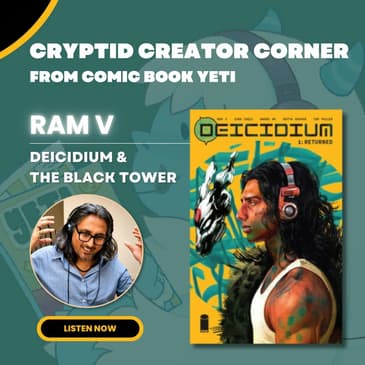

Acclaimed comic book writer Ram V returns to the show for an in-depth conversation about his most ambitious creative project to date (in my mind anyway,) a new nine volume graphic novel series called Deicidium and we spend a little time on his new DC Comics Vertigo project The Black Tower: The Raven Conspiracy.
Ram opened up about the necessity of taking a recent creative break to recharge, step out of his comfort zone, and flex new narrative muscles beyond the monthly superhero title grind. Fresh and ready to till new ground, he breaks down his massive new sci-fi graphic novel series, Deicidium, launching via French publisher Morgan to be distributed in English language markets through Image Comics. Our discussion explores the philosophical and mythological themes behind the book, its global release strategy, and the collaborative partnership with artist Evan Cagle.
The conversation then shifts to Ram's new DC Vertigo series, The Black Tower: The Raven Conspiracy, where he's reunited with the fan-favorite Swamp Thing creative team of Mike Spicer(Spicy) and Mike Perkins(Perky;) sharing the inspirations behind this occult spy thriller, diving into British espionage roots, and the esoteric history of the Tower of London's ancient myths.
Additionally, Ram touches on his unique perspective as an international creator working within the American comics industry, the value of emotional sincerity over post-ironic cynicism in superhero comics, and teases an upcoming painted horror project.
"I don't think I've ever read a story where godhood manifests within everyday people... The guy who was your Uber driver who you were nasty to yesterday, today is like, 'I am a god now, and you no longer have power over me.' That upsets society in ways that are very interesting." - Ram V on Deicidium
Show notes 🎶
🏛️ - Byron's recommendation of Unique Spaces
🎥 - Ram's Indian horror film recommendation Bramayugam
WATCH THE VIDEO VERSION OF OUR CHAT ON YOUTUBE!
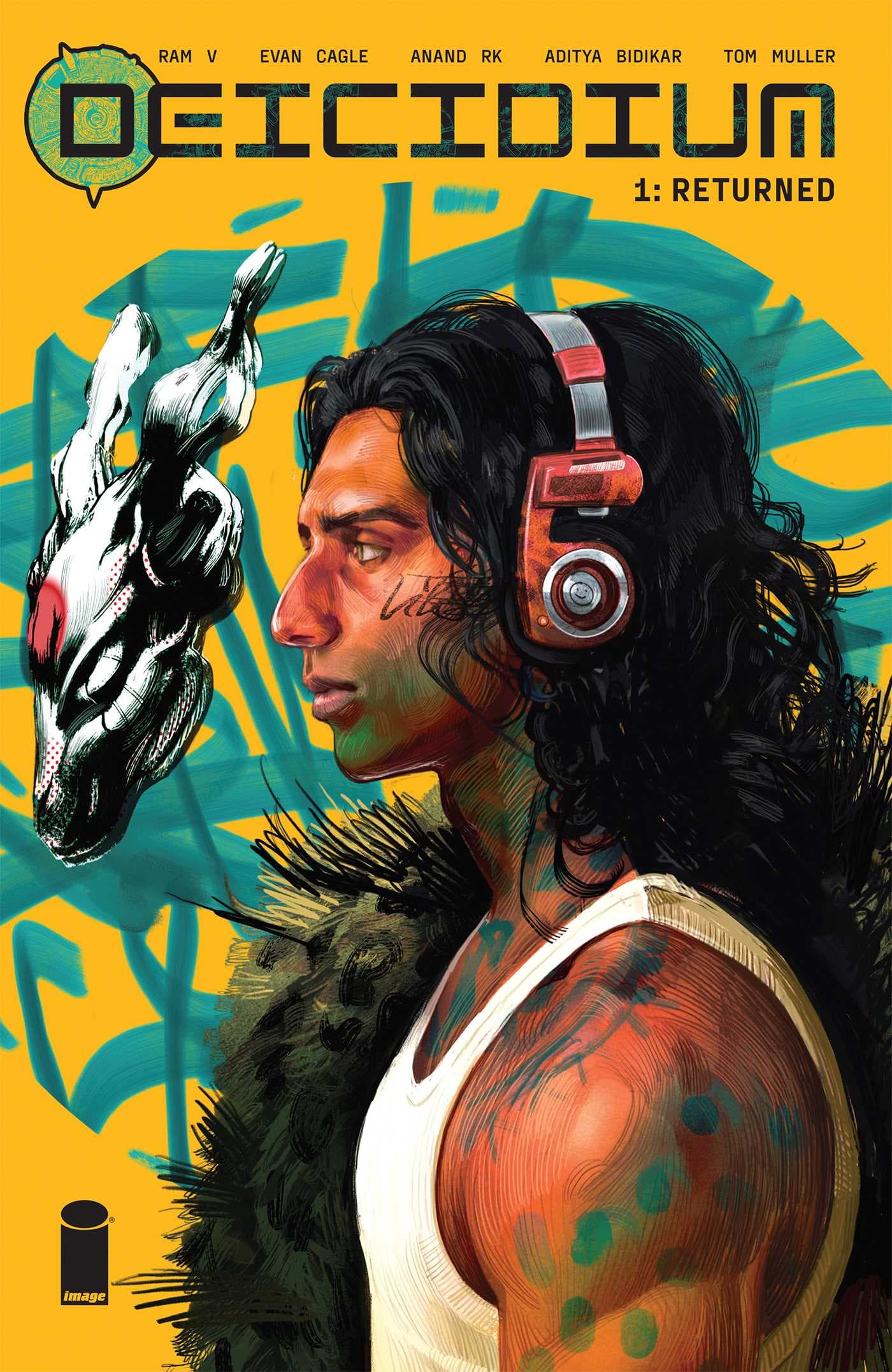
Deicidium
From the publisher
In a future rebuilt from the ashes of war, belief is no longer sacred—it’s monetized.
Humanity has entered a hard-won age of stability, governed by an unholy alliance between global corporations and newly engineered religions. Worship fuels the economy. Faith is power. Salvation is a product. Welcome to the industry of belief. That fragile balance shatters when the old gods return. Ancient deities of fire, wind, jaguars, love, war, and mischief awaken inside ordinary people, transforming neighbors and strangers into living gods. To the powers that be, they aren’t miracles—they’re threats.
The great faiths of the new world knew the old gods could one day return, and they planned for such an eventuality. 12 orphans were chosen, bestowed with gifts and taught to be faithless, loveless instruments without reward or remorse. The old gods have returned—and the 12 will be unleashed.
As old myths collide with a world built on manufactured faith, a brutal conflict ignites—one that will decide who controls humanity’s future, and whether salvation comes from those placed above us…or from within us. DEICIDIUM is a global epic series from the multi-award-winning collaborations of Ram V, Evan Cagle, Anand Radhakrishnan with Tom Muller, Aditya Bidikar and more.
Follow Comic Book Yeti
🔗 Comic Book Yeti LinkTree: https://linktr.ee/ComicBookYeti
For partnership and ad inquiries, please contact: thecomicsyeti@gmailcom
Follow your hosts
ARKENFORGE
Play TTRPG games? Make sure to check out our partner Arkenforge. Use the discount code YETI5 to get $5 off your order.
Make sure to check out our sponsor 2000AD.

[00:00:00] - [Speaker 0]
Your ears do not deceive you. You have just entered the cryptid creator corner brought to you by your friends at Comic Book Yeti. So without further ado, let's get on to the interview.
[00:00:11] - [Speaker 1]
The future is calling. 2,000 AD is the galaxy's greatest comic with new issues published every single week. Every 32 page issue of 2,000 AD brings you the best in sci fi and horror featuring characters like judge dread, rogue trooper, and more. Get a print subscription in 2,000 AD, and it'll arrive to your mailbox every week. And your first issue is free.
[00:00:35] - [Speaker 1]
Or subscribe digitally, and you can download DRM free copies of each issue for only 9 a month. That's 128 pages of incredible comics every month for less than $10. Head to 2,000 AD and click on subscribe now or download the 2,000 app and start reading today.
[00:00:55] - [Speaker 2]
Hello, everybody, and welcome to the Cryptic Creator Corner. I'm Byron O'Neil, and today we are joined again by the incredible Ram V. From sweeping original sci fi to dark gripping supernatural occult espionage, Rom is consistently pushing the boundaries of the comics medium in new and inventive ways. Today, we are diving into his massive new sci fi graphic novel series, Decidium, launching from French publisher Morgan and coming to English language readers via Image Comics. Plus, we're talking about his new brand new DC Vertigo series, Black Tower, The Raven Conspiracy.
[00:01:29] - [Speaker 2]
Ram, welcome back. Always a pleasure to have you on the show.
[00:01:32] - [Speaker 3]
Always a pleasure to be here and talk to you.
[00:01:35] - [Speaker 2]
For Of having course. Well, we've got plenty to talk about, but first I want to touch on your break. You've been working with, I've been working with artists or, you know, been one myself for over three decades now, and not enough attention is paid to how beneficial it can be to step away and to recharge and what that can do to spark creative expression. So what was the catalyst for you wanting, maybe needing to just take a little break?
[00:01:59] - [Speaker 3]
Yeah, I just, I think, you know, part of his complacency, you know, I've touched on this before in things like blue and green and rare flavors. It's very easy to go like, oh, I'm comfortable now. And things like, you know, I pitch things, they get picked up and and it's easy to make comics in a way that it wasn't when I was starting out. Right? Sure.
[00:02:24] - [Speaker 3]
And it's easy to sort of sit in that comfortable space and then, you know, slowly that complacency creeps into the creative side of things, which is not great. And so, like any good artist, I said, No, no, this place of comfort and good feels is good for me, but not great for the art. So I must, yeah, step away and consider what kind of stuff I want to do going forward. I think the things I pursued closer to the beginning of that break, like one hand, six fingers, is a lot closer to the kind of stuff that I'm interested in doing going forward, not just pushing narrative, but also pushing form and structure and whatnot. And even decidium, in that sense, is a first for me to work in 72 page, 96 page installations, plus work with three graphic novels over, you know, three years each, therefore nine graphic novels in total is is a is an expansive story that a structure that I haven't worked with before.
[00:03:38] - [Speaker 3]
So, yeah, that break was basically me going, I feel too comfortable, and what am I doing? I should be doing more interesting things.
[00:03:48] - [Speaker 2]
Did you find that the break allowed you to pull inspiration from other things that you're just not used to because you kind of get sort of with the blinders on and, know, we kind of get in the comics as a grind. So, you know, you just just, and I love that
[00:04:02] - [Speaker 3]
Especially all like monthly superhero stuff has a cadence and a tone to it. And and look, I think it's pretty evident from my work that I've never been one to sort of set into that comfortable tone and take the sort of, hey, this is another story that you've probably read some version of 10 times before, you know. So I don't I'm not saying like I was someone who was falling into that, but it's a completely different muscle than writing something like Blue and Green or writing something like A Leila Star. And, you know, like in any any sort of profession, if you don't work a certain muscle, it will eventually atrophy. And creatively, was feeling very sad at not being able to use that other muscle as much.
[00:04:54] - [Speaker 3]
And so I was like, listen, I've been flexing this muscle for about a little over two years now. I need to go flex some other muscles. So that was the reason for the break. In terms of inspiration, you know, I've always been someone who watches widely, reads widely. So I don't think that ever stopped.
[00:05:16] - [Speaker 3]
Yeah. Yeah. Does that does that make sense?
[00:05:18] - [Speaker 2]
Oh, absolutely. Yeah. Cause I was wondering if, Descidium was a response kind of even to the break, you know, not with narrative or visual content timescale, but, you know, it gives you more time as a creator to to actually do your work, you know? And that's one thing that comics is not very good at doing.
[00:05:35] - [Speaker 3]
No. I was actually discussing this, with Evan yesterday, Evan Cake, who's the artist on Desidium. And we were talking about how he's able to interpret characters in a different way than what I've put in the script. And so sometimes he'll respond to what's there in the script, but he'll take an approach that I hadn't seen. So if it's a somber moment, for example, sometimes he'll just take the character and go like, nah, I'm gonna I'm gonna make it a wildly funny moment.
[00:06:11] - [Speaker 3]
And when that happens, it changes the character in ways that I didn't intend for it to do in that in that place. Instead of going, no, you've changed it. Go back and fix it. When you have time as a writer, you can go, Oh, that's interesting. I didn't know this character had that in them.
[00:06:30] - [Speaker 3]
Now let me write them since they have demonstrated this ability. Let me, let me write them in a way that, that makes sense for this kind of character. And so Gotcha. It becomes truly collaborative, which isn't something you can do. I mean, much, you know, people talk about the conveyor belt of, you know, writer's script goes to an artist, then an artist does that.
[00:06:50] - [Speaker 3]
And that's one way of doing it, but that's not the only way. And I want to tell people like there's another way that is so much more interesting and more joyful when you're actually collaborating, but it takes time and it it needs room and I need to be able to go, you know what? Today, I'm just thinking. I'm not writing. So, yeah.
[00:07:10] - [Speaker 3]
Okay. Well, to
[00:07:12] - [Speaker 2]
give people the perspective of what Decidium is all about, this is a story about a corporate consortium that is controlling the world through religion, as old gods begin to resurface through ordinary people, which sparks a control versus freedom sort of conflict. We got that teaser for free comic book day this year. That was Omens, which blew my mind. You know? Let me start with the title.
[00:07:32] - [Speaker 2]
Right? Decidium is Latin for the killing of the gods, and thematically, this idea is foundational to our progressive, question mark, Marxist human beings, you know, with our shared cultural stories. We have eschatological, like Ragnarok, the murder of Osiris, Mayan pantheon, Greek gods, you know, often uses these elements for, like, world foundation, succession, seasonality, end of times, reboot. Right? So this feels like a collective expression of all of that, of
[00:08:01] - [Speaker 3]
a So I think I think in in that little piece you just said, you missed the the sort of persistent myth of the human rising to godhood through the murder of gods, Hercules, for example. Or even with the Hindu mythology, Ram, who was meant to be a mortal human who rose to godhood by challenging the gods themselves. And so I feel like there is a really wonderful aspect of being able to claim your own destiny only after you have defeated the things that are supposed to govern it. And I feel like it speaks to the time that we live in now, you know, without putting too much of a sort of straight line between the two things, like, I feel we are governed by our narratives. Feel like stories don't exist anymore.
[00:09:01] - [Speaker 3]
Franchises do and IPs do. And IPs must have their following and you can't you can't say one thing about someone's favorite character because that would be wrong. Gods weren't always like that for us. Our OG gods were things that we, you know, hunted with, rose with, things with things that governed our everyday life. And and I feel like somewhere in the in the human sort of transition from that kind of personal deification of things you encountered in everyday life this kind of organized, we all worship the big white dude in the sky.
[00:09:43] - [Speaker 3]
Somewhere in there, there is a loss of both personal responsibility and and personal empowerment in some ways. So these are, these are things that my brain is contending with when I write Dae Cities. Okay. Yeah. When I was reading through Omens,
[00:10:01] - [Speaker 2]
I guess my, one of the things that I took about it was generative AI, right? Our stories, mythologies that are passed down in mosques, churches, campfires, sacrifices, right? You know, this is what makes us human. And now they're fed into a machine to be spat out of this as this like sort of collective dissonance in my mind, you know, devoid of meeting and, you know, monetized for the ultimate benefit of corporations, you know, bent on absolute control of, well, everything that we do.
[00:10:30] - [Speaker 3]
Yeah. Yeah. As has been the goal from the very beginning, even before these were corporations, the goal of every sort of semi organized religious movement has been one of control. Even if it starts off from a very well intentioned place. And so, I think, for me, the fundamental difference is in the way human beings come up with gods versus the way human beings are controlled by gods.
[00:11:02] - [Speaker 3]
And so, in that way, the story kind of rights it so the conflict kind of rights itself, if you will.
[00:11:09] - [Speaker 2]
Sure. And you have 12 in here that are resurfacing. It's a big number of that in terms of numerology.
[00:11:15] - [Speaker 3]
No, no, I don't have 12 that are resurfacing.
[00:11:18] - [Speaker 2]
I'm sorry. Okay. Thought that
[00:11:19] - [Speaker 3]
In first volume, you'll come across three that we see resurfacing and hints of that may be around. There's also gods who may or may not have been around since the very beginning of things, who have been in hiding, who now feel emboldened to step forth for one reason or the other. And the 12 you talk about are 12 mortal humans who have been trained, if you will, by the powers that be, that in case this gets out of hand and the gods ever come back, we will this time instead of waiting for a Hercules to show up, we will have 12 that are trained and equipped and ready to perform the decidium that we are all here to read. Okay. So the and again, don't want
[00:12:12] - [Speaker 2]
to get into spoilers or anything like that, but you were kind of alluding to there may be gods that appear, you know, and it that gives me a, a Neil Gaiman kind of kind of feel to it, like American gods where we have, you know, deities that are more
[00:12:26] - [Speaker 3]
of a modern expression. So Sure. Some of them some of them absolutely are. There are a few in this that have been around since the sort of birth of humanity, if you will, that have learned to hide in this time where they are no longer worshipped as they once were. And so that is very much Cayman's American gods ish.
[00:12:51] - [Speaker 3]
But I think the fascinating aspect for me where this deviates from things like that is that I don't think I've ever read a story where the sort of godhood manifests within everyday people, which I think is a much more interesting take on the whole gods returning idea. Because every time I've seen it done, I think I believe Hickman also had a book about gods returning at some point where he had gods kind of floating in from space or wherever they were beyond us. I like the idea that the guy who, you know, your Uber driver, who you were nasty to yesterday, today is like, I am a god now. And, you know, I'm being facetious, but you understand the implications of when someone who is meant to be who is meant to be a person in the stratification of society from the lower rung suddenly goes, 'Actually, hold on a second, am God and you no longer have power over me. That upsets society in ways that is very interesting, especially in a future where people subscribe to the idea of being governed by a being that is superior to them.
[00:14:13] - [Speaker 3]
How do you reconcile that with the fact that the guy next to you has blue skin and is flying now, you know? So, yeah, I really, I don't even know the answer. I'm going to discover it as I write nine volumes. So yeah, and in the end, you know, it's also a comic book that's meant to be fun. It's me playing out all of my Shonen manga fandom as well.
[00:14:38] - [Speaker 3]
So there's gonna be battles between gods or between gods and god killers. And, you know, I I think a lot of people tend to forget gods aren't exclusive to human beings. There were there may have been gods long before there was humanity on Earth. So
[00:14:54] - [Speaker 2]
yeah, I'm definitely getting a bit of sort of an Akira vibe here, you know, with the echoes of like raw natural power that's given to an ordinary human up against that rigid, institutionalized establishment sort of thing. Yeah. You know?
[00:15:09] - [Speaker 3]
Yeah. There's definitely there's definitely elements of that in there. I also think that there is a the the thing that fascinates me about world mythology is just discovering characters and stories from across the world. Even though this is Stacidium is set far, far in the future and so the world as we know it may not be as recognizable, there's still there's still bits and pieces there that people can recognize and go, oh, this is from my culture, this is from where I am. And I find that fascinating given the, you know, coming back to the forum discussion that we were having before, I find that fascinating that this book will be released in multiple territories at once.
[00:15:58] - [Speaker 3]
It will come out at different, in different parts of the world at the same time or at similar times and people will be reading and I'm wondering how many people are going to look at it and go like 'wait, I recognize this God' or maybe this God, this power comes from this' and so I also wanted to encourage a conversation about the same thing across cultures, across languages, which isn't something you get with the way comics are released now, you know?
[00:16:25] - [Speaker 2]
Yeah. In ways this very much feels like your most ambitious project ever.
[00:16:31] - [Speaker 3]
I mean, always say that, so I'm trying not to say that. I always say that about every project I do, so I I leave that for other people to judge. But just in terms of the logistics of it and the scale of it, yeah, absolutely. This is huge, not only for me, but also for all of my collaborators. I mean, Evan will be working on close to two twenty pages over the course of his time on the book, and then Anand will come in and do another 200 and something pages, and then our third surprise artist will come in, who I know who it is, but we haven't announced it yet, will come in and do another two twenty pages.
[00:17:11] - [Speaker 3]
So it is going to be a long term project. The publishers are showing remarkable faith in, you know, trusting the fact that I can deliver this. So it's gonna be, yeah, it's gonna be an interesting thing to see. I wonder where things will be after, you know, three or four volumes have released yet.
[00:17:32] - [Speaker 2]
That's really cool. It sounds, enticing as a creator to be able to say, well, we've got sort of a blueprint, but you know, we got the roadmap, but we have no idea exactly where this is going. That's Yeah, lot and
[00:17:45] - [Speaker 3]
is my preferred way of writing and again, something that you don't get to do with a monthly ongoing because, you know, God forbid you go to your editor and say, 'Man, I have no idea where this goes after issue three. I'll figure And it then that makes people nervous because they're like, no, no, we have to share this with other creators and they have to figure out what happens with this character. We need to ask this team. None of that over here. I'm like, even even with the first volume, I was like, I have a vague idea of what the shape is, but what note exactly do we end on is something something we'll discover as I write it.
[00:18:24] - [Speaker 3]
And and I suspect that will keep being true throughout the throughout the run.
[00:18:29] - [Speaker 2]
Well, one of the things that I was taking from my omens read was this, sci fi as being creating an interesting juxtaposition of, of like, kind of looking at gods of the past. Right? Because you've got tech. That's, that's the
[00:18:43] - [Speaker 3]
thing
[00:18:43] - [Speaker 2]
that we always equate with sci fi. And, you know, the first thing that stood out to me was the kinesics, the characters move through space and, you know, how this is sort of tied to material culture and how we, we in turn now are interacting with emergent technologies from a physical perspective. I meant, went immediately to Marty's, you know, hoverboard and back to the future part two. Yeah. Yeah.
[00:19:05] - [Speaker 2]
You know, so how does that, what was intriguing about that for you presenting high-tech culture, so much of that embracing sci fi and creating a better lens for kind of how we talk about our mythological histories of the
[00:19:19] - [Speaker 3]
Well, my view of tech has grown more skeptical as I have spent more time here. Like, don't get me wrong, we've done I have said to this day that humanity's saving grace will be the fact that we are capable of creating things and that has always been to me the most beautiful thing about us is you can give somebody a little chisel and a hammer and then they will come up with something that is that will, you know, revolutionize all of society, as Boudin mentioned, the wheel, if you will. So while I maintain that level of optimism, I'm also increasingly aware that the more things change, the more things stay the same. In that, you know, all the effort we could be putting into, you know, clean energy and maybe even flying cars and jet packs and traveling around that way. Instead, that energy is being put into, you know, facial recognition and drone warfare and that even that feels cool and techy, like an AI that will create an image of a clown when you ask it to, like who asked for that, you know?
[00:20:39] - [Speaker 3]
Right. And so, and these things are taking up intellectual resources, natural resources. You know, what a point for humanity to look back after twenty, thirty years and go like, could have been working on jetpacks. Instead, I spent a whole bunch of water and power and built a whole bunch of data centers, so people on social media could lampoon each other with badly created AI videos. So, yeah, so my part of the way I'm approaching tech in Daisydium sort of comes from that place in that it's such a technologically advanced society.
[00:21:19] - [Speaker 3]
And yet this is a society that also had five world wars and somehow had to turn to God and organize religion to pull it from the mire of its own conflict. And that is not without adaptation and adopting of technology, but now technology is a second tier, it is subservient to the needs of organized religion, if you will, we did it. We let it go out of control once before it almost destroyed us. And now, therefore, the Word of God shall define what technology we use and what we don't. And obviously that too is used to create inequality, and so there are still poor people working, you know, in a place where you have a hoverboard and a robot that scans people's faces as it flies by, you still have people working in shantytowns on mechanized equipment.
[00:22:20] - [Speaker 3]
And so, I find maybe my commentary on tech is that it will never solve the human condition. That is an answer that is non technological. And no matter how much we think of ourselves as progressed because we have all this cool technology, effectively, we're still flinging poop at each other on trees. So, yeah. Well,
[00:22:48] - [Speaker 2]
that now that that depression
[00:22:50] - [Speaker 3]
has fully set in, let's
[00:22:52] - [Speaker 2]
get I into the never claimed to be a positive sunshine y kind of writer. It's not what I've come to expect. So, yeah, I should not be surprised, but the visual blueprint here, kind of were talking about Shonen manga being an influence, but it's also very French. Right? I'm seeing some like Marcinel school with like exaggerated proportions dynamic postures and, you know, environment as a character.
[00:23:19] - [Speaker 2]
And it's kind of hard to escape a, a meet all along, you know, kind of screaming metal coating as well in here.
[00:23:25] - [Speaker 3]
Yep. Yep. So, you mentioned that page four and five, Gustave Dore, nod as well. Yeah. But, you know,
[00:23:37] - [Speaker 2]
we constantly are talking about influences, but this seems like, and from hearing you talk about how you're wanting to pull in people essentially from all these cultures sort of wanting to be seen, you know, this sounds like a comprehensive way to also visually tell that story as well, you know, incorporating, all these different elements.
[00:23:56] - [Speaker 3]
Yeah. I mean, look, people keep saying like, write what you know, and, and, you know, I've heard some pushback against that idea as people go in like, yeah, but that's very limiting. I'm like, no, no, that's meant to encourage you to know more things, not write less. And so, this is a book that kind of falls in that zone of exceptional things that only this team of creators could know. Right?
[00:24:28] - [Speaker 3]
Like, Evan is originally from Texas, but lives in Paris, clearly inspired by classical illustration, a lot of it French, but also inspired by Japanese animation and manga and storytelling from there. And so he brings those influences, But also he's telling a story that to my mind is set in a very India esque place, which is an influence I don't think we've seen. I don't think we've seen Franco Belgian illustration art mixed up with manga set in an Indian setting with characters and gods from mythologies that are entirely foreign to those places as well. And so, but in 2026, a bunch of well traveled people can tell the story and I find it interesting that we can and we will attempt to and carry all of these influences on our sleeves and yet sort of put them together in a way that is new and interesting. So in terms of a kind of collective collaborative language, did you have to make Dawn Runner to maybe have, okay, confidence may not be the right word, trust maybe not exactly either, but like a synchronicity.
[00:25:47] - [Speaker 2]
Right? So let's commit to nine volumes as a creative team together.
[00:25:52] - [Speaker 3]
No problem. We can do this. Yeah. Look, I mean, Evan and I are an interesting duo. Evan's first graphic novel work of any length was with me and that was Dawn Runner.
[00:26:07] - [Speaker 3]
Yeah. And he'll admit it and and and I'll say this, I think Evan's work was always special and it was always brilliant, but you still need to learn like the most nuts and bolts banal stuff, which is impossible to pick up no matter how much of a genius you are until you've had to sit down and draw, you know, 12 pages in a month or something. The moment you have to do that, you pick up so many new constraints, but also so many new ways of solving those constraints. Right? And so I think confidence is maybe the right word to use in that when we arrived at Desidium, when we started to take it up, like, I'll be honest, the starting was a bit rough in terms of, like, oh, I don't Evan, this world has existed in my head from 2015 or or before that, but it hasn't existed in Evan's head for that long.
[00:27:08] - [Speaker 3]
And so when I start, I don't like to do preamble. I don't like to do give sort of ease people in. I will drop you right into the middle of things and go like, you'll pick it up. That's great for the reader, but it's really hard for the artist because they're like, I have no context for this world. Like, are they supposed to be wearing this material or this material?
[00:27:31] - [Speaker 3]
Am I allowed to use holographic screens? Am I allowed to use teleportation? What's going on? And so the starting of it was, a lot of it was spent finding out things like that. But I think because now you're comfortable with the sort of nuts and bolts of it, it's great to be spending time on the more interesting intellectual aspects of like, what is this world?
[00:27:59] - [Speaker 3]
Rather than going, oh, can I draw five panels on this page or can I draw six panels on this page? So, I think that level of confidence really elevates the work because you're no longer concerning yourself too much with things like, how do I translate action on a page? This is a question that Evan's answered now that he's worked on, what, 300 plus pages of comics between New Gods and Dawn Runner. So, I think in that way, makes the collaboration much more interesting. Synchronicity is an obvious sort of side effect of collaborating with someone for years.
[00:28:35] - [Speaker 3]
Wouldn't be working with Evan if I didn't absolutely enjoy every minute of working with him, considering we've done, what, two and a half plus big books together now. So the synchronicity is a given. Thank God, because otherwise, if I was writing scripts the way I was writing for him the first time we collaborated, it would I would absolutely be broken. Now my scripts are much shorter because I'm like, Evan, you know what I mean when I say these two words. Yeah.
[00:29:05] - [Speaker 2]
Yeah. Well, on that confidence front for you, we talked a lot about Evan here, but, you know, did you have to write Batman first to to feel like, you know, hey, I'm established enough that I can take a swing this big.
[00:29:21] - [Speaker 3]
I mean, yes. To be honest, it with me, you might consider this a matter of ego or a matter of of my my head being too too large for the rest of me. But when I started off in comics, one of the first books I did was a book at Image called Paradiso, and it was similarly large in scope. It was a living city and people from varying parts of a post apocalyptic world were arriving in this little living city. And there was gonna be a long like, if that series had gone on, it would have been, you know, thirty, forty, 50 issues, multiple years, multiple story arcs.
[00:30:05] - [Speaker 3]
And I went in naively going like, of course, it'll be great. It'll all be fine. And I went, you know, went to Eric Stephenson, pitched it. He was like, great. I love the ambition.
[00:30:14] - [Speaker 3]
Let's see where it goes. First year did really well. By the time second arc came around, the readership had fallen off. I mean, obviously, was creators nobody knew. Today, Dave Malia Promenik is doing Moon Knight, and, you know, I've done Batman and Swamp Thing and whatnot.
[00:30:30] - [Speaker 3]
But at that point in time, we were just two new creators. And so the idea to do something ambitious like this has always existed. So I won't say that it comes up as a matter of confidence, but I worry less about will I be able to see it through now. And so all of my attention and all of my anxiety is about will it be cool enough, not will I be able to finish it, which I think is a different, nicer anxiety to have. Yeah.
[00:31:01] - [Speaker 2]
With with those, I guess, sort of anxieties as a creator, I was curious about something that you said recently on, Twitter ex Q and A, you know, that you're sort of fascinated by the emotional sincerity, I think, and lack of cynicism in a lot of, you know, Japanese genre storytelling, which and and you're you're you're definitely delving into that with this.
[00:31:24] - [Speaker 3]
So I'm trying to get sort of
[00:31:25] - [Speaker 2]
a tone for how Desidima is going to play itself out. You know? So do you attribute that to like a Japanese cultural manifestation, like their worldview? Because it is very, very different. And I feel like the way our superhero narratives are going now, you know, you see, and they're fantastic books.
[00:31:43] - [Speaker 2]
Right? Absolute Green Arrow is wonderful. Yeah. But we're definitely playing off of corporate cynicism in a in a way that Yeah. Feels different, I guess, than here.
[00:31:53] - [Speaker 2]
You know? Is that I guess that's are you trying to do that?
[00:31:55] - [Speaker 3]
No. No. Absolutely. I think I think these things are absolutely cultural manifestations. Manifestations.
[00:32:00] - [Speaker 3]
Okay. The idea that American fiction lives in a post ironic sort of cynical place is not new. It's been broached before by other creators. But I think it's so hard to push away from that because it's part of the cultural narrative of things. Like, even sincerity, when you find it in books occasionally, I've seen people read that and go and tend and dismiss that as as like therapy writing.
[00:32:33] - [Speaker 3]
This is just a writer trying to be good and nice because their therapist said this is how you have to talk. And and so I feel like feel like it's almost impossible to get away from it because culturally it's impossible to get away from. Whereas I think with Japanese society, given the history of that country and what it was pre and post World War, Yeah. I think there's such a shock to the system in terms of who you believed you were before the war and the reality of, you know, how much reconstruction and putting yourself back together you had to do after the war, that I think some level of appreciation of how beautiful it is to just, you know, be human and have human feelings and emotions and be able to express them. Also, especially in a society where stoicism has historically been valued and championed, right?
[00:33:35] - [Speaker 3]
So for a notoriously stoic society to then be in love with even the most barest, sincere display of emotion makes complete sense. So, yeah, I'm interested in pulling at that because I'm so fascinated by it, but obviously it is still foreign to me and I almost have to teach myself to like, no, it's okay for characters to express themselves. They don't have to be stoic all the time. They don't have to be heroic all the time. They don't have to be sad or melancholy.
[00:34:08] - [Speaker 3]
They don't have to be any of these things. They can be silly. We can do silly things without the need to explain ourselves. And so, yeah, I'm having to like give myself permission to do things that I haven't done before. Okay.
[00:34:25] - [Speaker 2]
What do you feel like there's been a benefit for you as a creator living and working out from under the umbrella, I guess, of America for a while now. I think you went to school here.
[00:34:37] - [Speaker 3]
I did my masters in material science and chemical engineering at Penn. I went to school in India and then I've been working in comics largely in The UK. I don't know that I was ever someone who I mean, I clearly worked under the umbrella of American publishing, but I didn't start in American publishing quite in that way. Yeah. A lot of creators I know were quote unquote in the system before they they did their first work.
[00:35:12] - [Speaker 3]
And what I mean by that is I know people will be like, oh, yeah. I've been coming to San Diego Comic Con since I was 10. I wrote my first comic when I was, you know, 21. So you were there for a large part of more than a decade before you wrote your comic. I quit chemical engineering in 2013.
[00:35:34] - [Speaker 3]
I wrote my first semi professional short story around that year, and I wrote my first comic in 2016. So I had zero understanding or exposure to the umbrella of American comics publishing quite literally before I arrived there. I said this in a New Gods interview where they were like, what does it what did it feel like taking on, you know, work done by one of the industry's sort of greatest names in Jack Kirby? I was like, well, on some level, I felt like the guy, the fool who walked into the church and went like, 'Who is Jesus Christ?' So, you know, it felt a little bit like that in comics, and I've always sort of felt a little bit like that going into these sort of mainstream American comics publishing. And I think, honestly, that's a good thing.
[00:36:28] - [Speaker 3]
You shouldn't have all your creators already being fans of the properties that they're working on. Sometimes it's great to have a creator who comes in and goes, why can't we do things this other way?' And it's almost impossible for even me to think of things that I'm a fan of in quite that way because the very contention that you're a fan means there is already a version of the thing that you like the most. And so, how can you ever create a version of that thing that you like the most that is better or more interesting than the version you already idolized. So, yeah, yeah.
[00:37:07] - [Speaker 1]
So
[00:37:07] - [Speaker 3]
I've always been a bit of an outsider and, you know, I take pleasure in continuing to be one to this day.
[00:37:16] - [Speaker 2]
I did too. Jimmy is too humble to do this. So as his stalwart ride or die, I wanted to tell you about his new graphic novel, Penny and the Yeti with artist Amber Aiken. What started as a comic short with his daughter that I've known about for ages now and it's evolved and has become one of those annoying can't talk about it in comics things for too damn long. Yes, I'm predisposed to be supportive but after reading an advanced copy of it, I have to admit it's way better than I anticipated.
[00:37:48] - [Speaker 2]
No shade but it's really good, remarkably so. Does it have a yeti? Yeah. Is it cute and adorable? Yeah.
[00:37:56] - [Speaker 2]
But it streak lies in effectively tapping into the all too familiar family dynamics that we all are facing in 2026 and approaching it in a way that doesn't insult the book's target audience. Kids. They are way smarter and perceptive than we adults give them credit for. So I really appreciated Jimmy's narrative approach tapping into his own experiences as a dad and a spouse. I can hear his wife saying, get off your phone, Jimmy, through the pages.
[00:38:21] - [Speaker 2]
She's gonna kill me for saying that. It's hitting shelves on April 21, and I dropped the link in the show notes where you can preorder a copy today. Getty or not, here we come with Penny, Perry, Fenton, Maxine, and the magical, mythical, magnificent, Yeti. On behalf of us both, we appreciate your support. Oh, yohoala.
[00:38:45] - [Speaker 2]
Well, I wanna move on and so I can carve some time for Black Tower. Yeah. This is the return of the Swamp Thing team up with the the Mike Spicer and Perkins. They are back. In this one, you've got
[00:38:56] - [Speaker 3]
a We young refer to them internally as spicy and perky. Okay. They're both because they're both Mike's. We refer to them as spicy and perky.
[00:39:07] - [Speaker 2]
I will have to make a note of that. That is hilarious. Well, to kind of give people a perspective of this, you've got a young rookie agent, Darren Burrows, who is sent from America to train in England with division nine, which is an esoteric branch of the British intelligence that handles the paranormal called in espionage circles, the Black Tower. So I'm sort of getting slow horses meets hellboy. Am I far off?
[00:39:33] - [Speaker 3]
No, no. I well, my original pitch was slow horses meets Harry Potter. So there you go.
[00:39:39] - [Speaker 2]
Okay.
[00:39:39] - [Speaker 3]
Although hellboy is probably a closer, pick given my natural inclinations towards the darker side of things. So, very much, very much that vibe. Although I will say the magic is tempered and the joy of it for me is more in the spy stuff than the magic stuff because I feel like that's, you know, somebody else said this to me and put it really succinctly, I said, you know, I like magic when it's secretive and in the corners that you don't expect. I don't like it when people are throwing fireballs at each other on the street. And this friend I was talking to turned around and said, Yeah, because it's a cult.
[00:40:25] - [Speaker 3]
It's supposed to be a cult knowledge. So not everyone has it, and it's not widely known. And that put this idea in my head that when magic becomes known, it loses its power. And so, it makes complete sense that the last place that it survives is intelligence circles where secrecy and discretion thrive. So, yeah.
[00:40:47] - [Speaker 3]
Okay.
[00:40:48] - [Speaker 2]
Yeah. I saw you were reading the Psychic Battlefield by Adam Mandelbaum. I was not familiar with this one. I assume that was sort of research for
[00:40:57] - [Speaker 3]
It was. It was research. And, you know, I read a few other things. I think the there's a German manual of demonic magic that I read and read another called Crowley's London. So, yeah, there have been a few things.
[00:41:12] - [Speaker 3]
You know, did some research on research on John Dee and the historic use of metaphysics and magic in British intelligence and warfare.
[00:41:22] - [Speaker 2]
Yeah. So to play around with this, I'm trying to get a feeling for it. Are we looking for a more like, okay. You talked about what you just read, old German history on this magic treatise or whatever, you know, a little more I'm not going to say factual, but like less Art Bell, I guess, you know, how much are we getting into conspiracy theory and that sort of stuff with it?
[00:41:44] - [Speaker 3]
There was some conspiracy theory stuff, like the I don't think I'm spoiling anything by saying this, that part of the first arc is set against the backdrop that and I always love sharing this story. It's set against the backdrop of the fact that there is a head of an old Welsh king buried under the Tower Of London. The idea that the head is positioned in a way that it faces France. The idea was that as long as that head was positioned that way under that tower, England would never be invaded. And, funnily, true to this day, England has never faced a land invasion.
[00:42:24] - [Speaker 3]
Even at the height of World War II, there were bombings, but no enemy combatant ever set foot on English soil, right? And so, find that kind of stuff interesting. And so, that forms the backdrop to then go away and go like, yeah, but what does that mean in a modern day context when, you know, intelligence and warfare, you know, has long dropped the idea of land invasion being needed. And yet, as we are learning in multiple fronts in the world today, you cannot you cannot get things done without committing people and real lives to the to the idea that you want to wage war. This whole idea of, like, you know, I'm sat far away, I push a button and the other country has to secede to my demands.
[00:43:13] - [Speaker 3]
Well, it doesn't work because the other country decides, well, I'm going to block this little passage in the sea that people use to transport oil, and suddenly the entire world is like, Release your hands from my throat. And so, Yeah. Yeah. So there's that, you know, internal friction between the modern state of warfare and the inability to move away from facts on the ground, which are true this day as they were two hundred, three hundred years ago.
[00:43:44] - [Speaker 2]
Yeah, I love using Brown the Blessed for this, you know, with the, I guess Welsh, that for Crow, if I'm Yeah, understanding yeah,
[00:43:52] - [Speaker 3]
so it's called the Raven conspiracy and that also explains why Game of Thrones, it's a brand start that becomes the three eyed raven. Yeah.
[00:44:07] - [Speaker 2]
Yeah. Well, the, the ringmaster of the Black Tower is one Alastair Romeo, I guess. So his relationship with Darren, is that going to be similar to like an I'm Bond thing? Are we like Gallahed, Eggsy? Cause there's lots of mentor pupil kind of relationships and how that could play out in an espionage story.
[00:44:24] - [Speaker 3]
So the funny part in this and I appreciate the M Bond thing is still is James Bond and quintessentially British, but I also love the fact that British statements of power tend to be very understated and they tend to be very passive aggressive. So in true staying true to that, no one is quite sure why Alastair Romeo is the boss of Black Tower. That will be the case almost until you get to the very end. Throughout, he's just kind of bumbling through the story for about three or four issues. Things seem to be going out of control and then you realize why he is where he is, you know, when certain things happen, plus the climax.
[00:45:16] - [Speaker 3]
So I also love I was talking about this with Evan yesterday. He shares my love of characters who appear to be sort of incapable or inept right up until the moment where they are extremely not inept or not incapable. And so, yeah.
[00:45:37] - [Speaker 2]
Mr. Bean kind of thing or? Well,
[00:45:42] - [Speaker 3]
I guess the best example really is to pick from the wire. Okay. Well, one of the I forget his name. The character who keeps building the miniature furnitures. Do you do you remember him?
[00:45:57] - [Speaker 2]
So I I remember him, but I'm not recalling the name either.
[00:46:00] - [Speaker 1]
It's been a while.
[00:46:01] - [Speaker 3]
I'll I'll I'll eventually look up the name of the actor. But famously, he sat there through, like, half of a season just in the corner kind of building his miniature furniture, and other characters are discussing about like, oh, that actually brings him money more than, you know, being a cop does, so obviously he's spending all his time on that. And then they get to an impasse where their group is being broken down, they haven't made any progress, and one of the characters really breaks down and says, I just really want to solve this. I want to do good police work. And it's at that point that he gets up and he goes like, If you want to do some real police work, then maybe I'm interested in working with you.
[00:46:45] - [Speaker 3]
And it's actually his suggestion that leads them to putting on the the the wire taps, and therefore, the show is called The Wire. So, it's this character who's just sat in the corner in the background doing nothing until got I to realize he's think he's I think in the story, his name is Lester, but I could be wrong.
[00:47:07] - [Speaker 2]
Well, I've seen the preview pages and it's absolutely beautiful. But what's your thing with hands and eyes, man? Cause like, it's super creepy and it's repetitive. You keep
[00:47:17] - [Speaker 3]
doing this. Yeah, I mean, but also like, just in terms of classical magic, these are both symbols of potency and power, know, both hands and Hands because we do things with them, and eyes because they're the window to the world. And so, just in terms of magic and symbolism, think that completely makes sense. It does. And also, like, I don't know if you've noticed, but Mike draws people's hands in really poetic and dramatic ways.
[00:47:51] - [Speaker 3]
Yes. And so I love getting Mike to draw some more hands. My script is full of hands and I wherever I can Also, like, I have to say to people who haven't seen this, it's not his eye in his hand. It's somebody else's eyes in his hand.
[00:48:11] - [Speaker 2]
And that makes it
[00:48:11] - [Speaker 3]
better? Okay.
[00:48:14] - [Speaker 2]
Okay. Okay. Well, think I speak for a lot of us when I say I'm delighted to have you back here and cranking out work again, because both these look fantastic. Very much looking forward Yeah. To they sit them hits shelves in late September in the Black Tower at the end of the month.
[00:48:30] - [Speaker 2]
You know? Actually, this is this is
[00:48:31] - [Speaker 3]
probably a good place to correct it. We're gonna have we're gonna have some scheduling issues with Decidium just because we've talked about a global release, and it looks like Decidium will come out in France first at the end of October, obviously, with it being a French publication. And therefore, it means we've had to push back the American release because it's it's a little bit weird. We had stated that they should come out at the same time. But apparently the way things work in American publishing is the direct market gets the book a month in advance of the book market.
[00:49:08] - [Speaker 3]
And so with that being the case, the direct market would have gotten it in September, which would have been before the main publisher released the books. And then so obviously we couldn't, we couldn't do that. So now it'll come out in October in France, shortly after it'll come out in the direct market in The US. And then a month after that, it comes out in the book market in The US.
[00:49:32] - [Speaker 2]
Okay. Publishing is complicated. Check.
[00:49:35] - [Speaker 3]
As as we find out, and and, you know, we knew this was gonna be the challenge with doing like a global release. So it's also going to be available in Spain. It's also going to be available in Italy, Poland, perhaps Portugal and perhaps Brazil. Very exciting.
[00:49:53] - [Speaker 2]
Yeah. Many languages is it going to be translated into for like, you know, initial release?
[00:49:58] - [Speaker 3]
I mean, nailed down probably four and potentially up to seven or eight. Wow. Very cool. Yeah. Yeah.
[00:50:10] - [Speaker 3]
I mean, I meant it. Like, I wanted to do something that felt different even in terms of release cadence and format. So this is absolutely it would be a joy to have like a person from Brazil talking to a person from Italy about which god is from where. You know? Yeah.
[00:50:28] - [Speaker 2]
Way cool. Well, I know you can't offer specifics yet, but as a fan of painted horror comics, you know, you recently teased what you're cooking up with artist Steven Beach. And I know this is gonna be lit. Like, I'm John Bolton, John J. Muth, huge fan of, you know, like painting comics.
[00:50:44] - [Speaker 2]
So, you know, there's just something very special about it. So I'm looking forward to that for sure.
[00:50:48] - [Speaker 3]
Yeah. I mean, I've been working on that on the side, with Steve and it's part of a publishing endeavor called 'Ninth Circle' that we announced a little while back, but we've been quietly making this as part of it. I'm supposed to be doing three horror one shots as part of that, and this one with Steve is going to be the first. And it's very much my kind of horror, so I'm not one for the sort of schlocky jump scare horror stuff. I'm more of the weird Thomas Ligotti, I just read this, I have no idea why it's horror, but it's definitely horror.
[00:51:26] - [Speaker 3]
Yeah, so I'm kind of excited to get back to that space. I feel like it's a space that I particularly enjoy being in, especially given the work I did with things like blue and green, even parts of one hand, six fingers kind of fall squarely into that zone. So now I imagine being able to do three one trusts that are unashamedly, entirely in that space of like, what the hell is this? It's messed up, but I have no idea what's going on. Ah, my favorite.
[00:51:55] - [Speaker 2]
Well, before I let you go, it's time for my shout out and this could be something that inspired you recently or someone you'd like to thank that just did something nice for you. So I'll go first to give you a minute to think about it. Netflix has a new show that we've been watching as a family called Unique Spaces that showcases like a vast array of really, truly stunning architecture. And there was a recent one about the circular home that Frank Lloyd Wright built for his son, and it's undergoing a renovation that's being done by a Chinese, father and daughter combo, and absolutely loved it. It's really, really fascinating show.
[00:52:29] - [Speaker 2]
So if you're a fan of high end design, add it to your watch list. So what you got?
[00:52:33] - [Speaker 3]
Cool. I'm gonna recommend an Indian horror film. The thing that's been really inspiring me, I went back to India for a vacation a week ago, and the thing that really inspired me is a lot of young people in India are making, creating art and stories and narrative that is really cool and interesting, And so as a part of this, I'm gonna recommend a black and white Indian horror film that is not from Bollywood. It is a Malayali film and it's called Brahma Yugam. And that's all I'll say about it.
[00:53:10] - [Speaker 3]
Go go have a look And if you enjoy it, then, then, there's a lot more Indian horror that I can recommend. So, yeah.
[00:53:20] - [Speaker 2]
Nice. I'll have to put a link in the show notes, check that out myself. I'm trying to put together my, horror watch list for spooky season as it'll be here sooner than we can snap our fingers.
[00:53:31] - [Speaker 3]
Fascinating stuff going on with, like, younger filmmakers in India and their inclinations towards horror, but set in an Indian context and Indian setting. So, yeah, I mean, I want to say I did it first with D7 Chores on some level, but it is really nice to see people taking on subjects that aren't considered the sort of bread and butter of mainstream Bollywood.
[00:53:57] - [Speaker 2]
Is there a more of a fascination with horror in India going on right now in, like, a specific subgenre? You know, like, body horror is huge right now in comics, for instance.
[00:54:07] - [Speaker 3]
Sure. So Well, I think Indian horror necessarily is on some level contending with historic erasure. Right? Because you had all of these really old ancient belief systems and civilizations and kingdoms, and therefore, really ancient superstitions and horror stories that kind of suddenly went away at first with being colonized, but also then with the wave of modernization that followed becoming a independent republic. And I feel now that people have acquired the techniques and the tech of modernization, they're kind of looking back and discovering.
[00:54:56] - [Speaker 3]
Actually, there's some really interesting stories that we have forgotten in our own past that I am now capable of telling to a modern audience in an interesting way because all this modern narrative technology is available to me. So there's some really looking, slick looking films being made that are essentially about like an old landowner in some village outside of some town you haven't even heard of in pre colonial India. There we go. There's your story, you know? Yeah.
[00:55:28] - [Speaker 2]
Okay. Cool. All right. Well, Ram, it's always a pleasure getting a chance to catch up with you, hear about the new projects. Thanks for coming on and chatting with me today.
[00:55:36] - [Speaker 3]
My pleasure. Thanks for having me.
[00:55:38] - [Speaker 2]
Absolutely. Well, is Byron O'Neil on behalf of all of us at Comic Book Eddy. Thanks for tuning in and we will see you next time. Take care everybody. This is Byron O'Neil, one of your hosts of the Cryptic Creator Corner brought to
[00:55:51] - [Speaker 3]
you by Comic Book Yeti.
[00:55:52] - [Speaker 2]
We hope you've enjoyed this episode of our podcast. Please rate, review, subscribe, all that good stuff. It lets us know how we're doing and more importantly, how we can improve. Thanks for listening.
[00:56:06] - [Speaker 0]
If you enjoyed this episode of the Cryptid Creator Corner, maybe you would enjoy our sister podcast, Into the Comics Cave. Listen and subscribe wherever you get your podcasts.