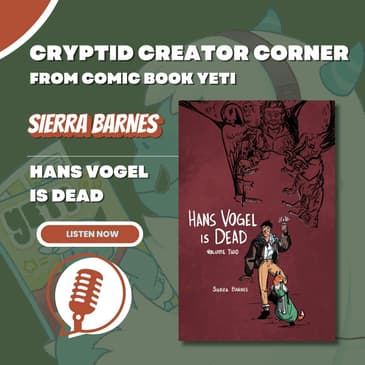

Comics creator and show friend Sierra Barnes returns to talk about her new Dark Horse Comics anti-fascist dark fantasy graphic novel Hans Vogel Is Dead Volume 2.
In this panel plunge, Sierra unpacks the chilling historical parallels between World War II German hunting culture, Nazi propaganda, and modern-day politics and how we can unpack all that through the use of animal metaphors, Slavic folklore, and the psychology of mob mentality. Plus, get an exclusive sneak peek into what to expect for Volume 3!
📚 Get your copy of Hans Vogel is Dead Vol. 2 out on August 5th, 2026 and buy it at your local comic shop or favorite independent bookstore because Barnes and Noble supports AI books which sucks.
"If I write accurately about the fascism of Hans' time, it's going to reflect in the fascism thereafter. Because there are similar factors at play, and also because fascists do not have an imagination—they are running the same playbook because they only have one playbook." - Sierra Barnes
WATCH THE VIDEO VERSION OF OUR CHAT ON YOUTUBE!
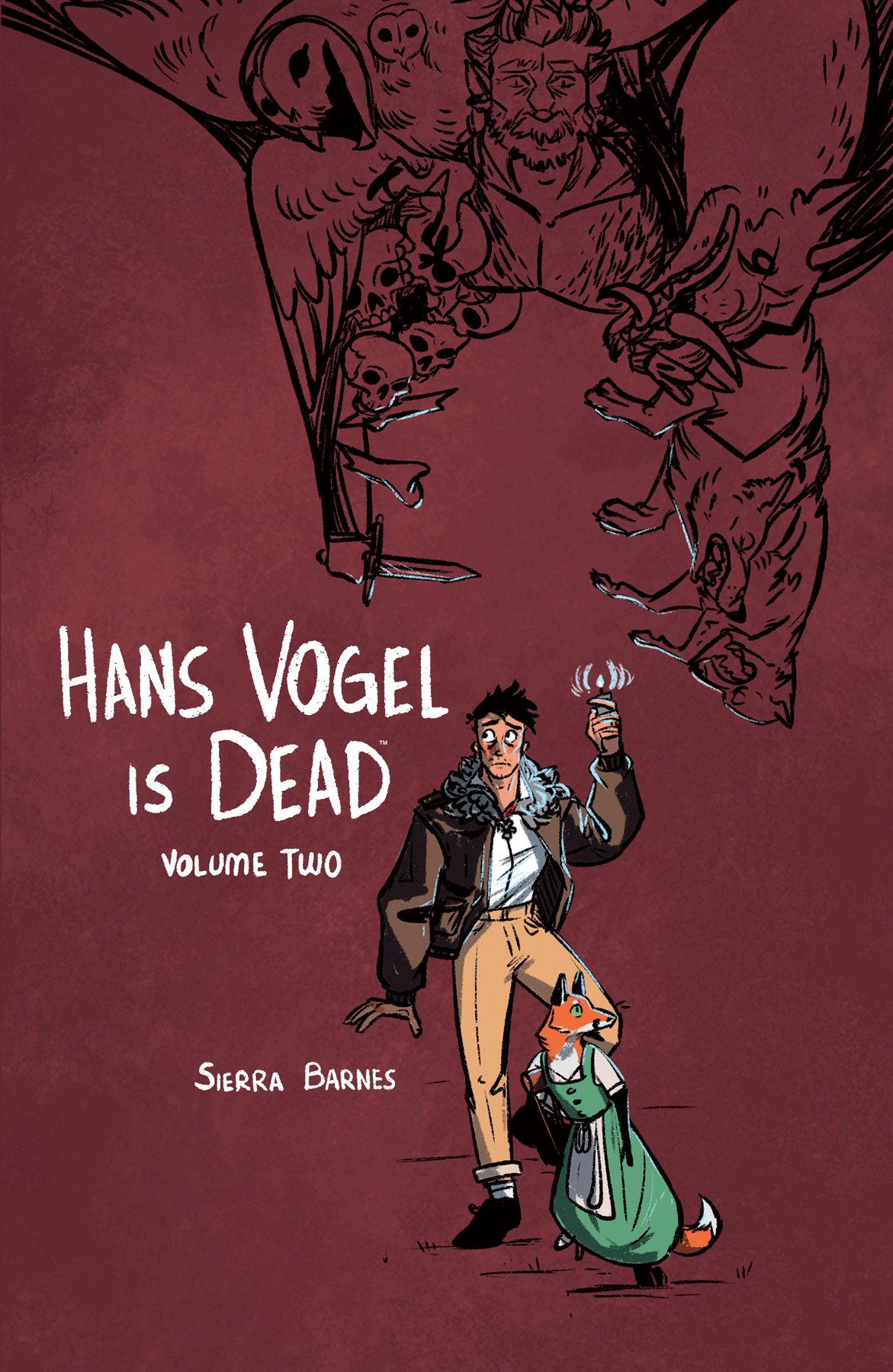
Hans Vogel Is Dead Volume 2
From the publisher
Deceased Nazi ace pilot Hans Vogel continues his journey through an eerie afterlife populated by figures from German folklore in this second graphic novel installment of Hans Vogel is Dead. Just when he’s begun to take responsibility for his actions in life, direct confrontation with the Erlking, his vicious allies, and Hans’s own past may send him spiraling back into denial—leaving Reineke, the young fox-girl in his care, in danger. Hans thought he and Reineke would be safe in the castle where resistance to the evil Erlking is rallying its forces. Instead he found a doddering old king clinging to broken ideals, tension amongst the would-be allies, and a ghost from his past with its talons around his throat. So when he and Reineke have a chance to leave the castle in pursuit of a wayward princess, they take it. Running from his fears takes him from an imprisoned potential ally to the heart of his enemy’s fortress, but his time is running out, and a collision with the monsters within and without are inevitable. Can he muster his post-mortem morality to make a stand for what’s right, or will he return to complicit cowardice?
Sierra Barnes weaves a rich anti-fascist fairytale about the importance of recognizing past wrongs, even (especially) when it’s easier not to.
Follow Comic Book Yeti
🔗 Comic Book Yeti LinkTree: https://linktr.ee/ComicBookYeti
For partnership and ad inquiries, please contact: thecomicsyeti@gmailcom
Follow your hosts
ARKENFORGE
Play TTRPG games? Make sure to check out our partner Arkenforge. Use the discount code YETI5 to get $5 off your order.
Make sure to check out our sponsor 2000AD.

[00:00:00] - [Speaker 0]
Your ears do not deceive you. You have just entered the cryptid creator corner brought to you by your friends at Comic Book Yeti. So without further ado, let's get on to the interview.
[00:00:11] - [Speaker 1]
The future is calling. 2,000 AD is the galaxy's greatest comic with new issues published every single week. Every 32 page issue of 2,000 AD brings you the best in sci fi and horror featuring characters like judge dread, rogue trooper, and more. Get a print subscription in 2,000 AD, and it'll arrive to your mailbox every week. And your first issue is free.
[00:00:35] - [Speaker 1]
Or subscribe digitally, and you can download DRM free copies of each issue for only 9 a month. That's 128 pages of incredible comics every month for less than $10. Head to 2,000 AD and click on subscribe now or download the 2,000 AD app and start reading today.
[00:00:55] - [Speaker 2]
Hello, everybody, and welcome to the Cryptid Creator Corner. I'm Byron O'Neil, your host for our comics creator chat. Today, I'm hanging out with my friend, comics creator creator Sierra Barnes, who has a new graphic novel dropping with Dark Horse Comics, the second installment of her series, Hans Vogel is dead. To give you a time warp moment, it was way back in October 2021 that we first spoke about volume one on Twitter spaces, of all places. And, yes, I will always call it Twitter.
[00:01:23] - [Speaker 2]
The book was funding on Kickstarter then, time flies, and the landscape of things has certainly changed. Has it not?
[00:01:31] - [Speaker 3]
It's yeah. That I feel like I've been I've been hit by the time, Ray. That's not a thing, but it could be.
[00:01:38] - [Speaker 2]
Where's Tim Curry? We need Tim Curry.
[00:01:40] - [Speaker 3]
Yeah. It's just a stop to eat. Yeah. So that's the time warp. God.
[00:01:48] - [Speaker 3]
Anyway. Yeah. Now and now so many so many years and many, many pages later, we've got we've got two books now that I can hold up for you. Woo hoo. My author copy has got in, so I'm able to wave them at people ahead of time.
[00:02:04] - [Speaker 3]
Very exciting.
[00:02:05] - [Speaker 2]
Nice. What's it feel like to get the author copies
[00:02:10] - [Speaker 3]
it was a shock. I because this book has been plagued with production problems. And when the book was postponed for for a week because of printer issues, I was kind of, like, half expecting to get an email saying, yeah. The the book was on a ship in the Strait Of Hormuz and was hit by a missile or something. So when they showed up on my porch unannounced, I was ecstatic.
[00:02:42] - [Speaker 3]
And especially ecstatic because it was supposed to pour rain that day and it didn't, which is great. Because if I had come home to a wet a a box of five boxes of wet books, I would have been devastated at all this time. But it didn't rain. It's a a Christmas miracle in in July, and they look great, and I am so happy.
[00:03:07] - [Speaker 2]
And no fascist missiles took out the book in 2026 that is talking about fascism. So there we go.
[00:03:14] - [Speaker 3]
No. No missiles. Yeah. Hooray.
[00:03:18] - [Speaker 2]
Well, I wanna start in a in a different way with this. So I wanna start with a quote because I was when I was kinda digesting the book, I I I kept looking at those parallels between then and now. So here's the quote. The great masses of the people will more easily fall victims to a big lie than a small one. And that was Adolf Hitler in 1925.
[00:03:44] - [Speaker 2]
Notably directed at his political opponents and not as a strategy directive, which I thought was really, really interesting. And that's eight years before the rise of the Nazi party and few kind of eerily prophetic in, in modern America and kind of a somber place to dive into Hans Vogel is dead. But let's do a brief refresher for folks who are listening and may not be as familiar with the story. So give me the volume one quick beats breakdown.
[00:04:13] - [Speaker 3]
Absolutely. Yeah. Hans Vogel is a German pilot in World War two, lauded as a war hero, recipient of the Knight's Cross of the Iron Cross, and he gets shot down and killed in the battle of Britain. Womp womp. But when he wakes up in an afterlife of the Brothers Grimm fairy tales he knew from his youth, he has to to have a second chance at life and decide whether or not he's going to do what he did in life, go with the easiest option, live under a rising fascism in the fairy tale world, or do better this time around.
[00:04:47] - [Speaker 3]
So he's unpacking the fascism he learned growing up in Nazi Germany. He's trying to be a better person. He runs into Reineke, who is a 12 year old girl cursed to look like a fox, and the two of them are negotiating this weird world of witches, werewolves, and, the rising power of the Errol King, a shadowy figure whose I I was going to say shadow influence is stretching across the land that Hans recognizes from his time alive. So fairy tales and anti fascism, two of the things that I love the most, kissing on the mouth. So I can make them do that.
[00:05:25] - [Speaker 2]
Yeah. They were leaving okay. Here's my first attempt at German words here. So the the Merchendweld? Did I get
[00:05:31] - [Speaker 3]
Merchenwald. Yeah.
[00:05:33] - [Speaker 2]
Alright. Not too bad. Not too bad.
[00:05:35] - [Speaker 3]
Not too bad.
[00:05:36] - [Speaker 2]
They were leaving the forest, and they were now headed to Heldenterm. Yes. So the castle in the mountains with Hans determined to take on the Eel King. And volume one was more focused on, as you were saying, reimagining some of grim fairy tales lore. So the setting was important as a reference point there in the forest.
[00:05:56] - [Speaker 2]
Volume two sees a lot more of the action in Heldenterm and the surrounding lands in the here here, I'm gonna try this one again. So, Beovagia, the forest?
[00:06:08] - [Speaker 3]
Oh, Dunwald. Oh, Bielavise. Bielowise Forest is the real world forest that Hans is in.
[00:06:17] - [Speaker 2]
Oh. Okay. Okay. And that's That's in Poland. Border Yes.
[00:06:22] - [Speaker 3]
Lot of very cool, real life history, there.
[00:06:26] - [Speaker 2]
Yeah. So the the castle and the forest, why there specifically? Did you have a personal, like, association with either of those?
[00:06:34] - [Speaker 3]
Yeah. So Heldentorm, is not a real place, but it is based off of a castle that was close to where I lived when I lived in Austria. A lot of the interiors and the exteriors are inspired by the Fortress in Grain, which is a small, but heroic city on the Danube in Austria that used to be a major hub for not only trade going up into Austria, but also for the Crusades, where it was a in order for your trip to The Holy Land to count as a crusade, sort of legally, you had to collect a bunch of pilgrim badges from designated points that the Catholic church would would tell you or would would grant to cities. Because, of course, if you had to visit the city to get the badge, you have to
[00:07:31] - [Speaker 1]
pay the money, have to pay
[00:07:32] - [Speaker 3]
the taxes, so a lot of towns would would financially very much benefit from this. And Grind was one of those very important strategic towns that had one of the required pilgrim badges. So it it got a lot of money and prestige from from that position. And as a result, the fortress, because it's a choke point on the Danube River, was very nice. If you ever get a chance to to visit Upper Austria, I highly recommend it.
[00:07:58] - [Speaker 3]
And you will you will recognize many of the rooms and the exterior shots from from this castle because I took a bunch of pictures while I was living there. And as for Gelavise Forest, which is I was I was not able to go there personally, but it is, in German, referred referred to as an which means like a is like a a word that means, like, primeval or, like, original. It's it's got this context of, like, being something that is timeless and from which all things come or a a bunch of other things come. And Pialyvisa is one of the oldest continuously standing forests in Europe. It has now and also had previously a bunch of endangered animals, and it was considered it was preserved by the Tsars for a very long time as a hunting ground.
[00:08:56] - [Speaker 3]
And in World War I, the German army hunted it basically to extinction. When they captured the area, there was hunting culture in the German upper classes, which is something that I talk about a lot in volume two, is like it's very wild. No no pun intended. But one of the things that was, like, very caught in the imagination of this, like, German upper class hunting society that in a lot of ways imprinted itself on the air force at the time because a lot of the air force wore these upper class jonkers, the the the the noblemen, was this idea of keeping Poland at large, but specifically the Bialowice Forest as a imperial hunting ground. And that's why Goring was, like, obsessed with it.
[00:09:52] - [Speaker 3]
And part of the reputation of the forest as a hunting ground was that the Polish people who were still living in the forest and were launching resistance efforts from it were considered or were treated as prey. They were
[00:10:12] - [Speaker 2]
Okay.
[00:10:12] - [Speaker 3]
Referred to as bandits and would the same, like, language in German to going after bandits in the forest was the same language of hunting animals. So that sort of threw line to me reading about the culture of Luftwaffe occupation of this forest, the forest imagery, like intrinsic and fairy tales, this like muddling of human and animal that was very inspirational for, for my work in this book.
[00:10:45] - [Speaker 2]
Yeah. I didn't realize that the Luftwaffe, the the pilots themselves were part of that hunting cult. Like I just don't have a basis for it, but I, and I found it fascinating how, just how superstitious they were, which was a very interesting element in the book. I went back and so I discovered the star of Africa and the cult of personality that was associated with that. So it was I really enjoyed that element of the book a lot.
[00:11:13] - [Speaker 3]
Thanks. Yeah. It was it's one of those things where I was like doing research and this was like years ago, and you're kind of like, dang, I don't know where the story is going to go, I'm kinda thinking about things, and you find the right book at the right moment, and it happened to be on hunting cults in the Luftwaffe, and I was like, oh, this is like, this is it. Like, this is the piece just kind of fitted into place. And I was like, yeah, okay.
[00:11:39] - [Speaker 3]
We're cooking now. Like, we've turned on the gas.
[00:11:41] - [Speaker 2]
Yeah. Yeah. Had the light bulb moment. Yes. Very much.
[00:11:46] - [Speaker 2]
Yeah. Well, influential books. So, there's one that I'm reading right now. I'm not familiar if you're familiar with it, but, Gustaf LaBonde's The Crowd. Not gonna book.
[00:11:58] - [Speaker 2]
Okay. All right. So for people who may not be familiar, it's a, the quick summation is an analysis of mob psychology written in 1895, which is sadly all too relevant today. And in the book, the Nazi framing was way more pronounced this time than in volume one. At least it felt that way to me, you know, where first, the first volume was a little bit more like a window dressing to kind of play with folklore.
[00:12:25] - [Speaker 2]
And in this year, you're with the wild hunt is kind of an analogy for, for the Nazis, you know, but this time I don't want to give away too much here, but the visual visuals clearly shift from that that folklore focus to looking at the fascism of the Nazi party and the parallels has to be of today, has to be something you were thinking about more. Because that's overwhelmingly what I got out of my read.
[00:12:53] - [Speaker 3]
I yes. I mean, there's there's yeah. Absolutely. I find that, like, I, and I was I was just talking about this on a panel actually this weekend, where, like, people were like, how how are you worried about, like, referring to politics in your work making it seem dated? And I guess that my answer to that was by grounding like, we we talked about a couple of books that seem timeless or that seem prescient now.
[00:13:29] - [Speaker 3]
The Hitler quote, the the crowd. I recently did a rereading of Hannah Arendt's
[00:13:36] - [Speaker 2]
Okay.
[00:13:37] - [Speaker 3]
Theories of fascism because, she was she's got some great great insights into it. And they thought they were free, which is, interviews with a bunch of German civilians after World War II about being under the Nazi rule. They feel very prescient to now, but they are very much grounded in the time that they were written. I think that that, to me, is the success of doing the research and speaking to the cultural moment that you're writing about. It's hard not to be cautious of living under fascism now, but I was very much like, if I write accurately about the fascism of Hans' time, it's going to reflect in the fascism thereafter.
[00:14:28] - [Speaker 3]
Because there are similar, factors at play and also because fascists do not have an imagination and they are running the same playbook because they only have one playbook.
[00:14:41] - [Speaker 2]
Yep. Yep. That's exactly what I saw. You had the Nazi party embracing pseudoscience, like world ice theory. You have demonization of your enemies through political propaganda.
[00:14:53] - [Speaker 2]
You have an obsession with purity insert whiteness. Mean, Trump's a statement about undocumented immigrants poisoning the blood, all these things seem to be exactly what we're dealing with now in 2026.
[00:15:08] - [Speaker 3]
Yeah. There's a lot of times where I'm like, Oh, that's what it sounds like in English. That's wild. Oh no.
[00:15:17] - [Speaker 2]
Wow. Wow. That, I had never thought of it like that, but, yeah, that's a very interesting lens.
[00:15:25] - [Speaker 3]
Whew.
[00:15:26] - [Speaker 2]
Yeah. Okay.
[00:15:27] - [Speaker 3]
Well, let's
[00:15:27] - [Speaker 2]
get to something that's lighter than that then. So with Hans, with Hans himself, there's a further recognition of his past rocks and this desire to confront a version of yourself that you want to change. So it's something I've been thinking about a lot recently. Now at around 50 myself, I spent a lot of wasted time trying to live up to this idealized version that I thought my family wanted me to be, you know? And so I found myself empathizing, I guess, a lot more with Hans this time around.
[00:15:58] - [Speaker 2]
Was that something that you intentionally had designed or just where I'm at in my life?
[00:16:04] - [Speaker 3]
I look, kind of both. Okay. I think, like, this is this story had always been sort of intended to be a dissection of Hans as a character. I think on some level, we put parts of ourselves into every character we have, and Hans especially, I think that there are there are certainly parts of me, in him that I am able to go like, okay. Let's take a little scalpel and get in here, and and deal with some and deal with some stuff.
[00:16:36] - [Speaker 3]
And I think Hans in the first volume is very much a 22 year old who just died. Right? And he's he's shocked and appalled, and he's not sure where he is, and he's not sure what he's doing. Hans in volume two has had a bit of a of a minute to to sit with being dead and being in this new world, and and he's no longer just sort of purely reacting to things. And now he gets a little moment to to figure out what what his his goal of of being a hero means, and what that like, being a hero is a good goal to say out loud, but it doesn't actually really mean anything.
[00:17:18] - [Speaker 3]
And, also, it's something that that doesn't come come with instructions, and it's hard to live up to in the moment. And especially for Hans, for whom the term hero has a specific connotation coming from the Nazi party, he has to take a step back and go, okay, if I was raised to think of the expectations of a hero being violent, being a warrior, dying for your country, and and I've already done that, and it turns out I'm still miserable, and I'm still freaked out, and I'm still I'm still here. What who do I what do I do? And that's that to me is is sort of the more the interesting part. And I think this is it's the the second in a trilogy.
[00:18:09] - [Speaker 3]
Right? So he gets to hit rock bottom, and that's that's the part where where you gotta go before you can before you can start going up.
[00:18:18] - [Speaker 2]
Well, dealing with those versions of yourself and perception. I remember when we were chatting about volume one and it was Reineke the Fox, and you were like, wait for it more or less. And so you're kind of playing around with the notion of like, antherapy in a way, and it doesn't, it's just in a way I haven't seen before. So maybe like, therapy is not exactly the right word, but, know, generally in that corpus, we're falling into themes of puberty, the id, queerness, power. Lots of analysis though here of personal perception, like the way we see ourselves, way we see others.
[00:18:56] - [Speaker 2]
You know, you talked about in Poland, in the forest, you know, how German officers were seeing that there's no difference between people and animals. So I think that's a really nice framing to kinda walk through the way you did that those versions, human animal, in the the story itself.
[00:19:17] - [Speaker 3]
I one of the things that I was fascinated by when I was studying the the, like, Nazi war crimes in college was the use of language by the people perpetrating them. Because there was a clear tension between the idea that these people who were continuously telling themselves that they were doing what was right, and and then believing that that it was the right thing to do, and the clear discomfort they were having with it, between, like, the suicide rates of the German soldiers that were doing, especially, like, the early genocides before the camps were built, frontline guys, the occupying guys, there was a clear discomfort with what they were doing that they of were tiptoeing around expressing. And one of the things that that was reflected in was the language that they used to refer to the people that they were killing. The euphemism usage in personal diaries, but also in official reports, was what really got to me when I was first reading them. The fact that they can't even put down what they were doing, even though they were like, this is this is the morally correct thing, if they can't put down the word, like, corpse.
[00:20:52] - [Speaker 3]
Like, the the word that they that they use sort of translates to almost like a like a marionette, like a doll, like a body, but, like, there's there's something that's, like, artificial about it. Yeah. And the the word for corpse was, like, not allowed. Like, you were not allowed to say it. And that's kind of, like, what I wanted to get across in a way, in a in a sort of fairy tale refracted way with Hans, in that he is from from the first time we meet Ryannica, she has said, I am not a fox.
[00:21:25] - [Speaker 3]
But we've only seen her as a fox because we've seen Hans' point of view. And, like, with the internal tension where Hans, even to other people, will say she's not a fox because she he's on some level trying to make her happy, but on another level, he still sees her as a fox. And the breakdown of that and sort of Hans' personal realization of how he sees her, how she sees herself, the tension and differences there, and also the potential reason why he can't take her seriously when she says who she is, is is central central theme to their relationship, which I think is is the beating heart of this book. Yeah. I've I've been waiting for a very long time to get to the meat of this.
[00:22:14] - [Speaker 3]
And I am very excited about talking about the two of them. Without going into too many spoilers, but, yeah, their relationship is very special to me.
[00:22:23] - [Speaker 2]
Yeah. I really enjoyed it. I was thinking about how we do this without thinking about it too in our society, right? How we use language and we use these comparative animal metaphors. She's the social butterfly.
[00:22:39] - [Speaker 2]
Somebody's always describing me as a night owl, you know? And it's really fascinating to hear the background there because again, I didn't have a whole lot of a background with talking about the Nazis and trying to use these different framings of language. So I haven't ever quite seen it played out this way. So was that, did you go about then choosing how you were going to do that? Like the choices of animals, you know, because you're, you're now doing this visually as comics as a visual medium.
[00:23:13] - [Speaker 2]
So I haven't, haven't seen it done like this.
[00:23:16] - [Speaker 3]
Yeah. I, I very, I get a lot of questions like, were you inspired by Mouse? And, and I think that I mean, I love Mouse. Mouse was absolutely influential in, like, my decision to make comics. But I think that Spiegelman and I are going different directions with with the animal people metaphor.
[00:23:36] - [Speaker 3]
His is a lot more one to one. We're absolutely both playing with the time honored propaganda tradition of turning your enemies into animals. But I think one of the things that I wanted to have in my the dehumanization, literally dehumanization, is I wanted to make it a little more subtle by choosing animals that weren't necessarily, like, off the bat recognizable as, like, a bad thing. Most of the peep the animal people in the background of the world are farm animals. Because that's, sort of a neutral know, sheep and pigs are not maybe the most nice things to call people, but in the grand scheme of things, they aren't the most evil things to call people either.
[00:24:34] - [Speaker 3]
Rinneka is a fox because foxes are, in folklore, seen as shifty, they are tricksters, they are liars, but she's also a kid. So she looks like a fox. People comment in the story about the expectation of foxes. But, as a person, Rhyanika is a 12 year old. She's impatient.
[00:25:04] - [Speaker 3]
She loves beetles. She's really interested in insects. She's very loyal. She's a little bit anxious about people leaving her because she has been abandoned in the past. She is funny.
[00:25:22] - [Speaker 3]
She's very smart. She's very astute. And she's very like, once she gets an idea in her head, she's very dedicated to seeing it through no matter what, which is sort of antithetical to Hans, who is used to having to be ready to cut and run at any moment. Hans is very much a like, if, if shit is scary, hit the bricks, because that has been his survival mechanism for a very long time. So between the two of them, he's he's sort of saddled with because he knows that, like, leaving Reineka is is bad.
[00:25:57] - [Speaker 3]
Objectively, if he's trying to do better, he's like, I can't leave this 12 year old kid on her own, probably. That's not good. But trying to make it work, is also complicated to him because he kind of doesn't really have a lot of social interactions with people that aren't like a chain of command. So there will be times where he's like, I am the authority figure. I'm older than you.
[00:26:20] - [Speaker 3]
I'm telling you what to do in sort of a big brother way. There are times where he's like, this this kid is telling me what to do, and, there's nothing I can do about it. I I've I've been given an order, and I simply I simply have to do it. And that is funny to me as well. Hans appears as a wolf in book one briefly, and he his his wolfishness is also a deliberate choice because wolves are very fraught characters in in fairy tales.
[00:26:54] - [Speaker 3]
There's it's a very loaded image. But also, the wolf as a an animal, a literal animal, to me, a Hans as a wolf is sort of a double edged sword in that other people around him see him as a a scary, evil, the bad guy, the consumer of children. But on the other hand, as several other background characters note, a wolf is also, in many ways, an undercooked dog. It is a canid that hasn't been domesticated yet. Not quite as useful as dogs.
[00:27:39] - [Speaker 3]
They're still wild. They ready for human society. So he's simultaneously big and scary, but he's also like, kind of a letdown, kind of a failure. And that, I think, is is interesting. I just he's not quite a not quite either of them.
[00:28:00] - [Speaker 3]
And I think that's, like, the main point of of all of the animal characters is that they aren't they can't fit into the skin that other people have put around them as animals because they aren't animals. They're people.
[00:28:13] - [Speaker 2]
Yeah. I got the the Nazi associations too. So Hitler's Ukrainian headquarters was the werewolf. Yes. His other well known one was the Wolf Lair.
[00:28:23] - [Speaker 2]
There were guerrilla units that were operated behind enemy lines that were called the werewolves. So
[00:28:30] - [Speaker 3]
Yes. Were werewolf as a term for a guerrilla unit in the German, like, military history goes back to the Napoleonic Wars, where the were the Werewolf was a short story about a heroic German revolutionary who stands up to Napoleon's occupying forces. In German, it's actually a delightful pun. Wer, w e r, means like man, so man wolf, but wer, w e h r, means like weapon, as in like, Bundeswehr is like the German federal army. So the title of the story is Wehr, W E H R, Wulf, in that he's a werewolf, but he's also a military werewolf.
[00:29:19] - [Speaker 3]
It's a good pun. It's a really good pun. In in my script, I refer to Hans as a Verwolf with the, like, military context because I I think that's very funny. And also, that is very much the imagery that I am trying to play with. But also, a lone wolf is just kind of sad.
[00:29:41] - [Speaker 3]
Right? The wolf can't really live without without anyone else. The pack. He's the only one there. Yeah.
[00:29:48] - [Speaker 2]
Yeah. That relationship between the two of them. One of the things, despite the overlay of fascism, despite, you know, this kind of being focused with Nazi Germany, you counter that thematically. You kind of go in the opposite direction with the narrative. So fundamental to it is the kindness of strangers and the idea that if you open yourself up to others, that it can surprise you.
[00:30:12] - [Speaker 2]
You can learn something about yourself by being empathic to other people. And I really like that.
[00:30:21] - [Speaker 3]
Yeah. I one of one of the fave my favorite, like, trends in folklore is this idea that, like, the kindness that you that you give comes back to you. And that, I think, more than anything. I I think a lot of a lot of ink has been spilled about fairy tales as as moralistic, which are you know, pros and cons, much to unpack there. I find it very interesting that a lot of the morals that people say we're supposed to learn from fairy tales are like, listen to your elders.
[00:30:52] - [Speaker 3]
When I think that a far yeah. More Like, a far more popular theme that I have seen in in my study of fairy tales is is this idea that being kind to people, helping a beggar, feeding an animal, greasing a squeaky, like, a gate. There are many instances of squeaking a gait, oiling a squeaky gait that then later comes back to help you. Being kind to a doll. Being kind to things, whether they are animals, plants, inanimate objects, people, all of this, it's never wasted, and it always comes back to you in some form or another.
[00:31:34] - [Speaker 3]
And I think that that, I don't know that really that's really resonated with me in real life as well.
[00:31:43] - [Speaker 2]
Jimmy is too humble to do this. So as his stalwart ride or die, I wanted to tell you about his new graphic novel, Penny and the Yeti with artist Amber Aiken. What started as a comic short with his daughter that I've known about for ages now, and it's evolved and has become one of those annoying can't talk about it in comics things for too damn long. Yes, I'm predisposed to be supportive but after reading an advanced copy of it, I have to admit it's way better than I anticipated. No shade, but it's really good, remarkably so.
[00:32:14] - [Speaker 2]
Does it have a yeti? Yeah. Is it cute and adorable? Yeah. But it streak lies in effectively tapping into the all too familiar family dynamics that we all are facing in 2026 and approaching it in a way that doesn't insult the book's target audience.
[00:32:30] - [Speaker 2]
Kids. They are way smarter and perceptive than we adults give them credit for. So I really appreciated Jimmy's narrative approach tapping into his own experiences as a dad and a spouse. I can hear his wife saying, get off your phone, Jimmy, through the pages. She's gonna kill me for saying that.
[00:32:46] - [Speaker 2]
It's hitting shelves on April 21 and I dropped the link in the show notes where you can preorder a copy today. Getty or not, here we come with Penny, Perry, Fenton, Maxine, three books here. So you have the kind of different themes that are, that are kind of evolving and you're still using, you know, fairy tale to, you know, folklore to do that. You were just talking about how the finger wagging element, and there was a little bit more of that in in book one. This seems to be more of the fairy tale.
[00:33:31] - [Speaker 2]
You know, we're getting a little bit more Disney. Is that by design?
[00:33:38] - [Speaker 3]
Never accuse me of getting more Disney. I I think that there are there are a couple of fairy tales that I use for this one that are that are, me whipping out some personal favorites.
[00:33:50] - [Speaker 2]
Okay.
[00:33:51] - [Speaker 3]
I guess I'm I'm not really other than, like, a happy ending potentially. Was what is I'm I'm curious what you mean by, like, getting more Disney about it. Like Well, you have gnarly. I
[00:34:03] - [Speaker 2]
don't maybe it's just there's a there's a German castle. Castle. Like maybe, you know, there, there's a German castle. True. But it's not, it's not as dark.
[00:34:14] - [Speaker 2]
Right? It is, it is not that, you know, Bobby Yaga's hut element. You're going to be eaten. Oh shit. We've got to get out of here.
[00:34:21] - [Speaker 2]
You know, this has a whole lot more of the relationship between, between Hans and Renekis is one of characters that are actually getting to know each other. You know, there's sympathy and empathy that is happening. And in that way, it's much, it's a, it's a much more softer presentation than I felt like book one was. And I think the visuals actually have a whole lot to do with my perception of it. And you've really stepped up to me as an artist in book two.
[00:34:55] - [Speaker 2]
You know, I'm seeing a lot more silhouette work that is complex and creatively defined. There's a broader use of playing with panel framing and angles and, you know, the character acting is more nuanced. So you very much leveled up. And that may be where I'm taking a lot of that too with with the presentation alone. And it just doesn't feel as dark.
[00:35:16] - [Speaker 3]
I think, like, there are a couple of angles to that. And one is that, a big theme of volume two is that, appearances are deceiving, or appearances can be deceiving. And I I wanted this book to be like, volume one is is very dark, just, like, visually. It's a lot of is set at night. It is scary, and it also appears scary.
[00:35:41] - [Speaker 3]
I wanted volume two to be more nuanced and, like, tricky, so to speak. Hans is is learning to see through things that appear one way and are actually another. So there are a lot of, environments that that seem friendly. There is a a friendly and familiar castle. There's a friendly and familiar king.
[00:36:04] - [Speaker 3]
There's a friendly and familiar princess. But if you look a little bit deeper, there's something going on with all of them. There's, you know, characters who are offering help who maybe have ulterior motives. There are characters who appear hostile, but are perhaps not as hostile on the inside as they are on the outside. Like, a lot of it is sort of Hans having to make active decisions about how he is going to deal with people, and Reineke also making decisions about how she is going to deal with people after a first book that was more or less pretty.
[00:36:43] - [Speaker 3]
It ends on the the ending of the first book is sort of Hans' first foray into having to make a decision, sort of a snap decision about a situation that appears one way and is actually another. And that is sort of intended to lead us onto this this other road, especially given that the politics of fascism revolve almost entirely around aesthetics, which is, like, true then. It's true now. And the the world appearing bright and cheerful and sunny, but but being, in in many thematic ways, much darker than volume one was something that I that I absolutely wanted to play with. Because I think thematically this book is is a lot is a lot darker than than the previous book.
[00:37:36] - [Speaker 3]
But if you have it with sunshine and and the nice setting, you know, it's it's sort of the the uncanny, that I love. The Unheimlich, if to quote the original German. Thanks, doctor Freud. But he was cooking with some things. He was wrong about a lot of things.
[00:37:55] - [Speaker 3]
But the Unheimlich, he he was he did have a lot of stuff going on. And I think that that the interesting thing about the word Unheimlich, if I can go on a bit of a linguistics rant, is that Heim
[00:38:07] - [Speaker 2]
Go for it.
[00:38:07] - [Speaker 3]
In German means home. Like, Heimat is like your home, but it also has the connotation of, like, homeland. It's a very loaded word, in German.
[00:38:18] - [Speaker 2]
Clearly.
[00:38:19] - [Speaker 3]
So Yep. Uncanny in English doesn't doesn't quite capture capture because Unheimlich because Unheimlich is something that is, like, off of what you consider to be right and correct and just and where you live and the people that are around you. And I think that that is, like, what I wanted to encapsulate, play with in this book where Hans is going through a lot of things that are familiar in a lot of ways, but just just rotated maybe like 10 degrees. And if and that's enough to make it a little bit something's off. Something's wrong.
[00:39:07] - [Speaker 2]
No, I get exactly what you're saying. The illustration that came to mind while I was reading it is you, you might have a, you know, a paramilitary fascist group running around in your head like, okay, they're somewhere, they're in rural Alabama. Okay. They're there, but they're staying in their place. It's quite another one to see one marching down, you know, the streets of Washington DC.
[00:39:33] - [Speaker 2]
In the middle of the day, there's 200 dudes who are all outfitted the same way, you know, wearing swastikas. And that is so much more jarring, than thinking about them hiding in the shadows. And one of the things I thought was very clever here, the birch, tree and the eyeballs that were on them, you know, it's a much, it's a boom, it's in your face in that same way. It's much more scary. Eyes always creep me out on things.
[00:40:03] - [Speaker 2]
They're just so fragile, Yeah. You know, you Yeah. When you see them exposed, they're not recessed behind, you know, your super orbital tools and all that jazz. But, but yeah, no, I get exactly, exactly what you're saying about it. In, in many ways, it is far scarier to to expose these things to the light and to be forced to confront them in our safe spaces.
[00:40:23] - [Speaker 3]
Yeah. And the the birch tree character, Vitold, is one of my I know you're you're talking about it as an imagery, but Vitold, the new one of the new characters in this book, has been one of my favorites for a very long time. So I'm very pleased that pleased to finally introduce him the world because he's he's a collaboration of a lot of images that I personally find weird and disturbing. Eyes are are definitely one of them. I've always found birch trees to be, like, kind of creepy in, like, a lot of Slavic folklore.
[00:40:57] - [Speaker 3]
Baba Yaga can see through the eye knots on a birch tree or on an aspen tree.
[00:41:01] - [Speaker 2]
Gotcha.
[00:41:03] - [Speaker 3]
And I wanted to kind of tap into that. And I was a little bit like, what are things that are, like, weird and off putting to me, and how can I put them into this character who it's you know, Meyer spoilers is not is not maybe the he's certainly not the worst guy, in this book?
[00:41:21] - [Speaker 2]
Well, I wanted to know too, the the Leshy. Is that a way because I'm not super familiar with those. You know, my a lot of my frame of reference is here, Native American kind of folklore stuff. So is that also a way traditionally to talk about gender and gender roles and queerness?
[00:41:38] - [Speaker 3]
Yes. 100%. The leshy in in this book, he vetoed the leshy. Leshy are are forest spirits. They are they're usually the commander of like, the they're they're in charge of a forest.
[00:41:53] - [Speaker 3]
They take care of everything that is within it, they have sort of a protective They be of They can be malevolent if you're doing things you shouldn't in a forest, if you're a poacher, if you're taking things that you shouldn't, but generally, the worst that they do is sort of play tricks on on people in Slavic folklore. Witold also comes like, he's he's also drawing from the schrat, which is a German sort of forest spirit, very similar powers and abilities. Leschi are always male. There is a female Leschi, and it's called a Lescheike. So there there are female forest spirits, the lashaika.
[00:42:38] - [Speaker 3]
They're very gendered. Vitold has a wife, who we haven't met yet, and he's he's looking for his wife. He's a big wife guy, our Vitold. But the Schwat is kind of fun because it's affiliated with the folklore tradition of the wild man, who is in the most famous example is an iron hans, which most people have heard a variation of, there's a wild man in the forest, he gets captured by a king, and he's put into a cage, and a prince has to decide whether or not he's going to release the wild man and go and live with him or stay with his father, the king. Spoilers for a fairy tale, I guess.
[00:43:27] - [Speaker 3]
But, like, it's it's sort of there there's a lot of again, a lot of ink has been spilled about it as a about the wild man as sort of an alternative a a symbol of alternative masculinity. He's Okay. He's not part of society. He is he lives in the woods. He's part of nature.
[00:43:45] - [Speaker 3]
And if the the prince is, like, a young boy and he has to decide this fairy tale is about him deciding between, you know, following the path that is set out for him, the path that is expected of him in society, following the traditional authority figure of his father, or as the wild man represents, this finding your own path, being successful on your own terms, this rejection of traditional masculinity and traditional society. And and it's it's one of my favorite one of my favorite fairy tales for that for that reason. And Witold is very much this in in this role of the wild man. He is a a an alternative form of authority and masculinity that Hans has seen certainly growing up, in Nazi Germany, but also that he is seen represented, in this fairy tale world. And I kinda wanna play with that, especially given one of the other features of the leshy, that they are famous for is transformation.
[00:44:44] - [Speaker 3]
They can transform into any shape that they like, which is something that is very queer. You can't really get around that. It's interesting to me that there is this sort of gender binary of the leshy and the leshaika, but you also have leshy can turn into, you know, a male or a female animal. They can do whatever they want. They can be the size of a giant.
[00:45:08] - [Speaker 3]
They can turn down to the size of a blade of grass. Who who can say? Who's gonna tell him? He's a it's, like unkillable forest spirit. You're gonna tell him how to present his gender?
[00:45:19] - [Speaker 3]
Absolutely not.
[00:45:22] - [Speaker 2]
Yeah. It was really interesting, Meera, to kind of use him for Hans' own growth. Okay. I dig that. Well, talking about spilling ink as a visual storyteller, I find it fascinating how you do scene transitions, right?
[00:45:38] - [Speaker 2]
You spend a lot of time with the journey, like going from here to there. So often in comics, get what I'll call panel maxing, where everything is optimized for page count. And we, we get to enjoy in the freedom of a graphic novel here where those things are just aren't as concerning or maybe they are like, did you get shit from the editor for like how big? Cause this one's longer than the first one by a lot.
[00:46:05] - [Speaker 3]
It's this, they are exactly the same length actually.
[00:46:09] - [Speaker 2]
Really?
[00:46:10] - [Speaker 3]
Yeah.
[00:46:10] - [Speaker 2]
Okay. No. All right. I'm wrong. I'm correcting.
[00:46:14] - [Speaker 3]
No. I, I, my editors are very nice. They let me, they let me be weird and freaky on the faces. But yeah, I, I love a good and maybe this is because I love, like, old stories, like ancient stories, medieval stories, and I love a journey. I love getting places.
[00:46:36] - [Speaker 3]
I love the sort of weirdness of being on the road and being in unfamiliar places. I love the in betweenness of it. There's a, like, kind of uncertainty there that I find to be very narratively interesting. And a lot of the stories that, like, I draw big inspiration from for these, for these books, not necessarily the fairy tales, but a lot of the sort of, like, surrealist postwar German literature that I'm a big fan of has to do with these in between spaces, because a lot of them were written after the war, and everyone's hometown has been destroyed, and you have to go some you can't stay here. You gotta go somewhere.
[00:47:20] - [Speaker 3]
And that sort of existential uncertainty, this loss of your home, this loss of Heimat is like, not only has your homeland been destroyed, but it also betrayed you before that. And that that sort of, like, transgression reflected in characters not being grounded in a place is very interesting to me. I I wanted very much to have the fairy tale world sort of feel transient and feel sort of a step back from the the the literal traveling is reflective of the emotional traveling that the characters are doing. They are constantly changing places physically, but also, in more importantly, they're changing places like within, in their minds. If that, if that makes sense.
[00:48:23] - [Speaker 2]
Yeah. The I think a lot about that, the sort of amorphous liminal space of, you know, make America great again. Okay. Comes to mind where there is this Halcyon days, time, whenever that was, when everything is, was grander, was better, was, you know, this idyllic kind of setting, you know, and, and a fairy tale as a way to explore that, which we, you know, the, the fairy tale classically always has these associations with, okay, we'll go back to Disney, right? It's the Disney metaphor.
[00:49:00] - [Speaker 2]
It's this, it's kind, it's, you know, it's Skittles, whatever, what have you, but it never is. You know, you peel back the layer and even what's going on with Disney is always some family tragedy, found family, you know, you're finding yourself, you're finding your place. And I think that's just a fascinating overlay to explore with, with a classic in ways, right? Cause you're, you're looking at Nazi Germany, but it's also again, very modern with all these things that we're dealing with now. And I don't know if you read a lot of modern German literature, but is that, is that idea, that liminal space, the space in between looking for home, is that something that they write a lot about now?
[00:49:46] - [Speaker 3]
Not in the not in the books that I have, been reading from modern German literature, but a lot of the the books that I've read from modern German literature have not, been in the genre. I think that I would be ecstatic to find, more if if people are also are still sort of doing the weird postwar surrealism. But I think that that has fallen a little out of vogue, which makes sense. I do think that it largely comes from the lived experiences of the people who wrote it. But one of the things that you're hinting, sort of touching on here that I think is interesting is something that I have also one of the sort of inciting thoughts of this, and I'm sure the inciting thoughts of this postwar surrealism as well, is that fascism requires this this idyllic mythic past.
[00:50:39] - [Speaker 3]
Right? And the similarity between this idyllic mythic past and the idyllic mythic past of the once upon a time that that I is a a clear one is more honest about its fantasy than the other.
[00:50:55] - [Speaker 2]
Sure.
[00:50:57] - [Speaker 3]
And I think, also, the interesting thing to me is that not a lot of fairy tales take place on this mythic, this mythic past. A lot of folktales take place in a very grounded, literal, that castle just over there. So it's like and and a lot of them take place in, like, specific years as well. The Bearskinner is one of my favorite stories, and it is specifically in the Thirty Years' War. The main character is a veteran of the Thirty Years' War, which is a lot more specific than I think a lot of fairy tales are dare to be when they're being very coy about, like, oh, princess of a kingdom long ago.
[00:51:45] - [Speaker 2]
Sure.
[00:51:45] - [Speaker 3]
I I yeah. I it's that's an interesting LEGO click there. I don't really know if I had a point about that, but
[00:51:55] - [Speaker 2]
yeah. I mean
[00:51:56] - [Speaker 3]
yeah.
[00:51:57] - [Speaker 2]
It is just an interesting place to play with because you you have the the mingling in these stories. And it's why I love them so much is, is you take Grimm, you know, and it has that, that timeless, exactly what you're talking about. You know, there's a castle that is just out there and it's always been here. Right? Sure.
[00:52:17] - [Speaker 2]
We'll buy into that. You know, and when the reality is with geopolitical conflict and everything, I mean, castles were built, why castles were fortifications, you know, it was, it was basically, I'm going to stake my place here. This is, you know, my ground and, you know, it's circling the wagons. I'm going to create this little fiefdom, you know, and, I just, I don't know. It's a lot of, return to same, which is
[00:52:45] - [Speaker 3]
There's there's a divorcing of, like, the present reality and the past under fascism that I think is very interesting that, like, in real life, things cause other things. There's a reason for everything. There's a reason why this castle was built. There's a reason why, you know, the river flows this way, whether that is a physics reason or a geopolitical reason or a historical reason or whatever. But under fascism, one of the lies that they are trying to sell you is that things just happen.
[00:53:22] - [Speaker 3]
Things just are. Things just happen because they should happen. And like that, you can't can't be doing that. That's not how the world works. It's not a people just get sick because they're morally weak.
[00:53:38] - [Speaker 3]
It's not because of germs that are going through the air or not masking in public or because of a failure of public health systems, all of these things. People are poor because they're morally weak, not because of any kind of economic systems that exist or historical factors or whatever. And if you try to point out the fact that these problems have roots that are caused by specific actions, and they can be fixed by other specific actions, well, that's going against the natural order of things. And the natural order of things is just what is currently benefiting them now.
[00:54:19] - [Speaker 2]
So how do you not get tripped up when you're working on this? How do you maintain your true north, whatever that is? I mean, maybe there's not one. I don't know. Is there?
[00:54:30] - [Speaker 3]
Yeah. I like, Reineke and Hans' relationship to me is the is the true north of this.
[00:54:36] - [Speaker 2]
Okay.
[00:54:37] - [Speaker 3]
Like, to me, there is there is a beating heart, in there. And I think that that's like, if I'm ever kind of lost in the weeks about something, have a chart that I set up and it's like, what is Hans thinking in the scene? What is Reineka thinking in the scene? What does Hans want in the scene? What does Reineka thinking in the scene?
[00:54:58] - [Speaker 3]
And like, what is Hans afraid of in the scene? And what is Reineka afraid of in the scene? And and I go through those three, I guess, six things. And at that point, then then usually I can orient myself into like, yeah, okay. I know I know how this is going to go.
[00:55:14] - [Speaker 3]
And if I can throw in a monster or a weird guy or something redacted, whatever, then all the better for it. I have them, they're kind of the fixed points around which everything kind of rotates. Okay.
[00:55:35] - [Speaker 2]
As they're walking Yeah. Well, talking about, I'll see you in days and when things were better in TV. When we were back in 2021, you mentioned pulling from Hogan's Heroes. So one of my Are favorite old TV there any in volume two? Because I've I looked, but it's been a hell of a long time since I watched that series.
[00:55:58] - [Speaker 3]
I don't think I have any cameos from them. I do have a great escape cameo, though.
[00:56:07] - [Speaker 2]
Okay.
[00:56:08] - [Speaker 3]
Which is a bit of a deep cut. Hans goes into a cafe in an inter chapter in a friend in in Paris during the occupation, and the waiter of the cafe where Hans goes into is based off of the waiter in the cafe in the great escape, to gets the phone call about the, French resistance at a critical point in the movie. I don't know how recently people have seen that. But it's a great movie. I highly recommend it.
[00:56:41] - [Speaker 3]
But, yeah, I did I have a there's a colonel clink in a sergeant Scholes cameo in in the first one, but I didn't I didn't get around to I didn't have a lot of, background characters to come play with in this one. So
[00:56:55] - [Speaker 2]
Yeah. I mean, you could have Radar. You could get you gotta get Radar in there somehow. That's
[00:57:03] - [Speaker 3]
I know. There's a volume three, so I'll put in
[00:57:06] - [Speaker 2]
a There you go. I'll look for it. Yeah. Yeah. Yeah.
[00:57:09] - [Speaker 2]
Well, on that, volume two publication date I have is August 4. Is that still accurate?
[00:57:14] - [Speaker 3]
Yes. Still accurate. Next Tuesday, one week from today when we were recording. Woo hoo. Woo hoo.
[00:57:23] - [Speaker 2]
We'll go out on Friday. So it'll this will be out, and people can get it next week.
[00:57:29] - [Speaker 3]
Yes. Stope that way. Very excited. I'm so so stoked.
[00:57:35] - [Speaker 2]
Well, everybody should pick Sierra's book up at your LCS or your favorite bookstore, not at Barnes and Noble because they're bastards and they like AI books, which blows my mind. But we won't get off on that, But, yes, just call your shops. Make sure to pick the book up because I'm a big fan. When can we are are you working on volume three or right now? Or
[00:57:56] - [Speaker 3]
I am. I have started working on volume three. I'm I have plans to send the initial drafts, overviews, got some new character sketches and stuff in August, so I'm very excited about that. I can't believe that it's going to be the last volume. I am like, having a lot of big feelings, having a lot of big feelings about it.
[00:58:19] - [Speaker 1]
Because I've been working on this project for a really long time.
[00:58:22] - [Speaker 2]
This is a, an interesting parallel that I'm hearing with me and letting my child go off to college and, you know, you putting your baby out into the world and eventually you'll have to shut the door with that chapter and be like, okay, it's done.
[00:58:35] - [Speaker 3]
My horrible son is going off into the world. Awful child. Yeah.
[00:58:42] - [Speaker 2]
But you have multiple children because you have Hans and Renekade.
[00:58:46] - [Speaker 3]
I do. I know. My horrible son and my beautiful daughter who's never done anything wrong in her life. She's perfect. I'm proud of her.
[00:58:54] - [Speaker 2]
Well, let's jump into my shout out. So this is something that inspired you recently or some one you want to acknowledge who did something nice for you. And I'll go first to give you a minute to think about. I don't know if you listened to that episode of Dan Snow's history hit podcast that I sent you about gladiators.
[00:59:09] - [Speaker 3]
I did. That was great.
[00:59:11] - [Speaker 2]
What'd you think? You liked it?
[00:59:12] - [Speaker 3]
It was so fun. Yeah. I really, I mean, I don't know if fun is maybe the right word, but I enjoyed it. I enjoyed it a lot.
[00:59:19] - [Speaker 2]
It was, that was pretty wild. I didn't know that gladiators basically that, that whole bit about them being fed. I think it's barley and beans to fatten them up so that they would have more subcutaneous fat so they could be cut and would bleed profusely, but it wouldn't be any kind of mortal wound. I was like, oh, that is such a tidbit. That's so good.
[00:59:39] - [Speaker 3]
I know. I was like, is there are we going to get a gladiator diet fad coming out? She's like, Probably. Get those podcast pros on it. Tell them eat like your gladiator ancestors, wheat and beans, barley and beans.
[00:59:56] - [Speaker 2]
Barley and beans.
[00:59:57] - [Speaker 3]
That doesn't sound fun.
[00:59:58] - [Speaker 2]
But anyway, that's my shout out. Been listening to lots of podcasts about history recently, and I love that show. So yay. I'm glad you got a chance to check it out.
[01:00:07] - [Speaker 3]
Yeah. I thank you for it. Cause I've been, inking a new project and I love listening to podcasts when I'm, when I'm inking on things. So it was very helpful. I guess my, things that I was inspired by, I finally sat down and read all of Golden Kamoy by Satoru Noda, the manga.
[01:00:26] - [Speaker 3]
And it's been finished for a while. I just haven't gotten around to it. And I got a cabin in the woods for a couple of days and just like binged a bunch of reading, which was awesome. And what a great manga. What a great time.
[01:00:40] - [Speaker 3]
I I feel like in the grand scheme of things, I I feel like Golden Kamoye is pretty popular. But in terms of like historical research, incredible. The characters are so good. The story is really engaging. They really kicked ass on the landing.
[01:00:56] - [Speaker 3]
I wasn't sure how the story was going to end because it goes all over the place, literally, metaphorically, grammatically, spiritually. But, wow. I just I've just been chewing on it for like a couple weeks now. And I just I keep finding things that I really like about it. And it's very it's very cool to read a comic that makes you just feel hell yeah, comics are so good.
[01:01:21] - [Speaker 3]
Comics are so good. Wow.
[01:01:25] - [Speaker 2]
See, I'm not familiar with that one. So what's what's the the Quick Beat? Give me the the gist.
[01:01:30] - [Speaker 3]
The Quick Beat is it's a sort of action adventure historical fiction fiction about about a group of mishmashed I don't even know how to describe them. In the North Of Japan, the Ainu people have been stockpiling gold in order to try and buy enough land to let them be a sovereign nation. The Russo Japanese war has just ended, and the Japanese government, high on its own supply, is modernizing the country. Wind gets word gets out about this hidden Ainu gold, and a group of Japanese imperial soldiers who want to take over Japan, a group of, like, former samurai who want to establish their own republic, and a third group, including Serpa, an Ainu girl, and Sugimoto, who is a a former soldier turned gold prospector who is trying to get enough money to help his beloved get eye surgery in America, all try to find this gold. It's wild.
[01:02:51] - [Speaker 3]
It is crazy. It's got a ton of it. It's, like, very good information about, like, the Ainu people, about turn of the century Japanese culture and history. There's it go human tattooed skins, weird taxidermy, horse racing, light cannibalism. It's great.
[01:03:14] - [Speaker 3]
It's wild.
[01:03:16] - [Speaker 2]
Can't remember what is. I'm sold. We'll check this out.
[01:03:20] - [Speaker 3]
That's a little like cannibalism between friends. I mean,
[01:03:24] - [Speaker 2]
an infection. That's what that is.
[01:03:27] - [Speaker 3]
Yeah, probably. Yeah.
[01:03:30] - [Speaker 2]
Probably. Yeah. All right. Well, Sierra, it's always a pleasure getting the chance to hang out and catch up and light cannibalism with you.
[01:03:40] - [Speaker 3]
Byron, always. You're you're always invited over to my place for dinner.
[01:03:46] - [Speaker 2]
Oh, I'm seeing
[01:03:48] - [Speaker 3]
I had to. I'm sorry.
[01:03:49] - [Speaker 2]
No. No. No. It's good. Now I've got visions of, oh my god.
[01:03:54] - [Speaker 2]
Why is his name Mads Mikkelsen? Like in
[01:03:56] - [Speaker 3]
Oh, my Hannibal Lecter? Yeah.
[01:03:58] - [Speaker 2]
Yes. Yes. Yeah. I feel, I don't know, there's something wrong with an, like replacing Anthony Hopkins in my head as that role, but Mads is, he's one of my favorite actors. I absolutely
[01:04:11] - [Speaker 3]
adore him. Michaelson. Yeah. He's great. I haven't I haven't seen Hannibal, but I I did I did see the original.
[01:04:20] - [Speaker 3]
So he's he's still in my head as Anthony Hopkins. I love his little
[01:04:27] - [Speaker 2]
Have you seen Valhalla Rising yet?
[01:04:29] - [Speaker 3]
No. I haven't. I'm behind. It's because I've been trying to ink this this project
[01:04:35] - [Speaker 2]
somewhat. Well, if we you if get a chance, Valhalla Rising is one of my favorite movies. It is Okay. There's there's a brutality to it that Mads portrays that it's you know, in in cinema, violence, of course, is so epic and we make it epic and, you know, because it is the, the, the rawness of real violence is just something that it's, it's like changing the language, right? Because our brains can't quite digest it.
[01:05:06] - [Speaker 2]
It's just, you know, too visceral. And this really leans into that. So it's, it's not, it is a tough watch. I'll put it that way, But Okay. It is it's one of the best that I've ever seen at just an accurate portrayal of what violence in its squelchiness really would feel like.
[01:05:27] - [Speaker 2]
You gotta sit in it, and it's uncomfortable.
[01:05:30] - [Speaker 3]
I don't you know, I gotta say it's an uncomfortable watch is like a good, like, salad. You're like, yeah. I need to like, I enjoy the maybe not, like, the experience of doing it, but having something to then chew on for the rest for a while, like, that's yeah. I got some of my favorite some of my favorite movies and books that I'm like, loved it, think about it often, don't know if I could ethically recommend it, probably won't watch it again for another ten years. That's yeah.
[01:06:03] - [Speaker 3]
Gotta have space
[01:06:04] - [Speaker 2]
One for of my favorite books is Brahms, the the illustrator, who also is a writer, but he's got a book called The Child Thief. And it is it is very much that way. So it is taking the real Peter Pan myth and portraying that in a more realistic light. Now I'll leave it there because I don't wanna give a whole lot of stuff away, but it is it is not the Disney version of Peter Pan. Good stuff.
[01:06:33] - [Speaker 1]
Hell yeah.
[01:06:34] - [Speaker 2]
But this is Byron O'Neil. And on behalf of all of us at Comic Book Eddy, thanks for tuning in and we will see you next time. Take care, everybody. Peace. This is Byron O'Neil, one of your hosts of the Cryptid Creator Corner brought to you by Comic Book Yeti.
[01:06:48] - [Speaker 2]
We hope you've enjoyed this episode of our podcast. Please rate, review, subscribe, all that good stuff. It lets us know how we're doing and more importantly, how we can improve. Thanks for listening.
[01:07:02] - [Speaker 0]
If you enjoyed this episode of the Cryptid Creator Corner, maybe you would enjoy our sister podcast, Into the Comics Cave. Listen and subscribe wherever you get your podcasts.