
Christopher Monfette has written for movies, tv, and comics. He was a Co-EP at Marvel, Magic: The Gathering, and Star Trek: Picard, and a Producer on 9-1-1 and 12 Monkeys. He has a brand new series from Dark Horse Comics called TexArcanum with artist Miguel Martos. Jimmy described the series as Supernatural meets Justified, which Christopher confirms that's how he pitched it. Christopher talks about his writing influences, the differences with writing for different media, his journey from covering projects as a journalist to creating his own. Plus Jimmy can't resist asking about Star Trek: Picard. There's so much great stuff in this interview, especially for newer creators. TexArcanum #1 is out July 23rd.
Follow Christopher Monfette on Bluesky
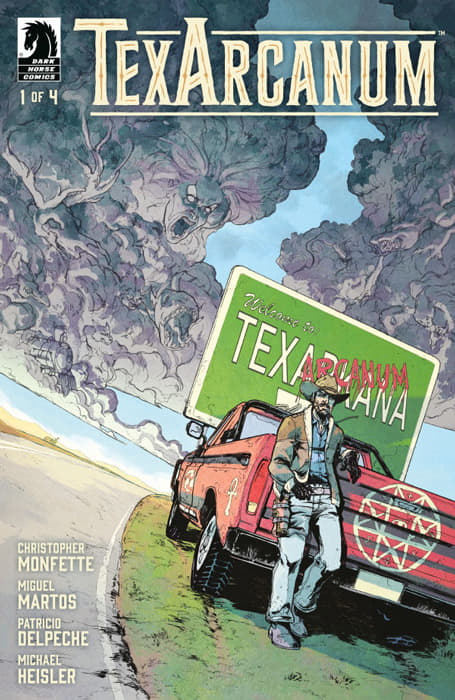
TexArcanum
From the Publisher
America is a melting pot for the supernatural. Ghosts and gods, angels and demons, horror stories and tall-tales, they’ve traveled from across the globe to collide in the rural Heartland… and cowboy arcanist Avery Belle has spent a very long lifetime amongst them. Horror noir meets Elmore Leonard in the mystic Mid-West.
PATREON
We have a new Patreon, CryptidCreatorCornerpod. If you like what we do, please consider supporting us. We got two simple tiers, $1 and $3. Want to know more, you know what to do.
THE ORDER OF THE NUN-YA STARBURST: VIOLA
Make sure to check out our friend's new crowdfunding campaign The Order of the Nun-Ya Starburst: Viola that I mentioned in the episode. (LINK)
ARKENFORGE
Play TTRPG games? Make sure to check out our partner Arkenforge. Use the discount code YETI5 to get $5 off your order.
[00:00:00] Your ears do not deceive you. You have just entered the Cryptid Creator Corner brought to you by your friends at Comic Book Yeti. So without further ado, let's get on to the interview.
[00:00:30] Show notes and thank you for your continued support. Thanks for your donation. Do you love sci-fi? Are you a horror fan? Maybe you prefer action or fantasy? 2000AD has it all and should be on your radar. With a whole universe of characters from Judge Dredd, Astronium Dog to Rogue Trooper, Shakara Halo Jones and many more, every weekly issue you get five action-packed thrills from incredible creators such as Garth Ennis, Rob Williams, Alex DeCampy,
[00:01:02] Dan Abnett, and so many others. Get a print subscription and it'll arrive to your door every week. And your first issue is free. Or subscribe digitally. Get free back issues and download DRM-free copies of every issue for just $9 a month. That's 128 pages of incredible comics every month for less than $10. That's like a whole graphic novels worth. All subscribers get amazing offers like discount vouchers and exclusive product offers. Head to 2000AD.com and click on
[00:01:32] subscribe now or download the 2000AD app and why wait, start reading today. I'll put links in the show notes for you. Hello and welcome to Comic Book Yeti's Cryptid Creator Corner. I'm one of your hosts, Jimmy Gasparo, and I'm very excited to talk to today's guest. He has been a writer on such TV shows as 9-1-1, 12 Monkeys, Picard. He also worked with Clive Barker in adapting Hellraiser to the comic book form.
[00:01:55] He has a brand new comic book that is coming out this summer, July 23rd, which from Dark Horse, which I believe is a one day before his birthday. So you'll have to pick up a comic and wish him a happy birthday. But please welcome to the it's Texarkanim. I'm really excited to talk about it. Please welcome to the podcast, Chris Monfett. Chris, how are you doing today? I'm doing very well. Thank you for having me. I really appreciate the chance to come on and chat.
[00:02:23] No, I'm very excited, especially whenever I do it. Like I said, before we started recording, I try to do a little bit of research. But it was excited to kind of hear your background, you know, in terms of after college and interning for different places. I mean, you've written you're kind of like a entertainment journalist. You you wrote for like IGN and G4 and doing things along those lines.
[00:02:51] And then, you know, to kind of make your way from from doing, you know, PR and then writing about the stuff that you like. And then, you know, yeah, then being in the in the room where it happens to easily quote Hamilton. But to be in a writer's room to do that, to write comics, to adapt Hellraiser and, you know, kind of work with Clive Barker on that.
[00:03:19] And now this new series, which 100 percent in my wheelhouse of stuff that I like. I mean, I want to talk about it. Texarkanim. I thought of it like a justified meets supernatural. Yeah, absolutely. But yeah, can you just I mean, I want to talk about Texarkanim. But can you briefly just kind of tell me, you know, did my research steer me wrong or was that kind of like your path at where you are today?
[00:03:48] That's that's 100 percent the path. You know, when I whenever I talk to folks, you know, a lot of times if I get asked advice about how to sort of make your way into a career like this, you know, I'll say talent obviously is a big part of the recipe and skill. And but it's 90 percent just like it's luck. Right. It's good fortune.
[00:04:10] And the only way that you can sort of invite that to happen is you just have to put yourself where lightning strikes and then hope that it does. And so, you know, what I I grew up knowing, you know, I grew up knowing that I love genre. I love storytelling. I love science fiction. I love horror. I love fantasy. You know, I was a nerd from like my earliest days. And I grew up in Western Massachusetts.
[00:04:36] You know, I grew up in a place where there wasn't an easy pipeline to get into this stuff. And so if you had this sort of big dream, you had to the thing I figured out early on was I just had to put myself where that would even be possible. And so I went to school in New York. And from there, I got a bunch of interns and film publicity and PR and started a career doing that, which eventually led me to a career in entertainment journalism.
[00:05:03] Because I very quickly realized, you know, instead of writing PR plans and like shilling for the stuff I loved, I could get paid to write about stuff. And so I was very I was very lucky to be taken in. Yeah, I was very lucky to be taken in by my my sort of tribe of like minded nerds at IGN and was there for many years and then G4 for a couple of years. And and, you know, all of that was really just I knew I could write.
[00:05:31] I knew what I loved and I knew if I could write about the stuff I loved, that I might meet the right people and position myself in the right place. That, you know, if I were going to get lucky, if I were going to have some fortune that it would be possible. And, you know, through meeting Clive Barker as a journalist to him taking me under his wing and really being a mentor of mine early on and folks that I met.
[00:05:57] Yeah, my time at IGN eventually going on to write and create 12 Monkeys and really give me my first staff job in television. I was just very fortunate and very lucky to find a group of great creative, like minded people. And we've all just sort of spent the last, you know, 15 years of my professional writing career trying to support each other and work with each other and kind of lift each other up where we can.
[00:06:22] So I've been very I've been very fortunate, very grateful to just work with some incredible people who just open themselves up. So, you know, I I definitely I definitely have had I've definitely had good mentors and good luck. Yeah, I mean, that's that's awesome. And but kind of like an incredible journey when you start working, when you meet Clive Barker and eventually leads to this adaptation of Hellraiser
[00:06:51] in comic form. I just I wasn't sure had you written like I know you had written before, but had you written comics before? Was that something you thought you wanted to do or you were just into storytelling and you were going to figure it out somehow? Yeah, I you know, I think early on, if you know, when I was a kid, I was I was writing I was writing stories. And, you know, I think I had ambitions to be a novelist at the time. And, you know, because I would just power books.
[00:07:18] It was Stephen King, Clive Barker, Dean Kroos, John's like all those John Saul, all those great like horror storytellers growing up. And I would just like book after book after book. And so if you'd asked me when I was a kid, like, what do you think you're going to do? I would have thought be a novelist. I want to write novels. And then, you know, I eventually discovered my love of film and, you know, I read comic books my whole life. And when Clive and I met and Clive sort of, you know, identified, he goes, well, you're a writer.
[00:07:48] You know, you I can tell that you don't want to just be a journalist. You have ambitions to tell stories. And our first couple of projects together where I wrote two films for his company at the time that were adaptations of his short stories. One was a movie called Down Satan. The other was a movie called Son of Celluloid. And both of those never ended up getting made. But, you know, the process of working on those together, we developed a kind of creative shorthand. And, you know, he was an amazing teacher, an amazing friend.
[00:08:18] And we actually wrote a comic book together prior to Hellraiser called Suduth, which was this really crazy, bizarre. IDW published it. It was just it was a 3D comic. It was meant to be super surrealistic. It actually, like, came with the red and blue 3D glasses. And when Clive asked me to do that, I was like, look, I've never written a comic before.
[00:08:47] I don't even know how. And I've read comics my whole life, but I've certainly never written one. And so, you know, and sort of the first thing I was tasked with doing was can you do this hyper surreal, super experimental format, non-narrative? There's sort of a loose narrative, but it's really just more of this crazy experience, this sort of trippy idea that Clive had in mind.
[00:09:13] And so I really kind of I think, you know, I remember James Cameron gave an interview once where he was talking about Terminator. And he said, if I'd have known that I wasn't able to do it, I probably wouldn't have done it. He's like, but we didn't know at the time that we were making Terminator that we weren't supposed to be able to make this. And I think that's very much my experience with my first comic book, which is like, I didn't know what I was doing. And I didn't so I didn't know what I was supposed to be able or not able to do.
[00:09:43] And so we just wrote this crazy bat shit, surrealistic 3D hallucinogenic horror trip that, you know, was a great collaboration. And so when that the opportunity to do Hellraiser, which was a much more traditional narrative came along, Clive thought of me and boom, liked what they saw with that one issue of Suduth and brought me on board. And that was my sort of first go at like, here's an eight issue. Tell your story.
[00:10:13] And, you know, you can use Hellraiser's jump off point and and really just play in somebody else's mythological sandbox. So, yeah, it's a treat. Such a gift. That's awesome. And so then you've been, you know, in writers rooms, you know, working on, like we said, 9-1-1 and the most seasons two and three of the card.
[00:10:38] And I guess right around that same time was the WGA, the writer's strike was, you know, just because I know kind of like the timeline of how long it takes to make a comic book. Was Texarkana something that you had had visions of doing previously or was it something born out of, you know, the WGA strike? No, it really wasn't. It was. So I'm originally from the East Coast and so is my wife.
[00:11:07] And I live out full time in Los Angeles. But we, because we have dogs, end up taking this crazy road trip once a year across Route 40 and then up 81, sort of just back and forth across the country. And Texarkana was really born of this desire and this interest in all the little places that you encounter along the way on that trip.
[00:11:36] And it's such, it's such interesting open country and you can stop in all these sort of little touristy spots, these little gas stations. And you find all these amazing communities that you don't, you wouldn't necessarily expect to find. And you get a real sense of the size and scale and scope of our country. And it's such a, it's such sort of like a highlight of the year. It's a beautiful ride. We always get to see new and interesting things.
[00:12:06] And, you know, just on those long drives, you're listening to sort of like, I'm a big fan of like country folk Appalachian, like Gregory Allen Isaac of Lord Huron. Oh, nice. Yeah, yeah. And, you know, so you'd be taking these long drives, listening to that sort of music, which has this sort of interesting, cool, ethereal quality. And I just kept thinking, man, there's, there's gotta be a show that's set out here.
[00:12:30] You know, that, that's not about, that, that talks about the sort of middle America as a collision point for all of these different immigration stories that make up America. This amazing tapestry of cultures that make up this country. Everybody brought their stories with them. Everybody brought their ghosts and their demons and their angels and their gods. And, and it just occurred to me that all that is colliding out in the Midwest and in the places.
[00:12:58] But oddly, seldom, if ever, do we, we, do we get stories told against that backdrop, you know? And so all of my favorite characters in comics are those noir supernatural PIs, you know, whether it's John Constantine or whether it's Clive's Harry D'Amour or whether it's, you know, Harry Dresden. And, but they're all like guarding the gates of major metropolises, right? Like whether it's London or Chicago or New York.
[00:13:23] And it struck me that there might be an opportunity to kind of access that kind of character in a very like Raylan Givens justified kind of way. You know, in the sort of rural parts of the country where you don't necessarily see those mythologies represented in a way that you might, unlike, you know, like it was like a Constantine show or something like that.
[00:13:48] So that was sort of like the seeds of, of where Texarkandum was born from was, was my love of that kind of character, but my wanting to do it in a different way in a different place. So that's, so you're working, you're not doing the same thing over and over again that everyone else is doing.
[00:14:08] Yeah. There's actually a, I mean, a line in the opening of it where it talks about the things that we've seen in other, you know, media and, you know, something that doesn't try and convince you is shot in Vancouver. Right, right. But that's what struck me when I read that line and I, you know, made me think of like Supernatural, which I think shot in Vancouver. But, you know, that was something that was set a good part of it, like in the Midwest, like they were in Kansas.
[00:14:35] But because of where, you know, the reality of television production, so much of it looks the same. And like, I was struck by, oh yeah, like, you know, when you're doing comics and you have an artist like Miguel Martos, you know, working on it, you, you're not constrained by, it can look like anywhere. It can really look like the places you're talking about. Yeah.
[00:14:58] And, and the people can really look like the people that inhabit these worlds and, and these, these tam. Yeah. So I, I, I love that aspect about, you know, having a comic like this set in the places it is, you know, set in. Yeah. And I think that, you know, it wears its influences pretty obviously on its sleeve. I mean, for me, I think Justified, one of my all time favorite TV shows, kind of a perfect show.
[00:15:26] Raylan Gibbons is kind of a perfect TV character. And, you know, there, there's a very overt nod to that character, the first issue of the book. Um, but, you know, Avery Bell, our, our protagonist is really cut from the cloth of, of the Raylan Gibbons of the world. And so, you know, my, my thought here was let's do Elmore Leonard meets Stephen King, you know, and let's do it in the places that these stories are actually set.
[00:15:50] And, you know, the wonderful thing in terms of television that Yellowstone really opened the door for, um, you know, and that sort of Taylor Sheridan sort of populist, uh, you know, Midwest rural, uh, storytelling has really made possible. So you can tell stories in these little, um, rural sections of the country. And, you know, like you said, now as a comic book, you have the opportunity to not be beholden to the limitations of television.
[00:16:19] You can actually like depict these places and real honest, you know, sort of vivid technicolor, you know? And so that's what we were able to do with these first four issues is, you know, really sort of pick our locations, uh, and, and, and try to tell a story that feels genuine and authentically set in the places that it's set. Yeah. Yeah. And I also, um, I mean, Miguel Martos, his artwork is, is wonderful. Just the rest of the creative team.
[00:16:46] It's, uh, uh, Patricio del Peche, Michael Heisler, um, great creative team. Uh, everything looks fantastic. The horror elements are, are really great. Um, but one thing I, I also noticed, and I, I read you talking about this in a different interview. I, I forget where, but, um, you were talking about the way you write and being a writer. I don't know how long ago this interview was.
[00:17:11] So if you're, if your style has changed up, but you, you said that, you know, you're, you don't set out to write the way that people talk. Like you want to use, you want to use the language you, you know, and, and that's something that I like a TV show, like, um, like justified certainly anything that like Aaron Sorkin worked on, um, both the, the, the, the play and the movie version of,
[00:17:39] Mammoth's Glenn Gary, Glenn Ross, like, like, you know, like, and I had read that about it, about you in the, that you saying that in the interview before I read Texarkana. And I, I mean, some of the dialogue in it, um, I, I, I love the way Avery speaks and he is there with, um, I guess she's the chief of police. Yeah. Yeah.
[00:18:04] And, and the way they talk to each other, um, I mean, I, I could, I felt it as almost like kind of like rapid fire back and forth. I just love the way they spoke to each other. You know, I, I love their like Avery's like little like turns of phrase. I, I just thought it was, um, it, it, it just had a, like a poetry kind of to it that I really loved.
[00:18:31] Cause I, I, I feel like a lot of times in modern comics and I, I love all comics. I'm not, I'm not criticizing anybody. Everybody has a different style. Right. But, you know, when you look at a comic from like the silver age and they are, there's a lot of words, but there's so many words. And I feel like the modern trend is to, to, you know, cause it is a visual medium to let the, a lot of the visuals do the heavy lifting for a lot of projects. I get it.
[00:18:57] And I, I love that aspect of it too, but to have a comic like this with, you know, mashing up these things that I love, but with like a, a, a, like a, a very interestingly. Articulate like in the way he speaks, like Avery bell. Like it's not, you know, don't get me wrong listeners.
[00:19:15] It's, it's not like some type of like, you know, highfalutin prose that you're going to need a dictionary to understand, but there's just a way of speaking that there's like a, there's a lyrical quality to it. That when you read it, it's, it scratches some itch in my brain. So I felt that and I very much enjoyed it. Yeah. It's, it's look, I'm, I'm nothing if not the, the sum total of my influence, you know?
[00:19:43] And so, you know, when you're growing up and you're reading books like, you know, written by Stephen King and Clive Barker, especially, I mean, there's such a poetry to, to, to his prose and the way that he writes. Um, and you know, so much of my brain was taken up by, by prose writing when I was growing up. Um, but the other half of my brain, like I grew up as a, I grew up as a film fan in the nineties and the height of the Miramax indie, uh, boom.
[00:20:09] And, you know, what was amazing was like, you know, I, I, I grew up at a time when like, I, I, I, I got to watch Quentin Tarantino's early movies, you know, when Soderbergh's early movies, like, um, Shane, uh, Shane Black is another favorite writer of mine, you know? Oh yeah. It's bang bang. I think is one of the all time greatest noir private eye movies ever made. Like, um, I love Hitchcock movies, right? The dialogue in those movies. So it just cracks with energy.
[00:20:38] And so it's really important to me to sort of marry those things so that you have banter, but you also have poetry and you've got something to say and you, and you're right. I mean, for me, it's like, uh, you know, some writers will tell you that their job is to disappear, right? Is to just, I'm supposed to write so naturally and I'm supposed to sort of convey the human condition in a way that like, you know, you don't even feel the hand of the writer. And for me, it's exactly the opposite.
[00:21:08] It's like, I don't go to a Transformers movie to watch cars behave the way they behave in real life. You know, like, uh, if I, I want to go and I want to see somebody use the medium. And so as a writer, I want to be able to write that. I want to, I want to be able to choose those words. And I want, I want my characters to talk the way I wish I talked in real life. I wish I could consider my word choices that carefully.
[00:21:30] And so I, I, yeah, I tried to build a character who, who felt very much like a glib grizzled noir PI and, and talked like that, but had the sort of banter and snap and in his dialogue with some of these characters that he meets along the way that you see. And, um, you know, the, those kinds of movies that I, that I love growing up. Yeah, no, I mean, it makes sense. And I, I feel the same way.
[00:21:55] I mean, like I see a clip or like one of the, on social media of, you know, the 10 best lines that Raylan Givens ever said, you know, and it's like there, that's why we, we watch those things and, and repeat them. You know, we don't say that in, in, in real life, you know, you would, I'm not ever in a situation where I would point a gun at anybody, but like there's why one of my favorites, he throws a bullet at somebody and he says, next one's coming at you faster. Yeah. Like you wish you were that good in real life.
[00:22:25] Yeah. And so to me, it's like, that's, that's how I like to write. And, and, you know, then the, the, the great thing about comic books is, is you get to be your own writer, your own director. Um, you know, you really are dictating what's on that page. And so you, you, you get to make a little film, um, every time you, you do one of these issues and it's the most freedom. Like I, I don't have this level of freedom in television.
[00:22:50] Certainly everybody reports to somebody and with a comic book and, and certainly, you know, dark horse has been wildly supportive of this book. I mean, I would turn in the scripts, there'd be no notes and they, they were very happy. And, um, the, the art was amazing. The color has been amazing. Like everything's really come together really well, um, for these books. And they've been really, really fun. And, you know, I've got the first three, the fourth is being worked on. And, um, and I, I can't, I couldn't be happier with how they're turning out.
[00:23:21] Yeah. I, yeah, I thought the first issue was great. Like I said, um, and you, you kind of, I really liked the build, the tension of it. It's kind of like, uh, you know, we get like a, a little bit of a cold open, which is kind of nice, which I'm sure is going to come back at some point, but we get like a nice little historical cold open.
[00:23:42] And then we kind of get into this story and really meet, uh, Avery and that it's, it's a bit of a build to figure out what is going on. I will say the, the, the panel and page that kind of reveals the, the thing is spectacular. I mean, it's, it's hard to do almost like a jump scare in a comic. This is pretty close.
[00:24:10] You know, it just was like all of the creative team coming together to really sell that moment. It wouldn't have worked if there wasn't the buildup before and it wouldn't have worked if Bigwell's art wasn't just so. The colors are, are, are wonderful. Yeah. It's just a, this fantastic moment that really, really worked in the comic form. I mean, that's, that's, that's hats off to the team. I mean, you know, you write, it's so funny.
[00:24:38] It's like, you write these panels and I'm marginally specific about how I, I, I want the panels to be laid out. You know, so I'm a little prescriptive in terms of what lands where, but, um, you know, you, you, you write a word like that, like, okay, this happens on this panel. And you don't really understand the impact of it until you get it back. You get the pencils and the inks and eventually the colors.
[00:25:04] And you're just like, man, they make it sing in a way that, you know, it is beyond what you even could have imagined in the, in the, in the moment when you were writing it. Um, and like you said, I mean, you know, uh, uh, comics do tend to go dialogue light. And I wanted this to really be a character piece, um, and really, you know, showcase its characters and really develop their relationship and their voices with each other.
[00:25:28] And, um, you know, and you know, look, you get, you get paid the same, uh, amount for a page with a bunch of words on it or a page with very few words on it. And, um, you know, I'm like, look, I got all this real estate and I'm using it. Um, and, and I want these folks to be saying something and, you know, his relationship with Irene continues through the, the first four books.
[00:25:50] Um, and there's a pretty, uh, interesting revelation in the, in the fourth book about, um, you know, how they, how they met, uh, and, and why he continues to, um, uh, to be there for her. And there, you know, there's some great little twists and turns, um, throughout the course of the story, but that relationship really is the core relationship that runs through the spine of the first four issues. Nice. Yeah. I, uh, I really, really, uh, really enjoyed it.
[00:26:15] You were talking about traveling, you know, cross country and I've, you know, in my, my younger days, I did that a few times, uh, drove around the country and had, had a wonderful time. I mean, I, I did once, uh, like 30 days, 38 States, but me and a buddy, I was, he had just graduated college. It was, and I was just about to start law school. Um, and I, I loved it. It was like the second of three times that I drove cross country.
[00:26:43] And it's, I, I, I recommend it to, to anybody to really kind of travel the country, like, and really, you know, try and see it and enjoy it and experience it. Um, I, and you know, but I still didn't think, I mean, it's place is huge. Like you just, you're driving when you drive cross country, like it is huge.
[00:27:02] And I, but I, I still don't think I kind of grasped it because I'm like used to just, you know, just how America is growing up here. But when I was a year or so ago, my brother and I traveled to Dublin and we're talking to some of the Irish, uh, comic creators that had been at Dublin comic-con after the convention. And one of them had like a girlfriend in America.
[00:27:26] And he was like, he was just, he had been there a few times, but could still not get over like how big the country is from Ireland. But, and I'm like seeing it through like, is somebody else's perspective who'd like, didn't grow up here. Like I grew up here. I understand it. And I, yes, even traveling around and I know it's big, but somebody from like Ireland who you can make it from one end to the other, like pretty, it doesn't, you know, you can do it in a day or so. He's like, I just don't, I just don't get, I don't understand how big it is.
[00:27:56] I was seeing America with new eyes. The thing that consistently floors me about that is because it's so big and because parts of it are so seemingly empty, it is amazing. The sheer volume of cool shit that it hides because, oh yeah, you would never think to look here for that, you know? And, you know, like I, I remember thinking like the best Indian food I've ever had in my life.
[00:28:26] I had at like a truck stop in, I want to say it was, it was somewhere in like Oklahoma or Arkansas or something. And I was just fascinated by this, you know, you're at this, like there's like a Love's and a Texaco and like all of the, you know, McDonald's over here. And then attached to it all is this little mom and pop Indian there. And you're like, I wasn't even aware there was an Indian community in this state, let alone in this town.
[00:28:55] And then you start to learn the history of it. And why did this little population settle here? You know, why did this person open this restaurant here in the seemingly least likely of places? And this country is filled with stories like that, you know, of a lot of the states that you, you know, what we consider the flyover or a lot of the states that you might drive through on a road trip, especially through the South and Midwest.
[00:29:23] At first glance are exactly what you expect them to be. You know, like if you stop at a gas station in Texas and Tennessee and, you know, Arkansas and Oklahoma, like you're probably going to see something that you would expect as Texan or, you know, as quintessentially Tennessee.
[00:29:46] But if you look, you're going to find all these amazing communities and niches and stories that you would never expect to find in these places. And those are the communities and the stories that I really want Tex Arcanum, you know, as a series that hopefully will continue to grow and live on to like really explore and get in there and find all those sort of unlikely communities.
[00:30:13] And what stories did they bring with them to these seemingly unlikely parts of the country? You know, and how can we take those different stories like, you know, toys in a toy box and smash them together in really interesting and unexpected ways? And that's one of the things that as the books go on issues two and three, it's kind of about how those stories influence and affect each other.
[00:30:41] You know, so so how can a little bit of Irish folklore weirdly intersect with a little bit of, you know, East Indian folklore? How can Native American and indigenous folklore intersect with Asian folklore? And how can things play off of each other in interesting combinations? Yeah, I the potential for all of those things to kind of come together and to continue to build. I mean, there's like a ton of it in a series like this, though.
[00:31:10] That's really awesome. Yeah. And, you know, I think my hope is that, you know, these four issues of Tex Arcanum go over well, that people enjoy them and that there's room to tell more stories because I really love the idea of this particular series being a platform, not just for me to get in there and create a character I love and to tell stories and and have fun. And it's it's, you know, it's I don't.
[00:31:37] I don't want to command like ownership over this. You know, I think this country is so rich with storytelling potential that in success, I would love for this book to grow and become a platform for other writers and other stories to come and take their turn with Avery Bell, you know, and and bring the stories from their cultures and their backgrounds with them. And tell stories that I wouldn't think to tell or maybe aren't my place to tell because like I'm very aware I'm a white guy from Massachusetts.
[00:32:06] Right. Like my my sort of view of horror is very Western European, you know, and and that's that's what we've traditionally gotten. But there are so many other voices out there, diverse voices in terms of whether it's comic books or television who have their own stories to tell from their own culture. Like, you know, what were their bedtime stories growing up? What were their gods, their monsters, their angels, their demons?
[00:32:32] And so, you know, my hope is that in success, this becomes not just four great issues of something, but a platform for other storytellers to kind of come in and tell stories that are more personal to them. And to with this character is a kind of common thread running between them.
[00:32:48] So, you know, I think you're going to get a vastly more interesting and diverse array of creatures and combinations that you wouldn't expect the more writers that you involve in this moving forward. So I see it hopefully not just as a single sort of four issue book, but as a platform for for storytellers to come and spotlight their identities and their stories as well.
[00:33:15] That's awesome. I mean, that that idea and, you know, taking something that you've, you know, created with this team and being able to say, I want other folks to do something with it. All right, everybody, we're going to take a quick break. We'll be right back. Far in the future and deep in space, humankind has been lost to the star.
[00:33:39] Quiet rumors circulate of righteous heroes willing to fight and save the enslaved and oppressed masses. Stories of beautiful habit-clad saviors are giving hope to those crushed under the thumbs of tyrannical rulers and alien parasites. These are the stories of the Order of the Nenya. Interesting. Interesting. Now, if I can avoid all the Nenya knock-knock jokes in my head for a moment, this is a great new Kickstarter project from a few Yeti friends you should check out.
[00:34:08] With a story inspired by a 1937 Vatican photo, these weapon-wielding heroines strike me somewhere between... warrior nun and 80s sci-fi adventurers like Flash Gordon. Who doesn't like a nun running around with a collapsible battle axe? Halberd? Hey, it's future check, so I don't ask questions. And she's trashing robots in stylistic fashion, riding around like Marty McFly on a... Well, I can't tell you more.
[00:34:33] But if it piqued your interest to hear about it, head on over to the Order of the Nenya on Kickstarter so you don't miss it. I'll put a link in the show notes for you to make it easy. Y'all, Jimmy the Chaos Goblin strikes again. I should have known better than to mention I was working on my DC Universe meets Ravenloft hybrid D&D campaign on social media. My bad. He goes and tags a bunch of comics creators we know, and now I have to get it in gear and whip this campaign into shape so we can start playing. Another friend chimes in,
[00:35:02] Are you going to make maps? It's fair to say it's been a while since I put something together, so I guess? Question mark? It was then that I discovered Arkhamforge. If you don't know who Arkhamforge is, they have everything you need to make your TTRPG more fun and immersive. Allowing you to build, play, and export animated maps, including in-person Fog of War capability that lets your players interact with maps as the adventure unfolds while you, the DM, get the full picture.
[00:35:30] Now I'm set to easily build high-res animated maps, saving myself precious time and significantly adding nuance to our campaign. That's a win every day in my book. Check them out at arkhamforge.com and use the discount code YETI5 to get $5 off. I'll drop a link in the show notes for you, and big thanks to Arkhamforge for partnering with our show. I think I'm going to make Jimmy play a goblin warlock just to get even. Welcome back. I wanted to talk to you a little bit if we could. Yeah.
[00:35:59] Because I was just curious in terms of your TV writing. Yeah, please. Which is so fascinating to me. Just in general. Because as a kid, I loved the same. I loved comics. I loved movies. I loved television. I still remember. I barely. I don't remember a lot. My memory is definitely not what it used to be. But I still remember the first time somebody told me, oh, you've got to check out this movie Clerks.
[00:36:24] Or I still remember the room I was in in school when this guy, David Kelly, came in. And he's like, everyone stop what you're doing. I need to tell you about Pulp Fiction. Like, I still. I was like, what? I mean, I don't know, 15? And I still, you know, remember. Because I think David actually went on to work in film. Yeah. But. Not that David Kelly.
[00:36:54] You know, not the famous David Kelly. A different David Kelly. But I, yeah. Not the David Kelly you're thinking of. But the David Kelly from Delaware. No, I saw. I'm just kind of curious. You know, because one, you have the aspect of you are, you know, growing up. You said like a fan of Star Trek and then getting to, you know, write and produce in the second and third season.
[00:37:23] You know, but also there. So I'm sure I would think that there's a part of it that it's like, like, wow, I can't believe I'm here. But then there's probably also the added pressure of like, all right, well, now I got to, you know, I got to do the thing. Yeah. In terms of that room, was it a collaborative effort in terms of the writing or would you be like a signed episode? No, I mean, it's very, the whole process is always very collaborative.
[00:37:49] And, you know, a bunch of us who had worked on 12 Monkeys together had sort of reunited on that project. And it was that specifically was really interesting because we were we were brought in in the second season, which was still being run at the time by Akiva Goldsman and Michael Chabon. And we were kind of coming in right as that season was gearing up and right as COVID was hitting.
[00:38:17] And so it was sort of like this perfect storm of, you know, of just sort of like, oh, this is this is the least effective way to to try to get a season of television made. Right. Like like a lot of the you know, a lot of the writers, we we kind of some of us knew each other. Others didn't that we weren't sure how we were going to produce television at all, what scope we should or shouldn't be writing for.
[00:38:45] And then the 12 Monkeys kind of sect, those of us who came over from 12 Monkeys, Tara Metallus, myself, Travis Fickett, a couple other writers. We we kind of ended up getting the keys to the car with season three. And, you know, because Akiva had moved on to Strange New Worlds. COVID has was kind of. Hadn't gone, but was going. We had better sense of what we could produce.
[00:39:13] And, you know, CBS and Paramount were very lovely to say, look, tell the story you guys want to tell. Right. Like no restrictions. And so, you know, we was season three. We really got to tell Star Trek the way we wanted to tell it and really continue next generation and kind of end that saga in a way that we felt was really fitting for Jean-Luc Picard and for those characters. And that was like a real sort of pinch me experience.
[00:39:42] You know, when you get to dive back into your childhood and say, you know, look, these characters, I grew up on these characters. These characters are somewhat why I'm a writer in the first place. It's such an honor and it's such a privilege. It's also such a daunting responsibility to get that right, especially when you're standing on a perfect recreation of the Enterprise D bridge. Yeah. Wow.
[00:40:09] And you're like, man, the responsibility we have to nail this. It's it's it's substantial, but so rewarding. And and the audience really embraced it and embraced what we did. And, yeah, it was it was a thrill. Yeah, I love season three. I mean, I love I loved all of it.
[00:40:28] But I but I really felt season three and what I liked about it in particular is that there was such a love for the for the next generation cast. And it, you know, it definitely could come across as I don't want to say gimmicky, but I'll look there. They're getting the band back together. And that, you know, kind of trading on that nostalgia and that be being all it is.
[00:40:55] Yeah. And which I think sometimes we see that with, you know, franchises where they can just, you know, let's let's repeat the hits or let's let's get the cast back together. That'll be fun for the fans. And that'll be that'll be a nice moment. And maybe it is. But I feel like I always feel a little let down when that happens, that there. Yeah. That there's kind of like a bit of like wasted potential. And I just thought season three was so good. I mean, I felt it had all of those moments.
[00:41:23] All of it were wonderful, but I really thought it was like very smartly weaved in with like the story that was being told. Yeah. And I just I just thought it was such a phenomenal series of of television. I in particular, you know, in in terms of like I don't like I said, I had asked. I don't know if like episodes are assigned or everyone kind of writes together. I don't I don't I don't know if there was one person or if it was the whole team responsible for writing.
[00:41:54] Riker like Jonathan breaks his dialogue. But man, he was incredible. The writing was so good. And talk about a guy that felt like felt like he just never stopped and got right back into that character and showing all of the nuance and all of the emotion and the reality of like the story we were being told in the intervening years. But didn't see that.
[00:42:20] That was like the perfect combination of performer and writers coming together for his character arc in that third season. That was out of the park. Dr. Drakes is one of my all time favorite people I've ever worked with. He is everything you hope he would be. I mean, he is just a phenomenal person. He's incredibly talented. He is an exceptional actor. And, you know, I think when.
[00:42:50] You know, I think that the risk you run or the sort of risk reward of embodying a character like Riker for so long is you are so attached to that one character that that's how audiences remember you. They remember you as Riker. And he is so multifaceted and so talented as an actor that he doesn't he could do anything. And so, you know, we felt this responsibility when we were telling the story of.
[00:43:18] We don't want to just bring back the same Riker. You know, we want to bring back someone who's had 30 years happen to him, you know, that's had and time has passed and affected his life and his life has changed. So it's like you want to bring back the character that everybody loves and respects. But you want to bring them back with something new to say and new to play. Right. And he rose to that occasion and he crushed it. And and it's just, you know, annoyingly nice.
[00:43:45] Like, I mean, he's he's just the nicest guy. And you you spend time with him and he just fills a room and you're like, man, I wish I could be more like him. He's he's a wonderful mensch. That's awesome. Well, that's that's good to hear about somebody, you know, whose work you admire. But I mean, I just felt the writing and the performance just really came together in particular. Well, the whole series was really it's not worth doing if you don't have something new to say.
[00:44:13] You know, if you're just bringing back the toys, you know, if you're just if you're just dragging them out of the toy box and, you know, it's going to tell the same old stories. And we had a chance because so much time had passed and not only the actors, but the characters had lived so much life in between that we could bring them back as versions of themselves. But, you know, they they've all changed the way that, you know, when you have like a high school reunion 25 years later, you're like, oh, you're still the same person.
[00:44:39] But you're also fundamentally different because you've lived, you know, 25 years of life or whatever. And so, sure, there was something new to say. There was something new to explore. And we were really, really fortunate that we were given the opportunity to do that. That's awesome. And then now, I guess from 12 Monkeys going to Pard and then is Terry Metallus also doing the Magic the Gathering?
[00:45:06] Yes. So, you know, it's we've got a little troop and, you know, we've been very fortunate, you know, 12 Monkeys to Picard, Magic the Gathering. We did two seasons of that for Netflix. And so, you know, that's been an amazing privilege to try to figure out the ransom note of that mythology. You know, when you're looking at, you know, however many thousands of cards that they've generated and trying to sort of look at them all and go, what's a story to tell?
[00:45:34] You know, that challenge is such a privilege to be able to tackle. Yeah. Yeah. That's in the middle of production now and is looking amazing. We have an amazing cast. I can't say who, but, you know, we're creating something, I think, that's going to be really, really special. And I think it's going to live up there in the pantheon of like very, you know, sort of high end, you know, young adult, adult animation.
[00:46:00] And so that's going to be, I think, super, super fun whenever whenever it comes out. Animation is such an incredibly long process. And then, yeah, and a lot of those writers also have moved on now to the Vision series that we're doing for Marvel. I'm here in London right now actually producing that. And again, that's just that's just been an extraordinary like honor and a privilege to be able to do. That's incredible. Yeah, I'm looking forward to that as well.
[00:46:31] I love board games. I've played D&D. I have a friend, Dan, who does for Comic Book Yeti, which I talk about Dan all the time. He's like he is the guy in my friend group that owns more board games than like anybody I know. But but Magic the Gathering, I kind of like missed. Were you familiar? Had you played it or did you have to kind of like learn it in order to write this, you know, write on the series?
[00:46:57] It's interesting because I think I had played one game of it at one point. But I'm I I'm surrounded by nerds like all my entire friend was like tabletop D&D nerd. So I was exceedingly familiar with it. I knew all the characters. I knew like I knew the kind of the stories. I knew the key planes, you know, that that a lot of my friends gravitated towards. I would sit in and watch people play.
[00:47:24] But I think I'd only played like a handful of games when I came to the to the show. And then, of course, once you once you get into it, like you you just have to get so deep into the lore. You know, our our book, our table in the writer's room had like all of the lore books, you know, these beautiful, gorgeous art books that have been produced on all the regions and characters. And and it's just it's an endless amount of it's it's an embarrassment of riches.
[00:47:54] And so the job really isn't, you know, it's it's not it's not being additive. It's editing. Right. It's like which of these pieces can we kind of come up with and tell one story that sort of weaves through all of the greatest hits of places and characters that fans are going to want to see. Right. It's almost like there's too much source material in order to, you know. Oh, my God.
[00:48:20] At least at least at least a focus on like, OK, one season we can't we can't possibly do everything. You could do a whole show set in one of the planes that we visit one episode. You know what I mean? So it's trying to strike that balance between you don't want to just seem like you are checking off boxes for fans. So it's like, OK, yeah, we did that. OK, yeah, we did that. OK, yeah, we did that.
[00:48:46] You want to tell a meaningful story that takes our characters to these places for great dramatic reasons, really emotional reasons, but also uses those places and all the fun ways that, you know, as a fan of magic, you would want to see. So, you know, hopefully we've created something that magic fans will feel really connected to and then they'll feel like we've honored the thing that they really love.
[00:49:08] And and and and hopefully we've we've we've we've used all the locations and characters that, you know, if you're a magic fan, you would hope to see in a magic show. And hopefully we've used them in inventive and cool ways that you might you might not have expected. So. Awesome. Well, that's that sounds great, too. But I'm I am very excited for other for listeners to check out Texarkanim. But, Chris, thank you so much.
[00:49:36] I know it's late where you are, so I really do it. I really appreciate you coming on the podcast. But listeners, Texarkanim is coming out through Dark Horse. Of course, it's going to be out July 23rd. So, you know, when this episode comes out, you'll have plenty of time to let your local comic book shop know that you want to add it to your pull list so you can get it, you can read it and come and find me on social media or TikTok or I don't know wherever I am. And let me know. Let's talk about it, because I really I want to I want to chat about it.
[00:50:06] I really love the first issue. I can't wait to see where it goes from here. And yeah, Chris, because I'm assuming that you were a Next Generation fan. And whenever I have somebody who I find out is a fan of Next Generation, I always ask, what's your favorite episode of Star Trek The Next Generation? Oh, you that's we on the spot. That's an impossible question. That's an impossible question. OK, you know, I know I can't answer that.
[00:50:35] Like I think it's a far point. Right. Because it's just. Starts off the series. It's a two parter, you know, it because I remember it might not be the best episode of the series, but I remember it's the one that makes the most impression, because when I when I watch it, I I go back to that time of me then watching it and and thinking, oh, this is something that's going to be. This is something cool.
[00:51:04] This is something I'm going to watch. I'm going to plug into this is destination viewing every week. Like, because I grew up OG Star Trek with my dad. Yeah. Yeah. My father was, you know, fairly blue collar duty was not he knew he was raising a nerd, but he was not a nerd himself. And like the only sci fi he spoke was was Star Trek. And so, you know, we would he would carve out time to spend with me by watching the original series.
[00:51:33] And so when D&G premiered and I just remember watching Farpoint and just thinking like, oh, this is this is that. But for me, you know, and I remember that making such an impact, you know, that it's it's. Very. Very. I mean, it's it's not the best episode of the show over all those seasons, but it is one that I have the fondest memories of. Oh, all right. That's an acceptable answer, Chris. Yeah, that's a good answer. I'm just always curious.
[00:52:02] I've it's been a few times on this podcast. Star Trek, the next generation has come up and I always like when we're there whenever it does. I'm I'm always like I'm just curious. I just want to know. Listeners have heard before. My my favorite is the inner light. I think that was Star Trek at its at its best for me. But, you know, it's funny. Like, inner light was it's such a it's kind of show go to because it's I mean, it's obviously,
[00:52:30] obviously, so up there in terms of the best that. Yeah, it just it just seems expected to say that. But yeah, I always default to what's the one I have the strongest sort of like emotional sense memory of and and watching that show premiere after having had the experience of watching the OG show with my dad. I think Farpoint really. Yeah, really was like, OK, this is going to be my version of that. Nice. Yeah. Yeah.
[00:52:56] I just I just I know it is kind of like, you know, an answer that a lot of folks give. But yeah, there's just something about the inner light that has really stuck with me. The other episode I would say that has always stuck with me is the one where what is it? Barkley when he sees the monsters in the transporter. I love that episode. I'm a fan of I'm a fan of transporter episodes. I yeah. Anytime something the transporter can be used as a gimmick for something. I'm in like, yeah.
[00:53:26] Yeah. I mean, it's it's nice. Star Trek is such a font of endless storytelling that, you know, we could do it forever. And hopefully, you know, who knows? Maybe one day we'll have the opportunity to go back to that franchise and play around in that sandbox again. But, you know, being able to do season three of Picard was was really a dream. Yeah, it was an incredible season of television. But again, I started talking about Star Trek. I apologize. I apologize. Tex Arcanum, July 23rd from Dark Horse.
[00:53:54] This is my guest tonight has been Chris Monfet. Chris, thank you so much for coming on the podcast. I really appreciate it. Thank you. All right. Thank you, listeners, for listening. Let me know what it is you're reading. And shout out to my brother, Bobby, the Cryptid Creator Corner's number one most dedicated fan. Listeners know Bobby listens to all my episodes. Thanks again, Chris. And I'll see you next time, everybody. This is Byron O'Neill, one of your hosts of the Cryptid Creator Corner, brought to you by Comic Book Yeti. We hope you've enjoyed this episode of our podcast.
[00:54:24] Please rate, review, subscribe, all that good stuff. It lets us know how we're doing and more importantly, how we can improve. Thanks for listening. Chip, boy. If not, put it to you. Thanks for listening. You are.