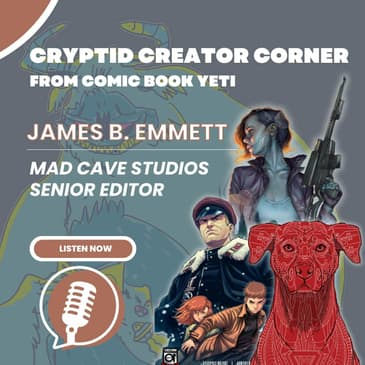

James B. Emmett is a Senior Editor for Mad Cave Studios. If you're a long time listener of this podcast you've definitely heard his name before as the editor for some amazing comics. After James posted on social media asking if anyone would be interested in him doing an "ask me almost anything" about editing or Mad Cave, Jimmy reached out to finally get him on the podcast. James covers some of the questions he was previously asked and he and Jimmy dig a little deeper into those answers. James also discusses his journey in comics, his current role at Mad Cave, how creator owned comics work at Mad Cave, and the upcoming comics he's excited about. This is a great conversation, but if you wanted to know more about what a comic book editor does or if you're planning on pitching a series to Mad Cave, you definitely don't want to miss this episode.
WATCH ON YOUTUBE
Follow Comic Book Yeti
🔗 Comic Book Yeti LinkTree: https://linktr.ee/ComicBookYeti
Follow your hosts
🔗 Jimmy Gaspero: https://bsky.app/profile/jimmygaspero.bsky.social
🔗 Byron O’Neal: https://bsky.app/profile/byrononeal.com
For partnership and ad inquiries, please contact: thecomicsyeti@gmailcom
PATREON
We have a new Patreon, CryptidCreatorCornerpod. If you like what we do, please consider supporting us. We got two simple tiers, $1 and $3. Want to know more, you know what to do.
THE ORDER OF THE NUN-YA STARBURST: VIOLA
Make sure to check out our friend's new crowdfunding campaign The Order of the Nun-Ya Starburst: Viola that I mentioned in the episode. (LINK)
ARKENFORGE
Play TTRPG games? Make sure to check out our partner Arkenforge. Use the discount code YETI5 to get $5 off your order.
[00:00:00] Your ears do not deceive you. You have just entered the Cryptid Creator Corner, brought to you by your friends at Comic Book Yeti. So without further ado, let's get on to the interview.
[00:00:30] Show notes and thank you for your continued support. Thanks for your donation.
[00:01:02] Dan Abnett and so many others. Get a print subscription and it'll arrive to your door every week. And your first issue is free or subscribe digitally. Get free back issues and download DRM-free copies of every issue for just $9 a month. That's 128 pages of incredible comics every month for less than $10. That's like a whole graphic novels worth. All subscribers get amazing offers like discount vouchers and exclusive product offers.
[00:01:29] Head to 2000AD.com and click on subscribe now or download the 2000AD app and why wait? Start reading today. I'll put links in the show notes for you. Hello and welcome to Comic Book Yeti's Cryptid Creator Corner. I'm one of your hosts, Jimmy Gasparo. I have a very special guest with me today. And we're going to talk all about, we're going to talk about comics. We're going to talk about editing. We're going to talk about Mad Cave.
[00:01:55] But please, welcome to the podcast, James B. Emmett. James, how are you doing tonight? I'm good. How are you? Thank you so much for having me on. This is so exciting. No, I was talking about comics and Mad Cave and all of that stuff.
[00:02:09] Yeah, I was very excited to have you on. I think you first, you put something on social media about would anyone be interested in like you, you know, throwing questions at you kind of like an AMA, you know, about editing or about the creator owned space or about Mad Cave. And I think folks are always just like, yes, yes, please, information. We want it. That would be delightful. And I said, well, we could also do it on here.
[00:02:39] So I know you answered some questions on Blue Sky, but I thought it would be fun to actually maybe get into some things a little more in depth. And also, you know, I'm always interested in terms of how things work.
[00:02:56] And I feel like I mean, I think people always had a fascination with like how things work in general when there's like an industry that not that there's not that there seems to be some mystery about it. But, you know, anything involving entertainment, whether or not it's film or television or, you know, book writing or comic books, I think there's always like, well, how does that work?
[00:03:23] And and especially because like with the podcast, I think we do have a fair number of folks who listen, who also want to, you know, make comics. And, you know, the conversation inevitably always turns to, well, how do you break into comics? And, you know, the number one thing I think is make we'll make comics in order to make comics, you have to make comics. But no, there are a lot of things that I think folks have questions for.
[00:03:48] And now with social media and things like discord, where you as a as a fan or as somebody who, you know, wants to take their being a fan a step further and actually make something you you there's no other time in history when you really can kind of.
[00:04:07] Have a closer, a close connection or at least somewhat of a line of communication with the people that are doing the thing that you, you know, want to do. So I really appreciate you being open to talking about what it is you do and talking about comics and talking about it and how it all works. So. So, yeah, thanks for that. Thanks for coming. Of course. No, and I love talking about it.
[00:04:36] So it's really exciting to have the opportunity to, like, break down some of the barriers and some of the questions that come up because it is such a and editing in comics is so it's such a strange thing because it's like, obviously, it's so it's really important for like producing books. But people produce their own books without having an editor attached. You know, the levels may vary in terms of the quality.
[00:05:05] Yeah, but I think that, you know, but I think that it's a thing that you can do without an editor. But I think that it strengthens content always to have. The second pair of eyeballs that might be able to be helpful in terms of like strengthening the story and developing out content and character and narrative and flow of the story you want to tell.
[00:05:29] I think it's helpful. Yeah, I mean, I'm definitely someone who is a proponent of, you know, working with an editor. I mean, I've certainly written some short comics where I I hadn't had an editor because, you know, it's just a couple of pages. But even I've had an editor on a four page comic and it was like just immensely helpful paring things down. And sometimes you'll hear, I think, in like the crowdfunding space where I can't really afford an editor.
[00:05:56] But I kind of think it, you know, for any type of like long term project, it can be crucial, you know, and not just for things like, you know, like copy editing type of stuff. But those things you were talking about, like pacing, low continuity, you know, even some of those. I think it's all very important.
[00:06:19] Yeah. And even art direction and like helping in terms of like structuring your story and panel layouts and stuff like that. Like a lot of editors come from a different backgrounds. They come from a variety of different backgrounds, which is really interesting.
[00:06:32] Some people come from more of like a very strong sort of prose background and some people come from more of like an artistic background and sort of it's a nice melding pot of learning from both ways of thinking because obviously it's a visual medium. So it's very important to get the storytelling across and to make sure the story itself is structured as strongly as possible. Oh, absolutely. Well, let's start there. Let's start with your with your background.
[00:07:01] So where'd you grow up? I grew up in New York. I was I was born in Brooklyn and and around like three years old, I moved out to Long Island. Just me by myself. Now, my parents like I'll move to Long Island and I mostly I grew up out there and then decided I was done with that.
[00:07:21] And when I got into college and I moved back to Brooklyn and went to Pratt Institute and studied communication design and illustration. OK. And so what was like the what was the plan at Pratt? Like what was what was the goal? Yeah, the goal is to become a really famous comic book illustrator. I was going to definitely draw X-Men and Buffy. Those are the goals. But, you know. Plans change. Things evolve.
[00:07:51] I mean, I love that school and I loved everything I learned there and I still use it today. And it's so helpful in terms of like, again, like art direction and knowing how pages should look and, you know, looking out for tangents and being really aware of composition. And, you know, and being able to give art critiques that are structured in like a very specific way.
[00:08:17] So, I mean, I'm really thankful for my, you know, learning that I got from that school. And so if the goal was to, you know, be in comic illustration to draw X-Men and Buffy and the X-Men, the inevitable X-Men Buffy crossover. Yeah, that was the plan.
[00:08:39] I mean, I was really like I was writing a superhero story that was like super influenced by me watching Buffy. And like that was like I was like, oh, this is going to be my grand opus. So I was kind of taking things that I love from X-Men, things that I love from Buffy and making my own superhero story. Years later, of course, Joss Whedon had written an X-Men story. So, you know, I guess maybe I was ahead of the curve. Just kidding.
[00:09:09] But yeah, you know, and now we can't speak his name, but at all. Yeah. You know, so there's that. Yeah, there is. Well, and. How do you make your way then into like into editing comic? I actually I was looking around for an internship and lo and behold, there's opportunities at Marvel Comics.
[00:09:36] And, you know, I'm in New York, so I was able to apply and I got in the interview and they liked me. So I kind of they asked me what area I was interested in, which is crazy. And they're like, do you like marketing? Do you like this? Do you like I was like, all right. Editorial. I really wanted to be an editorial because I'm like, I knew that was where the comics were really made. And that was what I was like. I want to do that part. Like, I want to be in there making the comics.
[00:10:06] And so I did an internship in the trades department. And, you know, it was a great experience. And actually, that's where I met Taylor Esposito, who I still work with today. And he letters a bunch of my books, which is so awesome. He might be like my longest comic book friend, my longest friend in comics. Yeah, Taylor's fantastic. Fantastic. He's awesome. Such a nice guy and so good at his job.
[00:10:36] And he was doing like in-house production stuff because he's not that much older than I am. So at the time, he was like just, you know, he was working in the office. And then out of college, they hired me on full time as an editorial assistant. So I really just like built my way up there for a little while. And I really loved working there.
[00:11:03] And then there was one day that they laid off 11 of us in one day. Yeah. And I was part of that. And they called it lovingly the marble side, which is really cool. I love that. Oh, no, I don't like that. You look back and laugh at it now. The day of, it was like tears and everyone's sad. And it was like a whole thing.
[00:11:28] But, you know, and then I kind of just floated around. I mean, your 20s are weird. Like you're trying to figure out. And I had like the dream job at 23, 24. So I was like, okay, now what? So it was a lot of floating around and figuring out and being. I worked at a startup advertising agency. I worked at, you know, I was a front person for the frame shop. I've done all the jobs.
[00:11:58] I've done so many different jobs. But I was lucky because I landed another gig at a small startup called 451 Media. And it was co-founded by Michael Bay. And it was a comic book company. And I was really fortunate to have that opportunity because I was hired on just like as a hired hand, basically. Like they're like, you'll just do stuff. And it became like I was a creative coordinator.
[00:12:27] So I was managing all the assets that came into the office and worked with design team and worked with like Diamond. And then it kind of continued to grow and then grew into more of an editorial position where I was really managing books and putting books together and getting them out the door. It was really exciting and really great.
[00:12:47] And I got to really learn the scheduling and all of it because we were a small but mighty team of five to ten people. Just like doing it. So I was, you know, we weren't producing the amount of books like Mad Cave is. So I mean, it was more manageable. But it was definitely like, you know, a lot.
[00:13:13] It was, you know, but I was really, really, I really appreciate that time there because it was so instrumental in teaching me. So much of what I kind of do every day now. Like I still, I still utilize the Diamond schedule, even though Diamond isn't our distributor, but it's like Lunar has their own schedule too, which I also utilize. I mean, I love being ahead of schedule.
[00:13:42] So I look at Diamond and because schedules are different. I'm like, oh, I'll just keep referencing schedules that make me early. Like I'll just try to get everything done super, super early. And that's probably, you know, breaking my brain a little bit. But, you know, it's been working so far. And I'm almost at three years at Mad Cave. So I think if I keep, you know, if I keep ahead of schedule, I'm winning. Right. Yeah.
[00:14:10] I mean, I think that's one of those weird things that like maybe I'm sure like the Wednesday warriors and the fans that are, you know, really, you know, into comics and up on that. But I think probably the casual fan or somebody that, you know, isn't real keyed into the industry. The schedule of the direct market is kind of wild. Yeah.
[00:14:34] In terms of like when you think of like other products and how it works, you know, comic things are solicited like one or two months in advance. Comic book shops have to have their order in. That's why when we say and I say when I with guests and I tell my listeners, like, if you want it, tell your comic book shop to order it. Because you you you run the risk that your shop won't be able to get it if it's not, you know, ordered before like the final order cutoff.
[00:15:02] So kind of staying ahead of that schedule so that books aren't late. Because, you know, I think most readers appreciate consistency is like a huge part of it, you know. And especially for in a creator owned space, like we really I really strive to be on schedule early on time always because I think that creator owned has a more uphill battle than what people already recognize.
[00:15:28] And, you know, like if you're not competing against my own team, but, you know, you kind of are for eyeballs a little bit because you're like, oh, well, whether they're going to buy Speed Racer or are they going to buy Morningstar? Morningstar like you're trying to like figure out like and I want them to buy all of it. Like I want them to buy everything. Oh, but that's sort of, you know, that's the battle. It's like it's it's a battle for shelf space. It's a battle for trying to get people interested in your material.
[00:15:58] And creator owned has a harder time because it's not like instantly already recognizable or something that you were up reading, which, you know, and we're all I mean, I might fall for it, too. I'm like, oh, another X-Men book. Like, you know, like that's my that's my that's my my jam, you know, like, oh, Storm. Great. Slacker undercover and I'm there basically like I'm an easy sell. But, you know, it's so it's harder. And I've gotten older. I'm like, I've broken out of that a little bit.
[00:16:25] I mean, I still love Storm, but I've broken out of the little bit like and have gotten. And and this is before Mad Cave. This is before really four or five one. I started just buying indie books like I got really into the independent comic book space because I think it's really where you see the most creative story is being told. I think it's, you know, I mean, you after you've read X-Men for 30 years, you're like, oh, yeah, they repeat a lot of things. Huh.
[00:16:52] Yeah, there's a yeah, there's a yeah. I mean, I've I've read I'm not up on on X-Men, but like, you know, in terms of like D.C. Green Lantern, like I've read Green Lantern for years. And it's you know, I'm amazed as to. I have into the storylines that come out and there's so many Green Lantern stories that I'm like a huge fan of and I absolutely love.
[00:17:19] But I've said it before in this podcast when writers who are do creator owned and, you know. Go move to like a big two book or you'll see somebody, you know, someone will put something on like social media and they're like, what's the one character that you want to work on? And I think that is the most daunting challenge. Like, I love Green Lantern. But if somebody was like, what's the Green Lantern you want to tell? I'd be like, oh, I don't know.
[00:17:49] I have no idea. I know it's really I mean, I think I mean, yeah, I mean, I love like Storm is like my favorite character. I think with the book, what they're doing with Storm right now is really cool. I love what I know. I mean, but I couldn't I mean, I would be gobsmacked to think of anything. I'd be like, I don't know. Make her fly a lot. I'm just so amazed with the writers that are just like can pull a pitch out of their back pocket for a character like that.
[00:18:16] That has, you know, that there have been so many stories and some are similar. And it's this backstory for years. I'm just I'm it's very impressive to me. It's very impressive. Yeah, you know, so you've been at Mad Cave now for about three years, you said? Yeah, coming on July. Like I keep looking over there because my second monitor and looking at the date. Sorry. I'm like, what day is it? Who? What?
[00:18:45] So, yeah, July will be three years, which is crazy. It flew by. You know, I didn't have glasses before I started at Mad Cave. I get to blame them for that. No. But, you know, it's like it's funny. It's really is blown by. Pretty crazy. And you do you still do like are you still able to do like freelance editing? Not as much as I was. Okay. When I started off at Mad Cave, I had.
[00:19:16] Ten books or something that like, you know, it was like very reasonable and like great. And as we've grown, I've gotten quite a few more. So it's become harder to find time to like. And then on the weekends, I'm just like, I just want to crash. I kind of just want to like chill out and have fun. And that's the perk of having a full time job is like not having to be on the hamster wheel as much. Like I did the freelance thing during COVID.
[00:19:44] Like so after 451 closed, I was, you know, it was COVID basically. And then I had to figure out how to survive and did a lot of freelance. And, you know, obviously we all were able to collect some money that we had paid already into the government and we deserved. Yeah. And that I'm like, that's how that works. So fortunately, we were all able to survive on our own money that we already paid ourselves.
[00:20:14] And then so, but I was fortunate because I had done a book with Erica Schultz and I had done a book with Kirsten Thompson and both had been picked up. Erica's was called The Deadliest Bouquet, which Image picked up. And then Kirsten Thompson's was called I Am Hex, which was picked up by Rocket Ship. Both of them were funded through Kickstarter. We like did we worked our asses off basically to get both of these books funded and made.
[00:20:42] And I edited both and helped produce the Kickstarters. And Kickstarter is such a great platform. I love crowdfunding. I think it's such a cool way to get directly in touch with people who really care and really want to read the stories and really will let you know what they think about them, which is really it's like instant gratification. Yeah. Yeah.
[00:21:03] It's not as instant when you work like as an editor, like a publisher, because you're not getting that instant interaction. So it's a lot more difficult to be like, do you people, do you guys like what we're doing or, you know, I guess sometimes I'm like, what happened? Do you like every once in a while I see people being like, I love Spectrum. And I'm like, that's amazing. Like that's so that's, you know, like exciting.
[00:21:30] But with Kickstarter, you kind of like you have interactions directly with people who are really interested in comic books and the story you're telling and all of that. It's really cool. Right. Just a different. Yeah. Different way of creating really cool stories. So I always liked it. It's a cool platform. Yeah. As having just kickstarted my first thing ever recently. Thank you. It was.
[00:21:56] We're, we're, we're finishing up two stories and then we'll get the book to the printer. And, and, and, um, are you ever going to do it again? Are you completely exhausted? Are you okay? No, I honestly, for this, it wasn't too bad. It was the right thing for me to do because it, it was a bunch of short comics. Um, a few, three of which had been three or four of which had been published before.
[00:22:25] And then about six of them that hadn't. And then we meet, we met our stretch goals. So we, I added two more stories onto it. So it's going to be 12 short comics. So I, I was able to have a low goal because, you know, I had, I had paid for the art for, for most of them already. And I wasn't really trying to get that back. I just wanted to basically have a book of short comics that I had done put together, you know, that I could just have and maybe hand out.
[00:22:55] Uh, that's awesome. Congratulations. It is. Yeah. So it was easy. It's not easy. So good job. Well done. I, I have, I had some, I had a lot of help and, uh, you know, it helps working with good people. I, I got a great cover by Heather Vaughn, who's local in Philly. So yeah. Love Heather. She's great. Great. Um, but yeah. So thank you. Um, and, but I, I, I, I enjoyed it. I would, I would do it. I would do it again.
[00:23:21] I like the, I mean, it's tough and it's a lot to, you know, shout from the rooftops, but I'm not exactly like, I'm not exactly an, an introvert. I'm not afraid to, to be like, uh, what was the old John Lovitz, the critic, you know, buy my book. Yeah. You just got to get out there on every corner, basically. Like, um, but I was doing them. I was, I was acting as the PR person. Luckily my mom was in PR. So I got to like feel, steal from that.
[00:23:50] Um, and I was just like, let me just blast all this out to everybody and see if there's interest. Um, and then you kind of line up interviews with the creator and get them out there as much as possible talking up, you know, talking it up. Yeah. I mean, selling their wares, you know, on the street, on the corner. That's it. That's it. Um, what is it as, as an editor real quick, before we get into some of the questions that you were asked before and, and, and we can talk about some of that, that folks were interested
[00:24:20] to know, just kind of give listeners the overview. What, what is your, your, your, what are your duties as an editor? Like what, how do you, how do you view your job? How do you explain it to somebody? If they're like, James, I haven't seen you. What is it you do? And you're like, Oh, I'm an editor at Man Cave. And they're like, what is that? What does that mean? Yeah. Well, I'll explain it to you. Like I explained it to my mom. Um, when she's like, what does an editor do for a comic? And I'm like, well, um, so we, you know, it's interesting.
[00:24:49] Well, for creator owned editor, like, um, we look at pitches and obviously we read over content and we look at what people send us and we think of like, if it's acceptable or if we want to send it up the pike or if we want to talk about it in the funnel, which is like when we have, uh, this is not a broad term for everybody in the industry, but like when the edit, we, all of us editors, we read 10 pitches a week. We meet, we discuss them and we decide what we're going to send up to the executive review,
[00:25:17] which is like the higher, the higher ups who finally decide, um, what they're going to spend their money on. Um, so they get the final say, of course. Um, so that's part of the job, but, um, my day to day is really filled a lot with reading over scripts, um, and making sure stories are following the flow of the outline, which, and I think the outline, like landing the outline with the creator is really the first step. Of producing a good story.
[00:25:44] Cause I think like, I know some creators don't love having that line, but for an editor, it's like everything. It's my blueprint. It's making sure I know how every issue is going to end, where it's going to go, what the characters are doing. It's almost just like, I need that in place. Um, cause it really helps me know what the scripts will look like. Um, and then, you know, I think then it's like the fun part of the script writing and they're like, they can kind of go and do their thing.
[00:26:12] Um, the, the difficult part is, you know, like if they don't, if we don't have that in place, then we don't know where things are meeting. Um, so that's a big thing. Um, obviously we, um, so like we, we, we reviewed the scripts and make sure that you're following the blueprint that we have in place and everything's flowing properly. Um, we helped the artists get, uh, we, I'm sorry, we helped the writer, um, or creator
[00:26:39] get, uh, the artists on board, um, colorist, letter, cover artists. Um, you know, uh, we set up schedules, production schedules. We bring everything in. We provide notes. We help the creator with figuring out what notes they would like to provide, um, to the artists. Sometimes they don't like if it's a licensed material, you know, sometimes the writer doesn't
[00:27:03] have any quote unquote say officially on like what happens in the art. That's more like, okay, well the licensor needs to look at it and approve everything. But then the editor also weighs in on that. So, um, and then we organize everything. This is like the less, um, uh, fancy schmancy side of, uh, being an editor. It's a lot of project management, which is like, okay, there, you know, like when is the, like what, what needs to be, get bumped in the schedule, where do the files need to
[00:27:33] go on the server? So everyone knows where things are. So the design teams can grab them in time to put the book together. So the book goes out. It's a lot of that stuff, which is, um, you know, it's the less fun, less creative side. I, I get a, like, I like it cause I'm a little type A and I like control things. Um, so that gives me a thrill. Um, but I know everything where everything is and I have it all and it's organized and
[00:28:03] like labeled properly and right. There's even aiming convention and all of that stuff. So like that, you know, and that is not usually an artist vibe at all. Like I will get like the name, the naming convention thing, uh, artists, they don't, they don't care. They're like K12 and you're like, cool. Is that the page or the book number? What's K? Um, so you have to like decipher, um, yeah.
[00:28:31] And hopefully it's on the trip, you know, hopefully it's on the email thread so you can figure it out, but it's a little, um, funny that, um, so yeah, I think that's kind of, I mean, and a lot of answering emails, a lot of answering emails. Um, cause you're, you know, I, if you're working on about 30 books, you have four high, like usually four creators per book. So like they're just like coordinating schedules and coordinating assets, making sure people
[00:29:00] have everything and connecting them to the creator who wants to see them and, you know, and provide notes. And like everything kind of goes through the editor usually. Like that's where the funnel we're like, okay, we'll take your notes and we'll bring them over here. Um, you know, and add my own and make sure you're okay with them and make sure we are in agreement. And then we'll get the notes back to the artist and then the colorist and then the letterer and the cover artist.
[00:29:25] Um, and then like we also have approval processes in like interior and side internally for a Matt cave, um, for covers. So it's like making sure everyone's happy internally with what the covers look like. Mike Martz, um, our editor in chief primarily. All right. Yeah. Yeah. That's a lot. It is a lot. It's a great overview of it. All right, everybody.
[00:29:54] We're going to take a quick break. We'll be right back. Far in the future and deep in space, humankind has been lost to the star. Quiet rumors circulate of righteous heroes willing to fight and save the enslaved and oppressed masses. Stories of beautiful habit-clad saviors are giving hope to those crushed under the thumbs of tyrannical rulers and alien parasites. These are the stories of the Order of the Nenya.
[00:30:24] Interesting. Interesting. Now, if I can avoid all the Nenya knock-knock jokes in my head for a moment, this is a great new Kickstarter project from a few Yeti friends you should check out. With a story inspired by a 1937 Vatican photo, these weapon-wielding heroines strike me somewhere between... Warrior nuns and 80s sci-fi adventurers like Flash Gordon. Who doesn't like a nun running around with a collapsible battle axe? Halberd? Hey, it's future check, so I don't ask questions.
[00:30:53] And she's trashing robots in stylistic fashion, riding around like Marty McFly on a... Well, I can't tell you more. But if it piqued your interest to hear about it, head on over to the Order of the Nenya on Kickstarter so you don't miss it. I'll put a link in the show notes for you to make it easy. Y'all, Jimmy, the Chaos Goblin strikes again. I should have known better than to mention I was working on my DC Universe meets Ravenloft hybrid D&D campaign on social media. My bad.
[00:31:20] He goes and tags a bunch of comics creators we know, and now I have to get it in gear and whip this campaign into shape so we can start playing. Another friend chimes in, Are you gonna make maps? It's fair to say it's been a while since I put something together, so... I guess? Question mark? It was then that I discovered Arkenforge. If you don't know who Arkenforge is, they have everything you need to make your TTRPG more fun and immersive, allowing you to build, play, and export animated maps,
[00:31:48] including in-person Fog of War capability that lets your players interact with maps as the adventure unfolds while you, the DM, get the full picture. Now I'm set to easily build high-res animated maps, saving myself precious time and significantly adding nuance to our campaign. That's a win every day in my book. Check them out at arkenforge.com and use the discount code YETI5 to get $5 off. I'll drop a link in the show notes for you, and big thanks to Arkenforge for partnering with our show.
[00:32:17] I think I'm gonna make Jimmy play a goblin warlock just to get even. Welcome back. All right, so I wanted to go through some of the questions that folks had asked on social media, and then Byron had put something up for folks to submit a couple of questions to, so I wanted to go through some of them. I was surprised that there were, there was more than one or two questions about your hair.
[00:32:46] I chopped it all off. Sorry, everybody. Yeah. But, but, uh, yeah. Gary Maloney in particular had asked, how do you get those luscious locks? No. Oh, Gary. Gary is a great writer. Gary wrote When the Blood is Dried, and he is a sweetheart, and did a great job, and, uh, I, I, you know, luscious locks, I don't know.
[00:33:15] I, my parents did a great job. Do that. But I chopped it all off. They're, they're gone. So, luscious locks. Oh, no. Well. I know. I got bored. That's fine. You know, it's your hair. You can do what you want. I gotta, gotta change it up. All right. Um, okay. So, I, I like, I like this one. This was by, um, uh, Ricardo Andres Acevedo, uh, who asked, what would you say are the most important things
[00:33:44] creators should keep in mind when working with editors? Things that'll make their, I think meaning the editors' lives easier. Or maybe the creators' lives. Maybe both. So. Well, both, yeah. I think, uh, I mean, the goal for editors is to make the creators' lives easier. Um, and the goal, hopefully, for creators is to make the editors happy. Um, so, that the editors feel that they can hire them again and trust that they'll deliver, um, every time.
[00:34:14] Um, so I think that the biggest thing for me would probably be, um, you know, obviously hitting your deadlines is really important. All of that. Um, making sure your work looks good. That you don't look like you're rushing. Um, but I think also, like, I always talk, we always talk about this internally is the communication. It's just, like, let us know if you're going to be delayed. Let us know why. Let us, you know, you don't have to go into, like, crazy detail if you're having the worst week of your life. You don't need to, like, belabor the point. But, like, let us know
[00:34:44] what's happening. So we can kind of plan accordingly or at least know why we're not seeing files from you. Um, you know, so I'm not emailing you four or five times in one week and being like, hey, so where are you? Um, so I think communication is the most important thing. Okay. Just got us to know what's going on. Yeah. All right. Um, uh, here's one. Uh, are there any major red or green flags in a new writer's work
[00:35:14] that you look out for? Things that indicate they would need to majorly improve before you'd put them in a place to write for you or things that show that despite their inexperience, they have good habits or instincts? Hmm. Uh, I mean, one big red flag always is multiple actions in one panel. Like, that's like, that is clearly someone who needs to understand and, like, that can come from multiple different, um,
[00:35:43] origins, basically. Like, you know, a lot of prose writers can do that because they don't realize, like, they're so used to writing their story down. Um, and they don't have to think about that. You know? But, like, an artist can only draw one action per panel. It's not 50 things. Like, you can't nod and grab a glass of water and drink it and then go to your door and open it. Like, there's, that's three actions that are crazy. Um, so you really have to be aware
[00:36:12] of pacing and how many actions you can place in a panel. And I think that, that visual storytelling can be a bit of a hurdle sometimes for writers. Um, I think, um, another red flag would probably be an overabundance of dialogue. Um, newer writers really tend to fall back on reliance of, let's just have these people talk. Let's, because I'm not gonna trust in the visual storytelling ability or, like, trust that the visuals
[00:36:41] will carry the story. Um, but if I say enough, if I make it funny, if I, like, get really snappy with my dialogue, if I really get in there, um, I'll distract, I'll, you know, um, and I'm like, okay, let's trust your artists, trust them to be a good collaborator, trust them to tell your story well. Um, so I think that those two are probably the biggest red flags that I, I always see with newer writers. Um, it can be a little hard to, like, get that out of their system.
[00:37:11] Green flags, I mean, green flags are true for any, I mean, for any comic book writer. I think it's instinctively trusting your collaborators, knowing the strength of your team, um, knowing how much to write in your, the panel descriptions, and then knowing also when to kind of, like, give up the ghost and sort of let the, like, your artists have their moment to maybe experiment or try something new or, um, even be like, this is more of a guideline, you guys. Like,
[00:37:41] if you think that another, um, layout or another, uh, panel, you know, composition would work better, please feel free and see, see if it works, you know? Um, so I think that, uh, that's really cool to me is, like, when writers are more open to that. And you're talking about, like, in a script, like, putting that in, like, page one, panel one, here's how I see it,
[00:38:11] but if, like, actually putting all of that out there. Yeah. Right? I mean, I've had writers who have done that. And I also know writers who are, you know, it's interesting because, like, um, things do funnel through the editor, but I will say that writers are sometimes in touch with their, I mean, a lot of times they're in touch with their artists, especially if you're creator-owned. Like, there's a very open conversation at times, um, where, where they're just being, like, just, you know, where we've collaborated before, you know the drill. Like,
[00:38:41] you can take this, not as gospel, um, but serve as a, um, a guiding post. Like, you can sort of, as long as you're following the story, you're not going, uh, you know, you're not doing a Marvel method, you're not just going off and doing your own thing. Um, this is, you know, it's not like a three beats written on a napkin that you're, like, going off on. Um, you actually have to follow the script, but, um, yeah, so I think that's sort of, I love, I, I really do love the collaborative nature
[00:39:10] of comic books and it's one of those mediums where it's the most free in terms of collaboration, um, and most immediate. Like, you don't have film directors and actors and set and, like, you know, like all of that stuff. Um, and it's really about usually, with four or five people working really closely together to create one piece of cool story. Um, and it's
[00:39:40] kind of magical and, like, every, like, everybody is so funny because I think that, like, anytime you get to tell a story and no matter what the medium, it's sort of a little mini miracle because it's honestly so much work to put a comic book together and it's, like, one comic book together, putting multiple graphic novels together, putting a movie together, putting a TV show together, I mean, putting a freaking, you know, stage show together, a Broadway show, I mean, it's just, and that's, like, every night
[00:40:09] and I can't imagine I would just lose my mind. But, you know, it's, like, it's all of these things that are, it's really just kind of an amazing thing that humans are capable of doing. It's really important, I think, to, like, take stock of, like, how impressive human beings and how impressive creative people are and to be a part of putting that together, pretty cool. That's awesome. Yeah. Love my job. I'm lucky. Good. Well,
[00:40:39] I'm sure you get this one a lot, but, someone asked, what is the best, least intrusive and annoying way to get a comic in front of you or another editor? I hear creators talk about how they used to just send comics to editors and would have to keep on sending them until they get a yes. Is this still a thing? Now, I know with Mad Cave, I think still has, at least, I don't know if it's open, but at one point it had the creator-owned portal you could submit, but,
[00:41:09] you know, is there a way to send it to an editor or is the portal the way for Mad Cave? What about approaching you at a con and being like, you know, oh, hey, I see you at Baltimore. Do you have a moment? I mean, yeah, I think the ideal way is to do the portal because, I mean, if we don't already have an existing relationship, if you don't have my email, that's hard. Though I will not be giving out my email.
[00:41:39] You know, you had it. Don't tell anyone. No, I won't. I won't. I promise. No, but I think, you know, it can get overwhelming with how many emails. I mean, I took a half a day off and I had 40 emails that I came back to and I was like, okay. So I think that, you know, the reality is that we have people that we're already in touch with that are emailing us frequently with pitches and ideas. So I think that if anybody is trying to break in, I think use the portal, use the mode that the publisher and the creator, owner,
[00:42:09] editor, and all those people have message to you to use because otherwise it'll just make them unhappy and they won't want to work with you. You know, I mean, it's true. It's like we're inundated. We have a lot of people, unfortunately, who want to work in the comic book industry or fortunately who want to work in the comic book industry. I think it's amazing. But it, you know, it's overwhelming. So I think that that's really important in the nicest way possible. You know, like it's really important to follow the guidelines
[00:42:38] for everyone. I think at conventions, it's a little harder for anybody to look at a pitch at a convention. It's loud. It's hard to always hear and communicate and talk about pitches. We don't have time to read. We can look at art sometimes. I always take time to try to look at portfolios while I'm at conventions. Not every editor does that. I know Mad Cave likes to. The editors like to. Unfortunately, we don't go to every convention. So sometimes
[00:43:08] we're not even there. But, yeah, but I will say like if you get the opportunity and you let, you got us on a good day, you can probably set a business cry out of us or drop something off and we'll read it later or we'll try to and we'll try to be in touch. But, yeah, the portal is the best mode of like getting pitches to us. Sometimes it takes a little while for us to answer but we'll do our best to get back to you. Okay. Yeah, that's what I was going to do. That was going
[00:43:37] to be the follow-up because someone had asked. I mean, you did answer this on Blue Sky but Edward Cain had asked, is there an estimated time that creators should expect to wait for a response from the submission portal? Yeah, it can take a little while unfortunately just because it's backlog and our review process and we try to answer everything within a couple months but it can really take a while because we do try to look at everything and we try to review
[00:44:07] content based on like what we think would do well in the market and so it's difficult to review everything but also get back to everybody in a timely manner. and we try our best too. So if you don't hear from us, I apologize and feel free to resubmit and we'll do our best I don't want people to get accustomed to pinging me online
[00:44:37] but you can always try. I'm on Blue Sky, I'm on Instagram. Don't abuse that though, please. Yes, do not. Do not. Please, please do not abuse that. I'm a huge fan of Mad Cave. You and I, for people watching this on YouTube they can see but for podcast listeners who cannot, James and I both have our
[00:45:06] Mad Cave shirts on. yes, it's a 10-year one too. I didn't know that. It is. I have a different, mine does the 10-year on the back. Yeah. Anyway, it's there. Believe me. So, you know, I have a lot of Mad Cave creators have come on the podcast, I talk a lot about their books and I mean, because I genuinely like them. That's,
[00:45:35] I mean, that's it. So just listeners, if you're wondering I really just do this because I like it and I like Mad Cave and I like the company and that's all it is. I listen, I listen to your show and I love Con Book Yeti. I've been with Con Book Yeti for a long time, so I'm really, yeah. Well, we appreciate that, but, you know, there's a lot of different comics on
[00:46:05] Mad Cave. I mean, I think early on, there was definitely, it seemed like a bent towards, you know, action adventure, some supernatural, you know, there's been, but there's been sci-fi, there's Nottingham, you know, there's been, and even more and more, there's so many different types of comics now. Is there any, is there anything that you would think is like,
[00:46:34] like a Mad Cave comic or, or idea? Like, if somebody was wondering, oh, I, you know, should I, I want to, which publisher should I pitch this to? Is there anything that if somebody was working on or had an idea that you thought is a Mad Cave comic or is that kind of not a thing anymore? Like, Mad Cave is just, we just want really good stories. I mean, I think we want really good stories. I think that's, you know, I mean, I think, I know it's sort of not an easy answer,
[00:47:04] but I think that's sort of true. I think that's like the, the barometer, the bar for us is like to make sure we're telling the best stories. I think for me as an editor, I always think of character-driven stories as being the thing. Like, I think like, especially in more of the independent market, I think it's really important to have a character that, hmm, I'm sorry, my voice, wow. You're doing great. I don't know, we're like, we'll be killing it. That readers can get invested in. And I think
[00:47:33] that's what really helps people to, you know, especially for monthlies, like you want them, you have to bring people back to read the next issue and the next issue and the next, monthlies are such a, it's such a strange, um, you know, way of publication in terms of just, like comics are so specific in that way, um, that no other, about their industry functions like that. Um, I mean, magazines to a certain extent, um,
[00:48:02] but comics are sort of the, the thing that, you know, you go into a store, you go into a specialty store and you say, I want to order this limited series that will come out every month and I'm going to pick it up and I'll be back, um, every month to come and finish my story. Um, and then I'll, maybe I'll get the trade. Um, so it's just interesting. It's like a very, um, different format. So, no, I don't, that did not answer your question. Um, I just went off on a diatribe of how comics work.
[00:48:32] It's fine. But, uh, that's how I roll after. I had like four meetings today and it's been long, so that's where I'm at. No, it's, it's fine. I'm barely, James, I, I had, I had, uh, an hour and a half long deposition and then I finished the day with another almost two hour doctor deposition. So I'm barely, I'm barely holding it together. We're both barely holding on for your life. Here we are. Uh, we are a pair. Um, but, uh, no, I think the most important, I mean,
[00:49:02] yeah, I think that's the most important thing, story. Um, you know, I mean, we obviously cater more towards horror, sci-fi, space opera, fantasy type of stuff. I like weird horror, horror. I like horror stuff. Um, that was like a big thing for me when I came on was I really wanted to create our own horror stories in and we're really starting to tell some, um, which is really exciting. We got like hill train. We have a bunch of new ones that are going to be announced soon, which will be really cool. I'm very excited. I was going to ask you like,
[00:49:32] what is it you, what is it you as an editor like to see? Horror. That's, um, that's my jam. Um, no, but I mean, I love, I mean, I, anything that's a good story is a good story. I love horror stories. Um, I mean, sci-fi space adventure, weird stories like we did, um, galaxy of madness, which I absolutely loved. Meg's Visaggio. I love that. Thank you. I mean, this is so particularly weird
[00:50:01] in like a way that I love, like it just kind of, it seems, uh, like it almost doesn't fit like right now, you know, like it was written by, uh, a time traveler because it has like this, such a bizarre 50s, 60s kind of sci-fi, um, like sensibility to it, but it also, it feels like very modern thematically. And then like, you know, Mike,
[00:50:29] Michael and Taki's artwork is incredible. And it's, uh, yeah, but Matt Mags, uh, Visaggio, uh, she's a rock star. She's so good. She's incredible. I think she's going places. I'm totally getting, she's, I mean, she's already places. She's everywhere. Uh, but no, she's great. I love Mags. Yeah. That team together, just even, even Victor who came in to doing the second volume, um,
[00:50:59] absolutely killed it in terms of like landing the look and feel of Michael even no means work. Um, his aesthetic at least and like keeping that consistency. Um, it really feels like a cohesive, it, I mean, I could talk about galaxy madness for a long time. It's a wild story. Um, and we're going to, it's great. So I'm really excited about that. But, um, yeah, so I think it really runs the gamut in terms of like, um, the stories that we tell, which is the most
[00:51:28] exciting part about working at indie press. Like if you're working at Marvel, you kind of have your, your rules and your house styles and your, you know, that expectations. I think like it's the nicest thing that, you know, Mike and I had a conversation once, uh, Mike Martz, um, about art and style and stuff like that. And the nice part about working for like a more indie book is there is no house style. You can kind of, you know,
[00:51:57] bring in an artist who will really do something really different and then you could bring an artist that's more standard, um, in terms of superhero, not exactly superhero style, but like fair, like they could easily go back into doing that sort of work. So it's really fun. It's great. Yeah. Awesome. Um, one of the other questions I really liked that you had answered on social media on Blue Sky, D Emerson Eddy
[00:52:26] had asked, do you, do you find any increased strictures in place working on licensed properties versus in-house or creator owned? Yeah. I mean, licenses, licenses, you know, they're very, they're very protective of their brand, which they should be like that's their, that's their baby. Um, so, I mean, so creator owned, but creator owned is you're directly communicating with the person who created the IP and they'll tell you what a character will say and what they'll do
[00:52:56] and they'll write the script and there it is. Um, there's no surprise. Um, for a license you're, you're learning while doing basically. I mean, you're reading up on the material, you're familiarizing yourself with the characters, you're watching the movies, you're, you know, absorbing the content, but you'll never know it as well as the license holder. Like you just, I mean, you might, who knows? Um, but, the likelihood is they'll probably know their license better than you.
[00:53:26] and you, and they get to have the final vote. They get to tell you what's up. Um, you know, they get to tell you if the character is off model, uh, and all of that stuff, you know? Um, so like, that's like, it, it's just more, a little, a little more, um, restrictive. Like, you know, and that's just the reality of the beast. That's like, that's just how, and that's how they're successful. So it's not like you can be like, well, they don't know what they're doing. Like, well, they do actually.
[00:53:56] So you just have to kind of roll with it and go, yes, you are correct. Um, have you ever had a situation? I mean, you don't have to obviously get in, I'm not asking you to get into specifics, but just generally, if somebody pitches something and you think it's a really good, you know, concept, uh, you know, maybe it's a writer and artist team and, and it looks really good, but it's something, you know, similar or in the same vein that,
[00:54:26] of a book that Mad Cave already has. It, it, I mean, are you ever just like, you know, this is, is it just a no? Is it, this is good, but this is a not for us? Like, do you ever give feedback? Like, how does that work when you come across something like that, where you think somebody's got a strong idea, but it's just kind of too close to something Mad Cave's already doing? Well, if it's something that's already out because we are like still smaller press. So like,
[00:54:52] we still have backlog books that sell and go out to distribute distribution and all that stuff. So we don't want to eat into those specific sales. So if there is something that's like very similar to something that's already out there, well, that's difficult for us to bring on. Uh, if it's something that's already in production internally, sometimes I'm, you know, it depends on the level of the relationship. Sometimes I can just be like, we have,
[00:55:21] this has too much overlap with something else that we're, that in production or like, you know, it might be coming down the pike. Um, you don't want to like say too much. Um, so I don't go into specificity when I say that. It's just like, there's, there's overlap and we can't see us doing this right now. Um, usually it's very, um, the, you know, rejection emails are hard because you can't go into like,
[00:55:50] depending on what level of the creator wants to talk about any notes or thoughts that people had. Um, I'm happy to talk to them. Um, but usually it's more of like, this is not a fit for us at this time or we, you know, we're not sure if this will work here. Um, and that's usually the truth is like, um, or we have too many books, which is also true. Um, at times, you know, it's like when we're overwhelmed with, with work, um,
[00:56:19] the higher ups are cognizant of that and are aware of like how much people's workload is. And you're not looking to overwhelm us. Um, so, yeah, just being aware of that. Okay. Uh, have, do you, you ever get to like, uh, a point, uh, or, or any of the editors at, at mad cave where, you know, you like somebody's work from something else and like ask an,
[00:56:48] an artist or writer, you know, to, to pitch something to you or is it always blowing? Yeah, no, we, we definitely have reached out to people that we like. So it's, I mean, and I've, I mean, I've, I've reached out to people that I've worked with before that I liked and who have pitched. Um, some stuff gets picked up, some stuff doesn't, but the reality of the world, some people pitch once or twice and then suddenly have the big two that they're working with and don't have any time to pitch anything. And so like that happens and you're just like,
[00:57:18] okay. Um, you know, and that's the best case scenario is that they become busy with like way too much work. Um, so, you know, yeah, uh, that's a long way of saying yes. We reach out to people, um, to pitch us frequently. Sometimes they have time. Sometimes they don't. Sometimes they're interested. Sometimes they're not, which is totally fine. Um, yeah, that's just the, the nature of the beast again, catching, catching someone on a good day and hoping that they might be interested in pitching to us. Well,
[00:57:47] so let's talk about the specifics in terms of like when you get a pitch packet, right. For, so for listeners who might not be familiar, like what are you hoping to find other than a great horror story? Um, or just a great story. Now, what are you hoping to see? You know, because I know Mad Cave has their, their requirements, you know, uh, and says we, we want to see A, B, C, and D, but like, what do you, you know, as the editor though, like,
[00:58:16] what are you really hoping to see in that, that the, the writer or artist or team has, has submitted? Yeah. I mean, we've become a little bit more lenient in terms of needing to see an artist attached or having a whole creative team attached. We've been more open at being like, if a writer has a good idea, we'll help you assemble a team. Um, you know, um, however, um, if you're pitching with a team, obviously we want to make sure like the artist that you've selected is up to par that you, you know, like,
[00:58:46] I think it's helpful sometimes to look at like other books that Mad Cave has put out and be like, realistically, does my artist measure up kind of like what their output is? And that's like, not to be rude to anybody, but everyone's at different levels at different times. So like, that's just the reality of the nature of the, of growth and growing as an artist and growing as a creator. Yeah. Uh, but for like a pitch itself, you know, I think having a log line, knowing who your target demo is,
[00:59:14] knowing who you're trying to put the book out for is helpful. Um, you know, like obviously, cause there's a difference between like YA and pitching for 150 page graphic novel versus a four issue mini series that will come out as a monthly and is targeted more for adults. Um, those, those are two different sensibilities of like how you're going to approach a story. Um, you know, we can't really show guts or we can, you know, we can show some guts. Um,
[00:59:43] but we can't show breasts and nudity and sex and violence and drugs and rock and roll. well, I can show some rock and roll, but you know, all of that stuff in YA, you can show that stuff in like an adult book, um, miniseries. Um, so I think like that, like those are just like clear differentiators. So it's important to kind of know who your audience is and who you want to talk to. Um, and then, you know, I mean, some people just write a synopsis down. Um,
[01:00:12] some people break it down by issue, which I think is kind of helpful in figuring out for yourself, how your story breaks down, what your outline, what your rush outline is going to look like. Right. Um, and where your cliffhangers are going to go and how your story and like, we'll end, please boil everything for us. Like, don't be like, and you'll never know what happens next. You're like, no, I need to, I do need to know. I need to know. Um, so like, don't end your pitch in a question, Mark.
[01:00:40] Like I get pitches from creators and I'm shocked. I'm like, I need to know more. Like this is a paragraph. Um, so like, you know, I think it's important to also like, I'm more open to this than a lot of other, like a lot of other editors. They like a one pager. They want to type, they want to like, get everything like concise. And I'm like, yeah, I would rather see what your story looks like. I want to know what the character's journey is a little bit. Like,
[01:01:09] I want to know what the narrative is. I want to know where we go. Um, and how you want to see the, you want to see the, the, the arc, right? Yeah. I want to see the through line. Where are we going? What's happening? What's the journey? Um, yeah, like that's the fun stuff. Like that's what I, I mean, I don't need the four bullet points. Like that's fine. Um, so that to me is more important. I don't want you to write me 20 pages of a pitch that will drive me crazy, but you know, if it's four pages, three or four pages,
[01:01:38] that's okay. That's cool. Like telling your story, like tell me everything. Um, and that's without art and everything like that. But if you have an artist attached, obviously, if you want to include sample pages, fabulous. Um, but again, like we don't require that all the time. Um, and sometimes it's, um, better to pitch without having an artist attached. Cause like, like we've had circumstances where it's like the, the artist is attached, um,
[01:02:07] and they're a co-creator and we don't necessarily think the art is up to par. So then there's that uncomfortable like conversation. If we're interested in the idea of being like, so do you want to pitch this without your artist attached? Um, and like there's that, and that's just a reality. Like that's, you know, um, so that's an uncomfortable conversation to have. Yeah. I can imagine. But like, I mean, and we've brought on books with artists that are attached and they're brilliant.
[01:02:37] So it does happen. Oh yeah, absolutely. Um, well now let's, let's turn to, uh, you know, may have caved directly. Cause I, I, I said, I would keep you about 45 minutes and we're closing in on an hour. I can't believe cause it is gone. It is. I'm blown by. Um, so let's talk some more about mad cave. There's a bunch of stuff that I'm, uh, I'm reading right now and, and absolutely loving. There's some, some stuff that, um, I've heard that is coming out and I'm really excited about, but what,
[01:03:05] what is you tell me, what is it that you're excited about that mad cave has, has coming up or that is out right now? Oh, you got me a little excited about what you're reading. Um, no, I can tell you, I mean, I'm reading, I'm reading, uh, I just finally caught up on Dick. Tracy and, uh, galaxy of madness. Cause I'm, you know, my, my to be red pile is it, it, it taunts me like everybody else's does. So I have, I have both of those that I just, uh, I just got caught up on.
[01:03:36] Luckily with the podcast, I get to read a bunch of stuff when I interview folks. So, um, I got to talk to Anthony Cleveland and, uh, Alex Cormack. So I read buried long, long ago. Right. It was awesome. It's so good. Yeah. And who else did I talk to recently? And I was super impressed with the book. I don't think it's out yet, but, uh, Peter Milligan and, uh, the, the pale night, the pale night. Yeah. That's awesome. Yeah. Um,
[01:04:05] I'm going to shout out some editors who worked on those. Uh, Marla is doing a great job on, uh, the pale night. They are a great editor and they're doing a fantastic job. Um, so shout out to them. They're great. Uh, yeah, but, uh, Peter Milligan, I mean, that book is rad and wild, um, and beautiful. It looks beautiful. I mean, the artist on it killed it. So, yeah. Um, it's, um, oh, the name just went right out of my head. It's too, it's too, it's too late at night,
[01:04:36] but, uh, you know, I was just trying to look it up real quick. Remember, cause I want, I want to say, I thought it was Val. Yeah, it is. It's Val, Val Rodriguez. Val Rodriguez. Yep. Yeah. But it was not helpful at all. I was like, what is he asking? I had a moment. I'm, we're both exhausted. Okay, great. Yeah, no, you're fine. But yeah, I've, I've had Val's been all, I think Val's been on the podcast before for work that he, um, for some of his, his, his other comic work, but yeah, fantastic artist. He's done stuff for vault.
[01:05:05] I think he's done stuff for wave blue world. And yeah, this, the book, it looks great. Looks great. Love, love the story. So, uh, very excited for, for folks to be able to read the pale night. That's awesome. Yeah, I know. It's really good. Um, and that's been in the works for a little while now. So it's very exciting to see. It's always exciting to see when the books come to life. Like, you're like, Oh, there it is. Um, cause I had started on that, uh, like very early on. and I mean,
[01:05:34] Marla's very quickly, um, cause it was one of those projects that I was just like, okay, well let's divvy up the workload a little bit. Um, and I was like, happy to. Um, so, uh, yeah, the pale night is great. Okay. Um, so books that are coming up that I, I'm really excited about. Um, I'm trying to think, Oh, uh, blue palo verde by Ray Fox, um, which is like a folk tale,
[01:06:04] um, horror story, um, drawn by this artist named Ramanti. And she is like, her artwork is so beautiful. Um, okay. I'm really excited for people to see, uh, that one. Um, and it's like, uh, about, uh, woman named, uh, Christine Woods, who, uh, gets out of prison. And she, uh,
[01:06:31] like tries to find her father and finds him. And he's in this town called promise. And it becomes, um, it becomes much more than she thought it was. Um, in terms of trying to get him to come with her and like, get her, get him out of this town and what it all means. And that was very, um, it's very mysterious and very cool and weird. Um, and I love it. It's so, it's similar to stuff that that he was done. That's also,
[01:07:00] so it's own beast, which is really, Yeah. Nice. Um, Ray's been on the podcast before for, uh, we talked about sanction. I'm just, you know, I gotta, I gotta watch out. I'm going to, I gotta, I gotta watch out my toes for all these names I'm dropping. I know. He's so great. I love Ray. He's such a, he's so good. I mean, the script that he wrote for, I mean, in sanction, I mean, he's, he's really great. He's great. Um, I'll, I'll shout out one that I just heard about, um,
[01:07:30] that I'm excited for is, red vector. That, uh, yes, my boys. Yep. Yep. That's another, uh, David Andrew and, uh, Tim Daniel, right? Another Tim Daniel DB joint. They are killing it with arc by Chris Evan Hughes, who's just, uh, an insane person. I mean, every page is beautiful. Um,
[01:07:58] and they just did crush depth with Alex Sanchez, who's also another incredible artist. And, you know, I mean, just, you know, we've been very lucky. All of their books are drawn by these Marco Finnegan did morning. So, I mean, just like, Oh, I love the morning. Brilliant. I love morning. After another and like, just like so patient and kind. We really have left out in terms of landing some incredible artists, um, every single time. So thank God. Um, but also, I mean,
[01:08:26] the writing and the story and the director, I mean, it's like, it's, it's, it's a wild story, but it's so, it's such a space opera, sci-fi story. It's so in the vein of star Wars and I absolutely love it. And it's so beautiful. Like, and I just, I couldn't, every cover was a delight. I mean, I can't wait for everyone to see them. They're just, I mean, the interiors like, we'll do like a, it was going to be like a,
[01:08:55] a man cave preview, but just so listeners just, I mean, I'll put links to stuff in the show notes, but, um, red vector is the one I'm really excited about. Cora Martinez has seen her fair share of conflict as a Sonoran desert park ranger. She straddles the line between sheltering desperate immigrants and steering others away from an uncertain fate. She longs for a place where disputes such as these no longer exist, but a clash far bigger than any on earth is about to rip the heavens apart and crash land upon her doorstep with the arrival of two opposing combatants
[01:09:25] in an alien civil war through a ripped in space, the earthbound space opera from the creators of morning star and crush depth to begin stars fall. War came to earth. Oh, Oh, Oh, I know that's illicit. Really well written. Really good. Good job guys. You killed it. Um, Oh, and the other one I'm looking forward to is called bitch craft, which is, um, very, uh, very, uh, um, very gay.
[01:09:56] Um, and I love it. And it's like, it's about these three witches who, um, live in the, in New York city. Um, it was written by, a great writer. Um, their name is Aaron Reese. Um, and, uh, drawn by, uh, Lemma Carroll. Both of them were, are brand new to comics. Aaron is no longer with us, but the book, it's magnificent. Um, and he,
[01:10:23] they wrote it before they passed on. But, um, and we, Oh, wow. To produce it. And it's really a beautiful story. Um, and it's beautifully drawn and has great covers by a L Kaplan. Who's just kind of everywhere. Um, there he is brilliant. Um, and we have some great variants. Um, so it's very exciting. We have a pride variant, um, by, uh, Joshua sway, sway B and, uh, Oh, fantastic.
[01:10:53] Who's just like crazy. And such a good artist. Um, and then, uh, a B variant by, uh, Luciano Vecchio. Okay. Totally not securing that name. So sorry. Um, but there is a great book. Um, so I, and yeah. Um, so like, I think those are kind of the, like, I agree with you, Red Vector. I always, I'm like, Oh yeah, it was just announced too. Like we have so many great books there. I'm trying to like,
[01:11:20] make sure I'm not boiling books that are not been announced yet. Cause I'm like, wait, which ones are we, have we talked about? Which ones have we announced? So yeah, there's a lot of great books coming down the pike. I'm really excited about, um, awesome books that I'm working on and books that I'm not working on. So there's a lot of very cool stuff. Very cool. I know speed racer though. I'm whatever. Anyway, um, just like totally excited about speed racer. So, yes. Yeah.
[01:11:49] Very excited about speed racer. Um, very excited about endless night. Um, I love all the series that make, that make up that. Um, spectrum has been great. I'm just going through the mad cave website now. I'm just scrolling through. I'm just like, uh, spectrum's been great. That's been wonderful. Um, I think the last issue just came out. Was it yesterday? I can't, you know, bringing capacity left. Um, but yeah, no, those guys,
[01:12:18] Dave and Rick are, I mean, obviously Dave's work is, unbelievable. His artwork is incredible, but there, that team up was really great. I mean, Rick had never written a comic book before and it was a wild. It's very, it's, it's very, very good. Um, but, uh, dark empty void. I've read. I, I really love that. I haven't read far down below yet.
[01:12:45] And I feel bad because it sounds like it's very much my thing. So I, I'm looking forward to probably this weekend, digging into the first issue of, uh, awesome. Far down below. So. The story, the art in that book is unbelievable. Far down below is so good. It's very like Stephen Kingy. It's very cool. It's very, um, it's very good. So, yeah, I think you'll dig it. I think you'll like it. Yeah. I, I, I can't wait. And, um,
[01:13:16] uh, my brother, Bobby, a shout out to Bobby. He's the cryptic creator corners. Number one, most dedicated fan. Bobby listens to all my episodes. And I said during the, the slasher's apprentice episode, when I was talking to Justin and Val, that I was going to put it on. There's another one. The slasher, the slasher's apprentice. Oh my God. Yes. Justin and Val just absolutely. Yeah. Literally killing it in that book. It's so good. And it's. So, I mean, it's unbelievable. We just finished the last issue.
[01:13:46] Like today, I have like two sound effects to put into one page. Anyway. So I, uh, that's so funny. Um, and I, I mean, I love them and they are, they absolutely did an amazing job. The storytelling, the art, the, I mean, the journey that these characters go on. It's wild. And somehow you're like rooting for killers. It's cool. It's great. Yeah. Yeah. I mean, it's, uh, I,
[01:14:15] I really liked that first issue, but, um, I feel bad because Bobby just got done listening to it. Cause he's always like a little behind. And he was like, did you, you said in the episode, you're going to put it on the list for me. And I was like, I think I forgot. So I added it now. Okay. He's going to get us issues to through whatever it is, five, five or six. So as soon as I can, I got it. I still have to track down an issue. Number one of slashes apprentice for Bobby. I promised him I'd do it. So, um, but yeah, so many great mad cave books out, but all right,
[01:14:45] James, um, we're both, I think, uh, on, on the verge of unconsciousness. Um, I've kept you way too long. I kept you way too long. I apologize, but I think this has been a wonderful conversation about comics, about editing, about mad cave, about you. And I appreciate it. And I know the listeners do, um, appreciate it so much. Um, that I hope I mean, I was, come on. I had a great time and I really appreciate you inviting me on. This is awesome.
[01:15:15] Um, yeah, I'm really pumped. I love comics. I'll try to fall asleep tonight. We'll find out. I mean, at least tomorrow is Friday, you know? Yeah. Here we are. We've made it. It's my, my Penny's birthday. Penny is going to be eight tomorrow. So happy birthday. You got to, you got to go to sleep. Yeah. She's very good about it. She just, you know, she, uh, we, we read and I got to sing her, uh, you are my sunshine. And then she goes to bed.
[01:15:45] So, so, yeah, I love that. Yeah. Um, she's, she's, yeah, she's great. So she's eight tomorrow. We're going to go to Del Pez and have, uh, guacamole and margaritas. So, I hope she's not having a margarita. No, she has to dry. Um, that's right. Teach him young. Yeah. You have to, you have to. All right. Listeners. Thank you so much. Um, and thank you to my guest, James, uh,
[01:16:15] B Emmett. I really appreciate him coming on and I, I kept him way too late. So I, I hope you appreciate it. Cause I did it. I did it for you and, uh, go buy some mad cave books. I talk about them enough and I do it cause they're great. And then find me. We'll talk about them. We'll start our own little blue sky, mad cave book club. Maybe I don't know. I'd host it. Yeah. there you go. All right. So, uh, rate and review us, do all the things they tell you to do about podcasts. Let me know what it is. You're reading. I, I'd,
[01:16:44] I'd love to talk more about comics and, um, yeah, thank you so much for listening. Thank you again to James and, uh, I will see you next time. Thank you. This is Byron O'Neill. One of your hosts of the cryptic creator corner brought to you by comic book Yeti. We hope you've enjoyed this episode of our podcast. Please rate review, subscribe, all that good stuff. It lets us know how we're doing and more importantly, how we can improve. Thanks for listening.