
Marvel March Madness wraps up with Ryan North! Jimmy gets instantly hooked as he reads his first Fantastic Four comics with volume 1 of Ryan's current run. If you haven't been reading Fantastic Four, you are missing out. Ryan talks a lot about the series, how he approaches writing it, and some of the different artists he's been able to work with. Issue #30 comes out March 26th. Ryan is also writing the new One World Under Doom. Ryan chats about the fun of writing Dr. Doom as the Sorcerer Supreme, and if there were any characters he was excited about using in this series. Hint: there were! It wouldn't be the Cryptid Creator Corner though without Jimmy going rogue and asking Ryan about some of his other works that Jimmy is now obsessed with, including To Be or Not To Be, a book that turns Hamlet into a choose-your-own adventure book. There's also How to Invent Everything, a book whose premise is that your time machine strands you in the distant past and you can't repair it so you might as well get work inventing, well, everything. At Comic Book Yeti we don't know anyone that thinks about time travel as much as Jimmy, except now, maybe Ryan? This conversation is such an excellent end to Marvel March Madness!
Follow Ryan on Bluesky: https://bsky.app/profile/ryannorth.ca
Ryan's website: https://www.ryannorth.ca/
Dinosaur comics: https://www.qwantz.com/about.html
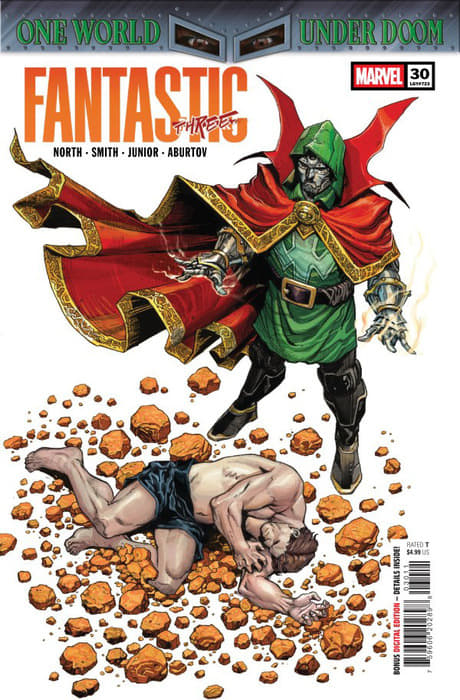
Fantastic Four #30
From the publisher
FANTASTIC THREE! After Ben Grimm has suffered a terrible (and very public) defeat at the hands of Doom, he’s left lost, adrift — and more vulnerable than he has been in years. And when a trip to New York goes wrong and his fate suddenly turns from bad to worse, Ben has never been more vulnerable — and soon takes a shocking shortcut he won’t be able to undo! This is one Thing and Alicia story you won’t soon forget!
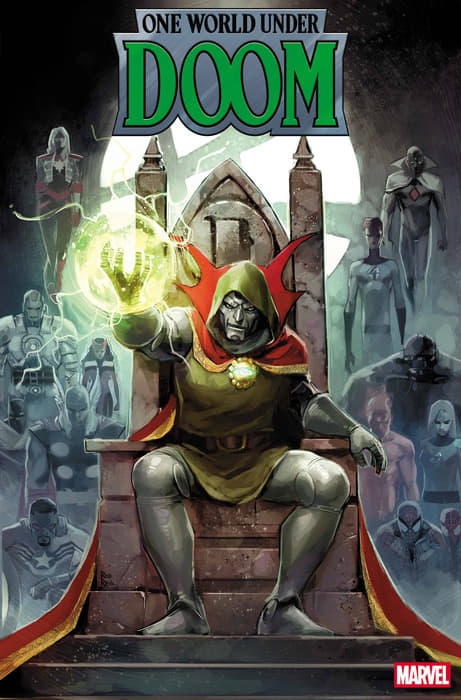
One World Under Doom
From the publisher
ONE WORLD UNDER DOOM! Six months ago, Doctor Victor Von Doom became Sorcerer Supreme - then disappeared behind Latveria's closed borders. For most, there's enough going on in the world that Doom's absence is not a priority, and some time without him feels like a blessing. Only a few recognize it for what it truly was...the calm before the storm. It is a storm that has now arrived. The world has woken up to a new reality: Doctor Doom, Earth's Sorcerer Supreme, has magically taken over every broadcast medium on the planet and declared himself Emperor of the World - the ruler of a new United Latveria! And shockingly, impossibly, all of Earth's leaders seem to be going along with this. Luckily, whether it's mind control or Doombots, whatever's affecting them hasn't affected Earth's heroes - and so they quickly form a strike team to stop Doom's machinations. But will they succeed? And what happens when some begin to welcome their new Emperor with open arms, clamoring for One World Under Doom? Marvel's biggest and most shocking event ever begins right here.
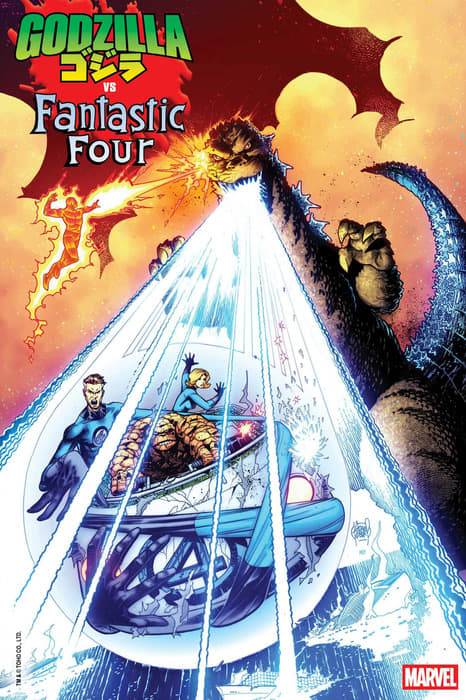
Godzilla Vs The Fantastic Four
From the publisher
THE BATTLE OF THE CENTURY STARTS HERE! The start of six sensational, action-packed issues with MARVEL HEROES battling THE KING OF THE MONSTERS from its many different eras! How will GODZILLA'S lore mix with the MIGHT MARVEL UNIVERSE? Find out as history is twisted when icons like the FANTASTIC FOUR, SPIDER-MAN, HULK, X-MEN and THOR go face off against one of the greatest monsters of all time! This issue, witness a threat never before seen as KING GHIDORAH descends upon the Earth with the POWER COSMIC as GALACTUS' newest HERALD! Can the FANTASTIC FOUR stop him from destroying New York along with the rest of the planet? It's a CITY SMASHING SPECTACULAR as GODZILLA with the help of the SILVER SURFER join forces to stop the world from certain annihilation! A must for MARVEL and GODZILLA FANS! ROUND 1 IN A SERIES OF 6 ONE-SHOT THROWDOWNS!
To Be or Not To Be: https://bookshop.org/p/books/to-be-or-not-to-be-a-chooseable-path-adventure-ryan-north/12470776
How to Invent Everything: https://bookshop.org/p/books/how-to-invent-everything-a-survival-guide-for-the-stranded-time-traveler-ryan-north/12476891
PATREON
We have a new Patreon, CryptidCreatorCornerpod. If you like what we do, please consider supporting us. We got two simple tiers, $1 and $3. Want to know more, you know what to do.
ARKENFORGE
Play TTRPG games? Make sure to check out our partner Arkenforge. Use the discount code YETI5 to get $5 off your order.
THE LANTERN CATALOG
Created on the premise of creating light in the dark, this is the the go to resource to keep you up to date on the indy projects and the creators you love. You can find them at https://www.thelanterncatalog.com/.
Make sure to check out our sponsor 2000AD.
[00:00:00] Your ears do not deceive you. You've just entered the Cryptid Creator Corner brought to you by your friends at Comic Book Yeti. So without further ado, let's get on to the interview.
[00:00:30] Show notes and thank you for your continued support. Thanks for your donation.
[00:01:02] Dan Abnett and so many others. Get a print subscription and it'll arrive to your door every week. And your first issue is free or subscribe digitally. Get free back issues and download DRM free copies of every issue for just $9 a month. That's 128 pages of incredible comics every month for less than $10. That's like a whole graphic novels worth. All subscribers get amazing offers like discount vouchers and exclusive product offers.
[00:01:29] Head to 2000AD.com and click on subscribe now or download the 2000AD app and why wait? Start reading today. I'll put links in the show notes for you. Hello and welcome to Comic Book Yeti's Cryptid Creator Corner. I am one of your hosts, Jimmy Gasparro. And on the podcast, we are continuing our Marvel March Madness. I guess Byron has wanted to call it, but we did DC December. So we're doing Marvel March.
[00:01:53] And I am very excited for today's guest. He has a long running, I guess, I guess it's called a web comic with a dinosaur comics. I think since 2003, he has won Eisner Awards, Harvey Awards for a lot of his work.
[00:02:14] He has written Unbeatable Squirrel Girl. He has written Adventure Time. He has these wonderful choose your own adventure Shakespeare books like To Be or Not To Be and Romeo and or Juliet. He has written How to Invent Everything. I think the follow up was How to Take Over the World. Also with Erica Henderson, Danger and Other Known Risks came out recently, which we might get to talk about.
[00:02:40] And he's been writing for Marvel Fantastic Four. And just as we record this just came out last month. Was it One World Under Doom? That is correct. Hello, it's me, Brian. Yes, it is none other than Ryan North on the podcast. And yeah, Ryan, I am so excited to talk to you about about all this stuff. But yeah, please welcome to the podcast, Ryan North.
[00:03:10] Ryan, how are you doing tonight? I'm doing well. Thank you for having me. Yeah, so I definitely want to talk about, you know, the purpose behind this with the Marvel stuff you've been writing. And listeners of the podcast know I've talked about it before when I have creators on and I say, oh, what first got you into comics and X-Men or Marvel comics come up? I have just not read a lot of Marvel comics in my life. And one of the things we're doing with this is I get to read more Marvel comics.
[00:03:37] I started to tell you before we hit record, I mean, I've been familiar with the Fantastic Four, you know, because I've just been aware of Marvel comics and aware of the characters. I mean, I think I have a complete 91 or 92 of the Marvel trading cards somewhere in my house still. And so I knew who all the characters were. Like, I knew their stats, but I just never really read a lot of Marvel comics for whatever reason.
[00:04:06] You know, growing up as a kid. And then when I got in, I got away from comics and got back into it years later. And I just had read DC and a lot of indie stuff. And of course, here, Comic Book Getty, we cover a lot of indie stuff. But I sat down to prepare for this. I didn't get to read your whole recent Fantastic Four run, but I read, like, volume one of those first six issues. And this has happened again and again.
[00:04:33] I imagine it's going to, like, keep happening with the creators that I'm interviewing. But I couldn't get over how much I loved it. Like, not just, like, liked it. I just, I loved it. Like, it was, I feel like with indie comics a lot, I read, like, a lot of science fiction and horror and a bunch of other stuff.
[00:04:59] And I think superhero books in the indie space can, like, be kind of tough. And I always think, like, we have to have something different. And I always think when I talk to a creator and they're like, oh, I one day want to work for the big two. And I have this Batman story or I have this Iron Man story. And I'm like, how do you do that? Like, they have decades and decades of, you know, stories.
[00:05:25] But I just dove in, blank slate, whatever this Fantastic Four story is, issue one, starts out with the thing. And is it Alicia Masters? Alicia Masters is my idea. In, like, a time loop in issue one and instantly in. Like, I want to go order a thing, like, action figure for my desk at work. Like, I just loved it so much.
[00:05:57] So, yeah, I mean, when you get tasked to do something like that, when you get either get the opportunity to pitch or somebody approaches you and says, hey, we're looking for somebody new for Fantastic Four. Like, do you have already stories to go? So, is it tough to kind of figure out what's going to be my way into a team book that has been around for so many years? Yeah.
[00:06:23] You know, listening to you say that stuff, I was thinking, you know, we're not so different, you and I. Because my introduction to print comics was I read so much indie stuff. Very little big two stuff. And it was never my dream to be like, I have a Iron Man story or a Fantastic Four story or whatever. And so when they, when I was asked by Tom Freiburg, my editor, to pitch for Fantastic Four, I didn't have anything. I didn't have, like, a story I could pull up.
[00:06:52] Like, I got the best story for you, boss. You're going to love it. It was just like, give me some time. I need to think about these characters. I need to read more of their comics. Like, I'd read them, obviously. I'd read a bunch of them in time. But I don't have a big depth, a deep pool of Marvel knowledge to dig into. I mean, between you and me and the podcast, if you look at the first villains that Squirrel Girl fights in around there, they were all in the movies. Because I was like, oh, I saw the movies. I can work with that.
[00:07:23] I mean, Kraven shows up early, though. Kraven's the exception. I like Kraven. He wasn't in a movie yet, but I just really like Kraven. But there's a note. I'm not sure if it was in the trade, but there was a note at the end of the first issue. It was me basically putting, like, here's what I want to do with Fantastic Four. And I had four, count them, four sort of ideas, sort of pillars. And one was that the Fantastic Four are adventurers. And the second was the Fantastic Four can do anything.
[00:07:50] Like, these are characters that have stuck around for so long because they're so flexible. You can drop them into a city in a time loop or, you know, a small town filled with doombots or whatever you want to do. And they work because they are not just read. They are flexible characters that can work in horror. They can work in sci-fi. They can work in adventure. They can work in anything.
[00:08:12] And so it was less of what I'm going to do with this book and more, okay, how do I do something that's going to feel vital? Right? Like, comic book continuity is a strange thing in that ostensibly it all counts. In reality, it doesn't. We remember the stories we love and we forget the ones we didn't. And so you want to make a story that resonates.
[00:08:34] And so the big idea I had was there have been so many incredibly epic runs with Fantastic Four doing these huge universe shattering stories. And I was like, well, that's not going to be me. I'm going to do little one shots. I'm going to do little stories for two reasons. One was comics is a not inexpensive hobby and it's nice to get a full unit of story when you buy a book. I always love that.
[00:08:59] And the second was, I just feel like it's more satisfying to buy a book, to read a book and be like, that was a narrative. That wasn't part five of seven. That was one chunk that I can think about. And I pranked myself because that was a book I wanted to read. And then I realized when I was writing issue three, I've got to keep doing this. Now I need a new sci-fi premise every month. I need a twist.
[00:09:26] I need some emotional recognition and character development. All this stuff is we crammed into 20 pages every month. It's not easy. It's not the easiest book I've ever written, but it is a fun book and a gratified book. Because like I say, you can do anything. We've done an issue that is a noir issue that I thought was really successful. We did an issue from Alicia's point of view. What's her experience as a blind woman reading comic books? We have to explore that. There's all this stuff, all these places you can go.
[00:09:57] And if I was doing four-issue arcs or ten-issue arcs or whatever, I'd get to tell maybe three stories. If we're doing one-issue stories, I could tell a whole bunch of stuff and go to all these different versions. Yeah, that's true. And you're working, at least in the first grade, I think still, you're working with, is it Iban Coelho? Iban Coelho. Yeah, we had a bunch of different artists. He started us. He's on other books now, unfortunately. Because he's great. They're all great. Yeah, I mean, you really have.
[00:10:28] The art in the, like I said, I've only gotten through the first six issues. But yeah, the art has been absolutely fantastic. There's just been some wonderful stuff in it. I was curious when you, just to kind of talk about the start of it, and then we can talk about, you know, kind of where it's gone. And then get into One World Under Doom.
[00:10:54] I really liked how it started with Ben and Alicia. You know, having read, like, the first arc, I kind of felt that, I think there might be an inclination where somebody's coming new onto a book to start with, like, Reed or Sue. Because they're kind of, like, the heart of the team, and they've been the heart of the team.
[00:11:15] But I really liked how you kind of had this, like, worky little time loop adventure with Ben and Alicia to kind of, you know, set the stage for what was to come. I just felt they're such a great dynamic as well, the way that they are, like, present themselves in that issue.
[00:11:38] And it's very, there's moments of it that are very funny, but there's, like, there's still a ton of action in it. And I love how they work to kind of solve the problem of the time loop. And I just, I thought it was a very smart choice if you're starting with the team kind of separated to start with. After I read the first arc, I was like, that was really smart to do it that way. Thank you.
[00:12:07] I really liked that, you know, then getting into, I think the next one is the Doom Bot with Reed and Sue. Or maybe it's the Johnny one, Jonathan Fairweather, which is not Johnny Storm. He's Jonathan Fairweather. Completely different guy who's always talking about how great the human torch is. Yeah. My favorite joke, I think, though, in the first arc was when he said one of his other names was Johnny Q. Tempest, who he thinks would have mutton chops.
[00:12:39] That looks so great. Yeah. Aren't they, though? Yeah. Um, so when, as you're doing it, um, did you know initially, like, when, when you first get it, that this, this could be like ongoing? Or is it like, we'll see how the first six go and then go from there? Yeah, I thought, uh, the book would not last because it is such a different thing than what's come before. And so there's two possibilities. One is people love and I get to keep doing it.
[00:13:08] The other is people like, this isn't what Fantastic Four is. This is too different. We don't like it. But the, the two main choices I made were the first to split up the team and to have a focus on each of these characters to start out. And the second was to, they have some kids. They don't show up in that first time because they put the kids, uh, on a bus. They come back in a year. And the reason for both those choices is you can't, I don't think you can do a team book. You don't care about the characters as individual people.
[00:13:35] And Fantastic Four, there's five of them with Alicia. They've got four kids. That's nine main characters in a 20 page book. And I didn't think I was capable of making you care about nine people when they each got two pages and change, right? That's not enough to make you want to know who these people are. So I thought, well, let's, if I split them up, not only does that give a reader, the reader a chance to like really get to know who these people are, but also it gives me a chance.
[00:14:02] I get a whole month just to think about what Ben and Alicia are like when they're together. Then a whole month, think about Rinzu and a whole month about Johnny, which really let me, uh, kind of ramp up to finally running all four of them together in issue four. Um, but one thing I didn't realize that made it kind of a bigger swing than I maybe intended was I didn't know would be relaunching with a new number one for that first issue. And so it is a, it is a bold choice to start a comic called Fantastic Four number one and only have two members.
[00:14:30] Well, really one member of the Fantastic Four in it. Right. Um, and at the time the people like, what is he doing? What is Ryan doing? This is bad. You can't call it the task for to only have Ben Grimm and Alicia. That's not enough. But I think we got there fast enough by issue four. And we, by the time we got there, you, you knew who these people were and you, you care about them. So when they all show up together, it's like, oh yeah, great. Not okay. There's, I think I like this guy and I guess that guy's a rock guy. I don't really know his deal. And maybe this one would turn invisible. It's not really clear to me.
[00:14:59] Like I wanted the Fantastic Four to be accessible because yes, this comic straight around since the 60s. And yes, there's people in life who've read every single issue of it, which is terrifying because the work you do will be judged against, you know, Stanley, Jack Kirby. Right. But there are also people who are going to pick up their first comic and it's going to be Fantastic Four number one. And I didn't want them to feel lost. I didn't want them to feel like this wasn't a comic for them because I don't know.
[00:15:26] My very first comic I ever read was put in my stocking by Santa and it was a Wonder Woman comic, probably three of seven or something. And I was completely lost. Like I liked looking at the pictures. I liked how the words and pictures danced together, but I had no idea what was happening. And that's for a lot of people, you just bounce off that, right? You're like, oh, this is not for me. This is something that I do not understand. I read it and I'm lost, so I'm not going to do that again. But if you can read a book and not be lost and feel like that was a cool story. I'd like another one.
[00:15:56] Oh, cool. There's another story next month. That feels accessible. People don't do that often because every new story, it's a jumping on point. It's also a jumping off point. You can do a big long storybook for me the whole time. But I don't know. There's a real art to it that is fascinating to me. And for a while, I thought what I was doing was impossible. And then I remembered that there were... I was at Kirk Fonnegut because I did...
[00:16:24] We were talking about the Slaughterhouse-Five graphic novel I wrote earlier before we started recording. And co-wrote. Adapted, really. I didn't write it. I just put some script down and Albert Montes drew it and Kirk Fonnegut wrote it. But he was writing in his diaries that I was reading how, you know, in the past, in the 30s, you could make a living selling a short story every month to magazines. And maybe think, okay, this is possible. You can do this. I just happen to be a sci-fi writer in the golden age of magazines.
[00:16:54] And I happen to have a magazine called Marvel Comics that wants a new story every month. So I'll just do that. And it really helped a lot for me to realize if this is something that people have done before. Or is kind of this moment where I'm like, this is hard. And maybe I've bitten off way more than I can do. But if you know it's possible, that helps a lot with being able to convince yourself he can do something. And I think as we record this, we're, I guess, a week before issue 29 comes out.
[00:17:24] Quite possibly. I think that's it. I think issue 29 is supposed to be out February 26th. But, I mean, creators, you know, whether or not it's writers, artists, don't, in this day and age, don't really get long runs on books anymore. Like, not, you know, not in indie comics it doesn't happen too much.
[00:17:46] I mean, I think there's only like a handful of books that, you know, really get it over 25 into 30 issues anymore. So, you know, which can be kind of surprising.
[00:18:04] But, you know, that it must be, I would think, a pretty good feeling, though, to still, you know, be doing it if you didn't think it was going to catch on at first and still be, you know, 29, 30, 31, like issues into writing this team. You know? Yeah. Yeah. It's funny because I don't think about that too often, but I was thinking about it the other day in the context of, oh, man, I have so many stories for these people.
[00:18:34] I have these files of just ideas. And will I have time to do them all? And then thinking, I've been extremely lucky to get this far. There is probably no way that I'll be able to do every story I have for Fantastic Four, which is fine. And it's fine. But I'm really happy that the book is as well received as it has been and that I've gotten to do so much with these characters.
[00:19:04] It's the same thought I had with Slaughterhouse, where I just didn't want to embarrass myself, right? Like, you don't want to be the guy who ruins, messes up Slaughterhouse 5. They don't want to be the guy who, you know, shows up for Fantastic Four, does four horrible issues, and then is quietly shuffled off the book. So it's, I'm glad to have not done that. Yeah. Well, yeah, I don't think that's the case. I can imagine, though, with something like Slaughterhouse 5 or a property like the Fantastic Four. Yeah, but I loved it.
[00:19:34] I can't wait to read the rest of it. But I just, especially Ben and Alicia, I just kind of fell in love with those characters. And I was wondering, with, you know, your background in terms of, you know, going to school and being a computer programmer, you know, as well as a writer. Was it easiest to kind of get into the head of, like, Reed Richards?
[00:20:00] Or was there another character that came easier to you than the others in terms of, like, writing the character itself? You know, not the action-y stuff, but really the heart. This is going to sound like such a cop-out answer. Okay, that's fine. We'll hear it. Let's go. I like them all. But the reason it's not a cop-out answer is that each of them surfaces this element, right? Like, Reed, yes, he's very smart. He will say the smart things. And that's super fun to write.
[00:20:30] And the secret to writing a genius character, you ever have that job, is you don't have to be a genius. You just have way more time than they do. I can spend a whole month thinking what Reed Richards is going to say. He does it on the top of his head. Like, man, that guy is smart. Took me a month, but I got there eventually. So Reed's fun for that. Yeah. Reed's really fun for that. Johnny is really funny. He is just like the funny part of me.
[00:21:00] Ben, so much heart, so much honesty. He's a real softie despite that rugged exterior like this. He's super fun to write and very honest. He's so sincere. And then Sue has this strength and this caring and this competence that I find really appealing. I mean, my favorite thing is competent people. I love people who can do their jobs really, really well. And she can do her job really, really well. It's just a bunch of jobs.
[00:21:30] So it doesn't feel like, oh, man, now I have to write Ben Grimm the thing. What a chore. It's, oh, I have this great, you know, sense of sincerity. I'm going to give that to Ben and he's going to elevate it. I was working on a speech today for an upcoming issue that's like six or seven issues out or ten maybe. So there's a lot to come.
[00:21:55] But it was a speech idea I had in my head as soon as I started writing it in Ben's dialect. It just comes to life because you can imagine Ben Grimm saying it. So the characters are, like I say, they're flexible, but they're also really, really pure. And there's a reason why, you know, we're still telling stories about these people after 60 years. Oh, yeah. Sure. Sure.
[00:22:22] And so then I say that as a guy who's not a big Fantastic Four fan growing up. Like, I just come to this late, but they're great. Yeah, no, they are. I agree. I came to them late as well. And I agree. All right, everybody. We're going to take a quick break. We'll be right back. Let's face it. The comics landscape is a mess right now. I'm the editor in chief of a comics journalism outlet, and I can't even keep track of it all. If you are as passionate as I am about indie comics and its creators, you should check out the Lantern Guide.
[00:22:48] Created on the premise of creating light in the dark, it's going to be the go-to resource to keep you up to date on the projects and the creators that you love. Don't take my word for it. I reached out to my friend Brian Lovell, Poison Ivy artist and indie comics creator, to get his take. Brian, what does The Lantern Project fix?
[00:23:05] I'm a dude who loves indie comics, and I know personally, like, I get very frustrated when something shows up in my social media timeline or something like that, and I feel like I can't keep track of everything. So really, The Lantern Project was born out of that. It was an opportunity for me as a reader to kind of, like, have a place to want to consolidate all the stuff that I wanted to read.
[00:23:29] All the cool projects from cool creators that seemed interesting and kind of unique to, like, something that I would like, which is really not super represented everywhere else, but it's all over the indies. Having a spot to go to that felt like it consolidated a lot of those audiences and a lot of those places where I couldn't just get drowned out in the feed of social media seemed really valuable to me. What's the ultimate goal?
[00:23:54] It's really our hope with this project that creators feel like they're able to get in front of readers, and readers are able to get books that they actually want to read with a much easier time of keeping track of them and accessing them. The catalog is scheduled for a quarterly release, so head over to thelanterncatalog.com to sign up now so you don't miss your next favorite thing. I'll put a link in the show notes for you. Y'all, Jimmy the Chaos Goblin strikes again.
[00:24:23] I should have known better than to mention I was working on my DC Universe meets Ravenloft hybrid D&D campaign on social media. My bad. He goes and tags a bunch of comics creators we know, and now I have to get it in gear and whip this campaign into shape so we can start playing. Another friend chimes in, are you going to make maps? It's fair to say it's been a while since I put something together, so I guess, question mark? It was then that I discovered Arkenforge.
[00:24:48] If you don't know who Arkenforge is, they have everything you need to make your TTRPG more fun and immersive, allowing you to build, play, and export animated maps, including in-person Fog of War capability that lets your players interact with maps as the adventure unfolds while you, the DM, get the full picture. Now I'm set to easily build high-res animated maps, saving myself precious time and significantly adding nuance to our campaign. That's a win every day in my book.
[00:25:17] Check them out at Arkenforge.com and use the discount code YETI5 to get $5 off. I'll drop a link in the show notes for you, and big thanks to Arkenforge for partnering with our show. I think I'm going to make Jimmy play a goblin warlock just to get even. Welcome back. And so now, as it kind of culminates with this event that just started, really, I think issue...
[00:25:45] Issue 1 just came out of One World Under Doom, and I think it's issue 28 of the Fantastic Four, which is kind of like, I guess, the prequel to One World Under Doom. So Doom has now become the Sorcerer Supreme, and he's in charge of everything.
[00:26:10] I mean, kind of getting to not only do Doom within the Fantastic Four, but in an event series. This is one level up, right? Like, so I've done, I do the indie stuff, I get the big two book. Now I'm in charge of an event.
[00:26:33] So do you feel like, well, I've got, you know, 30-some Fantastic Fours under my belt? I mean, I think you're also writing, isn't it Fantastic Four versus Godzilla's coming out soon, too, right? That's just the one shot, yeah. But still, you got some other stuff going on. Was there added pressure to the One World Under Doom because it is an event? Or you're like, now I know what I'm doing now. I've written enough that I kind of get a sense of what's happening here.
[00:27:03] Yeah, it helped a lot that I started working on One World Under Doom in 2003. And so I've had all this time to figure out the story, and the whole thing's written. It was written last year, which means the pressure's off in terms of like, what am I going to do? But the thing that I did find surprising was I had to sort of take off blinders I didn't really realize I had on. And I'll explain that in Duretti Normal book, let's say in issue of Fantastic Four.
[00:27:34] I can't, for example of the air, blow up the moon in Fantastic Four and have it stay blown up. Because that should affect what happens to Spider-Man and Captain Marvel and everyone else. That's a pretty big thing. Like, hey, what happened to the moon? We should be dealing with that. And so there's this idea when you're normally writing a book in the shared universe that, you know, if I get on both moon, I have to put it back together at the end. And that doesn't affect other books just to play fair in that sandbox.
[00:28:04] When you're writing an event, you can blow up all the moons you want. Your story can go big. And I sort of had to realize, like, I'm writing in my normal register when I need to consciously remove those blinders and go, like, you can do anything. You can bring in all these characters. You can go as big as you want. Your role is, in fact, to go as big as you can because you want to write a story that's worthy of being an event.
[00:28:30] The worst events are stories that feel mandated, that feel like they're there just to make you buy the book. And the best events, in my opinion, are the ones that feel like the story was so big and so impactful that it had to spill out and affect all these other books. That's what I'm shooting for is to tell a story that sort of justifies its existence in that sense and feels like this is the only way it could be told.
[00:28:54] It's a really unique, probably once-in-a-lifetime opportunity in the sense of, like, writing the way comics are written today is a very strange way to tell a story. It's a serial, like, you know, Dickens wrote in serials and then published the book books at the end. He was writing his own stories. There weren't 30 other writers also writing serials that are supposed to be taking place in the same universe all the time every month.
[00:29:24] That's a much more complicated thing to wrangle. And it is a form of storytelling that I think is unique to anything else. And the event is the biggest expression of that form of shared storytelling, where the fact that all does take place ostensibly at the same time in this same universe is of critical importance. So it's strange and unique and fun and a real privilege to tell a story that way.
[00:29:53] Was there ever, not to bring in, like, real-world events, but, you know, writing it in 2023, was there ever anything in the real world as it started to happen where you realized, wow, I've written this Doom character. I never thought that, like, maybe you could have gone farther based upon, you know, real-world events.
[00:30:25] Basically, you're in Canada, I believe, and I'm in the U.S. It's our current president who would like to be king. I was just thinking, like, oh, there's some strange parallels between Doom. Yeah, it's a resonance for sure. It's not there in the text of the story, I don't think. It's not a Trump story. It's a Doom story. Oh, yeah, no, it's not. But I was, it just occurred to me.
[00:30:54] And I think it's hard not to make a comparison when you have, you know, whenever you're, there's authoritarian creep, right, in any government. And then you have a character like Dr. Doom who wants to be emperor or take over everything. It's hard to, you know, not look at real-world comparisons.
[00:31:16] But I was just wondering if there was anything, you know, where you're like, oh, I could have gone bigger with Dr. Doom. There's no one bigger than Dr. Doom. Yeah, I guess that's true. I mean, it's, I was telling someone else that, like, the thing I love so much about Doom is that he is this character that is almost unique in fiction, in which he does science, he does magic, he dresses like a robot in a cape, like he's a full package.
[00:31:46] But he can also, he's so strong and so powerful that he can pull off talking about himself in the third person without it sounding silly. Like, if I say, Ryan North doesn't care for that ham sandwich, you're like, all right, Ryan, come on, knock it off. But if Dr. Doom looks you in the eye and says, Doom does not care for that ham sandwich, you're like, holy shit, I'm about to die. Like, this man is going to kill me.
[00:32:12] So the joy of writing him is that you can't write other characters as theatrical and as oratorial as Doom. Because they're real people. Real people say the word um sometimes or don't know exactly what they're going to say. Doom has never in his life said um. Doom always knows exactly what he wants to say.
[00:32:36] And so when you're writing Doom, you get to write in this heightened register that is so gratifying that you're going to come out of his mouth. He's just a very powerful, horrible man. Yeah, and I think that R.B. Silva had worked on it with you. Yeah, I just said, I can't be doomed. No, I do too. I mean, I said so many things in this conversation that are not technically words.
[00:33:06] I talk to you fast and I mumble. It's just, I'll never be doomed. I mean, some of the panels of him, though, are, you know, just, he does look, you know, powerful. There's these very particular shots of him, the paneling, the way it's done. Yeah, I just, I love how it kind of gets with this first issue. Like, if you didn't pick, if you weren't reading the Fantastic Four and you just pick up One World Under Doom and like, you know, it just, it's all out there right away.
[00:33:36] He's like, everyone is bent. Takes over the world on page one. Yep, everyone's bent the knee to me. I'm the, you know, Emperor Doom, Sorcerer Supreme. He's like, hey, we're, and then he starts instantly promising things that sound great. Like, we're going to have health care. You're going to be able to go to college. I've left your leaders in place. Your day-to-day life won't change. Sounds great. Yeah. Probably no downsides, right?
[00:34:01] You see all these people watching the broadcast and it like cuts, you know, the next page is like the Avengers sitting around like, well, what are we, what are we, what are we going to do now? And it kind of, you know, the story gets into it from there. But yeah, I really, I really, I really enjoyed it. I thought it was great. I love seeing the team of everybody kind of sitting around the table interacting was a lot of fun. Was there anyone in particular that you were excited that you're going to get to use in this that don't show up in the Fantastic Four? Yeah.
[00:34:32] Yeah. The one, this is a figure to me. I did 58 issues and a graphic novel on Squirrel Girl. And she is a character who is dear to my heart. And there was no way I was going to do a big Marvel event and not have her in it and not bring in Nancy and brain drain the other characters of the book too. So you can tell that it's a Ryan book when you see Squirrel Girl there, but it makes sense.
[00:35:01] It makes sense because she's defeated Dr. Dew in her first appearance. And if I didn't have her there, people would say, why do they not simply call Squirrel Girl who would solve this problem in 10 minutes? She's beaten him before. And so by having her there and the fact that she can't beat him right away shows that, oh, hi, this takes her. So it is actually really excellent writing and not just me putting my favorite characters every chance I get. So it's just, it's fun for you, but it also, it makes sense in the grand scheme of things, right?
[00:35:31] This is my claim, yes. Excellent. Yeah, well, I thought it was great. I really enjoyed it. I thought it was, it's the artwork inside, the coloring. I mean, it is, it's a beautiful book. It just is absolutely fantastic. Which is, you know, another plus. So I'm very excited for it. And yeah, I just can't wait to get into more and catch up on, you know, your Fantastic Four run.
[00:35:59] Because I just absolutely loved it. So I wanted to turn a little bit to talk about some of your other stuff. Because I am a big Shakespeare fan. Just got into theater when I was younger. Haven't really had an opportunity to actually perform too much. You know, some community theater productions. But I've, it's always kind of, certain plays have kind of been near and dear to me.
[00:36:26] So I was excited to see that you had done a choose your own adventure of Hamlet. And first I thought, well, how, you know, how rude to the play can it be? Well, because, you know, how, because, you know, it's a play can be so, you know, linear. And like a choose your own adventure. And I had so much fun though. Yeah, I picked Lady Ophelia.
[00:36:56] It was kind of like a short adventure. And I think we were talking about it before we started recording. But I ended up with Hamlet. And it was very nice. And I can't wait to go back and read more. But you've also done Romeo and or Juliet. Another, another one, which is, I mean, I love Romeo and Juliet. I love the Broadway musical and Juliet.
[00:37:23] So now I can't wait to add this to my Romeo and Juliet collection. So what brought this about? Where were you like, I'm going to do Shakespeare, but I'm going to make it. Interactive, second person. Yeah. Yeah. So, I mean, it's kind of like the height, you know, like the bard. And then nobody ever looks too highly on choose your own adventure. Oh, no, that was that was precisely it. That's what I love about it.
[00:37:47] Shakespeare has gone from like this ridiculously canonized author and like the lowest form of writing, in most people's opinion, is second person. You do this, you do that. Interactive fiction. Come on. That's not serious. Art form. No one does serious work on that. These are baby books. This form that's typically dismissed as juvenilia that makes it really powerful.
[00:38:15] And there's there's literary techniques that aren't available in other forms. For example, in Hamlet, there is a pirate battle. It's in the play. It happens offstage. Hamlet sort of gets kidnapped by pirates and comes back. And I seem like, hey, guys, I'm back from my pirate adventure. I bought some pirates and here I am. Now let's get back to the business. And you get my Shakespeare did that because my collaborator, Bill, was writing for the stage. But I'm writing for a book so I can have more set changes.
[00:38:44] And in that sequence, you're battling a pirate as Hamlet. And for that section only, no matter what you choose in this battle, if you're going to strike high, strike low, whatever, you will always choose the right option. There's no wrong option. And so the first time you read through, you get a sense of invincibility because you've died a ton in this book at this point. But once you do this fight, everything you choose is right. Like you are the best Hamlet in the world.
[00:39:09] And that's using the choice structure to inform the reader's experience as they make those choices, which is is really cool. So there I really enjoyed the books. I was terrified that Shakespeare scholars would hate them and think, who am I to desecrate the bard? But thankfully, they told me that I did not destroy the original Hamlet. Those books still exist. The plays still exist. It's another way into the book. And, you know, I hadn't intended it this way.
[00:39:35] But I discovered, you're talking to educators, that, you know, if you're teaching Hamlet and you're struggling to understand, you know, why is this guy so indecisive? Why doesn't he make these choices? When you are the person making those choices, you understand all the information going to Hamlet's head and why he's doing this and why he isn't doing this, what he might do instead.
[00:39:54] Yeah. And also, I think for somebody who, like if you're studying it in school and you're having a difficult time, you know, grasping some of the language, like even if you're going through it and like, well, what is Shakespeare saying here? And like the poetry of the language.
[00:40:11] But if you read something that kind of recontextualizes the action and what is happening and then you go back to the, you know, the Shakespeare written dialogue, knowing kind of what those choices are about and like a little bit more of the plot. I feel like the language starts to come to you easier in terms of, you know, if you're having difficulty with the meaning of it.
[00:40:39] I have no data to back that up. That is just my sense from reading a lot of things. No, I feel the same way. It was, I think what the joy of it for me was, was when you're writing interactive fiction, anything can happen. And a phrase like choose your own path is a lie because you are not choosing your own path.
[00:41:05] You are choosing from a subset of paths that I've already chosen for you. Right. And so there was a, it was Ebert, Roger Ebert, when he's still alive, talking about how computer games could never be art because you take the example of Romeo. If you chose not to have Romeo and Juliet die at the end, that would change the meaning of the play. That changes what the author is saying. So these things can never be art.
[00:41:31] And what he held to understand because they absolutely can be art is that when you make a choice in something like this, whether it's a book or game or whatever, you are taking ownership of that choice. If you're playing Mario Brothers and Mario falls in a pit and falls in a pit and dies, you don't say, oh, Mario died. You say, I died. I made that. And so if I give you a choice in a Romeo and your Juliet, and I say, all right, here's Romeo. Romeo, he is in love with being in love, but he definitely wants to kiss women. And you say, great.
[00:42:01] And then partway through, I show you this real interesting guy. And I say, do you want Romeo to kiss this guy? You're not going to look at that and be like, oh, well, right. And really messed up because he said Romeo was straight. And here he is being not super straight. What a bad author he is. You'll say, oh, no, wow. My Romeo is going to kiss this guy. I'm going to do this. And so it's not show, don't tell. You can tell and then tell something else and both will be fine because the player, the reader is making those choices.
[00:42:30] It's such an interesting way to explore a story, to take ownership of what happened and to make it feel like you are the person doing that. And so you now understand why these characters would behave this way, because you were there doing that as they were. Yeah, I just think it's yeah, I can't wait to play through more adventures with some of the other characters. I thought it was I thought it was great. Do you think I mean, did you choose Hamlet?
[00:42:59] Hamlet was the first one, right? Did you choose Hamlet just because of how well known it is? Or was it you thought the choices were interesting? I mean, do you think this would work with one of Shakespeare's comedies with something like Twelfth Night or Much Ado About Nothing? Or do you think it wouldn't be as as maybe interesting? Just kind of. Yeah. So the first part of the question, I did do Hamlet first because that's how I thought of it.
[00:43:28] I was turning over the to be or not to be speech in my mind on a long drive. And I realized, oh, this is structured like a choice, like the two-star adventure books used to be. But I was good. Oh, my God. What if you could do this? What if you have characters, all this stuff? But when I did to be or not to be and that was successful and I I'd promised to do a sequel for the Kickstarter we had for it. I was looking at the place and obviously did I did Romeo and or Juliet.
[00:43:56] But not every play that Shakespeare wrote and every story that's out there lends itself well to an interactive story. What made Hamlet work really well is the structure of that play is a bad guy has killed your dad. Go kill the bad guy. And he takes a while to get there. But like you have an end point. You have a final boss to defeat. And you have all these adventures along the way.
[00:44:21] But something like Macbeth, the structure of that is decide to kill a king, kill the king and then feel real guilty about it. And like turn to page 38 to feel guilty. But what you just did is not a fun, playable experience. No. So I did actually in, you know, slight spoilers for the book. You haven't fully finished yet. But in to be or not to be in Hamlet rather in the play, there's that play within a play with Claudius trying to get his guilt to come out.
[00:44:49] So in the interactive version, in to be or not to be, there is an interactive book within an interactive book. And I repeated that for Romeo where I had multiple interactive books. And one of them you can read as Macbeth. But I shortened Macbeth into like 10 choices to make it very small because it couldn't support a larger narrative in this interactive fiction for the reasons I already described. So not everything works. But in that book, there is also a Midsummer Night's Choice, which is another support version of a comedy.
[00:45:18] So it can be done, at least in sword form. Oh, that's great. I can't wait till I get to that. And before we go, I also wanted to talk about, because one of the other ones I picked up, one of your other books, was how to invent everything. I don't invent everything.
[00:45:40] I mean, I was not familiar with this until I started to dig into some of the stuff you had done before to prepare for this interview. Instantly loved the idea of it. So for listeners, I mean, it's not a comic. This is like a manual. But the idea of it is if you're traveling back in time and you go, like, let's say, pretty far back and you get stuck.
[00:46:07] You know how to invent all the things that a person has invented to talk from. I mean, you start with talking about language going through to farming and agriculture, like, you know, medicine all the way up. I mean, through concrete steel. I mean, it is I mean, it is impressive. And I I I've gone through. I think it's 400 some pages, the digital one that I have.
[00:46:37] I've I've gone through like 100 of them. So, wow. Thank you. Oh, no. Thank you. I loved it. I one I love kind of the the I mean, for. I said it's kind of like a manual, but going through everything, it's just it's filled with information, which is great.
[00:46:58] But it has like a sense of humor or like a bit of whimsy to it and telling, you know, some of these things and how, you know, humanity invented some of them. I mean, the premise of you go back in time and you get stuck and like, what are you going to do? I just I thought it was fantastic.
[00:47:22] Like, I just I mean, as like as a as a kid and like a nerd who just loved learning. I mean, I loved school. Like, I don't think I've ever said that on the podcast because I think there's still bully. I'm 45 years old. I think there's still bullies that are going to beat me up. But I love school. I absolutely love it. I love learning. And here I am. Haven't been in school for at least 20, 25 years now.
[00:47:49] I graduated law school and get a big book of. You know how to do stuff and how to make stuff and how to invent stuff. I just thought it was great. Like, what a fun premise to like kind of cram in like all that stuff. But what was the research like to put that together? It was a lot. I mean, I mean, that I wanted like you. It was a book I wanted to read. It was a book like this would be a cool book because I had this fear that turns out after putting the book out is relatively common.
[00:48:19] A lot of people have it of Samuel being sent back in time and being just a horrible time traveler. I'm saying like, hey, I'm from the future. We've got computers and penicillin in the future. And people would say, great. How do you invent computers and penicillin? I'd be like, I have no idea. I don't take my word for it. Yeah, I know. Like thinking about time travels, my favorite genre books, comics, movie. Absolutely love it. You know, it went around on TikTok.
[00:48:47] Not that long ago, my wife was saying like, how often do you think about the Roman Empire? I don't. I think about time travel all the time. When I worked at a different office in Wilmington, I used to walk at lunchtime down like the Brandywine River. And a lot of times I would think, OK, portal opens up. I get shot back to like not that far. Like, let's 1787. Wilmington at least exists in some form.
[00:49:16] What do I do? Well, if it's winter, I'm probably dying. You know, you got a couple hours and then bye bye. Yeah. Yeah. That's about it. I don't know. I can't do anything. But I love the idea of going like really far back. And yeah, I just I fantastic. Fantastic. Well, that was that was the joy of writing the book because I wanted to write. So the premise of the book is that you go back in time and your time machine breaks. It's a rental time machine from the future.
[00:49:45] And you open the repair guide and the repair guide is like, well, you're never going to fix this time machine. You're stuck here. But if you can't go back to the future, here's how you bring the future back to you by re-bending civilization from scratch. And. That's a fun premise. It's something we've all fantasized about. But I wanted it to be real. So like, yes, it's a fun and funny nonfiction book filled with facts. But I wanted the facts to be legitimate. I want enough of them there that you could read this book and be reasonably prepared for being sent back in time.
[00:50:14] So I had to do what it said on the tin. And most times when you write a nonfiction book, you're trying to sell that to a publisher. You would write one sample chapter and a table of contents. And that's just what all you need. Okay. For this, I wrote half the book. Because I wanted to make sure that there was enough stuff that I could reasonably tell you how to invent in a page or two or three. So that the book would be real.
[00:50:43] Because I didn't want to write a book about going back in time and inventing stuff and have it not actually teach you that. You know, I wanted to live that fantasy of being a more competent time traveler. And it's also better that, you know, I can, I now know how yeast works to make bread or how to build an internal combustion engine. Like those theories are understood to me because of researching and writing the book and hopefully by reading it too.
[00:51:07] But the main joy for me is if I were sent back in time, you know, a hundred years, a thousand years, a hundred thousand years, I could explain how a computer works. I could harvest and produce penicillin. Like there's stuff that I can do that would make the world a better place. I would no longer be a sucky time traveler. I could leave the world a better place than I found it if I were sent back in time. And that was the joy of the book for me in reading and writing it.
[00:51:36] I was amazed at some of the stuff that, you know, I, I think I'm a fair, you know, fairly well, you know, educated person. You know, I do. Okay. I would do all right on, on jeopardy for the most part. I think I, you know, but there are only two qualifiers in that answer. I would do okay. Jeopardy for the most part. I think. Yeah, that's it. You know, I don't want to be, I don't want to be too certain in case I get challenged and I do poorly.
[00:52:05] Um, there were things that I didn't, you know, just, I didn't know. Or if I did know that I, I had forgotten them. Like when you, you get to the part about, um, depending on how far back you go, like what you could eat. And, you know, before, uh, humans really developed kind of, I guess, uh, genetically modifying plants, like, uh, Yeah. Yeah.
[00:52:34] That, um, fruits thousands of years ago and vegetables look nothing like they do today. And I was just like, Oh yeah, of course. Oh, it's like, and then there's a little diagram that shows like the differences and it's like, Oh, corn looks, I love corn. It's getting worse. Yeah.
[00:52:57] Um, there, you can look this up online, uh, cause there is a strong tradition of, uh, still life in European art. And that goes back 1500s, 1600s. Look up still lifes over time for ones that feature watermelons cut in half. And you can see the evolution of selective breeding of the watermelon where now we cut a watermelon half. It's all flesh. It's all the red stuff, a few seeds. You go back in time.
[00:53:26] The watermelons are mostly pith. The, the white stuff there's, it's more of a, or you see why it's called a melon. There's more of that really thing. The seeds are bigger and more numerous. Like you can see in not living memory, but within like painting memory, how we've selectively bred the watermelon to be this fruit that's more suitable for us and less suitable for watermelons. So it's amazing. I was Googling stuff as I was, uh, reading it.
[00:53:54] Um, and because there were things I was like really curious about. I think my favorite fact of what I've read so far is that there was a plant that grew in, I think I'm going to get this right. A plant that grew in Libya, sylphium, which is like a, was a really good birth control, like a hundred percent effective.
[00:54:14] But essentially, and I, the other fact I read online by the time of like Pliny the Elder, who I really only know because there's a brewery in California that makes a really good IPA. Um, but by the time of the Plight of the Elder, it was, it was extinct. Like due to, due to over harvesting, they basically wiped out this plant. That's crazy.
[00:54:39] But I mean, it's also, it's so interesting that like there's different conceptions of how the world is. And there was a time in the Christian world where the, being the, the overall idea was the world is static and was given to us by God and we can never hurt it. And so, you know, things can't go extinct. If they go extinct, no, they didn't or God wanted that way. And you sort of have no personal responsibility or no species level responsibility for that.
[00:55:06] And, you know, now we understand that human actions can very easily ruin things for everyone. Sure. And there's responsibility that comes along with that. So it's, it's not just the evolution of technology, but the evolution of culture and understanding and like seeing your place in the world as part of a community that has changed over time too. Yeah. I mean, I get it.
[00:55:30] And I love this book for kind of talking about all those things and just like the, I don't know, it really activated my, my, my inner nerd, which I say inner, but it's inner, it's outer. I mean, I'm, you know, I have little action figures in my office. I got that work and folks are just like, what are those? And I'm like, you don't worry about those. You know, we're not so different. You and I. Yeah. Right.
[00:56:00] Um, but what, Ryan, this, this has been, this has been wonderful. I really thank you so much for, for coming on the podcast. Um, but listeners, if you have not checked out Ryan's fantastic for, please do, uh, one world under doom. As you're listening to this, you're going to be able to, you know, go and get issues one. And, and, uh, this will probably drop right around the same, like right before issue. I think two is about to come out in March.
[00:56:28] Um, and yeah, if you're even a little bit curious about some of the stuff we talked about, I would highly recommend picking up to be or not to be the Shakespeare choose your own adventure. But if you're someone like me that thinks a lot about time travel and also does not know how to do anything, um, or if you're just somebody that loves, you know, learning, pick up how to invent, uh, everything. I just found it absolutely fascinating.
[00:56:57] I cannot wait to get through the rest of it. And then probably knowing me making it my personality for six to eight months. And then, cause I just, I loved it. I was absolutely delighted. I mean, I've got good news. There's a sequel called how to take over the world that goes into doing super villain schemes in real life. So it's sort of a spiritual successor. So you can make that your whole personality, then have a whole new personality one book later. Good. I will. Yeah, I will check that out.
[00:57:26] I didn't, I didn't pick that one up yet, but I did read the little blurb about it. Are you talking about it saying that, you know, you're, you like monthly come up with plans for super villains to take over the world. But, you know, the hero kind of has to win in the end. But what if, what, what if they didn't have to? What if they didn't? Yeah. So I can't wait to check that out as well. That sounds like, again, like it would be right up my alley.
[00:57:50] And I think all of your writing that I've read so far is, is really, um, there, there is this sense of humor, this, like this whimsy to your writing. I mean, I maybe, I don't know if whimsy is the right word, but there is just something that I, I found very, uh, comforting. Um, and very, very joyful when I have read the stuff you have written. Like I was reading stuff like over the weekend and this week, like just smiling as I was reading it.
[00:58:19] So I just, that's what I was shooting for. Big fan. So, um, yeah. Uh, but Ryan, thank you very much. I really appreciate you coming on the podcast. It's been my pleasure. Thank you. So listeners, you can find me on blue sky, uh, tick tock or the, the comic book yeti website. Let me know what it is. You're reading, especially if you've checked out any of, uh, Ryan's work. Let's talk about it. Shout out to my brother, Bobby, the cryptic creator corners. Number one, most dedicated fan. Bobby listens to all my episodes. And I know he's going to be real excited.
[00:58:48] Uh, if he hasn't gotten into the, uh, one world under doom yet to check that out. And, um, yeah, thank you so much for listening and I will see you next time. This is Byron O'Neill, one of your hosts of the cryptic creator corner brought to you by comic book yeti. We hope you've enjoyed this episode of our podcast. Please rate review, subscribe all that good stuff. It lets us know how we're doing and more importantly, how we can improve. Thanks for listening.