
Comics writer Si Spurrier (Hellblazer, The Flash) joins Byron to discuss his highly anticipated new projects, the Ignition Press techo-folk horror series Minotaur and his new DSTLRY experimental portal fantasy project A Mischief of Magpies, two fantastic books dropping on the same day in July!
We discuss the wide ranging roots of Minotaur including the basic premise from writer Arthur C. Clarke's classic assertion that advanced technology is indistinguishable from magic to the possible ramifications of the singularity getting loose, do a deep dive into its main protagonist photographer Gloria Monday, delve into the collaborative process with series artist Mike Dowling, and how Si avoids nihilism in dark storytelling.
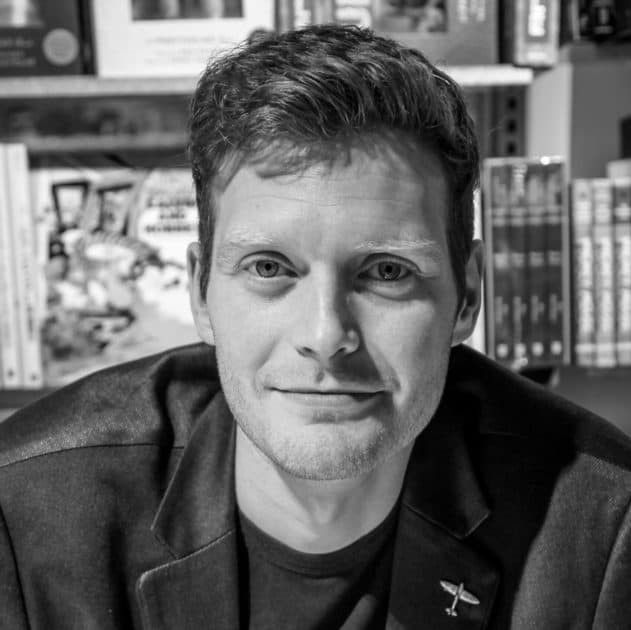
"If a miracle technology arises and if it is not controlled by the elite... it should have the capacity to liberate the worker... so that we can all evolve and become an entire species of artists and explorers and philosophers and dreamers... It's just so crushingly depressing that the first thing so many people do is use it to make art. It's the one fucking place where it does not belong." - Si Spurrier
🔗 - Si's website
🔗 - Si's recommendation of Fortean Times Magazine
WATCH THE VIDEO VERSION OF OUR INTERVIEW ON YOUTUBE!
Minotaur
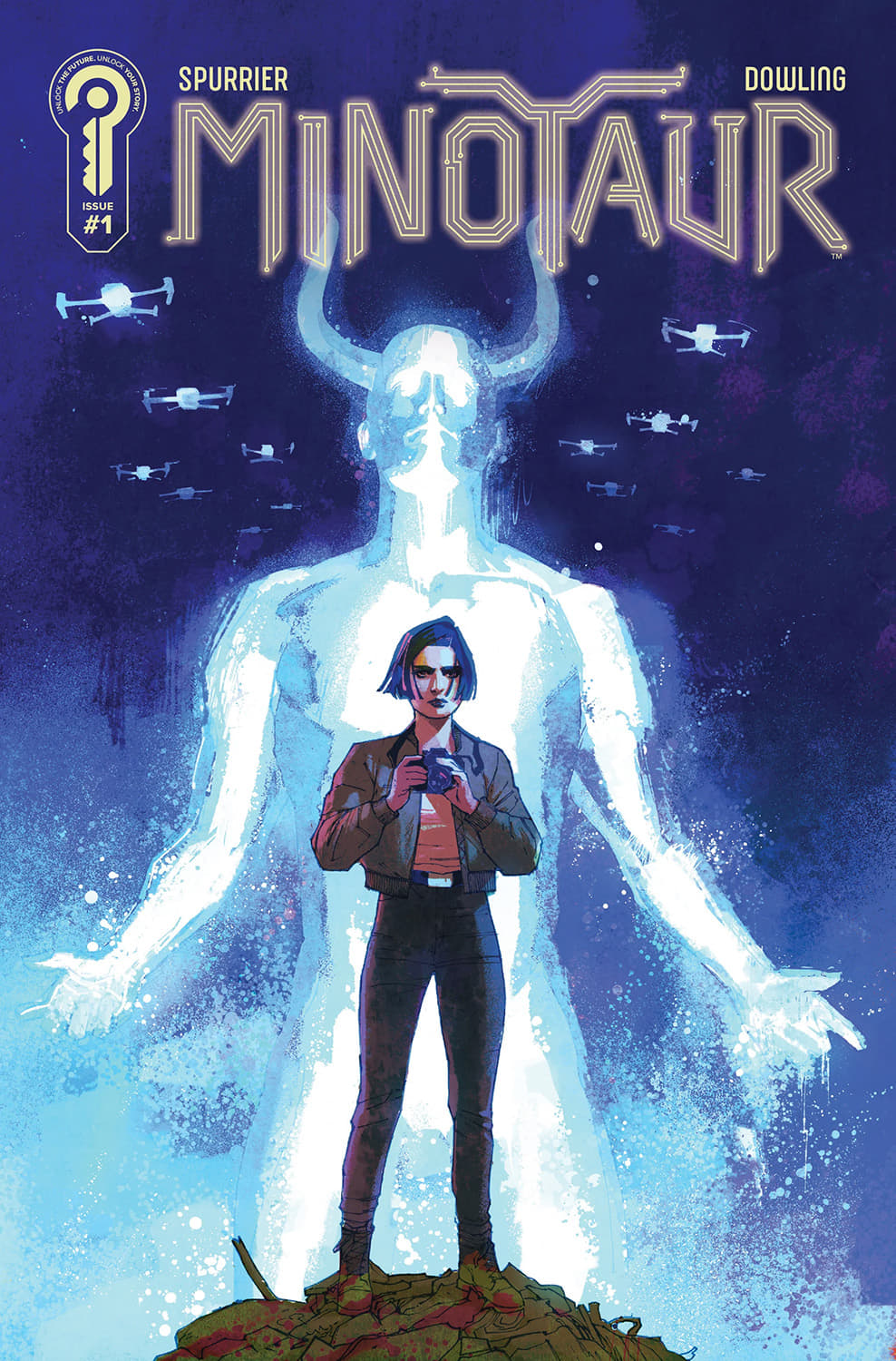
From the publisher
Five years ago, a government supercomputer triggered the Singularity: an explosion of technological superintelligence heralding an unimaginable tomorrow. At least, it almost did. Within moments, a failsafe activated. The plug was pulled. The future was aborted. But something leaked in those first picoseconds, through wire and wave. And now? The future fights back. Inexplicable events. Miracles and monsters. Harbingers of revolution…or apocalypse? Minotaur is the tale of Gloria Monday, a photojournalist documenting the lives of those, like her, who are haunted, tortured, and transformed by outbreaks of the future; along with the no-nonsense ex-military muscle who watches her six, and the reformed tech bro secretly bankrolling their global mission to expose it all.
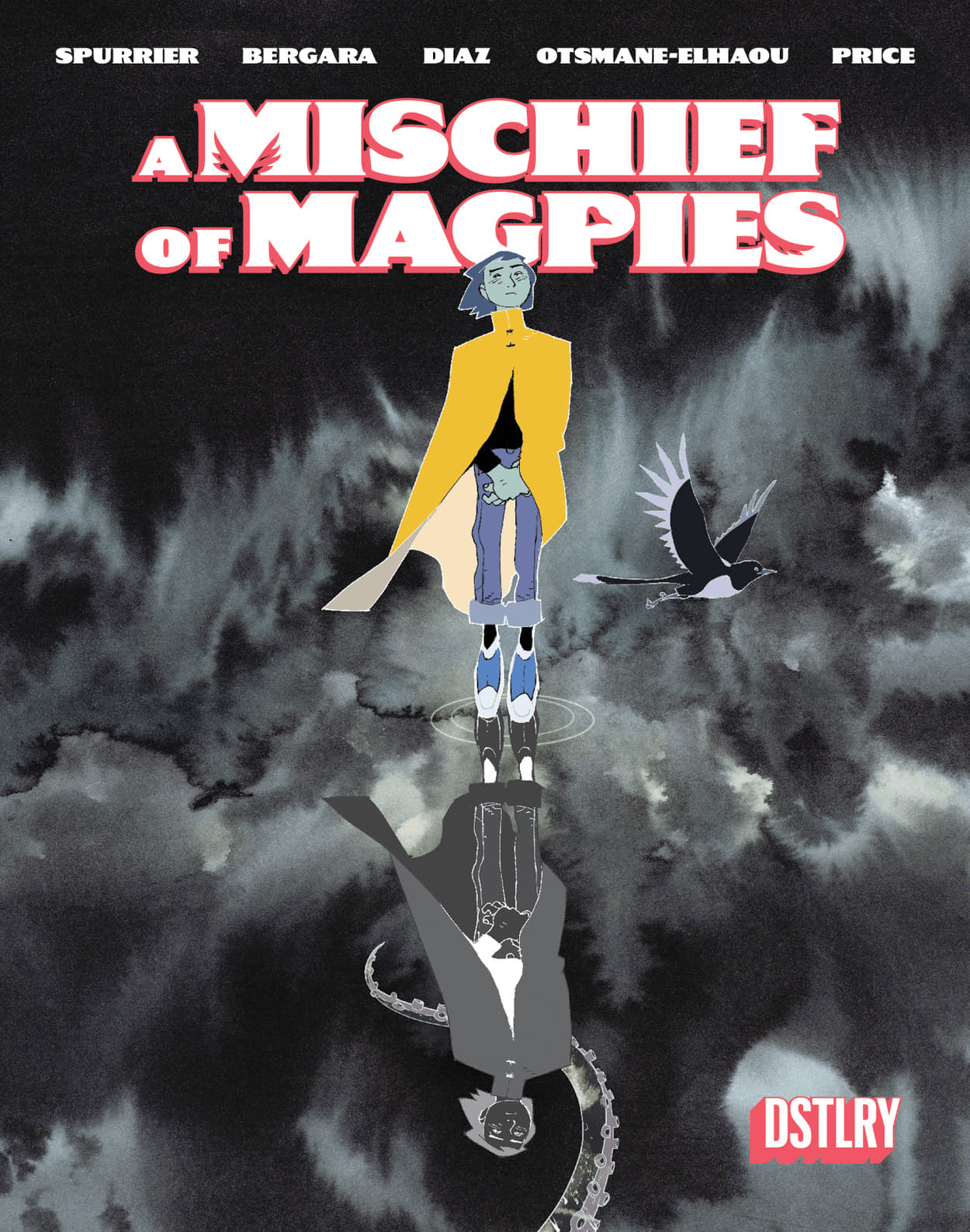
A Mischief of Magpies
From the publisher
Mar has a secret. Sometimes, without warning, he falls out of the world. This would be an inconvenience if his life wasn't already such a drag. When he's gone, he finds himself in an extraordinary city. A city which is also a machine, endlessly crossing a shoreless ocean. A city of two halves: the bright, bustling spires above the waves, and the beast-haunted twilight halls below. And between, clowning along the rusting beach, a troupe of anarchic magpies with all the answers but none of the questions. Recipients of the Angoulême Sélection Officielle, GLAAD Award, and multiple Eisner Award nominations, creators Simon Spurrier and Matías Bergara present a new fantasy masterpiece in the tradition of Coda and Step By Bloody Step, driving the comics medium into new, beautiful, baleful waters.
Follow Comic Book Yeti
🔗 Comic Book Yeti LinkTree: https://linktr.ee/ComicBookYeti
For partnership and ad inquiries, please contact: thecomicsyeti@gmailcom
Follow your hosts
CRYPTID CREATOR CORNER PATREON
Support the show on Patreon for as little as $1 per month as a Squatch Supporter and enjoy exclusive benefits like What's Your Favorite Cryptid ™ with some of our favorite comics creators and Byron's comic book reviews.
ARKENFORGE
Play TTRPG games? Make sure to check out our partner Arkenforge. Use the discount code YETI5 to get $5 off your order.
Make sure to check out our sponsor 2000AD.

[00:00:00] - [Speaker 0]
Your ears do not deceive you. You have just entered the cryptid creator corner brought to you by your friends at Comic Book Yeti. So without further ado, let's get on to the interview.
[00:00:11] - [Speaker 1]
The future is calling. 2,000 AD is the galaxy's greatest comic with new issues published every single week. Every 32 page issue of 2,000 AD brings you the best in sci fi and horror featuring characters like judge dread, rogue trooper, and more. Get a print subscription in 2,000 AD, and it'll arrive to your mailbox every week. And your first issue is free.
[00:00:35] - [Speaker 1]
Or subscribe digitally, and you can download DRM free copies of each issue for only 9 a month. That's 128 pages of incredible comics every month for less than $10. Head to 2,000 AD and click on subscribe now or download the 2,000 AD app and start reading today.
[00:00:55] - [Speaker 2]
Hello, everybody, and welcome to today's episode of the Cryptic Creator Corner. I'm Byron O'Neill, your host for our comics creator chat. I'm quite excited because I've got first time guest, Swaz Barrier. I mean, Sis Barrier hanging out with me today to talk about his new techno folk horror project Minotaur from Ignition Press hitting shelves in July. How are you doing today, man?
[00:01:18] - [Speaker 3]
I'm really, really good. Thank you. Soy Soy Sparrier. This was, to to fill in the the head scratches out there. I I recently tried against my better judgment, a, an AI transcription service, and it was as appalling as I fully should have known that it would be because apart from anything else, when I when I, said my name, hello.
[00:01:38] - [Speaker 3]
This is Cyus Barrier. It transcribed Soyce Barrier, created a little star on social media. Other comic creators coming in with their own AI names. Jim Zub, I think, was quite they end up being Tim Sub, something like that. There's all sorts of them.
[00:01:52] - [Speaker 3]
You can look them up. But, yes, no, I I will not be using that service again.
[00:01:56] - [Speaker 2]
I would imagine so. But that is my pitch that people should be following you on Blue Sky and on YouTube, and I will always stand for middle aged men who are trying to do their best on YouTube. So good on you for getting out there, for throwing yourself out there, and trying to promote the books. But please, I'll put links in the show notes. Everybody follow Si over there.
[00:02:16] - [Speaker 2]
It will make him feel better at least to get the, subscriber numbers ticking up. It does me anyway.
[00:02:21] - [Speaker 3]
Yeah. Thank you. I mean, I, I it's, it's a delight to do this because it means not having to generate the content out of my own brain and my own time. I'm, I'm very happy to waffle away, but I still don't fully know whether, you know, here you are, you you get into comics, you presumably have some sort of vocational approach to writing or art or the medium, whatever it may be that got you into it in the first place. You suddenly discover that unless you're working for one or two quite specific publishers, it's kind of on you to sell your book.
[00:02:54] - [Speaker 3]
None of us come up through. Well, that's not true. Very few of us come up through advertising or marketing or PR or any of rest of it. So these are skills you have to to learn quite quickly. And there was a little golden age when anybody who belonged to Twitter could just post a few things and everybody else who belonged to Twitter was able to to hear about the latest comics.
[00:03:12] - [Speaker 3]
That is no longer the case. Now there's like a million different places to put your content. I'm not convinced that anybody's paying attention anymore. There's a thousand million goddamn comics every single week. Anyway, we can we can get into all this.
[00:03:26] - [Speaker 3]
But, suffice to say, when I create a dumb little video, it's it's without much serious intent that millions of people are gonna see. It's just me sitting in this room talking nonsense to the camera. So it's a great pleasure to be talking nonsense to somebody else instead of Ty.
[00:03:43] - [Speaker 2]
It it made my research much easier. Like I already knew about the characters in this book, thanks to you. So yeah, it was great. I think it's fantastic.
[00:03:51] - [Speaker 3]
Thank you.
[00:03:53] - [Speaker 2]
All right. Well, let's get into Minotaur Asterion, the monster in the maze. The nucleus here is Arthur C. Clarke's assertion that advanced technology is basically indistinguishable from magic. So techno folk horror is the catchy logline phrase, but after reading this, it really does little to encapsulate how fascinating of a read this was for me.
[00:04:15] - [Speaker 2]
How did it all coalesce in your brain? Where did Minotaur start?
[00:04:20] - [Speaker 3]
Do you know, as a consequence of of this being literally the first interview I've done about it, I don't have a stock answer for that, which is unusual for me. I've usually got a sort of, know exactly how to answer that question. It's been around for a while. It's an idea that I first pitched, I don't know, maybe three or four years ago. Recall pitching it to Shelley Bond at one time and her being very, very taken with the way that I had laid out the pitch.
[00:04:47] - [Speaker 3]
And that never went anywhere. I'm I'm one of these people who was constantly having about six or seven different ideas on the go. And inevitably, because of the the sort of revolving door nature of the comics industry, the vast majority of them, people express an interest and then that business collapses or my time is occupied elsewhere. So there's a high turnover of things and I never throw anything away. If I love a project enough, I know that eventually it will come back round and it will have its day.
[00:05:12] - [Speaker 3]
And that's exactly what happened with Ignition. Where did it come from? I remember I remember that I've always wanted to do a sort of X Files. I've always wanted to do a story in which you could, if you wanted, turn it into a sort of procedural hellblazer esque thing where you could do a one issue story or a six issue story, and you could just keep creating content. And the basic unit, the basic metric for each of these unitary stories would be protagonist shows up in a place investigating something strange.
[00:05:51] - [Speaker 3]
The something strange turns out to be something other than what it was sold as, other than what it appeared to be. Case gets resolved. People die. Horror, horror. Move on to the next thing.
[00:06:03] - [Speaker 3]
And my natural interest in technology and in the Arthur C. Clarke of it all, as as you so rightly say, it just gelled, I guess, some point. I couldn't I couldn't even tell you when that happened, but it occurred to me that if ever there was a way in which high technology appeared amongst us without it being controlled by governments, without it being controlled and regulated by billionaires, which is the standard narrative. Almost everything we see that we take to be in some way advanced progressive technology has come down to us through countless layers of filtration and control, almost always with those who are in control having a vested interest in how it comes to us. We have no idea what other stuff is out there that they're not showing us.
[00:06:54] - [Speaker 3]
Anyway, my contention was if that stuff just appeared among us, the only way that our minds would be able to make sense of sense of it is in the same way that generations past who we laughably think of as primitive, that they were not primitive. They were just in a similar way to us. They were only exposed to the things I understood. They would have seen the lightning, and the only way that they could, pass it. The only way that they could justify it was to come up with some sort of story to justify why there's lightning or any of the natural scientific phenomena that surround them.
[00:07:29] - [Speaker 3]
So I suspect it would be today. If something truly peculiar popped up among us, that same part of our brains would start to associate it with spookiness and folk goings on and mystery and runaway screaming. And that's somewhere in that febrile mix of things. There's a really cool story. And and, yeah, I sort of leaned into that.
[00:07:53] - [Speaker 3]
We found the artist. It just one of those beautiful things where as soon as the bits are all together, it just sort of coalesces into the story that it has to be. The characters present themselves because you need a character who's like this and you need a character who's like that. And before you know it, you're sort of all these plates are spinning without you ever having necessarily put them onto their stalks. That's a horribly extended metaphor, but you see where I'm going with that.
[00:08:17] - [Speaker 3]
So yeah, that it just coalesced.
[00:08:20] - [Speaker 2]
Okay. Yeah. I mean, I'm a student of mythologies myself. I have an anthropology degree and mythologies was actually my focus in that. And that continuum in the book is examining the singularity as a modern mythical boogeyman as as you were just kind of illustrating, you know, not dissimilar to what the Greeks feared of our bullheaded friend, of the title of the book.
[00:08:43] - [Speaker 2]
So I adore it. I haven't quite thought of it in those terms before, but it it makes a lot of sense, and it's it's terrifying to me and that's why I'm so interested in where you're going with this because T two was foundational for me. I saw it in high school and now the man who created it, James Cameron, is on the stability AI board of directors. So I don't, I don't even know what's happening anymore.
[00:09:07] - [Speaker 3]
Like
[00:09:07] - [Speaker 2]
it just doesn't, it doesn't make sense to me.
[00:09:10] - [Speaker 3]
Lightning domes. And there's a lot to unpick there. Like Minotaur is not in itself about AI and by AI, what I refer to is what we laughably call AI today. It's let's not get too far into this because the weeds are long and there are many of them, but I tend to the view that what we call AI today isn't really AI in the sense of artificial intelligence in the sort of sci fi way that we like to imagine those words. I'm not a purist the way that a lot of people I have a lot of respect for people who are just say no to AI, fuck AI.
[00:09:46] - [Speaker 3]
And there's an awful lot of reasons why that makes perfect sense. You know, it's ecologically abhorrent. It speaks to theft of art. It speaks to class distinctions because of the way that data centers are inevitably put up in places where people can't afford to say no, dah dah dah dah dah. There's a million problems with it.
[00:10:06] - [Speaker 3]
On the other hand, I recognize that this is technology which could and should transform our lives. And without getting too Marxist on you, there's the idea that if a miracle technology arises and if it is not controlled by the elite, if it is in fact controlled and owned by the worker, then miracle technology should have the capacity to liberate the worker, to remove drudge from our lives so that we can all evolve and become an entire species of, artists and explorers and philosophers and dreamers. And that's beautiful. And there's a lot wrong with that because inevitably, the AI that we have today is not controlled by the workers. It is controlled by the eight.
[00:10:55] - [Speaker 3]
But let's just, the sake of argument, say that it's within the compass of every one of us to access and use this miracle technology to allow ourselves to become a race of artists. It's just so crushingly depressing that the first thing so many people do is use it to make art. It's the one fucking place where it does not belong is in the
[00:11:17] - [Speaker 2]
art. Exactly.
[00:11:18] - [Speaker 3]
So, anyway, this has become a massive digression, and that's not really what Minute talks about. There's a bit of that, and we do sort of examine that in in a couple of later issues. It's more about super intelligence, which is something that by definition we cannot imagine. It's not even necessarily about machine sentience, although, again, we sort of touch on that. It's about the moment that technological progress escapes our imagination and whether that is something that we should be afraid of or not.
[00:11:48] - [Speaker 3]
The one thing we can definitely say about that is that no self interested government on earth would allow that if they could control it. Because in a world where you don't know what's happening, some sort of unimaginable transhuman future, there is no government anymore. There's no voting. There's no there's no self interested elite millionaires. There's nothing that we can understand.
[00:12:11] - [Speaker 3]
And so the story that I wanted to tell begins with this moment when the world changes, And it it could just as easily have been the rapture or some other sort of, you know, quasi meteorological notion of of, universal evolution, universal change. The real inciting event is not the moment that it begins. It's the moment that the government says, no. Thank you. Pulls down the curtains, pulls out the plug, but something has leaked.
[00:12:42] - [Speaker 3]
And so our story is about people trying to track down the balloons. They call them the seeds of the future, which have sort of scattered out into the world somehow, a mechanism that they don't yet understand. They have found fertile soil in the minds of people who have big ideas. And this, again, let's not go too deep into this, but the missing ingredient when people talk about AI is that it means nothing without ideas. It means nothing without people having self interested.
[00:13:15] - [Speaker 3]
Yes. But also artistic and expressive and creative and randomized ideas, can drive this amazing new utilitarian processing power to do something useful rather than just making shit memes on social media. Anyway, you behold that I am on the cusp of a rant, so I shall pull myself back. But all of this stuff is there in the background of Minotaur, hopefully contained in a way that feels, you know, it's a bit BPRD. It's a bit devs.
[00:13:44] - [Speaker 3]
It's a bit scary. There's a bit of Scooby Doo. It's just cynical, beautiful, horrific fun. And I, and I think it's really cool. Well, I
[00:13:56] - [Speaker 2]
think the key is that you need very approachable grounded characters. I was a former photographer, my professional photographer myself, so very easy for me to connect with Gloria Monday. She's a photojournalist who's documenting our Iraqi descent as a species, and I love the idea of in this era of emergent AI, she's the last ditch effort as a sort of arbiter of reality, if you will, you know, and you like a deeply flawed protagonist for sure. So, so walk me through building her.
[00:14:27] - [Speaker 3]
There was I mean, like any any character that I've either created or really enjoyed working with, the crux of it is a a dichotomy. I'm fascinated. Like, you know, John Constantine, he's a bastard who knows he's a bastard who wishes he wasn't a bastard, but continues to be a bastard. That's a that's a fascinating conflict and internal conflict. With Gloria, her name is Gloria Monday, and and that in itself is a bad pun.
[00:14:52] - [Speaker 3]
The the backstory is sarcastic rage, the father names her Gloria Monday to recall the Latin phrase sick transit Gloria Monday, which means so past the glories of the world. So she she's sort of walking around as this expression of the fact that nothing lasts forever. Everything is doomed. As a consequence, she's become, I mean, there's no better phrase than doomsayer. She is so completely convinced that we are living in the end times.
[00:15:34] - [Speaker 3]
Everything's going to fall apart within our lifetimes and everything that she has ever seen up to and including the beginning of our story seems designed to, prove her right. The complication which we sort of hint at in the cold open and we get we get to an issue two spoilers, but not massive spoilers, is that she's pregnant. And so you have this fascinating dichotomy to get to get back on track here where you have a character whose whole reality is defined around chronicling the end of the human race in a way that is somehow beautiful and consoling. Like, she has a blog called Jinn and Eschatonix because it's the sort of deeply cynical, bleakly ironic thing where she goes looking for the most appalling things in the world, but she tries to put them in a way that is somehow consoling and speaks to the beauty of humanity even as it's spiraling down the toilet. And yet she's pregnant.
[00:16:32] - [Speaker 3]
So the dichotomy is how does somebody who is so completely certain of the world ending decide because she has decided to have a child? And that's fascinating to me because it means that she almost immediately has to get off the sidelines. Like, you know, anybody who is a dedicated, photographer or journalist, they have to have their own internal like, the what's the Star Trek thing? The prime directive. Right?
[00:17:01] - [Speaker 3]
Everybody has
[00:17:02] - [Speaker 2]
to have
[00:17:02] - [Speaker 3]
their own version of that. Know? Here I am. I'm a wildlife photographer, and the seal has been bitten half by a leopard. Sorry.
[00:17:10] - [Speaker 3]
The the penguin is bleeding over there. Do I go and help it, or do I take photos of Everybody has to have their own limit for whether they're involved in the story or they're merely documenting the story. As we come into our story, Gloria has already made that choice. She's decided to keep this baby, which means she's involved in making the world work whether she likes it or not. And here she is.
[00:17:32] - [Speaker 3]
She's been sent off to document these bubbling up of the future. She doesn't know what the fuck they are. She doesn't know how they're going to manifest. She doesn't know who's behind them. There's government agents running around after her because they would far rather this stuff keep secret.
[00:17:46] - [Speaker 3]
So it's a very bubbly, interesting mix. And in it all, she purports to be somebody whose job is to document and to chronicle. But almost immediately, she's interfering, getting off the sidelines, trying to help people. And and again, I just think that's a fascinating mix. And I I won't tell you about where the story goes, but she's the right vehicle for the story I have in mind.
[00:18:11] - [Speaker 2]
I'm curious because I'm a parent, you're a dad, and my filter changed dramatically when I had kids because I immediately connected to her as a character, as a Gen Xer who grew up with all these emergent technologies, you know, that, that define, and now we'll look back historically as, is it's incredible. It's truly incredible what we have experienced over our lives in terms of technological growth, especially as a student of anthropology. I'm looking at this and my mind is constantly blown. But, you know, I have this perverse sense of inevitable doom and especially looking at things with an anthropological mind that you, you look back longitudinally and you see our species and how it's evolved. And that we are at this really interesting singular moment in time where, you know, we we've created this thing that essentially could replace us.
[00:19:07] - [Speaker 2]
And it's, it's so fascinating. Anyway, back to what I was saying, you know, as, as a father, as soon as that happened, there was a shift. It didn't change my ideology about like what I felt like was happening that we were, we're just monkeys who think we're smarter than we actually are, and we're still throwing rocks, but something did shift. So I love that, that you did that with the character and adding that element to her. Hope other people anyway that it will resonate with them as much as it did with me.
[00:19:38] - [Speaker 3]
I hope so. And and yeah. But You're you're so right. Like, the the moment, the moment that you are no longer the most important perspective in your own life
[00:19:49] - [Speaker 2]
Yeah.
[00:19:50] - [Speaker 3]
That's that's a big thing. And look at you know, I I get fed up of other parents running around proselytizing. Oh, you never really know how beautiful the world is until you see it through the eyes of a child, all that stuff. There's some truth in that, but it's perfectly possible to to be a a good empathetic human without having children under your belt. But my God, it helps.
[00:20:08] - [Speaker 3]
Sure. It really does help. And it sort of speaks to morality even more so than the tech stuff and the shifting sociopolitical stuff. That's just something we all have to either deal with or we don't. But on a quotidian controllable level, suddenly I find myself questioning dumb things that I was so certain were completely facade.
[00:20:37] - [Speaker 3]
I spent most of my career writing superheroes. And then one day, my my kid, who was then four, comes home from nursery school shouting super superhero, daddy. I'm a superhero and proceeds to punch me in the balls straight away because what he's been exposed to at nursery school is that superheroes punch things. And it makes you start thinking, you know what? This is a whole genre of self elected, self empowered arbiters of morality who control what we do or do not do by breaking stuff.
[00:21:09] - [Speaker 3]
And, you know, how can I possibly justify writing that stuff now without that ticking away at the back of my mind? Anyway, I I I once again, I'm off on a waffle digression. But, yeah, the the terrors of the future are suddenly so much more terrifying because I have to be aware that my kids are gonna be there. I won't. And I think maybe the the single greatest gift that they have given me is learning.
[00:21:36] - [Speaker 3]
Whereas I was raised in the assumption that, satisfaction equals achievement. And that I suspect is probably the greatest poison that has ever infected our culture, let alone my brain. I'm now desperately trying to teach them that satisfaction equals happiness and, and the notion of having enough, because I think if more people grow up thinking that happiness is a nicer thing to have than power, then we're probably saved. But I think I'm alone at the moment. Anyway, we keep getting off because you're asking such interesting questions.
[00:22:13] - [Speaker 2]
Yeah. Well, okay. Let's bring it back then. You have the other branches of your character Trinity here. You have Sarah, who is, you've called, I love this, a pragmatic splatter of human obstacles, and Raf, a billionaire intent on exposing things that others want kept secret.
[00:22:30] - [Speaker 2]
So how did you envision this sort of Motley Crue trio working in the book?
[00:22:37] - [Speaker 3]
This is one of those things, I think, I mentioned this a bit earlier, when things just sort of coalesce naturally, you often start or I often start with some elements that feel interesting and important, and these are the things that I'm going to not immediately assume I know everything about. And in this case, it was the theme and the broader plot and in particular Monday's place in it. But then you start to feel the need for some sort of props, I guess, the best word I can think of, to, enable the things that you want to explore. And at their best, when you slam these props into place, you know, I need somebody to bankroll this entire project. I need somebody in a position of power or who was in a position power who's the sort of gateway into this world so that Monday can be sent on her journey.
[00:23:32] - [Speaker 3]
I need somebody who's going to be capable of action and violence because that's inevitably a part of this story. Dada, dada, dada. It's like a list of ingredients rather than something that you're you're sort of coming up with in a in a state of imaginative passion. But at their best, when those ingredients are in front of you and you start putting them into places, you realize that there are mysteries to unravel and things that you are equally as interested in within each of these ingredients. So, Raph is was a billionaire owner of a tech startup company that was previously part of the heavily classified CIA bankrolled government technological R and D world.
[00:24:22] - [Speaker 3]
And as a consequence of the singularity occurring and being aborted, he's out on his ear. And for reasons we don't fully understand, but will quite quickly start to to get the scent of, he's got a big grudge against the government. The way that he's going to leverage this grudge is to use his fortune to empower Monday, who he has decided is some sort of useful vehicle for broadcasting everything that's going on in the world. He's empowering her to go and be his eyes and ears and mouth. Along the way, she's going to need somebody to protect her because she's going into some very dangerous places, and that's Sarah.
[00:25:09] - [Speaker 3]
She's a fascinating what I really wanted with Sarah was I wanted to present a character who I'm about to spoil stuff, and that's okay because I think it's it's sort of obvious. I wanted to present a character who is completely simple, completely uncomplicated in the sense that everything they do is because of money. And there's no there's no deep meaning behind it. There's no trauma. There's no there's nothing to find under the surface except for somebody who's like, well, you want me to go and do that thing?
[00:25:46] - [Speaker 3]
That's very immoral, so I'll do it for x amount of money. You wanna do that thing? That's even more immoral, so I'll do that for y amount of money. That's that's a really interesting thing to sort of play with. Me being meany and readers being readers and stories being stories, that quite quickly becomes unsatisfying and there has to be more.
[00:26:04] - [Speaker 3]
So there is a whole secondary level under there, but it's kind of not what you would expect. And I'm in spoiler territory here. Part of the joy of working with Sarah is that she's both of those things. She's self consciously being simple because she doesn't like the complexity that's under the surface, which which is something that, you know, some people can relate to. I can relate to that.
[00:26:26] - [Speaker 3]
So, yeah, she's a favorite. And and and it's almost like she's the sort of character who diminishes the more we find out about her. So I'm sort of pushing that away as long as possible. There's lots of little things to be to be eked out about her. And Raph is just muddled with mysteries that I won't even begin to untangle.
[00:26:46] - [Speaker 3]
He's he's simultaneously the most immediately recognizable, but also the most secretly mysterious character we have in the canon.
[00:26:54] - [Speaker 2]
Okay. Well, I'm curious here with, with Sarah because she could also sort of be a gnat. I'm seeing there's what is it with you and female bodyguards? Because, they keep showing up in your work.
[00:27:08] - [Speaker 3]
I just think it's a really nice archetype. I think we're so you know, to to circle back a little bit, the the only excuse that I've ever seen for, realistic depictions of superheroes is that they are a power fantasy. They are something to aspire to rather than something that we genuinely propose would work in the real world. I I don't have a huge amount of truck with that argument, but let's let it stand. That being the case, we need for there to be power fantasies that aren't just about giant steroidal white guys hitting things.
[00:27:41] - [Speaker 3]
And that's that seems to me a nice thing to do. And and if most of the characters I write are cynical, smarmy, arrogant know it alls, then having them put in their place by relatively small women who don't even break a sweat is is, I think, quite a nice, a way of dealing with that and and, you know, just keeping things in a in a slightly smaller box, a more controlled box. And, that that's I don't know why. I I don't think I have a, like, violent woman fetish. My wife is gonna listen to this later and ask some questions.
[00:28:16] - [Speaker 3]
But no, I don't think that's the case. I just think that it's a it's a fun archetype to play with.
[00:28:22] - [Speaker 2]
Yeah. Well, as a you're probably not surprised here. As a photographer myself, I'm I'm a very visual thinker. So this this first issue embraced some very nontraditional locales that, and it created this really interesting binary polarity that, that I think sets the stage for the book wonderfully. There's nothing sexy at all about a landfill.
[00:28:46] - [Speaker 2]
And in this case, it feels perfect. So this kind of aggregation of our discarded disposable material culture, like you have zero fear here, embracing the dark side and shoving in our faces side. Doesn't, yeah, it, it doesn't have a character with a bunch of lore attached to them, know, like Constantine, where you do have that constant push and pull that he's kind of battling against that we want to excuse on some level, because we maybe see ourselves in that and we want to excuse ourselves, but no spoilers here, but how do you, as this goes on, how do we avoid heading into existential and moral nihilism here with a subject matter that's sort of as dark as this, that's kind of right there on the cusp of what everybody's already talking about, you know, with AI and kind of grappling with it.
[00:29:38] - [Speaker 3]
I mean, there's two answers to that. One is why shouldn't we? Can we not just do that anyway? But I I think the answer is that you you can't. Even if you set out to be as grim and meaningless and depressive as you possibly can be, the fact of having human characters striving, trying to be alive, let alone anything else, but but also trying to be happy and successful and to create beauty.
[00:30:09] - [Speaker 3]
Those are all things which naturally escape any sort of nihilistic cycle. As I said, Monday is pregnant, so that's a big part of it. She has to, whether she likes it or not, she has to escape from the nihilistic spiral. But also she has devoted her whole life to finding beauty in in dark places. And and that's that's a sort of a little whiff of the hypocrisy, which I think she probably recognizes is there deep within herself.
[00:30:41] - [Speaker 3]
She presents herself as this doomy, you know, pessimist who's constantly waiting for the world to end. And yet she's gone into war zones and photograph beautiful things. She's she's all about consolation. And I think consolation may not be victory and it may not be success, but it's definitely the opposite of nihilism. Think question mark.
[00:31:09] - [Speaker 3]
In any case, I think that by simply focusing on the human and one of the beauties of a format like we're using where it's sort of procedural show up every week, encounter a thing, you know, monster of the week, although it's never just a monster, is that it's not just about the protagonists. And if you look at the X Files example, you know, it it's actually not about the protagonists at all very often. It's about the encounters that they have and the the human lives that they intersect. And I think that's probably part of the answer too. I think that even if Monday comes into something feeling like there's no point, she's going to find people who do think there's a point and are striving as hard as they can to save the world.
[00:31:52] - [Speaker 3]
In fact, a lot of the funniest stuff to write in Minotaur is when Monday encounters the people who have been inspired or to to use the the sort of classic Greek literary function infused by these particles of of the singularity in whatever form they've achieved it. When she meets them, she's often furious with them because they're just these sort of slightly, naive science y types who've got big ideas and think that they can save the world and transform it and make everybody better by just sort of snapping their fingers and building a machine. She knows that's not how the world works. And yet she's also wrong. If we don't have those people, then the world won't save itself.
[00:32:35] - [Speaker 3]
So there's this interesting push and pull throughout the whole thing where she's she's sort of performing, rolling her eyes all the time because that's who she is and that's how she's created her brand. But she's encountering people who are simultaneously well, we we know lots of people don't this like the sort of mad geniuses who have zero common sense. She encounters quite a lot of those people along the way. And I I love that as a as a personality type.
[00:33:05] - [Speaker 2]
Well, don't break my heart here. I'm I I feel a lot of of connection. I feel seen through Gloria. So please just don't say that it's like her personality is her brand. No brand, no content.
[00:33:19] - [Speaker 3]
I think
[00:33:19] - [Speaker 2]
that Those are two bad words.
[00:33:21] - [Speaker 3]
If you, if you live your life in any way creatively, if you're an artist, and this is a side note, but I'm constantly fascinated by the intersection of, and this is especially true in photo journalism. So, know what you're talking about here, but the intersection of creativity and chronicling, you know, those two things can both be true at the same time, or you can choose to have them on completely different, spectra. So there is something fascinating going on with her. And I yeah, I think I think she has lived her brand for a long time and is now having to really readdress whether or not that is who she really is or whether that's just the way she's been presenting herself. That in itself is a, is a fascinating thing.
[00:34:06] - [Speaker 3]
The beauty, by the way, of embarking on a an ongoing project is that I don't have to have all the answers to these things. And I'm pretty sure I know where it ends, and I'm pretty sure I know maybe the four issues before it ends, but what sort of shape our main characters will be in when we get there is is sort of something I'm I'm excited to discover as we go.
[00:34:30] - [Speaker 2]
I love that. I don't I don't need everything planned out because the beauty of comics is that you can adapt it. And especially as some with something that is so topical, then you have the ability to then in turn take a piece of reality and put it in there. So yeah, Yeah. I think that's it's what makes comics special.
[00:34:52] - [Speaker 3]
Totally. Totally. Yeah. 100%. I mean, of the many things that makes comics special.
[00:34:59] - [Speaker 2]
Absolutely. Well, you've worked with series artist Mike Dowling before with DC's Time Work Anthology, but it's been a minute since you collabed and I can't imagine the pitch here to get him on board, including, you know, Hey, mate, I want you to draw a bunch of landfills. So how, how did you, how did you pull him in here?
[00:35:16] - [Speaker 3]
I've known Mike for many years. We actually live quite close to each other. He's he's about 10 miles down the road, frankly. We've hung out a lot. We have similar sort of overlapping friendship circles.
[00:35:29] - [Speaker 3]
I loved the work he did with another close friend of mine, Rob Williams on Unfollowed. So when I was looking for an artist for this, he just naturally presented himself. I sort of there was a short list of three, I think, and he was the top of the list. And we didn't we didn't get past asking him because he said yes. It's that spectacular combination of realist and tonally stylized that I think works so well in horror.
[00:36:03] - [Speaker 3]
You know, with horror, you can go far too far into stylist stylist art and it sort of breaks or it can break the verisimilitude a little bit. But you can also get way too hung up on the sort of over rendered pedantically realistic stuff, which means that you don't have access to any of the the slightly heightened stuff that I think is is key when it comes to horror and comics because let's remember, you don't have access to a boo. You don't have access to the jump scare. So if you're if you're dealing with horror, what you're really dealing with is how much can I unnerve my reader? And, yeah, I think Mike's got that in spades.
[00:36:47] - [Speaker 3]
I think he's extremely good at drawing people, which is a really dumb asinine thing to say. But actually, you'd be amazed at how many really great comics artists are not not great
[00:36:59] - [Speaker 2]
at drawing
[00:36:59] - [Speaker 3]
people. He designed an amazing set of costumes and haircuts. He said that we had this amazing idea. He just for reasons that he could not articulate, he wanted to give Gloria Monday, a scorpion tattoo on her neck. And we were like, mate, that's going to be a lot of extra hard work.
[00:37:21] - [Speaker 3]
You know, we're going to spend every hour of going through your inks and trying to remember whether she's got it on her neck or not. And then we came up with this idea that to recall the the old fable about the the scorpion that crosses the river on the frog's back, you know, this thing where it's like, if you if you get on my back and we cross the river, you're to sting me. We're both going to die. No, no, I'm not going to do that. And we get across halfway and the scorpion stings the frog.
[00:37:46] - [Speaker 3]
It's in my nature. So she has a scorpion on one side and a frog on the other side, which I thought was a really fun little thing as if she's sort of torn between these two extremes, which, you know, goes back to what we were talking about a minute ago about where she is positioning herself in the world. So little things like that are those beautiful places where the the art is not only spectacular in terms of rendering and creating and making a character feel alive, but also gently steering the way that I perceive their personality and therefore by increment steering the way that they behave in the story and therefore steering the story itself. So you do find in special cases the the collaboration is such that, you know, a sketch can change the whole nature of a story. That's kind of the case with Minotaur.
[00:38:38] - [Speaker 3]
We've very closely from the very beginning. So, yeah, he's fantastic. Really, really enjoy him. And because we brought in Sophie Dodgson, they're another close friend. In fact, they all live very close to me.
[00:38:50] - [Speaker 3]
It's really strange. This tiny little corner of The United Kingdom and and four of my team members live within a 20 mile radius accidentally, by the way. Sophie's colors are incredible. They help build this up incredibly. The designer, Emma Price, she's also done, the design on mischief, which which we'll come to later.
[00:39:12] - [Speaker 3]
But I'm sort of increasingly of the view that designers of comics are not given the credit they deserve. And and I'm sort of trying very hard to utilize elements in my comics that allow that to be a little bit more obvious. So in in, Minotaur, we've got these every issue has a double page splash, and the gimmick is Gloria has taken a photo, and the left hand side of the spread is her photograph. And the right hand side of the spread is an excerpt from her blog, which records her impressions, the the sort of the stuff that the photo can't show. And that gives me, you know, sort of slightly frustrated prose writer.
[00:39:56] - [Speaker 3]
That gives me the excuse to get a bit wordy, but it's also stuff that readers can skip if they don't want to be bothered with a load of text. But above all, it lets Emma do her thing and it shows everybody that you can do these really interesting things with comics that people aren't doing anymore. You know, it's there's all sorts of clever little gadgets that we can play with. The toolbox is barely open. And then Hass Hassan, Otsman, O'Hau on letters.
[00:40:22] - [Speaker 3]
It's it's kinda getting to the point where I I try very hard to get him on every single project I do because he As does everybody. Yeah. He's incredible. And partly because he he recognizes that letters are a graphic element. It's another tool in the toolbox.
[00:40:37] - [Speaker 3]
If you're just using it as a, you know, a splat of prose without any emphasis or, personality, then I mean, that works in some cases, but you are choosing to keep an awful lot of your tools in the toolbox. Whereas House is the only letter I've worked with where I've I experimental sigh has had to occasionally say, woah, can we tone that down a bit? That's a bit too crazy. And I love that. That's what I need in my team is people who are prepared to really try new things, and be content to be gently toned down a smidge if necessary.
[00:41:11] - [Speaker 3]
So it's a really cool team. I'm I'm really proud of them all.
[00:41:14] - [Speaker 2]
Yeah, I think there's, there's so much craft on display. And what I love about this as a fan of horror comics is the tendency now is to go big as you were talking about, especially with body horror and it's very in your face and what this has done at least successfully thus far. I don't know more, but it's very subtle because they're, they're really nice moments. They're these intermittent panels for people because issue zero is already out. You know, that came out for free comic book day.
[00:41:45] - [Speaker 2]
So there's these intermittent panel of wasps that I'm that are emerging from a bug carcass. And that will haunt me for some time. And it's so, so subtle, but it is this beautiful horror element. And I have no idea why it is as scary as it is, but it is very, very creepy.
[00:42:08] - [Speaker 3]
Yeah. It's things like that. That's a that was a little bit of an indulgence on my part. I confess, back when I was, oh, gosh, 17 and doing my art A levels and for the first time starting to get interested in comics and, you know, reading more and reading Scott MacLeod and getting excited about the way that it's not a question of show, don't tell. It's a question of show and tell two different things in a way that that juxtapose and, inform and strike sparks off one another.
[00:42:40] - [Speaker 3]
And I remember very clearly, I'm I was at one time a relatively decent artist, but not by any stretch good enough to become a professional. But there I was drawing my own little comics. I remember very clearly one
[00:42:53] - [Speaker 2]
of
[00:42:53] - [Speaker 3]
the things I loved doing was, a scene in which this, psychiatrist is visiting a guy in a mental institution, and she asks him what he's thinking about. And he holds up a cockroach and he says there's butterflies everywhere. And I just remembered the idea of you can show one thing and say something else and they both sort of speak to the same thing, but in they mean two completely different things and it changes the way that you see him and it changes the way that he sees himself. And anyway, blah, blah, blah. The point is cut forward all these years to Minotaur.
[00:43:30] - [Speaker 3]
It struck me that you could do something quite fun if you're talking about, emergent technology. If you're talking about something escaping, something needing to parasitize in order to fully fledge, then nature has plenty of quite icky examples of that. And why don't we just show one of those while the conversation is going on? It's it's it's it's no different from that old thing about if you're having a bunch of people sitting around talking, make sure one of them's got a prop. Well, in comics, you can cut away to look at their feet to see what's going on.
[00:44:04] - [Speaker 3]
You can show all sorts of things going on around them, environmental props. So, yeah, just just little dumb stuff like that is is kind of stuff that I like to toy with.
[00:44:14] - [Speaker 2]
I really appreciated it. I'm, I'm a gardener, at least before lupus sort of took that away from me. And I don't know if you knew, but parasitoid wasps are often bred and then released to do targeted, elimination of invasive species. So it's, they've been used to, to, to control emerald ash borers, like in ash, ash forests and stuff. So it's just, it was fascinating to me because it seems very on point, you know, the question here, kind of will we eliminate the singularity or inevitably will it decide that we are the invasive species and eliminate us?
[00:44:52] - [Speaker 3]
So, and all of that wonderful, you know, you look at the many times that people have released a parasite into an environment to try and control a different threat. And the parasite has become worse than the threat in the first place. You know, that's, that's the nature of of the ecosphere. You tinker with one thing over here and something goes wrong over there. This is all absolutely appetite for for thinking about the technological ecosphere as well.
[00:45:14] - [Speaker 3]
So, yeah, it's all it's all part of the same continuum. Yeah. Well, I'm
[00:45:19] - [Speaker 2]
gonna keep my gardening illustration going so I can switch gears. Hopefully, it's clever enough. But, you know, so pivoting to a mischief of magpies. This is from distillery, you know, which actually does on a personal level actually relate to my garden. So when we lived in Washington state, there would be these massive flocks of crows that would fly over in the summers.
[00:45:39] - [Speaker 2]
And my son and I, he was young at the time and we would set out trinkets for them and sometimes they would leave something in return. But corvids are this fascinating species. So why, what was the kind of using them as the nucleus of the story there?
[00:45:59] - [Speaker 3]
I don't think that they were there in the beginning. That's what's interesting about that. I think that that was one of the I think I mean, like you, I adore a COVID. In fact, tomorrow, I'm off on a little trip to Northern Ireland to a a tiny little island that I go to with same friends every year where there are wild nesting ravens, and and they're extraordinary to just sit and watch them. Where I live here on the the very Southeastern tip of England, we've got huge flocks of crows every day.
[00:46:30] - [Speaker 3]
I make a joke every morning when I cycle to school with my kids about a drive by murder, and they don't find it funny anymore. But love them. Love a Corvid. But I think I think that was a late element. I think that
[00:46:44] - [Speaker 2]
Okay.
[00:46:46] - [Speaker 3]
Magpies came about through a very different route, and I'll come to that. But what I needed quite late in the day was, a tonal element that sat somewhere between bright, controlled bureaucracy and gloomy, doomy monstrosity. And for whatever reason, my brain went to magpies. I mean, partly because black and white, it's a bit obvious. It was either gonna be magpies or puffins.
[00:47:21] - [Speaker 3]
Don't know why birds, partly because the, collective nouns for them are so great. Like mischief of magpies, it's just a great title. It tripped off the tongue. The the collective noun for a puffin. I'm trying to remember.
[00:47:36] - [Speaker 3]
It's a really good one. It's some oh, it's an improbability of puffins, which is beautiful, but not quite so good as a as a title. Right? That's it's a little bit too long as a title. Yeah.
[00:47:48] - [Speaker 3]
We we found magpies and and just it just worked. It's like there's an awful lot about this book that I will struggle to articulate how it came to be because it's the sort of book where nothing is conventional. Nothing has been developed in a conventional manner. If this will sound deeply pretentious, the hope with the book, and I think that the effect of the book is and should be that when people pick it up and read it without knowing any better, it feels like a book that has been created by one person, a writer, artist, letterer, colorist, designer, who's done the whole damn thing themselves and has therefore done an awful lot of it on a level which is purely instinctive rather than in any way strategic and and intellectual. And even though we are not, the team is not an individual person, I do feel like an awful lot of the book is instinctive and has been create.
[00:48:50] - [Speaker 3]
And and and that sort of speaks to the slightly eerie level of collaboration that goes on between, first and foremost, my co artist, Matias Bagara and myself, but also every member of this team. It is the sort of book that could only work if we were all prepared to be, ego free and to be corrected and to be overwritten. It's this deeply strange palimpsest where you can no longer tell where an idea or an element began without some other element being stamped on top of it and filed down and and sculpted away. Yeah. That that's sort of all I can say about it.
[00:49:40] - [Speaker 3]
It is it is a deeply odd but utterly miraculous book. And I I I yeah. The fact that even I am incapable of talking about it for hours on end tells you that it's it's a special one to me.
[00:49:53] - [Speaker 2]
Yeah. The formatting is very unique. I I can't see I've seen anything like it recently. It reminds me of some of the swings that DC was taking back in the nineties with their vertigo titles. It feels very moonshadow coded in a way, if that makes sense, you know, that heavier pros approach.
[00:50:10] - [Speaker 3]
Yeah. The simple origin, I guess, is that, having been fortunate enough to work with Matias on on previous books, we did Coda, which is sort of, deconstructive, deeply cynical approach to the high fantasy genre, which somehow ended up being my most sentimental and sort of love oriented book. And then we we decided to challenge ourselves and we made Step by Bloody Step, which is another fantasy in which the challenge to ourselves was, can we we tell a story that has some quite mature, almost complex emotional heft to it without using any text? So it's a purely visual story. Some people talk to each other, but in a language we can't understand.
[00:51:06] - [Speaker 3]
So there's no there's no sort of perceived information that readers can cling to to build the story around. And and that worked extraordinarily well. And the irony is not lost on me, by the way, that as somebody as deeply wordy as myself, one of my best books is one that contains no words at all. But then here comes a new project, a new collaboration. We have to challenge ourselves because why else do it?
[00:51:31] - [Speaker 3]
Why else keep making something? So we pivoted the other way and we talked a lot about what the opposite of that would look like. Is it just an illustrated novel? Is it just that we you know, I could go away and write a novel. I did that in my twenties and quite enjoyed it, but that doesn't that doesn't really satisfy the goal.
[00:51:57] - [Speaker 3]
The goal, I suppose, and and we sort of realized this quite late in the day, but the goal was to make every element of this book a visual designed element, including text. So we're back to what we were talking about before. You know, this thing that Hassan is so amazingly good at, this thing that Emma is so amazingly good at, making it all feel designed. And we hunted around for things that that sort of used that format, and and there's not a lot. The closest we could come to was like Xerox fanzines, you know, where you sort of got that kind of collage vibe and everything sort of pasted down.
[00:52:34] - [Speaker 3]
And that's got a lot of chaotic, punky energy, which we loved. But we sort of anyway, the the point, I suppose, is that at some stage, the idea arose that what we could do is if you if you utilize the portal fantasy, the portal fantasy as a sort of a a story trope in which a person transitions into another world and back and forth. If you therefore allow each world to be signified by a core medium, then there's all sorts of fun that you
[00:53:11] - [Speaker 2]
can
[00:53:11] - [Speaker 3]
have with the transitions and the segues. So in its purest form, Mischief of Magpies uses prose, in fact, diary entries to signify our main character's life in this real world and comics, sequential comics, to tell the chronicles of his life when he disappears into this extraordinary fantasy world. But we've seen that before in quite a lot of comics where they have, like, big chunks of text. And the the danger for reasons I fully accept is that if somebody buys a comic and they're flicking through their comic and then, uh-oh, I turn a page and here's a walloping great chunk of text, either they toss it over their shoulder in disgust or they skip it or it's just not what they thought it was and it's too much hard work. So the challenge was to find ways to make these transitions organic.
[00:54:09] - [Speaker 3]
And and in fact, to the extent that it's rare that there are parts of magpies where it's only one or the other form. So a huge amount of trial and error, a huge amount of Matias drawing panels and illustrations and then just surrendering them to Emma for her to tinker with them. And a whole very carefully evolved process at the very beginning of the first issue in which we have to sort of teach. It's like a tutorial level in a video game. We have to teach our readers the cocktail of media that we are shilling by starting with our main character as a kid.
[00:55:00] - [Speaker 3]
And as a child, your handwriting is really no different from your drawing. They're both visual elements which are unpolished. They are as much pictorial as they are perceived information like like, you know, regular text. And then gradually working our way up, you know, little interstitial moments from his his early teens and his late teens. Do we get to the point that even when we are finally delivering these big splats of word process text, a, they're muddled up with illustrations, which are sort of bleeding from the fantasy world and revealing bits and bobs of our main character's main real world life anyway.
[00:55:44] - [Speaker 3]
But more importantly, the reader has been taught by this point not to panic because they know there's this beautiful fusion of elements that this is never going to just turn into a whacking great novel without any pictures to illustrate it. There's always going to be this rhythmic change from one medium to another, to the extent without spoiling anything that when you when you come to later issues and, you know, moments of crisis, way that this kid's life changes, you can play with that. You can have much longer phases where it's just comics without any words at all. And then shorter, bullet like interjections of text, which change everything in a single paragraph. Again, as with step by bloody stick, we're sort of learning on the job.
[00:56:28] - [Speaker 3]
And that's another beauty of comics is that when you start tinkering with these tools that aren't very often taken out of the toolbox, you do have to discover their means and their methods as you go. But yeah, I think that's, I think that's sort of part of the job. If you're going to be somebody who works in a medium that has more potential than most people use it for, then why the hell wouldn't you? Why wouldn't you experiment as you go? That was an incredibly long answer and I'm sorry, you need to shut me up.
[00:56:55] - [Speaker 2]
No, no. I mean, why would I do that? I I really enjoyed that that diary approach of it. It makes it feel personal and in in ways not, this is going be lofty, right? But not dissimilar to more with Rorschach's journaling.
[00:57:10] - [Speaker 2]
And that created a visual intimacy that you don't see because of course the danger is exactly what you were talking about. It is people going too much prose. That is not what we see in a modern comic. Throw it over their shoulder. Don't pay attention to it anymore.
[00:57:24] - [Speaker 2]
Right? But it made you feel, because it was so intimate, so uncomfortable in a good way, but it was a very squirmy reading experience. And obviously I don't want to give anything away here, but it you know, it's bold, inventive and gut wrenching, you know, and in my opinion, the best thing that's Spregara, that's Sai's term folks. I just wanted to work it in here somehow. Is, is like the best thing you've done.
[00:57:52] - [Speaker 2]
You know? Thank you. It's very impressive.
[00:57:53] - [Speaker 3]
Yeah. Thank you. That means a great deal. Yeah. I'm yet to yet to see how it goes down, obviously, because it does, you know, sort of presents itself as as this quirky portal fantasy about a kid who falls out of the real world and appears in this extraordinary machine city, which is sort of endlessly crossing an ocean.
[00:58:16] - [Speaker 3]
But it does go to some extremely dark places. And and I think, you know, we we're gonna have to put some trigger warnings on issues two and three, I think, for that reason. So, it's a, yeah, it's a it's a heady mix. And I I feel like you're very kind to say it's the best thing we've done. I can say with great honesty, it's the most personal thing we've done because the the layers of fantasy are there to support the layers of humanity, whereas in previous books we've done, it's the other way around.
[00:58:47] - [Speaker 3]
So, yeah, it's it's been a journey. We're quite tired from feeling things.
[00:58:53] - [Speaker 2]
Well, my last question there in terms of like picking at that, but you talked about the fantasy world building, and I think it's fantastic. There's this layered approach creating sort of this trinity, if you will, between the city, the beach, and the water that struck me me as a bit Freudian for lack of a better kind of way of illustrating it. You know, the magpies inhabit the beach and they sort of rule it and it function as this incessant, like mental cacophony for Marr to kind of deal with as he's bombarded with base level emotions. And yeah, it was just really, really fascinating. So, so sort of build that out for me.
[00:59:37] - [Speaker 2]
How did how did you mentally map that putting it together? Because I kept coming back to things that I was exposed to as a kid in terms of portal fantasy that were so they're just ingrained in my own personal DNA. Puff the magic dragon or Lovecraft's dream cycle, you know, things like that. So yeah.
[00:59:55] - [Speaker 3]
I think I think I mean, to to your first part of the question, I live on the seashore. I can actually see the sea from where I'm sitting right now. Part of my daily routine has become going to pick up my kids from school five minutes early just so I can go and stand on the beach for a minute or two and just stare out to sea. You know, rain, shine, doesn't matter. Low tide, high tide, doesn't matter.
[01:00:21] - [Speaker 3]
And I think part of that is that I hold to the view that whereas the sea is frightening and dangerous and huge and unknowable and ineffable and, you know, the biggest thing any of us will ever perceive in our lives. If you are facing the sea, everything complicated in your life is behind you. And that's enormously powerful. It's it is liminal. It's a space of threshold.
[01:00:50] - [Speaker 3]
It's it's a a place where you can just get lost by staring. You know, it's a very comic y vibe because it's purely visual, and yet it will devour your attention in the most serene way imaginable. So there's a bit of that. And I'm blessed to have at least one and possibly two neuro spicy children. So I know full well how powerful it can be to either treat dysfunction with secondary stimulus or to treat dysfunction with zero stimulus.
[01:01:28] - [Speaker 3]
And in either case, being on a beach is just the most magical thing because it sort of presents enough distractions and enough opportunities for calm and serenity that any question of how one fits into the social sphere just evaporates. It's no longer important. So all of that gets filtered into the construction of the story. I think it just became as with as with Minotaur, it became a question of knowing that, I mean, with this, it's quite unusual coming together of elements because we started with the question, how are we going to do something that combines text and sequentials in a way that is satisfying and human and empathetic? And the diary was the first solution.
[01:02:23] - [Speaker 3]
As soon as you're getting into somebody's head, it removes so much of the formalist overwhelm that comes from those big chunks of text that we've seen in other experiments of this form that just solved so many issues. Inevitably, therefore, you have to tell a story which is about the landscape of this child's emotions, the landscape of this child's life, how it interacts with his his time in this fantasy reality. And and I'm sort of treading carefully here because there's some some sort of did you you read all three issues of it? Right. So there's there's some there's some sort of spoiler stuff that I won't go near that speaks to how these different elements harmonize towards the story's end.
[01:03:06] - [Speaker 3]
But, it was important that the city he visits, the world he visits, have different extremes. And and and it just I mean, it's a fascinating city in its own right. It's a city that's torn between the sort of above water, star chamber esque political machinations. It's all a little bit sort of gorman ghastly and deeply efficient, and everybody's very bureaucratic, and there's lots of red tape. And then below the sea, there's this creepy sort of witch figure called the Moray king who has monsters, and he's trying very hard to destroy the city because he just wants a bit of fucking peace and quiet because the engines won't stop.
[01:03:53] - [Speaker 3]
That's an interesting dynamic in its own right. And this kid arrives and sort of has to figure out his place in this strange binary world and quite quickly realizes that his place is right between on the beach where these anarchic, mischievous, cackling, clown like magpies just enjoy themselves and don't really get wrapped up in any of the rest of it. So that was an an interesting dynamic that just arose as a consequence of, as in any portal fantasy, the fantasy has to in some way speak to the child's reality. And if it doesn't, then there's no fucking point telling the portal fantasy in the first place. I resist the urge to say any more than that because the the limits of how much the one informs the other is is sort of quite important to the story.
[01:04:43] - [Speaker 3]
Sure. But, yeah, that's it's as with all these things and both both books that we've talked about, there is this, hard to define mixture mixture of elements that arise because they're interesting or because they just appear ping from the blue and elements which the story needs in order to be a story, which themselves then become interesting when you start exploring them. And I think that's normal. A I I don't know. It's very unusual for me that a story just goes ping and appears fully formed in my head.
[01:05:17] - [Speaker 3]
It's very unusual for me that it happens the other way where it's like a Lego set that I'm putting together very, rationally and and proactively. It's a sort of a mixture of those elements, and I guess that's normal. I don't know.
[01:05:33] - [Speaker 2]
I mean, we all have to deal with our own filter. I would not say that is normal. I've talked to a lot of comics creators, and that that is, that is not the average way of thinking, but I, but I think that's what makes your, your, your work special and unique. So yeah.
[01:05:46] - [Speaker 3]
Thank you.
[01:05:47] - [Speaker 2]
But, Minotaur and Mischief of Magpies are both dropping out on July 15, if the interwebs are to be believed.
[01:05:55] - [Speaker 3]
That's right. I think that's true. Certainly, know that, because I've just been promoting it this morning, Minotaur is definitely July 15. And yes, I think you're right. I think, think Mischief is too.
[01:06:08] - [Speaker 3]
Although interestingly, Mischief had an FOC a little bit earlier. So these are things that are worth checking and things that I should really know, and I'm and I'm shit at knowing that sort of stuff. I refer you to my my earlier conversation about creators not being very good at selling stuff because it's not why why aren't doing this?
[01:06:25] - [Speaker 2]
Yep. Yep. So have you ever had a double drop day before where you had two books that released on the same day?
[01:06:31] - [Speaker 3]
I don't think I have. I've had months where lots of things have happened at once, but no, I don't believe I have. And it's it's even more complicated because it's right around San Diego, which I was supposed to be going to, but I can't go because it's my parents' fiftieth wedding anniversary. So it's it's a hectic time. And, yeah, FoC, the whole process of FoC, for those who don't know, if you if you don't let your local comic store know that you'd like to preorder a copy, then the publisher doesn't know how many copies to print.
[01:07:04] - [Speaker 3]
So these things are quite significant. It's a really strange process that is unlike any other storytelling form in the world. So there's these strange sort of, peaks and troughs of creators needing to promote their books. I think at the time of us recording this, FoC has passed for both those books. So this is purely purely for pleasure rather than me trying to sell them.
[01:07:28] - [Speaker 3]
But no, I'm I'm thrilled reviews for Magpies. There's been lots of earlier reviews for Magpies, which have been fantastic. I think people are really responding to the newness and the strangeness of it and and the sort of even with issue one, I think people kind of can feel that this is a book that's going to probably hook them in the heart at some point. Minotaur, I'm yet to see any reviews beyond my peer group, but other pros I've sent it to seem to seem to quite enjoy it. So yeah, keeping everything crossed for both of them.
[01:08:00] - [Speaker 2]
Yeah. Well, congratulations to your parents. I think that must be said. But, yes, as I said, call your shops. You do not want to miss either of these books.
[01:08:09] - [Speaker 2]
You know, I I'm gonna call it one or both will end up on, I think, many, end of year award show. Certainly mine. That may be a bit of a giveaway, but yes.
[01:08:19] - [Speaker 3]
Thank you very much.
[01:08:21] - [Speaker 2]
And, I always like to end on a positive note. So we do a shout out here to be something that inspired you recently or someone who did you a solid that you'd just like to publicly thank. And I'll go first to give you a second to think about it. You know, I was contacted recently by someone who wanted to actually interview me. So I got to be on the other side of it for once.
[01:08:40] - [Speaker 2]
None of what I said was actually important in any way, but what they wrote first, found very illuminating. Right? So quick summation, you never know the impact that you can have on other people. Apparently in this case, it was in a positive way. Thank God.
[01:08:56] - [Speaker 2]
You know, through me being open about my own health challenges on the podcast. And as much as I've given that was actually returned and so much more because inspiration can run two ways in both directions. So thank you, Jacob. He's a regular listener. So, I really appreciate him him just telling me how much apparently my own story, you know, has inspired him.
[01:09:20] - [Speaker 2]
And that that's one of the most special gifts I think any human can give somebody else. So thank you, Jacob, for letting me be a small piece of your journey. Zaya, what do you have?
[01:09:29] - [Speaker 3]
I mean, that's, I I almost don't want to say anything. That's a spectacular and and really moving bit of bit of storytelling. Mean, this is not the answer to the question. I'll come to that. But after a career of having written some really big characters and stuff, which we are told is supposed to be the thing we aspire to, I want to write Batman, I want to write Spider Man, whatever it is.
[01:09:52] - [Speaker 3]
If I attend a convention these days, I'm relatively confident that at least one person will come up to me and talk about a book I wrote, I don't know, fifteen years ago called X Men Legacy, which was a sort of relatively small in the grand scheme of things X Men book, which foregrounded mental health issues. There's a lot more I could talk about it than that, but that's that's the thing that matters. And generally speaking, at any convention I go to, somebody will come up to me and say words to the effect of that book gave me strength in a very dark time. And, you know, that's that's not on me. That's on them.
[01:10:29] - [Speaker 3]
It's it's humbling to have been a part of people, people's journey back towards the light or back towards strength or back towards self knowledge. But isn't that incredible that that by simply being out there in some way, in ways that you didn't even imagine, you you can change people's lives? I have a a really tedious, oft repeated stock answer about this, which is that when I'm on my deathbed, it won't be looking back and and thinking about what I'm proud about. It won't be whether or not I wrote Batman. It will be that.
[01:11:03] - [Speaker 3]
It'll be exactly what you just talked about and exactly what I just talked about. Those are the things that will be shining beacons of pride in our lives. The the far more prosaic answer to your question of what has been inspiring me recently is 14 times. Do you do you wear a 14 times? It's a magazine, monthly magazine that is, named for Charles Fort, who is a collector of phenomena, a collector of of strange news stories from around the world.
[01:11:34] - [Speaker 3]
And it takes the most thrillingly, agnostic standpoint that I can imagine, which is a sort of hopeful skepticism. It sort of starts by saying the world would be so much better if the Loch Ness monster was real and there were aliens. Pretty sure that that's not been proven yet, but let's tell stories about that. And it's it's just weird news. Heartily recommend it to anybody who is into exaggerated versions of our own world, but refuses to be credible enough to believe them without asking questions.
[01:12:14] - [Speaker 3]
So, yeah, 14 times is a is a monthly treat for me and has informed a huge number of the stories I've told.
[01:12:20] - [Speaker 2]
Okay. I'll have to check that out. I'll put a link in the show notes. I'm I'm assuming you can get it digitally.
[01:12:26] - [Speaker 3]
Believe you can. And I I think it's I think it's distributed in The US too now as well.
[01:12:30] - [Speaker 2]
Okay. Cool. Alright. Well, listeners, I'll put that in the show notes so everybody can check it out. I certainly am going to.
[01:12:36] - [Speaker 2]
Sy, thanks for coming on so much. It was a pleasure to actually just get to kind of get inside your brain because I've admired your work for
[01:12:42] - [Speaker 3]
a long time. Likewise. You're a fascinating human, mate. Thank you so much for this chat.
[01:12:47] - [Speaker 2]
Pleasure. Well, this is Byron O'Neil. And on behalf of all of us at Comic Book Yeti, thanks for tuning in, and we will see you next time. Take care, everybody. Peace.
[01:12:56] - [Speaker 2]
This is Byron O'Neil, one of your hosts of the Cryptic Creator Corner brought to you by Comic Book Yeti. We hope you've enjoyed this episode of our podcast. Please rate, review, subscribe, all that good stuff. It lets us know how we're doing and more importantly, how we can improve. Thanks for listening.
[01:13:16] - [Speaker 0]
If you enjoyed this episode of the Cryptid Creator Corner, maybe you would enjoy our sister podcast, Into the Comics Cave. Listen and subscribe wherever you get your podcasts.