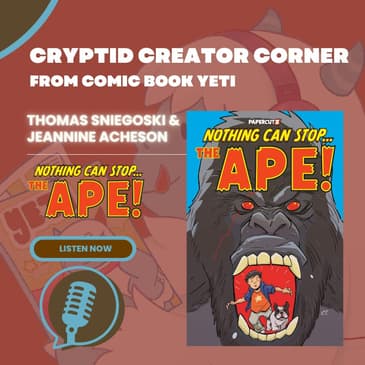

The dynamic comics writing duo of Jeannine Acheson and Thomas Sniegoski return to the show to chat with Byron about their highly anticipated new middle-grade graphic novel project Nothing Can Stop...The Ape from Papercutz.
Tom reveals the original concept three decades in the making, a project which initially struggled to find its footing as an adult oriented book but with Jeannine's help eventually found its place in the middle-grade market embracing a nostalgic Hanna Barbera filter celebrating the cartoons we all grew up loving. We discuss their ever evolving collaborative partnership; finding the balance of writing to a middle-grade audience; how the rest of the creative team of Craig Russo, Tom Gaadt, and Taylor Esposito helped bring their world to vibrant life; and touch upon their new projects including expanding Grim Death and Bill the Electrocuted Criminal into other mediums.
"I kind of think of Thuuna as a woman of a certain age who’s kind of just had enough... She does everything for everybody... and nobody appreciates it. It’s kind of like the mom who does everything for Christmas and nobody notices... I honestly don't know a mom who hasn't had that thought." - Jeannine Acheson on writing Thuuna in Nothing Can Stop...The Ape
Nothing Can Stop...The Ape
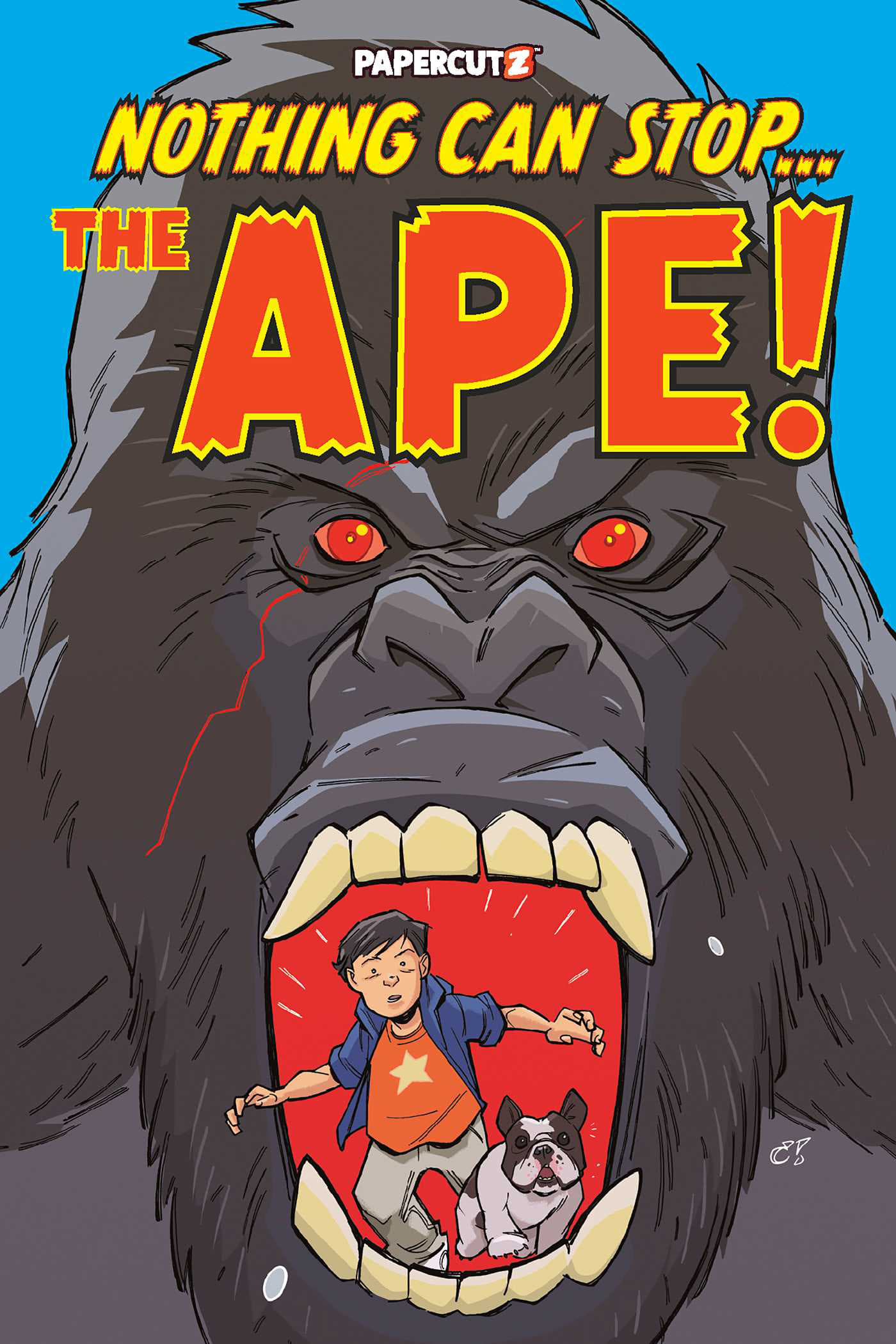
From the publisher
A raucous tale in the tradition of the classic saturday morning cartoons— Jonny Quest, The Herculoids, Space Ghost, and The Mighty Mightor— Nothing Can Stop...The Ape! This mini-series tells the story of Maxwell Morgan, a twelve-year-old boy who will go to any lengths to save his mom (who has been possessed by the spirit of Thuuna, an angry primordial goddess), even going as far as freeing the goddess's immortal enemy from his magical prison. With his faithful french bulldog and four primitive cave people gifted with the powers of the elements, Maxwell must convince the newly-released gorilla god of chaos, Ghraagg'endah, to help them save the world from Thuuna's genocidal intentions and free his mother from the goddess's clutches.
Paying homage to the Hanna-Barbera animated shows of the late sixties, Nothing Can Stop. . . The Ape! is a story for all ages. So pour yourself a bowl of cereal, and strap yourself in for a non-stop, pulse-pounding thrill ride of epic proportions because nothing can stop . . . The Ape!
Follow Comic Book Yeti
🔗 Comic Book Yeti LinkTree: https://linktr.ee/ComicBookYeti
For partnership and ad inquiries, please contact: thecomicsyeti@gmailcom
Follow your hosts
CRYPTID CREATOR CORNER PATREON
Support the show on Patreon for as little as $1 per month as a Squatch Supporter and enjoy exclusive benefits like What's Your Favorite Cryptid ™ with some of our favorite comics creators and Byron's comic book reviews.
ARKENFORGE
Play TTRPG games? Make sure to check out our partner Arkenforge. Use the discount code YETI5 to get $5 off your order.
Make sure to check out our sponsor 2000AD.

[00:00:00] - [Speaker 0]
Your ears do not deceive you. You have just entered the cryptid creator corner brought to you by your friends at Comic Book Yeti. So without further ado, let's get on to the interview.
[00:00:11] - [Speaker 1]
The future is calling. 2,000 AD is the galaxy's greatest comic with new issues published every single week. Every 32 page issue of 2,000 AD brings you the best in sci fi and horror featuring characters like judge dread, rogue trooper, and more. Get a print subscription in 2,000 AD, and it'll arrive to your mailbox every week. And your first issue is free.
[00:00:35] - [Speaker 1]
Or subscribe digitally, and you can download DRM free copies of each issue for only 9 a month. That's 128 pages of incredible comics every month for less than $10. Head to 2,000 AD and click on subscribe now or download the 2,000 AD app and start reading today.
[00:00:55] - [Speaker 2]
Hello, everybody, and welcome to the Cryptic Creator Corner. I'm Byron O'Neil, your host for our comics creator chat. It's been a minute since I last spoke to this dynamic duo, but it's always a pleasure catching up with them, and they have a new graphic novel dropping with paper cuts in June called Nothing Can Stop the Eight. I love that title. It is my pleasure to introduce Janine Atchison and Tom Stagoski back on the show.
[00:01:19] - [Speaker 2]
I had to look it up. It was early twenty twenty two when you were both last on and we were talking about Panther. So time flies.
[00:01:27] - [Speaker 3]
Wow. Wow.
[00:01:29] - [Speaker 2]
Yeah. Yeah.
[00:01:29] - [Speaker 4]
That was a while ago.
[00:01:31] - [Speaker 2]
It was. It seems crazy that it was four years, but like, I guess we've been doing it that long. Whatever. Well, you guys were at Wicked Con last weekend in Boston. It looks like Craig, the artist on this book was there as well.
[00:01:43] - [Speaker 2]
So Yes. How was it? Was it a good time?
[00:01:45] - [Speaker 3]
It was fun. It's always good.
[00:01:47] - [Speaker 4]
It's always a good show.
[00:01:48] - [Speaker 3]
Yeah. It's always fun to have a, like, a little one day show that's Yeah. Twenty five minutes from our house, you know, that's you have to stay, no hotels, no. It
[00:01:59] - [Speaker 4]
kind of kicks off the season. It's usually, well, no, it's not the first, it's the first like comic convention that we do.
[00:02:05] - [Speaker 3]
Right. Okay.
[00:02:06] - [Speaker 4]
Fun. Yeah.
[00:02:07] - [Speaker 2]
Okay. Do you do, like, horror conventions as well? You you're implying that there are more there.
[00:02:11] - [Speaker 4]
We do we've done, like, book conventions. Well, like
[00:02:17] - [Speaker 3]
Okay. Book
[00:02:17] - [Speaker 4]
fairs, that kind of thing. Although I forgot free comic book day, which we didn't do this year.
[00:02:21] - [Speaker 3]
We didn't do free comic book day this year. No.
[00:02:24] - [Speaker 4]
That kicks off the season, but Wicked Con's up there too. We had fun.
[00:02:28] - [Speaker 2]
Nice. And they they do that, like, twice a year, looks it like. Because I looked it up and they're doing it in October as well or something
[00:02:34] - [Speaker 4]
like They do it October and May, or April or May. Yeah. And it's free. That's the thing that fits the best about it. Like there's free admission.
[00:02:42] - [Speaker 4]
Everybody's welcome. It's packed. So it's- That's awesome. Yeah. Very
[00:02:49] - [Speaker 2]
cool. You can actually get kids involved more when Oh, it's did. Yeah. Very cool.
[00:02:54] - [Speaker 3]
Lot of families and stuff. Yeah.
[00:02:56] - [Speaker 4]
Yeah. I love to see that. That's so much fun. Like kids in costumes is so, so cool to see. Because you
[00:03:02] - [Speaker 2]
go Okay. What was the best? Saw did- a
[00:03:04] - [Speaker 4]
drag to there. Parents. What was the best
[00:03:08] - [Speaker 2]
that you saw? Tell me about a costume you saw that was amazing.
[00:03:12] - [Speaker 4]
Saw what did we see this year? We saw some spy we saw quite a few Spider Mans.
[00:03:16] - [Speaker 3]
Yeah. There was some Spider Man.
[00:03:18] - [Speaker 4]
It's so funny. We saw no Marios. Like, every year, every convention,
[00:03:23] - [Speaker 3]
there's, like Mario nonsense. All little kids, Mario. No Mario.
[00:03:29] - [Speaker 4]
Not a one. No kids, no adults. It was very strange.
[00:03:32] - [Speaker 3]
Yeah. Pretty strange. Yeah. A lot manga stuff that I don't know the name of that I'm Yeah. No.
[00:03:38] - [Speaker 3]
I know that. I've seen that before.
[00:03:41] - [Speaker 4]
And I don't know what it's called. Yeah.
[00:03:43] - [Speaker 2]
That's funny. Alright. Well, I got a chance to read the advanced copy of Nothing Can Stop the Eight that you sent over. As a big fan of the Hanna Barbera cartoons, they were one of the first that I was exposed to as a kid. That was probably the foundational kind of Yeah.
[00:03:57] - [Speaker 2]
Cartoon Yeah. You know, segment there for me. And The Gray Papes show was a favorite, which forever made me a sucker for a gorilla story in comics. So so how did you guys kinda conceptualize this? I know the Hanna Barbera stuff was was definitely a big component.
[00:04:13] - [Speaker 4]
That, I think, was the the key to it. Tom had been because Tom's been writing for forty years or so, and he had always had the title in his head, and he always had the story in his head, but it was much different. It was much darker, and it went through a bunch of iterations with different artists, and he I think you even showed me some of the old stuff that you would had on your computer that you found.
[00:04:37] - [Speaker 3]
Yeah, it's like thirty like thirty years this thing attempting to take form. Every single time I thought that I had it, it just would fall apart. It was just like the Okay. Yes. It just wasn't.
[00:04:51] - [Speaker 3]
There was something that was not working. Yeah. And I and and it frustrated the hell out of me for I don't know how many years that I would I had this amazing title. I had this amazing concept, and I just couldn't get it to work no matter no matter what I did with it. And then around the time and this was before I did the Herculoids, I didn't know anybody was going to be getting the Herculoids license, And I was bemoaning the fact that I wasn't going to get a chance to write the Herculoids.
[00:05:22] - [Speaker 3]
And I was like, well, wait a minute. The ape concept, what if we put it through the Hanna Barbera filter and, Okay, you know, let's see how how what how that would come out. And that's when Janine got involved with it. And we both started to kind of like play around with that idea and it really started to come together. And then when we asked Craig if he wanted to draw it, and this is before Craig was drawing the Hercules with me, Craig was like, I love the Hercules and this is it.
[00:05:52] - [Speaker 3]
This feels just kind of like it. This is great. And then Craig got involved and the rest is history. Put together a really nice proposal.
[00:06:01] - [Speaker 4]
Yeah. Brought it with us to San Diego, I think three years ago now.
[00:06:05] - [Speaker 3]
Yeah, three, mostly three years
[00:06:06] - [Speaker 4]
now. Yeah. And showed it to Mark Irwin at Mad Cave Studios. And he said, this would be perfect for cuts. We're gonna do it.
[00:06:15] - [Speaker 4]
And we just kinda got an acceptance, like, right on the spot, which Toxin is unheard of, but it's not my experience.
[00:06:21] - [Speaker 3]
Completely unheard of.
[00:06:24] - [Speaker 2]
Yeah. Yeah. That's that's not standard. That is not standard. So what was the key what was the key to unlocking it then?
[00:06:30] - [Speaker 2]
Like, Janine, in enter you as as the hero in the story.
[00:06:35] - [Speaker 3]
Had to be the
[00:06:35] - [Speaker 4]
Had to have been me. It had to be. No. I think it was the Hannah Barbera angle. I think that's really what kind of sent us in the right direction and everything just kind of fit together.
[00:06:45] - [Speaker 3]
The Hanna Barbera angle kind of lightened it up. Like originally, I kept kind of traveling down much darker paths with it. It was still kind of like funny and quirky and odd, but there was a more horror angle to it. Yeah. And I think when we kind of pull back on that, not that that's not there, it is kind of there still, but it's I think it's handled much more humorously and maybe even a little lighter.
[00:07:13] - [Speaker 3]
But that that, I think, was the final key that it was kind like, oh, wait a minute, you know, let's get away from the darkness for a minute and see if we can get it to work that way. It really just it was funny how quickly it clicked once we started to have that mindset.
[00:07:33] - [Speaker 2]
Yes. Yeah, it feels like a love letter sort of to your younger selves in a way. Yeah. Is what I'm hearing. Yeah.
[00:07:40] - [Speaker 3]
Definitely. Definitely. Barbara too. Yeah, just a lot. I think it allowed us to be goofier, playful, and not, you know, beholden dark, to the darker stuff that we normally do.
[00:07:57] - [Speaker 3]
Because really almost all the stuff that I do and the stuff we do together has a real kind of edge to it. Sure. So it was it was kind of nice to have something that was a little more fun. We got we got told to we got told to pull it back a little bit here and there. So
[00:08:17] - [Speaker 4]
no murders, no blood. Yeah, We handled that.
[00:08:21] - [Speaker 2]
Not yet anyway. I mean, maybe that's a spoiler, but not yet anyway. Well, okay. So then Hanna Barbera, it's clear that like both of these mean a lot to you. So what was the best theme song for both of you out of the Hanna Barbera pantheon?
[00:08:35] - [Speaker 3]
Oh my god. The Johnny Quest. Johnny Quest.
[00:08:38] - [Speaker 2]
Had the best. Yeah.
[00:08:42] - [Speaker 3]
That had the best. And hey, this is funny. Yeah. When I when I started to promote the ape a little bit and show around this punk band out of Upstate New York called The Antibodies Antibodies poked me and said, Oh my God, we love the look of this. We'd love to do a theme song.
[00:09:06] - [Speaker 2]
They actually
[00:09:09] - [Speaker 3]
and recorded a theme song for nothing could stop the eighth. They did an instrumental and they did one with vocals.
[00:09:15] - [Speaker 4]
Yeah.
[00:09:16] - [Speaker 3]
Speaker So if you want, we'll send it to you
[00:09:18] - [Speaker 2]
That's awesome.
[00:09:19] - [Speaker 4]
Yeah. It's fantastic. It's a great song. They're amazing. Yeah.
[00:09:25] - [Speaker 4]
They're amazing.
[00:09:26] - [Speaker 3]
Yeah. I never imagined in a million years that one of my books would have a theme song.
[00:09:32] - [Speaker 2]
Theme songs are so cool because even when I was reading the Herculoids, when I picked up every issue of it, before I would crack it open, I'd see the cover and I would have the theme song just resonating in my head because they're all so classic. I was looking through just how many amazing theme songs came out of and how many of those live rent free in my head, like Scooby Doo or the Jetsons or There's so many.
[00:09:57] - [Speaker 3]
A lot of the times you hear it in your head, you don't know which one it's connected to. Like, I'll have one, like, suddenly make its way in and I'm like, wait a minute, is that Space Ghost? Is that which one is that? So, yeah.
[00:10:10] - [Speaker 2]
Well, it's easy to see, I guess, the, the sympatic relationship that you guys have because immediately you both lock on to, oh, no, it's it's Johnny Quest. It's Johnny Quest. That
[00:10:20] - [Speaker 3]
has such an amazing theme song. There's not there had been nothing really like it for animated TV shows. So it just really stood out and kind of made you stop and listen and pay attention to that great opening. Those are great opening credits.
[00:10:37] - [Speaker 2]
Yeah. Well, I'm always curious, right? So with writing partners, does your relationship has it evolved over time? Are you finding that things have changed that much as it goes on?
[00:10:50] - [Speaker 3]
Yeah. She's way more vocal. The early days-
[00:10:57] - [Speaker 4]
I know stuff now.
[00:10:58] - [Speaker 3]
In the early days, the first twenty five minutes of our professional relationship, she has to hold back and kind of like, all right, you you you know, you've been doing this a long time. I trust you. And now it's kind of like, I don't she doesn't that
[00:11:14] - [Speaker 4]
I I like to think that I question because I'm not sure. So I do have a lot of questions about
[00:11:20] - [Speaker 3]
You question. You
[00:11:22] - [Speaker 4]
Yeah. But I think in a totally respectful way.
[00:11:28] - [Speaker 3]
Oh, it's really respectful. Yeah.
[00:11:34] - [Speaker 2]
All right. Before we have any conflict between writing partners, would like to show up on my podcast?
[00:11:40] - [Speaker 4]
It's all conflict.
[00:11:41] - [Speaker 3]
It's all conflict.
[00:11:43] - [Speaker 2]
Well, let's get into the central plot line here of Ape. So there's this conflict between two gods that are representing order and chaos with the, this youngster, Maxwell Morgan, caught in between. Okay. Well, maybe a lot of people are caught in between, but but Maxwell is the primary focus here. Hopefully, I'll pronounce these correctly.
[00:12:02] - [Speaker 2]
I'm gonna take a stab at it anyway. So we have Thuna, and we have Greginda? Is that
[00:12:07] - [Speaker 3]
We we like the the the we like the the vocal growl.
[00:12:14] - [Speaker 2]
Yeah. Yeah. Well, a gorilla is an interesting choice as as sort of a chaos god. Like, in most mythologies, they represent nature or power, you know, very masculine coded as it is here. And they're a bridge of sorts between humanity and the natural world.
[00:12:29] - [Speaker 2]
So okay. I'm I'm hearing at least this Herculoid's connection, connection, but otherwise, you know, what made you go with the gorilla?
[00:12:37] - [Speaker 3]
It's always a gorilla. Like gorilla. I I am just like, a lot of the times, monkey fixate it. I'll find a way to get a monkey or an ape or something into a story just because it's gonna look cool. It's going to, you know, I figured having a chaos god represented by this savage beast would fit perfectly with the savagery and the wildness.
[00:13:00] - [Speaker 3]
And again, it's all visuals. When you're dealing with graphic novels and comics, it's like, what's going to look cool? What's going to make somebody go, wow, that page is great. Look at that panel. Look at that splash page or whatever.
[00:13:12] - [Speaker 3]
So gorillas always pay off. In that department.
[00:13:18] - [Speaker 2]
How do you approach that differently then? Because you talked about having to tone it down and how they're always asking you to tone it down, and this is definitely a middle grade thing. So how do you go about approaching that? You know, with because you're you're you know, it is a it is visuals, but there's certain things you can't or you shouldn't, you know, connect in the same way if you're doing a horror book that's written for, you know, a general audience versus middle grade. So, how do you manage that?
[00:13:45] - [Speaker 4]
Some of the guidelines that we had gotten from our editor at Papercuts were in there were like three pages of guidelines of dos and don'ts. Okay. One of them was that people could meet their demise, but they weren't really allowed to see it. We weren't allowed to show it on the page. So there was like no blood.
[00:14:07] - [Speaker 4]
And I think we kind of got around that by I don't think we did kill anybody. And there were a couple of there was one scene where I don't wanna give stuck away, where Grog and Da, instead of, like, ripping somebody apart, kind of takes apart no. It wasn't him. It was Fauna. Think of Fauna.
[00:14:35] - [Speaker 4]
Instead of taking people apart, she takes things apart.
[00:14:40] - [Speaker 2]
Okay.
[00:14:42] - [Speaker 4]
Yeah. That's the one.
[00:14:44] - [Speaker 3]
Yeah. Yeah. Was one and then there was another one with Garagenda that we had more of like a like a almost like a homage to the King Kong where he's like a beast still thing. And basically, we lean more into the. Like less, less physical, more shadowy, amorphous type thing that could kind of almost like dissipate as opposed to being torn limb from limb.
[00:15:15] - [Speaker 4]
Yeah. And that's
[00:15:16] - [Speaker 3]
things burning, whatever.
[00:15:18] - [Speaker 2]
Okay.
[00:15:18] - [Speaker 3]
Yeah, there was just there was just we had to kind of rejigger certain thoughts and and, you know, the way we the way we perceive something originally versus how to get around the-
[00:15:33] - [Speaker 4]
Yeah.
[00:15:34] - [Speaker 3]
The boundaries set up by the fact that it's all ages and stuff.
[00:15:38] - [Speaker 2]
Yeah. Well, thank you for that moment, by the way, as, you know, an old school King Kong fan, you know, the 1970s version. That was that was a clear Skull Island nod. So I I definitely appreciated that.
[00:15:50] - [Speaker 3]
Okay. There's always if there's a big gorilla, there's always gonna be a Skull Island nod.
[00:15:56] - [Speaker 2]
Well, you talk about that there, Janine, with Thuna and the you're inverting the standard trope here. You know, it's boring if you don't do something. Yeah. But when Thuna comes back, she's anything but benevolent. And it's oddly the, you know, gorilla chaos god who ends up coming to the rescue.
[00:16:15] - [Speaker 2]
So gods are almost they're fallible in most mythologies, so we can connect with them. Right? But this feels more like a a modern approach to play with the gray area and effectively have them switch roles. So I was curious about why you wanted to do it that way.
[00:16:32] - [Speaker 4]
Don't know. I kind of think of kind of think of Buna as as a woman of a certain age, who's kind of just bad enough. And she she does for everybody. She does for everybody. She helps everybody.
[00:16:45] - [Speaker 4]
She she makes things good for everybody, and nobody appreciates it. They don't take care of it. It's kinda like the mom who like, you know, does everything for Christmas and nobody notices. And so she kinda just had enough. And so that's what, like, flips a switch in her.
[00:17:00] - [Speaker 2]
Okay.
[00:17:01] - [Speaker 4]
And she turns the other way. Well, if you're not gonna appreciate me that I'm just gonna take it all away. And, like, I honestly don't know a mom who hasn't had that thought. Oh, yes. At one point or another.
[00:17:14] - [Speaker 4]
So, yeah, I think my food is just kind of like the mom in everybody who's taken for granted and everything she does for everybody just nobody notices and nobody cares, and nobody takes care of what she does for them. So she kinda flips the switch and goes off.
[00:17:32] - [Speaker 3]
And one of the one of the main things that had survived all the incarnations of the story in my head over thirty years has been the flip. The the the the bad guy having to do good things in order to achieve his not so great goals. You know, it was almost like a trick. Hey, I'm going be a superhero, but I'm really working, you know, underneath everything to make you think it's a superhero thing, but I'm going get what I want out of, you know, fooling you, basically. That that had been there originally, like even thirty years ago.
[00:18:09] - [Speaker 3]
So was nice to to carry that through to, to the current incarnation.
[00:18:17] - [Speaker 2]
Well, Janine, I can attest that the mama in this household that that I live with, that has been my partner for over two decades, that is absolutely a sentiment that that she would Especially having had Yeah. Having had Mother's Day recently and having apparently failed that on my front.
[00:18:35] - [Speaker 4]
You know? Uh-oh.
[00:18:36] - [Speaker 3]
Yeah. Yeah.
[00:18:37] - [Speaker 4]
You wanna do that again?
[00:18:40] - [Speaker 2]
No. No. No. No. We we we made up for it.
[00:18:43] - [Speaker 2]
I made French toast, you know, so it's always
[00:18:45] - [Speaker 3]
There you go.
[00:18:46] - [Speaker 2]
Make French toast, always generally get ready.
[00:18:49] - [Speaker 4]
Honestly, that would be all it takes for me too. I would love that.
[00:18:55] - [Speaker 2]
Well, it feels like you might be also sort of channeling a love for DC comics here as well because Greg's level up has a gorilla Grodd
[00:19:04] - [Speaker 3]
sort of coding. Oh, there's definitely. Oh, yeah. You think of all the gorilla characters, movies and TV and comics and stuff. Sure.
[00:19:13] - [Speaker 3]
Sure. Little Mashuamala in there for. Yeah. Yeah. Yeah.
[00:19:16] - [Speaker 3]
Oh, yeah, for sure. Yeah. DC seemed to have the better. The better gorilla characters, the better ape characters than Marvel did. Marvel didn't really do much.
[00:19:27] - [Speaker 2]
No, I can't. I can't recall.
[00:19:29] - [Speaker 3]
I'm trying like I'm trying to think of a gorilla character Marvel, and I'm not I'm getting like the mandrill, which was more of a of a man than it was, you know, a gorilla or or a baboon. I think he will baboonsque. Yeah. So my yeah, DC had the better monkeys of the monkey ape character. Oh, for sure.
[00:19:50] - [Speaker 3]
Yeah. Detective chimp. We
[00:19:51] - [Speaker 2]
always Exactly.
[00:19:52] - [Speaker 3]
Detective chimp.
[00:19:53] - [Speaker 2]
He's one of my favorites. Absolutely.
[00:19:55] - [Speaker 3]
I would write a detective chimp book and a heartbeat.
[00:19:59] - [Speaker 2]
Wait. Have you pitched? I mean, it's next level It's time at
[00:20:03] - [Speaker 3]
so tough to get past, you know, it's almost like in comics, if you've been at it a while, you get known for a certain thing, and like we stay in our, our park and these guys will play in their park. It's, very tough. It's very tough to get over the wall, to have somebody take, take notice of your interest in something.
[00:20:28] - [Speaker 2]
Well, one of the other characters in this book that I thought resonated and certainly resonated to you, Tom, unless I'm reading this wrong, you have your own version of Bandit from Johnny Quest in
[00:20:38] - [Speaker 3]
the story too, with Harvey,
[00:20:40] - [Speaker 2]
the French French bulldog. And if I'm not mistaken, that's that's that's based off of Kirby, your own movie. I
[00:20:49] - [Speaker 3]
have a Harvey. We didn't even bother trying to change his name or anything. We just we'll just make it him. We'll make him Harvey, you know? So Yeah.
[00:20:58] - [Speaker 3]
Yeah. Yeah. And Craig is Craig Russo has met Harvey and stuff. So he's he was he he did a good job at, like, portraying him as the jerk that he is.
[00:21:08] - [Speaker 4]
Yeah. He counted as a jerk.
[00:21:11] - [Speaker 2]
He's trouble?
[00:21:12] - [Speaker 3]
Oh, god. Oh, yeah. I think all French bulldogs have a certain attitude. Yeah. That just comes with the breed, the attitude.
[00:21:20] - [Speaker 3]
And, yeah, we we thought he'd be perfect to fit in to the story and cause some issues in there.
[00:21:29] - [Speaker 2]
Well, you gotta have a good mischief maker. That's just kind of the kind of the thing. Yeah. Middle grade. So so how do you go about doing that then?
[00:21:35] - [Speaker 2]
So you've got the you've got Thuda and, and Greg, and you have Maxwell and the mom and now the dog, the dog.
[00:21:45] - [Speaker 4]
How?
[00:21:46] - [Speaker 2]
As, as kind of everything you're, you're pivoting around that. And they, you know, they say that five is the magic for a, a group book, you know, with with Marvel or something like that. So when you're creating this world, how did you how did you figure all of that kind of melding together? You know, like those and and then the plot line comes from that.
[00:22:09] - [Speaker 3]
Well, think we what we did was like it was almost like if this the the wording in this is gonna be a little funky. It's like the real world, which is Max and his family, his mom, his dog and stuff. Right. And then you have the the kind of like the supernatural world that they suddenly get thrust into. So I think I think the dog just was just a natural, especially when when paying homage to the Hanna Bob era stuff.
[00:22:38] - [Speaker 3]
Know, there's there was always some kind of like little animal sidekick in all all of those all of those cartoons. So it was very easy to kind of like start off there and then then kind of apply them to the the actual plot linesupernatural world that we're kind of introducing these characters into. So if that makes any sense.
[00:23:04] - [Speaker 2]
No. No. I mean, it makes a lot of sense. And you've got to have the the Hanna Barbera stuff is all about family core anyway. And and that's where you've kind of created the the emotional core, I think, that's going to connect with a lot of readers in this is asking that question.
[00:23:20] - [Speaker 2]
What will you do just to save your family when, when confronted with difficult choices? It feels a bit Disney, you know, in, in that regard, know, boy trying to save his mom and perhaps even a metaphor for parents not always being one thing, you know, the complexity of because I think it's very different now. You know, I think about, you know, when I was a kid, my my parents were these things and we put them on pedestals. And I think now more parents are open to, you know, showing fallibility in a, in a way, that, that didn't exist back then. And so I think that it's almost necessary to connect with a younger reader group that way.
[00:24:00] - [Speaker 3]
Yeah. Oh, definitely. Like, like if we were writing these characters, say for like the fifties or the sixties, they'd be completely, completely different in terms of how they would be portrayed. Yeah. Oh, for sure.
[00:24:14] - [Speaker 3]
Yeah. So, like, did definitely a more modern spin on on, like, the family dynamic than more traditional.
[00:24:25] - [Speaker 2]
So, Janine, when you're coming into this, he's got this idea that he's had for 40 And I'm feeling this experience as a mom sort of doing the creep into the book maybe a little bit there.
[00:24:42] - [Speaker 4]
Yeah, I think it did, and it happened early on, and I think this was one of the things that Tom talks about when we talk about our relationship evolving. We were writing a scene with Max and his mother, And Tom had her saying something, and I was like, I don't think I would say that. I don't think I would put that on my kid. I wouldn't put it like that. And he's like, it doesn't matter.
[00:25:08] - [Speaker 4]
And I'm like, no, I think it does matter. As a mom, I wouldn't put that kind of guilt on my kid. And he was like, oh, oh. And I'm like, if they have a good relationship, then then you don't wanna do that to your kids. You don't wanna say something.
[00:25:25] - [Speaker 4]
Or when you do say something, you go, oh my god, did I, I didn't mean it like that.
[00:25:30] - [Speaker 2]
Right.
[00:25:30] - [Speaker 4]
So we've had this conversation. I don't wanna give away what it is, but I'm like, yeah, I don't think she should say it like that. He was like, okay, fine. So we changed it. Now I was happy.
[00:25:41] - [Speaker 4]
I don't know if he was happy, but I he wasn't happy.
[00:25:45] - [Speaker 3]
I'm never happy.
[00:25:48] - [Speaker 4]
But you're not a mom. So I don't know. And maybe fathers would talk differently to their boys. That's possible too. But as a mom, I know I wouldn't wouldn't have said anything like that to my son.
[00:26:00] - [Speaker 4]
Wasn't anything bad, but
[00:26:01] - [Speaker 3]
No. I find the things that we argue about when we're scripting are so I'm much more, like, operatic. Everything is
[00:26:13] - [Speaker 2]
20,000 foot level.
[00:26:15] - [Speaker 3]
Yeah. Everything is very big in my head in terms of house. So she's the more she's more intricate. She's the more minute that like the little the little pieces that connect stuff like that. I'm too busy with creating universe, she's down she's down there planting the grass seed.
[00:26:33] - [Speaker 4]
Yeah. Know? Looking at I think I look at the people a little more, finely, a little more critically.
[00:26:42] - [Speaker 2]
I think that's really important in our inner writing partnership. I don't I don't know how I'd function. I haven't done it that much. The few instances that I have are my my podcast co host and I wrote a store, a comic story, And I found myself as that 20,000 foot concept guy, but trying to condense that into a panel by panel, like, what are you gonna say? How do they do this?
[00:27:06] - [Speaker 2]
I'm terrible at that.
[00:27:09] - [Speaker 3]
That's where my experience comes in.
[00:27:15] - [Speaker 2]
Well, the thing that I really connected with the book, and we're talking about caregivers here, And as somebody who has an environmental science background, who's a self avowed tree hugger, I'm seeing an environmental message in the book too. You have the four primals. You have fire, rock, air, and water who are rebelling against a goddess who represents order or natural balance of things. And we're living in a time where earth is being thrown that balance is being thrown off.
[00:27:43] - [Speaker 3]
Know? So
[00:27:44] - [Speaker 2]
maybe that's overanalysis on my part, but given the the middle, you know, grade target, I think it will resonate with younger readers who feel like they're inheriting a planet whose caretakers have abandoned it. So I was just curious if that was something you were actively thinking about with the primals and the series or
[00:28:00] - [Speaker 3]
It may not actually be as overt as that, but it's prob as I think about it, it's probably there in the background or was there in the background as we were concocting these as we were coming out with these characters. Yeah. The elementals were just really, really fun and they became more fun. I think originally they were just kind of like henchmen. Sure.
[00:28:30] - [Speaker 3]
I don't and I don't even think originally we thought of them even beyond that. I think I think they became more integral to the plot as we were just kinda, like, talking more and come and, like, plotting things out and stuff like that. Suddenly, like, they kinda took on a life of their own.
[00:28:47] - [Speaker 4]
Yeah. Like how they interact with Maxwell and his world that they have no idea about. It was it was I don't know. It was kinda cool to just see them try to fit into the world that we live in when they're from such a different time. That was fun.
[00:29:05] - [Speaker 4]
It was really fun to get to know them.
[00:29:07] - [Speaker 3]
They were they were the surprise. I think they were the surprise of the book, because I think they I think in my scheme of things, they served a very specific purpose and nothing more. And I think as we wrote it and as the as things were falling into place and things were happening, they had a much bigger part than I than I thought that they were going to have or that we thought that they were going to have. So that was kind of fun.
[00:29:32] - [Speaker 4]
Yeah, they were fun.
[00:29:33] - [Speaker 2]
They became like a bridge to me, and I definitely got some Fifth Element vibes, I guess.
[00:29:39] - [Speaker 3]
Maybe. Maybe. Yeah. Yeah. And they're still around, so if we do a second book, they'll, they'll be they'll they'll be in there.
[00:29:48] - [Speaker 4]
Yeah.
[00:29:49] - [Speaker 2]
Well, good, because I really like them. Don't take them anywhere. Well, I have a I I do have a deep cut question here. Which one of you is the Pam Grier fan? Because the government agent that's helping Maxwell is named Jackie Grier, and Pam Grier played Jackie Brown.
[00:30:05] - [Speaker 2]
Yeah. So the suit looks very similar okay. To Okay. Watch Yeah. Okay.
[00:30:12] - [Speaker 4]
And probably Craig too, because if the suit is familiar, he based it on.
[00:30:17] - [Speaker 3]
Yeah. Oh, yeah. He knew what I was doing. Craig knew Craig knew knew what what this was all about. So he he he was good.
[00:30:27] - [Speaker 3]
He knew.
[00:30:29] - [Speaker 2]
So you've been working with him on a lot of projects now. Yeah. And you're kind of talking about that where you don't even need the the shorthand. It's just like he just has that understanding. And and he's he's a really, I think, perfect fit on this this book.
[00:30:43] - [Speaker 2]
It's it's our style is a layup, you know? He's already nailed it with the Herculoids. So was he just the no brainer to pull in on the project?
[00:30:52] - [Speaker 3]
It's one of those things where we said, you know, who would be probably perfect for this? And we're like, yeah, it'd be great. But we didn't know if he had other stuff that that like and he couldn't fit in a graphic novel on top of the other stuff that he's working on. And he was like, he was he was a gruey heartbeat. He was like, yep, yeah, this is great.
[00:31:10] - [Speaker 3]
This this feels like something that I would really enjoy working on. So, yeah, he was he was immediate. Yeah. No question.
[00:31:19] - [Speaker 4]
Yeah. He was all great all the time for a while. It was great. Yeah.
[00:31:24] - [Speaker 2]
Yeah. It's, it's such a perfect fit. I think even for this, maybe even more than the Herculoids, and maybe that's he was I don't know what the timeframe was, if he was working on both simultaneously
[00:31:35] - [Speaker 3]
or He was at a point. Yeah. Yeah. Yeah.
[00:31:39] - [Speaker 2]
Okay.
[00:31:39] - [Speaker 4]
Yeah.
[00:31:40] - [Speaker 2]
Okay. Yeah. Cause I can sort of see how they would have influenced each other and kind of evolving, you know, okay, this has got the Hanna Barbera DNA to it. Yep. So now that I've got the familiarity with the silhouettes and especially working already with a gorilla, how can I do, do this in, in the panels and on the page for maximum sort of impact?
[00:32:01] - [Speaker 2]
And you could see, even with that, the scene, this, this sort of Skull Island homage, if you will, and I won't give that away. Right. But you could even see some, some Magnolia in there. Oh yeah. It looked like a panel that, that Mike would draw.
[00:32:16] - [Speaker 3]
Yeah. He definitely. Yeah. His his because he was even drawing a a a big ape in the very first Young Hellboy miniseries we did. We had another big ape character.
[00:32:27] - [Speaker 3]
So, yeah. So he was already he was already ready to draw another big ape.
[00:32:35] - [Speaker 2]
Well, given the ending, this certainly feels like you're open to do more. Do you have more planned if the sales merit? We going Yes. Do
[00:32:44] - [Speaker 3]
100%. Yeah. Yeah. We're doing If they came to us today, we would get right to work on the next one. Yeah.
[00:32:53] - [Speaker 3]
So, problem. Awesome. No questions.
[00:32:56] - [Speaker 4]
That would be so much fun. It would be great.
[00:32:58] - [Speaker 2]
Well, let's remind people when it's hitting shelves then again. Think it's June 9.
[00:33:03] - [Speaker 3]
Changed
[00:33:04] - [Speaker 4]
that. It's now July 21. So right before we hit San Diego Comic Con.
[00:33:11] - [Speaker 2]
Oh, cool.
[00:33:12] - [Speaker 4]
So it's July 21. It'll be like in stores. That FOC is June is a month before June something.
[00:33:21] - [Speaker 2]
Great. Then we'll be able to get it in there. So if you're hearing this now and we're on the early end of release on the episode, make sure to get your preorders in because those preorders matter a lot. A lot. Especially with graphic novels.
[00:33:32] - [Speaker 2]
Yep. So I'll put a link in the show notes so everybody can can buy that from from paper cuts. And then what else do you guys have cooking? I know, Tom, you mentioned the new Hellboy series, the Thrilling Sky Adventures. Yep.
[00:33:45] - [Speaker 2]
That just dropped.
[00:33:46] - [Speaker 3]
Yep. Number one just came out this last past week. So, yeah, that that's cool. We've been working on that forever. So that's ready to go.
[00:33:55] - [Speaker 3]
And there's a bunch of stuff yet again. We can't talk about. We've been sworn to secrecy. We should speak back.
[00:34:04] - [Speaker 4]
Yeah. But a lot of it is based on Tom's novel with Mike Mignola, Grim Death, and Bill, the electrocuted criminal.
[00:34:13] - [Speaker 2]
Oh, cool. Okay. There's there's
[00:34:15] - [Speaker 3]
more great. We're doing More of that coming. Jeanine and I are writing the new Grim Death novella. Yeah. Okay.
[00:34:21] - [Speaker 3]
We just finished a new grim death short story for a collection that's coming out in the not too distant future. But yeah, a lot, a lot of grim death. That's all I'll say.
[00:34:32] - [Speaker 4]
All different mediums.
[00:34:34] - [Speaker 3]
That's yeah, that's all I'll say. A lot of grim death.
[00:34:36] - [Speaker 2]
Yeah. Well, I'll put a link in the show notes for anybody who hasn't been listening to the podcast.
[00:34:41] - [Speaker 3]
Oh, Because
[00:34:42] - [Speaker 2]
it's fantastic. I mean, the production value's great. A lot of fun. I've been really enjoying that one.
[00:34:47] - [Speaker 4]
Yeah. And it's actually one I'm going to toot your horn because I know you won't. He's won like at least two awards. And he's can I talk about that one? Yeah.
[00:34:58] - [Speaker 4]
Yeah. Yeah. The Tribeca award Tribeca
[00:35:04] - [Speaker 3]
Rim Festival. Oh, wow.
[00:35:06] - [Speaker 4]
Festival in New York is featuring his podcast, Bill and the Electrocuted Criminal Rim Death and Bill, the Electrocuted Criminal, at a panel during the festival. So that's at the beginning of June. So he's racking both heads. It's cool stuff
[00:35:23] - [Speaker 3]
Recognized for by Tribeca. That was kinda cool.
[00:35:26] - [Speaker 4]
You know, that's huge.
[00:35:27] - [Speaker 2]
That is awesome.
[00:35:28] - [Speaker 3]
Yeah. Yeah. That was complete surprise. I'll let them come out of nowhere. Yeah.
[00:35:33] - [Speaker 3]
Yeah. It's very different too,
[00:35:35] - [Speaker 2]
because it's not like a comics award. I mean, you're used to that, you know, that's
[00:35:40] - [Speaker 3]
Yeah. What's wild about it is taking that novel and transforming it into this podcast was such an amazing, like, learning experience. I guess I'd never done anything like it before, that kind of script writing. I've done comic scripts, of course. Dabbled a little bit in TV scripts and stuff like that.
[00:36:01] - [Speaker 3]
But this was like intense. This was like I had to learn how to do a kind of writing that was it's all audio. It's all you know what I mean? So I had to really kind of focus on that kind of sensory type thing when I was when I was writing in. It was it was a super challenge, but I
[00:36:23] - [Speaker 4]
think it
[00:36:23] - [Speaker 3]
came out great. Think they did a fantastic job bringing it to life.
[00:36:27] - [Speaker 2]
So what was the biggest challenge then? Trying to find the intonation? Is that a part of it? Where do you enunciate?
[00:36:35] - [Speaker 3]
I think it's almost like, how do you make this novel work as something that somebody could see with their eyes closed? You know what I mean? How do you get this story across without a visual? You know, like a comic book page or a super descript, you know, complex description in a a prose novel or something. So it was really, really tough to kind of take this thing that existed in one form all already and transform it into something else.
[00:37:10] - [Speaker 3]
So yeah, it was a lot of lot of closing my eyes and saying, what would that feel like? What would that what would that sound like? I
[00:37:20] - [Speaker 2]
can see that being a great experience though, as a writer. It was. You know, it's flexing a different kind of muscle, you know?
[00:37:27] - [Speaker 3]
Completely. And it was absolutely frustrating and terrifying, in time, it's super rewarding. Yeah. But especially when you started to see the actors and things performing it, it was kind of like, oh crap, that that actually does work, you know, that that I wasn't quite sure how that was going to work. Would it work?
[00:37:51] - [Speaker 3]
And it did work. I don't know if that's me or the fact that the people who we had, the production people, were just kind of like They were very cool. Yeah, they were all, they were more on the ball than I thought thought I was. They, they would kind of like take it and go, no, all right, we're gonna do it. This is how we're gonna do it.
[00:38:12] - [Speaker 3]
And I'm like, oh, so I guess it, I guess it worked.
[00:38:16] - [Speaker 2]
So you guys are working on that, like a novella form now. Yeah. So how is, how is that, how's that experience then informing that? You know, like how, how does that transpose now into, okay, I've learned these things.
[00:38:31] - [Speaker 3]
Yeah. I think you find yourself at least I find myself thinking about if what we're writing now did get turned into an audiogram, you know, what will we have to do what will we have to do with this these particular moments to make that
[00:38:50] - [Speaker 2]
Gotcha.
[00:38:51] - [Speaker 3]
To be able to kind of transfer that over, you know? So, yeah, that's always back in my mind because we don't know, you know, if there will be more of the audio shows. We don't know. So but but that's like reflex. It's kind of like, oh, wait a minute.
[00:39:07] - [Speaker 3]
You know, this this particular aspect of this story, how would that translate to that, you know, to a more audio presentation?
[00:39:18] - [Speaker 2]
I mean, feel a little bit of trepidation there, but fear not because you have your your stalwart companion, Janine, to help you out and navigate that. It's it's gonna be fine. It'll be fine.
[00:39:27] - [Speaker 3]
That's her famous it's fine. It's fine.
[00:39:31] - [Speaker 4]
Everything's fine.
[00:39:32] - [Speaker 3]
I'm running around on fire, and she's like, it's fine. Just Yeah. It all worked out. It's all fine.
[00:39:38] - [Speaker 4]
That's because, like, okay, so I had no idea you were thinking that as we were working on this novella. And that's why you've been in the business for so long is because you're like five steps ahead. And I'm thinking, oh, I'm gonna write the novella. You know, oh, it's gonna be fun. And I hope we do it justice.
[00:39:57] - [Speaker 4]
It's going to be great. And you're already thinking, what if they turned this one into an audio drama as well? Like, five steps ahead. That's why you run around like a chicken.
[00:40:07] - [Speaker 3]
That's why I need that. Yes, that's why I'm in panic 90% of the time.
[00:40:13] - [Speaker 4]
It's fine.
[00:40:13] - [Speaker 2]
But that's, that's modern production on any of this stuff because it ultimately, any, any of the, the comics publishers are hoping that whatever gets pushed out there gets picked up as an IP to make a movie on it. Maybe to make a podcast on it now, you know, to throw it up on YouTube as a, I don't know, an animated short, you know? Yeah. Is. It's crazy.
[00:40:37] - [Speaker 3]
Yeah. That this, this stuff has, has the potential to have so many lives. Yeah. If the right people get involved and want to take it to those to those next levels. But yeah, you always have to be thinking about that.
[00:40:52] - [Speaker 2]
So what was your preparation then for Nothing Can Stop the Ape? Like what what are you thinking here? Oh man, like how what this did you was that part of it conceptually? Know?
[00:41:02] - [Speaker 3]
There's always that that, like, little voice in your head that says, oh, what if they made this into a movie? Oh, would it be better?
[00:41:09] - [Speaker 2]
A cartoon.
[00:41:10] - [Speaker 3]
Would it be a live action? Would it be animated? Would it be you know, your brain goes all over the place. But then you have to pull it back and say, you gotta just make what you have in front of you the best thing possible. Don't go worry worrying about Hollywood because it'll give you a nervous breakdown.
[00:41:27] - [Speaker 4]
Yeah, that's true.
[00:41:28] - [Speaker 3]
You know, they're possible to deal with. So it's better to focus on the best graphic novel that we could possibly come up with. And that's kind of where the focus had to go.
[00:41:40] - [Speaker 4]
Yeah. The
[00:41:41] - [Speaker 3]
other stuff is later. The other stuff is gravy. If they, you know, if anybody showed any interest in doing anything else with it, that's something you worry about then. But you don't focus on that now.
[00:41:52] - [Speaker 2]
Yeah. Yeah. Well, think you guys nailed it, so I think you did the job. The job that you were presented with, you did well.
[00:41:59] - [Speaker 3]
Thank you. After thirty years of gestation, Finally, this thing comes out.
[00:42:08] - [Speaker 4]
That's a long time. That's a long time. I
[00:42:12] - [Speaker 2]
imagine at the cons that will be a different kind of relief than maybe some of the other stuff that you've, you've done that you're like, oh, okay, well, this is Vampirella and I know how to do that. Then, you know, it comes very naturally. And just imagine a different level of satisfaction. You're signing a book for a kid, you know, and be like, oh, yes.
[00:42:32] - [Speaker 3]
Yeah. It's like, I'm looking at the actual thing. Finally, here it is. Yeah,
[00:42:38] - [Speaker 4]
it's been a long it's been a long process. It has.
[00:42:41] - [Speaker 3]
It has. Yeah.
[00:42:42] - [Speaker 4]
Not not just the thirty years, like even like the past. It's been three years, right?
[00:42:47] - [Speaker 3]
That's it. This this whole time to all come together. Know, we did our parts, then Craig was doing his part, and the editorial was doing their part, and the colorists were doing their part, they let her, you know, multiple, multiple layers on this thing. It's been a long, it's been, yeah, it's been a long time, long process on this.
[00:43:06] - [Speaker 2]
So, Janine, what's that been like working on a graphic novel like that? It's very different than a serial monthly.
[00:43:13] - [Speaker 4]
Yes. Although our editor at Paper Cuts kind of broke everything down for us. So, we took a period of about ten months, and we turned in like a chapter a month.
[00:43:26] - [Speaker 2]
Okay.
[00:43:26] - [Speaker 4]
So in that respect, it was very similar to doing like a comet because we'd have like certain chapter, we'd know how many pages and panels we had to do. But it was interesting because about about half almost halfway through, a third of the way through, Tom got the Herculoids gig.
[00:43:44] - [Speaker 2]
Okay.
[00:43:45] - [Speaker 4]
And so he was working on that, and he was like, you're gonna have to lay out pages by yourself. I'm like, what do you mean? He's like, you're gonna have to. He's like, you can do this. I'm like, yeah.
[00:43:55] - [Speaker 4]
So I think I ended up doing, like, a good chunk of it. A good chunk of it, I did the layouts by myself. And so the first time, we were a few chapters in, I think, and he's like, we talked it over and he's like, alright, this is what, you know, this is what I see. What do you see? And so I'd go and I'd work furiously on my layouts and I'd bring them back and we'd go over them and he'd go, okay, we need to move this.
[00:44:19] - [Speaker 4]
We need to, you know, fix this. And the first time was kind of a disaster. But as I kept on doing it, like by the end, I was finally, like, in a place where I could adequately describe, describe, like, like, what what we wanted. And so I think the only thing that I left were, like, the big fight scenes. I still have a little trouble with that.
[00:44:44] - [Speaker 4]
But, like, you know, people talking or them going places or doing things like I'm better at it. So for me, this was like a huge step forward because before all of the other stuff that we had done for the most part, like we did together, like literally together. But this was the first time that he kinda pushed me out of the nest and said, just go do it. You have to do it because I can't because I have Hercules, and he was working on that. So it was it was like like crunch time.
[00:45:14] - [Speaker 4]
It was like a lot of a lot of, like, furious work on both of our parts. But it was good. It was really good. It was a good experience. It was really good.
[00:45:24] - [Speaker 2]
Sounds like it. Not quite always. It's fine. It's fine.
[00:45:27] - [Speaker 4]
No. It wasn't fine for a while. But it got better. It got much better.
[00:45:32] - [Speaker 3]
She doubts her abilities. Thing that she has to learn to kind of relax a little bit and know that she can pull this stuff off.
[00:45:46] - [Speaker 2]
I mean
[00:45:46] - [Speaker 3]
Way more intense than you are, so don't even
[00:45:50] - [Speaker 2]
Nothing quite like a trial by fire to make you get good at something fast.
[00:45:55] - [Speaker 4]
Yeah. But I think by the end, and I don't know, I might have done seven or six or seven chapters, like, on my own. I think by the end, it was it was very few tweaks from him. So that was either that or he just got tired of tweaking.
[00:46:12] - [Speaker 2]
He ran out of time.
[00:46:13] - [Speaker 3]
Yeah. We we'll just look at it.
[00:46:15] - [Speaker 4]
We'll I'm
[00:46:15] - [Speaker 3]
sorry. It's gonna have to go.
[00:46:16] - [Speaker 4]
I'm gonna We're
[00:46:16] - [Speaker 3]
going with that.
[00:46:19] - [Speaker 2]
That's funny.
[00:46:19] - [Speaker 4]
No. It's good.
[00:46:20] - [Speaker 2]
Alright. Well, as is my custom, I like to end things on a positive note. So we do a shout out now. This could be something that recently inspired you or someone that just did you a solid you'd like to publicly thank. And I'll go first to give you both a minute to think about it.
[00:46:33] - [Speaker 2]
For me, I'm it may sound weird, but I'm shouting out my rheumatologist, Doctor. G. Working in the medical profession is a bitch these days. And my wife my wife does. Despite all all the people, you know, who went into the field to to help people, and Doctor.
[00:46:49] - [Speaker 2]
G is definitely one of them. You know, he's been this this great partner as I continue to recover from this nasty lupus flare. Good doctors just don't get appreciated often enough. So I'm gonna I'm gonna give him a shout out and say thanks, you know, that I can be back doing this thing that I love to do and talking to nice comics creators like you all.
[00:47:07] - [Speaker 3]
So and
[00:47:08] - [Speaker 2]
I'll also say fuck RFK and these crazy Darwinist assholes who are dismantling the entire medical system, and that's coming as a medically sensitive person. That's terrible. Anyway, I said we keep it positive, so I won't get into that. What do you guys got?
[00:47:27] - [Speaker 4]
I think I have to go with the obvious one. I have to thank my buddy here, Tom,
[00:47:33] - [Speaker 2]
for
[00:47:33] - [Speaker 4]
like six years ago coming to talk to my students and then dragging me, kicking and screaming into the field of publishing. I I never pictured anything like this happening in my life. I thought I would just teach until I retired and then quietly just went off into the sunset. And I didn't see this, like, third or fourth act of mine happening, and it's because of Tom. So thank you.
[00:48:05] - [Speaker 2]
Oh, that's so cool.
[00:48:07] - [Speaker 3]
That is nice. That's really nice. I would say besides Janine, making me kind of rethink. A lot of my career in regard to how I did things and why I did things. She was she was definitely a.
[00:48:23] - [Speaker 3]
Breath of fresh air on something that became kind of a grind in a positive way. Grind would have a negative connotation, but I was just kind of like in in a loop.
[00:48:38] - [Speaker 2]
Yeah. The hustle of comics. Yeah. Just
[00:48:40] - [Speaker 3]
doing doing what I'm doing and not appreciating what I was doing. She she allowed me to have bring back that appreciation in in in teaching her. It allowed me to see kind of like all the cool stuff that I've been doing and we've been doing together and stuff like that. But I also want to thank Tom Gad, who's the colorist on Nothing Could Stop the Ape, who was amazing, and Taylor Esposito, who was our letterer, who did fantastic work, and they should definitely be recognized for making the book the cool thing that it is. Craig.
[00:49:15] - [Speaker 3]
And Craig Craig Rousseau. As much as I don't as much as I don't care for him.
[00:49:22] - [Speaker 2]
I'll tell him you said that.
[00:49:24] - [Speaker 3]
No, he knows. He knows. But yeah, Yeah. All the all the cool people that help bring us grip to life and
[00:49:32] - [Speaker 4]
Yeah.
[00:49:34] - [Speaker 2]
Yeah. I mean, comics is a collaborative process, so thank you for mentioning them and Yeah. Know? Sorry. Yeah.
[00:49:40] - [Speaker 2]
I mean, oftentimes we end up just by default, I think because everybody else maybe is so busy. I think that's a piece of it. I mean, you know, this whole chatting up their their work isn't necessarily their forte. I've worked with artists for thirty years now myself. So, having been one myself, but it, that's not that is not their wheelhouse.
[00:50:03] - [Speaker 3]
No, not really.
[00:50:04] - [Speaker 2]
But yeah, it's always great to give them a shout out. So we already always appreciate that. But Tom and Janine, it's it's always a pleasure getting a chance to to catch up with you and and hearing about stuff. And and the ape is fantastic. I love hearing more about your, your collaborative process.
[00:50:19] - [Speaker 2]
I think this has been a fun episode just to, like, to get a little more into that and to how that, how that works. And it's, it's fascinating because I don't get that opportunity. I'll get a chance to talk to people who are maybe an artist writer, but not, not too many people who are co writers. So it's been fun.
[00:50:35] - [Speaker 3]
Yeah. We, we have an interesting relationship.
[00:50:40] - [Speaker 4]
Yes, we do.
[00:50:41] - [Speaker 2]
Ever, ever evolving. He's gonna keep throwing you under the bus. See. Cause you survived it. That's the problem.
[00:50:47] - [Speaker 2]
Right? If you don't flounder.
[00:50:49] - [Speaker 3]
Yeah. Yeah. And every project's different. So don't get comfortable.
[00:50:54] - [Speaker 4]
No, I'm never comfortable.
[00:51:00] - [Speaker 2]
Alright. Well, before we get into any more
[00:51:02] - [Speaker 3]
A whole other thing. Yeah.
[00:51:04] - [Speaker 2]
Alright. This is Byron O'Neil on behalf of all of us at Comic Book Yeti. Thanks for tuning in, and we will see you next time. Take care, everybody. Peace.
[00:51:12] - [Speaker 2]
This is Byron O'Neil, one of your hosts of the Cryptid Creator Corner brought to you by Comic Book Yeti. We hope you've enjoyed this episode of our podcast. Please rate, review, subscribe, all that good stuff. It lets us know how we're doing and more importantly, how we can improve. Thanks for listening.
[00:51:32] - [Speaker 0]
If you enjoyed this episode of the Cryptid Creator Corner, maybe you would enjoy our sister podcast, Into the Comics Cave. Listen and subscribe wherever you get your podcasts.