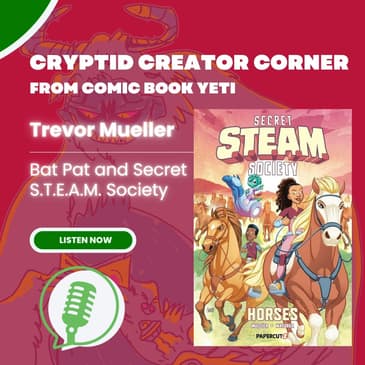

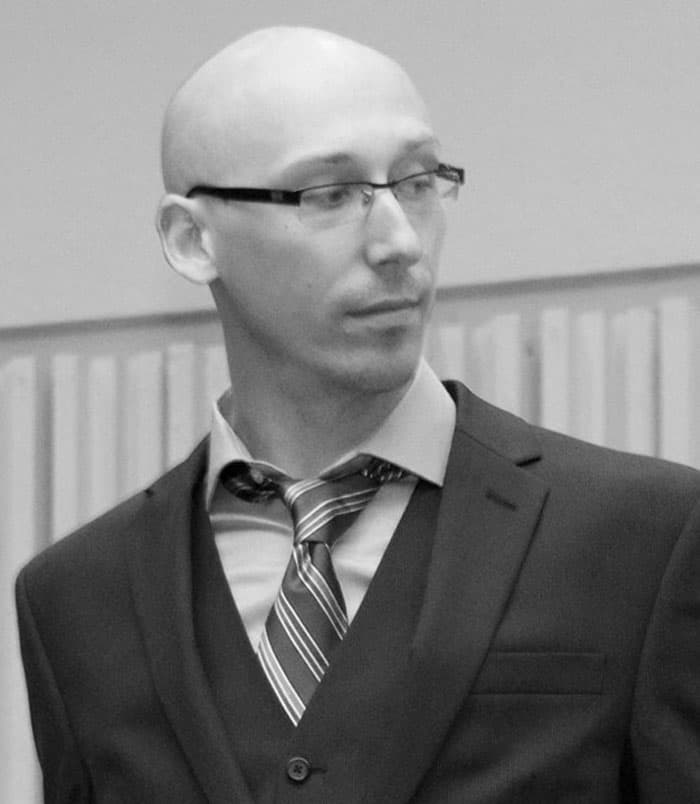
Trevor Mueller is the writer of Nexus Point, Re-Possessed, the multi-Harvey Award nominated Albert the Alien, Bat Pat, and many more comics. It feels like this episode has been a long time coming as Jimmy welcomes Trevor onto the podcast for a wide-ranging discussion about making comics, writing all-ages comics including Bat Pat as well as the upcoming Papercutz series: Secret S.T.E.A.M. Society, growing with your audience, his convention experience, inspiring his kids to create their own comics and tell their own stories, and also the movie Alien Nation (1988). Like I said: wide-ranging. Trevor discusses working with Papercutz editor Adam Wallenta on the Secret S.T.E.A.M. Society books (the first is out in February) as well wanting to have a comic for everybody, which is where the definitely not for kids Demon City came from. As we close out 2025, I'd like to think we are putting out some of our best podcast episodes. Happy Holidays!
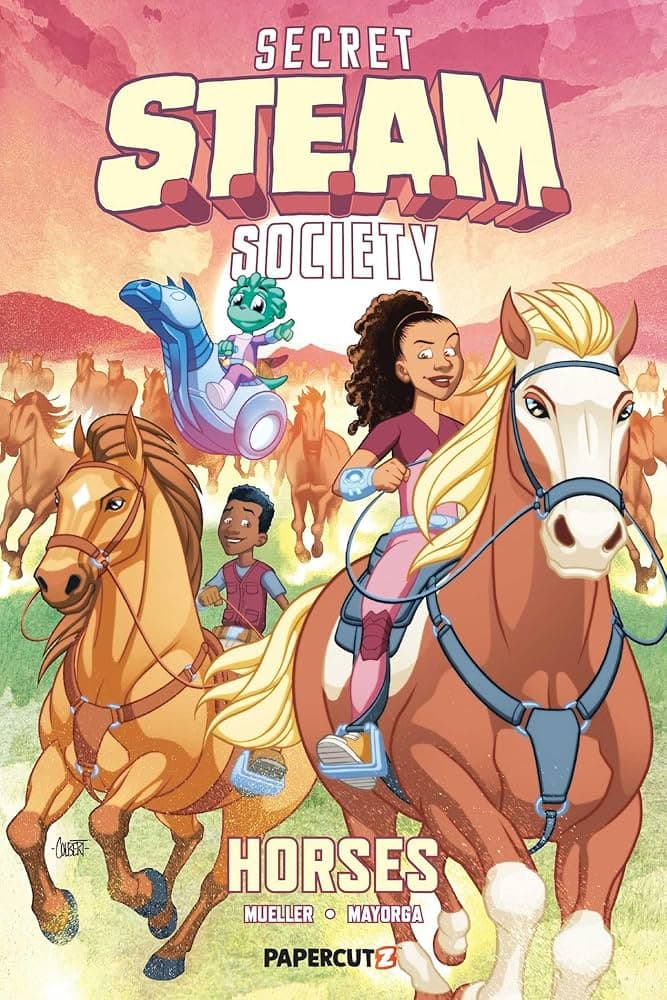
Pre-Order Secret S.T.E.A.M. Society vol. 1: Horses
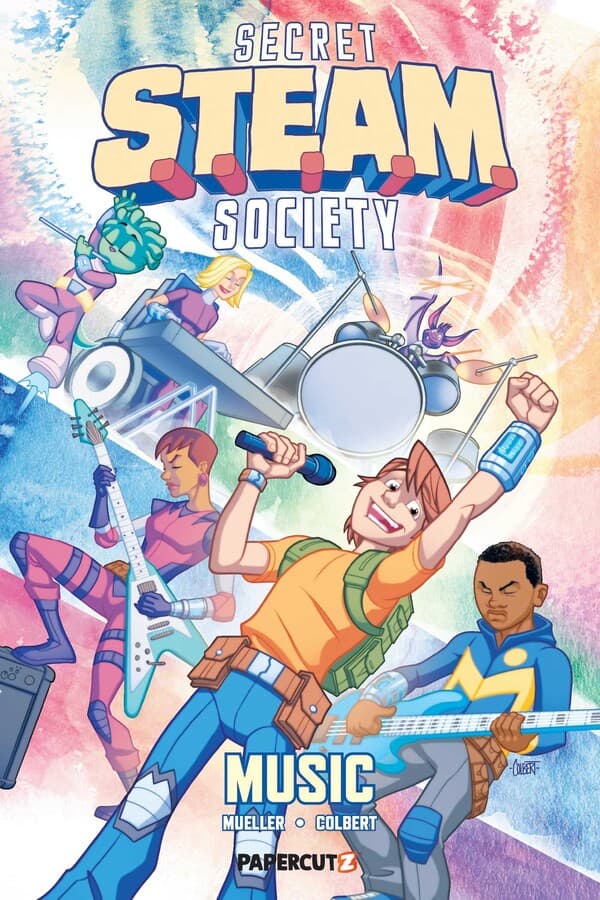
Pre-Order Secret S.T.E.A.M. Society vol. 2: Music
Follow Comic Book Yeti
🔗 Comic Book Yeti LinkTree: https://linktr.ee/ComicBookYeti
For partnership and ad inquiries, please contact: thecomicsyeti@gmailcom
Follow your hosts
🔗 Jimmy Gaspero: https://bsky.app/profile/jimmygaspero.bsky.social
🔗 Byron O’Neal: https://bsky.app/profile/byrononeal.com
PATREON
We have a new Patreon, CryptidCreatorCornerpod. If you like what we do, please consider supporting us. We got two simple tiers, $1 and $3. Want to know more, you know what to do.
ARKENFORGE
Play TTRPG games? Make sure to check out our partner Arkenforge. Use the discount code YETI5 to get $5 off your order.
Make sure to check out our sponsor 2000AD.

[00:00:00] Your ears do not deceive you. You have just entered the Cryptid Creator Corner brought to you by your friends at Comic Book Yeti. So without further ado, let's get on to the interview. Do you love sci-fi? Are you a horror fan? Maybe you prefer action or fantasy? 2000AD has it all and should be on your radar. With a whole universe of characters from Judge Dredd, Astronium Dog to Rogue Trooper, Shakara Halo Jones and many more,
[00:00:28] every weekly issue you get five action-packed thrills from incredible creators such as Garth Ennis, Rob Williams, Alex DeCampi, Dan Abnett and so many others. Get a print subscription and it'll arrive to your door every week. And your first issue is free or subscribe digitally. Get free back issues and download DRM-free copies of every issue for just $9 a month.
[00:00:51] That's 128 pages of incredible comics every month for less than $10. That's like a whole graphic novel's worth. All subscribers get amazing offers like discount vouchers and exclusive product offers. Head to 2000AD.com and click on subscribe now. Or download the 2000AD app and why wait? Start reading today. I'll put links in the show notes for you. Hello and welcome to Comic Book Yeti's Cryptid Creator Corner. I am one of your hosts, Jimmy Gasparo.
[00:01:19] And I feel like this episode has been a long time coming. This next guest, I feel like we've gone a little bit in some same circles on social media. He's had a couple of written interviews with Comic Book Yeti, but this is his first time on the podcast. He has Webtoons Nexus Point and Repossessed. There's Albert the Alien. He's had comics in a couple of different anthologies.
[00:01:43] We're going to be talking about some of his newest work, including Bat Pat, as well as the Secret Steam Society. I can't wait to get into it. We have so much to discuss. Please, welcome to the podcast, Trevor Mueller. Trevor, how are you doing tonight? I'm doing wonderful, Jimmy. Thanks so much for having me on. And congratulations to yourself on your own creator-owned book being greenlit through paper cuts. That's exciting, brother. Yeah, it is. Yeah, I'm very excited. So thank you very much. I really appreciate that.
[00:02:13] My brother told me I can't actually call myself a writer until Penny and the Yeti is published. So I'm like on the cusp. April can't come soon enough. Not that I don't enjoy being a lawyer most days, but really enjoyed the whole writing process with Penny and the Yeti. So thank you. I really appreciate it. But, you know, like I said to start, I've seen you, you know, I say I've seen you on social media, but like interacted on social media.
[00:02:41] I've seen some of the stuff that you've done and you I know you've done a few written interviews with comic book Yeti before because you have the webtoons. Like I mentioned, Nexus Point and repossessed repossessed is great, by the way. I love that. Well, thank you. And you've crowdfunded comics and you have have had comics with publishers in the direct market.
[00:03:03] Now with your bat, Pat and the two announced secret Steam Society books, I think courses and music, which they're fantastic. I can't wait for listeners to to hear about them, especially this episode is going to go out pretty soon after we're recording. So still have some time for your your your all ages stuff that's out for folks to pick up before the holiday season, because I think that Pat came out in October. Right. Yeah.
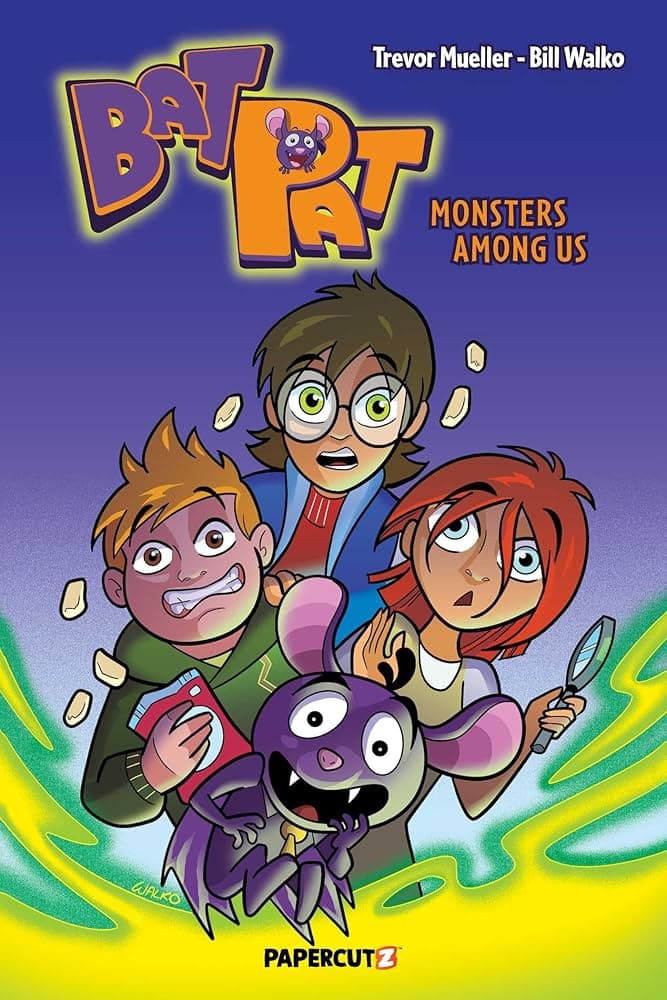
[00:03:32] Just about in time for Halloween. So a spooky book for the spooky season. But again, it's it's it's garnering on the silly side. So both both Bat Pat and secret Steam Society are licensed books. Right. So I don't own them. Bat Pat's actually an adaptation of a series from Italy called Echo in the Backpack. And it's a international bestseller. Apparently, it's really, really big over in Italy and Spain.
[00:03:59] And there was an animated series that they did translate over into English. I think it's probably streaming on Amazon Prime, if not YouTube or something like that. But they asked us to basically turn it into a graphic novel series. And I thought it was the cutest thing that I have ever seen. And the concept is very similar to Scooby Doo. Right. Like there's a talking animal. In this case, it's a bat and a group of kids who's their family. And they go out and they solve mysteries.
[00:04:27] The mysteries that these could solve involve real monsters. So there's supernatural situations that involve like real werewolves and witches and those types of things. But the monsters in these stories aren't scary. They need our help with something and they don't know how to ask for it. And that hook right there, I thought, really endeared the series to me. Because especially at a time when we've got people who think they can kind of do everything on their own, that don't necessarily know or recognize when they need help or how to ask for help when they need it.
[00:04:55] I thought that was a really sweet element to it. And something that was pretty refreshing and something that encourages kids to have conversations or to recognize signs in their peers and their friends and their parents and stuff. Who might need to talk about something. Right. And get something off of their chest. So Bat Pack is an adorable, adorable series. I'm really, really proud of that book. And we've got two more in the works right now.
[00:05:23] And we're in negotiations to see if they want to do any more adaptations for that series. And then Secret Steam Society as well, which we can talk about in a moment. But it's been a fun return to kids comics. Like I started off my career in kids comics and then I took a break for a bit and was doing stuff for teens and was crowdfunding some books for mature readers. And now I'm back to the kids books. So it's fun. Yeah. So for listeners who don't know, Albert the Alien is kind of, I guess, really where you started with comics.
[00:05:53] Albert's an international exchange student. And I mean, very well received comic book that you started in. And, you know, it is kind of interesting to kind of the stuff that you've done and now, you know, making your way back to all ages type of comics. Is that anything you had planned or was it just an opportunity came your way that you thought, oh, I can't I can't pass this up? I couldn't pass it up once I once I saw what Bat Pat was about.
[00:06:21] Again, how it resonated with me and how I thought that it might resonate with readers. So the return to kids comics was a very easy one. I often live my life based on a song written by a woman named Linda Kaplan Fair. You've probably heard it before. It goes a little something like, I don't want to grow up. I'm a Toys R Us. I'm very familiar with that tune. Yeah. I don't want to grow up. I'm I'm very much a kid at heart and a kid in spirit.
[00:06:50] And I have kids of my own. And so any time that I get to tell a story that they get to read and enjoy or with characters that they can identify with or look up to and aspire to be like is always a good thing. And a lot of the stuff that I've been doing with, you know, Webtoon for more teen audience or the mature readers books I did, Los Ojos and Demon City.
[00:07:10] Those are opportunities to stretch muscles, find new audiences, challenge myself as a writer to to see if I could tell a more layered and nuanced story for a more sophisticated reader. And then again, the chance to go back to kids comics is just a breath of fresh air. It's it's fun. It keeps me on my toes. I call it weaponizing my ADD. I'm I'm at any given time writing six or seven different series. Wow.
[00:07:35] That's amazing to be able to stretch, you know, your muscles like that to kind of do all those different things. I mean, I think all ages books are particularly challenging only because I think is maybe this is just a me problem. But I've seen it before because I with my kids, I read a lot of graphic novels and kids. I think sometimes, you know, we do this as parents, too. Our kids absorb a lot more and understand a lot more than we ever give them credit for.
[00:08:05] And I think sometimes certain writers, there's a real danger of not really appreciating that. You know, you don't ever want to talk down to, you know, an all ages audience. You don't want to make things too simple for for fear of kids not understanding or the material being too difficult.
[00:08:22] But the stuff that you've done, you know, so far and and and BatPat and what I've seen of the secret steam society, it's it really is kind of like pitch perfect for being being fun and engaging. You're working with like really interesting artists and collaborators because everything is bright and fun. And BatPat's also really funny. And it's it's like it's tough to make a good kids book.
[00:08:48] That's also, you know, funny without being, you know, corny or like right level of corny, I guess, is maybe a way to put it, you know? Yeah. With BatPat, we had some flexibility in there since it is an adaptation to to kind of update or localize some of the jokes a bit. We kept a few things in there because they were they were kind of random. And I don't know if it was just like a cultural thing or a translation thing or what was going on. But I was like, this is very random and therefore very funny. So I'm going to keep it in there.
[00:09:15] But you're right, like writing kids, kids comics. I feel like people feel like you're dumbing it down for an audience. And that's not the case at all. And I've never handled it that way. It's more so you are just not showing mature content, but you can still have mature themes in there. Albert the Alien has a lot of themes in there around peer pressure, around bullying and not just coming from peers, but also coming from adults.
[00:09:43] Because, again, he's a foreign exchange student from another planet. One of our antagonists in the series was was a government agent who was kind of like a stereotype of like a washed out action hero from the 80s who still thinks he's in the prime. And his name is Colonel Ty Fighter. Hey, I like that. And Colonel Ty Fighter is convinced that Albert is here as an invader, not as a student.
[00:10:10] And therefore, you know, he's going to unleash some alien weapon at any given time. And he was this antagonist that was really, really fun to write because he's so over the top and so goofy and so thinks that he's in the right, even though we as the reader clearly know that he's not. And kids pick up on that. They pick up on the subtleties. They pick up on the nuances and they pick up on the emotional elements that are pivotal to the story and the character arcs.
[00:10:35] And Albert as well, because he's an alien from another planet, a lot of our readers on the spectrum identify with him a lot as well. Because they also don't necessarily pick up on all the social nuances or those pieces, but they can see this character and identify with this character who's having fun adventures with his friends. And exploring everyday life on Earth and finding a way to turn the mundane into a wacky and fun adventure. And that was always the intention behind Albert.
[00:11:05] We've never tried to talk down to our audience. We've always tried to talk at their same level and have stories and situations that they can relate to. So at no point is, you know, Albert ever filing taxes or deciding that he wants to interview for a job as an actuary. None of that is what he's into because that's not part of a world when you are 12 years old and you're in seventh grade. You know, you're dealing with schoolwork. You're dealing with social situations.
[00:11:34] You're dealing with, you know, one of our books deals with the pressures of having to perform a stage performance. They have to put on Romeo and Juliet for their parents. And the show gets hijacked by a bully who's decided to make it all about him. And he's citing Shakespeare poorly. Like it. So, again, like it's silly. It's funny. And it's me tapping into that inner child and myself. You know, I had to read Shakespeare and Romeo and Juliet in front of a classroom when I was in seventh grade.
[00:12:03] That's required reading at that time. And I get social anxiety when I've got to perform or stand up in front of a group of people. Now, 20 years into doing comic books and having been a guest of honor at multiple shows and having to be, you know, in front of 2000 people and opening ceremonies and talk about myself for two to five minutes. You wouldn't guess that I have that social anxiety. I've trained myself to get over it. But it's still a thing that's there. And I very much consider myself to be an introvert.
[00:12:31] And because of that, like there's a there's a long recovery time on the back end. I feel like a lot of creatives do tend to find or to file into that column of introversion. But there's a long, long winded answer to basically kind of say, like, you find the things that the reader resonates with, the things that are going to be most relevant to them. You don't talk down to them about it and they'll connect to the characters if they identify with the characters. And then you put them on a fun adventure, pull silliness in there and some things that will make them laugh.
[00:13:00] And they'll keep coming back to that book over and over and over again until it's dog eared and the covers falling off. Well, and that's the best. That's what you want to see. Right. Right. With BatPat, was this the first time that you ever adapted something else? Yeah, it was. And also from one media to another. So, again, like we were given scripts for for the series. We were given episodes of the series.
[00:13:24] We were given copies of the book so that we could get a flavor for what it was all kind of based on and how it all kind of came together. And, you know, they're 12 to 13 minute episodes. They're fitting into 18 page issues, all of which there's maybe three chapters that get collected within each of the books. And so but things that work in animation don't necessarily work in comics and vice versa. Like some of the episodes would have montages of them trying different solutions to solve the problem with one of the monsters.
[00:13:54] And there's no talking during it. Or they'd have silent openings where there's like a character riding a bike and then something happens. And then, you know, it sets off the conflict, the inciting incident. That doesn't translate to comics without some kind of narrative. You have to set that stage. You've got to help set the reader up. And because it's kids, you're trying to do it in as few words as possible so that you can capture them as quickly as you can.
[00:14:18] So I feel like, you know, Adam Malenta, the editor on there, knew that I had a background in kids comics, knew that I had the ability to talk to that audience and make things that resonate with them. And because I've been working in indie and self-published comics for over 20 years, I know how the media works. And because of that, he had permission to not worry when he had to give me the project. And that's one of the reasons why I feel like Paper Cuts continues to give me a lot of work right now.
[00:14:48] I hit all my deadlines. Heck, I usually make my deadlines. I'm like, this is when it's going to be done. You cool with that? Cool. And then they just let me go. And I have set the standards over there in some instances, or at least so he's told me, in terms of how he likes to work with creators. Because I'm giving him a schedule. I'm giving him regular touch bases and check-ins. I'm giving him all the elements that we have promised and that we are supposed to deliver.
[00:15:16] And everything attached to my books, at least from my perspective, tends to be ahead of schedule. And that makes his job easier. And that makes him look good to his bosses. And that's a great way to make it in the industry, right? Is make your editor look good. If there are any would-be creators who are listening, do not underestimate the power of making your deadlines and making the editor's job easier. 100%.
[00:15:44] And again, that's why Adam is giving me all this work. And I think Steam might have come before Bat-Pat, if I'm being honest. Because he had told me that he was launching a brand new line. Something that Papercuts had never done before. And because Albert the Alien started in an educational anthology that I used to be the marketing director for called Reading with Pictures, right? They're licensed 501c3, whose mission was to get comics into schools and libraries around the world.
[00:16:13] And so Albert started off in these anthologies that had educational elements and components to him. So he knew that I knew how to mirror story and education. And he was launching this line where he was like, it's going to be kind of Magic School Bus inspired, where it is an equal measure of learning and adventure. And the emphasis is really on the adventure, because he wants these stories to be fun for kids so that they don't realize they're learning something while they're going on with it.
[00:16:42] And because we were kind of figuring out the tone and the pace of things at the beginning, I think I was the first writer he had engaged for this. So it's, you know, how much conflict can you put into it? How much story can be within the graphic novel versus the educational beats that we're trying to hit? Can we have interpersonal conflict within the stories, arcs that characters kind of undergo? We were figuring all that stuff out as we were going through it.
[00:17:09] And I feel like we had a really good vibe with the first book. And so when he had approached me, he just told me he was doing the line, but didn't necessarily have a topic. And he's like, what's something that you're very passionate about? My youngest daughter really loves horses. That is her favorite animal by far. She is very much a daddy, I want a pony, and I'm serious about it. And also I know how to feed them and everything else, right? Like she knows more about horses than I do.
[00:17:35] And so I told Adam, I was like, this is kind of a blessing in disguise because it gives me a chance to research horses, to learn as much or more that she does. And to tell a story about characters that she's going to care about and resonate with in a situation dealing with an animal that she's highly passionate about. And so that's how horses came to be. Look, I don't know a lot about horses at all.
[00:17:58] I think the last time I was on a horse was, it's got to be 20 years ago at least, when I was at the Grand Canyon and rode a horse around for a little bit. But I do love an educational chart. And I do love learning something still at 46 years old in a fun way.
[00:18:16] And as I was scrolling through the Secret Steam Society horse book and there was a chart about all the different parts of the horse and what they're all named, I'm pretty sure I learned that the coffin bone, I think, is the largest bone in the hoof that gives the hoof its shape. So I do like a nice graphic novel with a chart. But I was like, I was like, oh, man, my kids are going to learn so much about horses. It's a lot of fun.
[00:18:43] Again, as they're learning about the inside of the horse, like they go inside of the horse, like they have an adventure inside of the horse in this little shrinking ship. Because Adam was very adamant about wanting to have the kids explore, not just talk about elements. Yeah. And so my question to him, again, was I was like, well, how do they like what happens for them to shrink down and go inside something? Do they have a ship? Do they just have like a suit? Like and we had to create that stuff on the fly.
[00:19:11] And so, again, it was a really, really fun challenge to kind of co-authors, not the right word, but to kind of help pioneer and trailblaze a bit in this world with him. And I think after we got a book or two under our belts with it, we really started to get into a groove. And so, again, he just kept sending more and more of those projects to me. They've they've announced three books in the series so far, and I'm writing two of them. So it's it's exciting. It's a fun line.
[00:19:39] I think it's going to be great for parents, for teachers, for librarians and something that can actually be used in a classroom setting, but also a book that kids will want to pull off of their own shelf at home and read casually. Yeah. Yeah. I don't I don't want to misconstrue any, you know, or lead listeners astray in my excitement over the the horse chart. But it's again, the artwork is a lot of fun. The story itself is a lot of fun.
[00:20:09] Like it is it is a book that I think like especially my youngest, Penny, who's eight, I think she would it would be the type of graphic novel that she would gravitate towards and and really love. So I think that's, you know, fantastic. What do you think it is, you know, about comics or storytelling with you in particular?
[00:20:29] Because you come across to me as somebody who really does thrive with a particular challenge, whether or not it's adapting a story, whether or not it's, you know, as you just discussed, coming up with how exactly we're going to present this material for secret steam society.
[00:20:45] You know, working with Webtoons with Nexus Point and Repossessed and telling a story that's in a vertical scroll, which which I think takes a little bit of a different kind, you know, of I working with an artist to kind of get that vertical scroll right rather than working maybe towards like a page turn.
[00:21:06] What do you think it is that that you really do you just like storytelling or do you really thrive in trying to like figure out the puzzle of the best way to tell this story? You know, I think it's a little bit of both. I always considered myself to be both a storyteller and a problem solver. You know, my day job back when I had a day job was in marketing. And I always told people I don't consider myself a marketer.
[00:21:33] I consider myself a problem solver, which gave me a lot of versatility when it came to the types of projects that they could put me on because I didn't necessarily need to understand currently how a system worked in order to figure out how to fix an issue that was going on. And storytelling can be very similar. Where does the story begin? Do you start in the beginning, in the middle, at the end and then flashback? Right. Like how how do you want to structure those stories?
[00:21:57] How do you reveal the beats of characters and the arc and have proper pacing throughout there so the reader is intrigued, not exhausted, not bored? Right. And keep those pace up. And again, I like to think of it as just weaponizing my ADD. I like to play. I like to experiment. And if I can do that in different media and different genres, then I would. My passion when I was growing up was actually going to be in filmmaking.
[00:22:26] But making movies was expensive back in the 80s and 90s. And we didn't have a device that fit into the pocket of our jeans that could actually record video. So comics became the easiest and least expensive way for me to be able to tell visual stories. And so that's what I ended up doing. And I've just never stopped doing it. And even with film today, because I, you know, having gone to conventions for over 20 years, you meet people.
[00:22:55] I'm friends with almost all of the original cast of Power Rangers. And several of them have gone on to do other other works directing and producing. And some of them still do acting and anime and video games and whatnot. And one of my buddies was saying that he wanted to get back into making movies again because during COVID he made a short film. And it kind of got the passion reignited in him.
[00:23:16] And so he just had me assigned on as his associate producer for his first feature length film that he wrote and directed and produced and starred in and did all special effects for and the music and all that stuff. And again, like it was it was storytelling in a different in a different media and in a different format because comic book scripts, I'm sure, you know, are very flexible. Right. Like there's not like a hard and fast template for how that is.
[00:23:42] That is a lot less the case in film, I have discovered, where there is a much more rigid structure and a much more rigid template to be in there. So when we sit there and we talk about just comics, I try not to just limit my storytelling to just that. That just tends to be the thing that I gravitate towards and I have the most experience in, but would love to continue to expand into prose novels and to, you know, more film projects and those things down the road. And who knows, maybe some things will go. We'll see how his movie does.
[00:24:12] And maybe there'll be more opportunities to do that, too. But you're right. It's it's different. It's challenging. It's fun. And it keeps me on my toes. It keeps me learning. And I like to consider myself a student of storytelling. Oh, that's awesome. That's a good way. That's that's a good answer. I think I appreciate I appreciate that. Having been in, you know, telling stories, whether or not it's comics or some other medium for 20 years.
[00:24:39] I have a friend who is also a writer who who has written films and plays and he finds it very difficult to enjoy a lot of stuff now because he can't stop guessing the ending or picking things apart.
[00:24:56] Do you have that issue as well? Or are you still able to enjoy things and like turn off that the storytelling or the problem solving part of your brain and just enjoy a story or enjoy a movie or a TV show? It's a bit of both. I can usually see how the formula works and what's going to happen next. That doesn't necessarily take away the enjoyment. And sometimes I get pleasantly surprised that I'm wrong.
[00:25:22] And you never know. Right. I mean, I just finished watching the third Knives Out movie and like I could tell probably 10 to 15 minutes into the movie who done it. Didn't know why. Didn't know how. So there was still an element of mystery and enjoyment to unpacking the mystery. And also I could have been wrong. Right. And there are times where I'll sit there and I'll look at my wife and I'll be like, I think I know who did it. And she'll be like, don't tell me. Yeah. And then we'll watch and I'll be like, oh, no, I was wrong.
[00:25:50] I don't think that the ability to recognize structure, to recognize patterns in storytelling is is necessarily a thing that takes away from the enjoyment. And then there are some things that I will just let myself turn my brain off and and kind of watch it. I got really hardcore into the pit on HBO Max and I'm really excited for season two in January.
[00:26:13] It's a medical drama. I'm not a medical drama kind of guy, but the way that they do character in their show was so fascinating to me. And again, very visual. It was a lot of show don't tell. And they really used film to an effective degree in a way that I haven't seen done in a while and certainly not in a medical drama.
[00:26:36] And so I really, really enjoyed that series. And I'll go back and rewatch stuff that I already know how stuff goes and whatnot, because sometimes I want I want to be reminded on why did it make me feel a certain way or why did certain characters or certain scenes stick out in my head? Because I might recognize that they stick out. I don't necessarily always recognize why.
[00:26:56] And so as I'm continued to learning or as I continue to learn about new techniques in storytelling and new ways to kind of adapt things from film to comics, to other media, I'll go back and I'll rewatch and I'll notice things before that I never noticed the first seven times that I watched a thing either.
[00:27:17] And again, I think that that constant process of learning and that constant enjoyment of being able to apply something new to something that you've seen before or something that you're watching for the first time continues to give new reverence for it and gives you reasons to go back and re-experience things that you've already experienced before.
[00:27:37] It's interesting you say that. I have a difficult time going back and watching something I've seen already, unless it's a comedy. Comedies I can do that with. Other types of dramas or suspenseful shows, I have a difficult time. You can correct me if I'm wrong, but there was something on social media not that long ago, like name a movie that you've seen more than six times or something.
[00:28:05] I thought you had a very interesting choice, if I'm thinking correctly, that yours was Memento. Yep. And I thought that, because I feel like that's one where the first time I saw it, I don't know if I've ever watched it a second time, but multiple viewings. I was just curious.
[00:28:24] Like, are you still, is it just that you really, you really loved it? You really loved the Guy Pearce or Christopher Nolan, or was it, you're still picking up stuff about how that story is told in the re-watch? What's interesting to me about that story is it's a very simple tale told in a way that keeps you on the edge of your seat and constantly guessing because of the editing and the order in which it's told.
[00:28:51] So it allows you to experience the film a bit like the character experiences the world, because he wakes up in a diner and he's looking down at like a picture in his hand and he doesn't know where he is. He doesn't know why he's there. Then somebody sits down and starts talking to him because they just got back from the bathroom or something. And he has to play along like he knows what's happening. And I'm like, that's fascinating.
[00:29:14] And they've made cuts of that movie where you can watch it in order. And I did that once and I'm like, this does not have the same effect. This is not as interesting of a movie when it is, when it doesn't have that element working for it. And so I really enjoy that movie from a discovery standpoint and that want and desire to keep your audience guessing as to what's going on. I recently rewatched Pirates of the Caribbean, the Disney movie, because my kids had never seen it.
[00:29:44] And I was like, all right, the first 10, 15 minutes of this movie before they see zombie pirates is probably pretty OK. And so we did that. And there's a lot of questions and mystery in that movie as well that, again, are mostly displayed kind of visually. The first time Jack Sparrow shows up, he is on a sinking ship, right? And he's toasting into this port and then he's acting funny around the soldiers and the and the guards that are there.
[00:30:08] And then when he ends up running into Will Turner and they have their battle and he pulls out his pistol and he aims it at him. He's like, move aside. He's like, no. And he's like, please, this shot is not meant for you. And then it gets clubbed over the head. And so you as an audience again are on the edge of your seat like, well, who's that shot for? And what is he doing in Port Royale? And how did he get there in the first place with a sinking ship?
[00:30:31] And I like that element of storytelling. And I feel like a lot of modern cinema tends to miss that is that enjoyment and that thrill of trying to understand what comes next. And you're right. Like there can be a component there where if you're rewatching it multiple times in a short time span, it's less enjoyable because that thrill is no longer there. You already know what's coming. But I haven't watched Pirates of the Caribbean in 20 years. Right.
[00:30:56] And so that thrill was there again. And so I feel like it's not necessarily that I can't go back and rewatch a movie and still enjoy it in that way that you're describing. I think it's just a matter of time. Right. How much time elapses between the last time I watched it and the time that I'm watching it next. And and same thing with storytelling. I mean, you can see the plethora of graphic novels that I've got behind me here and I'll go back and I'll reread them all the time.
[00:31:23] Not necessarily like every year, not necessarily every two years, but every now and then I will I'll be like, you know what? Crisis on Infinite Earths. It's time to crack that open again. Kingdom come. Got to got to give that a reread. Need to appreciate a couple of panels in there. Alex Ross is great. Mark Wade's a genius late, you know, and I love that ability to kind of rediscover again. It's it's almost like putting nostalgia goggles isn't the right term because I feel like that is a negative stigma attached to it.
[00:31:50] But it's it's like allowing yourself to be that kid again and go back and re-experience that stuff, too. Now, that's awesome. All right, everybody, we're going to take a quick break. We'll be right back. Y'all, Jimmy, the Chaos Goblin strikes again. I should have known better than to mention I was working on my DC Universe meets Ravenloft hybrid D&D campaign on social media. My bad. He goes and tags a bunch of comics creators we know.
[00:32:15] And now I have to get it in gear and whip this campaign into shape so we could start playing. Another friend chimes in. Are you going to make maps? It's fair to say it's been a while since I put something together. So I guess question mark. It was then that I discovered Arkham Forge. If you don't know who Arkham Forge is, they have everything you need to make your TTRPG more fun and immersive.
[00:32:37] Allowing you to build, play and export animated maps, including in-person Fog of War capability that lets your players interact with maps as the adventure unfolds while you, the DM, get the full picture. Now I'm set to easily build high-res animated maps, saving myself precious time and significantly adding nuance to our campaign. That's a win every day in my book. Check them out at arkhamforge.com and use the discount code YETI5 to get $5 off.
[00:33:05] I'll drop a link in the show notes for you. And big thanks to Arkham Forge for partnering with our show. I think I'm going to make Jimmy play a goblin warlock just to get even. Welcome back. My brother and I, every year, go to Baltimore Comic Con. I know you were at Baltimore this past year. I think you've gone there before. And I was bummed because I was hoping to get by to actually talk to you. I think I waved hello at one point and I never had made it back there.
[00:33:33] And you've been going to conventions for years. And I wanted to ask in terms of your convention experience, because you have written for teens. You do have your very popular webtoons. You have written stuff in terms of that you've crowdfunded that are more mature and kids. What is your convention experience like? Do you get all manner of folks? And how do you navigate between, all right, I have my teen section here.
[00:34:03] I have my kids all ages section here. Yeah. And in particular, like how is, you know, Baltimore as a show for you? I love Baltimore. I have been going to Baltimore. So when we were talking about Albert the Alien, Albert the Alien, early on when it came out, got nominated for two Harvey Awards back when those were hosted from Baltimore Comic Con. Now they host the Ringo's. But that's how I got introduced to the showrunners and the people that run the show.
[00:34:28] So I was invited there as an award nominee, which was, again, very humbling and a gracious experience. And I've just been coming to that show as a guest ever since. So they'll put me on the billing. I think this year I was on the same marquee as Chris Claremont. And I was like, what? Did they just put all the bald guys together? And they were like, that's that's the because I don't have the body of work under my belt that that guy has. Well, wouldn't that be funny if that's how they did it?
[00:34:56] It's like, wait, it's Chris Claremont, Trevor Mueller, Arthur Adams. Yeah. But I have been very, very lucky and very blessed in my time as conventions because I started off going to conventions as a guest of honor. I had a couple of friends that knew people in the local Chicago area that that ran conventions. They were on the guest dockets already and they took me under their wing and they got me invited.
[00:35:22] And through that, I got to start networking with folks who spun off and started doing their own conventions and whatnot. And I continued to kind of get that guest experience. So my experience with with conventions has always kind of been through that lens of I'm there for the attendees. I'm not necessarily there for me. Like my job as a guest is to make sure that people have a good time. They want to tell their friends and they want to come back next year and bring their friends with them so that attendance continues to grow.
[00:35:48] And the convention hopefully credits some of that back to me and keeps bringing me back to the show as well. And so because of that and possibly because of the fact that I like so much diversity on my table, my goal as a creator is to have something for everyone on that table. Now, the challenge you start to run into is real estate because you've only got a six, maybe an eight foot table. Baltimore was kind enough to give me two eight foot tables this year. It was in a nice corner spot and I did not bring enough books for that show.
[00:36:17] But then you've got to try to keep the kids over by the kids books and not gravitating towards like the bright yellow neon adult book that's on the table, which is my Demon City book. I make the mistake of using like bright primary colors in the covers for my books that aren't for kids. And that's immediately what the kids gravitate towards. So I do tend to kind of segment them out. I do try to have sections on my table for like these are the books for kids. These are the books for teens.
[00:36:47] These are the books for for mature readers. And and I try to make sure there's enough spacing in between them so that hands don't accidentally grab something that they're not supposed to. I make sure those books aren't aren't directly next to each other. And if I can, I'll try to put the kids books and mature books on opposite ends of that table. So that and parents seem to appreciate that. So I used to go to 18 to 22 conventions a year before I got married.
[00:37:17] That was exhausting. And the idea of doing that anymore is alone is exhausting. Now I do about five days. Oh, OK. And a lot of them tend to be around the Midwest and I'll do a couple of coastal shows. But again, it's it's it's fun to see those convention goers and what they take from those experiences. And one of the reasons why writing kids comics is so rewarding. I'll I'll end on this story.
[00:37:42] My first convention, I had self-published a book that was based on a web comic I was doing at the time, which has a vulgar little title called asshole. I was listening to way too much Dennis Leary stand up. It was very much a, you know, a teenage boy, Kevin Smith humor style kind of story. Sure. But with a bright red or that kids would instantly gravitate towards. Uh, and and so I was standing next to my buddy and I was selling this book and I self-published it.
[00:38:11] I'd put all this hard work into it and I looked at him. I was like, man, is there a better feeling than like putting all this effort into a project and then being able to hold it in your hand and see it realized? And he goes, yes, it is. Yes, there is. Seeing that same book in somebody else's hand while they're waiting in line to pay for it. And he was not wrong. That is an addictive feeling. And you get those people coming back to your table every single year saying, what do you got for me next? What do you got for me next? What do you got for me next?
[00:38:39] And, you know, I, the, the asshole books, when I was, when I was touring with those books, I saw a lot of kids and families at conventions. There were not a lot of books at the time out for younger readers. And again, I was like, I can tell kids stories. So that's where Albert the alien kind of came from. And we, I got to a point to where I was so focused and so fixated on Albert for, for many years. I think we worked on that book for maybe four or five years. And our audience started to age. We had kids that started with us that were 10.
[00:39:07] They were now 15 and they came back and they said, well, what do you got for me? That's next. And also I'm, I'm, I'm a little too old for Albert and I didn't have anything. And I didn't like that feeling. Yeah. And so that was why I was like, well, well, what are teens reading right now? What are, what are teens interested in? What can I do? And what's the difference between what I've been doing for young readers and what I can do for teens? And through research found that Webtoon was like the big platform that teens run.
[00:39:37] And I was like, well, now I got to get on Webtoon. And, and now that's a different format because now I'm doing a vertical scroll comic instead of a page turn, you know, print book. And, and, and I kept doing all those things. And then now I've got, I've been doing this for so long that I've had audiences that started with me on Albert the Alien, young kids who now have kids of their own. And they came back and they're like, well, you know, what do you got for my kids? Great. I'll take some of those. And now what do you got for me? Cause I'm in my thirties or I'm in my forties.
[00:40:05] And I was like, well, let's try, let's try making something R rated. And so that's really kind of how the evolution of my career has gone. And I'm, I'm a, I'm a huge advocate for self-publishing. My, my creed is that it's never been harder to be published. It's never been easier to make a comic book. And there's nothing that should be stopping you from telling the story that you want to tell. And I'm the kind of person that I will pitch out the stories that I want to tell to publishers and to editors. And if they say no, I'll just make it myself.
[00:40:35] And that's what happened with Albert. Like Albert was in some anthologies. We made a couple of single issue stories. We kept shopping around to publishers. Nobody wanted to pick it up, even though it had been nominated for two Harvey award. And I was like, you know what? I'm just going to make it myself. And I just kept doing it. And that's really just been the credo of my career of, you know, I keep failing upwards, I guess. Nobody can stop me from telling the stories that I want to tell unless nobody's buying them. Yeah. And thankfully people keep buying them. So I just keep making them.
[00:41:02] Well, I don't, I don't know if it's failing upwards, but you've said a couple of things that kind of have keyed into it in terms of, you know, your, your, your earlier career being a marketer. Someone that likes problem solving. Like you definitely seem like the type of person where you, you want to tell your stories, but you're, you are going to find your audience. Like if the problem is, all right, how do I get this book to the right person?
[00:41:32] And like, you have definitely, you know, go on the route to, to do that. And it's just, it's just very fascinating. And I, I mean, I think it's fantastic and, you know, not, not just to be able to do it, but to be able to do it well and to see these books. And, you know, I've gone through a bunch of them myself and yeah, they're just some fantastic stories. You work with wonderful collaborators. So yeah, I think it's, it's, it's fantastic. Thank you.
[00:42:01] I've, I've been very lucky to find amazing artistic partners and fellow creators that want to work with me. And even when a project ends, if I like working with a person, I will find a reason to work with them again. Like, I mean, we made Demon City Volume 1. That was a COVID baby for me. I think we probably started doing that in like 2017, 2018. And, and again, we were shopping around to publishers. COVID was going on.
[00:42:29] It was, it was a bit of a wild and crazy time in the publishing world. And, and then we finished it probably in 2021, 2022. It didn't come out until last year. Yeah. Right. Or, or earlier this year, February, might've been February this year, actually. So there was a long window there. And part of that was just my own apprehension. It was, hey, I'm kind of known as like the kid's comic writer. And this is a very R-rated book. Are my fans going to accept it? Are they going to reject it? Are they going to reject me?
[00:42:58] Will I put this on Kickstarter and it will be the, a colossal failure? And it was a lot of that self-doubt that was holding me back. And eventually I, I, I did Los Ohos on Zoop because I was very apprehensive about going back to crowdfunding. And Zoop's big selling point was if you pay us an extra percentage, we'll do it all for you. We'll do the marketing. We'll do the, the, the printing. We'll do the fulfillment. We'll do all that stuff for you.
[00:43:25] And I was like, all right, if somebody else can, can do that and all I got to do is make the book, then we'll do that. And, and they did a phenomenal job of connecting me with people like yourself and, and, and other websites, podcasts to talk about indie comics. And I, I was brought kind of back into this subcategory of indie comics community that I'd probably been tentatively aware of and was following a handful of people, but hadn't been like a huge active participant in.
[00:43:55] And so the, going back into that community and seeing what the other creators were working on and seeing how much their passion drives them and how they can feed off of each other's energy and, and share ideas in an open environment. And it's, there's, there's a saying that I, I, I see happen a lot in artist alleys at conventions where, you know, if somebody buys something from somebody else, they feel like they stole that sale from, from them.
[00:44:22] And I'm like, that's not the case at all. Like it's very much a community, not a competition. And if they bought something from somebody else, it just means that they had something that that audience really, really wanted. And that's opportunity, right? That's not taking away from you. That's opportunity for you to figure out what that is. And if you want to mimic it, if you want to get that audience back, then figure out how you turn that into something that you own and you control something that's in your voice or in your style.
[00:44:49] And again, that, that I feel like is empowering and inspiring and encouraging. At least that's what I take away from it. And so again, being able to come back into that indie comics community, uh, and, and be embraced by it as somebody who's been doing comics for 20 years, uh, again, was reinvigorating and gave me confidence. And that's why that's when I was basically like, all right, two months later, it's like, you know what? Demon City's ready to go. Let's just pull the trigger. Let's just do it.
[00:45:17] I've got that momentum behind me. The wind is in the sails and now I'm ready to keep going. And now we're working on volume two. Yeah, that's awesome. Uh, can you just real quick, because I don't, I love the concept of, of Demon City. Can you just tell listeners the, the, the, the, the kind of log line or elevator pitch, however you want to do it at Demon City?
[00:45:37] Sure. Demon City is kind of like bad boys meets hell boy. It is a post-apocalyptic murder mystery buddy cop story that literally takes place after the biblical apocalypse. Demons from hell for 30 minutes spew up into earth and then all of a sudden it stops and now they're stuck here. It's a premature apocalypse. I'm told it happens to everybody.
[00:45:57] And the main story takes place three years after that event called end of days. Uh, the, the three years after that event, uh, the first demon detective has just caught his first case, which is the last homicide that will ever happen because someone has just murdered death and now no one else can die.
[00:46:14] I love it. I mean, that's so good. Yeah. Yeah. So we're, again, we're working on the, the sequel right now, which does not have as pithy of a pitch for it right now, but the idea behind it is how do you solve a murder with no body, no evidence, no crime scene, no weapon. There's nothing there, but somebody died. Oh, that's fantastic. Yeah. Trying to keep the supernatural mystery of it, of it going. Uh, cause again, I'm, I'm a big fan of buddy cop stories. I love lethal weapon, die hard.
[00:46:44] Bad boys, uh, uh, alien nation from back in the day. Oh yeah. Like of all. Yeah. Rakeem S O'Brien, um, both the series and the movie. I was going to say both the, the, the, the movie and the, uh, cause the movie was what James Kahn and Mandy Patinkin. Am I insane? Yep. No Mandy Patinkin. Yep. So, and, and again, what happened was I, I was like, I wanted to write a buddy cop movie or a buddy cop story.
[00:47:10] And I went back and I started rewatching a bunch of old buddy cop movies and TV shows and stuff like that. And I, I rented alien nation for my library. I found it at my library on a whim. It was just there. Like I wasn't looking for it, but I was like, Oh, I remember that movie. I would watch that again. And again, it was like that sci-fi buddy cop. I was like, well, what if I did like supernatural buddy cop?
[00:47:32] And it felt like a thing that I could own and something that I could have a, a put my voice in. So I, yeah, I, I enjoy that stuff. It's fun. I got pitches for days. All right. Well, keep pitching them, keep making them. We'll keep reading them. Uh, and you can come back on the podcast, uh, please. And, and, and talk about them. Um, I don't know how old, I know you said you had kids. I don't know how old your, your kids are, but are, are they of an age where they have read any of your stuff? Are they at all?
[00:48:02] I always like to, you know, talk to, to parents about it's so tough to get, it seems to have your kids be even a little bit impressed with anything you do. Are your kids like of an age where they understand that, Oh, dad wrote this and that they, uh, are excited by it. Uh, I wouldn't say they're excited by it, but they have read all my young readers stories that have been published so far. We've, we've read Albert the alien. They've read that. I'm sure they'll read secret steam society. Uh, again, my youngest,
[00:48:31] who's into horses is very excited. The fact that the first book is horses. She's like, daddy, you're going to buy that for me, right? I'm going to get to read it. We're going to read it together. We need to read that book. Um, so she does get very, very excited for that. Oh, that's awesome. Uh, but the biggest compliment to me with my kids is that when we read a book that I have written or when I go off to an event convention, library event, whatever it may be, whenever I come home, they go, daddy, daddy, I'm making a comic book too.
[00:49:01] And again, to me, that's the compliment. It's not necessarily the excitement about the work that I've done, but the inspiration that I've given in them to tell their own story. And I will, I will live off of that inspiration forever.
[00:49:16] That's awesome. Yeah. Oh man. That's the good stuff right there. Uh, well, Trevor, thank you so much for, for coming on the podcast. Uh, listeners, I will put everything in the show notes. You can go and you can go on web tune and read nexus point and repossessed. Uh, you can, I'll put links so you can follow Trevor on social media and I will put links so you can pick up bat pat, uh, and be ready for a secret steam society.
[00:49:45] All of those are through paper cuts. Uh, and, uh, yeah, and I'll put links. So you'll be able to get to any Trevor's other stuff and, you know, you'll follow him so that you will be able to be notified, uh, when, uh, demon city two is out. Cause I really like demon city one. And, you know, so, so you have plenty of stuff. If you have young readers in your life, you got them covered. And then there's even going to be a little something for you that I know you're going to like. So, um, but yeah, Trevor, this has been,
[00:50:15] an absolute pleasure. I apologize. It has taken so long to get you on the podcast and talk to you, but I just, I, I, I love your positivity and attitude on social media. I love the stuff that you've done so far. And this has just been an absolute, uh, honor for me to be able to chat with you for, uh, the past 50 minutes. So thank you so much. And, um, as we record this happy holidays and, uh, have a happy new year.
[00:50:45] Yeah. To you as well. And to your listeners as well. And thank you again so much for having me on the, the podcast finally to, to talk to you. It has been an absolute treasure. So thank you. Well, I, I really appreciate that. Um, and yet listeners, uh, rate review us, do all the fun things they, they tell you to do. Uh, shout out to my brother, Bobby, the cryptic creator corners, number one, most dedicated fan. Bobby listens to all my episodes, goes to Baltimore, uh, with me. And he, he does, he listens to all the episodes and he likes when I say his name. So,
[00:51:13] Hey, Bob. And, uh, yeah. Thanks again. Oh, there you go. You got a greeting from Trevor too. All right. Uh, so yeah. Thank you so much listeners for, for listening and, um, good night. I'll see you next time.
[00:51:28] This is Byron O'Neill. One of your hosts of the cryptic creator corner brought to you by comic book Yeti. We hope you've enjoyed this episode of our podcast. Please rate review, subscribe, all that good stuff. It lets us know how we're doing. And more importantly, how we can improve. Thanks for listening.
[00:51:48] If you enjoyed this episode of the cryptic creator corner, maybe you would enjoy our sister podcast into the comics cave. Listen and subscribe wherever you get your podcasts.