
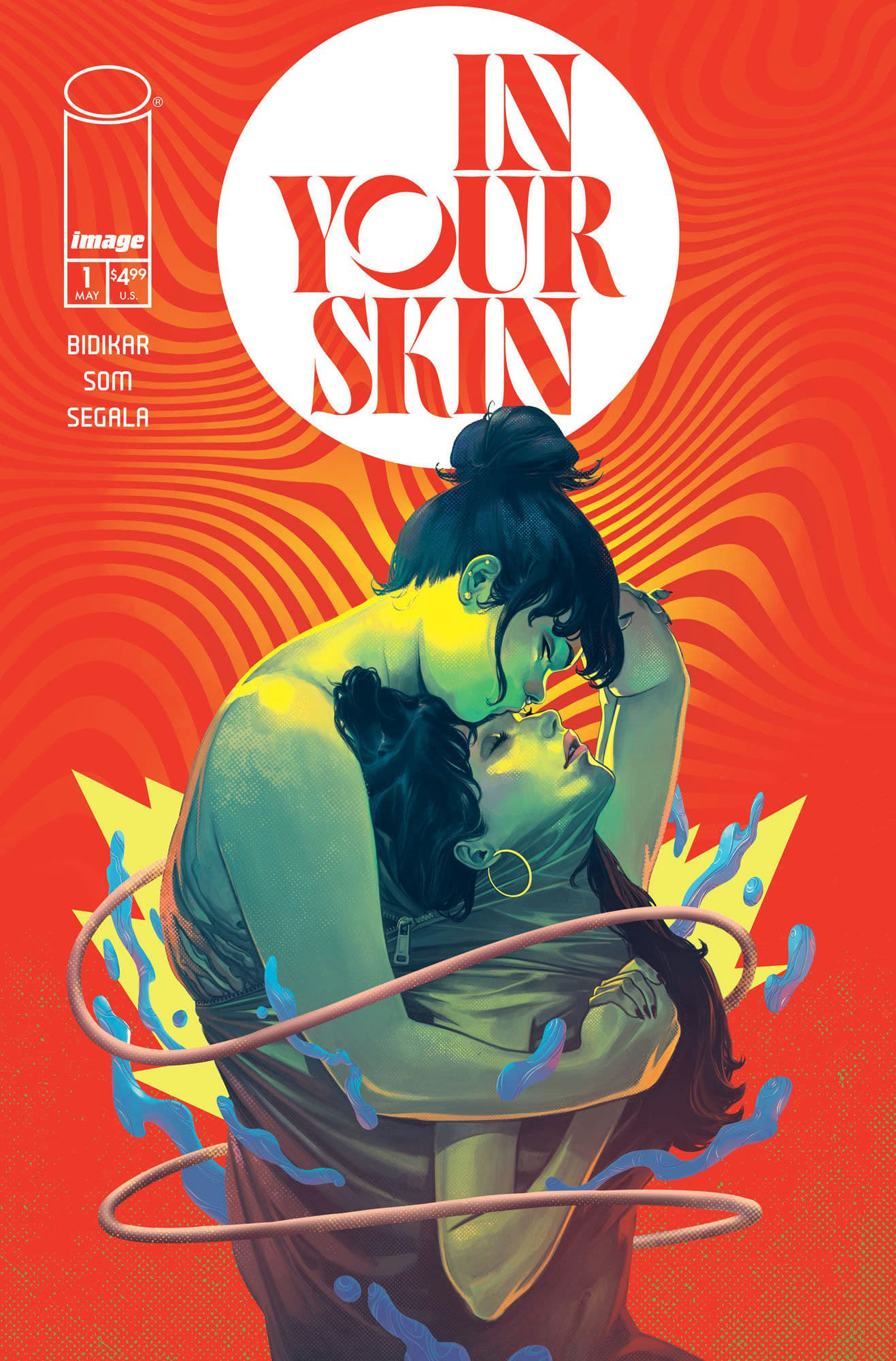
This is an amazing episode as letterer extraordinaire Aditya Bidikar and artist Som join Jimmy on the podcast to discuss their new comic In Your Skin. The first issue will be in stores April 22nd and the FOC (Final Order Cutoff) is March 30th, so make sure you let your local comic shop know you want a copy by then. In Your Skin is backed by Tiny Onion and being published by Image. It's a story about fandom, obsession, identity, body horror, and Bollywood. This series marks Aditya's debut series as a writer! Jimmy, Aditya, and Som discuss the creation of the series, the body horror of it all, Bollywood, Som's artistic influences, and the superheroes of Raj Comics. This is a series everyone is going to be talking about so after you're done listening make sure you add it to your pull list.
WATCH THE VIDEO VERSION OF OUR INTERVIEW ON YOUTUBE!
Check out In Your Skin at Image
From the publisher
Priyanka is a Bollywood uber-fan who has been obsessed with film star Ayesha Sen since she was a kid—she's watched her movies over and over, and knows her dances beat for beat. But after a once-in-a-lifetime chance to meet her idol goes awry, and Ayesha announces her impending retirement from movies, Priyanka decides that if Ayesha isn't going to live the life she's supposed to, Priyanka would be more than happy to take over for her… Bollywood body horror meets erotic fiction in writer Aditya Bidikar's debut series with rising star artist SOM (Crocodile Black), a twisted exploration of celebrity culture, identity, and image that's perfect for fans of The Substance and David Cronenberg.
Preview pages
YOUTUBE REVIEW
Follow Comic Book Yeti
🔗 Comic Book Yeti LinkTree: https://linktr.ee/ComicBookYeti
For partnership and ad inquiries, please contact: thecomicsyeti@gmailcom
Follow your hosts
🔗 Jimmy Gaspero: https://bsky.app/profile/jimmygaspero.bsky.social
🔗 Byron O’Neal: https://bsky.app/profile/byrononeal.com
Buy a shirt. Our new Matthew Dow Smith Artist Series design just dropped in the Threadless shop!
Make sure to check out our sponsor 2000AD.

[00:00:00] - [Speaker 0]
Your ears do not deceive you. You have just entered the cryptid creator corner brought to you by your friends at Comic Book Yeti. So without further ado, let's get on to the interview.
[00:00:11] - [Speaker 1]
The future is calling. 2,000 AD is the galaxy's greatest comic with new issues published every single week. Every 32 page issue of 2,000 AD brings you the best in sci fi and horror featuring characters like judge dread, rogue trooper, and more. Get a print subscription in 2,000 AD, and it'll arrive to your mailbox every week. And your first issue is free.
[00:00:35] - [Speaker 1]
Or subscribe digitally, and you can download DRM free copies of each issue for only $9 a month. That's 128 pages of incredible comics every month for less than $10. Head to 2,000 AD and click on subscribe now or download the 2,000 AD app and start reading today. Hello, and welcome to Comic Book Yeti's Cryptid Creator Corner. I am one of your hosts, Jimmy Gasparo, and I have two guests today, and I think it's their first time on the podcast.
[00:01:07] - [Speaker 1]
And, wow, what a first issue. We're gonna talk about In Your Skin. It is a new issue that is kind of under the, umbrella of tiny onion, but I have both the writer and artist on the podcast today, so you're gonna learn all about it. And, I mean, the best part of this podcast is getting to read stuff in advance. I'm not gonna lie.
[00:01:30] - [Speaker 1]
I love talking to creators, but getting to see stuff before anybody else does and getting blown away by it is just amazing. So please welcome to the podcast Aditya Bidakar and Som. How are the two of you doing today?
[00:01:45] - [Speaker 2]
Pretty good. It's 09:30PM here. I just got back from London after doing some stuff on, Ram and my new book, which was just announced actually today. Yeah. So quite ex it's a it's a good time for comics, actually.
[00:02:00] - [Speaker 2]
Yeah.
[00:02:00] - [Speaker 1]
Hi, everyone. Tom. How are you doing?
[00:02:02] - [Speaker 3]
Doing good. I have just been trying to change the headlines on the issue itself. So yeah. While the podcast is going on, I'm also I'll get back to the other issues of In Your Skin.
[00:02:13] - [Speaker 2]
Yeah. Okay. Okay.
[00:02:16] - [Speaker 1]
Yeah. I saw Aditi, I saw a little bit about I think you posted something Instagram that you had been in London for a while and that we would be hearing more about that. I I mean, I think you posted that a week or so ago. So very, very exciting stuff. I mean, I've I've I've been a fan of yours for a while in terms of your your lettering work when I first got back into comics and then started working with Comic Book Yeti to review comics.
[00:02:40] - [Speaker 1]
And then when we started when Byron O'Neil started the podcast, lettering was something that I, you know, really tried to pay, more attention to because I I felt, like, early on that it wasn't whether or not in reviews folks didn't talk about it or letters didn't get their name on the the cover of books, things along those lines. Like, I really felt like letters were you know, I was surprised at at in terms of how much they were, like, the unsung heroes, of comics. And, like, the the work that you've done and consistently done has been amazing, but I am very excited to see because I I know you've written stuff before. I know you've had a number of short shorter comics that you've done, and I was very excited to hear that you were gonna be involved in this series. I was very excited to hear that Salm was gonna be working on it.
[00:03:30] - [Speaker 1]
I was a big fan. I interviewed Philip Kennedy Johnson on the podcast and was a big fan of crocodile black. Salm, I thought your work on that was amazing. And I just thought, you know, the two of you in this comic that is about Bollywood, about body horror, I thought it was gonna be great. And reading issue one, happy to report to listeners, I was right.
[00:03:54] - [Speaker 1]
It is such a great first issue. Couple of things I liked about it. Body horror out of all the types of horror, body horror freaks me out the most. I can deal with just about anything, but body horror really disturbs me. And and body horror really done well, which it is in this first issue, makes me very uncomfortable.
[00:04:13] - [Speaker 1]
And I I like to be uncomfortable sometimes. I feel like it's necessary. And the other thing is I'm not very familiar with with Bollywood. It's not anything I was, like, ever exposed to, and I love being exposed to new things. I don't I don't know much about India.
[00:04:28] - [Speaker 1]
I don't know much about body horror, but I'll I wanna learn, and I I wanna see this little glimpse of it through this really incredible comic. So, with all of that being said, you know, Aditya, do you wanna start? Kinda tell listeners a little bit about what In Your Skin is is about. I know it's a story you've been working on for you know, or at least had it in your head for a number of years.
[00:04:51] - [Speaker 2]
Yeah. So In Your Skin is about Priyanka who is sort of a Bollywood uber fan. She has been obsessing over Ayesha Sen's movies for a long time, and she's kind of obsessing over it in that very Indian way where you learn the dialogues, you learn the dances, and kind of imitate the actress and so on. And she gets an opportunity to meet Ayesha at one point of time, and something goes wrong with that. And then when Ayesha decides to retire, Priyanka decides that it's her time in the spotlight.
[00:05:28] - [Speaker 2]
And the story is all about how we get there and what are the consequences. With all of
[00:05:35] - [Speaker 1]
that in mind and you're you're putting together, you know, the outline for the series, what were the you know, without giving too much away, what what were really the elements that you felt were important that, like, had to be included in the first issue to kind of inform Priyanka's character?
[00:05:50] - [Speaker 2]
So, the story has gone through a lot of iterations as stories do, like, over the years. The first time I had this story in my head was before the pandemic. And at the time, it was all about fandom, like, the idea of what a fan is. It's evolved from that a little bit because I wanted to see both aspects of this peculiar idea that humans have, which is celebrity,
[00:06:16] - [Speaker 1]
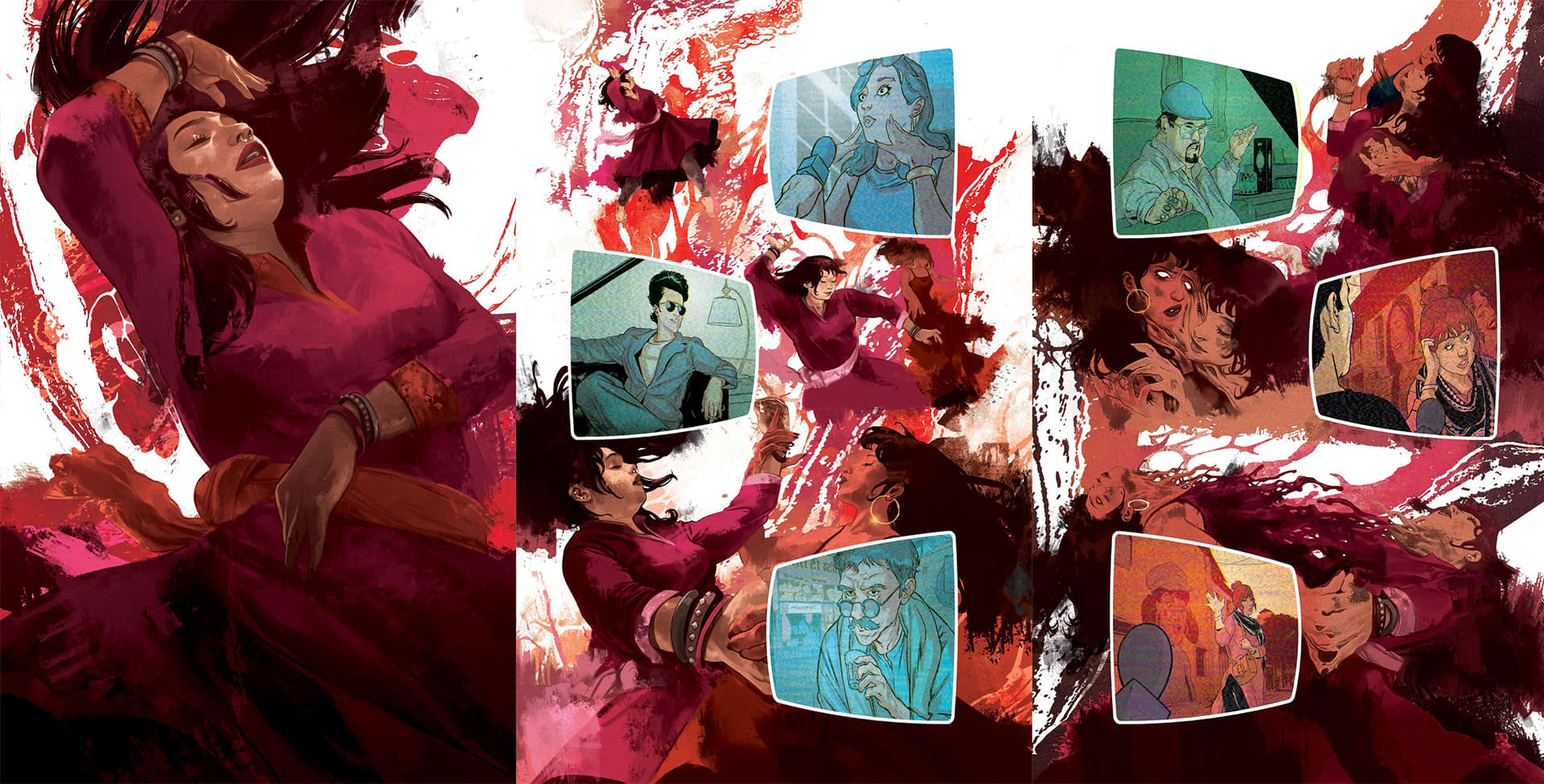
which is this idea that for some reason, some one person does something well and therefore, like, other people look to them. And it's a very strange thing. And the first issue is, to a large degree, getting into the psychology of somebody who thinks like that and what might lead them to think like that, what does their life look like, and what leads them to take certain decision? Psalm, I really liked how the the issue opened up, just to, you know, tell listeners a little bit because we we see the first issue open up, and, it it's almost like this this kind of dance the character is going through as we see, you know, clips on TV of of others being interviewed about Ayesha. I was just kinda curious in terms of your your inspiration to kind of, like, weave all of that through, because you have the the inset panels for, like, the interview, but the rest of it is kind of, like, free flow flowing, like like, floating through.
[00:07:22] - [Speaker 1]
I was just kinda curious in terms of your inspiration to kinda lay it all out like that, and working you know, leaving space for the colorist to kind of come in and do their thing because I I really feel like it's it's part it's very beautiful, but the the coloring and, like, the body position, it it starts to give a a hint of of something being wrong. It's almost like an unnatural pose at time through the dance. And I was very, very interested by that. Like like, right away, that kinda grabbed me looking at the posture in particular.
[00:07:57] - [Speaker 3]
First of all, credits to BD because I think he was the one who who was very clear as to how these moments need to be projected. So we were very sure, like after the discussion that I had with them, we were very sure that these were going to be in a certain painterly style, which is more dreamy, which is more surreal. And that's possibly the reason why you see that sort of a treatment. When it comes to the exact pose, were trying a lot of The idea was that all of these like the bollard actresses that we are kind of referring to belong to a certain era where song and dance and if you are remotely aware of Bollywood, you will realize that song and dance is almost as integral and sometimes more than the actual plot of the story. There are cases where song and dance, like good songs have made a film hit more than the plot of the story.
[00:08:54] - [Speaker 3]
And these dances are very iconic in there. The poses are very iconic. And we were very sure that we wanted to create those iconic moments for this particular page. And we went through a lot of iterations. I think the first page itself, I did like three or four of them.
[00:09:17] - [Speaker 1]
Oh, wow. Okay.
[00:09:18] - [Speaker 3]
Yeah. And I was just belting it out just to check whether any of these were. And we kind of finally froze on the one that not froze, but we kind of decided to go with the one that is in the final book. And even the body horror bit, it was meant to be a little creepy in that sense. Like, in in some ways, it's it's kind of a I don't know if it is a spoiler or
[00:09:44] - [Speaker 2]
not, but
[00:09:44] - [Speaker 3]
it's kind of a forbearer of what is to be expected in the
[00:09:50] - [Speaker 1]
Okay. Yeah.
[00:09:51] - [Speaker 3]
The comic. You know? So Ayesha kind of slowly, creepily taking over not take but sorry. Priyanka kind of getting entangled into this idea of what Ayesha is and Ayesha trying to get away from it, but still both of them kind of fusing into one entity. You know, that sort of a thing.
[00:10:15] - [Speaker 1]
Right. Right.
[00:10:17] - [Speaker 2]
Yeah. That was
[00:10:18] - [Speaker 1]
In terms of
[00:10:19] - [Speaker 2]
Sorry. Like, basically, I can Go ahead. Knew knew that a lot of issue one is going to be, like, dramatic in the sense of it's going to sit with characters. You're gonna see them talk. You're gonna see them interact with each other and figure out their relationships.
[00:10:35] - [Speaker 2]
So I did want some of the first sequence to hint at what's going to happen and kind of give people something to come back to after Nevral issue one to kind of see what the first few pages might have meant. And by the way, Sohm is kind of underplaying how much research he did for those dances. Like, we would be talking, he'd be playing different songs from Bollywood movies. And he'd be like, okay. This actress and this this particular song, this particular choreographer, like, we went through a lot of those to kinda nail down the dance poses.
[00:11:14] - [Speaker 2]
So, like I mean, that's that's the great thing about working with somebody like Soham is that if I put in, like, x amount of work, I know he's gonna put in, five x the amount of work in figuring that thing out.
[00:11:26] - [Speaker 3]
I think that's also the fun bit of it because when the writer kind of gives gives you a lot of fodder, then there are so many directions you can take that. You can take the material and you can go. And coming back to one of the aspects that you said about the panels with the interviews, the whole page was supposed to be surreal. And throughout, we were thinking, how can I integrate this moment of surreal in the interview shots as well? And if you closely notice, you'll realize that and these are iconic places in Bombay.
[00:12:00] - [Speaker 3]
So there are Bollywood actresses on the walls whose eyes are following this this woman. So if you go back to the issue, you will notice that. So that that kind of creepily adds to the idea of this page as well.
[00:12:15] - [Speaker 1]
Yeah. I I really I I mean, I really love the opening of this. I mean, I think it sets the stage, you know, really, you know, really well. There were yeah. I mean, there were a ton of things I really liked about this.
[00:12:27] - [Speaker 1]
Also, as as, you know, as as someone in my in my forties who probably should stick to wearing shirts, like, have one now with a collar, but I do like graphic tees. Not not not Natchiquette, if that's how you say his name. I love his first T shirt, I think, says, like, I, I saw, I came, I left early.
[00:12:49] - [Speaker 3]
Yeah.
[00:12:50] - [Speaker 1]
I really liked. That just made me kinda laugh and, like and there's a nice little character moment. I'm like, oh, okay. Here's a young guy, and this is kinda, like, his deal with these graphic tees and maybe wearing them ironically, maybe not. I thought very very interesting character.
[00:13:05] - [Speaker 2]
That was also by the way, like, he was just he he sent me a list of all these graphic tees that he wanted to do that we we often see on, like, young men in India. Yeah. Again, we are not always sure whether they're wearing them ironically or not. And, like, he was like, can I do them? And we went through the list, and we were like, okay.
[00:13:22] - [Speaker 2]
These five work well, so let's do them. Yeah.
[00:13:26] - [Speaker 1]
It's too funny. Well, I like that one. And and then there's another one later on I like too. I was really paying attention to that in terms of his character. But, yeah, I mean, you've set up with the issue so far, I mean, the first issue, you've set up a very interesting dynamic for Priyanka with her relationship to Ayashe, her relationship to Najaket, her relationship to her mother.
[00:13:46] - [Speaker 1]
I think I said it right before we started recording, but the scene with Priyanka and her mom was, like, was, you know, was rough. I mean, in terms of I thought so. You know? Yeah. Her mother has definite opinions about what Priyanka should be doing with her life and is is, you know, not happy about them.
[00:14:09] - [Speaker 1]
They kinda get into it a little bit at at a diner. I mean, was it important to have that type of, like, another stressor in Priyanka's life in terms of that relationship with her mom? Or, I mean, culturally, I is that I don't wanna I don't wanna say, like, are all Indian mothers mean? Like, there's, like, cultural stereotypes for things. Like, you know, I'm Italian and, like, all Italian grandmothers yell.
[00:14:36] - [Speaker 1]
Like, I don't know if that like, was it just important because it was, something, like, culturally, or was it important because another, like, stressor in Priyanka's life?
[00:14:49] - [Speaker 2]
Well, it's definitely an important scene. Like, I I think we paired issue one down to essentially, like, the scenes that really needed to be there. Like, I think the original version of issue one was I think, like, eight pages more than this. And we kind of pruned it down to, like, okay. Here's the stuff that absolutely needs to be there to kind of show who this person is, where she came from, and so on.
[00:15:14] - [Speaker 2]
But, also, like, we don't wanna spoon feed. Like, we like, I dislike exposition in writing. Like, I would rather you see a character interacting with another character and, like, when when you see the same person interacting with, like, three different people in three different ways, that tells you something about them. So that was shortly where the theme came from, I would say. But it's also like, I I wouldn't I would definitely not say that all Indian mothers are like Priyanka's father.
[00:15:45] - [Speaker 2]
I
[00:15:45] - [Speaker 1]
I of course not. I'm I'm I'm I'm being I'm being facetious. I I hope everyone knows that. I'm not, you know, I'm not passing
[00:15:53] - [Speaker 2]
catch on on Yeah. But I would I would still say that a lot of Indians would identify that kind of person. Because I do think I do I do think there's something that comes with, India's status as like, a nation that's still sort of dealing with patriarchy in some ways, like, we're still kind of figuring out where we stand. India is not one thing. India is like several different things.
[00:16:22] - [Speaker 2]
So like, yeah, this kind of person who, is about like, let's say 5,055 years old, and has gone through certain things in life and gotten to where she is and therefore believe she's owed certain things and particularly by the next generation is not so rare. Like, this is this is not like, you you would meet this kind of person if you stayed there longer. Sorry. Is he just saying saying more than that about her specifically might spoil certain things, so I won't say that. Yeah.
[00:16:54] - [Speaker 2]
But, yeah, that's what I that's what
[00:16:55] - [Speaker 3]
I wanted to say. Yeah.
[00:16:56] - [Speaker 2]
So mine was mine was just
[00:16:58] - [Speaker 3]
a joke. When you have a population of, like, 1,400,000,000 people, the possibility of every shade is quite high. You know?
[00:17:05] - [Speaker 2]
So there's every kind of
[00:17:06] - [Speaker 3]
parent available. So yeah.
[00:17:08] - [Speaker 1]
Yeah. I I mean, it's it's just interesting, like, that scene in particular, you know, because it's comic books, and you you you both know you only have limited space to kind of, like, inform your reader about the the psychology or the type of person in terms of your main And, you you know, when you strip everything down, you know, and show that relationship with several individuals to kinda build the profile of who this person was. I I it it was interesting to me kind of how early that scene showed up because we're still getting to know Priyanka. And, yeah, that's that that scene really packs a punch, I thought, in terms of informing her character. I just thought it was very interesting and and and, you know, very, you know, very interesting.
[00:17:58] - [Speaker 1]
And
[00:17:58] - [Speaker 3]
Thank you.
[00:17:58] - [Speaker 1]
You know, comic goes on from there. I I was curious in terms of, like, the working with tiny onion, and then I I think correct me if I'm wrong, but you're working with tiny onion, the book's being published by image. Yeah. And so what has that been like in terms of, you know, working under the umbrella of of tiny onion?
[00:18:23] - [Speaker 2]
I mean, it's honestly been wonderful. This is a book that I was planning to do before Tiny Onion offered me the AIR contract, like the artist in residence contract. And what that meant is that, firstly, I could get an artist like Soham because I don't know if I could have afforded his work, you know, if I was doing this by myself. So Tiny Union essentially, like, offered me a budget, and, I got to work with Eric as an editor, Eric Harbourn, who's one of the absolute best editors in the business. He came with the deal essentially.
[00:18:59] - [Speaker 2]
And, I find, like, this is my first full length project. Like, I've done shorter comics before this, but getting to do my first full length project with a team that is as experienced as the Titanium team, like, terms of editorial, in terms of design, production, marketing. Like, I'm getting to work with all of these people who are gonna put their efforts into, creating the best book possible and promoting it as well as possible, is essentially like, it's a privilege. Like, honestly, I don't know like, I don't know how I would have done this book without all of these people involved because having jumped into it, I realized that, okay. You know what?
[00:19:43] - [Speaker 2]
It's not just about the writing. It's about there are so many things involved in making a comic book and getting it to the market that I don't know if I was prepared for entirely. And having that kind of backup and support has been incredible. And I'm gonna take this learning kind of with me elsewhere. And secondly, I feel like just having Eric, you know, kind of giving me feedback on the script, giving us feedback on the artwork, and kind of being there for everything we might need on a day to day basis has just made this go much faster.
[00:20:19] - [Speaker 2]
Like, if I was I think if I was doing this by myself, I'd still wouldn't have an artist involved. I'd probably still be working on the first script. You know? Because, like, Eric just reminding me that, hey. We we need to get this done.
[00:20:32] - [Speaker 2]
We need to Yeah. Figure this out. Because I I I think as a every writer procrastinates a lot, and with your first book, you end up procrastinating a lot more. So, I mean, you could say that without Tailian, and I don't know if this book was happening in the first place.
[00:20:45] - [Speaker 1]
It's interesting to hear you say that, like, as as many projects as you've been involved in as a letterer. But when you're, you know, when you're a writer and, you know, that they're still and it it is amazing. Like, there are still so many things to learn. Like, I, you know, I did a a graphic I have a graphic an all ages graphic novel coming out next month, and it's my first graphic novel. It's the longest thing I've written.
[00:21:05] - [Speaker 1]
And I've done this podcast. I've talked to plenty of creators, but when you actually start to go through the process of everything involved, you're like, oh, I thought I I thought I understood.
[00:21:15] - [Speaker 2]
Yeah.
[00:21:15] - [Speaker 1]
I did not. Yeah. It's a little bit, you know, like that.
[00:21:20] - [Speaker 2]
And I think that have way more admiration for everybody that I've seen doing an image book, like somebody like Ram, somebody like James before. All of these people, I'm like my my admiration for these people have gone, like has gone through the status at this point.
[00:21:36] - [Speaker 3]
It's a it's it's like a rabbit hole. Right? And with art writers as well as artists, I think. Like, both of us both me and Bidigar have a very interesting com dynamics. We are very frantic in, you know, we can do this.
[00:21:49] - [Speaker 3]
We can do that. No. That sort of a thing. And while while that is important to understand understand the scope of the comic book, you need the right kind of, you know, calming agent in the in the mix to kind of pull you out when you are getting into that vicious rabbit hole because that rabbit hole goes. I don't know.
[00:22:07] - [Speaker 3]
There's no end to it. You can keep digging it.
[00:22:10] - [Speaker 1]
You know?
[00:22:11] - [Speaker 3]
So so, yeah, Eric was, a gift on the project.
[00:22:15] - [Speaker 2]
Yeah. Yeah. Me and the person without Eric would have probably still been working on the first page. Yeah. Doing more and more versions of us.
[00:22:21] - [Speaker 3]
Yeah. Yeah. Of her dancing and yeah.
[00:22:24] - [Speaker 2]
Yeah. Exactly. So I'm just
[00:22:27] - [Speaker 1]
to talk a little bit of more about, you know, your work in it, not just the the the body horror aspects of it, which, you know, I'm sure as there's I'm sure there's gonna be more as issues progress, but, one of the things I thought you do really well is your, like, close-up facial expressions. Like, you really capture something about, you know, these characters. I knocked my mic off, the stand. Now you're back. Problem.
[00:22:58] - [Speaker 1]
I was wildly gesticulating and knocked my mic off. The excitement.
[00:23:03] - [Speaker 2]
Yeah.
[00:23:04] - [Speaker 1]
But no. There's we talked about it a little bit before, but there, you know, there's there is a a kind of a a scene in the middle of the book, that's kinda get steamy. But then but but even before and after that, like, just when you have, Natchiquette kind of interacting with some people on the the street, he goes to get, like like, you know, he goes get something made up from somebody at a stand. And then even after that, with Priyanka, you know, when there's this there's the possibility of of her meeting this person she's been, like, obsessing over, Ayesha. Like, you really, like, get in close, and your facial facial expressions are so good.
[00:23:50] - [Speaker 1]
They they convey so much. And that's one of the things I love about comics because, you know, you'd have a script, and you can give them to a bunch of different artists. And they're gonna come up with some different paneling, some different expressions. But you really kinda dig into it, and I think you go to some places where some of your I don't I I hope this comes across the right way. I'm I'm trying to make this I I hope this sounds complementary, but some of your facial expressions are not, like, pretty in terms of what you would think of, like, a symmetrical face, but they are they're very realistic, and they always seem to be in service of the story.
[00:24:28] - [Speaker 1]
I mean, especially as someone who's done this podcast with a video component and Byron sometimes put it it on YouTube, I cannot watch it because you can pause it at a million different places, and this right here is doing something wacky. But you really get in there and give us something that feels real, that feels kind of, like, visceral. I was just hoping you could maybe talk to listeners a little bit more about your approach when you have to do close ups and facial acting.
[00:24:55] - [Speaker 3]
Sure. First of thank you for the compliment. I do take it as a compliment. I I can't stress enough that me as a comic book artist, like, I wait for those moments where there are close ups. Because because comic is a certain size, the wider shots, the faces are drawn in a certain size.
[00:25:16] - [Speaker 3]
So there is not much room because the brush size, everything, all of that is limited, right? So there's there's only limited room in terms of how much you can draw. But it's on those closer panels that you can really get to the subtleties and the nuances, which I like exploring a lot, I think. And one of the things that when when BD and I were kind of discussing this, one of the things that we realized is we don't want the characters to look flattering all the time. Like, one of the things that BD had suggested, and I I'm not really sure if I I think I've tried it in one of the panels, I might do it again is when when you you take up angles which don't obviously make them look pretty, like, you know, the the double chin kind of kind of pops up and all of that.
[00:26:04] - [Speaker 2]
I still
[00:26:04] - [Speaker 3]
don't see that enough in comics. And that's one of the reasons why I and I think partly it is also inspired by the fact that I serve the film industry here. And a lot of my drawing is storyboards. And I visualize in terms of transitions and cuts and all of that. So close ups are always the dramatic close ups.
[00:26:27] - [Speaker 3]
So when I have to draw storyboards, I always that that needs a moment. So I have to nail the expression just right for the actor or anybody else to kind of understand the the mood of the of the panel of the frame, in which I kind of translate to the comic book here as well. So yeah. I mean yeah. I I hope that answers the question.
[00:26:49] - [Speaker 3]
Yeah.
[00:26:49] - [Speaker 1]
Oh, no. No. It it definitely does. I I I appreciate that. And I thought it worked, you know, really well in this comic.
[00:26:57] - [Speaker 1]
I just thought some of the expressions in particular were were very interesting and, really served the story. And, yeah, I mean, like I said, I love the first issue. And, you know, you're working with, I think it is is it Francesco Yep. Francesco. Is is the the the the colorist.
[00:27:19] - [Speaker 1]
And, yeah. And you also have some great variant cover artists as well. I think I saw one by Maria Lovett by Tula Lotte, if I'm not mistaken, you know, which is always kind of fun, and both of them are tremendous. Yeah. So there there's there's so much great stuff in terms of this this this first issue and and the series.
[00:27:41] - [Speaker 1]
I I'm kinda curious just because I'm so I I don't I've not been exposed, you know, growing up in The States here to, like, to Bollywood. What is kind of your the two of you in terms of your relationships to that? Is, like like, are are there particular things in Bollywood that you like? Was there, like, a a a western film influence? Like, what is kind of your experience with Bollywood kind of film and culture?
[00:28:06] - [Speaker 3]
See, the relationship kept keeps evolving over time, obviously. Now that I'm part of that industry as well, that's a different mix. And you know? Yeah, when I was growing up, Bollywood always was a part of our lives. We grew up to and back by then, Bollywood had always like it had achieved that sort of aspirational quality to it.
[00:28:31] - [Speaker 3]
The superstars had elevated themselves from the idea of being an actor to a scene to being the superstar. They are the same image in every film. And it is that aspirational quality to which that people kind of, you know, relate to.
[00:28:54] - [Speaker 2]
Like Okay.
[00:28:55] - [Speaker 3]
I I don't know if I if it makes sense in any way. Like, there is there is always this kind of an actor who's like the angry young man, and he'll always beat up the goons by the end of the film. You know? So Okay. Yeah.
[00:29:07] - [Speaker 3]
And and that they're typecasted sometimes, but at the same time, there is always a romantic hero who will keep doing these romantic films, he and has a fan following of those. So so growing up, obviously, we were kind of I at least I was subbed into that as well. I had that aspirational element to it as well. Like, I always wanted to be a Shahrukh Khan or an Amr Khan and all of that. My looks betrayed me.
[00:29:33] - [Speaker 3]
That's a different thing. Yeah. When you get serious about films and you start working about films, you also understand the kind of attention to detail that some films put in. And that was like like in some Bollywood films, they will explore certain nook and corners of Bombay. And that that was something that I wanted to bring in in your skin as well.
[00:30:05] - [Speaker 3]
So I wanted to it's not always that you get a chance to explore your city that you live in in a comic book and present it to the world. So obviously, there are the flattering aspects of Mumbai that you would want to show off. But at the same time, there are these what constitutes the real Bombay. Like, you get into those hidden gullies, as in the hidden streets, nooks, hole in the wall sort of places. And at this point of time, Bollywood is more of a There has always been an element of entertainment.
[00:30:42] - [Speaker 3]
So despite everything, it will always stay a part of our lives because whenever we want to go watch a movie, we are not really looking for more I mean, I'm I'm I'm saying this from a very lay audience sort of a point of view and not the informed because there is an element of that in in me as well. So I have to kind of keep that aside. The the people who are more informed about films and who who understand film theory and all of that. So I'm I'm keeping that bit aside. But when we go to watch Bollywood films, we are going there for all the there's a term that is used in India called masala, which is you have action, you have romance, you have all of those fit into one, two and a half, three hour film.
[00:31:29] - [Speaker 3]
And there are there's comedy. There is, you know, heroes jumping from one building to the other, setting things on fire, that sort of a thing. So that is still there. And I kind of wanted to bring that childlike association to films that I had to this comic as well.
[00:31:53] - [Speaker 1]
Yeah. Awesome. Oh, no. I love that. That's that's a great answer.
[00:31:57] - [Speaker 1]
Thank thank you, Saul. I love it.
[00:32:00] - [Speaker 4]
Is too humble to do this. So as his stalwart ride or die, I wanted to tell you about his new graphic novel, Penny and the Yeti with artist Amber Aiken. What started as a comic short with his daughter that I've known about for ages now, and it's evolved and has become one of those annoying can't talk about it in comics things for too damn long. Yes, I'm predisposed to be supportive but after reading an advanced copy of it, I have to admit it's way better than I anticipated. No shade but it's really good, remarkably so.
[00:32:31] - [Speaker 4]
Does it have a yeti? Yeah. Is it cute and adorable? Yeah. But it streak flies in effectively tapping into the all too familiar family dynamics that we all are facing in 2026 and approaching it in a way that doesn't insult the book's target audience.
[00:32:46] - [Speaker 4]
Kids. They are way smarter and perceptive than we adults give them credit for. So I really appreciated Jimmy's narrative approach tapping into his own experiences as a dad and a spouse. I can hear his wife saying, get off your phone, Jimmy, through the pages. She's gonna kill me for saying that.
[00:33:03] - [Speaker 4]
It's hitting shelves on April 21, and I dropped the link in the show notes where you can preorder a copy today. Yeti or not, here we come with Penny, Perry, Fenton, Maxine, and the magical, mythical, magnificent YETI. On behalf of us both, we appreciate your support.
[00:33:21] - [Speaker 2]
YOLOWA. So my point of view on this is kind of almost the opposite because Okay. The moment like, I I remember having a conversation with my dad once when I was, like, four or five. And he told me, like, you know, they worship those people. Right?
[00:33:42] - [Speaker 2]
And I was like, what do you mean? And he was like, you know, these these people who are on screen, there are people who, like, literally deify them and worship them. And my confusion was that like, I remember this this this is gonna sound absurd, but I genuinely believe this at when I was three or four, which is that I thought they were all action figures because I couldn't believe that people would choose to do something somebody else told them to do. Right? Like like an actor is somebody who, like, the director tells them what to do and stuff.
[00:34:14] - [Speaker 2]
And I just couldn't believe that real people did that. So I thought they were action figures. And then my dad is telling me, like, no. No. No.
[00:34:20] - [Speaker 2]
They're not just people. They're, like, kind of up there. Like, they're considered up there. And that dissonance is something I've carried throughout my life where on one level I kind of just don't understand why somebody would literally worship them. Have these celebrity impersonators sometimes even are found outside the celebrity's house.
[00:34:43] - [Speaker 2]
So, like, let's say you can't see the celebrity, you can get a photo taken with one of them in in person eaters. Then, like, the way that Bollywood's Bollywood music essentially forms the soundtrack of India. Like, all those things I've observed as if I'm sitting outside in some ways. But I do get it because whenever my family gets together, we will not be watching a Marvel movie. We will not be watching a drama.
[00:35:10] - [Speaker 2]
We will be watching a Bollywood movie. Like, we'll be watching that masala as he said because that's got something to make everybody happy. Right. And I can find the pleasure in that
[00:35:21] - [Speaker 3]
as well.
[00:35:21] - [Speaker 2]
Like, I I actually do like the movies. It's like, even though I'm skeptical of the culture around it, I do enjoy the films. I enjoy the fact that you can have a slapstick sequence in one moment and you can have the biggest tearjerker of a sequence like two minutes later. That's something that Bollywood can do which it you know, there's a certain, like, suspension of disbelief that comes with watching a Bollywood movie that allows for that. And I think the world has gotten to experience this with, like, some Telugu movies like RRR or something like that.
[00:35:55] - [Speaker 2]
But Sure. This has been, like, like, the industry. Like, all all movies like that are, like, here are were like that. And so I drifted away from that, and then I came back when Bollywood started making movies that I like, like, which is somebody like Anurag Kashyap or Vishal Varadwaj. They were making, like, grittier crime movies.
[00:36:14] - [Speaker 2]
They were telling stories that, you know, resonated with real people. They wouldn't have songs like they wouldn't have people bursting into songs, and stuff like that. That's when, like, Balawat kind of got me back, and I started observing the phenomenon. I started looking at what celebrity had become by that point. You can also see like around 2010, 2015, like the phenomenon of internet celebrity coming up and sort of shaking this idea of the Bollywood star on a pedestal and so on.
[00:36:48] - [Speaker 2]
That's been my experience of Bollywood. So like it's always been about watching this thing from the outside and trying to make sense of it. But and yet it does like, you know, it does form the soundtrack of my own life. Like, when I am down, I will not listen to English music. I will list I will listen to Bollywood music.
[00:37:07] - [Speaker 2]
You know, I've I've got a massive playlist of Bollywood that I play whenever I'm, like, let's say I'm driving out somewhere, I'll be playing that. You know? So despite sort of being above it all as if someone saying earlier It's home food. It's still completely yeah. Absolutely.
[00:37:23] - [Speaker 2]
It's home food. Like, it's like you can't you can't do without it, honestly. Yeah. Yeah. Yeah.
[00:37:28] - [Speaker 1]
It Sohm, do do you is there like a is there a Bollywood soundtrack to in your skin?
[00:37:35] - [Speaker 3]
I mean, it always plays in my head. So whenever I'm
[00:37:38] - [Speaker 2]
doing it, it kind
[00:37:39] - [Speaker 3]
of subconsciously keeps playing, you know? I can't avoid it. I mean, whenever I'm drawing, actually, there is some piece of music or the other that I kind of put to play to kind of get the energy of the of the panel that I want. So yeah. Oh, that's awesome.
[00:37:56] - [Speaker 1]
Really quickly, one of the other things I wanted to ask in terms of the the two of you both getting, you know, into comics. What was it like growing up in India in terms of, like, the comic scene? Like, what, like, what what were your exposure to comics? Were there things you know, like, was it was it Indian comics? Was it, you know, manga?
[00:38:16] - [Speaker 1]
Was it western comics? Was was did you not get into comics until later? Like, what was your exposure to it? I'm just kind of curious.
[00:38:23] - [Speaker 2]
Sam, do you wanna take that first?
[00:38:24] - [Speaker 3]
Or Okay. Yeah. Sure. So my introduction to comics was very early, and it was all Indian comics. So there is, in the Northern part of India where I hail from, there was this publisher called Raj Comics.
[00:38:40] - [Speaker 3]
And they had come up with a series of Indian superheroes, but they were all inspired by the West. But they were quite original in their own right. So they used to take up contemporary Indian issues, and the superpowers were quite unique. Like there was this superhero called Nagaraj. And he's kind of the analogy would be, say, Spider Man.
[00:39:07] - [Speaker 3]
But instead of spider webs, he used to release snakes. And those snakes would intertwine and make like ropes and, you know, he could swing around and do all of that and is immune to poison and he can't be killed that way and all of that kind of shit. Not shit. I I absolutely love it. So, yeah, I there's this one particular superhero called Doga, which was like the dark vigilante sort of a Batman analog to the Indian comic books, which kind of got me into the idea of comics.
[00:39:41] - [Speaker 3]
It was drawn by this guy called Manu, and it was his drawings which were kind of the benchmark for me to kind of copy from. You know, I still have some of the comic books that that he had done, and I used to copy from them. And that is how my love for comics started. I discovered Batman much later. I think I was maybe 15 or 16 when I discovered Batman.
[00:40:10] - [Speaker 3]
And obviously, the production values were much better for all the DC and the Marvel comics. But this was kind of my intro. But in India, comics was even in the West, I think comics started as a very inexpensive medium. It was supposed to be you know, it was not not the highbrow literature. It was kind of Yeah.
[00:40:32] - [Speaker 1]
It was like something you could read and throw away.
[00:40:34] - [Speaker 3]
That You sort of a thing. So even in India, it it was in a similar sort of a state. But you have to understand that because India was still like, globalization came in much later, around the nineties, and these comics were already being circulated from the late eighties, if I'm not wrong. So, these comics were even cheaper for the lack of a like less expensive. They were, in today's
[00:41:01] - [Speaker 2]
day and age, they
[00:41:02] - [Speaker 3]
will be, say, 25¢ a comic, you know, that sort of a thing. 10¢, 25¢. You could just grab them and read them, and some of the stores used to give them out on rent. So you read the comic book and give it back, and you pay a very small fee for that. That Okay.
[00:41:26] - [Speaker 3]
Yeah, that was a very popular culture where I hail And that was my kind of initiation into the world of comics. And I've always been fascinated by this medium purely because it's writing and visuals drawn together and, you know, you sit with each drawing, spend more time to it. I don't think any other medium allows that much. You know, illustrated books have moments, but these are in sequence and they kind of lead you through the story and hold you through the story where you can you you can decide the amount of time that you're going to spend with each moment. So so, yeah, it has always been something very close to my heart.
[00:42:12] - [Speaker 1]
Okay. I was just I wanna look up more like, I've I've I'm not familiar with Raj comics, but I like I like the idea of the guy that that that Nagaraj shoots snakes. And he's a awesome poison. I I looked it up real quick. Yeah.
[00:42:30] - [Speaker 1]
Doga, par Parmanu.
[00:42:32] - [Speaker 3]
Parmanu. Yeah. Yeah.
[00:42:33] - [Speaker 1]
Oh, Parmanu can split into atoms and fly from one place to another and reduce or increase his own size. So Yeah. Yeah. Alright.
[00:42:42] - [Speaker 2]
It's like somebody in a rush from a T com, like, possibly. Yes. Yes. So all of
[00:42:47] - [Speaker 3]
these are inspired, but they had their own unique ways to kind of do it. So yeah. Yeah. By the
[00:42:54] - [Speaker 2]
way, awesome. Got to work with Manu for a long time. Yeah. So I used to work for this company called Graphic India and Manu who's Was was really Manu. George.
[00:43:03] - [Speaker 2]
Exactly. He he used to work for us. And I was thrilled to find out that the great Manu was working in our comic book company. Yeah. He's like the I grew up
[00:43:12] - [Speaker 3]
with sorry. Sorry. This one last anecdote. For the lack of a better comparison, he's like the Jim Lee of, like, Indian comics, at least for me. Like, if there is one original that you would want to own is for me, it's Edison George's.
[00:43:25] - [Speaker 3]
You know? Yeah. Yeah.
[00:43:27] - [Speaker 2]
No. Absolutely. I I read the same comics that he did. I so I remember we used to get Raj comics at train stations. So every time we would take a trip from And, like, a lot of these storylines were, like, later, I realized ripped off from a lot of DC and Marvel comics.
[00:43:55] - [Speaker 2]
But that didn't spoil anything for us, I think. And I kind of I read them through my teenage because we couldn't really find Superman. Like, I I mean, I didn't know where to sign, American comics in India. And then I, like, I think I was 19 or 20, and I was in this, library where I was reading an issue of Sight and Sound, which is a British film magazine. And they had one of those comics are not for kids anymore articles like Biff Bam Pow kind of thing.
[00:44:27] - [Speaker 2]
And there were a bunch of comics mentioned in that. And I just made a list of all of them. Like, so there was Watchmen, Uncle Sam, Sin City, The Dark Knight Returns, etcetera, etcetera. And I just made a list of them, and I went through all of them. And that was how I, like, as an adult, got into American comics.
[00:44:43] - [Speaker 2]
Like, after that, I realized that this is the medium in which I wanna make my bones. You know? Like, before that, it was just an entertainment medium, but after that, it kind of was, okay. I understand this language. I want to pursue this, and I want to write and later a letter comics.
[00:45:01] - [Speaker 2]
Yeah. You know? So for me, it was kinda later, I would say, but it was the same comics as the change. Yeah. Has, like,
[00:45:09] - [Speaker 1]
the kind of the Indian comic scene gone through similar transitions to, like, the the western comic scene in terms of grittier comics in the nineties, you know, through the February? Or, like, what has has there been a a transition with, like, Raj Comics and other comic publishers?
[00:45:27] - [Speaker 2]
So I I believe Raj Comics is still publishing, but we kind of had our own comics bust when, like, you know, one of the distributor was essentially, and, like, there was one distributor that kinda took over, and a lot of comics companies went bust around that time. So we didn't end up having our own comics boom partly because of that. But after the nineties, so early two thousands and stuff, people started making their own graphic novels, and people started like, people who had grown up reading DC and Marvel comics and Raj comics and all these other comics started making their own comics. So you do have a, I would say, a thriving comic scene. In India, it's not an industry.
[00:46:13] - [Speaker 2]
Like, there are there are people making comics. There are people making some great comics. We have some book publishers who publish graphic novels and so on, but I I don't know if it if I'd call it a full blown industry. Okay.
[00:46:26] - [Speaker 1]
Alright. That's fair. Well, so I I don't wanna, I'll talk about comics and in your skin, like, all day. So I know that's not possible, but before
[00:46:36] - [Speaker 2]
We can I a little more time,
[00:46:38] - [Speaker 3]
I say that?
[00:46:39] - [Speaker 1]
Oh, okay. Well, no. Before I let you all go, though, you know, it's it's it's tough to talk about something like this, you know, with without giving, like, you know you know, too much away. But I had mentioned earlier in terms of, like, my experience with body horror. I, I've it makes me the most uncomfortable out of any type of horror book, but I find there's some of the most interesting and compelling stories.
[00:47:05] - [Speaker 1]
Probably one of the reasons I really loved in your skin. Like, I I I love some of the work recently, like Zach Thompson and Hayden Sherman did with into the unbeing, which has elements of body horror in it, I I I think was very good. And so I'm kind of interested in terms of the two of you, you know, horror generally. Is there something in particular about how body horror works to tell this story, or are there other types of horror that kind of affect you, you know, more? Just kinda curious about your you know, the the the horror aspects of it all.
[00:47:43] - [Speaker 2]
Sure. David Cronenberg is a very early influence for me. I I watched the fly at nine years of age, which is almost certainly too young. But it blew my mind, and I kind of I was obsessed with horror and body horror after that.
[00:47:57] - [Speaker 1]
The funny thing is do it.
[00:48:00] - [Speaker 2]
Like, you you started the best, where are gonna go? Yeah. But the funny thing about body horror for me is that it's rarely genuinely, like, horrifying. When I watch a body horror movie and most of the time, I'm grinning because I'm trying to figure out how they did the practical effect. Like, I'm kind of I just marvel at the thing that we decided to do, like, at the ideas and so on.
[00:48:24] - [Speaker 2]
Like, I remember I watched Giuliano's titan with a friend, and, like, the friend was horrified. And I was just like, I had this massive smile on my face the whole way through. And so that that's kind of how I relate to body horror. It's it's a tool to to to tell stories that you can't in any other genre. Like, there is there's something that we can do here, for example, with the body or element that no other kind of story would allow us to do.
[00:48:54] - [Speaker 2]
And you're gonna see much more of that in issues two and three, because I I still wanted to ease people into the body horror aspect of it. Like, I kinda wanted to get you invested in the characters before, like, everything kind of falls apart, in literal terms. Sure. But I feel like in Cronenberg's movies and Giuliano's movies or even like with something like The Substance or like Satoshi Kon, these are things that allow you to say things about identity, about what the human body is. They allow you to engage with the human animal on a level that drama necessarily wouldn't.
[00:49:37] - [Speaker 2]
So you can kind of get to the bottom of things on a philosophical level with body horror in a way that I feel you can't with other even other kinds of horror sometimes. So it it allows you to read something very fundamental. And I that's I think why I love body horror in this place. Okay. Yeah.
[00:49:57] - [Speaker 2]
I
[00:49:58] - [Speaker 3]
for me,
[00:49:59] - [Speaker 2]
yeah. I think
[00:50:00] - [Speaker 3]
For me, I think body horror was more of an organic evolution, and I was just lucky that In Your Skin kind of picked me. So when you graduate from arts or whatever, film school, you are this pretentious little brat who wants to talk about the difficult things in the world. But you are doing it in a small sitting, casually sipping your coffee in a small cafe. You are of drawing that. And that is how my evolution happened that I was drawing.
[00:50:30] - [Speaker 3]
And you want to talk about violence, you want to talk about all of these bigger injustices in the world. I don't know. Sorry. But what ended up happening for me was that there was a certain sense of boredom that came in while drawing in cafes, because I was drawing the same thing over and over again. And then I started to pick and choose my subjects as to how I would draw them with, say, a twisted arm.
[00:51:00] - [Speaker 3]
Or what if I squeeze the face in a certain way? What would happen? How would I bend the spine or twist the spine in a certain way where take the body to uncomfortable positions which otherwise you can't imagine. And that is how essentially my evolution into this idea of body horror came. As I went along, I was picking my artists as well.
[00:51:23] - [Speaker 3]
You know, the likes of Terada Katsuya, Junji To, you know, all of them are influences. Some of the ones that BD has already mentioned. Kroenbach in films becomes like the go to for all kinds of body horror. So, yeah, I mean, for me, it was more of an organic evolution, and I was just lucky that In Your Skin kind of was offered.
[00:51:48] - [Speaker 1]
That's awesome. Yeah. That's interesting. I mean, I just think that the the pairing of the two of you with the rest of the creative team, I mean, you've really created something special with this issue. I mean, I I imagine that, it's it's going to do really well.
[00:52:06] - [Speaker 1]
I mean, I I hope it does. I don't wanna say it jinx anything, but I just I just think that it's it's so good. I I I can't express this enough to listeners. Like, even if body horror is not your thing, it's just very interesting in terms of what it's saying about, you know, celebrity obsession. But all you know, also, you're you're getting a perspective that maybe we don't always get in in western comics in terms of we have writer and artist, like, you know, from India.
[00:52:37] - [Speaker 1]
It's not something that we, you know, see in a ton of western comics, and I always find that interesting. Like, you know, there's a bunch of people who, you know, look like me who are making comics, and they're making, like, great comics. But the stuff that makes me, like, that I I really not necessarily always, like, learn from, but but feel something or see a different perspective or, you know, how somebody very, very different from me who grew up in another part of the world relates to the world and sees it. But we both love this medium. We both love comics.
[00:53:11] - [Speaker 1]
Like, that's kind of fascinating to me, and I just I can't I can't get enough of it. I can't get enough of seeing how somebody else sees the world, how they approach their work, how they tell stories. On that level as well, I just I think in your skin is just a a fantastic comic. So
[00:53:28] - [Speaker 3]
Thank you. Thank you.
[00:53:29] - [Speaker 2]
Thank you.
[00:53:30] - [Speaker 1]
I I really appreciate, the two of you coming on, the podcast today.
[00:53:36] - [Speaker 2]
Oh, this was fun. Yeah. Thank you.
[00:53:37] - [Speaker 3]
It was an absolute pleasure.
[00:53:38] - [Speaker 1]
Thank you very much. I'm I'm a big fan of both of yours. And, yeah, listeners, I mean, you could go into your comic shop and throw a stone, and you're probably gonna hit a comic that it didn't even let her. So but if you need recommendations, let me know. I'll I'll give you plenty of them.
[00:53:55] - [Speaker 1]
And if you haven't read crocodile black, which Solm worked on with Philip Kennedy Johnson, I thought that was a tremendous issue, and I think it got a little bit slept on, and I thought it was very good. His his artwork's incredible in it. But, yeah, Aditya Bidakar. Solm, thank you both very much for for coming on the podcast today. Listeners, it's in your skin through tiny onion and image.
[00:54:16] - [Speaker 1]
It's gonna be out April 22. The best thing to do is let your shop know that you want a copy of it because the shops have to get their orders in, and that's, you know, that that's an important thing in terms of the orders, and I think this is a really special comic. So, yeah, thank you both very much for coming on. Listeners, make sure you rate and review us. Do the things they tell you to do about podcasts.
[00:54:38] - [Speaker 1]
It does help. You can find me on Blue Sky and TikTok. Let me know what it is you're reading, especially if you pick up in your skin. I wanna know what you thought because I just think it's a fantastic, first issue. So, again, thank you both so much.
[00:54:51] - [Speaker 1]
Thank you listeners for listening. I'll see you next time. Good night.
[00:54:55] - [Speaker 4]
This is Byron O'Neil, one of your hosts of the Cryptid Creator Corner brought to you by Comic Book Yeti. We hope you've enjoyed this episode of our podcast. Please rate, review, subscribe, all that good stuff. It lets us know how we're doing and more importantly, how we can improve. Thanks for listening.
[00:55:15] - [Speaker 0]
If you enjoyed this episode of the Cryptid Creator Corner, maybe you would enjoy our sister podcast, Into the Comics Cave. Listen and subscribe wherever you get your podcasts.
[00:55:27] - [Speaker 5]
This episode is brought to you by Athletic Brewing Company. No matter how you do game day, on the couch, in the crowd, or manning the snack table, Athletic Brewing fits right in. With a full lineup of nonalcoholic beer styles, you can enjoy bold flavors all game long. No hangovers, no buzz, no subbing out for water in the second half. Stock the fridge for tip-off with a variety of nonalcoholic craft styles available at your local grocery store or online at athleticbrewing.com.
[00:55:54] - [Speaker 5]
Near beer, fit for all times.
[00:55:58] - [Speaker 6]
You know what they say. Early bird gets the ultimate vacation home. Book early and save over $120 with berbo. Because early gets you closer to the action, whether it's waves lapping at the shore or snoozing in a hammock that overlooks, well, whatever you wanted to. So you can all enjoy the payoff come summer with Vrbo's early booking deals.
[00:56:21] - [Speaker 6]
Rise and shine. Average savings, a $141. Select homes only.