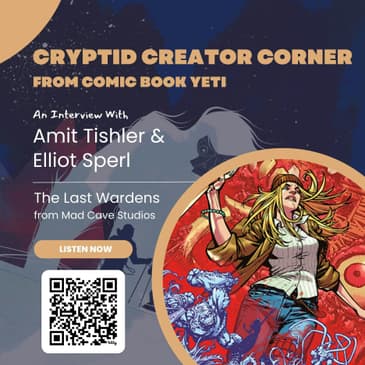

It's always a good chat when returning guest Amit Tishler drops in to chat with me and today he's brought along his co-writer and friend Elliot Sperl to talk about their new Mad Cave Studios mini-series The Last Wardens. I got a sneek peek at this book, and it is wild. Set in the 1970s, what starts out more as a sad slice of life family drama quickly ratchets up into bloody grindhouse bedlam starting the Doom Patrol from hell. We dive deep into the writing process and construction of this fast paced narrative and its clear stylistic 1970s influences. Dropping in mid-July, make sure to get your pre-orders in for this exciting new horror/oddball series.
From the publisher:
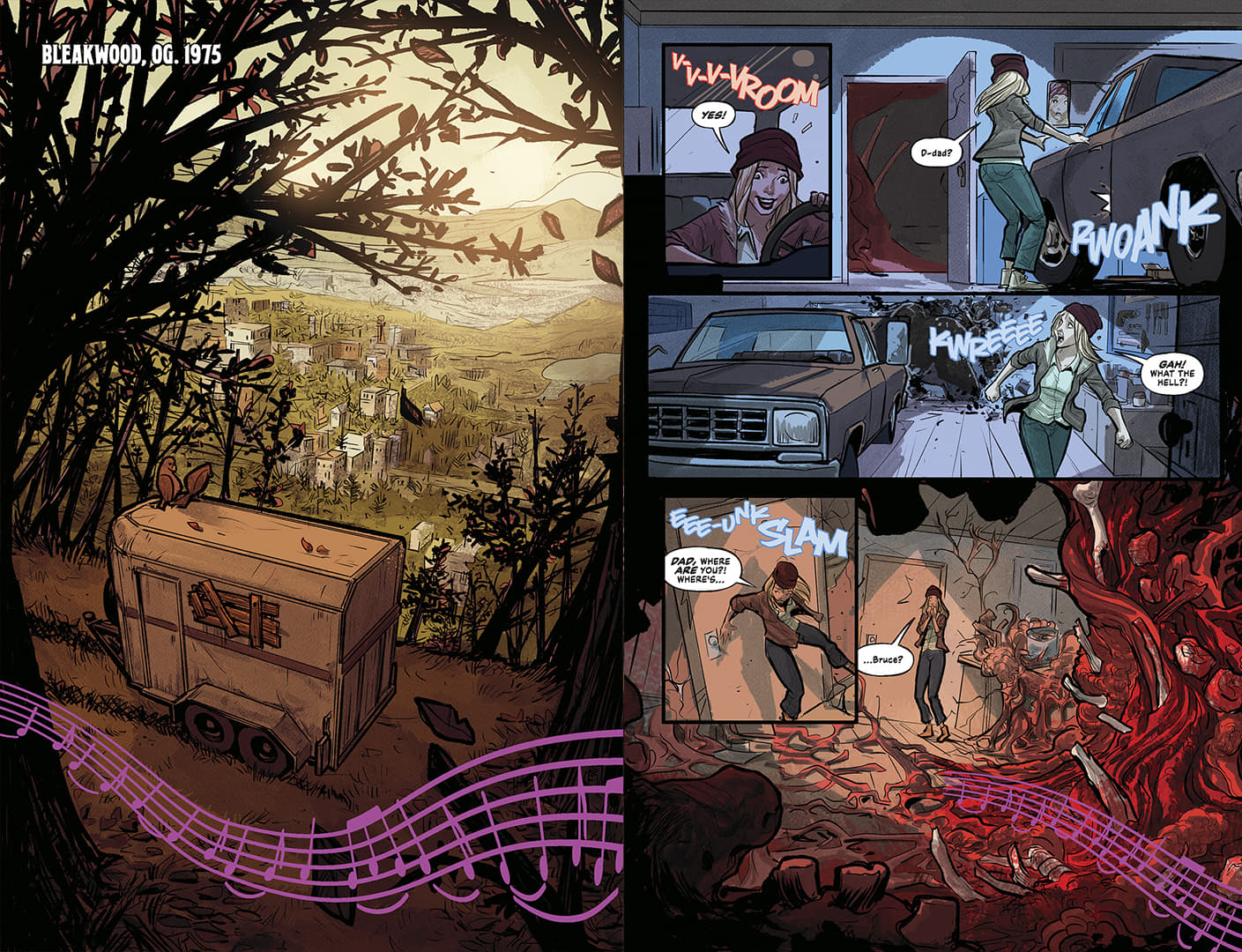
With an alcoholic father and a hole in her wallet, Danielle Pryer’s life in the rustic town of Bleakwood goes from bad to worse when her long-lost brother, Bruce, returns from the Vietnam War. While Bruce is being plagued by a mysterious and monstrous mutation, he is also being hunted by an incompetent team of paranormal misfits, which leads to Bleakwood quickly becoming ground zero of a supernatural battle that forces Danielle to choose between everything she holds dear and the fate of the world as a whole.
Art from Rui Silveira
Colors from Francesco Segala
Lettering from Frank Cvetovic
Sample pages:
Our episode sponsor
Play TTRPG games? Make sure to check out our partner Arkenforge. They have everything you need to make your TTRPG more fun and immersive, allowing you to build, play, and export animated maps including in person fog of war capability that let’s your players interact with maps as the adventure unfolds while you, the DM get the full picture. Use the discount code YETI5 and get $5 off your order.
[00:00:00] Your ears do not deceive you. You have just entered the Cryptid Creator Corner brought to you by your friends at Comic Book Yeti.
[00:00:07] So without further ado, let's get on to the interview.
[00:00:11] Y'all, Jimmy, the Chaos Goblin strikes again!
[00:00:15] I should have known better than to mention I was working on my DC Universe meets Ravenloft hybrid D&D campaign on social media.
[00:00:21] My bad.
[00:00:22] He goes and tags a bunch of comics creators we know and now I have to get it in gear and whip this campaign into shape so we can start playing.
[00:00:29] Another friend chimes in, are you going to make maps?
[00:00:32] It's fair to say it's been a while since I put something together so I guess? Question mark?
[00:00:37] It was then that I discovered Ark and Forge.
[00:00:39] If you don't know who Ark and Forge is, they have everything you need to make your TTRPG more fun and immersive.
[00:00:46] Allowing you to build, play, and export animated maps including in-person Fog of War capability
[00:00:52] that lets your players interact with maps as the adventure unfolds while you, the DM, get the full picture.
[00:00:59] Now I'm set to easily build high-res animated maps saving myself precious time and significantly adding nuance to our campaign.
[00:01:06] That's a win every day in my book.
[00:01:08] Check them out at arkandforge.com and use the discount code YETI5 to get $5 off.
[00:01:14] I'll drop a link in the show notes for you and big thanks to Ark and Forge for partnering with our show.
[00:01:19] I think I'm going to make Jimmy play a Goblin Warlock just to get even.
[00:01:24] Hello everybody and welcome to today's episode of the Cryptic Creator Corner.
[00:01:28] I'm Byron O'Neill, your host, and I'm delighted to introduce two co-writers as my guests.
[00:01:32] Y'all have already met Amit Tishler in the space before.
[00:01:35] Last time we were chatting about his series Eden Frost with Mad Cave.
[00:01:38] And now he's got an amazing new six issue mini series dropping soon again with Mad Cave called The Last Wardens
[00:01:45] co-written by my other guest, Elliot Spurl.
[00:01:48] With art by Rui Silvera.
[00:01:51] We're not quite sure on that, but we think it's colors from Francesco Sagala and lettered by Frank Svetovic.
[00:01:58] Amit, it's so good to see you again my friend and Elliot.
[00:02:01] Nice to meet you too. Y'all doing well.
[00:02:04] Yes, nice to meet you too.
[00:02:06] Nice to see you again man.
[00:02:08] On the promotional trail. Yay.
[00:02:12] The circus is in town. Let's do this.
[00:02:15] All right. Well, so Amit, I'm going to start out with this.
[00:02:17] I have to mention something here first.
[00:02:19] I was in a meeting the other day with Alison, who's the director of marketing for Mad Cave.
[00:02:23] And she referred to you as just meat.
[00:02:25] Okay.
[00:02:27] That is so funny.
[00:02:29] So considering the grindhouse nature of this book and while putting my questions together for the interview,
[00:02:34] now I cannot get said associated out of my head.
[00:02:37] And you have the hair of a young meatloaf all bat at a hell of a mask.
[00:02:42] So you're meat now. Sorry.
[00:02:44] Okay. All right. Look, this is not this is definitely not the first time this happened.
[00:02:48] I can give you like I think like one of my friends Robert Dottie is like a local actor.
[00:02:54] One day he basically came up with a really good way to help people remember how to pronounce my name.
[00:03:00] And he basically said just think about it like a meat or a vegetable.
[00:03:03] There you go. Amit.
[00:03:06] I think that's the same line you gave me when we first met.
[00:03:09] Yeah. And see and you remembered.
[00:03:11] You saw the confusion in my eyes and you had to stop.
[00:03:13] No, no. Let me let me explain it really quick.
[00:03:17] I didn't have too much trouble with it.
[00:03:19] But Elliot, I don't know you well enough yet to tease you.
[00:03:24] But you do share my brother's middle name.
[00:03:26] So we're off to a good start.
[00:03:28] So really. All right. So the question is one T or two T's.
[00:03:31] His middle name is just one.
[00:03:33] One. All right. That's that's rare.
[00:03:35] It's a very shiny Pokemon. That's great.
[00:03:37] Yeah, we could get on Pokemon all day long.
[00:03:40] Yeah. So my mom was an eighth grade career middle school English teacher.
[00:03:46] So named after T.S. Elliot.
[00:03:48] Although although I don't remember it was that two T's or one.
[00:03:51] I can't recall.
[00:03:53] I don't recall either.
[00:03:54] I'm curious if mom spelled it right.
[00:03:56] I'll have to go back and give her hell about that anyway.
[00:04:00] We'll say three T's. It'll be fine.
[00:04:02] All right. Well, to the last word.
[00:04:04] So I'm digging around the Internet and I find a page from Night Legion.
[00:04:08] Right.
[00:04:09] I can't remember where it's not on either of your websites,
[00:04:12] but the characters look strikingly similar to the last wardens.
[00:04:15] The guy kind of who looks like a displacer beast sort of.
[00:04:19] He's got the displacer arm pretty unmistakable,
[00:04:21] but I'm guessing this is kind of an earlier iteration.
[00:04:24] So am I on the right track here?
[00:04:26] Absolutely.
[00:04:28] Wardens has went through multiple iterations.
[00:04:32] Night Legion was the second one.
[00:04:34] Okay.
[00:04:35] Like the original iteration that we created,
[00:04:37] I think we started developing this.
[00:04:40] When was that?
[00:04:41] Like 2018.
[00:04:43] I want to say.
[00:04:44] Yeah, just about 2018.
[00:04:46] And at first it was called Warlocked.
[00:04:49] Then we changed a few things about like how the story structured,
[00:04:53] how the team operates.
[00:04:55] Essentially we kind of refreshed and revitalized it.
[00:04:59] And it turned into Night Legion.
[00:05:01] And the last iteration was the last wardens.
[00:05:05] And that's the one that found a home.
[00:05:08] And last wardens in many ways is, I mean,
[00:05:12] it is definitely the ultimate iteration of this thing.
[00:05:15] And I can tell you it changed a lot from like both its Night Legion
[00:05:19] and Warlock days.
[00:05:20] Like Danielle Pryor, who's our audience proxy and protagonist,
[00:05:24] she didn't even exist in the earlier version.
[00:05:26] It was just the wardens.
[00:05:28] It wasn't even a period piece at that point.
[00:05:30] It was supposed to be a little bit more contemporary.
[00:05:32] So a lot of things shifted.
[00:05:35] And we do that with a lot of our projects, honestly.
[00:05:38] Like we just go back and forth a lot.
[00:05:40] And we go back to the table because you know, you go out,
[00:05:44] you pitch it, you get feedback, sit back and go like,
[00:05:47] all right, what can we change?
[00:05:48] What can we refine?
[00:05:49] And it evolves.
[00:05:51] Yeah, absolutely.
[00:05:52] I understand this, the friendship here and kind of resulting
[00:05:56] collaboration started on the,
[00:05:58] you both were the animation team for the first season of HBO's
[00:06:01] Animals. Am I right?
[00:06:02] That's right.
[00:06:03] Yeah.
[00:06:04] Okay. So how did it evolve and kind of like, okay, yeah,
[00:06:07] we really like working together. How did that work?
[00:06:11] Oh, wow.
[00:06:12] Go ahead.
[00:06:13] I can pick it up and basically like we work together as like
[00:06:18] 2D animators, like you said, on animals and then on like Camp WWE.
[00:06:23] And we just started shooting the shit,
[00:06:25] found that we have a lot of shared interests and goals.
[00:06:28] And we just decided to unite and start producing our original
[00:06:31] content.
[00:06:32] And honestly, it kind of,
[00:06:34] we went to all mediums that we were fans of.
[00:06:37] So we started like thinking of how to develop stuff for games,
[00:06:41] for TV, for comics, I don't know, finger puppets, whatever.
[00:06:44] And I think one of the things that we found out is that we
[00:06:49] both have something very different to bring to the table.
[00:06:52] Isn't that right, Elliot?
[00:06:53] It's true.
[00:06:54] Like, so the thing with working with him is, I mean,
[00:06:57] he's lived this really insane intense life.
[00:07:00] He brings some of the darker elements to the story for sure.
[00:07:05] Kind of gets nitty and gritty.
[00:07:06] But me, I come from the Midwest.
[00:07:09] So I come kind of skimming out of there with, you know,
[00:07:12] a lot of plaid, some Mackinac Island fudge in each hand,
[00:07:15] some pierogies, the whole deal.
[00:07:17] Gotcha.
[00:07:19] So I kind of bring some of the lighter elements to the story.
[00:07:24] It's a weird combo, but it works.
[00:07:26] I mean, collaborations are always great.
[00:07:29] It really helps to have somebody to bounce stuff off of.
[00:07:32] Yeah, I think so.
[00:07:33] Yeah.
[00:07:34] Also, Elliot is a better visual artist than I am.
[00:07:36] Yes.
[00:07:38] Yeah, it's, well,
[00:07:40] and Amit here is kind of, as you saw with Eden Frost,
[00:07:43] kind of a really big history buff.
[00:07:45] So this being a period piece,
[00:07:47] I mean, obviously it was really useful to lean off him on that.
[00:07:50] Yeah.
[00:07:51] But it's so funny you mentioned the Displacer Beast in particular,
[00:07:54] because when it comes to the art front,
[00:07:56] the art guide, like I was responsible for that
[00:07:58] and creating the initial character designs.
[00:08:01] So Displacer Beast was absolutely like,
[00:08:03] not Displacer Beast,
[00:08:06] one of the other D&D monsters was actually influence
[00:08:09] on some of the character designs.
[00:08:11] A lot of stuff actually was from, you know,
[00:08:14] the zoonoids from BioBooster on Guyver.
[00:08:17] I don't know if you remember this movie Deep Rising
[00:08:19] from the early 2000s.
[00:08:20] Oh, yeah.
[00:08:21] Yeah, love that movie very ironically, but it's great.
[00:08:24] That was a huge influence.
[00:08:26] Okay.
[00:08:28] Listen, not the plot, the visual.
[00:08:30] Okay, okay, sure.
[00:08:31] I gotcha.
[00:08:32] Very clear separation on that one.
[00:08:35] But, you know, that plus, you know,
[00:08:38] obviously in the 1970s,
[00:08:39] you're going to see a little bit of Scooby Doo in there
[00:08:42] and really enough some jaws too.
[00:08:44] So it's pretty wild.
[00:08:46] Yeah, I mean,
[00:08:47] I kind of want to dive into big picture cultural motivations first
[00:08:50] kind of before we dig into the characters.
[00:08:52] This is set in small, you know,
[00:08:54] Bleakwood in the 1970s.
[00:08:56] It's, you know, kind of a defining era in horror fiction,
[00:08:59] you know, both written,
[00:09:00] but especially in cinema, you know,
[00:09:01] one of the big drivers was the erosion of the family unit.
[00:09:05] So there were lots of explorations into settings
[00:09:08] in our comfort spaces, right?
[00:09:09] Like in our neighborhoods,
[00:09:10] the original Halloween, you know, comes to mind.
[00:09:12] We were a country grappling with this tarnished sense of American identity,
[00:09:16] not only with respect to our nuclear family,
[00:09:19] but also with the Vietnam War.
[00:09:21] Both kind of central themes in The Last Warden.
[00:09:24] So why drop your story in the 1970s?
[00:09:27] And, you know, where were you wanting to play with those concepts?
[00:09:30] I love the fact that you asked that question.
[00:09:32] Good, good.
[00:09:34] So yeah,
[00:09:36] so I'll first start for why with why we made the initial choice,
[00:09:41] and then we can lean into how that affected the product.
[00:09:45] Because I think those are two related but separate topics.
[00:09:49] Like initial choice was very much just, you know, practical.
[00:09:54] We were thinking of the very nature of this team,
[00:09:57] like the wardens themselves.
[00:09:59] They're supposed to be this very ominous,
[00:10:03] mysterious creed that essentially exists in the shadows.
[00:10:07] They leave no trace behind,
[00:10:09] but the things that they tackle can be very, very dramatic.
[00:10:13] So immediately we went, well, okay, you could set it up in modern day,
[00:10:19] but you're going to have to focus a lot on the cover-up aspect of it.
[00:10:24] And it becomes a really significant element of the story
[00:10:27] because you're constantly like, well, I mean, one kid with a camera.
[00:10:31] Snap an Instagram story and bam, like everything is out.
[00:10:36] So we just because we didn't want the story to have to lean or focus too much on that,
[00:10:42] we were just like, all right, let's take a time period
[00:10:44] that still gives us all of the modern elements that we want,
[00:10:47] but without all of these essentially things that we don't really want to deal with yet.
[00:10:52] But you know, it also opens the question of like,
[00:10:54] hey, if this organization continues existing 30 years, 40 years from now,
[00:11:00] how are they going to adapt?
[00:11:01] So it leaves a lot of room for the imagination and for that level of growth.
[00:11:05] So that was the practical part of it.
[00:11:08] Then you get the fun, okay, now we're set in the 1970s.
[00:11:13] Aside from the visual aspects of it that we want to incorporate into the story,
[00:11:18] you're getting all the historical opportunity, right?
[00:11:22] And that's where things are really, really fun.
[00:11:24] So that's tied into it again without too many spoilers
[00:11:28] in regards to what's happening in the story.
[00:11:30] We started looking at like different important events that were happening in the world during that time,
[00:11:37] how that affected people of classes, people of different professions, of different backgrounds.
[00:11:43] And we just incorporated that into a kind of a core element of our story.
[00:11:49] There's still a lot of mystery in regards to like where the characters came from and their origins.
[00:11:53] And we're sprinkling a lot of hints about that within the story.
[00:11:57] But I can tell you that that time period is everything as far as how we're setting our characters in the world.
[00:12:05] So yeah, our main, let's say threat or villain is a Vietnam vet, right?
[00:12:11] That went MIA. His father served in Korea.
[00:12:14] So he clearly has very clear opinions.
[00:12:16] Even the fact that the kid and that happens in issue one,
[00:12:19] the kid went to war comes from, you know, my father disapproves of me.
[00:12:24] And maybe if I do this, he will finally show me some respect or love.
[00:12:28] So there is a lot that goes into it.
[00:12:31] And I think we leveraged a lot of it pretty well.
[00:12:35] And, you know, there's stuff that we also want to do in the future.
[00:12:38] We get to continue doing it. That's tied to some of our other characters.
[00:12:41] You'll notice that characters like Sira, she comes from Iran, right?
[00:12:46] And during the specific year that we're in, this was pre-Islamic revolution.
[00:12:51] But at some point, Sira goes long enough and you all of a sudden hit things that certainly affect her family back home.
[00:12:58] So there's a lot that we get to kind of just lean on because we set it up at that time period.
[00:13:03] And of course, visually, that'll leave to Elliot.
[00:13:07] Oh, just the 1970s aesthetic?
[00:13:09] Yeah.
[00:13:10] Yeah, we wanted that whole grindhouse sort of look for this comic.
[00:13:14] It really pans itself out.
[00:13:16] Yeah, and even the marketing.
[00:13:18] The marketing. Yes. Amit and I worked very hard on the social media.
[00:13:24] We I was in charge of kind of designing everything through Adobe Express.
[00:13:28] And it's been pretty wild.
[00:13:32] We kind of work on...
[00:13:38] It was both the music and the visuals.
[00:13:40] Like you basically leaned on a lot of things that come from horror films in the 1970s,
[00:13:47] a visual style that resembles the horror films of the time.
[00:13:52] And the entire marketing campaign was kind of tailored to project that.
[00:13:56] Even though the story itself doesn't feel like a grindhouse film,
[00:14:00] it's actually a lot more... it feels like a lot more modern day storytelling.
[00:14:04] But the visual theme of it all and the way that we're promoting it is very much leaning on that style,
[00:14:10] as if like, hey, if this did come out in the 1970s, how would you promote it?
[00:14:14] Probably look like that.
[00:14:16] Yeah, it's got a lot to me reading through a lot of visual cues from...
[00:14:22] Excuse me.
[00:14:23] Prunenberg.
[00:14:24] Yeah.
[00:14:25] There's a lot of body horror.
[00:14:26] Yes, absolutely. With a bit of the Kira on top.
[00:14:29] Yeah, for sure.
[00:14:30] Yes.
[00:14:33] Excuse me. Yeah.
[00:14:35] And after reading that first issue, I'm trying to get a feel for what the greater arc sandbox is going to look like.
[00:14:42] One of the other key things in the 70s there was this strong sense of white suburban paranoia
[00:14:46] that sinks into the fabric of our kind of collective psyche as a country.
[00:14:51] The perception of that whole white American landscape was challenged by the Manson family murders, right?
[00:14:57] So this idea of home invasion gave rise to the popularity of all these slasher movies and that whole genre during that decade.
[00:15:03] You've got Texas Chainsaw Massacre being released.
[00:15:05] That's a movie with $150,000 budget that raked in $31 million in the box office, which is insane at that time.
[00:15:12] So the appetite for it was really, really strong.
[00:15:15] So kind of how much are you...
[00:15:17] A bigger picture, right?
[00:15:18] What's that sandbox look like?
[00:15:20] Are we getting beyond the 70s or can you elaborate on that?
[00:15:23] Is that giving too much away?
[00:15:25] Not in this arc.
[00:15:27] Like, this arc is very much happening over the course of essentially a night, right?
[00:15:32] It's all happening...
[00:15:34] It's almost like 24, right?
[00:15:35] It's happening in real time and we're seeing...
[00:15:39] That was actually one of our philosophies walking into how to break this story out.
[00:15:44] We wanted to more or less always stay with Danny there as our prospective player.
[00:15:52] And that was a very intentional choice for this specific arc because we wanted our readers to know exactly as much as she knows.
[00:16:02] So at any given time, if you're a little confused or you have questions about this and this, she has the exact same question.
[00:16:09] So she would kind of mimic the reader's thinking throughout the entire thing.
[00:16:13] When she discovers something that's important about the situation, so will you.
[00:16:19] In order to have that be very, very effective, we essentially never really cut away from her.
[00:16:26] Like she's always either in close proximity or somewhere in the scene in every chapter of this.
[00:16:33] And once again, the idea is it feels like a lot is happening throughout the entire arc, but it happens so quickly.
[00:16:41] And that's part of, let's say, the warden's effect, right?
[00:16:45] They come in, absolute chaos. They run out. Nothing is left.
[00:16:51] And we want the readers to be able to feel that level of intensity and chaos throughout this entire arc.
[00:16:57] So if we get to make more future volumes and stuff like that, then we will certainly start moving forward in time.
[00:17:04] But every story, but we'll not do the time skips during one of these arcs, maybe in between.
[00:17:11] We always want to be very much in the moment.
[00:17:15] Fun fact, actually, about the whole chaotic element as well.
[00:17:19] So Rui, the artist, did something in issue one that we had to stop and basically take a look at all six scripts
[00:17:27] and kind of rewrite from the ground up, dealing with the layout.
[00:17:30] He created this balanced, chaotic, and disturbed layout for each moment
[00:17:38] where you're concentrating either on Danny, the warden's or our villain.
[00:17:42] And it just works so great. It worked so perfectly in issue one.
[00:17:45] We had to implement it basically across the board.
[00:17:48] Yeah, he made the mistake of doing something really cool and we're just like, okay, I guess this is going to be a thing now.
[00:17:53] It is. Yeah, it's really standout.
[00:17:56] You've got these kind of chaotic, frenetic other spaces for lack of being able to describe it in any way.
[00:18:03] They kind of mess with panel planes and create a deconstructive visual space.
[00:18:07] Yes. So it's a flip to kind of how the rest of the narration is revealed.
[00:18:13] So it's nice. It stands out for me.
[00:18:16] It's weird because it was a fusion, right?
[00:18:18] Like in the script we actually had like, Elliot, I think you put that in like when the drifter,
[00:18:24] when this entity essentially bursts out, revealing too much.
[00:18:29] You'll all of it will essentially invade your page space, right?
[00:18:35] It'll turn into these like veins. They just like scatter all over the place.
[00:18:39] So that was the one thing that was actually scripted.
[00:18:42] So he knew that was coming.
[00:18:44] What Rui did very intuitively is that in the first few pages, whenever he kind of showed the wardens themselves,
[00:18:51] he kind of broke the layout structure and made it look a little bit more loose and chaotic.
[00:18:57] And once again, intuitively, whenever Danielle was on screen or her scenes, it seemed very stable.
[00:19:03] Right. And this actually ties into her story arc.
[00:19:06] That's why we ended up just adopting it and making the whole system out of it and kind of forced him to go like,
[00:19:11] OK, we're just going to write this in the script now and we're going to define these things
[00:19:15] because you'll notice as the story goes along every time the layout type that we chose is based on who's driving the scene.
[00:19:26] Who's the most dominant entity, whether it's the wardens, your let's say threat or whether it's Danielle.
[00:19:32] And you'll notice that every time Danielle dominates the scene, which by the end becomes very, very clear, things stabilize.
[00:19:40] And that's part of the whole idea of her arc kind of becoming a team leader because there is going to be a lot of fiction.
[00:19:47] It's going to take time until they start working together.
[00:19:50] But essentially, she stabilizes things.
[00:19:53] She is the stabilizing elements and they are chaotic as hell.
[00:19:57] And their leadership is kind of broken.
[00:19:59] OK, well, let's let's jump into her as kind of the protagonist character.
[00:20:03] You know, she's she dropped into a meat grinder and to give people a little more background here.
[00:20:07] She's stuck in the dead end situation in Bleakwood, taking care of her deadby alcoholic father and grieving for her long lost brother Bruce, who has gone missing in Vietnam.
[00:20:16] You know, but wait, you know, Bruce is is mysteriously back and desperately in need of her help.
[00:20:21] Then the freak show up the wardens. Right.
[00:20:24] So with Danielle, it's pretty clear she's going to have a lot of decisions to make in the story, continue to help her family or potentially hitching up with the Doom Patrol from hell.
[00:20:34] So that's right.
[00:20:37] So it's usually some big clandestine sequence that leads to saving the world.
[00:20:43] But she's a pretty touring character. So what else can you tell me about kind of developing her?
[00:20:47] Because like that, that whole element of of balance, right?
[00:20:51] You know, or letting go of a loved one or loved ones plural is hard.
[00:20:56] Oh, yeah, absolutely. And that's you kind of hit the nail on the head like it's.
[00:21:01] In the end, and I'll let Elliot speak about that a little bit more in a second.
[00:21:05] But this this story has like much like Eden Frost, we always work on stuff and we anchor it in a very specific theme.
[00:21:12] And it's kind of, you know, drips into everything.
[00:21:16] So we'll get to that in a second. I'll basically I'll let Elliot deal with that.
[00:21:20] I'll just tell you something about her character that was very much related to that.
[00:21:25] Daniel's Achilles heel. And you'll see that throughout the entire story.
[00:21:29] She doesn't know when to let go. And it starts appearing already in the first chapter.
[00:21:34] Right. She's very she is very independent. She's very, very stubborn.
[00:21:39] But she doesn't know when to let go of the past.
[00:21:42] She doesn't know when to move on in that stubbornness is both a very endearing quality.
[00:21:48] Right. Because it does make her very brave and heroic.
[00:21:50] She's like she sees a fact she doesn't run away. Right.
[00:21:54] But it also makes her make some bad decisions or be blindsided because there are sometimes you just have to accept failure and be able to move on.
[00:22:03] Which leads to our theme, which, Elliot, go right ahead.
[00:22:07] Sure. Like what I mean, it's describing is basically, you know, it's all very dramatic and it is there's definitely like an emotional drama.
[00:22:16] But I think with the wardens jumping in also kind of takes the levity, helps the levity and creates kind of cynical comedy sort of like the boys.
[00:22:25] Sure. Sure. But at the end of the day, going back to the theme.
[00:22:30] Yeah, it's about failure. It's about how to chew it up, spit it out and ask for seconds.
[00:22:36] OK. Yeah. She seems like a frankly an odd choice amongst this group of misfit oddballs.
[00:22:43] And so you have the night legion there as the initial iteration.
[00:22:48] She wasn't a part of that. So was this your first kind of comics take on that team dynamic?
[00:22:57] You know, when you started sort of down this road, like, no, just curious what facilitated this shift.
[00:23:03] Yeah, I'm trying to remember why exactly we did that.
[00:23:08] I think one of the things that we didn't realize as because it went again through so many iterations with little changes, like even characters like some of the wardens themselves changed like the nature of Sierra and Lila.
[00:23:19] There was no Lila was supposed to be a fourth character. That was more of this ancient God.
[00:23:23] We made a lot of decisions. Some of them came out of literally, hey, we changed the time period.
[00:23:29] So now this will make for a more interesting character and things evolve from there.
[00:23:33] So that's very fluid. Danielle was actually a response to us kind of needing a human proxy so that we don't get too bogged down by the minutiae of their ancient order and their origins.
[00:23:48] All of these things are interesting, but a lot more interesting when you discover it essentially as an audience proxy, as someone who's normal, someone who's like us as a team.
[00:23:59] Their personality is like especially like you're seeing probably already like worm in her are going to have a lot of both headbutting, but they're probably going to have the most interesting relationship in terms of the kind of respect that they end up having for each other.
[00:24:17] But the character personality is kind of stayed very close to what they used to be for all of them.
[00:24:23] But they did need an anchor. They needed someone who could also given like just a vehicle of the words themselves and how they operate having a let's say human perspective or a human leader is very, very helpful when you're essentially and again without spoiling too much.
[00:24:41] You're traveling all the time and you're in the dark all the time.
[00:24:45] And that's something that also comes out of this entire story as she reveals what's their stories.
[00:24:51] She realizes you guys are kind of like me.
[00:24:55] You're here without really wanting to be here.
[00:24:58] You all have a goal, and the only thing that glues you together is your leader who's holding something over you.
[00:25:07] And that's a really big underlying let's say mystery that's happening throughout this story where you realize that riddle with the de facto real leader of the team.
[00:25:19] Doesn't really have a good relationship with them, which is a part of the chaos and to allow them because they are powerful creatures, but they are not able to achieve anything together.
[00:25:30] It is absolutely.
[00:25:31] When she steps in, she manages to be a good buffer in terms of communicating with both riddle and the team.
[00:25:38] So she becomes in a sense like the project manager that stands between the chaotic CEO and the actual employees.
[00:25:46] So a lot of that just came from we needed a more interesting vehicle of how to tell the story without getting bogged down by all the lore.
[00:25:54] And that was a really fun way of doing it.
[00:25:57] Just setting the whole thing up as a mystery where instead of telling you everything through the characters, you're coming in as a character that has skin in the game and demands answers.
[00:26:07] And then realizing that everybody is actually looking for answers.
[00:26:11] Even the wardens themselves really makes this into an interesting journey that kind of builds their team together.
[00:26:18] They end up having a singular goal.
[00:26:21] So is Danielle then designed as a missing piece or a piece to be assimilated because she's giving me like those reluctant hero vibes.
[00:26:30] Elliot, you can ask.
[00:26:31] Sure. Missing piece. Absolutely.
[00:26:33] Okay. Okay.
[00:26:34] Yeah. She ties the team together.
[00:26:37] Like Amit said earlier, Riddle is a very fun character because like, you know, yes, she's the de facto leader, but.
[00:26:44] Very chaotic at her job, at the job.
[00:26:48] And you find that out more and more as you go along.
[00:26:51] Visuals on her are super fun.
[00:26:52] But when Danielle comes in, she ties the team together.
[00:26:58] She and you see this in the layout again.
[00:27:01] You see it evolve from going from this chaotic and messed to something that actually turns into a plan that is able to come together and maybe save the day.
[00:27:13] All right. Let's take a quick break.
[00:27:16] Hey, comics fam.
[00:27:17] The comic book publisher Banda Bars just got a level up and announced it is now a cooperative.
[00:27:23] This heralds a new era for them, including a partnership with Dauntless Stories.
[00:27:27] And they added several new members to the ownership group.
[00:27:30] Marcus Jimenez is now chief operating officer.
[00:27:33] Brent Fisher takes on the role of chief diversity officer.
[00:27:36] And Joey Galvez is introduced as head of Kickstarter, Ops and social media manager, which is sure to increase their capabilities overall as a publisher.
[00:27:45] And it further promotes their mission statement of advancing representation, inclusion and diversity in the media.
[00:27:52] They also established a new board of directors to help chart the new path of their journey with new projects in the works like Alaskan by dropping in June.
[00:28:00] Unbroken soon launching on Kickstarter and Pond coming up with Dauntless.
[00:28:04] Stay tuned to this space for more exciting news from the growing Bards family.
[00:28:08] Let's get back to the show.
[00:28:13] To get to the kind of the word themselves, right?
[00:28:16] The name implies defender or guardian.
[00:28:18] Right. And this dark or outsider protectors aren't something new to comics.
[00:28:23] You know, kind of there's all these inherent tropes now with them as characters.
[00:28:28] So I'm kind of curious how you kind of envision them specifically to read, because you could go again multiple different ways.
[00:28:33] Right. Often you found family is a key narrative element, but you could also go kind of all watchmen dysfunctional, which it sounds like this is a little bit more in that vein, you know, and kind of do that, deconstruct the genre a bit a little bit.
[00:28:46] So, yeah, I feel like it's a little bit of both.
[00:28:50] Because in the end, and this is once again something that slowly gets revealed throughout the story.
[00:28:58] There's a reason why they're called the last wardens, which the accuracy of that, I won't say too much about.
[00:29:05] But as far as they're concerned, they are the last of their order in the continent, like in the North American continent.
[00:29:11] We don't know how that happened. I mean, we know.
[00:29:14] But, you know, yes, we know.
[00:29:19] We know.
[00:29:20] Yeah, yeah.
[00:29:22] I've heard it before.
[00:29:24] Hey, but as you've seen this this thing has been in development for years.
[00:29:28] That's part of why we basically went.
[00:29:30] We have so much lore and we know exactly how this team was formed and all of their backstories.
[00:29:35] That's less interesting when you just reveal it in a very like linear way through their perspectives.
[00:29:41] It's a lot more interesting when you have somebody who's looking for the answers, who is the audience proxy.
[00:29:45] So once again, that goes back to how Danielle is a vehicle becomes this very I mean, she's an endearing factor on her own.
[00:29:52] But her joining this team was really a good vessel to kind of reconstruct this story.
[00:29:59] As far as their team, they don't really view themselves as heroes.
[00:30:03] And that also comes up in multiple issues because they are kind of not.
[00:30:07] They are reluctantly doing this job as an obligation because Riddle has something over them that they want.
[00:30:15] And they're essentially trying to earn that by putting up with their shit and doing whatever it says.
[00:30:23] OK, that's kind of so everybody is kind of in this like hostage situation, which puts Danielle by the end of this arc.
[00:30:31] Essentially on the same team with them, which is like, OK, I want the same answers you guys got.
[00:30:37] And something here is very, very fishy.
[00:30:39] The enemy of my enemy, they end up coming together also because of that tension with their leader who isn't necessarily bad, but clearly isn't trustworthy.
[00:30:50] So it's I feel like it's a little bit of, you know, like the boys and a little bit of Doom Patrol.
[00:30:58] Like it's not. It subverts certain things and follows other tropes, but they're certainly not a team of heroes.
[00:31:06] They are a found family because they are all very much alone.
[00:31:11] But it's a friendship that everybody is going to have to kind of ease into because they are very defensive and unfriendly at first.
[00:31:21] OK, yeah, I was trying to figure out ultimately if the look if they're going to take on that gamut of human emotions, right?
[00:31:28] Like is the outsider element in countenance or character or both?
[00:31:32] And it sounds like we're definitely going to have a human gamut of emotion and motivation.
[00:31:37] Absolutely. That's something Rui is really good at, by the way.
[00:31:41] It's funny every time he draws worm gets better and better based purely on those like really angry human expressions,
[00:31:48] which it's a hard character to get right. But man, he knocked it out.
[00:31:53] Yeah. So with the group, right?
[00:31:55] What can you tell me kind of about their powers if you I mean, you know, team, you're putting the team together.
[00:32:01] You know, we've got a basic piece from Amit's Mindsplatter newsletter, which I encourage everybody to subscribe to, by the way.
[00:32:07] Thank you. You're welcome. Yeah, let's go through the powers.
[00:32:11] So the powers. Yeah, let's start with the worm.
[00:32:14] Worm is he was originally designed to be a essentially a human leech.
[00:32:20] And this kind of goes back to the whole deep rising influence by the technicals on his back.
[00:32:25] And he's able to quickly regenerate as long as he's eating but runs out of steam while that superpower kind of goes by the side.
[00:32:33] Then you have Sira and Lila.
[00:32:35] Sira is a really talented gymnast, but it really comes together with Lila, who's kind of her shadow duplicate.
[00:32:43] So she's able to basically use Lila as a both a way to fly and also portal through herself to different parts of the shadow.
[00:32:53] It's kind of a little bit like what is it?
[00:32:59] Spots from Spiderman.
[00:33:02] Except the spots at this point are sentient and they're essentially a duplicate of you.
[00:33:07] Like it's like having a twin sister that you're bound to cannot detach from because she's literally in your shadow, only you can communicate with her and both of you are kind of assholes.
[00:33:17] Well said.
[00:33:19] Then you have Bricks and Bricks is just kind of this big lovable, you know, character who cares about everyone trying to do the right thing.
[00:33:29] But he's, you know, as the name implies, he's been completely out of bricks.
[00:33:33] He can't talk because no vocal cords, but he is extremely strong and can also sort of deconstruct his body a little bit kind of fall into clumps of piles of rock to kind of camouflage himself and pull himself back together.
[00:33:49] Yeah.
[00:33:50] Yeah. And Riddle's powers are, I won't say what they are because it actually becomes a point in the story.
[00:34:00] So but so I'll just leave that vague.
[00:34:03] But their leader is very powerful, but also you'll see.
[00:34:07] Okay. Yeah. Bricks immediately jumped out to me because it immediately brought to mind Paul Chadwick's concrete, which I don't know if y'all are familiar with.
[00:34:16] But okay. Yeah, I mean, that's immediately where my brain went with bricks.
[00:34:19] So there's a landmark that I locked onto.
[00:34:23] Yeah, because I love that character.
[00:34:25] Elemental giant.
[00:34:26] I can tell you one thing and I don't consider that a spoiler because I think anybody that reads the series will start picking up on that pretty fast.
[00:34:33] They all used to be some point in time, normal people.
[00:34:37] Okay.
[00:34:38] Yeah, I was.
[00:34:39] Is extremely important to essentially how the entire world and the threats and even what happened to Daniel's brother.
[00:34:46] That'll come up multiple times where we will find out that the same thing he's going through, they went through.
[00:34:55] And that also becomes a point of hope for Daniel who thinks like I can save him. I can pull him out of it.
[00:35:00] Okay. Well, I mean, I'm waiting for your book that doesn't have a golem in it now.
[00:35:07] Yeah, because even frosted too. So I'm sure it's yeah.
[00:35:11] But yeah, well, here's the fun fact, by the way, if you want.
[00:35:15] Yeah. Yeah. Yeah.
[00:35:17] Bricks came first.
[00:35:19] Okay.
[00:35:20] Bricks came first like even frost is newer.
[00:35:24] And we made something different out of him.
[00:35:28] But even frost, I've actually developed it long after we started with the original like warlock night Legion.
[00:35:36] So there you go.
[00:35:37] Okay. I thought you were going to tell me like you go to pottery classes to like in the basement.
[00:35:45] Obviously.
[00:35:46] Obviously.
[00:35:47] All right. So the whole Avengers assemble moment is quite reserved, if you will.
[00:35:53] Right. This this ain't no Hall of Justice.
[00:35:55] Let's put it right there. It's humble and we will leave it there except for the music, which feels very Pied Piper like and kind of out of place, at least with what we currently know.
[00:36:06] So I've been working on a musically oriented comics project myself.
[00:36:10] So I've been paying real attention to how music is portrayed in books.
[00:36:14] And maybe it's less important than my brain wants to interpret as being.
[00:36:17] But can you elaborate on that kind of?
[00:36:19] Elliot, you were talking about that earlier about how music is important to it.
[00:36:24] So what can you say?
[00:36:26] What can I say?
[00:36:27] Well, without spoiling too much, it is tied to the character Riddle.
[00:36:31] Whenever the musical notes appear, you'll notice that this character is either talking, tears in some capacity as well along with them.
[00:36:39] It's something that we had to really focus on in the book and really the book itself.
[00:36:45] So it gets pretty action packed in certain sequences.
[00:36:49] So making sure that the musical notes fit and that they remain consistent all throughout were definitely important thing to concentrate on.
[00:37:00] But yeah, Frank, that's that's he did.
[00:37:05] We threw him that poor man in the deep end with the lettering.
[00:37:08] Everything is so illustrative when it comes to the speech bubbles.
[00:37:11] I know it's kind of the underdog when it comes to comics, but man, Frank knocked it out of the park.
[00:37:17] It's a hard job we had him do.
[00:37:19] There's a shadow language for Lila.
[00:37:22] There is different color speech bubbles.
[00:37:25] And yeah, like you said, the music, it's something that's really important.
[00:37:29] Yeah, I hope people dive in deeper.
[00:37:32] Yes, it's all we can say.
[00:37:35] The notes aren't random.
[00:37:37] Sure.
[00:37:38] It's a hint regarding it's a it's a very subtle hint regarding riddles origins.
[00:37:44] That's all I can say.
[00:37:46] OK, all right.
[00:37:48] Well, how as a writing duo do you kind of hash out where to get?
[00:37:52] Clearly, it's very natural, right?
[00:37:54] I don't there's no tension or anything.
[00:37:57] It feels pretty free flowing between you two.
[00:37:59] You know, I had my own collaborative scripting experience fairly recently.
[00:38:03] And for my part, it was just a really easy undertaking.
[00:38:07] I don't know that Jimmy would say the same.
[00:38:09] I hope he does.
[00:38:10] But getting through to completion on deadline as a holistic thing, that that's not as simple.
[00:38:16] And I'm sure you know that as well.
[00:38:18] But writing with someone else or the right someone else for me was a breeze.
[00:38:23] So what about you guys?
[00:38:26] I can I can start and I'll talk some of this over.
[00:38:31] But I think like one of the first things that we did, we just developed a very structured process and everything that we do.
[00:38:38] I mean, we're production, right?
[00:38:40] So yeah, we started by developing.
[00:38:43] I'll just kind of break down the system.
[00:38:45] It's not as sexy as talking about the story stuff.
[00:38:47] But I do feel like it's important or helpful because it definitely helped us be very efficient.
[00:38:53] You know, so when we start, we always kind of just identify the components that we needed to get it to,
[00:38:59] let's say, point of sale, right, to be able to pitch it.
[00:39:02] And that means, you know, OK, we need a deck.
[00:39:04] We need plotting.
[00:39:05] We need our verbal presentation if we're going to present it in person and we need some initial designs,
[00:39:10] whether it's something that Elliot designs or it's something that we outsource either way.
[00:39:15] The most important thing was that once you identify these components,
[00:39:19] you kind of have your domain expertise respected.
[00:39:23] And I'll explain what I mean.
[00:39:25] Like essentially, like in a team of even two and when I ran a startup,
[00:39:30] like we did the same thing on our founding team.
[00:39:32] Like essentially, like you have for each person a certain domain in which they have a final say.
[00:39:39] So in our case, it means when you get to that domain, one person leads and one person follows.
[00:39:45] And we kind of delegate tasks all around.
[00:39:48] So the domains themselves in this particular case, because it's a comic, it's story and it's visual and it's operations.
[00:39:55] So, you know, and by the way, this doesn't just mean the comic itself.
[00:39:59] It means like the social media, marketing, PR, pitch, production logistics.
[00:40:04] It's everything.
[00:40:05] So I'll just hand it off to Elliot.
[00:40:08] He can kind of start breaking down the process steps because I do think it's interesting.
[00:40:12] It is. I mean, we start off with there's discussion, production, review, sales, and that's kind of like the breakdown.
[00:40:20] But going through it, we start off with talking to each other pretty often.
[00:40:25] Obviously brainstorm, construct the core ideas, themes, characters, you know, the entire story arc, just like loose design choices.
[00:40:33] And we just kind of hash it out.
[00:40:35] And then from there, we kind of take it onto production, which is writing the actual deck, designing it, creating art, which I jump into usually.
[00:40:44] Designing the guides while we go over the verbal pitch presentation and the routine.
[00:40:51] And after we actually produce those things, we review them.
[00:40:56] We kind of go in, do quality assurance, basically.
[00:41:01] Edit, refine, polish certain things and make sure it's at a sales ready point.
[00:41:08] And then from there, you know, obviously when it comes to sales, that gets trickier.
[00:41:12] And luckily, Amit is really talented at that.
[00:41:15] So they can feel dirty.
[00:41:18] It's part of it.
[00:41:20] It is.
[00:41:23] Look, I mean, the sales part is like you essentially have to start by doing you make a list of viable sales targets, like publishers who essentially offer the kinds of deals that we want and that also have interest in the kind of product that we're making.
[00:41:38] Right? Like you have to have the right publisher, right title.
[00:41:41] And then iteration, which interestingly enough, that's where our discussion today started.
[00:41:47] It's the idea of we pitch it, we gather feedback, and if needed, we kind of reassess, revise, and we try again until we hopefully reach that sweet spot.
[00:41:57] Sometimes it takes months and sometimes like with wardens, it takes years.
[00:42:02] And that's kind of where you have to have, I feel as an artist, which were originally production artists, you have to have some humility.
[00:42:13] Right? You get feedback and it doesn't necessarily mean that your thing isn't as good, but you can't be too precious about these things if you do want your core concept or your product to get made.
[00:42:26] You have to be willing to constantly rethink, readjust.
[00:42:31] Like in the end, comics much like animation, much like film, these are collaborative projects.
[00:42:37] Like it's very rare that just one person does everything, including and I'm including in this marketing production distribution.
[00:42:44] Like it's a team effort. Right?
[00:42:47] Knowing that you do have to accommodate for, you know, just adult things.
[00:42:53] The market is the market what the market is.
[00:42:56] The buyers are what the buyers are.
[00:42:58] You have to be able to adjust to it while still maintaining the authenticity of what you're trying to do.
[00:43:04] And that's just a big part of the process that certainly last word is a good example of.
[00:43:10] I mean, otherwise you kind of get into a spiral where you're working on the same thing without any input whatsoever.
[00:43:15] It's kind of creating a never ending spiral of your own ideas over and over and over again without any input, which is the worst thing.
[00:43:26] Yeah, I think that it is something that is lacking with a lot of creators is just that flexibility.
[00:43:33] That's the word that keeps coming to mind is flexibility, because like if you are just too rigid with your idea and not willing to take in that feedback and make the changes.
[00:43:42] I mean, as you say, the is the market. You can dislike the market all you want better.
[00:43:47] It's still it's going to be what it is. You can't can't change that.
[00:43:51] Yeah, absolutely. Well, I hope you guys will indulge me here for a little bit.
[00:43:55] This is a bit abstract, but I was reading Black Dog, The Dreams of Paul Nash the other night.
[00:44:00] This is Dave McKeon book. It's fantastic stuff. It's mind blowing artwork if you're familiar with his stuff doing Sandman covers, etc.
[00:44:08] Everybody should pick this up, but it's historic fiction. So I thought I mean, it would definitely appeal to you.
[00:44:13] This Paul Nash was a real actual British surreal painter and a World War Two photographer or World War One, excuse me, photographer.
[00:44:20] And it's laid out kind of as a soldier's memoir through a somewhat hazy lens of personal experience and dream.
[00:44:27] So there's a line towards the end of it. The line is I'm not an artist, I'm a messenger and my brain just fixated on that.
[00:44:35] And I've been mulling this over and how it applies to kind of all facets of creative voice and you both have worked in different disciplines, you know, moving back and forth between these things.
[00:44:46] So, you know, with your animation backgrounds as storytellers, does this hold water like this? This whole is this a true statement? I'm not an artist. I'm a messenger.
[00:44:56] Elliot, what do you think?
[00:44:58] Do you think that actually holds up? In every story we try to create together, we have two others down the line and each one really focuses on themes.
[00:45:12] So yeah, I would say that the message is the main point of it.
[00:45:16] Yeah, the anchor of it.
[00:45:19] Thank you.
[00:45:21] Yeah, look, in the end I'm not a very sentimental or precious person about anything as Elliot knows very well.
[00:45:31] Sorry man.
[00:45:35] Yeah, but I do think that in the end, art is communication. Right? You're trying to pass a message of some sort, ideally, right? It could be a self-indulgent message, it could be an aspirational message, but you're trying to communicate something to an audience.
[00:45:54] And that's also why, again, this is completely personal philosophy, personal opinion.
[00:45:59] Yeah.
[00:46:00] You know, if you're making a book, if you're making a film, to me, there's really no point if you're just going to make it for yourself unless it's just practice, unless it's like sketch.
[00:46:10] But if you're not doing it for training, in the end, the real value that art has is when you put it out there and force other people to respond to it.
[00:46:21] If it's just you responding it, then it's just a sketch. Then it's just practice.
[00:46:26] Whether people hate what you did or love what you did, whether they got the point or made something else out of it, these are all lessons.
[00:46:34] So yeah, and art is just a vehicle for communication. And in a sense, all artists are a little narcissistic.
[00:46:42] We want to know. We want to pass a message onto the world and hope that it resonates with our audience.
[00:46:50] You always hope to find your audience, and that's what it comes down to.
[00:46:53] So yeah, to me, 100%. And as Elliot said, that's literally a part of our process.
[00:46:58] It's like, what is the theme here? Because it helps us just like anchor the entire story and make sure that everything, every character, every plot is affected by that line of thinking.
[00:47:11] Going back to failure and the last wardens, you'll see that with every single character, with a team dynamic, with how they resolve in massive air quotes every situation, and even how this arc ends.
[00:47:26] I feel like it's just a good practice because it forces you not to be too fluid about your process.
[00:47:33] Like you're kind of holding yourself to something that you've committed to, to the real message of your story so it doesn't get muddled.
[00:47:40] Gotcha. You're good, dude, because you just took my question and you pulled it right back into the last wardens. That was top shelf. That was well done.
[00:47:50] Well done, man.
[00:47:53] Well, I know you both have two in production projects for Humanoids who I'm a big fan of as a publisher and they should send me some promotional stuff to review.
[00:48:01] Hint, hint. That's Stomping Ground and Postmortal. So I mean, I know we talked a little bit about them last time, just a little bit. So Elliot, let's get the lowdown about it.
[00:48:14] Sure. So let's start with Stomping Grounds. It was originally called Norman's Land and we originally pitched it as this phone call with a Vita. It's great.
[00:48:27] I was like, we were coming up with ideas. He originally had something that was kind of a bit more Mad Max-y, I believe.
[00:48:33] And I was like, well, if we're going to do something in the post apocalypse, why not do something that's a little bit more out there?
[00:48:38] So I pitched him a Bob's Burgers meets Pacific Rim and that just stuck. It was funny.
[00:48:44] That is wild. Okay.
[00:48:46] You see, your reaction is why that log line that Elliot threw at me. I was just like, I don't care about the rest of it.
[00:48:52] Yeah, that's pretty wild. Okay.
[00:48:55] So we just started running with it and it's about kind of the everyday man, Norman Chin, who is trying to survive the post post apocalypse.
[00:49:07] It's when humanity, you know, the world has been terraformed by what we call Fermi Fall, which is where a bunch of alien spacecraft have kind of just all landed on the planet and sort of terraformed it for itself.
[00:49:19] And the last enclave of humanity is in this city called Century City.
[00:49:26] And it's just about the daily lives of the people living in it, specifically the Chin family.
[00:49:33] Okay. Yeah.
[00:49:35] Then there's postmoral. I think we developed that next, I believe, right? Yeah.
[00:49:40] But that had a lot more. Yeah.
[00:49:43] Talk about iterations like that one. That one, when we and Elliot started working together and, you know, something else started kind of in the same way.
[00:49:53] We looked at I looked at basically some of the older projects that I had and went like, how do I refresh these? Like, ah, I'm going to bring somebody who's going to balance this out.
[00:50:00] And that was once again, great result of that. So postmoral, I think I wrote the original script for it.
[00:50:07] Way in 2014, right? Where it was way too early for its time in terms of what we tried to do.
[00:50:14] And when I brought Elliot in, it was years later when we were already working together on multiple things.
[00:50:19] And I said like, this is there is a good nugget here. We need to make something out of it, but we need to modernize it.
[00:50:25] It was very much a product of its time.
[00:50:28] And all I can say is it's essentially and it's an easy concept to understand, but it's the idea of a soul reaper that essentially decides to leave his job in the underworld to become a life coach for the living, to show us how to live life to its fullest.
[00:50:45] OK, so literally death becomes a life coach is the small little log line.
[00:50:51] Not only anywhere. It's a life coach in LA specifically.
[00:50:55] OK, great. That one's contemporary.
[00:50:58] It is.
[00:50:59] It surrounds its future. Postmoral is literally happening today and it's very much a love letter to LA.
[00:51:06] Like in so many ways.
[00:51:08] Does LA need a love letter? Really?
[00:51:10] There's definitely parts of it that do I think.
[00:51:13] Yeah.
[00:51:14] It has some redeeming qualities. We make fun of it as well. Don't worry.
[00:51:18] OK, good.
[00:51:19] A love letter means everything. It's like love and death log. It's all in there.
[00:51:23] But yeah, and he teams one of the big changes with once again, you add a different character to the mix that wasn't there first.
[00:51:30] And that was one of the things one of the first things that I think like when we started working on this together, LA was like, hey, we need a character to counter him.
[00:51:39] That ended up evolving into Vicky Singh, who is essentially a life insurance agent who decides to quit her job to commit to the same thing.
[00:51:48] And you can see how those two stories will overlap.
[00:51:51] Sure.
[00:51:52] Both of the humanoid titles are very different from our current titles with Mad Cave.
[00:51:56] They are first of all, I mean, it's OGNs.
[00:51:59] So it's not going to be like issue based, but they're very, I think the best way to say like more wholesome in many ways, not as dark, different pacing, different tone.
[00:52:12] It's going to be interesting to see how people respond to them in comparison from what they're used to seeing from us up to that point.
[00:52:20] That's true.
[00:52:23] Well, what else you got cooking for 2024 and beyond? I know a meat's working on Bloodbound Cross.
[00:52:29] Is that like it's a late 1700s piece of historical fiction?
[00:52:35] From what I was reading, you know, OK, I'm thinking your love of Fullmetal Alchemist is sort of going to make an appearance again.
[00:52:42] You know, always.
[00:52:44] OK, OK. And I love the disability angle.
[00:52:46] So I'm intrigued.
[00:52:48] Yeah, I mean, I can already tell you like for me and Elliot, because we basically sold a lot of our concepts years ago and have been in production for them then we kind of went on a journey of like, hey, our slate is kind of clean now.
[00:53:01] We got to start new projects.
[00:53:04] A lot of this year has been dedicated to that.
[00:53:06] Some of them are me solo and some of them are more collaborations between us.
[00:53:10] So Bloodbound Cross is one of my solo works, and I hired Bruno to also help with the art for that one because his work on the cross is remarkable.
[00:53:20] And yeah, that one is once again historical fiction, but the lean's a lot more on fantasy than history.
[00:53:28] It's something that once again only starting to pitch around right now.
[00:53:33] Same with Helix Speak, which is another thing I've been developing that's a lot more sci-fi.
[00:53:37] Interesting thing is about Helix Speak, the artist that I ended up hiring to do a lot of the development art for the deck, Virginia Salucci.
[00:53:47] Remarkable, remarkable artist.
[00:53:50] And what she did on it was so good that in the next project, which is something that me and Elliot are right now essentially wrapping up, we're working on a YA OGM that we're literally looking to start pitching in the next few weeks.
[00:54:05] We rehired her to basically take a lot of the old art that we had in, again, one of the earlier iterations that Elliot did and essentially revitalize it making because her style very much lends itself to that demographic.
[00:54:21] She did a remarkable job.
[00:54:23] You'll probably see it in the next newsletter, like a little bit of hint of it.
[00:54:27] It's called Solar Sisters.
[00:54:29] Again, sci-fi, very futuristic, a lot more aspirational.
[00:54:34] Has a lot of the things that are in pretty much every bit of work that we ever do like all the nerd culture, but it is different.
[00:54:42] It talks a lot more about social media communication, self-acceptance.
[00:54:46] Those are the themes that we're putting into this one.
[00:54:49] And we've already started discussing, okay, after Solar Sisters, which one is the next one?
[00:54:55] We have a few ideas.
[00:54:56] So this year is going to be dedicated to developing, kind of using a lot of the momentum because all of our titles are coming out from Eden Cross all the way to like 2025 when the Humanoids books are slated.
[00:55:08] And we have to start using this momentum to get more things out there.
[00:55:14] So we're doing that right now in the same way that we've done it before and going to be interesting.
[00:55:19] Okay.
[00:55:20] Elliot, what about you?
[00:55:21] Are you making comics beyond what the control freak here will let you?
[00:55:24] I love working with Amit.
[00:55:26] I have not had the bandwidth actually to work with him yet, but trust me, working with him is enough, especially for right now.
[00:55:36] It's time consuming, but gratifying.
[00:55:40] It's fucking awesome.
[00:55:41] He's raising the little help sign.
[00:55:45] I wish I brought that prop.
[00:55:47] That would have been amazing.
[00:55:49] Next interview will do that.
[00:55:52] So what about the animation world though?
[00:55:54] I'm sure you're still busy.
[00:55:56] Yeah, actually picked up a lot of freelance.
[00:55:59] I've been working for Bento for a long while.
[00:56:02] But as you know, you could probably tell with the industry right now, it's contracting a lot.
[00:56:08] So I'm fortunate to still be doing this and that in the animation industry.
[00:56:12] But it's pretty spooky out there.
[00:56:15] So cross my fingers.
[00:56:17] But on the plus side, it's not like I don't have enough to do, right Amit?
[00:56:21] We're keeping busy.
[00:56:22] We're doing okay.
[00:56:23] I always keep him busy and stressed.
[00:56:27] What are friends for, question mark?
[00:56:29] Exactly.
[00:56:30] There you go.
[00:56:31] I'm a slave driver.
[00:56:32] I know.
[00:56:33] It's good though.
[00:56:34] It's good stuff.
[00:56:35] Hell, we're both Dark Souls fans.
[00:56:37] So yes, we like the pain and stress even in our downtime.
[00:56:43] So it works.
[00:56:44] Well, last word.
[00:56:45] Anyone who regularly listens to the podcast knows of My and Jimmy's Love for What Mad
[00:56:50] Cave Studios is doing.
[00:56:51] This is no exception.
[00:56:53] What starts out more to me is like this was a little dark, but nonetheless a slice
[00:56:58] of life family drama quickly ratchets up into the bloody Grindhouse Bedlam starring
[00:57:05] Doom Patrol from Hell.
[00:57:07] So in the recipe, there's quite a bit of sad.
[00:57:12] So there's like maybe a tablespoon of that.
[00:57:14] There's a little bit of outrageous.
[00:57:16] Okay, maybe there's also a tablespoon of that actually now that I think about it
[00:57:20] and maybe two tablespoons of bloody in there, right?
[00:57:23] With a relatable emotional core as its anchor.
[00:57:26] So when can we anticipate this hitting shelves?
[00:57:30] July 17th, issue one comes out.
[00:57:34] Then monthly it's going to be a six issue arc and then trade paperback in 2025.
[00:57:39] All right.
[00:57:40] All right.
[00:57:41] Well, meet and thanks for taking the time to chat with me and carving out a little
[00:57:46] time from what I'm sure is a very hectic summer schedule for you both.
[00:57:50] We appreciate it.
[00:57:52] Thank you.
[00:57:54] This is Barney Nillen on behalf of all this at Comic Book Yeti.
[00:57:56] Thanks for listening and we will see you next time.
[00:57:59] Take care everybody.
[00:58:00] This is Byron O'Neill, one of your hosts of The Cryptic Creator Corner
[00:58:04] brought to you by Comic Book Yeti.
[00:58:06] We hope you've enjoyed this episode of our podcast.
[00:58:09] Please rate, review, subscribe, all that good stuff.
[00:58:13] It lets us know how we're doing and more importantly, how we can improve.
[00:58:17] Thanks for listening.
[00:58:20] If you enjoyed this episode of The Cryptic Creator Corner,
[00:58:23] maybe you would enjoy our sister podcast, Into the Comic's Cave.
[00:58:27] Listen and subscribe wherever you get your podcasts.