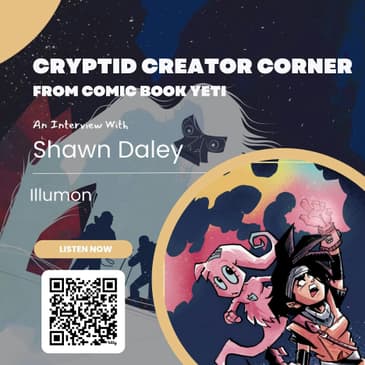
It's a jam-packed week of excellent guests on the Cryptid Creator Corner and today I chat with a creator known for Better Place, TerraQuill, Bridgebuilder's Creed, Samurai Grandpa, ILLÜMON, and Lost Souls #1: The Trials of Casci Capricor: it's SHAWN DALEY. Shawn is a cartoonist from Toronto who was recently named Sequential Magazine Awards Favourite Colourist of 2023. We talk about the comic creators and cartoonists that have impacted Shawn's style the most and how readers' reactions to the work he's done has impacted him. Shawn also talks specifically about his indie comics experience and advice for anyone starting out making their own comics. Be sure to check out all of Shawn's work, especially comics he's created with Eastin DeVerna (they're some of my favorites) and help defeat the algorithm by signing up for Shawn's newsletter here: https://substack.com/@shawndaley
Our episode sponsors
Transphoria Kickstarter
Make sure to check out the Kickstarter campaign for Transphoria, a new new 90 page graphic novel that collects 19 new short storeis about trans and non-binary experiences of gender euphoria.
Arkenforge
Play TTRPG games? Make sure to check out our partner Arkenforge. They have everything you need to make your TTRPG more fun and immersive, allowing you to build, play, and export animated maps including in person fog of war capability that let’s your players interact with maps as the adventure unfolds while you, the DM get the full picture. Use the discount code YETI5 to get $5 off your order.
Learn more about your ad choices. Visit megaphone.fm/adchoices
[00:00:00] Your ears do not deceive you. You have just entered the Cryptid Creator Corner brought to you by your friends at Comic Book Yeti.
[00:00:07] So without further ado, let's get on to the interview.
[00:00:11] Hey Comics Fam! Whether you are a long-time listener or a veteran catching the show today, all are welcome here.
[00:00:17] When we started this podcast, inclusion and diversity were at the forefront of what we wanted to cover and promote with it.
[00:00:23] So in June, we'll be celebrating Pride Month for our second year in a row featuring an amazing group of queer creators and their projects.
[00:00:30] One of those projects is from our friends at Lifeline Comics.
[00:00:34] Following their success with By Visibility Still By, Herology, and Rainbow Canvas,
[00:00:39] Lifeline Comics is launching their newest queer anthology, Transphoria, a trans and non-binary anthology on May 30th.
[00:00:47] The 90-page graphic novel will contain 19 stories all about trans and non-binary experiences of gender euphoria,
[00:00:54] crossing all genres like slice of life, supernatural, romance, science fiction, anime, and beyond.
[00:01:01] Featuring a vibrant display of artistic styles and storytelling techniques,
[00:01:05] Transphoria is a testament to the creativity and talent of its contributors.
[00:01:09] From sci-fi, striking stories to endearing romantic adventures,
[00:01:14] this graphic novel celebrates trans stories while delivering a powerful message of empowerment and affirmation.
[00:01:20] I'll put a link in the show notes so you can check it out.
[00:01:22] As always, thanks for listening and have a glorious Pride Month helping us celebrate!
[00:01:31] Y'all, Jimmy, the Chaos Goblin strikes again!
[00:01:34] I should have known better than to mention I was working on my DC Universe meets Ravenloft hybrid D&D campaign on social media.
[00:01:41] My bad.
[00:01:42] He goes and tags a bunch of comics creators we know,
[00:01:44] and now I have to get it in gear and whip this campaign into shape so we can start playing.
[00:01:49] Another friend chimes in, are you going to make BAPS?
[00:01:52] It's fair to say it's been a while since I put something together, so I guess?
[00:01:57] It was then that I discovered Arc and Forge.
[00:01:59] If you don't know who Arc and Forge is, they have everything you need to make your TTRPG more fun and immersive,
[00:02:06] allowing you to build, play and export animated maps, including in-person Fog of War capability
[00:02:12] that lets your players interact with maps as the adventure unfolds while you, the DM, get the full picture.
[00:02:19] Now I'm set to easily build high-res animated maps saving myself precious time and significantly adding nuance to our campaign.
[00:02:26] That's a win every day in my book.
[00:02:28] Check them out at arcandforge.com and use the discount code YETTIE5 to get $5 off.
[00:02:34] I'll drop a link in the show notes for you and big thanks to Arc and Forge for partnering with our show.
[00:02:39] I think I'm going to make Jimmy play a goblin warlock just to get even.
[00:02:43] Hello and welcome to Comic Book Yeti's Cryptid Creator Corner.
[00:02:47] I am one of your hosts, Jimmy Gasparro, and I am here today with a, well as his Twitter profile says,
[00:02:56] two-time Ringo Award losing cartoonist.
[00:03:00] Although that title really doesn't do him justice.
[00:03:05] He has made some fantastic comics.
[00:03:08] Bridge Builders Creed is one of my favorites, Terraquil, Samurai Grandpa, A Better Place,
[00:03:14] which I was just going through and reading, which I was right before we started recording,
[00:03:20] which I was lucky enough to pick up when I met this cartoonist in person at Baltimore Comic-Con.
[00:03:26] But please welcome to the podcast, Sean Daly.
[00:03:30] Sean, how are you doing today?
[00:03:32] Good, good man.
[00:03:33] Thanks for just letting me chat a little bit today.
[00:03:36] I really appreciate that.
[00:03:37] And that was a great intro.
[00:03:38] Thank you.
[00:03:39] I'm going to try and make it three time losing Ringo Award winner this year.
[00:03:44] So we'll see.
[00:03:45] Well, yeah.
[00:03:46] And like I said, we, you know, on the podcast, we can, I mean, I just like talking about comics.
[00:03:53] And I especially love talking about comics with folks that I've actually like had the pleasure of meeting,
[00:04:00] even if it's briefly, especially Baltimore Comic-Con.
[00:04:02] I've had a lot of folks on here that I've met at Baltimore, which I think is a show that I really like.
[00:04:09] I think they do a nice job.
[00:04:11] I've met a lot of great creators there.
[00:04:13] It's an amazing show, actually.
[00:04:15] That's like the I've done it twice now and I wish I was there every year.
[00:04:19] It's just the thing that blew me away about that show was just the people.
[00:04:24] Everyone was so nice and just kind and just wanted to consume comics.
[00:04:29] And I mean, you see that a lot at many shows, but Baltimore just had like an air about it that made me, I don't know, made me really happy, happy to be around.
[00:04:39] Yeah, I really like it.
[00:04:40] I really like it. My brother and I have gone for a number of years now, and we usually go down for the Friday.
[00:04:48] We've gone different days, but usually we're definitely there on Fridays.
[00:04:52] And sometimes I'll go back on Saturday.
[00:04:55] But yeah, I think it really does a nice job to get a lot of different creators there and to really get a lot of folks into Artist Alley.
[00:05:05] I've discovered some great creators and gotten to meet a bunch of folks that, you know, who make comics that I really like.
[00:05:12] I was excited to see that you were going to be there the year that you were.
[00:05:17] I think I first probably discovered your work through social media, through Twitter.
[00:05:23] Just somebody retweeted it into my timeline.
[00:05:27] And I think the first thing I read of yours was probably Bridge Builders Creed.
[00:05:31] OK, cool.
[00:05:32] And I think the last crowdfunding campaign for Samurai Grandpa, I backed.
[00:05:41] And yeah, I picked up Better Place from you in Baltimore.
[00:05:46] And I also think I backed and I probably have it around here somewhere.
[00:05:52] Lost Souls, which I also, it was you and Easton Daverna.
[00:05:58] That's it. Yeah, we've done a whole lot together.
[00:06:01] Which is, yeah, that's a bit of an understatement.
[00:06:04] But it's something that I mean, you know, he's one of those guys that I respect so much.
[00:06:09] Love his writing.
[00:06:11] And he's just a good friend.
[00:06:13] But any time he comes to me with like, hey, here's this new project.
[00:06:17] What do you think?
[00:06:18] I'm like, don't even tell me what it is.
[00:06:21] Just send me a script and I'll draw it because I know it'll be right up my alley.
[00:06:26] Yeah, it's fun getting to work with him as much as I do.
[00:06:30] I'm grateful for that.
[00:06:32] Yeah. And I mean, I think the two of you just make some fantastic comics.
[00:06:36] Lost Souls, I just absolutely love fell in love with that world, that that storytelling.
[00:06:45] I mean, I really feel like you have such a distinctive style now that I've read a couple of things of yours that you have drawn and worked on.
[00:06:55] The Bridge Builders Creed in particular, I was kind of blown away by and was so glad I discovered it when I did.
[00:07:06] I mean, it's just a wonderful story.
[00:07:10] I love your, you know, the style of it.
[00:07:13] And yeah, it was just something I was like, wow, I am going to check out everything this guy does.
[00:07:21] Thank you.
[00:07:22] Thank you. I appreciate that.
[00:07:24] That book actually almost didn't get made there.
[00:07:27] I started it in like 2017, right after, just shortly after, like Samurai Grandpa, which is why those two characters look so similar.
[00:07:37] Just like the old bald man with wispy hair and a beard.
[00:07:40] Right.
[00:07:41] I was just in that headspace at the time.
[00:07:43] And I got about halfway through and then I shelved it for maybe three years and I just didn't bother touching it for a little bit.
[00:07:54] And then once COVID happened, I was just kind of looking at the pages thinking like, why didn't I finish this?
[00:08:00] I think I got tied up with other projects.
[00:08:02] But yeah, that book very nearly did not happen.
[00:08:06] So I'm glad that you enjoyed it.
[00:08:11] It warms my heart.
[00:08:14] Oh, yeah.
[00:08:15] There's a lot to love about it.
[00:08:18] And I'm kind of curious with your kind of art style, like what do you think has been the biggest influence on you to kind of develop?
[00:08:33] Like the characters that you've created and the, you know, the worlds that you've built, especially something like Lost Souls where I mean it's just it truly is like otherworldly.
[00:08:43] And you really can get lost in the, you know, the landscapes that you have created.
[00:08:51] But in particular, your characters, I just love it.
[00:08:55] There's just such an ease to it that I'm sure is the exact opposite of easy when you're putting it together.
[00:09:03] It's you know what?
[00:09:06] It really depends on the book.
[00:09:09] Some books have characters that come really easily and others feel like they kind of challenge me a little bit.
[00:09:15] I really have to work towards figuring out their aesthetics and their personalities.
[00:09:19] And then even sometimes I'm not sure what those are when I start working on certain books and then I figure it out while I'm drawing the book.
[00:09:27] But I think it's pretty safe to say that cartoonists like Jeff Lemire and Matt Kent are huge influences on especially the style that I started off working in where it was very expressive with ink and lines.
[00:09:45] And then as I realized that a curatorial has been one of my favorite cartoonists for years and years and years since I was like 15, 16, I started kind of incorporating a little bit more of his work into, you know,
[00:10:02] You know, paneling and character design in line work and even like whimsical storytelling the way that every once in a while, you know, in Dragon Ball and Dragon Ball Z and some of his other work, he'll just sneak in these very heartfelt, whimsical, emotional beats that kind of break up the tension of extreme fighting or, you know, heightened drama.
[00:10:24] And I feel like every book that I do, there's always a little bit of space for that.
[00:10:29] And I kind of thank him especially for that. But yeah, I think the style, you could say a lot of cartoonists who paint their work and then guys like a curatorial who just do action and movement in a way that no one else does.
[00:10:48] But I mean, that style of changes from book to book, you could say, where, you know, I'm working on a book right now and I'm reading a lot of Dan Sakai's work.
[00:10:58] And yeah, that's gonna, yeah, eventually that will seep into the style and you're going to see a little bit of that there.
[00:11:06] But every time I sit down to either figure out an aesthetic or a character, it's just treated as a learning opportunity of, you know, it's just now I get to learn something new that I've never done before.
[00:11:17] I've never tried before. I get to let somebody else influence me. And it really is, I don't know, I feel so fortunate to, and I'm sure a lot of people feel like this, but a lot of artists feel like this.
[00:11:32] Just to have so many amazing influences in comics and in art who can kind of provide anything that you need to be inspired by or update your style or try new things.
[00:11:45] Yeah, there's a lot. There's a lot out there.
[00:11:49] In terms of your actual work, I mean, you still work, I guess traditionally opposed to digitally and in terms of the, you know, the, in terms of your books and your style.
[00:12:03] I mean, that's right.
[00:12:08] Yeah, sorry. Yeah, that's pretty much the only way that I've tried working digitally.
[00:12:16] And I can do that for concept artwork, but I cannot do that for pages. And it's something that I've wanted to for a little while to try and maybe figure out how I can start working digitally because it would be nice to be going to shows without having to bring an entire, like conventions, without having to bring an entire setup for inking stuff because I'm usually working on pages at these shows.
[00:12:39] I'll just bring my work with me and try to get it all done. That's way easier when you have an iPad and nothing else.
[00:12:45] I'm sure.
[00:12:47] Yeah, it's so much easier. But at the same time, I kind of like getting my hands dirty and feeling, you know, the difference pencils and markers and the paper that tactile experience just hasn't been replaced for me yet.
[00:13:02] I don't know if it ever will. I would never rule it out because I do think that technology is eventually going to get to the point where there will be a hybrid between the two, where you can get that tactile sensation while you're working digitally.
[00:13:16] Haven't found it yet, but yeah, it's all on paper.
[00:13:21] With your own storytelling, when you're working on something that is wholly your own as opposed to your cover work or something along those lines, what type of stories do you find yourself gravitating towards that you want to tell and you want to create?
[00:13:38] I have always been a fan of emotional stories, something that once you put down it kind of sticks with you and you're not just like, all right on to the next book.
[00:13:50] You kind of want to sit down and think a little bit about what you just read. And to me, that makes a book successful. It's not how much money it makes.
[00:14:00] It's not anything like that. Don't tell the editors I said that.
[00:14:08] But to me, I want something that somebody can read, they can put down and then even though it's not in their hands, they're still thinking about it afterwards.
[00:14:17] And it resonates with them, especially at a certain point in their life where maybe reading one of these books was something that they really needed at the time.
[00:14:28] Hearing stories about that from readers, it makes my day and there's nothing like it when somebody is like, hey, I just read this book that you did and I really needed a story like that because I'm at this point in my life or this just happened.
[00:14:43] And this did something for me, whether it helped them or gave them some respite from some of the challenges they've been having.
[00:14:55] Yeah, it's. I feel like that to me makes a book successful.
[00:15:04] So with something like the if we can talk about something like the Bridge Builders Creed, where you said you started it kind of got away from it for a while and then then went back to kind of put it all together.
[00:15:18] Even without that break in between, how long does it take from concept to completion to put something like that together?
[00:15:30] I think I wrote that book in about three months and there was almost no editing on it.
[00:15:37] I just kind of did the script and I just wanted to move into it.
[00:15:41] I didn't, which is bad. You're supposed to finish the script. You edited it. I didn't do any of that.
[00:15:47] I just kind of went into it and I figured I would edit it while I was drawing just because I knew that this wouldn't be done with a publisher.
[00:15:54] This was going to be something that I released myself and just kickstarted a crowd fund.
[00:15:59] And I would say that if I'm not counting the gap, the art probably took a year and a half to put together.
[00:16:06] Which for a 200 page book, I don't think is terrible.
[00:16:09] I was actually also working on things like Samurai Grandpa and other books at the same time.
[00:16:17] But yeah, it's a little chunk of time to actually put that together.
[00:16:23] Different books vary. Something like the book that I just released last year, the first book in a series called Illumon.
[00:16:31] That one, I rushed through that book and I'm not saying that I'm unhappy with it.
[00:16:38] I'm happy enough with the artwork in it.
[00:16:42] But I did end up trying to get through that as quickly as I could.
[00:16:45] It took about six months to write and draw that book, which is still a good chunk of time.
[00:16:52] But I feel like it's weird. It's almost like the time that you put into it doesn't matter.
[00:17:00] It's finishing it. It could have taken 10 years, but as long as it gets done and it's finished, fine. That's good.
[00:17:12] Yeah, no, I mean, I don't think a year and a half in terms of all the work put into that might actually be longer.
[00:17:20] I mean, Bridge Builders Creed was like 170 pages or so.
[00:17:26] Roughly, yeah. It's like a 200 page book, which meant I couldn't.
[00:17:30] I shipped it out around actually not too long ago and every publisher was like we can't, you know, we really like it.
[00:17:39] But 200 pages is kind of hefty for a story that we were kind of taking a chance on.
[00:17:48] And yeah, the page count actually did no services and many disservices to that book as far as being published ones.
[00:17:57] And actually as far as being shipped went because shipping a 200 page book, especially here in Canada, it is not cheap.
[00:18:03] It actually costs the same amount that the book cost about 20 bucks.
[00:18:08] And I'm really not cool with that to charge 20 bucks for a book and then 20 for shipping.
[00:18:15] Yeah, doesn't sit well with me. But yeah, but the thing is I wouldn't have done it any differently because I'm proud of that story and people seem to enjoy it.
[00:18:25] So it wouldn't have made sense to make any changes. Yeah, I mean, I love it.
[00:18:30] Listeners, if not, then just I think and then, John, it's your work.
[00:18:38] So correct me if I'm wrong. But I think the first thing you crowdfunded was about Terraquil and it was like short comics.
[00:18:47] Yeah, I think I'm assuming the bridge builders creed was kind of built from that because the bridge builder, he's the main characters kind of like I think like Tarek Terraquil is the land and he's like the last bridge builder.
[00:19:02] The land has been like ravaged by war. He's kind of helped shape it.
[00:19:06] A lot of it is been destroyed because of the war and it's really him kind of the main character.
[00:19:15] Kind of going on a bit of a journey through the land.
[00:19:20] And it's just a beautiful story about it kind of the work that he's put into his life, kind of rebuilding the land, rebuilding self.
[00:19:35] I really just I think it's wonderful.
[00:19:38] Thank you. But I'm assuming in terms of the chronology of it, the Terraquil came first, the bridge builders creed was kind of born out of that.
[00:19:46] Yeah, yeah, kind of. I mean, in a few different ways actually because like you said, the story does take place in Terraquil, which is the world of that first book of short stories.
[00:19:57] But I started working on bridge builders kind of right after I made Terraquil and Terraquil had a little bit of you know, it was way more successful than I thought it would.
[00:20:06] It was going to be and even by that metric, it wasn't like a smash hit success kind of thing, but it did allow me to fund my next book.
[00:20:15] And after that came out, that's kind of what I was thinking is like, what am I doing next?
[00:20:21] And I was terrified. I was actually just so afraid of having to do this all over again because it was so much work.
[00:20:29] You know what I mean? Like putting a book together, it's so much work, especially when you're doing it all yourself.
[00:20:34] And so I was kind of like I was afraid that what I had just done with Terraquil was like the best thing I'll have ever done with my life.
[00:20:46] You know what I mean? And it was like, well, where do I go from here? Like, does it just go downhill from here? Have I peaked?
[00:20:51] Do I have anything else to look forward to? And then that those feelings became the main character who feels like he's already done the most important thing he's ever done.
[00:21:03] And that he kind of has nowhere else to go and nothing to look forward to.
[00:21:08] Right. And then eventually changing that mindset and realizing that it's never too late to do the most important thing that you've ever had.
[00:21:17] Oh, wow. That's interesting how that I mean, that kind of they float into each other.
[00:21:24] And, you know, that's what I love about comics kind of taking those feelings and emotions and putting it into a story like that.
[00:21:32] So then what was it like? Because, you know, just I had the Kickstarter up and just to go through the crowd from the collected Terraquil stories.
[00:21:42] It's a successful campaign. It has looks like one hundred ninety five backers or so.
[00:21:49] You kind of take what you've just talked about, pour it into the Bridge Builders Creed and then crowd fund that.
[00:21:59] And, you know, I think like over three hundred backers or so show up for the Bridge Builders Creed.
[00:22:09] What was that feeling like, you know, after what you just talked about pouring into the Bridge Builders Creed and then seeing people show up for it on Kickstarter, Kickstarter when you put it out there?
[00:22:20] Yeah, it was it was it was terrifying and completely validating.
[00:22:26] Like it was a very weird mix of both. It's like, OK, I guess what I'm doing is some is somewhat working.
[00:22:33] It's you know, I didn't get zero people. That's great.
[00:22:36] But it was also like, oh, God, now people are going to read this.
[00:22:40] And, you know, obviously I did want them to.
[00:22:43] That was the whole point of creating it and kickstarting it.
[00:22:46] Well, not creating it, but at least kickstarting it.
[00:22:48] And yeah, it was just very validating. It felt it felt good.
[00:22:53] But I mean, doing a Kickstarter is so much work.
[00:22:57] And to be honest, writing and drawing the book are the easiest parts of putting a Kickstarter together.
[00:23:04] You have so much to consider afterwards.
[00:23:08] And I think that is what I was fearing the most was just the fulfillment aspect of it, because it is a lot of work.
[00:23:17] It's something that I try to tell everybody when I do panels at conventions that if you're going to run a Kickstarter, you kind of have to treat it like a full time job.
[00:23:26] It's going to be going to be a lot of work and just putting the book together is that's the easiest part of it.
[00:23:36] That's because I mean, that's something that you would be doing anyways.
[00:23:39] If you just like making comics, you're going to make comics, but doing everything else, sourcing a printer,
[00:23:44] going to shipping places, looking at fulfillment options, getting everything that you needed printed for rewards or manufactured for rewards is a lot of work.
[00:23:57] And it's very rewarding when you do it.
[00:24:00] But it is terrifying when you realize you have to do it.
[00:24:03] Right. It's so much.
[00:24:06] All right. Let's take a quick break.
[00:24:09] Hey, comics fam, the comic book publisher Banda Bars just got a level up and announced it is now a cooperative.
[00:24:16] This heralds a new era for them, including a partnership with Dauntless Stories.
[00:24:20] And they added several new members to the ownership group.
[00:24:23] Marcus Jimenez is now chief operating officer.
[00:24:26] Brent Fisher takes on the role of chief diversity officer.
[00:24:29] And Joey Galvez is introduced as head of Kickstarter Ops and social media manager, which is sure to increase their capabilities overall as a publisher.
[00:24:38] And it further promotes their mission statement of advancing representation, inclusion and diversity in the media.
[00:24:45] They also established a new board of directors to help chart the new path of their journey with new projects in the works like Alaska by dropping in June.
[00:24:53] Unbroken soon launching on Kickstarter and Pond coming up with Dauntless.
[00:24:57] Stay tuned to this space for more exciting news from the growing Bards family.
[00:25:01] Let's get back to the show.
[00:25:07] I heard it said, I can't remember who said it, but talking to someone about Kickstarters and their their sentiment was, you know, you got to prepare for failure.
[00:25:20] You know, and like how you're going to pivot, but you also need to prepare for success.
[00:25:24] And you're going to have to get published, you know, for like Bridge Builders Creed.
[00:25:28] You're going to have to, you know, however many of those 300 some backers back to physical copy.
[00:25:33] You know, you're going to have to get all those printed, get them shipped out, do all of that.
[00:25:37] I mean, I don't think some people realize when they go to Kickstarter and see like all the work that just puts into designing, you know, what the Kickstarter page is going to look like all that text, all those rewards, every bookmark or sticker that is going to, you know, get go out if you back at a certain level.
[00:25:55] And you're you did what you've done three so far.
[00:26:00] All by yourself.
[00:26:02] For myself.
[00:26:06] Yeah, yeah, I think it's been three and then a few with Easton three with him.
[00:26:13] And then just various other projects that I've kind of contributed to and help them build all of that stuff.
[00:26:21] But what you just man what you just said prepare for success is so good.
[00:26:25] That is something that everybody is sorry like they need to know that.
[00:26:30] Like I didn't come up with it, but somebody said it to me and I think about it every time I see a Kickstarter like it look prepare in case it doesn't go.
[00:26:39] You know, what can you do with this?
[00:26:40] Can you pivot?
[00:26:41] Can you, you know, pull yourself together, figure out what went wrong, figure out how to get the word out there, but also like, yeah, prepare that like it could get funded and you're going to have to make this book and get it fulfilled.
[00:26:55] These things don't have to do all of it.
[00:26:57] Yeah, give me flashbacks.
[00:27:00] And like I say that was like peace and love.
[00:27:02] It's a great, great experience and something that I really think that if you're working in Indie comics.
[00:27:07] You should take a chance on that.
[00:27:10] I always tell people at panels to start small, which is what I did with Terra Cool is I did short stories.
[00:27:17] Initially, I wanted to do a huge wild book like Bridge Builder where it's going to be this 200 page epic and it's going to, you know, tell this very important emotional story.
[00:27:30] And it didn't.
[00:27:33] It was, it was.
[00:27:37] It was too much.
[00:27:38] I had to start small by doing short stories.
[00:27:41] And so I don't know if anybody out there is listening and they want to do comics and you want to kickstart.
[00:27:47] Start small.
[00:27:49] Do something very concise and then maybe short stories is a good way to go.
[00:27:55] But, you know, it's going to vary with everybody anyways.
[00:27:58] Oh, yeah. Absolutely true.
[00:28:00] Yeah. I mean, in terms of the past few years within the Indie comics space like.
[00:28:09] I mean, what do you think that I don't know trend is the right word, but, you know, what do you think about what you've seen with folks going to Kickstarter and the rise of other crowdfunding platforms like ZOOP?
[00:28:22] I mean, do you think you're going to even though there are a lot of work, you know.
[00:28:29] Head to the crowdfunding space in the future.
[00:28:34] I will always crowdfund my books if, you know, even I'll sometimes even just not even bother approaching publishers with my work.
[00:28:44] I'll just not always, but there are some instances where I'll say, you know, I just want to do this myself.
[00:28:51] I am familiar enough the platform.
[00:28:55] I've done this a few times.
[00:28:56] I know how to run a mildly successful campaign, but I'll kind of always start there because to me there's nothing better for consumers than, you know, going direct to the source and buying a book off of the creative experience.
[00:29:14] The creator pockets all the money.
[00:29:16] They get 100% of the proceeds that the book is going to make.
[00:29:22] The thing is you're missing out on a huge, very important arm of publishing, which is the marketing section.
[00:29:29] And no one does that better than publishers, no indie creators, no self promoters do that better than the publishers.
[00:29:35] And to me, that is one of the most amazing things about working with them is that they, you know, have these divisions and these arms that can really take your book to the next level.
[00:29:46] And working with the editors that are at a lot of these publishers, outstanding, like just some of the best, most amazing people I've ever worked with.
[00:29:56] But if I'm not doing that, then I'm absolutely going to Kickstarter or crowd funder.
[00:30:01] They've changed a lot in the last, boy, maybe less time than I think, maybe like two years.
[00:30:09] And not in a bad way.
[00:30:10] I think that they're getting better and they're adding more features.
[00:30:14] And personally, I would love to see Kickstarter have its own almost like a social network in a way where you could kind of just use the platform itself to do a better job promoting your own work.
[00:30:32] It would be neat to see them integrate something like that.
[00:30:34] But right now we're stuck with social media and I'm sure you've noticed it is not as effective as it once was to share things on sites like Twitter or Instagram or whatever have you.
[00:30:49] Oh, yeah. It's certainly I've noticed it.
[00:30:53] I mean, a lot of folks have in terms of like trying to get things out there and engagement seems down depending on different things.
[00:31:01] And I've never been a big fan of Facebook or when I'm not really on Instagram.
[00:31:09] It just depends on what mileage you get out of it.
[00:31:12] I think that TikTok can be fun.
[00:31:14] I've checked that out a little bit, made some videos promoting comics that I've liked, but I don't have a lot of followers.
[00:31:24] They don't get many views and it's difficult to put links in, which is the nice thing about Twitter.
[00:31:29] You can put a link in.
[00:31:30] Right. Yes.
[00:31:31] But even when you do that in Twitter, the algorithm is just going to be like, oh, there's a link here.
[00:31:38] You're trying to take somebody away from Twitter.
[00:31:39] Well, we'll just make sure nobody sees it.
[00:31:41] Right.
[00:31:42] And yeah, it's it just feels like all of these companies have done everything they can to stifle the effectiveness of these platforms, which is still strange for like creators.
[00:31:54] But that's why things like mailing lists and substacks and ways to communicate directly with your audience are I think kind of and then things like Discord.
[00:32:08] Discord is big as well, but kind of like self-contained mini versions of social networks I think will be the future for indie creators trying to make sure that they have a network that's actually going to see what they're talking about.
[00:32:24] You know?
[00:32:25] Yeah, absolutely.
[00:32:26] Absolutely. I mean, I think, you know, even in terms of like Kickstarter, a lot of folks that I've talked to who kickstart projects, they're saying that they still see the most people find their campaign through Kickstarter itself.
[00:32:40] So somebody who is familiar with Kickstarter backs something on Kickstarter.
[00:32:43] Their project has even has gotten the project.
[00:32:46] We love Badge or it has been suggested through somebody else's campaign, you know, and the Kickstarter update goes out and you know someone else says, oh, here, check this new campaign out.
[00:32:59] And then, you know, you're found that way.
[00:33:03] Exactly.
[00:33:04] Listeners, that's a great thing though.
[00:33:06] If you find somebody that you like, whether or not it's a writer, an artist, a colorist, a letterer, an editor, a publisher, if you find something in the indie comic space that you like, I think the best thing to do is to go, they have a newsletter, sign up for the newsletter.
[00:33:22] Because that way you're going to make sure that you're not missing a post due to the algorithm that you're going to be able to see what they have coming out, what they have coming up.
[00:33:32] If they're working on a project, you know, if Sean has a new cover coming out with like a project that a publisher or if Sean's kickstarting a new book, you know, you'll be able to find out all that stuff.
[00:33:46] I think that's like one of the number one things to do to make sure that you're seeing the stuff from the folks who, you know, you like reading.
[00:33:54] It's amazing. And it's just again that direct contact with the readers is fantastic.
[00:34:01] I wish I had that when I was first getting into and learning about and understanding comics.
[00:34:08] Because you have this direct line to the people who are making the books that you love, and you can ask them almost whatever you want about the process, about putting their books together, about where they get their ideas from.
[00:34:20] You have that direct line of communication that you kind of didn't have like 10 years ago.
[00:34:25] And, you know, I always also tell any new artists who kind of stumble into my substack or my Twitch streams.
[00:34:35] Like if you have questions about this stuff, just ask them. As long as you're polite and respectful of like, you know, the artist's time or the creator's time, they'll probably be interested enough to tell you about what they're doing and answer your questions for you.
[00:34:51] And it can just be a very wonderful learning experience to connect one on one with these creators.
[00:34:57] Oh, yeah, I 100% agree.
[00:35:00] Speaking of what you just mentioned about when you got started and, you know, at the cryptid creator corner, I'm always interested in that.
[00:35:07] I loved A.S. folks, you know.
[00:35:10] We all like, I think a lot of people like to tell stories. A lot of people like, you know, everyone as a kid goes into some artistic endeavor, whether or not it's, you know, just to be occupied or whatever the case might be.
[00:35:27] But, you know, to get to the point where you want to tell stories for a living and or you want to draw whatever it is, especially comics visual storytelling.
[00:35:39] I'm always interested in what takes that from just a hobby or something you do to really want to put your work out there in the world.
[00:35:47] And so what was comics an area that you always wanted to work in?
[00:35:52] How did you find your way to making some of the stuff that you have?
[00:35:57] So for me, it was music. I just always wanted to be a professional musician in some way, shape or form, whether it was playing in a band or composing for movies or video games.
[00:36:08] It was always music and not necessarily for any storytelling related reasons.
[00:36:15] I just like I enjoy music. Yeah, I enjoy playing music.
[00:36:20] I enjoy listening. And so I went to school for that and I loved it.
[00:36:25] I worked in the music industry for a few years, ran a recording studio for a little while.
[00:36:30] And while I was working there, I ended up.
[00:36:35] Weird story. I was living with my boss at the time and I didn't really have any way to like I didn't really have any entertainment while I was living there.
[00:36:45] There was really no television or Internet access at the time.
[00:36:50] This would have been like.
[00:36:52] It hasn't been nine or so, and he just didn't have this stuff.
[00:36:57] So I ended up kind of rating a bookshelf every night and I would just find something to read and I discovered.
[00:37:06] Chester Brown's Louis Riel, which is kind of a history of how Canada was essentially founded and.
[00:37:13] A bit of the darker side that they don't really teach in schools.
[00:37:18] And I fell in love with it. It was one of the it was actually the very first comic that I read and you know, of all things, it wasn't superheroes.
[00:37:26] It wasn't anything like that. It was Canadian history.
[00:37:29] Right. And Chester Brown now. Yeah, Chester Brown.
[00:37:33] Top top notch cartoonist.
[00:37:36] And I just fell in love with the idea that.
[00:37:40] I could be so entertained and just so like it felt like I was a fish on the end of a line like he got me and he was just reeling me in the whole time.
[00:37:49] And I was almost excited to jump into the boat. It was just like, you know, where's this going?
[00:37:54] What's next? And after that.
[00:37:57] I realized that I was hooked. I needed to keep going and.
[00:38:02] You know, you go down the rabbit hole, you find out what are the best graphic novels out there.
[00:38:07] You discover Watchmen. You learn a little bit more about superheroes and it just kind of spiral from there.
[00:38:15] You got very out of control very quickly.
[00:38:18] And so, yeah, I just I read a lot. I read, read, read and.
[00:38:22] Ended up not working in music anymore.
[00:38:26] I was looking for a newspaper here in the city in Toronto.
[00:38:30] And there would be a lot of days where I would get my work done and just read comics.
[00:38:35] At like noon till like four or five, you know, the work's done.
[00:38:39] Doesn't matter. And.
[00:38:42] I just kind of ended up.
[00:38:45] My brain does this weird thing where it's like if you are consuming something so much eventually it in my brain just wants to do it.
[00:38:52] What happened with music? I was just listening to so much and eventually I wanted to start playing it.
[00:38:57] And it happened with comics where I was reading so many that essentially I figured I had to start making them.
[00:39:03] So I would just kind of lock my office door and draw for like three or four hours a day and just teach myself.
[00:39:09] I would go on YouTube and get some art books and stuff like that.
[00:39:14] And yeah, it it just turned into something I was doing every single day and just.
[00:39:20] I wanted to make comics and tell these stories like the ones that I was reading.
[00:39:24] And then we all got fired from that job, which is for the best.
[00:39:29] There's no complaints. It turned out OK.
[00:39:32] But yeah, the office got closed down and I was in a position where I had saved up enough money to live for a year without having to worry.
[00:39:43] I would have to blow through everything to do that.
[00:39:46] But you know, I could I could get by. I could afford rent and groceries and nothing else like that was.
[00:39:52] And so I said to myself that I'm going to make comics for people for free.
[00:39:58] And just kind of live off of what I've saved.
[00:40:01] And at the end of that year, if I'm in a position where I can start charging people, then I will keep going.
[00:40:08] And it hasn't stopped since.
[00:40:11] Wow. It just ended up being getting to the point where I was able to actually find work making comics at the end of that year.
[00:40:19] And to be able to sit down and treat it like a job and do it professionally.
[00:40:23] So a lot of it was luck, I think.
[00:40:28] But it did take a lot of work that I think I sometimes forget about.
[00:40:34] Well, yeah, I mean, you're you were to no like formal training.
[00:40:42] You know, just like really learning on your own.
[00:40:45] Yeah, yeah. A lot of books.
[00:40:47] To me, the training was reading comics because that's to me still the best way to learn them is to read them.
[00:40:54] Look at look at the artwork, look at the writing and ask yourself why did they make these decisions?
[00:41:00] Why why is this line here?
[00:41:02] Why is this technique used? What is this technique?
[00:41:05] And to always be asking questions about what you're reading.
[00:41:07] And I think that if you do that, whether or not you come to those conclusions by yourself or you learn about those conclusions in books, I still think it's the best way to learn.
[00:41:19] Wow, that's awesome.
[00:41:22] No, I just not that there's any I mean, you can learn how to make comics a million different ways.
[00:41:27] Exactly. Yeah.
[00:41:28] You don't need formal training.
[00:41:30] I'm just I was just curious about that.
[00:41:32] I mean, whimsical a bit in terms of your your style.
[00:41:40] But even just like going I was going through your Twitter feed recently, like right before this and you had some I guess either some retweets or some posts of some I think recent commissions that you did.
[00:41:49] But there was a Darth Vader.
[00:41:51] There was I think a Teenage Mutant Ninja Turtle one and I've seen, you know, others that you've done over the years.
[00:41:59] And it's just interesting that I feel like when I see something, I mean, I have a good sense that it might be yours or it might be your work.
[00:42:11] And I just feel like to have such a distinctive style is just what is one of the things that I always gravitate towards.
[00:42:22] And there's there is a certain amount of like whimsy in it.
[00:42:27] And in terms of your your line work, if that makes any sense to you, I really appreciate it.
[00:42:37] Thank you. I mean, I love express like expressing mood through lines.
[00:42:42] And, you know, that that to me is one of the most important arts in comics.
[00:42:48] It's like the line, you know?
[00:42:50] And so, yeah, I'm glad to hear that it's I it's it's you know how sometimes you look at something for too long or you listen to something for too long and you lose perspective of it.
[00:43:01] If that makes sense.
[00:43:02] That's how I feel about like style.
[00:43:06] Or some people will say, hey, this looks like you did it.
[00:43:09] Like, I can't tell. But thank you.
[00:43:11] Like, I appreciate that.
[00:43:13] But I have no idea.
[00:43:16] It's just yeah, it gets to that point eventually.
[00:43:19] Yeah. Oh, that's that's funny.
[00:43:23] So, I mean, I'm sure you probably have some stuff you're working on right now that you can't really talk about yet.
[00:43:30] But do you have any plans for the for any, you know, revisiting Terra Quill or any other things that you can talk about the listeners who want to check out your work or might not be familiar with it?
[00:43:42] That they have something to look forward to.
[00:43:46] Or what what do you think is the best way for folks to kind of get their their hands on your work?
[00:43:51] Honestly, the best way is just to send me a message directly.
[00:43:56] I do have a free sub stack, which is I think it's just Sean daily dot sub stack dot com.
[00:44:01] And I always just tell people like if there's a book you're looking for, message me.
[00:44:07] And if I don't have any physical copies in stock, I'll send you a free PDF.
[00:44:10] Like it's not, you know, I just want people to read the work that to me is still always the most important thing.
[00:44:18] And if you want to buy a book, we can talk about that.
[00:44:21] But if there's something you're looking for, just message me.
[00:44:23] It's kind of one of the benefits of doing this yourself is like.
[00:44:28] You can just do that. You can just be like, oh, you want to read this here?
[00:44:32] Just take it and read it's fine. And yeah, usually just one on one contact is like the best way.
[00:44:38] But I do have I'm drawing a new volume of Samurai Grandpa right now.
[00:44:44] I have 10 new short stories written for a new volume of Terra Cool.
[00:44:49] Oh, nice. Yeah, they're already done.
[00:44:51] I'm just waiting to to find a block of time where I can like sit down and finally get them out.
[00:44:57] And I'm putting together a second volume of Illumon, which is the book I did last year,
[00:45:04] which is kind of a cross between Dragon Ball Z and Pokemon.
[00:45:07] It's like what would happen if a 12 year old kid got their hands on very powerful creatures
[00:45:12] and then accidentally destroyed the world?
[00:45:15] It's very, very shonen inspired Pokemon.
[00:45:20] The characters, the I remember the Kickstarter page, you know, and when you're promoting that,
[00:45:26] but like those character designs are awesome.
[00:45:30] They know that's like so cool.
[00:45:33] Thank you. It was so much fun. That book is something that I want to be doing for not no kidding like the rest of my life.
[00:45:39] Like I have so much material written for this book, and it's actually it's pretty much already completely written.
[00:45:47] Like the story is written out. I would just have to script the whole thing.
[00:45:50] But the 80 page script for the second book is already done.
[00:45:54] I'm just again trying to find a time to draw them to another projects.
[00:45:58] But I do have plans to do a second Kickstarter or a Kickstarter for that second book later this year.
[00:46:04] Oh, nice. I have to finish up Samurai Grandpa first and get that to backers.
[00:46:09] I work on a couple additional projects and yeah, that's that's there's a lot going on.
[00:46:15] There's a lot happening and it's all so much fun.
[00:46:20] And I'm just so grateful I get to do to do that for people.
[00:46:24] Wow. Super cool.
[00:46:26] Listeners, I'm going to say, you know, and I try and recommend things when I have guests on.
[00:46:32] But listeners, if you can get your hands on or come across or see Sean out at a convention and does any of those and he still has copies of it.
[00:46:42] But Bridge Builders Creed I just is such a wonderful story.
[00:46:48] And I feel not just in the writing of it in the artwork.
[00:46:55] It's the initial premise sounds like something that is like such a bummer.
[00:47:00] You know, it's like this world ravaged by war.
[00:47:03] He's the last of his kind. But it there is such a I don't know.
[00:47:08] Just a hopefulness like a.
[00:47:11] It's one of those things where you read and you're like, man, there's a lot that can happen in a life.
[00:47:16] But there's life, you know?
[00:47:19] I don't know. I just well said. Thank you.
[00:47:22] That's it's yeah. It's one of those books that again, talking about perspectives like I've lost all perspective on.
[00:47:29] You know, I know why I made that book. But to me, it's maybe a little bit different than why people have enjoyed it.
[00:47:36] Actually, at the last convention, I was at somebody.
[00:47:40] Stop by and just said, you know, I've been going through a period where I kind of lost some people in my life.
[00:47:46] And this book helped me get through that.
[00:47:49] And to me, that is the best thing that you could ever hear.
[00:47:54] You know, I'll take any compliment you throw at me.
[00:47:57] But that one in particular is, you know, I'm sorry that that compliment has to be made.
[00:48:03] But I'm grateful that I can.
[00:48:06] Be a part of, you know, just.
[00:48:10] That that process, that process that we all go through, that we all, you know, one way or another or one one day or another.
[00:48:18] It's like, you know, we're going to go through that and we're going to feel it.
[00:48:22] So to have media that can help us is, I don't know, so important.
[00:48:28] Oh, yeah, I I 100 percent agree.
[00:48:33] Yeah, like I said, I was just revisiting before we got on a better place that I picked up at Baltimore.
[00:48:39] It's the book you did with Dwayne Marie and that that probably me is I feel like the most that reminds me of Jeff Lemire's work.
[00:48:50] You mentioned earlier.
[00:48:53] Sure, no, that makes sense.
[00:48:54] I mean, he actually him and Matt Kent both contributed our page to better place, which was the dream come true.
[00:49:02] I, you know, still.
[00:49:06] Smile thinking about that, I think.
[00:49:08] Yeah, it was just super, super cool and very nice of them to, you know, among other amazing creators like Nate Powell, Tyler Boss, Jim Rugg.
[00:49:18] Yeah, I'll just had a amazing single page pieces in that book.
[00:49:22] And to me, it elevated it really not to discount Dwayne's beautiful writing and his storytelling is it's just absurd how good he is.
[00:49:33] And, you know, one of those guys like Easton who it's it's going to be one of those scenarios where I hope that for the rest of my professional career,
[00:49:42] I get to work with him as well on anything that he does in some in some respects.
[00:49:48] Yeah, he's just so good.
[00:49:50] Yeah, it's a one. That's a wonderful story.
[00:49:52] You know, then again for listeners, it's about a kid and his granddad and mom kind of super busy doesn't have a whole lot of time for the kid for Dylan.
[00:50:05] He spends a lot of time with his granddad and granddad goes to is supposed to go to a like an assisted living facility.
[00:50:18] And the story goes from there where Dylan tries to track his granddad down.
[00:50:23] And it's it's really beautiful story and really love your artwork and it's Sean.
[00:50:29] Thank you. I appreciate that.
[00:50:32] Well, Sean, this has been great.
[00:50:35] I mean, I really appreciate you coming on.
[00:50:38] You know, comics.
[00:50:40] Yeah, no, it was nice chat.
[00:50:42] It's just always nice to kind of talk about, especially for me like this, the independent scene and kind of where it's at and the tools that people can use to either connect with their audience or to connect with fans.
[00:50:56] And yeah, I don't know. It's always changing. So I think it's important to talk about that stuff.
[00:51:01] Oh, yeah, I agree. And especially in Indie comics and I don't know.
[00:51:06] I just I love comics.
[00:51:08] I love connecting folks with stuff that they're going to love or appreciate or find some type of meaning in and meaning could be something deeply personal or could just be pure old fashioned escapism.
[00:51:25] You know, right. Yeah.
[00:51:26] Whatever it might be. Yeah.
[00:51:29] But to listen but listeners, I, you know, find Sean on on Twitter and sign up for the substack and Sean, please, when when Book Two of Illamon is ready or your Terraquel stories, please come back.
[00:51:44] Let's talk about it.
[00:51:45] Let's let's get it set up.
[00:51:47] Would love to have you back on when you're when you're doing those things again, too, because I'm just I'm such a fan and it's just so nice being able to chat with you kind of about, you know, your your journey to get where you are.
[00:52:02] I love hearing about the how you went from music to comics and all the work you put into it.
[00:52:08] It's just that's fascinating to me.
[00:52:10] And so glad I've gotten to read some amazing stories that you've been a part of and that you've created.
[00:52:16] Well, thank you for reading and thank you for sharing that as well.
[00:52:19] That means a lot.
[00:52:20] And yeah, any time happy to chat anytime.
[00:52:25] All right, listeners.
[00:52:26] Oh, I almost forgot to shout out to my brother Bobby, the cryptic creator corners.
[00:52:29] Number one most dedicated listener.
[00:52:31] Listen, probably.
[00:52:32] Yeah, thanks, Sean.
[00:52:35] Bobby listens to all my episodes.
[00:52:37] Listeners are probably like, does he have to mention his brother every time I do go to Baltimore together?
[00:52:42] We we like a lot of the same comics and a lot of different ones, too.
[00:52:47] And he listens.
[00:52:48] He listens to every episode and he buys a lot of comics.
[00:52:52] So I feel like if someone comes on here and they're like, I don't did anyone listen to this?
[00:52:56] I'm like my brother Bobby did.
[00:52:57] And he bought your comic.
[00:53:01] Thank you, Bobby.
[00:53:02] Thanks for showing support to comics.
[00:53:06] It's awesome.
[00:53:07] But yeah, for Comic Book, Eddie's Cryptid Creator Corner, Jimmy Gasparo, thank you for listening.
[00:53:14] And I'll see you next time.
[00:53:16] And thank you very much, Sean.
[00:53:18] This has been this has been awesome.
[00:53:20] Thank you, Jimmy.
[00:53:21] Appreciate it.
[00:53:22] This is Byron O'Neill, one of your hosts of the Cryptid Creator Corner brought to you by Comic Book, Eddie.
[00:53:28] We hope you've enjoyed this episode of our podcast.
[00:53:31] Please rate, review, subscribe, all that good stuff.
[00:53:35] It lets us know how we're doing and more importantly, how we can improve.
[00:53:40] Thanks for listening.
[00:53:42] If you enjoyed this episode of the Cryptid Creator Corner, maybe you would enjoy our sister podcast, Into the Comics Kate.
[00:53:49] Listen and subscribe wherever you get your podcasts.