
I’ve been talking and thinking recently about the intersection of comedy and comics. It’s sort of right there in the name but it’s rare to see a comedy forward book released right now which strikes me as particularly odd given the challenging times in which we are living mid 2025 when we could all use a good laugh. My guest today, Anthony Iannaccio, is no stranger to comedy as one of the hosts of the popular podcast Comics and Chronic and he’s making his inaugural debut with a new 28-page action/comedy deconstructing the monomyth called Superguy funding and already funded on Kickstarter as we speak.
Links:
From the Kickstarter page
Superguy is a 28-page action-comedy comic book written by Anthony Iannaccio and drawn/lettered by Joey Murphy.
In the original 10 page Superguy one-shot, which every backer will receive a FREE digital copy of, we introduced the lazy, narcissistic hero Superguy and his once enemy, now turned (unappreciated) sidekick, Robotguy. In this first full-length, 28 page action-packed issue, Robotguy is eager to prove himself as a bonafied hero but Superguy doesn't appreciate the spotlight being taken away from him...
Cryptid Creator Corner website
PATREON
We have a new Patreon, CryptidCreatorCornerpod. If you like what we do, please consider supporting us. We got two simple tiers, $1 and $3. Want to know more, you know what to do.
ARKENFORGE
Play TTRPG games? Make sure to check out our partner Arkenforge. Use the discount code YETI5 to get $5 off your order.
THE LANTERN CATALOG
Created on the premise of creating light in the dark, this is the the go to resource to keep you up to date on the indy projects and the creators you love. You can find them at https://www.thelanterncatalog.com/.
Make sure to check out our sponsor 2000AD.
[00:00:00] Your ears do not deceive you. You have just entered the Cryptid Creator Corner brought to you by your friends at Comic Book Yeti. So without further ado, let's get on to the interview.
[00:00:30] Show notes and thank you for your continued support. Thanks for your donation.
[00:01:02] Dan Abnett and so many others. Get a print subscription and it'll arrive to your door every week. And your first issue is free or subscribe digitally. Get free back issues and download DRM free copies of every issue for just $9 a month. That's 128 pages of incredible comics every month for less than $10. That's like a whole graphic novels worth. All subscribers get amazing offers like discount vouchers and exclusive product offers.
[00:01:29] Head to 2000AD.com and click on subscribe now or download the 2000AD app and why wait? Start reading today. I'll put links in the show notes for you. I've been talking and thinking recently about the intersection of comedy and comics. It's sort of right there in the name, but it's rare to see comedy forward books being released right now, which strikes me as particularly odd given the challenging time in which we live mid 2025 when we could all honestly just use a good laugh.
[00:01:57] My guest today is no stranger to comedy as one of the hosts of the popular comics podcast, comic synchronic and he's making his inaugural debut with a new 28 page action comedy deconstructing the monomath called super guy funding and already fully funded on Kickstarter. As we speak Anthony, I'm going to show you. Anthony, I'm not Joe. Welcome to the show, my friend. How are you doing? It's been a long time. Yeah. Thanks, Byron. Thanks for having me on. I'm doing great. And that was an amazing intro. Thank you.
[00:02:26] Appreciate it. Appreciate it. I hear your other podcast. I feel like maybe we all could use a gummy or three these days. So it's it's nice to get a chance to talk about like comedy for a change because I feel everything is it's really heavy in the industry right now for sure. Yeah. No, I've always, you know, I've always kind of had used my sense of humor to navigate the world.
[00:02:49] And especially now, you know, we all need it. But I mean, yeah, it's it's weirdly lacking in a lot of places that you think it should be, you know, thriving. Yeah. Yeah. I mean, congratulations on kicking this thing off already being successfully funded with super guy. It certainly takes a lot of the edge off of things, I would imagine. You know, you just kind of focus on the press and, you know, keep things rolling. Yeah, absolutely. I mean, I thought I was going to be stressed out all month.
[00:03:18] You know, I had confidence we would fund, but not in four hours. You know, that blew me away. So the support has been amazing so far. Yeah, that's monumental to get that kind of a turnout like immediately on the jump. That's that's that's amazing. So congrats. Thank you. Thanks, man. Yeah. Well, and looking through everything, first projects are all about captivating people's attention, you know, from from the jump.
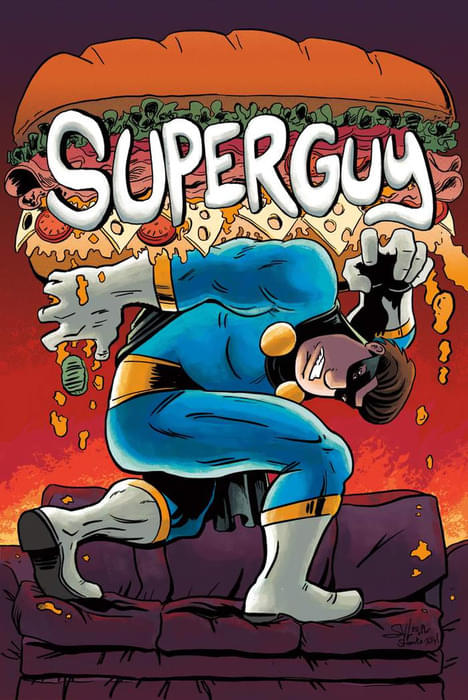
[00:03:41] And the cover alone certainly does that. There's this cheeky modern sort of interpretation of Michelangelo's the creation of Adam from the Sistine Chapel. But instead of the creator extending his hand to Adam, there's just kind of an inversion going on with super guy throwing the bird to his ex nemesis robot guy. I don't I don't know if that's an anti A.I. statement. I'm going to take it as such because I love that. And it sort of immediately sets the tone for your sense of humor and what people can kind of expect in the book.
[00:04:10] So walk me through where this all sort of came from. Sure. So this is the first issue, but it starts in a one shot that was part of the Unknown Heroes anthology. And for that, it was my that was my first piece of comics work. So my first comic script, the 10 pager. And and I always bring that up to whenever I talk super guy, because that informs this issue. And, you know, I've I've sent it to everyone like it's a completely free thing. I want everyone to read it.
[00:04:40] It's definitely I want to say required reading for this a little quick story. But it kind of just came out of the necessity of needing something in a short amount of time. Like I had a few ideas of what I could do for a 10 pager. I knew I wanted it to be something funny. And in terms of the artist that I worked with for this, Joey Murphy, who is essential to everything super guy and robot guy. I knew I would work with him for this 10 pager.
[00:05:11] And so his style lends itself to, I think, comedy. But but just his style is very reminiscent of I want to say Calvin and Hobbes. Like it has a sort of innocent charm. And so that definitely goes hand in hand with comedy. And so I know I wanted something lighthearted, but something that showed I still loved comics and wasn't like necessarily making fun of it.
[00:05:34] But building on what like so what you said earlier about comedy in comics, like I felt like for me personally, like I read a lot of comics. And super guy was not something I was seeing on my shelf necessarily, like not to knock anybody trying to make literal funny books because there are plenty of great ones out there. But but for super guy, I just wanted something that was not so serious and something that was just silly, but mainly fun.
[00:06:01] Like fun is what's so important for this first issue, for that one shot. And that's really what I'm trying to do. Have fun. Well, comics to me. Right. We always get to talk on these podcast shows about comics influences. So this is one of those rare opportunities. I'm going to flip that a little bit and we get to talk about comedic influences. Yeah. So so drop some comedic influences. What do you got? So I was really lucky. I grew up.
[00:06:27] My grandfather was the funniest guy I ever met, you know, to this day. And he was always watching like Turner classic movies or those kind of channels. And I would watch like the Marx Brothers with him and the Three Stooges and Mel Brooks. And like those like poor comedies, like really like fueled like what I found funny even as a little kid.
[00:06:50] And then comedians wise, you know, like George Carlin, Mitch Hedberg, Dimitri Martin and then TV shows. Like I grew up watching TV. So I did watch a lot of like especially mad TV back in the day. And like Comedy Central Presents was a show that was like I always had on TV. Like I was watching stand up sets that I should not have been watching at whatever age I was watching them at. But like my whole life, I've just been like, you know, the class clown.
[00:07:17] Like I just want to make people laugh because, you know, I in dark times in the world in general. But like, you know, growing up, I just was with my cousins all the time. And I was like the one to bring like the lightness, you know, and wanted to have fun. Like it's just part of who I am. And so I naturally it's just I gravitate to comedy. Yeah, absolutely. And it seems like the perfect timing for me to have more comedy and comics and a personal opinion here.
[00:07:44] We've lost something in this endeavor to kind of deconstruct the darker side of these superpower characters that we all love. And I feel like we're leaning into that too much. And I think the lightness is something that made us all as kids kind of want to reach out and pull that comic book off the rack, you know, just kind of looking for a bit of fun. So why do you think we don't see more comedy focused comics right now? Honestly, I think comedy is hard to write.
[00:08:13] I think first and foremost, I think a good writer doesn't necessarily that doesn't necessarily make it easy for them to write something funny. I know a lot of great writers put humor into their work, but like I think comedy is is a little bit different as a genre than just saying something is humorous, you know. And I think so being able to do it is hard, you know, like being able to scare people. Someone with a horror book, like being able to be original about it, but also being scary is hard to do.
[00:08:39] And so having an original joke and, you know, but not, you know, just being a meme in a lot of cases or just trying something original. I think that's really hard. And that's not to knock anybody or not to say I'm great at doing it at all, but that it's that it's difficult. And so that's why I think we don't see it a lot. And then I think it's just like, you know, like not everyone has a comedy background, you know, like it's like comedy is something that they want.
[00:09:04] Watch on TV, like a sitcom from like, you know, something like the Big Bang Theory to something like Community or It's Always Sunny, you know, classics like Seinfeld. Like they're so different. But you. Some people it's like for me, it's just like, you know, I want I tried being a stand up comedian. I've done sketch comedy improv. Like, it's just I'm all about it. So like, I'm very it's weird.
[00:09:26] Like, I read a lot of comics, but I'm much more of a critic when it comes to comedy and stand up sets and funny movies than I am for like the comics I read in a lot of ways. So I just think it's hard to make a good comedy. And I don't know, maybe people just shy away from that. Yeah. Who do you think is nailing it right right now in the business? Oh, I number one, I'm always going to say Mark Russell.
[00:09:49] Like he not only funniest, but like the most poignant at the same time, you know, like I wish I could be that smart and that funny. So, you know, he's he's a huge influence. Not that super guy is anything like any of his work, but just to say, like, damn, he's he does such a great job at handling those things. Um, you know, Chip Zardsky, like not not his Batman run, obviously, but, um, you know, his friendly, uh, was it friendly neighborhood Spider-Man or no spectacular Spider-Man?
[00:10:18] Sorry, like that run. It did hold a lot of drama, but it was I thought he got Peter Parker Spider-Man's voice down so well, like and the humor was not forced. I feel like a lot of humor in comics can be forced. Um, like maybe it just doesn't fit or you're just like, oh, we need a joke here instead of like something organically being funny. Um, so I don't know if there's a lot of people that do it well, like, oh, um, Justice Warriors from Matt Bores and Ben Clarkson. That was funny.
[00:10:46] But also, again, super smart, you know, like all these guys could could do it in a way that's not only funny, but smart. I don't know. Like, I'm not saying I'm a dumb guy, but I'm not bringing like I wouldn't call Superguy a smart story necessarily. It's definitely just more fun. Just leaning really hard on like a Saturday morning cartoon vibe. You know, you're you don't need to do much thinking to understand what's going on in Superguy. Um, but yeah, those guys, I really respect their work.
[00:11:12] Yeah, with respect to timing, and I think that is the crux of nailing comedy correctly. I know you spent some time working as a writer in the wrestling business. I was a PA for WCW back in the Attitude Era. So I got to see. Oh, that's amazing. Yeah, yeah, it was it was a blast at that time for sure. And, you know, I got that firsthand experience of what it's like injecting a bit of levity while crafting, you know,
[00:11:40] what amounts to really a weekly serial about good and evil character clashes. So what did that time teach you? Um, I mean, you know what? It really taught me like, like a WWE as a monolith, let's say, and especially like in more recent times, there's no more Vince McMahon, like, but he's just replaced. But, um, like being there, it's like, even if I had an idea that I thought was good, maybe I didn't hear.
[00:12:08] It didn't feel like my voice was being heard, you know, based on where it was in the totem pole or. Yeah. Yeah. Or more like, you know, like. You think like you're oh, you know, I'm finally here. I'm finally at this company that I've dreamed of working at, like and I, you know, the wrestlers are characters, right? So it's like I get to write for this character in some ways, but it wasn't really like that. Like, it was just more of a reality check. Like, you know, like I wasn't I was more of a writer's assistant.
[00:12:36] You know, I never really I wasn't there long enough to, like, become like full fledged writer, although I got to write a promo here and there, but but but it was like, you know, an experience to be there weekly and to see them put on this weekly show and really never quite understand how from week to week, city to city, they're pulling this off. You know, it's just amazing to see everyone. They're just working so hard. Right. Like and I've been at jobs to where, like, I was like a PA for inside Amy Schumer.
[00:13:05] And for that job, like that was one of the worst jobs I've ever had. Like I had to be up at like four in the morning and then on set until like sometimes one or two in the morning, like just crazy times. And I just remember sitting there thinking like, man, I'm spending so much time doing something that maybe I don't even really love. Like how when was the last time I spent this much time writing something or this much time creating something that I want to put out there? And I think those experiences put that into my mind.
[00:13:32] Like if I want to do something and be successful as a creative person, like I need to put the time in and, you know, Superguy is that example. You know, we spent like nine months working on this, you know, to get it right. You know, hopefully you want to take that long going forward for further issues. But I think, you know, having a day job makes making anything creative hard, you know, eight hours a day and then you come home, you're tired and things like that. But, um, I don't know, just working, putting a lot of work in for what you want and using
[00:14:01] your time to do that, I think is what, you know, my biggest lesson from that. Okay. Yeah. I mean, there's all these different pathways from all the different people that I talk to and it's always fascinating to see how people work their way eventually into comics and especially into writing comics. I think I don't want to put anybody, the artist journey feels a little more linear most of the time than the writer's journey specifically does to me. So how did you find your way into comic?
[00:14:31] Um, so what I've, you know, I've been writing since I was young, you know, as much as I've been into comedy, I've been writing since a very young age. I would write short stories, um, that eventually became scripts and like, you know, short, uh, comedy sketches. Um, really love script writing. Like I really attach myself to script writing. I've written spec scripts. I've written like movie scripts, things like that. Um, and I've always loved comics, you know, from a young age as well.
[00:14:57] And, you know, over the years, like it was always so mystifying to me, like how, you know, I can never crack the nut of like, how is a comic made? And then, you know, in the past, I want to say decade, like I really got more into that and, and sunk my teeth into it, collected a little bit harder, um, started reading more of the classics that I've just like skipped over. And I was, I was just really inspired to try it. Like I, like I said, I've tried writing other things and, and I love comics.
[00:15:27] So as a writer, you know, I don't want to just stick to one thing or one genre. Um, and super guy was my chance. Like the anthology story I mentioned earlier, um, just being contacted to be like, Hey, do you want to write a story for this? I saw it as my chance to finally try this. Um, I don't know. I, like I wanted to, like my plan was for, um, I guess that was 2023 to write a comic. I was going to sit down and write a comic and get something out there no matter what.
[00:15:55] That was just the opportunity that seemed to present itself while I was thinking about that. Um, and it was that, like I, I, I banged out the script kind of fast, like, um, and in a way that I knew if I thought about it too much, I would overthink it and be afraid to put it out there. Um, and I usually like to show my writing to people like, Hey, what do you think about this? Blah, blah, blah. But I didn't do it that time either. I was, I had to trust myself a little bit more.
[00:16:22] Like I kind of took a creative leap, you know, and just worked with the artist, Joey Murphy to make sure, you know, what I thought I wanted to put out there. He, he thought was good too and lends his own talent to that. Um, yeah. Okay. How did you connect with Joey anyway? Because I read the issue that, that you sent over of issue one there. And as you, as you got into there, it does feel very, I got Sunday, you know, cartoon
[00:16:52] strips. I was, that is immediately where my brain locked to only with like this, um, art Archie bunker. So we're sort of to it. So how did you enjoy connect? Uh, so Joey, I know Joey through another friend, one of my cohosts of comics and chronic Jake. Um, and Joey did, uh, the logo for us for the podcast comics and chronic he's, and he's also done on Instagram. You could just see he does fan art for a lot of stuff. Um, but also does a weekly comic called quickies comics.
[00:17:21] Um, okay. And those have more of a New Yorker vibe. He works with another writer, but all to say that his style was very apparent. Like I was mentioning before from the beginning and I just loved it. I loved everything about it. It's, it stands out. Um, like I said, it lends itself to comedy and humor. And I asked him, I said, Hey, would you like to work on a comic? I got this opportunity to do a 10 pager. He was immediately down. Um, I threw him a few ideas, but he was like super guy. That's let's do super guy.
[00:17:49] Um, and you know, he came up with some designs. I was like, this is his personality. This is robot guy's personality. Um, you know, and he's like, all right, that's all I want to hear. And let me throw some ideas at you. And like the creative process between us was just so smooth. Like we were always on the same page. Um, we can only improve what we sent to each other in terms of ideas. You know, he's like, I stress that he's just as much of a co-creator as, you know, I know
[00:18:16] with a lot of comics, people always just kind of tend to mention the writer. Like it, it happens a lot. You know, I'm not saying that to you. I just know like the community in general, like it's just something that happens. And I want to stress so much, like Joey is just as much a part of the spirit of super guy and robot guy. If not, you know, the spirit than anything else, because like his designs make these characters feel so alive. Um, and really make it feel as, as goofy as I want it to feel, you know? Yeah. Oh, of course. Yeah.
[00:18:44] The, the logo to me is, is really, really iconic and eye catching. And it sort of sucks you into this, the importance of food in the book, which was really unexpected for me. And Jimmy is always getting to talk about sandwiches. Like that's his favorite thing to do on, on his episodes. But maybe, maybe you can help me out here and we'll settle a debate. So, you know, that, that submarine sandwiches as the book lover.
[00:19:12] My assertion is that the muffaletta is the greatest sandwich known to man. He hates olives. So, would you care to hazard an opinion, uh, kind of into those dangerous waters as a, as a New Yorker home of the sandwich? Oh, yeah. You're asking me what, what my favorite sandwiches. Is that what you're saying? No, I'm asking, I'm asking you about the muffaletta specifically. Like, you know, you know what? Is the muffaletta the best sandwich known to man? I can't say it is. I'm not, you know what? I'm not even sure I know what that is.
[00:19:42] Now I feel like a fake New Yorker. Yeah. Oh, no, no, no. You shouldn't feel like a fake New Yorker at all. So, it's more of a, a New Orleans sandwich. Oh, okay. It's basically ham, cheese, and a tapenade, an olive tapenade. And it is delicious. It is a heavenly sandwich. And Jimmy hates olives. I don't know what to do to help him out. Oh. See, okay. I'm kind of, I don't love olives. I'm not reaching for olives. Oh, okay, okay, okay. Oh, you know what?
[00:20:11] When it comes to food, it's kind of funny. Like, the food is a big part. I'm kind of a picky eater. I'm annoying when it comes to food. Okay. So, so what is your favorite ingredient on a sandwich then? See, I'm, I, it's so, it's just so basic. So, like, it, it just, you can make fun of me if you want. But it's, so there's a, I go to, in the Bronx, there's a sandwich place called Cruzo's. I highly recommend it. But, like, it's just the best people come from, you know, all over to eat at Cruzo's. It's great. Maybe, like, a little known gem.
[00:20:41] But there's a sandwich called The Godfather. And it's literally just, it's chicken cutlet, lettuce, tomato, and American cheese. That's all it is. Very basic. I know. That is so boring. It is so boring. But that's, like, my go-to sandwich. Like, I can eat that every single day of my life and be happy. Well, at least tell me the bun is steamed. And then I'm okay with it. Yeah, of course. It's like a sesame seed, you know, they toast it a little bit. Oh, mayonnaise, too, obviously, on there. A little, at least a condiment. Oh, no. That's vile. I hate mayonnaise.
[00:21:13] Well, the logo is absolutely iconic and just locks you in. So, why make food such a focus in that book? Why do food and comedy make such a great pairing in your mind? That's a great question. I mean, you know, very basically, I just think a sandwich, something about a cartoon sandwich is just funny. I don't know why. There's just something about, like you're saying, it's just so eye-catching.
[00:21:38] But, like, you know, seeing cartoon characters eat a sandwich that's obviously too big for their mouth, you know? And then, like, you know, a classic, like, Looney Tunes moment, like, almost like a train going into, like, a tunnel, like, you know, eating sandwiches like that. I guess very basically that. Superguy is a lazy Superman, right? So, like, everything about him, like, you can't picture, for whatever reason, Superman sitting on the couch eating a sandwich. Like, he has no time for it. You know, like, he's just, you know, maybe Clark Kent has a time for a sandwich at the
[00:22:08] diner or something. But it's different. Like, Superguy is just, you know, the crumbs are on him. He's more worried about his next meal than who he's saving, basically. And to that extent, like, I think, like, you know, even the way Superguy looks, he's not, like, buff. He's just a regular guy. Like, I think we all enjoy sandwiches, you know? And, like, some of us maybe eat too many sandwiches, and that's okay. We can enjoy what we want. And, I don't know.
[00:22:36] Also, just like, you know, I'm the co-host of Comics and Chronic. When you get the munchies, a sandwich is a great thing to go for, you know? I'm not saying that Superguy has the munchies, but, you know, that's kind of part of his deal. Like, he's just like Scooby-Doo and Shaggy, you know? He's always hungry. Maybe that's a great example, too. I can picture Scooby and Shaggy just always wanting a sandwich, whether or not they admit what's going on in the back of the mystery machine, you know? Hell yeah. Yeah. Well, what was it?
[00:23:02] There was a famous episode of Hong Kong Fooley where he was talking about getting the munchies and because of the mushrooms in the basement. I only saw it one time. It may be out there still. I don't know. I have yet to actually go back and try to find it. But yeah, I don't know why. I remember that from as soon as I had that realization in high school about, okay, drugs in general, right? And it was like, I saw that and it just blew my mind.
[00:23:31] I was like, how the hell did they get away with that? Yeah. No, see, I didn't. When you say Hong Kong Fooley, all I'm thinking of is that they say he's the number one super guy and now I'm like, oh man, I didn't connect that until just now. Well, it's on brand. It's topical, right? Yeah. No, for sure. No, I loved. I used to watch that all the time. But yeah, like and honestly, like going back to me being a picky eater, not until like I started smoking a little bit more in my life that I like I it kind of made me less of a picky eater.
[00:23:59] Like, yeah, I would go for things that I wouldn't normally go for. So I feel like food is just I don't know. I just have an interesting relationship with it. So I think it's funny, like, you know, just saying that I like a basic sandwich. It's kind of funny that, you know, in general. I mean, it is it is one of the easiest things to pull people in. I mean, it's a universal experience. So, I mean, if you're going to and as an adult, it's interesting. Food becomes more complicated.
[00:24:27] You talk about being a picky eater because of my autoimmune condition. I have to eat this regimented diet. And it's the weirdest thing now to actually show love to people by cooking. And it's oftentimes stuff that I can't eat at all, which is the weirdest experience. Yeah, that's hard. Yeah. Yeah. Yeah. And then you like, you know, now my wife's lactose intolerant. So it seems like everybody's got a food thing now. So, yeah.
[00:24:55] No, but I kind of appreciate that because like, you know, I don't question, you know, being a picky eater, I never question what other people eat or don't eat if that's the reason or not. And I, you know, it just feels like people are more open to that now, which is good. You know, restaurants and, you know, stuff like that. All right, everybody, we're going to take a quick break. We'll be right back. Let's face it. The comics landscape is a mess right now. I'm the editor in chief of a comics journalism outlet, and I can't even keep track of it all.
[00:25:21] If you are as passionate as I am about indie comics and its creators, you should check out the Lantern Guide created on the premise of creating light in the dark. It's going to be the go to resource to keep you up to date on the projects and the creators that you love. Don't take my word for it. I reached out to my friend, Brian Lovell, Poison Ivy artist and indie comics creator to get his take. Brian, what does the Lantern Project fix? I'm a dude who loves indie comics.
[00:25:46] And I know personally, like I get very frustrated when something shows up in my social media timeline or something like that, and I feel like I can't keep track of everything. So really, the Lantern Project was born out of that. It was an opportunity for me as a reader to kind of like have a place to want to consolidate all the stuff that I wanted to read. All the cool projects from cool creators that seemed interesting and kind of unique to like
[00:26:12] something that I would like, which is really not super represented everywhere else, but it's all over the indies. Having a spot to go to that felt like it consolidated a lot of those audiences and a lot of those places where I couldn't just get drowned out in the feed of social media seemed really valuable to me. What's the ultimate goal? It's really our hope with this project that creators feel like they're able to get in front of readers and readers are able to get books that they actually want to read with a much
[00:26:42] easier time of keeping track of them. And accessing them. The catalog is scheduled for a quarterly release, so head over to thelanterncatalog.com to sign up now so you don't miss your next favorite thing. I'll put a link in the show notes for you. Y'all, Jimmy the Chaos Goblin strikes again. I should have known better than to mention I was working on my DC Universe meets Ravenloft hybrid D&D campaign on social media. My bad.
[00:27:09] He goes and tags a bunch of comics creators we know, and now I have to get it in gear and whip this campaign into shape so we can start playing. Another friend chimes in, are you going to make maps? It's fair to say it's been a while since I put something together, so I guess? Question mark? It was then that I discovered Arkenforge. If you don't know who Arkenforge is, they have everything you need to make your TTRPG more fun and immersive.
[00:27:33] Allowing you to build, play, and export animated maps, including in-person Fog of War capability that lets your players interact with maps as the adventure unfolds while you, the DM, get the full picture. Now I'm set to easily build high-res animated maps, saving myself precious time and significantly adding nuance to our campaign. That's a win every day in my book. Check them out at Arkenforge.com and use the discount code YETI5 to get $5 off. I'll drop a link in the show notes for you.
[00:28:03] And big thanks to Arkenforge for partnering with our show. I think I'm going to make Jimmy play a goblin warlock just to get even. Welcome back. Well, circling back to kind of the narrative, one of the things that pulled me in that I noticed too, it didn't escape me that you started this book in a school. And I feel like when we're talking about comedy, adults can learn a lot about humor or maybe remind us about humor and letting go just by being around kids, especially when they
[00:28:33] aren't yours and you don't have that parent filter and the responsibility of it. I know you worked in a preschool for five years or something like that. You know, that jumping off point can't be a coincidence based on, you know, happenstance. So, yeah, I mean, honestly, like I maybe I feel like some things when I'm writing and again, Superguy is not this deep, but like subconsciously maybe like that's where my head's at. But yeah, I did. I did work there for a little while.
[00:29:03] Honestly, with the whole school thing, really, it's two things. And one of them is so is so stupid. So I don't even know if you caught it. But OK, so the first thing is that like I'm just Superguy schooling you, the reader, about who he is and what he does. So so that's really the number one reason I said it in a school, like just to be like, hey, this is your first time learning about Superguy. You're learning. The kids are learning. And he's like whatever he's saying to the kids. In my mind, he's saying to you, the reader.
[00:29:32] So he's kind of making fun of you for like what you don't know what I do. Come on, look at me. You know, just poking fun at the genre a little bit, too. Number two, I just but it's kind of just to set up the scene where robot guy comes in and not to spoil because like these first six pages you could read on the Kickstarter. And I think it's a good flavor of what's to come anyway. But robot guy comes in to warn Superguy that a meteor is on the way to strike the big city.
[00:29:58] But the way and I with the art, Joe, I gave Joey complete freedom to do it how he wanted to. You know, we settled on that. Like we decided how the back and forth would work. But for that, that specific panel and a couple others. But for that one, I sent him an image, a very specific image. And it's of it's on 9-11. And it's a Secret Service agent telling George Bush that, you know, a second plane has hit the tower. So, so the panel that I'm going for here is is is kind of like that.
[00:30:28] Like robot guy is the Secret Service agent in that scenario telling Superguy who is in place. Like if you put the the image of that next to the panel, it's it's supposed to look exactly the same. Like I said, really stupid. But I just like the idea of Superguy kind of being. Just to like hammer home the point that he's supposed to be saving the day there. You know, he's responsible for what's happening here and he wants none of it.
[00:30:56] You know, he wants to take the credit, but he doesn't want to do the work. OK, OK. Well, going back to the relationship, Superguy, robot guy. What made you lock onto a robot as the obvious foil from the jump? Because, yeah, there's a lot of comedy in this. But I mean, come on, if you're incorporating 9-11, there's more to it as an undercurrent to this book than just Beavis and Butthead.
[00:31:24] Although, OK, Beavis and Butthead was really was poignant in terms of satire. But I mean, so you did bring up something and someone else has asked me this, too. Number one, I'm 100 percent anti-AI. I hate that BS. You know, I'm not for it. You know, yeah. I wasn't really thinking that like when I wrote this story, I it's really just my love of robots in general, like across science fiction.
[00:31:48] You know, like, you know, R2-D2, really, in my mind, Clank from Ratchet and Clank, the video game series. Like he's a huge inspiration to who robot guy is. A little bit of the Daleks from Doctor Who. OK. But just in general, I love robots. And and I saw that Joey had drawn a lot of different robots. Like I really liked how he drew robots. Anytime he draws or draws a robot, it looks completely different.
[00:32:14] And I don't know, like, I think it's funny, like just the comedy of a robot who actually does have emotions. And I point out, like, he's not just like your typical robot, you know, versus this, you know, macho dude that's well, kind of macho dude that just doesn't really care about things like that. He's very egotistical. He has no space for, you know, robot guy who's just his sidekick.
[00:32:38] Like, yeah, you know, I'm sorry to disappoint if it's not deeper than that, but like because like there's even some like very small details that me and Joey have talked about. And we've kind of snuck in there where robot guy maybe in the future, we're going to find some things out about him. That's like in the one shot, for instance, I make it a point to say that robot guys race of aliens evolved. You know, they're not. OK. They're not a robot classically that's been like built by somebody, let's say.
[00:33:09] But, you know, like I said, I'm very anti-AI. The his people are definitely the villains like they're trying to convince Anthony. You don't need to convince me. I'm good. But you know what I mean? Like, I don't I just don't think that's where my head was at when thinking of robot guy. Like, he's definitely more of the protagonist of the story and who I want everyone to root for as they're reading it. Yeah. Yeah. Like super guy, definitely, even though it's his book, he's more of an antagonist.
[00:33:40] Yeah. Like robot guy is just someone like I even, you know, kind of want you to feel bad for. And in ways I could relate to more than super guy, like the way I kind of thought of the characters is like, you know, different parts of maybe my personality. But I think a lot of people could, you know, I could be the lazy guy sitting on the couch eating a sandwich, not wanting to have any responsibility or the guy that's like, I need to prove myself. You know, I have the power to do something. Why am I not doing something? Yeah.
[00:34:07] But, you know, maybe I'm not 100 percent a great guy, you know, like maybe, you know, my past, you know, colors who I am and no one could see past that. So, like, that's where, like, maybe the story becomes less, you know, like not Beavis and Butthead, but like something a little bit deeper. That's why, like, some people have compared it to the tick that have read it. Although it's not necessarily an influence because I've never really read or watched it, but I see how it could look like that.
[00:34:37] And so, like, just that thought, like, that's cool to have that comparison. But, like, how come, like, there's not more of those kind of characters? Like we have, like you were saying before, we have a lot of evil super men out there, you know, and we've seen it a lot. But super guy is not evil super men. And I want to make that clear, too, to anyone listening. Like, he's more like Hancock. Yeah. Like, just kind of lazy, like, competent, but he doesn't want to use his powers.
[00:35:03] Like, and so, like, in the first issue, we don't really see him do a lot, except, yeah, I don't even want to say what happens because it's a bit of a spoiler past the first part. But, yeah. So, you just got into it a little bit, but I know that. As a debut writer, and I know you've done some other stuff, but, like, this is your first really big project. It's kind of just part and parcel to inject a lot of yourself in the story.
[00:35:32] I think that's just what people do. It's comfortable, right? So, you got into it a bit. Where else do we see Anthony in Superguy? Um, like, I, I, Robot Guy is definitely the most, I would say. Um, and then just, like, there's some, like, small, like, uh, narration jokes. I feel like that's me not being able to, like, take my, you know, throw a joke in there. Throw a joke in there.
[00:36:01] Which I could be in real life. There could be, like, a really serious moment happening, and I have to be the one to make a joke. You know? Okay. And that, there, you'll see that a lot where, like, there's big action, but then you get, like, you know, some, some comedy thrown in there to balance out, like, this very dramatic fight happening. Or the opposite, where there's, like, uh, you know, jokes back and forth, but something, you know, we're seeing something dramatic happen, but, uh, maybe strike that reverse side. I don't know what I just said.
[00:36:27] But, I try, my point being, I just try to make a balance between the comedy and the action. Like, yes, it's very much a comedy, but I wanted to make sure, like, even as a comic reader, I like to see big fights. You know? Like, that's, that's just something I like to see. So, I try to include both of those. Um, but myself, yeah, that's, unless, like, you know, now you have me thinking, like, maybe, was I trying to be deeper in places, or do certain things come across in ways that I just didn't catch? So, now I just, I don't know, like, yes, I have written before.
[00:36:57] So, like, uh, there are stories where I can't ignore that I put myself in there. Um, but I think, yeah, like, super guy and robot guy, the different halves of my brain, you could say. They're probably in there. This is, this is what I do, by the way. I've been accused of this many, many times. They're making it more deep than it actually is. So, apologies on that front. But I'm going to blame Matthew Rosenberg, because I talked to him last week about, we're taking everyone down with us. And that features a lot of robot stuff, too.
[00:37:25] So, and that definitely has a lot of components of where are we going with AI? How does it replace us? That sort of thing. So, okay, my brain is probably there. So, we'll just blame Rosenberg for that. No, that's cool. I mean, like, it's just, like, don't get me wrong. There are stories I want to tell that would be more serious and not be so silly. And I would want to have some sort of message. But really, my message with Superguy is, like, let's have fun in comics and be funny.
[00:37:54] And, like, you know, laugh at what's happening around us. And I don't know. Just really, like I said, fun, fun, fun. Like, if that's what you get from this, I'm happy. It's really cool to have seen some of your progression in terms of reading. Because I've been able to follow it online with socials and stuff. And I see you filling in these gaps. And there's a synchronicity kind of in there with me. Because I spent a lot of time out of comics.
[00:38:22] So, I feel like there's a massive hole in this certain era that I'm constantly trying to go back and fill. That people will reference something. And I'm like, yeah, I haven't read that yet. So, it's just really interesting to be a part of that journey. And kind of see how these influences and all these things. You're soaking it up like a sponge. I mean, it's really a joy. So, I was very curious if comedy was going to be your niche. Or if there was other stuff you wanted to do. I mean, yeah.
[00:38:51] Like, comedy and science fiction. Like, I want. There's sci-fi stories I want to tell. You know, there's more ambitious things for sure. But I've found most success in my life with comedy. Like, it's weird. Because I'm not really going on, like, social media. And trying to be the guy, like, writing jokes. Like, maybe here and there. But it's just not what I try to do online. I just feel like. And, like, to that extent. Like, I tried stand-up comedy. And I didn't feel like a great performer, let's say.
[00:39:19] But I feel like I could write something really funny. Like, I could go beat for beat for beat. And that's what I loved about doing the comic, too. Like, the comedic beats were really fun to figure out panel-wise. You know? Like, it was obviously a challenge to figure that out. And to see how it worked. And Joey was a big help with that. Even though it was his first comic, too. There was some freedom there to, like, just experiment. And whatever we have on the page is kind of what. You know, it's very raw in the sense that this is both of our first comics.
[00:39:47] And I've definitely read way more comics than Joey has. And that's not, like, a put-down or anything. Just to say, like, he has different influences that lend to it. That, you know, he doesn't have a vast history of comics knowledge. It's just he's putting a lot of himself. To go back to your question about where can we find Anthony, I think you could find a lot of Joey in here. That I wish, you know, he was here to speak on that. But, like, I think a lot of his personality lives in these characters and this world.
[00:40:14] Because he has added so many background details that, like, it was just him having fun. You know? Things that weren't even in the script. Or things that he just elaborated on that he's like, well, they're here. So this has to be happening in the background. Even though it's not in the script. Like, it just makes sense for the panel to look this way. Like, ah, he just made my script come to life in a way I couldn't even imagine. You know? I'm sure a lot of writers say that about artists. But it's so true. Yeah, but it's always awesome to hear that experience.
[00:40:43] Especially from people who are just starting out. That it's so positive and encouraging. And it builds a trust with artists. And the process of just getting into it more or less as a newbie. That, I don't know, I love hearing about that. That's amazing. Because it's one of the reasons I love comics. Because it is so collaborative. You have to birth this thing out of your brain as a writer. And then functionally hand it over. Yeah, and that's what's so cool about this, too. Like, I've written so many things.
[00:41:13] And even if I write a short story, let's say. I write it, it's done. Even if I put it out in the world. It doesn't feel as tangible as something like a comic. You know? Like, it's there. It's way more than my words could ever say. It's like, ah. It really feels like magic. Not to be corny or anything. But, like, just to see the final product. And I don't even have the final product yet. Like, yes, it's done. But, you know, I have to send it off to the printer. And help, you know, finally hold it in my hand. Then it'll really feel real. But, like, man.
[00:41:41] Like, I definitely am encouraged to keep going. That's awesome. I love to hear that. Going back to the food analogy. It's really fascinating. Because you feel like a supreme pizza. In terms of your writer's influence here. Because you have all these different ingredients that are thrown in. And it's like, you know, and it's not a Hawaiian. You know, it's still fairly linear. Where I can see all these things you're pulling from. I guess I've never had the opportunity to ask this question, though.
[00:42:11] So, as a fellow podcaster, what's that taught you about being a comics writer? Honestly, what it's taught me more is, like, the importance of the comics community. You know, like, I feel like at first, at least as we slowly. We don't do all that. You guys do so many interviews. Like, you're so great at it. And it's something we do. But it's not, like, it's not our bread and butter. And it's not, like, our main focus.
[00:42:40] Like, usually it's just like, hey, we're three friends just talking about the comics. We like making jokes about it. And going from there. But when we have people on, like, the importance of, like, just, like, you know, their gratitude has, like, kind of shown us, like, us helping getting the word out there about comics. It's hard to get the word out there about, you know, whatever level of comics creator you're at.
[00:43:05] Like, there's no easy path or avenue to just get the word out about your new comic, whether you've been writing them for years or it's your first one. And, you know, like, I try so hard to share as much as I put out myself to, like, self-promote. You know, like, I'm a firm believer in A Rising Tide Lifts All Ships. I even feel that way about, you know, the podcast community, comic book podcast community in general. Like, you know, like, it's not a competition. Like, we're all here for the same thing.
[00:43:34] Like, writers and artists are coming on to promote their work. And if we could help them do that, cool. You know, if we could help someone buy their comic, cool. That's fun. And I guess the importance of just, like, community is, I guess it's important for any field. But comic books, like, you know, funding in four hours, come on. I couldn't do that without the community. Like, I could not have done that. Like, this is not my friends and family supporting me.
[00:44:02] This is everyone that I've talked to and come across online in a real way. You know, like, that, I can't discount that. You know, like, it's just, like, creatively, like, you know, like, I mentioned some people like Mark Russell before, who I'm just, like, in awe of. And, like, like, yeah, Supreme Pizza of Inspirations.
[00:44:22] I don't think I'm, I'm, I don't, I don't think I'm, like, you know, writing, like, a Mel Brooks level comedy or anything like that at all. Not yet. Not yet. Not yet. Not yet. But what I mean to say is, like, and I, maybe I heard someone say this recently, but, like, influences don't necessarily mean, like, that's what you're going to be. You know, like. Oh, yeah. Like. Yep, yep. I just think that they inform how I, how, you know, like, I, I did this.
[00:44:52] If I couldn't make myself laugh with this story, then I knew it would have fell flat instantly. Gotcha. Gotcha. Uh, so I kind of made it for myself, you know, like, if, if, if, if that's, you know, I hope that doesn't sound like egotistical, like, but I just. I've been in, I've been in many forms of creative arts and they're all self-indulgent and that's just part of it. Yeah. Yeah. You're right. You're right. Yeah.
[00:45:18] And, and it, it just really felt like, again, something that was missing from my shelf. So I was like, if I could write the story that's missing from my shelf, uh, you know, that made me want to give it a shot even more. Um, and the response so far has been great, you know? So like. It's, it's not a Mel Brooks level comedy yet, but I think that, uh, I think that I'm definitely encouraged to at least go forward. You know, I have something, even if it's the seed of something or, or whatever, you know, it, you know, I want to do more projects than super guy.
[00:45:47] I obviously, um, you know, comedy is a niche. I, if that's what I'm, I'm in, I'm in, you know, I would not be mad about that. Um, but you know, as much as I love comedy, I love, you know, serious things, you know, um, I love science fiction, um, or too, you know, I definitely want to write horror comics. I feel like horror and comedy are very similar in beats and, you know, that payoff. Uh, and I have one too. So I, I, I definitely have plans to work on that more.
[00:46:17] Um, but you know, like you said, like comedy is needed. So if that's what the people need, I'll, I'm here for it. Hey, it's what the people want because they are responding. So there you go. Yeah. But to me, the super guy was great and don't take it the wrong way, but honestly, I was surprised you were able to nail some of the beats as well as you did as somebody who's kind of starting out.
[00:46:39] I mean, you're fully funded and then some as a recording and I'm assuming you'll probably move on to stretch goals soon. Is there anything you can say about them at this point? Um, so I did actually announce a few. So one of them was that we had, um, so we had three variants already. Um, but now there's a fourth one from, uh, Sean Von Gorman. That is so good. The bugles. Ah, thank you. That's so good. I loved it. I saw him just in love with it. Well, sorry, sorry.
[00:47:09] So the, the, the, the bugle, the bugles one is actually, uh, one of, uh, an Irish, uh, cartoonist named Billy Lahith. That was his. Oh, okay. Okay. That was so good. Yeah. The Sean Von Gorman one is, uh, he's carrying, it's the, uh, incredible Hulk homage. It's, he's holding the sandwich. He's standing on the couch and he has a sandwich above him. Um, so that, that was one of our stretch goals. And then, um, because honestly it happened so fast, Byron, like I just was not prepared.
[00:47:37] Like I was like, all right, we're going to have stretch goals. And then out of nowhere, it's just like over, over what I was expecting. Um, so, uh, I do want to add more, but, but so we have that so far. Um, and then some free things. So if you're a physical backer, you get a print, um, from one of our variant artists, Dominique Barlow. Um, and then if you see here, one of these super guy, uh, wham stand makes these, these emblems. Um, they're just, yeah, they're magnets.
[00:48:06] So everyone's going to get, every physical backer is going to get one of these super guy magnets. They're really like the detail is incredible. Like it just is the exact logo. Um, but in terms of future stretch goals, yeah. Like right now, um, we're very close to hitting 300% funded and 130 backers. Um, I'm thinking about maybe some trading cards. I was talking to the artists about it. Um, uh, with Joey about it. Yeah.
[00:48:32] I, I, like I said, it happened so fast that I, I, I just didn't think I would ever get to this point. You know what I mean? It's just, I'm kind of flattered. So like, I, I definitely want more, but I don't want it to be half-assed. I don't want to be like, Oh, here's the stretch goal. And then I'm, you know, I, you know, I, I was so meticulous about everything about this Kickstarter and the comic in general. So, you know, I want to, if I announce something, it'll be real.
[00:48:57] I don't want to just, you know, what I'm saying is I don't want to make something up right now and say like, we're thinking about this, but like training cards are probably the next thing. Um, but besides that, I might have to do a little bit more brainstorming. I can see all the planning. Your spreadsheet bought the extra weed because I'm going to have the anxiety. There you go. There you go. Well, I'm so glad this is going so well for you. It's, it's a crowded crowdfunding landscape right now.
[00:49:26] So yeah. Yeah. So it's really cool to see this having the success that it's already, already meeting. So where can people find you online to keep up to date on the other stuff you got going on? Sure. So I'm Mr. Tony Nacho everywhere across social media. Um, mostly on blue sky. Um, I guess Instagram to Instagram. I kind of use more for like the, the, the, my friends and family and in real life. Like they're just, everyone's just always on Instagram. Um, I don't know.
[00:49:53] I feel like after this campaign, I'll probably not be, I want to not be on social media as much, you know, but like mostly blue sky is where you'll find me. I have a link tree there. Uh, you can, uh, you know, it just has links to all the other social medias plus, um, uh, a short story of mine and some of my YouTube, uh, sketch comedy stuff. If you want to check that out. Um, yeah, so I've, I've been putting stuff out. I think when YouTube first came out, like the first year, me and my neighbors had, uh,
[00:50:22] a movie out on there that we made in our backyard. Like, you know, I've been putting stuff out there since I was like 12 years old. So like, Whoa. Yeah. Now you, you added my age right there. YouTube was around when you were 12. Yeah. Yeah. Cool. Well, I, I always like to wrap up with a shout out now. Uh, it can be something that's inspiring you that you've seen recently or someone that did you a solid, you know, just anything like that, whatever.
[00:50:50] I'll go first to give you a moment to think about that. Sure. For me, it's cool to hear you talk about seeing your comics work for the first time because I'm going through kind of the exact same thing myself. You know, we've got something in Jimmy's anthology coming, coming up that he just started crowdfunding today. Yeah. I just backed it actually. Yeah. Yeah. Thank you. Thank you. My first comic story is in that. And I'm just, yeah, I'm just juiced about the whole experience.
[00:51:18] So shout out to Jimmy for carrying through with that. And I know there's always a lot of anxiety from everybody before they start. Should I do this? How do I get this stuff out there? You know? So yeah. Shout out to Jimmy. Nice. Um, yeah. And to that extent, I would, I do want to give a shout out to my co-host on comics and chronic Jake and Cody, uh, cause it's actually their birthdays this week. Their, their birthdays are like a few days apart. Yeah. The Aries Kings, we call them. Um, so, uh, shout out to them.
[00:51:47] And, and there, you know, there, we, the podcast is like, you know, we're three, we all met doing a comedy program. So we're all doing our different thing. Uh, Cody is a standup comedian. He's getting ready to, uh, film and record his first special. Uh, so that's pretty cool. Um, and Jake does a lot of, um, improv work in LA, um, and acting. And like, I really feel like, you know, we, we could see him in commercials and things like that. Like he just has it. Um, and if you listen to the podcast, you could definitely tell he's like, you know, like
[00:52:16] I feel like I could call him the host and it would make sense. Like he just, he's just always on fire in that way. Um, so yeah, I want to give a shout out to those guys and happy, happy birthday to, uh, both of them. Awesome. So what do you feel like your role amongst the three is? So your, your host, are you ringleader? How does that, how does that shout out? I guess, I mean, the, the, like I, you know, I'm the editor of the podcast and I'm, you know, usually the one to schedule an interview and things like that. So I hold the strings together for sure.
[00:52:44] Um, I'm always making silly jokes on the podcast, you know, like when we're going through it, but a lot of times I feel like the straight man, like, and I love that, you know, like I feel like it's, it's sometimes harder to do, but like I, sometimes I apply, I, if you listen to an episode, like I'll play the straight man for like, 30 minutes and then like, I'll say something ridiculous that, you know, gets a laugh. So like, that's kind of my MO. Like I could be unassumingly funny and you know, that's why I like, you know, I probably didn't come across as like the funniest guy in an interview or any of the interviews I
[00:53:14] did, but it's just in the writing is where my comedy lives. So like, I would hope people could see that, you know? Yeah. Yeah, absolutely. Well, I'll put a link in the show notes so everybody can find you and, and the podcast and everything like that. Tony, thanks so much for coming on the show. It's been awesome to get a chance to finally chat and meet sort of. Yeah, no, no, this was great, Byron. Yeah. I had a great time. Thank you. Good, good. Well, this is Byron O'Neill and on behalf of all of us at Comic Book Yeti, thanks for tuning in and we will see you next time. Take care, everybody.
[00:53:43] This is Byron O'Neill, one of your hosts of the Cryptid Creator Corner brought to you by Comic Book Yeti. We hope you've enjoyed this episode of our podcast. Please rate, review, subscribe, all that good stuff. It lets us know how we're doing and more importantly, how we can improve. Thanks for listening.