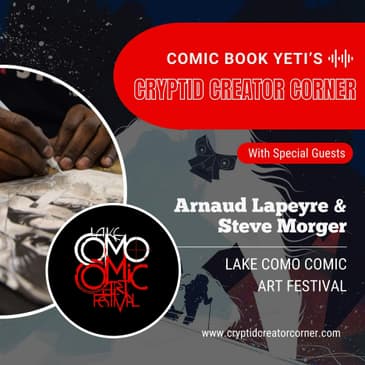

As an original comic art collector, I’m excited because we are going to dive today into a different corner of the comics collectable market today. There’s been a bit of an upheaval in recent weeks with the exodus of artists from Cadence Comic Art. As many arts look for new representation or in some cases for collaborative opportunities to share the burdens of operating a direct-to-consumer model over the internet, the tried-and-true convention continues to provide a unique pathway not only for purchasing artwork but for interacting with the artists as well. Enter my guests today. Arnaud Lapeyre and Steve Morger are the co-founders of the Lake Como Comic Art Festival, a unique, curated event designed to streamline the traditional convention experience and focus solely on the comic artists and their artwork. This is a one of a kind comic art festival in I guarantee what has to be the most idyllic of locations for something like this. Fandom never got treated so good. With around a month left before the show kicks off, make sure to visit their website for all the details.
Make sure to check out our monthly crowdfunding comics feature book: Super Kaiju Rock n Roller Derby Fun Time Go!
[00:00:00] Your ears do not deceive you. You have just entered the Cryptid Creator Corner brought to you by your friends at Comic Book Yeti.
[00:00:07] So without further ado, let's get on to the interview.
[00:00:11] Skirt of Good Mutt sound like something spoken by Cthulhu cultists or the name of a weird craft beer brand,
[00:00:17] but it's actually the shorthand for this new wild crowdfunding comics project Super Kaiju Rock and Roll Derby Funtime Go! from creator David Hedgecock.
[00:00:26] This is a mashup of Jim and the Holograms meets Roller Derby with Kaiju with a twist of 70's pop culture thrown in.
[00:00:32] Harmony, Lyra, Melody, Cadence, and Viola are a struggling 20-something band and a roller derby team flushed with talent but broke as a joke.
[00:00:43] The burnouts are thrilling concert goers with their killer looks and vibe until a music mishap drops a curious ancient artifact into their hands.
[00:00:51] Cheeky, lighthearted and fun, it will be launching soon and there's an early bird special if you catch it in time that scores you a discount and a VIP wristband.
[00:01:00] I'll drop the link in the show notes.
[00:01:02] I read the advance for this and honestly it reminds me of my own carefree days gigging on the road in the music industry but with way better shower scenes.
[00:01:10] The only thing missing is more cowbell.
[00:01:12] Hello and welcome to another episode of the Crypti Creator Corner.
[00:01:18] I'm Byron O'Neill, your host for today's episode of the show.
[00:01:21] I'm excited because we're going to dive today into a different corner of comics collectible market, the original art world.
[00:01:27] There's been a bit of an upheaval in recent weeks with the exodus of artists from Cadence Comic Art as many artists look for new representation or in some cases for collaborative opportunities to share the burdens of operating to a direct consumer model over the internet.
[00:01:41] The Try and True Convention continues to provide a unique pathway not only for purchasing artwork but for interacting with the artists as well.
[00:01:48] So enter my guests today, Arnaud Larpierre and Steve Morger.
[00:01:53] They are the co-founders of the Lake Como Comic Art Festival, a unique curated event designed to streamline the traditional convention experience and focus solely on the comic artists and their work.
[00:02:03] Arnaud, Steve, thanks for joining me today.
[00:02:05] I know both of you must be extremely busy getting tees crossed and eyes dotted for the festival coming up in May.
[00:02:11] It's been busy.
[00:02:13] I can only imagine.
[00:02:16] Hi, Byron.
[00:02:17] Hey, how are you?
[00:02:18] Good, good and you?
[00:02:20] Doing well.
[00:02:21] Well, let's get started a little bit with your backgrounds.
[00:02:23] Arnaud, kind of first tell me a little bit about your own journey in comics and how this all culminated in the LCCAF.
[00:02:32] Well, I first started to work in a comic book store when I was a student or even before being a student, like during school.
[00:02:44] And that turned into my full-time job when I decided to stop my studies.
[00:02:52] I took a break of one year before being like a partner.
[00:02:58] And once that happened, I continued to develop the stores we had in Paris, the Peltz chain store.
[00:03:08] And we started to walk into a lot of different things from co-publishing, distribution, import and exports, distributing all the smaller comic book stores, wanted to have like a section of imported books and also send abroad French and European comic books.
[00:03:32] And little by little, we decided to also do a convention in Paris, which was called the Paris Comics Expo.
[00:03:41] This was more like a generic kind of bigger family orientated festival.
[00:03:50] But what we wanted to focus on was still the comic book part.
[00:03:57] That was in the early 2010s.
[00:04:02] And we had a mix of celebrities, we had a lot of different associations, cosplay, a lot of dealers.
[00:04:12] But we also wanted to make sure that we wanted to keep focus on the comic books, which was still something that mattered and that we wanted to be very careful because you could feel that back then we had lots of requests for comics.
[00:04:27] Manga dealers, for example, that could feel like two times the space we had.
[00:04:33] But we really wanted to keep the focus on the American comic books.
[00:04:38] And the festival grew and grew. We did four big editions.
[00:04:43] But the last one, we had to stop for a lot of different reasons.
[00:04:48] We had competitions in the forms of read exhibition.
[00:04:51] We wanted to do a show in Paris as well.
[00:04:54] And that was growing into like a huge event that it was complicated to continue with, especially with the stars and all with the other activities.
[00:05:05] So back in 2016, I said I was out of organization of festivals and events like this.
[00:05:15] And that was it. And that was going to go back to the stars and to a lot of different things, but no more events and no more festival.
[00:05:24] That was it.
[00:05:26] But wait, you did.
[00:05:30] That's when Steve called me and said, hey, I've got this great idea on this location.
[00:05:40] You need to come and check it out.
[00:05:43] So, Steve, I guess this is a little bit more of your brainchild then.
[00:05:47] And I understand the idyllic setting of Lake Como is your fault. Is that correct?
[00:05:53] That is correct.
[00:05:55] So kind of my backstory is when I was a little kid, my mom said, I don't care what you do read and I don't care what you read.
[00:06:02] And so there was a junk store by my house where you could buy comics for a nickel apiece.
[00:06:07] This is back in the mid 60s.
[00:06:10] So it was a good time to buy five cent comic books because that's where I got my X-Men one and Tales of Suspense 39 and kind of that stuff for a grand total of a nickel.
[00:06:20] So I'm one of those guys that it's like, oh, man, if I was as old as him, it would have been great to be collecting.
[00:06:27] So I just loved comics, read them, collected them, got to the point where I had about 30,000 of them and then decided I needed a new house.
[00:06:37] So I started collecting art and there got to meet a lot of artists, which has helped us for the guest lists and all the shows.
[00:06:47] I hooked up with a friend of mine, Steve Wyatt, who asked me to help on his show, which ultimately evolved into the Big Wow Comic Fest.
[00:06:55] We did again four versions of that ending in 2015.
[00:07:01] Much like Arno, we got the offer that you could not refuse to leave the convention market.
[00:07:09] So I did. We sold out to the guys that became Silicon Valley, who have since gone the way of many other shows that have failed.
[00:07:20] So I have been going to Como for about 30 years and keep coming back.
[00:07:26] And in 2015, 2016 decided to buy a small apartment there.
[00:07:31] Oh, OK. And so that's the connection with Como.
[00:07:36] And one day I was there. I saw that the Sheraton Hotel in Chernobyl advertised convention space.
[00:07:45] And much like Arno's Paris Comic Expo, Big Wow Comic Fest focused on creators.
[00:07:51] So it was always creator centric, but it had everything that a big convention has with toys, T-shirts, cosplay media and the like.
[00:08:00] But I've always been partial to art and the artists because of my history.
[00:08:05] So I went to the Sheraton Hotel, checked out their convention space, which was not very great for what I had in mind.
[00:08:13] And then I was just talking to the people there and they said, well, have you checked out the Villa Arba?
[00:08:18] And it was like, no, I have no idea what that is. Where is it? And it's just across the street.
[00:08:24] So I walked over, they called ahead, got me in to look at the space. It is mind blowing.
[00:08:31] Yeah, I looked at it. Wow. Online it was wow.
[00:08:35] Yeah, so I walked around and Arno and I had gotten to be friends from our convention days because both of us had similar goals, similar likes, similar interests.
[00:08:49] And I would share with him things that didn't work with our show, Big Wow.
[00:08:55] So we'd reciprocate there and just got to be friends. I called him up and said, I have this idea. You need to pop down to Lake Como.
[00:09:04] He got on a plane, came down. And I remember it because of the little overcast and he was just yeah, this is really nice.
[00:09:12] This is really nice. And then the sun came out. Then it's like, oh, my God, you know, because you've got the Alps in the background with the snow capped peaks and the lake and the green.
[00:09:24] It's just magical. And so he came down, fell in love with it as well. And then we decided to give it a shot.
[00:09:32] Our first event was 2018. We did 2018, 2019. Obviously 2020 and 21 did not happen.
[00:09:43] And then hit the ground running again and starting in 22 and 23. So this upcoming show will be our fifth show.
[00:09:50] OK. Well, kind of sadly with the audio restricted nature of a podcast, listeners can't see over my own shoulder.
[00:09:57] But I've got an original page from the Blue Beetle miniseries, Graduation Day from Adrian Gutierrez hanging on my wall.
[00:10:04] You know, downstairs, I've got, I think, eight original commissions since getting back into comics in earnest a couple years ago.
[00:10:12] So the original art market is always something that's interested me.
[00:10:18] So I guess I'd be remiss in asking you what are both of your all's favorite pieces that you have?
[00:10:24] Obviously, you've both been in it for quite some time.
[00:10:30] For me, I think there's a lot. But I think probably the very first piece I bought back in 19, I think it was 76,
[00:10:41] which was a fanzine piece from Frank Brunner.
[00:10:44] Wow. OK.
[00:10:45] Known for Howard the Duck, Dr. Strange and like. Still my favorite artist to this day.
[00:10:52] You know, probably because I grew up in that time frame when all of the, you know, the Jim Starlin, the Frank Brunner, Val Marix were creating some just amazing stuff.
[00:11:02] So I've probably got 15 pieces by Frank, a bunch of pieces by other people.
[00:11:07] I mean, I've been really lucky because I know a lot of these artists, which either means I bought stuff from them or they've gifted me stuff.
[00:11:15] Yeah.
[00:11:17] Arnaud, what about you?
[00:11:19] I would say it's more, you know, a lot of times also we had gifts from artists and some of them included the logo, the Star's logo.
[00:11:35] You know, how to integrate it.
[00:11:37] And it was really funny to see all we could have really different ideas and some were really crazy.
[00:11:45] I remember Kim Jong-il did like a really nice one, but that's one I have to keep in the basement because that's not one I can put on the walls in the store.
[00:11:57] But that's one of my favorites for sure.
[00:12:03] I know which one you're talking about.
[00:12:06] There are a lot of ways you could go about putting together a con or a festival, right?
[00:12:10] Unlike so many others though, there's no movie or TV announcements, no cosplay, no unrelated commercial vendors.
[00:12:18] It's laser focused on comic artists and getting in to interact with them, which I think that element alone is super, super special.
[00:12:26] So why did you want that to be the specific focus for Lake Como?
[00:12:33] I'll take the first shot at that since, you know, one of the issues with The Big Wow Show and I suspect with The Paris is each year they group.
[00:12:44] And I think the last year that we did The Big Wow Show, attendance was over 10,000 people.
[00:12:51] Yeah.
[00:12:52] And that was just at the cusp of what we could handle as kind of the group.
[00:13:00] You know, because, you know, so we would have been in the position of having to hire people, you know, deal with a lot more security, a lot more insurance, just all of the things you need as you get bigger.
[00:13:14] And that became less and less attractive.
[00:13:17] And, you know, because my primary focus has always been on the comic books and the comic art side of things, because that's what I collected.
[00:13:25] I like all the other stuff and I think they definitely have a space in shows.
[00:13:30] But for me, those were the two primary things, comic books and comic art.
[00:13:35] And so both from a logistics point of view, what it would take to run the show and from an interest perspective since we got to create it.
[00:13:44] We decided just to do a much smaller show, which at that point had not been done, at least like we did it, just focusing on one aspect of the comic book world, the art side.
[00:13:57] Yeah, it's exactly the same because exactly, you know, and it's really funny because when we compared, you know, the growth of both of our shows, it was very similar in terms of audience, in terms of size, in terms of what we had inside the show.
[00:14:13] Our last edition gathered a little bit more.
[00:14:16] We were like maybe around 17 southern people and that started to, it was like a two day and a half show, the last edition, and that started to grow into something really big.
[00:14:29] And as much as it made sense to have cosplay, to have TV celebrities in this show, at the end of the day, you know, that was not my main interest either.
[00:14:42] I mean, they have a sense, but it's not something that I'm really excited about.
[00:14:49] And it was growing into something like really, really big also to deal with.
[00:14:55] And I really prefer to focus on something that I was more passionate about, which was the comic books and the comic book art.
[00:15:06] I still think there should be, for example, in Paris, like a very big comic book convention focused only on comic books, all kinds of comic books because that would be too complicated, for example, for American comic books.
[00:15:25] But back to our show, that was really something that I would consider only if it would be something smaller.
[00:15:36] So that would be, it wouldn't turn into like a huge event with all the logistics and all the problems that can be attached.
[00:15:44] And only if it's focused on something that I'm really interested in because we've got lots of things to work on and lots of things to worry on the side.
[00:15:54] So, you know, that's a benefit of being your own boss.
[00:15:58] You know, it's like choosing what you're going to do at the end of the day, you know, on which aspect you want to spend a lot of time working on.
[00:16:06] Even if it's not the most, definitely not the most beneficial part, but in terms of money.
[00:16:12] But that's the good, that's an advantage.
[00:16:17] But I reached out to some artist friends who attended last year to kind of get their feedback about the event, and it was overwhelmingly positive.
[00:16:25] You know, one of them actually call it the most unique show they had ever been to.
[00:16:29] This is a two day festival. And kind of tell me about how exactly this works so listeners can kind of fill in the expectation gaps.
[00:16:38] So I'm on your website considering to buy a ticket. What can I expect exactly from the show?
[00:16:46] So let me step back unless, unless Arno you want to start. But I think the first thing to focus on is travel.
[00:16:54] Okay. You know, because I know one of the things that we've always gotten from people is, oh, it's in a foreign country.
[00:17:00] Can I get there? Can I speak the language? Will I be able to order a pizza as it were?
[00:17:08] You know, and so the first thing is it's actually really easy. The Malpensa Airport is a major international airport in Milan.
[00:17:16] There's three airports in Milan, but Malpensa is the closest.
[00:17:20] You fly in there, customs normally takes me five to 10 minutes to go through. It's actually a fairly easy airport to clear customs.
[00:17:28] And then it's about 40 to 50 minutes by cab.
[00:17:33] There's other alternatives, but the easiest is either to rent a car or take a cab to the event center.
[00:17:40] Okay. In Como, because it's such a tourist destination, no one has had problems with the language.
[00:17:50] You know, when I was looking at buying my place in Como, my Italian friends are, oh, you don't want to live there.
[00:17:54] There's way too many Americans. So it really is easy to get there.
[00:18:01] So the event itself is broken up into two parts.
[00:18:06] There's the opening night reception, which is in the ancient villa. It's purely social, fully catered.
[00:18:14] And so some people elect to do that in addition to the show. That normally goes from about six to eleven.
[00:18:23] The event changes a little bit, not in what it is. But if it's raining, it's all inside.
[00:18:31] If the weather is gorgeous and given that it is an alpine area, it does rain there on occasion, more than on occasion, but not always.
[00:18:41] So we have two events that have been just gorgeous weather, two events where it's been somewhat rainy.
[00:18:47] You know, none of them bad enough that you had to think about how am I going to get from point A to point B.
[00:18:53] So the reception is purely social in this fabulous location. Next door to it is a modern convention center.
[00:19:02] The difference between their convention center and most is it's broken up into 12 rooms, Arno?
[00:19:09] Yeah, about 12 rooms depending on the year.
[00:19:13] Yeah, so it's 12 smaller rooms. So you can have anywhere from four to eight to ten artists in a given room instead of these huge convention centers where it's a hundred thousand square foot square space.
[00:19:30] Right.
[00:19:31] So you wander from room to room to see the different artists that are there.
[00:19:35] One of the things that people have liked most that we've done was pretty simple is we put a chair on both sides of the table.
[00:19:43] Because, you know, a lot of artists when they're talking to you, you're standing up, they're looking up.
[00:19:49] They can't really draw when they're looking up at you. So we put the chair on the fan side.
[00:19:55] The fan can sit there and talk to the artist as they're drawing, which I think probably the biggest benefit.
[00:20:03] There's a lot of them, but I think the biggest benefit is FaceTime with the artists.
[00:20:07] Because the ratio of guests to artists is fairly low. Unlike, you know, at a New York Comic Con where you've got 200,000 attendees and 200 artists.
[00:20:21] You know, last year, well this year our ratio should be about 70 to 80 artists and probably about 500 attendees.
[00:20:29] Okay, that's really nice.
[00:20:32] Yeah.
[00:20:34] But it's true that if you've ever been to a show in the US, a big one, especially a big one like San Diego, you know, or New York,
[00:20:44] and you can and you've been able to find your way on to navigate until the show, you can do the same in Como.
[00:20:52] It's not, it's even less complicated, you know, because I know that for some people, traveling can be, you know, can raise a lot of questions.
[00:21:01] But honestly, if you can move from one state to the other, I mean, I don't see any difference between a New Yorker going to San Diego Comic Con.
[00:21:11] You know, it's exactly the same because and it's going to be even more simple, you know,
[00:21:18] considering all the edX and logistics it can be in these big shows.
[00:21:25] We don't have lines, you know, we don't have, you know, everything is so much easier, you know,
[00:21:32] and relaxed and for everyone's perspective, not just the artists, but the attendants, the attendees as well.
[00:21:40] Imagine everything that you don't like in a big show, you know, that you have to wait,
[00:21:47] that you're going to have like a 10 second interaction with someone because there's like a southern people behind you waiting their turn.
[00:21:55] That's all, you know, that's imagine the complete opposite.
[00:21:59] You know, that's for me, it's really like it's a paradise for any art collector or any comic book lover who wants to meet the artist.
[00:22:09] You know, it just honestly, it's just like it's you can't have a better interaction unless you would meet up the artist in a restaurant lonely
[00:22:20] and he wants to have a chat with you for one hour.
[00:22:23] You know, that's I don't see how you could have a better experience than in a show.
[00:22:29] And that's honestly even from an outside perspective.
[00:22:36] Yeah, one of the things that, you know, Arno just touched on, which is nice is the town Chernobyl is a very small town.
[00:22:44] You know, you've got the Villa Erba, a number of great restaurants.
[00:22:50] And, you know, it's kind of nice from the as a promoter to go walking through and see the fans that have come having dinner,
[00:22:58] having drink with the artists because, you know, they all go to the same basic area walking, walking around.
[00:23:04] So it almost becomes, you know, you hear about San Diego, but everybody going to the Hyatt bar at night,
[00:23:10] not as much alcohol and Chernobyl, but, you know, they go out and do get a chance to see people outside of the show and say hi or,
[00:23:20] you know, at times sit down and have a meal with them, which is really great.
[00:23:24] All right, let's take a quick break.
[00:23:27] Hey, comics fam, indie comic book publisher Banda Bars just got a level up and announced it is now a cooperative.
[00:23:34] This heralds a new era for them, including a partnership with Dauntless Stories.
[00:23:38] And they added several new members to the ownership group.
[00:23:41] Marcus Jimenez is now chief operating officer.
[00:23:44] Brent Fisher takes on the role of chief diversity officer.
[00:23:47] And Joey Galvez is introduced as head of Kickstarter Ops and social media manager,
[00:23:53] which is sure to increase their capabilities overall as a publisher.
[00:23:57] And it further promotes their mission statement of advancing representation, inclusion and diversity in the media.
[00:24:04] They also established a new board of directors to help chart the new path of their journey with new projects in the works like Alaska by
[00:24:11] dropping in June, Unbroken soon launching on Kickstarter and Pond coming up with Dauntless.
[00:24:16] Stay tuned to this space for more exciting news from the growing Bars family.
[00:24:23] Let's get back to the show.
[00:24:25] I can see how this is appealing, not only for the fan attendee, but also for the artist.
[00:24:30] You know, as a visual artist myself for over a decade, having my work up in galleries and the whole routine.
[00:24:35] But you know, my biggest sales opportunities were always when I had that that face time, the opportunity to meet people face to face and interact with them.
[00:24:42] Because people are buying not just artwork, but also the personal experience having that with and that time with the artist connections or everything.
[00:24:51] So I'm kind of curious.
[00:24:53] Have artists who have come expressed like similar increases in sales numbers?
[00:24:58] Have they just been like, OK, I want to come back because this was a great opportunity for me personally, you know, financially.
[00:25:06] And I think both aspects, you know, I mean, a number of the artists have acknowledged that they've done really well financially and have come back repeatedly.
[00:25:18] But a lot of them like the social aspect.
[00:25:20] I mean, we have one of our artists who's coming back this year.
[00:25:24] He just went and got himself lost.
[00:25:27] And I don't mean that really, but he just took his watercolors and just went wandering.
[00:25:34] And just started painting landscapes and shots that he saw.
[00:25:41] And that wasn't a lone person.
[00:25:45] I had another French artist came by and at the end of a show did a painting of the mountains in the distance and gave it to me.
[00:25:52] And it just so you know, a lot of them because of location and the lack of stress, it seems to be very creativity or to enable them creatively.
[00:26:07] I don't know why it's so tough to say this morning, but they get there and they want to draw.
[00:26:13] You know, they see their compatriots drawing.
[00:26:15] They see the location, the lack of stress, the money.
[00:26:20] And it just we haven't had any any real issues of people getting there and enjoying themselves, at least at least reported to us anyway.
[00:26:31] What is the design to kind of have a group of artists that are returning year after year?
[00:26:36] Is there an intentional rotation?
[00:26:38] Like, so how do you go about sort of recruiting talent?
[00:26:45] Primarily if they ask.
[00:26:47] OK, it's you know, there are some people that both Arno and I really want.
[00:26:55] You know, I mean, that's one of the advantages of being the promoter.
[00:26:58] I can invite people that are of interest to me for sure.
[00:27:02] But but mainly it's you know, people say they want to come and then it's slotting them in.
[00:27:08] You know, we don't have enough space for everybody that wants to come.
[00:27:12] So there are some that have supported us all along from when we were really tiny to growing now who have come back.
[00:27:21] But we do like to have new blood every year.
[00:27:24] Yeah, it's true.
[00:27:25] We have, as you said, almost everyone who came at least once want to come back.
[00:27:32] You know, they everyone had such a good time and it was both from the show itself, the interaction and financially also,
[00:27:42] because they know that if there's one place that they're sure they are going to meet the audience and people interested in buying and not just walking by.
[00:27:50] That's our show.
[00:27:52] So a lot of them told us that even some that had been in shows for 20, 30 years told us that the edition they came was the most successful one they had ever been to.
[00:28:05] But also I think that's just the atmosphere of being like again in a relaxed, beautiful location.
[00:28:15] Less people means also less interactions that are not what you would expect.
[00:28:22] You know, if you come into a big show and you're going to have a lot of people of questions asking you, I don't know things.
[00:28:28] Is this a print?
[00:28:29] You know, for example, for an original art, you know, stuff like you would you you don't need to worry too much.
[00:28:38] And so, of course, that makes it the I would imagine for everyone the show you want to come back and we every year we have everyone telling us that they want to be there the next year.
[00:28:49] So it's true that it's a bit not complicated, but we want to keep control to not grow too big.
[00:28:57] You know, last year we had too many artists present.
[00:29:01] So we wanted to make sure that this year we are going to make sure we we were going to go back to like a little bit smaller number of artists.
[00:29:10] And it's a mix of getting people returns and also new people who never came.
[00:29:18] So it can have, you know, a rotation since there are a lot of artists who never came that we would be really happy to have.
[00:29:26] At the show. So strike kind of trying to have a mix, you know, to of who's coming on it.
[00:29:32] So who are the big names this year?
[00:29:38] One that I had several that never came to the show that we're going to have for the first time.
[00:29:46] We're going to have a general meter junior is coming from quite least coming and then we're going to have a lot of artists who are going to be coming.
[00:29:55] Quite least coming in. And that's I'm also really, really happy because it's been a very long time since I was hoping to have him as a guest, even since the Paris show I was doing.
[00:30:08] So these are two, for example, two of the of the new names that are coming.
[00:30:13] That's something that I'm really, really happy with.
[00:30:19] We are going to have Glenn Fabre is coming.
[00:30:23] We're going to have David Peterson is coming. Also, we have a lot of more artists coming this year.
[00:30:32] David Finch.
[00:30:34] David Finch is coming also.
[00:30:37] So is everybody currently that you are expecting up on the website or are there going to be more announcements as you get?
[00:30:44] There'll be a few more announcements. I mean, I would say probably 90 percent, but there's still some that we're working with.
[00:30:51] I mean, it's as you know from dealing with events, as you get closer, there's always things that come up.
[00:30:57] Oh, yeah. Oh, sorry, I can't come, which hopefully we keep to a minimum. We've been lucky through the years.
[00:31:03] But then also invariably you get somebody who's got a pretty big name going, hey, I'm going to be in the neighborhood.
[00:31:10] Can I get a table? And those are ones you can make space for.
[00:31:15] Always.
[00:31:16] But we're pretty much set on this year. We've actually had a couple of people that we've been talking about for 2025.
[00:31:23] So, you know, five percent of our time is dealing with 2025.
[00:31:27] Ninety five percent of our time is dealing with this year.
[00:31:30] OK, I was excited to see Charles Vesce was going to be there. I'm a big Vesce fan.
[00:31:36] Well, we still have about I would say about 10, 15 more names to announce in the coming days.
[00:31:44] OK. And then and then yes, we reached our capacity.
[00:31:51] So but so now we are trying to starting to focus on next year for already building the 2025 guest list.
[00:32:03] So lots of artists have signups in advance of cons that they are attending.
[00:32:08] So to kind of go through what is the mechanism, let's say I'm wanting to purchase a commission.
[00:32:15] I'm sitting there. How does trying to get a feel for exactly how this work?
[00:32:21] Or is it is it by artist or? Yeah.
[00:32:24] Yeah, and we're not the ones that handle the commission requests.
[00:32:28] Yeah, I mean, obviously, if you were like, how do I get in touch with, you know, this artist?
[00:32:35] We can help with that. But, you know, we don't get a piece of what they create.
[00:32:40] Right. Yeah. You know, so it all goes to them.
[00:32:43] So it's, you know, and different artists have different things.
[00:32:46] I mean, you know, Frank Cho is one of my best friends.
[00:32:50] He generally does two types of commissions.
[00:32:53] The ones in advance are much more detailed as he calls them cover quality.
[00:32:58] And so those you'd reach out in advance and people already have at the show.
[00:33:04] Pretty much all of the artists also draw.
[00:33:08] So he will do smaller type commissions at the show, because if he did one of the cover, that's all he'd be doing for two days.
[00:33:15] Right.
[00:33:16] And, you know, I think pretty much every artist there wants to do some type of commission.
[00:33:22] So they'll bring art, take their commission list, some in advance, some at the show.
[00:33:28] And it's really up to the artists themselves what they want to do.
[00:33:32] OK. Go ahead.
[00:33:35] It's a mix. Some will take advance.
[00:33:38] So I always suggest to follow the social media of each artist.
[00:33:43] And during the show, it's like any other show, you know, they have a commission list that opens in the morning.
[00:33:50] So you need to go straight to the ones who you are most interested with.
[00:33:56] But the good thing to keep in mind also is that a lot of most of the artists offer different type of commissions and prices.
[00:34:05] So they are not just going to do very expensive, full color, big pages commissions.
[00:34:13] A lot of them offer different, you know, for different ranges.
[00:34:17] So you can have it's not like you need to bring millions to the show if you want to be sure to have a drawing from one of the artists.
[00:34:27] Again, it's all different between all of them.
[00:34:31] But that makes it at least very much easier than in any other show because, again, the attendees number is very limited.
[00:34:43] So if you compare the ratio of attendance to artists, you know, that's almost one to five between one to five to one to ten.
[00:34:53] So it's you know, you're sure you're going to if you go straight to the artist that you are the most interested with,
[00:34:59] you're not going to arrive with already 200 persons in line in front of you.
[00:35:04] You know, that's just impossible.
[00:35:07] I'm trying to get a feel too for like commissions versus, you know, original page ratio.
[00:35:13] So if I'm planning on coming and I'm assuming it's very variable based on the artists.
[00:35:19] But, you know, just kind of in general, is it more unique commission work or is there quite a bit more, you know, original pages?
[00:35:28] Kind of how does that look?
[00:35:31] I could jokingly say the answer is yes.
[00:35:36] You know, we have a really nice selection of original art dealers there as well.
[00:35:43] Probably half a dozen to a dozen people selling art separate from being artists.
[00:35:49] So there's tons of original pages available.
[00:35:53] You know, one of the things that we highly recommend to the artists is that they actually draw at the show.
[00:35:59] It's more rewarding for them both financially and from a personal perspective.
[00:36:06] So they're not sitting there, you know, twiddling their thumbs.
[00:36:09] You know, so it's if you're into collecting original art pages, they're everywhere.
[00:36:14] If you're into collecting sketches, you've got 70 to 80 of the best artists in the world to choose from.
[00:36:22] So I don't know that it's really either or because pages do, you know, transfer ownership and pretty much every artist is creating commissions for the both days.
[00:36:36] OK.
[00:36:37] And an interesting thing also is to note down is for the for the dealer sections, we have art dealers and art galleries that are both from Europe and from USA.
[00:36:50] So it's it's interesting because if you're American coming to the show, you're going to see art galleries that you've probably never seen before in American shows.
[00:37:00] And the other way works also as well.
[00:37:04] Europeans tend more to go to big shows like New York, so they're going to meet, you know, dealers that they saw over there, but maybe not all of them.
[00:37:13] So that's interesting because it's one of the place of the few places where you have a mix of art galleries and art dealers from both sides of the globe.
[00:37:24] We both done this for a while now.
[00:37:27] Both have a background putting these types of things on.
[00:37:29] There are always unique challenges.
[00:37:32] Sure, location was a significant one with this, although the location is also the drop.
[00:37:36] But you have those growing pains learning experiences that make the show the next year that much better.
[00:37:42] So what's been the most unexpected hurdle in this particular one thus far?
[00:37:50] I think our first year.
[00:37:52] OK, you know, it's our very first year back in twenty eighteen.
[00:37:58] We found the location, found the space to hold it.
[00:38:02] It was gorgeous lined up a really attractive guest list.
[00:38:06] Jim Lee, Adam Hughes, Neil Adams, just a bunch.
[00:38:15] And did the advertising and almost no one showed up.
[00:38:21] Oh, wow.
[00:38:23] And then I was talking to some of my Italian friends and it was like, you know, what the hell happened?
[00:38:29] You know, you get the best collection of artists that have been seen in ages and nobody's there.
[00:38:35] And they just laughed and they said nobody knew either one of you guys.
[00:38:39] And so the Italians, you know, with their perspective, were like everybody thought it was a scam, you know, that we were going to do the fire convention.
[00:38:51] Oh, no. OK.
[00:38:53] You know, it's like nobody can get Neil Adams and Jim Lee and Adam Hughes and Frank Cho and all of this list of guys.
[00:39:01] The people that did show up had a wonderful time.
[00:39:05] Yeah.
[00:39:07] You know, so the growing pain has really been since neither one of us had a footprint in the Italian comic art community.
[00:39:16] It's been a growing pain to let them know.
[00:39:19] And now, obviously, they know it's been, you know, five, this will be five shows.
[00:39:24] But over seven years with the two years that have been gone, people know we're legit now.
[00:39:30] Yeah.
[00:39:31] And if they guess that we advertise, you know, absence something unforeseen happening will be there.
[00:39:38] But that first year was not pleasant.
[00:39:43] I mean, I think the loss combines of the first edition.
[00:39:49] We probably could have bought a second apartment in Como for us to go instead of funding a comic book and art festival.
[00:39:59] That's for sure.
[00:40:01] Not for the faint of heart, for sure.
[00:40:03] But I mean, good on you both for just sticking it out and believing in the concept.
[00:40:08] It sounds amazing now.
[00:40:11] Oh, no, I'm happy I did it.
[00:40:13] I don't know if I can speak for Arno's wallet.
[00:40:16] But you know, I mean, both the first and the second year, it was like, you know, why are we doing this?
[00:40:22] And then the show happens.
[00:40:24] And that's why we're doing it because, you know, right before the first and right before the second, I think we were both ready to throw in the towel because our wallets were crying.
[00:40:36] But then the show happened.
[00:40:37] And it really is a magical experience because I mean, I think one of the best things for me is the friendships I've made.
[00:40:45] Yeah.
[00:40:46] You know, with the artists, with Arno and his people, it's been really great to do that.
[00:40:52] And so every time you come back, you're at a familiar location with familiar people and new people who will be familiar as time passes.
[00:41:03] Well, this feels like one of those unique experiences too, where you get more of a mixture of European and American talent.
[00:41:14] And I mean now South American talent is South America's there's so many artists coming from South America now.
[00:41:19] Well, actually, it's even broader than that because we've had one artist that's come in multiple shows from Australia.
[00:41:29] This year, we have an artist coming in who hasn't been announced yet from South Africa.
[00:41:33] We've had Singapore, Japan, all over Europe, all over America, South America.
[00:41:43] And I'm sure there's other places I haven't thought of.
[00:41:46] But I mean, it really is a worldwide and one of the things we're trying to do is get people to come to the show who the fans haven't seen before.
[00:41:59] For sure. Yeah, I mean, that was when I was looking at the list and I saw Vess.
[00:42:03] I know Charles doesn't do that many things these days.
[00:42:07] So it was really nice to see some of the older guard, if you will, featured in the show, because I know a lot of times those folks just get lost in the big conventions.
[00:42:20] Absolutely. Yeah.
[00:42:21] How many times have you seen such a great artist in a big show with absolutely no one?
[00:42:27] And you're like what?
[00:42:30] And you're really surprised and you're like, oh my God, that's it doesn't make sense.
[00:42:34] But that's exactly the our show is exactly the kind of show where artists who are kind of decided not to go to any more to shows because, you know, it didn't make sense and everything.
[00:42:49] But in our show, it just, you know, it's actually makes all the sense in the world to come because that this is the one place you're sure you're going to meet the people who like and appreciate your art.
[00:43:03] Well, Steve, I want to give you a chance to talk about the that Brereton collab before we started.
[00:43:08] We were getting into this a little bit.
[00:43:10] So as a fan of Dan's.
[00:43:13] So what's going on with these collabs?
[00:43:15] Okay, so it were this podcast is all audio, right?
[00:43:20] Yeah. Yeah, unfortunately.
[00:43:22] So last year, as I mentioned, Frank, Frank chose one of my best friends and one of the artists that Frank and I both love is Palo Superieri.
[00:43:34] For obvious reasons.
[00:43:37] And so, you know, Frank and Palo have a lot in common with some of their art.
[00:43:42] And most of it goes to beautiful women.
[00:43:44] And so we had this idea of what if we could get Palo to do a pencil piece and then have Frank finish it.
[00:43:55] And sorry to the fans, but.
[00:44:00] That was the, you know, the finished piece.
[00:44:04] And then we turned it into a limited print of 100 copies.
[00:44:08] And it went over really well, both the interest of the people and then, you know, we do an art auction to raise money for the show.
[00:44:15] And that piece did really, really well.
[00:44:18] And so we started chatting about what other pieces might work.
[00:44:23] And so last year, Dan was a guest at Como and he liked that idea.
[00:44:29] And so he created.
[00:44:32] And you can, you know, sorry for your fans, but this is a drawing by Dan or painting by Dan of a European artist's character.
[00:44:44] And with a lot of a lot of white spot in the back.
[00:44:47] And so the idea is, is that she will fill in with one of Dan's characters.
[00:44:54] The jam piece.
[00:44:56] And so we have that one coming.
[00:44:59] And then.
[00:45:02] Jordi Burnett reached out to us and wanted to be seated near to another artist who he respects greatly.
[00:45:13] OK, and so I asked Jordi if he wanted to do a jam piece with this artist.
[00:45:19] I'm not giving the names because they haven't finished their side of it yet.
[00:45:24] And both of them were thrilled.
[00:45:27] And so Jordi did the, you know, the pencil piece of Torpedo that hopefully I'll be taking down to WonderCon to an American artist to get that finished.
[00:45:37] We've got a couple others in line, at least two others that I know of at this point.
[00:45:45] And so, you know, our idea is to try to create these unique collaborative pieces, either one person penciling,
[00:45:53] one person inking or one person doing the fully finished half of the image and then another doing it.
[00:45:59] And then make those available both to raise money for the artists and for the show so that we can keep it going.
[00:46:07] Very nice. That's really cool.
[00:46:10] Some of them might take longer not to actually be seen at the same year, because, you know, it takes time sometimes to get the pencils or the first part of the drawing and then to end it over to the other artists.
[00:46:24] So some of them might take even more than a year.
[00:46:29] But at the end, we're going to be able to have like really exciting and unique pieces that have never been seen before.
[00:46:36] So and that's an opportunity that we can have only at the show.
[00:46:41] And we try, we didn't mention it before, but we try to have a lot of different exclusive or things that are included into the tickets.
[00:46:50] You know, that the attendees are going to get like the portfolio, for example, every year we produce a portfolio that every year is even nicer and nicer because now it's in a hard case.
[00:47:02] And it's played with the different artists present at the edition.
[00:47:07] So all the attendees, when they buy a two day ticket, they can have it in there for free and they can have the plate signed, you know, by the artist present.
[00:47:17] And that makes a really nice, really nice things to keep for every year.
[00:47:25] Is there a...
[00:47:27] One thing on the portfolio, just to note, I'm not sure when this podcast will air.
[00:47:33] But because we print it pretty much to order, it's available to everybody that gives a two day or the two day plus reception ticket so long as they purchase before the cutoff, which I think is April 2nd.
[00:47:50] Yeah, correct.
[00:47:52] So maybe by the time it airs, you know, the people are going to get just a couple of days.
[00:47:58] Well, where can people go for more information? Is the website the primary location to get all the details or...?
[00:48:04] Yes. So we have the LCCAF, Lake Como Comic Art Festival. So LCCAF.com is the main website. We also have a presence on Instagram and Facebook.
[00:48:19] So if questions come up, they can either be sent through the website or through one of the social medias and then one of us should see it.
[00:48:27] Okay.
[00:48:29] Well, as a former event planner myself, I think this is the most pertinent question of them all. What are you both going to do to recuperate after it's over?
[00:48:38] I always stay an extra week and go up to my apartment.
[00:48:41] Of course, why not?
[00:48:43] I mean, there's nothing better for me than to wake up in the morning, walk down to the local cafe, get a coffee, get a croissant and just sit at the lake and stare at the lake.
[00:48:54] Hours disappear in my life doing that. It's wonderful.
[00:48:59] What about you?
[00:49:00] It depends on the year because sometimes some events in Paris require a quicker return.
[00:49:07] But if I can have for sure a couple of days extra to enjoy it down and enjoy the lake, really, that's great. That's the best location to recover for sure.
[00:49:22] What does that hurt to go work and then be in vacation mode afterwards if schedules allow? That's pretty cool.
[00:49:29] Well, I got to say if I travel well, I'd already be booked and planning my trip over now because it really looks quite special.
[00:49:36] My artist friends who have attended have nothing but great things to say about the experience.
[00:49:40] And I don't think you're going to find a setting in the realm of comics fandom that is this idyllic. So it sounds really great.
[00:49:48] Go to the Lake Como Comic Art Festival website. Check out the full guest list of people. There's some more that are going to be added soon.
[00:49:55] Get more information. Arno and Steve, thanks so much for coming on the show to talk with me today. Appreciate it.
[00:50:00] Thank you for having us.
[00:50:01] Thank you, Myron.
[00:50:02] This is Byron O'Neill on behalf of all of us at Comic Book Yeti. Thanks for tuning in and we will see you next time.
[00:50:18] Please rate, review, subscribe, all that good stuff. It lets us know how we're doing and more importantly, how we can improve. Thanks for listening.
[00:50:27] If you enjoyed this episode of the Cryptid Creator Corner, maybe you would enjoy our sister podcast, Into the Comics Cave.
[00:50:35] Listen and subscribe wherever you get your podcasts.