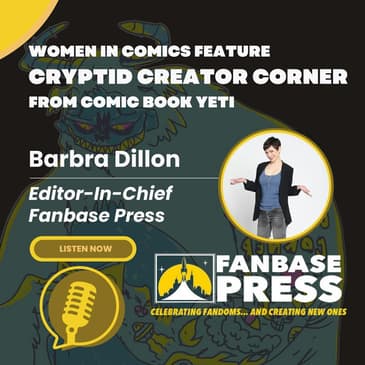

As I was setting up the round of interviews that would be our first Women In Comics Feature to celebrate Women’s History Month on the podcast, I wanted to get a variety of voices included to represent different facets of the medium. That lead me to reaching out to Barbra Dillon, Editor-In-Chief of Fanbase Press, a GLAAD Winning and Eisner and Harvey Nominated publisher and geek culture website. Who better than Barbra to cover the angle from both the vantage point of a small indy comics publisher as well as comics journalism. Two birds, one stone and I’ve been meaning to catch up with her since last Fall when their anthology Ripple Effects was crowdfunding which was of considerable interest to me as its focus is to increase awareness of and highlight people with incurable non-visible diseases like myself.
I don’t know of another comics journalism outlet that shares such a strongly aligned set of core values like Fanbase does so it was a pleasure to finally get a chance to catch up with her and chat about representation in the medium.
Fanbase are celebrating their 15th Anniversary in 2025 and provide a range of unique and diverse programming to support creators in the medium. Please take a moment to check them out if you haven’t already.
Mission Statement
Fanbase Press celebrates fandoms and creates new ones! As a GLAAD Media Award-winning and an Eisner and Harvey Awards-nominated comic book publisher and geek culture website, Fanbase Press produces new and distinctive works, as well as daily reviews, interviews, and podcasts, that span the pop culture spectrum and give voice to the themes, ideals, and people that make geekdom so exceptional.
Fanbase Press believes that #StoriesMatter. Acknowledging the importance of stories and the impact of storytelling is at the core of the organization. Universal communication through stories allows us to examine the essentials of human existence, to understand ourselves better and to grow and/or heal, to pass on important values, knowledge, and lessons to the next generation, and to connect with one another through empathy and compassion. Fanbase Press holds a commitment to looking beyond the simple entertainment factor of pop culture storytelling in order to find the value that each story offers to us as individuals, our world, and/or the human condition.
The company was founded in 2010 (originally under the name Fanboy Comics) rebranded to Fanbase Press in May 2016 by co-founders Barbra and Bryant Dillon.
Fanbase Press’ graphic novels, including the 2024 GLAAD Media Award-winning Four-Color Heroes, 2023 Eisner and Harvey Award-nominated Ripple Effects, 2018 Eisner Award-nominated Quince, the 2020 IPPY Award-winning Quince: The Definitive Bilingual Edition hardcover, the 2022 International Latino Book Award-winning Nuclear Power, the 2019 IPPY Award-winning A Geek’s Guide to Cross-Stitch: Journeys in Space, the 2014 Bram Stoker Award-nominated Fearworms: Selected Poems, The Sequels, The Margins, The Gamma Gals, Something Animal, Identity Thief, The Arcs, and Penguins vs. Possums, are available online at www.fanbasepress.com.
Here’s the link for GeeksOut that I talk about in the show.
PATREON
We have a new Patreon, CryptidCreatorCornerpod. If you like what we do, please consider supporting us. We got two simple tiers, $1 and $3. Want to know more, you know what to do.
ARKENFORGE
Play TTRPG games? Make sure to check out our partner Arkenforge. Use the discount code YETI5 to get $5 off your order.
THE LANTERN CATALOG
Created on the premise of creating light in the dark, this is the the go to resource to keep you up to date on the indy projects and the creators you love. You can find them at https://www.thelanterncatalog.com/.
Make sure to check out our sponsor 2000AD.
[00:00:00] Your ears do not deceive you. You have just entered the Cryptid Creator Corner brought to you by your friends at Comic Book Yeti. So without further ado, let's get on to the interview.
[00:00:30] Show notes and thank you for your continued support. Thanks for your donation. Y'all, Jimmy the Chaos Goblin strikes again! I should have known better than to mention I was working on my DC Universe meets Ravenloft hybrid D&D campaign on social media. My bad. He goes and tags a bunch of comics creators we know and now I have to get it in gear and whip this campaign into shape so we can start playing. Another friend chimes in, are you gonna make maps? It's fair to say it's been a while since I put something together so I guess...
[00:01:03] Question mark? It was then that I discovered Arkhamforge. If you don't know who Arkhamforge is, they have everything you need to make your TTRPG more fun and immersive. Allowing you to build, play, and export animated maps including in-person, fog of war capability that lets your players interact with maps as the adventure unfolds while you, the DM, get the full picture. Now I'm set to easily build high res animated maps saving myself precious time and significantly adding nuance to our campaign.
[00:01:32] That's a win every day in my book. Check them out at arkhamforge.com and use the discount code YETI5 to get $5 off. I'll drop a link in the show notes for you. And big thanks to Arkhamforge for partnering with our show. I think I'm gonna make Jimmy play a goblin warlock just to get even. Hello everybody and welcome to today's episode of the Cryptid Creator Corner. I'm Byron O'Neill, your host for our Comics Creator Chat.
[00:01:56] This week I'm continuing my Women in Comics coverage celebrating Women's History Month in March and finally catching up with someone I'm long overdue sitting down with. That would be GLAAD winning an Eisner and Harvey nominated publisher and geek culture website, fan-based presses, editor-in-chief Robert Dylan. Barbara, I think I've been trying to catch up with you since last August when Ripple Effects was coming out. How are you?
[00:02:20] I'm good, Byron. Yes, I have long wanted to catch up with you as well. So thank you so much for having me and chatting with me. I look forward to hearing more about you just as much as you wouldn't chat with me. Thank you. Well, I know y'all are LA-based, so how's everything faring with the fires and everything that happened with that? We are incredibly fortunate. We did not end up having to evacuate. Our home is safe, which has not been the case for many of our friends and colleagues.
[00:02:48] So we're just trying to provide our support as much as possible, time, financial resources, anything that we can for folks who have not been as fortunate. Yeah, I know it was really tough and the comics community got hit really hard. Podcast friend, David Boer, so I think you know David pretty well too. He had the GoFundMe losing his house. So just some crazy stories out of all that. Absolutely. It's hard to imagine. I know. We just caught up this past weekend and he is in good health after he also had a heart surgery.
[00:03:17] So he's up and around and doing well and just has a wonderful lease on life and is just trying to find that new path forward. Awesome. Good. Well, we haven't chatted before, so give me a little background. Why for you comic? Everybody's got a different origin story. Yeah, I think that's what's so amazing and remarkable about the comics community is that we're all coming to this and navigating it through a different lens, a different path.
[00:03:45] Something different has brought us here and that makes each of us so unique. For me, I was born and raised in Pittsburgh and came out to LA to work in the entertainment industry, TV and film, which I did for a few years. And initially, you know, my path was law school and working as a talent manager. And I just became really jaded with TV and film and Hollywood in general. And I really for me, it was about helping creative people to do what they loved.
[00:04:15] And I wasn't seeing that happen. And I had so many friends who were so talented but weren't being given the opportunities. And all I saw were the barriers. And out of that really came Fanbase Press. My husband and I were creatives ourselves. We had our own stories that we wanted to tell. But mostly we wanted to provide a safe space, an outlet for folks to be able to share their stories and not experience those barriers. So that was really the genesis of Fanbase Press 15 years ago.
[00:04:44] And we started as kind of a strange animal in that we did both publishing and media. And for us, you know, it was never a competition. It's all about recognizing our limitations and being a boutique publisher, only being able to put out so many stories.
[00:05:05] But still seeing so many talented folks out there and wanting to give them a voice and give them a spotlight to ensure that they're reaching as many audiences as possible. And so for us, it was just, you know, this wonderful symbiotic relationship between helping people have stories that are put out there, but also giving spotlight to those that may not be through Fanbase Press. Okay. Well, when I came up with this idea to do a Women in Comics feature after starting to evaluate how, you know,
[00:05:35] we at Comic Book Getty were personally doing as a journalistic outfit covering different segments of the creative community. So Fanbase Press 15 years ago, how has the landscape changed in your mind in the publishing world over that time with respect to representation? With regard to representation, I feel like that's a great question.
[00:05:59] I think specifically with regard to representation, it has improved. It's almost like I want to say two steps forward and one step back. There are still so many voices that are not being given an opportunity intersectionally. And I think that while there may be some new inroads that are made, especially with regard to the independent landscape,
[00:06:29] I think new barriers are always created. And over the past 15 years, I mean, we've seen wonderful abilities in publishing. I mean, the crowdfunding landscape alone has been remarkable in breaking down a lot of those barriers, you know, not requiring folks, you know, it's not just, you know, you're putting out a zine or you're spending thousands of dollars to put something in print. Now you can do crowdfunding. You can do digital media only. I mean, my goodness, one of the Eisner nominees last year posted through Instagram.
[00:06:58] So it's remarkable the number of resources out there to help you tell your story and to have it out in the world. Yet at the same time, as we see, you know, monopolies continue with regard to distribution and barriers with regard to getting your voice in libraries, there's just always something new.
[00:07:19] It's almost like the new innovations that come, the larger forces at Bay, as it were, kind of see those and create new barriers. I feel like it's so unfortunate, but it's heartening to see that folks are still trying. I think that's the most important thing is that there's hope and there's a drive and there's a motivation. And I think that spirit and that drive of the independent community is really what drives things forward.
[00:07:47] And it really pushes to get diversity, inclusion, representation in all aspects of the comic industry. I mean, it's important that it's not just the creators. It's not just the stories. It's the publishers. It's the editors. It's the voices that are making the decisions that really need to change, that really need to be more inclusive in order to provide those opportunities and break down the barriers.
[00:08:16] So how do you, as a publisher at Fanbase, carve out more opportunities for people? What initiatives do you have as a publisher? How have you approached that given this constantly shifting landscape of barriers that are put up against us all?
[00:08:32] Yeah, I think it's something for us that is baked into our core ethos as a company, our mission as a company, is to share these stories, these voices that are so vital and necessary to not only the comics community, but our community at large, the world. And I think that for us, it's about we have to be very selective in the stories that we publish because we're a two person operation.
[00:08:56] And so we have limited resources, but it's why the stories that we pick, we are very intentional in wanting to select often those marginalized stories of voices that are not heard. And it's so tough in selecting those because one voice is not going to be able to speak to an entire community's experience. You know, every individual's experience within one community is so vastly different. So it can't represent everything or be everything to everybody.
[00:09:26] But I think that is what further underscores the need to have more, to have more diversity, to have more initiatives. And so for us, especially in this challenging landscape, this challenging world that we find ourselves in, we are simply doubling down at Fanbase Press. We are not giving up on diversity initiatives. We're not giving up on inclusion and equity especially.
[00:09:51] So for us this year, we started our Build Your Community initiative, which is really just geared towards two things with regard to community. Skill building, making sure that everybody has a seat at the table and has the opportunity to learn new skills and providing opportunities for connection. Because a lot of times, Byron, as I'm sure you know, you know, especially here in Hollywood or in any entertainment industry, it's about who you know.
[00:10:20] And so we want to provide those opportunities to, again, bring you to the table, meet other people, form those important connections that can help you now five years down the line, 10 years down the line, etc. And so we're doing things like, we have our first community potluck next week that we're doing. It's free. Anyone is welcome to attend. We have weekly Zoom calls, our comics and coffee calls, which are just an opportunity to network virtually.
[00:10:48] Which, you know, we want to be mindful of access, that not everybody can come in person to things. And so we want to be mindful of accessibility for everybody. And so we do that. We do, I do weekly office hours, which is just another Zoom call to check in. So these are just some of the things.
[00:11:08] I don't want to go on forever, but, you know, just some of the things that we're doing to really provide, again, those opportunities for connection and for building your skills so that you can move forward. So one of the things that I've heard a lot recently doing sort of this Women in Comics segment is how much at the editorial level it makes a massive difference. Like that seems to be one of the glass ceilings that sort of appears like it needs to break more. Yeah.
[00:11:37] So on the publishing end, how do we carve out more opportunities for women to be able to have access to those positions so that in turn it feels like it trickles down? That's a great question.
[00:11:52] I think that I really just think that it needs to be a decision made by the leadership of a publishing company that it is going to be in your best interest to be inclusive of women in editorial. And not just editorial, but all leadership level positions.
[00:12:14] I think without those voices, without those perspectives and those lived experiences, you are missing out and your lens is very limited in the stories that you're going to tell and the decisions as a company you're going to make. And so I think it's just vital that companies, corporations make these decisions. Now, are they going to make that? I can't say.
[00:12:35] But that's why here at Fanbase Press, it's vital that, you know, I appreciate being able to make these decisions, being able to voice, hey, as a woman, you know, I want to offer this perspective. And at times that I have to recognize myself that my own perspective is limited.
[00:12:53] And so in that instance, we bring in a lot of other folks, whether it's with regard to publishing and making sure that not only are we hearing the creator's voices, but that we bring in sensitivity readers to ensure that we're hearing and being mindful of others' perspectives.
[00:13:09] With regard to media, ensuring that if we do virtual or in-person panels, that we're bringing in panelists and not just having them speak during the panel, but making them integral to the creative process, the production process to ensure that are we asking the right questions? Are we saying things that you feel need to be heard?
[00:13:28] So I think it's important that in these decision-making roles that as many people be included as possible, especially those voices of women and other marginalized communities. Yeah, which unfortunately, in my mind, keeps returning back to the almighty dollar. Yes. Because a lot of what I'm hearing is we need to offer people these more opportunities. But as far as I'm seeing it, please weigh in your opinion here.
[00:13:58] But the key to that is the next generation of readers and young girls having access and being encouraged. And I think a whole lot of that is just frankly getting that in their hands, right? I'm constantly thinking about the next generation of readers. I have a teenager. I know you're a mom. It feels like we're seeing a pretty significant shift in the representation of women in comics, both from a character perspective and in the number of creators as well.
[00:14:26] Although on the creator side, that's still painfully small. Does that feel accurate to you? It does. And I think it's challenging in that I think your initial point was 100% correct. I think that the late stage capitalism in which we find ourselves is really challenging. And not just in the world, but in comics specifically and in all entertainment fields.
[00:14:51] I mean, we're at a time when, and it's across the board, if we're just speaking about comics, no one has paid their value. And that is incredibly unfortunate. And because of that, you know, folks are, you know, on the creative side of things, folks are burned out or they can't afford to take on a creative job, which means you're losing out on their voice, their perspective, what they could bring to things. And it's so unfortunate.
[00:15:16] It's a symptom of a larger problem, which is, you know, a system, a systemic problem across the industry, but across all industries. And I think that, you know, comics is always in a state of flux. The industry is always in a state of flux. There are ebbs and flows of how the industry is doing. Our industry right now is at a very milestone moment. There is a lot that needs to change. And it's anyone's guess as to what will happen.
[00:15:45] I know, especially with diamond distribution and, you know, everything that's happening there, what's so interesting is it has so many ripple effects throughout the industry. And when you're adding more challenges to it, like the pending tariffs that might be coming and how that will impact the industry, it's just, again, a ripple effect of how much money will be available, how much time will be allotted to creators, how much funding will be available to pay them.
[00:16:15] And this just continues on and on and on. And so you're not, again, you're not getting the stories that need to be heard. You're not paying the people the amount that they deserve to be paid. And because of that, you're losing out on voices. Well, is there a direct market problem just being wedded to an outdated floppy system? Because if you look in the graphic novel publishing space, it's a vastly different representational landscape. Yes, there absolutely is a problem.
[00:16:44] I think that it's a, you know, and I won't be able to solve it all today, sadly. Or even best encapsulate what the problems are. But yes, I think that it is a systemic problem. I think that we, the pre-order system and depending on a very small handful of distributors to provide access to readers, to news outlets, it all kind of comes back to the dollar.
[00:17:13] And we see the same thing on the library side of things. There are a finite number of distributors that provide access to libraries or that libraries are permitted to purchase from. And that's, you know, a thing that folks don't necessarily know. Whether it's federal, state, local laws, school libraries, public libraries, private libraries are only sometimes able to purchase from specific distributors.
[00:17:42] And so that causes an issue and prevents them from being able to purchase and store a lot of the stories from independent creators, which are the diverse stories, are the stories we need to be seeing out there. And it's, again, these barriers that exist that just get harder and harder. It's also, you know, if you can't afford to pay to be in certain media outlets, then libraries aren't going to see you. They're not going to find you. And so they're also not going to be able to know to purchase you.
[00:18:12] So it is. It's systemic. And it's not just the direct market distribution with retailers and, you know, your Diamond, your Lunar, you know, Ingram, everything like that. It's on the library side. And it's just a system-wide problem that does absolutely need to be fixed. Yeah, the library, the whole library piece is a gaping hole in my own personal knowledge base. I remember when my son was in elementary school, my wife and I would volunteer for the
[00:18:41] book fair, the scholastic book fairs and things like that. But beyond that, I really don't know much about that landscape. How do we change that? Educate me a little here because I just don't, I don't have a reference point here. Well, first and foremost, I want to say that librarians and educators as well are amazing and deserve our appreciation for the hard work that they're doing each and every day because
[00:19:06] they truly are providing access and support for not just readers, but creators as well. They're really on the front lines of a very challenging time in having to defend books, having to defend creators against constant challenges, censorship, book bans. And it's remarkable that the work that they're doing because they care, because they see the
[00:19:33] value of books and specifically comics, because comics are right now some of the most challenged books out there. And so while battling all of those things, they're also battling limitations of themselves. I mean, like everybody else, like the creators we were talking about, they are underpaid, they are understaffed. And so they're juggling so many jobs. But they're also having to struggle against those barriers of distribution challenges, not
[00:20:02] being able to purchase from certain things. Um, sometimes there are some libraries, maybe they are able to purchase outside three different distributors, but unless the book is on Amazon, then they can't purchase it. So if you're an independent creator, you only have your own online store, there may be no chance that a library can purchase from you. And they want to, they want to be able to, you know, do that. But, but there again are so many forces out there that make it really challenging.
[00:20:28] Um, and sometimes it's as basic as we, we were having some colleagues and I had discussion the other day about the fact that, um, unless a book has been reviewed by an acceptable media outlet, and there are a select few of outlets that are providing reviews in a very certain way that librarians need to be able to provide evidence to their superiors to purchase. Again, that's another barrier that they now can't purchase a book. Um, so it's, it's really challenging.
[00:20:56] And I think that's the thing that all of us at the end of the day need to understand is that each of us, no matter our place in the industry, we are all up against so many challenges and so many barriers that, you know, it's, it's important for us to recognize this, to see this, and to find some solidarity in knowing that we're up against so much, but knowing that if we work together, we may be able to find some path forward. Is it going to be challenging? A thousand percent yes.
[00:21:24] But, um, but being able to have open conversations like this one about, you know, what, what are the barriers you're experiencing? What, what challenges do you have? How can we work together to resolve those? That's, that's the only way we're going to find a path forward. All right, everybody. We're going to take a quick break. We'll be right back. Do you love sci-fi? Are you a horror fan? Maybe you prefer action or fantasy. 2000 AD has it all and should be on your radar.
[00:21:51] With a whole universe of characters from Judge Dredd and Strontium Dog to Rogue Trooper, Shakara Halo Jones, and many more. Every weekly issue, you get five action-packed thrills from incredible creators such as Garth Ennis, Rob Williams, Alex DeCampi, Dan Abnett, and so many others. Get a print subscription and it'll arrive to your door every week. And your first issue is free. Or subscribe digitally.
[00:22:16] Get free back issues and download DRM-free copies of every issue for just $9 a month. That's 128 pages of incredible comics every month for less than $10. That's like a whole graphic novel's worth. All subscribers get amazing offers like discount vouchers and exclusive product offers. Head to 2000AD.com and click on subscribe now. Or download the 2000AD app. And why wait? Start reading today. I'll put links in the show notes for you. Let's face it.
[00:22:44] The comics landscape is a mess right now. I'm the editor-in-chief of a comics journalism outlet, and I can't even keep track of it all. If you are as passionate as I am about indie comics and its creators, you should check out The Lantern Guide. Created on the premise of creating light in the dark, it's going to be the go-to resource to keep you up to date on the projects and the creators that you love. Don't take my word for it. I reached out to my friend Brian Lovell, Poison Ivy artist and indie comics creator, to get his take. Brian, what does The Lantern Project fix?
[00:23:14] I'm a dude who loves indie comics. And I know personally, like, I get very frustrated when something shows up in my social media timeline or something like that. And I feel like I can't keep track of everything. So really, The Lantern Project was born out of that. It was an opportunity for me as a reader to kind of, like, have a place to want to consolidate all the stuff that I wanted to read. All the cool projects from cool creators that seemed interesting and kind of unique to, like, something that I would like,
[00:23:44] which is really not super represented everywhere else, but it's all over the indies. Having a spot to go to that felt like it consolidated a lot of those audiences and a lot of those places where I couldn't just get drowned out in the feed of social media seemed really valuable to me. What's the ultimate goal? It's really our hope with this project that creators feel like they're able to get in front of readers,
[00:24:07] and readers are able to get books that they actually want to read with a much easier time of keeping track of them and accessing them. The catalog is scheduled for a quarterly release, so head over to thelanterncatalog.com to sign up now so you don't miss your next favorite thing. I'll put a link in the show notes for you. Welcome back. It feels like to me, too, that parents kind of play a pivotal role in this equation.
[00:24:35] I know both of us as parents, you know, we're caretakers, the next generation of nerds. Um, and how do we, it seems like that is, from what I'm hearing, a lot of the key here. And how do we get that information in parents' hands? Um, I know you guys have an initiative where you're trying to help parents. There's a geeky parent guide that Travis is doing.
[00:25:02] Honestly, I really wish I've thought of that one because I think it's a fantastic idea. It could be so difficult to navigate everything as a parent because you're hearing what may or may not be in a book that your kids have access to, and you're not there, and, you know, how do you have time to juggle all the things that are bombarded you as parents at life right now on top of that? So, I know I've actually made probably some suspect decisions with respect to comics.
[00:25:29] I know my son read Philadelphia at far too young an age, and all kids also mature at different rates. So, what is Fanbase doing to kind of help with that piece and help educate parents a little bit more to make some of these other barriers, um, to diminish them? Absolutely. That's a great question. And, um, first, thank you for shouting out Travis Licata.
[00:25:56] He has been with us for many years at FanDays Press, um, and has, uh, for just as long been running the Geeky Parent Guide, uh, which is a monthly article series, uh, really geared towards speaking to, uh, parents who may be geeks themselves or parents who may be parents of geeks or future geeks, um, and just providing that open, honest dialogue of, here are some of the barriers that, you know, Travis himself is experiencing, um, and how he works through those.
[00:26:24] Uh, just this morning, uh, we posted his article providing date night options on, you know, a doable scale because right now it's really important that parents, it's kind of like that, that analogy of, you know, putting on your, your, uh, emergency mask on an airplane first, because if you are not okay, your kids may not be okay. And kids are so, um, they're resilient, but I think they have high degree
[00:26:49] of empathy. And so they sense that we may be stressed and they sense that we are going through all of this and, you know, that, that trickles down to them. So it's important that we have these open, honest dialogues with each other about, you know, how, how are you navigating parenthood? How are you navigating school life? You know, especially we did article series on parenting during the pandemic. And what did that look like? What did homeschooling look like for you? And what are the challenges?
[00:27:16] What are some fun science things you can do at home when you're, you know, stuck it at home that, that you can do with your kiddo. And it just allows, I think the foundational thing is number one, building that trust, building that connection with your kiddos because that's so vital. And then from there, when you have that trust, you know, finding opportunities, not only to create lasting memories, but to ensure that they likewise feel comfortable having conversations with you.
[00:27:42] Because I think at the end of the day, when you start introducing comics or other, you know, media, it's important that not only do they have the opportunity to read it and to consume it, but they have the opportunity to converse about it. Sometimes they're, you know, whether it's Philadelphia or something, something completely different. There are some challenging or confusing topics that might be brought up. And if we don't have that solid basis with our kids to have those
[00:28:08] conversations and allow them to have that comfort level of, hey, I can bring this to you and talk with you about it. I think it just allows them to know that they should be asking questions, that, that there are lots of topics that may be tough, but are important to tackle. And that there are, there are helpers out there. There are helpers who can guide you through it, that can offer advice or simply offer an ear. And I think that's the most important thing that we,
[00:28:36] we instill in our kids, this sense of trust and empathy. Because without it, I don't think there is a path forward. Yeah. Yeah. Being a parent in 2025 is tough. Anybody that's listening that has kids, I empathize with you so, so much. It's, it's, it's wild. Um, yeah, even, even the stuff in our household, I was concerned last night. Um, you know, he gets home after practice and we're talking about
[00:29:04] things and you always worry about how, how much is, is rubbing off of, of your stuff is rubbing off on them. And I ask him, are you okay? Framing thinking in my head? Well, all the stuff that we're talking about that is, you know, these global and, you know, American kind of the issues that are going on. And he's, he's like, Oh, it's so bad. And of course, as a parent, you're like, Oh no.
[00:29:30] Okay. And you prepare yourself for the worst. And what he's actually upset about is, is this guy that he's not right. It has nothing at all to do. Like he didn't absorb any of this stuff I thought he was absorbing. So yeah, talking with your kids is, is absolutely, is absolutely critical. Well, switching gears a bit, I was looking at our podcast demographics on Spotify now that the information is available and it's a little grim since we started three years
[00:30:00] ago. Now we're sitting at just under 15% of listeners being women from a journalistic lens coverage is still weighted, you know, from, from both and by men. So how do we create safer and more welcoming spaces on the journalistic side? That's a really great question. I think that number one, it, it goes back to what we were talking about earlier about staffing. And I think
[00:30:22] that we have to provide opportunities for, um, female and non-binary individuals to not only feel comfortable, um, working with us, but just provide an opportunity to be able to tell, um, the stories, the editorials, the news that they want to. Um, and I think that's a big thing for, for us. Um, we have,
[00:30:46] um, female and trans staffers and, uh, we really try as much as possible on our podcasts, uh, to bring in a variety of voices. Every year I make sure to put out a post looking for, um, female trans non-binary individuals to be guests, um, because I want to make sure that we are not just populating our podcast episodes with men. Um, there are lots of really talented, amazing men out there, um, that have a lot
[00:31:13] to share that are working on a lot, but unless we're intentional about, uh, choosing and, and making time for, um, non-male voices, um, it, it may not happen. And I think that's the biggest thing. I mean, the fact that you are taking time to look at your demographics to, to see, uh, the disparate difference between male and female listenership is amazing. I think that we should be doing more of that. I think you're doing the right thing by doing that. And then, you know, it's, it's the actions
[00:31:42] that we take after that, that, that really help us to move forward and find that, uh, that new path. Yeah. Yeah. Well, from the jump, fan base has also been about building that community, reaching out and engaging different groups, something near to, near and near to me as well at the helm of Comic Book Yeti. It's a, it's a structure built around these different programs that you've already talked about, the virtual office hours to comics on coffee, which I don't think we've really touched
[00:32:07] on yet to the potluck that you've got coming up, which is new. So first, how in the world do you have time to do all this stuff? Right. And, and then, then tell me about some of the ones that, that we've missed. Yeah, absolutely. I, for me, um, so I've always balanced, and I think it's important that we have this transparency. I, I have always maintained a day job, uh, to pay the bills, um, with my time at Fanbase Press, um, because, uh, my time at Fanbase Press is what fulfills me
[00:32:36] creatively. And it's something that is so near and dear to my heart that I will always make time for it. And I, I also think going back to our parent discussion, it's important for us as parents to demonstrate and lead by example for the fact that you should have passions, that you should be an individual and you should be brave and bold and have a life. Because I think that when our
[00:33:01] children see that they will, they will, those same values are instilled in them. They will carry those with them and see that they are important and that their needs need to be met as well. Um, and so I make time, even if that time is, you know, all hours of the evening to get things done. Um, uh, and of course balancing, uh, time with my kiddos as well and time with my partner. Um, but yeah, for us, I think it's very much about all of the spreadsheets, all of the calendars,
[00:33:30] making sure that we, uh, are planful, you know, months out, years out, if need be, to ensure that, um, that all of the things are happening in a way that, that makes sense. Um, you know, is burnout happening? Probably if I'm honest with myself. Yes, we're probably well past burnout. Um, but I also think that there's such, I think that there's such a difference in the work that you and I do. And I think that's why we do it. I think that as, uh, comics journalists,
[00:33:58] we find value and impact and import in getting the word out there about creators, about, um, sharing stories, because I think stories are so vital to our community, to our essence as human beings. I think it's how we connect with each other. I think it's how we, excuse me, how we process things that may be too challenging to process head on. Um, and so, and I think it's how
[00:34:24] we can learn from one another and, uh, build empathy. Um, so for, for us, it's so important that we do what we do and that we carry this torch of fan-based press because we want to carry on stories and we want to value stories. And if we have the ability to do that, then I think that's our own sort of rebellion in a way. Well, one comics outlet to another, do you go to bed at night always thinking you aren't doing enough for the community despite knowing that you're bending over backwards?
[00:34:52] Or is that just me? A hundred percent. The grind is real. Um, yes, yes. Um, it's, it often, and I think imposter syndrome probably plays into that a lot as well, but yes, I feel like it's never enough. There is a to-do list that is never ending. Uh, so yes, the short answer is yes. Yeah. Well, I kind of guessed it. But so what about overcoming societal expectations as a woman in
[00:35:20] comics, which is something I haven't touched on a lot yet with this series? So as a working professional, a spouse, a mom, fan-based press, I feel like I have a full-time job just doing comic book Yeti. So what preconceived notions or barriers have you come against trying to juggle and navigate it all over 15 years? Absolutely. So it's, uh, I would be lying if I didn't say that I've, um, been hit with many, uh, uh, I don't know, misogyny at, uh, especially comic conventions,
[00:35:50] um, as of late in panels, unfortunately. Um, the number of, yeah, the number of times that I've been told at a, uh, if I'm at the booth with my, uh, partner, uh, who is male, uh, if, if, uh, someone comes up to the booth and says, Oh, you know, can I speak to the owner of the company or, Oh, do you work here? Um, it's yeah, it's there, these sort of microaggressions or sometimes even more forward
[00:36:17] aggressive behavior that comes at conventions. Um, and unfortunately during panel discussions, I've, I've been part of, uh, a few panels as of late where I feel like male, uh, audience members are becoming more emboldened. I hope that, you know, if anyone else is experiencing this, I'm so sorry. And, uh, basically, um, a lot of toxicity with regard to fandom and questioning why women need
[00:36:43] to be involved as creators at all while, why our voices need to be heard, uh, why as a queer woman myself that we need to see queer woman represented in any form of media. Um, and it's, it's very disheartening and it's very hurtful. Um, but I think it underscores why we need to keep doing what we're doing, uh, why it's so important and valuable. Um, and yeah, sorry, I kind of lost
[00:37:08] track of my response there, but no, no, it's quite a right. I mean, if that's the first thing that came to mind, what can we do as outlets to help support convention? Yeah. Because I've heard, I've talked to the folks at geeks out, um, and who, who show up and, and, and try to represent the queer community at a lot of cons. It's fantastic organization, by the way, I'll put a link in the
[00:37:35] show notes for anybody who has not heard of them. Um, but what can we do to, to help combat that as men? Is it as simple as just pointed out? I think so. Honestly, um, I, especially with regard to, and I hope that this isn't a more prevalent issue for other folks. I know some folks have experienced it with regard to sort of toxic audience members in, in panels. But, um, I would
[00:38:04] say that for anyone, if, if you are in person at a panel and you see someone coming under attack or just at all uncomfortable, it's okay to say something. It's okay to step in, whether it be, you know, tackling it yourself and saying something yourself or just saying, Hey, I'm going to take a moment to, um, find some security, um, and, and see if someone from the organization itself
[00:38:29] can help. But I think that's the thing. I think that a lot of folks feel uncomfortable, uh, on panels and, and feel uncomfortable even at tables, at conventions, um, because there may not be protection. There's not an active, you know, security walking around necessarily checking in to make sure that all of the creators okay. Um, and a lot of times at conventions, because again, of, of money, there may not be onsite security in every panel room during every panel, ensuring that
[00:38:57] decorum is kept and ensuring that everyone feels safe. Um, and so I think it's a lot of times incumbent upon all of us to ensure that we're protecting each other, that we do have that community. And we recognize that, Hey, things are getting a little out of hand here. Um, maybe we step in and do something. Well, things have gotten a little grim here. What gives you the greatest satisfaction with, with this job? What, what makes you truly happy? What do you feel accomplished
[00:39:22] with, with fan race? I think it's simply being able to share stories that have, have impact. I think the most amazing experience is being at a convention table and having someone who has picked up a book entire, come back to say, my goodness, I feel seen in this story. I've never felt that before. I've never felt represented before. And I felt like this was me in this book, um, and seeing how that impacted
[00:39:51] them. And that, you know, has been from folks who have been eight years old on up. Um, and that's why we do what we do to be able to give folks an opportunity to be seen, to be appreciated, to be valued for who they are, uh, and, and what they bring to, to the table. Well, what else is in store in 2025 for fan base to celebrate your 15th year anniversary? Well, uh, as I mentioned, we launched our build your
[00:40:17] community initiative and we've got lots in story. In addition to the, the comics, a coffee, coffee, excuse me, the, uh, office hours. Um, we're doing quarterly potlucks for those in the, the SoCal area. So stay tuned for those. Um, we are going to be doing a resilience workshop that we'll be announcing soon with Dr. Drea Letimendi, who's a clinical psychologist, just talking about how to, yeah, how to find resilience and how to take care of yourself in these challenging times. Um, we've got
[00:40:46] a resume building workshop because we know a lot of folks in creative, uh, industries are finding themselves out of work and having to look towards non-creative industries. So how to prepare your resume, what that looks like, how to search for jobs. Um, we're also doing a portfolio workshop with Ray Anthony Height and Donna Gillio, uh, later this year for folks to just have a kind,
[00:41:11] thoughtful experience in having your, your resume and your portfolio reviewed. Um, I know that that may not be the case for a lot of folks who go to conventions and have their portfolios reviewed. So this is a very laid back opportunity to do that. So, um, we've got lots in store. We're, we're very excited. That sounds amazing. What can listeners do to help fan base? Well, honestly, feel free to just check us out. Uh, our website is fanbasepress.com. We're on all of the social medias and you're always
[00:41:39] welcome to reach out, whether it be, uh, our email is on the website, uh, but you know, reach out through social media, whatever medium or mode of, of contact is easiest for you, but we're always here. Someone is always available. And, um, yeah, we look forward to hearing from you. Well, folks, I invited Barbara on because there is not another outlet in comics. I found that feels so idly ideologically aligned to what I want comic book Yeti to be then, then fan base. You guys are
[00:42:06] amazing people. I can't speak highly enough of you. Please consider following them and supporting the next inevitable project that they have, have dropping as a publisher. Um, I'll put a link in the show notes where you can find all that stuff. We need more people like you and Bryant in this medium. So thank you for what you do. Thank you for what you do as well. Well, I really appreciate you having on. Um, we finally got to hang out. So yay. Thank you. Yay. This is Byron O'Neill, one of your hosts of the Cryptid Creator Corner brought to you by
[00:42:35] Comic Book Yeti. We hope you've enjoyed this episode of our podcast. Please rate, review, subscribe, all that good stuff. It lets us know how we're doing and more importantly, how we can improve. Thanks for listening. If you enjoyed this episode of the Cryptid Creator Corner, maybe you would enjoy our sister podcast Into the Comics Cave. Listen and subscribe wherever you get your podcasts.