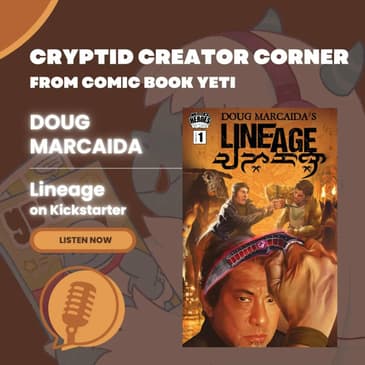

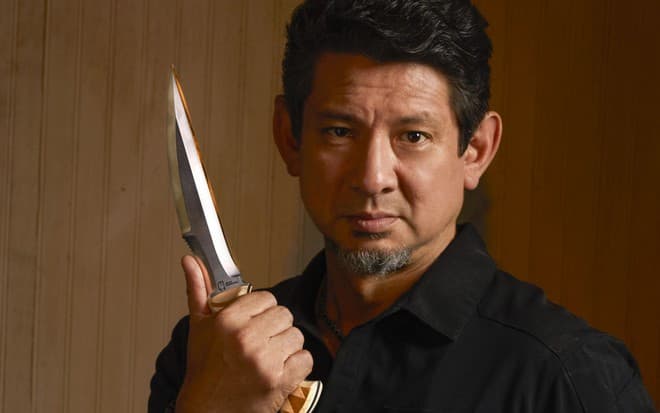
It's a very special episode of the Cryptid Creator Corner podcast as Jimmy chats with Doug Marcaida about the current Kickstarter campaign for LINEAGE. Doug is well known for his martial arts videos on YouTube and TikTok, but also as a judge on Forged in Fire. Doug discusses his influences and inspiration for LINEAGE and partnering with Kid Heroes Productions. Doug also offers insight into his time as a judge on Forged in Fire, Filipino martial arts, and how making his videos helped him hone his skills as a storyteller. Doug is a fascinating individual, generous with his time and talents, and this is a great episode.
WATCH THE VIDEO VERSION ON YOUTUBE!
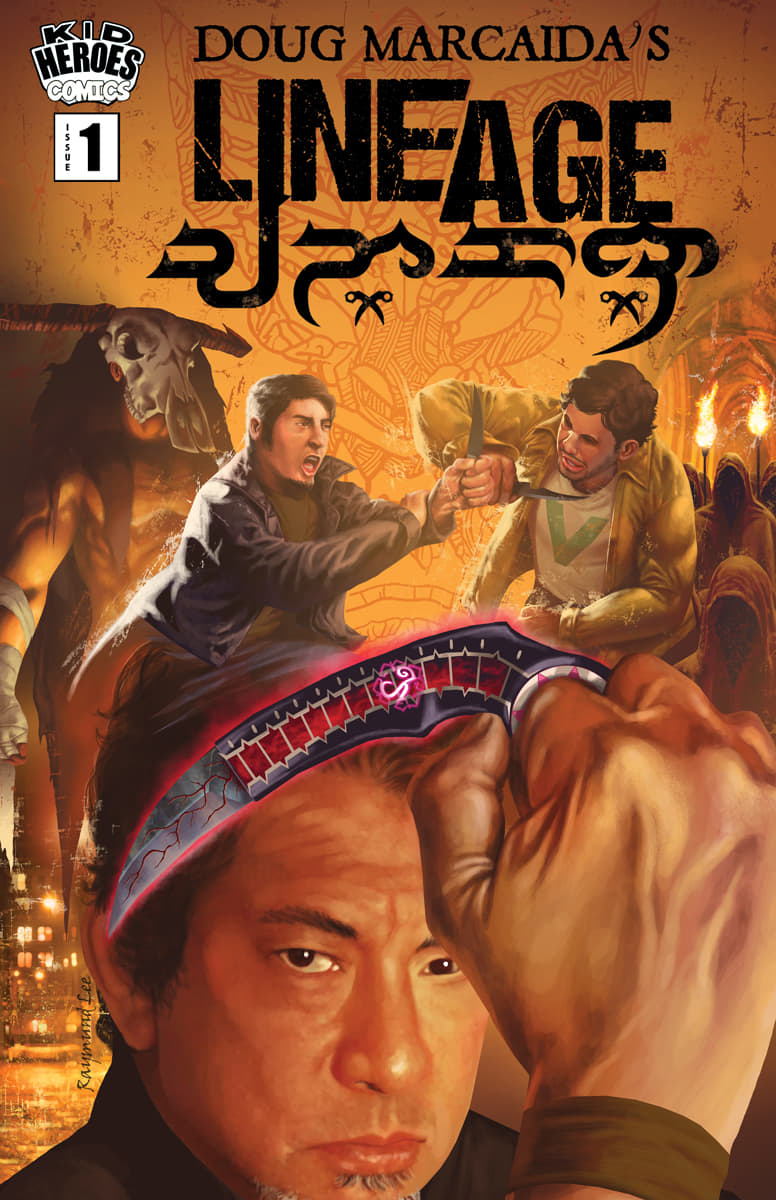
This story of LINEAGE revolves around a blade and a father training his two sons deep in the jungle of the Philippines. After a traumatic incident, we jump years later in present time Los Angeles, where brothers Miguel, now a private detective and Vergil, a social media reporter, have to peel back their past, reconnect with their father's blade, and confront a mysterious cult. Can this brotherhood of the blade unravel their family secrets to unravel this "circle of blood"?
Check out Doug Marcaida's website
Go to Kid Heroes Productions website
Follow Doug Marcaida on YouTube
Check out Forged in Fire on the History Channel
Follow Comic Book Yeti
🔗 Comic Book Yeti LinkTree: https://linktr.ee/ComicBookYeti
For partnership and ad inquiries, please contact: thecomicsyeti@gmailcom
Follow your hosts
🔗 Jimmy Gaspero: https://bsky.app/profile/jimmygaspero.bsky.social
🔗 Byron O’Neal: https://bsky.app/profile/byrononeal.com
ARKENFORGE
Play TTRPG games? Make sure to check out our partner Arkenforge. Use the discount code YETI5 to get $5 off your order.
Make sure to check out our sponsor 2000AD.

[00:00:00] - [Speaker 0]
Your ears do not deceive you. You have just entered the cryptid creator corner brought to you by your friends at Comic Book Yeti. So without further ado, let's get on to the interview.
[00:00:11] - [Speaker 1]
The future is calling. 2,000 AD is the galaxy's greatest comic with new issues published every single week. Every 32 page issue of 2,000 AD brings you the best in sci fi and horror featuring characters like judge dread, rogue trooper, and more. Get a print subscription in 2,000 AD, and it'll arrive to your mailbox every week. And your first issue is free.
[00:00:35] - [Speaker 1]
Or subscribe digitally, and you can download DRM free copies of each issue for only $9 a month. That's 128 pages of incredible comics every month for less than $10. Head to 2,000 AD and click on subscribe now or download the 2,000 AD app and start reading today.
[00:00:55] - [Speaker 2]
Hello. This is Jimmy Gasparro. I am one of the hosts of the comic book yeti cryptid creator corner, and I am very excited for today's, guest. Byron O'Neil, you know, the other host of the podcast and the editor in chief of comic book yeti, really wanted to be here for this interview. Unfortunately, Byron is still dealing with a flare up from his lupus and has been taking a break for a number of months.
[00:01:19] - [Speaker 2]
But he is a a big fan of the gentleman that is on the podcast today, and he's gotten me into it too actually because of this. My youngest, Penny, and I, needed a new show to watch, so we started forged in fire from the very beginning. And and, Penny, she's eight as you, as listeners know, and she got really into it. So so we're excited, and she's very excited to, for me to interview, our guest today, but, he is involved in a comic book project called Lineage. When you're listening to this, you're gonna be able to go to the show notes and check out the Kickstarter for it.
[00:01:56] - [Speaker 2]
But please welcome to the podcast, Doug Marcaida. Doug, how are you doing today? Hello, everybody. You know, thanks for the opportunity to be here. Byron, I
[00:02:06] - [Speaker 3]
hope you're feeling well. And, hello, Penny. I'm glad that you're watching this. You know, one of the amazing things about the show is that there are so many stories of people watching it with their fathers, you know, father, daughters, and their sons watching the whole theory. It's a family show, so I'm blessed to be part of that.
[00:02:24] - [Speaker 2]
I really I'd heard of it before, but just hadn't, you know, gotten into it. And Byron told me when the opportunity came to interview you that Byron's like, I can't do it. You have to talk to Doug Markaida. I'm like he's like, I'm such a big fan. Byron is like has trained in Kali, which is a Filipino martial arts as as as I'm learning, and, he was so excited.
[00:02:51] - [Speaker 2]
So I'm like, oh, definitely. I'll I'll check out the comic, and I'll I, you know, started doing research on you and checking out your TikTok channel, which is awesome. And, yeah, started watching forged, forged in fire, and, he thought it was great. So we're still on the first season, but I think it's gonna there's, like, so many seasons. Yeah.
[00:03:10] - [Speaker 2]
We're we've done ten seasons so far. Yeah. So Penny and I have a lot to catch up on, but, yeah, she she really likes it. So let's let's just get right into and talk about lineage as, you know, this is gonna be the Kickstarter for issues like two to four, like a trade paperback. As I understand it, it's, you know, about two estranged brothers, and I've seen some of the the preview artwork from it.
[00:03:38] - [Speaker 2]
It looks great. I love all the martial arts aspect of it, but I'm kinda curious. You know, there it's like presented as Doug Marcaida's lineage. There's different individuals that have worked on the script and and worked on the art, of course. But how did, like, you become, you know, involved in this?
[00:03:54] - [Speaker 2]
Was this your story idea and a story that you had wanted to tell for a while?
[00:03:59] - [Speaker 3]
Yeah. Basically, this came about because it was supposed to be a TV show while I was doing fortune fire, talking to my producers. Because, you know, fortune fire is about blades, blade making. And my idea came from watching the bladesmiths pretty much start creating the blades. And what I noticed in there, some would say that after beating the the the the, you know, the metal and trying to form it, they say, you know, I let the metal tell me what it wants to be.
[00:04:25] - [Speaker 3]
So I'm like, oh, interesting. And then when you look at, you know, our research for all iconic blades all over the world, the history, the cultures, and everything else, the blade is a very sacred thing. And when I'm watching the show and I'm seeing people create the blades and then they present it to us, the beating of the blade and presenting it all, It's like, wow. Then when they create the blade, they give it away. They sell them or it's made for somebody else.
[00:04:50] - [Speaker 3]
It's like a parent beating the child, forming the child, getting it stronger and everything that they present it to the world. When I saw that, I go, I wonder if the blade ever gets a chance to come back and tell its maker what it's experienced. And I thought, there's a story in there. So when I saw that, I go, something hit me. Every blade has a story to tell.
[00:05:12] - [Speaker 3]
So that's when lineage started being formed. You see, it's a story about the first issue, the first book, Brotherhood of the Blade is about these estranged brothers and their history and how they have all these different things that that have to come to fruition because they're trying to find their identity. But what the people don't realize is that as you're watching this, it's a blade that's telling the story. The brothers are just the ones that the blade witnessed, and that's why every blade has a story to tell.
[00:05:43] - [Speaker 2]
I I I love that. I love the idea of does is it, like, the blade conveying its story back to the person that that forged it? Like, I love that that was kind of, like, the seed of of this story of of lineage. And so with that idea, though, and, you know, whether or not it was supposed to be a TV show, you know, to begin with, you, I'm assuming, joined up with Kid Hero Productions. And then what was the genesis of it?
[00:06:17] - [Speaker 2]
Like, oh, to pivot and, like, well, let's try and do a comic book with it.
[00:06:23] - [Speaker 3]
Yeah. What happened was because of COVID and the change of the way the film industry was and all the all the setbacks, the very people that I was working with had switched to different fields. And I said, you know what? Let me get this story down. At least I can have it printed out there, and then we can revisit those plans.
[00:06:44] - [Speaker 3]
But I'm a storyteller. That's what I love to do. And I said, let me get this in print, and then maybe, just maybe, we're able to at least tell the story and get it going. And that's what I wanted to do. A mutual friend with Kids Heroes introduced me and say, hey.
[00:07:00] - [Speaker 3]
Work with these guys because I think they're interested in making this happen. And once I told them
[00:07:04] - [Speaker 2]
the story, they were hooked. I'm like, let's go. And here we are. Well and I I know from, you know, your background and some of the things you've done, you've gone to, like, San Diego Comic Con, and I I believe. But what was your interest?
[00:07:20] - [Speaker 2]
Was it just presented to you as, oh, here's this group. They're interested. They can turn it into a comic book, or what was your relationship with comics? Was that something that you were a fan of as a kid, or, you know, that were they something in your life, or was it like, oh, comics? Yeah.
[00:07:34] - [Speaker 2]
That's a great idea.
[00:07:36] - [Speaker 3]
I grew up in The Philippines, and, being a third world country, I couldn't afford to have comic books. So though my exposure to comic books were usually from my friend my friends who could afford them. Right? So I would just look at the artwork, and I would just read it, but I never saw the connection from comic series to the comic series because I I never could subscribe or buy them or afford to do that. So I was always a fan of just the artwork, just what I was seeing, but I could never really follow the story.
[00:08:04] - [Speaker 3]
Flash forward to to the present, I wanted the story to tell. And when I joined Kids Heroes and they introduced me to San Diego Comic Con and the different artworks, there's a there's a cover artist that's different than the actual artist who who does the artwork in there. You have writers for this. I was blown away. But what really got me, because when I was first looking at the artwork, to me, I couldn't tell if it's good artwork or bad artwork.
[00:08:28] - [Speaker 3]
I just see great artwork. Right? It wasn't until later on that I talked to some people who were considered legends, like Will Sportachio, right, for example. And he says, yeah. You've you've got a great artist there.
[00:08:40] - [Speaker 3]
I go, oh, that's cool. But then the fact that these guys are able to really put my imagination in print, that blew me away. Now San Diego Comic Con, watching the comic world, really taught me a lot about how people are so passionate about comic books. I mean, in many ways, this is the way we tell history, right, in print. It used to be oral history.
[00:09:04] - [Speaker 3]
Early man used to do paintings on the walls and everything, now you got comic art. But what I loved about it was how people are passionate about this, how they understand the storytelling of comic books, and then I saw cosplay and how people are truly really passionate about this, and that blew me away because that actually is influencing the upcoming issues.
[00:09:27] - [Speaker 2]
Oh, that that is interesting. But, I I mean, the comic book community, yes. Traditionally a very passionate community. And and when they have something that, you know, they like, they they will latch onto it. And martial arts comics in particular, there there is a pretty decent history.
[00:09:45] - [Speaker 2]
I mean, not just, like, manga and in the, like, you know, eastern comics, but but in the West as as well. There you know? Mhmm. I mean, really, it exploded kind of, like, in the seventies and and Bruce Lee, you know, in The US, and then there were a lot of martial arts comics. And I'm curious with your martial arts, you know, background and training, were you able to to bring, you know, some of those skills and what doing some of these moves and using a blade, what it would really look like, you know, and and to the to the artist to kind of, like, make sure that things were authentic?
[00:10:25] - [Speaker 2]
Because I would have to think, you know, I'm not an artist, but if I were, that would be a real benefit to have somebody who, like, knows and understands how the body moves and how weapons are used and kind of get that right on the page.
[00:10:39] - [Speaker 3]
Yeah. Great question. When I first, talked to the artist, we had a conversation about this. So the first book is called Brotherhood of the Blade, and it is my first story. The first story is about my culture.
[00:10:53] - [Speaker 3]
Where did I come from? The Philippines. And, of course, it's connected to my martial art, Thali, which is based in The Philippines. So I wanted to tell that story and how the blade is connected with all that. So when I talked to the artist who happens to be Filipino in The Philippines, we delved into our culture, but he's not a practitioner.
[00:11:11] - [Speaker 3]
But he does know the culture. He added a lot of things. For example, what I was saying, okay. We have this, fight with this guy, and, he goes, what's the guy from? The Filipino martial arts.
[00:11:21] - [Speaker 3]
We're talking to Philippines. And then he put the mask of a carabao, and that's that's basically our water buffalo onto the villain. And I was blown away. I go, that is so Filipino. That is so much of my culture to put in there.
[00:11:35] - [Speaker 3]
And the artwork that he did, he goes, this guy gets it. But what he doesn't understand are the moves. So I told him, you know, I don't want this to be another x man superman punch and all this, you know, punches that you see. I go, I want you to take the moves and the bows and the rituals from my martial art. So what I did was I actually recorded myself and my brother training with blades.
[00:11:57] - [Speaker 3]
And I I recorded all this, and I sent it to him. He goes, take the moves, freeze frame on this, and I want you to understand how we move. And he actually was able to put some of these into the comic book.
[00:12:09] - [Speaker 2]
Oh, that that that is so cool. Like, to be able to do that and have I mean, because your experience and for listeners, if you don't know, if you've never watched Forged in Fire, if you just listen, you know, to the podcast for comic book stuff, a I mean, a little bit about Doug. As Doug said, he's from The Philippines, but he's a trained martial arts. He's been a judge on Forged in Fire, for ten years. He's a US military veteran, was in the air force, I believe, for eight years.
[00:12:41] - [Speaker 3]
Mhmm.
[00:12:42] - [Speaker 2]
I mean, also a respiratory therapist. I mean, Doug's had a life, but but such a resource, you know, to try and get those moves right and bring, you know, that authenticity. I'm curious if you could tell listeners a little bit more about the martial art that you practice in terms of, like, Filipino martial arts. I have a very limited understanding that Byron tried to give me an education before our our interview. So I understand it's mostly or not mostly, but more geared towards, like, weapon based fighting in terms of which which makes sense, but in terms of your practice.
[00:13:20] - [Speaker 2]
Is that right?
[00:13:20] - [Speaker 3]
Yeah. Well, the Filipino martial arts is like any other martial art. Right? People use it for so many different reasons. In The Philippines, we're tribal, where we have 7,100 islands.
[00:13:32] - [Speaker 3]
And the tribal wars, pretty much each tribe that goes up against each other, don't go kickboxing, grappling, punching, or kicking. They fight with weapons. So it's a it's an art to survive. Why do we use bolos and machetes and swords and everything else? Well, because punches and kicks don't work against that.
[00:13:49] - [Speaker 3]
So we start with weapons first, and that's because we it has the highest percentage of survival. So we specialize in that. Now can we fight with our hands and kick? My teacher goes, but why when you can stun? I go, yeah.
[00:14:02] - [Speaker 3]
But there's a the deeper meaning for that is you have a higher percentage of survival. Now what wields the weapon? Your hands. Your your legs for movement and everything else. We have all that, but we're always saying that the hands are for loving, for caring, for taking care of your family.
[00:14:18] - [Speaker 3]
Now if it's combat, pick something up. It's a force multiplier. Right? I mean, you have a five year old punch, it's a five year old punch. You have a 90 year old punch, it's a 90 year old punching.
[00:14:27] - [Speaker 3]
Right? Now put the knife there on the five year old and the 90 year old is very sharp. They're dangerous. So that's what starts out with. But Kali is also something very metaphorical.
[00:14:38] - [Speaker 3]
It tells you that it doesn't matter what's in your hands, it's what you can do with it. So a knife is basically based on its attribute. If it's got a point, it can puncture. If it's got an edge, it should lacerate. If it's flexible, it should be able to wrap around or snap.
[00:14:51] - [Speaker 3]
It can all become, you know, basically something that you can throw, and it could be a mixture of all. So can we use a toothpick? Absolutely. I mean, Filipino martial arts is all over the movies. Born identity, John Wick.
[00:15:04] - [Speaker 3]
All men, they use it. The people don't realize that its core is Filipino martial arts and using everything around you. We're like the MacGyver of martial arts. Right? We just pick up anything and make it work because that's the mentality there.
[00:15:16] - [Speaker 3]
Doesn't matter what's in your hands. You look at the attributes of that because the bottom line is we wanna live.
[00:15:22] - [Speaker 2]
I I could listen to you. I mean, like, we I've I could listen to you talk about martial arts, Doug, for, like, the next eight hours. I know, that's not possible, but I I love to hear you talk about, you know, how the culture has kind of influenced the development of the martial art. And I'm I'm sure that's reciprocal as well at a certain point where the martial art martial arts practitioners like yourself start to influence the culture as well. I do wanna talk more about lineage, but I I wanted to ask, how did your your, like, martial arts practice, how did that lead to you, you know, being a judge on Forged in Fire for the past ten years?
[00:16:01] - [Speaker 3]
When they were looking to create Forged in Fire, they were looking for a end user. So we have a Master Smith that was Jane Nielsen. Then we have a weapons recreator who who does a lot of props and everything that was Dave Baker from Hollywood. And then they wanted someone who could be actually use him, and that's me. They found me on YouTube because as a martial artist, I'm also a special forces.
[00:16:21] - [Speaker 3]
I I was teaching I was a military contractor. And my job in the as a military contractor was to teach weapons combatives, how to how to use knives, how to use your gun when bullets don't shoot anymore. It's a spear. You know? Everything but your hands.
[00:16:35] - [Speaker 3]
Pick up
[00:16:36] - [Speaker 2]
your helmet. Use all that. So that was my job. I celebrated my martial art hobby. This was my passion.
[00:16:43] - [Speaker 2]
And what I did was I recorded everything that I did, and I put it on YouTube, and that's how they found me. Wow. Do you are you ever surprised looking back? Like, I can't believe that, you know, posting those videos on YouTube has led to the past ten years on a show like like Forged in Fire because, I mean, ten years is a long time for a television show to last anymore. You know?
[00:17:04] - [Speaker 2]
They don't
[00:17:04] - [Speaker 3]
Yeah. I mean, it definitely was a blessing to be able to do what I was so passionate about. I had to leave my respiratory job because and but, actually, that's not true because I left my respiratory job because I I I got a very big contract to teach, what I love to do, the combatives through a as a military contractor overseas. But what had happened was there was a delay in my, in leaving and to do that contract that, fortune fire showed up. And so I said, maybe I'll just do one season.
[00:17:34] - [Speaker 3]
But then it would, like in the end, I'm like, I don't have to travel overseas. I'm just we I live six hours away from where we were filming. This is a blessing, and look at what I'm doing. I'm really paid to do this. Are you kidding me?
[00:17:45] - [Speaker 3]
So the rest is history.
[00:17:47] - [Speaker 2]
Wow. That is, yeah. That that's incredible. You said earlier on when we started to talk about lineage that, like, ultimately, you're a storyteller. So when you're whether or not you're, you know, helping to create this comic book world of lineage or as a judge on Forged in Fire or you're posting on TikTok or posting on on YouTube.
[00:18:09] - [Speaker 2]
But were you always honing those skills as a storyteller even in those videos?
[00:18:14] - [Speaker 3]
Oh, absolutely. I mean, it's all connected to the comic book. A lot of a lot of what I've gone through in my life and my social media, talking about it on Facebook, Instagram, TikTok, is based on, you know, I I'm a storyteller, so I I try to motivate people in my morning coffee talks, in my knife designs, I designed with KA BAR, Fox Knives Italy, all these. They're all bits and pieces found in this comic book, because the comic book, that's why it shows the first one to be up in The Philippines, but it all comes back to the same thing. Right?
[00:18:45] - [Speaker 3]
Who's telling the story? So in many ways, when we look at this, the very blade that's featured on here is telling the story. See, lot of people don't realize that when they're looking at this, it's called a Mercado. There's a mark on this blade. There's a soul in this blade.
[00:19:01] - [Speaker 3]
And the soul is telling, hey. I was in this world where there were these two brothers, and they used me when they were young, and if you only knew what I saw, I saw their dad teaching them. There were demons and everything. So the blade is just pretty much telling what happened. But in the end, what happens after this whole saga is done, that soul of the blade dies, or rather the body, but the soul gets reincarnated in another blade, in another time, in another era.
[00:19:28] - [Speaker 3]
And then when it wakes up, it go, oh, today I'm a different I'm in this world, in this country, and it'll tell a different story. So that's why it's lineage. Right? The blade soul keeps bouncing from blade to blade, different eras, different dimensions, everything, and it's just telling its life story.
[00:19:46] - [Speaker 2]
No. I I really like use I mean, it it really feels like the culmination of so many things that you have done, and I I just I just think it's a really interesting concept. And, the the pages that I've seen, the preview pages from the comic book are from issue one. I I think they look great. And so Thank you.
[00:20:07] - [Speaker 2]
It really looks like it's a fantastic team that has worked on this.
[00:20:11] - [Speaker 3]
Well, those guys are amazing. But what I loved about this, the whole idea here is it's really based on my my my time in fortune fire. We have to research and test blades from all over the world, iconic blades from history. So when I was exposed to that, I started to learn a little bit about the culture, about the Knights Templars and their Crusades, about the Excalibur and the stories behind that, and my own superstitions with Southeast Asian blades where some blades actually have spirits living in them, or you have to create, you know, a twin blade, all these different stories. I'm like, wow.
[00:20:43] - [Speaker 3]
Every blade has a story to tell, and I wanted to capture that in this comic series. Like, book one is about in The Philippines. Later on, wherever that blade will go, the soul will go to a different blade and different culture, it tells the different stories. But it's not always about the combat use of blades. Some blades we use not just for destroying, we used to build.
[00:21:03] - [Speaker 3]
We cut our food with a blade. We build things with our blade. So it's got a different story. It's just a witness. Some blades in our stories will just basically tell us maybe about a love story or a a triangle of the story.
[00:21:16] - [Speaker 3]
You know, all these different things, we never know as we get there, but it's so inspiring to use that as a media instead of everybody talking about the blade did this, the blade did that. Look. Doesn't matter what's in your hands. The blade is not a a bad thing. It's what people do with it.
[00:21:32] - [Speaker 3]
It that makes it either good or bad. And I bet you that blade was the one to say, I can really use me for that. Or it's amazing I got to be be used for this.
[00:21:42] - [Speaker 2]
Oh, no. I love it. I think it's such a I I think it's such an interesting concept.
[00:21:46] - [Speaker 4]
Alright, everybody. We're gonna take a quick break. We'll be right back. Y'all, Jimmy, the chaos goblin strikes again. I should have known better than I mentioned I was working on my DC Universe meets Ravenloft hybrid D and D campaign on social media.
[00:22:01] - [Speaker 4]
My bad. He goes and tags a bunch of comics creators we know, and now I have to get it in gear and whip this campaign into shape so we can start playing. Another friend chimes in, are you gonna make maps? It's fair to say it's been a while since I put something together, so I guess, question mark? It was then that I discovered Arkham Forge.
[00:22:20] - [Speaker 4]
If you don't know who Arkham Forge is, they have everything you need to make your TTRPG more fun and immersive, allowing you to build, play, and export animated maps, including in person fog of war capability that lets your players interact with maps as the adventure unfolds while you, the DM, get the full picture. Now I'm set to easily build high res animated maps, saving myself precious time and significantly adding nuance to our campaign. That's a win every day in my book. Check them out at arkinforge.com and use the discount code yeti five to get $5 off. I'll drop a link in the show notes for you, and big thanks to arkin forge for partnering with our show.
[00:22:59] - [Speaker 4]
I think I'm gonna make Jimmy play a goblin warlock just to get even. Welcome back.
[00:23:07] - [Speaker 2]
As a practitioner of martial arts and especially, you know, with the being known for Forged in Fire and and Blades, what are some of your other, like, influences in terms of, like, television and movies when it comes to portraying martial arts? Are you like, I'm a lawyer by day, and so I am much to my wife's chagrin, I am hypercritical for law shows if they are, like, too unbelievable. Are you do you get like that? Are you able to just, like, enjoy it for the entertainment value of what it is?
[00:23:41] - [Speaker 3]
I try to enjoy it for the entertainment value. Even there are certain things only because, well, you know, it's a fantasy. Even what I do is a fantasy. Think about that. Okay.
[00:23:51] - [Speaker 3]
You're a lawyer. Everything I know as a warrior, my warrior ethos from the military, law enforcement training, all this, I am doomed to ever use it. If I don't meet the five, what do we call the the the five, situations for self defense, I'm gone as a lawyer. If I get punched right now and the guy runs away, if I chase him and attack him, I'm the one in the wrong right now. There's no such thing as an eye for an eye.
[00:24:16] - [Speaker 3]
If I attack the aggressor and hurt the aggressor and not the aggression, I'm overdoing it. There are so many laws. If if it's my life is not an imminent danger. I'm not allowed to hurt anybody. It's gotta be imminent danger.
[00:24:28] - [Speaker 3]
And as long as and once that imminent danger stops, I cannot continue on. So my training of martial arts, the more I do it, the more I realize, and being a respiratory therapist, I see how it's also used, the more I know I don't ever wanna use it. That's really a loss if I did, because I know and I think of about in my lifetime, about 99% of all the fights that I've gotten into, I could have walked away. I chose to stand my ground. I chose to fight back.
[00:24:55] - [Speaker 3]
I chose so that I could have run. Right? So I'm looking at all this from a young testosterone filled world to an actual wisdom where you're crazy to ever use any of this because your life was never ever in a situation to where, oh my gosh, if I'm cornered, that doesn't really happen. You know? So there's a lot of these rules.
[00:25:16] - [Speaker 3]
Yet, when I'm training the military, it's a different story. It is about survival and getting the enemy taken down. It's a different world. Law enforcement, oh my gosh. Those guys, I feel so bad for them.
[00:25:26] - [Speaker 3]
They're they're supposed to protect and serve, but but they can't even do anything. They have to truly protect and serve even their the criminals and suspects. It's a hard thing.
[00:25:35] - [Speaker 2]
Yep. It it it it must be. I don't I I very early on in my career before I went to law school, I I dipped a toe into the the world of not really even law enforcement. I was a a probations officer for for a year. That's the close
[00:25:50] - [Speaker 3]
Mhmm.
[00:25:50] - [Speaker 2]
And before I went to law school, that was the the closest I ever came to anything in that world. And, I got I I had to be trained to use, an asp, you know, an extendable baton. And Oh, yeah. Very familiar with that. I was the first one in my group to volunteer to be pepper sprayed so we would know what it was like.
[00:26:09] - [Speaker 2]
Listeners, zero out of 10. Don't recommend. But, yeah, I I I have to imagine it's a much, you know, much, much different world. Yep.
[00:26:21] - [Speaker 3]
And then that's one of one of things that I wanted to talk about in this comic series too is the true dangers of violence. Right? The part of lineage is not just about the two brothers finding out about themselves from their past. This is connected to a cult, and the cult is almost close to and was very much inspired by making the cult of cosplay. You know?
[00:26:44] - [Speaker 3]
We become what we try to you know, our our fantasies of putting on a mask, and what does putting on a mask do to you? You know? All these different things that that we're gonna be exploring in the comic series, And the the the a lot of this comes from, you know, the culture of the blade and the cultish behavior. But it also has a story about facing your fears. And when you dig into your past to face your fears, you'll realize some things are not what you thought it was, and some things are not as scary as it was, and some things should have been left alone.
[00:27:14] - [Speaker 3]
It's all found in this story, stories, in this this whole, lineage saga.
[00:27:19] - [Speaker 2]
Oh, that's great. What was the where did it come from in terms of the main focus being on the two estranged brothers? Was there something interesting about that, like, brotherly bond and, the the blade being handed down from their father? Like, why was that the core, like, relationship, of the comic?
[00:27:41] - [Speaker 3]
Initially so the story of the two brothers that pretty much, they were snatched away when they were young because one of them has nightmares now of always a recurring dream to where they were training. They were trained by their father on how to knife fight at a young age, which is not uncommon in The Philippines. But then they saw their father being killed by this demon. And flashback in the future now, and, like, in the present rather, now he's an older guy, he's a mature guy, and, he always has this recurring dream, but he happens to have the very same blade that was handed down to his father, but his memories are all messed up that the blade to him is nothing more that was passed down to him. The younger brother doesn't does barely remembers the past at all because he was very young, but he also wonders why do you have that blade?
[00:28:24] - [Speaker 3]
Can I find the same blade? Because he he wants to find his past past. One brother doesn't wanna face the past. He wants to leave it alone. The other brother is trying to find it because somehow, someway, they know the answers are from the past.
[00:28:36] - [Speaker 3]
So that young brother, all of a sudden, starts using technology like TikTok and has his own show called On the Verge because he's Virgil, but he keeps on looking into these paranormal research. You know, he's researching everything about the pig and trying to find that kind of of the very same blade. And eventually, they fall into a cult. You know, they start to find these things that now they are faced with the very same demon that appears in the older brother's dream all the time. And all of a sudden, he was afraid of it.
[00:29:06] - [Speaker 3]
He froze, but the younger guy doesn't know the difference. He's just throwing stuff at him. You know, there's a combination of fights. But then the brother realizes when he when the demon tries to attack his brother, no, brother, leave love. Brother, we protected here.
[00:29:17] - [Speaker 3]
He remembers his blade, and he draws the blade because the blade reacted differently. And all of a sudden, when they fight and face the demon, he realizes, wait, how did I draw blood on that demon? And all of a sudden things change, now he goes, wait, if it bleeds it can be killed. And his confidence comes back and he's training as a youngster, and my brother's right here. So he asked his brother, do you remember our training that our father taught us?
[00:29:44] - [Speaker 3]
And the young girl said, yeah. And all of a sudden, it all comes back like muscle memory. Right? The memories come back, and they work as a team, and they defeat the demon with the blade. And then that's when they realize this thing that I thought was a devil or or some kind of entity, and they see it's just a mask.
[00:30:02] - [Speaker 3]
It goes, it's a man. It's just a man. And the younger brother goes, oh, pretty cool. Look at your blade, man. You got a blade too.
[00:30:10] - [Speaker 3]
And that's the end of the first one. Now they realize, we gotta go home and find out what the hell this is all about. Because for the younger brother, they were finding a particular logo that they both recognize from their past. This is what the the the older brother was so afraid of. What the demon here that all everything that he ever thought of was so paranormal, actually is nothing more than just a man wearing a mask.
[00:30:34] - [Speaker 3]
And why did this come thing come and show up and try to kill us? So that all has to be answered. So in many ways, it's facing your fears. It's also about brotherly love and protection. It's also about the story of a blade telling what's going on, but it's also a who done it?
[00:30:52] - [Speaker 3]
Now we gotta find out more. It's a mystery thriller. What's going on? What's the story behind all of this? Things just like finding your past.
[00:31:01] - [Speaker 3]
Sometimes it's not what you think it is.
[00:31:03] - [Speaker 2]
I love that. That sounds right up my alley. And my my brother, Bobby, and I, we love comics. Bobby, shout out to Bobby. He's the cryptid creator corner's number one most dedicated fan.
[00:31:14] - [Speaker 2]
Bobby listens to all my episodes. He's my younger brother by a few years, but my dad is, like, growing up a a huge, like, martial arts. He was a big Bruce Lee fan when when he was a kid, and, like, he had us we took martial arts, like, for a little bit when when we were younger. But since I like, my dad came down at my thirteenth birthday party that I had in the basement of my house and did a nunchuck demonstration for all the kids. Like, nobody asked him to do it.
[00:31:44] - [Speaker 2]
He just came down and did it. But, yeah, this this comic sounds like something that, like, all of us, me, my brother, my dad would definitely be into. So I'm gonna make sure that they know, all about lineage that it's, it's on it's on their radar.
[00:32:01] - [Speaker 3]
It's right up your alley. Just think of the word itself, brotherhood. Brotherhood of the blade. So there's a lot of that going on there.
[00:32:10] - [Speaker 2]
Absolutely. I wanted to ask you. I wanted to kinda pivot a little bit before I let you go because Mhmm. I, because I know you were born in The Philippines, and you've talked a lot about that. I I'm a big fan of, like, cuisine from all over the world, and there's a little place not too far for me in Wilmington that had real it closed during the pandemic.
[00:32:34] - [Speaker 2]
But before the pandemic, it had really great Filipino food, and I I miss it because I would just go in there. And even if I didn't know what it was, I would just point to something, and they would make it for me. And every time, it was fantastic. So I wanted to ask you, like, are you is there anything in terms of Filipino food that you would would recommend to somebody? Say, you if find a good Filipino restaurant, like, this is the dish.
[00:32:58] - [Speaker 2]
Do you like Philip I mean, do you like Filipino food?
[00:33:01] - [Speaker 3]
Absolutely. I live and die with that. But you should always try our adobo and garlic rice. Okay. Anything garlic for me, but it's all based on the soy and garlic thing.
[00:33:12] - [Speaker 3]
I mean, I love adobo, chicken adobo or or regular pork adobo with garlic rice. It's one of my favorite staples.
[00:33:18] - [Speaker 2]
Okay. Alright. Adobo and garlic rice. So that's that's what I'm gonna be on the lookout for. So I I I had to ask.
[00:33:26] - [Speaker 2]
I'm just like,
[00:33:26] - [Speaker 3]
I wanna know. You gotta try the Filipino barbecue too. Always. Filipino barbecue. Yeah.
[00:33:31] - [Speaker 2]
This the place that was the place that was near before it closed, it had really great Filipino food, and then it also made, like it it made brisket, and it it was some of the best brisket I have ever had in the world.
[00:33:45] - [Speaker 3]
It was just a
[00:33:46] - [Speaker 2]
tiny little tiny little place. I think the family that ran it were were from The Philippines, and they just knocked it out of the park every time. I'm I'm I miss it.
[00:33:55] - [Speaker 3]
Awesome. And that got me hungry.
[00:33:59] - [Speaker 2]
Oh, well, Doug, I really appreciate you coming on the podcast to talk about this. I'm gonna put a link in the show notes. So listeners, you can follow Doug on social media. I'll put a link to his YouTube, TikTok. I'll definitely put a link to the Kickstarter, which I think is gonna launch February 16 for Libby.
[00:34:16] - [Speaker 3]
Sixteenth. And, we'll be doing some more stories. Just follow me on my online because I got more to reveal. Is this is this a radio podcast? I'm just here, or do you is this a video actually?
[00:34:28] - [Speaker 2]
I do. So, it definitely goes out like a regular podcast, but I do I do use the video. We we sometimes put them up on YouTube. So for listeners, if you wanna check out the YouTube, Doug, if you're there's anything you wanna show, we'll put it on YouTube. So
[00:34:41] - [Speaker 3]
Well, just like every blade has a story to tell, the first issue was talking about this particular blade here, the Mercado, the marked one. But as the story goes and we go back to The Philippines, more revelations of different blades that are telling different stories will be revealed.
[00:34:58] - [Speaker 2]
Oh, okay. No. I love that. And there's also listeners, if you if you went over to the YouTube and got to see the the first blade that that Doug showed, there is a really, I think it was from issue one, a really great metal cover, yeah, with that blade on it. It looked so good.
[00:35:18] - [Speaker 2]
So, yeah, that's awesome.
[00:35:20] - [Speaker 3]
Sorry. This is one of my new designs based on the Filipinos headhunter's axe that we made into a tunnel hawk. So it'll be featured also on this comic series along with two other designs that are all connected. So it's gonna be awesome. Yeah.
[00:35:37] - [Speaker 3]
It's gonna sound storytelling. Like Once you see them all battle each other out, it's gonna be amazing. I promise you that.
[00:35:43] - [Speaker 2]
That sounds fantastic, Doug. So, yes, Lineage, February 16. Link's in the show notes. If you haven't checked out forged in fire, Penny and I just started it, and we're excited about, our journey. So, Doug Marcaida, thank you so much for coming on the podcast.
[00:36:00] - [Speaker 2]
My pleasure. I really appreciate it. Listeners, rate and review us. Do all those things. If you back lineage, let me know.
[00:36:06] - [Speaker 2]
I'd love to talk to you about it. If you check out forged in fire or any of Doug's videos, let me know. I'm real I was really excited to talk to Doug tonight. So listeners, thank you, very much. Good night, and I will see you next time.
[00:36:20] - [Speaker 4]
This is Byron O'Neil, one of your hosts of the Cryptid Creator Corner brought to you by Comic Book Yeti. We hope you've enjoyed this episode of our podcast. Please rate, review, subscribe, all that good stuff. It lets us know how we're doing and more importantly, how we can improve. Thanks for listening.
[00:36:40] - [Speaker 0]
If you enjoyed this episode of the Cryptid Creator Corner, maybe you would enjoy our sister podcast, Into the Comics Cave. Listen and subscribe wherever you get your podcasts.