
You might not think digital coloring brushes screams excitement—but hear me out. The Last Band On Earth is hands-down one of my surprise sleeper hits of 2025, and I’m psyched to welcome first-time guest Elaine M. Will onto the show. We’re diving into her process, geeking out over digital brushes, and pulling back the curtain on her eerie, hilarious, and heartfelt new graphic novel chock full of demons and tentacles.
Elaine, creator of the Xeric Award–winning Look Straight Ahead, has a knack for highlighting the struggles of mental health using a unique combination of horror and humor storytelling in her work and this was no exception. Having spent over fifteen years in the trenches with bands, I know the depressive shadow that can follow musicians around and I'm delighted to get a chance to expose more people to it through highlighting this book.
🔗 Make sure to check out the Cartoonist Co-op
The Last Band On Earth
Synopsis
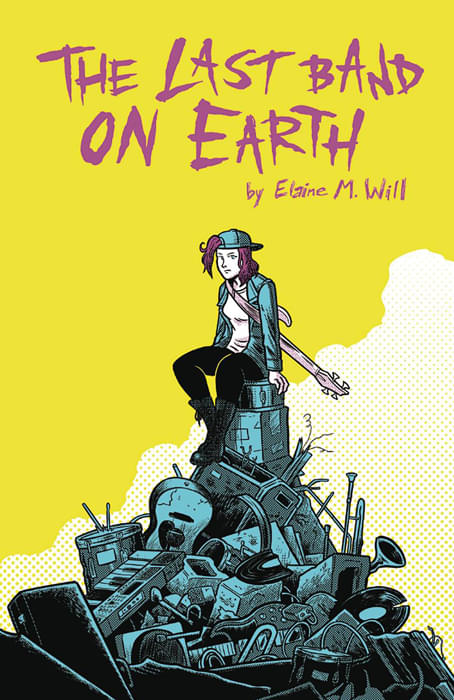
The Last Band On Earth, my third graphic novel, tells the story of The Dead Layaways, a noise rock band trapped in a semi-post-apocalyptic city ruled by demons. The band wishes to leave the city so they can tour whatever might be left of the world, but the demon overlords insist there are miles of untraversable wasteland surrounding the city in all directions, and anyone attempting to leave will die. Better to stay put, where it’s safe.
Except...it’s not safe at all. There are strange demonic creatures roaming the streets, empty grocery shelves, and a general feeling of malaise and existential dread hanging in the air at all times. This anhedonia only seems to intensify the longer one remains in the city. After an unexpected personal tragedy/setback, the band decides they have nothing left to lose, and they must strike out into the unknown.
From here, we begin a liminal horror road movie about fighting both literal and metaphorical demons...
In addition to the mental health themes, Last Band On Earth is also a book about trying to survive as a creative person in a world that is actively hostile towards you.
Follow Comic Book Yeti
🔗 Comic Book Yeti LinkTree: https://linktr.ee/ComicBookYeti
For partnership and ad inquiries, please contact: thecomicsyeti@gmailcom
Follow your hosts
🔗 Jimmy Gaspero: https://bsky.app/profile/jimmygaspero.bsky.social
🔗 Byron O’Neal: https://bsky.app/profile/byrononeal.com
PATREON
We have a new Patreon, CryptidCreatorCornerpod. If you like what we do, please consider supporting us. We got two simple tiers, $1 and $3. Want to know more, you know what to do.
MY NEIGHBOR NECROMANCER
Visit this month's feature crowdfunding campaign at 🔗 NECROCOMIC.COM
ARKENFORGE
Play TTRPG games? Make sure to check out our partner Arkenforge. Use the discount code YETI5 to get $5 off your order.
Make sure to check out our sponsor 2000AD.
[00:00:00] Your ears do not deceive you. You've just entered the Cryptid Creator Corner brought to you by your friends at Comic Book Yeti. So without further ado, let's get on to the interview. I don't know about you, but I've never considered a biting tarantula familiar a good thing? Then again, when it comes to necromancy, there's always a price for power, especially when raising the dead.
[00:00:23] Now you might be wondering why I'm thinking about that. Well, I just got a sneak peek at issue three of My Neighbor Necromancer, the witchy, wonderfully weird comic I've already been a backer of, and I've been eagerly awaiting more of our novice necromancer apprentice Jessie's adventures with her flying undead lizard, Bivitt. This story hits my sweet spot with this danger-just-be-on-your-doorstep kind of narrative. In this issue, Jessie continues her training with Sierra Reno and receives a mysterious invitation to the body farm.
[00:00:50] Now, I worked at the actual body farm in college, so when I heard that, I wonder what in the hell they were doing here. Will Jessie find friend or foe there? No spoilers here. I won't be accused of spilling the bones, so you just have to wait and see. This is Hands Down, one of my top crowdfunding comic picks of the last few years, brought to life by an absolutely stacked creative team.
[00:01:13] Yeti fam Jack Foster contributes an extra backstory rendered in jaw-dropping watercolor, and you'll find freaky familiars, undead mounts, a couple of new characters, one of mischievous creep who look like a harpy-cobold hybrid, and a mailman who hops bodies faster than the postal service changes shipping rates. If you like your magic a little messy and your monsters a little lovable, head to necrocomic.com or hit the link in the show notes,
[00:01:38] so you don't miss the comic that's redefining life on the bright side of death. Hello, everybody, and welcome to today's episode of the Cryptic Creator Corner. I'm Byron O'Neill, your host for our Comics Creator Chat. As regular listeners of the show will know, I spent over a decade and a half of my life in the music business, and the transection of comics and music is something that endlessly fascinates me.
[00:02:08] So, there's nothing that quite sticks with me as a narrative than putting those two and mashing that stuff up. So it should come as no surprise that with a title like The Last Band on Earth, I needed to know what was up. Turns out it's a thoughtful analysis of mental health and depression, something I witnessed, unfortunately, all too often in the music business, and this is through the lens of a punk band called the Dead Layaways, which to me sounds very ominous.
[00:02:35] So, it is my pleasure to introduce first-time guests Schuster and Zarek Award-winning cartoonists, the drawer of demons, the mental malaise murderer, and the bard of bands, Elaine Will, hailing all the way from Saskatchewan. Elaine, it's great to have you on the show. Welcome. Awesome. Thanks for having me. Yeah, absolutely. I'm happy to host you. Well, I want to first start out with punk pets, which may seem like a weird place to start, but my research is exhaustive, taking me all the ways to the corner of the internet,
[00:03:05] known as Instagram, where I found an array of animal headshots, one with a rather fetching, like, headband? That's kind of a bold fashion statement. Not many people can pull it off, but apparently this cat can. So, is this like a sketching warm-up thing that you do, or tell me about punk pets? Yeah, so the punk pet portraits were actually one of the reward tiers on the Last Band on Earth Kickstarter. Okay.
[00:03:29] Yeah, so if you selected that tier, you could get your pets drawn in, like, punk regalia with sort of a spite hairdo. And the cat with the headband, the person who commissioned that requested that cat to be dressed like, I can't, I'm sorry, I can't remember the guy's name, from the band Idols. Okay. John something, I think. Yeah. Nice. Okay. So, how many did you have of those to do?
[00:03:59] I think I did eight of those. Okay. Yeah. Those are really cool. I've never seen anything quite like that. So, did people get to actually also request the punk attire? You know, like, do they, I want a purple mohawk, or, you know, lots of piercings, you know, what have you? Yeah, I sort of made those decisions more or less. But yeah, I did ask if people wanted anything specific. And then I also had a reward tier where you could get yourself drawn playing a guitar.
[00:04:29] And then for those ones, I asked, do you want a specific guitar? And most people were like, oh yeah, whatever you pick is fine. One person said, I want this specific Fender Squire guitar that I have. Nice. Yeah, people are, well, people who play are very, very particular about their guitars. I know this from experience. I never want to be a guitar tech. I did drum tech stuff, but guitar techs, that's, they're a different breed entirely.
[00:04:58] They're serious about the craft. Drum techs, I mean, they don't really care. Just put my drums kind of in a kit and I'll bang on them and you're good to go. But yeah. Well, tell me a little bit about the scene there in the Saskatchewan, because I just don't have a lot of a basis. There's very little knowledge about, you know, kind of what the comic scene looks like. It's pretty good. I think it's pretty healthy. We've got, we've got a good scene going here. One of our local stores has like a creative club.
[00:05:28] The second Wednesday of every month, I think. And they've been making zines and making their own comics for a while. I went to one of them quite a few years ago now. I haven't made it to another one. I need to do that and maybe get, get more involved with that. And yeah, we've, we've had some, some people who've kind of made it big. Like Riley Rossmo is actually from Saskatoon.
[00:05:55] And then he moved to Calgary for a while and he has now moved back to Saskatoon. Okay. Is that shop amazing stories? I was doing a little bit of digging about it. Yes, it is. Oh yes. Another, another big name who still lives in Saskatoon is Tom Gromit, who's done like quite a bit of work for Marvel and DC headlong runs on Teen Titans and Robin in the 90s. Yeah. I mean, it's the reason I asked, you know, my, my wife is a, is a trauma psychologist.
[00:06:22] So mental health is something we, we talk a lot about around the house. And it's something that having worked with, uh, first musicians, then, you know, being, I, I haven't personally dealt with, with depression, you know, but, um, being a professional artist myself for a time now being in comics on a journalistic side and, and talking to a lot people, it is, it's a familiar, familiar refrain, uh, for, for so many people who are creatives.
[00:06:51] And I think it's something that, you know, so many people struggle with and we just don't get many comics that feature that as the focus. So, yeah. And I think like there are comics about it. A lot of them tend to be, you know, the hashtag relatable Instagram type of thing where it's like, Oh, have you ever done this? Have you ever experienced depression like this? And I mean, there's not, there's nothing wrong with that type of comic. Of course, I enjoy a lot of those sorts of comics.
[00:07:20] Uh, but of course I'm more interested in doing the long, I'm taking the long form approach and also a bit more of a metaphorical approach. Cause I like to draw, you know, sort of supernatural stuff. I like to draw swirling flames and, and coiling vines and things like that. And so, yeah, this, this work was like, how can I put all of that into one book? How can I make the most self-indulgent thing I've ever made and also make it about mental health?
[00:07:50] So is that your like visual comfort food, like, uh, demons, monsters? Super supernatural stuff. Yeah. Body and I felt more comfortable living closer to home, closer, closer to where I grew up. Because like, I mean, the thing about comics too, is that you can do them from anywhere. So yeah, it wasn't really, I'm not sure it was really necessary to move.
[00:08:16] Like, I guess there, there are things depending on where you live, there are things that are easier to do. Like, you know, uh, obviously Saskatchewan is a bit isolated. It's a bit like lower population than someplace like Toronto. Sure. So, but again, I'm not sure how well I would do in Toronto because I need a lot of space and I like don't do well with crowds and you know, the noise and the hustle and bustle and chaos of Toronto.
[00:08:46] So I'm not sure that would be great for my mental health. So yeah. Well, it probably would not surprise you that a whole lot of the people I talked to in the comics creator community are introverts. Like they're like, yeah. Yeah. Just about, yeah. Just about everybody that I talked to, I think is. Yeah. Yeah. Well, jumping into last band on earth experience tells me that bands are less about talent
[00:09:13] and more about how they gel as a group. Um, in some cases, maybe they don't gel so well and that's their magic chemistry. But so you're putting the band together in your book, in your head, you have Nat, Will, Rick, Axel, Charlie, maybe we'll include Leah. So how do you imagine them knitting together as characters when you're conceptualizing this project? Yeah. So basically it was like, you know, it's the story at its heart is about a group of friends
[00:09:43] who, you know, want to keep their band together no matter what, want to support each other through their mental health struggles. Um, which maybe runs counter to other stories about bands, which end up being about the conflict within the band and the stuff that breaks the band up eventually. Like one of my biggest inspirations for this book actually was a Canadian movie that no one has ever heard of called hardcore logo, which I haven't either.
[00:10:09] So a fictional punk rock band in Vancouver who have broken up. They reunite for one last tour in the nineties. And yeah, the things that broke them up in the first place resurface and they just kind of seems like, how did these people get together in the first place? They all hate each other. Okay. And that sort of thing. But I didn't see the movie first.
[00:10:33] I actually read a graphic novel adaptation called portrait of a thousand punks in high school and like became obsessed with it because, uh, it's a pretty decent adaptation of the movie and also includes some stuff from the original novel in comic form, which is really cool. But it's sort of, it plays with a lot of different art styles and also like the form of comics.
[00:10:59] And so you have things like typed interviews with the band from, you know, fake magazines and things like that just inserted in and, uh, like testimonials from roadies like, oh yeah, I toured with hardcore logo in the eighties. Oh yeah, it was great. And stuff like that. And I, I like stuff that plays with the form of comics, I guess. Yeah. Uh, and I'm always trying to do that a little bit. I didn't end up doing anything like the interviews in, in my book.
[00:11:29] I sort of wanted to, but yeah, sort of ran out of time. Couldn't figure out how to, how to fit it in. I can tell you with, with absolute certainty that roadie testimonials are not a thing like that. Yeah. That does not exist and should not exist. Uh, cause that would never be a bright portrait that is. No. Yeah. Yeah. Yeah. You're, I know you're a punk fan yourself.
[00:11:55] So, so the names are these people, you know, cause there's, there's only one Axel. And although he's not really considered classically punk, I can tell you from personal knowledge, his life is pretty punk. Or what was back then? Yeah. Well, actually I decided that's actually not his real name. Um, he just really likes the game streets of rage. Yeah. And there's a, there's a character in streets of rage called Axel. I have never played streets of rage. I confess. Okay.
[00:12:24] But I am a big Sega fan. Nice. And yeah. Are they based on, are they based on people I knew? Uh, like I think Nat visually is kind of unconsciously based on someone that I know who doesn't really dress like that anymore. But, uh, and the other two, yeah, I'm not sure. Uh, Rick, I guess looks a little bit like, uh, the Dutch electric DJ Lego Welt if he were Asian.
[00:12:55] Okay. Again, again, sort of unconsciously. Yeah. I mean, reason I ask is I'm working and working. It's on the back burner. We'll put it that way. Um, on the, a comment with a band just kind of based upon my own experiences and injecting some of, some of those into something that is a little more YA and I cannot escape putting all of these people that I know and making them characters. It's probably too on the nose, but yeah.
[00:13:25] Yeah. Yeah. Yeah. I try to, I try to avoid that whenever possible because I don't want to upset anyone or anything like that. Yeah. Yeah. It makes sense. Putting too much of, putting too much of your real life in your comics is always a delicate balancing act. Yeah. Well, kind of injecting real life into it. You were, and unpacking the book, you know, kind of from my read, you're highlighting mental health, which isn't something new in your work. You're probably best known for your graphic novel, Look Straight Ahead, which is this story
[00:13:54] about a 17 year old, a bullied outcast and the mental breakdown that he goes through. So what made you want to highlight depression specifically here? Well, so I guess it's, I guess I felt like I hadn't really, uh, done everything I wanted to do with Look Straight Ahead. I had more things to say about depression in comic form. And it's like, I don't know, they always say, write what you know.
[00:14:22] And that's one topic that I know very well. Uh, but also, Last Bound on Earth was based on a comic that I did in high school called New Edge, which was kind of the same story, except the characters are all furries. And it was, I only did one issue also, cause I couldn't figure out where the story was going. Uh, but they're trapped, yeah, they're trapped in this dangerous city they can't escape from. There's like, it's not really explained all that well.
[00:14:51] And I do a big like intro dump on one of the last pages to try and explain it. And it doesn't really come together. But I was sort of looking at that again. And I was like, Hey, I feel like I could do this story again. But, you know, in a more, in a more grown up way and kind of finish, finish the story. And like, there's still, there's still, uh, there's still something to this idea.
[00:15:20] And I could also make it about depression. Yeah. I mean, one of the things that I noticed that is kind of consistent throughout your work is that you're using a pop culture sort of as your, your narrative sandbox to, to play it. So has that always been, uh, like a personal safe space for you to explore, you know, these, these things that we all struggle with, emotional traumas, you know, depression, anxiety, all these mental health issues. Yeah.
[00:15:50] I guess drawing comics basically is my therapy drawing in general. Yeah. So yeah, I put, put a lot of myself into it and, and my struggles and yeah, I don't know. All right, everybody. We're going to take a quick break. We'll be right back. Y'all Jimmy, the chaos goblin strikes again. I should have known better than to mention. I was working on my DC universe meets Raven loft hybrid D and D campaign on social media.
[00:16:19] My bad. He goes and tags a bunch of comics creators. We know. And now I have to get it in gear and whip this campaign into shape so we can start playing. Another friend chimes in. Are you going to make maps? It's fair to say it's been a while since I put something together. So I guess question mark. It was then that I discovered Arkenforge. If you don't know who Arkenforge is, they have everything you need to make your TTRPG more fun and immersive.
[00:16:45] Allowing you to build play and export animated maps, including in-person fog of war capability that lets your players interact with maps as the adventure unfolds while you, the DM, get the full picture. Now I'm set to easily build high-res animated maps, saving myself precious time and significantly adding nuance to our campaign. That's a win every day in my book. Check them out at arkenforge.com and use the discount code YETI5 to get $5 off. I'll drop a link in the show notes for you.
[00:17:15] And big thanks to Arkenforge for partnering with our show. I think I'm going to make Jimmy play a goblin warlock just to get even. Do you love sci-fi? Are you a horror fan? Maybe you prefer action or fantasy. 2000 AD has it all and should be on your radar. With a whole universe of characters from Judge Dredd, Astronium Dog to Rogue Trooper, Shakara Halo Jones and many more, every weekly issue you get five action-packed thrills from
[00:17:44] incredible creators such as Garth Ennis, Rob Williams, Alex DeCampi, Dan Admit and so many others. Get a print subscription and it'll arrive to your door every week. And your first issue is free or subscribe digitally. Get free back issues and download DRM-free copies of every issue for just $9 a month. That's 128 pages of incredible comics every month for less than $10. That's like a whole graphic novel's worth.
[00:18:10] All subscribers get amazing offers like discount vouchers and exclusive product offers. Head to 2000AD.com and click on subscribe now or download the 2000AD app. And why wait? Start reading today. I'll put links in the show notes for you. Welcome back. I found it really easy to personally relate to Last Band on Earth who as someone as a teen who jumped at the chance to get out of rural East Tennessee and hit the road working with fans.
[00:18:39] I enjoyed the kind of clever trappings of the inertia that just roots you to a place that you're presenting as demons. So it reads as a metaphor for bullies and society holding you back from growth. So what went into your conceptualization of these demons, these creatures in the book and how you wanted to present them, to use them to represent these big concepts?
[00:19:09] Yeah, I don't know. I guess there are similar demons in Look Straight Ahead. But then, yeah, I guess at this book I tried to play a bit more with what does the landscape of this place look like? Yeah. There's a lot of desert. This hill dimension or whatever. Yeah. And it's, yeah, so the city is all covered in vines and growth that's like slowly devouring everything.
[00:19:36] I think in one, on one page you see like a house that's completely covered in these vines. And then, yeah, and then outside the city is just a desert wasteland. But it's like, they're just like weird shaped rock formations everywhere that are really unnatural looking. Like, you know, these weren't made by humans or by nature. These were made by something else. Yes.
[00:20:05] And then, yeah, and then you have like this, the sign, the town, they find it has a sign outside with like this weird glyph writing on it. And then that shows up a few more times here, which I guess was, was sort of supposed to represent, you know, the confusion that depression and mental illness can sometimes cause. Yeah. Yeah. Yeah. I mean, that's certainly the way it read to me, especially the, the barrier of out of town.
[00:20:34] You know, we, a lot of times when you think of, you know, wasteland, you get this idea of, of the, the walled city. And then there's beyond, beyond this safe zone, there is emptiness, you know, and don't, don't go there. Um, which just resonated for me so much because my, my grandmother growing up was always telling me, you know, once you get beyond Knoxville kiddo, then it is that the world is evil and everything beyond our doorstep is scary, you know?
[00:21:03] And it's just ingrained into me as a kid. So it really resonated with me that way. Yeah. Thank you. No. And yeah, no, I don't think anyone ever told me that or instilled that fear in me as a kid. I just naturally had a lot of anxiety. So I just sort of created it all in my head. Oh no, it's going to be so scary when I'm all out on my own, I'm all alone. And that's, I guess that's my number one fear is being completely alone and abandoned. So how did you adapt to art school in Bournemouth then?
[00:21:33] That's, that's a pretty big shift. I don't know. I don't, and I don't know if I can do that now, to be honest. Yeah. I just like white knuckled it. I forced myself because I had to. Yeah. And then, yeah, eventually realized, well, maybe this isn't for me, but it was a good experience all the same. Well, I really, really enjoy your art style. The very demon forms are, they're, they're truly creepy and they have a touch of Robert Crumb in here. If you don't mind me, you know, making the comparison there.
[00:22:03] Oh, okay. That's interesting. Cause I, like, I wouldn't consider Robert Crumb an influence. I would say pretty influenced by Charles Burns though. Okay. Probably shows. Yeah. Yeah. Yeah. Yeah. I mean, I can't articulate why tentacles are so effective at being grotesque, but they, they simply are. Yeah. And I love a winged eyeball. I love the wings that just added to things that I don't care, just add wings to it.
[00:22:31] And I think it's so much cooler, you know, and since we're talking about bands, I have to know if there was a bit of an homage to Rick Griffin who designed album covers and popularized the flying eyeball with that famous Jimi Hendrix concert poster. Oh no. I don't think so. Well, I'll just give you credit for it. You can just say it. Where would I have gotten that idea from? I guess I just like artwork of biblically accurate angels. And I was like, what if that, but even scarier. Yeah.
[00:23:01] To fill people in here a little bit, the band encounters a flying eyeball that looks a bit like Dr. Strange's eye of Agamotto that broke feet of that's mystic. Okay. There we go. Yeah. That's probably where I got it from then. Again, unconsciously. Yeah. I love, I love Dr. Strange. Yeah. The eyeball acts as sort of an antagonistic guide of sorts from, from my read of things. Is that an accurate description for what it's doing in the book? Yeah. Sort of.
[00:23:28] I guess I've, I've think of it as the final boss. Okay. The final boss in their journey that they have to defeat and in a battle of wits. Sort of. Yeah. There's also, there's also some, like some of the other creatures, there's some walkers that remind me of the, the behemoth and Stephen King's, the miss that could just be my interpretation in my own head, but where else are you pulling from visual touchstones? You talked about Burns there. Yeah. Yeah.
[00:23:57] So Charles Burns and yeah, Dr. Strange. Now, now that you mentioned that for sure, the old, the old Dick Crow, Dr. Strange books with the, the weird landscapes. And yeah, as far as album covers go, uh, I like Roger Dean's album covers a lot, but again, I don't, I don't know if that really, uh, if my stuff really looks like that, but there's probably some unconscious influence there. Okay.
[00:24:26] Just a really weird, like sort of psychedelic influence. Yeah. I mean, I'm always curious about how artists approach presenting music in a comic form. Your depiction was similar in my mind to Tyler Crooks that he did in some of the Harrow County books. And I've been reading this, uh, Jimi Hendrix, Purple Haze recently that is illustrated by Tom Mandrake, who's one of my favorite artists of all time. And he takes a, a trippy hippie approach to it.
[00:24:54] You know, the smoke is very sinuous with these, you know, broad sweeping curves. So when you're trying to conceptualize that in the book, how did you go about it? So again, a lot of it was from that hardcore logo graphic novel. Um, I think, uh, I can't remember what, what it is, uh, which, which part of Disney's Fantasia it is, there's also, is it Box to Call it a Fugue?
[00:25:24] Something that, so that I also, I think probably took some inspiration from, uh, and an artist who I really like, who is really good at depicting music in comics is Dave Chisholm. So he did, yeah, Miles Davis and the search for the sound. And, uh, so the book I have is called Instrumental. The first work he did, which is about a trumpet player who sort of makes a deal.
[00:25:48] It's, I think it's a deal with the devil, a deal with the demon that, you know, uh, you can, you'll be the best trumpet player, but every time you play your trumpet, someone will die, I think is the story. So I really like that. I really like all his, all his books. Yeah. Dave's a friend. Have you read Spectrum yet? No, I haven't. I really want to. Okay. Yeah. Fantastic. I confess I'm waiting for the trade, which I don't normally do. But yeah. As you can see behind me, I'm more of a trades person.
[00:26:16] I just don't do that many singles, but, um, I did on that one and I got a chance to interview both Dave and Rick about it. And Rick's actually a local, he's North Carolina local. So, um, that was pretty cool book. So check. Yeah. Everybody should check that out. What was the hardest sort of thing you encountered in this book to actually draw, to conceptualize and kind of put it together the way you want it to? Ah, yeah. I don't know.
[00:26:43] Any scene, any scene where they're sitting around and talking is hard. It's like, those are the hardest scenes for me because they're really hard to just make them interesting and not just make them talking heads. Uh, and then, uh, yeah, leading on from that, there's a scene where they find that bar in the middle of nowhere and then it starts getting swallowed up by the, the tentacle monster.
[00:27:11] Um, so that was, that was kind of hard to draw, try to figure that out. Um, I think I did an okay job though. Oh yeah. Yeah. I loved it. I really connected with those. What else was there? I'm trying to think. But yeah, the one, the ones that always stick out to me as being super hard of the talking heads. Putting too many people together in a panel is your nemesis. Yes.
[00:27:40] Well, talk to me about the, the black and white and the lack of color. I mean, I, I'd love a good, just plain black and white book, but I'm assuming, you know, time and all that kind of stuff. Do you like to color your own work? Uh, I like to color, but well, no, actually, no, I don't like to color. I don't, I don't like coloring. Mostly I don't like flatting. If I could afford someone. Nobody likes flatting. I could afford to hire a flatter. That would make it easier. But yeah, coloring is extremely time consuming. Uh, yeah.
[00:28:10] And you know, the main, the main reason I've gravitated towards black and white or grayscale over the years, it's a cost thing. Uh, which it's maybe not as much of a cost thing now, but it still kind of is. Um, and I would, I would really like to do a book in color. Like it would have been cool to have done this book in the, um, you know, this, the bright CMYK shades that I have for all the, the different, uh, floppy issue covers.
[00:28:39] Um, and I've done a lot of artwork that is in this, like, it makes it, it makes it really easy to pick colors when you only have a limited palette for sure. Um, but I just like, I like how striking that palette looks. I would love to do a book like that, but again, it's still really, really time consuming. Oh yeah. Yeah. I mean, I, I've given up being the, the amateur colorist moniker. I've just kind of dismissed that. I'm like, I, I love coloring.
[00:29:08] I just don't have the time. Uh, it, cause it does, it takes a lot of time. Yeah. And then I did in the initial planning stages of the book, I wanted to like do the last parts of the book in color when they get back home. Um, and you know, have it sort of start to turn color slowly at first and then have it be full color right at the end. Uh, but yeah, I can't, again, I ran out of time to do that.
[00:29:37] So I didn't do that. Yeah. I like that transition idea a lot. Well, comics are tough and we so often see people embracing hustle culture, some big name pros preaching it as a necessity for success in the modern comics game. Although I personally love it. I don't believe it's a universal truth at all. It shouldn't be any way it's not for everyone. It can be really mentally harmful for people who aren't naturally can accept that stream and
[00:30:05] just kind of go with it and put themselves out there and work, work, work. And you've used the medium to delve into the challenges of mental health. So where do you, where do you find your own sense of balance, uh, with, with your work? And then, you know, just kind of with your own mental health and balancing those things out. Cause it has to be hard when you're talking about these things through your work. Uh, it is very hard. And yeah, generally when, whenever I finish a big book, like any type of book, I'm just
[00:30:34] going to say, Oh, I never want to do that again until, until the next time. And yeah, this, this one was particularly hard to finish and I'm still, I'm still not quite sure what my next project is going to be. So I'm just sort of doing a lot of artwork for myself right now, trying to get back, get back into the habit, figure it, figure out what is really important to me, what I really enjoy doing.
[00:30:59] Um, and, uh, sorry, losing my train of thought very quickly here. That's quite all right. Yeah. Yeah. As somebody with, with, with lupus and just kind of with the book itself, I really connected with the presentation of invisible illness and, you know, somebody who sort of struggles with that condition and shedding a light on it.
[00:31:27] I really appreciated that note that that was, that was in the book and, and, and in the characters. So talk to me a little bit about that. Thank you. I appreciate that. Yeah. Um, yeah, I do, I do struggle a lot with a lot of different things and I like, I don't actually have a real job. I do art full time, thanks to a very, very supportive family. Uh, I have tried the real job thing and it's like, I don't know. Yeah. And I don't, I don't know that it's for me.
[00:31:57] Although this, this year, unfortunately hasn't been great financially. So I'm kind of thinking again, oh, I guess I have to look for a real job. Oh boy. I don't know. And I don't really, I don't really have a lot of marketable skills other than drawing. So I'm not really sure what I'm going to do. I mean, that's, that's the plight of creatives. Yeah. Yeah. And I'm sitting, yeah, I'm trying to, I'm trying to hustle a bit more online.
[00:32:25] Like you were saying about hustle culture, hustle a bit more. I'm trying, trying to sell some stuff, but yeah, I think we're all kind of struggling right now. And a lot of other people are struggling with money. So yeah, I don't know, but yeah, I mean, you're like, I used to do like local markets and sell drawings there, sell paintings. Uh, although the type, the type of stuff that sells, there isn't always type of stuff I get
[00:32:52] the most creative film and thought of doing, but yeah, yeah, I'm trying to again, figure, figure out ways to make that sort of work more creatively fulfilling. I can, maybe I can start doing markets again and sell art that way. And of course, a lot of my, a lot of my colleagues supplement their income by teaching, doing gigs, teaching how to draw comics, which I have, I have done some of that.
[00:33:17] Again, I find it kind of stressful and I don't think I'm very good at it, but maybe it's, it's probably not as bad as I think. Um, and yeah, I think maybe where I get stuck is I try to put all of Scott McCloud's stuff into like an hour and that's impossible. And I should really be focusing more on just like talking about here's how I do comics and this is my process.
[00:33:46] And, but then again, where I get stuck is how do I show other people how to do that? Cause my, my own process tends to be a bit chaotic and, and, uh, it's, it's difficult to pin down. And it also changes for every block, like, uh, the last band on earth. I did really, really detailed scripts where I described every panel and indicated whether each page was left-facing, right-facing.
[00:34:12] So I could plan for really dramatic page turns, uh, which was good, but it also made the script harder to write. Cause in the past I've done scripts that were not quite so detailed and they were just like, I would write out all the dialogue and the actions. And then I would go back as there's thumbnailing and add in, this is where this page should end, which made it harder to do the thumbnail process. So I was like, no, I'm not doing that again, but I think maybe I went too far the other way.
[00:34:39] So again, if I could find, if I could find a less chaotic balance between these two methods, that would be helpful for the next book. So that's, that is my ultimate goal, I guess. Sorry. That was very long and rambly. No, it's, it's quite right. No, I, I'm, I love diving into that and people's process of things. Did you always envision it as coming out in the single issue format? I know you kickstarted those. Uh, I didn't kickstart the single issues actually just the, the final. Oh, I thought you did. Okay.
[00:35:08] Uh, although yeah, going forward, maybe I, I will start doing that because like, of course, from the Kickstarter, now I have this built-in mailing list. I can write an update and say, Hey everybody, I'm doing this new thing. Maybe you would like it. And then it would be nice to have a little bit of money and not have to take all the money out of my savings to print issues over and over. Yeah. Well, I want to touch on how you ended up getting funding for this too. And the journey of the book itself, it's not attached to a publisher.
[00:35:37] As I understand it, that publisher is you through cuckoo's nest. This is just me bitching about, you know, the funding landscape for the arts that just got gutted here in the States. So I'm silently tipping my hat to SK arts, who is the oldest public arts funder in North America. So did you get a grant for, for working on last band or? I did. So at the end of 2020, they awarded me $15,000 to complete the book.
[00:36:06] My original deadline was 2022. So unfortunately I had to ask for like the maximum number of extensions because every, every graphic novel I do ends up being longer than that and ends up, you know, having a lot of page creep. So yeah, I just kept saying, yeah, sorry. I've been like, you know, rewriting the story and also figuring out like how to do digital art because, uh, starting with issue three, chapter three, the whole book is digital from
[00:36:35] that point forward. Um, so I penciled the first two issues on paper and I finished them digitally. And then I started doing the whole thing digitally with issue three, which felt like a really big milestone because I had been trying to successfully draw something, anything directly from scratch in the computer for like the past two decades. And finally like got the right hardware and the right software to make that possible. Okay. Uh, yeah.
[00:37:02] So, so I finally, you know, submitted my final report in October, last October when, when I was doing the Kickstarter and then, uh, and then I, yeah, and then I got the funding to actually print the book through the Kickstarter. Okay. So you hadn't really worked with digital prior to that at all before you tinkered with it
[00:37:28] and just didn't click or, and then, or it was just necessity that kind of pushed you to be the mother of invention here, right? Necessity is the mother of invention. So. Yeah. Well, it's just, it's something I always wanted to be good at and I just, yeah, I just couldn't get there. So I was kind of like a hybrid traditional digital artist, just mostly drawing stuff on paper and coloring it in the computer, maybe doing like a few other embellishments here and there in the computer.
[00:37:57] Um, and I just like, I felt like, I bet there's a lot of aspects of the process that would be easier if I could do it digitally. Like for example, setting up perspective grids or, uh, you know, tracing 3d models, things like that. Cause there's a lot of that stuff available, particularly in clip studio paint, which is the program I'm using. Uh, and yes, sure, sure enough.
[00:38:23] It has, it has made a lot of aspects of the process easier, but also I do kind of get, uh, I become a bit too perfectionist. And I'm like, I'm one of those people who's like, oh no, that line's not perfect. Got to control Z and redo it again and again and again. Yeah. I need to stop doing that. Yeah. Yeah. Yeah. The, the command Z is, is, is not your friend.
[00:38:47] I mean, I, I, uh, all my professional artwork was a, as a fine art photographer. So that is, that is the plague of, of anybody who works in digital photography is just tinkering incessantly for forever. Endless, endless tinkering, endless experimenting with new brushes. Although now I've kind of got to a point where I've found my favorite brushes and I mostly use those. And now I still can't stop hoarding brushes. I still can't stop buying brushes.
[00:39:18] I think that's the thing that people don't realize from the outside is how obsessive we can become about brushes. Cause I think I'll speak for myself, but I think it's a pretty familiar refrain is when you just download tons, tons and tons of those sampler packs or something. And somebody has a YouTube video that's like, try my brushes. Here's 50 free brushes. And yeah, just, Oh, these are great. They're all free. I'm going to try them all. And then you whittle that down to, you know, four or five that you end up using.
[00:39:48] One brush from each pack. Usually. Yeah. Yeah. Yeah. Oddly there was one I found for coloring that I really, really liked. That's a skull shape. So nice. I don't know if I like it cause it's the skull shape or because of what it does, but yeah, I really liked the skull shape brush. Well, what's next on your agenda aside from promoting last band on earth? Hopefully let's, let's try to get you more work so that you don't have to go get our quote real job.
[00:40:17] Yes. Yes. Everybody should go and buy my book, which can be, should be orderable from any bookstore via bookshop.org, or you could go to your local bookstore and ask them to order it. I'm not sure about comic shops right now, cause I'm not sure what's going on with Diamond, but you can probably try. And then also you can get it directly from me. And of course I get more money if you do this. Yeah.
[00:40:45] From my Kofi page or my itch.io page. Okay. Is that where you would like people to try to find you online? Cause I'll put links in the show notes so they can find you and buy the book. And then I'm also on blue sky, most active there right now. So just at elanemwill.bsky.social. Cool. I'll put the links up in the, in the show notes. And before I let you go, I always wrap my episodes with a shout out.
[00:41:11] So this can be someone who did something nice for you or something that was inspirational recently. And I'll go first to give you a moment to think about it. One of my degrees is in anthropology. And I saw the other day that we have uncovered these skulls in Morocco fossils that are dating back now to over 300,000 years ago. And this kind of redefines the map of how long we have been around and where we were on the planet.
[00:41:39] And I'll leave it to paleontologists to kind of discuss the relative merits of is this, this, is this, that, and how that all hashes out. But it does highlight that there's still so much in the world that we don't know about. And as somebody with an anthropology degree, I found that really, really exciting. So what do you got? That is really exciting. Uh, so I guess I would probably be remiss if I didn't give a shout out to the cartoonist
[00:42:04] co-op who helped me out with a promotional campaign while the Kickstarter was running. Um, so if you make comics in any capacity, you can become a member. And the only requirement is that you help someone else out with something that they need help with, uh, in regards to their comics work or some aspect of the process, uh, three times a year. So you can join at cartoonist.coop and we would love to have you.
[00:42:34] Oh, that's rad. Is that a local or is that, I know there's worldwide. Yeah. Oh, okay. Okay. Yeah. And there's over 1300 members now, I believe. Oh, that's awesome. And you can also join as a volunteer if you don't make comics. Okay. Yeah. Very nice. I'll put links in the show notes for that too. That's a great shout. I'll have to do some more investigating. Well, please dear listeners, check this book out and Elaine's other work.
[00:43:01] And this is one of the most unexpectedly cool comic finds for, for 2025 for me. Um, it's, it's been an absolute pleasure getting to have you on and chatting with you today, Elaine. Yeah. Thanks so much for having me. This has been great. Yeah. Yeah. Thank you. Well, this is Byron O'Neill and on behalf of all of us at Comic Book Yeti, thanks for tuning in. This is Byron O'Neill. One of your hosts of the Cryptid Creator Corner brought to you by Comic Book Yeti. We hope you've enjoyed this episode of our podcast.
[00:43:29] Please rate, review, subscribe, all that good stuff. It lets us know how we're doing and more importantly, how we can improve. Thanks for listening.