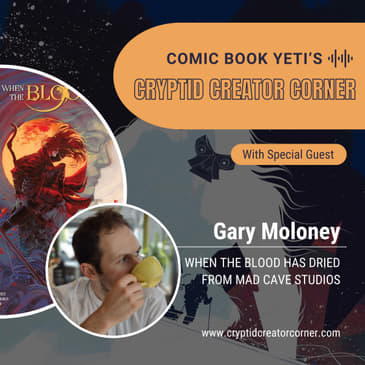

I recorded an episode early on Sunday for this one because the Cryptid Creator Corner is going International as I chat with Irish comics writer Gary Moloney. Gary has written a fantastic new series with artist Daniel Romero and letterer Becca Carey, When the Blood Has Dried. Issue #1 is out April 10th so be sure to add it to your pull list now. I'd describe it as a fantasy western. Gary is a brilliant writer and Daniel Romero's linework and colors are extraordinary. It is being published by Comic Book Yeti's good friends at Mad Cave Studios, who have been putting out some phenomenal comics. Gary and I chat about his influences, D&D, and his work as a Barrister at Law. Gary tries to help me understand the differences between a barrister and a solicitor, and I think I get it. I think. In any event, I love Ireland. I love comics. I love Irish comics and those that make them. It's a great episode and an even better comic that you are going to want to read! Check out Gary's other work here: https://linktr.ee/garymoloney
Make sure to check out our monthly crowdfunding comics feature book: MechaTon.
[00:00:00] Your ears do not deceive you. You've just entered the Cryptid Creator Corner brought to you by your friends at Comic Book Yeti. So without further ado, let's get on to the interview. Hey Yeti, what's shaking?
[00:00:19] Yeah, I did see that Mechatea was crown funding on Kickstarter now. I love that book. I was in backer for the single issues myself. That whole creative team is great.
[00:00:26] I love Fernando Pinto's artwork and it reminds me so much of hanging out with my friends at middle school and playing Nintendo, well, minus the giant mutant bubs from outer space, swooping in and trying to take over part. Wait, you can make a transformation sound? Who knew?
[00:00:48] Yeah, that power gauntlet is cool. Whatever Derek touches can transform him into an alien and annihilating Mech. Yeah, it's over. It's over. Why you?
[00:01:05] Where can people go to back it? They can head on over to Kickstarter and search for Mechaton in E-C-H-A-T-O-N or just check the show notes. I'll make it easy for them.
[00:01:13] It runs all of February and it's awesome that everything is done and looks like a really quick turnaround for backers. And that exclusive Jason Muir cover is awesome. He's doing Spider-Man stuff now. No more. Did you just really say Fuyo? You've got to get off TikTok, man.
[00:01:30] And yeah! I'm doing well, Gibby. I'm doing well and I hope you've had your morning coffee at this point. It's always strange when you have to organize interviews across different time zones. You don't know where to use your pints or having a cup of coffee.
[00:02:19] Yeah, I would actually have both. It's nine in the morning here, but I do have my coffee so I got that going for me, which is nice.
[00:02:29] But yeah, organizing things across time zones can be difficult, but I'm glad we were able to do this because I wanted to talk to you before in terms of your work with Limit Break Comics.
[00:03:12] It's with Daniel Romero, Becca Carrey, When the Blood Has Dried. Issue number one is coming out April 3rd. Mad Cave was kind enough to send over a review copy of issue one and I loved it. Love the whole setup.
[00:03:28] Daniel Romero is like a revelation. Artwork is just tremendous. He's top quality guy. He's been getting better, but he was that good when I first started working with him. He's brilliant and I love him to bits.
[00:03:46] Yeah, the issue looks amazing. I love the opening of it, kind of the setup. But why don't you tell listeners what's the pitch for When the Blood Is Dried?
[00:04:00] So the elevator pitch for When the Blood Is Dried is very much looking at the epic fantasy through the lens of a spaghetti Western.
[00:04:09] I know it's been wrote or tried to be talked about, oh, it's this meets this. But in the initial conception stages, I always looked at it as like, oh, if you crossed Red Sonja with Logan
[00:04:21] or Red Sonja with Unforgiven or something like that. That idea where there's the old retired adventurer or hero who's lived a life of violence and is starting to feel the weight of that.
[00:04:33] And we often see that in terms of the gunslinger in the Western or the superhero a lot of the times. But it's something that has been touched upon in the fantasy genre in terms of novels and stuff, but it was not something I'd ever seen in comics.
[00:04:49] And it very much came about from kind of hand in hand with becoming a comic creator. I also started to play D&D with a group of friends.
[00:04:59] I had moved to a new city, I'd moved from Cork to Dublin and one of the kind of social events I had when I was kind of finding my feet was a friend of mine who I knew
[00:05:08] invited me to start playing D&D with him. And I'd never been involved in anything like that or I'd never done any kind of role playing.
[00:05:14] But through playing that and I had always been a fan of fantasy as a genre and the epic fantasy going back to Lord of the Rings.
[00:05:21] Like I grew up when those films were coming out and had a big, it was a renaissance for Lord of the Rings itself, but fantasy in general. The books became big. There was video games. There was the games workshop, model games and things like that.
[00:05:35] And I just drank that up as an eight, nine year old kid when those films started to come out.
[00:05:40] So I kind of really embraced fantasy genre, but over time I kind of, you know, I didn't lose my love for it, but in terms of the classic high fantasy setting and the kind of setup
[00:05:49] I became a bit of strange from it. You know, I was looking more urban fantasy styles of things. But really when I started playing D&D when I moved to Dublin, that was really when I kind of re-discovered high fantasy and re-discovered my love for that.
[00:06:04] And at the same time I was starting to do comic shorts. So then one of the kind of initial ideas, when I was playing D&D, it was like, well, you know, we're all
[00:06:14] adventurers in the vertical commas. But like if we were being honest with ourselves, you know, we're cellsoys or mercenaries. We're doing whatever jobs are going and rarely in the context of a game like D&D do you stop to take stock of that and what it would mean.
[00:06:31] And that's where the idea of like mixing the kind of the spaghetti Western, which focus so much on that at a tight, the idea of the older Gumslinger who looks back on their life
[00:06:42] is trying to find a bit of peace, but wonders if they can actually really do that. I thought it'd be really interesting to look at how would you approach the fantasy hero if you looked at it from that perspective?
[00:06:52] And that's where Maeve, our main character in When the Blood Has Dried came from. The kind of the initial inciting incident is that she has had a falling out of some sorts with her guild for reasons which we'll explore throughout the series.
[00:07:09] But it leaves her being betrayed and left for dead. And she ends up in the rural kind of peaceful town of Carrigan Vaughan, very much kind of based on kind of rural Irish villages that I grew up around.
[00:07:24] And has set herself up nicely. She's got a nice life. She's running the local tavern. Everything looks like it should be going well. She's found that bit of peace and found somewhere she can potentially die with a bit of dignity and respect for herself.
[00:07:40] But it all takes a turn in the first issue when her old guild come into town. And so everything that she's been trying to bury, that she's been trying to keep hidden from the townsfolk really reawakens.
[00:07:54] And the series is about can she keep that modicum of peace that she's built for herself? Can she be the person she has tried to become over the five years and she left the guild?
[00:08:06] Or will this return of this influence in her life reawaken that darker side of her that she clearly wants to get away from?
[00:08:16] Yeah, I mean the opening of it is very much in that fantasy genre, that realm that I think if you like fantasy you're going to be familiar with. And I don't know exactly when it was because I hadn't read too much about it beforehand.
[00:08:35] I just wanted to kind of go into issue one and see where it took me. And I like the idea of this meets that. I just think it's helpful to boil things down.
[00:08:46] But I wouldn't say like, I'm not sure if it was the halfway point or maybe a little before it. I was getting kind of like tombstone vibes, you know, like Wyatt and his brothers go to a town to try and like start a business.
[00:09:01] They leave their gunslinger ways behind them and like something finds them no matter what, you know? And yeah, and I never, I don't know.
[00:09:11] I mean, I guess there are some similarities between what we see in fantasy and Western, but I don't know that I've ever, you know, can think of anything off the top of my head right now. That kind of compares the two.
[00:09:23] And I thought it just really getting to the end of when the blood is dried. I was like, oh, this makes this makes total sense. And I was just like, yeah, I can't wait for issue two. I just thought the storytelling was.
[00:09:39] I mean, both in terms of your writing and dialogue and the visuals on the page, it just all came together so well. And Becca carries also a fantastic letter. So really, a fan, fantastic creative team. But I just I loved it. I just want more.
[00:09:59] But those scenes in that in the tavern, I just went at all you start to see Maeve's relationship with the town and with Fergus and, you know, how she runs the place. I just thought it was great. Yeah. Yeah.
[00:10:14] But that's something that's like so important to it as well. And that you noted earlier on the kind of cold open we have.
[00:10:20] And it's a it's a structure we're taking into the whole series and that each issue starts off with a little flash of the past, which kind of shows you how she ends up in that time.
[00:10:31] She goes from the end of her life with the Guild to the start of her life in Caragin the Phone and this mentor character who's alluded to in the first issue, Treylock, who we learned in the first issue has passed away.
[00:10:44] And in the opening, in those opening sections, we look back towards that and establish that and always kind of juxtapose it where she is now. But the book only really works as if you and I'm glad it seems to work. So thank God it worked.
[00:11:02] If you can get a feel of like, well, why would she want to stay in this town? You know, what that it's something she values and something she wants to keep. And if you don't get that in the first issue, then the rest of the book doesn't work.
[00:11:15] But I'm glad it's working. And like I said, the the artist phenomenon like Daniel Romero, he's someone who I worked with very early on in my comics career.
[00:11:21] When I back in, I started seriously now when I dabbled before, but like I seriously started to try making comics back in twenty eighteen. And that was like by doing short stories where I kind of made a commitment to self. I do a four page or a month.
[00:11:36] I had managed to get some savings, scrape together to be able to pay to hire a letter or hire artists to do it.
[00:11:44] And one of the lot and the idea was that I collect them for however many I did in a year, I collect them and put them out in self-publishing. And when the last ones I did was with Daniel Romero, who I met on a comic creators for.
[00:11:58] And we just got on really well. And his work was brilliant. And we were always saying for years, like we'll come back and we'll do something bigger to get it.
[00:12:06] But he does a lot of work on the illustrations for RPG books, you know, tabletop RPG books or people are doing commissions for people if they want their their party represented.
[00:12:18] So one of the ideas I came to him was with this idea of the fancy book and he immediately he was he was offered. And it took us a while to get it all together.
[00:12:27] But like, I was so glad that when it came to my one of my first books on the direct market that I was able to do it with someone who I'd worked with so early on and had we'd kind of come up together.
[00:12:39] And Becky, Becky Kerry, Becky Kerry is a friend of mine from from Ireland. She's moved now at this point. But I was just really glad that we were able to do with a team of people who I really, really liked and loved working with.
[00:12:52] Was the short you did with Daniel before? Was that in mixtape? Yeah, in mixtape. The very last story mixtape is called Wishing You Were Here. And that was a story that came together very late in the day.
[00:13:05] But I kind of had had space in it for one more story. And so I asked Daniel if you wanted to work on it with me and I wanted to kind of do a crime story because at that point,
[00:13:15] I've written a lot of crime crime stories since then. But I hadn't really the idea of mixtape, which was my first kind of collection of short stories was to explore different genres and you'll scratch different niches in that sense.
[00:13:28] And really just kind of see where I where I found myself best place and what kind of stories I like writing most. And I hadn't done a straight up crime story in the book. And from having done a course in the Irish writer center with Declan Shelby,
[00:13:45] I really started to explore crime writing and finding I really enjoyed it. So that was one that Daniel and I teamed up for with Joe Griffin coloring it at that point.
[00:13:55] And from that we realized that we just really worked well together and that we wanted to work again in future. And we always try to find places where we might be able to. So we did one or two other shorts elsewhere and we tried different other places.
[00:14:11] But we were when the blood is dried, kind of all came together for us both because Daniel had started coloring his own work as well at that point. And it just pops like it just like he's great for not people call him.
[00:14:23] But he's phenomenal when he colors himself. Yeah, the colors in the book, the colors in the cold open in particular just are fantastic. And the panel that kind of does the transition from the cold open to the five years later story is really well done.
[00:14:39] I just in particular, I really love that that panel. I don't want to give away too much. I want folks to get in and read it and make sure.
[00:14:48] But yeah, I don't know if I have to go back to revisit that with a mixtape which for our listeners that don't know, I think ICN would name that best Irish anthology of 2018. They did. They did. ICN made Rest in Peace. The website itself has shut down since.
[00:15:08] Yeah, I was a really gratifying thing that year to have have my first book that I published pushed out my first self-published work, Get it Recognized Like That from the community and it's very tight knit community, the Irish comics community. So I was really, really delighted with that.
[00:15:23] And for everyone, everyone of the collaborators who I worked with on that book because there were so many people from across the world both in Ireland and elsewhere. Oh, yeah. That's pretty awesome.
[00:15:34] So did you have any an inkling of some of this story like before you started like playing D&D like to want to play in like the western genre or the fantasy genre? Did D&D really, you know, kind of like, I guess, real reawaken that within you.
[00:15:53] And I guess what in particular was it about D&D? Was it just the camaraderie? Was it the role playing aspect of it? Was, you know, something else?
[00:16:03] When it came to the fantasy genre, fantasy was a genre when I first began writing because I've always been writing in some shape or form. You know, from the minute you were told you could write a short story in English class and get credit for it.
[00:16:17] Like I was writing short stories and I was writing all sorts of stories.
[00:16:20] And I always had this idea of wanting to write a fantasy novel because again, I had grown up at a time where the fantasy novel and the high fantasy stuff had just picked up steam again. Sure.
[00:16:31] And I was reading all that stuff and it was like that for years, like that was the only thing I read. You know, it was fancy novels and and other kind of YA night. I think it's like as I was growing up.
[00:16:40] And I don't I'm at many points. I tried to write a fancy novel and kind of break into to to a fantasy world in that sense. And for whatever reason, it just it never clicked.
[00:16:52] I think I was too focused on the world building at all and thinking that, you know, I had to have, you know, the the Tolkien style map built out of my head before I could put words to paper.
[00:17:04] Or had to create your own language had to develop all the lore. Exactly. I kind of had that fear like, well, I have to. It has to be an epic, you know, for it to be an epic fantasy or it has to be.
[00:17:21] That's been some kind of high art to it to be a high fantasy book.
[00:17:24] I think I had that preconception to a large point, but I think so in terms of like there was never like an early version of this back from when I was 16, not this book at the very, very least.
[00:17:37] Like here, Joe, Joe Aberfrombie, who writes the first law series of fancy novels, like he talks about the fact that he wrote a version of that when he was 20.
[00:17:44] And then it was only when he was 35 that he was actually ready to write the book that everyone finally saw. But for this, I think it was more, I think it was more so that when I started playing D&D with that friend group.
[00:17:57] I think it made me realize one kind of conceptualized idea of, you know, well, what kind of what is a fantasy hero? You know, what what when we look at them carefully, what are they actually doing? But I think more so it was like it was the.
[00:18:12] The idea that fantasy could be a fantasy story could be small scale. That it didn't have to be an epic or a world ending plot. It can just be it can be inter interpersonal stories.
[00:18:27] It can be the individualistic story and the world doesn't have to be ending for there to be stakes. If your own personal world is about to end or if there's a threat to that own personal world, that can be just as epic as anything else.
[00:18:42] So that was something that I think it was just kind of playing because even like even having watched Game of Thrones and the song of ice and fire stuff that had come up around that time too. Like that was that was still, you know, world shattering.
[00:18:56] There was still the epic fantasy to that. Whereas I think playing D&D made me realize that they can be these personal stories too. And that was really kind of the focus going into this and that there is a world here.
[00:19:07] You know, there is things if you look first, you can see the trappings, but really it's about one small town and one woman's relationship to that town and trying to. Keep a hold of it and keep a hold of that life as long as she can.
[00:19:23] And that is all it needs to be, you know, and if it's set in a fantasy world, but really that's the core of it. The core of it is it doesn't have to be a fancy world. This could be equally in whatever setting you want it.
[00:19:37] It could be sci-fi, it could be modern day. The thing that the core of the story would be the same. This just so happens to take place against the backdrop of a high fantasy world. Yeah.
[00:19:49] No, I like that what you said about thinking that it had to be like epic and that it could be small scale, but the stakes are still hugely important. You know, to Mave to the town to whatever it might be. But that makes a lot of sense.
[00:20:07] I never played D&D when I was younger. I didn't I've played now for we didn't play much the past year to be honest, but I started playing in 2017 having never played before but always wanting to like I kind of was familiar with it.
[00:20:22] I was aware of it and I really enjoyed playing with no group of friends that you know over the past couple of years. And yeah, we follow.
[00:20:32] I like the aspect of D&D following like a general story, but half the time we end up just being murder hobos and just you know, wreaking havoc.
[00:20:44] But I like I've always enjoyed the role playing aspect of it because I've created a character very different than myself, which is what I enjoy playing out like the scenes. Like did you find in creating your own personal character to play D&D?
[00:20:57] Did you create somebody that's pretty close to, you know, Gary Maloney or did you really let your creative side go in fleshing out the character that you were going to play for the sessions and somebody very different?
[00:21:12] I think a lot of the time when it comes to role playing games, it's not that I'm creating someone who is Gary Maloney, but I kind of try to like. I don't tend to go for the powerhouse characters.
[00:21:24] I tend to do for like a charisma heavy build, you know, that if I can talk my way out of the situation, you know, that's what I'll do. Now, how different is that from Gary?
[00:21:34] You know, that's probably a bit of me trying to again, as you said earlier, I'm embarrassed. Talking that way my way out of my problems is kind of what I do in day and day life.
[00:21:43] So I think for a lot of it, I was I in more recent times, I tried to make characters that are more different from me.
[00:21:50] But I think it's a lot of times when I was starting off at least, I was like, OK, well, what would I do in this scenario?
[00:21:55] Obviously with whatever backstory we grabbed onto, you know, if I decide I'm going to be I think my first campaign, I was a half elf wizard. You know, obviously I don't have that. But I think that character was someone who studied a lot, who had, you know,
[00:22:10] who's very much head in the books for a lot of a lot of times and then would try to talk their way out of things. So there was there was definitely an element of me in that.
[00:22:18] And I think I've what I've enjoyed more recently is trying to break out of that that kind of, you know, that approach to things. But I think a lot of the time when it came to either tabletop role playing or playing characters in video games,
[00:22:30] whether it's kind of folders, gay style game, Dragon Age, Night City Republic, I would tend to kind of do someone that tried to talk their way out of things, which probably close close to what I would do in real life if I was in those fantastic scenarios. Yeah.
[00:22:48] I my my character that I've only ever the campaign that we've done, I've only ever been one character who is because I'm short. Well, I mean, then my friends, but five, six. So I was a halfling rogue.
[00:23:02] I like the idea. But my character, I think, at least, you know, was a bit of a thief and a con man. And then I always I would like to think that as an attorney, I can talk my way out of things.
[00:23:15] But I think my skills lie more so in like mediation and getting folks to, you know, see the outcomes being played out. My character was just not anxious, which I think is my biggest personality trait as an attorney is my anxiety.
[00:23:30] So I wanted to create a character that just did not deal with that at all, was very confident going into the situation no matter whatever it was, which I found kind of cathartic or maybe a little therapeutic playing D&D.
[00:23:44] Oh, definitely. I mean, you hear a lot about there's a lot written in D&D about D&D groups in different rehabilitation sessions and how good that can be. Whether it's in a prison context or even I saw in an old folks home
[00:23:58] that they were they were introducing D&D and finding that that was helping people, particularly those that are having memory issues and things like that. Oh, wow. So it's like it's like there is clearly a therapeutic benefit to role playing
[00:24:11] in the storytelling that you do when you're in that kind of a setting. That yeah, I love that. That makes a lot of sense. And I like I like that D&D being used in that kind of fashion. So how's it been like working with Mad Cave?
[00:24:30] I mean, I think from listening to your other podcasts with other Mad Cave creators, you won't find a dissenter here. I think Mad Cave are fantastic when it comes to finding a publisher that's acting as a partner and a true partner
[00:24:46] because in this game, you hear a lot of horror stories of different publishers and all that. And you'll have heard those yourself. But like Mad Cave from day one have just been the most supportive bunch in terms of, you know, helping me.
[00:25:03] Craft the story and to refine it. But also letting us as a team explore different things and explore different avenues. And they had been very upfront from the start, you know, that they that they believe in this book and they believed in us as a team
[00:25:19] and wanted to help us get to make the best version. Of when the blood has dried. And they have always been totally transparent, great communicators. And as I said, very supportive throughout the entirety of the process.
[00:25:35] So we've been working on this for for about a year at this point. So we initially. Got an offer and we're in talks in late twenty twenty two. We locked everything in in January of last year. So we've been working on this for a long time.
[00:25:50] So I've had an opportunity to have a full working year with them and to see, you know, how they how it works in practice. And James B. Emmett, who's our editor on the book, has been lovely, nothing but a champion, an advocate for the book.
[00:26:07] And the entirety of the publishing side of things, the editorial staff and the marketing staff have just been wonderful, wonderful collaborators. And I think sometimes that. The idea of the publisher as a collaborator isn't spoken about as much as it should be, but they they they get it.
[00:26:27] They get it that, you know, when when the book succeeds, when the team succeeds, everyone succeeds. And it's very, very clear they're they're focused on helping their on their creators and acting in a true partnership with their creators.
[00:26:42] Yeah, I mean, I first, you know, started reading Mad Cave just because I was interested in some of the books they had out and you but starting the podcast or Byron starting the podcast and working on it and trying to line up interviews.
[00:26:57] Mad Cave, I just really they're very easy to deal with in terms of like this aspect of it, like, you know, helping to coordinate to get their, you know, creators on the podcast to get me materials to review for the interviews.
[00:27:11] And, you know, I met a few of them when they were at Baltimore Comic Con that I go to, you know, every year. And I think I met James and I met Chaz Pangburn and a few others.
[00:27:22] And they're just very easy to work with, at least from this side of it. And I'm only I'm only just, you know, talking to them and getting interviews set up. But yeah, I just everyone I've spoken to and I've spoken
[00:27:34] to quite a few like Mad Cave creators have had nothing but wonderful things to say about them. So I'm glad that we're continuing that streak. Yeah, I mean, they just were really and like. Like, rock creators talk.
[00:27:49] So if there were issues, you know, and like it is a it is a real true sign of, you know, the the publisher itself that, as you say, anyone you speak to has nothing to say about them. All right, let's take a quick break.
[00:28:06] What in the Sam Hill is happening right now? What is that? Yeah, what is that? You like Bart? Yeah, what is all? Oh, you like Band of Bards. It's not my fault, you muffle. Oh, what? That makes sense. They're dropping some great new series right now.
[00:28:24] There's that one about a heavy metal guitarist in the 1970s with monsters, working class wizards. You know how we love monsters around here. And my friend, Dakota Brown, he's working on a project. Grandma Tillie's Hell Tech Mech with Lane Boyd. I saw the preview for that.
[00:28:41] That is crazy. Jimmy even contributed to their anthology from the static and had Matt Sumo on the podcast to talk about his project, The Bartic Versus, which makes a lot of sense that the project landed there. Where can you find them? You need to get out more.
[00:28:58] They are in previews or you can visit their website, BandofBards.com for all the latest. Can we turn the music off now? Oh, damn you. Thank you. No more surprises. Menstruals or anything like that, or I'll rinse you out to the RIN fair as children's ride.
[00:29:13] Let's get back to the show. Well, I wanted to kind of turn into something you said earlier about ever since you could write stories and we're told that, yeah, you can write a short story. You could do this. You've been doing that.
[00:29:28] And so did you ever consider pursuing that professionally? How did young Gary Maloney writing short stories end up as a barrister at law? I mean, I was always wanted to write. And in the back of my mind, you know, like from when I was in, like even
[00:29:49] when I was in primary school, I was writing novels and a vertical comments, like one of the first big projects ever took on. Like I did an adapt, like I wrote a version, an adaption of the Saiyan saga, like from Dragon Ball Z.
[00:30:03] Like I wrote a prose version of that when I was like. You did a novelization of Dragon Ball Z. I did a novelization because at the same time, like there was like Pokemon novelizations coming out at the same time because Pokemon was big.
[00:30:15] And so they were doing like novelizations of episodes. So I was like, oh, I could do a novelization of Dragon Ball Z. I love Dragon Ball Z. So I started like, you know, doing things like that, but then doing more original stories.
[00:30:25] So it's always kind of and I was entering and as I was going, growing up, they'd be writing competitions that I'd entered. So there'd be competitions in the local library, competitions in the county library that I'd put in for and I would often do quite well in them.
[00:30:42] One of the things when I was 15 that my, that the Cork City Library did was that they started a graphic novel project, which is they got professional writer. There's an application process where young writers could submit, you know, their reasons why they wanted to be in the program.
[00:30:59] And what they did was they got a professional writer and a professional artist to come in and coach you over a couple of weekends. And the idea was that you'd be teamed up with someone on the art side of things and you would put together a comic.
[00:31:09] So I did my first comic in that context in like 2008. 2007, 2008. Can't say. But like that project is still going. So like that was like what, 16, 15 years ago? And the Cork City Library has been doing that every single year since.
[00:31:25] And I'm not going to tell you that's a good comic. But what it did show me is like, you know, oh, well, this is what script looks like. And this is what how you match the script to the art and some of the kind of basic things there.
[00:31:36] So I always wanted to to write and like, you know, saw some avenue of, you know, professional elements to it. But I was also quite a realist, and you know, Irish Irish mothers can be quite certain about those things.
[00:31:51] Yeah, you can do all the writing you want, but you're still going to college. You're still like you want to have a fall back in case any of this doesn't work out.
[00:31:58] I mean, it came to, you know, the kind of subjects that I was good at in school. I was good at things like English and history, where you could write essays, you could make arguments and things like that.
[00:32:09] And there was a time there where I was thinking about becoming a teacher and going down that path. But I did work experience. You do this part of the Irish school program where you spend kind of two weeks on work experience.
[00:32:21] And so I knew I did debating as well in secondary school. And so that kind of, you know, was the man to go, well, lots of people who went out, who did debating went on to become lawyers.
[00:32:32] I was like, well, I can have a look at that and explore that. And so I did one week of my work experience with a solicitor, one week with a barrister. And I found the advocacy, the trial advocacy of being a barrister best spoke to me more.
[00:32:47] And so I decided that I'd look, I tried to pursue law as a career. And even when I was studying law and college, I was writing for various websites, comics websites or writing for the college paper. Like the writing never left.
[00:33:06] But it was always in tandem with the law. And the law is something I love. And I love, you know, practicing. It's something that I really enjoy. And I think it's very, very important, particularly the type of work that I tend to do.
[00:33:17] But the writing side of things has always been there. And it's never something that I wanted to give up or completely abandon. But it was always about trying to find the opportunities and finding the time
[00:33:29] to devote to it when there were other considerations and other things that I had to do. But I think in terms of, you know, I mean, if you look at how many creators and comics have a law background in some shape or form,
[00:33:43] I think a lot of times that the skills you learn from law being able to present, you know, ideas, being clear in communication, presenting narrative in some sense. Obviously, there's not a one for one transition, but they they clearly work interchangeably.
[00:33:59] There's a there's an appreciation or something there that allows people to who have that legal background to connect creatively. And comics is just one of those many, many avenues. Yeah, I enjoy talking to the creators that I that I have who have that type of the legal background.
[00:34:20] Just just indulge me because I know David has on, I think, tried to tell me in terms of Australia. But just so what is the difference for anyone who's curious with a barrister and a solicitor in term, you know, how things play out in Ireland?
[00:34:37] So one way to look at it is like that a solicitor is not a trial attorney. A barrister is a trial attorney. Or another way to look at it is that if you're like if you compare it to a medical context, if you're sick
[00:34:51] and there's something wrong with you, you go to your GP, you go to your local doctor first. And then if there's something that they need to check up on or requires expertise beyond what they have, you get sent to a specialist.
[00:35:02] Embarrassed are really kind of specialists because they tend to be focused on one or two different fields that you go to them for particular advice that you wouldn't necessarily have if you're a general practitioner, which a solicitor would be more likely to be.
[00:35:19] So you would come to someone who has particular knowledge of immigration asylum or particular knowledge of personal injuries cases or things like that. So the the barrister is, yes, you know, trained to
[00:35:31] be the expert in the advocacy side of things, but also tend to have a subject matter that they would be known to deal with. OK. And so but barrister in terms is more so at least can do the trial advocacy, can can can handle the trial and
[00:35:51] still wear the the robes and the the wigs. Still wear the robes. You're you're allowed to wear the wigs. I personally don't. But yeah, they're the kind of theatrical side of things where you've got the robes, you've got the tabs and things like that.
[00:36:09] So, you know, you go around and you almost like have a cape building behind you as you're you're roughly into court. But yeah, the idea is both solicitors and barristers could appear in court and could argue in court. There's no difference in the right of audience.
[00:36:24] But the idea is that barristers are trained to do that and to focus on advocacy more so than solicitors would be necessarily. OK. And what to what type of area of law are you in now? I'm primarily kind of human rights.
[00:36:38] So oh, wow, racial asylum things, anything where I'm saying that the state has done something bad and that they should stop doing that thing tends to be what I do. OK. Oh, that's awesome. I also saw the lecture as well.
[00:36:53] So there's that that idea of becoming a teacher in there. So yeah, I said in terms of law subjects. Yeah, I did. I kind of I've always kind of kept the one idea in teaching as well. So I teach human rights law and public international law,
[00:37:10] the law of everything that's kind of happening in the world and the law of the UN and things like that. But I but I originally back in the day, one of the first jobs I ever had was teaching windsurfing, as you mentioned, as you hinted at earlier.
[00:37:20] So despite the fact that I was always kind of going down the law path, I always wanted to kind of keep a hand in teaching as well. And you find that a lot of which are barristers because all barristers are all self employed in Ireland.
[00:37:33] So they'll often be doing teaching as well to supplement their income or two other things. So what do you mean by that? They're all like self employed, like in terms of like we have law firms here. I mean, we have firms or
[00:37:50] you know, barristers don't solicitors have firms. Barristers are all freelance. Really? It's one of the rules of the just one, the rules that you have to be independent. It's called the independent referral bar.
[00:38:04] So in order to be a barrister, you have to be you have to be self employed. So it's a yeah. And all the tribulations that that creates. Right. So in terms of like, you know, here in the U.S.,
[00:38:15] like four or five attorneys are all doing personal injury and they're like, hey, we could we could we could share overhead. We could, you know, pull our resources. We could maybe get a break on malpractice insurance. We're going to form, you know, the firm of.
[00:38:31] To borrow from the three stuages. Do we cheat them and how? So barristers, you and two other barristers could not do that in Ireland. No, like we have like the bar, the bar council is kind of a group
[00:38:43] that kind of oversees barristers and like gets kind of collective deals and stuff. You know, means you don't have to pay for your for your Westlaw subscription directly. You know, you can get the the databases packages together and, you know, deals on the insurance and things like that.
[00:38:56] But every every individual barrister is a sole trader. And that is a requirement. You do a year's apprenticeship called Develin, but everyone is and so you might have connections and they might have support through that and through your colleagues. Like it's very collegiate, collegiality focused profession.
[00:39:16] Everyone kind of looks out for each other, but in principle, you're on your own. Wow, I did not know that. So all right, well, we'll turn back to comics. So it's but but listeners, I, you know, you you if you've listened
[00:39:30] to the David Huzon, the David Buer episode, Emily Witton, even Mark Guggenheim, we all talk about was he one of us? I didn't realize that. Yeah, Mark, yeah, before before his shows on the CW and and his comics.
[00:39:47] Because obviously, I know Charles Soal was an attorney for age. Oh, I didn't realize I didn't realize Mark was. Oh, that's cool. Yeah. Yeah, before his work with the CW and his comic work, he was an attorney
[00:39:58] for a little bit, and then he eventually went, I think I'm remembering from his episode, he then he went out to I think he went. He was in maybe New York or Chicago and then went out to LA.
[00:40:09] Yeah, because we started off talking about how I really like I think I think he worked on and it was I think it only lasted two seasons, but there was a a law show that Eli Stone that was I remember that
[00:40:23] that he had worked on and yeah, I really liked I really liked Eli Stone. That was a lawyer who had a brain tumor and then he he saw like fantastical scenes. Yeah. And it was and then he would see George Michael all the time
[00:40:43] and like people would break out into George Michael, you know, like flash mob dance stuff that was kind of all in his head. But yeah, that even. So yeah, there's there's quite a there's there's there's quite a few.
[00:40:58] But OK, to turn back to comics, I wanted to talk before I let you go a little bit about limit break and about like limit break comics for any folks that aren't familiar to Dublin based. I mean, I don't know if you guys consider yourself like a publisher
[00:41:12] or a comics collective, but you've put out a number of books you, Paul Carroll, I think Gareth Lube, if I'm saying Gareth last correctly and, you know, in particular, you've done anthologies for anyone listeners, if you're not familiar with it and you like anthologies,
[00:41:30] they have turning roads and down below. Fractured realms and then they've just solicited submissions pitches for the fourth anthology. So kind of, you know, how hard to have things been going with like limit break and kind of what's like the future of of limit break,
[00:41:51] if you will, if you can talk about that because I'm kind of curious and I really like the stuff that's been put out so far. Oh, no, definitely. And like, thank you as all you've always been a great like supporter
[00:42:00] of limit break throughout the years and the anthologies like limit break came about from when back in 2018 when I was starting to put together that collection of short stories. One of the first people I met among the Dublin comic community were Paul Carroll and Gareth Lube.
[00:42:19] And at the time they had started off doing their own book series, you know, called Miaoch, which was their cat assassin character that they created. And so when I was starting to put together my first couple of shorts, I'd run the scripts by them.
[00:42:36] I mean, what do you think of this? What do you think of that? And we're like, oh, well, we really enjoy doing that. We meet up together and have have drinks and talk about comics, the process, the craft, but also what we are reading.
[00:42:47] And so when I decided I was going to put together my little anthology, Paul decided he was going to do one too. And the idea of limit break came about as a way to and we consider ourselves more of a collective, you know,
[00:43:01] because we do the open pitches and the open submissions for the anthologies. You know, it's not a sort of thing where we're constantly looking for new books to come in or things like that. If people bring books to us and they tend to be friends,
[00:43:15] people we know well, we can put it out. But he was really trying to find a structure whereby we could support each other. And if it means that I was going to a con weekend, I could bring Paul's books and Paul's going to a con.
[00:43:26] He could bring my books and vice versa and really kind of just provide a support structure for each other in a more formal way. And that's how it began. And that's really how it how it remains to these days. The pandemic kind of changed things because we
[00:43:44] we started going to Thought Bubble and we would go over and the Thought Bubble is a great show in Lee. We used to be in Leeds now in Harrogate, a comics festival into UK, which is really, really cool and really kind of crater focused.
[00:43:57] And we'd be going over there and we'd be talking to all these different craters and they're like the idea of like, oh, we should do anthologies of this or we should do anthologies of that. And Paul started throwing around the idea of will do
[00:44:08] a lot of folk or anthology and the pandemic hit. And so during the when the pandemic hit, then that gave Paul the time to put together Turning Roads, the first book, which was science fiction, fantasy spins and Irish folklore and Irish mythology. And that did well.
[00:44:25] We funded that on Kickstarter. That did very, very well. And then afterwards we said, well, this seems to done well. Why don't we try it again? And from there down below, which was the Greek mythology crime stories
[00:44:39] came about and I and I was brought on as a co-editor and that because at that point I'd kind of become the crime writer amongst the group versus who knew the noir genre more so than most. So when it came to the editorial process, picking stories,
[00:44:53] but also offering feedback, I could offer that expertise in a way that Paul, who was kind of more fantasy and mythology focused, he'd be able to help with the Greek mythologies out of things. But the crime genre element was less so.
[00:45:08] And we've just been doing that ever since on a yearly basis. We put out a call normally in late December and January for submissions for a mythology themed anthology. So it's always mixing one kind of classic mythology or folklore with another genre.
[00:45:27] So the first three books were all the kind of the classic classic mythology, Irish folklore, Greek mythology, Norse mythology for fractured realms. And with Wish Upon a Star, we're kind of starting a new
[00:45:39] era of that, which is to look at a kind of more modern elements of mythology. So for Wish Upon a Star, it's fairy tales and mixing fairy tales with sci-fi elements. And we're doing similar things going forward as well.
[00:45:51] And the idea is to have different books that kind of look at more mythology, more kind of modern ideas of mythology, including cryptids, which fits into the topics of this podcast. So generally I'd be expecting a pitch from yourself and or Byron. Now, you'll you'll you'll get it.
[00:46:09] I mean, look, for listeners who like are interested in creating comics, and that's why you listen to this because you want to hear what creators not only have coming out, but when we get into why do we write? Why do we want to create?
[00:46:22] Why do we want to? Why are we artistic? I love anthologies and the practice of pitching to them. Rejection is a huge part of any type of creative endeavor. It doesn't have to be.
[00:46:35] But if you usually if you want to get somebody else to look at your work, you're going to run into rejection time and time again. And so you can't you have to. I think it was actually Andrew Irvine who interviews as the interviews editor for Comic Book Yeti.
[00:46:50] I think interviewed you and Paul and Gareth in a written interview from October of twenty two. If any listeners want to go back and check that out. I think it was something you said, Gary, in that. I don't know if maybe it was P.J.
[00:47:02] Holden, you took a class with and said something about like fail, you know, fail fast, fail often, something along those lines of like, just get it out of the way. You're going to get rejected. And yeah, I mean, I've pitched to down below and fractured realms.
[00:47:15] And I've submitted. I think I submitted five pitches to wish upon a star. But but look, they could all five could just get rejected. It's just a part of it. And you just got to keep going. The one I'd like for down below, I like my idea.
[00:47:28] So I made it. I worked with Rachel Allen Everett, Harry Saxon and Buddy Bedouin. And now I have a four page story that I like. And it's anyone wants a sample of the kind of stuff I do. I can show them.
[00:47:44] But you know, it's just I like trying to come up with something. I find it very difficult to pitch to anthologies to try and fit a story with whatever the brief might be. And telling a four page story is tough. You have to introduce your characters,
[00:48:02] introduce the conflict and resolve it in four pages. It is not an easy task. So being able to being able to work that muscle and and do it. And you know, if we're down below. No, no war meets Greek mythology.
[00:48:18] I had an idea to take Escalus's Seven Against Thebes and set it in 1980s Philly mob war. So I have a four page comic Seven Against Philly. I mean, the best thing about it, other than the art and coloring and lettering might be the title.
[00:48:32] In terms of what I do. But you know, I just really appreciate that you guys do this, especially for the comics community, especially that it's an open call. Anybody can put their team together and put in a pitch.
[00:48:46] And anthologies are a great way if you want to start creating comics and figuring out coming up with an idea that fits the brief, being able to outline it or pitch it or do a story breakdown
[00:48:56] and tell a story with the beginning, middle and end in four pages. I just think what you guys do every year for creators, you know, writers, artists, colorist, letters is fantastic that you're still doing this. And I'm excited that they've all been, you know, successful
[00:49:11] that you know, you've been able to crowdfund them and high praise for turning roads, certainly. I love down below. I thought it was phenomenal. So I, you know, I can't wait to see what ends up with Wish Upon a Star.
[00:49:25] Yeah, well, fingers crossed, we can pass that kickstart or threshold. But no, really, thanks so much. Like I really like yourself. I love short stories. I love the four page format. Like I think like comics as a medium is all about the economy of storytelling
[00:49:39] because you have, you know, every page, particular unit, every double page spread has a particular purpose. And, you know, the act of the page sharing is vital in that context. So the four page story was something that P.J. Holden
[00:49:55] very much was advocating for that if you're starting off, whether it's writing, drawing, do four pages, one because you'll finish them and you'll get better by finishing. And it could be a good story, it could be a bad story, but at least it's finished.
[00:50:08] And now you can learn from that, particularly if you put it out there in the world and get feedback. But also it kind of teaches you how comics work in a very condensed way. The reason why the likes of 2000 AD used the Future Shop,
[00:50:22] which is a four page format to bring in new writers and bring in new artists because it teaches you to be to use that space sufficiently. You don't have time as you say, you don't have time to be messing around.
[00:50:34] You've got to get in, introduce the character, what their problem is and then tell them whether they're going to succeed or not and what that teaches us about them. So do I think sometimes that you often see because I think the anthologies,
[00:50:48] whether big in the indie side of things and say the crowdfunding space, you don't see them as much in the direct market. And there are various reasons for that. But I think the short story in comics is a form that perhaps should be looked at a bit more
[00:51:06] and particularly for what it can offer and the storytelling opportunities it can offer. Obviously 20 page stories are great. But I think if you get a good short story like often those stay with you more so than the 20 pages you just read. Yeah, I don't disagree.
[00:51:24] In preparing for this interview, I was going back like through you know, Googling Gary Maloney and various and sundry other things and going like looking through your go and I know. No, no, no, only because you had shared an article
[00:51:38] I think that was in The Guardian or something from 2010 about the Irish short story and I started to take a look at it. And I was. That was this morning. It was nearly this morning. Was it this morning? I think it was just this morning.
[00:51:53] OK, yeah, so I. I was it was this morning I was looking at it. But Anne Enright, I guess the Irish short story from from an article from 2010. And I just started to take a look at it to see what it was about.
[00:52:05] And I ended up reading the whole article because I was kind of, you know, fascinated with, you know, what it had to say about the Irish short story in particular, which I found that a very, a very good article. And it made me want to read the
[00:52:23] the short story anthology that was being talked about, I guess, that was was being put together in terms of Irish short stories because I love love short stories and love collections of short stories and love, you know, comics anthologies.
[00:52:40] Well, actually, one of the things my my my wife had got me, I think last Christmas that I read on our vacation this past summer was appendix N, which is I can't remember who put it together. But it's a list of short stories
[00:52:52] that are similar to what Gary Guy Gax, who created Dungeons and Dragons, said influenced him. But it was somebody else. It's I can't remember where the book is. I'd grab it, but it's called Appendix N. OK. Appendix N. I think it has an intro by Patton Oswald.
[00:53:07] And the person who put it together was looking at some of the original stories and including some of them and maybe some other ones that kind of fit the mold. So short fantasy stories that kind of influenced
[00:53:21] Gary Guy Gax when he was like in the creation of, you know, D&D and those early player manuals. But it was fantastic, fantastic short stories. I really enjoyed it. But yeah, I read in that whole article about the Irish short story
[00:53:39] and I just found it very fascinating. So I got to I got to find out the you're going to go double check on what that title is, because now I want to go read whatever anthology or collection of short stories that was being put together
[00:53:55] as a really good article. Yeah, I know what I think the Irish short story or the short story in Ireland is given a lot of weight, like if something that Joyce did, something that a lot of them like Franco Conner is celebrated internationally for his short stories.
[00:54:10] So it's like something that I think people think a lot about in Ireland, the idea of the short story from at least from the literary side of things. And I. Yeah, I suppose there's a part of me just thinks that perhaps
[00:54:22] we need to have a look at that a bit more in comics than we have historically. But like that being said, like like when the blood is dried, is something that is the longest thing I've written.
[00:54:31] I've done a one shot before, but it's the longest thing I've written. And I think having known what you can do in four pages, that helps you then when you are given that extra space, because then you can use it more effectively than you would necessarily otherwise.
[00:54:46] What is it? Is it five issues? It's five issues. The idea is like that it's five issues self-contained story. Like I said earlier, there is a world there. There's a wider universe. And if it does well, maybe we'll come back and look at that as well.
[00:55:02] But I wanted to do and we wanted to do a very contain story that gives you your beginning, middle and end focuses on the characters and this kind of slow burn exploration of a life of violence. And then if that's all it is, that's all it is.
[00:55:19] And that's all it needs to be. But and I think we're happy with where we've ended up at this point with the five issues. And I said, if it does well, maybe there's something else in that world. You know, there'd be something.
[00:55:32] So that is something that I'd be interested in doing. But this is when the blood is dried is mavestore. And it's all about whether or not she can save that little her pub, save the lock in tavern and keep the life that she has maintained
[00:55:51] for herself over five years. Well, yeah, and I can't I can't wait to see how it all plays out. Because like I said, I absolutely loved issue one. You know, you're writing Daniel Romero. Artwork is just incredible. And like I said, the rest of the team, Becca,
[00:56:06] Carrie's phenomenal letter, love their work. So very, you know, very exciting. One day as in terms of putting because you said about, you know, this is the longest thing you've written when are you somebody that like outlines? Did you did you have it?
[00:56:22] Like, did you have the idea first in terms of the pitch? Or did you like have like a long form outline before you start scripting? When it comes to my process, I for when the blood is dried,
[00:56:37] I didn't an outline, but it wasn't a an in depth outline. It was I had the general idea, the general theme and things like that. And then I had an issue by issue breakdown, which was here's what happens in the issue.
[00:56:49] But it wasn't a granular page by page breakdown. It was just kind of a general sense of what happens in the issue. I think I do a lot. A lot of my kind of process, I do longhand.
[00:56:59] So I would have done I have a notebook that has the initial character ideas for when the blood is dried. It has the initial. I always do the first draft of the script longhand as well. So that I might be changing panel, panel numbers.
[00:57:18] I might be changing the description might be very short in that version, whereas there might be more, more flavor in the final version that goes out to the artist. I don't like to dictate, you know, in the right hand corner,
[00:57:32] there is a box or there's a gun on the wall unless I need to be shot, obviously. Yeah, unless three panels later, you're going to you're going to need to check off gun to fire. You need to tell the artist it's there.
[00:57:44] Exactly. But I like giving them the sense of like, well, here's the tone we're trying to get across. Here's what the characters are feeling right now. Things that allow the Daniel or allow any artist to just inform that into their work.
[00:57:58] And so I think a lot of the work gets done while there's a general outline. It gets done in that initial heart, that longhand form where I'm kind of working through the script and I can cross things out and change them more readily.
[00:58:15] And then so when I'm writing it up, then afterwards it's much more polished version. And so I'm not fully going by the seat of my pants, but I'm not a gardener writer. I'm not just, you know, like I'm not planning everything else meticulously.
[00:58:32] I know where I want to go and I have a general sense of the tone I want or a particular image I want. But I think a lot of it gets gets worked out on the page itself.
[00:58:41] You still give yourself a little bit of freedom if like, you know, you think of something that could go a different way. You're still able to or you're still able to kind of work that in within the framework that you've created.
[00:58:56] Yeah, I mean, like when I was pitching when the blood is dried, there was it accompanied it was the five issue breakdown. And so that would have been a page long with a kind of a paragraph for each issue. And we didn't stray awfully from that.
[00:59:09] The purpose of each issue, the main beats of issue are still there. But the moments in between, I leave myself space for that. And I leave myself to find moments where I can give the characters quiet time and just allow them to reflect on things
[00:59:25] because I think that that's important and say a story like this, which is about, you know, which is a Western in tone, even as aesthetically a fantasy that you give those characters time to to reflect on everything, you know,
[00:59:39] and to because it's one of the things I like about Cowabeebop. Actually, it's a Cowabeebop was very much something I was thinking about when I was writing this book, the idea of, you know, well, it's an epilogue to a story you don't see.
[00:59:54] You know, you don't see the the main life that Spike and the others had before they're on the bebop. You just kind of see the last the last of their development. But also so much of the Cowabeebop,
[01:00:04] the best moments are when they're just sitting around on the ship, smoking cigarettes and they're just, you know, reflecting on everything that's happened to them. So I kind of try to give the space for that where I can and to give myself space to put in scenes
[01:00:18] that I think are necessary or character moments that wouldn't necessarily belong in an outline either. To give it gives you a structure, it gives, you know, and it tells the publisher the important things they need to know. And then when it comes to those other character moments,
[01:00:32] those are things that you can discover on the page. So it doesn't feel like you're writing it twice because that can sometimes be boring, but it gives you some some sense of discovery. And I think that's important in writing. Oh, yeah, I agree.
[01:00:46] I agree. That's that's fascinating to hear. And I, you know, I appreciate you kind of breaking that down. I think I'm always curious as to how different writers, you know, kind of like their process or kind of, you know, how they how they approach storytelling
[01:01:01] or at least the very least scripting. But. Well, the other thing I wanted to mention is my brother, Bobby, who's the Crypti Creator Corners, number one, most dedicated listener. I say that every episode. But Bobby does listen to all my episodes
[01:01:17] and a lot of times he will buy the comics. So if there's any other creators who are going to be on the podcast in the future, Bobby, if he likes the episode, he does go and add your comic to the pull list.
[01:01:29] So, but yeah, we will be in Ireland for my 45th birthday. So if you're around March 8 or March 9, I'll be in Dublin, Gary. Oh, definitely. No, we are going for drinks. You know, we're going to because again, it took us long enough to organize this.
[01:01:47] So again, is it? Yeah. It's eight and the ninth year here. Is that? Yeah. Yeah, we fly into Shannon on the set. Will we leave Philly on the seventh? I think we land March 8th and we're going to stop for somewhere at lunch.
[01:02:02] And then we'll be the night of the eighth and then the night of the ninth. I think we're going to be in Dublin. So when you do realize that the at the ninth is Dublin Comic Con weekend. So actually, no, I said, no, I didn't realize that.
[01:02:16] Well, I will have to look. Creators are going to be in Dublin for the weekend. So well, I will have to check that out. I did not realize that. Yeah, we are in the great thing. It is it is I like when that I like when that happens.
[01:02:31] A little bit of luck never hurts, you know? Well, Gary, I really appreciate you spending my morning and your your afternoon with me to talk about this. I think listeners, I mean, I you hear me talk about the comics
[01:02:47] and I I try to I tend to be very complimentary because I have folks on here that I want to talk to because I like their comics and but but seriously, when the blood is dried. In terms of a fantasy story, Western elements, I and Daniel Romero's artwork.
[01:03:06] I mean, look, even if you're like, I read Gary's stuff before it and he's a crap writer. Well, get it for Daniel Romero's art. Also, you're wrong because Gary's made some great stuff. So but. I remember it was art. Marco Rudy and Declan Shelby's covers. Oh, yeah.
[01:03:23] Like Marco Rudy is our main cover artist for the series. So if you there's been a lot of I think a lot of said on Twitter at the moment about Marco's cover for the series, like and they just get better.
[01:03:34] So even if you don't like me, Daniel's doing brilliant work on the inside and Marco's going to be there for the whole five issues. So yeah, I already added it to my pull list. And usually I'm not like a I mean, I have a ton of comics,
[01:03:47] but I'm not like a why wouldn't call myself a collector? I get them because I like them and I like to read them. And I get physical stuff just because my brother and I will go to Baltimore
[01:03:56] Comic Con every year and we like to get stuff signed and tell folks that, hey, I really liked your work. But I did ask. Yeah. And the podcast. But I yeah, I did. I added like the A covers to my pull list, but I did get that Declan
[01:04:11] Shelby B cover because it's really, really good. So that is very, very good. Declan has always been a good, good friend and was was kind enough to provide that cover. I don't have it here in this room, but in the hallway,
[01:04:27] the original of Declan's cover is hanging on me wall. That's fantastic. But yeah. Yeah. So I just I really love I can't wait for other folks to get their hands on it. But yeah, you listen to this podcast, make sure you either go to
[01:04:42] Mad Cave directly, I think you can get it or tell your local comic book shop, add it to your pull list. If you're listening to this and you don't have a pull list, you know, most comic shops will let you set one up and that way
[01:04:53] you make sure you get the stuff that you want. But the first issue is out April 3rd when the blood has dried. It's going to go the title alone, I think is awesome as well.
[01:05:05] I wanted to say it goes up there with there will be blood and Rambo first blood. I think my three favorite titles of things with blood in it. But when the blood is dried, yeah, I wanted to mention that earlier and I didn't have such a great sense
[01:05:18] of the story you're going to get. I just love that idea of this is after something, you know, that idea of like when the blood is dried. And yeah, I really, really loved it. I can't wait for other folks to read it.
[01:05:32] So Gary, thanks a lot for coming on the podcast today. Thanks, Jimmy. Thanks for having me and I appreciate the time you took to set aside on this. It's what I'm hoping is a lovely Sunday morning and you're part of the world.
[01:05:43] Well, it's not it's rainy and gray, but, you know, we're going to we're going to make the most of it on this on this Sunday here here in the states. We have we have playoff football. So we have playoff football going on today.
[01:05:57] I will be following it later on myself. I was devastated when the bills flopped it last week. Yeah, that was upsetting. But we'll get over it. Yeah, my the Philadelphia Eagles had a great start to the year 10 and one.
[01:06:14] And then they lost six of their last seven and were knocked out of the knocked out of the place because I'm in Delaware, but I grew up in Delaware County, Pennsylvania. So which was just south of Philly.
[01:06:24] So we're we're in there with a bunch of other comic writers and the the lack of the Philadelphia Eagles lack of joy this year has has hurt me a lot in my fantasy stats this year.
[01:06:40] So yeah, I'll be next year so I can at least or at least I can just make a better team at that point. If I can't expect a better team from them. Yeah, I don't know.
[01:06:50] It was just a lot of high hopes in the beginning of the year going 10 and one. And then I think it will probably end up going down as the worst collapse in Philadelphia Eagles history to lose six of the last seven. So that's that's that's a bit tough.
[01:07:04] Oh, one speaking of sports, though, one of the things I'm really excited about when I come to Ireland is my brother and I have tickets to see a hurling match live. We've never seen one live. So I'm very excited to watch hurling.
[01:07:17] I think we're seeing County Derry play County Wicklow. I am not going to comment on the quality of the teams. But no, it's like hurling is great. Crackets, it's the fastest. It's the fastest game on grass. And was it I think Jatam's
[01:07:36] Statham in some film refers to as a cross between hockey and murder. That's great. It's very vicious. Like it's like it's actually only relatively recently that they required them to wear helmets because they're going around with these ash stick, these wooden sticks made of ash,
[01:07:51] they've eaten several different shades out of each other. Like, yeah. And I have every single weekend across the country from the highest level to the lowest level. And the lowest level can get very dirty. Yeah, I I had never heard about it
[01:08:06] until the first time I came to Ireland. I've been to Ireland twice in 2003 and 2005. So I had never heard of it before until I came in 2003 and would watch it on TV. And I just thought it was great.
[01:08:20] I got to like the hurling sticks that I brought home with me. I have a county Limerick Jersey from that time because that's where I was staying when I was first there. But never gotten to see a match live. So I'm kind of excited about that.
[01:08:32] I'll sort you out with a cork jersey. So thank you. So you have a proper team to support going forward. I appreciate that. I appreciate that. Well, Gary, thank you so much. And best of luck on when the blood is dried.
[01:08:49] I think folks, when they get it in their hands, they're going to love it. And I wish you all the success, you and the rest of the creative team. And good luck to you and Paul. I think you had over 200 pitches for Wish Upon a Star. 224.
[01:09:04] Well, so good luck going through all of those. And yeah, I can't wait to see that because I like the idea of fairy tales and like this distant future sci-fi stuff. So good luck getting all that sorted. But thank you very much for coming on the program.
[01:09:20] I really appreciate it. Thanks for having me, Jimmy. All right. And everyone else, thanks for listening. And if you like the podcast, please let us know. Remember, I'm Irish, Italian and a 50% golden retriever puppy. So I need to hear that you guys like this. All right.
[01:09:35] Thank you for listening and definitely put when the blood is dried on your pull list. Go and get it April 3rd. All right. See you next time.