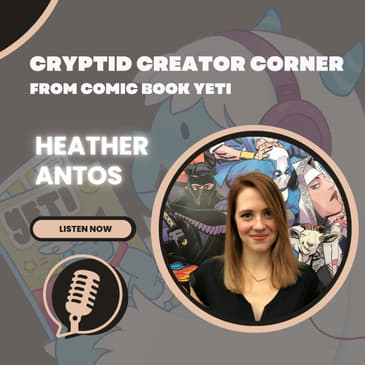

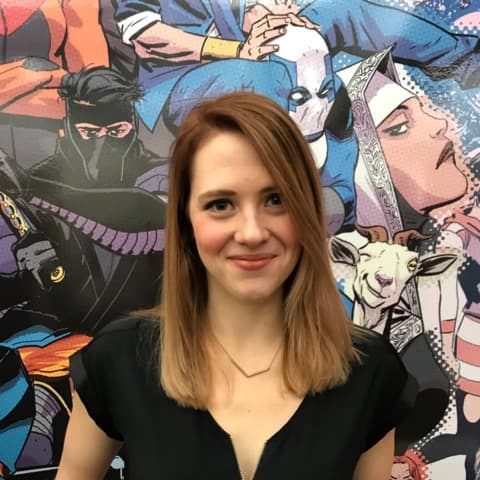
This is an incredible episode today as Jimmy welcomes Heather Antos on the podcast. Heather's name has been mentioned more than a few times on the podcast over the years as an editor on some of our favorite comics. Heather talks about how she got into comics, her work at Marvel, her role at IDW, Star Trek comics, the new IDW Dark line, her editing of creator-owned comics like the fantastic Bug Wars, and a whole lot more!
WATCH THE VIDEO VERSION ON YOUTUBE!
Follow Comic Book Yeti
🔗 Comic Book Yeti LinkTree: https://linktr.ee/ComicBookYeti
For partnership and ad inquiries, please contact: thecomicsyeti@gmailcom
Follow your hosts
🔗 Jimmy Gaspero: https://bsky.app/profile/jimmygaspero.bsky.social
🔗 Byron O’Neal: https://bsky.app/profile/byrononeal.com
PATREON
We have a new Patreon, CryptidCreatorCornerpod. If you like what we do, please consider supporting us. We got two simple tiers, $1 and $3. Want to know more, you know what to do.
ARKENFORGE
Play TTRPG games? Make sure to check out our partner Arkenforge. Use the discount code YETI5 to get $5 off your order.
Make sure to check out our sponsor 2000AD.

[00:00:00] Your ears do not deceive you. You have just entered the Cryptid Creator Corner brought to you by your friends at Comic Book Yeti. So without further ado, let's get on to the interview. Do you love sci-fi? Are you a horror fan? Maybe you prefer action or fantasy? 2000AD has it all and should be on your radar. With a whole universe of characters from Judge Dredd, Astronium Dog to Rogue Trooper, Shakara Halo Jones and many more,
[00:00:28] every weekly issue you get five action-packed thrills from incredible creators such as Garth Ennis, Rob Williams, Alex DeCampi, Dan Abnett and so many others. Get a print subscription and it'll arrive to your door every week. And your first issue is free or subscribe digitally. Get free back issues and download DRM-free copies of every issue for just $9 a month.
[00:00:51] That's 128 pages of incredible comics every month for less than $10. That's like a whole graphic novels worth. All subscribers get amazing offers like discount vouchers and exclusive product offers. Head to 2000AD.com and click on subscribe now or download the 2000AD app and why wait, start reading today. I'll put links in the show notes for you. Hello and welcome to Comic Book Yeti's Cryptid Creator Corner podcast. I am one of your hosts, Jimmy Gasparo, and I am very excited.
[00:01:19] I have a guest that I have been wanting to have on the podcast for quite a while, to be honest. She is a writer, an artist, and an editor who has worked for Marvel, Valiant, IDW, a ton of titles that I, it's a fairly exhaustive list of wonderful comics like Bitterroot, Redlands. I think the recent Bug Wars and a whole slew of others.
[00:01:48] And we're going to talk about all kinds of comics today. I am so excited. Please welcome to the podcast, Heather Antos. Heather, how are you doing tonight? I'm doing super well. Thanks for having me. Now, I've been wanting to have you on the podcast to talk to you for a while because your name is, one, of all the stuff that you've done. But two, your name has come up like quite a bit. Oh, no. Oh, no. We have done over 400.
[00:02:18] We've done 400 episodes. I've done over 200. And a number of times that your name has come up either just from, you know, just someone in the industry or worked on a lot of the comics that, you know, I have talked to the creators who have just had wonderful things to say about your work on the comics. So I'm like, man, this I think I should have this Heather on because your name has come up quite quite a bit.
[00:02:49] So, yeah, I'm really, really excited to have you on here to talk about all the things that you've done in comics. Well, it's all lies. Anything that anyone has ever said, it's all lies. Don't believe a word of it. No, that's very, very kind. And, you know, I thank you to all the lovely people who have dared utter my name.
[00:03:14] So I guess I wanted to start a little bit, you know, at the beginning in terms of your relationship with comics that made you eventually want to work in them. Yeah. I didn't grow up like with a local comic book shop or anything like that. My mom would actually say I drew comics before I knew what comics were. I've always been an avid artist, writer, reader.
[00:03:41] I won a lot of reading competitions as a kid. So I think I think my path was set pretty early on. But, you know, one of my first one of my earliest memories of comics actually is fighting with my siblings over the comic section of the Sunday newspaper.
[00:04:02] Like that was always something we always did, you know, to read, you know, whether it was Peanuts or Kathy or, you know, any of any of those those strips back in the day. And, you know, I grew up watching, you know, the Adam West Batman show and, you know, the Tim Burton Batman movies. And, you know, as as when I was in high school, we got like the Dark Knight and like all of that sort of stuff. Right.
[00:04:28] And the Marvel stuff that was a natural, you know, as a pop culture phenomenon. And I was always like tangential and I was always interested in it. But it just like, you know, the newsstands weren't a thing anymore. Right. Comics just themselves weren't really in my my natural purview. But it wasn't until when I was in college, I took an American literature course where we read a lot of the Vertigo classic books.
[00:04:55] You know, we read Constantine or Hellblazer. We read Sandman, Why the Last Man? And it was around that time, coincidentally, that the Marvel Now movement was happening. Right. The reboot of the Marvel Universe, as well as the New 52. Like that those were happening around the same time. So it was a kind of a good time also being in college, being in a bigger city where there was a comic shop.
[00:05:24] Like it was a good time for me to jump on to try stuff out for the first time. And but, you know, honestly, I will say like Sandman. I know it's cliche and everyone says this, but like Sandman is is the comic series that really made me interested in comics as a storytelling form.
[00:05:43] Form is as the medium, particularly the 24 hour diner issue and volume two, I think is volume two, issue six, where you see all these different character threads kind of come together in like the most fucked up way. And it's it's true. But it's truly like those characters in the 24 hour diner don't know how they're related. But you as the reader know because you've read everything else leading up to that moment.
[00:06:11] And it makes it, you know, as an issue by itself, it's brilliant. But like, you know, the payoff of of having, you know, been been along for the ride is is truly excellent. And, you know, all the little literary allegories throughout and just, you know, it was it's that that really kind of challenges me as an editor and a creator to push comics, you know, beyond what we're used to.
[00:06:39] And I think that's something that you see a lot in the work that I do, be it, you know, the You Are Deadpool book where you literally have to make a die out of the recap page to roll the die to to play the comic. You know, Gwenpool, where we, you know, her powers were breaking comic books as a form. And, you know, even the most recent Warp Your Own Way, the Choose Your Own Adventure graphic novel that just won the Hugo Award for us at IDW.
[00:07:06] You know, like I love to challenge creators in the medium to just do things that I've never seen before. Yeah, that's the like really exciting part of comics to see something that you, you know, haven't seen before and to be a part of that. So but how does that love of storytelling, the love of like what you see in Sandman take you to an editor at Marvel?
[00:07:36] Yeah, I mean, so like I said, it was around college in that time and and in that kind of pop culture geek resurgence in media, I started doing, you know, what a lot of us do. Right. I did like reviews online and like criticism and, you know, kind of the press angle. And I was, you know, near the end of college and I was trying to figure out, oh, God, what am I going to do with my life? This this theater degree is useless. Is that what you have, a theater degree?
[00:08:05] I was a theater and film double major with a French minor. All all useless. That's not true. They're very useful in what I do. They're very, very useful. But yeah, I would think the theater would be the theater one would be useful. It's honestly a lot of people in comics editorial come from theater backgrounds. I've discovered like a lot of us do. Oh, cool. Yeah. I mean, our job is to wrangle creatives on a limited budget by a deadline.
[00:08:33] The show must go on no matter what it is. They're very there's a lot of crossover there. But but a good friend of mine at the time said, well, you like comics. Why don't you just do that? You know? And I had never up until that moment, like really considered, oh, yeah, people get paid to make these. This is a you know, this is this is a job for people.
[00:09:01] Um, and so I really just started to explore what other what opportunities in the industry there were. Obviously, I knew of being a writer, being an artist, being a colorist, you know, the the, you know, top of the line, you know, creator front, creator facing roles.
[00:09:20] But one of the things I noticed is a lot of the books that I read tended to all have the same editor behind them, whether it was at the time like Mike's Mike Martz's work on the bad office at D.C. Or, you know, I read a lot of Will Moss books when he was at D.C. And then a lot of Will Moss books when he was at Marvel or, you know, I read all of Jordan Light's books at Marvel.
[00:09:42] And and I thought that was really interesting to me because clearly there was something that these people who are shepherding these titles that they were doing that I was resonating with. And I didn't really know what it was a comic book editor did at the time because, you know, who who possibly knows what a comic book editor does? It's kind of this like amorphous, you know, weird role.
[00:10:08] And so I did what any good millennial does at the time. And I just found editors on Twitter and I tweeted them and I was just like, hey, will you talk with me? I want to, you know, learn more about what it is that you do. And it just so happens that I was going to be at C2E2. This is 2014. I was going to be at C2E2 in like a month or so. Jordan White, who's at Marvel, was also going to be at C2E2. And he agreed to sit down with me.
[00:10:38] And I left that convention, you know, being like, this is it. I want to be a comic book editor. And honestly, I just like if anyone has ever met me, I'm probably the most like determined, stubborn person that they've met. I really set my sights on something and I just I do it. And I just started self-publishing. I just, you know, I knew that all writers want to do is write. They don't want to have to like make a book.
[00:11:08] They don't want to have to find an artist, you know. Our artists want to do is draw. They don't want to have to worry about a schedule or worry about a printer or worry about finding a color, you know, like all that stuff. So I started doing that and I put together a huge anthology at the time. This was in the early days of anthologies when they weren't like as popular, you know, as they are now. And I put together I put a call out thinking I'd get like maybe four people interested.
[00:11:36] And I ended up getting over 100 submissions that I had to whittle down. And in between C2E2, which was in March of 2014 and October, New York Comic Con, I put together an anthology with over 50 careers, funded it, got it produced on Kickstarter, raised like $15,000.
[00:12:02] And by the time I ran into Jordan White again at New York Comic Con, you know, six months later, I was able to say, look what I've done, you know, since our first conversation. Little did I know he had just gotten promoted and was going to be looking to hire his own assistant at the time. So he asked me, would you ever be willing to move to New York? I said yes. One month later, I was interviewing for Marvel. Two months later, I moved from Michigan to New York City to be an assistant editor at Marvel. And but the rest is history.
[00:12:31] Wow. Well, just to speak a little bit on on that history, I'm curious because I am, you know, I I'm somebody that always I can't help it. I always think of like what's like the worst case scenario and try to plan for that. What what's the worst that could happen? Let's like have a plan for it. But I often don't let myself think about like what is the best.
[00:12:55] So I don't know, like what what type of person you are, like when you start working at Marvel and when like looking back now and thinking of the work you did with Star Wars and like Gwenpool, like even in your like wildest imagination, were you prepared for like what those like what those comics would like do and go on to do? No, no. You know, it's it's it's it is surreal. Right.
[00:13:24] Like looking back and thinking of it and every day, like I still have moments. Right. I've been working professionally as an editor for 10 years now, and I still have moments where it's just like, holy shit, I can't believe I do this. Like this is wild, which is great to to still be able to have that feeling. Right. This the song in your career. But at that, honestly, at the time I was interviewing with Marvel, I was also fortunate enough to be interviewing with Dark Horse.
[00:13:53] And, you know, I knew, you know, when you're interviewing and you get the vibe like you're going to get an offer like you kind of know. And like I knew I was I was going to get an offer from both companies and it really just was going to come down to what path I wanted to take. And, you know, heart of my heart's the indie stuff, the horror stuff like that's where my heart lies. You know, I do, you know, as you said, Redlands, Bug Wars, Bloodstained Teeth, you know, like that sort of stuff.
[00:14:22] I love those projects. Exorcism at 1600 Penn, you know, I love those types of books. And now the Dark Line I get to do at IDW. But and I and I knew that like my passion would probably be more in line with what Dark Horse did. But if I started at Dark Horse, I didn't know if I would ever go to Marvel, ever have the opportunity to go to a Marvel. But I knew if I started at a Marvel, I would have the opportunity to go to a Dark Horse.
[00:14:54] And so I wanted to like really be strategic with my career. I didn't know I was interviewing for Star Wars. I had no idea. They knew they talked to me specifically because they knew I I'm a huge Star Wars junkie. I wish I had known that I would have felt better in the interview. But did I cry after my interview with Marvel? I did. I was so nervous. I was so nervous.
[00:15:22] But like it is wild. It is truly like I say it all the time. The success we had with Gwenpool is a fluke. The success we had with Dr. Aphra is just like the perfect scenario of right character, right concept, right time. You know, the stars kind of aligning with that sort of stuff.
[00:15:44] But I think it also comes to with like trusting your gut instinct and like persevering, you know, because as much as we like to think, oh, it's just a bunch of people playing with Spider-Man action figures and coming up with wild ideas. Like there's still a lot of hoops you have to go through to get those ideas approved and out the door. And a lot a lot of no's happen even when you're the one in charge of all the toys.
[00:16:14] You still get a lot of no's. And so learning how to navigate those hoops was a skill set that I had to develop super early on that, you know, it really just comes down to like trusting your gut instinct on a lot of that.
[00:16:35] And so now to turn like more to the present, what you've been doing at IDW with Star Trek, you know, to go from from Star Wars to Star Trek and the things that you're, you know, I think the group editor of of that. Right. And I mean, I've recently read Red Shirts. I had Christopher Cantwell on the podcast. We talked a little bit about that. I read the first issue of The Last Starship.
[00:17:05] And I mean, I'm a huge Star Trek fan, but Star Trek comics, I just isn't something that I've gotten like into. But man, I feel like I'm missing out because Red Shirts has been phenomenal. What is kind of that experience been like working on those comics? And, you know, what is your role in terms of kind of like getting the right writers and artists in on those projects?
[00:17:34] Like, what is that like? You know, because there are so many. There's been, you know, not just Jackson Lansing and Colin Kelly and the wonderful artists, but you have, you know, so many different Star Trek series. And they've all everyone I've taken a look at has been, you know, wonderful. Thank you. Yeah. I mean, you know, I when I got the role of of editor on the Star Trek line, like that was actually something I chose. There was a bunch of editorial shifts that were happening at IDW.
[00:18:04] This was like around 2021. And the Bobby Kernow, who was a longtime editor on TMNT, was, you know, taking a leave from the company. And they John Barber, who was the EIC at the time, really wanted me to take on Turtles. And, you know, there was there was a lot of push like takeover Turtles because it was, you know, the big superhero line, you know, the company and all these things. And with my Marvel backgrounds, like it was just like a natural progression.
[00:18:35] It made a lot of sense and I totally understand it. But like for me, it's like I've done the superhero thing. There's not a lot for me to do with Turtles. Like Turtles already has its audience. It has like, you know, it's not one of those lines you go in and shake up because it's it's it's very stable and it has its core.
[00:18:56] But Star Trek, there was a lot of opportunity to do something, a lot of opportunity to sculpt something and build something with, you know, kind of like he said, like a lot of people paid attention to Star Trek comics. You know, they were for Star Trek fans only at the time and for the hardcore Star Trek fans and nothing against those books or the creators or anything like that.
[00:19:20] But I that always felt weird to me, this this kind of attitude that the nerd and comics industry has towards Star Trek, like even within our niche comics nerddom, Star Trek is still too niche and nerdy for us. Right. Which is so wild to me. But it's true. You laugh because it's true. It's funny. Yeah. Yeah. It's like even amongst the nerdiest of nerds, we're still like, oh, Star Trek.
[00:19:47] Like, that's like kind of the attitude. And like. I find that so disrespectful because. The pop culture industry, as we know it, would not exist without Star Trek. Star Trek was the first fandom that put on fan conventions. It was the first, you know, that we had the first sci fi conventions. We had the first, you know, all of that stuff was put on because of Star Trek fans.
[00:20:12] Um, Star Trek was the first like cinematic universe. It was the first, you know, like in the MCU would not exist as we know it today without Star Trek. We wouldn't have San Diego Comic-Con as we know it today without Star Trek. And it really has shaped and informed so much of our sci fi pop culture that, um, I kind of wanted to build a line to remind people or to engage people that like, no, like Star Trek is cool, actually.
[00:20:41] Um, if you just give it a chance. And in order to do that, I really wanted to build a line and work with creators and characters and concepts that spoke to comics fans first, not just Star Trek fans. Um, and that meant building a line of books and stories that could only exist in the comics. We're not just doing, here's a lost episode from a TV show, you know, like we're, like we did with the flagship series, right.
[00:21:11] That just concluded this past year. We, we built what I call our Avengers of Star Trek. You know, you have Benjamin Sisko, Beverly Crusher, Scotty, you know, all of these characters coming together in a, in a book that never could appear on TV because they're just not around to do so anymore.
[00:21:28] You know, um, and with a budget to do things that they could never do on the TV shows and, um, you know, these epic three year, this epic three year long saga and, um, and like what we're doing with red shirts, like red shirts was actually the first idea I had for a Star Trek comic. But I knew when I took over the line that Paramount wasn't going to be quite ready for what that this book is.
[00:21:55] You know, if, if you read the most recent issue that just came out, we had a transporter accident, a big body horror accident, you know, a Romulan and a red shirt, um, combined. Yes. Yeah. That's issue. That's issue three, right? I think. That's issue three. Yeah. Yeah. Yeah. I'm all, I'm all caught up on, on, on red shirts, but yeah, my, my plug for red shirts. I was so excited.
[00:22:24] The covers are fantastic. Like I'm not a, I mean, I, I'm not like a collector. Like I don't buy a ton of like variant covers. I mean, I like, I have, I have more comic books than my wife would like me to have, but, um, I love the covers. I think Chris Sheehan had done some, um, but I was very excited for that idea. Cause it's kind of not, it is the one thing that is really broken out beyond star Trek and has really influenced pop culture in terms of the idea of like a red shirt.
[00:22:54] And, uh, the series is, is so well, well done. I'm a huge fan of Christopher Cantwell. Love his series, the blue flame that, that he did. Um, and yeah, I just, the three, the three issues I've heard have been phenomenal. So there's my little red shirts commercial for any listeners who haven't checked it out yet. Even if you're not a star Trek fan, it it's, it's very good. Thank you. It's just an action. It's just a sci-fi action book.
[00:23:23] That's all. That's all it is. And like the, the, the, my whole idea with, with it is, you know, the idea of a red shirt, like what a red shirt is, like has, has breached beyond star Trek fandom. Right. It's, it's become a meme in and of itself. Uh, and everyone, you don't have to know who Kirk or Spock is, but you tend, people know what a red shirt is. And, um, you know, it's, it's become that, that meme, that joke.
[00:23:49] And so I wanted to like, no, like, this is actually a pretty fucked up that it's, you know, if you're a security officer, you're probably going to die, you know? And, um, and we see them just get written off all the time. And so I, I, Chris and I, you know, we really wanted to come up with a cast of characters that like you sell in love with and you had a favorite character and you're rooting for this character. And then, wow, that character died in the most gruesome way you didn't know was possible in a Star Trek comic.
[00:24:20] It's, it's remarkable in terms of like how quickly the writing and the art endears the characters to you. Cause I mean, it is like Star Trek, the dirty dozen, you know, or where you just have a sense that, all right, they're red shirts. I know something bad's going to happen, but you really in, in very few panels give a quick, enough of a snapshot of like their personality and like their interactions.
[00:24:49] And it, it really is so well done for the, the, the payoff of the, of the premise, you know, in the three issues I've read so far. And there's also like an, an overarching story woven in there as well. It's, it's not just these guys are cannon fodder, you know? Yeah, no, it's true. It is a true, like you truly don't know who's going to make it out if anyone's going to make it out.
[00:25:17] And we, we hope to break your heart a million times reading that book. I think my favorite thing, my favorite thing was, um, it was, I think it was a review of issue two and someone was like, so-and-so is my new favorite character. And my assistant and I were reading it and she was like, oh, they die in issue three. Oh, well, but that's the goal, right?
[00:25:45] Is to have, you have a favorite character. Then we kill them off. Yeah. In, in terrible, terrible fashion. Um, terrible ways. All right, everybody, we're going to take a quick break. We'll be right back. Y'all, Jimmy, the chaos goblin strikes again. And I should have known better than to mention I was working on my DC Universe meets Ravenloft hybrid D&D campaign on social media. My bad.
[00:26:14] He goes and tags a bunch of comics creators we know. And now I have to get it in gear and whip this campaign into shape so we can start playing. Another friend chimes in, are you going to make baps? It's fair to say it's been a while since I put something together. So I guess, question mark? It was then that I discovered Arkinforge. If you don't know who Arkinforge is, they have everything you need to make your TTRP. More fun and immersive. Allowing you to build, play, and export animated maps.
[00:26:42] Including in-person, fog of war capability that lets your players interact with maps as the adventure unfolds. While you, the DM, get the full picture. Now I'm set to easily build high-res animated maps. Saving myself precious time and significantly adding nuance to our campaign. That's a win every day in my book. Check them out at Arkinforge.com and use the discount code YETI5 to get $5 off. I'll drop a link in the show notes for you. And big thanks to Arkinforge for partnering with our show.
[00:27:11] I think I'm going to make Jimmy play a goblin warlock just to get even. Welcome back. There also has to be the fun of something like The Last Starship. Where it just seems like, I've read the first issue. The premise kind of seems like a fever dream of everything I like about Star Trek. Desperate circumstances.
[00:27:41] Everybody's hopeless. Trying to find the hope in a terrible situation. The Borg show up. And Kirk. Yeah. And suddenly Kirk is there. How is Kirk there? And it's just, oh yeah. This is wild that somebody's getting to do this. The first issue was fantastic. And I'm not familiar with the artist.
[00:28:11] I just thought the artwork was like wonderful. Not anything I expected for like what I would envision of a Star Trek comic, but just works so well. It's just so awesome. Thank you. Yeah. It's kind of this like retro futuristic noir. Adrian Bonilla, the artist. This is actually his first time doing an American comic book. He's this wonderful Spanish artist that I've developed a relationship with over the last couple of years.
[00:28:38] And, you know, as an editor, I'm always like looking out for, you know, the next great artists. And like what's the right project, right? Because if I'm going to work, if something's going to be someone's breakout comic, I want to, you know, not only set the comic up for success, but also set the artist up for success. Right. And especially with a licensor, you know, and with that fan base and everything like that. And Adrian's work is just like constantly blowing us all away on the book lined with Heather Moore colors.
[00:29:07] Just, just absolutely stunning. And I mean, this, this book is truly like such a passion project for everyone involved. It first came about the idea for it first came about, I think like a year and a half, two years ago, two years ago. I think it was New York Comic Con two years ago is when, when we first started conversations of it. And we really got into the meat of it.
[00:29:32] San Diego Comic Con last year with Jackson Collin and I, I remember our lunch where we sat down and we really broke out like what this was going to be. And, you know, originally it wasn't Kirk. Originally it wasn't, you know, the, the enterprise. Originally it wasn't the board, you know, it was all of these things. And this book was a big, big swing.
[00:29:57] I mean, getting Paramount to approve Agnes, getting Paramount to approve Kirk, getting Paramount to approve how we're using Kirk and the things that are going to happen with Kirk and the issues to come, as well as the things that are going to happen in the Federation for the issues to come. Like it's, we're taking every big swing that you can possibly take with this book.
[00:30:16] And, and I think, you know, that it really comes down to the trust that myself, Jackson and Colin have built with Paramount over the last, you know, several years doing the flagship and, you know, showing them that like, no, no, no. We can treat your world with care. We've got it. You know, that they're allowing us to, to take these swings. Cause it was would you there?
[00:30:43] Like there was some times where like, truly I didn't know if this book was going to happen. So it's, it's every, I say it all the time. Like every comic is a little miracle in your hands. And like the last starship, like truly is a miracle. And like, I'm just so blown away at the reception. Like people are really enjoying it. And, you know, we, we tried to make it as, you know, entry level friendly as possible.
[00:31:08] If you've never seen a Star Trek show, you can just pick this up and we give you all the information you need to know, like right from page one, because this is a period that has never been explored in TV. You know, these are characters that aside from, you know, Agnes and Kirk, like have never been explored in TV, but even our Kirk is a new Kirk. Like he's not, you know, he's, he's the reincarnation. Right.
[00:31:34] And so like a big part of this story, it'll be out by the time this episode airs issue two. We get into it. A big part of our Kirk story is him like coming to, like trying to like, am I Kirk? Can I live up to this legend? You know, am I a fraud? I don't know. Um, which is like, that's a lot of weight to, to carry on one's shoulders. The legend of like the captain of Starfleet.
[00:32:05] Yeah. I mean, especially, I think isn't there, I think one of the panels in the comic is showing what Sam, is it San Francisco? And there's a statue of Kirk. I mean, that's. Of Kirk. It's, it's like Kirk Janeway. And, um, who else is in Picard? I think. Yeah. That's a lot of weight to carry, man. Yeah. That's a lot of weight. So I also wanted to talk about some of the other stuff at IDW in terms of the new, like considered the dark line or.
[00:32:35] Yeah. Yeah. The dark line. Event Horizons Us. Yep. Event Horizons Sleepy Hollow, Twilight Zone. Yeah. And now Smile, Um, A Quiet Place, Um, Exorcism at Buckingham Palace are all part of it. Right?
[00:32:51] I, I, so when things like that, when opportunities, I guess, come up where IDW is, you know, purchased a license or gone out and gotten it, you know, and, and then is it like your job as the editor? Or one of the editors on those types of lines to then go and find the person who would be the right fit? And how do you go about kind of matching up? Oh, here's this artist, you know, I've been paying attention to, or here's this writer that I've worked with before.
[00:33:21] Like, what, what is, I guess, kind of the, the calculations for that, for you to figure out who might, you know, be a good fit or who do you want to introduce to the editor in chief to like make those matchups? Yeah. I mean, um, a lot of it comes down to just like, you know, knowing the creators I work with and like knowing the stuff that they're into. Right?
[00:33:44] Like I didn't know Christian Horizon or Christian Ward was an Event Horizon fan, but like his art is very cosmic horror kind of leaning. And so, you know, it was when we had the license and, um, we needed a writer. It was just kind of a thing I felt like, do you like Event Horizon or, you know, like, or I'll just, I'll, you know, occasionally float with trusted creators.
[00:34:11] You know, um, is, you know, is we have these licenses. Is this something you'd be interested in? Like a super, not with the dark line, but also another book that I oversee the editor who edits it, like Street Sharks, right? We have Street Sharks. And like, this was pure, this was pure coincidence, but we have Street Sharks and we were trying to like, you know, find the creative team for it. And the art side was a little bit easier because there's, it's a cartoon model, right?
[00:34:35] You just need someone who can, you know, luckily having done My Little Pony, Sonic, Lower Decks, we have a great stable of artists who are great at, you know, drawing on models. So the art side of that was a little bit easier to cast, but, um, with writers like Street Sharks is kind of like, it was a blip in time, right? It was such a like moment. And then everyone forgot it ever existed as, as a cartoon. And I just, I put out to Nick Nino, who, who's the editor on it.
[00:35:05] I was just like, I don't know why, but I feel like Stephanie Williams is a Street Sharks. Like, I just, just ask her, like I have, like, and mind you, I had never heard of Street Sharks before we got the license. So this isn't like something I had talked about with anyone ever, you know, I just like, Stephanie Williams just puts off Street Sharks vibes to me. I don't know why. Couldn't tell you.
[00:35:30] And like, he sends the email and she literally responds back all capital letters. Ah, I love Street Sharks, like freaking out. So like, sometimes it is just vibes. I don't know. Like, I truly don't know. So, you know, sometimes it is just, you'll put off the vibes. Right. But a lot of times it is, you know, I read a lot for my job.
[00:35:54] My job is to read a lot of comics, to know who's up and coming, to know who's doing what, what concepts are working well. You know, also to know, you know, is this a difficult license? Is the licensor difficult in this? Is, you know, are there certain things, notes that we need to hit or certain things that are going to be off limits and knowing what writers are best suited and best equipped to be in that circumstance?
[00:36:20] Not every writer is best suited for every single license just because of the different hurdles that, you know, an individual license can present. Some licenses are easier than others. And a lot of that depends on the alchemy, right, of all the people involved. And, you know, but a lot of it just truly when it comes to usually its familiarity and just being a fan, like, comes first.
[00:36:48] And so that's why I always tell, you know, creators, if you're a fan of something, let editors know. Like, that makes our jobs easier if you're already a fan of the thing that you're working on, right? If I know, like, oh, you already know the lore of smile. I don't have to, like, teach you and hold your hand through, you know, how the entity works, how the entity passes on from people to people, right? The rules of the world. That's always super, super helpful.
[00:37:18] And then just, like, also knowing that the people that you work with are going to treat, you know, these toys with care. Because that's really all it is at the end of the day, right? We are shepherds for these brands and these franchises. And, you know, the licensors need to trust that whoever we hand those keys to are going to, you know, treat their babies with care.
[00:37:42] So and I always like to, like, in my job, you know, because if you look, again, if you look at Star Trek where it started before I took the books on and the type of books we're doing now, like, the art is drastically different, right? The creative, the arcs, the stories and stuff that we're doing is very different. And that was very intentional through, like, pushes, right?
[00:38:02] Pushing the licensor to expand their comfort levels and see that, like, no, we can push the limits of what you've done before, but we're not going to break anything.
[00:38:15] And that comes from, like, a lot of listening to a licensor and understanding what their biggest fears are, what their biggest sticking points are, what their biggest concerns are, and making sure that anything that you're presenting to them that might make them, might get their hackles raised, right?
[00:38:38] That you're making sure that you're presenting it in a way that you're, you know, still assuaging those concerns, if that makes sense, you know? So it's a lot of, I call it chess, like, it's chess, not checkers, you know, a lot of times. It's being intentional and being smart. If I'm going to, like, bring on an artist like Adrian Bonilla, right? If I'm going to do an artist like Adrian Bonilla who, you know, Star Trek has never had someone, like, quite this stylized before.
[00:39:06] I'm making sure it's paired with writers that they trust and know are, you know, have everything. So they have, they still have their blank, their comfort blanket, their safety blanket to make sure that everything's going to be fine. And it's the same thing with, with the horror stuff too. It's the same thing, you know, what we're doing with, with Smile, you know, Hannah, Rose May was a, I knew, you know, going, when I got the license, like, she's a huge fan of that franchise. A huge fan of that franchise.
[00:39:35] When Smile 2 came out, she would not stop talking to me about it. And so when the opportunity to pitch it came, came on, like, she, she was one of the first people, you know, we spoke to. And her pitch is just killer. It's so good. A bunch of models going around Fashion Week with the entity possessing them, like, Smile models? Are you kidding me? Like, it's great.
[00:40:01] So, you know, it's, it's, it's a lot of listening, you know, it's a lot of listening, a lot of paying attention and, and yeah, being intentional. Just, just to get back to Street Sharks for a second, even if you weren't familiar with it. Yeah, of course. Yeah. You, have you at least by now seen the, the Vin Diesel at the Toy Fair with Street Sharks? I have. No, that was one of the first things that was shown to me.
[00:40:27] One of my very, very good friends runs a toy podcast, actually, Adventures, Adventures in Collecting. And as soon as he heard, he, like, sent that to me. Yeah, I can't, between, between my time at Bloodshot at Valiant and, and now Street Sharks, I can't run, I can't hide from Vin Diesel. He follows me everywhere. Yeah. It's a very important part of internet lore. Of his lore, yeah.
[00:40:52] What do you think is the most important factor, like, once you find the right fit, when you're either the group editor or even a lot of the creator-owned stuff that you've done and your editor on, like, once you have the team together, what, what do you think is the most important thing for, for you to do to set the team up or to set the book up for a success? Yeah, I think it's just, you know, making sure all of the goals are aligned of everyone.
[00:41:20] I often equate my job to being, like, the Google Maps algorithm. You know, like, let's all make sure the destination, we're on the same page of what the destination is, right? And, you know, I can help us find the most efficient path. I can help us find the scenic route. You know, along the way, we might run into some detours or delays or take a wrong turn. And that's fine. We're all here to get back on the path together.
[00:41:49] And it's really just creating, you know, that space where we all feel free to do our best work. My job is to create a situation, an environment where all a writer has to worry about is writing, all an artist has to worry about is drawing, all a colorist has to worry about is coloring. And hopefully I've taken care of as much of the other bullshit on the side so that they don't have to worry about that.
[00:42:16] You know, of course, I can't do time management for individuals, you know. But, like, you know, it's I go to Christian. You know, Christian and I are working on some stuff right now. And it's just how much time do you need? You know, you need this much time. OK, this is what a schedule looks like with this much time per issue. Does that work for you? Great. OK, this is, you know.
[00:42:41] And then I just I check in with every single project I do, every single creator I work with once a week just to make sure, like, hey, has life happened? Life happens sometimes. Let's figure it out. Let's, you know, here are here are our options. You know, it's editors, even in work for hire environments, like people view them as like the boss. But I'm not the boss.
[00:43:05] I'm just like the I don't know that I'm just there to to oversee everything and make sure it's all going according to plan as best as possible. And what that might mean for an individual project or individual creator is very, very different. You know, there are some creators that will want to text me daily to talk creative stuff and, you know, show me work in progress or whatever.
[00:43:33] There are other creators that don't want to talk to me at all until the stuff is turned in and done. You know, like there's there's just different levels. And it's just making sure I am being the editor to those creators that they need to do their best work. You know, when I was working with the late and great Justin Ponzer, you know, he was someone who like he he worked best during a chit chat.
[00:43:58] And so if that meant I'm calling him every day and talking with him on an hour on the phone about, you know, what we're watching on TV until he turns in his pages. Great. That's how he does his best work. I have another creator who's terrified of their email inbox. That's great. Instagram DM is how you prefer to communicate. We can do that. You know, there's a lot of editors out there that try and force creators to work the way they want to work.
[00:44:26] And I think that's like that's just not setting up your team for success. It's best to figure out how your team does their best work and then and do whatever you can to provide that environment for them. You I you wonder like about some of the process of like the editing for, you know, when you're you're not doing like your own thing, like when you're hearing how it all goes with a publisher.
[00:44:51] But I mean, it makes a lot of sense in terms of how you see your role and why you have been, you know, so successful. I'd say in the industry in terms of the books that you've shepherded, you know, all the things that you've said in terms of how you work with creators listening in terms of licensors. It's just remarkable.
[00:45:18] And how about with your own art and illustrations and writing? Did I see that you have something in the new Lifelines Witching Season Anthology? I do. Yeah, I wrote a eight page story with Morgan Beam, near and dear artist. We worked together on an IDW original book called Crashing written by Matthew Klein. And she most recently drew Twilight Zone number one that was written by Dan Waters. That's really great.
[00:45:47] Definitely check that out. But I adore her. And Michelle Abinader, who is the curator and editor of that anthology alongside Phil Falko and Kat Kalamia. She's a near and dear friend of mine. And she asked if I would write in it. And I said, well, only if Morgan Beam will draw it. And then Morgan said yes. And I was like, well, I guess I guess I'm writing this. Yeah, it's it's I I love I like writing a lot. I like drawing a lot.
[00:46:16] But it's it's for me, it's like a creative outlet. It's not like a passion. Like I'm not you know, I there's a lot of comics creators I run into when I table at shows who are like, oh, no, you're coming for our jobs. And I have I will say it here. I say it all the time. I'm not coming for your jobs. I do not like people who want to write and draw comics full time are crazy and insane human beings. I have the utmost respect for you. I could not do that life. I do not want that life. But it's a fun exercise for me.
[00:46:45] Like I do like writing. I do like drawing. And I think it's also important to like if my job is going to be giving notes on art, giving notes on scripts, giving notes at like it's important to at least have a basic understanding of how that job is done. And you can articulate and speak the language better in communication.
[00:47:08] But I also think, too, it adds another level of respect of creators to be like, oh, yeah, no, she knows what she's talking about. Like she she does that. You know, I've drawn interior pages. I've colored my own comic. I've done covers like I've I've I've done it, you know. And, you know, I think it's I think it's just important, even if you're not, you know, like going to be the next Alex Ross.
[00:47:34] But I think it's very important for for any editor to have a basic understanding of color theory, to have a basic understanding of how Photoshop works. And, you know, and but it's it is fun to I've had a lot of opportunities the last couple of years. I, you know, I wrote this story for Morgan Beam and this I did a I wrote a story that Adrian Bonilla from Last Starship drew in an anthology called Let Her Be Evil a couple of years ago.
[00:48:03] And then I drew a story for the When I Was Young anthology that Sam Max wrote last year. And so it's it's it's a fun little exercise to break up the you know, to work on the other side of the brain rather than just like the critical thinking note stuff. It's it's a fun you know, it's it's it's it's nice to shake it up. But, you know, and it keeps it it keeps it still fun. I think that's the important thing with my art.
[00:48:31] I never want it to become work. And I like that balance of what I have now because I get to just draw whatever I want. You know, it's not it's not work. And if I don't want to do something, I don't have to do it. And it's really nice. It's really nice that way. Yeah, no, that's awesome.
[00:48:52] Well, Heather, I you know, I really appreciate you coming on the podcast and I feel like and chatting with me about that. Your journey in comics, about editing, about the stuff that IDW, you know, has has coming out. So I will just say, listeners, you know, when this this podcast, if you're listening to it when it comes out in November, you're still going to have plenty of time to catch up on red shirts. Please check out The Last Starship.
[00:49:21] I just I thought it was the art in particular was not anything I expected in a Star Trek comic. Like what I had as somebody who's seen every episode of like The Next Generation. I just loved it. I thought it was phenomenal. And yeah, we're all going to be on the lookout for the the rest of the IDW dark line in terms of smile and a quiet place. I just really love a lot of that stuff.
[00:49:50] And if you're not reading, I mean, I had Christian on the podcast. If you're not reading Event Horizon, go do that. And I just I mentioned, I think, Bug Wars earlier. I think you're editing Bug Wars. Jason Aaron and Mahmoud Asrar. Bug Wars is phenomenal. Like talk about a comic. Talk about a comic that has a very simple. The premise is so simple. Yeah. Yeah. This meets that. Like I read somewhere.
[00:50:20] I don't know if it was Jason described it as Honey, I Shrunk the Kids meets Conan the Barbarian. Yeah. Yeah. That's what we call it. Talk about a comic that delivers on that promise. And then some. It is unreal. It is absolutely gorgeous and terrible in terms of I hate bugs. And it's just it's so, so good. I want I want everyone to read it. It's so good.
[00:50:50] Well, and we've got and we've got plenty more plans for Bug Wars. We've got a lot more on the way for that one. So it's super exciting. So thank you so much for having me on. This was super great. Yeah. No, absolutely. Absolutely. My pleasure. So listeners, thank you so much for listening. Shout out to my brother Bobby, the Cryptic Creator Corner's number one most dedicated fan. Bobby listens to all my episodes. And as as we're recording this, Bobby and I will be spending the weekend at Baltimore Comic Con.
[00:51:20] So we'll have an episode about everybody we got to meet and and chat with at Baltimore Comic Con. We've been going for a number of years and it's a really fun show. And yeah, Heather, thank you so much. Listeners, find me on Blue Sky or wherever I am on the Internet. Tell me what you've been reading, especially if you've been reading anything that Heather's worked on or that Heather edited. Love to talk about Star Trek comics. Now I'm going to take a deep dive.
[00:51:48] And and I was as I was going through some things. I haven't read all of lore war, but I think I need to get into that next. So. All right. So thank you for listening. I'll see you next time. And thank you so much to my guest, Heather Antos. This is Byron O'Neill, one of your hosts of the Cryptic Creator Corner brought to you by Comic Book Yeti. We hope you've enjoyed this episode of our podcast. Please rate, review, subscribe, all that good stuff.
[00:52:17] It lets us know how we're doing and more importantly, how we can improve. Thanks for listening. If you enjoyed this episode of the Cryptic Creator Corner, maybe you would enjoy our sister podcast, Into the Comics Cave. Listen and subscribe wherever you get your podcasts.