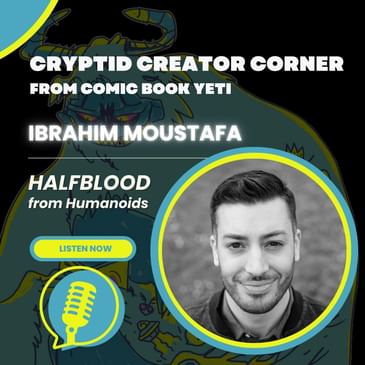

I love samurai, the code, the fashion, I mean, who doesn't so when I saw that comics writer/artist Ibrahim Moustafa was working on a samurai centric project, I immediately reached out to chat about it. After getting a look at the actual pages, it should come as no surprise that as an adept at blending genre, he's knocking it out of the park again with his forthcoming East meets West Humanoids project Halfblood funding soon on Kickstarter.
I get annoyed sometimes at the panel economization of fight choreography in comics as a daily martial arts practitioner, but was pleasantly surprised with how meticulously this was researched and executed . We chat about that, vampires, the white savior trope, and sculpting figurines which if you haven't checked out his YouTube channel, consider giving it a follow if sculpting or just collecting them is your thing.
🔗 for the Halfie Project podcast discussed in the show
Halfblood
From the Kickstarter page
“Do you believe in fate?” asks Senjuro, The Black Demon, to all those who cross his path. Victim or guide.
A masterless, mixed-race samurai, Senjuro skulks through the shadows of an evolving feudal Japan, seeking to serve...but the age of the Samurai flickers on the winds of modernization, and any work to be had is less than honorable. That is until Claire, a wealthy British explorer and anthropologist, swings through the tavern doors seeking aid from the man whose reputation precedes him; the one they call The Black Demon. Her family has just been monstrously slain and exsanguinated, and signs point to perpetrators beyond human. Along with Claire and her Sikh companion Jangveer, Senjuro the Black Demon must face hell on earth to deliver their reckoning, and in the process, find the honor he so desperately seeks.
Follow Comic Book Yeti
🔗 Comic Book Yeti LinkTree: https://linktr.ee/ComicBookYeti
For partnership and ad inquiries, please contact: thecomicsyeti@gmailcom
Follow your hosts
🔗 Jimmy Gaspero: https://bsky.app/profile/jimmygaspero.bsky.social
🔗 Byron O’Neal: https://bsky.app/profile/byrononeal.com
PATREON
We have a new Patreon, CryptidCreatorCornerpod. If you like what we do, please consider supporting us. We got two simple tiers, $1 and $3. Want to know more, you know what to do.
MY NEIGHBOR NECROMANCER
Visit this month's feature crowdfunding campaign at 🔗 NECROCOMIC.COM
ARKENFORGE
Play TTRPG games? Make sure to check out our partner Arkenforge. Use the discount code YETI5 to get $5 off your order.
Make sure to check out our sponsor 2000AD.
[00:00:00] Your ears do not deceive you. You have just entered the Cryptid Creator Corner brought to you by your friends at Comic Book Yeti. So without further ado, let's get on to the interview. I don't know about you, but I've never considered a biting tarantula familiar a good thing? Then again, when it comes to necromancy, there's always a price for power, especially when raising the dead.
[00:00:23] Now you might be wondering why I'm thinking about that. Well, I just got a sneak peek at issue three of My Neighbor Necromancer, the witchy, wonderfully weird comic I've already been a backer of, and I've been eagerly awaiting more of our novice necromancer apprentice Jessie's adventures with her flying undead lizard, Bivitt. This story hits my sweet spot with this danger-just-be-on-your-doorstep kind of narrative. In this issue, Jessie continues her training with Sierra Reno and receives a mysterious invitation to the body farm.
[00:00:50] Now, I worked at the actual body farm in college, so when I heard that, I wonder what in the hell they were doing here. Will Jessie find friend or foe there? No spoilers here. I won't be accused of spilling the bones, so you'll just have to wait and see.
[00:01:04] This is Hands Down, one of my top crowdfunding comic picks of the last few years, brought to life by an absolutely stacked creative team. Yeti fam Jack Foster contributes an extra backstory rendered in jaw-dropping watercolor, and you'll find freaky familiars, undead mounts, a couple of new characters, one a mischievous group who look like a harpy-cobold hybrid, and a mailman who hops bodies faster than the postal service changes shipping rates.
[00:01:31] If you like your magic a little messy and your monsters a little lovable, head to necrocomic.com or hit the link in the show notes so you don't miss the comic that's redefining life on the bright side of death. Hello, everybody, and welcome to today's episode of the Cryptid Creator Corner. I'm Byron Neal, your host for our Comics Creator Chat.
[00:01:57] As a daily martial arts practitioner, I'm immediately sucked into pretty much any comic book that has samurai in it. So the clothes, the fashion, they are just that fucking cool. So as soon as I saw a few panels on first-time show, Asner-nominated comics creator Ibrahim Mustafa's Blue Sky account, I reached out to see what he was cooking that had samurai in it.
[00:02:19] So I've got the master facilitator of fandom figurines himself on with me to discuss his new humanoids project, Half-Blood. Ibrahim, welcome to the show. It's great to have you on. Thank you, Byron. I've been aware of what you folks at Comic Book Yeti have been doing for a while now, and I'm honored to be a guest. And thank you for the incredible intro. I appreciate that. Oh, thank you. Yeah, no problem. I really appreciate the accolades for Comic Book Yeti, too.
[00:02:44] It's a weird position I find myself in because I took over for Matt, who originally started it and everything. So, yeah, I never expected to land in comics journalism, but here I am talking to wonderful people like you. So it's not a bad gig. Yeah, I know. You guys do great stuff, too. It's, you know, sometimes I can be a little annoyed by comics journalism. Okay.
[00:03:09] I'm like, you guys have always been like an outlet that I really appreciate following. Thank you. Yeah, I feel like you've always, it's been a smartly and curiously curated kind of thing that you all have done. Like, it's not, you don't just cover like the same stuff that everybody else does. That's what I generally find annoying is like, you know, another Marvel thing or whatever.
[00:03:36] But like, Yeti has always followed, you know, from the more esoteric to the more indie stuff. So, yeah, it's always been fun to follow along and see what you all are getting up to. So, yeah, I appreciate being on your radar and being invited on. Yeah, absolutely. Well, before we jump into the book, I've been following your ongoing Superman movie figurine manufacturing that you've been doing on the YouTube channel. And I'm impressed. I don't possess anywhere near the skills to pull off what you are doing.
[00:04:05] But I do find it really fascinating. So, where did this level of sculpting in miniature come from? Well, thank you. Yeah, I've just always, you know, I actually realized recently where my fascination with all things miniature started. And it was the intro to Mr. Rogers' Neighborhood. Okay, sure. Yeah. Yeah, because they had the little miniature neighborhood with the little cars. Because I loved, I've always been a car guy. Like, I love cars.
[00:04:31] And, I mean, since I was a little kid, like, I can no-scope a drawing of a Volkswagen bug accurately right now. Like, I used to draw them all the time as a kid. I've always paid attention to different makes and models. And, you know, I can generally get within, like, a couple years. If you were to show me a car, I could usually tell you, like, what year it is and who made it and all that stuff.
[00:04:53] And so, that, you know, led to the love of Hot Wheels and Matchbox cars and then seeing those little cars on Mr. Rogers' Neighborhood and then seeing them having, like, a miniature street to live on. And, you know, I grew up very poor. So, a lot of times I had to kind of make my own fun, right? And that's a big part of how I got into drawings because it was a free thing I could do and have fun.
[00:05:18] And so, you know, probably around 10 years ago or so, I got into making these custom figures. And that was born out of, I want a figure, I want a little physical manifestation of this thing I enjoy that I can just look at for brief moments of escapism, like, at any time, right? I can't really watch a movie or read a comic book, but I can look at the character from it and feel that just that little hit of dopamine I need to keep going through my day, right? Yeah, yeah, that makes perfect sense. Yeah.
[00:05:48] Yeah, and so, you know, there was always a gap for me in what was available versus what I wanted. Like, I loved Ninja Turtle as a kid. I still do. But, you know, I was always frustrated that they didn't look like the movie, like, you know, or even the cartoon. Like, I wanted them to be an accurate representation. And so, you know, at some point within the last 10 years or so, Playmates put out these, like, figures based on the movie. So I set out to, but they weren't very accurate.
[00:06:18] They still looked a little too cartooning, too much like a toy. So I set out to sculpt replacement heads based on the, you know, Jim Henson puppets from the first movie. So that was my first dip into customizing. And then actually a company called NECA made incredible figures, like, within the same year. But I never finished that project because I could just buy them at that point. But that led to me, you know, I took an old McFarlane Neo from the Matrix and turned it into a John Wick early on.
[00:06:45] And, you know, I made like a 1-6 scale James Bond based, you know, I found a head sculpt of Daniel Craig online. And so that just kind of led me down the rabbit hole. And so, yeah, now, I mean, you can see behind me, I have a whole wall of stuff that I've made and dioramas. Your love with cars is clear. Lots of clear. Yeah, I love pairing. That's kind of the central, like, conceit of my collection is I pair the characters with the vehicles that they're, like, iconic, you know, known for.
[00:07:14] The Batmobiles, I have a mystery machine down there. I've got, you know, John Wick's Mustang. I've got an Aston Martin for James Bond. And I made a Knight Rider, like, kit from Knight Rider. Nice. A little Hasselhoff to go with it. So, yeah, it all kind of came out of that. And it's evolved over the years. You know, I'm now getting into, like, digital sculpting and 3D printing of my own custom heads to make these figures with. And so, you know, I made my own Superman head from the new movie.
[00:07:42] And I made a whole suit form out of some existing sort of, like, little 112 scale body suits that I cut up and, you know, painted trim lines on and did iron-on vinyl for the S and stuff. So, yeah, a few years ago, I started a YouTube channel for it. And, you know, a friend of mine was really extolling the virtues of YouTube and how it's this sort of way to vertically integrate what you do as a creator and, you know, make a little money on the side while doing it.
[00:08:11] And at first I was very resistant to it because he was suggesting that I do it for my art stuff. And it's, you know, people don't really watch people draw that often, I don't think. I mean, there are channels that are big, but if you have the name recognition, yeah, you know, but otherwise. Yeah, but even, like, I remember this friend of mine who's a huge name in comics as an artist and writer had a channel that wasn't, you know, he was getting engagement, but it didn't. It was eclipsed by his other.
[00:08:41] So I just thought, like, well, if he's not generating a huge, then, you know, what am I going to do? Um, but then I realized I have this other thing I do that people might find interesting and thankfully they have. And so I've been able to kind of build this channel up and it's been great as a, as an independent creator, because it's the thing that I can do, you know, that, that I control. And nobody, I don't have to, there's no permission structure involved, you know? Right.
[00:09:09] Um, and that's something that's actually been very difficult for me in my career. Or I don't get, you know, despite I feel having earned them, I don't, I don't receive a lot of opportunities from publishers. You know, I've watched a lot of my contemporaries and even people who've come up after me, you know, be given the keys to certain kingdoms that I'm just not afforded.
[00:09:28] And the only thing I can really surmise from that is that it has to do with like, there's just not enough Arabic representation in comics for somebody to be looking out for someone like me. Like, you know, there's no, like, uh, Asian creators have Jim Lee. They have Larry Hama.
[00:09:47] There's, you know, a lot of the Filipino artists, you know, Wills Portacio, people that came up ahead of them, you know, uh, black creators have people like Christopher Priest, Trevor Von Eden, Dwayne McDuffie. There's no Arabic version of that. Like it's just, I, it's really me at this point. Like I'm kind of the one trying to break down some of those barriers.
[00:10:08] And so, you know, I, I really had to kind of reckon with my place in, in the industry in terms of that, you know, right now we have a lot of queer representation, which is fantastic. And I think it's because there's a lot of queer representation in editorial and there are really no, you know, very few.
[00:10:30] I mean, there's not Arabic representation in editorial on that level across the, the, uh, the different publishers. And so I think it's, it's kind of a, uh, an issue of that. And so, you know, cause I mean, unless, unless I'm terrible, I don't know. I feel like I, you know, they say you gotta be, you're not terrible. I mean, you know, I, I see things like, you know, I have either nominations under my belt. Right. Right.
[00:10:57] Usually that, that works to get people jobs and it hasn't really done that for me. And so, um, I kind of look at it like, okay, well, if I'm not able to create a profile or a name for myself based on working on these bigger characters, how can I use them to my benefit? Well, I can make Superman action figures and people will tune in for that. And I can make Batman, you know, bat caves and customize Batmobiles.
[00:11:24] And so I'm still kind of using those characters to uplift my visibility, but just in my own way that, you know, so my intent with that has been to build my own sort of general audience, uh, off of that common interest. And then hopefully parlay that into, you know, larger, a larger support system when I come out with my independent comics. And so that's kind of been the goal there. Okay. Yeah. I, I love this whole model you've got going on here.
[00:11:54] In my head, I was, you know, kind of coming up with this, oh, I've got to get him to do a commission with the much maligned gremlin since you love drawing cars so much and like get a Yeti, like waving out of the grill. But yeah, well, and I was watching, uh, David Cho. I think about this on YouTube the other night and he was talking about repurposing an art, which is something you're talking about doing a lot of here.
[00:12:15] So in that case, he was taking a $300 Michael Jackson figurine and making it quote priceless by destroying the original thing and making something new and original from it. And it resonates with me as regular listeners will know. I deconstructed this like Dr. Strange, uh, skateboard deck over my shoulder. Your process seems kind of sort of similar to this, that, that Lex Luthor thing. I was watching the other night where you took a, a John wick body.
[00:12:43] So it's like a little bit of this, a little bit of that is taking things apart and making something new out of it. Part of the enjoyment of, of the craft of this for you. Is it just trying to, you know, kind of get the sense of, cause I've never really talked to somebody who makes figurines, you know? Yeah, no, that's a great question. There's, there's sort of two approaches to it. There's kit bashing, which is like taking existing things and kind of mashing them together to make a new thing.
[00:13:13] And then there's sort of like, you know, from the ground up, you know, building of them. Right. And I do both. It really just depends on, you know, what, what the inspiration calls for. Like if I want to make a, I'm trying to think of a good example. Um, you know, I've taken like a, an existing figure. Uh, Oh, okay.
[00:13:34] So like, I wanted to make a Shazam figure to go with my, you know, I made a whole line of DC movie stuff, you know, based on the sort of like the, the former DCEU. Right. Not a huge fan of, of a lot of that stuff, but it was kind of like, I really liked a lot of the casting and the character designs and, you know, sort of like what we had to work with. Right. So you start going down the rabbit hole of like, I have a Henry Cavill super. Well, then I need a Batman to go with him and so on. Right.
[00:14:02] So, uh, I was, I wanted to make a, uh, Captain Marvel Shazam. Right. And McFarlane made a figure of that. So I had a head sculpt that I could use that was already pretty accurate. I didn't have to make my own or augment an existing one. So I repainted it to make it look more lifelike. Like, and then I, you know, you can buy little blank bodies that are in one 12 scale that are just like an action figure body. That is just like an anatomically fairly correct, just a little naked person. Right. Okay. Sure. Yeah.
[00:14:31] And then, and then you can use, you know, outfits from, I like to work in what they call cloth goods. So like they actually have little, little outfits made of fabric and stuff. Um, when I started out, I was sculpting outfits onto them or using, you know, kit bashing existing ones that like, oh, that shirt would work for this character, but I need the legs from that one to make these pants. Uh, but I don't like, I like realism a lot. I don't like to see the articulation cuts and stuff like that. So I wanted to look as much like a real little person as possible.
[00:14:59] So, um, there's a company called Mezco that makes figures in that vein. They're six inch, you know, cloth goods. And so, uh, they made a magneto and I looked at the magneto outfit and the boots and the gauntlets, and they looked a lot like that movie version of Shazam. And like the suit was already the perfect sort of burgundy color. So I used one of those to make, you know, the Shazam outfit essentially. And I had to repaint all the purple parts to be like a gold color.
[00:15:28] Um, so that one was sort of like a somewhat easy, somewhat difficult, you know, thing. And the end result looked, you know, like an exact little version of the movie version of Shazam. Right. Yeah. In other cases, I'm, I'm starting from the ground up and I'm taking just a blank body and I'm using, you know, like in the case of the new movie, Superman, I bought a couple of little spandex.
[00:15:55] One 12 scale blue suits that a guy on eBay makes, right. That you can use to make whatever you want. Yeah. I had to dye them to be the right color of blue. And because his, his outfit is so like layered with all these, you know, kind of panels and things on trim lines. I actually, I took a second of the identical suit and I cut out sort of the, you know, the trim lines and where you would see them on them.
[00:16:19] And I, and I glued them onto the other one so that it would have this kind of, you know, three dimensional layered look. And then I took an acrylic leather paint and I painted on the lines of the suit and, you know, use like a glossy version that would reflect more like in the movie. And, you know, I had to make a little collar for him using like a sleeve of one of the other suits.
[00:16:43] And so, yeah, it's a lot of, you know, just kind of like building from nothing or taking stuff and kind of mashing it together. And it just depends on what I can think of in my mental sort of Rolodex of what exists that I can use. Because sometimes there's like, oh, that would be a perfect approximation of that. It won't be a hundred percent, but if you can get 80, 90%, you know, it works and tricks the brain that it's accurate. So that's, that's a lot of the fun.
[00:17:11] And it's like kind of a fun way of problem solving, figuring out what I can use to make this. So, yeah, well, that's what I was curious about. Cause you know, is the, is the joy, is the creative, you know, the nexus of it, the spark of it for you, the collecting aspect. I have this really cool, this really unique thing, or is it process? And it sounds like, well, maybe, maybe a mixture of both for sure. It is. Yeah. I love, I love the fact that I can say this doesn't exist anywhere in the world. Like I have the only one of it and I don't really value exclusively.
[00:17:41] Exclusivity in that way. Like I want everyone to be able to have cool stuff, you know, like I don't, I hate when companies are like, you can only, there's only one in 50 of these. And it's like, just make it so we can all have it. What are you doing? You know, for those less talented. Right. Like myself. Just like, you know, sometimes there's stuff that like, um, McFarlane toys came out with this, this 89 Batmobile. Right. And it was so difficult to get. And it was at retail, but it just, they didn't make enough.
[00:18:08] And you know, a lot of us had our orders canceled because they, they didn't make enough to fill pre-orders and stuff. Um, but for me, it wasn't about getting it and obtaining it. I wanted to fix it because they made it wrong. Right. Like the canopy sat way too high and it was the wrong color. And they're just weird choices that, that they made. It only sat, it only had one seat in it. So I was like the first person on the internet to chop the canopy and lower it and fix it and, and make it a two seater and build out an interior for it.
[00:18:37] And, um, so I really get joy out of doing that stuff. Um, not so much having the, the, the finished product on the shelf or, or just, you know, buying one and obtaining it and putting it away. But I really like having a, a relationship to it. That's sort of extracurricular. Right. I feel, I feel more like I had something to do with it. Um, and it feels less like I'm just buying plastic stuff, you know, cause I really, I really value sustainability. Like in my life, I'm a vegetarian.
[00:19:06] I recycle rainwater. I pay for extra recycling services for hard to recycle plastics. I compost, but then I buy all this plastic stuff, you know? And so one of the aspects is I love to upcycle. So I will take, I'll, I'll find trash and I'll be like, I can use that for something and I'll keep it in a, in a bin or a drawer. And then two years later, I find the perfect application for it. And I tell my wife, see, that's why I keep this stuff.
[00:19:34] You know, I was going to say, this is an understanding partner you have. Cause I can, I can imagine this conversation, dear, I've got a bin that I'm going to hold for two years full of trash. I, I do, you know, I keep it consolidated to my studio. So there's, you know, I, I generally try not to, or the garage, I guess, but I try not to, you know, clutter the house. Like my, my collection stays within this room, you know, like I, it's not, we're not tripping over action figures in the living room or anything like that.
[00:20:02] So, well, how do we connect you with Todd? Cause it sounds like you, there's such a passion here that I feel like you should, you should be doing this and this be your job. You know, that's something that, uh, I think about a lot, but again, you know, I, I try not to chase that permission structure. Okay. And that's actually something that, that I've been, you know, Todd McFarlane seems like an absolute megalomaniac.
[00:20:30] Like, it's just his ego is through, I'm sure working for him is awful, but I, I really admire and respect that he just goes for it and he doesn't wait for people to tell him he can do it. And I, and I'm really inspired by his business acumen. I think a lot of it, he reverse engineers to be like, Oh yeah, I meant to do that, you know, but he, he takes these bold swings and has a, has a brilliant brain for marketing.
[00:21:00] And, you know, I just, I, I try to take inspiration from that because I am kind of climbing without a rope here, you know, like I'm doing my own thing and trying to make it work. And so, uh, yeah, yeah, I, I just admire that he goes for it and doesn't ask for permission or really forgiveness even, you know? I mean, I guess that's what happens with success. I mean, you go back and it's like, Hey, let's just throw spawn out here.
[00:21:25] I'm the biggest comics artist in the world at the time when comics are bigger than they ever have been in the nineties. And I'll just go for it. Here's spawn, which now 300 plus issues later. Boggles the mind because I've never, never been a big spawn fan. I think there's way too much exposition in it.
[00:21:44] Sorry folks, but yeah, he, you know, and I, I think there's something interesting about McFarlane is he doesn't seem to like, you know, those guys came out at a time when the getting was good and like, you know, and, and you could change Spider-Man permanently. By drawing his webs differently because nobody had done it. You know, you can't have a Todd McFarlane today.
[00:22:12] Like, I don't think, I don't think if he was, you know, hitting the scene right now, he would have the same level of success that he has enjoyed. I think he was still be successful because of who he is and his internal drive. But, you know, it's that thing where like everybody bought up all the old houses already, you know, like he, he got in when you could buy a house and flip it. You can't do that anymore. You know, every house costs $500,000 now, you know?
[00:22:36] So it's like, uh, I, there's, it's an interesting thing being a creator in this industry today and trying to navigate that different playing field that we have, you know? Oh yeah. Yeah. The only person I can think of in recent memory where I've seen a Spider-Man of them and it's like, I haven't seen something like this before was Junie Ba. Yeah. So.
[00:22:59] Yeah. And you know, Junie is one of those, I feel like generational talents where like once a generation, you see somebody doing something different and, you know, it's certainly inspired by other stuff, but it's their own thing. Like in an industry where, you know, so I, I came up in the hip hop scene, hip hop culture, right? Like I have a, a real life, Mr. Miyagi who taught me to breakdance when I was 15 and like, you know, he's still like my, I mean, I, I just talked to him the other day.
[00:23:27] I call him on father's day. He's like, he's like the dad I didn't have, you know? Nice. Okay. Yeah. And he, you know, he grew up in Harlem in the eighties. Like he was around for the inception of hip hop. Like he was, he was part of that movement and in the hip hop culture, like biting what we call biting or like copying people's moves and their style and that sort of thing is like, yeah, that's a no, no, you don't do that. Right. In comics, it's rewarded. Like if you draw like Jim Lee, you're getting work, you know?
[00:23:57] And so somebody like Junie Ba coming out, not drawing like somebody else is something I really appreciate. Um, and I know I'm going off on a whole tangent now based on one. No, no, you're good. You're good. I really do think he's one of the revolutionary artists that's working right now. And I was just delighted to see wonder boy come out. Just, I was just clapping my little hands that he got the opportunity finally to work on something like that because I think he's such a talent, but.
[00:24:27] You know, I don't want to dismiss your own talent because I got the preview pages you sent over from half blood and they're absolutely fantastic. Let me give the listeners a little bit of a quick plot breakdown here. We have a masterless mixed race samurai named Sinjuro, who is also called the black demon and he's looking for work in feudal Japan.
[00:24:48] Enter wealthy British explorer and anthropologist Claire, who is on a revenge mission and trying to recruit warriors to her cause after her family was slain and exsanguinated. I think that's probably pretty, pretty critical here in a genre blending East meets West supernatural smash up, I guess is what I would put it. So let's start with the samurai since you were talking about character forms there with the figurine chat. What's alluring about samurai visually to you?
[00:25:17] Well, I have always been, uh, just, you know, I think just that red blooded male thing where you're just like a warrior. That's so cool. Right. And I remember learning, I mean, I was always, you know, I'm a child of, I was born 85. So Ninja Turtles, it was all about ninjas in the eighties. Right. I came up in that era.
[00:25:39] And so Japanese martial arts and the culture surrounding them was something that was always super fascinating to me as well as like Kung Fu and, you know, uh, other, other martial arts from different parts of the world. But, um, you know, and then movies and that sort of thing. So I just gravitated toward that stuff in general. But I remember in the seventh grade learning about the samurai and the feudal system in history class and just being absolutely fascinated because we learned about, you know, other medieval cultures as well.
[00:26:08] And, you know, you have these brick clunky, like, uh, you know, armor suits that they were wearing in Europe and these heavy swords that were more about, you know, crushing limbs than like precision. And then you learn about the samurai and they're like ingenious armor. Yes.
[00:26:27] And like, it's artisanal, you know, like the, the way that these things are handmade and like woven together and the way the plates all work in unison with each other from different, you know, aspects of covering the body. And, you know, the, the, uh, the bottom of the helmet, you know, reaches the shoulder pauldrons, which, you know, are designed to block arrows from, and just the precision of the, the samurai blade.
[00:26:53] And, you know, there's a thing about it that I kind of allude to in the, in the third page of Half Blood when he cuts the, the cherry blossom petal in half. There was something I read about called the Lotus Test where they would hold a blade in a stream and let a, a lotus flower flow into the blade. And, you know, it was a test of how sharp the blade was that the lotus flower just cleave in half once it reached the blade. Like that's how sharp they were. I don't know how true that is, but it sounds cool as hell.
[00:27:23] So, um, yeah, I think it was more of the lore and the, the samurai code and all that sort of thing that has just always been so romanticized that I just found to be so cool. And, um, I'm really fascinated by like the changing over from like the Edo period to the Meiji era where it was like Japan modernized and, and this entire way of life was just left without a purpose, you know? And just, and so that's, I found that so interesting.
[00:27:52] And that's what I wanted to do with this character is like really put him in a place where he's questioning, like, what am I doing? And I was kind of, you know, at the time, uh, feeling that in my own profession, you know, as I just mentioned, like it's, it's been an uphill battle for me in a lot of ways. And yeah, I feel like when I'm also a half blood. Right. And so, uh, when, when that is, when your ethnicity is something that is, you know, front and center of your identity, whether you want it to be or not. Right.
[00:28:22] I mean, my name is very ethnic Ibrahim Mustafa, right? Like it's very Arabic. It's very Muslim, you know, despite the fact that I'm, I'm not a religious person. I don't, I don't, you know, I consider myself an atheist. Um, and, but you know, that, that path is set for me. Right.
[00:28:40] And so I feel like I have to make myself larger in what I do to eclipse my identity because a lot of people will prejudge that or put me into a corner or a box. And so that's what this character is doing. He, he became known as the black demon, like the fiercest samurai warrior. Like he, he took that and made it his own thing. And so now, you know, he's not the half blood anymore. He's the black demon.
[00:29:07] And they fear him because of his reputation that he had to create himself. So I hope that answered your question. I kind of, you know, no, no, it was really good. Like we, we've kind of gone over some of the challenges there you've illustrated with kind of working with samurai artistically that, you know, they, they're really intricate and they're also really blocky. So I'm just thinking about as an artist, like their, their silhouette and how you're managing that.
[00:29:36] And I think you managed it really, really well. Um, our listeners, I'll drop a, a link in the campaign to the show notes. So you can see what I'm talking about here, but there's a panel on the campaign page where Sinjuro is dual wielding. I don't know if they're katanas, but some sort of sword there while taking on combatants in front and behind him. And as a former theatrical lighting designer, I take silhouette and space very seriously in comics, probably too serious, but it's just something that I constantly look for.
[00:30:05] And kind of given your background as a prop illustrator, as a keyframe artist. So how do you go about, you've got this samurai, this is the nucleus kind of visually of what you're playing with. It's really cool anyway, in this book. So how do you go about crafting those, the choreography that, that goes into a fight scene? Well, I, I love action.
[00:30:28] Like I, and I think that's one base I've been able to really carve out for myself in this industry is that I'm known for pretty, you know, kinetic. Well choreographed, I hope action. Yeah. Oh, it is. Thank you. I, I try to, I try to approach it differently. I think a lot of times it's hard to follow in comics because people will draw these sort of disparate static images.
[00:30:51] And, and while that part of the language of reading comics is trying to connect those dots and fill in the spaces between the panels, we don't all think visually. And so I try to, I try to make it as smooth as I can while, you know, using static images. Right. Uh, so whether it's like, you know, like in my book count, which is my sci-fi re-imagining of the count of Monte Cristo.
[00:31:15] Um, I created this sword called the elemental, which is basically like just a standalone hilt, kind of like a lightsaber. It's just the handle. Right. And when you engage it, it ionizes surrounding elements into a hardened blade. So there's this kind of like dusty smoke effect that like it pulls into the handle and sort of just like, you know, uh, creates a blade. And so there's this kind of cloud like trail that follows it when it's in use.
[00:31:43] Uh, cause it's sort of always pulling these elements in. And so I use something like that to show the motion where, you know, you have a character in a static pose, but you can see the trail behind them of where they just. So, you know, I, I employ a lot of that kind of stuff, a lot of inset panels and that sort of thing. Um, and with every action scene, I, I, I actually acted out myself to make sure that it makes sense and cohesive before I draw it. Uh, okay.
[00:32:10] And, and, and with this, I studied a lot of Kenjutsu and like, you know, the, the samurai sword positions and movement. I mean, I've always been a fan of that stuff anyway, but, um, I watched a lot of videos on YouTube from like a modern day practitioner that goes over different stances and different defense techniques and, and, you know, footwork and, and, and how a samurai will place their feet.
[00:32:34] And, and, you know, and you see in the, the scene where he fights in the preview, I sent you, there's a panel where you see his, just his feet kind of like shuffling and some dust kicking up. Oh yeah. I was going to ask about that. That was so well done. Thank you. That's him establishing his, his, you know, his, what they call his, my, I believe it was like is where his, his stance is, where his, you know, uh, pace is at, um, in order to kind of anticipate the attack from these guys coming at him.
[00:33:02] So it was very meticulously researched and I tried to keep it as, as authentic as possible, you know, recognizing that I am borrowing from another culture with this. And so I wanted to do it right. And I think it's easy to just have somebody flinging a sword around. Right. But to, to have the proper grip and the proper stances, and I'm sure I got some of it wrong, but I definitely made an attempt. No, I thought you did a great job.
[00:33:28] I mean, somebody who I have more of a baguazong, which is more of a Chinese style and a screamer and more of the Filipino stick style in terms of like the training that I've personally had. But that the piece that you mentioned with the foot, I was like, okay, there's either somebody who practices martial arts here or, and, or somebody who's done a hell of a lot of research. So thank you for doing the research. Yeah. Thank you for noticing. I appreciate it. Yeah, absolutely. I was first thinking, uh, are you familiar with sticky bones?
[00:33:57] Do you know what they are? The company. So what they do is they make the, uh, anatomical figures for all kinds of things. So if you're an artist and you're trying to get a pose down and you want to be able to pose the figure. Oh, like the little wood block people. Yeah. Oh, this is the next iteration of that. These are plastic and, you know, you actually get full, you're able to do a lot of really cool movements. Oh, I actually, yeah, there are, I have, I have one here that's just a little guy.
[00:34:25] This is from, I think Bandai makes this one, but it's very similar. Yeah. Yeah. Yeah. I was wondering if you were using something like that when you were, were putting panels together. Oh, because I have, I have an actual one 12 scale samurai figure that I used for reference shots for this. So. Okay. He's, he's in the full regalia and everything. I mean, I have, I have an armored one and I have one in just the kimono and, you know, so yeah, I use those to, to get the silhouette.
[00:34:55] Right. To get the, you know, just the sort of the way the folds are. And it's not one-to-one because in one 12 scale, you know, the, the fabric still, it doesn't quite approximate full size because the fabric has to be a certain thickness to even function. And so the wrinkles won't be as small or as defined. And, you know, I use my artistic know-how to bridge that gap, but I certainly for perspective shots and for, um, you know, just general staging and stuff.
[00:35:23] I, I rely on those figures a lot to, um, you know, just kind of block things out correctly. Yeah. Yeah. You have a very plastic plastic, maybe not the right word, but it's very adaptable, I guess would be the, the better way to put it artistic style because you're working in a lot of these genre sort of bending, twisting kinds of period pieces. You got sci-fi and now you're doing beautiful Japan.
[00:35:51] Only you're actually, actually putting Victorian, I'm assuming it's Victorian. It could be Stuart or Georgian. I'm not quite sure with the timeline, but old England into it as well. And so mashing all this stuff up. So yeah, I just really impressed with your ability to, to, to transcend all these kinds of different genres and, and make it your own. Thank you. I, you know, I'm just trying to make the stuff that I would want to read.
[00:36:15] And like, you know, my, my approach to a lot of this is like, cause I love movies. Right. And I'm not, I know there's a lot of like, Oh, don't make comics to tournament in movies. That's not what I'm doing, but I enjoy the experience of sitting down and watching a great movie and just being like, well, that was a great movie, you know? And I want to evoke that with my books.
[00:36:35] I want it to feel like, you know, you sit down and, and 90 minutes later, you just had a pretty satisfying visual meal that was sort of a cinematic experience and hit those notes and, you know, told a complete story. And I really enjoy that experience as a reader. And we don't often, I feel like get that in comics, like, because usually we're reading a trade of an ongoing thing.
[00:37:02] So it's more like watching a season of a show and that sort of thing. And, and I, I don't really, there's not a lot of people making books like this. I don't think really where it's like, you're kind of sitting down and reading a movie, you know, that isn't a movie pitch, but it's just like, you know, I, I died in a little comics person making a one-off experience like that. So I really enjoy getting to do that, you know? All right, everybody, we're going to take a quick break. We'll be right back.
[00:37:30] Y'all, Jimmy, the Chaos Goblin strikes again. I should have known better than to mention I was working on my DC Universe meets Ravenloft hybrid D&D campaign on social media. My bad. He goes and tags a bunch of comics creators we know, and now I have to get it in gear and whip this campaign into shape so we can start playing. Another friend chimes in, are you going to make maps? It's fair to say it's been a while since I put something together, so I guess, question mark? It was then that I discovered Arkham Forge.
[00:37:59] If you don't know who Arkham Forge is, they have everything you need to make your TTRPG more fun and immersive. Allowing you to build, play, and export animated maps, including in-person Fog of War capability that lets your players interact with maps as the adventure unfolds while you, the DM, get the full picture. Now I'm set to easily build high-res animated maps, saving myself precious time and significantly adding nuance to our campaign. That's a win every day in my book.
[00:38:27] Check them out at arkhamforge.com and use the discount code YETI5 to get $5 off. I'll drop a link in the show notes for you, and big thanks to Arkham Forge for partnering with our show. I think I'm going to make Jimmy play a goblin warlock just to get even. Do you love sci-fi? Are you a horror fan? Maybe you prefer action or fantasy. 2000 AD has it all and should be on your radar,
[00:38:54] with a whole universe of characters from Judge Dredd and Strontium Dog to Rogue Trooper, Shakara Halo Jones, and many more. Every weekly issue, you get five action-packed thrills from incredible creators, such as Garth Ennis, Rob Williams, Alex DeCampi, Dan Abnett, and so many others. Get a print subscription, and it'll arrive to your door every week. And your first issue is free. Or subscribe digitally.
[00:39:18] Get free back issues and download DRM-free copies of every issue for just $9 a month. That's 128 pages of incredible comics every month for less than $10. That's like a whole graphic novel's worth. All subscribers get amazing offers like discount vouchers and exclusive product offers. Head to 2000AD.com and click on subscribe now, or download the 2000AD app. And why wait? Start reading today. I'll put links in the show notes for you. Welcome back.
[00:39:48] So on the subject of movies, we so often, historically, when you have, well, you have a white savior. That has dropped into feudal Japan. The movie reference just immediately got me thinking of Tom Cruise. Right. And you've flipped it on its head here with Sinjuro as a mixed-race samurai. He's heading the other direction, you know, as we spoke about going into older England, Stuart period, maybe, I'm guessing, with that. Yeah, Victorian England. Yeah, yeah. Yeah. Japan.
[00:40:18] Okay, okay, yeah. So what was important for or formative about him as a character that you really wanted to put in there? Well, you know, it was inspired a lot by the real-life black samurai. I'm not sure. You know, he's like a historical character, Yasuke, who was, yeah.
[00:40:42] And, you know, it's sort of like there's not a lot of concrete information about him other than that, like, he most likely was a former slave from Sudan who came over on as like a deckhand or I think like somehow involved with like a Portuguese Catholic priest or something, I believe it was. Yeah.
[00:41:08] And I don't know if it was Nobunaga or one of the, like, big Japanese, you know, feudal lords was just so taken by this guy who was so tall and so dark-skinned and was just like, I want this guy around. And eventually just made him like a retainer or something and, you know, part of his sort of inner circle. And, you know, I'm fascinated by, I mean, you know, as I mentioned, I'm mixed race, right? So I like that in a protagonist.
[00:41:38] And I thought, you know, it's, I think it would be more interesting, especially from my perspective as somebody writing in and as somebody who's borrowing from another culture, like, how do I infuse some of my own into it? Whereas like, you know, Sudan and Egypt, I'm, I'm half Egyptian and, you know, Sudan is a neighboring country. And, you know, generally like Egyptian and Sudanese people are part of this region of Nubia. Right.
[00:42:06] And so his father being a Sudanese former slave turned deckhand on a Dutch ship, the Dutch trade ship, because that was the only during the Edo period where Japan was closed off. Dutch trade ships were the only thing allowed in basically.
[00:42:28] So I conceived that he would be the love child of this deckhand and a Japanese woman who was like a, I think she, I have her as like a, you know, sort of a servant within one of the larger houses kind of thing. Um, so that's just, that's how he ended up being this, you know, half black samurai, half African samurai in Japan and an outcast.
[00:42:54] Um, and then, yeah, take, you know, I, I love a fish out of water experience. And I think we, we always see, like you said, the, the Western character coming to the East and I think it's a fun way to flip it on its head. Um, and also, you know, just for my own part, like I mentioned, I, I'm, I feel like I have to break down a lot of barriers with what I do, uh, just as who I am.
[00:43:18] And so, you know, count has a, a very sort of Brown, you know, skin coated, you know, somewhat middle Eastern, um, lead character. My, my book after that retroactive has a, as a lead who's Arab, uh, you know, who's essentially a, a, you know, an agent for a time travel equivalent of like the CIA within the U S. And so I'm kind of, and he's trying to thwart these white supremacist terrorists. So kind of flipping that paradigm on its head.
[00:43:48] Um, you know, I'm, I'm, I'm trying to make something that will, you know, if it does get adapted, will change that narrative. On a larger scale so that, you know, if it, if it becomes a TV show or a movie, we now have an example where you can cast, you know, a darker skin lead with a, with an ethnic name. And it's hopefully not going to be weird to see that because we're so used to the opposite, you know? Right. So I'm just trying to do my part really.
[00:44:17] And, and, you know, and I've, I've had people reach out to me, which is really amazing saying like how cool it is to see themselves in a, in a thing like this. That's awesome. Yeah. That's been the goal really, you know, it was just kind of like trying to, trying to do what I can to leave the door open behind me as much as I can, you know? Oh yeah. Yeah. I mean, I thought it had a lot of current relevance and dimension to it. You know, we, we think of Japan as this ethnically homogeneous nation.
[00:44:47] It's, you know, still is back then it was, and it still is. And you have the title there, half blood. The modern Japanese term is a hafu or half, if I'm pronouncing that correctly, you know? And I guess back during Sinjuro's time, that would be Ainoko or hybrid. So it was much more of a derogatory, derogatory term at that time. Um, that post feudal Japan, the Meiji period was marked with a lot of nationalism in Japan, which is something we're seeing a resurgence of here in the U.S. and around the world.
[00:45:16] So yeah, although we're looking at the past, I felt like it was also simultaneously very contemporary, contemporary in a very sad way. Unfortunately, yeah, that is, you know, it's, it, I mean, all that stuff has always been around. Right. And I think in that way, it's, it's nice to read something that is, you know, takes place a couple hundred years ago, but is still like relevant thematically in a lot of ways. Yeah. Yeah. Yeah.
[00:45:46] Ah, the weird minds of white nationalist Americans where the lens of the ancestors, you know, the, the, the descendants of the colonizers are talking about the importance of heritage and purity will never make sense to me. Right. At all. Yes. It is, it is wild. Well, analyzing different potential levels of meaning there, the, the, what's it, the, the Kuro, the Kuro Unui are, that's the black demon in terms of Japanese mythology.
[00:46:14] So Sinjura will also sort of be cast as a, an outcast and even potentially a scapegoat. So for anything that's going wrong, that was kind of the role of the, the only, at least partially in, in society and how they function. So talk to me about how that might play out in the story too. Well, you know, I like the idea of taking a weakness and turning it into a strength, right?
[00:46:39] Like if you're being pigeonholed by society or an industry you work in or whatever, looking at that and going, okay, if you're going to put me in this box, how do I make this the best looking box that everyone's going to want, you know, to be around or have access to. And so that's very much what Sinjura did by, you know, building up this moniker of the black demon. Right. So it's kind of like, okay, that's what you're going to make me. I will, that's going to be a name you fear now, you know?
[00:47:09] And eventually that reputation is what leads Claire to find him because, you know, as we mentioned, she's a, you know, world traveler, explorer, anthropologist. So she's aware of Japan and the, the, the lauded samurai warrior. So she goes there specifically looking for, you know, at this timeframe, the world's sort of like most renowned type of warrior. Right.
[00:47:36] Because she has this lofty task she needs and she understands that there, you know, there's a line she has where she says like the, the flame of the samurai is flickering on the winds of modernization. Right. Right. So she under, she knows what, that these guys are out there looking for something and she's also mixed, right? She's, you know, her, her father was a British explorer. Her mother was Kenyan. So, which, you know, we learn later in the book because they're sort of comparing.
[00:48:03] Hey, you, he's like, you're the first person I've ever seen who looks like me, you know? Okay. Sure. And so, yeah, I think, I think it creates an interesting dynamic. And also, you know, the fact that she's looking for this fearsome warrior and he's in a place where he's essentially contemplating suicide because like, you know, that was the sort of the way they would do it back then.
[00:48:31] If they didn't, you know, here's a samurai whose whole life is built around honor and, you know, the, the honor of serving and of having a purpose. I mean, samurai means to serve. Right. And, and so here he is without that means of, you know, having like meaning in his life and, and she comes and finds him at just the right time. And she doesn't even really know it. Well, she kind of does because she knows what, what's happening in Japan.
[00:49:00] Um, and then there's another character, uh, in the book who is like, we meet him briefly in the, um, in the preview I sent you, but he has a bigger role throughout the book. Uh, his name is Jangveer Singh and he's a sick, uh, warrior from India. And, you know, we learned his, how the two of them have come to be companions, him and Claire.
[00:49:26] Um, but you know, the, the tenants of the sick faith are really beautiful and. Mm-hmm. You know, they're all about shedding the ego and being, living a life in service of others and in service to God. And, and so I found that there was a really cool opportunity for companionship between those two warriors from completely different cultures that both have this ethos centered around service.
[00:49:51] And so they really bond over that in the book and, and he kind of becomes a mentor to Senjuro, you know, about shedding his ego and learning to just exist in the moment. And, and, you know, um, so yeah, that was, that was my favorite part. Actually, that book is writing the two of them together and sort of the relationship that they form.
[00:50:09] Um, but the, I mean, talking about practitioners of cool martial arts, the, the Khalsa Sikh warriors are pretty incredible, uh, in their own right with their weapons and, you know, their fighting style. And just like, you know, I, I read some accounts of, from British soldiers from the Anglo-Sikh wars and like, they were just like, and I'm sure some of it was just, you know, weird colonialist, like racism.
[00:50:36] But they talk about how they were just like these fierce animals, you know, in the way that they fought. And like, there's a story of one guy who fought one sick soldier who fought off, like, you know, a multitude of British soldiers.
[00:50:49] And, um, I was trying to find a, you know, a, a, another like soldier, you know, veteran warrior that, that Claire would have found in her travels for this mission along with him. And the time period, you know, it, it, I was looking up like what other wars happened around that time. And I found the Anglo-Sikh wars and that sent me down to rabbit hole of research. Okay.
[00:51:18] These guys are awesome. So, uh, it was, it was such a, uh, happy coincidence that, you know, their, their sort of tenants were similar in certain ways. But, um, you know, the, the, the Sikh faith doesn't value, uh, higher social hierarchies at all. Like they all, every Sikh person has the last name Singh because there's no, they didn't want to be part of the caste system that India had. And so, you know, I just, I think that's so beautiful.
[00:51:47] And I think that's a perfect person for Senjiro to meet this time when the feudal system is, you know, waning and he's looking for a purpose. So, yeah. Yeah. I mean, that concept of service really resonated with me personally, because that's where I've found fulfillment even here with, with comic book Yeti, you know, as long as I stick to the true North, that that's basically what I'm doing.
[00:52:12] That everything I do serves, tries to, attempts to anyway, serves the greater good of the larger comics community, then I'm happy with what I do. Yeah. Yeah. Yeah. I mean, we were talking before we started going on air with rescue dogs, you know? Yeah. I mean, that's a form of service that I really value. And, um, yeah. So I, I think, uh, that was a really like cathartic theme to explore, I think for me in this.
[00:52:41] Well, it's not complete without, of course it's monsters. So touching on the supernatural element, which presents us some sort of blood sucker, right? All cultures, well, most cultures have some form of vampire mythology. You know, you've got the, the culture clash here of the Japanese oni, uh, you have five, six different kinds of quote vampire, like creatures in Japanese mythology, everything from.
[00:53:05] Um, there's a lot of animism in it was like the white tiger, the water vampire, or the flying, even have a flying squirrel. What I did a little research about that, which I love. I had no idea there was a flying squirrel vampire, but apparently there is. And you've got that Victorian overlay of Stoker's Dracula that's at play as well.
[00:53:26] So without oversharing, cause spoilers, you know, are we sticking more to the classic Victorian model or are we going to get some Japanese influence here? So my, the impetus for this book was, I was just thinking we've never seen samurai versus European vampires. Like, I don't think it's ever been done. I did extensive research and I could not find anything. Right.
[00:53:54] Um, so that was, that was what I set out to do was, and then I, from there, the mission was, okay, well, how do I make it my version of that? Right. Because, you know, the, the Bram Stoker version and, you know, just sort of everything that that spawned, I feel like is very well-worn territory. Um, and I wanted to, I like when things have a bit more of an explanation to them.
[00:54:20] And so I approached this without saying too much as more of an evolutionary offshoot. Okay. Man. Right. Um, but also with, you know, like bat influences in the anatomy and that sort of thing. So, so we see, I think a version that we haven't really seen before. Um, I mean, you know, it's certainly, you can't totally reinvent the wheel, but this wheel has different spokes in it, I guess, you know?
[00:54:50] Okay. Sure. But yeah, so that was the, that was the goal. And so we only spent, I mean, what you saw in the preview, the first 20 pages, that's all of Japan that's in the book. Like we pretty quickly go to London and in search of what killed Claire's family.
[00:55:06] And, uh, you know, the last act of the book is really kind of a storm, the castle type of, uh, you know, sort of thing that, you know, is, uh, basically this, this, you know, sick warrior and a, and a samurai. And Claire with her, you know, Western, uh, weaponry influence, like just trying to make their way to the top. Um, so yeah, definitely we've not seen it before. Okay. Yeah.
[00:55:35] It seems some sort of like league of extraordinary gentlemen meets Bram Stoker's Dracula. Yeah. I mean, I think with what exists out there, like that would be probably the closest, like, you know, aesthetic, uh, mashup to it, I guess. Um, okay. But yeah, like the, my take off vampires is, uh, it's a, it's a, I would say it's more animalistic.
[00:56:02] Um, so, you know, it's less like the charming dapper type of person with fangs and more like, oh my God, what is that? You know? Right. Murder machine. Yeah. Okay. Yeah. I was wondering how you were going to kind of navigate the, the bat with Japanese culture, because bats are protectionist and in, in most applications with, with Japanese culture. Yeah.
[00:56:28] I really wanted to, you know, be tread very lightly over, uh, whatever I did with Japanese culture representation in this, recognizing that it's not my culture and I didn't want to, you know, we see that so much in Western media where people, you know, they, they, there's a lot of like Orientalism and, you know, things of people kind of like overstepping the boundaries is, and, you know, I mean, traditionally, like you see a lot of like white dudes who really
[00:56:55] love Japan and, you know, I wanted to be very conscious of my role in that. And, uh, you know, borrow just enough to where I feel like it's, you know, pretty bulletproof in terms of like, I wasn't, I wasn't taking any liberties. Like this is all pretty well researched and, you know, grounded and, uh, where we get sort of, and same with, with the, the sick character as well.
[00:57:24] I mean, I did extensive research on Sikhism and, uh, the culture and, uh, I really honestly walked away from it with like a real respect and, and affinity for, uh, that practice. And, and, uh, yeah, so that was a really cool by-product of this, this project. So touching on the, cause you have so much diversity and everything that you're doing here
[00:57:51] and it feels like we're stepping around and maybe I'm just, it's because I'm not completely fluent with your older catalog, but it feels like you're building up to get enough exposure so that you can do maybe the, the Arabic version of a, of a mashup here or am I wrong? Um, I mean, I, I certainly have an idea that, that would play with, uh, you know,
[00:58:20] Egyptian themes that I want to explore, but you know, I think there's a, there's a fine line to walk when you are a creator who is, you know, of a marginalized group or of a different representation where it's very easy to be thought of as like, Oh, we're doing an anthology of like Latinx creators. That's when we hire that one Mexican artist and that one Argentinian artist.
[00:58:49] And we don't give them work the rest of the time. Right. Right. So I'm very conscious of, of not trying to, you know, a good friend of mine told me about, hopefully they don't mind me sharing this. Um, they're, they're also Arabic and they, they're a writer and they, they had a story that had to do with like a magic system in it. And it was, and they had pitched it and it was, it was, you know, just sort of the, like a, uh, I guess generally European kind of magic system.
[00:59:19] And the publisher was like, what if you did one based on your background? And they were like, like just because I am of that ethnicity doesn't mean I need to do a thing based on that. Right. So sure. Yeah. Yeah. Yeah. Yeah. So it's kind of walking that line of like, when I, when I feel the inspiration to do it, I definitely will, but I don't also, you know, like, but I mean on the same turn, like my
[00:59:45] character in the lead character in retroactive, which is my groundhog day meets James Bond book. Right. Um, the lead character is middle Eastern and, but we don't go into, you know, his heritage or his ethnicity. He's just a guy. And that just happens to be his name. And you see a little bit of his culture peek out just through his relationship with his family. But, um, it's mostly, I guess my mission is more so to normalize it than it is to sort of highlight the differences. Yeah.
[01:00:15] Yeah. But that's not to say I won't do that in the future. It just kind of depends on where, where the dopamine takes me, you know? Yeah. I mean, it's just something I'm curious about because I talk to people from different backgrounds all the time. And this is, this is half blood. You're getting into people who fall into, you know, multiple identity camps, if you will. And it's just this constant refrain that I hear reference to the, the, the Latin anthology.
[01:00:42] And, and I hear this all the time from creators from South America, from Mexico and say, Oh, well, okay. It's not going to fly. Where are the luchadors? Right. Right. You know, where's Tetzalcoatl? Like, and, and there really is, we're in this weird pocket of time. I feel like where people are trying, they're putting the effort in properly to promote diversity,
[01:01:11] but, but where's the balance, I guess, you know, is, you know, and then from the outside, I mean, I'm, I'm the white guy in the room and I'm, I'm aware of that. Well, I think that speaks to just how like, you know, prevalent it is, I guess. And, and I mean, we've made huge significant strides. Right. And yeah. Um, you know, to much to the chagrin of some people, but obviously we don't, we're not
[01:01:36] worried about them, but you know, um, I think there with anything like this, like the balloon sort of expands to, to like the further edges of it. And then sometimes you forget that like the, the edge of the balloon has sort of crossed a boundary of like sort of regularity. And so it's kind of like now we're on the fringes of the, of certain kinds of representation.
[01:02:05] And whereas like there is a more of a middle ground, which is kind of what I'm talking about, where it's like, you can have a character who's this thing and that's not all they are. Or, you know, it's, it's interesting, like growing up, you know, it was, I mean, I was 16 during, you know, September 11th. And so my entire adult life has been post nine 11 America and, you know, I've struggled to
[01:02:33] find work because of it, you know, in, in like the sort of regular private sector of jobs and been overlooked for things, you know, people don't, they see your name on paper and they just disregard it completely. Um, you know, uh, I deal with a lot of microaggressions and that kind of thing. You know, people like don't want to take the time to try to pronounce my name. Meanwhile, they can tell you all about fucking Daenerys Targaryen. And, you know, it's like, you can't say Ibrahim, that's too much of a stretch for you.
[01:03:01] Um, so, uh, you know, with that, like, I, I think for me, I see a lot of creators who in their bios online, it'll say like, they'll have all these qualifiers of what they are and then what they do, you know? Like, uh, whereas for me, it was always like, you don't want people to identify you by the thing that makes you different. You want that you want, like, I want to be an artist first and then the other things after.
[01:03:29] Right. Whereas now that's flipped. And so that's been a bit of a culture shock for me. And I think we're seeing a lot of that kind of have its moment right now, which is phenomenal. And I guess I'm trying to future proof for when I think that balloon will shrink back a little bit because we've, you know what I mean? We've, we've sort of seen that level of accommodation and then it won't be as in vogue anymore to do it.
[01:03:57] And so I, I worry that those creators are going to be left outside that bubble once it shrinks back down to like sort of, sort of a equilibrium size, you know? Yeah. Yeah. And then they will just be that other person who we only hire when we have a pride month thing or something, you know? Um, yeah. And so, yeah, I guess there's a part of me that's still like trying to be pragmatic about that too. But, um, you know, I'm, I'm in a really good place right now creatively where I am just following
[01:04:27] whatever I want to do. And I, I'm trying to position myself to where I don't have to chase the permission structure anymore. And so, um, I think this Kickstarter for Half-Blood through Humanoid. So my publisher is running the Kickstarter, but I think this will be a good test for me of like, can I do one on my own? You know, like, do I need permission? Do I need a support structure or can I build enough with my YouTube channel and with my
[01:04:54] previous catalog and with a cool concept to get people to support it to where I can do it on my own? So that's kind of what I'm looking for next. Okay. We hear every day about problems with publishers. So you've been producing a lot of work with Humanoids, which has been turning out for, for my mind, a lot of good, diverse quality projects for years. And I think they deserve more attention because I think a lot of that, especially in the mainstream,
[01:05:23] even in the indie space, just sort of gets overlooked, you know, Humanoids is like over here. Yeah. Clearly you have a good relationship with them. Yeah. They've been phenomenal. Um, you know, when I first itched out to them, uh, admittedly, I think they were a little like apprehensive because they are this French publisher in origin. Right. I mean, they have a U S branch, which is what my work is through, but you know, you're,
[01:05:50] uh, here I was an American, uh, with the gall to adapt to like a French classic. And they were kind of like, can he really do this? You know? Um, and fortunately Mark Wade at the time was there, uh, he was kind of like an editorial consultant, I guess. But then he very shortly after that became their full blown publisher. Um, and he was a champion of my work and said, you got to sign this guy yesterday. Right.
[01:06:18] And then from there, he offered me a three book deal that would encompass count and two more books. Um, so I had a really great home with them for that. And then when I had the idea for half blood and I was finishing up sin, which was my sort of soft sequel to count, um, and my third book in the deal, I was, it was a no brainer to just see, Hey, you guys want to do this one too? Because they've been really great partners to work with. And I totally agree.
[01:06:46] I think, you know, they're more of a boutique publisher, I would say. Um, and so they don't have the weight of a Marvel or a DC or image, you know? Um, and they've been around, I think as long as dark horse, uh, not maybe even longer, but you know, because they were primarily big in Europe first, I think only over the last
[01:07:12] probably six, seven years, have they been really making a push in the Western market. Um, and I think they've found a solid footing, especially with like the, the direct book market, like through partnering with Simon and Schuster for distribution. Um, but you know, I mean with things the way they were with diamond, they were such a shit company. And then on top of that, like, you know, the, you had to fight for space in their phone book
[01:07:39] every month and, you know, it was just kind of like, I think it's hard for a publisher of that size and publishing more, uh, you know, sort of like creative, bigger swing type of work and like higher concept stuff. I think it's hard to, to get that sort of a foothold in, in such a isolationist industry like comics. And so, um, I think, you know, now that the playing field is leveling a bit more with the
[01:08:08] loss of diamond, like we might see them sort of, sort of take their kind of rightful place. I think, uh, I hope so. Yeah. They do put out really cool stuff from really diverse creators and, um, you know, a diverse array of content. I think it's, it's, you know, would benefit the community and the industry at large to, to have more of their stuff in the spotlight. Yeah.
[01:08:34] And the quality is beyond just, it is really is physically what they're producing. They put nice books together. I mean, the quality is way better than most of what's out there. Yeah. I mean, the, the paper stock they use, even, even during the pandemic and, you know, after the pandemic and, and with tariffs and all that stuff, like they continue to put out really nice stuff. And that I know has been a priority for them since I have been with them.
[01:09:01] That was something that was kind of, you know, pitched to me as like a reason to work with them was we're putting out stuff that is, you know, premium quality. They also dual print everything in French and in English. So, okay. I did not know that. Yeah. Which is really cool. So, so my books automatically come out in France and that's awesome. Yeah. So, um, you know, it's just like a, a, a helps generate a bigger readership for you and that kind of thing.
[01:09:28] So yeah, they've been, they've been really wonderful. That's amazing. Well, I don't want to keep you all day here. We've been chatting for a while. I always wrap up my interviews now with a shout out so we can end on a positive note. Cause I think we all could use a little bit more of a drip dose of positivity in 2025. So this can be somebody who did a solid for you recently or something that inspired you. And I'll go first to give you a second to think about it. I got to look up somebody's name cause I know their screen name, but I don't know their, uh, remember their actual. I'll let you do that.
[01:09:58] Yeah. Thank you. Yeah. I'll share mine and I will actually extend a thank you to you because this came out of researching for this interview. I came across a podcast that I had not previously heard of before called the Haffey Project. Are you familiar with it? Maybe once you go into it, it'll jog my memory. Okay. Yeah. There are two hosts, Becky and Cedric, and they talk about what it means to be half Korean,
[01:10:22] but also to explore how to find community and identity across the board in other cultures, just kind of exploring half cultures. You know, I discovered them while, while looking at what it means to be a hafu or, you know, half in, in Japan and I intend to devour the rest of the episodes because it, it looks just absolutely amazing. Yeah. No, that's news to me. I'll definitely check that out. That sounds like I would probably be very cathartic for me to listen to. So I appreciate it.
[01:10:52] I think it would be for, for anybody just, you know, I, yeah, I'm, I'm the white guy in the room, but you know, we're, we're all made up out of this really complex, you know, world cultural melting pot and nothing pot is overused, but I think it's really, really accurate. You know, I've, I find myself now where I didn't before when I was younger in the disability community and sort of navigating that and how that is in comics.
[01:11:20] And so I think anybody can, can benefit from just the more exposure, right? Yeah. I mean, there's other people, what people are struggling with, what their joys are, you know? Absolutely. I think it's really important to practice that kind of empathy and, and just like, oh, that kind of awareness, you know, like I try to consider everybody with everything I do as best I can. And that includes, you know, folks who are like struggling, like, like, you know,
[01:11:45] my, my sister has had, she had a very extensive back surgery when she was in her early twenties and, you know, she's experiences chronic pain from that. And it's not something I have to think about. Right. And so I try to consider her like when we're hanging out, where am I in the room? Am I making her crane her neck to look at me? You know, cause that's not going to be comfortable for her.
[01:12:11] And so, yeah, I think whatever we can practice like that is great. So, I mean, and podcasts are an excellent way to, to just download information into our brains. So yeah, please send me a link to that if you could win. Yeah, absolutely. That'd be great. What do you got? So I want to shout out a fellow creator named Justin Renteria. He's L justo draws on Instagram and he has this really cool book.
[01:12:38] So I love like independent black and white comic. That is absolutely my jam. Right. Um, and he has a book called that Rufus Carl is one bad hombre. And it sounds great. It's so good. It's like, uh, and, and I found out about him because, you know, I live in Portland and he tagged one of the local comic book shops. He, Justin, uh, is from Colorado.
[01:13:07] And so he tagged one of the local shops, like on a visit here, he, he consigned a bunch of issues of his book to the, to the shop. And I was like, what is this? Cause his art is great. And that, you know, I was really curious about it. And basically it's about a, a, a hit man for like a fast food conglomerate who like, it's this sort of heightened Tarantino esque kind of world where like, you know, there's
[01:13:34] like a McDonald's and they have their own sort of like crime family and that sort of thing. And, you know, he worked for, I think like a fried chicken chain or something. And he left cause he, his dream was to be a chef. And so he left unceremoniously and now he's running a little food cart in the middle of nowhere. And one of their guys is passing through town and recognizes him. And so, you know, the guy makes a phone call and the, the other bad guys descend upon the
[01:14:03] town and he's trying to like evade them and kill his way out of trouble kind of thing. And it's, it's pretty, you know, it's, it's a bit arch and like, you know, it's very self aware of what it's doing and like the covers are brilliant. There's one where he's Rufus Carl is like, has, you know, the, the French fry thing, like you get a McDonald's and they have that sort of tray thing that they load them in with. And it's a bunch of bullets going into the fry holder, you know? And, uh, Oh, that's cool.
[01:14:33] Yeah. Like there's one that, that is an homage to, to Frank Miller's sin city where Marv is standing there doing this with the ax in his hand from the hard goodbye, but it's Rufus Carl with a spatula in his hand and his apron is flowing in the land. So yeah. Uh, look him up, check him out. I just, I've, it's something that is really inspiring me right now. And, uh, he seems like a, I don't know him well personally, we've messaged back and forth, but he seems like a good guy who cares about the right stuff.
[01:15:01] And so I think he deserves people's attention. So, Oh, I'm going to definitely check that out. I, my baby project is a food project. So I read a lot of just food comics in general. I just finished a crazy food truck, the manga. Oh, nice. So yeah. Yeah. I'll definitely check that out. That sounds really cool. If you haven't read it, uh, my dear friend, Chris Sabella had a book. Uh, oh gosh, now I'm blank on the name of it, but it was about a PI who operates out of a food truck. Uh, okay.
[01:15:31] Yeah. Let me, let me look at it. I'll, I'll send you a link to it after. Um, and I, I can't believe I'm blanking on the, blanking on the name now. Um, but yeah, he's, he's full of cool high concepts like that. Oh, short order crooks. That's what it's called. Short order. That's a great man. That is such a good title. That's Chris. How do I not know about this? That's Chris, man. Yeah. He's nice. Cool. Well, I'll put a link in the show notes for, for half blood. So everybody can easily find it. When are we launching? Just remind me.
[01:15:59] So I'm still, yeah, I'm still waiting on a date for the actual launch of the Kickstarter, but, uh, there is a pre-launch page and actually Humanoids is, is pre-launching four projects at once right now. And there's sort of a, an unofficial internal bake-off, whichever one gets the most follows, they're going to lead with, uh, as a, as a launch priority.
[01:16:22] So I've been campaigning to have people click notify me on launch on the pre-launch page because the higher the number, the more, the better priority placement the campaign will get. Um, and we went from dead last to the lead. So, uh, if anybody wants to click that and help us maintain that lead, that would be fantastic. Um, on my blue sky account, there's a bunch of little teaser videos I've made that have,
[01:16:48] you know, kind of panels from the book that are sort of, you know, just a quick 30 seconds that, that kind of give you an idea of, of what's going on and you know, what, who the characters are. Uh, those are also on my YouTube, which is just under my first and last name, Ibrahim Mustafa. Um, yeah. So if people want to follow me there as well, that would be great. And, uh, I'd love it if you'd check out the pre-launch page. Yeah. Yeah. I'll put links in the show notes to make it easier on everybody. I think last time I looked, I saw that you were doing that.
[01:17:16] You were just under 600 or so last time I looked. Yeah. I think the last time I checked, we were 570 something. And that's a, that's amazing. Thank you, man. And you know, we were up against a book by, with, with, I think it's like a two parter by Yodorowsky and by, um, Gabriel Rodriguez, who Gabriel Rodriguez of lock and key. So yeah. Okay. Some heavy hitters.
[01:17:43] And it felt kind of like, okay, I'm up against some giants here. I, I, you know, need to need to turn this into a strength. Right. How do I, how do I flip that? So I started making these little teaser videos and just really pumping it online and, and, you know, asking people to check it out. And thankfully the response was really good. And it, it got us just up over the, over the edge we needed to be at. So yeah, the more we can get, the more, the quicker this book will come out. It's done.
[01:18:11] I finished drawing it in December. Okay. It's being lettered right now and colored. So the colors are almost done and letters should be with the next couple of weeks. So it's not one of those things where you're going to have to wait for the production of it. Like this is essentially just a pre-order and the cool thing about the way, you know, the book will still eventually come out via the book market, but be a Kickstarter that allows humanoids to one, ship it directly to people, um, you know, faster.
[01:18:39] And two, you know, there's perks and incentives. So, you know, we could get a hardcover version of this, which we wouldn't have normally, uh, just because fiscally it doesn't make a lot of sense for them. But, um, you know, they come out as hardcovers in Europe, which is cool, but, um, you know, having an English hardcover for the Western audience would be great. And so that's the kind of thing we can do. And I think there's probably going to be incentives with my older catalog too of stuff, you know, from the last, I mean, all of the books I've done with them.
[01:19:08] Um, started in I think 2021. So we're talking the last four or five years. Um, so it's all pretty recent stuff. I've just been, you know, uh, cranking them out. Cause I just, I love making these things and it's the most like unfettered sort of creative way to put them out for me. So, well, don't stop making these things. We absolutely love it. And I think you've got a great niche with the figurine thing you've got going on too, because it is one of those things I constantly preach to comics creators is like,
[01:19:36] you've got to think outside your normal audience. Cause if you're just going to your normal social media and you're putting stuff out there, same people are going to see it for the most part. You know, you gotta have something else. Yeah. And there's a lot of crossover between people who like comic books and people who like action figures. And a lot of people probably read comics, but they don't know about mine, you know, cause they're in the back of the previous catalog or they're from this boutique publisher.
[01:20:02] And so, um, you know, that's something that I, I really put a lot of importance on is, is trying to, you know, spread the word about myself. I mean, that's another reason I created the YouTube channel so that I can bake in trailers for my books in my videos and say, you know, Hey, while you're here, if you like this, check that out. And I'm working on developing my own book right now. That is going to be hopefully something that I just published myself via crowdfunding.
[01:20:30] And, um, it's got a very toyetic lead. So I'm hoping to kind of, you know, because I'll own it outright. I'm not going to be sharing this IP with anybody. I can make my own figure of the, of the lead character and some of the supporting cast. And that can be something good. Yeah. Yeah. I really want to vertically integrate this and just kind of make it as pure direct from me to people who enjoy this kind of stuff as much as possible. So that's amazing. Well, thank you.
[01:20:59] Ibrahim, thanks so much for coming on the show and chatting with me today. It's, it's been a blast. I've really enjoyed it. Thank you, Barrett. This is great, man. I, I've enjoyed finally getting to chat with you and, uh, I so appreciate you having me and sharing the platform with me and, um, yeah, hopefully we'll do it again soon. Yeah. This is Byron O'Neill and on behalf of all of us at Comic Book Yeti, thanks for tuning in and we will see you next time. Stay dangerous comrades. This is Byron O'Neill, one of your hosts of the Cryptid Creator Corner brought to you
[01:21:28] by Comic Book Yeti. We hope you've enjoyed this episode of our podcast. Please rate, review, subscribe, all that good stuff. It lets us know how we're doing and more importantly, how we can improve. Thanks for listening.