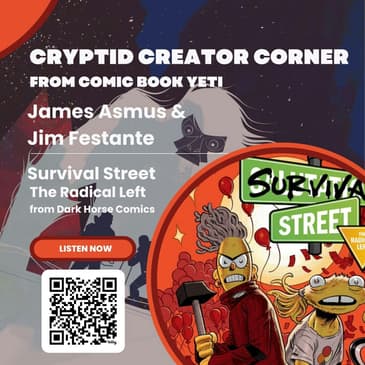
When the first volume of Survival Street came out, I hadn't seen anything like it on shelves and it ended up immediately being one of my picks for the first annual Comic Book Yeti ICE or Indy Comics Excellence Awards in 2022. Who wouldn't love a satirical take on the current sad dominance of corporate culture in America and what a complete take over might look like in a not too distant dystopian future. Couple that with former children's show puppets being the aggressive catalyst to take on our corporate overloads, I was in love. Way back then writer James Asmus came on the show to talk about the project and how it was a mechanism to help overcome the anxiety from the pressures of modern society that we all feel. Now he's back with co-writer Jim Festante for another round promoting the second volume of Survival Street: The Radical Left from Dark Horse Comics. It gave me a rare opportunity to ask not about comic influences but comedic influences for the writing duo, how their partnership works, and even compare a few hopeful notes about where we're all headed.
Make sure to visit their website to see what else they've been working on.
From the publisher
The political satire action-adventure hit series returns!
After America is sold off to private companies, this A-B-C-Team of ex-entertainers rescues kids from cruel company towns. But Portland can’t hold everyone, and the cracks are about to break... Prepare for a radical departure in the series Library Journal called a “blisteringly satirical mash-up of Sesame Street and Robocop.”
A candy coating of pop culture madness, humor, cartoonishly absurd hyper-violence, and just enough hope to keep holding on.
Our episode sponsors
unSeen/unHeard: Disability and Neurodivergence Comic Anthology on Kickstarter
Don't miss this 64-page, 12 story anthology where at least 50% of each creative team is comprised of people who are neurodivergent or have a disability.
Arkenforge
Play TTRPG games? Make sure to check out our partner Arkenforge. They have everything you need to make your TTRPG more fun and immersive, allowing you to build, play, and export animated maps including in person fog of war capability that let’s your players interact with maps as the adventure unfolds while you, the DM get the full picture. Use the discount code YETI5 to get $5 off your order.
Learn more about your ad choices. Visit megaphone.fm/adchoices
[00:00:00] [SPEAKER_01]: Your ears do not deceive you. You have just entered the Cryptid Creator Corner brought to you by your friends at Comic Book Yeti.
[00:00:07] [SPEAKER_01]: So without further ado, let's get on to the interview.
[00:00:33] [SPEAKER_02]: I'm not likely in the cards, but this podcast has connected me with people in ways I never would have imagined possible.
[00:00:39] [SPEAKER_02]: I know the similar challenges disabled creators face trying to get their work seen.
[00:00:43] [SPEAKER_02]: So it should come as no surprise that I'm excited about the new Unseen, Unheard, Disability and Neurodivergence anthology on Kickstarter.
[00:00:52] [SPEAKER_02]: This 64-page, 12-story anthology covers a wide range of genres including slice of life, horror, sci-fi, fantasy, and romance
[00:01:01] [SPEAKER_02]: and features at least 50% of each creative team being comprised of people who are neurodivergent or have a disability.
[00:01:09] [SPEAKER_02]: I know the editors and can assure you it's in good hands.
[00:01:12] [SPEAKER_02]: And after having seen a few sample pages myself, I'm excited to see the rest of what all these amazing creators have cooked up.
[00:01:20] [SPEAKER_02]: If they do a second one, you best believe I'm submitting.
[00:01:23] [SPEAKER_02]: I'll drop a link in the show notes for you or you can find them on Kickstarter. Search for Unseen, Unheard.
[00:01:29] [SPEAKER_02]: Please consider supporting it and our community. Everyone deserves to be seen. Thanks.
[00:01:38] [SPEAKER_02]: Y'all, Jimmy the Chaos Goblin strikes again.
[00:01:42] [SPEAKER_02]: I should have known better than to mention I was working on my DC Universe meets Ravenloft hybrid D&D campaign on social media. My bad.
[00:01:49] [SPEAKER_02]: He goes and tags a bunch of comics creators we know and now I have to get it in gear and whip this campaign into shape so we can start playing.
[00:01:56] [SPEAKER_02]: Another friend chimes in, are you going to make BAPs?
[00:01:59] [SPEAKER_02]: It's fair to say it's been a while since I put something together, so I guess?
[00:02:04] [SPEAKER_02]: It was then that I discovered Ark and Forge. If you don't know who Ark and Forge is, they have everything you need to make your TTRPG more fun and immersive.
[00:02:13] [SPEAKER_02]: Allowing you to build, play, and export animated maps including in-person Fog of War capability that lets your players interact with maps as the adventure unfolds while you, the DM, get the full picture.
[00:02:26] [SPEAKER_02]: Now I'm set to easily build high res animated maps saving myself precious time and significantly adding nuance to our campaign. That's a win every day in my book.
[00:02:35] [SPEAKER_02]: Check them out at ArkandForge.com and use the discount code YETI5 to get $5 off. I'll drop a link in the show notes for you and big thanks to Ark and Forge for partnering with our show.
[00:02:46] [SPEAKER_02]: I think I'm going to make Jimmy play a Goblin Warlock just to get even.
[00:02:51] [SPEAKER_02]: Hello everybody and welcome to today's episode of the Crypti Creator Corner. I'm Byron O'Neill, your host for today's Comics Creator Chat, and I'm joined by co-creators James Asmas and Jim Fistante.
[00:03:02] [SPEAKER_02]: The duo have been working together on field tripping, The End of Times, Brom and Ben, and Rick and Morty properties.
[00:03:08] [SPEAKER_02]: They are dropping the first issue of the second arc of their satirical puppet comedy adventure Survival Street soon with Dark Warp of Spice.
[00:03:16] [SPEAKER_02]: James has already been on the show before talking about the first volume, and I'm delighted to have them both on writing with me today. So Jim, James, how are you both?
[00:03:25] [SPEAKER_05]: Great. Alive. Complained. Okay. I didn't get the right... Cautiously hopeful.
[00:03:31] [SPEAKER_02]: I didn't get the right... Well, we'll take a live. A live is pretty good.
[00:03:34] [SPEAKER_02]: Well, I want to start off with saying thank you for... I got to pull this out. I got a visual aid. My signed promo card from San Diego Comic Con last year.
[00:03:46] [SPEAKER_02]: So sort of to fill everyone in here, my friend Sierra Barnes picked this up for me while signing at the Dark Coast booth with you all.
[00:03:52] [SPEAKER_02]: So make sure to check her book out too. That's Hans Vogue is Dead. Of note here was the fall of 2023 designation.
[00:03:59] [SPEAKER_02]: You know, the first issue was released in August of 2022 and the second arc is now dropping this fall.
[00:04:06] [SPEAKER_02]: Was that like a shift at maximum damage to kind of hit during the presidential election cycle? What happened?
[00:04:13] [SPEAKER_02]: No. You can go with that if it's if it's if it's mundane and you just want to go with yeah, yeah, we were trying to maximize sales.
[00:04:19] [SPEAKER_05]: No, if anything, I feel like my fear about us coming out in fall of 2024 is that people might be like drowning in political angst and they might not want a little more.
[00:04:35] [SPEAKER_05]: Although I will say the goal of this book is to also be a little cathartic about it. So hopefully it's less of a pile on and more of a pressure release valve.
[00:04:44] [SPEAKER_04]: It's almost like, you know, taking like microdosing like poison so you can kind of just like get your system used to it.
[00:04:52] [SPEAKER_05]: Right, right. Yeah. Yeah. But poison and microdosing mushrooms at the same time.
[00:04:59] [SPEAKER_05]: That's really that might be we might have just stumbled on the best metaphor for this book.
[00:05:05] [SPEAKER_02]: Was that Hannibal that did that? I'm trying to remember like the the world leaders back in the day who actually did microdose poison.
[00:05:11] [SPEAKER_05]: Oh, yeah. That sounds about right. It just always makes me think of Princess Bride.
[00:05:16] [SPEAKER_05]: Okay, sure. Those are more my references than historical facts.
[00:05:22] [SPEAKER_05]: But you know, I think I don't know if it was now.
[00:05:26] [SPEAKER_05]: I can't remember if it was that we got our wires crossed or if it was over zealousness on our part that once they said we would do another volume that we thought it was that year.
[00:05:40] [SPEAKER_05]: But Dark Horse just had a pretty full schedule.
[00:05:45] [SPEAKER_05]: And then our artist Abel A. Kusanov had after the first volume committed to another project kind of before it was even coming out.
[00:05:55] [SPEAKER_05]: And so he needed time to finish that before he could start working on this.
[00:06:00] [SPEAKER_05]: And somehow what we thought would be the way we would come out at the end of last year, this the way schedules triangulated between publisher and artist and everything.
[00:06:11] [SPEAKER_05]: We couldn't do that. And the next open slot Dark Horse had was this fall.
[00:06:17] [SPEAKER_05]: Okay. So yeah, my fear is that is that people might be getting overloaded as is.
[00:06:28] [SPEAKER_04]: I feel like we're a little out of woods. I don't want to get too excited, but we're definitely not where we were about a month ago.
[00:06:37] [SPEAKER_02]: So the anxiety is kicking in for you both. I see. I get it.
[00:06:42] [SPEAKER_05]: Yeah, yeah. Absolutely.
[00:06:43] [SPEAKER_05]: I mean, we have perpetual baseline anxiety that this book is largely built as a coping mechanism for us and a way for us to kind of wrestle with all the things in the world that are stressing us out.
[00:06:57] [SPEAKER_05]: And we hope we've heard from people. It's pretty effective at kind of engaging that anxiety and other people while kind of exercising it in a way that's been overall more enjoyable.
[00:07:15] [SPEAKER_05]: Which if it's doing that for other people, I'm hugely grateful and relieved and happy to provide some of that because it's definitely doing it for us.
[00:07:25] [SPEAKER_02]: I'm here for it. I love this book. And now that I've got you both together, last time James told me about how you met during doing improv comedy in Vegas.
[00:07:34] [SPEAKER_02]: So, yeah, I get to ask people all the time about comic book influences. But who are your comedic role models? Because I never get to ask that question.
[00:07:42] [SPEAKER_04]: That's awesome. Yeah. I mean, I think my trifecta growing up was probably early Saturday Night Live.
[00:07:52] [SPEAKER_04]: Second City Television and Weird Ali Anger. That was my holy triumvirate.
[00:07:59] [SPEAKER_05]: Awesome. Yeah, I would say my earliest comedy influences were The Muppets. No surprise.
[00:08:10] [SPEAKER_05]: My dad had a bunch of comedy records I kept listening to, which were like Bob Hope, Bill Cosby, Before We Knew.
[00:08:21] [SPEAKER_05]: And I know he had some others, but those are kind of... Oh, Smothers Brothers.
[00:08:26] [SPEAKER_05]: And then I kind of latched on early on to weird old rerun stuff on TV like Laugh-In and Bob Hope Telethon kind of thing.
[00:08:41] [SPEAKER_05]: So there is a kind of cheesy performative thing that I can't shake from my earliest things.
[00:08:49] [SPEAKER_05]: But once I got into my own, Kids in the Hall was really transformative for me.
[00:08:54] [SPEAKER_05]: In terms of kind of the weirdness, the specificity of character, the sort of sincerity with which they approached oddballs.
[00:09:04] [SPEAKER_05]: And I think that really started to permeate a lot of my other character work.
[00:09:08] [SPEAKER_02]: Okay. Well, Jim, tell me about Second City because I grew up and I guess my comedy influences were a lot of what was on WGN because that was like the expanded cable at the time.
[00:09:18] [SPEAKER_02]: So I had The Jeffersons and Sanford & Sons. Those were mine.
[00:09:22] [SPEAKER_02]: Yeah, I had that box.
[00:09:25] [SPEAKER_04]: I had this friend in third grade that we were like super tight and we would always hang out.
[00:09:31] [SPEAKER_04]: I loved his family. His parents were really cool and his dad was just into...
[00:09:36] [SPEAKER_04]: Yeah, he would again in third grade would just show us SCTV.
[00:09:40] [SPEAKER_04]: And again, kind of like the first couple years of Saturday Night Live.
[00:09:45] [SPEAKER_04]: And it was just like, what is this? This is fantastic.
[00:09:49] [SPEAKER_04]: So, yeah. So I've always just kind of had an affinity like, James, like what you're saying too about just like kind of those oddball sketches, especially SCTV was just so...
[00:09:59] [SPEAKER_04]: You know, like SNL was cool and I don't know if I would ever describe SCTV as cool except in a counter cool, like so nerdy it was cool kind of thing.
[00:10:11] [SPEAKER_04]: But all of those people like Eugene Levy, Katherine O'Hara, Martin Short, just genius.
[00:10:19] [SPEAKER_04]: John Candy.
[00:10:19] [SPEAKER_04]: Yeah, John Candy, genius level people. Rick Moranis.
[00:10:22] [SPEAKER_04]: So it was just having that introduction and then yeah, just like the sheer amount of Weird Al that I listened to.
[00:10:31] [SPEAKER_04]: There are just so many songs where it's like you hear the original unparodied song and it's just my brain just does the lyrics for whatever Weird Al version.
[00:10:39] [SPEAKER_05]: My son is now diehard on Weird Al over the last like year.
[00:10:44] [SPEAKER_05]: It's just endless. So it's gotten me back into all that and caught up on anything since I... He's too good.
[00:10:52] [SPEAKER_05]: Yeah, like that's very true.
[00:10:54] [SPEAKER_02]: I still play Christmas at Ground Zero every Christmas because I grew up in Oak Ridge, Tennessee.
[00:10:59] [SPEAKER_02]: So we had three nuclear power plants in the city that I grew up.
[00:11:02] [SPEAKER_02]: So it just feels right. It feels on brand.
[00:11:06] [SPEAKER_02]: Well, when did the partnership doing improv comedy translate into a comics writing partnership?
[00:11:15] [SPEAKER_02]: Pretty quickly.
[00:11:17] [SPEAKER_05]: Because so originally Jim and I talked about doing something as a web series.
[00:11:27] [SPEAKER_05]: There was sort of a concept that I... Some stuff I had been doing some comedy on about like End Times fiction.
[00:11:38] [SPEAKER_05]: And we started talking about it and kind of landed on this idea that became our first comic together, an image book, The End Times of Bram and Ben.
[00:11:48] [SPEAKER_05]: And it was really like this idea that if the biblical apocalypse happened and came true,
[00:11:55] [SPEAKER_05]: because especially around that time 2012 ish, there were just every six months some preacher was predicting a date, like a specific date.
[00:12:05] [SPEAKER_04]: The Mayan calendar, I think, is around then too.
[00:12:09] [SPEAKER_05]: And so we were talking about like if that happens, we are not going to get raptured.
[00:12:17] [SPEAKER_05]: We did not qualify for literal biblical cross your T's dot your I's.
[00:12:23] [SPEAKER_05]: But we're like, but we think we're good people.
[00:12:25] [SPEAKER_05]: So it'll really suck if we're trapped on Earth when demons start to rise and torture humans and begin this decades of plague and torment.
[00:12:36] [SPEAKER_05]: And I was like, we just thought about that.
[00:12:39] [SPEAKER_05]: Like the reality of what is it to be a person when this you're like, oh, I picked the wrong horse and now I'm going to be cosmically screwed for the next few years.
[00:12:52] [SPEAKER_05]: And that just seemed ripe for comedy and commentary for us.
[00:12:56] [SPEAKER_05]: And we started writing something we thought would be maybe like a web series that we could do together as performers.
[00:13:03] [SPEAKER_05]: But really quickly, I think the scope of what we wanted to do and talk about and explore with it just got too big for what we could accomplish.
[00:13:12] [SPEAKER_04]: James, we did shoot a sort of pilot.
[00:13:16] [SPEAKER_04]: So that's right. Don't leave that part out.
[00:13:18] [SPEAKER_04]: That's right. That's right. Floating out there somewhere on the Internet is.
[00:13:22] [SPEAKER_05]: Yes. No, hey, if any producers want to see a future concept for how you could adapt it with a budget, that's a low budget.
[00:13:31] [SPEAKER_05]: But very low. But yeah, so the scope of what we wanted to do just got bigger.
[00:13:38] [SPEAKER_05]: And eventually I was like, I've been doing enough comics at that point that I was like, you know, we could try doing a first creator.
[00:13:46] [SPEAKER_05]: And we found a great artist, Rem Brew, and he
[00:13:55] [SPEAKER_05]: image picked up the book and we learned a lot doing our first creator own.
[00:14:01] [SPEAKER_05]: But there's a lot I love about that book. I'm still proud of it.
[00:14:05] [SPEAKER_05]: And the process was so much fun that we just wanted to keep working together.
[00:14:11] [SPEAKER_05]: And we just kind of ever since then worked on stuff.
[00:14:15] [SPEAKER_05]: There's always been something that we're always working on what's next together.
[00:14:19] [SPEAKER_05]: And we developed some stuff for animation that didn't see the light of day, but it got us through a couple times being hired to develop some other things for people.
[00:14:30] [SPEAKER_05]: So we've just kind of always been doing something since 2012.
[00:14:37] [SPEAKER_04]: Yeah. Yeah. And like with that improv thing, too, of just like, you know, hitting on that.
[00:14:41] [SPEAKER_04]: Like that was like for me, it was our first year of college and our acting program was just like all improv.
[00:14:48] [SPEAKER_04]: And I hadn't really done it before. But our mutual friend who introduced us was in my class and had been doing improv for a couple of years and put together a group.
[00:14:56] [SPEAKER_04]: And it was like super fun. And what I loved about that background is just like I've never made something by myself that wasn't that was better than something I've made with other people.
[00:15:06] [SPEAKER_04]: And I really love that kind of collaboration. And so it's just like the stuff that James and I get to do, like it's just it's selfishly it's just really fun to write together and kind of come up with these different situations where we're always just asking like, OK, well, if this thing is true, like what does that mean?
[00:15:23] [SPEAKER_04]: And it's like, you know, really fun to kind of dig in and explore. Like what are the ramifications of the biblical apocalypse? Republicans getting everything they want in our country.
[00:15:33] [SPEAKER_05]: Yeah. All that all that fun stuff. But but to explore it with someone else, you get surprised by their brain and their connections they make and the way they elevate something and escalate it.
[00:15:49] [SPEAKER_05]: Yeah. And that extends to each other, but then also the artists that we've been fortunate enough to work with and the way they bring it to life and add their own flair and visual gags and just keep raising the creative level of it.
[00:16:06] [SPEAKER_05]: It's it's so addictive and especially compared to when we were working in, you know, in TV projects that kept you hit a ceiling and one person goes, we're not going to put more money into this.
[00:16:21] [SPEAKER_05]: So this thing you love never sees the light of day. But then in comics, we can we could find a way to make it happen. And the fact that we keep having that opportunity has really kept us excited and has ultimately made us just kind of prioritize making comics so that we get to share what we are proud of.
[00:16:43] [SPEAKER_05]: You know, whoever's up for something new and weird.
[00:16:48] [SPEAKER_02]: Yeah. Well, jumping into the book itself to give people kind of an abbreviated catch up as to exactly what Survival Street is all about. After corporations have fully taken over America, a group of former childhood edutainer public stars get together to take on the corporate overlords and save all the children.
[00:17:04] [SPEAKER_02]: You know, it deserves this book really deserves more attention and my prediction that it would win awards last time James seems to have been a bit premature. But you got a second volume. So I'm not the only one that liked it.
[00:17:17] [SPEAKER_02]: You know, and in my read through the thing that really stuck out is it weirds me out how in this day and age we simply can't escape being part of the system.
[00:17:26] [SPEAKER_02]: And like, I hate supporting Amazon all the time. I do it anyway because budgets are tight. I'm disabled. We have a teenager, you know, all these things and it doesn't escape me that we're chatting about a book essentially owned by a Swedish multinational corporation, the Embracer Group with 38 billion dollars.
[00:17:42] [SPEAKER_05]: No, it's not. No, it's owned by us. No, no, this I'm very proud to and grateful to say this really is a creator and book like through but dark publishing.
[00:17:53] [SPEAKER_05]: Well, our publishing partner is Dark Horse, but we own all the rights to like it still is a greater own book where really we just have a publishing agreement with them. But if we were to make toys or a movie or whatever, that's that's just us.
[00:18:10] [SPEAKER_05]: And it's it's it will us and the creative team like it's shared with artists, colorist letter.
[00:18:15] [SPEAKER_04]: But but fire into your paint like then those people making the toys are like, yeah, no, there are no like good conscious decisions in in corporate America.
[00:18:27] [SPEAKER_05]: Like you learn at school. Yeah, any large sale consumable.
[00:18:32] [SPEAKER_02]: Yeah, I mean, it all goes incredibly hands always right. It feels inescapable and overwhelming, which hey, this is a perfect time to enter murder puppets. Right. So we were introduced to Tony the Troll, hippie the hippo, gurgle birdie Hubert in the first volume and their corporate attacking ways that there are so many things you could focus on.
[00:18:53] [SPEAKER_02]: You know, I got a review copy sent over kindly from Dark Horse. And it was really funny that prioritization was one of the very things the team is battling with as we all seek to make a little dent in this massive current shit storm that we find ourselves in.
[00:19:07] [SPEAKER_02]: So did you decide what to tackle in volume two?
[00:19:13] [SPEAKER_05]: I you know, we definitely wanted to not just do more of the exact same. And so so while they do have new missions and different things, they're like topics were wrestling with every time.
[00:19:29] [SPEAKER_05]: It's very conscious for this volume. We wanted to kind of pivot to what our problems within the left or the resist any coalition trying to resist forces of power.
[00:19:41] [SPEAKER_05]: And we wanted to sort of expand the scope of what we're talking about to talk about the problems, the headaches, what you wrestle with internally when you're trying to push back against a giant system like this.
[00:19:57] [SPEAKER_05]: And what we'll hit on a few different things through the mini series. But one of the core ones is, you know, when 1% have the power and you're gathering just a coalition of all the people being harmed by it, the truth is, we're coming from all different places and there's all different ways people are being harmed.
[00:20:19] [SPEAKER_05]: And so your personal investment in which battle to prioritize is going to be different. And you're also going to find uneasy allyship where you're going to disagree on how far do you want to take it?
[00:20:35] [SPEAKER_05]: What measures are going to go too far for your code, for your morality, for your vision of an ideal outcome or society?
[00:20:44] [SPEAKER_05]: And and so the reality of that is something we wanted to wrestle with. And we were kind of anxiety predicting once we realized this was coming out in 2024, the way the left often eats itself at a time when it needs to come together.
[00:21:03] [SPEAKER_05]: And so there was a lot of anxious forecasting about how many ways are we going to shoot ourselves in the foot or undermine our own best efforts? How often does the left make the perfect, the enemy of the good, right?
[00:21:20] [SPEAKER_05]: And that we sort of say, like unless it's exactly passing this purity test, tear it down. And it's sort of like, oh, my God, if when you're stuck with a binary decision, you're trading away better for horror sometimes.
[00:21:37] [SPEAKER_05]: And it's just like, is that what we want to do? But that's not to say we have the answers either. And a lot of this arc represents that there can be two different views and there is a real wrestling within us sometimes about how we feel about the own responsibility choices, moral choices we can make.
[00:21:59] [SPEAKER_05]: But funnier. I'm not making it sound funny, but it's because we take the comedy very seriously and then we dress it up in puppets with weird hang ups and because otherwise no one would go and would want to listen or read it.
[00:22:13] [SPEAKER_04]: You know what I mean? It's like that is what is so brilliant about satire is just that you're able to kind of dig into these really deep, heavy things without turning people off.
[00:22:23] [SPEAKER_04]: You know, it's why people were psyched when Jon Stewart's like, I'm coming back to The Daily Show on Mondays. And you know, you have yeah, so it's just it's being able to laugh and cut through that tension makes everything a little bit more palatable.
[00:22:39] [SPEAKER_04]: And then like, yeah, that step back just allows you to kind of think a little bit more clearly about, yeah, what are these arguments and you know, what are the things that we need to talk about? Because if we don't talk about them, then yeah, we are going to perpetually just shoot ourselves in the foot by making like James said, you know, the perfect enemy of good.
[00:22:58] [SPEAKER_02]: Yeah, I mean my favorite bit was poking fun of schools being privatized. You know, just this week I discovered that the standardized AC test that ACT test that high schoolers take for college applications since we're in that phase ourselves has now moved into the hands of corporate ownership formerly nonprofit.
[00:23:18] [SPEAKER_02]: Obviously you're exploring some controversial topics in the book, although I'd argued not much wouldn't be considered controversial in some way and these polarized times in our country.
[00:23:26] [SPEAKER_02]: Right. So what's the difference between approaching these topics in a comic form? In terms of producing a comedy centric focus over say a stand up routine or a TV show like what are you able to get away with differently?
[00:23:45] [SPEAKER_04]: Except pieces like you know what I mean? Like you can make like really fun. Like that's what I loved about comics. Like when James had proposed the idea of us turning end times into a comic book, I hadn't ever written for comics before.
[00:23:59] [SPEAKER_04]: I mean, I've written like, you know, TV stuff or you know nothing, nothing that was in that format. So learning, you know, just that freedom of just we could do whatever we want to do is something really special because if there's a point you're trying to make, if there's a thing you're trying to do, like you can go as far as you want to with it.
[00:24:20] [SPEAKER_04]: To kind of push it to have it be as effective as you need it to be. And so it's kind of hard to do that with other mediums unless, you know, again, you have tens of millions of dollars making a TV show or a movie.
[00:24:36] [SPEAKER_05]: And I would also add, I think, you know, something that I love about narrative as opposed to stand up. And I did spend a few years doing stand up, which was really valuable, but it was like both the hardest and the worst thing that I had done in my creative career in terms of like just it's full credit to people who do it.
[00:25:01] [SPEAKER_05]: And it was the biggest struggle because I think the audience is so resistant. They really you walk into that audience and they sit there with their arms crossed like, okay, impress me.
[00:25:12] [SPEAKER_05]: You know, whereas I think and it's because it's just one opinion being beaten at them. Whereas when you do a story like this, you can have different characters with different perspectives and you can introduce a little uncertainty.
[00:25:31] [SPEAKER_05]: And so I think there's more room for audiences to find themselves in there. And so truly like within this team, we have a spectrum of characters from total pacifists to like militant pseudo anarchists.
[00:25:47] [SPEAKER_05]: You know what I mean? And and they're all the story invests in all of them. And so we've heard from different people who have a different favorite character or they identify a different person.
[00:26:00] [SPEAKER_05]: Very interestingly, different characters as like the lead of the team or like the lead perspective. And I'm like, oh, it's very telling to me about your perspective because we sort of try to have a balance.
[00:26:15] [SPEAKER_05]: And it's just something I think is valuable about narrative. We can round out the edges and have more shades of coloring to what we're saying or a greater complexity.
[00:26:29] [SPEAKER_05]: And just at the end be like, these things remain in conflict with each other. And this is what happens to diverging opinions.
[00:26:38] [SPEAKER_04]: And a literal sense of like color, right? I mean, it's a visual medium and it's just like, it's beautiful to look at. Like, you know, Abela's art is phenomenal.
[00:26:50] [SPEAKER_04]: I mean, I don't understand how the man gives puppets emotions in pictures. Yeah, I mean, that is doubly difficult and he pulls it off. Doesn't just pull it off.
[00:27:02] [SPEAKER_04]: I mean, just is amazing at it. And then have it like even further brought to life with Ellie Ellie's colors. It's just Ellie Wright's colors.
[00:27:11] [SPEAKER_04]: It's like, you know, it's lovely to look at. And like James was saying earlier, too, of just like finding like, you know, what are their things that they're putting in that we haven't necessarily asked for?
[00:27:21] [SPEAKER_04]: But like, you know, I remember that first time too with Brennan Bram and, you know, we would get pages back and there would just be like jokes that Rembrew had put in.
[00:27:33] [SPEAKER_04]: And I was just like, that's fantastic. I love that aspect of it. So yeah, to have something that you're also just like can appreciate visually, I think is really special too.
[00:27:45] [SPEAKER_04]: All right, let's take a quick break.
[00:27:55] [SPEAKER_02]: After a string of unexplained disappearances in the southern parts of the United States, retired detective Clint searches for his white trash brother.
[00:28:03] [SPEAKER_02]: While searching for him, he ends up being abducted by aliens. He is now in the arena for Big Guns Stupid Rednecks, an intergalactic cable's newest hit show, which puts him and other humans in laser gun gladiatorial combat.
[00:28:18] [SPEAKER_02]: And his brother is the reigning champion with 27 kills. That's the premise for a new book from Banda Barnes, Big Guns Stupid Rednecks.
[00:28:27] [SPEAKER_02]: I got a chance to see an advance preview of this book and being from the south, honestly, I was a bit skeptical going in, but they won me over and nothing is more powerful than an initially skeptic convert in my book.
[00:28:38] [SPEAKER_02]: In Jimmy's words, Big Guns Stupid Rednecks is many things, but it isn't subtle. It tells you exactly what it is upfront, then it delivers with a great premise, fantastic art and a whole mess of fun.
[00:28:50] [SPEAKER_02]: I had a great time reading Big Guns Stupid Rednecks and what I thought was going to be an indictment of redneck culture quickly showed it was actually a love letter.
[00:28:58] [SPEAKER_02]: A family mystery, brother pitted against brother, aliens fighting for profit in a big arena. This truly has it all.
[00:29:04] [SPEAKER_02]: Issue one is out already, but you can still pick up a copy on the Banda Barnes website and current issues are available via your previews or lunar order form or just ask your LCS.
[00:29:13] [SPEAKER_02]: Don't miss it. Let's get back to the show.
[00:29:17] [SPEAKER_02]: As comedians, how do you kind of approach that shift in audience? How do you entertain the comic book reader as an audience of one when sort of pinning a script because there's no feedback loop.
[00:29:29] [SPEAKER_02]: You can't read the crowd. There's no way to walk it back. So how do you know when you hit that line or do you just like, oh, we fucked up?
[00:29:39] [SPEAKER_05]: I mean, I it's you're very right and it's a very interesting. It's so different, especially from improv where you really can dynamically respond to where the audience is happy to go.
[00:29:54] [SPEAKER_05]: And if you feel like you've wronged some way and you can sort of tease them across the line, if you realize they need more work to get where you're trying to go or you can sort of make an apology and like pivot or double down.
[00:30:10] [SPEAKER_04]: Yeah, exactly. Oh, you didn't like that. Here's more. Yeah.
[00:30:14] [SPEAKER_05]: And and but I truly think.
[00:30:19] [SPEAKER_05]: A couple things. One thing is humor is like music in that.
[00:30:26] [SPEAKER_05]: Objectively well done things can be your taste or not your taste.
[00:30:31] [SPEAKER_05]: And there are objectively wonderful albums that I have no interest in listening to because it's not my jam.
[00:30:39] [SPEAKER_05]: And then there's stuff that's like, okay, musically. But I love it because it's just it's the right flavor for me.
[00:30:47] [SPEAKER_05]: And humor granted has that right. And so hopefully we try to cover our bases and have a mix of like really biting satire, but then also really silly puppet stuff.
[00:30:59] [SPEAKER_05]: And you try to. For us, kind of make more of a meal rather than one dish, hopefully in and to mix my metaphors now from music.
[00:31:10] [SPEAKER_05]: But or we're making a mixtape. You know what I mean?
[00:31:13] [SPEAKER_05]: And so so we're trying to get things that are sort of like within a range and they're they're sort of thematically tied.
[00:31:22] [SPEAKER_05]: But we're we're mixing up what it is to try to appeal to a broader range.
[00:31:29] [SPEAKER_05]: And they're not something for everyone.
[00:31:31] [SPEAKER_05]: But if you're if you relate to the anxiety this book is based on, then there's something in there for you.
[00:31:39] [SPEAKER_05]: And there's there's the light and silly side. And then there's the like earnest emotional investment in this stuff.
[00:31:46] [SPEAKER_05]: Like, I think one of the biggest things we want people to know is it seems like the biggest risk was some people just dismissed the book out of hand and never tried to read it because they just think it's shock puppet stuff.
[00:31:59] [SPEAKER_05]: Right. They think it's sort of the lowest common denominator version of what the premise looks like to them.
[00:32:04] [SPEAKER_05]: And we put I promise you we put way more thought and and and effort and concern and sincerity into it than that while also still being ridiculous.
[00:32:17] [SPEAKER_05]: But yeah, comedically, I think, you know, we spent enough time live in front of a broad enough range of audiences.
[00:32:26] [SPEAKER_05]: I spent four years performing in Louisiana and I spent three five years performing in Chicago.
[00:32:34] [SPEAKER_05]: And then I toured around the country.
[00:32:36] [SPEAKER_05]: And Jim was in New York, in New Jersey and L.A.
[00:32:39] [SPEAKER_05]: And we did shows in Vegas for crowds from all over the world.
[00:32:43] [SPEAKER_05]: And you really kind of learn what version of your sense of humor has the best batting average.
[00:32:49] [SPEAKER_05]: OK. And so and you start to learn, you know, where my sensibilities resonate most effectively.
[00:32:59] [SPEAKER_05]: And so once Jim and I both had a decade plus of that experience honing that once we go into a script, if we both like something and we both feel like it's funny and it makes the point and it works,
[00:33:12] [SPEAKER_05]: I feel pretty confident in putting that out into the world, that it's going to hit about as well as you can for something that's still ultimately as subjective as you.
[00:33:24] [SPEAKER_04]: But also like James and I, our backgrounds are both very much in grounded comedy.
[00:33:30] [SPEAKER_04]: You know, it's not just like, you know, like let's make jokes and offhanded things and let's just be silly nonsense.
[00:33:37] [SPEAKER_04]: It's always based in something. And I think real good comedy is or at least it has been for us to experience.
[00:33:44] [SPEAKER_04]: So we try to do that with our books as well.
[00:33:47] [SPEAKER_04]: So, like, you know, it is always based in an emotion and a real thing, you know, in real relationships.
[00:33:56] [SPEAKER_04]: So it's not just like, you know, you can tell when it's like kind of empty and it's just like somebody's either performing or writing something or doing something that's just like for laughs.
[00:34:04] [SPEAKER_04]: And that's like really where comedy comes from. I mean, comedy, good comedy is recognition.
[00:34:10] [SPEAKER_04]: So it's just like it has to be grounded in something real.
[00:34:14] [SPEAKER_02]: So I want to explore for just a sec how comedy as a mechanism can make people feel uncomfortable in a good way, you know, in a way that promotes thought evaluation and not just something for purely entertainment value.
[00:34:25] [SPEAKER_02]: You know, I personally hate dystopian sci fi shit. Right.
[00:34:29] [SPEAKER_02]: As a disabled person, putting myself into one of those types of narrative vehicles is depressing because I know I'm fucking toast.
[00:34:35] [SPEAKER_02]: You know, and it just makes me feel anxious.
[00:34:39] [SPEAKER_02]: Comedy, however, with like the same trappings, I absolutely love.
[00:34:42] [SPEAKER_02]: Like I was thinking the other day a lot about how prescient the movie Idiocracy was and recently watching like my childhood hero Hulk Hogan up on stage at the RNC convention.
[00:34:52] [SPEAKER_02]: It's like this crazy surreal analog to Terry Crews playing President Kamacho in the movie.
[00:34:57] [SPEAKER_02]: So to my original point, why do you think comedy allows us to explore uncomfortable things in a more approachable way?
[00:35:04] [SPEAKER_04]: Because it's not such a turn off. It's like when you said that, my brain immediately went to the Apple TV show Silo and fall out.
[00:35:13] [SPEAKER_04]: Right. Because Silo like Emily and I tried my wife, Emily and I tried to watch it.
[00:35:17] [SPEAKER_04]: And it was just like, I remember reading the books like what 15 years ago at this point.
[00:35:21] [SPEAKER_04]: And I love them. And like, you know, it was really interesting.
[00:35:24] [SPEAKER_04]: But like we tried to watch the show and my God, it was a slog to get through because it was so depressing and everything was going wrong.
[00:35:31] [SPEAKER_04]: And they're trapped in this silo.
[00:35:33] [SPEAKER_04]: And then you have fallout, which is the same premise, but it's handled in a different way where there it's still serious.
[00:35:40] [SPEAKER_04]: But there is an under it's all built on humor.
[00:35:44] [SPEAKER_04]: It's dark humor, but it allows you that release and that tension to go somewhere as opposed to like with with silo.
[00:35:51] [SPEAKER_04]: It was just like you just had all this tension and nowhere to take it.
[00:35:55] [SPEAKER_04]: There was nowhere to go with it. Whereas with the fallout, they gave you that moment of release.
[00:36:00] [SPEAKER_04]: There's the laughter. They're able to kind of release that tension.
[00:36:02] [SPEAKER_05]: I also think so often humor if it I mean when it's done effectively.
[00:36:08] [SPEAKER_05]: It is. Nudging you in the ribs at the moments of like this is inappropriate, right?
[00:36:17] [SPEAKER_05]: Or like this sucks, right? You know, I mean, as opposed to and it's meant to call out the absurdity, the schadenfreude, the like commiseration.
[00:36:28] [SPEAKER_05]: And hopefully it's done heightened enough that there's like surprise or weirdness to it that adds a zest of fun on top of the bitter pill.
[00:36:44] [SPEAKER_05]: And and I think that mixture is so much more.
[00:36:51] [SPEAKER_05]: First off, you feel like you're not in it alone.
[00:36:52] [SPEAKER_05]: And someone else understands. Whereas when you're watching like straight drama and it gets to something uncomfortable,
[00:37:01] [SPEAKER_05]: it can be sometimes hard to tell if the narrative just wants you to suffer or it's just doing it and it doesn't realize how painful it is for you as the audience.
[00:37:12] [SPEAKER_05]: Or, you know, like to get specific in without being too specific.
[00:37:20] [SPEAKER_05]: I really don't I don't write like sexual assault and I really have a hard time watching things that have it in it,
[00:37:29] [SPEAKER_05]: which is not to deny the existence or the problem of that.
[00:37:34] [SPEAKER_05]: But so often I have seen it depicted in films or television where I can't tell if the film is unaware that it's painful to watch.
[00:37:46] [SPEAKER_05]: If they're just doing it because they think it's a story beat as opposed to if they understand the intentionality, sensitivity, the effect on the audience.
[00:37:57] [SPEAKER_05]: And what's worse, I've seen other ones where I feel like they want you to like luridly enjoy it or it feels like the filmmakers in some way enjoy this component.
[00:38:08] [SPEAKER_05]: And that is horrible and uncomfortable, like another level to experience.
[00:38:14] [SPEAKER_05]: So I think comedy approaches uncomfortableness in a knowing way.
[00:38:20] [SPEAKER_05]: And maybe I don't want to say most, but modern comedy and certainly with us, most of the time I'm sure we have our blind spots.
[00:38:30] [SPEAKER_05]: But we are generally aligning ourselves with the disempowered person in these awkward scenarios like we are our empathy, our sympathy, our identification ourselves is usually with the people getting screwed over in these stories.
[00:38:47] [SPEAKER_05]: And so I also think when comedy by people who have that perspective gets to something uncomfortable, it's usually knowing and meant to be cathartic or commiserating and a relief as opposed to even just in being like we see you.
[00:39:10] [SPEAKER_05]: We feel this and has some absurdity that makes it not just reliving a horrible kind of thing that happens.
[00:39:19] [SPEAKER_04]: Yeah, I mean, it's almost like, you know, not to be too grandiose. It's just like it's how you I mean, it's like looking at life, right?
[00:39:25] [SPEAKER_04]: I mean, it's so easy to just like you can look around and be like, nothing means anything. And it's wildly depressing.
[00:39:32] [SPEAKER_04]: And that is a valid perspective to look at. Or you could look at it and be like, nothing means anything. You know what I mean?
[00:39:40] [SPEAKER_04]: So it's just like, why not take that second point of view and go easy on yourself as opposed to just like, you know, the first one you're going to you're just going to drink yourself to death.
[00:39:51] [SPEAKER_04]: So it's just like, but if you have that way of just like looking at the absurdity of things and like James was saying, like having other people around you, like we are communal animals.
[00:40:02] [SPEAKER_05]: Then you drink yourself to life instead of to death.
[00:40:07] [SPEAKER_03]: Yeah, yeah. So, you know, do that.
[00:40:13] [SPEAKER_02]: Well, I think about that line. Right. And so are you ever afraid that thou shalt not pass tolerance line will move again like before the issue comes out?
[00:40:23] [SPEAKER_02]: Okay. What got me thinking about this? I logged into Twitter X whatever we're calling it today and yesterday like shitter like the X.
[00:40:31] [SPEAKER_02]: I call it. I love that.
[00:40:33] [SPEAKER_02]: That works.
[00:40:35] [SPEAKER_02]: It's a dumpster fire. But when I logged in, I saw trending JD Vance Jizz Cup.
[00:40:42] [SPEAKER_02]: Okay. That was yesterday. That was not on my bingo card for the week.
[00:40:47] [SPEAKER_02]: So we seem to be hurling at an ever accelerated pace and you guys are juggling with fire here.
[00:40:53] [SPEAKER_02]: Right. So yeah, not to not to compound your anxiety. But are you are you worried you'll transcend?
[00:41:00] [SPEAKER_04]: We can't compete with JD Vance Jizz Cups. Kind of.
[00:41:03] [SPEAKER_04]: How do you keep up? Right.
[00:41:05] [SPEAKER_04]: Well, that's the thing is like we don't there's nothing that we're doing that is specific to an event.
[00:41:10] [SPEAKER_04]: It is more about the climate that we're in.
[00:41:14] [SPEAKER_04]: Yeah, yeah.
[00:41:15] [SPEAKER_05]: It's yeah. That's the thing. We don't we don't chase an individual moment in culture or pop culture.
[00:41:25] [SPEAKER_05]: And that's why it's I mean, the difference between satire and parody is a few things.
[00:41:31] [SPEAKER_05]: But one of them is that you're addressing sort of a broader swath of reference.
[00:41:39] [SPEAKER_05]: And so it is it's a systemic problem about we've got issues coming up that are really about AI being forced into or displacing creatives to make soulless kids out of the world.
[00:41:57] [SPEAKER_05]: And that is, you know, there's certain things we had in mind when we were writing it.
[00:42:03] [SPEAKER_05]: But it's not entirely rooted to one moment, one show, one whatever.
[00:42:11] [SPEAKER_05]: It's it's it's meant to represent a bigger struggle that is happening and is going to be happening for the next several years at least.
[00:42:21] [SPEAKER_05]: And similarly, it's why while some of our puppet characters are more directly analogous to some other ones, other ones are just kind of.
[00:42:31] [SPEAKER_05]: A squinty type, you know what I mean? Or or it really is sort of spiritual, but the hallmarks are kind of all all different kinds of stuff put together.
[00:42:43] [SPEAKER_05]: And so we're not worried about like.
[00:42:47] [SPEAKER_05]: We did this version of.
[00:42:52] [SPEAKER_05]: Like, we don't have a JD Vance. We don't have like we never name who the president is.
[00:42:57] [SPEAKER_05]: It's just that the president, the corporations were OK with picking and stuff like that.
[00:43:04] [SPEAKER_05]: And so.
[00:43:05] [SPEAKER_05]: By not pinning ourselves to anything particular, we're able to talk about these broader things like privatization of kids education has been increasing and increasing.
[00:43:17] [SPEAKER_05]: There are companies for the last decade who are saying, OK, we'll fund our local education system, but it's all going to be about how our local petrochemical industry is great.
[00:43:31] [SPEAKER_05]: And it's good for everything. And you're not going to teach about climate and you're not going to teach about fracking, causing earthquakes or whatever.
[00:43:39] [SPEAKER_05]: But we'll give you all these books to alleviate the cost of education.
[00:43:43] [SPEAKER_05]: And so that's like one example.
[00:43:46] [SPEAKER_05]: But there's dozens of other ones. And so when we're just talking about this systemic trend.
[00:43:54] [SPEAKER_05]: Then we can do our own weird version of it.
[00:43:57] [SPEAKER_05]: And hopefully reality won't pass us.
[00:44:00] [SPEAKER_05]: But I will say there's no shortage of things that we kind of have done as offhand jokes where, like, by the time it comes out, it's really happening or it's something very close to it.
[00:44:12] [SPEAKER_05]: Like the first volume we had written this stuff about, you know, forced child labor in factories in America.
[00:44:20] [SPEAKER_05]: And then three months before we came out, but once the book was done, there was like an arms race among red states to see who could roll back child labor laws most fully to satisfy local industries to where people were like, yeah, a nine year old can work overnight in a meat slaughtering factory.
[00:44:43] [SPEAKER_05]: You know what I mean? It's like it's just it's insane.
[00:44:46] [SPEAKER_05]: Actually, if they're an immigrant. Right. And it's things that when we were writing it, we thought were definitely beyond reality.
[00:44:55] [SPEAKER_05]: And then it was catching up to us really quickly.
[00:44:58] [SPEAKER_05]: And that's always horrifying. But then it also just means, I think as long as we're playing kind of absurd enough with it, it actually only makes the rest of our anxiety and forecasting feel maybe a little more real.
[00:45:14] [SPEAKER_05]: And like, yeah, we should we should worry about you should think about this. You should ask where this goes.
[00:45:20] [SPEAKER_02]: Well, James, I read in a recent interview of yours that you would describe the first volume as our primal scream. Yeah. You know, now you're getting the second volume to play with, which is rare these days in comics, by the way. Congratulations. That's amazing.
[00:45:34] [SPEAKER_05]: Well, thank you for, you know, like, like you were an early enthusiast for it and truly hearing people telling people other folks that they like to book does more than a hundred posts I could make or anything like that.
[00:45:54] [SPEAKER_05]: Like actually hearing people enjoyed it is so much more persuasive. And I we can never spend enough marketing dollars in this fractured diffuse Internet to to to persuade someone to buy something as much as like you telling your friend like, no, really check this out or comic shops recommending it like that.
[00:46:15] [SPEAKER_02]: That makes the biggest difference, especially for original concepts like this and create our own books. So so thank you. Yeah, absolutely. No, no, we're good. We're friends as long as you don't call me an influencer in any way because I'm a Gen X and like I hate that.
[00:46:32] [SPEAKER_02]: I have amazing. I'm trying to establish a tone like for volume two and kind of the way I'm thinking about it is in terms with these team books. And so hopefully this analogy makes sense. So it becomes Avengers assemble and or X-Men adapt, you know, so is the story focused on the attempt to overcome these colossal problems?
[00:46:53] [SPEAKER_05]: Avengers or how the characters respond and interact to it. X-Men because I feel like we're going to change pace here a little bit. Maybe it was one and went to the next one or yeah, I think that's fair. I think this arc definitely we try to have the balance of it still the book people liked. They still have a mission every issue. It's sort of each one has its own capsule in the events kind of keep building to a climax across the mini series.
[00:47:22] [SPEAKER_05]: But it definitely is very consciously examining the effect. This is having on them as individuals and and add their collective where the friction is and how things might not be the same at the end of the series that they were in volume one.
[00:47:47] [SPEAKER_05]: And so it yeah, I had described the first one as sort of like just our primal scream about all this stuff and the second one.
[00:47:58] [SPEAKER_05]: This volume considers a little more about our role in how we respond and and it's not just that.
[00:48:06] [SPEAKER_04]: Fear and frustration energy, but it's also an analysis of like well, what do we do which is hard to get to if you haven't had the visceral fear reaction and the primal scream of the first book.
[00:48:22] [SPEAKER_04]: It's important to have that moment just like you know, just speaking, you know, just as a person of just like you have to have that to let that out before you can be like, okay, fuck well now what do we do about it?
[00:48:33] [SPEAKER_04]: Like what are the things that can like actually be solved? Like how are we approaching this? You know, just just the the utter frustration is not you know, it'll drive you for so long.
[00:48:44] [SPEAKER_04]: But it's like that will consume you. So you can't fix all the problems. So how do you narrow in on the things that you can fix? So it's kind of that exploration.
[00:48:54] [SPEAKER_05]: Yeah, I also compared it sort of like volume one was very punk rock for us and this gets a little post punk.
[00:49:01] [SPEAKER_05]: We're trying to keep it catchy but it gets a little more complex and thoughtful and sort of dynamically responding to itself.
[00:49:11] [SPEAKER_02]: Okay, okay. Well I know you've worked on Xbox before. Yeah, and I'm kind of looking at how you gel a team concept to those kind of experiences help you round out the various personalities or survival Street, you know, as a team and the composition.
[00:49:27] [SPEAKER_02]: And I'm not thinking about powers as much as kind of how to create those internal conflict dynamics of a group and how to present them because after my read through of issue one that that's where it really does feel like this is sort of going.
[00:49:39] [SPEAKER_05]: So, yeah, I think, you know, I, my biggest, my most consistent comics consumption growing up was Xbox like Excalibur really drew me in the most and that sort of led me to spread out through different iterations of Xbox.
[00:49:57] [SPEAKER_05]: But I also like Justice League International was one that was literally the first comic book I had gotten and so kind of internally frictionist teams but also teams with diverse perspectives and
[00:50:15] [SPEAKER_05]: And paths totally shaped it. So when I did get to write team books, those were always the ones that really got me thinking about what did I love about those what kept me going and
[00:50:29] [SPEAKER_05]: How was there some real engaging sustenance in just the character work outside of the splashy plots that I cared about and gave me something to invest in and think about. And so on this, we definitely knew we wanted when we were building the world
[00:50:49] [SPEAKER_05]: Like a cast of puppets. We were always trying to think, not only what's the sort of political response spectrum within them but what's like the comedic game, each of them has and what's the different archetypical puppet type that they're meant to represent and what are some of those different elements you bring in.
[00:51:11] [SPEAKER_05]: And we sort of define those games across the first arc and tried to build those through what that first arc storyline was. And in this one, we're able to invest in them I think even more having played those games with like, well, what do they really want?
[00:51:27] [SPEAKER_05]: And like deepen their characters in a way while keeping all those things true about them. And I hadn't thought about it, but I think you're right. Like having already thought about those dynamics and how to make them as engaging and real and fun, but also
[00:51:54] [SPEAKER_05]: dramatically valuable in doing those Marvel team books. I had that kind of mechanism built into my mind and then I was like, okay, and now we're adding comedy and social commentary on top of that.
[00:52:09] [SPEAKER_05]: But you're just like, so I already had the exoskeleton. And then we were able to kind of make the choices outside of that to keep this all flowing together and I'm really happy with how this whole arc plays out. And I do think it deepens the world and deepens the characters while also still having mayhem and explosion and, you know, society is going to hell jokes.
[00:52:39] [SPEAKER_05]: In it that are hopefully, like we said cathartic.
[00:52:42] [SPEAKER_04]: Yeah. And if you haven't read the first volume, you can still read the second volume. Like it's not like it's a prerequisite to understanding what's going on. I mean, these are still like one off. You know, we wanted to make sure that like yes, there is that light serialization that does have a payoff if you've read all of the books.
[00:52:58] [SPEAKER_04]: But if you haven't and you're just interested in you curious and you want to pick it up, like it's not like, well now you got to go buy volume one. I mean, no, you don't buy volume one, but you're still going to understand. You're going to get what's going on because I mean, my introduction, I came to comics very late. And so it wasn't until I was like, I think probably early into college, a friend of mine was like, Hey, have you ever read Watchmen? And I was like, no. So my introduction to team dynamics was complete dysfunction.
[00:53:23] [SPEAKER_04]: So that's like, you know what I mean? So it's like, I didn't necessarily need to have that X-Men experience of the team working well together to understand the dynamics of when the team is just like, shit's a fucking mess. And, you know, so it's, it's, I just want to, you know, again, if you are curious about this, you haven't read the first volume and you want to try the volume books for volume two. Yeah, you don't need to necessarily dive into one.
[00:53:51] [SPEAKER_02]: But my only beef is the incredibly positive light that you shined on Portland as a former Seattle resident. Go Sounders. I just got to get that in there.
[00:54:03] [SPEAKER_05]: Well, it's yeah, it's where I've been living for the last several years. And, you know, knowing the way that Portland keeps being represented in right-wing media as like, oh, it's a failed state.
[00:54:18] [SPEAKER_05]: It's, you know, it's a DMZ and, you know, people flee for their lives as all the roads are blockaded and the air is on fire.
[00:54:28] [SPEAKER_05]: Like, it's so funny. And then we go take the kids down there to go to like Chinese New Year celebrations or do a marathon downtown or whatever. And it's like, and then I would go back home to Ohio or visit my wife's family in Indiana.
[00:54:48] [SPEAKER_05]: And I'm like, oh, these these unhoused people encampments are here and were not here eight years ago and are likely a result of fentanyl crisis creating an unprepared level of addiction and things like that.
[00:55:07] [SPEAKER_05]: Or, you know, unaffordable housing is happening all over the country. And a lot of these problems are systemically other places and the dial turns slightly, but they're everywhere.
[00:55:20] [SPEAKER_05]: And it's, they like to, it's funny living in a place that keeps being depicted as like wildly off the deep end. And I was like, well, in the world we're talking about, a lot of that would also be true for the survival street world.
[00:55:37] [SPEAKER_05]: And like all of these problems escalate, but what I think makes a city like this different or in some cases, I have known people who moved here when they were without jobs, without medical care, without housing, because this is a place that shows to people kept voting to raise their own taxes to provide services and to have more food programs, to have more, you know, low income housing initiatives and things like that.
[00:56:07] [SPEAKER_05]: And I'm like, yeah, I think if you suddenly had nothing, you might think to move to a place that's trying to offer a social safety net that doesn't exist other places.
[00:56:17] [SPEAKER_04]: Yeah, at the end of the day, the villain is capitalism.
[00:56:20] [SPEAKER_05]: Yeah, right.
[00:56:22] [SPEAKER_05]: But, but we talk about, you know, what is, what is the limit of people moving from places that don't want them there to places that are trying to be welcoming, but then you over saturate and you are running out of housing, you are running out of like you are over indexing your services.
[00:56:40] [SPEAKER_05]: Because other places are saying we're going to slash it as a way to encourage people we don't want to move away.
[00:56:46] [SPEAKER_05]: You create you even even a place that wants to think of itself as welcoming hits a limit when they realize it's too much, you know, and Portland has been wrestling with that internally on some fronts.
[00:57:02] [SPEAKER_05]: And so that we definitely wanted to take a look in what is the world outside of some of these company towns.
[00:57:09] [SPEAKER_05]: And I just felt like I could see what it is here.
[00:57:15] [SPEAKER_02]: Oh, yeah, I mean, it makes a whole lot of sense to me.
[00:57:17] [SPEAKER_02]: And I'm just poking fun anyway. Oh, yeah.
[00:57:19] [SPEAKER_05]: But I was but it but speaking of teams sports teams, it did unlock the thing in our brain that mascots are of course also from the snuffle up ago silence.
[00:57:32] [SPEAKER_05]: And so it introduces it expands the spectrum of our furry characters to include like, oh, of course your favorite sports team mascot is also in this culture of, you know, X of sort of immigrants from the puppet islands.
[00:57:48] [SPEAKER_02]: Which is not subversive in any way.
[00:57:50] [SPEAKER_05]: No, no.
[00:57:52] [SPEAKER_02]: And and thank you, by the way, for I won't I won't give anything away here.
[00:57:56] [SPEAKER_02]: But I think it's certainly applicable to us at the Cryptid Creator Corner, who some of the new characters may.
[00:58:04] [SPEAKER_02]: Yeah, so just getting this stuff out of your heads and being able to vent out all the pent up anxiety.
[00:58:10] [SPEAKER_02]: Hope you sleep at night.
[00:58:12] [SPEAKER_02]: Or does it make it worse?
[00:58:17] [SPEAKER_05]: It's a good question. Jim, how about you?
[00:58:19] [SPEAKER_04]: Well, this might have to be my last question is I do have to go to therapy.
[00:58:26] [SPEAKER_04]: I gotta get going after there.
[00:58:29] [SPEAKER_04]: I mean, anytime you talk about something, it's better.
[00:58:33] [SPEAKER_04]: It just is, you know, you can't just like keep things in your brain, even if it's just as minor a thing as James and I talking and writing a script and making comedy and making each other laugh.
[00:58:45] [SPEAKER_04]: It's helpful knowing that it's well received by people and they took some solace in it or, you know, I got anything out of it that could just kind of alleviate that day to day.
[00:58:57] [SPEAKER_04]: You know, what the fuck are we doing?
[00:58:59] [SPEAKER_03]: Feeling I think is a good thing.
[00:59:03] [SPEAKER_03]: And yeah, on any level.
[00:59:06] [SPEAKER_05]: Okay, yeah, I think.
[00:59:11] [SPEAKER_05]: What is it dreams are supposedly like the thoughts and things that hit us we haven't metabolized yet.
[00:59:18] [SPEAKER_05]: Right?
[00:59:19] [SPEAKER_05]: Who knows if that's true, but if it is, I think this the us writing this is part of how we metabolize these ideas that we're wrestling with and the things we're afraid of in thinking about if this is happening now what is the world when our kids are our adults and having to face it.
[00:59:37] [SPEAKER_05]: And that's the word actually do about it. Yeah, yeah.
[00:59:42] [SPEAKER_05]: And and you know I think my my brain has always worked.
[00:59:48] [SPEAKER_05]: Where and this is kind of that comedy thing of like if this then what so so often I see a little news thing that's like.
[00:59:57] [SPEAKER_05]: Disney is saying you can't sue them for.
[01:00:01] [SPEAKER_05]: Wrongful death because you agree to the terms of a free Disney bus deal.
[01:00:06] [SPEAKER_05]: Yeah, that's great.
[01:00:08] [SPEAKER_05]: And that is like my brain just says okay if that passes then this is legal then you could do this then you can and so all these new stories my brain escalates and so often when I say things like this to my wife or two friends are like oh my god I didn't think about that like the Disney ones pretty clear but.
[01:00:28] [SPEAKER_05]: For some other things I'm like if this is true then you could do this this is the next step of that whatever and a lot of people like oh my god and think about it I wasn't worried about this before you said that and so to me if I can share my doom prophesying with with other people and like you know.
[01:00:49] [SPEAKER_05]: Hopefully it makes people.
[01:00:51] [SPEAKER_05]: Broaden their scope of what we're concerned about what we want to be active about what we want to be vocal where we can about and who knows but it's it feels like it's better than just suffering.
[01:01:07] [SPEAKER_04]: Yeah, and that permission to not have to feel like you have to do all the things but just right.
[01:01:13] [SPEAKER_05]: Something minor can can make a difference to and that's part of what we get into to this round is sort of like the feeling of do I have to solve everything and no but but we wrestle with that and where it's it's it's something we get into and.
[01:01:31] [SPEAKER_02]: All right well I'll abbreviate things because Jim I know you need to get out of here but I'll drop a link in the show notes for the future skeletons website and we'll direct people there so they can check out the other stuff you guys got going on including cookbooks I understand I had this.
[01:01:45] [SPEAKER_02]: Oh yeah I wanted to get into that was really weird Jim but okay.
[01:01:50] [SPEAKER_02]: We both do it we both do it.
[01:01:52] [SPEAKER_05]: Yeah, yeah.
[01:01:53] [SPEAKER_02]: Good culture cookbooks and cocktail books it's been a really fun gig get into so we're so genre cookbooks are weird and I'm one of the rarest of cooks because my diet is super limited because of my autoimmune condition and I'm the primary cook in our household, but I can't taste anything that I prep
[01:02:10] [SPEAKER_02]: So I have to exclusively go off of smell and salting is like the trickiest bit but like I'm trying to imagine a bio where Mass Effect cocktail book like this seriously fun to work on it was super fun yeah I mean that's like one of my favorite properties to and my birthday is on Saturday so.
[01:02:29] [SPEAKER_02]: Nice yeah there we go all right well folks I can't I guarantee you there's nothing else like this on the bookshelves that's out there I love the first volume after reading the first issue of the second art I'm confident it will be even better this time around I'm excited about it make sure to get your pre orders in
[01:02:57] [SPEAKER_02]: That was absolutely my favorite little bit in the first issue.
[01:03:02] [SPEAKER_02]: Jim and James thanks for hanging out with me today we'll leave that right there.
[01:03:06] [SPEAKER_02]: This is baron O'Neill on behalf of all of us at comic book yeti thanks for tuning in and we'll see you next time.
[01:03:11] [SPEAKER_02]: Take care everybody.
[01:03:12] [SPEAKER_02]: This is baron O'Neill one of your hosts of the cryptic creator corner, brought to you by comic book yeti.
[01:03:18] [SPEAKER_02]: We hope you've enjoyed this episode of our podcast.
[01:03:21] [SPEAKER_02]: Please rate review subscribe all that good stuff.
[01:03:25] [SPEAKER_02]: It lets us know how we're doing and more importantly, how we can improve.
[01:03:29] [SPEAKER_02]: Thanks for listening.
[01:03:32] [SPEAKER_01]: If you enjoyed this episode of the cryptic creator corner, maybe you would enjoy our sister podcast into the comics cave.
[01:03:39] [SPEAKER_01]: Listen and subscribe wherever you get your podcasts.
[01:03:48] [SPEAKER_00]: The great visionary leader of India Mahatma Gandhi said it is health that is real wealth and not pieces of gold and silver.
[01:03:58] [SPEAKER_00]: Listen to the healthy grocery radio show on your favorite podcast platform.
[01:04:03] [SPEAKER_00]: We know that health is our greatest wealth and we will be discussing all aspects of natural healing.
[01:04:08] [SPEAKER_00]: Explore everything from supplements, superfoods and healthy lifestyle choices to help conquer stress and boost productivity.
[01:04:15] [SPEAKER_00]: Top industry expert and natural health professionals join us for a deep dive into our healing journey.
[01:04:22] [SPEAKER_00]: You can find the healthy grocery radio show on demand every day wherever you listen to your favorite podcasts.
[01:04:28] [SPEAKER_00]: And remember, health is your greatest wealth.