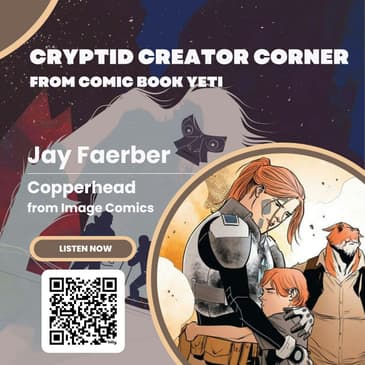
It's a brand new Cryptid Creator Corner with guest Jay Faerber. Jay and I sat down to chat a little while ago and I'm excited for folks to finally listen to this episode. Jay wrote one of my favorite comics (illustrated by Scott Godlewski) Copperhead, and I was excited to nerd-out about that. Jay has co-created and written comics like Elsewhere, Noble Causes, Dynamo 5, and Near Death. Plus, Jay has written for some iconic television shows like Ringer, Zoo, and Supergirl. It was great hearing Jay's perspective on collaboration both in comics and in a writers' room. I also loved talking about Jay's other passion: 70s and 80s television! This was such a great conversation.
Check out Jay's website here: http://www.jayfaerber.com.
From the publisher
Welcome to Copperhead, a grimy mining town on the edge of a backwater planet. Single mom Clara Bronson is the new sheriff, and on her first day she'll have to contend with a resentful deputy, a shady mining tycoon, and a family of alien hillbillies. And did we mention the massacre?
NEW PATREON
We have a new Patreon, CryptidCreatorCornerpod. If you like what we do, please consider supporting us. We got two simple tiers, $1 and $3. I’ll be uploading a story every Sunday about some of the crazy things I’ve gotten into over the years. The first one dropped last week about me relocating a drug lord’s sharks. Yes, it did happen, and the alligators didn’t even get in the way. Want to know more, you know what to do.
Our episode sponsors
Arkenforge
Play TTRPG games? Make sure to check out our partner Arkenforge. They have everything you need to make your TTRPG more fun and immersive, allowing you to build, play, and export animated maps including in person fog of war capability that let’s your players interact with maps as the adventure unfolds while you, the DM get the full picture. Use the discount code YETI5 to get $5 off your order.
Learn more about your ad choices. Visit megaphone.fm/adchoices
[00:00:00] Your ears do not deceive you. You've just entered the Cryptid Creator Corner brought to you by your friends at Comic Book Yeti. So without further ado, let's get on to the interview.
[00:00:11] Y'all, Jimmy the Chaos Goblin strikes again! I should have known better than to mention I was working on my DC Universe meets Ravenloft hybrid D&D campaign on social media. My bad.
[00:00:22] He goes and tags a bunch of comics creators we know, and now I have to get it in gear and whip this campaign into shape so we can start playing.
[00:00:29] Another friend chimes in, are you gonna make maps? It's fair to say it's been a while since I put something together, so I guess? Question mark?
[00:00:38] It was then that I discovered Arkham Forge. If you don't know who Arkham Forge is, they have everything you need to make your TTRPG more fun and immersive.
[00:00:46] Allowing you to build, play, and export animated maps, including in-person, fog-of-war capability that lets your players interact with maps as the adventure unfolds while you, the DM, get the full picture.
[00:00:59] Now I'm set to easily build high-res animated maps saving myself precious time and significantly adding nuance to our campaign.
[00:01:06] That's a win every day in my book. Check them out at arkhamforge.com and use the discount code YETI5 to get $5 off.
[00:01:14] I'll drop a link in the show notes for you, and big thanks to Arkham Forge for partnering with our show.
[00:01:19] I think I'm gonna make Jimmy play a goblin warlock just to get even.
[00:01:24] Hello, and welcome to Comic Book YETI's Cryptid Creator Corner.
[00:01:27] I am one of your hosts, Jimmy Gasparo, and I am here with a writer that I'm very excited to talk about.
[00:01:33] He's not only written comics, he's written for television, and yeah, we're gonna get into it and talk about a lot of different things,
[00:01:39] including one of my favorite series from the past 10 years, Copperhead, that he created with Scott Godlewski.
[00:01:46] But yeah, please, welcome to the podcast, Jay Ferber. Jay, how are you doing tonight?
[00:01:51] Hey man, how are you? I'm great.
[00:01:53] Good, good. I'm doing well. Thank you for coming on the podcast.
[00:01:57] I think the first thing I read of yours, and I've read a couple other things, I still need to catch up on some stuff,
[00:02:04] but Copperhead, I think, was the first thing that really stood out to me, and I absolutely loved Copperhead.
[00:02:11] Thank you.
[00:02:12] And I also follow you on Twitter, and I really appreciate your posts about 70s and 80s TV shows.
[00:02:23] It's my obsession, yeah.
[00:02:25] Yeah. You know, especially, it makes me wish that a lot more of those were streaming,
[00:02:32] that I had only ever caught a little bit of a kid, as a kid.
[00:02:36] Yeah.
[00:02:37] You know, because I was watching some things that you've posted, and I miss really good TV theme songs.
[00:02:46] Yeah.
[00:02:47] We don't have those, but I think I was watching something the other day, like the opening to Riptide.
[00:02:53] Oh, sure.
[00:02:54] You know, and all of those things I've probably seen like a handful of episodes of, but you know, to go back and watch them from beginning to end.
[00:03:04] And I don't think all of those are available, but yeah.
[00:03:08] I mean, they come and go on different streaming services, and sometimes they're on like the obscure free ones,
[00:03:15] like you might find them on Crackle or Tubi.
[00:03:18] Yeah.
[00:03:18] But so they are out there, but yeah, it's kind of you got to hunt and find, you know, look for them.
[00:03:25] Right.
[00:03:26] Yes.
[00:03:26] But you know, unless you have like the physical media, but I think some of those they've never,
[00:03:31] I don't know if they've even ever come out on DVD.
[00:03:34] A lot of them they have actually, and like they're out of print, but you can find them on eBay and stuff.
[00:03:39] That's I have basically if a classic show that I enjoyed is out on DVD, I have found it or it's on my list because to your point, they'll stream, then they'll go away.
[00:03:50] And I like to, I mean, I've got a whole setup.
[00:03:53] I've got everything ripped digitally.
[00:03:55] So I have it on my Plex server and it's like my own private streaming service and can just stream stuff whenever I want.
[00:04:02] So it's like a whole seventies and eighties collection there.
[00:04:06] That's awesome.
[00:04:08] Although I will say as much as I do enjoy streaming, one of the things I do miss is like weekly television.
[00:04:17] Oh yeah.
[00:04:18] You know, like I do.
[00:04:19] I, I, I, maybe it's, I mean, I certainly like when I can like get things, um, you know, right away, but I find that I remember them better when I watch them over a period of time rather than all at once.
[00:04:33] Yeah.
[00:04:33] And there's that in, I mean, there's two things at play.
[00:04:37] I mean, more than two, but two, I can think off the top of my head.
[00:04:39] There's the anticipation of being made to wait a week.
[00:04:43] And then there's also like time passes differently.
[00:04:47] Like, you know, if you binge a show over a weekend and the show takes place over six months or whatever, it's kind of jarring to be an episode six and hear them talk about, you know, that thing that happened two months ago.
[00:04:59] And for us, it was an hour ago.
[00:05:01] It's, uh, but in weekly television, you know, time stretches out a little more.
[00:05:06] Yeah.
[00:05:07] Also, I miss talking about like the, like TV, like it's very few, there's very few shows now that I feel like everybody's watching and watching at the same time, you know, and especially with, with, with, with streaming.
[00:05:21] Yeah.
[00:05:21] Um, someone might've watched the original run of like breaking bad and then someone, you know, just watches it.
[00:05:27] Well, I forgotten most of breaking bad by now.
[00:05:30] Yeah.
[00:05:31] That's what's, I mean, it's, it's a blessing and a curse.
[00:05:33] Cause on one hand there's so much stuff out there, like any genre you can imagine, you can find something to satisfy that.
[00:05:42] But the downside is there's fewer people to talk to about it.
[00:05:46] Cause everybody's watching their own stuff.
[00:05:47] Yeah.
[00:05:49] It's, it's, it's frustrating.
[00:05:50] Like I remember when Netflix first started, you know, dropping stuff in a binge and it would be like a race to get through it in the weekends so that you could, you know, be caught up and be part of the conversation.
[00:06:01] And like, I just don't have the time for patience anymore.
[00:06:05] It's like, I'll watch it when I watch it.
[00:06:07] Oh yeah.
[00:06:07] And there, there's, there is, there's way too much stuff and it's, there's, there's too many other things pulling for your, your time.
[00:06:13] But I mean, but it is like, no matter what, what you like in terms of television.
[00:06:17] And I say the same thing about comics, like no matter what type of comic you like, there's something out there.
[00:06:24] There's, you know, whether not just the big two, but so many indie comics with Kickstarter and other crowdfunding services like Crowdfunder and Zoop.
[00:06:34] There's just, you know, global comics.
[00:06:37] If you, you know, like stuff digitally and not to mention manga and tapas and webtoon, it's like there's, you know, every genre, every sensibility.
[00:06:47] Yeah, it's absolutely great.
[00:06:49] I mean, it's gotta be a tough time, you know, to make your mark when, if you're creating comics.
[00:06:54] But as a fan, it's, there is an embarrassment of riches.
[00:06:58] Exactly.
[00:06:59] That, that's the double-edged sword.
[00:07:00] As a fan, it's great.
[00:07:01] As a creator, it's hard to cut through the noise.
[00:07:04] Like there's just so much competition out there.
[00:07:07] Right.
[00:07:07] Yeah.
[00:07:07] It's very hard.
[00:07:09] I wanted to talk, you know, about your kind of career in comics and then, you know, some of the other things you've done in terms of writing for television.
[00:07:17] Uh, so what you, what I understood was I was reading about you in preparation for this.
[00:07:24] And I think what I found out your, your first comic job was, uh, an issue of what if for Marvel in 1998.
[00:07:33] Yep.
[00:07:34] Yeah.
[00:07:35] Yeah.
[00:07:35] I mean, it was technically, I think my, yeah, no, that was my first job.
[00:07:41] I then shortly after that got hired to write like a, it was like a 10 page wonder girl story for, it was like a secret origins, 80 page giant.
[00:07:51] Okay.
[00:07:52] And that came out first that came out before the what if, but the what if was the first one I actually got hired to write.
[00:07:58] Yeah.
[00:07:59] And it was, it was like, just a gift because what if had already been canceled.
[00:08:06] And so they had like two or three issues left, but they could just slot anybody in.
[00:08:11] And so Frank Pitarisi and editor offered me that gig and it was perfect.
[00:08:16] Cause I couldn't hurt anything.
[00:08:17] I couldn't break anything.
[00:08:18] The book was already canceled.
[00:08:19] So, so it was just kind of a stress-free audition and you know, it was a good time.
[00:08:26] And the, the, we did the, the story was basically what if, uh, the secret wars heroes never got home and had spent the last like 20 years on, uh, battle world.
[00:08:38] And so we pick up like a generation later when they've had kids and there's like teenage offspring and stuff.
[00:08:45] And it was super fun and was pretty well received.
[00:08:47] And it was kind of my launching into comics from there.
[00:08:51] I got to do a generation X fill in and that led me to take over the series for a while.
[00:08:56] So yeah, that was a great first gig and really led to a lot.
[00:09:02] So when, I mean, how did you get to that first point though?
[00:09:05] I mean, had you wanted to, you know, write in comics and like, were you doing like similar to movies or television writing?
[00:09:14] Were you doing like spec comic scripts or were you just bugging editors?
[00:09:18] I was working, let's see.
[00:09:23] I was desperate to write comics, really wanted to write comics.
[00:09:27] I was, I was good friends with Devin Grayson, who was just breaking in around that time at DC.
[00:09:32] Oh, okay.
[00:09:32] And so she introduced me to a couple of assistant editors at DC and a couple, I went to visit her in New York once and she took me to the Marvel offices, I think.
[00:09:42] So I met some Marvel editors and, but then at the same time I had, so I've been sitting in pitches, just like one page documents of like, here's a way to dust off bronze tiger and do a bronze tiger miniseries.
[00:09:56] Uh, and I got some kind responses to the edit from the editors saying like, Oh, you know, this is a cool idea.
[00:10:04] You know, bronze tiger is earmarked for this other project or whatever, like try somebody else.
[00:10:09] Uh, and then I had met, I had found Frank Pitterisi at Marvel.
[00:10:15] Uh, this was when AOL was, you know, it was 97, 98 when AOL was just taken off.
[00:10:21] And I found Frank in some like Marvel chat room or whatever.
[00:10:26] And I learned that he was a big soap opera fan.
[00:10:30] And so was I at the time we were both general hospital nerds.
[00:10:33] And I reached out to him about that.
[00:10:36] It was like, Hey, you know, I'm trying to break into comics and I understand you are a general hospital fan.
[00:10:41] So am I. And we hit it off. Like that just gave us common ground.
[00:10:44] And we just started talking and, uh, you know, shooting the shit.
[00:10:48] And next thing I know, he's like, Hey, I have this slot, you know, if you want to try for it.
[00:10:54] And it wasn't really, I'm sorry. I didn't have to try out for it.
[00:10:57] He, he gave it to me like again, cause the book was being canceled and they already had the secret wars premise.
[00:11:03] That was kind of handed to me.
[00:11:05] Oh, okay. Take this idea and run with it.
[00:11:08] Right.
[00:11:09] Uh, so that was something the editors had cooked up internally.
[00:11:12] Uh, but yeah, it was that, uh, Frank's still a good friend of mine today.
[00:11:16] We, we still keep in touch on it's been, you know, over 20 years now.
[00:11:20] Wow. Wow. That's awesome. Yeah. Because you did like, or I guess early in, in your comics writing career, once you did that, you, you, you know, you were kind of doing stuff with both at different times, Marvel.
[00:11:31] Yeah. And DC.
[00:11:33] Yeah. I know for like DC, I think you did, I know you, you did a couple issues of green lantern you've done.
[00:11:39] Um, I think Robotech and, uh,
[00:11:42] And I was the regular writer on Titans for a while for a year or so. Um, and I did a couple of super boys. Yeah. I think I've had more Marvel work than DC, but yeah, there was a time where I was kind of just bouncing back and forth between the two of them.
[00:11:57] Um, and then a couple of years into it, I pitched a book, an image, which was my, which was noble causes, which was superheroes as a soap opera. So it was really me taking everything I loved about general hospital and mashing it up with a superhero team. And that's where that book came from.
[00:12:14] Oh, wow. Uh, I bet. I mean, when you, I didn't realize that when you say that, you know, what I know about noble causes kind of, kind of makes sense. And then, um, yeah, when you start doing, you know, creator owned work, um, it feels like at least from what I'm aware of, you were still kind of firmly in kind of superhero, you know, genre stuff initially.
[00:12:39] Yeah.
[00:12:39] You know, with noble causes and I think, uh, you know, dynamo five and elsewhere are all kind of in that. Yeah. Well, elsewhere is a little.
[00:12:48] Yeah. Elsewhere is not, but, but there was a thing called Gemini and they were, yeah, when I, when I first started at image, it was superhero stuff.
[00:12:56] And, and I was feeling sort of typecast because I had done a bunch of superhero stuff at DC and Marvel and at image. And I really wanted to kind of, I mean, I loved it. I'm a superhero nerd, but at the same time, I, you know, it was like having too much of your
[00:13:09] your favorite candy. So I, as we talked about, I'm also a huge pop detective fiction guy. And so I really wanted to branch out and do that's where near death came from, which was a straight crime book.
[00:13:22] Uh, and I've done some more mystery stuff since then. And then with Copperhead that became a, you know, genre mashup sci-fi Western thing. And that was my love letter to, you know, it was, it was Deadwood meets Star Wars was basically the idea.
[00:13:41] Yeah. I mean, I, I just, uh, Copperhead to talk about that just intrigued me from, you know, the very beginning. Um, the idea of like, uh, you know, Deadwood in space or, you know, that type of, I'm a big Western fan. I think it was my grandfather always had a Western on, like they were around a lot. And every time, you know, didn't matter what it was.
[00:14:04] Like he just always had a Western on. And so, you know, plus I, I, I grew up, you know, Star Trek and Star Wars. And so those two things feel very, it's like comfort food, you know?
[00:14:20] And then when, then when it's done well, or when you see something that you've never, um, you know, kind of seen before. Uh, plus I, I really like capybaras. So like, uh, you know, Boo, I don't know if that's what he was like a capybara, like humanoid, but.
[00:14:36] That's a question for Scott. Like we never, we never discussed it that specifically, but he came up with Boo's whole look. And I don't know if that was a conscious reference point for him or not.
[00:14:48] I wasn't sure exactly, but I'm, I'm, I reread the last issue issue 19, uh, before this. And I'm pretty sure like there's a scene where the teacher Lucan, who's like now a cop is like talking to three of them. Cause they almost get in a fight with some of the, you know, uh, um, the arties. Yeah. Uh, thank you. And I, I think he, they, they refer to him as capy back, like Baron or something. Like they refer to their race as.
[00:15:16] Oh, yeah. I, we might, I forget, you know, Scott actually kind of wrote that one that it's, it's a plan that he'll write the last arc, you know, all kinds of, you know, contribute, but it's, uh, the idea is that he'll do it. So that's why it hasn't come out yet. It's because I'm waiting on his schedule, but, uh, but yeah. So I don't remember that line, but you're probably right. Yeah. He probably put that in there.
[00:15:38] So in any event, the point being, there was a lot of stuff in copper.
[00:15:41] We like, yeah. Yeah. Well, it's funny because like, I'm obviously not the first person to tackle sci-fi Western mashups. You know, we, Star Trek was wagon train in space. And obviously we had Firefly.
[00:15:56] And, uh, but what I wanted to do, they were all like spaceship shows. I wanted to do like a Western town where you're in one location, like, you know, Dodge city or tombstone and, and build it around that town.
[00:16:11] So that's what I thought made copperhead a little bit different was that you're not in space really. You're just always on this desert planet.
[00:16:17] Right. Yeah. And that's what I really liked about it. I mean, because not even though, you know, there, like you said, there is like that sci-fi Western, you know, mashup, but, um, I mean, Firefly got into it a little bit, not just in the look, but as they went to planets that were like further out, you know, and that's what I liked about it. Cause you realize that like, yeah, like you, we might be able to colonize something where there's aliens out there, but it's,
[00:16:46] it takes a lot to build that infrastructure and you're going to kind of start from scratch when you're building these towns for whatever, you know, purpose, uh, which clearly for Copperhead, it's Hickory's mine. Um, but yeah, I just really enjoyed that series. Very well done. Scott did a fantastic job with the art. And I think Drew Moss took over.
[00:17:08] Yeah. Um, yeah. And so much of the book is Scott truly like that was when we developed it, I just suggested it to him as like, Hey, I had this idea of like dead wood on an alien planet and we just started talking. And so like, it wasn't a situation where I had this fully fleshed out concept that I brought to him. It was us building it together. So it really is a true, you know, co-creator experience, which was great.
[00:17:36] I mean, the results speak for themselves. It was super fun.
[00:17:40] Yeah, absolutely. And the rest of the creative team, Ron Riley doing the colors and I think Thomas Maurer did the, um, uh, the letters. Yeah. Fantastic. Um, yeah. Good group.
[00:17:52] All right. Let's take a quick break.
[00:18:02] After a string of unexplained disappearances in the Southern parts of the United States, retired detective Clint searches for his white trash brother while searching for him. He ends up being abducted by aliens.
[00:18:13] He is now in the arena for big guns, stupid rednecks, an intergalactic cables, newest hit show, which puts him and other humans in laser gun gladiatorial combat. And his brother is the reigning champion with 27 kills.
[00:18:29] That's the premise for a new book from band of Barnes, big guns, stupid rednecks.
[00:18:34] I got a chance to see an advanced preview of this book and being from the South, honestly, I was a bit skeptical going in, but they won me over and nothing is more powerful than an initially skeptic convert.
[00:18:44] In Jimmy's words, big guns, stupid rednecks is many things, but it isn't subtle. It tells you exactly what it is upfront. Then it delivers with a great premise, fantastic art and a whole mess of fun.
[00:18:56] I had a great time reading big guns, stupid rednecks and what I thought was going to be an indictment of redneck culture quickly showed it was actually a love letter, a family mystery, brother pitted against brother, aliens fighting for profit in a big arena.
[00:19:09] This truly has it all. Issue one is out already, but you can still pick up a copy on the band of Barnes website and current issues are available via your previews or lunar order form, or just ask your LCS. Don't miss it.
[00:19:21] Let's get back to the show.
[00:19:23] When you start to move away, though, from some of the superhero stuff, are you always still kind of like anybody does, really leaning on those different types of TV influences?
[00:19:37] Like you said, superheroes and soap operas. I've seen you talk about before on social media that you were a big fan of Robert B. Parker's novels and the TV show Spencer for Hire.
[00:19:48] Yeah.
[00:19:48] So when you start to do like a crime story, do you find yourself still kind of going back to that well a little bit?
[00:19:57] Oh, yeah. I mean, it's so baked into who I am.
[00:20:01] Like, I mean, I spent so many, you know, weekday afternoons after school coming home and watching Magnum P.I. at four o'clock in the afternoon.
[00:20:10] And it's just that's like in my DNA at this point. So I'm all like I couldn't divorce myself from that stuff entirely if I wanted to.
[00:20:19] I don't think. And there are some projects like near death in particular was a real like I want to do my crime story.
[00:20:28] Like it was in a lot of ways. It was episodic. So I wanted it to feel like an 80s television show where every issue there's a new case with a new client and he's in a whole new situation.
[00:20:40] So, yeah, that stuff is still very foundational to the stuff that I like to write.
[00:20:46] And I was the same way. I mean, I feel like television raised me.
[00:20:51] And I think I'm just I don't think we're that far apart in age. I think I'm a little maybe a little younger.
[00:20:57] But, yeah, I'm the same way. And then I feel like so many of those TV shows and I've probably said before on the podcast when like TV shows come up.
[00:21:07] But like late 80s, early 90s. And I certainly was watching show in reruns.
[00:21:12] But like Star Trek, The Next Generation, X-Files, Quantum Leap.
[00:21:17] Every time I sit down to write a story or write something like I feel like that little bit of pull and influence, like, you know, how can I make my I don't want to mimic it.
[00:21:28] But how can I make my like Jose Chung's From Outer Space?
[00:21:31] One of my favorite X-Files episodes, you know?
[00:21:34] Yeah, yeah. Yeah. There was, you know, speaking of X-Files, we were talking about cliffhangers earlier and like week to week.
[00:21:40] There was one of the cliffhangers I remember the most was in X-Files.
[00:21:46] I think it was season three, maybe.
[00:21:49] There was an episode that ended where Scully is looking for Mulder.
[00:21:54] He's disappeared. And at this point, we don't quite know whether Skinner's a good guy or a bad guy.
[00:21:59] And she and Skinner have their guns on each other as I think Mulder starts to enter the room and we cut to black and have to wait a week to find out what happened.
[00:22:08] And it was such a tense cliffhanger that I still remember that of like, I have no idea what's going to happen next.
[00:22:15] And it was like, you know, you mentioned Star Trek Next Generation, that end of the Best of Both Worlds episode where, you know, Picard has been consumed by the Borg and Riker ends the episode by saying fire.
[00:22:29] Yeah.
[00:22:30] You know, he opens fire on his captain.
[00:22:32] Yeah.
[00:22:33] To have to wait a week for that is something we don't get off, you know, get as much these days with everything streaming.
[00:22:41] Yeah, you can just, you know, go on to the next one.
[00:22:43] That's why I appreciate like Apple TV with some of their shows.
[00:22:45] They, you know, we'll put them out a week at a time and it's like, oh, OK.
[00:22:49] So, you know, we have we got a little bit of that old magic back.
[00:22:53] Yeah.
[00:22:53] A lot of the streamers, I think, are realizing that Netflix is the real holdout.
[00:22:57] It still just wants to keep their binge model for the most part.
[00:23:02] Yeah.
[00:23:02] Yeah, that's that's that's true, which is tough.
[00:23:04] Like there's a lot of stuff I like on there.
[00:23:06] I know they I think they just speaking of comic books and TV, I think the most recent season of the Umbrella Academy just came out.
[00:23:14] And so scrolling through and there was already a video online of like this, the cast watching the last few minutes of the last episode.
[00:23:24] Yeah.
[00:23:24] Just showing that the cast reaction.
[00:23:26] I'm like, it just did it just come out.
[00:23:29] Yeah.
[00:23:29] Yeah.
[00:23:30] It's rough.
[00:23:31] Yeah.
[00:23:31] You got to just beware of spoilers, man.
[00:23:33] Yeah.
[00:23:34] Yeah.
[00:23:34] And it is frustrating when shows spoil their own show where it's just like I haven't even watched this yet.
[00:23:40] You spoiled it for me.
[00:23:42] Yeah.
[00:23:43] Yeah.
[00:23:43] Yeah.
[00:23:44] I've gotten a kind of like I don't worry about spoilers anymore.
[00:23:47] It's like I just try and, you know, might happen.
[00:23:49] And my brother, Bobby, who he's the cryptid creator corners, number one most dedicated fan.
[00:23:57] Bobby listens to all my episodes, but he is still very protective of.
[00:24:02] Yeah.
[00:24:02] Of spoilers.
[00:24:03] And I'm just like, you can't.
[00:24:05] It's got to try and enjoy it, you know?
[00:24:07] Yeah.
[00:24:08] I mean, for me, I try to avoid them to a degree, but I don't really get mad if somebody spoils it because I like it's my own fault.
[00:24:15] I'm the one who went online.
[00:24:18] I should have just stayed away if I really didn't want to know.
[00:24:22] So when you're making comics, you've done some work with the big two.
[00:24:28] You have a couple of creator-owned series, you know, under your belt.
[00:24:31] Well, is there a definite like turn when you start to write for television or are you still doing both at the same time?
[00:24:40] Because I was just curious if there was an overlap there or if you kind of did one than the other.
[00:24:47] There was an overlap for a while.
[00:24:49] When I got my first TV staff job on a show called Ringer, I was still doing Near Death as a monthly book.
[00:24:56] And that was tough.
[00:24:57] Only because, you know, Ringer, we were doing 22 episodes, so it was a long season, which was great.
[00:25:07] But Image in particular runs kind of – there's not a lot of wiggle room in their schedules a lot of times.
[00:25:13] So, like, I'd be in the writer's room and I would get an email from Image saying, hey, could you proof this book?
[00:25:19] You know, it was at the printer.
[00:25:20] You know, you need to sign off on it by 5 o'clock.
[00:25:23] And it's like noon.
[00:25:24] And I'm like, I'm in the writer's room all day.
[00:25:26] Like, I need more notice than five hours.
[00:25:29] Right.
[00:25:30] So that was tough.
[00:25:31] I mean, and then, you know, finding time to write it.
[00:25:34] I would have to, you know, carve out a weekend here and there to write the issue each month.
[00:25:38] So I realized pretty quickly that having a staff job in TV and doing a monthly book is a big challenge.
[00:25:47] So I've tried not to do that.
[00:25:49] I try to now just do, like, miniseries or graphic novels so that I can kind of control my schedule a bit better.
[00:25:56] But so I'm – it's mostly – my focus these days is mostly TV, but I still have a little bit of comic stuff going on.
[00:26:03] Okay.
[00:26:04] And so what was that – so Ringer, that's Sarah Michelle Gellar's show.
[00:26:09] For any listeners that don't know, because Jay and I are a couple of TV nerds.
[00:26:13] So even if we haven't watched it, we could probably tell you the premise.
[00:26:16] Right.
[00:26:17] So Ringer, Sarah Michelle Gellar.
[00:26:20] In a dual role.
[00:26:22] In a dual role.
[00:26:23] After Buffy.
[00:26:25] Right.
[00:26:25] Yeah.
[00:26:25] And, yes, so she witnesses a crime.
[00:26:29] She goes to see her twin sister who then, like, vanishes overboard and she assumes her sister's luxurious, rich lifestyle.
[00:26:39] Very good.
[00:26:40] Yeah.
[00:26:41] Yeah, so that's Ringer.
[00:26:43] And then what was that experience like, though?
[00:26:46] Because you've done comics, which as a writer, although the process is collaborative, it can be a little more solo.
[00:26:54] Like, you and Scott creating Copperhead, like, isn't always the case.
[00:26:58] Like, sometimes – you know, I've talked to plenty of comic book writers who have, like, never met in person or, you know, the artist.
[00:27:05] They've done everything.
[00:27:06] They've sent the script and maybe there were some notes and then they, like, approved the thumbnails and, like, that's it.
[00:27:12] So now you're in a writer's room that's staffed by several people and you've got to crank out, you know, a 22-episode season, which is, like, no small feat.
[00:27:23] You've got to – that's what – those were, what, like, 45-minute episodes?
[00:27:26] Yeah.
[00:27:26] Yeah.
[00:27:27] Yeah.
[00:27:28] So what was that like?
[00:27:29] It was fantastic.
[00:27:30] It was – I was intimidated initially because I wasn't sure, to your point, how I would do in a writer's room because I was so used to writing alone.
[00:27:39] You know, even with all the collaboration in a comic, you're still writing it by yourself.
[00:27:45] And in television, yes, the actual physically typing out the story you do on your own, but so much of crafting it and kind of beating out the story you're doing in the writer's room with, you know, six other people.
[00:28:00] Sometimes.
[00:28:01] So I was a little apprehensive of, like, am I going to be okay in that?
[00:28:05] But I loved it.
[00:28:06] It was great.
[00:28:08] The whole staff was super smart.
[00:28:11] Everybody was really collaborative.
[00:28:13] It was great because this was kind of a rarity and even more rare now.
[00:28:17] We shot in L.A.
[00:28:19] And our writer's room was at the studio where we shot the show.
[00:28:23] So at any time, we could just walk from our writer's room downstairs to the soundstage and watch shooting or answer a question if we had to.
[00:28:32] So that was fantastic.
[00:28:34] And to be able to, you know, I had showrunners who, you know, wanted all the writers to be on set for their episodes and to learn how to be a producer, which was great.
[00:28:46] You know, I was the lowest level writer on the staff, but they were still treating me like a writer and letting me go to set.
[00:28:51] And, you know, kind of it was, you know, writer's boot camp, essentially.
[00:28:57] Right.
[00:28:58] Yeah, it was it was great.
[00:28:59] It was a lot, but it was it was a great experience.
[00:29:03] Well, I'm sure, like, you know, with the recent writer's strike and I think that was.
[00:29:09] I don't know how high it high up it was on, like, the priority list, but I know there was a lot of talk of, like, making it so that writers could be, like, on set and in terms of, like, being paid for that.
[00:29:21] So, you know, because that's been somewhat of an issue in terms of the numbers of staff.
[00:29:27] So it sounds like, though, with your experience, you, like, learned a lot being able to do that.
[00:29:33] I've been super fortunate that literally every show I've been on, they've sent writers to set as a matter of like as a standard practice when, you know, to your point, that's not always the case.
[00:29:43] I've worked with writers who were just as experienced as I was, who had been on multiple shows but had never actually been to set.
[00:29:51] And that's it's bad for two reasons.
[00:29:54] Number one, it's bad just because I think the show's a little bit better when the writer's there.
[00:29:58] They can help troubleshoot and problem solve.
[00:30:03] The stuff always comes up.
[00:30:05] But also, you're sort of robbing the next generation of writers because you're developing a generation of writers who haven't been to set.
[00:30:16] And at some point, you know, the current writers are going to age out and retire.
[00:30:20] And you're going to have people who don't really know how to make television because they've never been sent to set.
[00:30:24] So it's yeah, it was a it was something that we really fought for with the strike.
[00:30:28] And it's it's not you know, the strike was settled.
[00:30:31] And having writers on set wasn't like an ironclad rule.
[00:30:35] But it did kind of restructure things a little bit.
[00:30:38] So it's a little bit easier to get writers on set.
[00:30:42] OK, yeah, that I mean, that makes sense because you would think, yeah, there are issues and troubleshooting.
[00:30:48] Yeah.
[00:30:48] Yeah.
[00:30:49] You just to kind of stick with like your career in TV and and on Ringer.
[00:30:53] And I think you you wrote a little bit for Star Crossed was another show.
[00:30:57] And then I guess you're too maybe at least for listeners, well-known shows as you wrote for Zoo and for Supergirl.
[00:31:06] Yeah.
[00:31:07] So with Zoo, what was that experience like?
[00:31:10] Because now was it different going from like a CW show to like CBS or is it a writer's room is a writer's room?
[00:31:18] It was it wasn't that different.
[00:31:19] I mean, we had a little bit of a bigger budget, I think, for special effects and action sequences and stuff like that.
[00:31:26] But yeah, day to day, it was, you know, to your point, a writer's room is a writer's room.
[00:31:30] So it wasn't really that different.
[00:31:32] It was the first show that I was on for multiple seasons because Ringer and Star Cross both were just one and done.
[00:31:39] But Zoo, I was on from season one and we ended with season three and I was on there.
[00:31:44] I was one of the only people on there the whole time.
[00:31:47] And it was that was one of my favorite experiences because it was it was a crazy show.
[00:31:53] Like it was just out there, but super fun to work on.
[00:31:57] The stories we told were fun and kind of comic book.
[00:31:59] Everything was heightened.
[00:32:01] And it was yeah, it was just a blast.
[00:32:04] I had I had so much fun of that show.
[00:32:07] So, well, I mean, it's great to hear.
[00:32:11] But with a show like that, you know, Zoo in particular.
[00:32:16] You know, I read.
[00:32:18] Something that you had said before might have been online.
[00:32:21] I don't know if it was in another interview about sometimes when you were writing like comics, you were would improvise as you go.
[00:32:28] And I think specifically with Copperhead, I think you had said like it opens with a murder.
[00:32:33] And when you had done that, you weren't even sure who the person was going to be.
[00:32:37] No idea.
[00:32:38] And I mean, sometimes I'm sure that still happens in in television.
[00:32:42] Writers will leave themselves some room, you know, especially with TV.
[00:32:47] Like what if you can't get a certain actor to come back or whatever the situation is.
[00:32:51] But was it much more with something like Zoo where you're you know, when you do you get together, like plan out the whole season, like break it down by story?
[00:33:00] Like what does that process like look like from the inside?
[00:33:02] Yeah, we would usually spend.
[00:33:05] I mean, it's been a little while, so I have to think back.
[00:33:07] But we would broad stroke the whole season.
[00:33:11] You know, we would talk about it.
[00:33:13] You know, the first week or two in the writers room would just be talking what we call blue sky.
[00:33:18] Just, you know, anything goes.
[00:33:20] Just what are the biggest moves of the season?
[00:33:23] What story do we want to tell?
[00:33:25] And day by day, we would kind of whittle it down and kind of zero in on what we wanted to do.
[00:33:31] And then I think we would usually very roughly plot out like, OK, we know this character is going to turn bad and it will probably happen around.
[00:33:41] We're going to say episode eight.
[00:33:43] And we know that we'd have like a whiteboard up with episodes one through 13 and columns with kind of mile markers and what we wanted to have happen there.
[00:33:53] And stuff would change.
[00:33:55] You know, we would, oh, let's let's have this reveal happen in episode seven instead.
[00:34:00] And we'd have to, you know, shift stuff around and improvise.
[00:34:03] But there was always at least a loose plan to start off the season with because the studio and the network would want that.
[00:34:11] They want to know some that we have some plan of what we're doing and that they're OK with it.
[00:34:16] So, yeah, there were always sort of guardrails in place.
[00:34:19] You couldn't just wing it entirely like I did on Copperhead.
[00:34:24] But was there ever anything for I mean, for any of the shows you worked on?
[00:34:29] But I was just curious about Zoo, you know, where, you know, because it was kind of heightened.
[00:34:35] Was there ever anything you recall where somebody pitched and you're like, no, we can't.
[00:34:39] That's that's too too much.
[00:34:41] Gosh, what I well, this one is something I pitched and people were like, are you crazy?
[00:34:51] We were doing an episode.
[00:34:56] You know, the animals, we gave them like heightened powers, essentially.
[00:35:00] You know, they were like mutated.
[00:35:02] And so we were doing a story.
[00:35:05] It never made it to air, but the original idea.
[00:35:08] Oh, no, wait, we.
[00:35:09] I'm trying to think.
[00:35:11] Yeah, we were going to do a story about jellyfish that could paralyze people with their toxins.
[00:35:17] And there was going to be something about somebody was going to be swimming when he gets paralyzed and he's drowning and they have to rescue him.
[00:35:27] And there was going to be like a black market dealer who dealt in like jellyfish toxins or something.
[00:35:35] And I pitched something about like, what if there's this weird sect of people who like to get paralyzed to do it like recreationally?
[00:35:44] And that's like their kink.
[00:35:46] And there are like these like red light districts.
[00:35:49] And one of the other writers looked at me and it's like, is that a real pitch?
[00:35:54] No, I guess.
[00:35:58] So, yeah, that one was a little too extreme.
[00:36:01] I mean, if that existed, though.
[00:36:05] I mean, you never know.
[00:36:07] Yeah.
[00:36:07] We're not going to kink.
[00:36:08] We're not going to kink shame anybody here, you know, but that's that's pretty funny.
[00:36:14] And so and then with, you know, with writing on Supergirl.
[00:36:19] Yeah.
[00:36:20] And kind of having that experience of like really, truly a comic book show, which was, I think, you know, very well received.
[00:36:31] And and also, I think as part of that, I think you were one of the writers on the Crisis on Infinite Earths Part One, which I thought was great.
[00:36:40] I really enjoyed that.
[00:36:42] But and so do you go is there any like are you able to call back that, you know, comic book knowledge and experience and get in?
[00:36:54] A little bit.
[00:36:55] I mean, that was part of the reason I got hired.
[00:36:56] I came on with season four and season five, excuse me.
[00:37:00] I did seasons five and six.
[00:37:01] And part of the reason they hired me was that they had lost a staff member who was a big comics nerd.
[00:37:07] So they wanted to kind of shore up their comic nerd quotient because a lot of people working the show were not like comic book people.
[00:37:15] So that was kind of what I was there for.
[00:37:18] So a lot of times it would be like, hey, we need a who should she fight this episode?
[00:37:22] Like we need somebody who, you know, would complement the theme of this story we're telling.
[00:37:28] It will be up to me to kind of wrap my brain to think of a villain that we can pull from the comics to see if it's somebody we could use for the show.
[00:37:37] And then also just actually crafting stories.
[00:37:39] But yeah, it was I was a big fan of the CW, the Arrowverse and those shows.
[00:37:45] So to get to come in and play with them and the crisis in particular was that's like a career highlight for me.
[00:37:51] That was so much fun to be in because the crisis room was mostly hardcore comic book nerds from each show who all knew crisis for the most part.
[00:38:04] And, you know, we're pitching deep dives and Easter eggs and like that was so much fun.
[00:38:11] And then to be there, I got to be in Vancouver when we shot at least, you know, my episode.
[00:38:16] And that was incredible, like to see Brandon Routh in the Superman costume again in person.
[00:38:22] And yeah, just introduce, you know, have Batwoman meet them for the first time.
[00:38:27] I got to meet Burt Ward.
[00:38:29] You know, we had him show up as Robin.
[00:38:32] Robert Wool as Alexander Knox from the Batman movie.
[00:38:36] Oh, yeah.
[00:38:36] Yeah, that was that was super fun.
[00:38:39] That's pretty awesome.
[00:38:41] Yeah, that that that had to have been.
[00:38:43] Yeah, pretty cool.
[00:38:45] Yeah.
[00:38:46] Yeah, it really was.
[00:38:47] And it was it was also fun to be up there shooting.
[00:38:51] And, you know.
[00:38:53] All five shows were shooting at the same time and they had actors running from one set to another to, you know, oh, Flash is in this part of our episode.
[00:39:02] So we need Grant Gustin.
[00:39:04] You know, when's he going to get here?
[00:39:05] And just getting to work with everybody was was great.
[00:39:09] And just.
[00:39:11] I don't even know if anything like that had been done before by the time we did it, a crossover.
[00:39:15] We've been five different shows all shooting, you know, utilizing five different crews.
[00:39:21] It was a huge undertaking.
[00:39:23] And like, I'm just flattered to have been a part of it.
[00:39:27] Yeah.
[00:39:27] I mean, they had done other crossovers, but I don't I don't think with that number of shows.
[00:39:32] Yeah, no, this was the same time.
[00:39:34] That had to be.
[00:39:35] Yeah.
[00:39:36] Yeah.
[00:39:37] It was it was it was pretty spectacular.
[00:39:39] Yeah.
[00:39:39] It was pretty great TV.
[00:39:40] I really enjoyed it.
[00:39:42] Yeah.
[00:39:42] It was a special time.
[00:39:45] Well, being in the in the writers room for for, you know, any of the television shows that you've worked on.
[00:39:52] Have you how do you deal with like when you're if everybody's pitching something and it's like you've been picked to write, you know, a certain episode and you get like studio notes.
[00:40:05] How do you how do you deal with what to keep, what to cut?
[00:40:08] Like, how do you develop your best sense of that?
[00:40:11] Because when you're doing a creator and comic, if you have an editor, that's one thing.
[00:40:15] But sometimes there aren't people to tell you like when to pull back or you need to get rid of this for budgetary reasons.
[00:40:21] You know, comic books, you don't have that concern.
[00:40:24] How have you developed when to fight for a plot point or something in a story or a line of dialogue and when to pull back?
[00:40:31] You know, it's tough.
[00:40:32] And I haven't had to really have too many fights like that because I haven't been a showrunner yet.
[00:40:37] And so on Supergirl and Zoo and all these shows, like I'm not the final decision maker, even on the show.
[00:40:45] Like even if I'm writing an episode, it's got my name on it.
[00:40:48] The showrunner is still the one who makes decisions about everything.
[00:40:52] You know, I can have an opinion, but it's their show.
[00:40:55] My job is to kind of try to write it in their voice.
[00:40:59] So a lot of times when we get studio notes and network notes, you know, we'd be on a notes call.
[00:41:04] We get on speakerphone and it's me and the showrunner.
[00:41:07] And on Supergirl in particular, most of all episodes were co-written by at least two writers, sometimes three, sometimes four.
[00:41:15] So I'd be there with my co-writer and the showrunner and the studio would be on the phone.
[00:41:20] And the showrunner really does most of the talking on the writer's side.
[00:41:25] So they're the ones fighting for stuff.
[00:41:27] And on Supergirl in particular, by the time I got there, it was a pretty well-oiled machine.
[00:41:33] So the studio and network rarely had notes.
[00:41:37] Like they rarely made us change anything.
[00:41:39] If anything, it was usually more like, hey, this line here, do you want it to mean this?
[00:41:47] Are you trying to get across this?
[00:41:48] Yeah. Oh, okay. Can you adjust that dialogue?
[00:41:50] It wasn't clear to us.
[00:41:51] It was usually about clarity, about making things more clear.
[00:41:56] But like on Zoo, because it was a newer show, we would run into more issues where like the studio would push back and like, this isn't working.
[00:42:06] You know, and we'd have to kind of start again.
[00:42:09] And again, but there still, like it wasn't really my job to fight for anything because I wasn't the showrunner.
[00:42:15] There are times in the room where you'll pitch ideas to the showrunner.
[00:42:20] And if they don't go for it, you know, you'll sometimes want to, it's a tough, a tough thing to learn about how hard to push.
[00:42:29] Like, and again, because the showrunner is their show.
[00:42:31] They're the boss.
[00:42:32] You may feel passionately.
[00:42:34] You could maybe bring it up one additional time.
[00:42:37] But if the, like to really kind of prove your point, if you think you didn't articulate it well.
[00:42:42] Yeah.
[00:42:42] But if they say no twice, then like drop it and move on.
[00:42:46] That's it.
[00:42:47] I got it.
[00:42:48] I go.
[00:42:48] That's good.
[00:42:49] Good to know.
[00:42:52] So with your love of comics and television, you know, what is it you're like into right now in terms of what are you reading or watching?
[00:43:04] I'm really liking some of the DC stuff I'm reading right now.
[00:43:09] Like I've been loving Nightwing for a while.
[00:43:11] I love Titans, the stuff Mark Waid's been doing with World's Finest and the new Absolute Power is really fun.
[00:43:21] And then TV, I just started watching Bad Monkey on Apple.
[00:43:25] Oh, I did too.
[00:43:27] Yeah, it's so good.
[00:43:29] Really like the first two episodes.
[00:43:31] Yeah, same here.
[00:43:33] Yeah, that's what I think tonight after this, I will probably go watch the latest episode of Evil on Paramount+.
[00:43:39] I enjoy that.
[00:43:40] Okay.
[00:43:42] I think what else?
[00:43:44] Yeah, we're kind of.
[00:43:47] I'm in kind of a dry spell right now.
[00:43:50] I'm trying to think of what else I'm watching.
[00:43:54] Oh, boy, oh, boy.
[00:43:55] I'm just waiting for more of the false stuff to come back, which will be starting.
[00:44:00] I know Only Murders starts up again pretty soon.
[00:44:02] I'll be watching that.
[00:44:03] Oh, yeah.
[00:44:04] I'm a big fan of that show as well.
[00:44:06] Very well.
[00:44:07] Very well written.
[00:44:09] Yeah.
[00:44:09] I mean, Steve Martin and Martin Short are just incredible.
[00:44:13] I mean, Selena Gomez is excellent, too, in that role.
[00:44:16] And they really get really good, you know, guest stars and other people to come and play in that world last year with Paul Rudd and Meryl Streep.
[00:44:25] But, yeah, I mean, I've always loved Steve Martin.
[00:44:29] Yeah.
[00:44:30] I've been a huge fan of his and everything he's done.
[00:44:32] And Martin Short is the same.
[00:44:34] And, you know, I mean, Martin Short is just one of the fastest people in terms of his wit.
[00:44:39] And like still, still with it, still has it.
[00:44:42] Like, I just he just did an interview like as Jiminy Glick with Bill Hader, like like a couple of weeks ago.
[00:44:48] I think he was I don't know if it was a fill in for Jimmy Kimmel or something.
[00:44:51] Oh, wow.
[00:44:52] They did a bit where he was Jiminy Glick again and interviewed Bill Hader.
[00:44:58] And it was absolutely hysterical.
[00:45:00] Amazing.
[00:45:00] I mean, it was just it was so good.
[00:45:02] He's he's so fast and just so well put together.
[00:45:07] So, yeah, I like only murders in the building.
[00:45:09] And that show is it's both, you know, incredibly funny.
[00:45:14] And it's also like legitimately a good mystery every season.
[00:45:17] Like it's both.
[00:45:18] It's a parody of a mystery and legitimately a good mystery.
[00:45:23] Yeah.
[00:45:24] Very impressive.
[00:45:25] Yeah.
[00:45:25] They do a very, very, very good job with that one.
[00:45:29] With your love of 70s and 80s television and, you know, we see every once in a while a resurgence.
[00:45:37] You know, I think there's another there's a newer or been a newer Magnum P.I.
[00:45:41] And Quantum Leap was last season or two seasons ago.
[00:45:46] You know, every every everything old is new again.
[00:45:49] Is there a television show that you love that hasn't been brought back that if you were tasked with it, if you had the budget and the time that you would that you would bring back?
[00:46:00] You would show run?
[00:46:02] I mean, I would love to do a Spencer for Hire reunion, not reunion, but reboot because we don't have Robert Uric anymore.
[00:46:09] But but yeah, I would love to.
[00:46:11] I mean, I know that it's now a Netflix movie with Mark Wahlberg.
[00:46:15] I don't know if they're going to make another one, but I would love to do Spencer.
[00:46:19] That would be my my that greatest American hero.
[00:46:24] I would love a crack at.
[00:46:25] I think that is.
[00:46:25] Oh, my gosh.
[00:46:26] Unmined property.
[00:46:28] They could be incredible.
[00:46:29] And a great TV theme song.
[00:46:31] Yeah.
[00:46:31] Great TV theme song.
[00:46:33] And what a what a what a like a wonderful kind of wacky show that was so perfect.
[00:46:39] Right.
[00:46:40] I mean, I think it what is it when did that debut?
[00:46:42] Like either 78, 79, 80.
[00:46:44] OK, 81.
[00:46:45] So I was within a few years.
[00:46:47] Yeah.
[00:46:47] But just what a wacky kind of goofy show at times.
[00:46:52] But with a lot of heart.
[00:46:53] Yeah.
[00:46:54] Action.
[00:46:55] Some emotion.
[00:46:56] Yeah.
[00:46:56] It's I'm surprised that that that actually hasn't been.
[00:47:01] That that idea hasn't been, you know, floated around.
[00:47:04] Yeah.
[00:47:04] They tried.
[00:47:05] They made a pilot a few years ago.
[00:47:07] Oh, really?
[00:47:08] But it was it was a half hour comedy.
[00:47:11] So it was it was like a sitcom.
[00:47:13] So it was very different.
[00:47:15] OK.
[00:47:16] And it was with a young woman that got the suit.
[00:47:19] And it didn't even look like a super suit.
[00:47:21] I forget what it looked like.
[00:47:22] I think it was like a I think it morphed into things.
[00:47:26] So it was like very, very different.
[00:47:28] I would want to skew a little closer to the original.
[00:47:32] Right.
[00:47:33] Just update it for these times.
[00:47:36] And I think it's also a little.
[00:47:38] Candles rights are kind of weird, I think, because like box had them for a while, but then Disney bought Fox.
[00:47:45] And so I'm not even sure who has the rights to some of this stuff at this point.
[00:47:49] That's true.
[00:47:50] Yeah, I was.
[00:47:50] My wife was asking me the other day about, I guess, because of Deadpool and Wolverine.
[00:47:54] And she was asking me she had we I haven't seen it yet.
[00:47:58] And neither has she.
[00:47:59] But I guess on TikTok or something, they were showing like some of the special get the cameos in it.
[00:48:05] Right.
[00:48:06] And she was asking me a question about how can certain superheroes show up in this movie and not that.
[00:48:12] And I had to be like, all right, well, how much time do you Marvel initially didn't have its own story?
[00:48:19] Studio.
[00:48:20] So they used to license their car.
[00:48:21] She's like, you know what?
[00:48:22] I'm I wish I didn't ask.
[00:48:24] Yeah.
[00:48:26] Totally.
[00:48:26] Yeah.
[00:48:27] Your poor wife.
[00:48:30] Yeah.
[00:48:30] Yeah.
[00:48:30] She's put up with a lot.
[00:48:35] Yeah.
[00:48:36] Yeah.
[00:48:37] Spencer for hire would be a good one.
[00:48:39] I always loved all those shows.
[00:48:40] And like I was saying, when we started, I probably seen a handful of like all of them.
[00:48:44] But there were so many like Riptide and Spencer for hire and Hardcastle and McCormick and crazy like a fox.
[00:48:54] That was.
[00:48:54] Yeah.
[00:48:55] You know, there were so many of those.
[00:48:57] Like it was every show or every network had two or three private eye shows.
[00:49:02] Yeah.
[00:49:02] Yeah.
[00:49:03] It just seemed like everybody in like L.A.
[00:49:06] Well, I know Spencer for hire, I think, was set in Boston.
[00:49:08] That was Boston.
[00:49:09] Yeah.
[00:49:10] But like everybody in L.A. was a private eye or private investigator.
[00:49:14] I always like Simon and Simon.
[00:49:16] That was one of my favorites.
[00:49:18] Yeah.
[00:49:18] That was a good one.
[00:49:21] That was never that was never a huge Simon and Simon fan, but I enjoyed their crossover with Meg.
[00:49:26] Oh, OK.
[00:49:28] The crossover shows were such a big deal back then.
[00:49:31] Oh, yeah.
[00:49:31] You know, you always knew whenever sweeps were coming up in like November and May.
[00:49:36] Yeah.
[00:49:37] Chances are you're going to get a good crossover episode.
[00:49:40] Yeah.
[00:49:40] For some kind of event.
[00:49:41] Yeah.
[00:49:42] Yeah.
[00:49:43] I liked when spinoffs would do, you know, crossovers after they had.
[00:49:47] Oh, yeah.
[00:49:47] You know, like when Empty Nest had a spinoff, like with the Golden Girls.
[00:49:54] Yeah.
[00:49:55] I forgot that was a spinoff.
[00:49:58] Yeah.
[00:49:59] All my useless TV knowledge.
[00:50:02] Right there with you.
[00:50:04] Yeah.
[00:50:05] So is there anything that you can talk about that you're working on, you know, now or have coming out?
[00:50:11] I've got an image graphic novel.
[00:50:14] It'll be out next year sometime.
[00:50:17] Oh, nice.
[00:50:17] Hasn't been announced yet.
[00:50:18] OK.
[00:50:19] We're still working on it, but it's sort of a mystery romance book with a little bit of a supernatural tint to it.
[00:50:28] Oh.
[00:50:29] Nice.
[00:50:29] And I've also got in, let's see, end of this month, on the 28th, I've got a story in Brave and the Bold issue 16 from DC.
[00:50:41] Just a short, it's like a 10 page story set in Metropolis about what it's like to be a beat cop working in Metropolis.
[00:50:52] So it's sort of a slice of life kind of story.
[00:50:56] So it'll be out in like two weeks.
[00:50:58] But that's all I got.
[00:50:59] Everything else, I'm just focusing on TV at the moment.
[00:51:01] Nice.
[00:51:03] All right.
[00:51:04] Well, I really appreciate you coming on, Jay, to talk comics and TV with me.
[00:51:10] And I'll look forward to your image graphic novel when that comes out.
[00:51:13] Thank you.
[00:51:14] You know, whenever I see your name on whatever shows you're working on, whatever writer's rooms or once you're show running something.
[00:51:24] Yeah.
[00:51:25] I appreciate it.
[00:51:26] Hopefully soon.
[00:51:27] Yeah.
[00:51:28] I'm really a big fan.
[00:51:30] And like I said, love Copperhead.
[00:51:32] If any listeners haven't checked it out yet, you have to.
[00:51:35] But also, if I can, elsewhere, the story of like Amelia Earhart and D.B. Cooper trying to get out of a fantasy world and antihero as well and near death.
[00:51:46] I'll plug all of those.
[00:51:48] Thank you.
[00:51:50] Thank you.
[00:51:50] I appreciate it.
[00:51:52] All right.
[00:51:53] So for Comic Book Yeti in the Cryptid Creator Corner, I'm Jimmy Gasparra.
[00:51:57] My guest tonight has been Jay Ferber.
[00:52:00] And yeah, thanks for listening.
[00:52:01] And I'll see you next time.
[00:52:03] Good night.
[00:52:03] This is Byron O'Neill, one of your hosts of the Cryptid Creator Corner, brought to you by Comic Book Yeti.
[00:52:09] We hope you've enjoyed this episode of our podcast.
[00:52:13] Please rate, review, subscribe, all that good stuff.
[00:52:17] It lets us know how we're doing and more importantly, how we can improve.
[00:52:21] Thanks for listening.
[00:52:23] If you enjoyed this episode of the Cryptid Creator Corner, maybe you would enjoy our sister podcast, Into the Comics Cave.
[00:52:30] Listen and subscribe wherever you get your podcasts.