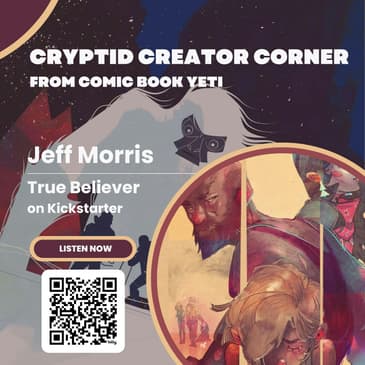
I'm delighted to introduce first time guest, Jeff Morris, on the show with me today to talk about his new crowdfunding project, True Believer, a collection of three short comics about his journey through grief. Each story draws inspiration from his personal experiences with loss and is bound to make you cry. I know personally, grief is a weird thing. I’ve had to deal with more than my fair share of it recently learning to come to grips with the loss of who I was with my disability. Identity is such a fragile thing and the exploration of grief is something I typically avoid because it channels as a downer but these stories do not, they all plot a clear path through it in very different ways.
Jeff and I met on line and became fast friends. When he reached out about potentially coming on the show, zero hesitation on my part even though I don't cover many crowdfunding projects these days. I can assure you that this is a comics debut you don't want to miss. The project is fully funded and it's ready to roll to the printer when the campaign ends.
NEW PATREON
We have a new Patreon, CryptidCreatorCornerpod. If you like what we do, please consider supporting us. We got two simple tiers, $1 and $3. I’ll be uploading a story every Sunday about some of the crazy things I’ve gotten into over the years. The first one dropped last week about me relocating a drug lord’s sharks. Yes, it did happen, and the alligators didn’t even get in the way. Want to know more, you know what to do.
Our episode sponsors
From Within is a martial arts revenge graphic novel about a slave fighting his way through a deadly tournament where the rules shift at the whims of a tyrannical emperor. It's a mash-up of the high-impact action sequences of Bruce Lee's films with the paranoid thriller undercurrent found in Ed Brubaker & Sean Phillips' Sleeper series. Late pledges are enabled if you happen to hear about it after the campaign officially ends.
Arkenforge
Play TTRPG games? Make sure to check out our partner Arkenforge. They have everything you need to make your TTRPG more fun and immersive, allowing you to build, play, and export animated maps including in person fog of war capability that let’s your players interact with maps as the adventure unfolds while you, the DM get the full picture. Use the discount code YETI5 to get $5 off your order.
Learn more about your ad choices. Visit megaphone.fm/adchoices
[00:00:00] Your ears do not deceive you. You've just entered the Cryptid Creator Corner brought to you by your friends at Comic Book Yeti. So without further ado, let's get on to the interview.
[00:00:11] Y'all, Jimmy the Chaos Goblin strikes again. I should have known better than to mention I was working on my DC Universe meets Ravenloft hybrid D&D campaign on social media. My bad.
[00:00:22] He goes and tags a bunch of comics creators we know and now I have to get it in gear and whip this campaign into shape so we can start playing.
[00:00:29] Another friend chimes in, are you gonna make maps? It's fair to say it's been a while since I put something together so I guess? Question mark?
[00:00:38] It was then that I discovered Arkham Forge. If you don't know who Arkham Forge is, they have everything you need to make your TTRPG more fun and immersive.
[00:00:46] Allowing you to build, play, and export animated maps, including in-person, fog-of-war capability that lets your players interact with maps as the adventure unfolds while you, the DM, get the full picture.
[00:00:59] Now I'm set to easily build high-res animated maps saving myself precious time and significantly adding nuance to our campaign.
[00:01:06] That's a win every day in my book. Check them out at arkhamforge.com and use the discount code YETI5 to get $5 off.
[00:01:14] I'll drop a link in the show notes for you. And big thanks to Arkham Forge for partnering with our show.
[00:01:19] I think I'm gonna make Jimmy play a goblin warlock just to get even.
[00:01:24] Hello everybody and welcome to today's episode of the Cryptic Creator Corner.
[00:01:28] I'm Byron O'Neill, your host for today's Comics Creator Chat.
[00:01:31] I'm joined by a first-time guest on the show with me today, Jeff Morris.
[00:01:34] Jeff and I have been connected for a while now on social media and he's got a new crowdfunding project dropping soon called True Believer,
[00:01:40] a collection of three short comics about his journey working through grief.
[00:01:44] Jeff, it's great to finally have you on. Welcome.
[00:01:48] Byron, thank you for having me. I'm so excited to connect with you.
[00:01:51] We've been chatting for a long time, so it's cool to meet you in person through the power of the internet.
[00:01:56] So thank you for having me.
[00:01:58] Yeah, more than parasocial we are now, I guess.
[00:02:01] It's been a while, but it finally happened.
[00:02:03] And you are a St. Pete native, or not native, but you've lived in St. Pete.
[00:02:07] So it's cool to have someone who knows where I live as well.
[00:02:10] Yeah, I mean, going through all of the hurricane recently and thinking about you and what you were going through and having lived there, it's just really wild.
[00:02:19] We have my wife's old supervisor lives on Coffee Pot Bayou.
[00:02:25] Oh, used to live right by there, yeah.
[00:02:27] Yeah, and we used to live in Old Northeast, so their entire basement got ruined by the first one and then got re-ruined by the second one.
[00:02:36] And yeah, it's just a lot.
[00:02:38] Like thinking, hey, are all those places that I just used to walk to and take my son when he was little?
[00:02:44] Or they still be there?
[00:02:45] Yeah, yeah.
[00:02:46] So it's pretty heavy.
[00:02:48] Yeah, it's a rough time, but the community has kind of come together, which is really cool.
[00:02:53] I saw the World Food Center actually by the library in Gulfport yesterday, and so it was so cool to see there.
[00:02:59] And they were helping the community by giving out free food.
[00:03:03] But definitely understand that feeling of these places that are memories, right?
[00:03:08] These nostalgic places like John's Pass and Treasure Island are a couple places I grew up with that a lot of those restaurants have been kind of flooded
[00:03:16] and are in need of great repair.
[00:03:18] But that's part of the process, especially when you live here, unfortunately, is you have to be prepared for that.
[00:03:26] Yeah, I mean, we were watching all of the radar and everything coming in.
[00:03:30] And, of course, my parents live down – well, my in-laws live down there in Sarasota.
[00:03:35] They weren't there.
[00:03:37] They were in Maine at the time.
[00:03:38] But just, hey, what's their house going to look like?
[00:03:40] And we got married at Selby Gardens down in Sarasota.
[00:03:43] So what's that going to look like?
[00:03:45] Yeah.
[00:03:45] Yeah.
[00:03:46] It's just weird how loaded everything is.
[00:03:49] And, of course, with everything that happened in Asheville, too.
[00:03:52] Like I was –
[00:03:53] Oh, my gosh.
[00:03:54] Yeah, I actually lived in Asheville for a little bit, too, and seen like the River Arts District, just kind of what it is.
[00:04:01] It's crazy.
[00:04:02] You know these things will be bad, and then it happens, and then you start to kind of process.
[00:04:07] It's a form of grief in a lot of ways, right?
[00:04:09] You know, of seeing – not necessarily for me as much as the people who work there, the people who run those businesses.
[00:04:16] Like just seeing that loss that they go through is harrowing.
[00:04:20] So, yeah.
[00:04:22] It's tough to watch, for sure.
[00:04:25] Well, I think this is your first, if I'm not mistaken, crowdfunding project.
[00:04:29] So how are you feeling about the project specifically?
[00:04:31] It's all about anxiety management, that I heard right now.
[00:04:35] Of course.
[00:04:36] Of course.
[00:04:37] Wow.
[00:04:38] Yeah, it's tough because it's such a personal project.
[00:04:42] You know, these stories are drawn from my experiences with grief.
[00:04:46] The first story I wrote in the collection is called Paper Champion, and I wrote that around 2018 and originally put it online in 2019.
[00:04:57] And so that draws from my experience with losing my dad and then also just being a wrestler myself.
[00:05:04] And so it's just been kind of a process of, you know, telling these stories about grief and kind of learning new things I needed to kind of work through myself.
[00:05:14] And really just using the medium of comics to kind of go on that healing journey.
[00:05:18] Yeah.
[00:05:20] So it's weird, in a sense, to kind of have to monetize it, I guess, or to kind of have to like crowdfund it and be like, hey, like, here's these painful personal stories.
[00:05:33] Right.
[00:05:33] But I want you to read them and I've got to promote.
[00:05:36] So that's been just trying to balance those feelings there.
[00:05:39] But, you know, that's the market we're in, you know, is crowdfunding.
[00:05:45] So I just hope ultimately it connects with the people who will benefit most, you know, and people can kind of see themselves in these stories.
[00:05:54] Well, I want to go through each of the three projects individually.
[00:05:56] But the through line, as you mentioned, is all about your journey working through grief.
[00:06:01] So how specifically has comics helped you do that big picture?
[00:06:05] Yeah.
[00:06:07] Comics for me.
[00:06:08] So I originally started writing short stories.
[00:06:11] Right.
[00:06:11] And so I was trying to use short stories as a way to work through not just grief, but a lot of different emotional struggles in my life.
[00:06:18] And particularly, you know, I went through an experience of like deconversion with, you know, evangelical Christianity.
[00:06:25] And so at that time, I was using short stories to work through that.
[00:06:29] But something about comics, I started getting into a lot of Daredevil comics.
[00:06:33] I started reading a lot of like Miss Marvel and particularly Mark Waid's Daredevil run.
[00:06:40] And then I found Blankets by, I hope I get it right, Craig Thompson, which was all about deconversion from Christianity.
[00:06:49] And I saw how comics had helped him work through that journey.
[00:06:54] And I was like, wow, this is very visceral.
[00:06:56] This is very raw, you know, the way he was able to portray that experience.
[00:07:00] And so I had been going to counseling at the time and trying to work through the loss of my dad when I was 15.
[00:07:08] He had passed away in front of me.
[00:07:12] He had cardiac arrest.
[00:07:13] And it was just me and him.
[00:07:15] I had actually come home after a youth group meeting on Saturday night.
[00:07:20] And he was watching Billy Graham on the television.
[00:07:24] And we were talking about that.
[00:07:27] And then he just kind of fell on the ground.
[00:07:30] And I was like, we're in this moment, right?
[00:07:33] You know, trying to save him.
[00:07:35] And I had never really processed that, you know.
[00:07:40] And part of that ties into kind of Christianity that I was like, well, he's in heaven now.
[00:07:45] I'm glad he's in a better place.
[00:07:47] But kind of doing that kind of mental gymnastics there a little bit prevented me from experiencing kind of the trauma of that situation.
[00:07:56] And so it wasn't until I got involved with a group called Comics Experience.
[00:08:00] It was led by Andy Schmidt.
[00:08:02] It was like an online comics community.
[00:08:04] And I started writing my first comic, Paper Champion, that I was able to kind of say, let's put this out here through comic book.
[00:08:13] In the same way that Craig Thompson had kind of done with Blankets.
[00:08:16] You know, just really visceral, raw emotions, letting the image do the work, you know.
[00:08:21] And so by using comics, I was able to replay those scenes on the page.
[00:08:27] And it wasn't until the artist, Jorge Santiago Jr., actually put some of those moments on the page that I had realized I was still blaming myself.
[00:08:38] I still feel a lot of guilt for not being able to save my dad in that moment.
[00:08:44] And there's actually a scene in there on the fifth page where, you know, I'm trying to I'm on the phone with 911.
[00:08:51] And I'm trying to get to him.
[00:08:54] But the telephone cord is too short.
[00:08:56] We didn't have a cordless phone at the time.
[00:08:58] So they were like, hey, go perform CPR on him.
[00:09:01] And I'm like, the cord's too short.
[00:09:03] I can't reach him.
[00:09:04] And he was kind of a hefty guy.
[00:09:07] And so I couldn't pull him to the phone.
[00:09:09] And so that moment alone for like 15 years stayed with me as as this like guilt, this blaming.
[00:09:16] And then just working with George and making that comic, I was like, Jeff, you're still blaming yourself.
[00:09:22] Like, you don't need to blame yourself for this.
[00:09:25] You did the best you could in this moment to help him.
[00:09:29] And I found that was extremely healing for me.
[00:09:32] And so that first comic really kind of kickstarted me doing Dirt Mountain and then doing the latest one, True Believer, of revisiting moments of grief throughout my life and saying, hey, let's open this up.
[00:09:43] And I'm going to help through sequential art and try to kind of ask some questions, unearth some feelings that maybe I've been avoiding.
[00:09:50] And hopefully if readers can see themselves in it, they can unearth some of those feelings that maybe have been too difficult to process all these years.
[00:09:59] Okay.
[00:10:00] I mean, is that kind of the goal?
[00:10:01] Because there's different ways to approach grief, right?
[00:10:04] You know, a fair number of people have asked me if I would ever want to tell, you know, the battle of dealing with lupus that almost killed me in 2020, like in a comics format.
[00:10:12] I've written it out, but I've thought about it.
[00:10:15] And there's no catharsis in my mind about working through the idea.
[00:10:20] Like it wouldn't be for me.
[00:10:21] The goal for me would be to hopefully inspire someone who's struggling or just to help shed some light on the challenges of the disease specifically.
[00:10:28] So sure.
[00:10:29] Sure.
[00:10:29] Yeah.
[00:10:30] I absolutely think the end goal is that connection that we create with readers.
[00:10:34] And that's been the most satisfying thing has been for people to say, this reminds me of my brother.
[00:10:40] This reminds me of when I lost my dad.
[00:10:42] Right.
[00:10:43] And the catharsis, I think, comes in them seeing themselves.
[00:10:47] But there's that connection that both of us are a little less alone in that experience.
[00:10:52] Right.
[00:10:52] And I think just a shout out here to, I know, a project that you know and love, Unseen Unheard Anthology.
[00:10:58] Yeah.
[00:10:58] It's a fantastic example of that.
[00:11:01] There's just such a power that comics can create when, and art in general, when you can see yourself in these pages, your experience is amplified.
[00:11:10] And you feel a little less alone.
[00:11:12] You feel that other people get you.
[00:11:14] They get your experience.
[00:11:15] And so with grief, I absolutely hope people experience that with this collection.
[00:11:23] Well, I'm curious, with these three different stories, why you wanted to work with different artists, as opposed to kind of nailing down a rapport that you developed through that repetition of working with just one.
[00:11:32] Yeah.
[00:11:32] All the artists on this are amazing, and I've loved every experience.
[00:11:37] And each one brings a distinct kind of visual style, right, and a visual kind of storytelling.
[00:11:44] But I think the through line through all the artists is hopefully you feel something through their art, right?
[00:11:50] You can look at the facial expressions.
[00:11:52] You can look at the way they set up their pages and feel something.
[00:11:56] And so for me, it was a lot about I want to work with different artists who can put emotion on the page, right?
[00:12:03] I want these stories to make readers feel something strongly because I felt something strongly, you know, writing it, experiencing some of these things.
[00:12:12] And so for me, it was let me find people that really can translate the story in a very emotional, impactful way.
[00:12:19] And also, too, just as a writer starting out, I wanted to get more experience with different artists, right?
[00:12:26] Okay, sure.
[00:12:27] It definitely would have loved to just work with George or Dennis or Daniel.
[00:12:31] But for me, just wanting to do comics as a living eventually one day, having that experience, collaborating with different artists, and going through that process, I felt would be like a good growth for me and just a good experience to learn from them and learn how they kind of approach storytelling as well.
[00:12:50] Okay, well, for people who are thinking about doing it themselves, did you seek each one of them out having an outline already worked up?
[00:12:57] Or did you see their work and mold it to them?
[00:13:00] How did that process work?
[00:13:02] Yeah, yeah.
[00:13:02] So I saw everybody out.
[00:13:04] It was a painful process of like finding 50 people and just being like, wow, your art's amazing, but does it fit the story?
[00:13:12] Yeah.
[00:13:12] Right.
[00:13:13] And so with each artist, it was, are they the best fit for the story in the terms number one of emotion?
[00:13:20] That's the number one thing is if they can put the emotion that I'm envisioning on the page, that's number one.
[00:13:28] Right.
[00:13:28] And then the second part was the flow.
[00:13:30] Right.
[00:13:31] I saw a lot of artists that are amazing, but maybe the readability and flow of some of their work maybe wasn't the best fit for more kind of intimate emotional stories.
[00:13:41] Right.
[00:13:42] And so I wanted to gravitate towards artists that could do those quieter moments.
[00:13:47] Right.
[00:13:47] That make you feel like you're in the panel.
[00:13:50] Right.
[00:13:50] With these characters and, you know, experiencing their emotions in a visceral way.
[00:13:57] So, yeah, just really finding what resonated the most and then also just reaching out to them and how was the communication?
[00:14:03] I think for first time creators or if you're just getting started, the communication is so huge.
[00:14:11] Right.
[00:14:11] You know, do you have somebody that communicates with you consistently?
[00:14:14] And then ultimately, is this someone you think you can trust?
[00:14:17] Right.
[00:14:18] You won't know that going into the process, but do they have, you know, a good reputation when you talk with them?
[00:14:25] Do you get a good sense of security about their professionalism, about their love of sequential art?
[00:14:32] So I was grateful I was able to find three people who could check those boxes, I guess.
[00:14:38] And apparently as a writer, I checked boxes for them, too.
[00:14:41] So that was encouraging.
[00:14:43] Nice.
[00:14:44] Well, starting with Dirt Mountain, I have some personal familiarity with it.
[00:14:48] You asked me some time ago.
[00:14:49] So we started to kind of get to know each other online if I'd be willing to take a look at it, which I happily did.
[00:14:54] And hopefully it was useful.
[00:14:56] But I offered up some largely artistic panel construction editorial feedback because I'm not sure why anybody would ask me for writing feedback at this point in time.
[00:15:06] I feel pretty good about like artistic layout and construction related questions.
[00:15:10] But I don't know if I'd ever be comfortable calling myself a writer.
[00:15:13] Maybe a storyteller.
[00:15:14] We go with that.
[00:15:15] Yes.
[00:15:15] I would agree.
[00:15:16] Right.
[00:15:16] But you're working with Dennis Minier.
[00:15:18] Like, how do you pronounce Dennis's last name?
[00:15:20] Uh, Menhiri.
[00:15:22] Menhiri.
[00:15:23] He's corrected me on this through chats many times.
[00:15:27] So, but I believe Menhiri.
[00:15:30] Yes.
[00:15:30] Okay.
[00:15:31] Okay.
[00:15:31] And this is not the first one, though, that you developed chronologically, right?
[00:15:36] No.
[00:15:36] So the first one was Paper Champion.
[00:15:38] And then Dirt Mountain was largely me still.
[00:15:41] Um, my stepdad had passed away around the time when I wrote that and was, um, working with Dennis on that.
[00:15:50] And then right after a month later, my uncle passed away and I didn't really have a chance for that last goodbye.
[00:15:57] Um, yeah.
[00:15:58] And so that comic was a lot of like, you know, if I could have had a last moment with my stepdad or my uncle, what would I wanted that to be?
[00:16:07] And this is slightly spoilerish, but I don't mind in the sense.
[00:16:11] Um, you know, the ending is a lot of, I wanted to believe that they would say that they missed me too.
[00:16:18] You know, this idea that when you lose somebody that they would miss you too.
[00:16:23] And a lot of that was speaking to my experience with faith and Christianity.
[00:16:27] And so Dirt Mountain kind of became a symbol for me, at least, uh, of God and this higher power of like, you know, why couldn't you just save this person?
[00:16:36] And why couldn't you prevent them from going?
[00:16:39] So I could at least have this last moment with them.
[00:16:42] And, you know, with, with death and loss, we don't get that.
[00:16:45] We don't get those last moments, um, to, to really say what we would want to say to somebody or hear what we wish we could hear from them.
[00:16:54] And so that was my way of saying, Hey, you know, I believe that my stepdad, my uncle would have said that they would miss me.
[00:17:02] And that gave me a sense of kind of healing it for a firm, that kind of feeling in myself there.
[00:17:09] Well, why Dirt?
[00:17:10] Like, why did you, yeah, it's a non-standard way, you know, with this animate, animate object to work through grief.
[00:17:17] Although now that I think about it, like comics are also sort of an inanimate object.
[00:17:21] So true.
[00:17:22] Yeah.
[00:17:23] Why Dirt?
[00:17:24] Yeah.
[00:17:25] So that was actually a short story that I had written way back in 2012.
[00:17:29] Okay.
[00:17:30] And, um, it was like very much rooted in my Christian deconversion experience of like this silence of this mountain.
[00:17:39] Right.
[00:17:40] So a lot of it was like, when you're a child, you grow up and you believe in God and you don't really question it.
[00:17:47] Right.
[00:17:47] You never really question, um, whether this is real or who this person is.
[00:17:51] And so like the character in the story, Suze, she has this childlike faith in this mountain that it could really come to life.
[00:17:59] And then when it's supposed to come to life and the moment she needs it most, it doesn't do anything.
[00:18:05] It's just silent.
[00:18:06] And she's like, why wouldn't you at least say something, you know, step in here and help me.
[00:18:12] My brother here is he's, he needs your help.
[00:18:14] He's passing away.
[00:18:15] And so writing that as a short story really helped me work through those feelings.
[00:18:20] And then through comics, I was like, man, that would be awesome to have that, you know, in comic form to see this thing come to life and have her interact with it and have her actually like ask questions to this thing.
[00:18:32] And just the visual, um, kind of storytelling, like you mentioned, just really, I think would be cool to see.
[00:18:39] Um, and yeah.
[00:18:42] Yeah.
[00:18:43] Well, I mean, it's definitely my favorite of the three stories largely because it's a way for me to easily examine might've been like for my family to have lost me a few years ago.
[00:18:54] So sort of the inverse.
[00:18:56] Um, but playing catches is particularly relevant in the story.
[00:18:59] Was that, was that something you did with them?
[00:19:01] Like as an anchor that you're using?
[00:19:03] Yeah.
[00:19:03] So that goes back a lot to just my dad and I, um, you know, um, growing up playing baseball and he, you know, would go to me or go with me to little league and would always give me critique after the games of like, Hey, swing this way.
[00:19:19] And then my stepdad in particular, a huge Tampa Bay race fan had all the Tampa Bay rays baseball gear and everything like that.
[00:19:27] And so that was just kind of a, a through line to put in there that, um, you know, as siblings that they would have this common shared ritual almost, you know, and then also the shopping cart in there of like going down the mountain and surfing down the mountain and him being called the shred master.
[00:19:45] Just these, it reminded me of times, you know, with friends that I had in the neighborhood or my own, you know, dad as well of, of just having these things that really bonded us together.
[00:19:54] And so I wanted that to kind of like have an emotional purpose to it, you know?
[00:19:59] Okay.
[00:20:00] Yeah.
[00:20:00] Makes sense.
[00:20:01] Well, the title comic true believer drops second, um, sequentially in, in this project, I found it to be a little more abstract for me than the other two.
[00:20:10] Um, you're working with Daniel Romero on this one without giving too much away.
[00:20:14] It's certainly relevant to the upcoming holiday season where I think we all to some degree think about loved ones that have passed that we spent precious time myth.
[00:20:22] So, so where did this, this story idea come from?
[00:20:25] Yeah, you hit on it perfectly Byron right there.
[00:20:28] So it's, it's totally about the holidays, right?
[00:20:32] And it, this had been something I had wanted to write a while.
[00:20:36] I wanted to do a holiday theme Christmas comic, um, about grief.
[00:20:40] Um, just because it had been something that I felt so long, but never really knew how to put it into story form.
[00:20:47] And so, um, kind of dealing with the aspect of someone, the ambiguity, right.
[00:20:54] Uh, is this person gone?
[00:20:55] Are they coming back?
[00:20:57] Right.
[00:20:57] Um, you know, uh, in the story, we never really kind of tell what happens, uh, with the sister slash mother.
[00:21:05] And so for me, that was just kind of dealing with a lot of the questions, right.
[00:21:10] That, that come up about grief specifically at the, at the holiday time, um, of just wanting somebody to be there, but you don't know if they can be back or, or if they will be there.
[00:21:21] Um, and you know, if you've lost somebody, you, you kind of know that they're not coming back.
[00:21:26] So how do you accept that?
[00:21:27] Right.
[00:21:28] That kind of, that feeling like almost the first Christmas after you lose somebody, right.
[00:21:33] What do you do?
[00:21:34] What are the feelings?
[00:21:35] Like, how do you try to, um, have a sense of that holiday feeling when you've lost the person that would, would make that season feel like it should.
[00:21:45] Right.
[00:21:46] Yeah.
[00:21:46] Um, and especially like in the story, dealing with kids, you know, and children, how do you communicate that to them?
[00:21:52] How do you help them kind of start to process loss as well?
[00:21:57] Yeah.
[00:21:58] I mean, the, the anthropologist in me loves a focus on a material object as kind of the emotional salve of sorts.
[00:22:04] The, and, and they're abundant during the holidays for sure.
[00:22:07] You know, I crawled up on the roof the other day to clean the windows so I could put up our, our Halloween ghosts, you know, and, and, and attach them outside.
[00:22:13] Um, I got the rest of the stuff out, hung up the lighted spider web from the gutters on, in, in the yard, threw the big spiders on it.
[00:22:19] And my wife gave me a huge hug and said how much it meant to get everything out, you know, just to get this paraphernalia.
[00:22:26] Of that time of the year up, you know, and in your story, it's extra special because it's handmade.
[00:22:31] So why do these external material objects help us work through internal emotions?
[00:22:37] Oh, that's, you hit on that amazingly bar.
[00:22:40] Thanks for pointing that out.
[00:22:41] Yeah.
[00:22:41] I think there's just something so powerful about objects that are passed from generation to generation.
[00:22:49] Um, and so in the story, you know, it's, it's really about this angel that's passed from, you know, a brother and sister relationship.
[00:22:58] Um, something that kind of is defined in love of where the sister, um, loses her angel and she can't find it.
[00:23:05] And it's this angel that her mom said would never leave her.
[00:23:09] And the brother has to come up with a way to kind of make her feel like that angel still there, right?
[00:23:14] That that angel still loves her.
[00:23:16] And then we kind of go to the scenes in, in the present where the mom's now gone.
[00:23:21] Um, but that angel from that past still exists.
[00:23:24] And so it's, it's, how can that still be a symbol of that same love, that same, um, comfort from that previous time buried?
[00:23:32] How can we bring it into the present so that this, um, youngest daughter who's now experiencing the loss, how can she kind of feel some of that love that her mother felt way back in the day?
[00:23:43] So there's, it's, it's kind of like, you know, your grandparents giving you something.
[00:23:47] I remember my grandfather gave me his world war two, um, I, I uniform and I got to wear it once.
[00:23:54] Right.
[00:23:55] And I just felt like the king of the world.
[00:23:57] Right.
[00:23:57] Because I was wearing something that he had.
[00:24:00] And then when he passed away, you know, I, I got to keep that.
[00:24:03] And then later my nephew got to keep that.
[00:24:06] And it's just, there's something so special and physical things that, um, they embody time.
[00:24:13] They embody love, emotion, history, you know, and so comics are so tangible with their ability to kind of tell a visual story that you can take an object and build emotion around it.
[00:24:25] Hit that build emotion around it and, um, create new meaning.
[00:24:30] So yeah, I hope that kind of hits on it a little bit.
[00:24:33] It does.
[00:24:34] I just looking down here while we're talking at like what's on my desk and it's like the weirdest grouping of things.
[00:24:41] I have an old pocket watch from my grandfather's pocket watch.
[00:24:45] Um, I have a box that my son made that his, okay.
[00:24:48] People think this is probably weird, but his baby teeth are in this.
[00:24:51] Um, that's awesome.
[00:24:52] I have a trust bolt from working shows back in the day.
[00:24:56] And these are just these random things that are just sitting on my desk, but which, you know, I can glance at and give me at least some form of comfort.
[00:25:06] Yeah.
[00:25:06] And I think there's also the aspect of like grief rituals, right?
[00:25:10] You know, obviously in different cultures, those exist.
[00:25:12] And I think sometimes in America, we may be a little more detached from that or don't have as many conversations I think as we should.
[00:25:20] But I think every family has some form of grief rituals that they engage in, especially around times when, you know, the anniversaries of someone's death or somebody's birthday, um, comes up again.
[00:25:33] Um, and so I think those objects are like those very tangible things to help us kind of reenact those grief rituals and remember somebody and recall those memories in a very like real way.
[00:25:45] It's physical.
[00:25:46] I can touch it.
[00:25:47] Right.
[00:25:47] I can smell it sometimes too.
[00:25:49] You can smell the, you know, thinking of my grandfather, the musk still on his, you know, World War II outfit.
[00:25:55] Right.
[00:25:55] Like there's something, my senses are very much engaged in that transports me to memories with him.
[00:26:02] And so comics, unfortunately, we don't have the scratch and sniff yet to recreate that.
[00:26:07] But, you know, I think in a visual way, um, and through dialogue, you can hear people's voices.
[00:26:13] We're trying to kind of recreate that experience a little bit.
[00:26:17] Yeah.
[00:26:18] Place also plays an important role in the story.
[00:26:21] We talked about Asheville weighing heavily on both of our minds recently.
[00:26:24] It was like a second home to me when I was younger.
[00:26:27] It seemed like I was working a music show at least once a week there for a few years.
[00:26:30] And we bounced up to the Hawks Nest ski resort near Boone all the time.
[00:26:35] Oh, awesome.
[00:26:36] Yeah.
[00:26:36] We did.
[00:26:36] That's when I was trying to snowboard all the time.
[00:26:39] We do the, the late night hours.
[00:26:41] They ran from 10 to two.
[00:26:43] So that was.
[00:26:43] Oh, wow.
[00:26:45] 2 AM.
[00:26:45] Yeah.
[00:26:45] Those were awesome.
[00:26:46] Oh, daredevil.
[00:26:48] It was a sheet of ice.
[00:26:50] Yeah.
[00:26:51] Yeah.
[00:26:51] For sure.
[00:26:52] Wow.
[00:26:53] What's the significance of grandfather trail that's in the story?
[00:26:56] Yeah.
[00:26:57] So we used to go to North Carolina a lot when I was a child, specifically with my dad and mom.
[00:27:04] And so we would go up to Cherokee, Franklin, Boone, all those areas and just travel.
[00:27:10] And there was just as a child, there was just such a feeling of like this bigness of the forest,
[00:27:17] right?
[00:27:17] Of being lost in the forest.
[00:27:19] And so for me, that just fit with the story really well of this uncle slash brother searching
[00:27:25] for his sister and trying to find the mom so that he can tell these girls that, yes,
[00:27:31] I found your mom.
[00:27:32] She's going to be back by Christmas, you know?
[00:27:34] And so it kind of represented like just being swept up in the scene larger than yourself,
[00:27:39] but also connected emotionally to me as a kid of just, you're just lost in these huge
[00:27:44] like trees and then you can just walk forever.
[00:27:48] Right.
[00:27:49] And just kind of this expansiveness of nature that I think for me, North Carolina really
[00:27:53] represented as a kid.
[00:27:56] All right, let's take a quick break.
[00:28:06] After a string of unexplained disappearances in the southern parts of the United States,
[00:28:10] retired Detective Clint searches for his white trash brother.
[00:28:14] While searching for him, he ends up being abducted by aliens.
[00:28:17] He is now in the arena for Big Gun's Stupid Rednecks, an intergalactic cable's newest hit
[00:28:24] show, which puts him and other humans in laser gun gladiatorial combat.
[00:28:28] And his brother is the reigning champion with 27 kills.
[00:28:33] That's the premise for a new book from Banda Barnes, Big Gun's Stupid Rednecks.
[00:28:38] I got a chance to see an advanced preview of this book and being from the south, honestly,
[00:28:42] I was a bit skeptical going in, but they won me over and nothing is more powerful than
[00:28:47] an initially skeptic convert in my book.
[00:28:49] In Jimmy's words, Big Gun's Stupid Rednecks is many things, but it isn't subtle.
[00:28:54] It tells you exactly what it is up front.
[00:28:56] Then it delivers with a great premise, fantastic art, and a whole mess of fun.
[00:29:00] I had a great time reading Big Gun's Stupid Rednecks and what I thought was going to be an
[00:29:05] indictment of redneck culture quickly showed it was actually a love letter.
[00:29:08] A family mystery, brother pitted against brother, aliens, fighting for profit in a big arena.
[00:29:14] This truly has it all.
[00:29:15] Issue one is out already, but you can still pick up a copy on the Band of Bards website
[00:29:19] and current issues are available via your previews or lunar order form, or just ask your LCS.
[00:29:25] Don't miss it.
[00:29:25] Let's get back to the show.
[00:29:27] The selective colorization, where did that come from?
[00:29:30] Because you have a natural environment, you would expect some earth tones.
[00:29:34] That's not what we get.
[00:29:35] Yeah, so Daniel and I are huge fans of Jeff Lemire.
[00:29:40] Huge fans.
[00:29:41] I owe so much of me going into comics and just inspiration-wise to Jeff Lemire, specifically
[00:29:49] Essex County, the Underwater Welder, and then also Roughneck.
[00:29:56] And so a lot of his comics use selective colors.
[00:29:59] And I just find that when the colors hit for the right moments, it just really brings out
[00:30:05] the emotional kind of weight of that moment, right?
[00:30:09] It makes it matter so much more.
[00:30:12] And so Daniel was able to do a great job of using the blues for kind of nostalgic feelings.
[00:30:18] So the blues matching with the snow and the forest.
[00:30:20] And then when we go to kind of the more harrying moments in black and white, representing kind
[00:30:26] of that sense of hopelessness, ultimately spoiling a little bit, but building towards color,
[00:30:32] right?
[00:30:32] Of some sense of life slowly being kind of imbued back into this family when they've kind of
[00:30:38] lost life, when they've lost hope.
[00:30:41] Um, so we wanted to kind of use the colors to visually tell the story, um, kind of in
[00:30:47] a more visceral way without words.
[00:30:49] Has Daniel ever done that before?
[00:30:50] Was that a new thing?
[00:30:52] No, this was his first time doing it throughout a comic.
[00:30:55] Yeah.
[00:30:56] But he was really excited to, to go through that process.
[00:30:59] And it was, it was so cool just to see you getting new pages.
[00:31:02] I'm like, oh, I see what you're doing here.
[00:31:04] So there's just stuff where he slowly starts to add the colors back in.
[00:31:08] I'm like, oh, I see what you're doing.
[00:31:09] And we hadn't even really talked about it.
[00:31:12] I had kind of given him an overview of the colors in the script, but he just, as an artist
[00:31:16] knew the right moments when to kind of slowly build the colors back in.
[00:31:21] Um, so that by the end we could have that kind of more hopeful, comforting use of colors.
[00:31:27] Right.
[00:31:27] Um, and add some emotional weight there.
[00:31:29] It looks great because when it works, it works when it doesn't, it's bad.
[00:31:34] This, this way.
[00:31:35] Oh, thank you.
[00:31:37] I was like, uh, clinching there.
[00:31:39] No, no, this didn't work.
[00:31:41] Thank you.
[00:31:41] It's all good.
[00:31:43] I'm very much a less is more, you know?
[00:31:46] Uh, if you can strip it down to a bare essence and, and I, it just punctuates your story so much.
[00:31:54] And I will say, Byron, like, I think you and I talked about this way back with dirt mountain.
[00:31:58] Like, that's probably my favorite thing about comics is just the ability of colors to be symbolic, but also just to make you feel something right.
[00:32:07] Right.
[00:32:07] And it happens at such a subconscious level, right?
[00:32:11] You know, you're reading it, but, and you're getting these subtle hints about how you're supposed to feel or how we kind of intend you to feel.
[00:32:20] But it's, when it's done well, it's, it's a beautiful thing, you know, with like how we work as, as people, just colors just signify so much to us at such a subconscious level that we don't even recognize it, that it's happening.
[00:32:34] Yeah.
[00:32:35] Yeah.
[00:32:35] Coming from the background in theatrical lighting design, that it's, it's a second nature sort of thing to me.
[00:32:42] Uh, I just need to be able to get the tech down and get a lot faster.
[00:32:46] That's my challenge.
[00:32:47] That's the significant thing with me and coloring is just speed.
[00:32:51] It's so hard.
[00:32:52] It's so difficult.
[00:32:54] Yeah.
[00:32:54] I'm excited to see some stuff though.
[00:32:56] I keep, I keep, uh, encouraging you hopefully to, to see the first comic.
[00:33:01] So I appreciate it.
[00:33:02] I just hope to have, have time to get into it at some point here.
[00:33:06] Hopefully, hopefully the health stuff will kind of level off.
[00:33:10] Yeah.
[00:33:11] And we can make that happen.
[00:33:12] But then there's, there's paper champion with artists, uh, Jorge Santiago jr.
[00:33:16] Which seems to be, it's got to be the most personal of the three, uh, working through the death of your father.
[00:33:23] You know, the central connection for the characters is wrestling or rasslin as it would be around here.
[00:33:28] You know, we, we've definitely both spent some time.
[00:33:32] In the sport.
[00:33:33] So myself on the tech end, in the production, but you were an actual wrestler.
[00:33:37] Is that right?
[00:33:37] Yes.
[00:33:38] Yeah.
[00:33:39] So that, that story, uh, is, is definitely the most autobiographical.
[00:33:43] It's the, it's the comic that I said, Hey, if I make one comic, this is it.
[00:33:48] Right.
[00:33:48] You know, this would be the one that I'd be happy with.
[00:33:51] Not knowing that that would inspire me to, to, you know, love comics even more after making it.
[00:33:57] But, um, yeah, I was a wrestler named the professor Murdoch and I wrestled for five years in Georgia, South Carolina, North Carolina, up in Charlotte, um, other areas up there too.
[00:34:09] And I was a heel, which is wrestling terms for a bad guy.
[00:34:12] And my gimmick, um, was, it was a professor from Princeton, New Jersey named the professor Murdoch.
[00:34:19] And I was an academic and there's nothing that gets you heat in the South more than being a snobby academic.
[00:34:26] Um, when you're wrestling in middle schools and gyms, um, and pofolk, uh, Georgia and these areas.
[00:34:34] So, um, I loved it.
[00:34:35] It was great.
[00:34:36] I could be such a despicable person, but that was encouraged because, um, you know, I was a bad guy.
[00:34:44] That's the goal is to get hate so that they want to see the good guy, um, or the good wrestler win.
[00:34:50] So, um, while I was wrestling, I just had all these moments and flashbacks to, wow, I wish my dad could be here because we had loved wrestling.
[00:34:59] My love of wrestling was instilled by him and growing up and watching WWF back in the day.
[00:35:05] And so there were all these kinds of grief moments, these flashes of like, I would win a championship.
[00:35:10] I won like the, a tag team championship and then extreme SEW X division championship.
[00:35:16] Right.
[00:35:16] And I was like, I'm holding the belt.
[00:35:18] Wouldn't it be awesome?
[00:35:19] Like if he was here in the crowd to kind of feel this moment, cause I know he would love it.
[00:35:26] And so that really started bringing up a lot of feelings that I didn't know were still there.
[00:35:30] Um, with that.
[00:35:32] Yeah, that's, that's, yeah, I think that's part of, I think largely then transitioning to the comics aspect of it.
[00:35:39] Was okay, let's, let's develop this into a story.
[00:35:42] Let's kind of see like, what's the end of this.
[00:35:45] And I, I had remembered back as a child, we created our own cardboard wrestling belt that we'd kind of wrestle with.
[00:35:53] We bring out like a small mattress and wrestle on the living room floor and do leg drops and emulate Macho Man, Randy Savage and stuff.
[00:36:02] And so I was like remembering that wrestling belt.
[00:36:06] And it goes back to what you said, Byron, about the objects, right?
[00:36:09] That was such a powerful emotional object that had, you know, um, stayed with me.
[00:36:15] And so I was like, let's, let's see what we can kind of unpack here through comic books.
[00:36:20] Um, with me wanting my dad to be there in the crowd and also this wrestling belt that we had created together as a kid.
[00:36:27] Sport is such an interesting thing for, especially the older generation of men to safely emotionally interact.
[00:36:37] Right.
[00:36:37] So my oldest memories are, are, are at my great grandparents' house.
[00:36:41] My grandfather wasn't super mobile at the time, you know, but he was just like pale, you know, rugged dude.
[00:36:47] Right.
[00:36:47] Um, but I peek in his room, crawl up on the bed and watch wrestling with him.
[00:36:51] And I think that's the first place I'd ever even heard a curse word, you know?
[00:36:55] Yes.
[00:36:56] He animated about it and, and really emotional is the only time I ever saw him got emotional.
[00:37:00] Um, and, and I lost one of my best friends during, but not to COVID.
[00:37:05] Um, he's the one that got me the production job working in wrestling shows to begin with.
[00:37:09] And, you know, every, every Monday and Thursday when we weren't working, we'd get together with a group of other friends who were techs and we'd watch it.
[00:37:17] Yeah.
[00:37:18] Yeah.
[00:37:19] I've been to a lot of places and I've seen a lot of things, but those were some of the best nights of my life, you know?
[00:37:25] And these memories are like these positive anchors of a sort.
[00:37:29] Yes.
[00:37:29] Help focus on the good times.
[00:37:31] Right.
[00:37:31] Yes.
[00:37:31] Yeah.
[00:37:32] So I'm curious.
[00:37:33] I know there was a, that lapse between your dad passing and you being able to work through it in this way.
[00:37:39] So how did that, how did that comic specifically become like the catalyst to help you work through the grief and, and to have, to help you revisit that connection?
[00:37:50] Yeah, that's, I didn't expect it to help me do that if I'm being honest.
[00:37:56] Right.
[00:37:56] Right.
[00:37:56] It wasn't like, Hey, let's sit down and write and we're going to heal, you know, through this.
[00:38:01] I want to get better.
[00:38:02] Exactly.
[00:38:03] I wish it could.
[00:38:04] And I think I'm more intentional in that process now than when I first started.
[00:38:09] Um, it just had been, honestly, I was, I was wrestling and these feelings were coming up and they were shocking to me of just kind of like, I really miss my dad, but I miss him in these moments of, of, you know, I'm wrestling and I want him there.
[00:38:25] Right.
[00:38:26] Right.
[00:38:26] I am.
[00:38:27] And there's a scene in the comic where the pref, you know, that's literally me in the, the artist, George, um, I sent him some pictures and videos of me.
[00:38:37] I was like, Oh, you can just do kind of a likeness of this or, or your own version.
[00:38:40] And he pretty much drew exactly me.
[00:38:43] Cause he's such a great artist.
[00:38:45] So, um, when I was teaching, my students were like, why'd you put yourself in a comic book?
[00:38:50] I was like, that's what the artist interpreted.
[00:38:52] So we're going with it.
[00:38:53] And he did great.
[00:38:54] But, um, yeah, it was just, these feelings were kind of coming up a lot with me, particularly while I was wrestling.
[00:39:01] And I was like, you know, at that time I joined the comics experience, um, you know, uh, community and they had a chance to kind of write scripts and get feedback from like editors at Marvel and DC and other people there.
[00:39:14] And so I'm like, let's just work through these things.
[00:39:17] Let's see if we can kind of take that moment of, um, you know, being in the crowd and saying, I wish you could be here to see me.
[00:39:24] Um, which is the scene in the comic.
[00:39:26] Let's kind of use that as the catalyst and see if we can kind of work through it.
[00:39:30] And then it brought up all my memories as a kid.
[00:39:33] It brought up when my dad was younger, you know, he had wanted to play for the New York Yankees, but he got in a car accident.
[00:39:39] And so I was like, Oh, that could relate to him wanting to be a wrestler.
[00:39:44] Right.
[00:39:44] To make that into fiction.
[00:39:45] Um, and you know, him wanting to be a wrestler and he never had a chance to, to kind of win the belt.
[00:39:51] And so that kind of became like a plot point that we could develop.
[00:39:54] And in a lot of ways, Byron, I think you'll relate to this and people love wrestling.
[00:39:58] It's very similar to the Cody Rhodes storyline that they had with like finishing your story that, you know, your, your dad had this opportunity to win something and never had the chance because of, you know, a setback.
[00:40:10] And now it's kind of your time as the son, right.
[00:40:14] To step up and finish the story.
[00:40:16] Right.
[00:40:17] Do the legacy.
[00:40:18] But in the process, you're able to kind of work through that grief and honor his memory.
[00:40:23] Um, so, and, and the other thing too, I had a lot of kind of negative feelings towards my dad.
[00:40:29] You had brought up, uh, just a little bit earlier about wrestling kind of being this language for men, particularly.
[00:40:36] So my dad wasn't really like an emotional guy.
[00:40:39] Right.
[00:40:40] But through wrestling, he would get emotional.
[00:40:42] He would get angry or he would feel strong emotions.
[00:40:45] And so I wanted something to kind of memorialize my dad that for readers who didn't know him, um, could kind of see a little bit of what my dad was like and what kind of I remembered and loved about him.
[00:40:59] And so it was a way really of like, I want to keep his memory and legacy alive.
[00:41:04] Here's a way to do it.
[00:41:07] Do you still watch it?
[00:41:08] Cause I, I know for myself, I don't, but a couple of years ago I went back and, and watched, uh, WrestleMania, I guess when it picked it up, I was like, okay, it's on there.
[00:41:19] I'm going to watch it.
[00:41:20] And it just blood of, of these associated with my friend passing.
[00:41:25] So, you know, were, were you able to keep watching it or do you watch it?
[00:41:29] Byron, I, I watch it.
[00:41:31] I miss it.
[00:41:32] I wish I could still wrestle if I'm being honest with you.
[00:41:35] Um, I actually, when paper champion released, I actually had.
[00:41:38] I had a match again back in 2019 and, um, I was going to keep wrestling in 2019 and then the pandemic hit.
[00:41:46] And then I was like, okay, this is my sign to, to step away.
[00:41:51] And I was also having back problems from being body slammed on concrete.
[00:41:56] Um, which I called by the way, I said, Hey, you know, in the moment, like to body slam me there on the sidewalk.
[00:42:03] And so, you know, they body slam me there.
[00:42:06] Um, so I miss it.
[00:42:07] I love it.
[00:42:08] It's, it's just such, it brings out so many feelings in me, you know, and it's not like high art, but it's like what you said.
[00:42:15] Part of it is, I think just growing up as like a boy, you know, and if you have a father figure or a male figure, they're like, Oh, you got to watch this.
[00:42:23] And it's such like a, it's almost like a rite of passage in a certain way.
[00:42:27] You know, as a kid, if you're exposed to it, like you've got to get into wrestling, you've got to know who the good guys are.
[00:42:33] The bad guys are, you know, to kind of be accepted in this living room.
[00:42:38] Yeah.
[00:42:39] I had an opportunity to do it years ago.
[00:42:42] I was working at a club doing bouncing and I was working with, uh, Mr. Fuji.
[00:42:48] Oh, a legend.
[00:42:50] Oh yeah.
[00:42:50] He was, he was tearing tickets and his son, Kevin, uh, was also one of the bouncers and Kevin and I are friends, but he, he kept trying to convince me, Hey, you got to do this.
[00:43:01] You got to do this.
[00:43:01] And, and it was always, I had gotten off the road and I say, I don't think I want to my body.
[00:43:08] The reason I stopped working in the entertainment business is I saw the writing on the wall.
[00:43:13] Right.
[00:43:13] Sure.
[00:43:14] Sure.
[00:43:14] In my late twenties there.
[00:43:15] And I was like, I want to be able to walk the rest of my life.
[00:43:19] Yes.
[00:43:19] There was a month when I stopped wrestling.
[00:43:22] Um, when I was doing it every weekend, multiple times in the weekend, there was a month I stopped
[00:43:28] wrestling and I woke up at the end of that month and I said, I don't feel pain or I don't feel like my bones don't ache.
[00:43:37] And I was like, is this what other people feel?
[00:43:40] Because I had been doing it so much of taking bumps.
[00:43:44] Right.
[00:43:45] Um, that just.
[00:43:46] The pain was the norm.
[00:43:48] Aching, constantly being hurt was just the norm.
[00:43:51] And so for people who aren't fans, you know, um, I don't think they realize like just the physical toll.
[00:43:57] And then, you know, I had, um, a concussion as well.
[00:44:01] I'm getting kicked in the head and dislocated.
[00:44:03] Um, a couple of my fingers as well.
[00:44:06] Um, and I loved it.
[00:44:07] Right.
[00:44:08] It was exciting.
[00:44:08] I wouldn't trade it, but it just, you wake up and you're like, wow, this is a real physical toll.
[00:44:14] For $20 a night.
[00:44:17] Yeah.
[00:44:17] And in a gymnasium, you know, in Brunswick, Georgia, do I want to keep doing this the rest of my life?
[00:44:24] I mean, thankfully it's gotten so much better for the athletes.
[00:44:28] And I think back in the time I was doing is ironically, that was same timeframe.
[00:44:32] I'm doing no holes barred stuff, which is a whole nother level of wrestling.
[00:44:38] Wow.
[00:44:39] The precursor to MMA.
[00:44:40] And this was when things were much looser and I have always loved getting hit.
[00:44:48] This is this weird guilty pleasure of mine because it condenses the world down to a singular moment and everything else shuts up.
[00:44:57] And it's wow.
[00:44:58] You just wake up, right?
[00:44:59] It's reality.
[00:45:00] You can't deny that your face, your body is hurting.
[00:45:04] Yeah.
[00:45:05] And I would feed off of that.
[00:45:07] But of course the toll of it is, is exceedingly high, you know?
[00:45:10] As you say, you're not getting paid much and it's pretty brutal on the bottom.
[00:45:15] Are there videos that exist of this, Byron?
[00:45:18] Probably.
[00:45:19] Okay.
[00:45:19] We've, I'm going to do some internet sleuthing and try to.
[00:45:23] That is amazing.
[00:45:25] I did not get that.
[00:45:27] Yeah.
[00:45:28] It was rough.
[00:45:30] I wasn't, I'm not going to say I was particularly good at it or anything like that.
[00:45:33] I was coming in very much from a striking perspective.
[00:45:37] And then I was working with, um, I have a, my old martial arts instructor who has the perfect, like the most, the best name ever.
[00:45:45] Cause it was Sipu Graves.
[00:45:47] Like how cool is that?
[00:45:48] Like graves as your martial arts instructor.
[00:45:50] But that was a Chinese boxing curriculum.
[00:45:54] So it was a lot of strikes.
[00:45:56] Wow.
[00:45:57] And, and this was when, uh, jujitsu, especially Gracie jujitsu was really hitting the scene.
[00:46:06] So people could shoot on me and just throw me around because I just didn't have the basis in jujitsu.
[00:46:12] Sure.
[00:46:13] And so I was developing it, but I was never particularly good at it and I never really liked it.
[00:46:18] I'm like, I'm here for like getting hit and hitting people.
[00:46:21] Yeah.
[00:46:22] But that's the cool thing.
[00:46:23] You bring up like kind of the pain.
[00:46:24] Adrenaline is a beautiful thing.
[00:46:26] You know, that's the thing when I was always wrestling, I didn't really feel it in the moment.
[00:46:31] And then when the adrenaline comes down, you know, and you're at kind of like homeostasis, then you're like, oh, wow, this hurts.
[00:46:39] But in the moment it's, it's glorious.
[00:46:41] Right.
[00:46:42] Absolutely.
[00:46:42] Absolutely.
[00:46:43] And then you get older and you hit 50 and you're like, wow, why did I do that?
[00:46:48] That's very true.
[00:46:49] My back hurts constantly.
[00:46:50] Why?
[00:46:51] Well, I know mental health and making comics is a passion for you.
[00:46:55] So how do you see these, these two things merging into where you'd like your personal comics journey to go?
[00:47:01] Yeah.
[00:47:02] No, thank you for, thank you for bringing that up.
[00:47:04] That's absolutely my vision for the future.
[00:47:08] What's the purpose of the future.
[00:47:09] It is to just keep writing comics that are about mental health or about emotional journeys.
[00:47:16] And so right now I'm getting my master's degree in counseling with a focus in expressive arts therapy.
[00:47:23] And there's lots of different expressive arts therapy from painting and sculpturing music, you know, lots of different modalities that you can use.
[00:47:33] But I don't feel comic books and sequential art have been explored as like a viable medium for expressive arts therapy.
[00:47:42] And so really my goal is to bring attention to that and hopefully through research and working, you know, with professors and my peers is to kind of, you know, do the whole research paper thing and studies thing to kind of see, you know, what are the benefits to reading comics that are going to be about deeper emotional struggles, right?
[00:48:04] What could be the benefits of someone creating their own comic?
[00:48:08] And so I recently applied for grants to help children in particular work through grief by making comics and trying to kind of use these comics as a template to help them start that process.
[00:48:22] So that's the journey.
[00:48:24] I'm definitely just beginning, but I hope in about five years I'll have a lot more to bring to the community and say, hey, here's what I've seen that really does work for helping people, you know, work through their mental health difficulties.
[00:48:38] To find some level of healing and catharsis, right?
[00:48:43] In their journey.
[00:48:45] Yeah, there's more reveal.
[00:48:47] I feel like working in sequential art as opposed to just a word narrative or even a single image.
[00:48:56] You know, speaking from experience, you know, when I'm writing sort of, you know, my own lupus journey and I was like, oh, okay, I've got this down.
[00:49:04] And then as I'm working through it, I realized, oh, wait a minute, this is going to make this so much more nuanced and layered.
[00:49:11] I add this into it.
[00:49:13] You know, it was, it was presented, for instance, just me throughout the whole narrative.
[00:49:19] And then it popped into my head.
[00:49:21] Oh, wait a minute.
[00:49:22] Here's me.
[00:49:23] And then I show a transformation.
[00:49:24] So how do I do that?
[00:49:26] Yeah.
[00:49:26] Now, now I'm going to be a wolf, right?
[00:49:29] So how do people interact with me?
[00:49:33] How do I feel about that interaction?
[00:49:35] Yeah.
[00:49:35] Identity of myself and how that's changed.
[00:49:38] Yeah.
[00:49:39] It allowed me to explore that through just even thinking of how I'm going to lay this out sequentially.
[00:49:44] That's such a great point.
[00:49:45] There's such a power.
[00:49:47] Why are you speaking, Byron?
[00:49:48] I was thinking of mirroring.
[00:49:49] There's such a power when we mirror people's experiences, right?
[00:49:52] People's emotions.
[00:49:54] So when you see your experience mirrored in something so visceral, like sequential art, visual storytelling, there's something there that just clicks inside of us, like as human beings.
[00:50:08] And then you spoke about the transformation.
[00:50:10] One thing I'm learning about now is, you know, we, the eventual goal is, is to have the ability to reframe our stories, right?
[00:50:19] To take something traumatic and be able to reframe it, to re-script the narrative that we've been telling ourselves our entire lives.
[00:50:26] And so, you know, like me going back to Paper Champion, you know, I had this script that I was to blame, right?
[00:50:32] For my dad dying, for not being able to save him in that moment.
[00:50:36] Logically, obviously that's ludicrous, right?
[00:50:39] I could logically look at it, but I'm not thinking with my logical self in those moments.
[00:50:45] There's something very deep emotionally.
[00:50:46] And so for me, making that comic was, I get to reframe the narrative, right?
[00:50:52] I get to re-script the story.
[00:50:54] And that is when kind of that healing process could begin for me.
[00:50:59] Are there any words of wisdom from kind of your experience thus far that you'd like to share?
[00:51:03] I know, you know, making comics, I talk to a lot of comics creators and it's notoriously draining.
[00:51:08] And for a variety of ways.
[00:51:11] Any words of wisdom of just making comics like in general?
[00:51:15] Yeah, you know, for the people who are going through it.
[00:51:18] Well, my book is coming out in a month.
[00:51:20] I'm just kidding.
[00:51:21] I'll do it.
[00:51:21] My book on how to make comics.
[00:51:23] Yeah, the best thing that I would learn or I've learned, I think, is the importance of trust and collaboration, right?
[00:51:31] To develop a very close relationship with the artists, the letters, whoever you're working with on your creative team.
[00:51:38] To really just get to know them, to understand their storytelling passions, what they love to do, right?
[00:51:46] Because it's as much as their story that is yours at that point, right?
[00:51:51] You know, I wrote it.
[00:51:52] I scripted it.
[00:51:52] But you want them to bring their voice and their kind of interpretation.
[00:51:56] And so that requires a lot of trust and good communication.
[00:51:59] And so, yeah, just really be intentional about that, you know, and supporting what they find passionate or what, you know, kind of excites them, you know, about this story and support that.
[00:52:14] And that's a very fulfilling process because somebody else gets to take your story, you know, and for me, it's out of my head now, right?
[00:52:22] So they get to kind of, hey, here's my trauma.
[00:52:25] Feel free to do with this what you want, right?
[00:52:28] And I had, like, Daniel throughout the process of True Believer.
[00:52:31] He's like, Jeff, why did you do this?
[00:52:33] You know, he's like, why would you make it happy and then very, like, hurtful and painful the next moment?
[00:52:38] And it's like, yeah, that's, you know, it's kind of what I did, but I trust you to, you know, make it work.
[00:52:45] I mean, it's also life, right?
[00:52:47] Yeah.
[00:52:48] It's the thing that I constantly keep saying to my son as a teenager and this idea of happiness.
[00:52:59] We're all trying to find happiness.
[00:53:01] And I keep telling him, and this is, you know, my own personal view of it, of course, but, you know, happiness isn't a state.
[00:53:09] Happiness is a place you will find yourself in a moment or with a thing or with a person or group of people, you know, and it's ephemeral.
[00:53:17] It's intrinsically not something that is going to last.
[00:53:20] And that's what makes it so cool.
[00:53:22] Yeah.
[00:53:23] No, that's a great point.
[00:53:24] Yeah.
[00:53:25] But I think a lot of people are chasing life fulfillment as this, I want to be happy.
[00:53:31] Yeah.
[00:53:32] It didn't work.
[00:53:33] My experience in 50 years of life is it does not work that way.
[00:53:37] Yeah.
[00:53:38] And it's kind of like forcing you to freeze a moment in time, right?
[00:53:43] You know, you've got to take that emotion and like, you know, freeze it.
[00:53:47] And unfortunately, life doesn't let you do that.
[00:53:50] Right.
[00:53:50] But one thing I think through making comics for me enables me to kind of reframe the story.
[00:53:56] Like we get a sense of we can kind of choose in a sense or over time have the ability to shape what narrative we're going to put our trust in.
[00:54:05] Right.
[00:54:05] What we want to kind of believe about ourselves and the people close to us.
[00:54:09] And we get that, but we don't get the ability to be like, I'm going to be happy all the time.
[00:54:15] You know, your narrative doesn't allow like my narrative is I'm happy 100% of the time.
[00:54:20] Yeah.
[00:54:21] Well, I'm already signed up for notifications when True Believer drops.
[00:54:25] I know personally grief is a very weird thing.
[00:54:28] I've had to deal with it more than my fair share of it recently learning to kind of come to grips with the loss of who I am.
[00:54:36] You know, because identity is such a fragile thing.
[00:54:39] And that the exploration of grief is something I typically avoid because it channels as a downer.
[00:54:45] Right.
[00:54:45] It's not something I typically seek out reading.
[00:54:48] But these stories don't.
[00:54:49] You know, they all plot a very clear path through it in different ways.
[00:54:55] And I encourage everyone to check out this project.
[00:54:58] I'll put a link in the show notes to make it easy for everybody.
[00:55:01] Jeff, where can people find you online?
[00:55:03] Yeah.
[00:55:03] Thank you so much for this opportunity, Byron.
[00:55:05] It is so awesome to connect.
[00:55:07] I'm on all socials as I Built a Mountain.
[00:55:10] And my website is IBuiltEmMountain.com, which has some more background info and a little bit about me if you're interested in the wrestling aspects.
[00:55:18] And feel free to DM me if you want to watch some five-star classic matches of the Professor Murdoch from back in the day.
[00:55:25] I would be happy to share those.
[00:55:28] That's awesome.
[00:55:29] I want to see that.
[00:55:30] Very cool.
[00:55:30] I'll share the greatest hits.
[00:55:32] You got anything else that you're working on?
[00:55:34] You alluded there to a book that you might be working on making comics.
[00:55:38] Is that right?
[00:55:39] No, that was me being sarcastic.
[00:55:41] But I do have another comic coming up that I actually did start working on in 2019 but didn't have the financial ability to finish.
[00:55:50] But it's going to be called Teacher of the Year and it's about a lot of the mental health struggles I experienced as a teacher teaching English for 13 years and then had a lot of difficulties with anxiety and panic attacks in the classroom.
[00:56:07] So I'm hoping to kind of continue that healing journey through comics myself to unpack some of those things I went through and hopefully that'll resonate with readers who might have experienced the same.
[00:56:19] Very nice.
[00:56:20] Well, before we wrap up, we got a Patreon now largely to help cover the recent online recording platform increases that they've thrown on us.
[00:56:27] So I've started a Sunday Story segment over there for the paid tiers.
[00:56:31] Jeff is actually a supporter.
[00:56:32] I love it.
[00:56:33] I might regret this but what do you think of what we're doing so far?
[00:56:38] If you are not listening to these stories, you are losing out on joy and shock.
[00:56:46] Byron will shock you.
[00:56:47] I am just amazed by the experience that Byron has had in his life.
[00:56:52] Such a multifaceted individual.
[00:56:55] You've experienced so much.
[00:56:56] Oh, thanks.
[00:56:57] I actively am excited to hear because I'm like, what is Byron going to throw out next?
[00:57:02] It's generally surprising but in an extremely entertaining and fun way.
[00:57:07] So highly recommend it.
[00:57:09] Well, I think next week's is going to be about an off-Broadway.
[00:57:13] Okay.
[00:57:14] Nice.
[00:57:14] Nice.
[00:57:15] Really cool experience that ties into my childhood in a unique way.
[00:57:19] Okay.
[00:57:20] More heartfelt, potentially.
[00:57:22] Well, yeah, there's definitely the heartfelt element to it because it's pulling out of something very near and dear to my heart in terms of childhood.
[00:57:30] Nice.
[00:57:31] We've talked all in this episode about how these things we go through in childhood and coming full circle.
[00:57:37] So this is a bit of a full circle moment.
[00:57:39] And I'm glad you're very, very kind to say that I'm doing a decent job with it.
[00:57:44] I feel like I've lived all these really cool experiences, but I'm just not the best storyteller at times.
[00:57:51] You know, it's like, you know, I miss my friend that actually passed during COVID, Tommy.
[00:57:57] He was one of the best people I've ever met in my life at throwing a yarn together.
[00:58:02] And yes, they were embellished a little bit at times, but it was all grounded in something that actually happened.
[00:58:08] And he was so good at it.
[00:58:09] If I could only channel his voice into those stories, it would be amazing.
[00:58:13] It's such a gift, like oral storytelling.
[00:58:15] I love, I don't know if you've gotten into the moth podcast, but it's a nonprofit in New York called the moth.
[00:58:24] And they focus on the craft of storytelling and have sessions to kind of do oral storytelling.
[00:58:29] And it's, it's so powerful to, to see people have spent time telling these very personal stories and just such an art that harkens back to, you know, early humans.
[00:58:40] You know, when you first started out, just telling stories that I can't fire and stuff like that.
[00:58:45] And you're doing that, you know, through a little bit through Patreon.
[00:58:49] Yeah, a little bit.
[00:58:50] Yeah.
[00:58:50] I remember going back to a hot Springs.
[00:58:53] They used to have storytelling festivals up there this time of the year, actually, I miss a storytelling, like a spooky season storytelling session.
[00:59:02] They're so good.
[00:59:04] Oh, so good.
[00:59:05] Especially like you brought up the childhood.
[00:59:07] It just speaks to you when you're a child, right?
[00:59:09] You know, you don't have TV.
[00:59:11] You don't have technology.
[00:59:12] Tell a scary story, right?
[00:59:14] It's yeah.
[00:59:15] Wow.
[00:59:16] Well, Jeff, I appreciate you coming on.
[00:59:18] And more importantly, being able to openly explore all these difficult themes and sharing them with the world.
[00:59:24] It's, it's really putting a lot of yourself out there.
[00:59:26] I, I really hope it helps somebody.
[00:59:28] And, and thanks for coming on the show.
[00:59:30] Thank you so much, Byron.
[00:59:31] Really enjoyed it.
[00:59:32] Well, this is Byron O'Neill.
[00:59:33] And on behalf of all of us at Comic Book Yeti, thanks for tuning in and we will see you next time.
[00:59:38] Take care, everybody.
[00:59:39] This is Byron O'Neill, one of your hosts of the Cryptid Creator Corner brought to you by Comic Book Yeti.
[00:59:45] We hope you've enjoyed this episode of our podcast.
[00:59:48] Please rate, review, subscribe, all that good stuff.
[00:59:52] It lets us know how we're doing and more importantly, how we can improve.
[00:59:56] Thanks for listening.
[00:59:59] If you enjoyed this episode of the Cryptid Creator Corner, maybe you would enjoy our sister podcast, Into the Comics Cave.
[01:00:06] Listen and subscribe wherever you get your podcasts.