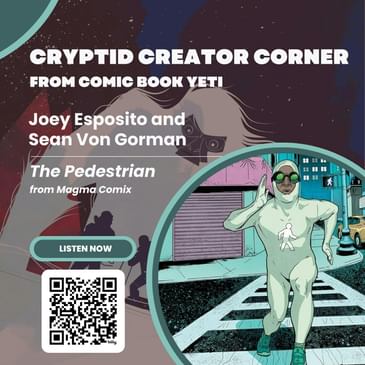

The Pedestrian is one of those gems of a comic book you find, increasingly rare for someone who works covering the industry, so I was excited to finally catch up with co-creators Joey Esposito and Sean Von Gorman. It was my favorite new series of 2024 and Jimmy was kind enough to get me a signed copy when we visited Baltimore Comic Con last fall.
Nearly everyone I know was impacted by the passing of artistic legend David Lynch and the boys get into how Lynch inspired the project, delve into superhero mythologies, and the challenges and joys of developing a unique superhero who is nonverbal. We also get into some of the project's themes and share a few stories about growing up in small towns and how that experience laid the foundation for the characters to explore in their world.
From the publisher

Behold, The Pedestrian! A strange visitor speedwalks into Summer City and silently changes the lives of its residents. But not all is quiet in this sleepy, small town—an ancient conflict linked to the secret history of street signs is brewing! DON’T WALK... RUN! In The Pedestrian, justice always has the right of way!
The collected trade hits shelves on February 11th. Don't miss what is for me the standout unique comic book of 2024.
PATREON
We have a new Patreon, CryptidCreatorCornerpod. If you like what we do, please consider supporting us. We got two simple tiers, $1 and $3. I’ll be uploading a story every Sunday about some of the crazy things I’ve gotten into over the years. The first one dropped last week about me relocating a drug lord’s sharks. Yes, it did happen, and the alligators didn’t even get in the way. Want to know more, you know what to do.
Arkenforge
Play TTRPG games? Make sure to check out our partner Arkenforge. They have everything you need to make your TTRPG more fun and immersive, allowing you to build, play, and export animated maps including in person fog of war capability that let’s your players interact with maps as the adventure unfolds while you, the DM get the full picture. Use the discount code YETI5 to get $5 off your order.
Global Comix
Save on a subscription to GlobalComix with us. Visit the link below and use the discount code COMICBOOKYETI.
[00:00:00] Your ears do not deceive you. You've just entered the Cryptid Creator Corner brought to you by your friends at Comic Book Yeti. So without further ado, let's get on to the interview. Hey everyone, this is... Hi Byron. Who is this? I'm your fairy godmother. I have a fairy godmother? Of course you do. I'm 50 years old, why haven't you shown up before? I appear when I'm needed. And I didn't need you in all these years? Do you want my help or not? Um...
[00:00:30] Sure. Exactly. I was just about to pitch our Patreon. Why would I need help with that? Because you're an idiot sometimes. That's hurtful. What were you going to put on there? We do comic stuff? So something along those lines? And this is why I'm here. You do know what people put on Patreon most of the time, right? Honestly, no. People need something a little bit spicy to entice them to support you.
[00:00:59] Nobody wants to see me shirtless. I doubt that's true. You are in pretty good shape considering your age. Thank you. Let's see. A little spicy. I've been bugging Jimmy to figure out what he's going to do. I know lately he's been playing around with his **** all the time. He loves to take it out and show it off. There's even a specific TikTok channel now. How's that sound? Not a bad start. People like Jimmy. What else you got?
[00:01:24] I told a story recently about being in a strip club with some of the four horsemen when I was working for WCW back in the day. I picked up an infection on my- From the experience? I hate strip clubs. Is that better? Getting there? But maybe spicy shouldn't include infections you get in strip clubs. That's not sexy. We'll workshop it. Like I need more meat. At least tell them where to find it while we figure this out. Mother goddess, help this poor man.
[00:01:53] You can find us on Patreon at cryptidcreatorcornerpod. I'll put it in the show notes. Anything else you'd like to remind me that I'm bad at? How much time do you have? Why do you look like Rosario Dawson anyway? I appear the way you want me to look. Okay, that's disturbing. Wait, have you been showing up in my dreams? I'll never tell. And we're done here. Y'all, Jimmy the Chaos Goblin strikes again.
[00:02:20] I should have known better than to mention I was working on my DC Universe meets Ravenloft hybrid D&D campaign on social media. My bad. He goes and tags a bunch of comics creators we know, and now I have to get it in gear and whip this campaign into shape so we can start playing. Another friend chimes in, are you going to make maps? It's fair to say it's been a while since I put something together, so I guess? Question mark? It was then that I discovered Arkenforge.
[00:02:45] If you don't know who Arkenforge is, they have everything you need to make your TTRPG more fun and immersive. Allowing you to build, play, and export animated maps, including in-person Fog of War capability, but let your players interact with maps as the adventure unfolds while you, the DM, get the full picture. Now I'm set to easily build high-res animated maps, saving myself precious time and significantly adding nuance to our campaign. That's a win every day in my book.
[00:03:14] Check them out at Arkenforge.com and use the discount code YETI5 to get $5 off. I'll drop a link in the show notes for you, and big thanks to Arkenforge for partnering with our show. I think I'm going to make Jimmy play a goblin warlock just to get even. Hello, everybody, and welcome to today's episode of the Cryptic Creator Corner. I'm Byron O'Neill, your host for today's Comics Creator Chat. I'm joined by two newcomers to the show, co-creators Joey Esposito and Sean Von Gorman.
[00:03:41] They are the architects of my favorite new series of last year, The Pedestrian, which was nominated by me on our annual end-of-the-year show, the ICE or Indie Comics Excellence Awards. All four issues are in shells now, and you can find them. And the collected trade is dropping on February 11th? That was the last time I checked. But Joey and Sean, welcome to the show. Hi, thank you so much for having us. Hi, Byron. Great to be. Whoa, where'd you come from? Neverwhere.
[00:04:10] Well, Joey, I think you might be my first down Easter on the podcast. Like maybe Zach Conch is up there. Ooh, I'm honored. That's like Maine, maybe Nova Scotia. I can't exactly remember. But I hope the winter isn't hammering you up there this year. Where are you up there? I think we talked about this a little bit. I'm in Midcoast. I'll tell you exactly when we're off the record. But I'm in Midcoast, Maine. It's not too bad so far.
[00:04:37] We only had like one moderate snowfall, and it's just really, really, really cold, basically. That's it. But no snow dumps so far. Okay. Well, that's not bad for getting into mid-January. I mean, my in-laws are out of Bar Harbor. They only live up there half the year, but their place will get, I don't know, four feet by now. Yeah. Yeah. It's pretty mild so far, just bitter cold. Well, to the pedestrian, I guess it makes sense to start with my own exposure to the book originally.
[00:05:07] I was visiting my LCS Acme Comics in Greensboro here in North Carolina, and Jermaine, who's the owner, turned me on to it. Now, most of the time, I'm pretty up on what's out and what's hip. I wouldn't be doing my job very well as a, I guess, quote, trusted comics journalist outlet if I wasn't on top of everything, which is a long-winded way of saying that those local comic book shops are vital to spread the good word, especially for books like this that might go a little bit under the radar.
[00:05:35] And given the news about Diamond filing for Chapter 11 this week, I just wanted to highlight their importance and encourage you to support them. Like, wherever you are, please pick up your pool boxes, folks. Soapbox over. This was the most pleasant surprise of the entire 2024 year in comics for me, and it's difficult to encapsulate exactly why. It's a quirky book. On the surface, you have a black hero in a white tracksuit in a small town who is fighting the incursion of evil as only they can.
[00:06:03] But it's the nuance here to pull a reader in. And the real success, I believe, is a deep understanding of the role of the reader to interpret the story kind of through their own filter. That's my ramble. So how did this rather unorthodox project get kicked off by you two? Joey and I had worked on a book called Pawn Shop a number of years ago that we had kickstarted successfully and it was put out by a publisher.
[00:06:30] And then not much happened after that. Just kind of like a slow whimper, but it was about a day in the life of New York from four different perspectives. Each chapter followed one of four characters going through their day in New York and seeing how these stories sort of intertwined with each other.
[00:06:51] And I had been playing around with a costume design of someone inspired by the little blinking white man in the don't walk sign and thinking it'd be really funny if like what if he had a superhero kind of like flash, but doesn't really run especially well. Maybe just walks really, really well.
[00:07:13] And maybe we see him in real time walking around and had they have that rough concept and just a name with the character. The pedestrian justice always has the right of way as the tagline and not much more than that. And remembering how great it was to work with Joey on that project.
[00:07:35] And we've been trying to get other things off the ground for a number of years and remembering how great Joey is at writing these rich, diverse characters. And I thought maybe bringing Joey on to help fill this world and maybe kind of play with that experimental thing we were doing a couple of years ago, just on a broader scale, instead of, you know, this pawn shop, which was the linchpin of the four stories that would intertwine. And we have this costumed hero person to do maybe like a slice of life superhero thing.
[00:08:06] I gotcha. Well, I have a background in studying mythologies myself. My anthropology degree had a focus on Native American myths and I'm always in trance when people can interpret them in a comics medium in a new and inventive way. Myths in general, and there are no native ones. Okay. As of yet, we don't know what the future holds, but it's, it's in fact about as modern of a mythology as one can imagine, you know, traffic to,
[00:08:31] and it's a, such a fascinating choice of material culture to lock onto. It's ubiquitous, it's everywhere. And there's kind of a not so subtle element of co of like a collected social conditioning. That's inherent to all of it. So why, why traffic signs aside from you came up with the designs and then needed to wrap a world around it? Is that, I mean, I think you touched on it. Like it's, it's so ingrained in all of us.
[00:08:58] And so our sort of thought process is why is that? You know, like, is this, you know, something long lost that has reinterpreted itself as a modern truth, truth sign, or is someone fucking with us and trying to make us live life in a certain way? Um, and it's sort of, I guess with the larger mythology we'll deal with.
[00:09:20] Um, but yeah, I think it's just capitalizing on this thing that we all sort of take for granted and kind of digging a little bit deeper in a fantastical way. Of course. Yeah. Like, why do we stop at street sign? Is it learned? Is it learned behavior or is it just ingrained in all of them? Yeah. I mean, um, I, I mean, I certainly think that it is learned, but it is one of those things that I guess is so subtle. You don't even know it.
[00:09:50] And which ones do you pay attention to? Like we always pay attention to, well, you pay attention to stoplights, even if everybody doesn't stop for them. But there's so many other signs and they're, they're just constant. You don't realize I started looking after I, I finished reading the trade that you guys sent over and it's, it's kind of mind blowing.
[00:10:10] How many, how much, how much data you're expected to kind of pull in and internalize, um, which is kind of an interesting metaphor for how much data we're all having to suck in all the time and how it's sort of overwhelming us all right now. Right. Like is social media or whatever, or just news coming at you from all angles. Is that like the next evolution of what they, I say they as a broad term is what they've been doing with street signs, you know? Um, but yeah, you're right.
[00:10:39] There's certain ones that were conditioned to, okay, this red stop sign, very important. But then there's like the yellow squigglies and it's just like, uh, okay. Yeah. You know, you just kind of let that brush by you, but they do have a purpose, but also when they're so ubiquitous, do they lose their meaning in a certain point? You know, and how do you sort of combat that? I guess. Yeah. I mean, it is kind of programming if you think about it.
[00:11:07] Like these are, these are, these are symbols that are being used to program how we move through the world. And, you know, and, and kind of that thinking is, is kind of where we're coming from in terms of the incorporation of stop signs in here. I think we're, we're going to get deeper into that.
[00:11:26] Um, you know, once, once we, we continue the series, but you know, if you think about, you know, we have all of these roadways and pathways and, and there's, and there's energy passing through these, you know, we're all living beings and our, you know, our entire lives are being hurtled through these channels at 80 miles an hour at times, depending on where you are. And, you know, go left, go right, go right. We're moving this energy around for, for what purpose?
[00:11:57] We'll find out. Well, beyond those kind of being the, the grounding through line for the project, the, the narrative has often been described as Lynchian, you know, from a lot of other folks that I've talked to. It's a timely association, I guess, given his, his recent passing, but I was on the road during the, the Twin Peaks craze, you know, Sean and I were talking about this joy before we started there.
[00:12:19] So I just don't have as much of a familiarity specifically with, with the Twin Peaks show, but the pedestrian certainly has a parallel. There's this portrayal of a small town life, if a quite distorted one. And in this case, this concept of feeling stuck and I can't help, but think there's some personal reflection here from one or both of you that's kind of been injected into it. Yeah, for sure.
[00:12:44] I think the small town element definitely is inspired by my hometown and where I grew up and I've, I've talked about it a lot, but it's very much this kind of town where you can leave for 15 years and either nothing changes or it changes a lot and in a bad way.
[00:13:01] Um, and just growing up in a place where all the adults around you are like, are aware of this, but have planted their roots so firmly that they're not going to move, but are telling you that like, you can't expect to accomplish anything if you stay here. Um, and then also like not really abiding by that themselves. Um, so just sort of growing up in this place that feels like a black hole.
[00:13:26] Um, and a lot of that definitely seeped into summer city and what the characters themselves are, are going through. Um, but also hopefully showing that it's not, you don't have to let it pull you in, you know, and that's sort of what their, their journey is here. Yeah. I mean, I grew up in a small town, um, in Oak Ridge, Tennessee, which is anything but a typical America town.
[00:13:51] It's got super weird. It's got three nuclear power plants. Uh, it was the secret city and was instrumental in the development of the bomb. So that along with Los Almos, um, we, I think the claim to fame is we have more PhDs per square mile than anywhere in the country. So it was a very weird, very surveilled place to grow up. Yeah.
[00:14:11] So that's, that's interesting because Pittsfield, you know, when I was growing up and sort of what led to the kind of environment that I grew up in was the GE plastics headquarters was there. And so that was like, you know, the major employer. Um, of course they polluted everything and that's been an ongoing struggle, but, and then they left and that was kind of like the beginning of the wasteland, you know?
[00:14:34] Um, but it's interesting that these places that are small town America or whatever, but also like the core of something rather sinister, um, in terms of like a global corporation that's like actively doing harm to the environment. And that's also sort of why you see, you know, if we're talking full spoilers about the book, um, you know, Pizza Sun clearly based in summer city and there turns out not so great.
[00:15:06] Um, so we had, um, where that comes from. I had similar kind of situation. Uh, we had tons and tons and tons of super fun sites and I'll, I'll get off tangent here, but it's, it's a fun story. So, um, I've told it on, on here before, but, uh, there was one afternoon, uh, everybody who worked in the plants in Oak Ridge had to wear these like lanyards that, that, that did a, um, basically kept track of how much exposure to radioactivity that you had.
[00:15:32] Um, and of course there would be, you know, leaves them in their cars, hanging in their car, what have you. So one day a whole bunch of frogs that were in a settlement pond. So this is the water that they use off the reactors that they can't dump back into the rivers for a while. That's a different story. But anyway, these frogs would settle in the ponds because they were warmer than other surrounding bodies of water. So for an unknown reason, there was this mass exodus of frogs one day.
[00:16:01] And so they crossed the road that was close to the plant. So everybody got off work and ran over those frogs. So they got home, left their lanyards hanging in the car as, as one does, got out, came back to work. And it set off this mass hysteria of like, what's going on? There's a radiation leak, reactors melting down or, you know, something catastrophic is happening. It was just the frogs, you know, leaving the settlement pond. That's insane. Yeah. Yeah. That's my hometown.
[00:16:31] But there's, there's also definitely a bit of an on the block kind of feeling to this. It reminds me of a bigger city, kind of like New York or Chicago. So there's a little bit of an urban overlay to it as well. It feels like it wasn't my experience of sort of the neighbor, neighborhood-y hometown where everybody would kind of gather. So it felt a little urban too. Yeah.
[00:16:53] It's probably a little bit, it's probably a mixture of like my hometown as well, like, like South Brooklyn, which is, you know, South Brooklyn being the suburb in a sense, but still pretty, pretty fairly urban in terms of like you get, it's hard to tell if you're sometimes in Manhattan or just very, very South Brooklyn. But definitely that being near a big city, but kind of being away from things a little bit.
[00:17:22] And also, you know, just trying to capture the isolation of how that can feel as well. If you have these things that were set up for more people that are no longer being filled. Like when you have like, like a big chain roll into town, they take over like the bank of this, this hundred year marble, beautiful building. Then they make it a target and then they decide to close it.
[00:17:49] So you just have like this beautiful building that's been smirched with like target scraped off on it and all the furnishings on there. You just destroyed this historic building to try and be a target. And having a lot of that growing up around a lot of that of like, why, why did you have to try to put, put the target there?
[00:18:10] This, this was a beautiful building that has stood the test of time, but then the economy downturns and, and we're okay. We're you need it. You need a pharmacy now. This needs to be a dweave. Oh, no. Oh, sorry. We changed our minds. We're not going to put it back the way we found it. We're just gone. So now it's a spirit Halloween. That's, that's what it is. Yeah. It's nice this morning, Brooklyn. Living in the bone, their businesses.
[00:18:42] It may be my personal filter here kind of injecting it, but I locked onto the, that, that middle American sensibility with the bad guy, you know, a young man who's feeling sort of untethered. And Joe, you touched on this sort of, sort of without purpose. It leaves you as a reader also feeling a bit untethered in the beginning, wondering if these are sort of just the voices in, in your head, or is it an actual entity at play, which has to be intentional.
[00:19:06] So you're kind of playing around with this biblical concept here, pitting free will against a form of sort of predestination. At least that was my read. Sure. I think that's a, I think that's a fair read. Um, you know, you'll notice that they, we call him clutch commander, but he is actively responding to the captions of the characters, which implies that he has sort of, sort of like an omnipresence over the world and, and the narrative.
[00:19:34] But I think also, you know, James specifically kind of makes himself receptive to receiving that, um, influence. Um, so that's just kind of where I was coming from with that. But, um, yeah, I think the power to like resist that external force is something that is compelling about these characters. And now that James has gone through it, it'll be interesting to see like where he, where he winds up next.
[00:20:05] Yeah. I mean, it's hard not to lock onto the red right hand, which I'm assuming is built as, as sort of the oppositional foil to the to go symbol and not referencing kind of the red right hand origin and, and Milton's paradise lost or Nick cave in the bad seed song, which I certainly did not listen to last night while I was writing up questions. That's awesome. I love, I love that you're so engaged with this. That makes me, makes us really excited.
[00:20:35] And happy. Um, but yeah, I, I mean, I think, um, you know, you mentioned the lynching influence and I think one place that comes into play is maybe not giving all the answers explicitly, um, with this sort of thing. Um, and I, I really liked that you've drawn your own conclusion on sort of what's going on and what the implications are. Whereas maybe it doesn't align completely with what I was thinking. I think that's exciting.
[00:21:04] Um, and I think as far as the red right hand stuff goes, I think that's, will be peeled back, but maybe not explicitly, you know, explained, I guess, at least not for a while. Yeah. Yeah. And, and, and, and going, and going back to having twin beaks as a big influence, I think the thing we appreciate about that work in particular is not everything is a spoon fed to you.
[00:21:32] A lot of, a lot of it exists solely in the understanding of the individual and as much as they put out, like not every, not all the details are in one medium and they put a lot of, you know, other facts out in other, in other texts. And you kind of have to indulge in different levels of media absorbing this piece. So there's not one end all be all explanation of all these things.
[00:22:01] And now there never will be. And now we'll just be talking about, you know, what was that last shot forever? And that trick of Lynch is that it's not written down anywhere. It's, it's, it's, it's no, it's over. We did that. You're welcome. You're lucky you got that. And then we had some fun together.
[00:22:23] And I think, but I think, you know, with that specifically, it's like twin peaks itself is kind of about never being able to know the answers, you know, like it's just a constant search. And this is something that was being circulated a lot yesterday because obviously when she passed away, but just about how great it is to have the mystery and not, you know, not only in the narrative, but like in life and not knowing what's next. And, and that's like the whole, the whole point. Right.
[00:22:53] So I think, um, twin peaks itself being about that, but then also sort of on a meta level, that's like the intention I think is really, really fascinating. And that's something that I definitely wanted to inject into what we're doing. Um, I think, you know, I'm hopeful that we can come, come close to giving that sort of feeling, but that's the intention for sure. There, there are two quotes that are jumping at me.
[00:23:21] Um, I was in, I was at a library, uh, at Ryder Park in Manhattan, this beautiful old church that has been turned into a library. So walking up these oyster like stairs, walked into like their main library and there was a book open. That was like a David Lynch retrospective that had a shot of, of, of Dale Cooper at like in that last shot of the, of season two, where he's just smashed the mirror with his face and there's blood gushing down his face.
[00:23:51] And there's a quote saying, as soon as you, uh, as soon as you give some closure to the story, uh, the viewer can't wait to forget it fast enough. So if you never completely closed the book on every little plot thread that you have on there, people always be gnawing on those questions forever of like, what happened with this? And then the other one was there were, there's someone going over an account of meeting him at like a signing. He had, he had to give him a talk.
[00:24:20] Someone got the chance to walk up to him and say how much they've enjoyed their work. And, and he said, thank you. And remember the universe is in your basement. Okay. Which, which like, we'll just pause for a moment. Universe is in your basement. Pause for a moment. Just let the viewers really absorb that. But I really, I really enjoyed that. Uh, yeah.
[00:24:45] Of like, I, I, I, I interpret that as, you know, your basement is the place where you can have some free space. You know, you have your home, you have your established home of like the thing you build to trick people into thinking you're a horrible human being. And then you go to your basement. It's where you really let you, that's where you have your tools.
[00:25:06] It's where you have your toys that you don't really have out and really have your true, truest form of creativity is when you're locked away in secret down there. But also, I, I think his approach to storytelling and, and filmmaking certainly is almost painterly in that, you know, a painting hangs on your wall and you engage with it forever. You can constantly look at it and reassess it and, and all this stuff.
[00:25:32] But I think now you're such, uh, you know, everything you just know about X, Y, or Z or X, Y, or Z explained. And like everything is contained and it's like, I watched these eight episodes and it's over and they tied up everything in a bow and don't have to engage with it anymore. Whereas Lynch's work and Twin Peaks and, you know, they leave the door open just a crack.
[00:25:56] So you can constantly be thinking about it and like reassessing things almost like you would, uh, a painting that's just like constantly in view. Um, and I think that's the things that, I think those are the things that stand the test of time. You know, it's why things like Watchmen are, are just still just constantly being analyzed and dissected.
[00:26:16] It's because there's so much in the text that is so subjective to the reader or the viewer that, um, you just gotta have to constantly reassess it and engage with it. Um, and I think that's beautiful, you know, like it, that means it never, even though there's no more coming, it never stops you enjoying it or thinking about it or letting it sort of seep into you.
[00:26:45] But I think the strength here is, is also in what else is added, right? Because you have all those elements, which are beautiful and engaging, causing you to question, but it's also, it's also like a superhero story and it has a very redeeming element to it, right?
[00:27:04] Because the, the pedestrian himself is acting as a catalyst for ordinary people to stand up and figure out a way to make a difference in all this sort of ambiguity where they can't, you know, this, the guy, the crossing guard, you know? And he's this somewhat robotic black hero and a white jumpsuit who doesn't speak and never acts aggressively, but is also a bit authoritarian. You know, he's a stickler for the rules, shall we say?
[00:27:33] And he has a, the way you guys have created him, he's got an immediate aura or a presence that kind of acts as a guardian of entropy in this. So, so talk me through developing him as a character because, because there's a lot of pieces that you, you basically input it into, to this character who is this larger than life figure in the book. But okay, he doesn't have Superman powers, right? He's, he's not an Omega level mutant here.
[00:28:03] So I, I think, I think you're touching on, on a big thing of, of Superman being an influence on, on here, which, which, which may be a surprise being what the character is. But we were really inspired by the triangle era of Superman comics where Superman wasn't like the only star of the book. Like the stories would pull back and it was more of an ensemble piece, which really, which we really enjoyed.
[00:28:28] And there's a lot of, there's a lot of things going into the blender for this character. I think one of the earliest thoughts coming into this was there was a fellow I used to work with years ago where we would go out after work for like a drink at the bar.
[00:28:45] And he was a very, um, a very conservative individual, a very, uh, a very tall African-American fellow, like very long fingers and very long, just, just a big guy who was very reserved, who would come out to, to the bar, but he didn't drink. And he would sit there at the corner of the bar with his arms crossed and he would just, just announce every so often.
[00:29:08] It's like, Oh, I don't drink, but you can drink of like trying to lead us by example of like, I see how I'm living. This is the way you should be living. And I'm going to, I don't quite fit into the situation, but I'm here and I'm being heroic in the way that I don't fit here. But someone's going to see what I'm doing and think of what I'm doing as an example of how you should live.
[00:29:35] And we thought, yeah, this, this guy is someone who's trying to, he's not, he's not a cop. He's not here to judge anybody. He's just here to help. But he's also like, you should really like watch where you're going when you cross the street, man. You should, you should follow that stop sign because this is what I'm doing. Because rules are so important in this world, especially talking about like the supernatural elements of, you know, once, once you're dealing with creatures beyond our, our understanding, all they have are rules.
[00:30:04] So that's why rules are so sternly followed in this, in this story. And, and, and what, and what happens where, you know, if you take everything that's kind of like impressive about Superman, the flying, the strength, all, all the powers, what do you have? You've got someone who's just trying to do the right thing all the time. And that's, and that's what the pedestrian is. So did you go back in terms of like creating the form language and use older Superman?
[00:30:33] Because the, it's not a, it's not a form fitting outfit, you know, it's not tight. It's not a modern interpretation, let's say of superheroes where, you know, every sinew of bicep is, is accentuated or something like that. Um, so was it anything else inspired the design? If to me was somebody who was a, um, production assistant with wrestling back in the day, it feels very wrestling like the, the outfit does. So yeah. Yeah.
[00:31:03] I mean, what we wanted to seem like this is, we didn't want it to be overly spectacular. We kind of wanted this, like, what if this is just a guy who puts on a superhero costume and goes out into the night trying to help? Because anyone else in that situation, if they were verbal, the first thing, you know, it's, it's, it's, it's dark. It's you in the sky on the street corner. You make eye contact. That other person is going to be like, oh, don't worry. I'm not crazy. I'm just going to a Halloween party.
[00:31:32] Get some, I, I, I see what you're seeing. Let me reassure you that I'm not here to murder you today. He doesn't, there's no verbal here. So he's, he's someone who can only be judged by his actions in a literal sense. And a lot of people have also picked up on, uh, that there's also a lot of, um, a lot of autism coding in the characters. Yeah. For sure. Where we touch on, you know, when both of my kids are on the spectrum, it's, it's very possible.
[00:32:03] I'm, I've got a touch that's hasn't been diagnosed in terms of, this is very dissimilar to how I act on the street of like, I'm very conscious about going around things. I'm, I'm, I'm, I'm touchy about, uh, eye contact and people getting too close to me and not following the rules that really, really bugged me when that isn't happening, which is being brought to my attention that this is, this is, this is something that people on the spectrums all struggle with.
[00:32:30] And we've had, we've had, uh, readers who, who, who teach kids on the spectrum. We've had, we've had some kids on the spectrum come to us at shows and just very intrigued that, that we didn't want that to be the headline of the character, but we thought that would be cool if that were something we're putting out that maybe someone sees and, and get something out of it. Well, that's awesome. That's really, really cool.
[00:32:52] As, as somebody who is on the spectrum myself, I, I definitely noticed that and it is definitely appreciated because representation matters, especially, honestly, unintentional representation. Like that's a, something you don't see as much and something that can hit. You can see yourself in it without it being, you getting hit over the head with it, I guess. It's, it's really cool.
[00:33:16] You can't be a, a on his chest or like a blue puzzle on his chest and all of the heroes and villains being linked to some, some aspect of, of, of an autism diagnosis. But, but no, it's, it's, it's a rich, diverse world. And we wanted to show these rich, diverse characters in such a way that like, Oh, is this something here? Is this something here? Oh, this is interesting.
[00:33:40] This is building up where, you know, he's, he's a nonverbal character where if we're looking at, you know, a potential media adaption at some point, what a challenge for an actor that would be of like, you know, you don't have a lot of dialogue, but you're still going to have to break our heart. Well, speaking of diverse characters, that dude in the convenience store in issue one looks a lot like you, Sean. Yes. He was very rude to that, that person.
[00:34:09] It's, it's a place I can go. And it's, it's kind of a cry for help. I'm I, I, I want it, but I don't know how to stop. And I need someone to be like, listen, man, you gotta, you can't, you can't be that way in the store. I mean, most of the time when people are crowdfunding, they have to pay to get in a book, but I guess if you're drawing it, you can just draw yourself. Whatever you want. I also didn't want to like, I think that's the only role I could be like, okay. I, I wouldn't want someone to be like, is that me? You're talking about me.
[00:34:40] I don't know. If I'd be way too scary if I put myself there like, is this you? Is this you in the world? Is this really, is this really the secret you? As we, as we learn the secrets of our, of our heroes in grim detail. Is this the worst thing about me that I'm a little rude to shopkeepers? There's their worst thing there. Well, as we've learned, whoa, what a guy.
[00:35:09] And, and, and at the time of this recording, we're like, we're like 17, 18 days into 2025. And what a fucking year it's been so far. You're telling me it's a, it's something else. It's like, yeah, I think. Way to go 2025. 2025. We were like, okay. Okay. 2025. You're, you're, you're, you're getting, you're, you're getting a good start here. 2024 was rough. Let's get your chance. 2025 is like, hold my beer. Wait till you see that.
[00:35:38] I was so waiting actually right there at the end of 2024. I thought about putting out a post cause everybody was like, oh my God, thank God this is over. And I was like, y'all, I mean, January 6th is coming up. January 20th, just around the corner. There's a shit show just about to drop on all of this. It's also just like, really, we're still clicking to the, a calendar flip at meeting anything.
[00:36:02] You know, like everything doesn't magically change just because like a little clock turned over. Like, oh my God. We get our grades. We hire champagne. We put on our hats. We, we performed the ritual and nothing changed. We're really bad mass accusers. That's the thing, right? Collectively. Well, talking about things that can actually make a change in people's lives, the, the twins are one heck of a, like a nerd metaphor.
[00:36:32] So for me, it was, how do we connect with media and its role in inspiring us? And in this case, these power ranger ask a TV show called laser twins that they're watching. Um, this is comic book creators in a nutshell. I feel like taking a nugget of inspiration muse from our childhoods, you know, or adult life for that matter. And inscribing their, you know, their art with it. And I'm really, I'm really impressed with, with the twins. Talk me through sort of developing them and where they came from.
[00:37:01] So that was actually a whole other project. We were trying to get off the ground after on shop. Uh, okay. Razor Titans. Yeah. Okay. We had, we had, uh, you know, Joey and I have intersecting interests. And I think during, you know, pawn shop was an indie darling and it, it, it jumped up our, you know, notoriety a little bit in terms of the response and a following. We have a little bit of a following after that.
[00:37:29] Uh, and really worried dude, what, what did we want to do? And we figured we would love to do a power ranger's book, but no one would let us do a power ranger's book. So let's just scrape the serial numbers off. Let's just do the things that we would want to do in something like that and, and celebrate, you know, that, that feeling of that nineties, uh, TV toy commercial energy. And what would that look like?
[00:37:57] So we figured let's make a new thing that would inspire a nostalgic response for something that, that did not exist previously. And that just didn't, didn't happen. Um, and then, then going back to what, um, what, what pedestrian was, you know, a lot of times in comics, you're kind of waiting for permission to do the thing. What you kind of make the thing, you make a little sliver of it, six pages, you do all
[00:38:25] the groundwork of figuring out what this is going to be, where it's going to go. Um, you make a little taste of it and then you send it out into the world and then you wait and see if someone will say, okay, you can do that. Here's your green light. Go ahead and come, come, come make this for us. And then nothing happens. And when we started riffing on, on pedestrian, we're like, yeah, this is really, really interesting. Let's just make this. Cause this is also lockdown. It just happened.
[00:38:53] We were talking about it like late 2019 and a couple of months passed by. We're like, well, fuck it. We got time. Let's just, let's just make this. Let's just go out of pocket. You know, you do the words, I do the line art. We'll pay out of pocket for, for the letters and the colors. And okay, let's just make this. And we've worked on it in secret for a year. And then by the end of that year, we had maybe almost most of what became issues one and two.
[00:39:21] And we were like, this is really fucking good. And then we're like, you know what? Fuck it. Throw laser Titans in there. We're just throw everything we can at this book of like, let's just make the best possible thing we can make. And we got pretty, um, pretty, uh, you know, we mentioned Watchmen. We were there. There was a point where we're like, this is kind of our Watchmen in terms of the superhero story.
[00:39:48] But then also there's another separate project in it that intertwines and hints to where the story's going. So there's a little, there's a little Watchmen there as well of like looking at our careers right now. We knew early on that this was going to resonate in a way with people because we were really digging on it. We had made an ash can of like the first, that first chapter where he foils that robbery. And that was all we had.
[00:40:14] We had a cover very similar to that, um, or an earlier version and those first six pages. And we went, we did shows. We just had on a table, people would come over and go, what is this? I got a, and they would look at it and they go, they would either buy one at 10 bucks a pop or give us their email address to like, let us know when this is happening. And we were able to get this to shops and, and, and build up this, this following to the
[00:40:43] point where by the time Magco finally came around, we had done maybe like four years of legwork in terms of what this launch is going to be quietly and secret. And as far as your question, Sean, you know, I love you. Uh, so the laser as far as no, as far as the twins, um, it's really just, I love that dynamic
[00:41:12] of sibling energy where you just, there's just a communication that happens that is like sort of impenetrable to everyone around you. Um, but also they are the lens to what a Sean is, what Sean was talking about in terms of being inspired by that thing that you loved when you were a kid. Um, we love power Rangers. And so having them be sort of this lens into, you know, how the media that we consume at
[00:41:42] that age can have a positive impact on us. For us, it was power Rangers or, or Superman, like really looking at those characters as aspirational and finding a way to take their sort of ethics and values into your own existence, right? Even though there are fictional characters. Um, so there's sort of the entryway into that idea. Whereas the flip side of things we're seeing is like the pizza song commercials and just like things being sold to you constantly.
[00:42:12] And, um, so media can have positive and negative impacts, but I think through the twins, we get to see that it can really be more positive if you let it. And then, and then reverse you back on it. There's a, there's a bit in the book where, where, where the kids use a toy that was inspired by a real, uh, a real life, um, power Ranger boy that existed when we were growing up.
[00:42:40] That was like, it was that first wave of toys fast by the missus just started slapping stickers on shit. And, uh, there was a, uh, commercial for a project, uh, for a product called the, uh, power Rangers space shooter. So we, we rejiggered that for, for laser Titans. And then to, to promote, uh, the trade release, we made a new toy commercial where we made a pedestrian space shooter where we got, we replaced the stickers on everything.
[00:43:09] We shot, um, a short ad with, with my son, uh, introducing the pedestrian space shooter. So it just keeps going back and forth in terms of where we're being inspired. Those discs are huge. I had one of those cheap old disc guns as a kid. My mom was always getting on me. I was going to put it, put out my brother's eye or something like that. So, so how did you get that worked out? Cause those things are huge. I'm sorry. Audio listeners. You're not seeing those are like three quarters of an inch wide. Yeah. They're pretty solid.
[00:43:39] It's like, it's like shooting like one of those gummy pineapple rings that you'd get through like box, like shooting like a large gummy candy at somebody. And they're just foam. They're, they're actually not, they're, they're harmless and ineffective against the clutch. That's for sure. And there's a lot of conversation of that scene. Cause there was an early version of the scene where it was just more or less a nerf gun.
[00:44:06] And then the conversation of, is this the image we want to see to African-American children on the street, uh, doing a fake robbery with a gun where, where in my mind of like, I'm just going off of, off of like a thing that my kids would do. And Joey, you know, it was like, let's, let's pause for a moment. And then we settled on, Oh, let's just do a space shooter from power Rangers. This innocuous weapon that like no one could ever think this would actually hurt anybody.
[00:44:34] Cause then you actually have a full cartoon character on top of the thing. I think the fact that any sense that this could be a weapon, it's shooting candy at you. Well, at least you have a backup. You've already got your mock-up. Should comics happen to fail? And I don't think it is. You get, you guys have got a home run here, but you've, you've already got a product tested to go on shark tank and shoot gummies. So that would go absolutely viral.
[00:44:58] If you could shoot gummies accurately across the, like lifesavers, gummies across the room into somebody's mouth, you've got meant meant. I think the thing we need our CBD gummies being shot from across the room into your mouth of like chill to start. Wow. Bring it down on the floor of Congress. There you go. So, okay. I got to ask was, was pizza son also a side project? Cause I don't know. I just feel like I love that pizza son stuff.
[00:45:26] I, I, the guy in there like was like sort of a cross. I was a wrestling kid growing up. So like between Randy Savage and Jimmy Snuka. Right. And then you have two pizzas on turntables that just show up. It would, that was magic. I just, is that another concept you guys had developed? You're just like, ah, we're just going to throw it in there. No, I think, I think, um, I think I had like this idea for like, what if. Like we just had like one of those weird. Like non pizza hut chain pizza restaurants.
[00:45:56] Like there's tons of like, like Tony Roma's or like little Caesars of like these things that you see pizza. Yeah. See, see, see, see, these things that just pop up in these, in these, in these low run towns that become the only restaurant that becomes like your only source of like going out to eat. And we're like, like, which is just like a picture of the sun with like just one slice taken out of it. You were slicing up the sun.
[00:46:20] And, uh, I think, I think a tagline while a while was like, of like an idea for commercials, like you're getting a phone call or like, hello, you're like, you're getting pizza, son. I thought that was, uh, a funny thing that would, uh, just, just kept coming back to. And then, and then the ad, I think we did as a separate piece during like, during the lull between, you know, what we had done in that initial run and the Magwa thing that
[00:46:49] we would just, I would have an idea and I would just kind of dry out the idea and we would just find up a place for it later. And we thought it would be cool to like, maybe have this like pop up during the course of this book, uh, because we were very receptive to the concept of a reread, especially now that the trade's coming out, you can kind of go back and look at all of like the little details that we have, we've peppered in over the course of the, I think now five years
[00:47:18] of working on this for even the second, the second version of the cover, you know, it's, it's more rich in terms of like, look at like all the little windows that you may not have caught on your first look at it where the first version just kind of had like our hero on here. But if you look very closely at the windows, like there's maybe someone creeping in the window that you didn't necessarily see on that first look.
[00:47:45] So, you know, we, we, we've, we've made a thing that we hope stands the test of time to analyze and overanalyze and talk about and come at us with questions that we may not be expecting down the road. Well, I mean, I certainly have overanalyzed it. Maybe it was, I was hungry, but you know, uh, this could have just as easily been about pizza as in creating a mythology around pizza as streetlights. Cause they really, what is more small town than a family owned pizza joint?
[00:48:12] And, and why did they have so much more character than any other restaurant in a small town? Sure. It's interesting that you say that. Cause in the, in the script, I did send some reference for a specific restaurant in my hometown that's been there forever. Um, and you know, it's, it's not as, uh, it's definitely not as sinister as a piece of sun, but just like capturing that sort of environment and that vibe, the early nineties pizza hut, but like offshoot vibe.
[00:48:39] It's like Bill, it's designed to be homey and feel at home. It's not, it is a synthetic environment that we're, we're using to kill authentic environments like this. And that goes around. We're going to add a taco bell to this and take away all of the fellas that you like. I mean, ours was very, I mean, defining, um, like the pizza joint from my hometown, um,
[00:49:07] has a New York style pizza place called Big Ed's and it's okay. I know it's heresy, absolute heresy, but it's the best New York pizza I've ever had. And I told my wife this and she's like, that's, that's not possible. Like there's no way. And she had it and she's like, shit. Okay. You're right. How is this possible? And it has a mythology to it too. Like the proprietor is an ex Marine sniper with all his metals up on the walls. And he's this just massive dude. Um, it's all this autograph sports memorabilia.
[00:49:37] They cut the pieces with scissors, right? As dark as hell. And as a kid, I mean, it just, it had such a mythology to it that I, I don't know. It's just, I've never forgotten it. It's ingrained. It's just such a cool place. Yeah. Yeah. That's awesome. I love those places where it's someone has lived a life and then they, then they go, now they make a restaurant and the walls, this restaurant, I'm going to tell you everything you need to know about me in little snippets during the course of your meal.
[00:50:06] As you're, as you're getting your entrees, you're gonna be like, is that who shaking hands with the president? Is this you on stage with the rock band? Is this you holding it? Who is this guy? And then the guy goes, comes out. I was like, Hey, it's me. Hey, I hope you're everything. Okay. Okay. Okay. You're like, Oh, that's, that's the dude we're eating in his restaurant. That's funny. He was always there. Go ahead. It's funny that you say that because in our neighborhood, when we lived in Los Angeles,
[00:50:33] there was a place called lobster and beer that had on the wall, I guess an autographed guitar and like signed CD from the band puddle of mud. And, uh, you know, one day I find out that the former guitarist of puddle of mud owns that restaurant. And that's, Oh wow. That's, you know, that's why that's there, but it's just very random, really interesting that like when someone moves into the second phase of their career, that's why you go out to eat. So you can learn things.
[00:51:04] You can not learn things and eat at home with no additional information. That's true. See, this is awesome because I'm coming up with more story ideas as I'm talking to y'all. I'm working on sort of a piece on my hometown, like a weird sort of horror story kind of thing. And now I need to have big Ed as a central figure in this. Cause he was, the cat would always be at the end of the bar. I always have his arms crossed like this. And I mean, he was huge.
[00:51:32] He had to be 400 pounds, just larger than life, massive dude. And nobody fuck with them. Everybody that worked there, he would hire ex-cons who couldn't get a job anywhere else. So yeah, it's the total flip side to the, to the, the pizza hut analogy, I guess is, yeah. Yeah. I love that. I think you have like a twin peaks levels town to come and investigate.
[00:52:01] You have an outsider coming in to investigate something and they're just marveling at like the, I love like all of the fantastic details that you have about this, but whoever's living there, it's just like, Oh, it's just this again. It's the frogs again. Yeah. Like I went to do a signing at, um, at black cat comics, uh, at Salt Lake city. And I'd never been there before. And he's driving me from the airport and just marveling at the landscape there of the, like
[00:52:30] the beautiful rock features you have there. Like, wow, this is, this is gorgeous. And like, we're just driving past a Taco Bell and he was like, Oh, Oh yeah. I actually, it's like anyone coming to, you know, you come to New York and like, you're walking around, like everyone's marveling at the building. Yeah. Well, we got, we, we have to, we're on our way to this other place. You're not, we're not the thing yet. Yeah. Colorado Springs, when we lived there was a great example of that. And there were just multiple iterations of that.
[00:53:00] They're, they're known for the Red Rocks park there. I don't know if either of y'all have been there or anything. Okay. And right butted up against Red Rocks is the Intel campus. So you couldn't have anything, a bigger dichotomy except just up the road is the, the air force Academy. It's wild. These are three groups of people who are congregating.
[00:53:26] Well, in the book, getting back to the actual book, I was really sucked in by the balance of, and it's, it's topical to what we're talking about here. Maybe think of it of the mundane kind of mixed with a little bit of cosmic madness that keeps you on your toes. Oh yeah. It reads a little bit more of a shades to come like animal man or swamp thing where I was just getting adjusted to the flow of the book.
[00:53:52] And then all of a sudden there's a parliament at play only instead of the green or the red, it's a parliament of streetlights. And I was just like, what just happened? That was the best scene in the book by far to me. Can you elaborate on that? Maybe where you're going without giving a ton of stuff away? Um, I think we were trying to make every issue feel new and different. Um, in fact, I'm rereading the Alan Moore, Stephen Bissett, Swamp Thing right now.
[00:54:22] And I, you know, going, going back, I can be like, oh yeah, this is, I see how this imprinted upon me. Um, but yeah, so it's like every issue is kind of, if not its own tone sort of goes in its own direction or, or changes things from what you thought they were in a, in a fun way. So it's, you know, I don't ever want this. I don't ever want us to be at a stop sign. You know what I mean?
[00:54:51] Um, and so I think that's kind of once we decided to put that sort of reveal at the end of issue two, I think that kind of set the tone for like, okay, let's see if we can kind of up this with every issue in some particular way. Yeah. In, in terms of, in terms of how we were looking at an issue one, you know, we set the table. Here's, here's our world. This is the real world. Uh, this is where we live.
[00:55:20] There's except there's this one weird thing about the world. Okay. Kind of like, uh, you know, get kind of like in Ghostbusters. The world feels very real. We're in the world, except for these guys should not be in charge of, of saving us. How are these guys going to be saving us down the road? We meet the guy. We love the guy. Issue two, we pull the curtain back a little bit where we smash the fishbowl in a significant way of this is not the world we thought this was.
[00:55:48] Maybe we, I think we're working in maybe even a, a cosmic creation myth into this that just, that just brought in an awkward time going back to Twin Peaks of like, you know, uh, the Dale Cooper in the red room from, for the first time, just something so completely off the wall, batchet crazy of like a Kirby level event happening in here in an unexpected way. And we end issue two there.
[00:56:16] Issue three, we realize we're underwater. We've been underwater this whole time. Things are way worse than we thought they were going to be. And then issue four, we deliver a superhero story because it's been earned because we've, we've waded through these first three issues and then boom, here are these payoffs of these earned superhero moments. And then we also answer the question of like the big, the big comedic aspect of this is
[00:56:42] like, how is this guy going to do anything when he's in a very traditional street fight superhero situation? And then that we learned like spoiler, like he is a pacifist, but he's still going to defend himself. He's still going to stand up for what to protect others. He's, he's a protector, but he's not going to hurt you, but he will let you hurt yourself if that is what you're going to do. Well, you've laid out the four issues there, which brings up the question of more.
[00:57:12] Um, I know there's more in the locker. There's already a cliffhanger at the end there. So, um, I'll, I'll continue your pun, Joey here and just any word on a green light for a second arc. We are, we are, we are actively in talks with, with Magma. They, they know we intended to continue, but you know, they're, they're a small publisher. Uh, there are a bunch of, of, of, of pros from, from, from other companies in this, in
[00:57:38] this new, uh, in this new company that, you know, they're, they're going through, there's some changes right now. Uh, Bobby, uh, Bobby, who was our editor there just went back to IDW as their editor recently. So they're, you know, they haven't filled that role yet. They're getting other projects out. And a lot of, a lot of this is going to be linked to the sales of the trade paper bet in terms of being a profitable project.
[00:58:04] We, we, we, we've essentially broken even on, on printing from the first four issues, which is amazing. Now we need to show that, you know, there is that following there that we, this can be a profitable enterprise moving forward. And that's, and that's where, that's where you all come in. Anyone listening today? Hey, look, it's anything we've said today. Peaks your interest in picking out this book.
[00:58:28] If you've missed an issue, uh, if you just want to get the trade paper back anyway, we've got a beautiful collection coming out at the end of the month with a bunch of new, um, features. There's brand new, um, pinups and cover art by a bunch of fantastic people, including, uh, a, um, an original sketch by the, by the great Tom King is in there. Wow. Oh, we've got a lot of fun material in there. Tom can't draw. So that should be interesting.
[00:58:57] Tom is a lot of people give him flack, but he works really hard on those sketches. He's not just throwing a sketch out sits there and he's really trying very hard to make that piece. And I think that needs to, to be known that he's not, he's not fucking with you. This is the best he can do. And he tried to talk me out of it several times. Like I saw him at the ring those night before and I cornered him. I was like, Hey, are you still doing sketches? He goes, why? Like, cause I really want you to do a pedestrian.
[00:59:26] He goes, are you sure? Like, yeah, yeah. It goes, it's not going to be good. Like I I'm going to love it. And then he tried to talk me out of it right before the next day. And really sat down. It took him like 10 minutes to do what you would assume he just scribbled on and threw at somebody. And that's, and that's what my interpretation was of it. I was like, Oh, okay, here you go. Whatever. No, every piece he does is the best thing he can do.
[00:59:56] And I think that's worth, worth knowing. Just bookend it with the all red and you're fine. Ah, Mike. Oh, Mike already is one of my favorite people and artists. Like just, just the life he's living. He doesn't live on the same planet we live on. But he, the, the pedestrian cover was, was the, was the first thing I had him commissioned
[01:00:22] because we met years ago when I was doing a book about Harry Houdini called the secret Avengers of Houdini. So my party trick was I would see people at shows holding a straight jacket, explain who I was, and then go, would you like to put me in a straight jacket? Cause I would do live straight jacket escapes at comic shops and conventions to promote the book. And Mike goes, yeah, I would love to. So the next day him and Laura strapped me into a straight jacket.
[01:00:51] I did, did my thing, got out of it. Uh, and then years later, uh, I got his email off of Dean Haspiel, uh, cause I wanted to approach him for doing a cover. I write him this email, dear Mr. Allred. Uh, you may not remember me, but you put me in a straight jacket a number of years ago at this show. It writes back, of course I remember you. I've never put any other person in a straight jacket before. And then, uh, I mean, it's what you do.
[01:01:19] And then after, you know, and then when you're, when you're emailing, when you're emailing Mike, all right. A lot of responses are just one word responses. It's like dig, groovy, yinchi. Yes. Just like very abrupt, but I did a, another cover with them that I bought. I bought the original arc for, and this is like right at the height of COVID when FedEx
[01:01:45] was being extra, extra horrible during that particular period where I would do things with, they would do things like, why are things it's delivered and then deliver it like the next day. So it's like, oh no, heads up. Hey Mike, heads up. Just, I got this, uh, delivery receipt. I don't have the thing. Just so you know, I'm sure it's going to be fine. He responds back with, I think maybe the longest thing he's ever written where he describes,
[01:02:11] uh, he had had a home invasion a few years before this. So he goes on to go into the story about how his biggest peeve now is porch pirates. Cause he leveled up the security in a big way, like cameras, a security system, the whole thing replaced. Sure. Yeah. But now people are just coming off and swiping off his Amazon packages. So he then goes on to describe a very interest, intricate acne, uh, acne co level of like
[01:02:41] trap that he wants to set for porch pirates where like a trap door would open up. That's electrified. This is a very long email. And this is amazing that he's going off on this tangent. And then the thing gets there the next day and like, oh, Hey Mike, sorry. Sorry for the false alarm. We got here. And then the first plans back, uh, groovy. He needs to hook up with Mark Rober. That's the thing.
[01:03:09] Mark Rober has all the solutions for porch pirates. Yeah. It's, it's, it's such a shitty thing that someone just comes to your house, takes your box. Like, Hey, fuck you. No, no doubt. Yeah. It's ridiculous. And Joey, I can see how this works immediately because Sean reaches out to you and said, Hey man, I got this idea for promotion. And you're like groovy. People who Mike already. Yeah. And that he's, you're not, you're not wrong. Oh yeah. Yeah. It's, it's easy to see.
[01:03:36] Well, I would be remiss here if I didn't pause to say thank you to you both. Uh, before we sign off for the signed copy of the pedestrian on the wall behind me, uh, that my cohost Jimmy stiked from you both at Baltimore comic con. So I can see this. We'll go over here. We're speaking of Tom King. You're up here with a Tom King, wonder woman, sign cover and everything like that. So that should at least show my affection for the book. So make sure to get out there. If you can find the single issues, I highly recommend picking those up, but definitely the trades drop in here in mid February.
[01:04:06] So make sure to snag that and signal to magma that we need another story arc of this. I mean, selfishly for me, people seem to think I have a decent opinion. I don't know why people listen to me, but they do. So if you're listening to me, then go buy it. Well, of course you will. And in addition to the trade, we also have a couple of, um, the parish is going to be popping up in a couple of other projects, uh, over the course of the year, uh, through other publishers and in some very surprising ways. Uh, okay.
[01:04:36] One thing that's going to pop up is there is a official team up between, uh, the pedestrian and, and, uh, and Josh Gad and the Burkowitz brothers, the, the writer. So there's, there's going to be a pinup of those guys meeting for the first time. That's Canon and their trade favorite fact is coming out in a couple of months. Oh, we've got a couple of other, we're working on a brand new story, um, that that's popping
[01:05:00] up in a, uh, an anthology that's, that's being put together, uh, to, to support, um, the, the, the, the victims of the LA fires, uh, that I think it's just been announced. We haven't been announced being on it, but we're literally writing it right now. It's going to be a brand new thing and there's also going to be a, for Mad Cave. Uh, yes. Uh, through, uh, and there's also going to be a newspaper style strip popping up in a, uh, a very popular comic periodical in February.
[01:05:31] Oh, cool. So there's more, but we want to keep making more cause this, this character is bigger than all of us at this point. Well, congratulations on getting in the, the Mad Cave fire relief book. I didn't, I got a rejection. So who do we have to talk to over there? Oh, it's all good. It's all good. I mean, I, I know they got a massive amount of submissions in and everything like that. So that's, I'm just, I'm just glad that it's getting off the ground and something like that is happening. That's, that's a beautiful thing.
[01:06:00] Hopefully that'll help benefit. I know. Cause I'm sure you guys have connections as I do with people who have lost like virtually everything in the comics community. So look for that, make sure to support it. Where can people find you both online? We're in, we're in all the socials. Uh, right now I'm probably most active on Instagram, uh, at Von Gorman art. Uh, and I'm also having a great time on blue sky at show on Gorman. So, so come, come check us out over there.
[01:06:26] You can always hit a show on Gorman art.com, uh, for anything in between. And I am at Joey Esposito on Instagram and blue sky. And that's it. Awesome. Well, I'll throw links in the show notes to make it easy for everybody. Joey and Sean, thanks for hanging out with me. It's just been a whole lot of fun to get to talk about the pedestrian finally and pick your brains. Thanks for having us. And thank you so much for, for all the support.
[01:06:52] Uh, you, you've been a very vocal champion of the book and it's very, it's very much appreciated. Uh, it's been a very big sleeper hit as you've mentioned, uh, which is, I think you're directly why we've initiated the hashtag don't sleep on the pedestrian. Uh, and this is now everyone's last opportunity to hop on board. The fort's too late after the trade comes out. It's going to be too late and you've slept on it and there's no going back. So let's get on that. Everybody.
[01:07:22] You can't be cool anymore. That's the deal. Right? Right. And then take your card away. And, uh, speaking of cool, is that a Stratocaster behind you? That is a, that is a Jazzmaster offset. Okay. Which is, which is a fun, there, there are some customizations to it, but that's the, that, that, that, that's a fun right back there. Is that your relaxed? I am. I am. And record player back here. Nice. Very cool.
[01:07:52] All right. Well, this is Byron O'Neill on behalf of all of us at Comic Book Yeti. Thanks for tuning in and we will see you next time. Take care, everybody. Thank you. This is Byron O'Neill, one of your hosts of the Cryptid Creator Corner brought to you by Comic Book Yeti. We hope you've enjoyed this episode of our podcast. Please rate, review, subscribe, all that good stuff. It lets us know how we're doing and more importantly, how we can improve. Thanks for listening.
[01:08:19] If you enjoyed this episode of the Cryptid Creator Corner, maybe you would enjoy our sister podcast, Into the Comics Cave. Listen and subscribe wherever you get your podcasts.