
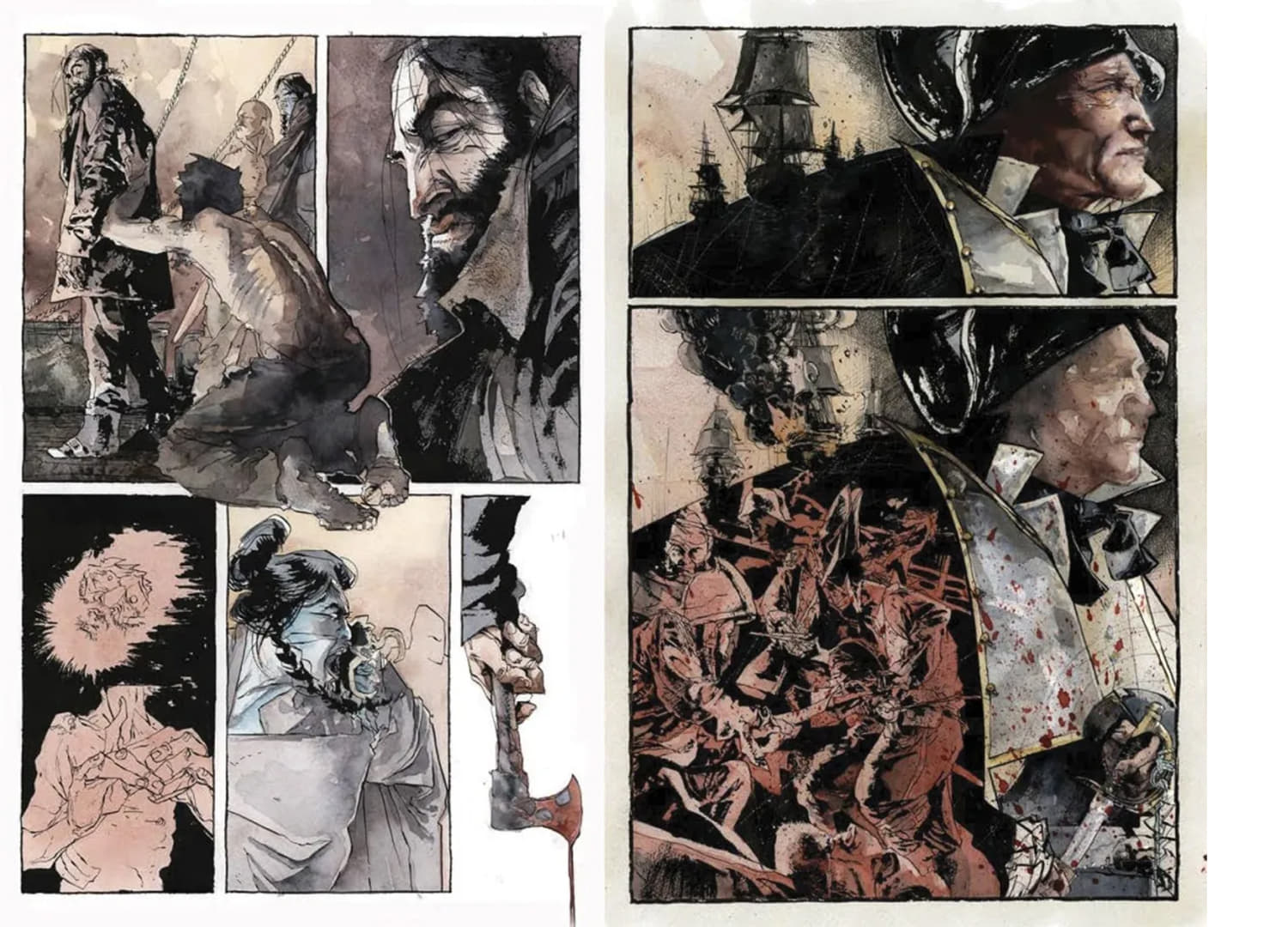
I am hype about this project y'all. It's the most visually stunning thing I've seen thus far in 2024 by a country mile. Today I'm chatting with artist Jonathan Marks Barravecchia about his new Image Comics series that he's co-creating with writer Sean Lewis Bear, Pirate, Viking, Queen. This thing is a straight up visual feast. It's poetic carnage and something you just have to see. I've been wanting to do more deep dives into the artistic process and this was a perfect chance to engage with a daring mixed media illustrator pushing the boundaries of the comics medium. Oh, and I got to nerd out talking about watercolor paper choices.
Make sure to check out our monthly crowdfunding comics feature book: Super Kaiju Rock n Roller Derby Fun Time Go!
Preview images
[00:00:00] Your ears do not deceive you. You have just entered the Cryptid Creator Corner brought to you by your friends at Comic Book Yeti.
[00:00:07] So without further ado, let's get on to the interview.
[00:00:11] Scared of Good Muts sound like something spoken by a Cthulhu cultist or the name of a weird craft beer brand,
[00:00:17] but it's actually the shorthand for this new wild crowdfunding comics project,
[00:00:21] Super Kaiju Rock and Roll Derby Fun Time Go from creator David Hedgecock.
[00:00:26] This is a mash-up of Jim and the Holograms meets Roller Derby with Kaiju with a twist of 70s pop culture thrown in.
[00:00:33] Harmony, Lyra, Melody, Cadence, and Biola are a struggling 20-something band
[00:00:39] and a Roller Dirty team fleshed with talent but broke as a joke.
[00:00:43] The burnouts are thrilling concert goers with their killer looks and vibe until a music mishap,
[00:00:49] drops a curious ancient artifact into their hands. Cheeky, lighthearted and fun, it will be launching soon
[00:00:55] and there's an early bird special if you catch it in time that scores you a discount and a VIP wristband.
[00:01:00] I'll drop the link in the show notes.
[00:01:02] I read the advance for this and honestly it reminds me of my own carefree days giggling on the road in the music industry,
[00:01:08] but with way better shower scenes. The only thing missing is more cowbell.
[00:01:16] Hello everybody and welcome to another episode of the Cryptic Creator Corner.
[00:01:20] I'm Byron O'Neill, your host for today's Comics Creator Chat.
[00:01:23] And this was kind of the most happenstance pathway to setting up an interview I do believe I've ever had.
[00:01:29] You know, my guest Jonathan Marks-Barevecchia is the artist working on an exciting new image comic series,
[00:01:35] pirate biking queen, sorry about that, with writer Sean Lewis.
[00:01:40] So kind of the story here is I saw a very cover in the hard cover for Last Ronin on my read through.
[00:01:48] It caught my eye. It's Michelangelo kneeling with his head bowed holding a sword and a fall force scene with like a big food dog statue.
[00:01:56] And for some reason it popped in my head that I should go back and see who this artist was and if they had a print of it available.
[00:02:02] I think it was moving around my trade paperback shelf where I have like food dog bookends and I think that triggered it.
[00:02:08] But anyway, I find my way to Jonathan's website. Sure enough, there's a print, but there's more to the image than is printed in the last Ronin book.
[00:02:14] There's a baby food dog. So I like I knew I had to have it.
[00:02:18] So I ordered a print when I was poking around to see what other stuff this incredibly talented person was doing.
[00:02:23] Turns out he had an image comic project soon to be released and I knew I wanted to talk to him about it.
[00:02:29] So here we are, Jonathan. Welcome to the show. How's things?
[00:02:32] Oh yeah. Thanks so much for having me. It's good. Everything's good. Thanks, Mark.
[00:02:35] Yeah. So I promised Jonathan surprise. He has he has no idea where this is going by the way.
[00:02:40] So hopefully this won't completely tank. But maybe you can help me solve a dilemma.
[00:02:44] So I was poking around your website and I came across a tribute piece from the classic Frank Miller Wolverine cover.
[00:02:50] He's like covered up fighting a bunch of ninjas. Does this piece ring a bell?
[00:02:54] It does. I know. Yeah, I know what you're talking about.
[00:02:56] Okay. So tell me about it. What inspired you to do that piece?
[00:03:00] So that's actually that's a piece for so we were talking before we recorded I'm in New York and there's a gallery I work with in Chelsea called the Philippe LeBon Gallery.
[00:03:10] Specializes in narrative art comic book and illustrator from Europe and the US mostly.
[00:03:16] Yeah. And so that was a piece I did for a show at Philippe's.
[00:03:20] It was a group show with a lot of the RDC represents and it was one of I think I did two pieces or one or two pieces.
[00:03:29] And that was that was my my Frank Miller tribute.
[00:03:32] I love that the image like it's one of the one of the earlier comic books that I have or one of the earlier trades that I have is that Frank Miller covered in ninjas Wolverine.
[00:03:43] And so I wanted to just sort of pay homage and you know show show my interpretation of that.
[00:03:50] Very cool. Well, here's my surprise.
[00:03:52] Yeah.
[00:03:53] The listeners will have to have to bear with me for just a moment.
[00:03:56] But hey, so what I'm holding up.
[00:03:58] What?
[00:03:59] Right, right, right.
[00:04:01] So I'm trying to get it out.
[00:04:03] Yeah, so you can see it but what I'm showing off is a 24 by 36 original poster from 1987 that hung on my wall.
[00:04:10] Amazing.
[00:04:11] Yeah, so it's the same cover.
[00:04:14] Yeah, a back story here.
[00:04:16] So we recently moved close to my parents and they've been cleaning out the attic and you know bringing this stuff over from Tennessee and North Carolina when they visit, which includes all of my old comics and posters from the area when I worked in three different comic book shops.
[00:04:31] And there are way too many of them for me to hang and my wife wants it contained to one room.
[00:04:37] So I got to be choosy.
[00:04:38] So I took a bunch of them over to Hight Me Comics in Greensboro.
[00:04:41] So my friend Jermaine, who is also known as Lord Retail that I didn't want money for them.
[00:04:46] I just wanted to find them good homes.
[00:04:48] So you know short story long here.
[00:04:51] Some of them I've already given to comics creators I know but this one I've held on to until it seemed like fate would intervene.
[00:04:57] So if you're interested, it's yours.
[00:04:59] I would love it.
[00:05:00] Thank you so much.
[00:05:01] That's amazing.
[00:05:02] Yeah, 100%.
[00:05:03] Oh hell yeah.
[00:05:04] Oh man, my wife is going to be thrilled.
[00:05:07] I doubt that.
[00:05:09] That's so cool.
[00:05:10] Thank you so much.
[00:05:11] That's amazing.
[00:05:12] Yeah, yeah, problem.
[00:05:14] Well, first off, getting to the actual book we're trying to cover here.
[00:05:18] I loved it.
[00:05:19] I was sharing on the comic book Yeti editors this court yesterday that your work here is absolutely the best visual presentation I've seen in the medium in 2024.
[00:05:29] And I have no idea how you haven't been working on more major projects at this point.
[00:05:33] So I want to start with your kind of comics journey as an artist.
[00:05:37] So how did all this start?
[00:05:42] So the very start, like the very beginning was short short or long story short, you know grew up reading comics and love comics when I was in high school had an opportunity to make a comic for my senior,
[00:05:56] basically a senior project.
[00:05:57] My high school, you know, for the last couple weeks had this option where you could, you know, get an internship to a project with a in the field that you wanted to study or something like that.
[00:06:07] So I pitched a comic book.
[00:06:08] Basically it was hard.
[00:06:10] I was 17 or 18 and it was so much harder than I thought it was going to be.
[00:06:14] I finished the guy teamed up with a writer.
[00:06:16] One of the teachers was a comic fan.
[00:06:18] He'd written this fantasy story back in the day.
[00:06:21] So we made it into like a, I don't know, 12 page comic.
[00:06:24] And it was so difficult and so discouraging that I finished the project.
[00:06:31] It's terrible.
[00:06:32] My mom has a bunch of it's just like swipes from Joe Mad and in the Adam Cuba and like whoever I was reading.
[00:06:39] Yeah.
[00:06:40] And I basically like after that I was like, okay, I can't like I can't do this is too hard.
[00:06:45] I don't want to lose the love I have for art.
[00:06:47] I don't want to lose the love I have for comic books.
[00:06:49] I can't do this as a career.
[00:06:51] So I stepped away from it for not honestly, not that long.
[00:06:55] I studied literature and history in college and you know, kind of started reading comics again and started falling in love with them again.
[00:07:05] Always kept a sketchbook.
[00:07:06] And eventually as I got a little bit older still in college, I realized that need to make art of some, some form or another visual art.
[00:07:17] So kind of just dabbled in a bunch of different things and eventually recognize that I needed to focus on, for me personally, at least focus on one sort of discipline.
[00:07:28] And then from from that maybe move move forward or branch out to do you know this was this was I was still young I was like I wanted like design sneakers and I want to tattoo and I want to draw comics and I want to work in galleries and all above.
[00:07:44] You know, and you can't. Well I can't do all of those things do one thing well enough that you know other doors open.
[00:07:51] So basically like fast forward. I don't know how many years committed to comic books made my, you know, my submission packet and was you know convinced that like well whoever I send it to is definitely going to give me work.
[00:08:07] And so like who should I send it to first and obviously sent it to everybody nobody gave me work because it was terrible.
[00:08:14] So you know you just you start doing cons and work and you know improving is what I always tell young artists, for me at least was, you know go to the cons, speak to the editors and artists that you admire, show them your work, get the critiques and then find them again in six months or any year
[00:08:31] and show them the work again and again and again.
[00:08:33] So eventually I was, I did that for a number of years. I started working with Aspen comics. I was living in California at the time I was living in LA.
[00:08:42] Those dudes are out there started doing some work with Aspen and then from from Aspen started doing work with Marvel and was actually under contracted Marvel for a couple years I did the dark tower.
[00:08:56] Two minis in the dark tower universe the the lady of shadows and bitter medicine, and then some some singles and one shot to the two Wolverine stuff some Dr. Streen stuff, but at that time I was painting more and and and sort of exploring more multimedia stuff in in my comic books in my narrative storytelling.
[00:09:20] And the mobile editorial was great they were very honest with me like hey man this is tough to place like we're having a hard time finding you work and suggested edits and stylistic changes that I could make to be a little
[00:09:35] easier to make my life a little easier to be working in mainstream comics. And I basically said you know I do appreciate that this is the kind of work that I want to make so I'm going to continue down this road.
[00:09:48] And so started doing more independent books and a lot more cover work.
[00:09:54] But you know it's the mainstream comic book market is a funny thing.
[00:10:02] I think I grew up with both the.
[00:10:06] You know 90s image and Joe mad like I said you know X men books that that I genuinely loved.
[00:10:15] And sort of the vertigo stuff in the Dave McKean and you know George Pratt's Wolverine and these painted sort of.
[00:10:25] I don't want to say more artistic but you know paint painterly books.
[00:10:30] Yeah we're a big influence to so in my mind comic books can be.
[00:10:36] Either or can be anything and it's just about finding the right stories and the right audience frankly to.
[00:10:43] To tell the stories who are the reality to who appreciates those those kinds of stories that kind of art.
[00:10:50] So along your journey there was watercolor sort of always a component of your style or I.
[00:10:59] I started working in watercolor.
[00:11:05] No is the short answer is no I started working in watercolor because it seemed I always liked working in black and white and from black and white to black ink wash made sense and then ink wash to a water based pigment.
[00:11:24] You know watercolor made sense.
[00:11:27] So I don't know it was just sort of a progression you know one thing after another.
[00:11:31] I mean like I said I didn't study art so I didn't necessarily know what I was getting myself into.
[00:11:36] Sure.
[00:11:38] Except for you know high school art classes and stuff but no I don't know I like sort of the flow like the literal flow of the medium so it.
[00:11:48] I always I was enjoyed working with it but I don't know what what sparked it.
[00:11:54] Well let's kind of dive directly into Bear Pirate Viking Queen my take on this is it's all about you know man's conquest drive.
[00:12:02] And so how did you get involved with the project with Sean.
[00:12:06] So Sean there's a funny story Sean and I are neighbors.
[00:12:10] We did we didn't know any of this.
[00:12:13] So we're I guess it was last year Sean was doing a book an image called above snakes is a cowboy.
[00:12:20] Yeah yeah yeah sort of surrealist Western.
[00:12:23] Yeah and I picked it up on the shelf and you know I was all this is cool I did a little sketch cover and I posted on an Instagram and you know I tagged him in or I tagged him in our message in where he messaged me or something whatever we started talking on Instagram to do something again and blah blah blah blah blah.
[00:12:38] And one was like or I asked my son you're you New York I like I live in New York.
[00:12:44] You I said this before I'm like there's a 50% chance that he lives in New York and 50% chance he lives anywhere else in the world.
[00:12:52] So yeah you know what I do live in New York but you know I don't live in the city we live like upstate like about an hour and my wife and I just moved out of Brooklyn like as as I was messaging Sean.
[00:13:02] So on away like I just moved out of the city to we live up in the Hudson Valley say I live in the Hudson Valley.
[00:13:08] I live in this town called Beacon.
[00:13:10] No way we just moved to this town called Beacon.
[00:13:12] He's like oh not really like I actually I live in a small town next to Beacon that no one's heard of.
[00:13:17] I said I live in that's any name the town I live in that same small town.
[00:13:20] Basically we're like he's walked to my house before we live like a mile away from each other.
[00:13:25] That is wild.
[00:13:27] It's crazy so at that point it was really like well let's just meet up and like see.
[00:13:32] If we even get along and then like if we can have like a working relationship then even better.
[00:13:38] So yeah you know met up for drinks and just sort of shooting the shit like talking comics talking life.
[00:13:46] And eventually like talking about the kind of books that we would want to make.
[00:13:51] And it really was like just listening I mean I had a sketchbook with me that he was flipping through like this or this or like what do you like to draw.
[00:13:58] And Sean's great.
[00:14:00] He's not uniquely but but the best writers I think within the comic book space or within collaborative spaces are willing to have that conversation with the artist or with their collaborator like what do you want.
[00:14:14] What do you like to draw what do you get excited about and that was Sean he was you know what do you want to work on because he's like we can figure out a story about anything.
[00:14:23] And man it was just like literally listing nonsense just listing things like you know dinosaurs pirates.
[00:14:33] I like you know I always like John animals samurai you know really grounded like detective noir like I mean I'm just literally now I'm just like it was just that listing a bunch of stuff.
[00:14:48] And I think eventually we got to a list of very pirate Viking Queen and jokingly we're like God that's a book like imagine if we just caught it that and I think we both sort of like the level went off like yeah.
[00:15:00] Imagine like what what would that even be so Sean really sort of went off is it so we sort of decided like let's see what that actually is showing off on his own for you know we could to and figured out sort of the bones of a story and basically brought me up.
[00:15:17] I was like I think this is something here and it was.
[00:15:23] It certainly not like a comic book script in the traditional sense it was sort of a.
[00:15:30] Home meets outline meets.
[00:15:34] I don't even know what but like these are these are the beats I think is what we want to.
[00:15:40] The story we want to tell us somewhere in here yeah like yeah this is great man at that initial document which was like two or three pages was I think this is.
[00:15:50] This alone is like a 50 page comic.
[00:15:53] So like meet up again and break it down and what happens here and here and here so like thematically you're absolutely right like it turned into sort of.
[00:16:03] An exploration of like.
[00:16:06] Empire and conquest and.
[00:16:11] You know man's sort of desire desires for for control and for power what that brings but that's like the lofty bullshit like the other stuff is like right and it's about a pirate and it's a Viking it's action story it's on the water it's got a bear in it like it's just fun stuff so.
[00:16:32] Well for those who haven't seen your work yet I want people to picture kind of a mixture and I hate doing this but we got it we gotta give landmarks right yeah yeah yeah you know kind of a mixture between you know Jason Sean Alexander and Bill Sinkiewicz like somewhere in there.
[00:16:47] I think you know Sinkiewicz especially you if you draw parallel between enjoying drawing bears is something he's known for yeah it is a very visceral presentation kind of which fits this tone of this dark tail perfectly like fluctuating.
[00:17:02] Between.
[00:17:03] Fortune realism and embracing those abstraction watercolor bleeds you know which provide.
[00:17:10] At least a scaffolding for some of this like bear pencil work that you're doing.
[00:17:15] And I'm educating myself on kind of how to write comics now I'm just trying to do scriptings and I come from more of an artistic background which feels very difficult mentally to make the elite because I want to construct.
[00:17:27] The visuals all the time in my head right but I don't want to be that guy handing over an overly nuanced or you know detailed script which just basically tells the artist what to do.
[00:17:38] Right so it sounds like Sean from the jump you were very very involved in this collaborative process and you guys created this much more together than something where.
[00:17:51] You know the artist is let's say from South America right like you guys are just down the road so yeah.
[00:17:57] And that was like invaluable I mean yeah it was definitely a collaboration and us breaking the story together and like to your point to you know at no point was I given very strict guidelines or or.
[00:18:12] I mean even specifics is makes I don't know it makes my life as the artist harder but it was something that I wanted and embraced and frankly for Sean as the writer like it takes a tremendous amount of trust for him to be like this is.
[00:18:31] The idea of like hey these next three pages let's have the pirates.
[00:18:38] You know sail into the sunset and then you know crash into an island.
[00:18:43] And then leave it up to me to figure out exactly how to do that is take some trust.
[00:18:49] Yeah yeah for sure but what part of the script was kind of hardest for you to conceptualize or did did you just have kind of free reign to okay I want to take it like this.
[00:19:01] Yes and no there were some.
[00:19:05] Parts where especially at the beginning where we had.
[00:19:10] Sort of a very broad outline of where we wanted to go and this is entirely on me I got ahead of myself once or twice with like.
[00:19:19] This can happen in this can have a lot of other blah so so I'm going to take the story in a certain direction visually.
[00:19:26] That when we then met up again Sean and I didn't make sense and so some of those pages are just.
[00:19:34] Scrapped pages like it's not it sounds dramatic is not it's not a big deal but.
[00:19:40] Yeah you know once or twice it was like wow.
[00:19:44] This you know you you wanted Jonathan you wanted to to.
[00:19:50] I don't want to give anything away let's say like even something as simple as like these you have a page here where the protagonist.
[00:19:59] Scared of something and really for the story to hit better he needs to be.
[00:20:06] Like aggressive towards that something so you know this is again me taking it on myself to be like I want to do this thing but it doesn't fit the story and so then we let go back and make sure that we're both on the same page.
[00:20:17] But but but again like working in that kind of collaborative space was I was never I never felt like.
[00:20:24] Anything was being forced or.
[00:20:28] Like I was I was having to figure anything out that I frankly that I didn't want to figure out on my own anyway.
[00:20:35] All right let's take a quick break.
[00:20:39] What in the Sam Hill is happening right now what is that.
[00:20:43] You like bars.
[00:20:46] Oh you like band of bars it's not my fault you know.
[00:20:49] That makes sense.
[00:20:51] They're dropping some great new series right now.
[00:20:53] There's that one about a heavy metal guitarist in the 1970s with monsters working class wizards.
[00:20:59] You know how we love monsters around here and my friend Dakota Brown he's working on a project.
[00:21:05] Grandma Tillie's Hell Tech Mech with Lane Lloyd I saw the preview for that.
[00:21:10] That is crazy Jimmy.
[00:21:11] Even contributed to their anthology from the static and had Matt Sumo on the podcast to talk about his project the Bartic Versus which makes a lot of sense that the project landed there.
[00:21:24] Where you are.
[00:21:26] Where can you find them.
[00:21:28] You need to get out.
[00:21:30] They are in previews or you can visit their website band of bars dot com for all the latest.
[00:21:34] Can we turn the music off now.
[00:21:35] Thank you.
[00:21:37] No more surprise minstrels or anything like that or I'll rent you out to the RIN fair as a children's ride.
[00:21:43] Let's get back to the show.
[00:21:45] There are a few moments in here which feel contemplative like in the first issue.
[00:21:51] So there's like a panel with lightning two full consecutive pages of stormy seas with a sky and very little else you know my personal favorite.
[00:21:58] Anil with a shark rendered in.
[00:22:01] Yeah or it looks like kind of an homage to the famous great wave of Kenigawa like the Japanese woodblock print.
[00:22:08] None of these are particularly detailed and they're like these primal pause buttons that let the story breathe a little bit between kind of the furious action sequences.
[00:22:19] So I'm really wanted to kind of dive into process of something I love talking to artists and people who are interested in the art of art.
[00:22:28] So how did you put together your layouts because there's that dichotomy especially between those.
[00:22:34] I detailed action sequences and these very visually fluid moments that are in this detail.
[00:22:41] Thank you.
[00:22:43] Yeah I mean again like because the script was so sparse was so unlike a script that pacing was entirely up to me.
[00:22:50] OK and because it was an image book or is an image book and we don't have like the page limitations that other publishers do.
[00:23:00] We can make the book as long or short as we want.
[00:23:02] So having that sort of breathing space was very important to me.
[00:23:06] And so it was it just I laid everything out pretty much in one or not one go but like all together like so I had the thumbnails for the first issue.
[00:23:16] I mean you've read it's like 70 pages.
[00:23:17] Yeah.
[00:23:19] So I had I had almost all those except for the ones where I got too far ahead of myself then I pulled back.
[00:23:23] I have all almost all those together so I know that like to your point if we have a big action sequence.
[00:23:31] I want to slow the reader down is one of the greatest things about comic books that the creative team is in charge of but can influence the pace with which you consume the story.
[00:23:44] And you can do that through like a million different ways but like for me as the visual storyteller like slowing slowing you down like you said like now is just a page two page spread of clouds which some people might just like oh there's nothing to read here and flip through it.
[00:24:01] And some people might like sit in it for a moment.
[00:24:04] That's entirely up to the reader but my intention is for you to like pause and like be in that storm with the character for those two pages or three pages or whatever it is.
[00:24:15] So again I mean I was very lucky that the you know that the working relationship between Sean and I allowed for that.
[00:24:21] Yeah I mean what really blew me away more than anything else was the panel diversity because it's bold.
[00:24:28] You were you were definitely playing with shapes.
[00:24:33] I mean more than even it's very in style you know with the big two like a thing in Batman or something like that where they get really pretty creative with layouts but but this you're you're doing all kinds of crazy stuff.
[00:24:46] So talk to me about how you're wanting to take a reader you know from point A to point B and how you're doing layouts and how you you know set this up on the page.
[00:24:56] I don't know. I mean at this point it's almost intuitive. I have a lot of influences from within comic books from you know American and European and Japanese artists.
[00:25:11] So I think that that's influenced some of my storytelling like like architecture in moving the eye around the page.
[00:25:20] Like I said I mean I did grow up with some of those image books where it was like that big anchor panel or that big you know figure and then breaking the borders and then doing all this nonsense.
[00:25:30] So that's in there somewhere. But but I think that I want to only use those tricks when it's absolutely necessary and when it's in service to like like moving around the page.
[00:25:44] And frankly too like honestly I heard I think Brian Bowlin in an interview was talking about this too where like our job as as illustrators or as specifically as comic book illustrators is to tell the story and the art itself is kind of a secondary thing.
[00:26:05] But for me and Brian was saying this to Brian Mr. Bowlin was saying this was like we love the art.
[00:26:14] It's very important to me into my fragile little ego that like this bear looks cool as shit though I want as that panel that panel has to look perfect.
[00:26:25] And then because it's a comic book not only that but it has to pull you into that next panel which also has to look perfect which has to pull you across and you know so it's like a juggling.
[00:26:38] I don't know if that answers your question or not but.
[00:26:39] No it does because I'm just always interested in getting into the mind of how people conceptualize us because I'm coming from like a fine art photography background.
[00:26:49] So I don't tell I mean you do in terms of a series of images that you put together in terms of sequential they need to have a thematic thread you know that combines them all but not not like this right.
[00:27:01] So I'm just interested in how people put that stuff together and you're getting away with so much there was like one full page scene on the with a boat where it's almost entirely black the mast head by sex the page.
[00:27:16] Yeah which definitely breaks with like these traditional composition rules but it worked right you pulled it off.
[00:27:22] So it's moments like that that I was just saying damn man he's really pushing the envelope here.
[00:27:27] Oh good thank you I'm glad that some of them work.
[00:27:31] That one really jumped out to me I was like wow OK so I'm trying to do this.
[00:27:36] No there's information on the other side I'm getting and I'm getting it doesn't bother me at all that there's just black.
[00:27:42] Good.
[00:27:44] Well it's almost like a panel break anyway.
[00:27:46] Yeah yeah yeah I mean it's you talk about photography I mean like the composition of the image of the single image especially on like a splash or a double page for it is super important.
[00:27:57] It's definitely something that I'm thinking about and as much as I love traditional comic book are I do want to.
[00:28:05] So like an asshole like challenge what that can be sometimes.
[00:28:10] No you got to know that that's what pushes you.
[00:28:12] Yeah exactly and again my influence is like you said I think ever just definitely one Jason's another one but you know Dave McKean George Pratt and Kent William you know Muth like these were these were the
[00:28:21] These were the big ones who were like OK we can do this this whole thing as well.
[00:28:31] Very cool very like eye opening for me.
[00:28:34] Yeah Muth is so underrated like one of my favorite and just didn't do enough stuff but.
[00:28:41] No I know he's got kids books now that I'm always trying to scoop up.
[00:28:45] I can't remember the latest one it's like an astronaut something.
[00:28:49] It's cool.
[00:28:50] It's like a little bit more kid friendly but beautiful still.
[00:28:54] Well whoever the editor is on the book God bless them for leaving in the like white negative space that you're utilizing because that has that's a heavenly visual right there.
[00:29:06] No editors we were doing is just Sean and I really glad so thank you.
[00:29:10] I'm glad that it works yeah.
[00:29:11] OK I hope editors see this sells really well and more people do this because it's so good to use the space like that.
[00:29:20] Well you have these distinct linear archetype phases as well to deal with you know kind of the bear operates off of instinct the the pirate is behold into no code other than freedom.
[00:29:29] You know the Viking is savage but existing in a more rigid societal and religious structure and then which I don't quite know yet but I'm imagining representing kind of that ruthlessness but you know nonetheless a civilized character.
[00:29:43] So how did you go about kind of wanting to portray each because they're almost function like phases if you.
[00:29:49] There's there's not I guess a.
[00:29:52] I don't want to give too much away but there's not a singular distinct protagonist let's put it that way.
[00:29:59] Yes.
[00:30:01] I also don't want to give too much away as as the series as a mini series goes forward.
[00:30:07] Sure.
[00:30:09] So yes everything that you said.
[00:30:12] OK.
[00:30:14] We.
[00:30:18] So I'll say this which will kind of answer the question.
[00:30:20] It's a three issue mini and we wanted each issue to sort of stand alone as well as contribute to a larger narrative and within each issue to sort of examine those archetypes like you're absolutely right that that we
[00:30:38] were sort of playing into.
[00:30:42] To examine them as archetypes and then to examine like what that means and how we can sort of challenge that.
[00:30:49] So.
[00:30:52] Yeah I mean you've read the first issue you know how the first issue ends.
[00:30:56] The second issue picks up right after that but feels follows a different path.
[00:31:03] Sure.
[00:31:04] And then the third issue you know again.
[00:31:08] Sort of take takes the reader hopefully in a surprising and enjoyable direction.
[00:31:15] Sean I wanted as long time fans of comics wanted to make sure that at no point or in this few times as we can that the story was predictable that now this this next thing is going to happen that you know that the disenfranchised
[00:31:34] English sailor is going to turn into a pirate and then we see that happen and then the pirate challenges that came pirate and then he wins and then that happens and then you know it's predictable it's fun but we wanted to sort of challenge that both in the characters themselves
[00:31:50] and then in the storytelling.
[00:31:51] Well maybe we can get into the form language then right.
[00:31:56] You've got you've got those four.
[00:31:58] You also have the pirates.
[00:31:59] I know a fair number of comic artists use pictures as guides so do you use reference photos at all or you know I do yeah yeah yeah I shoot I shoot all my reference and then you know find stuff on online you know reference for old ships and fashion and
[00:32:18] okay you know whatever it's called.
[00:32:22] You know like the weaponry and the shit it's not I'll be honest it's not exhaustively researched if you are a scholar of 17th century or I guess it would be 16th century like weaponry it's probably not accurate but
[00:32:37] like it looks cool and it's old you know right whatever yeah but but I do use a lot of photography I do shoot.
[00:32:43] Most of mostly myself frankly and you know my camera and my phone up just a bunch of pictures of me looking like growling like a pirate or you know standing like a Viking or you know whatever or occasionally my wife if I can bully her into it or friends but
[00:33:01] yeah I like when I was younger I didn't I was embarrassed to admit that I use reference I felt like especially as a comic book artist like I need to be able to like come off the dome man like what a Spider-Man look like when he's swinging between two buildings upside down and flipping back and forth like I need to know anatomy so well that I can do that quick off the
[00:33:22] side of my head and you should honestly like especially if you're doing superheroes especially if you do in spider-man you have to know anatomy back to front but I found with the kind of work that I do to I like having
[00:33:35] the reference in front of me so that I can pick and choose what I use from it so I can spend less time sketching my my layouts you know once I figured out the thumbnails for the full page my pencils are really I mean I use a lot of
[00:33:52] little red pencil and it's really just kind of you know an egg for the head and then the stick figure body with notes for the elbows or for the hands or for the feet or whatever it is and then I go straight into the ink and I can do that because I have the reference to one side of me so I have something to like visualize
[00:34:13] and then I can go into the ink and sort of just in me how I have that immediacy of the line when I pull it instead of trying to sketch and sketch and find the right line and find the shift here or there just just go right into it and I think it just makes for a more interesting and honest look
[00:34:32] it certainly does I'm very glad I'm a photographer too because like that I can't imagine doing it that way especially if I'm putting down you know ink washes and stuff on a to be scared at fuck everything up all the time and yeah yeah
[00:34:47] yeah there's I mean this I've got a I'm actually I'm working on the new cover the cover for the trade right now on my desk and it's got so far only one patch so I do everything traditionally and there's one like chunk that's just a different piece of paper glued on top of the board where I fucked it up already so yeah
[00:35:08] yeah yeah that's you're lettering the project as well so is this your first lettering it is yeah yeah yeah figured it out for this like taught myself and you know did a couple little projects with friends to make sure that I was confident and comfortable with it but the lettering is all digital so that that does give me a little bit of
[00:35:29] little room that a lot of the
[00:35:32] terrific smell like
[00:35:35] a lot of the sound effects are on the board but all the dialogue is is digitally done and
[00:35:42] appropriate.
[00:35:43] Oh okay cool yeah I was thinking that some of those fonts were hand drawns.
[00:35:47] Yeah yeah yeah all the fonts are hand drawn.
[00:35:49] I designed the fonts themselves yeah but then I can do I can letter the whole thing digitally.
[00:35:55] Okay well kind of what kind of projects are you most interested in let's say next right like what is an amoring you lately.
[00:36:04] There's a couple projects that I'm working on now that I'm very excited for that I can't talk about.
[00:36:14] I'm used to that but yeah I know it sounds I was at a con a couple years ago where I was saying that to someone and they were like oh that just means you're not working on anything.
[00:36:22] God damn it man.
[00:36:24] No no no no it means these things take years to get out.
[00:36:28] Unfortunately yeah you know like Sean and I have another project that we've got in with some editors you know as a pitch document now.
[00:36:35] I've spoken with some other writers where I've got some some pages in the works I do book illustrations as well I've got
[00:36:42] an illustrated edition of Bind Swamp and I can't remember the name of the author that's coming out this year.
[00:36:55] Anyway but in the comic book space yeah I mean I love doing this kind of thing I love doing sort of the fantasy surreal stuff I like the adventure.
[00:37:06] I like honestly after this book being so sort of free and broad I like the idea of sort of doing something smaller.
[00:37:21] Sure.
[00:37:23] Which is one of the projects that actually Sean and I are talking about.
[00:37:25] Is you know super grounded like a detective story something that's smaller in scope limited in visuals as much as I love to like bear pirates sort of be showing off or trying to show off.
[00:37:43] It's unrestrained yeah it's yeah yeah unrestrained yes I think that I actually look forward to one of the projects that's in the works that's like super grounded like I can't do.
[00:37:55] I can't hide behind.
[00:37:57] Well this is a big like expressive watercolor wash it's like no it's just like black and white like the shadows right or it's wrong.
[00:38:05] Yep because you can always throw down more watercolor I mean you can it doesn't always work enough yeah yeah yeah I mean that's the thing yeah you can always add more.
[00:38:15] Well I'm going to get the weeds about paper for just a sec because I'm always interested in you know paper choices for watercolour artists and I've experimented with quite a few different papers in my own work like that you know like 100% rag 5050 ragpult even mulberry so what do you like to use what do you typically use.
[00:38:32] I started with the I've got an arches roll of a hot press it's 153 pound which only comes in these giant roles they don't do it in books.
[00:38:46] So I do like that it's a little bit pricey to be honest so I've I've explained there's a whole bind multimedia paper that I like and then I've actually really enjoying Stonehenge paper which takes a wash pretty well.
[00:39:01] And then I've also got some strapped more Bristol and some like trying to see it on my files over there.
[00:39:13] I think it's a canson just a drawing pad that's not particularly good paper but like the way I like the way that the watercolor let the pink sits on it these kind of pools on it you have to wait the same with the Bristol like yes you have to wait longer than with the watercolour.
[00:39:30] With the water with the traditional watercolour paper yeah as a pigment isn't absorbed as quickly but it has like a cool and interesting look to me.
[00:39:38] Okay, so does it does it typically make a more saturated color that way then since it's pulling and it just takes longer to soak or it can do it I find it.
[00:39:50] Traditional watercolourists would hate it because you get those halos a lot easier you will have because the pigment will be dispersed basically around a bubble of a bubble of water.
[00:40:06] So you'll have the lightest area in the middle of your wash and then surrounding it you kind of have a darker area and it gets lighter as it goes to the middle.
[00:40:16] Which you can which you can easily paint around or move that that you know heavier area of water or be more precise when you're putting the water down or wet the paper before there's a many things you can do right but I like that look.
[00:40:32] Sometimes I want that very smooth wash sometimes I like the.
[00:40:35] Almost like segmented pieces of color almost like I like painting oils as well and I remember one as an adult I've been trying to take painting classes with artists who I like who I know, and one one of the artists who I love.
[00:40:57] Described.
[00:40:59] Painting with oil is as putting down pieces of paint.
[00:41:04] And I think watercolour doesn't typically work that way but with with some of these papers like where it does pull you can kind of put down a little piece and then wait.
[00:41:15] Let it let it soak in or move or do whatever wants but something else down put something else down.
[00:41:20] It's all about patience which I sometimes have and sometimes do not.
[00:41:26] I still blown away that you can manage to do this on a singular piece of paper because I was I was telling Tyler crook about this with the lonesome hunters and he was breaking down how how he goes about doing it and it's much more panel by panel.
[00:41:38] You know, and then that he's dropping things on on the page kind of digging things in but.
[00:41:44] Okay this explains why the reeds work the way they do in this because it's just I don't know to try to describe to somebody listening is just so much more fluid than you typically expect from from most comic books, you know, yeah, thank you.
[00:41:59] Yeah, I mean I love the hell out of it.
[00:42:02] So where can everybody find you online.
[00:42:03] Also on Instagram at Jonathan marks art and have a website on online is Jonathan marks art.com that's that's it just the two will put them in the show notes.
[00:42:18] I think it should be clear to everybody that I like the book quite a bit.
[00:42:22] So listeners get the pre orders in because I selfishly want to see Jonathan get more work but also because because this thing is kind of a visual feast.
[00:42:30] I mean it really is.
[00:42:32] It's one of those things where you really got to take time to read it.
[00:42:36] So I really appreciated the pacing and and really trying to slow people down because everybody even comics journalist friends my co-host Jimmy, we're all trying to slow down the reading process because it's just that tendency is to spend seven eight seconds especially on a splash page and you're done.
[00:42:57] So don't do that here at all because there's there's so much to pull in and for your eyes to kind of feast on.
[00:43:05] It is poetic carnage.
[00:43:08] That is how I'm christening it.
[00:43:10] I like that if people are fans of like Game of Thrones or Black sales.
[00:43:14] This is the book for you.
[00:43:16] So Bear Pirate Viking Queen is in stores when exactly first issue is out May 1st that FOC the final order cutoff for your shops is April 8th.
[00:43:26] OK.
[00:43:27] So do tell your shops support your local shops.
[00:43:30] Tell them to order it before you get in your pull box before the 8th of April.
[00:43:35] Well Jonathan thanks so much for joining me on the show today and kind of indulging in my deeper art.
[00:43:40] Of course that was fun.
[00:43:42] I love talking about this stuff.
[00:43:44] Good I'm glad you enjoyed.
[00:43:45] Well this is Byron O'Neill on behalf of all of us at Comic Book Getty.
[00:43:48] Thanks for tuning in and we will see you next time.
[00:43:50] Take care everybody.
[00:43:51] This is Byron O'Neill one of your hosts of the Cryptid Creator Corner brought to you by Comic Book Getty.
[00:43:57] We hope you've enjoyed this episode of our podcast.
[00:44:01] Please rate review subscribe all that good stuff.
[00:44:05] It lets us know how we're doing and more importantly how we can improve.
[00:44:09] Thanks for listening.
[00:44:11] If you enjoyed this episode of the Cryptid Creator Corner maybe you would enjoy our sister podcast into the comics Kate.
[00:44:17] Listen and subscribe wherever you get your podcasts.