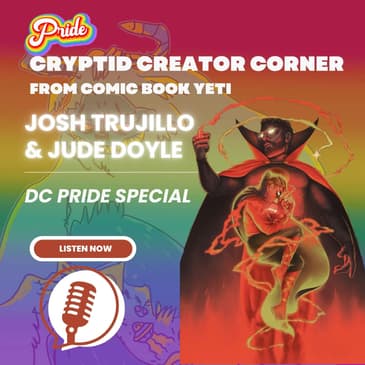

It's week two of my Pride 2025 Feature and this week I'm so excited to get to hang out with two of my favorite people in comics and returning guests, Josh Trujillo and GLAAD Nominated Jude Doyle. Josh and Jude have multiple projects in the new DC Pride Special, now in it's fifth year, including one developing new DC trans character Ethan Rivera.
I've already picked it up and found this new formatting where there's a common narrative thread that connects all the stories incredibly powerful. We also get to talk about one of my new favorite characters the snarky Blue Snowman and how things are looking representationally with queer characters and creators in the medium.
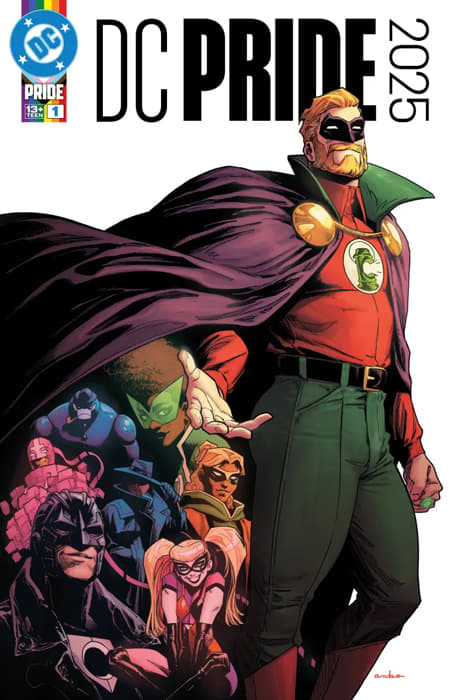
DC PRIDE SPECIAL 2025
From the publisher
DC Pride 2025 brings DC’s heroes together when a century-old tavern, the center of queer life in Gotham City, unexpectedly announces its imminent closure. It’s a huge loss to the community, and generations of patrons return to pay respects to a space they’ve endowed with entire lifetimes of memories, wishes and dreams—including Alan Scott, the Green Lantern. Alan returns, for one last time, to the place he fell for his first love, Johnny Ladd, to touch the wall on which they carved the symbol of their love, to remember the days before everything went to hell for them...and to say goodbye.
But love is a kind of magic, and, in Alan’s experience, magic can take on a life of its own. Before anyone knows it’s happening, heroes, villains, and civilians alike from across the DCU with powerful ties to this mysterious place—the Question, Midnighter and Apollo, Harley Quinn, Green Lantern Jo Mullein, Bunker, Connor Hawke, and Blue Snowman among them—find themselves spirited away to strange, alternate worlds where everything they ever thought they wanted can be theirs…but at what cost?
AQUAMAN: YO-HO-HOLD ONTO YOUR HOOK! (Josh's new DC GO! series)
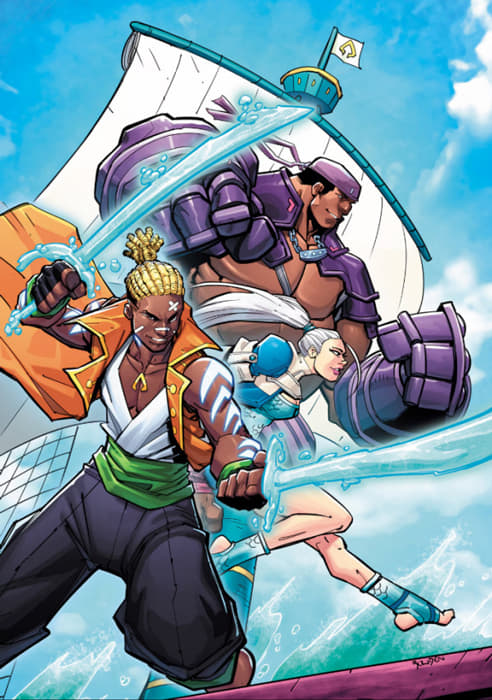
In Aquaman: Yo-Ho-Hold onto Your Hook! by writer Josh Trujillo (Blue Beetle) with artists Niky Lelapi, Andrew Drilon, and Bradley Clayton, Jackson Hyde is a pirate, a warrior, and a hero—but on the Dee Sea he is known only as Aquaman! It’s a madcap oceanic adventure as Jackson, Ha’wea, and Dolphin search for the hook of the legendary King Arthur. Glory awaits this motley crew, if they can just survive the reimagined heroes and villains they meet along the way!
Be Not Afraid (Jude's new Boom Studios project)
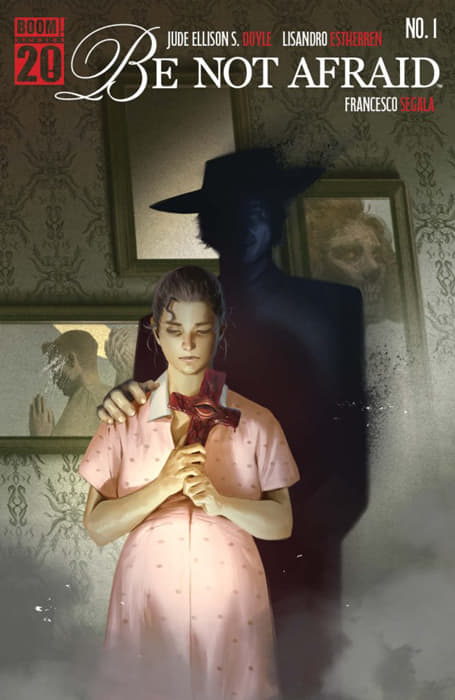
From the publisher
Cora Reims lived the isolated life of a simple farm girl until one fateful summer day, prophetic visions brought her a visitor made of pure light… an angel. In the aftermath, Cora gave birth to a child, a Nephilim: the offspring of an angel and a human woman, seemingly imbued with evil itself.
17 years later, that child’s cherubic appearance can no longer hide his monstrous nature. Frogs boil in their skins as he passes. Crops rot. The townspeople live in fear, knowing that atrocities follow closely behind him.
Now, on the eve of his 18th birthday, Cora receives a new vision… Heaven itself has called upon her to destroy the abomination born of her own flesh and blood.
Be Not Afraid is a breathtaking new series from visionary writer Jude Ellison S. Doyle (Maw, Hello Darkness) and acclaimed artist Lisandro Estherren (Nightmare Country, Redneck).
Equal parts feminist rage and folk horror, this descent into Hell itself is fueled by the mythological underpinnings of American Evangelical tradition, presenting brutal cosmic horror through the lens of Southern Gothic; a truly otherworldly journey that can not be missed.
PATREON
We have a new Patreon, CryptidCreatorCornerpod. If you like what we do, please consider supporting us. We got two simple tiers, $1 and $3. Want to know more, you know what to do.
ARKENFORGE
Play TTRPG games? Make sure to check out our partner Arkenforge. Use the discount code YETI5 to get $5 off your order.
THE LANTERN CATALOG
Created on the premise of creating light in the dark, this is the the go to resource to keep you up to date on the indy projects and the creators you love. You can find them at https://www.thelanterncatalog.com/.
[00:00:00] Your ears do not deceive you. You have just entered the Cryptid Creator Corner brought to you by your friends at Comic Book Yeti. So without further ado, let's get on to the interview.
[00:00:30] Show notes and thank you for your continued support. Thanks for your donation.
[00:01:02] Dan Abnett and so many others. Get a print subscription and it'll arrive to your door every week. And your first issue is free or subscribe digitally. Get free back issues and download DRM free copies of every issue for just $9 a month. That's 128 pages of incredible comics every month for less than $10. That's like a whole graphic novels worth. All subscribers get amazing offers like discount vouchers and exclusive product offers.
[00:01:29] Head to 2000AD.com and click on subscribe now or download the 2000AD app and why wait? Start reading today. I'll put links in the show notes for you. Hello everybody and welcome to today's episode of the Cryptid Creator Corner. I'm Byron O'Neill, your host for our Comics Creator Chat. As we continue our third annual Pride Month coverage on the show, it is my pleasure to introduce two returning guests on with me. Comics writers Josh Trujillo and Jude Doyle.
[00:01:55] Josh is the scribe behind the hit DC relaunch of Blue Beetle following the adventures of Jaime Reyes, which you might be aware was adapted into a movie. He's also one of the creators of Aaron Fisher. Captain America has worked on tons of other properties like Rick and Morty and Adventure Time. And in his spare time, he likes to dream about love stories between demons and pool boys at luxury resorts.
[00:02:17] Since Jude was last on, he brought home a GLAAD award for Fantastic Project. We were discussing last time around the neighbors from Doom's Boom Studios. Got a new horror series from Boom hitting shelves this month called Be Not Afraid and a new book dropping this fall with the most excellent title ever, DILF. Which is not at all what you might think, but it's cleverly cheeky. Combined, they are the dynamic duo bringing you multiple stories in DC's fifth Pride special on shelves now.
[00:02:46] Josh and Jude, welcome back to the show. It's so nice to see you. Hi. It's nice to see you too. I should warn you that I did not win that award. I was nominated. Right. I think Kieran Gillen won it. Did I say a one? I'm sorry. That was an error on my part. Okay. But it's lovely to be back, you know. Well, you deserve to win because it was great. Kieran's great too, but you know, that was a fantastic book. I love that book.
[00:03:11] Well, Josh, con season is in full swing, so as someone that I know gets out and about, have you seen any Aaron Fisher cosplay yet this year? Oh, gosh. You know, I do see quite a bit sometimes. I was at QCon, which is a local show we have here in West Hollywood. And there was an Aaron Fisher cosplayer. And I was walking in and getting set up and I saw Aaron and I was like, oh my gosh, Aaron Fisher. And he's like, whatever. And then I was like, had to go through the grapevine. I was like, I don't think he knows who I am.
[00:03:42] And then he found out. He's like, oh, okay. The character downthrone me, I will say. But it's nice to see the overalls and the trash can shield and all that stuff. And he's been getting an upgrade in his look in the comics. So I'm always excited to see the new iterations of that every year. Yeah, it's always wild when your characters just get legs and they grow and evolve. And, you know, they're out in the world. And that's a whole different thing, I think, when you see somebody cosplaying,
[00:04:11] it just puts a different perspective and light on the whole thing. Yeah, sometimes you see those like out of context panels, right? And you're like, wait, I wrote that. And now it's a meme? Like stuff like that. Yeah, yeah, it's wild. Well, to DC Pride, I picked up my copy already. And this is by far, in my mind, the best one yet. It's incredibly powerful storytelling. It feels so poignant to this moment in time. But Jude, you're writing a superhero book now.
[00:04:40] And it's not all horror stories. What happened? They reached out to me. They, Andrea Shea, who's very kind and very gracious, acted out of the generosity of her heart and invited me on board. And I was, I was really thrilled and also really nervous to do it. Like neither of these stories that I worked on are in a tone that I've like publicly worked on before. Right.
[00:05:06] So I was just, I was really, really lucky to be in the room with a lot of people who are a lot better, ultimately. Well, there's so much talent in the book all around. The writing duties are shared by both of you. Tim Sheridan, Vida Ayala, Maya Houston, and Sam Maggs. And Jenny Blake has a section at the end that's not related to the rest of the narrative continuum, but is equally as powerful following the autobiographical journey as a comics creator. And they're transitioning.
[00:05:32] And that narrative through line is what sets this project apart from all its predecessors. To give people kind of a snapshot of what's going on, Alan Scott is revisiting an old queer bar that's about to shut down with a trans vet named Ethan Rivera. And he's showing him a spot on the wall downstairs where he, in 1936, carved out a heart, which unknowingly precipitated a cosmic event that creates a series of pocket alternative realities, which pulls into its orbit, a bunch of other DC heroes.
[00:06:02] So to start off with, y'all seem like a bit of a creative odd couple initially when considering it. So, so how did you both end up working together on this? Gosh, what was, I don't even remember the genesis of why we were paired, but I do believe that it was, you are, you know, getting sharpening your teeth or whatever the phrase is on superhero books. And I think they wanted kind of that collaboration, right?
[00:06:31] I think that was a little bit of the element there. And, you know, Ethan Rivera's story is so interesting. And I think in some ways personal. And so I think it was really great to collaborate with Jude on this story as well. Yeah. And we worked on, you know, I think every writer in the book gets a page or two of Ethan, but we got to write his sort of backstory and his hero's quest.
[00:06:57] And I, it's something that I really love because we are just like literally in his head watching him hash out his traumas while talking to like a giant pillar of evil flame that maybe wants to be his boyfriend. And I'm like, that's really, that's my comfort zone. I can remember that. Yeah. Like, I understand how to tell this part of the story. That put him in a weird mirror world. And we got to work with A.L. Kaplan on the art who I haven't worked with since Ma. But my very first book was with A.L.
[00:07:25] Kaplan and it was best possible introduction because everything you put in front of him, it's so beautiful. So it was just like writing weird things that you knew Alan would be able to draw that maybe nobody else could. You know? Yeah. It was interesting because, oh, sorry, please. No, go ahead. Oh, no, a lot of the, a lot of the interstitial, the way we weave between stories is a lot of what Jude and I did.
[00:07:49] And so we're trying to kind of bring that coherency and that, that glue that really binds all these stories together, which is what Ethan is doing in the story as well. Yeah. I mean, my normal expectation of a DC pride special is a celebration without much continuity. So what excited excited you both the most about that shift and change in formatting? It was a massive challenge to get all these stories to work together. It was maybe the most rigorous editing process I've been through in my life.
[00:08:18] But for me, again, as someone who's new to the format, it was such a relief to just be in a Zoom call with a whole bunch of queer people and be in a Discord and like have people throwing around back and forth ideas. That like every story in this book is its own story, but it also touches onto and connects with and holds hands with everybody else's. So we just kind of had to move as like, you've seen those schools of fish that can appear to be one fish.
[00:08:47] Like, we're just like a fish guy, you know? Please cut out that part where I said fish guy. Or just keep it and loop it and be like, this is really sad. No, we're totally a fish guy. I can echo Jude's sentiments. It really was the most rigorous editing process you could ever imagine on a superhero book like this. And, you know, I've been very lucky in doing Blue Beetle. We're kind of in our own lane. We're in continuity, but we have our own city, right?
[00:09:16] We have our own little bubble. And this story is all about bubbles, but we have to connect them all. And so it was little things like massaging language so we're not repeating phrases unintentionally or repeating story beats. You know, community is a big part of a lot of these. We are pride stories, and that's no exception here. But we wanted to make sure that every story told a different facet of what that kind of meant.
[00:09:40] And it really took Andrea and Tim Sheridan to kind of, like, keep an eye on that and make sure we weren't repeating ourselves over and over again. Yeah, I mean, that sounds really, really tough. I mean, in my read, I'm not going to lie, this book was completely unexpected. It was an emotional roller coaster for me. To get personal for a moment, my best friend is post-op female and an army vet who did two four-year tours.
[00:10:05] My wife is a trauma psychologist in the VA and has willingly heard the worst events of people's lives every single day for the last 15 years. On both ends, the uncertainty right now that's created by the Trump administration through the chaos of Doge has turned all our lives upside down. And this is not to make this about me at all, but I felt like some personal context would be important to share with listeners so they can understand how deeply connected I got with this story.
[00:10:32] You know, will my friend continue to be able to get gender-affirming care through the VA? Will my wife be able to still help people work through the horrors of these personal traumas? I was immediately invested in Ethan Rivera as a new DC character. And that is a magic trip to just suck people in like that and have them connect with the character so immediately. I don't know that everybody's going to have the same experience as me, but I thought it was really, really powerful.
[00:11:00] So making him a vet, what else did you, was that Tim who kind of came up with Ethan or how did that process work and kind of developing Ethan as a character? I think midway through the writing of this, a woman that I actually knew and profiled for a magazine, Eliza Rae Shue, died. She was a veteran.
[00:11:28] She was in a hospital somehow a few miles down the road from me without me knowing that she was in town. And she found out that her gender-affirming care might be taken away. So she died by suicide right outside of the VA hospital in my hometown. Oh, wow. And yeah, it was a horrifying thing and it's a dark thing to bring up on a podcast.
[00:11:53] But unrelatedly, I think Tim read the story and was like, we need to speak to what these veterans are experiencing right now. So Ethan wasn't a veteran before that moment, but he became one afterward. And I think it, you know, just if I can talk about the story and not just like tell you horrible traumatic things. It's really, Alan is also a veteran.
[00:12:18] Vlad, who is the pillar of flame that Ethan is talking to, is a veteran of his own army. That it's very, very common for characters in the Green Lantern universe to have that sort of background. And it helped Ethan sort of seem like a next generation version of Alan in a way. That you could see the torch being handed between these two characters. Yeah. Yeah. I mean, that makes a lot of sense.
[00:12:44] Alan's got actual functions as a queer elder, but he exemplifies that sense of loss as all the heroes. They escape being trapped in a world that they want versus the real world. And there's even some continuity in the statements made about the timing.
[00:13:03] 1936 was at the height of the Nazis, you know, saying all homosexuality is wrong and, you know, campaigns to eradicate homosexuality completely. So there's definitely some connecting points there, too, that I don't know. It just floored me. And I'm not trying to make it, you know, I don't want to make it overly serious because there's a lot of joy that is in this book, too.
[00:13:29] But that character and tying those two together was brilliant. It's just brilliant storytelling. It worked so well, right? Because Alan really represents kind of that golden age hero. But we've added new context and new layers to Alan over the years, especially recently. And I love that, like, we're able to see really the evolution of the modern gay identity kind of through Alan Scott's point of view. Right. Like we're seeing queerness as it continues to grow and expand and communities build.
[00:13:58] And what what Alan was doing in that gay bar in private is like a speakeasy, you know, back in the 30s is so much different than the kind of open community center it became in the present. And I love that that that kind of like there's the story of Alan is also the story of this bar. Yeah. Well, well, tell me about the bar and where that sort of sort of came from.
[00:14:22] From the the writers team, because it does play a really a central role in kind of moving things through and creating a safe space for people. Mm hmm. Yeah. Yeah. I'm kind of paraphrasing something Tim said to me the other day. But, you know, it was a reflection of kind of the situation we're in. I've been to more than a few gay bars final nights, and some of them have been around for as long as 50 years.
[00:14:50] But because of covid, because of just business models, real estate raising, gentrification, they're erasing a lot of these spaces. For example, I live in Los Angeles. There are no lesbian bars here is one of the country. There's not a single one. The last one closed a few months ago. And so if you are a part of that community, there's really there aren't any places for you. And so this is kind of what I think we're trying to capture is that moment we're in is like they are visible.
[00:15:20] They're actually trying to erase us and they're trying to take our spaces to what do we do? How do we find each other now? Yeah. Yeah. And I respected the commitment of this issue to not being a standard pride issue to it's so hard because when you're talking about, you know, a really, really dark time for queer and especially trans people.
[00:15:43] One major function of superhero comics is that they create spaces for life and hope and joy and escape places where you can sit and not have to think about your problem.
[00:15:54] But for a pride issue, it felt really important to have these characters live through some version of what we're all living right now to face some kind of annihilating threat to their community and to have multiple generations present who had maybe lived through these cycles of erasure and pushback and rebirth, you know, before. Yeah. Yeah. Yeah. Yeah. I was thinking back to my own experiences many, many, many moons ago. I worked in a gay bar called The Closet.
[00:16:24] And one night I'll never forget. There's a really close friend of ours who fell off kind of the collective group radar and had randomly enlisted in the army a few years prior to that. I was working in the bar. Someone came up from behind me, grabbed me on the ass. And then there was this characteristic. How's it going, Bubba? And I knew it could only only be him. It was, you know, it was my friend. And he had a huge, proud grin on his face. And he told me at that moment, I'm gay.
[00:16:52] And my immediate response was, yeah, I know we all do. And the change in his expression at that moment with what looked like this Titanic just released, like his entire body softened. And that was so pivotal for him and for both of us because, you know, he I don't think he ever would have felt comfortable telling me without being in that place. And in the random context, they're just running into me.
[00:17:21] And it made me happy to be a part of it. But sad that it took that long for to get there for us as a friendship and that they're needed that that separation happened over time. We're still very close today. And it's really sad to hear that those spaces are just disappearing. Yeah, I mean, it's absolutely like it's a it's a tragedy in its own right.
[00:17:47] Right. Because I know that, like the kind of bars that I was going to, I lived in a very conservative pocket of Southern California. You think of SoCal as being kind of like a liberal bastion because it's California. But I assure you, it's not the case everywhere. And just the kind of the hole in the wall, the podunk little little bars like those just don't exist anymore. I don't know. Thankfully, we I guess we have the Internet to communicate with each other and connect. But there is something lost in losing those physical spaces where you can feel safe.
[00:18:17] Well, kind of the overall other thing that's connecting these things is trauma. Traumannous connective tissue is nothing new to you and your stories. I think Jude, I think the intersectionality of the stories in the collection and views as a whole is where it really shines. Take Ethan as a character, as a trans-Latin man or being a black lesbian in Sojourner's case, all displaying the challenges of living authentically in a hostile world. But all things also sort of in balance.
[00:18:44] And Jude, you made me chuckle, which I did not anticipate. So where was this version of Blue Snowman hiding in the resources of your brain? Because this is the comic relief to the otherwise very serious nature of everything else that's kind of going on. Yeah. I think that it just felt important. I think, you know, you see this in the Midnight Run Apollo story, too, which is a little bit lighter. But I think many of us are at a breaking point.
[00:19:13] And it feels like that raw id of just like, I don't, if one more cis person accidentally references Harry Potter or Dementors in a conversation, I'm going to flip a table. I'm just going to flip it out. You know, like, Blue Snowman is written, there's this beautiful Crystal Frazier story where like, Wonder Woman helps them figure out that they're gender fluid by putting the lasso of truth on them.
[00:19:39] And like, this is shortly after Blue Snowman has just done a very typical Blue Snowman thing, which like, their powers could conceivably cure climate change, but their idea of a crime is like making someone's driveway icy so they'll slip on it. Like, they do very low stakes things all the time. So they're like holding up a restaurant to ruin Wonder Woman's date to prove a point about gender. And Wonder Woman conclusively beats their ass and then enlightens them about like what gender is. And they're like, okay, let's call this a draw. I'm going to go.
[00:20:08] Like, I love that that character is just, somebody on Reddit, I think, said they had Team Rocket energy. And I think that's exactly it. That like, if James isn't your favorite character on that show, you're just not watching the same show as everyone else. It's like, they're a villain, but they have this completely unrepressed, impulsive, childlike id energy that I just like, I feel like Ethan is very noble and he suffers.
[00:20:35] And he bears up under the burden of his suffering. And there are a lot of trans people in this book that are noble. There's Coagula. There's gorgeous Al Kaplan image of Coagula in this that I will, I wish it was a post-trick. You know, there's Coagula, there's Galaxy, there's Xanthajou shows up in a few, a few iterations. There's Stitch.
[00:21:00] None of these trans people are the same trans person, but they're all vainly heroic. So I felt like, as a trans person who's a mess, I wanted to just drop a trans person who's a mess into the book. And, you know, community isn't necessarily monolithic and not everybody likes each other and not everybody is perfect all the time. And we don't need inspiration porn. We can have imperfect trans people in our comics and that's fine.
[00:21:23] You know, so that it just felt like as a counterpoint to Ethan and his deeply noble trauma mining in the, you know, demon flame zone. Just just have somebody freeze somebody who's talking about Harry Potter. Just do it. You know, like. No, for what it's worth, Jude, my boyfriend devoured the entire issue in one sitting. And your story is the one that stood out to him the most with Blue Snowman. He is obsessed with Blue Snowman. He's like, where can I learn more?
[00:21:52] And I'm like, we're going to figure that out. Don't you worry. But the thing with Snowman is that what's the phrase? Support gay rights, but support gay wrongs. And I think it exemplifies that so well. Yeah, I absolutely like I can see where, you know, it's it's a risky thing to just put like a trans person being a total brat in the middle of a pride issue because it's like, is this good representation?
[00:22:19] And I, you know, I have been harsh enough about stuff that I dislike that like anybody who wants to have a reaction to something I've written is welcome to have it. It's I'm definitely fair game. But I think that for whatever reason, it just it feels important to have a story about community contained friction with that community that I think Blue Snowman's story is not ultimately about just like zapping people with an ice gun and assassinating members of Congress.
[00:22:48] It's also about just it ultimately comes down to one really heartwarming exchange that Tim wrote where like Blue Snowman holds Xanthe's hand and is able to have like an actual friendship with another trans person for the first time. And I think that's really beautiful.
[00:23:06] You know, it is and it is the perfect balance to to the rest of the issue as well to create those lighthearted moments that that are critical or because if you don't have them, you go absolutely insane. There was my favorite part of that was the Wonder Woman who she's just showing she's got this quizzical like, are you gaslighting me now kind of thing going on?
[00:23:29] And in my opinion, this criticizing bit that you've got going on where you're you're basically calling in superhero comics that emphasize how the alt right in media are weaponizing language that that is it felt fresh. It was like the first time I read Keith Geffen's Lobo in the 90s. And I was like, damn, this this is what you need to do. I don't know who I need to call it DC to get you working on on some on some on this book.
[00:23:59] But Blue Snowman is is your spirit animal. And that's that's what you need to be working on in the future. Josh, back me up here. Oh, I totally agree. I'm I'm doing Aquaman for DC Go this summer. And I already told Jude, but we're sneaking some Blue Snowman in there. I just had to do it. That's awesome. That's very cool. I love people in comics who historically don't matter.
[00:24:25] Like, I think that's the thing is that Blue Snowman has five fans who are incredibly passionate about Blue Snowman and nobody else has ever heard of them. So I think just giving them five pages to be the most important person in the world. Like, I always do that. I always get back on to somebody that, like, nobody cares about. Nobody will ever see again. But I want to know that person's story. I want them to have their day in the time. And I think that's what Blue Snowman both demands and deserves. You know, it kind of goes back.
[00:24:51] At least it reminds me of when I was a kid and we'd buy, like, the trading card packs with all the superheroes. And, you know, a Wolverine was, like, the big card you want, right? Sure. And you'd never get those in the packs. You'd end up with these kind of objectively C, D, E list villains or characters. And those are the ones I became obsessed with, right? Like, those are the ones that I love because those were the ones that were mine. Yes.
[00:25:17] Like, my friend Zoe Tunnel just wrote this story from Marvel Pride, actually. And it has despair in it. The, like, demon with the mall goth name that has an apostrophe in it. And I just got so excited to see despair because their power is making people sad. And they're just, like, the most emo, silly villain in the world. And I just, like, I would 100%, I want, like, a slice of life anime about, like, just despair.
[00:25:45] Like, what does despair do for breakfast? What is despair? How do they go shopping? You know, like, it's, there's absolutely, there's room for a full exploration of despair's day-to-day life. I would read that. I would be the one guy that read that. But I still think we should make it for me. I clearly think slice of life within the big two is something that they're, I mean, obviously, they're planning on developing a lot more of that stuff. You're seeing more and more and more of it.
[00:26:14] So there's an appetite for it. So Blue Snowman, DC editors, pay attention to this if you're listening. All right, everybody. We're going to take a quick break. We'll be right back. Let's face it. The comics landscape is a mess right now. I'm the editor-in-chief of a comics journalism outlet, and I can't even keep track of it all. If you are as passionate as I am about indie comics and its creators, you should check out The Lantern Guide.
[00:26:38] Created on the premise of creating light in the dark, it's going to be the go-to resource to keep you up to date on the projects and the creators that you love. Don't take my word for it. I reached out to my friend Brian Lovell, Poison Ivy artist and indie comics creator, to get his take. Brian, what does The Lantern Project fix?
[00:26:55] I'm a dude who loves indie comics, and I know personally, like, I get very frustrated when something shows up in my social media timeline or something like that, and I feel like I can't keep track of everything. So, really, The Lantern Project was born out of that. It was an opportunity for me as a reader to kind of, like, have a place to want to consolidate all the stuff that I wanted to read.
[00:27:19] All the cool projects from cool creators that seemed interesting and kind of unique to, like, something that I would like, which is really not super represented everywhere else, but it's all over the indies. Having a spot to go to that felt like it consolidated a lot of those audiences and a lot of those places where I couldn't just get drowned out in the feed of social media seemed really valuable to me. What's the ultimate goal?
[00:27:44] It's really our hope with this project that creators feel like they're able to get in front of readers, and readers are able to get books that they actually want to read with a much easier time of keeping track of them and accessing them. The catalog is scheduled for a quarterly release, so head over to thelanterncatalog.com to sign up now so you don't miss your next favorite thing. I'll put a link in the show notes for you. Y'all, Jimmy the Chaos Goblin strikes again.
[00:28:12] I should have known better than to mention I was working on my DC Universe meets Ravenloft hybrid D&D campaign on social media. My bad. He goes and tags a bunch of comics creators we know, and now I have to get it in gear and whip this campaign into shape so we can start playing. Another friend chimes in, are you going to make maps? It's fair to say it's been a while since I put something together, so I guess, question mark? It was then that I discovered Arkenforge.
[00:28:38] If you don't know who Arkenforge is, they have everything you need to make your TTRPG more fun and immersive, allowing you to build, play, and export animated maps, including in-person Fog of War capability that lets your players interact with maps as the adventure unfolds while you, the DM, get the full picture. Now I'm set to easily build high-res animated maps, saving myself precious time and significantly adding nuance to our campaign. That's a win every day in my book.
[00:29:06] Check them out at Arkenforge.com and use the discount code YETI5 to get $5 off. I'll drop a link in the show notes for you, and big thanks to Arkenforge for partnering with our show. I think I'm going to make Jimmy play a goblin warlock just to get even. Welcome back. Of course, working on a Pride anthology is a little bit like our story's heroes. This is not the real world, but the idealized sandbox that you get to play in for a moment. And we've seen changes. I'll speak for myself anyway.
[00:29:36] There have been, I feel like, dramatic strides made with being able to tell authentic queer stories with the big two recently. You have Tim Sheridan, which is in here, and the Alan Scott and the Green Lantern run, Anthony Oliveira's Avengers Academy, Josh, your hulking and Wiccan, Stephanie Phillips on Nubia. And now that I've subtly pitched people listening to a lot of the other episodes I have dropping this month, that's coming from my perspective. So where is queer representation in comics to you both in 2025?
[00:30:05] Are we making progress? I actually just, I got to, for my other job, interview a whole bunch of queer comics creators. And it was heartening for me to see not only how much there is, you know, above board in the big two, but how broad that field is. You know, I think that we are heading towards a place where it's going to become increasingly risky
[00:30:31] and scary to publish any queer media and any trans media. I'm super heartened that DC and Marvel are not backing down and that they just made this one gayer. Just make it, make it even gayer, you know? But I think that there's just like this long, long history of queer people making art out of their circumstances, trans people making art out of their circumstances, and finding a way to have it read. If it's like a Kinko zine in the 90s, if it's just like on your Patreon today,
[00:31:01] there's always, always a market for it. And often, you know, some of the biggest names come up out of those tiny places. You know, that's what's making me happy. Right now, I think that there are so many voices in so many places that they don't all have to sound the same or have the same message. And that's when you're starting to really be treated as a human being, you know, and not just like a representative for your sexuality or for your gender or what have you,
[00:31:31] is when you're allowed to sound like yourself. Yeah, absolutely. I think even, what, five years ago, I feel like the field was a little bit narrow, the Rolodex was a little thin, and we're getting new voices added every month, basically, in our long boxes, which is so exciting. And just like, you know, when I first started doing comics, I was an intern at Dark Horse a million years ago, and there were no queer superhero characters. I think Hulking and Wiccan had just come out. And so that was revolutionary at the time.
[00:32:01] And since then, we've gotten so many characters and so many folds and so many wrinkles kind of to that tapestry. It's really exciting. And so many queer people work behind the scenes and kind of as unsung heroes and allies like Andrea Shea. You know, we have a lot of people in editorial. We have a lot of people in print production and marketing, etc., especially on the DC side. It's nice to know that they kind of, that we're not alone and that they have our backs, right? Oh, yeah, for sure.
[00:32:31] Yeah. Well, Jude, does the calculus change with respect to trans characters now that trans rights is fully in the crosshairs of America's cultural wars? Well, I mean, I don't know if I'm like the one and only person to ask about how it goes for trans characters. But I do think that it's increasingly fraught. And to be honest, representations of trans people have always been extremely fraught.
[00:32:59] It's hard even for trans people to get their names into consideration. And then once you do, you have to think about whether you're going to be like the first or the only trans person in the room, whether you're going to be the first or the only trans person the reader has encountered. The burdens of representation are really high. And I think that when you look at things like the increasing push towards censorship and like all, you know, queer media,
[00:33:26] all trans media in specific being characterized as pornography, undeniably like something like Maya Kobabe and genderqueer, like that's at the forefront of that, right? It's one panel of somebody getting a blowjob and that effectively went on to define the next, God, has it been five years of the creator's life? I mean, it's really brutal. But I think that, you know, there's going to be increased scrutiny.
[00:33:55] I think also there's just increased resilience because trans people are used to being heard and they are used to building communities to uplift each other's voices. We are not in, you know, like let's say 1996. There were about, you know, there were trans books on the stands, but there were like very small, very local communities of trans writers working to get them on the stands.
[00:34:23] There was maybe like five trans books you would have heard of. Right now, we stand at the end of an explosion in independent publishing, an explosion in internet and social media, you know, even though social media is increasingly becoming unusable as a space if you're like a marginalized person. We stand at the end of this generation of kids who are allowed to come out earlier than we ever could,
[00:34:50] of kids who have gotten used to being heard more than we ever did, of kids who have seen themselves normalized and have been alive long enough to both see the trans tipping point and the seeming normalization of trans people, and to get the backlash and to get really fucking mad about it. That I don't think that it will ever be possible to 100% suppress trans voices again. I think once something is in the bloodstream, it's just in there. You can't get it back out. Was I like on the barricades there?
[00:35:19] Was I Norma Ray-ing you? I'm sorry. No, you're great. I asked the question. I mean, I want a genuine answer, you know, and that was a genuine answer. We don't have to sugarcoat this stuff. I think it's important to have those dialogues and to have open dialogues about the real challenges. I mean, given the current administration, we see, and I guess this is part of what I've been thinking about a lot, you have these ups and downs.
[00:35:47] You had the Reagan administration and what it did, and then you, I'm not the biggest Biden fan in the world, but you certainly had, it was a softer time. Let's put it that way. When you have Democrats in power, you know, given the context of what's happening now with the Trump administration, do stories as creators working in the space, does it change your storytelling in 2025 now with what's going on?
[00:36:15] Or is it just the same fight that it's always been? I'm just curious how much those shifts really have to do with the stories that are being told. Well, I think there's, I think there's a new urgency to telling these stories in the mainstream format, right? Like, I think independent, I mean, I'm, I'm like getting my zine materials back together. You know what I mean? I'm like, I'm like ready. But at the same time, I'm sending out more pitches and queer books than ever and hoping that we can get some stuff to the finish line.
[00:36:45] Because these companies are fundamentally owned by these mega corporations and we don't know what their whims are going to be. So I, thankfully we've had years of building up careers and networks. And I think, like you said, it's in the bloodstream. We're not, we're not going anywhere. We're going to find a way to get our stories out no matter what. But I do think we have an opportunity and a responsibility to use our platforms as long as we can. Yeah, absolutely.
[00:37:12] I mean, I'm, I'm surprised how much honestly has come out recently with respect to queer history. Um, Josh Washington's gay general, absolutely fantastic book. Um, I interviewed the, the creators behind the illustrated trans history book. It's beyond the show coming out later this month. And so it's happening. It's there.
[00:37:35] And I just feel like there's, there's a lot of inertia now to, to get this out as it feels like the stories and the history of queer people is being targeted. And they're attempting to erase it. Yeah. But I mean, that's the thing is that I think we go through cycles of erasure. Yeah.
[00:37:58] And I have to believe that the cyclical nature of these things will hold out. I don't want to be caught going in a circle around and around again, but I do want to believe that maybe this is a spiral and we're in a really bad curve. But the next time we have to face this, we'll have more freedom and it'll be harder to push us back. You know? Um, yeah. Yeah. Yeah. Yeah.
[00:38:26] I think, um, we have to maintain our caution with optimism, right? Like they both have to kind of be in check with each other and it is, it is, you feel powerless. I think a lot of times I know, especially the more vulnerable people in our community, obviously get the worst of that.
[00:38:41] And, um, it's, it's very frustrating to feel like we're at the end of kind of not a, not a golden age, but an opera, you know, of, of a happier, a more optimistic, a more, uh, welcoming time. And I think we just need to kind of like shore up our, our strength and really try to maintain as long as for as, as much as we can for the people who are not able to do that. Right.
[00:39:09] There's so many readers who look to our stories and our characters as kind of power fantasies and escapes and ways to see that and give them new ways to see themselves. A lot of my work is for trying to find people, uh, ways so they can see themselves in popular fiction for the first time, including different groups and different types of people than ever before. And I think this DC pride book does a really great job of that. I think we have so many diverse voices, both behind the scenes, but really on the page.
[00:39:36] I want to say with this, this book has like 50 characters in it. There are a lot. And most of them didn't exist more than 10 years ago. That's crazy to think about. It really is. And you said that statement and now my head is running to when these things actually started coming out. And it really, it's, it seems like in the last decade, there's been a massive amount of inertia in, in a positive direction. From my perspective.
[00:40:04] Yeah, that's, I think you can speak to that more. But again, when I was talking to superhero artists and writers, you know, just for my own little journalism thing that I do, that's what everybody said is that in the past decade, the inside of these companies has gotten significantly more diverse. And it's been a lot more common to hear from an acquiring editor who is themselves marginalized in some way. It's a lot more common to have someone behind the scenes rooting for you.
[00:40:32] And as a result, you can speak to your identity in ways that are specific, in ways that are explicit, you know, in ways that are not a subtext or an allegory. You can just have someone who looks like you in a comic and they also happen to have superpowers and that's okay. And that really, you know, I think that, well, DC has always been part of that.
[00:40:56] I mean, you know, if you look at the Invisibles, if you look at Rachel Pollack's Doom Patrol run, this was happening in like the 80s and early 90s with them. But now younger generations of queer people are coming up and are looking at that history and are trying to find ways to move it forward. And I think, you know, that's what always happens. Somebody opens a door for you and then you get to walk through it and hopefully you open it.
[00:41:19] And that's why I thought it was so important to just, you know, this is not, Josh got to write the fun bubble zone part. Oh, that was so fun. I was just like pitching terrible bubble ideas at him. But what I really just was like so urgent that Ethan had to like, if he's going to be a new trans character in the DC universe, he has to like pass through Coagula's realm and receive her blessing.
[00:41:42] You know, just get sort of baptized into the tradition before he can move forward. Yeah. And I think actually just the little internet chatter I've seen, the book only came out a couple of days ago, but Coagula's appearance and more importantly, Coagula's look, her fashion in that scene. I think people were really overjoyed to see Coagula really get a moment in the spotlight and be treated with the respect and gravitas that she deserves.
[00:42:12] Yeah. She has that like Venus de Milo almost thing. Like she appears in a sparkling cathedral. She's got like a very goddessy vibe going on, which is fun because in Doom Patrol, she's like hanging out in a tank top and jeans. But like, I think Coagula deserves her space Supreme Court, you know, inauguration to have like full on goddessy robes. Like we need that. Yeah. I would have done 50 pages of Coagula in space montage if I could.
[00:42:45] I can't for her that she's in space. Everyone else is down here. We got to deal with, you know, our stuff. I think Coagula deserves to just be in space and just, you know, come in every once in a while. But that's her dream. They're looking out for us, right? Yeah. And then Blue Snowman will show up and raise all kinds of hell. That's the deal. He's the comic relief. Yeah. They, I think, yeah, Blue Snowman's gender fluid.
[00:43:13] You know, there's probably a range of pronouns that applies at some point in their life. But, um, I think Blue is just like, to me, represent, I know that when I first came out as trans, like the baby trans here is like so messy because you're being so vulnerable in public. And you're also coming into the middle of a culture war. And like, I, for one, got really messianic. I was like, I am, I am the trans person that will solve this for everyone.
[00:43:40] You know, like, that I think that in significant parts of Blue Snowman are a self-portrait, unfortunately. But, um, that Blue Snowman represents someone who's like just out as opposed to Coagula who's like the elder and who can like confer upon you her blessing and initiate you into the community. And then Ethan plays that role for Blue Snowman a little later on. And so does Xanthe.
[00:44:04] That Blue Snowman is somebody who just sort of exploded out of the closet, doesn't know what to do, bought 50 stickers about it, but has never had a conversation with another trans person in real life. You know, and needs to slowly accept that the world outside of their head can be as fulfilling as the one inside. Which is hard for me. I, for one, would rather be at home.
[00:44:29] You know, having imaginary conversations with my enemies in which I'm always smarter than they are and I always get the upper hand. But that's, that's not where activism is done and that's not where change is made. You gotta go out there and make yourself vulnerable. Even if you are being vulnerable in like an eight-foot mech suit with a smiley face drawn on it. That's fine. That's your vulnerability. We should respect that.
[00:44:50] But I think that's really the strength of this particular anthology is the peril and that peril creating the environment of vulnerability. And I think everybody who's involved, first of all, should be commended for the difficulty of, you talked about, Jude, putting some of yourself in it. And I think that's inevitable.
[00:45:14] Like I'm, I'm writing a story I'm of the disability community and I feel the, the way of the representational lens on something and it just holds me back. And I'm like, how is this going to be perceived? And, and it is a very vulnerable experience. And it's something I haven't really gotten into that much about how, how as writers, how much, if, if you belong to a community, how much of yourself you really are putting out there.
[00:45:42] Um, and, and how necessary that is to create an environment where there's talking to Anthony Oliver about this last week. And it's something I've been preoccupied with his assertion that straight writers tend to, to coddle queer characters and find a happy resolution for them too quickly. And not enough peril is created for them. So they don't have the same authenticity in terms of feel. Um, does that resonate?
[00:46:10] Well, I think, um, I think the best, the best of intentions, uh, from straight writers, cis writers, what have you. Um, it, it just lags a little bit behind, um, what the community is feeling at the moment. And I think, um, there was a time for kind of those shiny, happy, perfect queer stories.
[00:46:32] There's kind of like Will and Grace glee era as we're trying to build up this, this well of acceptance and, you know, past normalcy. Right. And now we just want messy queer people that reflect our life. Like a lot of people with a pile of laundry in the corner of their bedroom that never seems to get. We want some, we want that anger and we want that, that, that, that, uh, reality that we're facing every day. Jude? Yeah.
[00:47:00] I think that it's, you know, there's so many emotional reactions that you can have to this moment. Like to be real, we pitched this and I think it was January or February. And in that time, things have gotten just significantly darker than even I thought they were going to get. I cover this stuff. Um, that.
[00:47:23] It's rage is one legitimate reaction and sorrow is one legitimate reaction and regression. And this concept that I've heard of that I now love called hyper normalization, where you just like shut everything out and try to go about your life as if it's normal as a way of just dissociating from the situation. Yeah. That's unfortunately legitimate. If you have to just pretend the world isn't happening in order to like raise your kids or walk your dogs and that's what you got to do.
[00:47:53] Um, and I think that what we're seeing in this particular book is really, to me, it's a really kind and deft way of dealing with that. We're like, everybody is just retreating into their world that is livable for them. But as long as you're retreating from the moment, you're not engaging it.
[00:48:15] You know, nothing, not everything that is based can be changed, but nothing can be changed until it is faced is the old James Baldwin quote. And we're seeing people slowly emerge from their shock and their trauma and their denial into a dark moment. And finding out that what happens when you open the door out of that dark moment is that you land with a bunch of other people going through the same thing and who have your back. And that's, I think the message that pride ultimately needs to, you know, be about.
[00:48:45] Trying to process all that. It's a, it's, it's, it's, it's a lot. It's, it's, it's honestly tearing me up. And, and thank you for that because, you know, I've, I've got friends who are doing that exact thing and they feel guilty for, for shutting things down. And, you know, I can't have some of the conversations, you know, I was like, Hey, I can't say, Hey, have you seen what happened today? Because it will, it will wreck their world completely. And out of respect for them, I'm like, no, I, I, I want to respect what you're going through.
[00:49:14] I need to talk about the birds that are outside or something and not, you know, all the collective trauma that we're all sort of absorbing right now. Yeah. And I, I, I think we're all building, hopefully we're building those support networks where we can talk about the day-to-day horrors. But also I want to know what dumb thing you're hyper fixating on right now. Well, you know, what were you doing on Wikipedia last night?
[00:49:41] Like, you know what I mean? Like, we got to, well, we still got to live and we still got to find joy and hope and community where we can. Okay, Josh. So what was the dumb thing that distracted you on Wikipedia recently? Oh, um, that's a good one. Um, so I was looking, cruise ships have godmothers. Every cruise ship has a woman or, you know, who's designated as the godmother of the cruise. And so usually a celebrity like Jennifer Hudson or Bette Midler or something, she's like a diva.
[00:50:11] And so I was just like going down this like list of like, who's, who's cruise ships or what? And then you go to like cruise ship, like when they crash or whatever. And you're like, I wonder what it feels like to be the godmother of like a bad cruise ship. And so that's what I was doing. I love that. There's a story in that for sure. Oh, definitely. Just have to find an artist who wants to draw boats all day, every day. That might be slightly challenging.
[00:50:40] Boats are as bad as horses from what I've heard. Yeah. Horses and bicycles, I think, are the nightmare. Yes, this is me. I'm like, again, as like the new person who's only done a couple of comics, I got to have a call with Josh. And like the first thing he told me was like, never, ever make your artist draw a bicycle or a motorcycle. And I looked at my script and I was like, there are there's a motorcycle in this. She must be so mad at me.
[00:51:07] And someone was like, well, we need to make it clear that, you know, this is contemporary. It's 2025. And I was like, put a rack of city bikes in there. Like I immediately broke that rule. But she was very gracious about it. Good for you. That's awesome. Well, before I let you go, let's talk about the other stuff that you've got cooking. Jude, that's DILF. Again, what a title. That was Did I Leave Feminism? It is not just like, dad, I'd like to fuck. So dropping this fall, your third book, I believe.
[00:51:36] Tell me a little bit about that. Third nonfiction book and first book I've written, first nonfiction book I've written under my own name as me. And the other two were very explicitly about gender politics, but I was kind of constrained by having to pretend to be another gender. So I found myself becoming sort of an object of fascination or confusion for people when I came out. It was like, well, how could you write those books if you're also a dude?
[00:52:03] And I felt like that's a question a lot of trans guys in particular ask. Like, what's my relationship to the patriarchy now? Am I an ally? Am I not involved in the conversation? You know, what should I do and how do I do it? I can't give you those answers. What I can do is interview a bunch of trans people and try to like write about the places where trans theory and feminist theory have connected and disconnected.
[00:52:29] So it felt like, you know, it felt like a book I would have wanted to read when I was maybe just freshly out and I had no idea what I was doing. And that's hopefully what you want to do for people. Very cool. And then Be Not Afraid is coming out with Boom and that's hitting shelves now, I think, right? Came out this past week. Yeah. Be Not Afraid came out the same day as DC Pride.
[00:52:53] The first issue came out and that's with Lysandra Estharan and a really astonishing team. It's pure horror. It's I think that I just that I wanted to go as hard and as dark as I could. It's not explicitly queer, but it's about religious trauma. So like you guess if there's any queer subtext in there. And it's I think I've been getting really kind reviews for it.
[00:53:22] So hopefully people will not just pick up DC Pride and then pick up this and be like, I have no idea who this writer is or what they're about. I don't know what the F you're doing. But I've unfortunately like, well, fortunately or unfortunately, I have like every single thing that I can do as a writer is coming out basically in the same three months. So we'll see how it works. That's generally how it goes, though. You work for years and then it all sort of happens at once.
[00:53:51] You're like, how am I going to manage all this stuff? Yeah. Well, Josh, what have you got aside from dreams of Tim Drake happening? I know I've been launching my shadow campaign to write for Tim Drake, but I'm here. I'm here for it. So I have a story in Young Men in Love, a new romance that comes out. It came out this week in comic book shop. You can find it in, I think, traditional bookstores in a week or two. My story is with DJ Kirkland and it's called Care.
[00:54:20] It's about kind of a fresh romance that's threatened by a bad medical diagnosis, I will say. And that's something that I pulled from people in my life, unfortunately, but I've been really inspired by kind of couples to stick together through hardship, whether it be, you know, something like a medical issue or whether it be, you know, from an exterior threat that we're dealing with every day in our lives. And so that was really meaningful to do. I have a story.
[00:54:50] I have a comic coming out from DC, Aquaman. Yo, ho, hold on to your hooks. It's reimagining our Aquaman Jackson Hyde as a pirate. So you'll see a lot of characters reimagined as pirates. Harley and Ivy, Blue Snowman, for example, and a lot of surprises. My editor kept going, why this character? And I said, gay every single time. So we're having a lot of that.
[00:55:18] I'm with Andrew Drulin, Nikki Lallapi, who's a really talented Italian artist and Bradley Clayton. That's really cool. Those that series is kind of super gay because you have Stephanie who's who's doing her thing with Themyscira and you have Steve Orlando where he's on Shazam, I think as well. Yeah. Yeah. Those look great. They all look like so much fun. And I love the pirate angle with Aquaman.
[00:55:46] It should have been explored a whole lot more before now. So that was definitely one of those ones where I pitched it. I'm like, has this been done before? And not really. No. So this is some fresh meat for us to dig into. And it's nice to have our own bubble, right? Where we're not threatened by whatever belt Sinestro is wearing that week. We can just tell the story we want to tell and use the characters we want to use. And it's been a delight so far. That's awesome.
[00:56:14] Well, can you say if King Shark's going to show up or not? Oh my gosh. I will show you the King Shark design we have up this recording. Yes. That's so cool. I'm a huge King Shark's fan. So that makes my day. That makes my day. Well, where would you like people to find you both online these days? Oh gosh. You can find me on, let's say, Blue Sky. You can find me at LostHisKeysMan. I lost my keys man.
[00:56:44] And you can find me on my website, which is just my name. And I post a lot of pictures of my dog on Instagram. So that might be a good place to go. I'm also on Blue Sky for the most part. I'm Jude Doyle. I'm Blue Sky. And I have a newsletter that's like Jude-Doyle.ghost.io. But if you Google Jude Doyle newsletter, that'll probably get you there faster than writing that down. So yeah, those are the two places I'm at most often. I will put links in the show notes for all of that.
[00:57:14] Jude, I love your newsletter. I don't know if there's something about this scathing nature of the way you approach life that just speaks to me. I really, really enjoy it. It's hopefully self-scathing as well. Like I don't, I don't necessarily want to be terrifying to everyone but me. I should probably be like twice as terrifying to myself as I am to other people because that seems fair. But. Well, I always like to wrap up with a shout out.
[00:57:44] This can be gratitude towards someone who did something nice for you or something that just inspired you recently. Because I always like to end on a positive note. And I'll go first. And Josh, did you see this? I've been waiting. I can't show you. Is that a Blue Beetle page? What is that? It's a Blue Beetle page. So I finally get to show the person who wrote this, the original page that's on my wall. It's here for every single interview. I'm so happy to be able to do that.
[00:58:14] What issue is? I'm so sorry I can't make it out on the screen. Truthfully, I don't think that I'm going to be terrible here. The page number is not there. Oh, it's the Batman Superman page. I can see it now. Right? Yeah. That's what spoke to me so much is you have Highman, you have Batman and Superman. And I was like, oh, this is amazing. I don't give the most detailed descriptions when it comes to Batman and Superman. And whenever I get to write them, right? Because every artist has those poses they know they want to pull from, right?
[00:58:42] And so for me, I remember I was like, Batman and Superman fly down. You know the pose. And then Adrian immediately delivered. That's so cool. So talented. So talented. And as for shoutouts and gratitude, I mean, I'm so grateful to the whole DC Pride team. Andrea Shea has really been championing this book for the past five years. And she was working on it on her honeymoon, I believe. So that's real allyship right there, I will say.
[00:59:11] So my shout out is to Andrea and everyone at the DC team who does the marketing and the promos and everything to make our book really feel as special as it is to us. Yeah, absolutely. I have absolute gratitude in my heart for like everybody that let me into this thing and made me feel welcome. You know, I knew that I was a new writer coming in and it was just the most magical team of people. Tim Sheridan is like a baby angel. He's sent from above. He's wonderful.
[00:59:41] And Andrea also is like there's many baby angels there. We don't have to compete. We can assign that title to everyone, including you, Josh. But my big shout out is that I got a DM from someone who was like, I don't know if you know this, but my name is also Jude and I'm also a really big snowman fan, big blue snowman fan. And I also put Coagula in an issue of DC Pride.
[01:00:06] So Jude DeLuca and I are now, you know, like maybe considering that we might be in an orphan black situation. And I think that's going to open up my world a lot. So that's that's exciting. There's another job. Yeah, he's not comics, but he's an award winning photographer. And he's at Josh Trujillo, which is why I have my my my awful handle. And so I'm Josh Trujillo dot com. So we get each other's emails all the time. And it's like, hey, Josh, I'm to Columbia and film this.
[01:00:36] And I'm like, I do. But I want to make it very clear. Thing about. No, I get this. There is one other Byron O'Neill out there and they are a lawyer in Texas. So I get some very strange emails at times. I get Jude Doyle's obituary a lot because it's a common name for like 60 year old Irish traffic cops, apparently. So I die like every other week and it's really depressing for me. But then I'm reborn.
[01:01:06] So do you get to read about yourself and all the wonderful things that people think about you? Yeah, all the other Jews are doing good work. They all leave behind many grandchildren. They're much loved. I'm not making light of their deaths. I'm celebrating their lives. All right. Well, Josh and Jude, thanks for coming back on and letting me pick your brains about DC Pride 2025. It's on shelves now. And I genuinely hope they continue with this formatting because it's fantastic.
[01:01:34] And I haven't even mentioned the back matter, which is comprised of open submissions of selections about how DC stories have impacted people's queer identity, their journeys, their experiences. The whole thing is incredible. Make sure to pick it up. I'm so glad that they included that at the end. And thank you both for coming on and being so open and forthcoming and chatting today. I appreciate it. Oh, of course. Thank you so much for having us and happy Pride. Yes. Thank you. Thank you for having me. All right.
[01:02:03] This is Byron O'Neill on behalf of all of us. A comic buddy. Book Yeti. Thanks for tuning in and we will see you next time. Take care, everybody. This is Byron O'Neill, one of your hosts of the Cryptid Creator Corner brought to you by Comic Book Yeti. We hope you've enjoyed this episode of our podcast. Please rate, review, subscribe, all that good stuff. It lets us know how we're doing and more importantly, how we can improve. Thanks for listening. Bye.