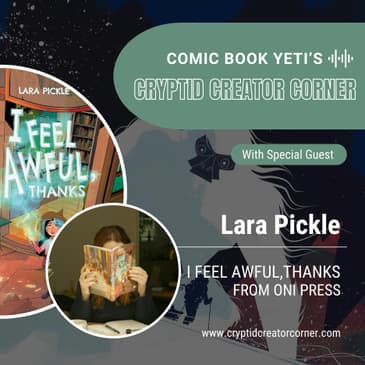

I'm joined today by comics creator Lara Pickle who has a new graphic novel I feel Awful, Thanks just released from Oni Press. The main character, Joana, is a young witch with a lot of life changes happening. She’s moved to London for a new job working for a potions company and has to find an apartment, make new friends, deal with office drama, navigate a new relationship... stress, fatigue, and sadness are things everyone deals with and I was really excited to find another project with a mental health focus and much of Joana's journey in the story mirrors Lara's own. I hope it finds its way to a bunch of people who might need to hear that addressing mental health is important and needs to be normalized as learning to live with our emotions is one of the greatest self-care gifts we can give ourselves. That's the messaging but it's also gorgeously illustrated and the emotional dragons are a real visual standout. We also dig a bit into Lara's K-Pop obsession, her journey as an artist, and why hats work so well as a narrative element.
Make sure to check out our monthly crowdfunding comics feature book: BattleMex.
[00:00:00] Your ears do not deceive you. You've just entered the Cryptid Creator Corner brought to you by your friends at Comic Book Yeti. So without further ado, let's get on to the interview!
[00:01:00] We'll definitely get picked up by major publishers, so get in on the ground floor. Head over to Kickstarter and search for Battle Mechs to sign up for notifications when this thing goes live.
[00:01:10] I've also dropped a link of the show notes to make it easy for you. It will be available in both English and Spanish which I absolutely love.
[00:01:17] This podcast has always been about promoting diversity, inclusion, and comics, and it makes it so much more accessible to a wider community of new younger readers. Don't miss it!
[00:01:28] Hello and welcome to another episode of the Cryptid Creator Corner podcast. I'm Byron O'Neill, your host for today's episode.
[00:01:35] And I'm joined on today's show by Laura Pickle who has an amazing new graphic novel being released by Oni Press called I Feel Awful Thanks.
[00:01:43] Laura, thanks for coming on the show and hanging out with me today!
[00:01:46] Hey, hello! Hi everyone! Thank you so much! I'm super pumped to be here!
[00:01:53] Good, good! I'm excited about this. I think it's a really great project. I want to start though with kind of your comics journey so I get to...
[00:02:00] I and listeners get to know a little bit more about who you are. So how did you find your way into the comics medium?
[00:02:07] It was actually a little bit accidental.
[00:02:13] So I grew reading comics, my whole life, especially manga.
[00:02:20] And I remember that I wanted to be a manga artist when I was young for whatever reason I thought it was very romantic to have deadlines and poor old writers.
[00:02:33] I know! And then I worked on animation for a long time and then I really wanted to do my own stories.
[00:02:46] And I was very lucky because I got signed up by an agency in Spain.
[00:02:54] And I had... Like, I usually do like my own mini comics for myself. It's just fun.
[00:03:04] And when I started going to therapy for the first time, I did these sort of mini comics just to sort of like understand my own emotions because it really helped me process everything a lot better.
[00:03:21] And when I signed up with my agency, they saw these little comics because I never posted them anywhere.
[00:03:32] And they were like, oh, hey, have you ever thought of doing anything with these? And I was like, yeah, but I'm not very sure because I've never done anything like this.
[00:03:43] I've never done a big scale project. It's really hard to get your work out there because you have to pitch it and so on.
[00:03:55] So they were very supportive and they were like, oh, you should definitely work on something that this has a lot of potential. And I was like, huh.
[00:04:03] So I just started working on that. And it just like came out very naturally.
[00:04:10] Okay. Yeah.
[00:04:12] Okay. So did you go to school then formally for illustration or animation or even comics?
[00:04:20] So I did fine arts. I knew that I wanted to like draw, but I didn't know that like animation was a thing until I went into fine art because at the time in Spain, there was no
[00:04:37] animation courses available. I mean, they were but they were very far away and very expensive. So I didn't have the means to do that.
[00:04:47] So I studied fine arts. And then I did like, I just like did things on my own like I studied animation. And then I practice comics and.
[00:05:00] Is it for fun really? Oh, okay. Well, kind of jumping into I feel awful thanks or English translations anyway, which we're talking more about now.
[00:05:10] I just to start off, I really, really love this book. I think it's fantastic. You know, my wife is in the mental health field and among other things.
[00:05:18] You know, there's a kind of basic blueprint of a few stages to kind of help you work through your emotions and you kind of alluded that as part of, you know, your journey, you know, your own mental health journey.
[00:05:29] So it's far more in depth than most comics that I've read to kind of address that at least in terms of offering potential solutions.
[00:05:37] So from the jump you were starting, it sounds like to want to put something together about mental health. But we also have this whole magical realm thing, you know, as it's injected to it.
[00:05:51] So it talked to me about how kind of the project itself sort of evolved in your mind because you were doing these little bity. It sounds like short illustrations or small illustrations and then they led up to a 220 thereabouts pages graphic novel.
[00:06:08] So that's a pretty big step. So fill in the gaps for me.
[00:06:13] So the thing is when they asked me to do something with the story, I initially, you know, it was very based on my own story with therapy.
[00:06:25] But throughout the years, I've been talking a lot with other friends that either have had therapy as well or just like having their insights and, you know, just knowing how they struggle with things.
[00:06:41] And it's been really like feeding into this story as well. So for me, it was more like the beginning was just about me. But then I side investigating for other like I side investigating and asking people and then it became more of like a mix of the story of everyone together with like my own story as a base.
[00:07:07] And really, I knew from the very beginning that I really wanted to do something that would help somebody identify their emotions.
[00:07:18] Because in my case, I used to be a little bit like Joanna. I used to bottle up my emotions very much because I didn't want to deal with them.
[00:07:32] Because if, you know, there's a lot of posts about toxic positivity online and they always say like, yeah, just don't be sad. And it's like, yeah, that's the thing.
[00:07:47] It's so easy. Just don't be sad.
[00:07:51] And I try to do that, but obviously it backfires on you because that's not how it works. If you're sad, you're sad.
[00:08:01] And then it exploded. And I remember that this is exactly why I started going to therapy in the first place and it really helped me out.
[00:08:12] And to me, therapy really really changed my life because it really helped me develop, you know, maybe the correct word would be reconstruct my own mindset.
[00:08:26] And just like find ways and tools on to how to project my thoughts and how to deal with those emotions, right?
[00:08:39] So that I can just like, you know, if they're there, then they won't take over myself.
[00:08:45] So I thought that was so important and it really was very cathartic for me that I just thought, but what if I'm not the only person that is going through this wouldn't be this like a really good story to help people identify?
[00:09:05] Especially because if we're talking, if we're making something in a very explicit way, which I really try to do or at least like going in depth, then people would go through the journey and then they would find they would find themselves in Joanna as in like falling into the depression.
[00:09:26] And then slowly getting to that point where she realizes that she needs help, you know.
[00:09:35] Yeah.
[00:09:36] So I really like, that's how we went in my head.
[00:09:41] Like I thought that it was an important story to tell, which is why I started like asking people around because I thought it wasn't probably not the best idea to just base it on my life.
[00:09:55] Because my life is only my own experience. So that's why I like went on and asked around and yeah.
[00:10:04] Yeah, yeah.
[00:10:05] That's one of my questions I had on here is obviously we all deal with different kinds of mental health issues, right?
[00:10:12] You know, Joanna is dealing with some depression, self doubt, some anxiety which really aren't my demons.
[00:10:19] You know, I tend to worry and my overarching emotion is frustration.
[00:10:24] But kind of how did you narrow down what you wanted to focus on in terms of the emotions?
[00:10:31] Because it's a huge range or gamut, right?
[00:10:35] You can't tell the story of everybody.
[00:10:37] So how did you kind of drill that down and say, okay, I want to deal with anxiety, self doubt, depression.
[00:10:43] Was it more or less yourself and your close friends and kind of what you were dealing with?
[00:10:49] And that was the envelope, if you will, of okay, this makes sense to try to tackle that.
[00:10:55] Or, you know, you can't do everything.
[00:10:58] Yeah. So I tried to, I did a lot of research and I asked my therapist a lot of questions about this topic because I wanted to be informative to the best of my ability.
[00:11:12] If I had to put something out there that would potentially help people, then I didn't want to, you know, like do, like put out there something that was not correct.
[00:11:25] So I did a lot of investigating and asked a lot of questions.
[00:11:30] And I came up on this, you know, it's not like it's some some like theory of the emotions.
[00:11:41] It's more about like, we have some primary emotions that humans, you know, like sort of like are born with and then we evolved them.
[00:11:56] Yeah. And emotions also evolved with time and periods. Like I mean, obviously nowadays a lot of people unfortunately suffer from anxiety.
[00:12:07] And that's not that much of an emotion that say prehistoric people used to have because now our triggers are also very different.
[00:12:17] Like I don't know like a, like a, you know, like a really bad boss or I don't know like anything else can trigger it whereas like early on, you know, in history times, it might have been just like, oh, you know, this,
[00:12:36] you know, this beast is like about to escape and or like is going to eat me alive or something like that. You know, so like it's a lot more nuanced I think nowadays.
[00:12:47] But all the emotions root in the same primary emotions.
[00:12:55] So for example, anxiety usually roots in like fear a lot because it comes from like sort of like anticipating yourself to events that have not happened just yet only in your head.
[00:13:15] Right. So obviously it's about fear of that maybe happening, but it's not and it's just I try to then just maybe simplify quote unquote simplify those into the primary emotion so that I could talk about those in hopes that it would represent the others as well.
[00:13:41] Okay. Well, to give people a little more of a basis of the basic beats of the plot, you've got Joanna who is a young witch with fair to say a lot of life changes happening.
[00:13:52] You know she's moved to London for a new job. She's working for a potions company has to find an apartment has to make new friends deal with office drama navigator new relationship.
[00:14:03] So it feels like when a lot, but when you kind of throw into a graphic novel format. You know, it's really just the normal things that young people who are starting out of their own have to deal with right so you live in London was it the kind of the familiarity of the place that made you want to center the story there or yeah actually.
[00:14:24] It's also this this bit is a little bit based on myself because I tend I used to romanticize London a lot before actually living here not so much anymore.
[00:14:37] No, I love London but it you know when I was young, I used to think that London was this amazing place that was perfect and I think a lot of people usually do that because they're very
[00:14:53] like stuck into their own minds. Like just not really liking where they live. I do remember that when I was living in Spain, my mind was always like oh I really need to get out of here because like I need to go to London.
[00:15:13] And you know like for me it's like London was a solution to all of my problems but it's not.
[00:15:21] Yeah, you know it's just a city like it's a beautiful city but it's just a city and it has a lot of issues like any other city.
[00:15:30] Yeah, got the best Indian food in the world though I will yeah that's true.
[00:15:35] Yeah, it has amazing Indian. I will say that.
[00:15:38] Well, I enjoyed the presentation of kind of a physical manifestation of Joanna's emotions in the form of a chest you know listeners should be imagining like a small treasure chest of sorts only this one is full of dragons which must be tamed so I guess there are any number of ways to examine our emotions.
[00:15:57] This one gave me a little bit of like inside out the movie vibes. Why dragons? What did dragons make sense because so like I think dragons can be very scary.
[00:16:12] So my thought process on that was that you know it's sort of like when you have like a little beast and when when it's tamed
[00:16:25] it looks very sweet and cute but when it's left unattended it can be very like very scary.
[00:16:33] So that was sort of the the thought behind it and I also thought that it would be a lot more impressive visually because of course I'm a visual thinker.
[00:16:43] So I thought that like when put on paper visually it would look a lot better if it was something that was sort of like disproportionately big like compared to Joanna.
[00:16:58] That makes a lot sense yeah it's a creative way to illustrate these big things that can run our lives if left unchecked they become the brightest thing too on the page that I noticed when present you know and I love to ask questions about color choices where you always kind of
[00:17:12] intending to feature them in this way or is that something that developed as a part of the like natural creative process as you went along.
[00:17:19] No actually I always intended them to be the most colorful thing in the room because emotions makes us us.
[00:17:28] So and actually the first ever concept art that I did for this was like a like the sort of like the outer line of a girl.
[00:17:40] And inside it was just like scribbles like lines of multiple colors and that was like one of the things that I did for one of the comics.
[00:17:50] And I thought that was sort of like the root of the emotions because they're not bad. They're not good. They're just emotions. They're just part of who we are.
[00:18:02] So it's I you know like it's it's I think it's that thought that we sort of are taught to you know through life of like oh you know these are like positive emotions these are negative emotions.
[00:18:20] And you know it's okay I get why they're they're called like that but at the same time I feel like they all have an amazingly important task on us.
[00:18:33] Like if we cry we will let steam off and we feel a lot better so it's important for us to feel sad because then we can appreciate also happiness.
[00:18:47] If we were like if we were to like smile every single day we wouldn't appreciate it.
[00:18:53] Yeah, it's not just say that it's good to be sad but it's also not a bad thing you know what I mean like so I always thought that emotions and dragons had to be bright and they had to be alive.
[00:19:09] Yeah, that makes a lot of sense.
[00:19:12] Talk about some of your other color choices. There are these really nice color boards at the end of the book which give me a window into kind of how you're creating your color language.
[00:19:21] You know it's very character centric so how do you go about making those choices you know kind of what were some of your color inspirations because clearly we've touched on the dragons being kind of the biggest the brightest things that when they do happen pop out on the page but
[00:19:37] as far as the other things like your characters you know how did you how did you make those those color choices.
[00:19:45] You mean for like a like they're they're like hair color and like yeah I mean yeah yeah just didn't know if if you're using inspiration from you talked about your friends and you're pulling you know kind of some of what they're going through with their own mental health stuff so I didn't know if you just put your friends in the book for instance.
[00:20:06] One of them has purple hair so you really like purple hair.
[00:20:09] Oh yes a lot of my friends are in the book but they're like pieces of them because I like sort of I mixed some of my friends with them.
[00:20:19] But I try to I try to stick to colors that would suit their personalities a lot so for example.
[00:20:29] John comes from Spain and she's very emotionally connected to the sea so I try to use a lot of blue tones on her also because blue is also in western culture in color psychology you know blue is usually very associated with calmness and also sadness.
[00:20:57] So I really wanted to like use that as a little bit of if you will easter egg.
[00:21:04] Okay.
[00:21:06] Yeah, yeah whereas like yeah like for example James is a lot like he tends to go towards the grays because he's a very gray character where like he's just very detached.
[00:21:21] Um be goes towards pink because she's like very lively and just very loving and like you know extroverted and the door is like you know very earthy very mystical very you know very like cottage cool.
[00:21:40] So yeah I try to use that in terms of characters.
[00:21:45] Okay.
[00:21:48] Alright let's take a quick break.
[00:21:50] What in the sand hill is happening right now what is that?
[00:21:55] What is that?
[00:21:57] You like Bart?
[00:21:58] Yeah what is that?
[00:22:00] Oh you like band of bars it's not my fault you muffle.
[00:22:04] Oh that makes sense they're dropping some great new series right now there's that one about a heavy metal guitarist in the 1970s with monsters working class wizards.
[00:22:16] Oh how we love monsters around here and my friend Dakota Brown he's working on a project.
[00:22:22] Grammatellis hell-tech mech with Lane Boyd I saw the preview for that that is crazy Jimmy even contributed to their anthology from the static and had Matt Sumo on the podcast to talk about his project the Bartik versus which makes a lot of sense that the project landed there.
[00:22:38] Where are you?
[00:22:40] Where can you find them?
[00:22:42] You need to get out there in previews or you can visit their website bandabars.com for all the latest.
[00:22:48] Can we turn the music off now?
[00:22:50] Oh yeah!
[00:22:52] Thank you no more surprises, menstruals or anything like that or I'll rinse you out to the rim fair as a children's ride.
[00:22:59] Let's get back to the show.
[00:23:01] Kind of in terms of a world like our own that is full of magic there's not that much magic or rather it's sort of intentionally baked into the fabric of things so that it's it's much more common it's much more mundane for lack of a better word.
[00:23:18] So was that a move to kind of focus away from that aspect and make it more character driven you know just kind of make.
[00:23:27] If magic the back seat if you will yeah I never intended for the world to be the primary thing.
[00:23:33] I do understand and a lot of people actually have told me on reviews and everything that it's a bit of a shame because they expected more magic in it and I do understand that quite honestly if I had the chance to do a series of it instead of just one graphic novel I would have put a lot more magic in it.
[00:23:56] But because of story choices I could not do that because otherwise it would have been really hard to pinpoint the story.
[00:24:08] And sort of like directed towards like what I needed to be but the main reason why I put it in that world is because I am a sucker for analogies.
[00:24:25] I really like a good analogy and I thought that magic would be the best way to just show that because then you have for example the fact that it's very common for people to just like show up their emotions or it's you know it's it.
[00:24:47] And then the dragons to be that it's there's a lot of room to play with certain analogies so I try to use the magic only when I needed it to conduct the story.
[00:25:00] Okay.
[00:25:01] Well one of the more magical elements kind of are the characters hats they're a very defining element visually you like hats do you just like drawing hats there are a lot of hats.
[00:25:12] No, but I actually don't like wearing hats myself.
[00:25:15] Okay.
[00:25:16] But so like the way I thought about it right it's a I'm I really like fashion and I love fashion history.
[00:25:25] So my thought of this was that you know in our actual modern life we have like a I don't know dresses right dresses have evolved so much throughout the centuries.
[00:25:41] But people still wear them.
[00:25:43] So my idea was that something that was meant to be sort of like a professional attire which would be the witchy hat which is sort of like the representation of a witch also would have evolved through the times through like the witchy history when people would wear like the ropes and everything you know got it.
[00:26:05] Okay.
[00:26:06] Well, I really enjoyed that and kind of your artistic style overall you know the character form language is fairly simple but it's very expressive and you create loads of these interesting visual space moments for Joanna and the cast to kind of operate in.
[00:26:25] There's this really nice moment I'm thinking about where she's looking overhead in the witch company building into a dome you know and that is brilliant because it's a kind of perspective you don't often see.
[00:26:37] And comics you'll see it more animation you'll see it more cartoons but you don't see it so much in comics.
[00:26:44] So there's like this dynamism to that it really does speak of like your your love for manga and kind of how expressive it is but you know your panel construction is really definitely handled and nuance kind of relying more on the color work to make the figures pop with the more muted backgrounds you know you don't obviously have that and most manga so.
[00:27:06] Do you take like reference photos of spaces you find yourself in in London to kind of create some of that kind of stuff i'm thinking of the dome specifically but.
[00:27:16] So I do like I did like a gold like I did when like go on like a on like a mission to find some pictures of things but I mean throughout the years I've been living here for really long time so.
[00:27:32] So i've had a lot of pictures of very different places and i'm very used to draw environments because that's usually what I do in my main job as a you know an animation okay and it is something that I really enjoy doing is just very lasting for me.
[00:27:52] And i'm also not for architecture so it's just like yeah yeah that makes a lot of sense yeah you there's a lot of architectural presentation even if it's not specific to architecture so.
[00:28:07] So it's one of the things i really enjoyed about it visually or those those spaces where you're you're looking over character shoulders and then the movement change in a little be a side profile so it's not so flat.
[00:28:19] So yeah nice work I like it thank you I think personally I just take a lot of because i'm very used to like reading and seeing a lot of storyboards so I like obviously I just like.
[00:28:36] I think that there's a lot of influence from that as well.
[00:28:41] Yeah that makes sense well breaks between story segments or music tracks which i've seen before but not quite like that and a magically focused world that one's kind of curious to me to go on that so tell me more about that do you have a kpop thing I do I do I do.
[00:28:59] I very much do but but in honesty so for me music is super important like I do I do playlists for literally everything I do okay one one so one thing I do for everything is playlist and another thing is mood boards I do those things for literally everything in my life.
[00:29:19] And I just feel very connected to music I don't know how to explain why but but I do and it feels like music for me is a little bit like poetry because it has a lot of like different like meanings and feelings and you can be very sort of like ambiguous with words you can play so much with it and I really love it.
[00:29:48] So you know I personally really love when musicians put out albums out there that have like that like the entire album is a whole story and it has like a whole connection and then like a deeper meaning thing or like it's sort of like part of like a universe or something like that.
[00:30:10] Sure.
[00:30:11] I love those things so I thought that it would be really cool to have something like that for this book as well.
[00:30:23] And I even thought of it like oh wouldn't be super cool this was like a sad playlist while you listen to the yeah to the thing is like you have an album very sad playlist and you go through it and then you just like at the end of it you just like
[00:30:40] yeah girl here I am okay okay make some sense here I thought it was just the Londoner and you like coming out and queuing people all the time we know how much they love to cue.
[00:30:52] Oh yeah no I don't like queuing yeah well nobody likes queuing yeah yeah well I know English wasn't the original language for the book and in the afterward you talked about being able to do the translation and kind of the evolution of yourself personally between the two years between.
[00:31:09] The original Spanish to English and that was really interesting to me so kind of as an artist myself it's always interesting to revisit and reinterpret my own work.
[00:31:20] So what was that experience like for you in that gap between translation.
[00:31:26] So the thing is with the translation thing is that when I first wrote it I was still healing myself and I was going through a lot of like emotion processing at the time.
[00:31:44] And while I was writing the and like drawing the panels and everything I had to put myself in the mindset of so many different characters and some of them were very toxic.
[00:31:57] So I got triggered so much okay and at the same time I had to be as objective as possible so I think that sometimes when I when I wrote down that you can tell me.
[00:32:13] That you can tell that or at least I can tell that I was definitely definitely definitely more emotionally affected by the you know what was happening in there because it would trigger memories that you know things that had happened to me.
[00:32:36] Whereas you know it's been really after I finished it I sort of like took a like a really long break I didn't even like want to read it or anything because I just I was sort of cringing on my own thing because I was like I can't I can't deal with this anymore I spent a year and a half non stop on this and I couldn't.
[00:33:01] And so I took a break and I just let it sit there and the first time that actually re-read it properly was when I was to you know to do the translation and that's when I realized that I had managed in these years to sort of like detach from it emotionally.
[00:33:22] Yeah. So it was a lot easier for me to see and to notice maybe that's just because it was me who wrote it so I know myself but it was easy for me to see that that emotional connection that I had that would not let me express things in the way that I would have liked it to now.
[00:33:50] So I was so grateful that I was you know given the opportunity to do the translation myself because I got to revisit everything and make sure that this you know in this new translation all the words were exactly how I wanted them to be.
[00:34:13] Okay.
[00:34:16] Yeah I was wondering if you had that moment when you're doing the translation where you really wanted to add another panel or like change a small character expression beyond the language itself and I feel like we're I feel a little bad because I've kind of taken this in a serious more somber kind of direction with the interview but the book is not overwhelmingly sad right that it is yeah you know yes there's a whole lot of heavy issues and we're going to do that.
[00:34:42] So I think that's a lot of heavy issues and we're dealing with lots of emotions you know this pertinent important but it's also a fun story about which growing up working in a potions factory so yeah sorry that's a long way to say did you want to change things when you had that opportunity to go back.
[00:35:00] There's some there's some like errors that I did like in between panels because when I was when I was when I was doing it.
[00:35:14] I did not notice that some panels just don't match with the previous ones because some because when I had the sketches and like the final things my editor would ask me to like oh actually this is not very clear over here could you add like these like another page in between to like sort of like make it a little bit smoother and I'll be like okay sure fine.
[00:35:40] And then I just I think you know like it was a very hectic schedule that I had so I made a lot of mistakes it was also my first comic so it's just so definitely I was looking at it and there were loads of panels and loads of things that I was like oh and I was super changed is but it is what it is.
[00:36:05] Yeah it feels so daunting to me. I've talked to quite a few people now where is their first published work and they always seem with their first published work when it's somebody who who who does more or less everything but editing right that they want to do a graphic novel and I'm like can you can you try to break it up into smaller pieces wouldn't that be like easier to manage but yeah seems to be the way it goes it's always a graphic novel.
[00:36:31] I mean in my case it was not I didn't specifically want to do a graphic novel. I actually I actually asked if we could um sort of like have like different volumes but I think for myself or my situation in particular the publishers are not very keen on to um just like buying many volumes.
[00:37:01] Because they have to invest a lot more money so it's a lot cheaper for them to just you know do one standalone volume because we did have that discussion and actually I do think that it would have personally like I really think that it would have helped a lot more of the story if I could have like just make it a little bit longer in just like different sort of like tones.
[00:37:27] Because it has so much to it right. Yeah, it is but it is well it's not a spoiler but the end of the book ends with a quote which is it's okay to not be okay.
[00:37:39] Aside from that you know what is this specific message you'd like to leave a reader with from this.
[00:37:46] So the main thing about it that I want people to take from this comic is that you don't have to be all smiles all the time to be actually happy that you know happiness actually also has sadness in it or you know like you can have bad days and that's fine.
[00:38:13] It's not like going to ruin your happiness if you have a bad day or even a bad month. It's okay, you know like you can pull through those things and just um you know move on and just let it go.
[00:38:33] But this is your first big published graphic novel now several translations of it.
[00:38:39] What do you have to aside from apparently translating into a bunch of different languages?
[00:38:44] I only translated the English one but here.
[00:38:49] So right now I'm working on my next comic project okay.
[00:38:56] I can't really reveal a lot about it just yet just because I'm still working on the pitch with my agent.
[00:39:06] Okay and yeah but it is also it also has a bit of a component I guess about mental health but it's very specifically going to talk about generational trauma.
[00:39:21] Okay and it is slightly based on my parents lives.
[00:39:30] Yeah but yeah it's also going to have like some music things to it.
[00:39:39] Well if generational trauma is something you're working on thinking about and stuff.
[00:39:44] I would recommend because I read this recently so Robin Ha if you're familiar with Robin at all.
[00:39:50] Oh I think I've heard of that comic yeah I haven't read it yet but I definitely heard of it yet.
[00:39:56] Yeah there's a new one that is coming out in February called Fox made and it's the core of that is very much about generational trauma.
[00:40:07] Female repression in historical career but it also has this really nice element of a nine tails so there's some mythology to it too.
[00:40:14] So it's fun.
[00:40:16] Yeah mine also has a little it has some like fantasy elements because of course it's what I like to do.
[00:40:24] But yeah I think I mean for me I like exploring topics that are like something you know that are something important to like to like people I guess.
[00:40:39] I like to talk about like messages that are going to help us grow personally I think that when I work on these things they also help me grow.
[00:40:53] Sure.
[00:40:55] But yeah so I'm working on that and I'm putting a bit of a focus on there's a whole thing then I'm reading a lot about it nowadays and it's very interesting actually.
[00:41:07] It's about maternal, familial specific generational trauma.
[00:41:14] So it's a very interesting one and then I'm also like prepping like another page of it's like have like two things that I'm trying to work on.
[00:41:28] And this one is going to be about burnout.
[00:41:32] Yeah that is, I don't know if you could touch on something more material to the comics medium than burnout right now.
[00:41:39] Yes.
[00:41:40] Yeah.
[00:41:41] So what I'm gathering is don't expect Laura to just do fluffy entertainment pieces alone by themselves there's going to be some meat to everything you do is that affair their statement.
[00:41:53] I mean yes I will try to at least I think I think I think I would get bored if I just like drew something that's like not as substantial to me at least.
[00:42:05] Especially because you know how it is with comics you have to spend years on it especially on like a graphic novel you've just been so much time with it you have to care about it.
[00:42:15] Yeah.
[00:42:16] Well where where would you like people to find you and your work online because like social media is an absolute mess right now so yeah.
[00:42:25] So I mainly use Instagram nowadays and I thought I'd use it threads more so than Twitter because yeah.
[00:42:35] But yeah Instagram asked Laura pickle.
[00:42:39] Okay yeah we'll make sure to put the links in the show notes for you.
[00:42:44] Well to reiterate this is a wonderful book I hope it's finds its way into a bunch of hands who might needed to hear it's okay to mess up you know it's it that's part of the process and kind of learning.
[00:42:54] To live with our emotions and how we deal with them is one of the greatest self care gifts we can possibly give ourselves that's that's my take and that's that's my soap box and messaging.
[00:43:04] Thanks for for making such a lovely little book Laura I think it was great thank you so much I really appreciate it yeah so when exactly are we hitting shelves because I know release schedules are kind of crazy.
[00:43:16] So it's it's going to be out the fourth of March.
[00:43:20] Okay all right well look for it and local commercial bookshops you can order it online you can pre order it now right yes you can put it now yeah yeah yeah.
[00:43:29] Yeah look out for I feel awful thanks folks this is biono nil and on behalf of all of us at comic book Yeti thanks for tuning in and we'll see you next time.
[00:43:37] Bye.
[00:43:50] Thank you for all that good stuff it lets us know how we're doing and more importantly how we can prove thanks for listening.