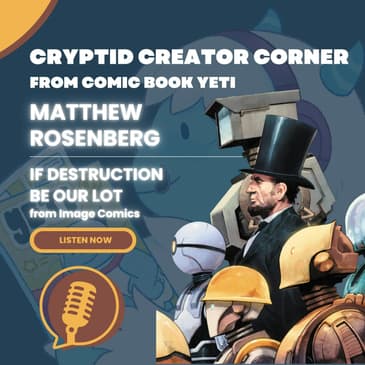

Today I'm joined by returning guest comics writer Matthew Rosenberg, who I'm christening the hardest promoting man in comics, to chat about his new Images Comics series If Destruction Be Our Lot and taking over writing duties from the Toddfather on the longest running creator owned series of all time, Spawn.
Conversation highlights include
* Matthew discussing the coincidental timing of his back-to-back robot-centric projects What’s the Furthest Place From Here? and If Destruction Be Our Lot and how they serve as a conversation or rebuttal to his previous comic book themes.
* Collaborating on a writing project with his brother Mark Elijah Rosenberg and their wildly different tastes and influences.
* Why a robotic Abraham Lincoln was the perfect nucleus for a story about loneliness and the breakdown of human connection.
* Why comics are the perfect responsive medium to address making a statement about our rapidly changing world.
* Taking over Spawn and the unique challenge of legacy.
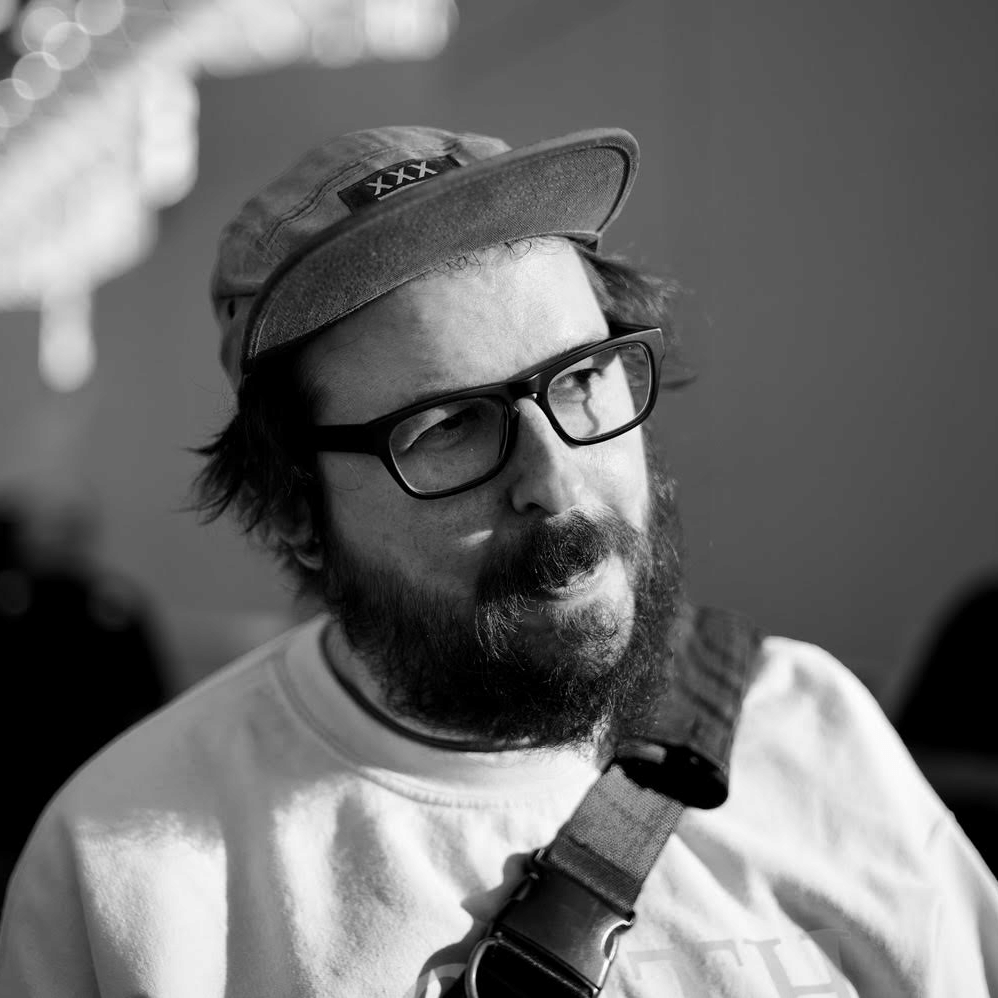
"I find isolation to be the greatest threat to democracy and freedom and civil liberties in the world."
WATCH THE VIDEO VERSION OF OUR INTERVIEW ON YOUTUBE!
If Destruction Be Our Lot
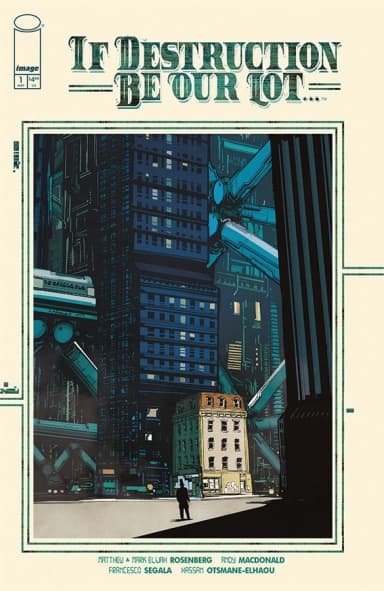
From the publisher
Humanity is extinct and all that remains are the robots who once helped us.The robots who once helped us are happier now, doing their work without human interference. But not Abe. He believes there must be something more out there. After nearly getting killed, he's determined to wander the Earth until he finds it—or gets recycled trying. Brilliant artist ANDY MACDONALD (Doctor Strange, Wonder Woman), and adequate writers MARK ELIJAH ROSENBERG (Approaching the Unknown, Year Million) and MATTHEW ROSENBERG (WE'RE TAKING EVERYONE DOWN WITH US, 4 Kids Walk Into A Bank) bring you an ongoing sci-fi adventure about finding purpose, holding onto hope, and really lonely robots.
Spawn #376
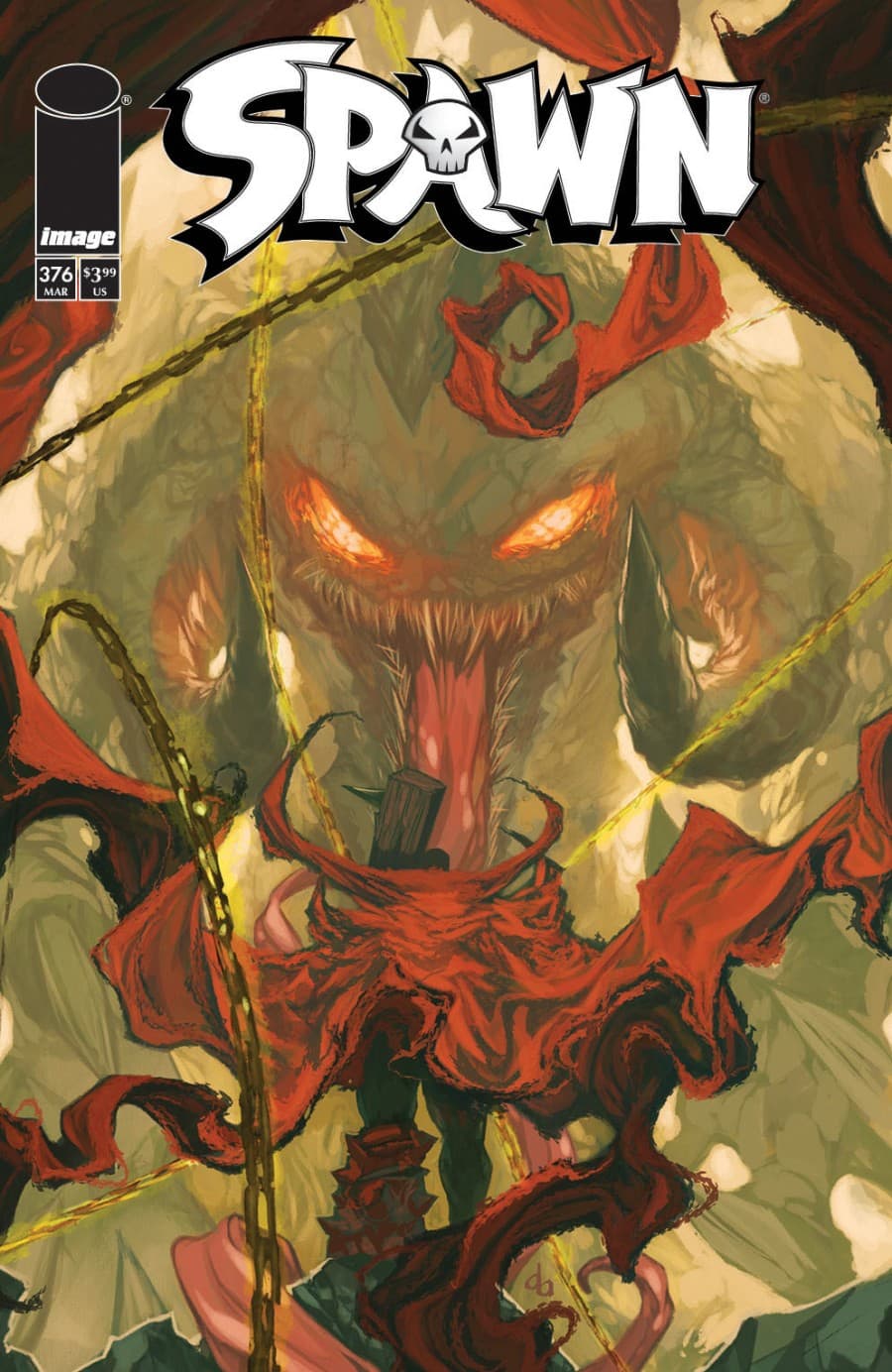
From the publisher
For several months, the creature known as Spawn has been missing. Last seen fighting an enormous creature off the coast of Oregon, with other unknown beings of power. Now, the man known as Al Simmons is trying to live a quiet life, his past unknown to those around him. But the truth is a hard thing to hide. Especially when a reporter is looking for the story of a lifetime, a young homeless teen is desperate for salvation, and the last two honest cops in New York City, Sam and Twitch, come looking for their friend. Spawn is drawn back out of the shadows to face the world that he left behind.
Spawn #376 features a brand-new creative team with MATTHEW ROSENBERG (WHAT’S THE FURTHEST PLACE FROM HERE, 4 Kids Walk Into a Bank) taking on writing duties and STEPHEN SEGOVIA (SCORCHED, New Avengers) on art. If you have been curious about the Spawn Universe, this is the place to jump on.
Follow Comic Book Yeti
🔗 Comic Book Yeti LinkTree: https://linktr.ee/ComicBookYeti
For partnership and ad inquiries, please contact: thecomicsyeti@gmailcom
Follow your hosts
Buy a shirt and support the show. Our new Matthew Dow Smith Artist Series design just dropped in the THREADLESS SHOP!
ARKENFORGE
Play TTRPG games? Make sure to check out our partner Arkenforge. Use the discount code YETI5 to get $5 off your order.
Make sure to check out our sponsor 2000AD.

[00:00:00] - [Speaker 0]
Your ears do not deceive you. You have just entered the cryptid creator corner brought to you by your friends at Comic Book Yeti. So without further ado, let's get on to the interview.
[00:00:11] - [Speaker 1]
The future is calling. 2,000 AD is the galaxy's greatest comic with new issues published every single week. Every 32 page issue of 2,000 AD brings you the best in sci fi and horror featuring characters like judge dread, rogue trooper,
[00:00:27] - [Speaker 2]
and more.
[00:00:28] - [Speaker 1]
Get a print subscription in 2,000 AD, and it'll arrive to your mailbox every week. And your first issue is free. Or subscribe digitally, and you can download DRM free copies of each issue for only $9 a month. That's 128 pages of incredible comics every month for less than $10. Head to 2,000 AD and click on subscribe now or download the 2,000 AD app and start reading today.
[00:00:54] - [Speaker 3]
Hello, everybody, and welcome to today's episode of the Cryptic Creator Corner. I'm Byron O'Neil, your host for our comics creator chat. I've got returning guests and someone I'm gonna christen the hardest working man in comics or at least the hardest promoting one. Matthew Rosenberg, I'm with me to chat about his new Image Comics project, If Destruction Be Our Lot, which he's co writing with his brother, Mark Elijah Rosenberg, and taking over writing duties for the longest running career creator owned comic book series of all time. Spawn.
[00:01:27] - [Speaker 3]
And hey, for good measure, Kingspawn as well. Brother, do you do you ever sleep?
[00:01:34] - [Speaker 2]
You know, it's funny. FOC final order cutoff for if destruction bear a lot. My first issue with spawn was last night. So last night is the first night in three weeks that I've gotten seven hours of sleep. Oh my God.
[00:01:50] - [Speaker 2]
Yeah. It's a I I have not been sleeping a lot lately, but no, I'm I'm rested now. I'm good.
[00:01:55] - [Speaker 3]
Yeah. But didn't you hit a concert, like on Sunday,
[00:01:58] - [Speaker 2]
I did. Saturday, Sunday I did. That was, that was, that was actually the first time I'd left my house in three days. Yeah. One of my favorite bands was playing, in Brooklyn and I had bought tickets.
[00:02:10] - [Speaker 2]
I'd gotten, tickets a while ago and was like, oh, I shouldn't go because of the deadline and deadlines. And then I was like, I haven't left the house. I should actually like interact with humans and go see friends and stuff. So I did go to that and that was good. Time I could have been spent sleeping or doing interviews, but went to a show for a couple hours.
[00:02:30] - [Speaker 4]
That's okay. You, you've done enough of all of them
[00:02:32] - [Speaker 3]
and you're here. So you're talking to me. So I'm going get this far. It's good. Well, how do you start with where you're, Well, it's glad it's good to see you again.
[00:02:41] - [Speaker 3]
Yeah. And that you're alive after all this promotional stuff. But I want to start with where your head is at as a writer with your creator owned projects. Last time you were on, we were talking about We're Taking Everyone Down With Us, where artificial intelligence and robotics become the surrogate father proxy of sorts. And you're exploring this idea of the unfeeling nature of robots and how it's an inadequate substitute for that human connection.
[00:03:07] - [Speaker 3]
Right? This is my read of it anyway.
[00:03:08] - [Speaker 2]
Sure.
[00:03:10] - [Speaker 3]
In If Destruction Be Our Lot, we have robotic Abe Lincoln serving as a human mirror of sorts, a robot himself with a seemingly primitive one in a world now devoid of humans and populated by robots. Back to back projects now. What's making you dig into this as a comic subject? Why is this so intriguing?
[00:03:30] - [Speaker 2]
I wish I had a good answer. I, I truly do not. I The, the honest answer is both these books came to me in weird ways, separately. And, and it just happened to be that I was working on both of them for a while before I was like, oh, I should put out something in between. So I'm not doing back to back robot books.
[00:03:52] - [Speaker 2]
And then the thing I was doing in between was delayed. And so I was like, well, I guess I'm a back to back robot book guy. But I do think, you know, part of the way my brain works and maybe it's a, you know, a subconscious thing that I didn't tap into and why these ideas work for me so much. But when I make a book, spend a lot of time sort of, inhabiting the world of the book. I really like eat, breathe, and sleep it.
[00:04:21] - [Speaker 2]
I, in my free time, I'm thinking about it while I'm eating food, I think about that book. It's pretty much the duration of that book. I, it's always like on my mind in, in, in a pretty present way. And so what I find is that when I finish a book, either I've developed more things I wanted to say about the theme or the ideas of the book, or, sometimes I've found that what I wanted to say when I started the book is not what I wanted to say when I finished the book. And so I, yeah.
[00:04:52] - [Speaker 2]
So I end up at this point where like, I'm kind of doing a rebuttal to my own work. I mean, I guess a rebuttal is not correct, but it, to me, all the work feels like it's in conversation. Like there's a through line of all my creator owned books from we can never go home to fork its walk in a bank to what's the first place from here. We're taking one down with us to If Destruction Bare A Lot. I see like it is one conversation.
[00:05:18] - [Speaker 2]
I don't think other people see it that way until I'm like, Hey, there's robots in both of these books. And then people are like, why are these connected? But to me, there's always sort of this connection. But I do think, you know, we live in this very interesting time. I think it's very easy to be like, if Destruction Beer A Lot is a conversation about AI, which it is in some ways, it's very easy to be like, it's a conversation about COVID and how we really entered into a digital world.
[00:05:47] - [Speaker 2]
And like, we're very isolated for a long time, but it also, the idea for the book predates both of those. I mean, predates AI, but predates AI as we're having a conversation about it now.
[00:05:57] - [Speaker 3]
Yeah.
[00:05:58] - [Speaker 2]
And, and so more than anything, I think it's just my brain being really into robots.
[00:06:06] - [Speaker 3]
Okay. I mean, fair enough. I mean, AI is, is, it's like certainly the thing that's on the tip of everybody's tongue right now.
[00:06:13] - [Speaker 2]
And
[00:06:14] - [Speaker 3]
nothing is quite so universally accepted as toxic in the comics community as generative AI. So aside from, Hey, it's what I do. What makes comics as a medium special that we can examine these topics in a different way, you know, as, as, as sort of evaluative?
[00:06:31] - [Speaker 2]
Yeah. I, you know, I think one, comics is a really intimate medium. It is, it is, you know, some of the best comics ever made are made by a person. And that's, I, you know, it's rare in a lot of other artistic mediums. You're not getting film that's made by a person.
[00:06:54] - [Speaker 2]
You're not getting very often, you're not getting TV that's ever made by a person. Obviously in prose and painting and stuff, it's more common or music, but like still, comics feels like a very, to me, it feels like a very urgent sort of direct conversation with the people involved. There's, there's not a long timeframe for putting out a book. And I think in that way, it presents itself as a good op, good medium to talk about anything. But when you're talking about it, a thing like AI and the way that AI works, generative AI works and the way that, you know, so much of comics is, is borrowed.
[00:07:38] - [Speaker 2]
So much of comics already is like a language that, that we're, we've learned, whether it's going back to like the way Jack Kirby made comics or Will Eisner or, Tazooka or anyone like there's certain things that are established that then become the language of comics. And it's, it's very much watching comics do it in a very loving, honest way, I think is so important to, to understand where things came from. And I think generative AI is that idea devoid of humanity, devoid of any personality and with the serial numbers piled off. That there's no attempt to be like, this is all a conversation. This is all a loving homage.
[00:08:22] - [Speaker 2]
This is a language we speak. It becomes, this is stuff we consume and shit out. And so I think in some ways, a very, in a very pure way, comics is already the thing that generative AI is, that it is, they've invented something to make what we do cheaper and dirtier and grosser. And I think it's a good, it's good for us to talk about it
[00:08:48] - [Speaker 3]
for sure. It's a fascinating way to look at it. I have not thought of it and processed it quite in that way before in terms of the conversation, terms of an actual evolving monthly dialogue, whereas, say, book on a shelf, you might spend two years writing a book about AI, but you're just going to have this your thoughts don't have the opportunity to to to provide this continuum, you know Yeah. Change.
[00:09:19] - [Speaker 2]
Yeah. I mean, you know, I it's a thing I think about a lot in in comics is that, like, other than, like, the hip hop mixtape, we are the medium that could be responding to things the quickest. You, when I finish a comic, when I finished writing a comic, someone draws it in thirty, sixty days, whatever it goes to the printer. And it's on shelves a month after that. So like, by the time the last, the last of it is drawn, lettered and colored, it's like thirty, forty days before it gets to shelves sometimes.
[00:09:56] - [Speaker 2]
And that is an incredibly powerful tool that you can be talking to ten, twenty, 60,000 people about something that happened last month, about something that happened two months ago. And we take almost no advantage of it in the medium, which is a huge failing, I believe. And I say this a lot and I, I was talking to Kieran Gillen recently and I, I talked about that and he said, well, how do we do it? And I said, I have no idea. I'm not smart enough to know how to do it.
[00:10:24] - [Speaker 2]
I just recognize that we should be doing it. It's smarter people than me who could, who I think should be running with that. But I do think, yeah, I think there's a conversation and definitely like, you know, stepping back from that, we, myself, Mark, and Andy have been working on this book for a very long time actually, in some form. So we do have some of that in a less urgent way in that, like, this book was about certain things and these other things have come into it and started to be a part of it. And so AI is a part of it, but I think also, it sort of goes the other way too, that a lot of the things like COVID and AI were things that we were sort of touching on thematically anyway.
[00:11:10] - [Speaker 2]
And that's in that, this idea of like loneliness and isolation and, and people becoming things and people becoming obsolete and the ways that we're distanced from the people around us. Like those were already things in the book. So AI and COVID or whatever we talk about in the book are things that, you know, were already happening and they're just, you know, a big a big metaphor for them, a big metaphor for those things we were talking about already.
[00:11:39] - [Speaker 3]
Yeah. Well, yeah, you're working with Mark on this and he co produced and created Year Million, which was a six part documentary series on National Geographic about the effects of technology on the future of humanity. And that was like a decade ago. So I'm sure he has some evolving thoughts since then. So how did y'all end up working together on this?
[00:12:03] - [Speaker 3]
Well, we met a long time ago,
[00:12:06] - [Speaker 2]
when I was a baby and he was, I don't think we were gonna work together then. We had a rough first first eighteen years of, there was some crying. There was there was some fighting. But, yeah, the, this as a thing that we worked on is, is funny because my brother, you know, his most, his most well known things are like, yeah, the, the year million TV series he, he wrote and directed and, he made a film called approaching the unknown, which I love is a, is a sort of small indie sci fi film. And my brother's not really a sci fi guy.
[00:12:49] - [Speaker 2]
Like, I'm much more of a sci fi person than he is. And so I think he never intended to do another sci fi thing when we talked about making a book together. And I, I, you know, I was open to not doing it. And this idea was just something we were batting around ideas and coming up with stuff. And this was something that like had come to me as a, as just a sort of visual image of just the robotic Abraham Lincoln in a world without people.
[00:13:18] - [Speaker 2]
Like, I just had this visual in my head and kept sort of coming back to it being like, why, why do I keep thinking about this? Is this interesting? Is there something I was like, I think it's funny. Is there anything more to it? And when I brought it to my brother, he was also intrigued by it.
[00:13:31] - [Speaker 2]
And it turned into this sci fi thing because part of it was robots and part of it was the extinction of humanity. I don't think he was hoping to do a hard sci fi book, but here we are. But yeah, I think that, you know, his work on Your Million definitely early on, definitely informed a lot of the stuff because he'd been thinking the Your Million project, like, sort of looking at where humanity would be over the next basically million years and, and at various points. And so he had really been researching and studying and spent a long time thinking about technology and the way, the way it would impact us in the way it could impact us and speculative science fiction. So early on, this was a very, like, was throwing a lot of stuff out there that I was like, this is too crazy and too sci fi for my brain even.
[00:14:27] - [Speaker 2]
So yeah, it's, it's, I don't think it was by design that we ended up doing this. It was just sort of serendipity that we ended up making a book that he had a sort of language and toolset already to work on it. So it's your first professional collaboration then? Yeah. Yeah.
[00:14:47] - [Speaker 2]
You know, I, I show him a lot of my stuff and he reads a lot of my stuff and we talk about it and same for him. Like I said, I read a lot of his scripts and you know, that. But no, this is the first thing we've ever, like, officially done together for sure.
[00:15:01] - [Speaker 3]
Lesviu, like, I can imagine maybe building a deck with my brother. Like, it would have to be something very tangible because we're both tactile, physical people. So that's the only way we would ever be able to collaborate on on something. Writing something with my brothers, no. Mm-mm.
[00:15:18] - [Speaker 2]
You know, know, it's funny because everyone is like, that's crazy. And I was like, I, yeah, and it's not, it's a nice feeling to hear because I was like, oh yeah, I guess we're closer. Like, I always think of us as close, but I was like, I guess we do have a closeness that is, is sort of rare. Not, not that we're closer than other people, but just like that we can get along in that space is, is a nice feeling. We are very much not taste wise on the same page about almost anything.
[00:15:46] - [Speaker 2]
Like we don't like the same bands. We don't like the same movies. We don't like the same music. We don't like the same TV. We don't like the same books.
[00:15:53] - [Speaker 2]
We don't like the same food. Like we are very, very different taste wise, which I think is a strength to the book actually. But, there's a world where I definitely understand about this book one weekend, we were like, this isn't going to work and abandoned it, but we've seen it through and, I'm very happy we did.
[00:16:10] - [Speaker 3]
Yeah. Well, I read, your recent Reddit AMA where you were talking about the idea of using Lincoln in this story. That was late night walkabout. I think most people say they do their best thinking in the shower. Apparently, you need to to knock up a gate, which is a word, actually.
[00:16:27] - [Speaker 2]
I had
[00:16:28] - [Speaker 3]
to look up what it what walking around at night and just sort of wondering is. So that's that's the word for it. So you have Abe is the nucleus. What was next?
[00:16:38] - [Speaker 2]
Yeah. Abe is the nucleus. I, I, it was in my head, like
[00:16:42] - [Speaker 4]
I said, for a couple of
[00:16:43] - [Speaker 2]
weeks before I brought it to my brother and I was like, is this something we could use? And, and he was really intrigued by it. And then it was just trying to figure out the, what the story is and what the world is. And I think it, it was right there in the idea really, which is that he's alone. He's lonely.
[00:17:03] - [Speaker 2]
And that to me, when we had that piece of just like, it's about loneliness, it's about isolation, and connectivity and connecting with people. When we had that piece, I think it, it helped us figure out where we were going, but also did a really good thing for both Mark and I, which I think is cut off getting too into the science half of science fiction too fast. Getting like, we were like, okay, this is a very human story. This is a very relatable thing. If this is our theme and this is what we're driving towards is isolation and loneliness the ways we're losing the ability to connect with other people, then all of the big science ideas are in the backseat and have to serve that story because I I'm, like I said, I'm a science fiction guy, but at the heart of it, I'm more a fan of, of story and character than anything.
[00:18:02] - [Speaker 2]
And, you know, I'm not telling tales out of school when I say that like a lot of science fiction puts character and story in the back seat to ideas and these big concepts. And we want to ensure that we weren't doing that. So we ended up having that as, as our end game is like, what is this story about a guy who's an outsider and doesn't fit in anywhere and wants to make a friend and wants to connect? What, what does that story look like? And then everything else sort of fits in a place around that.
[00:18:32] - [Speaker 2]
So, yeah, it was, it was sort of a, it all came, all of the pieces of the idea came in that, that first visual of just Abraham Lincoln alone, world without people like that, that tells me everything that it's, it's the theme, it's the setting, it's the main character, like it, all of the seeds to grow this book were in that one idea.
[00:18:55] - [Speaker 3]
On my read through the famous speech you're pulling from in the book, the title comes from Lincoln's address at the Lyceum. It was 1838. And it doesn't escape me that we're still dealing with many of the same issues in our country that he was trying to address with that speech, like racial violence, caution against politicians operating outside the law and appeal to reason above passion. Right? So that's, there's a lot of juicy stuff in there, but it's also fraught with a lot of landmines.
[00:19:25] - [Speaker 3]
Because you, you had mentioned you're kind of already dismissing the, okay, we're not really going to dig deep into the science y aspect of the science fiction here. Then you have character. That's where you want to focus. The danger is Abe comes with a lot of baggage.
[00:19:40] - [Speaker 2]
For sure. Yeah. Yeah, it's, it's a weird situation I'd never been in before where we have a character that is nice because he's so iconic. He's so recognizable. He's, he's American mythology.
[00:19:55] - [Speaker 2]
Like he's, he's our mythical figure. We put him on mountains. We put him on money. We put him in, you know, we have buildings and cities and streets named after him. And in that way, like he is, and, and not just that, but like, yeah, like you said, like people know a lot about him.
[00:20:15] - [Speaker 2]
They, they know about
[00:20:16] - [Speaker 3]
Or think they do.
[00:20:17] - [Speaker 2]
Yeah. Or think they do, but they know a lot, you know, they, they can, if, if we'd say it's, it's Millard Fillmore, people would be like, I don't really know anything about Millard Fillmore. Like they don't have, you know, if, if, if we'd made it Taft, there's not a lot that people are going to bring up about like, oh, I think you're doing a book about this, but was it Lincoln? You assume that civil war and slavery and abolition and all these things are part of it. And that's a very weird position to be in to be like, that's not what our book is about.
[00:20:45] - [Speaker 2]
There's metaphor built into the book that we're trying to strip out. And in that, like we spent a long time trying to take Lincoln out of the book and figure out someone else that could be not just presidents, but just like anyone. I mean, was, we spent a good three, two or three months just writing down names and sending them to each other and just being like me, Mark and Andy, just being like James Brown, Timothy Chalamet, you know, the nutcracker from the nutcracker, like anything, like just whatever it could be, like, would this be interesting? If it was Shaka Khan, is that something? Is it was Gigi Allen.
[00:21:20] - [Speaker 2]
Gigi Allen. I mean, animatronic Gigi Allen is the scariest idea I've ever heard and I'm in love with it, but, I'm not sure GG Allen made the list, but probably should have. The, and, and then we realized that like, well, Lincoln is not just the physical things that he did. It's not his positioning in a time and place, but he also stands for all these things. And he stands for, you know, people think of him as a very empathetic person.
[00:21:49] - [Speaker 2]
People think of him as a person who really carried the weight of the world on his shoulders and was very troubled. Obviously the honest Abe, a metaphor of a man who was honest to a fault. He was a great orator. And all of those are things that to me felt very human and felt very, very much at the core of things we would want in our character and would want to establish. And I was like, well, he's the shorthand for a lot of these things.
[00:22:17] - [Speaker 2]
Like he's the shorthand for so much stuff that we do want. He's just historically, and that's when we sort of realized, well, it's not Abe Lincoln. It's, approximation of Abe Lincoln. It's his animatronic version of him. So I think there's a way to do the story where he is these things, but just a representation proxy of them without having the physical.
[00:22:39] - [Speaker 2]
And also, you know, when people expect something in a book and you can subvert it, that's always a good thing. Think when I think so when people are like, oh, is this about this thing, A or B or whatever it is? And we can be like, no, that's good. But like you said, like, there is all this, this woven metaphor and the Lyceum, address is an amazing speech and, and a really powerful one. Yes, like very prescient still.
[00:23:09] - [Speaker 2]
Like, is our book about those things? Not entirely, but also our book is about the distance between people and the divide between people and the things we use, the things that are being done to separate people. And Yeah. The Lyceum address is about that. It's about, you know, it's political, but it's also about like, are we looking out for our neighbor?
[00:23:35] - [Speaker 2]
Are we looking out for the common good? If you think of democracy as community, which I do, the Lyceum Address is about how is community being undermined? How are we not taking care of our neighbors? How are we going to lose this idea of taking care of each other as an important thing? And the idea that, you know, the destruct and obviously it's also about the destruction of America, which our book is a little bit about.
[00:24:03] - [Speaker 2]
So, you know, you find that all this stuff works on a lot of levels and sometimes we back into it accidentally and sometimes we do it very intentionally, but like our book isn't about demagogues taking over democracy, but it is about some of the factors that allow demagogues to take over democracy. And that's isolated people who don't, who have a problem empathizing with people and and don't don't trust the people around them and don't think and are just looking out for themselves. And that's a scary, scary thing to do at this day and age, and it can lead to dangerous things. And our book is about that in a lot of ways.
[00:24:45] - [Speaker 3]
Yeah. I kept coming back around to, as somebody who is very visual, like my, my medium of choice is photography. And so Abe is just this fascinating choice for me because he's not just human. He's quirkily human. And that's a real striking contrast to the way robots would be interpreted, which is essentially function where Abe is formed.
[00:25:09] - [Speaker 3]
So it creates this nice visual polarity in the book immediately.
[00:25:13] - [Speaker 2]
Yeah.
[00:25:14] - [Speaker 3]
So, you know, without giving too much away though, you were also leaning into the other side of it. You know, I think his interplay with the bus becomes this, this really good illustration of that. So it feels like a unique opportunity to explore character in a very different way, not just narratively, but visually as well.
[00:25:33] - [Speaker 2]
Yeah. Yeah. I mean, it's not lost on me that like, I spent long enough at Marvel and DC with them saying like, when you put together a team of superheroes, you should be able to recognize them by their silhouettes. Like that's a Marvel and DC rule. They tell you that like, if you can't look at the silhouette, you don't have a good team.
[00:25:53] - [Speaker 2]
We have the historical figure who has maybe the most recognizable silhouette of any historical figure. So like, yes, visually there's a good, easy shorthand for us that we really love, but also, yeah, he is that idea of, of his form versus the other robots who are functional in a way is so core to what the book is because he is the only animatronic walking around. He's the only robot that looks like a human and the other robots don't like him or respect him because of that. But also it speaks to a different, a bigger thing for him because all of the other robots have jobs and they do them whether or not the job is actually useful to anyone. They don't concern themselves with that.
[00:26:45] - [Speaker 2]
The bus drives its route every day. There's just no one to get on it, but that's not its job. Its job is not to have people get on it. Its job is to drive its route. And the breakfast robot is ready to make breakfast every day.
[00:26:57] - [Speaker 2]
Whether or not it does is not important to it. Abe's job is to educate and entertain and all of the other robots pretty much know everything that he knows. Like they they're connected to things. They know, they know the language of Lincoln. They know the history of Lincoln and they find him annoying.
[00:27:14] - [Speaker 2]
So he's neither educating or entertaining anyone. So he is really more bereft of purpose than the other robots are, even though they're sort of in the same situation. And that manifests in his visual look and that he looks like something that has no use to them. He doesn't, he looks like something that is truly obsolete in a way that the other things are not.
[00:27:39] - [Speaker 3]
And they, their interaction with him, think, is really interesting too, because it it struck me as very high school. Mhmm. Just just sort of like a a bullying atmosphere. And, like, normally, we think of robots and advancement as very mechanical, you know, towards a perfection or a vision of that. Not individuals who are preoccupied wanting to be entertained, which, you know, echoes our own society moving in this direction of of being simply consumers as AI takes on more and more and replaces things we do, including thinking.
[00:28:13] - [Speaker 3]
So why did you want to portray the robots like that?
[00:28:17] - [Speaker 2]
You know, early on, we had this idea, we were just discussing this actually, we, and a very early idea that goes back to, you know, I think a lot of my brother's sci fi research, speculative science research is, is we have this idea that all of the robots were networked together and they all shared an intellect that was far beyond anything we could comprehend. And the shorthand we had for it is that like, they're smart enough that essentially they're almost a God, like they are, and it's all of them. So the garbage can is God and the streetlight is God and the, you know, as much as the robot that moves the city. And that was an idea and that Lincoln is removed from that. And he he's isolated.
[00:29:02] - [Speaker 2]
And early on, that was an idea we really liked as a science fiction idea. And there's a lot of good metaphor in that and it's very fun, but also in terms of character, it meant that we were doing a two character book. It meant that we were doing, you know, my dinner with Andre, or Waiting for Godot or what, you know, whatever we're doing, we're doing something where it's just like, well, every character Lincoln talks to is the same character and they all have the same voice. And I creatively was like, I don't find that as fulfilling as going down this other road of what they are. And I think we had a lot of struggle at first understanding why they would have these like quirky, weird personalities and sort of trying to justify it.
[00:29:47] - [Speaker 2]
And then very quickly as the, as the AI stuff took off, I feel like we were really vindicated in that idea that it's like, oh, they're gonna take after us and not just in an aspirational, like who are the best thing, who are the best humans who could be, but it's just like, who are the most online humans? Like that's, they're gonna talk like 4chan and before they're gonna talk like, you know, MIT professors, that's just what they're going to learn. And that to us was a very sort of freeing idea that like, they're not, they're not a representation of, of the next step of humanity towards attaining something more supreme. They're a derivative of that is sort of just everything about humanity mushed together in a kind of not always pleasant way.
[00:30:40] - [Speaker 3]
Yeah. I mean, we got to do these things. You got to work. Yeah. And you don't want to be defined by necessarily your work.
[00:30:47] - [Speaker 3]
That is not who you are. Sure.
[00:30:49] - [Speaker 2]
It's part of who you are. Yeah. I think, I think that there's, there's, yeah, there's a fun, fun thing to play with there of, of just like these robots in these roles. And, and as, as the story goes, you're gonna see other robots who don't necessarily fit into these roles. There are these obsolete robots.
[00:31:08] - [Speaker 2]
There's two sort of branches off of that, that we are going to play with as the book goes on. And one is that the way one is these ideas that these robots are making robots who are then making robots and the further they get away from human hands, the less they become something that we would understand as a reader, but it's also something that is going out of control for the robots. Like they don't understand what they are. And you get hints of that in the first issue, but it continues more and more that there's just robots they don't understand what they're doing and that seem very alien to them. But there's also these robots who are obsolete and the society has a way to get rid of obsolete robots and sort of dispose of them.
[00:31:47] - [Speaker 2]
But there are robots who escape that and these obsolete robots sort of go down this different path of of not having a role and and their role is just surviving. That's all they do. That's all they try and do. And who they are, it's sort of the fringes on the outside of this robot society. They become some of my favorite characters because they are, devoid of that connection to work in any way.
[00:32:13] - [Speaker 2]
They are pure survival and and what becomes of them and who they are. Like, I think they're very fun, but I also think they're very tragic characters. And and, yeah, we're just playing with a lot of, I think, what expectations of robots would be in this book is hopefully, people are gonna see stuff that isn't what they expect.
[00:32:33] - [Speaker 3]
Yeah. I I certainly did. One of the things that really struck me was in terms of an idea I kept coming back to, you know, we think of Abe giving speeches and how that's this communal experience that brings people together and how we're losing that with the younger generation. Like I've got an 18 year old, he's gonna be launching to college in the fall, and, you know, both of us have spent significant amount of time in live music. It's important to both of us.
[00:32:57] - [Speaker 3]
Sure. You know, for me, there's nothing like it. You get that collective energy that creates a and exerts a natural force that, you know, it's in the room. It's like the wind before a storm. It's something you can feel.
[00:33:09] - [Speaker 3]
And I feel like the younger generation is just losing some of that connectivity because they don't go out. They're just not interacting with each other in the same way. So that was just something I kept coming back to in my read through of the, that first issue.
[00:33:23] - [Speaker 2]
Yeah. I mean, that's a big thing. I, I, you know, like, like I talked about, you know, sort of COVID and AI, but I think that's a thing that's on my mind all the time is just like, I live in New York City, like New York City is in the middle of a thirty, forty year war with public spaces. Like we just are not a city that has good public spaces other than a few parks. We do a very bad job of having communal spaces and a place where you can go to connect people.
[00:33:53] - [Speaker 2]
Everything is monetized. If you wanna go hang out with people, you're going to a bar and have to buy drinks. You're going to a movie, you're going to a show, you're doing whatever you're doing, There's a, there's someone trying to be like, well, the place to do that is here and it costs money. And that I think is a huge problem. New York City, like everyone lives in small apartments, so you don't have a lot of get togethers.
[00:34:15] - [Speaker 2]
Like there aren't a lot of just like ways for people to hang out and you see it, you know, in the planning, like they just redid the train stations and, you know, because there's a war on the unhoused, they don't put benches in the train stations anymore because they don't want poor people sitting there, which is, you know, a whole different tangent of just abhorrent, abhorrent way to treat our most vulnerable. But beyond that, what do you end up is like, you go to the train station, there's nowhere to sit. You don't wanna end up talking to anyone. Like, you're, you're waiting for the bus and waiting for the train.
[00:34:50] - [Speaker 3]
Or on your phones?
[00:34:51] - [Speaker 2]
Yeah. You're just on your phone. And like, that to me has been a problem I've thought about for years and years, especially as someone like I'm straight edge, I don't drink. And so bars don't hold a lot of allure to me. Like I go there, but I don't love them.
[00:35:05] - [Speaker 2]
I don't like that that becomes a focal point of culture and society. And so it's the thing I've always thought about. And then, you know, in the last fifteen, whatever years they've been like, well, these digital spaces are now the new community spaces and it's Facebook and it's Twitter. You know, the thing we've learned in the past few years is like, no, those are definitely not safe communal spaces. Those are very large corporations attempting to sell you ideologies and ideas and products, often dangerous ideas and ideologies and products.
[00:35:39] - [Speaker 2]
You are a, you know, being shotgunned things that you do not consent to on a daily level and you don't have control of your space there. Like, you know, how many of us have an Instagram where we're like, yeah, I have this many people who've signed up to see what I post and you don't show it to them because that's, you're showing them what you want to show them, not what I want to show them. And that's not how public forums and public space and public interaction works. And so those divides are very much like things that are very on our minds in the book of just like Abe is in a bustling city full of robots, surrounded at most of the time by robots. And he is very, very lonely and very alone.
[00:36:23] - [Speaker 2]
And that is a, a, a very modern problem, but a very real one that, that connecting with people is not a proximity issue. It is, it is a cultural issue and it is, and there are people who are very much attempting to make it something they can monetize, connecting with other people. And that's a dangerous thing that we're all dealing with the outcome and the fallout of, of those ideas now.
[00:36:49] - [Speaker 3]
Jimmy is too humble to do this. So as his stalwart ride or die, I wanted to tell you about his new graphic novel, Penny and the Yeti with artist Amber Aiken. What started as a comic short with his daughter that I've known about for ages now, and it's evolved and has become one of those annoying can't talk about it in comics things for too damn long. Yes, I'm predisposed to be supportive but after reading an advanced copy of it, I have to admit it's way better than I anticipated. No shade, but it's really good, remarkably so.
[00:37:21] - [Speaker 3]
Does it have a yeti? Yeah. Is it cute and adorable? Yeah. But it street flies and effectively tapping into the all too familiar family dynamics that we all are facing in 2026 and approaching it in a way that doesn't insult the book's target audience.
[00:37:36] - [Speaker 3]
Kids. They are way smarter and perceptive than we adults give them credit for. So I really appreciated Jimmy's narrative approach tapping into his own experiences as a dad and a spouse. I can hear his wife saying, get off your phone, Jimmy, through the pages. She's gonna kill me for saying that.
[00:37:52] - [Speaker 3]
It's hitting shelves on April 21 and I dropped the link in the show notes where you can preorder a copy today. Getty or not, here we come with Penny, Perry, Fenton, Maxine, people at a show now because technology is now the connective point
[00:38:22] - [Speaker 2]
Mhmm. Which
[00:38:25] - [Speaker 3]
it it blows my mind, and it makes me just tragically sad to see how many people will lift their phones at a show to show other people who are not there the experience of what it's like as opposed to actually being present. That's one of the things I really loved about the book is there is a lot of presence to it with the robots. So how in the hell did robots become your muse? I mean, it's, it's a, it's weird.
[00:38:51] - [Speaker 2]
Yeah. I mean, I think, I think as the rise of sort of the digital age and the rise of all this technology, we're represented by digital avatars. We're represented, you know, most people who interact with me are interacting with me through a screen, through their headphones, through a book, I hope, but like a lot of those people are reading the book digitally. I'm not a physical entity to a lot of people. And so that idea is very, very prevalent in my mind of just like, we are not, we are, we are becoming digital representations as a, as a, I, I don't want to say I'm a public figure, but I'm close to a public figure as someone who makes things and, you know, people, I have the privilege of having a platform where some people will listen to me and some people will, you know, I'm not just a guy shouting on the bus.
[00:39:47] - [Speaker 2]
Like I have people who are sign up for a newsletter to see what I say or tune into a podcast to hear what I say. I think a lot about how I'm just a, just a data and, and where can I find the humanity in that? How can I make sure that my data and my, connection to people somehow has traces of me in it, that I'm not just, you know, like, it's very hard? Like I have, you know, I have a Facebook account. I don't ever talk about anything personal on it because it has thousands of people on it that I don't know.
[00:40:29] - [Speaker 2]
And I don't want to be like, Oh, my family member, this, it's dangerous. Like it's actually literally dangerous, but then I lose that connection. I'm dehumanizing myself because of that. I'm, I'm, so I try and find ways to be honest and, and who I am in, in the right spaces. I don't necessarily want to give that to Facebook or Instagram, but I do try and, you know, my newsletter is one where I try and be a little more confessional about who I am and what I think and how I feel about stuff.
[00:41:06] - [Speaker 2]
And it's hard. It's hard to find the humanity when you're like a faceless digital entity. And so I think robots are a great representation of that, of just like how much of us is in them, you know, and now we're dealing with it with people who are like, the chatbot is their best friend. They're in a very serious relationship with them. Terrifying.
[00:41:28] - [Speaker 2]
Yeah. It's terrifying, but it's tragic too. It's like, well, you're
[00:41:30] - [Speaker 3]
Oh, absolutely.
[00:41:31] - [Speaker 2]
We've built a thing to replace. And, you know, I just saw this thing the other day about, some company that made a chat bot that is Jesus. And it's for evangelical people to talk to Jesus and everyone, you know, obviously everyone on my feed was making fun of it. And yes, like in my non religious reading of things, I was like, isn't this sort of creating a false idol? Like, isn't that literally what we're talking about is that we've created a fake Jesus?
[00:42:01] - [Speaker 2]
Like that is, seems to me to be a cardinal sin, but devoid of that, like getting over the dunking on it and getting over the profiteering of it, which I find revolting. It really just broke my heart that I was like, these are people and, and it goes back, you know, it's not a twenty first century problem or a twentieth century problem. It goes back to, you know, it goes back to, it's a religion of all times. It goes back to Homer. It goes back to, you know, storytellers of all times.
[00:42:30] - [Speaker 2]
It's people trying to make connections and looking for ways to make connections that they're not just getting from their daily interactions. And, I felt really just sad about the fact that there are people who need to talk to digital Jesus. That like, even if you believe in Jesus and think you can pray to Him, like praying to Jesus felt like not enough anymore, that you needed digital Jesus to me was like, I get why people are making fun of it, but it just kinda broke my heart because I was like, that's just a lot of people who are gonna use that service who are missing things in their lives that they need and and that they shouldn't be missing, that that I hope they can find somewhere that isn't a robot pretending to be God.
[00:43:13] - [Speaker 3]
Yeah. Yeah. Yeah. Well, my wife is a, is a psychologist. So yeah, we, we talked at length about that one.
[00:43:19] - [Speaker 3]
That was, that was rough.
[00:43:21] - [Speaker 2]
It's, yeah, it's, it's really, you know, it's a really, we're entering a really weird age and, you know, it's a thing we talked about in the book of like, obviously our frame of reference on this stuff, people are like, well, it reminds me of Fallout or Mad Max or Guy or, you know, whatever it is, Wally or anything.
[00:43:42] - [Speaker 3]
Interesting.
[00:43:43] - [Speaker 2]
We get all these different things that are like post apocalyptic. I was like, one of our first points of contact was the movie Her that we were like, Her is about a person who's in a relationship with a chatbot. Like that to us was like a thing that we really honed in on early on. And we're like, I know it doesn't sell a lot of comics for the comic shop clerk to be like, did you like the movie Her? Read this But like, that is definitely the touchstone for us.
[00:44:10] - [Speaker 2]
But also, you know, we have a lot of touchstones, so it's not a perfect example. But, you know, I think that there's, this stuff is very much weighing on me all the time of, of just the connecting people and the way people are isolating. And, and, you know, it, it goes to the way that I talk about comics. For me growing up, comics was a very isolating thing. I was a kid who, I had friends, but like comics I read on my own and I didn't share comics with my friends.
[00:44:40] - [Speaker 2]
I didn't talk to my friends about comics. I have very close friends who didn't know I was into comics. Like friends I've had since I was a little kid who were like, Oh yeah, I guess you, there were comics at your house. And I'm like, Oh no, I was like all the time comics. But I just didn't talk to anyone about it.
[00:44:56] - [Speaker 2]
And now as an adult, someone who makes comics, I realized that that's not, it's okay if you want to interact with comics and have it be a private, isolated thing. But for the medium, it's not good. The medium, we need to be, have more people out there talking about evangelizing comics and sharing them. And so I try and do that, even though at my core, I'm like, what I'm reading is feels very private to me, but I'm always like, this is what I'm reading. This is what I'm into.
[00:45:20] - [Speaker 2]
This is what I bought. And that all feels super intimate, but I'm trying to, break down those barriers of things that feel isolating. I, I, I find isolation to be the greatest threat to democracy and freedom and civil liberties in the world.
[00:45:42] - [Speaker 3]
I definitely, the isolation was not something at all, you know, that I eat in on in my read, and you might find this to be kind of an odd comparison. You know, we always liked comparisons. You said her. For me, was The Wizard of Oz. That may seem really strange, but, that was what I got.
[00:46:00] - [Speaker 2]
It's not strange at all. That is definitely another like core, core thing. I mean, the funniest part to me is that I was doing an interview and I talked a lot about one of the key ideas that we had on the book was that we wanted to do this type of comic that I think we don't really, I said, it's a comic we don't really make anymore, which is that like, meet a character, you, we ask you to fall in love with the character or care about the character. And then we just send them on a journey. Like there's an end point, there's a goal, but more than anything, we want you to show up and just trust us that the adventures are going to be fun.
[00:46:35] - [Speaker 2]
And like, I point to stuff like Concrete or ElfQuest or, you know, like Love and Rockets, even of just like, this is a character piece. And I, in an interview said, know, it's this very, me, it's a very comics idea of just being like, show up every month and get a little chapter. I said, it's, it's falling over the characters and just trusting that their odyssey is going to be good is something that, you know, exists only in comics. And then I was I use the word odyssey. I guess that's not something that exists only in comics.
[00:47:04] - [Speaker 2]
I guess that's a thousands of years old storytelling idea, but I mean, you know, The Wizard of Oz is an odyssey. It's a, it's a character being thrust into a new world they don't understand and, and they're looking to find their way home. And that's sort of what Abe's journey is, for sure. Like the, there's a robot later on that was code named Toto for a while in the script that's not their name in the final book. So, the Wizard of Oz thing is very much on our minds.
[00:47:33] - [Speaker 3]
Nice. Okay. I wasn't that far off. Feel dedicated Well, I feel need to kind of praise Hassan's work as the dialogue is the connective tissue of the book for me. It sells the premise with the robots, except Abe.
[00:47:46] - [Speaker 3]
You know, you don't have facial acting to convey emotion, you know? So you're making the lettering do the heavy lifting. And the diversity is anything but mechanical or robotic here. You have color variation and word balloon shapes with tails, and it's it's beautiful. He absolutely deserves an Eisner Nunn for this
[00:48:06] - [Speaker 2]
because
[00:48:07] - [Speaker 3]
it's I mean, he is the best in the business,
[00:48:09] - [Speaker 2]
but A 100%.
[00:48:10] - [Speaker 3]
Yeah. Yeah. Yeah. He killed it.
[00:48:13] - [Speaker 2]
Yeah. I, it's funny because he, I mean, project I do with, with Hass, like changes my understanding of lettering, for the better. And he's always readjusting my understanding of what lettering is and can be and should be. But in this book, especially, he keyed into an idea that was a core tenant of the book, but found a way to illustrate it that none of us had found, which is every there's always, there's tons of robots around. They all look different.
[00:48:54] - [Speaker 2]
They all serve a different purpose. They're all talking. It's not quiet, but they're all sort of speaking a different language and it's, they can understand each other, but they're not connecting in the same exact language. And that is something that we wanted so much in the book. And Andy McDonald did an amazing job of designing the robots.
[00:49:13] - [Speaker 2]
You don't see the same designs twice. You don't see everyone looks different, but Hass went in and just made their language a little different. And when I, when it came back, I remember just like looking at the second page and being like, oh, that's a little distracting. And then by the third page, was like, oh, oh, this is the metaphor of the book. Like, this is, he's captured it in lettering.
[00:49:37] - [Speaker 2]
Like he has it. Yeah. This is it. Like, and yeah, I mean, I a 100% agree with everybody you said. It's, it's, it's to me, like there's more storytelling in the lettering choices in our book than in a lot of comics I read.
[00:49:52] - [Speaker 2]
And yeah, he's a genius and it's amazing. And I find that I'm excited every issue he letters where I'm like, oh, you know, what's, you know, maybe it's a too much pressure, but he always rises to the occasion of like, well, what's he going do on this? What's he going to do here? And it's always awesome and exciting and fun. Yeah, he does, he, if you're a lettering nerd or even if you're not yet, like, I hope this book turns you into a lettering nerd the way it's turned me into a lettering nerd.
[00:50:20] - [Speaker 3]
I don't even consider myself a lettering nerd. I'm a coloring nerd normally. But his work is just so standout that I'm always just locked in to see what he's doing that's different.
[00:50:33] - [Speaker 2]
Yeah. A 100%. Yeah. Yeah. He's, he's killing it.
[00:50:37] - [Speaker 2]
You know, a big thing about the book for us, like the way we're making it is very unique to me, which is that I just decided that for a lot of reasons, but that we should all take the time to make the book as good as we want it to be, to to see how much time it needs. So everyone has script always to work on. Everyone always has stuff to work on. There's not downtime, but, I mean, Andy really drives the the ship in that regard, but it is We were like, Hey, let's not Comics and I love this about comics. So much of making comics is decided by deadline.
[00:51:19] - [Speaker 2]
And I don't think the audience knows that. That like, they're just concessions to what is, and it even comes down to, I remember when I, we were making Four Kids Walk Into a Bank, Tyler Boss was in art school and David Mazzucchelli was a teacher and that was his senior project was Four Kids Walk in No Bank. And David Mazzucchelli sent a note back to me when I turned in the script. He said, you know, you're just doing a lot of five panel pages. That is factory work comics.
[00:51:47] - [Speaker 2]
That is a number that is decided that was deemed to be efficient way to tell a story. Gets the most story for your book, while being the easiest. You're not spending too much time on detail. You're not spending too much time on lots of little panels like, and he was like, don't do that. Don't, don't make a comic to be efficient for a machine that you're not in.
[00:52:08] - [Speaker 2]
And, and that's always stuck with me. And that is a major tenant of this book of like, let's make the book that we need it to be, deadline be damned. And so I think what Andy's doing, what, what Francesca's doing in colors and what Hass is doing in lettering, they're taking the time to really focus on their craft a little more. And I think as the book goes on, people will really start to see it. The first issue, I think everyone was sort of learning that they could do that, that they could take an extra two or three days on a page or do what needs to be done.
[00:52:46] - [Speaker 2]
And now, now the work is constantly leveled up. I mean, I think by issue three of this book, Andy, Francesco, and, and Hassan are doing things that I don't think a lot of books are doing, like, visually. So, yeah, I I'm I'm very proud to have my name on this book because I think that people are really we're trying to make a book in a different way and and test whether that would work. I don't know that fiscally, it's a smart idea, but creatively, I found it to be so rewarding and so thrilling. And also, hopefully, it means that, you know, no one on the team is missing family members birthday parties or, everyone is getting a good night's sleep.
[00:53:34] - [Speaker 2]
And that is obviously very important to me too, despite me not doing it these past couple of weeks. So I think in a lot of ways, what you're seeing in the book is a product of that, and I'm really proud of that
[00:53:48] - [Speaker 3]
aspect of it. Well, recently, I can't remember exactly where I read this, but you mentioned being on issue 11. So obviously based on that and what you've already said here, there are legs for this series. I can understand also why you've been promoting it quite this hard. So what can you tease us at least a little bit about where this might be going?
[00:54:09] - [Speaker 3]
Like where do you envision this?
[00:54:10] - [Speaker 2]
Yeah. You know, I think a big thing we're trying to do is always keep, keep it fresh, change it. Like it's, it's, there's an end point and there's, you know, if you, if you sat me down today and said, you have to write the last issue, I could do that today. Like I know what it is. You know, we'd have to tweak a few things, but like, I could definitely have a workable version of the last issue written today.
[00:54:36] - [Speaker 2]
Even though we're more than a year off from having to write it. The, and in that, in that idea of keeping it fresh though, it's constantly about changing settings, changing characters, changing ideas, changing things we talk about, keeping all of that fresh. And so we're really trying to do that. And I'm, I'm hoping that the driving force of the book is we can continue to do that until we've run out of things to say, not the audience has run out of the patience for it. We have, you know, we are working on the third volume, so we are at least doing three volumes of this book, if not more.
[00:55:16] - [Speaker 2]
Mean, we're probably gonna do more. We're almost definitely doing four volumes at least, unless something cataclysmic happens. But the goal is to do that and keep it fresh. And obviously if there's still ideas we wanna talk about and things we wanna say that we think are fun, that we think the audience will appreciate, We're going to try and do them and take Abe on that journey. And if the audience is kind of like, feels like the journey has run its course, then we have the ending ready to go and we can drop it in.
[00:55:49] - [Speaker 3]
I'm here for it. I don't want to see it end anytime soon. You just got me invested. So let's keep this ride rolling.
[00:55:53] - [Speaker 2]
All right. I'll do my best.
[00:55:57] - [Speaker 3]
Well, speaking of a book that's been on a ride, you're taking over writing duties on a little book called Spawn. Yes. I was, I've got something to show you. So I was looking through, my brother brought all of the, the so I, when I was younger, I worked in three different comic book shops. This is my first three actual jobs.
[00:56:15] - [Speaker 2]
Okay.
[00:56:15] - [Speaker 3]
Where I got paid to do it aside from like mowing a lawn or whatever. So all this stuff had been totally cliche at my parents' house, sitting in the attic, and my brother just bought it over the last couple weeks ago. So I'm going through all this stuff, checking it out to see what's there. Right? So came across this.
[00:56:31] - [Speaker 3]
I don't know if you Yeah. Are familiar with So for people who are on the audio version here, this is the Malibu sun that is, I don't know. Some people consider the first appearance of spawn, which I think is a little weird, I'll be honest. But I cracked it open and it's actually got the, the green printing error too. So Oh, cool.
[00:56:49] - [Speaker 3]
Like, I've got some mint going on here. There you go. Oh, yeah. Got it. Be like maybe my first ever graded comic book.
[00:56:57] - [Speaker 3]
I I have an issue. I have an issue with Slavic things. I think it's kind of corrupt, personally, but anyway I'm not I'm not a Slavic
[00:57:03] - [Speaker 2]
guy myself, but everyone's Yeah.
[00:57:05] - [Speaker 3]
Yeah.
[00:57:05] - [Speaker 2]
Do their thing.
[00:57:06] - [Speaker 3]
But you've got the the Prelude in March and officially taking over as March. So given the history here, it's got to it's gotta feel more like a big two IP than a creator owned one, I would guess. So, you know, kind of what's your approach to to this?
[00:57:22] - [Speaker 2]
Yeah. I mean, it's weird because it's sort of neither. Okay. It it obviously is a creator owned book. I'm not the creator who owns it though.
[00:57:34] - [Speaker 2]
So like, Right. The, that is obviously a thing that matters. I think the big difference is, and this goes two ways. The big difference obviously is like, when I write X Men or I write, you know, Spider Man or Batman or whatever, there's never a point where I sit down with Stan Lee and Jack Kirby or Steve Ditko or whoever to talk about this. Okay.
[00:58:00] - [Speaker 2]
Yeah. I talk to Todd all the time. So it is a very emotionally different thing to go to the creator of a character and be like, this is what your characters should be doing. This is what your character should, has been missing. That feels in some ways, I'm more aware that I don't own Spawn, but in some ways it feels, I don't know.
[00:58:35] - [Speaker 2]
It's, it's hard to explain the way, the way it changes the dynamic, but it changes it in a huge way. But conversely, I will say when I pitched the idea that, you know, Todd called me and asked me, you know, do you want to take over Spawn? And I said, yes. And then we talked about, you know, he wanted to see in the book, things I was thinking of doing. Then I sent him a proposal and he didn't like it.
[00:58:58] - [Speaker 2]
And he just said, no. He just wrote back and said, no, this isn't right. And there was not a lot of feedback. And so I called him and I said, you know, can you give me anything else? Like what is not right about it?
[00:59:11] - [Speaker 2]
He'd been very generous with feedback before. So I was very curious where I tripped up on that. And I, and he said, this feels like very much like you're trying to write a continuation of the book that I write. Like it feels like you're trying to write like me. And I said, well, yeah, it's your DNA is so much.
[00:59:30] - [Speaker 2]
Obviously he hasn't written every issue of Spawn, but you can feel his DNA in every issue of spawn. There's not an issue of spawn where it doesn't have Todd's fingerprints on it in some regard and in a, in a very heavy regard often. And he said, it feels like you're trying to do the book that I would do. And I said, well, yeah, of course I am. Like it's your book and you're here.
[00:59:51] - [Speaker 2]
He said, if I wanted a book that read like I wrote it, I'd just write it. I hired you to make the book like you'd write it. And that I don't think I can convey. I've told that story to a couple other writers and people get legitimately choked up because that is not the way comics publishing approaches people anymore. I've had editors, I've had amazing editors at, at Marvel and DC editors.
[01:00:20] - [Speaker 2]
I truly love, you know, like, and editors who I consider friends who have very much been supportive of who I am as a writer and my voice and wanting my voice on those characters. But that's not every editor. That's not most editors. And it's definitely not the prevailing view of the companies for the most part. I think DC is doing better at that now.
[01:00:43] - [Speaker 2]
I think DC in the past few years has been like, who, who are you and what do you have to say rather than like, who is Captain America and what can you make him say? Yeah, yeah. But when I, that moment hit me like a lightning bolt of like, oh, Todd is trusting me to be me and tell the story that I would tell with Spawn. And that that's an amazing amount of trust on his part. And I'm, I'm hoping that I'm doing it justice and I'm hoping that I'm honoring that.
[01:01:17] - [Speaker 2]
And I'm also just like incredibly, you know, Todd is, is an amazing creator and an amazing businessman and, and, and, but more than that, he's just an amazing champion of artists and artists voices. And, and it's awesome to, to be able to be in the shadow of that. It would terrify me. Like this is somebody who's worked with many, a household name before and felt like no anxiety whatsoever
[01:01:48] - [Speaker 3]
or anything like that. But this just feels heavy the way you've described it. Right. You, you can't cut talk to Kirby. Right?
[01:01:54] - [Speaker 3]
But now now you're there's not just the, oh, I could potentially let down fans. It's like, you could let down the Todd father, dude. Oh, for sure. No fucking pressure.
[01:02:03] - [Speaker 2]
Yeah. Yeah. No. It's it's very it's very much on, on your mind all the time that it's like, well, this is his child. I mean, he's been with this, he's been with the book for thirty plus years.
[01:02:16] - [Speaker 2]
Like this is his creation that, to me, it's a character I've loved since I was a little kid. To him, it's his, it's his life's work. And, and, you know, I'm not egotistical enough to think I can break it. Like if I do a bad job and he doesn't like it, I get fired and he just comes in and fixes it and fine. I can make sales dip if I do a bad job and then he can come in and fix it and bring them right back up.
[01:02:41] - [Speaker 2]
So I know, I don't, the weight is, the weight is entirely a weight of approval and not a weight of, of fear of damaging it. But I still like, man, when I touch on something that gets him excited, I really feel great. It's a great feeling. Yeah. Went out for drinks.
[01:03:03] - [Speaker 2]
I was in LA and we went out for, we went out, for drinks for, you know, and ended up sitting and talking life and story and all this stuff for four and a half hours, but I kept throwing things out there and he would challenge me on stuff. And when I, when I would, you know, and some of the stuff he would challenge me on, I didn't have the answer to. And some of the stuff he would challenge me on when I had the answer and it worked and, and he would just nod and be like, yeah, I, it was like such a thrill creatively. It's such a thrill to make things with him creatively.
[01:03:33] - [Speaker 3]
Yeah. Yeah. I'd imagine so. And it it feels like the ultimate sort of sideways career move as a writer, because after you work with the big two on the bigger books, there's only so many power ups, right, that that you get the opportunity to do as a writer because there's only so many books Yeah. To to be even with the X books.
[01:03:51] - [Speaker 3]
Right? There's only so many of them. Right? Spawn has this it stands by itself as a a truly unique opportunity with such a dedicated fan base and has a quote in the book. You're going to
[01:04:04] - [Speaker 2]
be great.
[01:04:05] - [Speaker 3]
I'm I'm convinced it's going to be great.
[01:04:06] - [Speaker 2]
Yeah. I, I, I said this to someone the other day and I truly believe it. Like I've written uncanny X Men and the punisher and the joker and issues of detective comics and issues of amazing Spider Man. Announcing spawn felt like the, the biggest craziest moment. And I don't, I bet I don't think necessarily sales wise, it is bigger or crazier, but like the idea of it felt like, I was like, oh, this is something very different.
[01:04:37] - [Speaker 2]
The number of like, my phone was just ringing nonstop of creators calling me to be like, dude, this is wild. And I was like, yeah, it is. And, you know, when you take over the Joker, you get some nice notes and people and fans are excited and all that, but like, this was a whole different league. Yeah, I don't think there's a lot of outside of Marvel and DC. I don't think, you know, I think there's a handful of properties that have the same or even in the same could be in the same conversation.
[01:05:03] - [Speaker 2]
I think, you know, there's a world where transformers and GI Joe's in the same conversation. GI Joe to me is the thing I love. And so like, maybe I'm projecting that, but I do think, know, turtles is obviously in the same conversation as spawn. And then after that, you're like, I don't know. I don't know what the other things you could say are on that level are.
[01:05:25] - [Speaker 3]
It is. Yeah. There's, there's a couple of things that are quote indie that everybody has their moment with, know, whatever, you know, Yeah. I can, I can recall what it was with turtles? I can recall what it was with spawn, you know, and GI Joe.
[01:05:38] - [Speaker 3]
I know exactly where GI Joe was.
[01:05:40] - [Speaker 2]
So, yeah. Yeah. It's, it's, it's awesome. It's a, it's a super, it's an honor. And I, I hope, you know, I am a fan of the character going back, you know, like I have, I have a, I have the first issues with Spawn still that I got when I was a kid.
[01:05:54] - [Speaker 2]
Like I have all-
[01:05:55] - [Speaker 3]
Don't we all? Yeah. All five, it's all five copies. Right.
[01:06:00] - [Speaker 2]
So like, you know, I, I hope, my goal is to take it to new places and take it to things that people haven't seen, while still clearly honoring what's come before. We're not rebooting. We're not retconning. We're not doing any of that stuff. But we are trying to make a book that new is new reader friendly.
[01:06:15] - [Speaker 2]
You don't ever have to have read Spawn to read what we're doing. That's by design, but that doesn't mean that if you haven't read, if you've read three seventy five issues of Spawn and every issue of Kingspawn and Gunslayer and Medieval and the Scorched and all those books and Sam and Twitch, that doesn't mean we're not giving you making a book for you because we definitely are. It's definitely a love letter to all those things. And it's a Rushing Gameran down with us. People were very enthusiastic about it and showed up and bought it, and it was very flattering.
[01:07:13] - [Speaker 2]
Myself and Stefano love making the book. So we are doing our sequel, which does not have an announced date, but we are working on it. We are hard at work on it, and it's called In Good Hands and Bad Company. Great title. Thank you.
[01:07:27] - [Speaker 2]
And it is, I'm hoping before I'm hoping fall. I have to coordinate with image and figure out schedules and everything. It's sort of been figuring out dates has not been something I've been working on while I've been getting spawn and, if destruction bear a lot out the door, but now that I have slept a night's sleep, I can go forward and start working on the next thing. And, what's the first place from here? We are, people ask me every day.
[01:07:55] - [Speaker 2]
I get a note or a message or someone I'm somewhere, if I go to a comic shop, people ask me, we are finishing it. We are working on it. We were hitting delays for work reasons and life reasons. Tyler and his wonderful wife, Courtney, just had a baby.
[01:08:10] - [Speaker 3]
Oh, congrats.
[01:08:11] - [Speaker 2]
Yes. And so that, we've also been really busy. There was delays on my end. It's not all I don't want to pin all our delays on a baby. I'm not trying to throw baby into to the wolves to be like, it's baby's fault.
[01:08:23] - [Speaker 2]
It's not. But, towards the end, baby didn't help, delays that already existed. But we made the decision. We were releasing issues too sporadically and it was not a good reading experience. And so we were like, well, let's just finish the entire book and put it out monthly then.
[01:08:40] - [Speaker 2]
So that is our, what we're doing. So we have issues done and in the can. We're just waiting to finish it all. And we should have news on that soon of when you can start seeing those issues and we'll be wrapping it up, which I'm very excited about. It is, I can't I can't speak objectively about my work, but I feel like it's the best work I've ever done is in the back end of that book.
[01:09:04] - [Speaker 2]
But I can speak objectively about Tyler's work, and it is definitely the best work he's ever done is the new issues of that book are just gorgeous and sweet and heartbreaking and uplifting and all the things that we wanted it to be. So I'm very excited to finally get it back in people's hands.
[01:09:22] - [Speaker 3]
Oh, fantastic. More breaking my heart. Thanks. Appreciate that.
[01:09:25] - [Speaker 2]
It's my job.
[01:09:28] - [Speaker 3]
Well, let's flip the script there, right? As I do with all my episodes, I like to finish on a positive note and give a little shout out. So this can be something that recently inspired you or somebody that just did something nice for you that you'd just like to recognize. And I'll go first to kind of give you a minute to think about it. For me, it's, it's the really simple things, you know, getting over this lupus flare.
[01:09:49] - [Speaker 3]
I have the opportunity. I bought my son a little over the, the door basketball hoop for Christmas, And now I just get to shoot air balls with him in his room, and that is the coolest thing in the world for me to be able to do again. So, so that's mine. It's just a nice little piece of serenity that I get to share with him before he's off to college, and then I don't get to do that as much, which breaks my heart. But, anyways
[01:10:12] - [Speaker 2]
That's great. The thing that came to me is maybe not in the spirit of this, but I think it is. It's just in a roundabout way. There's a a musician whose whose band I really liked, and who had a podcast that I really liked. His name is Bo.
[01:10:35] - [Speaker 2]
He's in a band called Harm's Way from Chicago, and I was a fan of the band and he's in other bands I liked and his podcast I love deeply. And, he just passed away. And that was very, I was kind of shook up by that. But, the outpouring, I've been reading a lot of comments and people talking about him and his friends and his bandmates and his cohost on his podcast and a lot of this of people talking about him. And the way people talked about him really, really struck me.
[01:11:10] - [Speaker 2]
And the thing people kept going back to was his boundless enthusiasm and support for the people in his life and the things he loved. And just people talking about meeting him when they were kids and him encouraging them to go out and telling them their bands were good and checking in on them and seeing how they were doing or whatever it was. I, you know, I, he was just a person that people were like, yeah, when my band would play, he would be in the row. Like he'd be dancing the hardest. Like he would be the only person dancing.
[01:11:40] - [Speaker 2]
And you know, when we would come to town, it didn't matter if he just got off tour that day, he would be at the show. He would call in, if we were playing in his town and he wasn't there, he would call and check-in and say, have a good show and things like that. And it was not just banned people, but people I, you know, I've seen all these different people in his life talking about it and fans talking about the way he would check-in on them and take care of them and acknowledge them. And obviously someone passing is really heartbreaking and sad. And I didn't know Bo really, but, I really loved this idea of who he was and the energy he brought.
[01:12:16] - [Speaker 2]
And it really like made me think that I, I myself and everyone could be redoubling our energy to connect with people and to support people and to encourage people to do the things they wanna do and make things and put things out into the world and celebrate them for trying. And I think taking a loss of someone and turning it into a positive, I can't think of a better tribute to that person. And so that is something that's been on my mind a lot lately of just being like, how can I be a better friend, a better member of my community, a better neighbor, a better all these things? And Beau is really the person who had me thinking about that. And so that is the positive that I'm taking from a dark place and saying like, I wanna carry this light a little bit into the world more and do better.
[01:13:09] - [Speaker 2]
So I feel like that's a twisted version of your positive thing, but it is, it is, I'm, I'm seeing people celebrate a loss, not as the loss, but as a celebration of the life that it was. Yeah. And, I want to do that and celebrate that and lead a life where people might, you know, celebrate my life when I pass. And that's something that I'm thinking about a lot. And so I encourage other people to do the same.
[01:13:35] - [Speaker 2]
Support the things you like and the people you love. Yeah.
[01:13:38] - [Speaker 3]
I get a 100%. Like the dealing with somebody who deals with a terrible autoimmune disease, you know, that just recently took me out of this thing that I love since last August. You know, had spent nearly six months where I'm not able to do this. This is my way of connecting with the comics community right here. Yeah.
[01:13:54] - [Speaker 3]
And it it's so meaningful to me, and I always try to bring that, like, that energy into it. Like, I love doing this. And I I hope that it it transcends and it shows. And if, you know, the meaningful thing to me is to try every single day, even when awful shit happens, is to try to maintain being positive and have a positive outlook, you know? Because it's, it's, there's too much toxicity out there, it's really easy to poison the well for somebody in ways that you don't even realize.
[01:14:24] - [Speaker 3]
But on the flip side of that, it's also pretty easy to be kind, to be nice, to be an example, and to, to hopefully brighten somebody's day.
[01:14:33] - [Speaker 2]
So Yeah. Agreed. Agreed.
[01:14:35] - [Speaker 3]
Yeah. Cool. Well, if Destruction VR Lot is on shelves in early May, correct? That's the Yes.
[01:14:41] - [Speaker 2]
May 6.
[01:14:42] - [Speaker 3]
I was going say, surely you know the release date after all this press you've been doing.
[01:14:45] - [Speaker 2]
It'd be great if I didn't, but yes, it's May 6.
[01:14:48] - [Speaker 3]
Okay, cool. And then Spawn is the three seventy six. The first full issue is going to hit.
[01:14:53] - [Speaker 2]
Yes. I believe May 6 also is March, which there's a five page story in that I wrote with Steven Segovia that sets up And then King Spawn 55 is two weeks after that. And Spawn three seventy six is two weeks after that.
[01:15:07] - [Speaker 3]
Okay. I'll make sure to call your shop folks, because there's a lot of buzz about both of these. You might even be able to snag some destruction goodies if you're quick about it. Cause I think you've been sending stuff out to select shops
[01:15:17] - [Speaker 2]
I have, something like quite a few 100 shops got some bonus stuff. I mean, shop got some stuff, but a bunch got a bunch of stuff. Okay. Move quickly to stuff.
[01:15:29] - [Speaker 3]
Ask them about it. Alright, Matthew. Props again for promoting the value of the the solid hustle. I see you working. I have so much respect for you believing in your work.
[01:15:39] - [Speaker 3]
Know, come hell or high water. People can't ignore it even if they wanted to, and they shouldn't, because I've actually got to read the first issue and it's very good. So Thank you. Make sure to to call your shops and to get the pre orders in. And I always appreciate it, man.
[01:15:51] - [Speaker 3]
Thanks for coming on again and hanging out with me. It's been fun.
[01:15:54] - [Speaker 2]
No, I appreciate it. Thank you. This is great.
[01:15:56] - [Speaker 3]
Absolutely. This is Brian O'Neil, and on behalf of all of us at Comic Book Getty, thanks for tuning in. And we will see you next time. Take care, everybody. Peace.
[01:16:04] - [Speaker 3]
This is Byron O'Neil, one of your hosts of the Cryptid Creator Corner brought to you by Comic Book Yeti. We hope you've enjoyed this episode of our podcast. Please rate, review, subscribe, all that good stuff. It lets us know how we're doing, and more importantly, how we can improve. Thanks for listening.
[01:16:23] - [Speaker 0]
If you enjoyed this episode of the Cryptid Creator Corner, maybe you would enjoy our sister podcast, Into the Comics Cave. Listen and subscribe wherever you get your podcasts.
[01:16:35] - [Speaker 2]
How many discounts does USAA auto insurance offer? Too many to say here. Multi vehicle discount, safe driver discount, new vehicle discount, storage discount, legacy
[01:16:45] - [Speaker 5]
How many discounts will you stack up? Tap the banner or visit usaa.com/autodiscounts. Restrictions apply.
[01:16:51] - [Speaker 4]
Lots of places can expose you to identity theft. Oh, no. That's why LifeLock monitors hundreds of millions of data points a second for threats to your identity, which is way more than anyone can do on their own. If we find anything suspicious, like new loans or changes to your financial accounts, we alert you right away, all through text, phone, email, or the LifeLock app. Get the alerts that could make all the difference.
[01:17:15] - [Speaker 4]
Save up to 40% your first year at lifelock.com slash special offer. Terms apply.
[01:17:21] - [Speaker 5]
Hi. I'm Emily, your friend and jeweler at Shane Company, where fine jewelry is always crafted with care no matter the price. Mother's Day, birthdays and graduations, weddings and anniversaries, the new job you got, and even the one you didn't. Give a birthstone necklace, a heart shaped locket made in Italy, or high quality diamond studs you can trade up every year. At Shane Company, we have something for everyone because a friend wants you to win the gifting game.
[01:17:46] - [Speaker 5]
Visit us in store or at shaneco.com. Shane Company, your friend and jeweler.