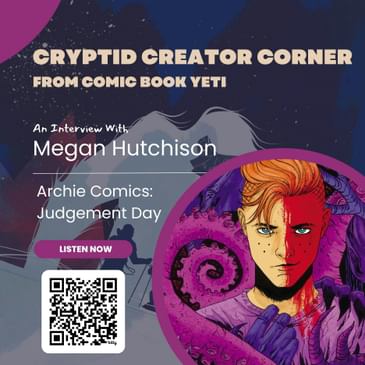

I’m joined by a new guest today. Megan Hutchison is a Mistress of the Dark Comic Arts, if today’s book is any indication, with an amazing new project coming out soon Archie Comics: Judgement Day written by Aubrey Sitterson with colors by Matt Herms and letters from Jack Morelli. This is the flagship of the Archie Premium Event, a new mini-series formatting designed to take readers beyond the one-shot with cardstock covers, improved interior paper stock, basically it’s longer and prettier and it’s kind of a big deal as it is there first mini-series in five years. Lots of process and design chat in this one, we dive into the visual inspirations of the demons in the book and the imprint of Aleister Crowley and Jack Parsons while carving out time to speak on the power of music and bats.
This book surprised me honestly with how good it is. I'm a fairly new returning reader to Archie Comics Universe and this has me excited about seeing what's in store down the road. I came in thinking, yeah, how far are they really gonna take this demon hunter thing. Turns out, pretty much all in. It’s a lavish visual read that turns the Riverdale world on its head and asks questions of Archie as a character that have never been explored before which is exciting and it’s a novel approach in the horror genre to provide this much tapestry. Very visceral and in your face. It's out in stores as of this week so make sure to snag it before they are gone.
From the publisher:
Written by Aubrey Sitterson (Archie vs. The World, No One Left to Fight) with art by Megan Hutchison (Rockstars), JUDGMENT DAY sets Archie Andrews on a daring quest to cleanse an alternate version of Riverdale overrun by demons. After claiming some destructive powers of his own, Archie is forced to destroy corrupted versions of the people closest to him, ostensibly in the name of the greater good. As questions about his own morality and the sacrifices he’s made start to pile up, Archie must confront the question: are his efforts truly good, or the work of pure evil?
JUDGMENT DAY places Archie Andrews squarely at the center, acting as our hero—but with the power to choose who lives and who dies, can he truly remain a hero through and through?” said Archie Comics’ Jesse Goldwater. “This miniseries raises the stakes more than any title we’ve ever done before. The fate of the entire world is in Archie’s hands.
Preview pages:
Our episode sponsor
Play TTRPG games? Make sure to check out our partner Arkenforge. They have everything you need to make your TTRPG more fun and immersive, allowing you to build, play, and export animated maps including in person fog of war capability that let’s your players interact with maps as the adventure unfolds while you, the DM get the full picture. Use the discount code YETI5 and get $5 off your order.
[00:00:00] Your ears do not deceive you. You've just entered the Cryptid Creator Corner brought to you by your friends at Comic Book Yeti.
[00:00:07] So without further ado, let's get on to the interview.
[00:00:11] Y'all, Jimmy, the Chaos Goblin strikes again!
[00:00:15] I should have known better than to mention I was working on my DC Universe meets Ravenloft hybrid D&D campaign on social media. My bad.
[00:00:22] He goes and tags a bunch of comics creators we know and now I have to get it in gear and whip this campaign into shape so we can start playing.
[00:00:29] Another friend chimes in, are you going to make maps?
[00:00:32] It's fair to say it's been a while since I put something together so I guess?
[00:00:37] It was then that I discovered Arc and Forge. If you don't know who Arc and Forge is, they have everything you need to make your TTRPG more fun and immersive.
[00:00:46] Allowing you to build, play and export animated maps including in-person Fog of War capability that lets your players interact with maps as the adventure unfolds while you, the DM, get the full picture.
[00:00:59] Now I'm set to easily build high res animated maps saving myself precious time and significantly adding nuance to our campaign.
[00:01:06] That's a win every day in my book.
[00:01:08] Check them out at arcandforge.com and use the discount code YETI5 to get $5 off.
[00:01:14] I'll drop a link in the show notes for you and big thanks to Arc and Forge for partnering with our show.
[00:01:19] I think I'm going to make Jimmy play a goblin warlock just to get even.
[00:01:24] Hello everybody and welcome to the Cryptid Creator Corner Comics Chat today.
[00:01:28] I'm Byron O'Neill, your host for today's Dive into the Dark Side and I'm joined by a new guest today.
[00:01:33] She's a mistress of the dark comic arts, if today's book has any indication anyway.
[00:01:38] With an amazing new project coming out soon, Archie Comics Engagement Day written by Aubrey Sitterson with colors by Matt Herms and letters from Jack Morelli.
[00:01:46] This is the flagship of the Archie Premium event so it's a new mini series formatting designed to take readers beyond the one shot.
[00:01:54] Hard stock covers, improved interior page stock, basically it's longer and prettier.
[00:02:00] And it's kind of a big deal because this is their first mini series in five years.
[00:02:05] So I'm delighted to introduce artist Megan Hutchison to the show today.
[00:02:09] Megan, welcome. How are you doing?
[00:02:11] Aside from the cold.
[00:02:12] I'm good, yeah thank you.
[00:02:13] You get these like three packs of random comics in the store, probably progressively for me since it didn't seem like they sold all that well at the time.
[00:02:21] So to some extent those stories are in my own foundational comics DNA.
[00:02:25] You know, fast forward many years and there's been some amazing stuff dropping recently from them.
[00:02:30] And what set me in was this recent Archie Horror Presents Chilling Adventures.
[00:02:35] That was the big one. So that was the catalyst for me to start paying attention.
[00:02:38] So as a horror fan I saw it was coming out.
[00:02:43] I was all in to Judgment Day.
[00:02:45] It should be mentioned though that Archie Horror has been around for over a decade now.
[00:02:50] I think that was starting with the zombie tale afterlife with Archie.
[00:02:53] So after reading the first issue, whoa, I did not expect this at all.
[00:02:58] So how did you get involved with this project?
[00:03:01] Yeah, so I mean same kind of background.
[00:03:04] I also grew up reading Archie.
[00:03:06] It was one of my favorite my first comics as a child.
[00:03:10] But I've been doing work for Archie over the past couple of years with their horror line.
[00:03:17] So I've been doing a lot of covers for them.
[00:03:19] And I'm usually known kind of as a horror artist.
[00:03:25] And when they were putting this project together, they approached me about it.
[00:03:29] Just because you know we have been working together in the past.
[00:03:33] Sorry.
[00:03:34] And yeah, they sent me the script and I fell in love.
[00:03:38] It's been kind of amazing.
[00:03:40] I read the whole series of Afterlife with Archie.
[00:03:43] I've read a lot of the horror stuff.
[00:03:45] You know, and obviously from working on it I've been exposed to it.
[00:03:48] But after reading the script it was like, oh this is kind of next level horror.
[00:03:54] They asked me to put my background of witchcraft and occultism into it.
[00:04:01] So there's a lot of that in there.
[00:04:03] And yeah, I mean honestly my notes back from them have always been like more blood.
[00:04:11] We need more blood.
[00:04:13] So that's like any indication of kind of the direction that they're going with this.
[00:04:17] It's definitely not a kids book at all.
[00:04:19] My nephew was asking me about it.
[00:04:21] I just went to go visit him.
[00:04:23] He's seven years old and he was like, I can't wait to read it.
[00:04:26] And I'm like, you're not reading this.
[00:04:28] Good call.
[00:04:29] No.
[00:04:30] I'm like there's way, way too much gore in this.
[00:04:33] It's really violent.
[00:04:35] It's kind of like falls into that vein of kind of like art house horror.
[00:04:41] You know, where it's almost like really quiet and really moody and just like ultra violent.
[00:04:49] Which is I think kind of what they want to do with this premium line is kind of like step away from what they have been doing.
[00:04:57] Even with like their horror stuff and like kind of going into, you know, like unexplored territories with it and doing like more adult stuff with it.
[00:05:05] OK.
[00:05:06] Yeah.
[00:05:07] I mean, this thing kicks off kind of to me full on hellraiser.
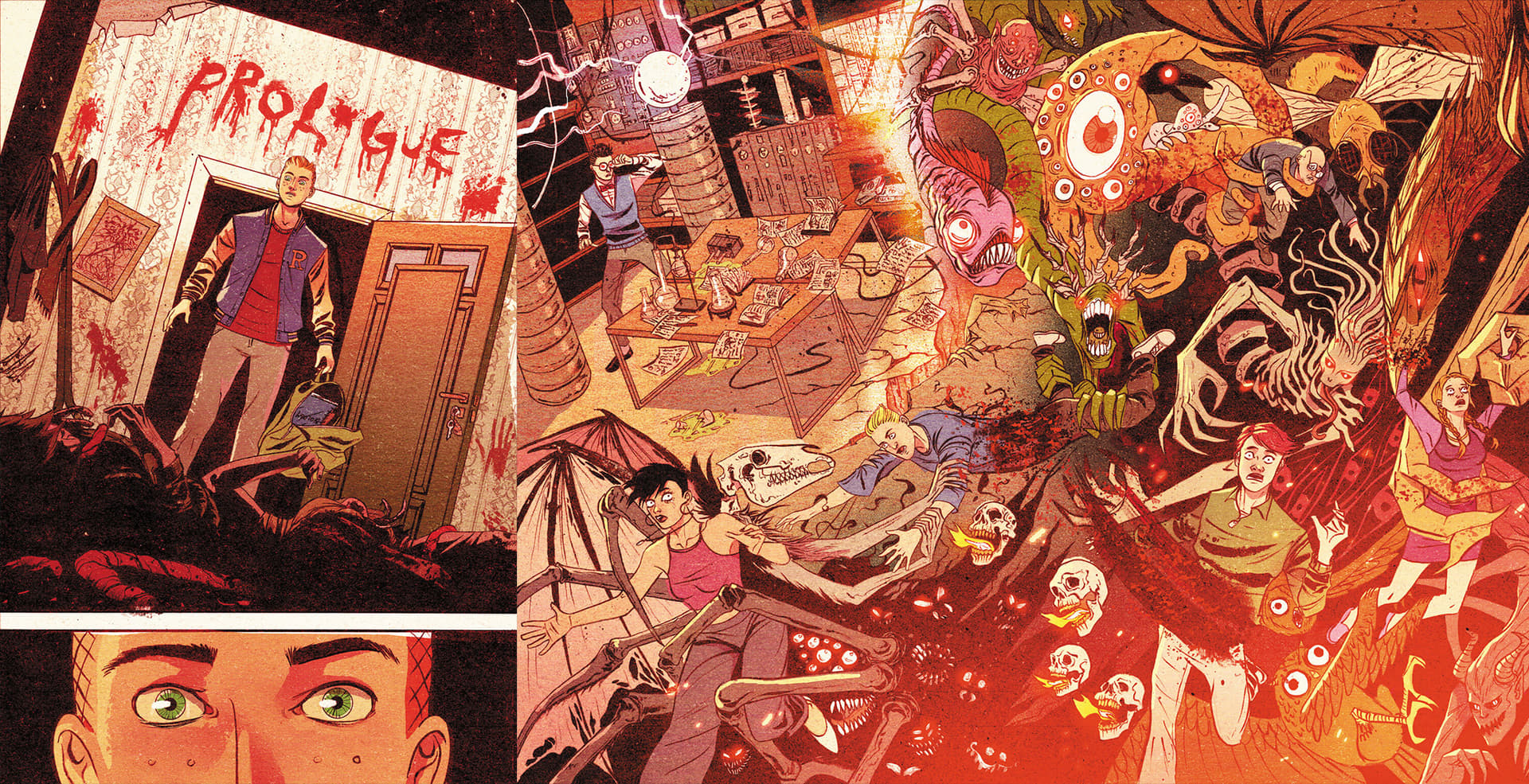
[00:05:10] You've got, you know, Dilton D'Oyly experimenting in his garage with a very lavish double spread that just looks magnificent.
[00:05:19] Right. I was reading about Aubrey imparting a Jack Parsons imprint onto this and kind of background.
[00:05:25] For those who have no idea who that is, quick version.
[00:05:28] He was a brilliant chemist and a rocket engineer, follower of Alastair Crowley and a leader of a mystic order in California.
[00:05:35] Along with Scientology pioneer Elrond Hubbard, he attempted the Babylon working designed to invoke the limit goddess Babylon into our own reality.
[00:05:45] Ultimately, all his esoteric explorations deemed him persona non grata to continue working at the Jet Propulsion Laboratory after World War Two.
[00:05:53] He helped found so he started these experiments at home, which is believed to ultimately precipitate in his own demise when an experiment gone wrong went boom in Pasadena.
[00:06:03] So seriously, go read about this guy's completely fascinating.
[00:06:06] And as it pertains to this story, it's something I had to immediately go back and reread and check for clues because there are more than a couple now.
[00:06:15] And I'm in love with this book now. So there's some rather cheeky references.
[00:06:19] I won't elaborate more than that.
[00:06:21] So back to Megan here in your artwork, you have more than a passing interest in the occult and considering that splash page, I'm kind of wondering where you pulled your sort of demon mythology from, you know, because we're taking these
[00:06:34] the limit cosmology, which is largely Egyptian.
[00:06:38] And, you know, mythology is kind of my thing.
[00:06:40] I have a background in anthropology.
[00:06:42] So, oh, awesome.
[00:06:44] I love that.
[00:06:45] Yeah, actually going back to what you said before about Jack Parsons.
[00:06:49] If people are interested in it, Strange Angel is like one of my favorite books.
[00:06:53] Okay.
[00:06:54] I don't know if you've read it. It's it's great.
[00:06:59] Yeah, I'm mildly obsessed with them.
[00:07:02] But yeah, like monsters and stuff.
[00:07:05] I mean, I've always been interested in it.
[00:07:08] Like ever since I was a kid, I was introduced to Geiger like way too young.
[00:07:13] Like most artists my age, which influences like a lot of my work.
[00:07:19] But yeah, I just I've always loved like monsters and demons.
[00:07:23] Some of the demons like if you've noticed, like if you kind of look at the designs and stuff are based off of that.
[00:07:31] And everyone says it differently, but the RS gotia.
[00:07:34] Yeah.
[00:07:36] So I.
[00:07:37] Yes.
[00:07:38] Yeah.
[00:07:39] So it's like the 72 demons of hell.
[00:07:41] So I pulled from them a lot like in my work.
[00:07:46] So there's like a lot of that in there.
[00:07:48] There's some her on this Bosch in there, you know, like I just kind of collect all of like the weird monster, like kind of like conglomerations of things that I like to put in my work.
[00:08:03] And in this book, there's so many demons that like I just, you know, kind of like pull from everywhere and just kind of get to have fun with it.
[00:08:12] Yeah, it's awesome.
[00:08:13] What really caught my attention was the owl, you know, in the in that particular spread, which I think is Stolas question mark from from the lesser key of Solomon.
[00:08:21] I usually don't see owls.
[00:08:23] So yeah, no, I can't remember.
[00:08:26] Really bad at names.
[00:08:28] Remember anyone's name.
[00:08:31] Yes. Yeah, he's based off of that.
[00:08:33] And then there's also kind of hidden in the book, like through the whole series are certain sigils and stuff that are like based off of Aleister Crowley.
[00:08:45] Okay.
[00:08:46] So like there's a lot of kind of like occult hidden like inside of the book.
[00:08:51] Okay.
[00:08:52] So what else is in your poor DNA aside from HR?
[00:08:59] I mean, like grew up reading Lovecraft.
[00:09:03] Okay, sure.
[00:09:04] So, you know, a lot of tentacles.
[00:09:07] There's a lot of tentacles in this book too.
[00:09:11] And, you know, like a lot of like big eyed frog people kind of thing like pull a lot from that because he loves writing about what was it like Owens mouth.
[00:09:24] Like the story that he wrote about like the frog people.
[00:09:27] I've always been very obsessed with them.
[00:09:30] And then other than that, there's just like.
[00:09:34] I just draw sometimes they just draw a bunch of teeth and then just kind of shape like a glob around it and then just like make that into a form and then put a bunch of eyeballs on it.
[00:09:46] Or like a bunch of legs.
[00:09:48] And then just run with it.
[00:09:50] What the hell is it about horror and teeth?
[00:09:53] Like this is one of those elements that I've never understood.
[00:09:56] But like there's something very primal about the depiction of teeth that just resonates in our lizard brain, right?
[00:10:03] Oh, for sure.
[00:10:04] Absolutely.
[00:10:05] I mean, I think it's because.
[00:10:07] Like we share.
[00:10:08] I mean, they think that we laugh because we're like showing our teeth.
[00:10:12] It's almost like an act of aggression.
[00:10:15] Okay.
[00:10:16] So I think that like there is this idea of like this.
[00:10:21] You communicate like you see teeth when you communicate, but it can also kill you and it's also for nourishment.
[00:10:26] And it's also, you know, like there's like so many things tied to it.
[00:10:30] But I think that when you like when you see it out of context, it just kind of brings up all of these different ideas all at once.
[00:10:39] And I like when they look weird and there's that uncanny valley to it, like you kind of don't know where you land with it.
[00:10:46] And I think it just kind of makes you feel uncomfortable.
[00:10:48] That's my thought anyway about it, especially when you have too many.
[00:10:54] Like my favorite thing is like too many teeth is really, really gross.
[00:11:00] I like doing a lot of like stacked and layered teeth.
[00:11:02] I don't know if you've ever seen like a toddler skull.
[00:11:07] Google it. It's terrifying.
[00:11:10] They have their they have their teeth, but then they have teeth inside, like up inside.
[00:11:16] Sure. Yeah.
[00:11:17] One's ready to come in.
[00:11:18] Those are their adult teeth that are going to come in.
[00:11:20] And so it's like a toddler skull is like it's absolutely horrifying because they just have like they have so many teeth wrapped in this tiny little head.
[00:11:29] It's amazing.
[00:11:30] It's amazing.
[00:11:31] So like stuff like that, like I pull from a lot, you know, like I go to, you know, like all these like weird science museums where they have like things in jars and all of that.
[00:11:40] Like, OK, you can find horror pretty much in everything.
[00:11:43] Oh, yeah, absolutely.
[00:11:45] Well, how is Judgment Day going to factor into like the larger Archie continuum?
[00:11:50] If indeed it does it at all because is anyone ultimately safe, I guess, is my question because Aubrey's newsletter tells me he's shocked with what y'all were getting away with here.
[00:12:00] So.
[00:12:01] Mm hmm.
[00:12:02] Yeah, I don't know. They actually haven't really told us yet.
[00:12:06] OK, how this is going to fit into the overall thing.
[00:12:09] And also for like their premium events, it's not all going to be horror.
[00:12:13] It's going to be different genres.
[00:12:15] So there might be a time when someone picks up where Aubrey and I leave off.
[00:12:21] But as far as I know, it's just kind of like they're just right now kind of like establishing like these events and telling these stories in different genres.
[00:12:33] And yeah, they haven't told us like ultimately where it's going.
[00:12:38] OK.
[00:12:39] Well, Archie is a character.
[00:12:41] He's all American varsity football team does construction work for his father.
[00:12:46] He's good with the ladies.
[00:12:48] He's like this honest high school kid with a typical white American trajectory, historically speaking.
[00:12:54] And I have no idea on this how much editorial jumped in and says, Hey, you can't do that because it feels like a big swing to make him a demon hunter.
[00:13:03] You know, the visual aesthetic of Archie dates back to the 1950s and Dan DiCarlo's foundational work.
[00:13:09] You know, I've always found it personally fascinating that he also produced a fair bit of for humorama.
[00:13:14] So like pinup magazines.
[00:13:16] So there's like this weird crossover, you know, like TNA sort of aesthetic sort of going on that this foundational to Archie and all these like adult magazines.
[00:13:26] Anyway, you're getting to play around with this truly iconic American visual aesthetic here and give Archie an identity crisis of sorts.
[00:13:34] Right. So so what makes she visually Archie for you as an artist?
[00:13:40] So we have like a lot of back and forth around the design of Archie.
[00:13:45] I like kind of started out like making him like full goth, like long stringing hair, like make up all this stuff.
[00:13:52] And they're like, oh, it's kind of dial it back a little bit.
[00:13:55] But what we kind of settled on, that's my agenda.
[00:13:58] Like that's my goth agenda.
[00:14:00] I'm like, let's just put everyone in black with eyeliner and we'll make them look better and cover them in tattoos.
[00:14:07] But what we kind of settled on and like as the book progresses, he kind of like slowly deteriorates and becomes less and less Archie.
[00:14:14] But he always has like these like the two like kind of characteristics that never go away.
[00:14:21] And that's his red hair with like the shaved sides, the crosshatch sides and his freckles.
[00:14:27] And that's it. And those are the things that like distinctly make him Archie.
[00:14:31] And he looks like Archie in the beginning.
[00:14:35] And then by the end of the book, he becomes less like Archie, but he still always has that.
[00:14:43] Like those two key features of him.
[00:14:47] So it's kind of funny because it's like they're also like the thing that make him like the most like Americana is like his his his fade cut and his freckles and his red hair.
[00:14:58] And like those are the only things that make him like distinguishable as Archie.
[00:15:03] But, you know, like I don't want to give anything away.
[00:15:05] But, you know, he he becomes a little feral in this.
[00:15:12] Let's just hair down. Got it. Yes. Yeah. OK.
[00:15:16] Well, there's a kind of a new visual legacy with recent female artists like Fiona Staples and Eric Henderson kind of reinterpreting that classic look of not just Archie, but like the wider Riverdale world.
[00:15:27] And you kind of do this was going to be a horror book from the jump.
[00:15:31] So kind of talk me through your your visual character form language when you're starting out with this is very Archie focused.
[00:15:38] And I mean, obviously we don't think where who else might might pop in and stuff.
[00:15:43] But, you know, kind of a side from the hair and you're sketching this thing out and you're getting script stuff from Aubrey, you know, kind of how did how else did you want to aside from Gotham up as much as you could?
[00:15:54] How did you put that together?
[00:15:57] Kind of, I mean, editorial kind of let me, you know, do my interpretation of what I want.
[00:16:06] So we just kind of modernize the characters a little bit, but they still hold pretty true to like who they are.
[00:16:14] I tried to give Veronica septum piercing and that got X made.
[00:16:19] But other than that, like they're they're kind of like their classic characters just, you know, updated clothing basically.
[00:16:29] You know, so they they didn't change a lot.
[00:16:32] But when designing the characters and not going to like give too much away, but, you know, some of the characters turn into demons.
[00:16:40] And I mean, you see this in the first issue, but I did do some of the character designs with the demon designs in mind so that like there's a connection between the two of them.
[00:16:50] And so that was kind of like my viewpoint.
[00:16:52] But honestly, like just I noticed in comic books a lot like, you know, there's like default costumes and stuff that people put them in.
[00:17:01] I that kind of drives me a little crazy sometimes.
[00:17:05] So I just wanted them to look, you know, like updated.
[00:17:07] I want them to look like they would dress now.
[00:17:11] OK, yeah, I mean, there's this this emphasis on big drama panels.
[00:17:17] I went back and counted.
[00:17:18] I don't believe there were ever more than four panels, I think, on a single page.
[00:17:22] You know, I haven't read rock stars yet, so I can't say I have a lot of data points in my brain for Megan's artistic DNA.
[00:17:28] You know exactly how that plays out in comics.
[00:17:30] But are the big roomy panels a hallmark of your style or is that something more unique to this specific project?
[00:17:38] No, I'm not opposite.
[00:17:40] I have like borderline OCD.
[00:17:42] I cram. I'm a letterer's worst nightmare.
[00:17:46] Gotcha. I cram so much information into a panel and then also in rock stars.
[00:17:52] There was like a lot of information in it.
[00:17:55] And so like there were a lot of panels on the page.
[00:17:57] There was a lot of stuff going on.
[00:17:59] It's like very rock and roll.
[00:18:00] Same thing, like a lot of hidden iconography in it.
[00:18:04] Whereas this one we intentionally have it like the bigger spreads.
[00:18:09] Let it breathe like because there's a creep factor to it again, like going back to kind of like what I was saying about like kind of like the Indy horror where it's just that, you know, like like Mandy keeps coming to mind where it's just like these like really silent like scapes.
[00:18:25] You know, and you're just like you're terrified.
[00:18:27] You don't know why because it's you're so uncomfortable.
[00:18:30] And so it was it was more like evocative of that.
[00:18:33] And like that was done on purpose.
[00:18:36] You know, so and it also kind of emphasizes the action and the violence because there's these really, really quiet moments.
[00:18:43] And then all of a sudden it's just like super gore and it's Archie that's doing it, you know, so it kind of makes the violent that much more impactful.
[00:18:51] So that's it's been different for me.
[00:18:54] It's not my usual M.O. But I've been learning a lot from it.
[00:18:57] I'm actually really enjoying doing it like this way.
[00:19:01] Yeah, yeah, I mean, I enjoyed it because the style allows for, you know, a higher visual density with the backgrounds, you know, in that and character topography kind of way more than your typical horror projects that often leave lots of shadow and these dark spaces for the mind to like conjure with.
[00:19:19] You know, it's more of a weird to say like this, but a documentary sort of approach.
[00:19:24] It's very face forward and visceral, you know, with fewer panels, but more material.
[00:19:30] So how is an artist are you wanting to kind of help the eye move around the page, especially if it's something that's not typically what you do?
[00:19:39] Yeah, I mean, it's so I am my background in film and graphic design as a graphic designer and then worked in the film industry for a while.
[00:19:48] I've been in the film industry for as an art director for 15 years.
[00:19:52] And so I use both of those when I work on comics.
[00:19:56] So it is about like, it's it's about design, but it's also about visual storytelling.
[00:20:01] You know, and so it's like because I worked in film for so long, like tone and mood and you know, like all of that stuff is kind of like the most important thing to me.
[00:20:11] So kind of being able to play with that more than I have been able to in the past has actually been really fun.
[00:20:17] And then like visually being able to, you know, kind of like work out on the page, like actually like physically see it and see how kind of like how it balances, how it reads, how your, you know, your eye goes through the page and all of that stuff.
[00:20:28] Like being able to kind of go back to that because there there is obviously a story and information that you need to follow.
[00:20:36] But because it is kind of more of a tonal piece, like having it have more of an organic flow to it has been something really fun to play with.
[00:20:44] And like something that I've been able to, you know, like kind of go back to my roots and, you know, do that more and make it more filmatic.
[00:20:55] Is that a word?
[00:20:57] Sure. Sure.
[00:21:00] You made it up. We'll go with it.
[00:21:01] Yeah.
[00:21:03] But yeah, like make or cinematic. That's the word I was looking for.
[00:21:07] But like being able to kind of make it more cinematic.
[00:21:11] So that's yeah, that's been really fun. And that's been like an emphasis, you know, for me and also how Aubrey has been writing the script for me.
[00:21:21] Yeah, I had one page that was sticking out to me.
[00:21:25] It's kind of bifurcated and creates this really nice visual loop.
[00:21:29] You know, it pulls you down to the lower right corner and kind of whips you back up.
[00:21:33] It's quite well done and forces you to kind of face horror from like a vantage point, like a lower vantage point.
[00:21:39] You know, it sucks you in, gives you that cosmic horror feeling of, you know, insignificant.
[00:21:43] So I really dug that one.
[00:21:46] Oh, thank you. Yeah.
[00:21:48] Yay.
[00:21:49] There you go. Success.
[00:21:50] There we go.
[00:21:52] Yeah.
[00:21:53] All right. Let's take a quick break.
[00:21:56] Hey, comics fam.
[00:21:57] Itty comic book publisher Banda Bars just got a level up and announced it is now a cooperative.
[00:22:03] This heralds a new era for them, including a partnership with Dauntless Stories.
[00:22:07] And they added several new members to the ownership group.
[00:22:10] Marcus Jimenez is now chief operating officer.
[00:22:13] Brent Fisher takes on the role of chief diversity officer.
[00:22:16] And Joey Galvez is introduced as head of Kickstarter Ops and social media manager, which is sure to increase their capabilities overall as a publisher.
[00:22:25] And it further promotes their mission statement of advancing representation, inclusion and diversity in the media.
[00:22:32] They also established a new board of directors to help chart the new path of their journey with new projects in the works like Alaska by dropping in June.
[00:22:40] Unbroken soon launching on Kickstarter and Pond coming up with Dauntless.
[00:22:44] Stay tuned to this space for more exciting news from the growing Bards family.
[00:22:48] Let's get back to the show.
[00:22:53] To your other background artistic DNA, you know, you spent some time in South Africa as a child, I think.
[00:22:59] And I believe you have family roots there.
[00:23:01] So do you see that play out in your artwork or has that changed over time?
[00:23:06] Is that a big impact for you?
[00:23:08] Um, I don't know.
[00:23:10] I mean, I have you can kind of see in the background.
[00:23:13] I have a lot of African art in my house.
[00:23:15] So I think that like, yeah, it was my my family is South African.
[00:23:20] I'm the only American in my family.
[00:23:22] And, you know, so I think being kind of raised around that has probably definitely done something to my DNA.
[00:23:31] You know, and also like being out in the wilderness with wild animals that can kill you and like making you really question how we got here and why we are alive.
[00:23:44] Because literally everything can outrun you and kill you.
[00:23:47] And kind of having that realization as a child.
[00:23:52] Um, you know, I'm sure all of this stuff like affects me on some kind of, you know, like subconscious level.
[00:24:00] But also what I remember from like being a kid, my aunt was really into this stuff.
[00:24:08] But also, you know, like the, you know, it was it was the 90s.
[00:24:15] It was apartheid, which is so like there's there's the violence in that.
[00:24:20] But the people that used to work for my aunt, you know, there was a lot of spiritualism in that, you know, like I remember there was one time where her housekeeper was in the fight with her driver because she said that he cursed her.
[00:24:36] And like I remember being a kid and being like, is that a thing?
[00:24:40] Like, can you do that?
[00:24:42] And so kind of being around that.
[00:24:47] You know, like that kind of spiritualism and like, um, like having that kind of magic be like a real thing.
[00:24:54] Like, like a part of the culture that I was living in at the time, you know, I think definitely affected me and kind of like really opened my eyes to all of this stuff in general.
[00:25:04] And then I think, too, I was talking to a friend about this.
[00:25:08] Why I'm drawn to horror and why a lot of people are is because they are products of trauma or violence or horror.
[00:25:15] And like, I think, you know, being exposed to that much, I didn't personally see a lot of violence, but you could tell.
[00:25:22] Like, you know, like being in South Africa, like pre apartheid, you know, the end of apartheid.
[00:25:28] Like there's there's a lot and kids pick up stuff.
[00:25:31] And I think that that is also part of it because there's something about like kind of taking control of your narrative when it feels like it's so out of control.
[00:25:39] Um, but yeah, but like aesthetically, probably.
[00:25:43] I mean, you know, I was raised around like African art, African music, like, you know, pretty much my whole childhood.
[00:25:50] So I'm sure there's a lot of that in what I do.
[00:25:53] Yeah.
[00:25:54] Yeah, I guess the parallels and the violence and culture.
[00:26:00] Right. I was I was raised in the south and in East Tennessee.
[00:26:03] And I've lived in nine different states, so I've really gotten a perspective of what culturally things look like.
[00:26:11] And it's so aggressive.
[00:26:13] People don't understand it was just hyper aggressive, especially at that time.
[00:26:17] And for myself, I guess, you know, my horror roots were steeped in these Appalachian stories, you know, and the way these were told in my family was that these were very, very real and, you know, tangible.
[00:26:30] Like, Taley Poe was not just a story like state.
[00:26:33] Taley Poe was like a thing, you know, as tangible as I was raised in a Baptist church.
[00:26:39] So as tangible as Satan is was was Taley Poe.
[00:26:41] So like it really does. It's like steeps into your your psyche yourself and then is forever linked.
[00:26:49] But I was.
[00:26:51] Yeah, no, I mean, and it's interesting, too, because they're connected.
[00:26:54] You know, I mean, it's like in all culture you have like, you know, like the things that you grew up on are connected to your culture.
[00:27:02] So it is it is just as like Baptist as it is, you know, like Appalachian, like, you know, folklore.
[00:27:09] Like they they create they come together and they create this, you know, like the culture that you grew up in.
[00:27:15] And I think that's, you know, I think it's really interesting when you can bring that into like storytelling.
[00:27:23] And I think that is why we become storytellers is because that we grew up on these stories.
[00:27:29] You know, and it's just like so much a part of us and like how we were raised and why we are the way we are.
[00:27:35] Yeah, I don't I don't get an opportunity to talk to many people who have also a theatrical background.
[00:27:40] You know, one of my former lives, I was involved with the theater and the technical end of things like 15 years of my life as an acolyte of somebody else's muse.
[00:27:48] So, you know, I knew you grew up at least in the theater and I was seduced at a later age.
[00:27:56] It wasn't a kid at the time. So did the theater leave like a foundational impression as well in your work?
[00:28:05] Um, I mean, I think first of all, I don't know how you got that information.
[00:28:10] I'm good. I don't really talk about that a lot. Yeah, I was a theater kid.
[00:28:20] I was not. Yeah, I've been outed. Sorry, it was me. I get credit.
[00:28:27] Only only my closest, not even my closest friends. No, that's not true. But yeah, I was I'm a classically trained singer and dancer and pianist.
[00:28:38] And and yeah, so grew up in the theater. I was going to pursue the theater.
[00:28:47] I was in plays and musicals my entire life until college and almost went to school for theater and decided that was not a I wanted to do something else.
[00:29:00] I wanted to like basically go into art, but I wanted to do like kind of more practical art.
[00:29:05] And that's when I went and did graphic design. But I think like it's just creation.
[00:29:14] You know, like anything like singing, dancing, acting, it's all creation. It's all creative. It's all storytelling.
[00:29:22] And that's I think what it comes down to is at the end of the day, that's all I wanted to do is story tell and whatever medium that looks like.
[00:29:30] I've always wanted to be an artist, but I was kind of like pushed one way or the other and to like all this stuff.
[00:29:36] I also have ADHD. So I was like, let's try everything.
[00:29:41] So I think it was more of like being able to express storytelling.
[00:29:46] And then later on also definitely when I went to grad school for production design.
[00:29:53] Like my theater background definitely like tied into that. So it was, you know, like designing sets and, you know, like putting mood boards together and like all of that stuff, which I still pretty much do now in comic form.
[00:30:08] You know, so I think that everything kind of influences each other, like all the creative arts really do kind of play into each other.
[00:30:16] And I know that like you worked in like on tours and stuff.
[00:30:21] Yeah, right. So it's like having music. Music is a huge part of it, you know, and like even though this is a comic book and you can't hear it, but like the music that I listened to or like the music that I equated to influences like the art that I'm making.
[00:30:36] Like, I'm sure you know, you having been around music all the time, know the power of it. You know, even if you if visually you can't feel it like there's, you know, like that connection is still there.
[00:30:49] And so everything in the creative world just like kind of comes together and like feeds off of each other.
[00:30:55] Yeah, concerts were temples to me. That was my church. That was my experience of that kind of thing. That's why I got hooked.
[00:31:04] That's the very first one, which was odd because it was a Carmen show. I don't know if you know who Carmen is.
[00:31:10] I love that so much.
[00:31:22] It was the weirdest, you know, first concert experience working ever to suck me in. But nonetheless, you get these experiences with 60,000, 20,900 people who are all vibing on the same thing and it becomes like transcendent.
[00:31:41] It's amazing.
[00:31:43] Oh, yeah.
[00:31:44] Yeah.
[00:31:45] Oh, I get it. I mean, well, I live in Austin now and I'm going to shows like I'm going to show tonight. So I'm taking DayQuil because not missing it. But yeah, we call it church.
[00:31:57] You know, we're going to a black metal show tonight. We go to punk shows all the time. Like it kind of depends like I go in and I come out feeling completely different.
[00:32:06] And it is church. So it's like if I'm going through something, it just kind of like, you know, let the music go out of wash through you.
[00:32:12] It changes your DNA, maybe dance it out being around people, the different vibes.
[00:32:17] And like literally just being able to watch somebody on stage share their art with you live and share that energy with you. There's nothing like it in the world. I mean, it's just it's beautiful. It's such a beautiful energy exchange and it changes you.
[00:32:31] You know?
[00:32:32] Yeah, yeah, I'm so glad you're both obsessed with it.
[00:32:35] Yeah, I'm so envious as you live in Austin because the other one another experience for me was with the bats under the bridge down.
[00:32:43] That is so amazing if people are not familiar with it. There's just I don't even how many hundreds of thousands of bats that leave and I don't do they come out? Are they out yet?
[00:32:53] I don't know if they come out year round or no, they they're they're very temperamental. So I've lived here for five years. I've never seen them.
[00:33:01] What? Yeah, I got lucky. Yeah, oh, for sure. And I've seen them other places. They're everywhere. Like I used to live in the canyon so I would see him every night. So I'm like, that's Schmatz.
[00:33:13] But yeah, the ones under the bridge are really temperamental and it has to be like the certain amount of heat but not too hot.
[00:33:21] And right now it's been raining like it's raining every day. So yeah, they're they're hiding. So I've yet to see the bats on South Congress Bridge.
[00:33:30] Oh my god, that's unfortunate. Right? Yeah, I was I was in college before the whole thing happened with with rock stars. I was actually in the bat lab is in National Geographic with with everything at the University of Tennessee bats. I love that.
[00:33:46] I'm going to get to I'll get to sidetracked with bats. My dog's name is bats. Ah, her name is bats and those are bats all over my arm for her. Yeah, cool. I love that too.
[00:34:01] There we go. We should do a bat podcast then. That's the thing. Yeah.
[00:34:07] All right, well, let's get back.
[00:34:12] Now that I've totally put you on the spot analogy as a theater kid, I'm going to ask another tough question here.
[00:34:17] So not specific to this project, but I'm always curious like as a visual artist myself, although not in comics, you know, we are often now advocate, we should often be our own worst credit, you know, to kind of push us to be the best version of ourselves creatively.
[00:34:31] So what do you wish you were actually better at or more proficient at as an artist?
[00:34:37] Everything. Okay. Okay. I mean, that's general. Okay. Um, no, I mean, it's funny, like, we can be the most self deprecating people on the planet.
[00:34:53] So I don't know if you're familiar with Colleen Hammer. Yeah, yeah. So he really good, really, really good friend of mine. He lives here and we go out to lunch every other week.
[00:35:05] We try to go out to lunch, have a little artist lunch and both of us just like talk about how we have imposter syndrome and he's been in the industry for over 20 years, probably close to 30.
[00:35:15] And so it never goes away. And I think what it is and kind of what you were talking about, it is that drive to push yourself into get better and to grow.
[00:35:32] And I think that we never stop growing. We never stop learning. And, you know, like once you think that you've learned everything and that's when you start like kind of petering out and even the guys who are on like the top of I say guys, the people at the top of their game.
[00:35:51] They're still learning and growing and trying new things. And it's terrifying. And, you know, every time I'm on Instagram, I'm like, why am I doing this? Like everyone's better than me. But I bring something to the table that they don't.
[00:36:05] And just like they bring something to the table that like I see and I admire, you know, or like something that like, oh, you know, I wish I do this easier, you know, whatever.
[00:36:17] And I think it's just kind of like a matter of, of just like recognizing that and, you know, kind of pushing through it and just being like, you know, like, this is a lifelong journey. And there's never going to be a top.
[00:36:34] Like, it's just, it is just the traveling. It is just the journey. It's the path that you know, like that you're on and just accepting that and being able, you know, to humble yourself enough to, to like, just be like, I might be bad at this for a while, but I'm going to practice and I'm going to keep going. And it's going to be like that until you die.
[00:36:57] Comics is an interesting industry. And I'm fascinated by especially coming from the music industry because like so many people do have that inferiority complex in comics, where I mean you come from music and whether they're just all man babies who have never been told no, you know, oh, you're shaking your head like you understand very, very well how that works.
[00:37:19] Oh, very well.
[00:37:20] Okay. You didn't date musicians, did you? That's not good.
[00:37:24] Yes, I also, you know, I'm, I lived in LA and worked in Hollywood for 15 years. So I also dated musicians. Okay. Okay. All right. So dated musicians, artists, actors, writers. They're all a mess. Yeah.
[00:37:39] But I think it's because I'm also a mess because, you know, like, because I'm a creative. So I, you know, but yeah, like, sorry, you're going on about the man babies. Yeah, go ahead. No, no, no, no.
[00:37:55] No insult to any musicians. Like I play music, my boyfriend, he also plays music. He's not in a band anymore. But you know, like, you can't help it.
[00:38:06] It's mainly just the comics feels way more humble than the music industry does. So it's a refreshing change to me for sure.
[00:38:14] But also I just want to help like lift people up because I'm like, come on, you can do this. It's I mean, you're good. It's not hard. You know, and I feel I find myself so much more, especially having been on like the production end of things and, and having to keep the man babies.
[00:38:27] Like, no, you actually do have to go on stage. There's 25,000 people out here who showed up to listen to you. You know, you can't just sit there and play your video game and ignore the 25,000 people in the other room.
[00:38:39] So yeah, it's a, it's a significant shift, but.
[00:38:43] But I get that honestly, because like, I think that there's like a lot of, you know, again, what we were talking about, like the imposter syndrome when you are a creative and you're sharing your art with people, it's terrifying.
[00:38:55] And so I think for a lot of that, you know, like
[00:38:58] for at least like the people that like actively play music in my life that are in bands and stuff there, there does come a time where it's like so overwhelming.
[00:39:10] You know, and like the bigger you are, like the more the imposter syndrome kind of sets in.
[00:39:14] Yeah. So I can see that, you know, like being, you know, it's, it's terrifying. Like when you're an artist, when you're creative, when you're sharing your art with the world, you are so vulnerable.
[00:39:28] And it's a lot. You know, that's why all of us, you know, are weirdos and have, I mean, I have a very healthy drinking habit, but
[00:39:42] I can't touch it anymore with, with my autoimmune conditions. So, but yeah.
[00:39:46] Oh, okay. Oh, you're honestly, you're better off.
[00:39:49] Probably. Yeah.
[00:39:51] I was 15 years in the music industry. I mean, you get it.
[00:39:54] Yeah.
[00:39:55] Well, switching back to Archie Judgment Day. So let's get away from the imposter stuff. What are you proudest of about, about this particular comic book as an artist?
[00:40:07] Honestly, like, so
[00:40:11] when I first started on this project, I was doing
[00:40:17] before this, like I was doing covers for like DC and you know, like boom and you know, like
[00:40:22] all this stuff. And I was like cranking all these covers. I was doing everything digitally and I am like a painter, really.
[00:40:33] And you know, I ink with a brush and all of this stuff, but like I've been a digital artist for so long.
[00:40:41] And when I was approached by Archie and I did all my character designs and stuff and I was like, starting to put stuff out there like, Hey, can you paint these?
[00:40:51] I was like, yeah. Is that what you want? Because my style had gotten so tight and kind of like, I want to say like commercial in a way.
[00:41:00] You know, and I kind of lost that, you know, when I first started like my first book, I was just like,
[00:41:08] playing, you know, ink on a page and like,
[00:41:11] I just got them so tight. And they're like, Yeah, do you want to paint this? And they were like showing me sample pages of like books that I did like years ago.
[00:41:18] And I was like, Oh yeah, absolutely. Like that sounds amazing. I would love to do that.
[00:41:23] So being able to kind of go back to that has really kind of loosened something in me that has been, you know, kind of coiled up for so long.
[00:41:32] And just been able to just like, kind of go wild and like splatter paint again. And it gives it that kind of like visceral feeling.
[00:41:41] And being able to tap back into that has really like awoken something in me and has made this like,
[00:41:47] so much more enjoyable and freeing. And whereas before it's like, I'm trying to control everything now. I'm just like, Nah, fuck it.
[00:41:56] Let's go. Like, um, which also helped really helps with like the action and the violence. But, you know,
[00:42:04] I feel like I've grown as an artist on this book because because of that, because like, and also they're just like, go like,
[00:42:09] be free, like the, you know, like do weird shit, be violent and like kind of having that freedom.
[00:42:16] Both, you know, like with what I'm drawing and how I'm doing it has been like incredibly freeing and was really helped me tap back into like my style.
[00:42:25] Yeah. Yeah. So I'm like, I'm super proud of that. And it's been really, really inspiring.
[00:42:30] That's amazing.
[00:42:31] Yeah. Well, you got anything else cooking? Um, before that, speaking of which, um, you have an untitled baking project on your website. So, um,
[00:42:40] I'm working on a cooking oriented project myself. So I pay attention to these things and cooking has always been this weird enigmatic process for me.
[00:42:48] It's I used to be the guy that like would burn microwave popcorn. Like when my mom would cook, I would just like,
[00:42:53] I'd pay attention to these things and cooking has always been this weird enigmatic process for me.
[00:42:58] It's, I used to be the guy that like would burn microwave popcorn. Like when my wife and I were first married, we were living in Colorado and I did that very thing.
[00:43:05] I had to throw it outside in the backyard into a pile of snow and even the dogs would not go near it.
[00:43:10] And now it's really, really weird because of, you know, this autoimmune condition. I eat like a super limited diet, but I do all the cooking in our family.
[00:43:17] So everyone tells me I'm pretty good at it now. I don't know if they're just like trying to make me feel better, but you know,
[00:43:23] despite being not able to actually taste anything that I cook, which is hella odd. Anyway, so you and cooking, is that like a future endeavor or just something that helps you stay sane?
[00:43:35] Yes, both. Okay. Um, yeah, I love baking. I actually got into baking for that reason too.
[00:43:42] I was, I decided to go vegan when I was in college and so I started baking. And then my, my family are all like scientists based.
[00:43:58] And I remember at the time my brother was studying to be a nutritionist. He's an electrical engineer now. He went a different path, but like we've always been like kind of interested in like the chemistry of all of that stuff.
[00:44:09] Yeah. And, um, so yeah, so I just kind of continued baking even after I stopped being vegan. Um, and then it became a form of therapy. Um, and, uh, it really scratches an itch for me.
[00:44:24] Whereas like cooking, I think is like very expressionistic and you know, like it's in like the scale of like what we were talking to form about how like all the creative things like kind of come together.
[00:44:38] Cooking is in that, you know, cooking is storytelling. Whereas baking is, um, and it is also that, but it's, you know, the chemistry in it. So it's kind of like the science based part of that, which I love.
[00:44:51] Pickles that. Got it.
[00:44:52] Yes. Yeah, I love it. I love measuring shit and like doing like little experiments and like all of that stuff. Um,
[00:44:59] Cause like I, you know, I read physics books for fun. Like I'm a nerd, like I'm a huge science nerd. And so that definitely scratches that itch for me of, you know, like I didn't go into the sciences. I went into the arts instead as opposed to the rest of my family that went into the sciences.
[00:45:14] Right. Um, so yeah, so like the baking is that so I just like love playing with stuff and, um, now my best friend is has Celiac.
[00:45:24] So now I bake for her, you know, so I'm trying to find like the best things that, you know, like, like the best substitutes and the best way, like, cause she misses like rye bread and all, you know, like stuff like that.
[00:45:36] So I'm trying to experiment and find ways to, uh, like feed her now. And like kind of seeing how like all that stuff works.
[00:45:45] And like, I watched all these baking videos for fun and just like watch like the chemistry of it. Love it. Love it.
[00:45:51] That's wild. Yeah. Yeah. Um, we're gluten dairy free. The whole household is now. Um, so we've got a really good, um, like all purpose baking flour. Finally took forever to get the right one. But yeah, yeah, I get it. Yeah.
[00:46:06] Well, where can people find you online these days? Where would you like them to?
[00:46:10] Um, I'm mostly on Instagram. Uh, it's at black EM underscore art. Um, I am on Twitter or X or whatever, but I'm probably going to not be on that for much longer. Um, yeah. So mostly Instagram.
[00:46:28] Okay.
[00:46:29] That's kind of it. That's like the bandwidth that I have of like online interactions, but, um, I'm pretty, I don't post a lot right now just cause I'm so busy, but, um, like I'm pretty easy to get ahold of. Um, also if you follow me on Instagram, I getting back into it, but, um, I do terror read tarot card readings.
[00:46:52] Yeah.
[00:46:53] Uh, usually on full moons and new moons. Um, I know it was bell time yesterday. I missed that again, deadlines. Um, so I do all of like, uh, you know, like the equinoxes stuff like that.
[00:47:06] I do kind of like Instagram life. So if you're interested in that, um, a lot of people like that stuff. And then I also post I'm getting back into it, but I post little cartoons about mental health.
[00:47:19] On there as well.
[00:47:20] Very cool. Yeah, I'll have to check those out. My wife is a psychologist in the VA. So yeah.
[00:47:26] Oh, awesome.
[00:47:27] Yeah. Yeah. Mental health very important to the family.
[00:47:30] I love that. Very, yeah. I, um, yeah, I'm pretty outspoken about it and actually like, I know you mentioned this before, but like what's next, but like I'm, I'm starting kind of a project that is about mental health.
[00:47:45] And, um, I've been, I've struggled with my mental, with anxiety and depression pretty much my entire life. Um, I have a lot of people in my life that are no longer in my life because of mental health issues.
[00:47:57] And I think it's something that we really need to talk about more, especially in the creative industry and especially in the comic book industry.
[00:48:04] Because there, there are a lot of people that do struggle with it. I think most of us do, and that's why we do what we do.
[00:48:12] Absolutely.
[00:48:13] You know, I'm trying to like kind of have an open dialogue about it, destigmatize it. Um, like I just went on Lexapro and very open about it. Um, you know, like there's nothing wrong with getting help for what you need, you know?
[00:48:27] Exactly.
[00:48:29] I'm a really, really big proponent and like, especially in the horror, like what we were talking about before, like where horror comes from. It does, it stems from trauma, you know?
[00:48:38] And it stems from, you know, wanting to have control because there's something in your life was really out of control at one moment or you, you know, like you kind of flirt with that edge.
[00:48:48] And so I think a lot of people do suffer from this. And I think that we need to destigmatize it.
[00:48:54] Yeah, absolutely. I mean the root of so much mythology is rooted in that. It's rooted in trauma. It's trying to come up with an explanation to not being able to control our world, right?
[00:49:03] One of my favorite Native American myths is this, um, which is called Needle Finger, who would go around and essentially the idea is you had these like long, long needle fingers and would, would at night come in and suck out like the liver of healthy people.
[00:49:20] And you know, it's a way of explaining why people died from like liver disease or cancer or something.
[00:49:25] So yeah, yeah.
[00:49:29] I mean that's like a really beautiful way of, of explaining it, you know?
[00:49:33] Yeah, I've always loved that one.
[00:49:35] I have to look into that.
[00:49:37] Yeah, needle finger.
[00:49:39] Yeah, that sounds awesome.
[00:49:40] Yeah, there's several different iterations between, you know, different tribal groups in the U.S.
[00:49:45] But yeah, if you look up needle finger, you'll get the gist of it.
[00:49:48] And then then do that little deep dive and get lost and try to try to find them all.
[00:49:52] Yeah.
[00:49:53] Yeah, I love that stuff. Yeah, I'm totally into it.
[00:49:57] Well, to put it in a judgment day again before we wrapped up, I absolutely loved it.
[00:50:01] I came in thinking, yeah, how far are they really going to go to take this demon hunter thing?
[00:50:06] Turns out pretty much all in.
[00:50:07] You know, it's a lavish visual read and it turns that Riverdale world on its head
[00:50:12] and asks questions of Archie as a character that have never been really explored before,
[00:50:16] which is exciting, you know?
[00:50:17] And it's a novel approach to the horror genre to provide this much visual tapestry to it.
[00:50:22] So it's like very visceral in your face.
[00:50:24] Make sure to call your shop and reserve a copy.
[00:50:27] You know, I'm not a big alt cover guy.
[00:50:29] I don't honestly buy that many single issues.
[00:50:31] I'm more of a trades person.
[00:50:32] But the, you know, that, that the Murakami variant, that was, that was very nice.
[00:50:36] I really loved that.
[00:50:37] That's really cool.
[00:50:38] Yeah, we've been really lucky.
[00:50:40] We have the Murakami, Frank Avia and Jay Lee are all doing variants
[00:50:45] and they're not incentive variants.
[00:50:47] I think I can remember.
[00:50:49] I was just wanting to call it with diamond, but yeah, like all the variants
[00:50:52] actually throughout the entire series are absolutely amazing.
[00:50:57] All right. And we're dropping in late May.
[00:50:59] Is that correct?
[00:51:00] That's the timeline.
[00:51:01] Yeah, I think it's May 22nd is when the first book comes out.
[00:51:04] Okay.
[00:51:05] Awesome.
[00:51:06] Well, Megan, I appreciate you coming on the show and chatting comics with me today
[00:51:09] and our process and bats and all things.
[00:51:12] Right?
[00:51:13] Anytime, honestly, like we could sit and talk about like mythology.
[00:51:17] Maybe that should be our podcast.
[00:51:19] We could do that.
[00:51:20] We could do that.
[00:51:21] That's mythology.
[00:51:22] Oh yeah.
[00:51:23] There we go.
[00:51:24] We're on it.
[00:51:25] I love it.
[00:51:26] All right.
[00:51:27] Well, this is Byron O'Neill on behalf of all of us at Comic Book Getty.
[00:51:29] Thanks for tuning in and we'll see you next time.
[00:51:31] Take care everybody.
[00:51:32] This is Byron O'Neill, one of your hosts of the Cryptid Creator Corner
[00:51:36] brought to you by Comic Book Getty.
[00:51:38] We hope you've enjoyed this episode of our podcast.
[00:51:41] Please rate, review, subscribe, all that good stuff.
[00:51:45] It lets us know how we are doing and more importantly, how we can improve.
[00:51:49] Thanks for listening.
[00:51:52] If you enjoyed this episode of the Cryptid Creator Corner,
[00:51:55] maybe you would enjoy our sister podcast, Into the Comics Cave.
[00:51:59] Listen and subscribe wherever you get your podcasts.