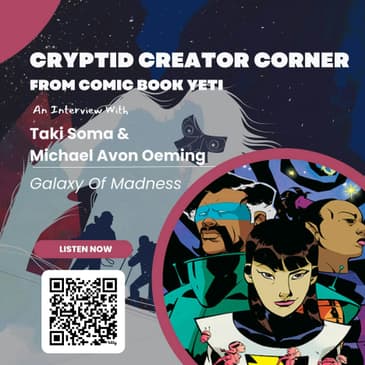
Michael Avon Oeming returns to the podcast and he'a brought Taki Soma with him! Michael and Taki are here to chat about Mad Cave Studios' GALAXY OF MADNESS arriving at your LCS on June 19th.
Written by Magdalene Vissaggio, GALAXY OF MADNESS is a retro-futuristic sci-fi adventure about a "swashbuckling space archeologist". It reads like a love letter to silver age comics for a modern audience. Michael's artwork is stunning, capturing the feel of the silver age but it's Taki's colors that blast this book into another universe.
We chat about the development of this project, working with Mad Cave, how they work together and if it differs from working with other collaborators, and so much more!
From the publisher:
In the far-flung thrilling future of the 41st Century, and on the other side of the galaxy, a swashbuckling space archaeologist, Vigil Virgo, is on the cusp of learning a universe-shattering secret in this four-color fantasy! But she’ll have to dive into the abyss, where no human was ever meant to go, to do it. The question is what happens when she emerges from the other side.when she emerges from the other side.
Our episode sponsors:
Transphoria Kickstarter
Make sure to check out the Kickstarter campaign for Transphoria, a new new 90 page graphic novel that collects 19 new short storeis about trans and non-binary experiences of gender euphoria.
Arkenforge
Play TTRPG games? Make sure to check out our partner Arkenforge. They have everything you need to make your TTRPG more fun and immersive, allowing you to build, play, and export animated maps including in person fog of war capability that let’s your players interact with maps as the adventure unfolds while you, the DM get the full picture. Use the discount code YETI5 to get $5 off your order.
Learn more about your ad choices. Visit megaphone.fm/adchoices
[00:00:00] Your ears do not deceive you. You have just entered the Cryptid Creator Corner brought to you by your friends at Comic Book Yeti. So without further ado, let's get on to the interview.
[00:00:11] Hey, comics fam! Whether you are a long-time listener or a veteran catching the show today, all are welcome here. When we started this podcast, inclusion and diversity were at the forefront of what we wanted to cover and promote with it.
[00:00:23] So in June, we'll be celebrating Pride Month for our second year in a row featuring an amazing group of queer creators and their projects. One of those projects is from our friends at Lifeline Comics. Following their success with By Visibility Still By, Herology, and Rainbow Canvas,
[00:00:39] Lifeline Comics is launching their newest queer anthology, Transphoria, a trans and non-binary anthology on May 30th. The 90-page graphic novel will contain 19 stories all about trans and non-binary experiences of gender euphoria, crossing all genres like slice of life, supernatural, romance, science fiction, anime, and beyond.
[00:01:01] Featuring a vibrant display of artistic styles and storytelling techniques, Transphoria is a testament to the creativity and talent of its contributors. From sci-fi, striking stories, to endearing romantic adventures, this graphic novel celebrates trans stories while delivering a powerful message of empowerment and affirmation.
[00:01:20] I'll put a link in the show notes so you can check it out. As always, thanks for listening and have a glorious Pride Month helping us celebrate. Y'all, Jimmy, the Chaos Goblin strikes again.
[00:01:34] I should have known better than to mention I was working on my DC Universe meets Ravenloft hybrid D&D campaign on social media. My bad.
[00:01:42] He goes and tags a bunch of comics creators we know and now I have to get it in gear and whip this campaign into shape so we can start playing. Another friend chimes in, are you going to make maps?
[00:01:52] It's fair to say it's been a while since I put something together so I guess? Question mark? It was then that I discovered Ark and Forge. If you don't know who Ark and Forge is, they have everything you need to make your TTRPG more fun and immersive.
[00:02:06] Allowing you to build, play and export animated maps including in-person Fog of War capability that lets your players interact with maps as the adventure unfolds while you, the DM, get the full picture.
[00:02:19] Now I'm set to easily build high res animated maps saving myself precious time and significantly adding nuance to our campaign. That's a win every day in my book. Check them out at arkandforge.com and use the discount code YETI5 to get $5 off.
[00:02:34] I'll drop a link in the show notes for you and big thanks to Ark and Forge for partnering with our show. I think I'm going to make Jimmy play a goblin warlock just to get even. Hello and welcome to another episode of Comic Book Yeti's Cryptid Creator Corner.
[00:02:49] I am one of your hosts, Jimmy Gaspéreau, and I have a returning guest and I think a first time guest as well. And I'm super excited to talk to both of them today about their newest Mad Cave comic Galaxy of Madness. It is coming out June 19th.
[00:03:05] I believe you'll be able to get issue one, but please welcome to the podcast Michael Avon-Oming and Taki Soma. Michael, Taki, how are the two of you today? Doing okay. Doing alright. Well, I am. I'm glad to hear it.
[00:03:22] So I really appreciate you coming on the podcast and chatting about this issue. I cover a lot of Mad Cave stuff. I've said it a million times so far on this podcast with different creators I've covered their 10th anniversary year,
[00:03:35] and I really feel like they are knocking it out of the park with all the books they have coming out. And Galaxy of Madness, absolutely no exception. I really like this when I got to read it today because I feel like this is kind of like an outlier.
[00:03:48] A lot of Mad Cave stuff can sometimes have a bit of a darker undertone and not that it was necessarily missing from this, but I really feel like and we'll get into it and talk about it,
[00:03:58] but kind of the retro feel to it like a Silver Age book, the design of it, the coloring. It just doesn't feel like you see something like this on the market right now. And I very much enjoyed it.
[00:04:16] I said before we started recording, like it kind of in some of the writing of it, it's written by Magdalene Visaggio and gave me like a Doctor Who, like maybe a Tom Baker Doctor Who kind of feel to it, but very modern characters, very modern sensibility.
[00:04:33] So I absolutely loved it. Mags is a huge fan of Star Trek and all that sort of technical talk. And I think that's why she was able to just hone in on that arena. Yeah, so it's seamlessly in there, but it's also not an obstacle to anything.
[00:04:50] It just sort of deepens everything like it makes it feel more real, but you're not getting lost in the babble either. Like it feels like it means something and stuff. So yeah, she's an expert at that stuff. Yeah, that's the trick to it.
[00:05:03] It's not just like, I mean, I remember when I first tried to read like some of the old Silver Age Flash, and that was really good for kind of coming up with, you know,
[00:05:11] villains would have gadgets that just sounded like techno type of talk that didn't really mean anything. Like this feels like it means something in terms of how the wording was used. It all feels very intentional, which I think is important. But there's so much fun in this book.
[00:05:30] I feel like there was a turn at some point with comics. I don't know if it was out of the grittiness of the late 80s and into the 90s to make things feel more real and more grounded,
[00:05:43] which is great. But sometimes you can kind of lose the fun of the silliness of, you know, the funny books. And this kind of has those elements to it, but has some very dark and serious topics.
[00:05:56] It like really kind of walks a fine line and does it very, very well. I agree. It has a lot of like humanity in it, but it's out in space. So it feels like a great juxtaposition and like it's it's it but it has a really good balance.
[00:06:19] Yeah. So it doesn't come across as like a like a family drama. But it kind of is. Yeah. I mean, like for all the trappings of it, of like the science fiction stuff and like, you know,
[00:06:35] sort of the style that we're telling the story in, you know, the core of it really is this family story. And that's what pulled us in when she pitched it to us. Like at first I wasn't wild about the scale of it.
[00:06:47] You know, I'm usually looking at four issues of something, you know, and then you have to move on or you hope that it does well enough. And like she had this idea of this really, really big story.
[00:06:58] And like at first I just wasn't I thought it was just too much to take on. But then as I was reading the characters, you know, and specifically there's a father daughter dynamic there that you don't see that I don't see a lot of it comes.
[00:07:12] We don't talk about it. Yeah, not often. That was the thing that pulled us in. I think that's why like the darkness isn't like, you know, gritty blood and guts spread out all over the place or murders and stuff.
[00:07:25] It's a psychological darkness, you know, and I think she really tapped into a lot of family dynamics and relationship stuff that resonates and kind of hits deep. Yeah. I mean, you have a story to get into it a little bit where you have a crew of a spaceship.
[00:07:43] Your main character is Vigil Virgo. She's described as a swashbuckling space archaeologist, which like right off the bat is like, yes, please say more. That was another thing that pulled me in.
[00:07:55] I'm a big archaeology nerd. Like, you know, you give me five hours of time team on YouTube. I'm happy. Right. Like these archaeological shows and like Josh Gates adventure shows and he's doing real archaeology and stuff. And like the chance to do like space archaeology.
[00:08:10] I was like, oh my God, this is too fun. Yeah. I mean, there's definitely something about whether or not it's like shows like Josh Gates or, you know, movie characters like like Indiana Jones.
[00:08:23] Like there's always something that archaeology captures the imagination of a kid and like kind of continues into adulthood.
[00:08:31] The idea that there are things out there that we don't know that we can we can dig and unearth some type of secret of an ancient civilization just seems scientific, but also magical in a wonderful way.
[00:08:45] And to feel it and to think about like all the options and opportunities that your story presents itself when you're talking about space archaeology in terms of all the all the different realms and areas you can conquer.
[00:08:57] But you're right. It really is still grounded in vigil and Odysseus, who is kind of like, you know, promised vigil's parents that he would look after her. And, you know, the rest of the crew crew was kind of flushed out with some very interesting characters.
[00:09:14] I'm not sure how, you know, it said, but is very interesting. Onden is kind of like kind of runs the ship and yeah, there's just there's so much of that element to it.
[00:09:29] But with any crew of, you know, in close quarters, and we've seen some of those types of things before. There's a closeness there. There's a friction to it as well that, you know, Mags does a great job in terms of her writing.
[00:09:49] But I'm very curious about how like the design of the overall characters. So when Mags pitches the idea and finally sells the two of you to come on board, how does that process work in terms of what is everybody going to look like?
[00:10:04] What is this world? Because you could do whatever you want setting it in the 41st century. Yeah, I think two really interesting things came out of that was one, I wasn't into Silver Age comics.
[00:10:17] And when she said like a silver age, like, so what do you mean? And she's like, lots of things, you know, like gloves and like.
[00:10:23] Oh yeah, that's right. That's right. That's right. Like all these like push them on like embellishings on clothing that make no sense or any functional sense at all. Yeah, but they have like, yeah, bins and like, you know, like shoulder pads.
[00:10:42] Yeah, yeah. And scales that are like, you know, space scales and yeah. Yeah. And like even when I was asking about the ship, she has a great name for the ship called the Barisimilitude. Yeah, fantastic name. So much on such a subtle level.
[00:10:59] And she was just like a rocket ship. Just, you know, so basically I just designed like an old fashioned rocket ship with basically like a wingnut on the top of the ship.
[00:11:11] So it's really fun taking those cues. But we had also just come off of Dick Tracy, which Taki colored and part of Dick Tracy is when we did this futuristic Dick Tracy story. And then it goes from like the 30s all the way up into the future.
[00:11:27] So we had just started playing around with all these like crazy like panel colors and panel designs and using layered opacities in our colors and the arts and doing just some really interesting stuff that we weren't sure what else to do with it.
[00:11:42] So then when we started Galaxy of Madness, like all this crazy stuff came out where we're doing like layers of Zip-a-Tone and Taki was doing these these color holes and she would take the Zip-a-Tone or those little dots that appear, the dot patterns and like shifting them around the colors and stuff.
[00:11:58] And like we came up with this sort of new language in a way that so far is only existing in Galaxy of Madness for us.
[00:12:06] It was just like a great place to like just kind of play around because nobody was out there telling us like, well, this doesn't fit this universe or this doesn't fit this character because it's all, you know, like ours.
[00:12:23] Like some ads and ours. And so it was like a fun playground and just kind of experiment and stuff.
[00:12:30] So yeah, so I think the look of it just kind of came out of like we just want to have fun and that's what you're seeing on the page is like we're just having fun.
[00:12:40] Yeah. And Max is really generous as a writer too. She didn't ask for changes. She didn't go like I don't like that costume or don't do this or whatever. Even though she clearly had like a clear image in her head.
[00:12:50] We also did do like a ton of sketches ahead of time. Just trying to find that look because I was really battling my 1970s vibe growing up. Like I watch a lot of like Doctor Who and there's this old show that I'm obsessed with called Blake 7.
[00:13:05] So like, you know, trying to, you know, so there's a little bit of that in there as well.
[00:13:09] So I think we ended up coming up with something interesting that feels retro but also not like we're just copying, you know, Russ Manning off of like, you know, robot fighter or something like that.
[00:13:20] Right. Yeah, I always think of the design of not only in comic book like Silver Age comic books, but even the American design in the 50s in terms of car.
[00:13:30] Like one of my favorite car that I one day hope to own is like a 1957 Chevy Bel Air with those back fins, you know, like cruising down Route 66 and the design of old motels.
[00:13:41] Like I was talking to a friend once and we were both commenting on how we like that that era in terms of design. But it's like they design things for a future that that didn't happen. Yeah. Yeah. That's how I always.
[00:13:52] And to see like this is the future, the 41st century and like have some of those design elements from the late 50s, like maybe early 60s carried over. Googie architecture? Does that sound right? There's a weird name for it. Don't you dare.
[00:14:07] There's a funny there's a funny sounding name for that 50s like Jetsons kind of style. It was called Googie I don't remember. But that was a lot of fun just trying to grab that and play off of it. And, you know, that's how the look came together.
[00:14:22] And it's it's a lot of really nice contrast to again, some very character based story. You know, it's not about who's running the galaxy or rebels and, you know, corporations and stuff.
[00:14:34] It's it's really the story about searching out your parents and what happened to them, why are they not here? You know, just lots of great family dynamics up. And that's reflected in all the characters as well. But they're just so fun.
[00:14:47] And then there's just crazy stuff to draw, you know, like there's like people losing their minds and, you know, space messes around with your head and all that stuff. So lots of cool fun stuff. Yeah. Yeah.
[00:14:57] I mean, and even in terms of the panel designs themselves, because it's like there's there's no standard to it. Like there's in terms of like layouts, like you have a lot of different inset panels. You have a lot of differently shaped panels.
[00:15:17] Like what was kind of like Michael, your approach to kind of doing that? Was it just we're going to you know, how did that?
[00:15:22] I'm kind of curious as to how that looked from the script to translate into, you know, we're going to instead a bunch of stuff here.
[00:15:28] There was one thing you did at one point that something happens to vigil where she kind of gets like sucked out of the ship and you like. She's connected in terms of the two panels and the whoosh sound effect kind of follows along with it.
[00:15:43] There's like really things like that that has such a great movement to it. I think a lot of that came out of Cave Carson, which is kind of when around I started talking to Maddox because she was doing a changing girl.
[00:15:57] Yeah. And Cave Carson had a lot of psychedelic things going on in there.
[00:16:01] And I had already been a big fan of Will Eisner, who did a lot of like work with, you know, titles and working that into the layout and making the page feel three dimensional, almost like a maze and stuff. So those things just started to really come together.
[00:16:17] And some stories like to be very, very straightforward about, but others call for this sort of like, like how do you mix the layout?
[00:16:26] The panel shapes, the panel colors. How do you actually use the panels themselves in a way to interact with the environment that becomes part of the story? Mostly it's about moving the eye on the page.
[00:16:37] Like, it's not about just doing a crazy panel thing because you can do it like you want to be able to. It should express the feeling of either the characters or the scene.
[00:16:48] Yeah, it should serve the story and the pacing and all of those things you always consider. And, you know, so that it's it makes sense like it has to make sense for you to make those choices. It's not randomly crazy because it looks cool. Yeah. Right. Yeah.
[00:17:07] And then you're picking out the right colors to either contrast or to emphasize those moments. Yeah, because there were a couple of times, especially later on in the first issue with like cryos where she's meditating and like those different.
[00:17:24] I had to look at them like very carefully to see that they like how they were differently shaped. But all of those things kind of does it affects the flow. And it's just so interesting looking at a comic like this that isn't just not nothing.
[00:17:39] There's anything wrong with just like have your, you know, your five panel story or however you're going to set it.
[00:17:45] But when there's something done like this, that really affects kind of like the flow of the comic, it's very interesting to think about all the choices that went into that. Like this is going to be an octagon or a hexagon.
[00:17:57] This is going to be a little different and it's going to flow into like two other like rectangular panels, like to think that all of that is important and that there was intentionality behind that is like very fun.
[00:18:11] And it really as someone who's a fast reader, it always forces me to kind of slow down and pay attention to what's like really going on on the page.
[00:18:23] But Taki, I'm very interested in terms of the coloring choices for this because I'd read an interview that you did before talking about coloring and you said you just you just go with your gut.
[00:18:35] And that was from a few years ago. I want to know if anything has like changed. Is it still you just go with your gut? I just go with my gut. You know, I mean, I know the basics of like color theory and you know,
[00:18:50] like what colors actually like, you know, like neurologically like will hit certain nodes and like evoke certain feelings or whatever. I get that. But it all comes down to like my gut and what I feel would express what's going on in the story first and foremost.
[00:19:22] Then I then I kind of follow up with like, OK, just because I feel this way, maybe this isn't the right choice. But you know, but that's basically like my guiding light. Like that's my beacon. So yeah, so my gut is always what I follow to this day.
[00:19:39] And I think you said to when you talk about that gut feeling, it's not like a gut feeling like oh, blue would look cool here. Right. It's like, well, what is the scene talking to you in your gut? Yeah. What are the characters saying?
[00:19:49] Right. Or like, you know, I always prefer to like murder ink colors because it's an easier way to like describe what I'm intending because each scene I only use like two colors but in different tones.
[00:20:08] And how I choose those colors is based on like, you know, I'm like, oh, choose like pukey green because everybody in that scene are lying to each other.
[00:20:20] And, you know, and then like the background is kind of like this yellow kind of dull yellow whatever because that's kind of like there's hope. But it's veiled by all the lies.
[00:20:34] You know, like, you know, stuff like that. Like, that's yeah, that's what I mean by following my gut. All right. Let's take a quick break.
[00:20:44] Hey, comics fam. It the comic book publisher Banda Bars just got a level up and announced it is now a cooperative. This heralds a new era for them, including a partnership with Dauntless Stories. And they added several new members to the ownership group.
[00:20:58] Marcus Jimenez is now chief operating officer. Brent Fisher takes on the role of chief diversity officer. And Joey Galvez is introduced as head of Kickstarter Ops and social media manager, which is sure to increase their capabilities overall as a publisher.
[00:21:13] And it further promotes their mission statement of advancing representation, inclusion, and diversity in the media. They also established a new board of directors to help chart the new path of their journey with new projects in the works like Alaskan by dropping in June.
[00:21:28] In June, Unbroken soon launching on Kickstarter and Pond coming up with Dauntless. Stay tuned to this space for more exciting news from the growing Bards family. Let's get back to the show.
[00:21:43] When did it, I guess, when was the decision made in terms of the like the different coloring for all the panel borders because that's not something you see too often? Um, I think that also kind of came out of like murder ink.
[00:21:58] What Michael generally do when he does pages digitally is He'll leave like the panel borders on a different layer, even though he has them all in like black and white.
[00:22:19] And one day I was like, oh, I kind of want to play with these and like see what it looks like if I just colored them like really bright colors or whatever.
[00:22:29] And I just kind of went with it and some of the pages work better that way. So, you know, and I just yeah, I just one day played with it and it worked.
[00:22:39] It looked good. It made sense. So I just started incorporating that type of border colors since where it makes sense. Yeah, and I feel like this really a youth thing like I know it's been done before but I don't see it a lot.
[00:22:54] I haven't seen it a lot. You really you really took with it and took it and made it your thing. Yeah, I just think it's it's fun. It's eye catching. But again, like, um, it only works for certain scenes.
[00:23:07] Yeah, I'm really proud of her too. It's not just because I'm her husband and partner but like what? But like when we did murdering she had never colored before. She didn't technically know how to color, you know. Yeah, I didn't even know how to do it.
[00:23:28] So everything that she's done with coloring has been really self taught. She had like one sit down lesson with Dave Stewart, a good friend of ours here, you know, colors hellboy.
[00:23:38] Yeah, no slouch, Dave. Yeah, Dave showed her the basics and then she just ran with it, you know, and like the only thing we're thinking of I think during murder ink days was we were looking back at like four color process.
[00:23:51] You know, when colors were only there's only three or four colors but you look at those those old books and like there's nothing wrong with them.
[00:23:58] You know, those Jack Kirby Fantastic Fours or Sterenko books like they look great with just four colors. They didn't need, you know, fades and special effects and all this kind of stuff.
[00:24:08] So we started there and then talking went from there and just ran with it into multiple these two different directions.
[00:24:15] One is murder ink where it's very abstract with all these different colors and then the other direction became like Dick Tracy and Galaxy of Madness which was a little more based in reality. Yeah, yeah. Yeah.
[00:24:30] Yeah, I am especially towards the end of the first issue in terms of some of the use of color. There's kind of a not really I wouldn't necessarily call it a confrontation but the Galaxy of Madness kind of ends with vigil confronting Odysseus about something and like that deep the outer space there kind of looks like they're on like they got their helmets on.
[00:24:55] It looks like they're kind of on an asteroid or where they are. But the space is rendered in this light, like reddish, you know, maroon kind of slightly orangey color and it kind of when it gets to like the second the last page it kind of encompasses like it goes all the panel like the outside of the panels and the interiors a bit too.
[00:25:19] And it just looks fantastic. It's one of those things that really you feel enveloped in the conversation that they're having. I mean, that could have been that would have looked that could have looked like oh, it's an asteroid.
[00:25:31] It's just space in the background and some planets would look would look great. It would have, you know, it would have played fine on the page, but that type of like redness that that envelopes it and kind of overtakes in the second to last page overtakes everything and kind of, you know,
[00:25:48] goes to the edges really brings you in. It has an effect to really bring you in and it's just it's just fantastic work. Fantastic. Thank you. Yeah, I mean, it's, you know, 80% like 90% Michael's art really, you know.
[00:26:05] Yeah, but you're tapping into both what I drew and knowing the story. So there's not giving me anything away. There's with all this family entry. There's a bunch of family secrets or stuff that Odysseus knows about the past that he's trying to protect vigil from.
[00:26:21] So like Takis just picking up on this when they're having these conversations like that redness is is like it's like it's an omen basically and it's just building up around them.
[00:26:32] And yeah, it's just it's just a really beautiful mixture of storytelling through color. And let me tell you man has a lot of layers and it was it was a lot of work, but it was worth it.
[00:26:47] So tell me that the longest the thing that takes longest in your coloring. Oh, it's flatting surprisingly. Oh really? Yeah. Preparation. Yeah. I know like probably the least known thing in in comics. I feel like it's flatting like you know
[00:27:05] it's where I like make my battle plan. So as I'm like you know in my kind of Zen moment and I'm not really thinking about anything but just kind of like just doing the grind work of flatting.
[00:27:22] I'm just making choices as I'm going along. So when I actually do the colors themselves like it's really really quick because I've already made my choices while I was flatting which you know which is something that like a lot of people ask like well why don't you just hire flatters like it's it's you know it's it's grunt work and it's it's it takes a long time and I agree it takes a long time but it's actually a really important
[00:27:52] step for me because that's when I get to know the page really well and like I said make my plans and
[00:28:00] and I've had flatters before but um it kind of got in my way more than it helped. So yeah it's just my method it's like you know like I don't fault anybody for like getting flatters or anything like that but it's just like this is my method.
[00:28:24] Yeah plus we make it complicated like when I give her a page when I'm working all digitally a lot of times what she'll get is a layer that's the panels and sometimes those are in two or three letters if they're like crossing over each other right.
[00:28:36] And then there's a layer of the foreground characters.
[00:28:40] Then sometimes there's a background layer then often I'll give her a layer with the zipatone that dot matrix stuff that bendy dot thing and then sometimes some textury like watercolor kind of thing for certain special effects or something but she can take all of those and flatten them.
[00:28:58] She can take any of them and make them all individual layers she can duplicate them and move them around and stuff like it would seem like we would drive a flutter insane I would think.
[00:29:10] Right for listeners who aren't familiar like the flat and please correct me this is my limited understanding because I'm very curious and I've heard different things.
[00:29:22] But that's the essentially the process where you know you're going through all those layers and just an adding color but not necessarily the final color to all of those layers I mean that's what flatting is on a I guess a simplistic level.
[00:29:35] Yeah you're just kind of separating each section where the color ends and color starts separating like you know like here like you know this flesh color and then you got the black hair and like the background is like this kind of yellowish.
[00:29:52] White or whatever and like yeah so you're just kind of like just assigning like different colors to separate them but also to make sure that there's no gaps that where it shouldn't be.
[00:30:09] So that like when it gets printed you know you don't have like a white dot yeah white dot like where they're not where they don't belong.
[00:30:21] Right essentially like what flatting is supposed to do which is kind of something that like I've always kind of done but never really understood. But I but I did it anyway.
[00:30:36] But again like I just use that step to make choices so it was always a good a good step for me anyway. So yeah well I mean it's you can tell in terms of the work that you've put into it because it's it's a fantastic first issue.
[00:30:59] Also did want to mention it's lettered by I think Morgan Martinez the entire creative team is really you know. Yeah she does some great work that that swoosh that you're talking about where visuals like being thrown out of ship and it is following along like that.
[00:31:13] That is where letters you know I forget the word I was going to use but like they go above and beyond you know and they elevate the story.
[00:31:24] Because that storytelling with with the lettering not just as a sound effect but the sound effect takes a physical form you know and it's it's moving your eye across the page and stuff.
[00:31:34] Michael you had mentioned before working on Cave Carson and that the the those young animals series of books that came out which I didn't I didn't know how many how popular it was at the time.
[00:31:48] But I really enjoyed the that series and the milk wars that kind of like crossover was pretty wild and do you think in terms of like handling something like that when you kind of dig into a project with that does that influence your style moving forward at all or you know where you are in your career.
[00:32:09] I mean you started what when you were like 1314 do you do you think anything like doing a different type of book like that or something like Galaxy of Madness kind of ends up having ends up having like a lasting effect on your art style.
[00:32:24] 100% because I mean this in a good way I'm not a master of my own art. You know there are some people they know exactly how they're going to handle something because they studied their form.
[00:32:36] In a way they've got it down they got it down you know exactly how they're going to do stuff.
[00:32:41] I don't quite know how I'm going to do things all the time sometimes that's not for the best sometimes I'm hitting the wrong note but but every time I take on a new project it'll tell me what it needs.
[00:32:51] I'm doing a BPRD thing right now and I thought I was going to do it all in and or digitally. But there's something about the story that told me to do it analog so I'm for the first time I'm drawing interior pages completely. On paper again.
[00:33:08] I had done that previously with a project called William & Newberry then Galaxy of Madness is completely digital.
[00:33:14] You know and then you just learn different things and like working digital will change your sort of my brain chemistry in some way so that when I'm working with real brushes again.
[00:33:25] Then the digital stuff is I'm going oh I can't get that line the way that I did digitally so I start doing different things with the brushes.
[00:33:32] And then when I'm working digitally I'm like oh this looks so cold and it's so perfect and I'm going in pretending like I don't have a ruler and I'm like messing up the lines on purpose.
[00:33:42] To get it more life yeah yeah every project will tell me something different about it and murder ink is like a combination of the two like some pages are analog and some pages are digital.
[00:33:57] So yeah that definitely happens like working in Cave Carson taught me how to do things differently Galaxy of Madness. The interesting thing about Galaxy was at one point before it pitched anywhere we're thinking of doing it on our own and doing it digitally.
[00:34:10] So there were a handful of pages that I drew with like a infinite scroll kind of feel because we were thinking people going to read it like that.
[00:34:17] Okay bunch of those pages were two or three times the height yeah so we're playing around with that movement going up to down and stretching things out.
[00:34:25] And again that all made me think differently about the page how does the eye move across the page what is it what is the reader experience when they're reading stuff like that.
[00:34:33] Especially digitally like on screen and whatever you know versus like you know printed out like it's it is a different process and like approach. Yeah and then reverse engineering that to get it back to regular size.
[00:34:48] Yeah yeah it's my favorite thing is running into problems is interesting like it's actually a good thing because I know you come up with these solutions that you normally wouldn't have had to come up with.
[00:35:00] So you always learn something new yeah I don't mean that in that kind of cliche way oh you learn from your mistakes. Know your mistakes can really teach you something new a problem can really teach you something new and give you new tools and improve what you're doing.
[00:35:13] So I always welcome it even the failures like I'll look back and go okay that's why this didn't work and that's why this did work. Yeah I agree well I'll just tell you right now like I've been with Michael for 16 17 years or whatever right and.
[00:35:32] Oh she's getting tired. Like kind of look at his art and I marvel at like how much he's like improving all the time. Year after year I just see him grow as an artist and it's it's an incredible thing to like. Witness there is a page from.
[00:35:56] The spirit that he did that I just cherish and love it so much and it's it's an ode to. Isner like you know like he has like interior of like a building and you can see it like.
[00:36:10] You know cut out yeah like a cut out and you see the. The. The. The. The. The. The. The. And you see the you see this character like going from top and to the boards bottom.
[00:36:39] And I love it so much and I was looking at it the other day and I'm like oh. Like I thought like this was like the pinnacle of like you know. The perfect layout. And I'm looking at his art now and I'm like.
[00:36:57] Improved even from that this this perfect layout page that I love so much that I ended up like. You know framing it and yeah no he's just he's always growing it's incredible to watch it's it's an inspiring thing to watch really.
[00:37:15] Well we're really privileged because we can just it's just her and I in this house and we just talk art and stories and deconstruct.
[00:37:23] You know art and writing and stuff all day you know whether it's a commercial on TV and we talk about the messaging what you know what worked it didn't work about it.
[00:37:32] So we're just we're just always sharpening the knife on each other you know yeah yeah like we consult each other on our own like projects that we're working on separate from each other.
[00:37:43] But we'll still consult each other just use each other as like a sound board and it's it's it's a way of life. It's our only language that we know yeah.
[00:37:57] Yeah I was going to ask in terms of like collaborating with with other individuals you know but when you collaborate with each other like what is that.
[00:38:06] What are the advantages which you've just spoken to a little bit I didn't know if there were any drawbacks but I mean I would think that you would develop your own type of language which is what you just said in terms of.
[00:38:20] You know how you handle certain things with when you're working on a project together that's that's awesome yeah yeah we feel privileged that I'm like when we work together. We don't step on each other's toes at all like there's hardly ever a moment where we have disagreements.
[00:38:42] But we but we do speak like every degree and you know everything to death about each nuance everything.
[00:38:54] Why did I choose red or like what you know why is this yeah you know character like looking this way instead of that way or whatever and you know but it's never really like we were not. Like defensive about it.
[00:39:09] No it's all it's all about putting your ego aside for what's best for the story something we learned from Brian really you know Brian Bendis. And you know what's funny is because we're lucky and we get to work with mostly people that.
[00:39:25] We already have close relationships and close working relationships every now and then when I work outside of that there'll be these weird bumps because just the rhythm is slightly different you know. But but that's still pretty rare and usually I can adjust to it you know.
[00:39:41] And again it just gives you a new set of skills of you know adjusting to somebody else's rhythm and stuff. It because both of you have in terms of comics not only being fans of comics but have written them drawn them.
[00:39:58] I mean does that only enhance your experience when you're working on a project and you're you're solely focused on the project and not just the When you're just working on the end lettered them that's true.
[00:40:22] I mean does that only enhance your experience when you're working on a project and you're you're solely operating as the colorist. Does it ever get in your way at all having done those things before. Oh no no not at all.
[00:40:37] It only improved it like when Taki did her biography book Sleeping While Standing she just she decided to do everything you know she she colored lettered wrote everything.
[00:40:47] It's an amazing book highly recommended each stories in four page chapters and writing those stories in the chapters really taught me how to write because she had these constraints that made the focus become laser like and then you can take.
[00:41:02] That training from the short stories and expand it to like a full miniseries everything like clarity becomes so much so much better.
[00:41:10] But learning every step of the way we're just talking today with David Walker who was lettering a page and we're talking about when you write a page and you letter it it's a complete game changer changes your script you're bouncing off of the art whether you drew it or somebody else drew it.
[00:41:23] I highly recommend every every writer should learn how to letter even if it's not for the finished product like if you can just quickly slap letter it yourself not just for the layout but you're going to learn to rewrite your words and stuff it will it will improve everything same thing with the coloring.
[00:41:39] Actually I think that goes with the layout and art too like even if you're not an artist if you're a writer and like you. You you you want to like write a script that makes it like that can speak.
[00:41:59] To the artist as clear as possible if you like to sit down and really like just lay out the panels that you're thinking in your head and like do stick figures and like really figure it out on your own just so you understand like how.
[00:42:17] Somebody would take your script and interpret it just so that the writer can understand that language I think is would be very very helpful if they're not artists themselves. Yeah yeah.
[00:42:34] You know I think that makes a lot of sense it also has an appreciation you know as a writer if you've especially for you know any listeners who are just starting out and want to write comics to understand.
[00:42:46] You know one of the early mistakes is to have too many actions on a page but if you sit down after you write a page and you know page one panel one and then you know you try and like even if you just stick figure it out you're like.
[00:42:59] That's that's not that's too bad. Yeah there's no room for that yeah like I taught like writing comics with Brian Bendis for like a couple of semesters and one of the things is like it was strictly like writing comics but our finals were always about.
[00:43:21] Like each student have to write and then like a 20 to 22 page comic and actually produce like visual comics even if it's just stick figures they have to draw what they write and that's like you know and that's. That's you know like.
[00:43:44] That was that's the assignment like if you yeah that's your final you know right and I you know I really think it's really really helpful and when I started when I did the lettering for the first time and that was with sleeping while standing.
[00:44:00] I learned so much and I was just like oh my God I had no idea the power of lettering has on guiding the eye and the pacing and all that on top of everything else like colors and the arts and the writing.
[00:44:20] All of it is incredibly like it works in symphony yeah and you I didn't know it. Until I did it yeah same thing with me with the lettering I now when I'm writing there's a calculator going off my head.
[00:44:37] For each panel how how much dialogue is being said like I can just tell it oh this isn't going to fit even before I even think about will this fit like there's an alarm going on now that I've lettered I've had the experience.
[00:44:49] It almost comes to a formula of two and three it's like in each panel one person can have two lines the other person can have three lines anything past that or three lines and then two lines.
[00:45:03] That way but okay go on anything past that becomes exponentially harder to start to fit you can but you're going to you're going to start building problems for yourself.
[00:45:12] But if you just want a cool smooth easy read two and three just bam bam bam people going back and forth just a little bit.
[00:45:21] Yeah like it's it starts to like it was such a great thing to learn how to letter because it made me a better writer.
[00:45:28] That's awesome yeah I didn't I never thought of that either the two and three or that makes a lot of sense though that you've said it.
[00:45:35] Yeah it's not cool it just it starts to get after that and I've had those panels where I'm just looking for space and trying to move stuff around and then even changing the writing because I can't fit that much in the page but there's also that page ends I can't have the conversation continue right so like you just got to figure it out.
[00:45:53] Yeah yeah you got to figure it out it's a puzzle and it's a fun puzzle to figure out. Yeah yeah it is not a problem that you're now handing to the letterer.
[00:46:02] I imagine letters a lot of times are like I can only put this over the action happening in the page like there's unless I'm covering a face and has to go over the thing that they're talking about like I can't imagine the problems that letters get when that's not a consideration for them.
[00:46:16] I've caused them for letters in my Marvel days I'm sure when I was writing and it was like blah blah blah blah over every single page. Hopefully all is forgiven by this point.
[00:46:28] To get back to Galaxy of Madness you know before we wrap up here I also wanted to say and let listeners know that I loved how it ended not just like what happened in the book but there's like a little tease that I think is kind of like a
[00:46:48] silver age comics or like also like the end of the end of the Batman 66 TV series where they ask a series of questions until you came back next time and I just thought that was brilliant.
[00:47:01] And yeah we're having a lot of fun with that stuff like we just did a cover which was just revealed for issue three and like it's a it's kind of like the old silver age panel covers right like a cover image.
[00:47:12] And then there's a bunch of like panels behind it from the book that are recreated and I think Mags at one point was like wouldn't be cool if this had the blurbs you know like these crazy word word balloons all over and stuff.
[00:47:25] So we worked that into it too and like just that silver age vibe is a lot of fun to play with.
[00:47:30] Yeah this book has a lot going for it I mean not only fantastic art and colors but it's lettered very well Mags' writing is fantastic great outer space kind of science fiction family drama with like a really really fascinating like multi-level mystery as well.
[00:47:50] It's just got a lot going for it so I hope listeners check it out. Mystery and intrigue and action and archaeology. Everything.
[00:47:59] Taki I read in an interview I think it was with fan base press might have been Kevin Sharp I'm not sure if that was the interviewer's name but one of the things that I found out about the book was that it was a very interesting book.
[00:48:10] Taki I read in an interview I think it was with fan base press might have been Kevin Sharp I'm not sure if that was the interviewer's name but one of the things they'd asked like if there was a plan B for either of you.
[00:48:24] And you had talked about like writing on TV or film but then you said cryptozoology and since this is the cryptid creator corner it's the name of the podcast I wanted to ask you.
[00:48:34] So they didn't delve into it like why cryptozoology and do you have a favorite cryptid? I mean you know Bigfoot. Yeah I've always like you know like we even went on like a Bigfoot like searching expedition with this like. Cryptid hunter.
[00:49:02] Yeah cryptid hunter like and like they even found like a footprint the day before we arrived and like but like yeah.
[00:49:14] Yeah like we were we were out there for like just looking for Bigfoot and like you know and like we go like guy watching sometimes looking for UFOs.
[00:49:26] What's beautiful about that is like we've never seen anything and if you don't I mean you're still out there in the Washington Mountains. Yeah. Beautiful or you're looking at the night sky for hours on end it's beautiful like it's a win-win situation. Yeah.
[00:49:41] Unless you get mauled by a bear. If you find Bigfoot great if not it's still pretty and you know I just I like looking at the world as if there's some magical beings out there that you know you know necessarily.
[00:49:56] Like a bigfoot is real and Bigfoot's real I like to live in that world. Yeah that's a fine place to live but yeah speaking of UFOs in terms of Michael your work on Blue Book it was a big fan of that Roy loved it.
[00:50:12] I you know X-Files and I had a slew of books that I would get at like the book fair when I would go as a kid.
[00:50:18] Like a song mysteries and you know strange disappear strange disappearances or something it was it was one it was just like you know a little paperback book with like who knows where they came up with these stories if there was any basis in reality but like just strange tales of folks disappearing and UFOs.
[00:50:39] So I was always fascinated with like X-Files stuff and you know Project Blue Book and the Majestic 12 and like all that stuff like that you know I just found it fun and fascinating and so I really.
[00:50:53] Yeah yeah yeah I I get it I I I'm not I mean I love the idea of like supernatural and like paranormal paranormal stuff I don't know if I you know believe any of it but.
[00:51:09] But yeah you have those is the one thing that I think if there is anything out there that's like the more likely than not just because the universe is so big so I just think it's fun to hear something really interesting and it's relevant to your podcast so I just heard the story of the day.
[00:51:24] This is all real that the these ocean I forget the term for it they study ocean by biologists or whatever okay the deepest part of the sea like near New Zealand or something there's this like rift.
[00:51:37] That their causes crack in the so I got a King Kong or something like that like deep at the sea and they put these nets down there and they brought up like 100 new species that had never seen before you just look it up in the news like I will think like it sounds like yeah they basically like.
[00:51:52] Found like a second ocean under the ocean or something they just pulled out life that nobody has seen like literally 100 new species out of this these these couple of nets they grab so there is stuff out there to be discovered there's still there's still discoveries and wonders out there and this planet.
[00:52:09] Maybe big foot will be next. Yeah fingers crossed I have a friend who's obsessed with big foot and so yeah he's a big big foot fan. Kevin if you're listening. We have we have we have big what's real buddy.
[00:52:28] This has been awesome thank you both so much for coming on the podcast I really appreciate it. Thanks for having us. Thank you for having us this is really fun. Thanks Jim.
[00:52:38] All right listeners June 19th Galaxy of Madness you are not going to be disappointed this book is fantastic I really think you're going to love it.
[00:52:48] Shout out to my almost forgot shout to my brother Bobby Bobby's the cryptic creator corners number one most dedicated fan my brother Bobby listens to all my episodes and Bob you're going to want Galaxy of Madness you're really going to like it so I'll add it to the pull list for you.
[00:53:04] Thank you both thank Michael Taki I really appreciate it. Thank you both so much. Thanks so much. Thank you. Good night listeners thank you for listening and I'll see you next time. Yeah.
[00:53:18] This is Byron O'Neill one of your hosts of the cryptic creator corner brought to you by comic book yeti. We hope you've enjoyed this episode of our podcast. Please rate review subscribe all that good stuff.
[00:53:30] It lets us know how we are doing and more importantly how we can improve. Thanks for listening. If you enjoyed this episode of the cryptic creator corner maybe you would enjoy our sister podcast into the comics cave. Listen and subscribe wherever you get your podcasts.