
It's episode 250 of the Cryptid Creator Corner podcast and we got a good one for you today. Breakout comics writer Murewa Ayodele joins me to talk about two of his projects, Akogun: Brutalizer of the Gods from Oni Press co-created with friend and artist Dotun Akande and Storm, everyone's favorite elemental omega mutant in an ongoing solo series with artist Lucas Werneck for Marvel that relaunches the X-Men franchise as a part of the larger From the Ashes storyline this fall. We get into what the local comics scene looks like there in Nigeria, some of what makes up his comics DNA as a writer (spoiler Samurai Jack among other things,) and how a background in software engineering can be applied to writing comics. It's a fantastic chat that gave me an opportunity to dust off my minimal Yoruba skills from university days, hopefully I pulled it off. Murewa is such a positive and open person. It was a true pleasure to talk with him.
From Oni Press
In an age thought forgotten . . . when man, monster, and the divine all strode the Earth . . . a lone warrior emerges to test the immortality of the cruel gods who would deal destruction with impunity . . . He is a one-man reckoning that stands in defiance of his divine masters with a sword in hand and a thirst for godblood. His name: AKOGUN THE BRUTALIZER!
In the tradition of Robert E. Howard's Conan the Barbarian, Stan Lee and Jack Kirby's Thor, and the best-selling God of War franchise, superstars-in-the-making Murewa Ayodele and Dotun Akande—the creative duo behind I Am Iron Man and Moon Knight: Black, White & Blood—usher in a new epoch of African dark fantasy on the ancient continent of Alkebulan with a mythic cycle of cosmic destiny and unrelenting warfare colliding man against god . . . and blade against blade!
Told across three powerful oversize bi-monthly chapters, steady your mind and spirit for a glorious new comics milestone revealing the fabled origin and battle-tested fury of . . . Akogun: Brutalizer of Gods!
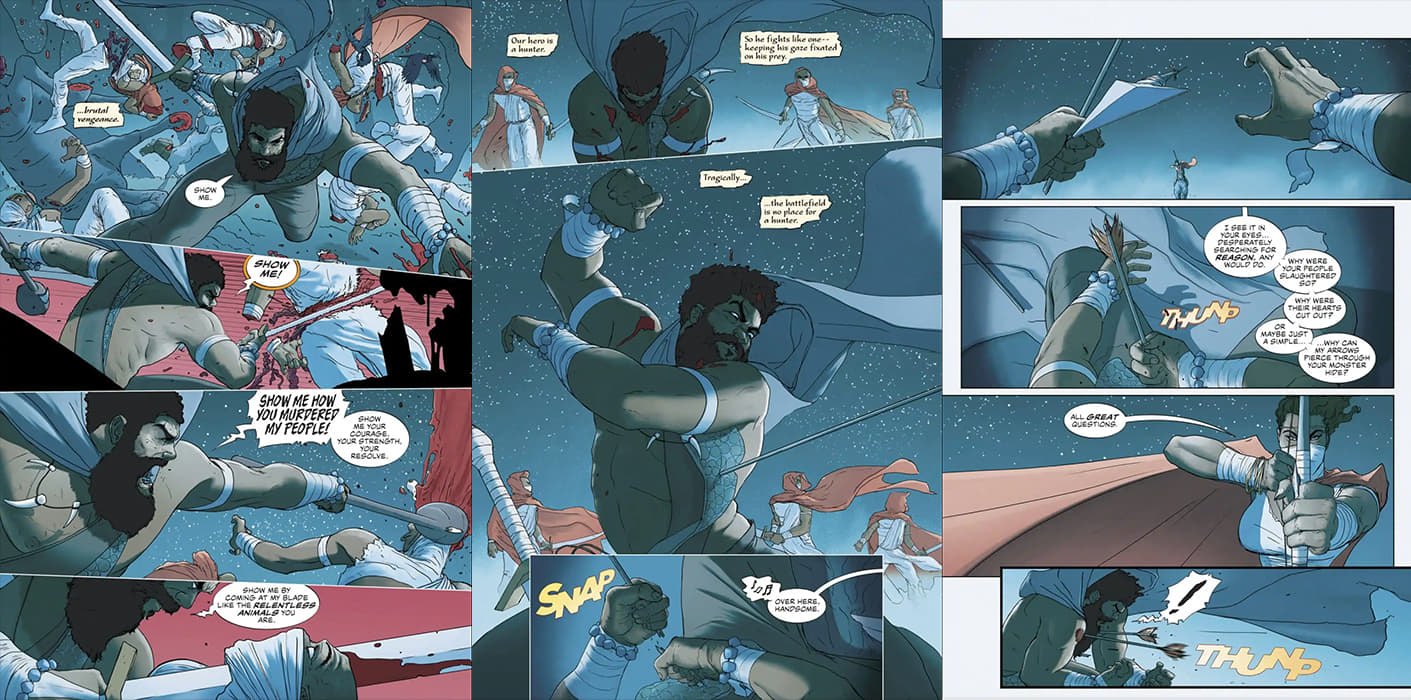
Sample pages from Akogun: Brutalizer of the Gods #2
From Marvel
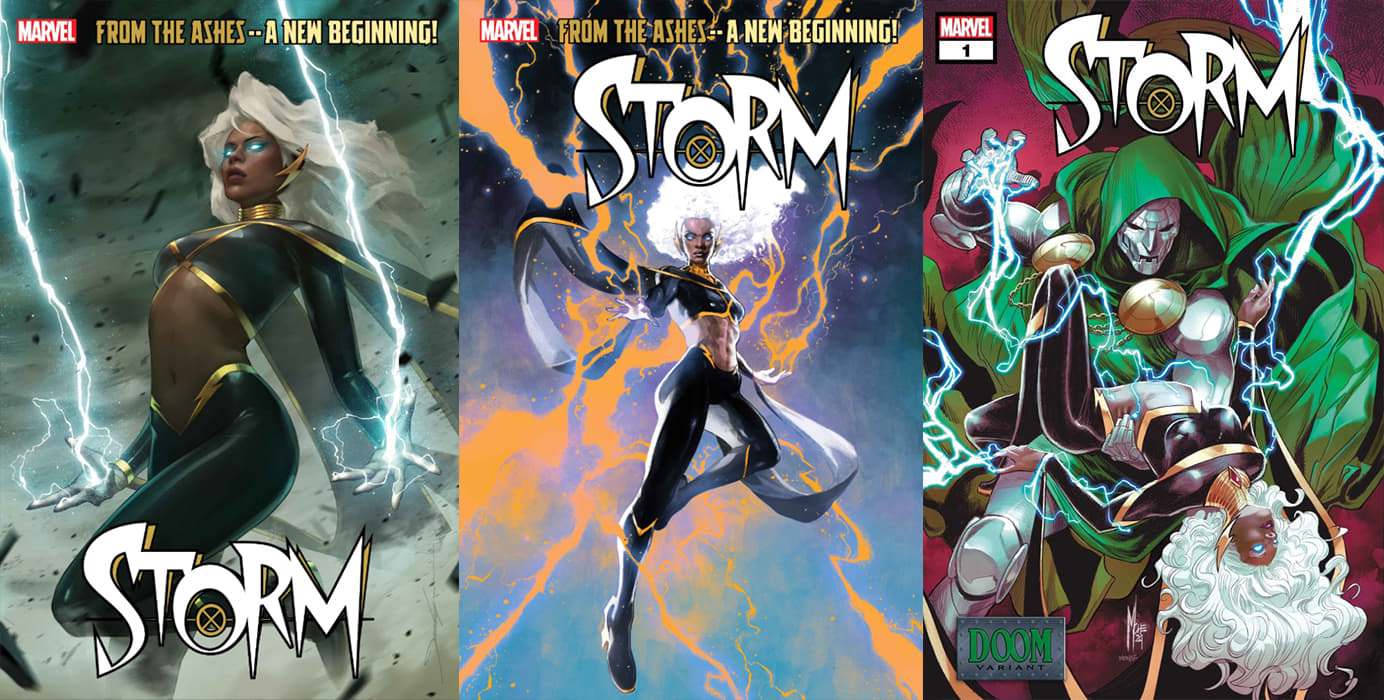
EARTH’S MIGHTIEST MUTANT, NOW HEADLINING HER OWN SOLO SERIES! Ororo Munroe has lived many lives. She’s been a thief, a goddess, an X-Man, a queen and now an Avenger! She is the most prominent, most respected and most powerful mutant on the world stage – and in that role, she intends to be a force for positive change! First up: A major meltdown at a nuclear facility in Oklahoma City draws Storm from her Sanctuary in Atlanta – and into a moral conflict that will test her iron resolve! Guest-starring X-FACTOR’s FRENZY!
Storm #1 Variant Covers
Our episode sponsor
Arkenforge
Play TTRPG games? Make sure to check out our partner Arkenforge. They have everything you need to make your TTRPG more fun and immersive, allowing you to build, play, and export animated maps including in person fog of war capability that let’s your players interact with maps as the adventure unfolds while you, the DM get the full picture. Use the discount code YETI5 to get $5 off your order.
[00:00:00] Your ears do not deceive you. You've just entered the Cryptid Creator Corner brought to you by your friends at Comic Book Yeti.
[00:00:07] So without further ado, let's get on to the interview.
[00:00:10] Kicking off our 250th episode of the podcast, we wanted to thank a few people. I wanted to let Jimmy go first. Jimmy?
[00:00:18] Hey, it's Jimmy and I can't believe that we are on episode number
[00:00:23] 250 of the Cryptid Creator Corner podcast. I am blown away
[00:00:27] by the response to the podcast. I hear from folks
[00:00:31] quite a bit who really love the podcast, who want to come on the podcast.
[00:00:37] Not just my brother Bobby,
[00:00:39] but shout out to Bobby, the Cryptid Creator Corner's number one misdemeaned fan.
[00:00:44] But I really want to thank you, the listeners.
[00:00:47] You're the reason we do the podcast. We hopefully are bringing you some really fun, interesting, informative
[00:00:55] comic creator interviews. I want to thank all of our guests.
[00:00:58] We've had some incredible guests on, in particular the past year, some comic creators
[00:01:04] that I really respect and admire.
[00:01:08] And not only find interesting to talk to but you know learn from. I've gotten to interview Tom King and Scott Snyder,
[00:01:16] David Peppos,
[00:01:18] Jared Luhan. It's just been
[00:01:21] fantastic. I also want to thank Byron, the other host of the Cryptid Creator Corner who does so much work
[00:01:28] to make the podcast what it is in terms of the editing, putting together little graphics, posting on social media,
[00:01:35] coordinating with comic shops and
[00:01:40] advertisers. He does so much to try and get the word out about the podcast.
[00:01:45] And lastly, but certainly not least, I really, really want to thank Matt Leggetti
[00:01:50] who started Comic Book Yeti. He is the comic book yeti.
[00:01:54] He brought me in to be a reviewer. He reached out to me on social media.
[00:01:58] I became the interview editor doing written interviews and you know now
[00:02:04] one of the hosts of the podcast and I just absolutely
[00:02:08] 100% on the bottom of my heart love doing it. So thank you. Thank you. Thank you.
[00:02:15] This podcast has been one of the strangest blessings of my life.
[00:02:19] I started it in a time. My health was probably the worst it has ever been after a huge autoimmune event.
[00:02:26] Now as a disabled person, my life looks way different than it did prior and this outlet has given me the opportunity to
[00:02:32] connect with the community in a way I would not otherwise have been able to do.
[00:02:36] I'm forever grateful to the creators who have taken the time out of their busy schedules and lives to answer all my questions.
[00:02:42] I'm grateful to the listeners, whether this is your first time with us or to the veterans who have been with us all along.
[00:02:48] Thank you.
[00:02:49] I'm grateful to my co-host Jimmy for keeping me grounded.
[00:02:52] When I have a tendency to focus too much about the numbers, his enthusiasm for indie comics remains boundless
[00:02:57] and he has jumped in and carried the load several times from my health inevitably tanked for a bit and kept us going.
[00:03:03] I'm grateful to Matt Leggetti who started Comic Book Yeti for creating a platform for lots of people and for always putting up with my zany ideas.
[00:03:11] Lastly, I'm grateful to my family who understands how important this is to me and lets me sacrifice some of my good hours to keep this going.
[00:03:19] Yeah, grateful.
[00:03:21] Rest assured we aren't slowing down.
[00:03:23] Thanks for listening and now on to the show.
[00:03:26] Hello everybody and welcome to today's episode of The Cryptic Creator Corner.
[00:03:30] I'm Byron O'Neill your host for today's Comics Creator Chat and I'm welcomed by a new guest on the show today.
[00:03:35] Marewa Ayodeli.
[00:03:37] He's a rising writing star in the medium with 2023's I Am Iron Man and the ony press series Akogun, brutalizer of the gods with artist and friend Dotonakande,
[00:03:47] hitting stores and pull lists right now, including my own.
[00:03:50] I'm really enjoying that series.
[00:03:52] And this October he will be writing everyone's favorite Elemental Mutant Storm, a solo ongoing series with artist Lucas Werneck for Marvel that launches the X-Men franchise as a part of the larger from the ashes storyline.
[00:04:05] I'm going to do my best here.
[00:04:07] Okay, so Marewa is a Ekabo, Bawani, Osewa.
[00:04:11] So welcome.
[00:04:12] How are you doing?
[00:04:14] Yeah, I'm doing very good.
[00:04:15] You're good at very good.
[00:04:17] Yes.
[00:04:18] Yes.
[00:04:19] Okay.
[00:04:19] I bet you didn't expect that.
[00:04:21] Like I know.
[00:04:22] Yeah, I had to polish up on it.
[00:04:25] Like I know a little bit of Yoruba just a little bit from from my university days.
[00:04:31] Like I might be able to find a bathroom, but like one of my degrees is anthropology.
[00:04:35] And I took several African religions and cultural classes when I was there and I was supposed to go to Nigeria.
[00:04:41] And then I broke my tibia.
[00:04:43] I was going to do like a summer like a residence there in Lagos.
[00:04:47] So I missed the trip, but I've been to Nigeria several times like working concerts and stuff throughout the years.
[00:04:54] So I absolutely love the country.
[00:04:55] It's beautiful country, beautiful people.
[00:04:57] That's nice to hear.
[00:04:58] Thank you.
[00:04:59] So I'm on family business.
[00:05:01] Yeah.
[00:05:02] Well, I'm trying.
[00:05:03] I do my best.
[00:05:05] Um, so I actually like to kind of start with Nigeria and its comics footprint.
[00:05:12] You know, we've had other African comics creators on the show.
[00:05:15] I've talked to Isaac Mohajani chatting about Land of the Living Gods with Aftershock.
[00:05:20] And my co-host Jimmy recently interviewed Juniba, you know, whose work I adore.
[00:05:24] Yeah, I actually just finished Mobilis.
[00:05:27] And but I don't really have a great perspective on what a reasonable footprint looks like there.
[00:05:32] You know, like what kids are growing up with these days.
[00:05:35] You know, we have kind of our American superhero tradition and Europe has like Tintin and Asterix.
[00:05:40] Japan gave this manga.
[00:05:41] You know, what does the scene look like there?
[00:05:45] It's changed over the years.
[00:05:47] Well, when I was growing up, the most popular comic book where you could get physically anywhere.
[00:05:54] Usually petrol stations, banks, not comic shops there are no comic shops.
[00:06:01] Basically, I will get in front of the bookshops to both petrol stations, restaurants,
[00:06:07] banks, you could find this book called Stupor Strikes.
[00:06:10] It's basically a comic book series that we studied every every issues a standalone about soccer players.
[00:06:20] OK, and it's really, really fun.
[00:06:23] A lot of people love that and enjoyed it.
[00:06:27] I I just start out as a soccer fan.
[00:06:31] I love soccer for a little while as a teenager, but then kind of love kind of died off a little.
[00:06:37] Sobo, I know lots of friends.
[00:06:40] They love it.
[00:06:41] Everybody knows that.
[00:06:42] So that was very, very popular in Nigeria and also here in a lot of other African
[00:06:47] countries that South American country.
[00:06:50] It tells millions of copies per issue.
[00:06:53] OK, I'll have to check that out.
[00:06:55] And you don't have to call it soccer.
[00:06:57] You don't have to recognize it.
[00:06:58] I know it is football.
[00:06:59] I love the sport, so it's all good if you say football like the rest of the world does.
[00:07:07] Well, is that kind of what you grew up with?
[00:07:10] You know, finding whatever you could in, you know, a gas station or whatever,
[00:07:15] you know, kind of what heavily influenced your comics DNA?
[00:07:20] I think this is also the same thing in some other countries, even like in the US.
[00:07:25] You know, things like comic books and movies that are easy to access
[00:07:30] when you're living in a city or when you're living in a very small town
[00:07:34] that it becomes less accessible to watch.
[00:07:37] Maybe I think Rob Lifer was saying I think it has to go to a comic
[00:07:42] or to watch a movie is that I drive in a town or something like that.
[00:07:46] So I live in a very small town called Osho Book in Osho State, Nigeria.
[00:07:51] So I didn't really have access to that growing up.
[00:07:55] I think I only had a few DVDs of like
[00:07:59] classic Disney movies like Cinderella and Snow White.
[00:08:05] So I didn't really have access to cartoons.
[00:08:07] I didn't have access to comic books or and at that time
[00:08:12] also I was born with an art deformity.
[00:08:16] So I was always a very sick child and it took a while before my parents knew.
[00:08:21] They saw that I was misbehaving a lot.
[00:08:23] So the girls thought I was a problem child and it was years later
[00:08:28] that the doctor said his problem is being because he's uncomfortable.
[00:08:32] He's constantly uncomfortable.
[00:08:34] The oxygen in his blood is not always sufficient.
[00:08:37] So I play hard and it's always just very strange.
[00:08:43] So my parents were also saving money.
[00:08:46] They were to have the surgery.
[00:08:48] So they can take me to have a surgery for my heart and the procedure is not done in Nigeria.
[00:08:54] The closest place that he gets was Ghana.
[00:08:57] And for the best place that the doctor suggested was in Israel.
[00:09:02] So they were kind of struggling for money because of that.
[00:09:06] They eventually couldn't afford the government to step in.
[00:09:10] So after that, after that, that was when I was four years old.
[00:09:14] So I think at around seven,
[00:09:17] you were more comfortable getting promotions in the works.
[00:09:21] And we could finally afford cable.
[00:09:25] OK. And at that time it was called DST.
[00:09:27] So Patune Tsok was like my first introduction to anything illustrated.
[00:09:33] So I was like and I immediately fell in love with Gendi
[00:09:36] but that pops keys Sam Raejak.
[00:09:38] Yeah, I loved Sam Raejak so much.
[00:09:40] I was always watching it all night long.
[00:09:43] And that kind of got my interest in animation and drawing and coloring.
[00:09:49] So I started experimenting and playing around with a lot of things.
[00:09:52] Trying to draw my own comic, colors or coloring books.
[00:09:56] And later I discovered Supairo's and I'm not sure how
[00:10:01] I learned that they came from comics first
[00:10:05] before they were adapted to this animation stuff.
[00:10:07] So I knew I had a rough idea of what comics were.
[00:10:11] So and very quickly, there's that Supairo comic
[00:10:15] that was very popular at that time too, that now got introduced
[00:10:19] because a lot of people are not watching this cartoons.
[00:10:22] It's called Indomitables.
[00:10:24] OK. I'm sure you know,
[00:10:27] I think it's a Malaysian noodle called Indomitables.
[00:10:31] So yeah, they're very popular here.
[00:10:34] That's basically the household noodles everybody eats.
[00:10:37] So just to further like, children love it the most.
[00:10:40] Adults didn't like it.
[00:10:41] Adults thought noodles were made from strange chemicals.
[00:10:44] OK.
[00:10:45] Like I had this batch for you.
[00:10:47] Shouldn't eat stuff like that.
[00:10:48] So only kids kind of liked them.
[00:10:50] So in an attempt to market to kids,
[00:10:53] they started this comic called Indomitables
[00:10:56] and they were basically like fantastic food repos.
[00:10:59] But it was a little fun.
[00:11:04] They by bit I when I left second
[00:11:08] just when I got to the university,
[00:11:09] there are the next guys that knew how to access this comic
[00:11:13] because there was no physical comic.
[00:11:14] I could not get access to them.
[00:11:15] So when I went to the university,
[00:11:17] there are the next guys that had like tons of like
[00:11:20] digital files.
[00:11:22] They are probably pirated by the way.
[00:11:24] A lot of digital files on their laptops
[00:11:26] and I'm like, yes, finally.
[00:11:28] So that's when I got into about my comics,
[00:11:31] Iron Man comics,
[00:11:32] is what's part of me off on that love of comics.
[00:11:37] And very quickly, I started writing my own
[00:11:40] trying to ask the tune to join me
[00:11:42] because it was a much better artist than I was.
[00:11:46] I was terribarded.
[00:11:47] I can't go to say my life anymore.
[00:11:50] So I would beg and please illustrate some of these things.
[00:11:53] But we always said no,
[00:11:55] because we were both like failing in our courses.
[00:11:59] So it was like I want to graduate.
[00:12:01] I still want to graduate at the right time.
[00:12:03] So please, after we go to school,
[00:12:06] I'll help out with this.
[00:12:08] So while I was just always writing,
[00:12:09] I've given up on having the grades my parents wanted.
[00:12:12] So yeah, that's my journey to comics.
[00:12:16] It started later, but mostly because of accessibility.
[00:12:20] OK, yeah, similar.
[00:12:22] Well, similar to similar story.
[00:12:24] Like I dropped out of school getting my anthropology degree
[00:12:27] and I dropped out of school to go work with rock bands.
[00:12:30] So like I feel what you're talking about
[00:12:32] with that like pull to do something different.
[00:12:35] You were in computer programming, is that right?
[00:12:38] Yeah, complex sciences. OK.
[00:12:39] Yeah, yeah, yeah.
[00:12:41] Well, I can see kind of the talking about some of those influences,
[00:12:45] kind of the clear blueprint then,
[00:12:48] especially with the samurai Jack in Akogun,
[00:12:51] you know, which is hitting stores now.
[00:12:53] Yeah, yeah. I picked up the first two issues.
[00:12:56] They're fantastic.
[00:12:58] You know, I know the obvious analog here would be, you know,
[00:13:01] like something similar like a black cone.
[00:13:03] Right. But yeah, there's there's way more nuance
[00:13:06] than that kind of generalization describes, you know, among other things.
[00:13:10] It's got a real cosmic flavor and a mythology to it.
[00:13:13] You know, more than just, you know, a typical
[00:13:16] during adventure type book, you know, I got Beowulf kind of vibes from it.
[00:13:20] So so talk to me about, you know, what you and and Doton were thinking
[00:13:25] about when you sort of developed that story.
[00:13:29] Yeah, when we started
[00:13:32] probably both in in Nigeria,
[00:13:36] we started with science fiction stories
[00:13:40] because we were deeply connected to like the backstage things
[00:13:45] happening in the US about how a lot of people were fighting
[00:13:50] diversity in comics and stuff like that.
[00:13:53] And we wanted to kind of replicate our own idea,
[00:13:56] even though we're predominantly black,
[00:13:58] they are white immigrants, they are Asian immigrants.
[00:14:01] So we started trying to tell like futuristic stories where
[00:14:06] I think maybe for the first time there's like an Indian commissioner
[00:14:09] in Lagos and we'll tell you some of the stories.
[00:14:14] And we saw that.
[00:14:17] The market here was also connected to the US
[00:14:20] but in a different way, in a different way where
[00:14:24] why the US was trying to promote the minorities like black people.
[00:14:29] We're trying to do the same here, even though we're not the minority here.
[00:14:33] So it was all about, yeah, having black faces and stuff like that.
[00:14:37] And that kind of affected how our work was being accepted.
[00:14:42] There were some awards that for you to get nominated,
[00:14:46] your character has to be your protagonist has to be a black character.
[00:14:51] And we found out, I found out very, very strange,
[00:14:54] like I could be telling stories about like talking animals.
[00:15:00] So I wouldn't qualify for the award, you know, so stuff like that.
[00:15:03] So and we got upset and were like,
[00:15:07] we're so we were being very prideful about it.
[00:15:10] So like, see, we're so good if we should leave this sci-fi thing
[00:15:14] and come to tell like these African stories about God.
[00:15:19] I'm going to be better at it than you are.
[00:15:22] You like you guys, you guys are city folks.
[00:15:26] You live in Lagos.
[00:15:27] You've not seen any of these things.
[00:15:29] I live in the hub of Andorusha called Oshun.
[00:15:34] There's an Oshun called Oshun. I live in Oshun state.
[00:15:37] Like I see these things every day.
[00:15:40] I know about these gods.
[00:15:41] I know about these things.
[00:15:43] I speak your rubab better than any of you.
[00:15:46] If I go, if I go into this, I'm going to kick your asses, you know?
[00:15:52] So yeah.
[00:15:53] So yeah, so I go and go about it.
[00:15:56] So I started telling like a lot of Oshun stories
[00:15:59] and immediately they kind of picked up
[00:16:02] and we actually have noticed some of our work
[00:16:07] in Newman, that was the superhero stuff.
[00:16:09] We worked on that and we now did something called
[00:16:14] my grandfather was a god. Sorry, it's a long story.
[00:16:17] That's great. I'm asking.
[00:16:18] I want to know which was a free
[00:16:22] the free comic on Webtoons.
[00:16:24] Yeah. And even though the readership is about one thousand
[00:16:27] two hundred five episodes, it comes from a diverse location.
[00:16:30] There are people from the UK, people from Nigeria,
[00:16:33] people from South America,
[00:16:36] because these gods are worshiping in South America.
[00:16:39] They really, really love the comic.
[00:16:41] They loved it a lot.
[00:16:42] That was the comic that Tom Brevert read,
[00:16:45] that asked us to come on board to work on Moon Night.
[00:16:49] Moon Night, Black, White and Blood.
[00:16:51] So we've always been in this zone.
[00:16:54] So after I am Iron Man, only press reached out to us.
[00:17:00] And what wanted to pitch was an African story.
[00:17:03] Well, before we could talk
[00:17:06] they basically said, gave us a pitch of OK,
[00:17:09] can you guys do Black Conan?
[00:17:12] And we felt a little offended like
[00:17:15] say African Conan, it feels weird.
[00:17:19] They use Black Conan.
[00:17:20] So like so.
[00:17:23] So we're like, yeah, that's basically what we're working on
[00:17:26] already. So Dotto and I came together
[00:17:30] and we tried to analyze it,
[00:17:34] not trying to make Conan African, but what is
[00:17:39] what's the equivalent of the Conan story here in Africa?
[00:17:44] OK, because we have Southern
[00:17:46] Soccery stories too that are folk tales.
[00:17:49] So what's the equivalent and the equivalent was
[00:17:54] Hunter story.
[00:17:55] Yeah, any stories about warriors?
[00:17:58] Yeah, tell stories about hunters
[00:18:00] because warriors, warriors, they put
[00:18:03] on today's time for war and they go in massive
[00:18:07] to dance really adventures.
[00:18:09] But the hunter goes where no man has done before,
[00:18:13] goes to forest that they have
[00:18:17] spirits and beast and creatures that
[00:18:20] have weird screams that nobody knows what creature was making the sound
[00:18:24] that he wants to see the things that eyes are not supposed to see.
[00:18:28] You know, that's how it's described.
[00:18:30] So those so we're like, OK, our protagonist
[00:18:34] wouldn't be a warrior like Conan.
[00:18:35] It would be a hunter.
[00:18:37] So and and then we start playing with your robot mythology.
[00:18:42] There are there are like two popular mythologies about how the world was
[00:18:46] covered slash created.
[00:18:48] And the first one is about a drunk God.
[00:18:52] Yeah, a God that is full of drinking.
[00:18:54] Yeah.
[00:18:54] And that came to Earth and the Earth was
[00:18:59] towards and did all the creation story things.
[00:19:03] And there's another one way is like.
[00:19:06] The gods were were looking for a place to go to
[00:19:11] and only one God could lead the way.
[00:19:13] And the God was the God of war and basically because
[00:19:17] he had met all destroy anything that was way.
[00:19:20] And we found it very strange that.
[00:19:26] These two stories are very weird.
[00:19:28] Yeah, unusual.
[00:19:30] We have a lot of stories about creation.
[00:19:31] This one's our usual number one, a drunk God and about to a war God.
[00:19:36] What God's are not usually the God's that part.
[00:19:40] Creation.
[00:19:41] So I was like, OK, what if those two stories are the same story?
[00:19:46] What would bring a war God over?
[00:19:49] What if the drunk God was a criminal God?
[00:19:52] So and that's where the story began.
[00:19:55] So a mix of a comic book history, trying
[00:20:00] to trying to one up competitors in Nigeria
[00:20:04] and the Euroband mythology and everything mixed together
[00:20:07] and I had to watch a lot of old samurai Jack episodes
[00:20:11] and primal on adult swing, both by against the cops.
[00:20:16] He just gets in the Berserk.
[00:20:18] OK, yeah, I really enjoyed the creation myth adaptation
[00:20:24] because I'm an anthra major.
[00:20:28] My focus was in specifically Native American mythologies,
[00:20:32] but mythologies are something that I pay a lot of attention to.
[00:20:35] You know, so I really like the way you did that with
[00:20:39] with the drunken God minus the chicken,
[00:20:41] because I don't know how you would have fit the chicken in there.
[00:20:44] Yes.
[00:20:46] That was so well done.
[00:20:48] I was like, yeah, yeah, yeah.
[00:20:53] Let's take that out.
[00:20:55] Yeah, climbing down the road with the was it a snail shell?
[00:20:59] Like sand and a snail shell drops from the shell.
[00:21:03] Yeah, the chicken spreads it right.
[00:21:05] See.
[00:21:07] So yeah, yeah, yeah.
[00:21:09] And in my read through what the thing that really stuck out there
[00:21:13] when you touched upon that was a hunter as opposed to more of like a warrior,
[00:21:19] right? Because you do get the opportunity to explore isolation
[00:21:25] in a different way, in turn kind of a hero's journey with a different lens
[00:21:31] because it allows you to bring out these introspective moments
[00:21:34] and these moments of a self analysis that a hero will never get
[00:21:39] because they're in the mix of the fray and can't be seen to be weak
[00:21:43] and all these different things.
[00:21:45] So you get a much broader range of the human emotive experience.
[00:21:51] And I really enjoyed that about the story.
[00:21:53] It was really cool.
[00:21:54] Yes, yes, because Conan has to be surrounded by warriors and hot chicks.
[00:21:59] Right.
[00:22:00] When you are.
[00:22:02] Well, I think there's a way you're about a danger
[00:22:04] that shows even don't as I respected,
[00:22:08] you're also fear.
[00:22:10] There's this parable that basically says a hunter that is so powerful,
[00:22:14] that is so good, that could use his heart, throw it and kill an elephant
[00:22:21] will only be celebrated for a day.
[00:22:23] Basically, if you are so powerful, you could kill an elephant with a heart
[00:22:28] after people celebrate how powerful you are, they become scared.
[00:22:31] That means if you should just get angry or anything,
[00:22:35] maybe just by a slight wave of your hands, you feel thousands of people.
[00:22:40] So there's also this fear of them too,
[00:22:42] because they are the ones that face this powerful beast in the forest.
[00:22:46] They are the ones that explode the unknown.
[00:22:48] So there's always this fear of them as well.
[00:22:50] OK, but narratively, in and of itself,
[00:22:54] the cadence of the book is really interesting.
[00:22:57] You know, I have a background working with musicians.
[00:23:00] So I have this tendency to see that kind of storytelling is lyrical.
[00:23:04] You know, it makes sense to me as like a fable, you know,
[00:23:08] with a verbal storytelling route, you know, sung around the fire,
[00:23:11] something like that.
[00:23:13] You know, so you have these, you know, multiple chapter breaks
[00:23:15] and a single issue without kind of a singular ending crescendo, if you will.
[00:23:21] You know, is that a byproduct of you working
[00:23:24] in this sort of more loose style narratively with the script or
[00:23:31] generally, or is it something more adapted to this project?
[00:23:37] The combination of many things.
[00:23:39] And when it comes to when it comes to me,
[00:23:41] some of these are usually like grudges I have against some people.
[00:23:45] So
[00:23:48] there was a time where someone wanted to create some comics
[00:23:52] and was supposed to work with them.
[00:23:54] They wanted to create like a series of web comics.
[00:23:57] Yeah. So we're planning to like produce five pages each.
[00:24:02] So they'll so when you read comics to get five pages per week
[00:24:05] as I read them, that was also supposed to be on the platform.
[00:24:09] And it didn't pay and some strange arguments started.
[00:24:14] They wanted to represent of your rights and stuff like that.
[00:24:17] So we're like, OK, you know what? We're not working with you anymore.
[00:24:20] So we took those comics and we pitched it everywhere, everywhere
[00:24:26] in Nigeria, in Africa, in America,
[00:24:30] in the state. Everybody basically said no.
[00:24:34] And there was this publisher, which I would not name
[00:24:38] because I want people to give it back to other people that pitch as well.
[00:24:42] Is they said.
[00:24:45] The story doesn't work because
[00:24:49] there's there is no crescendo because it ends so shortly every time.
[00:24:55] Basically, they didn't like the fact that they were chapter breaks.
[00:24:58] They felt that it was impeding the flow of the story.
[00:25:01] And that felt strange to me because we have their collection of short stories.
[00:25:07] You you have people that put web comics into like
[00:25:11] why that students impede the enjoyment of a story.
[00:25:16] And then there was this comic called Absolute Carnage by Donny Kates.
[00:25:21] Yes. And the first issue were broken down into chapters.
[00:25:26] And I'm like, see, Donny Kates did it. It's worked. Why?
[00:25:30] Why?
[00:25:33] So when only said they really wanted something oversized
[00:25:37] for this comic, like they don't want the typical 20 pages.
[00:25:40] They want like 40 page chapters like, you know what?
[00:25:43] I'm going to do that for this project.
[00:25:46] Because I think it works for this project and I just want to prove those guys wrong
[00:25:51] that you can do stuff like this and make it work.
[00:25:54] And I was happy when I got to reviews that kind of reflected why
[00:26:01] I think it's such a good idea.
[00:26:02] It's you have in initially basically three last pages,
[00:26:06] you have three cliffhangers, you have so and you have three puzzle pieces
[00:26:11] where you get to have fun and put the story together.
[00:26:14] You're like, oh, yeah.
[00:26:15] And just have like cool titles in the middle,
[00:26:19] like in issue two where you have a chapter breaks,
[00:26:23] like called 3D God, you know, and Obatala makes no mistakes.
[00:26:27] You know, so different cool titles like that.
[00:26:31] Yeah. I liked the outcome.
[00:26:35] And that's why I came up with that format.
[00:26:39] OK, I love this.
[00:26:40] So you are pushing the medium and you are trying to prove people wrong
[00:26:44] and you are hungry.
[00:26:46] Like, I love this so much.
[00:26:47] I love people who try to do different things.
[00:26:49] I don't know if you have read or been exposed to bear pirate Viking Queen yet.
[00:26:55] I've had a lot of people, but I'm not able to get to it yet.
[00:26:59] OK, yeah. And sounds very exciting.
[00:27:00] You have the same thing also.
[00:27:02] Yeah, yeah, they're really pushing the envelope
[00:27:04] with all kinds of different things.
[00:27:06] So I love people who are pushing the media.
[00:27:09] But, you know, the word choices there reinforce
[00:27:13] kind of this timelessness in the narrative.
[00:27:15] For instance, you have you have prose that feels like it was written a long time ago,
[00:27:19] like maybe Edgar Rice Burroughs, something or similar.
[00:27:22] Like under the moonlight, it's steel, hard skin turns invisible.
[00:27:26] It's demonized for ever, prowl for unsuspecting.
[00:27:29] So in most cases in modern comics, less tends to be more
[00:27:33] and exposition would have been edited out in, you know,
[00:27:36] in favor of a cleaner presentation.
[00:27:38] But here it works and it actually feels necessary.
[00:27:42] You know, I listened to your chat recently with David Harper,
[00:27:44] which is a very good one that people should check out if they've missed it.
[00:27:47] And he pointed out, you know, that computer programming background
[00:27:50] and you kind of went into this
[00:27:53] thing as an unlimited scroll the way you kind of visualize the narrative.
[00:27:58] Yeah, yeah. Well, I knew how to program in three languages
[00:28:01] when I graduated high school myself.
[00:28:03] And I think most people think that, you know,
[00:28:05] programmers grains must be very analytical.
[00:28:09] But, you know, mine isn't at all.
[00:28:10] It's very abstract.
[00:28:11] And I constantly think in pictures.
[00:28:12] I hate words, right?
[00:28:14] Because they just feel so restrictive.
[00:28:18] Anyway, I'm rambling a bit, but it's, you know,
[00:28:21] something in that interview I thought was fascinating about scripting
[00:28:23] was that unlimited panel.
[00:28:25] So tell me more about that and how you work on editing this specifically
[00:28:29] and those inclusions of like making sure
[00:28:32] there's all these really fine touches that I really enjoy.
[00:28:35] Like even the word bubble choice has created these beautiful zags,
[00:28:39] you know, there's a curve to them, you know,
[00:28:43] that you just don't see that kind of thoughtfulness all the time.
[00:28:47] So yeah.
[00:28:50] OK, I think these are like three questions.
[00:28:53] Yeah, I'm sorry, I gave you a lot, my bad.
[00:28:55] Yeah. So let me see if I can remember everything
[00:29:00] and if I forget anything, just feel free to call me back.
[00:29:04] Yeah. And.
[00:29:06] Growing up, I think I'm not sure what was done in America,
[00:29:10] but in Nigeria, there's like something called
[00:29:13] like junior secondary schools, like junior high school.
[00:29:16] Yeah. So there they teach you all the courses.
[00:29:20] Like science stuff, social science stuff and humanity stuff.
[00:29:26] And then you get to senior high school, like senior secondary
[00:29:29] school, senior high school and you are forced to either pick
[00:29:33] social sciences or call business sciences,
[00:29:38] science class and then art class, which is basically humanity.
[00:29:42] And my parents were so shocked that I went to sciences.
[00:29:46] Everybody in the family was shocked.
[00:29:48] Like once you're like.
[00:29:50] You talk a lot, you express yourself a lot, you are very artistic.
[00:29:53] Why not choose the arts and humanities?
[00:29:56] Sure. And that's always I've been not I've been someone like that.
[00:30:01] There's always been this balance of arts and sciences and.
[00:30:06] Arts and sciences, yes, basically those two.
[00:30:09] And when I was in science class to my mom,
[00:30:11] got very angry when I dropped the course to pick up literature
[00:30:14] from the arts department and she had to come to school
[00:30:18] and say, stop him from going to that class
[00:30:20] because it's going to affect how I get into university
[00:30:23] because I want to have enough courses,
[00:30:25] enough science courses to get into computer science.
[00:30:28] So stuff like that.
[00:30:29] So I think being analytical and creative,
[00:30:33] they don't have to be mutually exclusive.
[00:30:36] They can go together and I tend to analyze a lot
[00:30:41] in when it comes to like I read people's comic
[00:30:44] and I analyze them and when you talked about narration,
[00:30:48] it's when I was reading books about writing,
[00:30:51] there was one thing they kept saying like.
[00:30:54] Narration is like this bad thing that ruins your stories
[00:30:58] because it's basically exposition.
[00:31:01] And in cinema scenes, this YouTube channel,
[00:31:04] like the first scene, he always gives a movie is narrating
[00:31:07] and stuff like that.
[00:31:09] And I hear a lot of writers talking about
[00:31:11] narration is bad, it's lazy.
[00:31:14] You are saying what we are seeing and strange things like that.
[00:31:18] So I.
[00:31:20] I.
[00:31:21] I kind of stopped it in my own writing too,
[00:31:24] because I felt it was bad.
[00:31:25] But I was like, I read Sin City by Frank Miller.
[00:31:30] It's heavily narrated.
[00:31:32] It kind of works, but I deleted it from my brain.
[00:31:36] Like, you know, like as those cities do not exist.
[00:31:39] OK, let's follow the rules.
[00:31:41] And then I discovered Edwubaker
[00:31:44] and I'm like this guy hardly has dialogue in some of his comics.
[00:31:48] It's all narrated and it's and it works.
[00:31:50] Why does it work?
[00:31:52] And then I discovered Jason Aaron
[00:31:54] and I'm like, it works too.
[00:31:58] So I was experimenting with it, but I still didn't like
[00:32:02] devoid myself of that rule against narration.
[00:32:06] And then Doni Kates comes up and is like,
[00:32:08] oh, this guy wants to take narration to an old new level.
[00:32:11] You have like Edwubaker, Jason Aaron, Doni Kates.
[00:32:13] Like now it's not like a fluke.
[00:32:15] It's not like an exception.
[00:32:16] Now you have like this large number of people that have made their
[00:32:19] careers almost narrating the story to you.
[00:32:23] And like Frank Miller, Edwubaker, Jason Aaron, Doni Kates
[00:32:28] and I'm like, OK, let's analyze this.
[00:32:31] Why does narration work in some comics
[00:32:34] and it doesn't work in some comics?
[00:32:36] And not to do like this serious breakdown.
[00:32:39] And it's all about there are some things that help you perceive the story
[00:32:45] that yes, don't see what you see, but there are so many things
[00:32:48] that you don't see that I can still tell you.
[00:32:50] And you see that in the front, like since it's it might tell you how the
[00:32:55] S knows like you can't see it.
[00:32:59] And if a character suddenly says the S knows like this, just you string
[00:33:03] by narration, it kind of works and I started learning it and stuff like that.
[00:33:08] And my dad is also a pastor.
[00:33:10] So I came from a Christian OK from
[00:33:14] Mr. Byron Way and there's this Bible version called the King James version
[00:33:19] where they talk in like this old English and stuff like that.
[00:33:23] So there was that also there and just mixing everything up together.
[00:33:28] And I was able to like pick one or two things from everywhere
[00:33:32] and try to like get.
[00:33:36] That's why this narration style was birthed from.
[00:33:40] That's why I was able to like it's a mixture of so many random things
[00:33:44] elsewhere that I put together.
[00:33:46] And so that's basically the answer to everything is I tend to analyze things
[00:33:52] when I was working in the vertical scroll webtoons, I had to read a lot of stuff.
[00:33:56] Why does this work in vertical scroll but doesn't work in flip books?
[00:34:01] Why does this work in flip books, but not in vertical scroll?
[00:34:05] There are so many fun things that you can do in vertical scroll
[00:34:08] that people don't know like one single panel
[00:34:10] can have multiple layers of information as you scroll.
[00:34:13] So you can so you can have reviews in like the bottom half of the same panel.
[00:34:20] So you can have like a serene scene in the sky where you scroll.
[00:34:24] You see that there's been a massacre down below.
[00:34:27] You might not be able to have that on a comic book
[00:34:30] because if you open it, you've seen all the pages and everything.
[00:34:33] So and there's also no page turn reveal
[00:34:36] like you see on where you have this big image and you can see all at once.
[00:34:41] So those are basically it's basically from constant analysis and discussions.
[00:34:47] Sometimes I call my friend dot two and I'm like, I read this comic book.
[00:34:52] It's not good. It's not bad. Why?
[00:34:56] Why is it not work?
[00:34:57] And we discuss it to analyze it and we're like,
[00:35:00] oh, the reason why it doesn't work is because it did everything right.
[00:35:04] But it's milk toast.
[00:35:07] Storytelling is usually a word of extreme.
[00:35:13] Like it's not bad enough if a woman cheats with someone just in her mind or something.
[00:35:22] Let's take it to an extra level.
[00:35:24] Let's make the cheating extremely disgusting in the sense that he does it on
[00:35:29] their matrimonial bed while he was sick in the hospital.
[00:35:33] So, you know, you know, like, oh, my God, that's just terrible.
[00:35:39] Yeah, yeah.
[00:35:40] Yeah.
[00:35:41] And that's that's what makes those things really stand out to you.
[00:35:46] And you remember those for a lifetime.
[00:35:49] So it's true analysis, constant analysis of stories by other people
[00:35:55] because it's hard to analyze your own stuff.
[00:35:57] Yeah.
[00:35:58] So you try to analyze other people's stuff to kind of improve yourself.
[00:36:01] Yeah.
[00:36:01] Yeah, absolutely.
[00:36:02] So it's still computer science thing happening because in computer science is
[00:36:06] basically analyze it, troubleshoot it, break it down to its components.
[00:36:11] Then find a way to represent those blocks, those blocks of understandings
[00:36:16] into blocks of codes and then you have a system to like why does this work?
[00:36:21] That's always the question.
[00:36:22] Why does this work?
[00:36:23] How can I incorporate it into my ass now?
[00:36:26] All right, let's take a quick break.
[00:36:29] Hey, comics fam.
[00:36:30] Itty comic book publisher Banda Barge just got a level up and announced it is now
[00:36:35] a cooperative this heralds a new era for them, including a partnership with
[00:36:39] Dallas Stories and they added several new members to the ownership group.
[00:36:44] Marcus Jimenez is now chief operating officer Brent Fisher takes on the role
[00:36:48] of chief diversity officer and Joey Galvez is introduced as head of Kickstarter
[00:36:53] ops and social media manager, which is sure to increase their capabilities
[00:36:57] overall as a publisher and it further promotes their mission statement of advancing
[00:37:02] representation, inclusion and diversity in the media.
[00:37:06] They also established a new board of directors to help chart the new path of
[00:37:09] their journey with new projects in the works like Alaska by dropping in June,
[00:37:14] unbroken soon launching on Kickstarter and pond coming up with
[00:37:17] Dallas, stay tuned to this space for more exciting news from the growing
[00:37:20] Bards family.
[00:37:25] Let's get back to the show.
[00:37:27] One of the things I really loved about the mythological presentation here is
[00:37:32] there's a very familiar link between the flawed nature of the gods and kind of
[00:37:37] the Yoruba, Pantheon and the the Greek ones that are so pervasive in Western culture.
[00:37:42] Right? You know, so I'm curious about, you know, we already talked about the
[00:37:46] the drunken God creating the world.
[00:37:49] But was there anything that that you and Doton were concerned about,
[00:37:54] you know, in terms of portraying any of them in this non-traditional way?
[00:37:58] You know, if your dad's a pastor, you know, you got you got to play it pretty close.
[00:38:03] Right? You don't want to make him mad.
[00:38:05] Yeah, I grew up in the church too.
[00:38:08] So yeah, they're like, yeah, yeah, very correct.
[00:38:12] There are two things that two things do it like
[00:38:16] even if my family, I think my brother, he got worried along.
[00:38:21] He was always saying that this one that you're telling stories about these
[00:38:23] gods, have you started worshipping them?
[00:38:26] Are you going and I've not been going to church like that.
[00:38:29] So it's always like go to church to cleanse yourself from all these demon things
[00:38:33] you've been writing about and stuff like that.
[00:38:37] So yes, there's that.
[00:38:39] So there's a limitation to things I can say.
[00:38:43] I know that my no one wants me to say this, but
[00:38:47] Doton is in a relationship now where the mother of the girlfriend was very scared
[00:38:53] because the books because of the books he was working on with me.
[00:38:57] Oh, wow.
[00:38:58] Because they were this orisha gods and stuff like that.
[00:39:01] So there's that part.
[00:39:03] Then the other part is compared to like some other mythology.
[00:39:07] These gods are still being worshipped to things.
[00:39:11] Yeah.
[00:39:12] So there was this fear of if you misrepresenting God or if people get angry,
[00:39:18] like it's not about somebody to return from online.
[00:39:23] People actually can reach out to you and
[00:39:26] you know, yeah.
[00:39:31] So yeah, so it's real.
[00:39:36] Well, we try to be creative as much as possible and to be respectful.
[00:39:41] But at the same time, Doton and I have like something we said we would always
[00:39:45] say if people challenge us about this.
[00:39:48] So even if it happens, we know what to say and stuff like that.
[00:39:53] So yeah, there's there's that.
[00:39:55] But yeah, but the reason why we're not too too worried is that in like Judeo-Christian
[00:40:04] religion, it's about God is perfect.
[00:40:08] Yep. And same thing in also Islamic.
[00:40:11] So if you write a story that portrays the perfect God as imperfect,
[00:40:17] there's a problem.
[00:40:19] But in your religion, the gods are not.
[00:40:24] And that's the point.
[00:40:26] In fact, that's why you pray to that.
[00:40:28] That's why you try to suit them.
[00:40:29] That's why you have like things,
[00:40:31] sweet words you have to say to them so that they might be biased towards you
[00:40:36] positively.
[00:40:37] So it's one of the stories of Ogun, for example, the God of war.
[00:40:42] Is that it got so freaking angry one day, so freaking angry.
[00:40:48] It killed the enemy and killed his own men to like, yes, yes.
[00:40:54] He was pissed.
[00:40:57] So it's that.
[00:41:00] So yeah.
[00:41:02] So I don't think there's also the expectation to portray them as flawless.
[00:41:10] OK. Yeah.
[00:41:12] I mean, yeah, the analog is Greek, so it makes so much sense.
[00:41:16] It's just really interesting when we have that Western cultural overlay
[00:41:20] that I'm coming with where just like you mentioned it, God is perfect.
[00:41:24] God is everything and without those fallibilities.
[00:41:29] It's just so much more approachable, so much more reachable in this fashion.
[00:41:34] And I don't want to stay too much in the weeds in terms of process,
[00:41:38] but I did read about how Nigerian playwright and novelist Wule Solinka.
[00:41:43] So Solinka, yes?
[00:41:44] Yes. Yes.
[00:41:45] Yeah. He's a Nobel Prize winner and he had an influence on the book.
[00:41:51] You know, I was a technical theater actor
[00:41:52] and spent time on the road doing Broadway stuff.
[00:41:54] And I've seen a couple of his plays actually met a long, long, long time ago.
[00:41:58] I adapted into like small black box and I did some research for this.
[00:42:02] And I had no idea he was honestly related to Feliciti as well.
[00:42:06] But I can say that.
[00:42:09] Yeah, yeah, I was like that's really cool.
[00:42:12] And on my read through, I can see kind of the parallel between the protagonist
[00:42:15] having everything taken for them and Wule is imprisonment or criticized in political
[00:42:20] elites. So could you just kind of expand on how his work
[00:42:23] influenced Akogun and, you know, kind of more broadly you?
[00:42:29] I mostly said that to like make the work sound more eye class.
[00:42:37] I can edit.
[00:42:39] I can cut this really bit of bad.
[00:42:41] It's like it's it's fine.
[00:42:43] It's like OK, that's awesome.
[00:42:45] This is yeah.
[00:42:46] So I've read like like like very little of Wule Shoyka's work, very, very little.
[00:42:52] And what I like about his work is basically the complexity and the tone.
[00:42:59] There's there's this there's this dark serious tone.
[00:43:07] To his work and Ogun has also been a protagonist, one of the story.
[00:43:11] And it's complexity like it said here that oh, you don't read like Wule Shoyka stuff.
[00:43:18] If you're an illiterate, like you have to be like real learned and patient,
[00:43:22] able to pick his work and we kind of.
[00:43:28] Dato and I kind of suffered from that on our work because when people see our
[00:43:32] books and see this difficult to pronounce names,
[00:43:37] they automatically just assume we're diversity hires.
[00:43:41] Like some people say like, oh, yeah, they just put them on the workers.
[00:43:44] They have weird sounding names.
[00:43:46] And if you read our work with without that patience,
[00:43:51] without the understanding that, oh, maybe they are competent,
[00:43:54] you would assume that our work isn't because you just read a surface value.
[00:44:00] Like like a lot of people, for example, just read the words.
[00:44:03] They don't even look at the images and the images are very important to us.
[00:44:09] Like you see like my script, for example, they are very precise things.
[00:44:15] That's where you will read Watchmen about.
[00:44:16] There's so many visuals that you have to see in Watchmen.
[00:44:19] Like noticing that in like in the first couple of scenes,
[00:44:23] you already see Roshak without his mask before he's reviewed later.
[00:44:27] Stuff like that.
[00:44:28] That's what we put in our stories.
[00:44:30] You know, repeated and cyclical imagery and stuff like that.
[00:44:36] So
[00:44:37] we want people to be able to like pay close attention.
[00:44:41] Like we're not saying we're like gods, like we're like these people that can't
[00:44:45] write a bad story, but it's always very strange when it hurts when you get
[00:44:50] a bad review, but the bad review based on you just didn't read it.
[00:44:54] Like, for example, I think there was a review I got once.
[00:44:59] Like I take reviews just like a computer scientist, by the way,
[00:45:02] and analyze them like I don't feel like hurts by them.
[00:45:04] I just analyze their books.
[00:45:06] Sometimes you're like,
[00:45:07] I wish you come to your karma with this book.
[00:45:13] So, for example, there's this thing I do in my writing where there's a little
[00:45:19] opening scene and then you have like the title slash credit page.
[00:45:23] Then the story, just like a TV show.
[00:45:26] It's easier before the thing.
[00:45:28] And there's a review that he taught.
[00:45:32] He probably taught those first couple of pages were ads or something.
[00:45:36] So he started after the teaser
[00:45:39] and it was criticizing the story that why would it start that way?
[00:45:43] And I was like, because there are a couple of pages there.
[00:45:47] I was like, the story just starts with Iron Man under water.
[00:45:51] How did they get there?
[00:45:52] What's the story behind it?
[00:45:53] There are like three pages before that, because in a lot of Marvel books,
[00:45:57] the story starts after the credits page.
[00:46:00] But in my books, even for Marvel, there's always a story before the credits page,
[00:46:05] even in short stories, you kind of do that.
[00:46:07] There's always a story, a little story before the credits page.
[00:46:11] So and I was like, man, so we have to say some of these things just so
[00:46:17] that calm down, read our stories the way you would read the Wale Shoring Cars
[00:46:21] work, a distant stuff.
[00:46:24] And I promise you there's a lot of depth and thought put into these pages.
[00:46:30] They're not just a silly, put together pages.
[00:46:32] So yeah.
[00:46:33] Yeah, I mean, it's a comparison stuff.
[00:46:36] OK, yeah, it's a it's a big personal
[00:46:39] beef of mine when people are immediately out to criticize.
[00:46:45] And I hate that about comics fandom and in the community.
[00:46:48] It drives me absolutely nuts.
[00:46:49] There are things I don't like.
[00:46:51] I don't go to great lengths to preach about how much I don't like them.
[00:46:55] Right? I leave it be.
[00:46:57] It's not for me.
[00:46:58] And that's OK.
[00:46:59] You know, I mean, that's just my personal perspective.
[00:47:02] But you know, people are putting their heart and soul into their work.
[00:47:05] And it's just heartbreaking to see if they go to read their reviews.
[00:47:09] And I know a lot of people who just simply won't do it
[00:47:12] because it's just so soul crushing.
[00:47:15] But it just it just really bothers me, you know, because it's hard.
[00:47:19] You know, art is hard and we don't need to have people who are intrinsically
[00:47:23] supportive of the community who are spending dollars to support it,
[00:47:27] you know, to simultaneously just create a culture of trying to break it down
[00:47:32] and break people who are trying to create down.
[00:47:35] It's just it's really weird.
[00:47:36] Yeah, like even if you would do it, be accurate.
[00:47:39] Like.
[00:47:41] I'm not a lot of creators, it's criticism.
[00:47:44] And like I said, because I'm coming from a computer science background,
[00:47:46] like I'm going to give I'm going to bring out a product.
[00:47:49] There's a better version.
[00:47:51] That's how apps work.
[00:47:52] They they are begging you to give them bad reviews.
[00:47:55] Tell me what's wrong so I can fix it.
[00:47:58] Right? But the problem that I have with some reviewers is not the bad.
[00:48:04] Feel free to insult me.
[00:48:06] Go pass on if you want.
[00:48:08] But at least be accurate.
[00:48:11] If you are accurate, I can learn and improve.
[00:48:15] So that kind of thing.
[00:48:16] And also by being inaccurate, so you've also let some people away from the book,
[00:48:20] even though that's not really the truth about it.
[00:48:25] So imagine imagine someone says, because, for example,
[00:48:30] there's this thing that gets me angry from some Nigerian reviewers when they
[00:48:33] review Marvel movies, there are some that think Thor is not a real
[00:48:37] mythological character.
[00:48:39] They think Marvel, they think Marvel saw
[00:48:43] Shungu and stole the idea of Shungu and made him Thor.
[00:48:50] And because I know both mythologies, I know that yes,
[00:48:53] they are very similar in a very strange way.
[00:48:57] One has like a short arm and others a short axe,
[00:49:00] both double ed ed ed kind of hammers and axes.
[00:49:04] They both control lightning.
[00:49:06] They're both fierce warriors.
[00:49:08] And like, yes, I know they are very, very similar, but trust me,
[00:49:12] it's another mythology.
[00:49:13] They didn't take it from Shungu.
[00:49:14] So imagine someone now wants to like give a review of
[00:49:21] Akogon and says, oh, they stole Thor and made him black
[00:49:27] and called him Shungu in this car.
[00:49:30] A lot of people are like, they just they've ruined the story and they
[00:49:33] just don't read it.
[00:49:35] But that's not what happened.
[00:49:38] So that's my only issue.
[00:49:40] Like you can give a bad review, but don't be wrong.
[00:49:44] Like just as accurate as you can.
[00:49:46] Yeah, I mean the the prose nature of Akogon, I can that I really enjoyed,
[00:49:52] but I can see how for certain people that may not be there for them.
[00:49:57] And it's fine, but it's very purposeful and methodical as to its inclusion
[00:50:01] and why it's there.
[00:50:02] You know, so acknowledge that and then it's fine.
[00:50:05] If you don't like it, OK, cool.
[00:50:06] You don't like it. Not everything's for you.
[00:50:08] Doesn't have to be not everything's written for me.
[00:50:11] So yes, yeah, yeah.
[00:50:13] So have you gotten a whole lot of that?
[00:50:15] Like, oh, it's just a diversity hire.
[00:50:17] I'm thinking about Storm, obviously.
[00:50:23] OK, in Kreuzer's own work.
[00:50:28] You don't get much of that.
[00:50:30] People just don't read the book for in
[00:50:34] Moon Night, Black, White and Blood, I didn't get that.
[00:50:38] OK.
[00:50:39] I didn't get that.
[00:50:41] I'm not sure why.
[00:50:43] I think people bought the book because of Ikman.
[00:50:46] So because the issue because of Ikman and for some reason we even got
[00:50:52] like the better reviews of all the three stories.
[00:50:55] We've got the best review of the three stories.
[00:50:58] So that didn't come up in Iron Man.
[00:51:03] I think it came up like twice.
[00:51:05] It's not much.
[00:51:06] It's not like I'm going out looking for them.
[00:51:08] I mostly read reviews, like I said,
[00:51:11] so analyze them.
[00:51:13] Why am I doing wrong?
[00:51:14] How can I improve?
[00:51:16] So the only reviews that have been like completely useless while
[00:51:20] like there's one that just said, oh, yeah,
[00:51:23] if I am into the diversity, I asked what it was that one.
[00:51:26] And it was another one who said he felt like tearing the book into pieces,
[00:51:29] into shreds, blah, blah, blah, blah, blah, blah, blah.
[00:51:32] But the reason why I was upset with that was because someone in the video
[00:51:36] said, wow, you ate it that much.
[00:51:37] That means I'm going to buy the book.
[00:51:39] So I was like, yeah, well, it convinced someone to buy it.
[00:51:41] So I'm not upset.
[00:51:43] Oh, yeah.
[00:51:45] You know the way of the bank, right?
[00:51:49] So for Storm, I've not been getting that because
[00:51:52] I think people are more aware of being called racist too.
[00:51:56] So they're just like, yeah, Storm,
[00:51:58] they'll cancel it to like two issues, blah, blah, blah, blah, blah.
[00:52:01] That's the only thing about mostly everybody has been like super excited.
[00:52:06] Like the Iron Man fans love that I am Iron Man to a fault.
[00:52:09] Like they still like chat me up and stuff like that.
[00:52:13] Storm fans are here.
[00:52:14] Like the book is not even out yet.
[00:52:16] And I really feel like family that I really support in the book pushing the
[00:52:19] book. So people have like pre-order like 25 copies each saying that I
[00:52:22] give everybody they know and stuff like that.
[00:52:25] And I try to give like a little
[00:52:26] little hint on what to expect.
[00:52:29] So people are really loving that, getting new followers by the day.
[00:52:33] So it's been overall positive.
[00:52:35] It's been overall positive.
[00:52:37] It's
[00:52:39] the only problem I don't even think it's racism.
[00:52:42] There is this thing that it's it's perfectly normal.
[00:52:45] It's just when you're a creator, it might hurt, but it's perfectly normal.
[00:52:49] The thing about the comic book industry is this.
[00:52:51] It happens in other industries, too.
[00:52:54] Music, movies, but stronger in comic book industry.
[00:52:58] It's
[00:52:59] when you are a newcomer,
[00:53:02] people don't give you the benefit of the doubt.
[00:53:06] And I think it's perfectly normal.
[00:53:09] So it's you can see it in music.
[00:53:12] Someone has never made a song before, but the song is good.
[00:53:15] A lot of people can admit, yes, this song is good.
[00:53:18] A movie.
[00:53:19] Someone has never directed a movie before.
[00:53:21] Get out is like the first movie
[00:53:25] Jordan Peele would direct.
[00:53:27] I'm like, yeah, it's good.
[00:53:29] But in comics for some weird reason, if you don't have backlog and the book is good,
[00:53:35] they don't even say a lot of people don't admit it's good.
[00:53:38] They don't even talk about it.
[00:53:39] They don't even so there's that.
[00:53:41] So until you have backlog, once you've made comics in the past,
[00:53:45] that's when they're like, there's what they can easily admit that.
[00:53:47] Yeah, you're good.
[00:53:48] In fact, if you want to write a bad story,
[00:53:51] they'll say that it's done.
[00:53:52] It's done good works in the past and we'll let him go.
[00:53:56] We'll forgive him for this bad one.
[00:53:58] But if it's your first time, it's bad.
[00:54:01] Like it's like this unforgivable.
[00:54:02] Say like, yeah, you are done.
[00:54:04] Right.
[00:54:06] So so yeah.
[00:54:07] So so I know that with time.
[00:54:12] Those things will die off because
[00:54:14] I'm getting more backlog.
[00:54:16] Like now I can say, oh,
[00:54:18] minus the stuff I've done in Nigeria have published like maybe like four to five
[00:54:22] comic books in the US.
[00:54:24] So there's like this cross a lot of storm fans or X-Men fans wanted to like
[00:54:31] see if I was good or you know, there was this doubt.
[00:54:34] But when they went to read I am I am I am like, oh yeah, this guy can write.
[00:54:37] So that's that's the benefit.
[00:54:40] So as you have more in your backlog,
[00:54:44] you are forgiving easier and less.
[00:54:48] So that's just basically.
[00:54:51] OK, yeah.
[00:54:51] I just started out.
[00:54:53] Yeah, so like I'm not just starting out now.
[00:54:56] People don't say, oh, is that style?
[00:54:58] People just say, oh, yeah, it's a bad.
[00:55:00] But if you've drawn a lot of comics, people
[00:55:03] know, oh, yeah, that's the style.
[00:55:05] Like, you know, you have like artists that are like very popular now
[00:55:09] that are praised for being the greatest of all time.
[00:55:12] And like, yeah, not only is one kid, the perspective is bad and stuff like that.
[00:55:16] But people don't talk about it.
[00:55:17] You say, oh, yeah, that's that style.
[00:55:19] Yeah, not only is off for a reason.
[00:55:22] So that's comic book industry.
[00:55:25] Why the movie industry might have made like 100 good movies if you make a bad one.
[00:55:29] Sorry, this is not good.
[00:55:30] I'm not going to like lie on this review and say it's good.
[00:55:33] So those are the small, small differences.
[00:55:36] We are more forgiving and also more unforgiving.
[00:55:39] So it's a weird paradox for the comic book industry.
[00:55:44] Yeah, I mean, I feel that 100 percent like I
[00:55:48] have been pretty vocal, not in a bad way, but just when I have people have asked
[00:55:52] like the whole Hickman Cracowa thing was not my thing.
[00:55:56] Like I recognize all the cool things that were done.
[00:55:59] I recognize the swing.
[00:56:00] I'm a huge advocate for big swings in comics.
[00:56:03] So great, good job.
[00:56:05] I love to eat east of West like just absolutely fantastic.
[00:56:08] I love other Hickman stuff.
[00:56:10] Right. So absolutely, I will return to reading Hickman stuff later.
[00:56:14] But, you know, Cracowa wasn't so much for me.
[00:56:16] So I'm really glad to see the reboot happening.
[00:56:20] I picked up X-Men last week.
[00:56:21] Thought it was really, really good.
[00:56:23] Great, great grounding point.
[00:56:24] You know, and my first exposure to Aurora was like the Claremont era.
[00:56:29] You know, and I love the punk
[00:56:30] phase of Storm in the early 1980s with artist Paul Smith.
[00:56:35] So kind of what was your first exposure to Storm?
[00:56:40] Oh, yeah, I think I wrote.
[00:56:41] I just wrote the letter speech for issue one couple of a while ago.
[00:56:44] I only know don't remember.
[00:56:47] It's just strange.
[00:56:48] It's so yeah.
[00:56:50] I've.
[00:56:51] Aurora is not like other characters where they have like your own series
[00:56:55] that you can point to.
[00:56:56] So it's just like from picking out from most most is.
[00:57:01] You get so number one from the movies.
[00:57:04] The movies were probably like my first exposure
[00:57:08] because I go into college when I was in university, which was 20 times.
[00:57:12] So from and that was around the time that Marvel 2 was basically almost
[00:57:16] reducing the publication of X-Men stuff.
[00:57:21] Yeah, so it's from Osmosis, maybe a Black Panther book.
[00:57:27] Watch some videos that analyze comments like comments explained
[00:57:32] from the movies, the animated series, you know, so different.
[00:57:37] And they all came a far.
[00:57:39] Sadly, I'm not sure which one would I would say came first,
[00:57:42] but the combination of different ones have had exposures to and yeah.
[00:57:47] It's always been this fun face character for.
[00:57:53] Especially the Krakowan era, I kind of enjoyed some of the directions,
[00:57:58] especially a new zone.
[00:58:00] And so yeah, Greg Paxson was also a very good one.
[00:58:04] They've been different ones, but I'm not sure exactly which one was the first
[00:58:09] my first exposure.
[00:58:11] It's all combined in a way that it's probably the animated series.
[00:58:15] OK, well, how did you get pulled into the project from the jump?
[00:58:19] How do you end up writing Storm exactly?
[00:58:23] I think when I was done with I am Iron Man,
[00:58:27] someone asked me online like what characters would I like to write?
[00:58:33] And I said Storm.
[00:58:36] And also when after my grandfather was a god, the webtoons,
[00:58:47] I was working when Tom Breaver reached out before he
[00:58:52] offered moon nights, he asked what characters did I like?
[00:58:56] And Storm was part of the characters I liked.
[00:58:58] I want to do is why I liked that was not because she was a badass,
[00:59:01] but because she was also African.
[00:59:04] So yes, from Kenyan.
[00:59:06] So I really like that.
[00:59:08] So I said, yeah, and Shuri are like my favorite black women in Marvel.
[00:59:14] OK, and Shuri.
[00:59:16] I love them to death.
[00:59:19] And in the tweets, why said Storm again?
[00:59:24] Some rivers now replied noted.
[00:59:27] Ah, OK.
[00:59:29] So I guess it's always kept it in mind.
[00:59:33] So when the from the ashes thing came and
[00:59:36] I finished with Akko Gunga, I reached out to
[00:59:40] the Marvel Ricky Podding is a child of like managing creative resources
[00:59:46] like, oh, yeah, I'm free now.
[00:59:48] There's anything on ground.
[00:59:49] So I think it reached out to Tom like, oh, yeah, he's free now.
[00:59:53] He's done with Akko Gunga.
[00:59:53] Like, yeah, you want to come and put on Storm?
[00:59:56] That's awesome. Yeah.
[00:59:58] So she broke onto this scene in kind of the mid 1970s with Giant Size X Men
[01:00:02] and an era where black superheroes, especially black women, was really,
[01:00:07] really rare. So let me drop you a stat here.
[01:00:10] So I had to look this up.
[01:00:11] So Storm ranks eight in the number of comic book appearances with a staggering
[01:00:17] blew my mind over 7500 comic book appearances.
[01:00:21] This is ahead of Thor.
[01:00:23] This is ahead of the Hulk.
[01:00:24] This is ahead of Wonder Woman and Professor X.
[01:00:27] Absolutely blew my mind.
[01:00:29] So you're taking on right, right?
[01:00:32] You're taking on one of the big heavyweights in the medium
[01:00:35] and omega level mutant here, right?
[01:00:37] So as an African, what does it mean to you to be able to add to an African X
[01:00:44] Men's characters legacy?
[01:00:46] Yeah, like I've said a lot of times when
[01:00:51] Marvel reached out, when Top Rewards reached out, I planned to say no.
[01:00:55] OK, because I was so scared.
[01:00:59] Yeah, I get that.
[01:01:01] Yeah, because I know how much she means and I'm like.
[01:01:06] She even though like she has so many appearances,
[01:01:09] she hasn't had like her own run that's gone incredibly long.
[01:01:13] Like even these are Lewin's run.
[01:01:15] It's X Men right?
[01:01:16] It's not Storm and the second longest is Greg Parks, which was just 11 issues.
[01:01:23] So most of it has been when she has been on the X Men.
[01:01:26] She has been an Avengers for a little while.
[01:01:28] Once when she was a Wakandan character, when she married
[01:01:31] her child, when she was on the Fantastic Four,
[01:01:36] different, different comics, that's where our parents has been.
[01:01:40] She hasn't really had a long run.
[01:01:41] So I'm like, man, this is going to be a lot of weights.
[01:01:45] So even when Storm reached out, I was almost like doing things where it
[01:01:51] would make him get angry and say, you know what?
[01:01:54] I'll ask someone else.
[01:01:55] So I'll be like, do I get to pick a costume?
[01:01:58] Do I get to?
[01:01:59] I was just.
[01:02:01] So I say, OK, thank you.
[01:02:02] Let me get back to you.
[01:02:04] Can I?
[01:02:05] I'll say, can every issue be like 30 pages long?
[01:02:08] You know, I was just asking where stuff.
[01:02:11] So I was basically self sabotaging it.
[01:02:14] So and when I was thinking about it, I'm like, man, this is really scary.
[01:02:21] And I told my sister, my sister said, see,
[01:02:25] number one, you don't have any job right now
[01:02:29] because you finished a Kogun and there's no new projects.
[01:02:32] And you're kind of broke, too.
[01:02:35] So even if
[01:02:37] be a true Nigerian and at least do it for the money.
[01:02:41] There you go.
[01:02:43] That's hilarious.
[01:02:44] You're talking with the more creative one.
[01:02:46] He said, if you say no to this project.
[01:02:50] They may ask.
[01:02:53] A quote unquote, worst writer to undo this series.
[01:02:58] And every single issue you're going to hate yourself and say,
[01:03:01] I would have come up with something better.
[01:03:03] And it's like, yeah, why didn't why didn't you he get so like,
[01:03:08] OK, let's give this a try.
[01:03:10] That's a good friend.
[01:03:12] That's a good friend. Yeah.
[01:03:14] So like, let's give this a try because another thing why it was also scary
[01:03:19] was this is also like the first major comic book I would be writing.
[01:03:24] And that's when he's not drawing it.
[01:03:26] Right. So there's also that and like we've established in this conversation is
[01:03:31] I'm a very visual storyteller
[01:03:35] in I am I am there's even no narration.
[01:03:37] Everything is visual dialogue is sparse.
[01:03:41] It's not bendy.
[01:03:42] It's not so it's very, very sparse.
[01:03:45] So I'm like, what if the artist I'm paired with?
[01:03:49] Because I didn't just look at them.
[01:03:51] They hadn't brought look as on the project yet.
[01:03:53] What if the artist.
[01:03:56] Can't represent the visual thing?
[01:03:58] What if he's a strong visual storyteller?
[01:04:02] I would get out to be all those writers that have
[01:04:07] positions in their dialogue and all those stuff.
[01:04:10] I don't know if I would be able to do that and do that well.
[01:04:13] It was so it was very so there were so many layers to the fear.
[01:04:17] The character is so big.
[01:04:19] I know what that character means to the black community,
[01:04:21] to the African community.
[01:04:23] And this is the first time I'll be working with another artist at Marvel.
[01:04:27] So it was a lot of layers.
[01:04:31] So I did a lot of research.
[01:04:36] I came up with about.
[01:04:38] I started coming up with episodes, different episodes because Tom said,
[01:04:44] number one, he wants an interaction between Storm and Dr.
[01:04:49] Doom.
[01:04:51] OK, so that's one.
[01:04:53] Number two, Tom is going to be based in Atlanta.
[01:04:58] Yeah.
[01:04:58] So that and then three, he wants to in one way or the other, except I have a better idea.
[01:05:07] He wants to one way or the other where Storm is heavily involved
[01:05:12] in the politics on the world stage.
[01:05:15] OK.
[01:05:16] Physically representing mutants.
[01:05:18] So those are like the three things.
[01:05:21] So and go to the crafting the characters,
[01:05:26] characters I like from the X-Men from the one thing I didn't like about a lot
[01:05:31] of X-Men books, why?
[01:05:34] In if you had to look at books I've read, I read more books in the Avengers
[01:05:38] office than in Spider Office or in X-Men office.
[01:05:42] And it's because a lot of Avengers office books you can just jump on.
[01:05:47] They every story does have to be linked to this like long law of things.
[01:05:53] Like when I found out that when Stacy died in the comics,
[01:05:56] like before I was born, I was surprised and like, are you guys to talk about
[01:06:00] when Stacy till now?
[01:06:04] So X-Men stuff, like they are linked to like things from like.
[01:06:09] Nineteen, yeah.
[01:06:11] Yes.
[01:06:11] So and so many things.
[01:06:13] But like you can just jump on like other Avengers books.
[01:06:17] Like, oh yeah, just read this all crown, just read this.
[01:06:20] They have run and you don't have to like know anything.
[01:06:22] Yeah, King Ping is the big villain again.
[01:06:26] And you know, you're good and you read it.
[01:06:29] So like I didn't need to know anything before I jumped on chips.
[01:06:32] That's just their devil run stuff like that.
[01:06:35] I didn't need to know anything before I jumped on Jason Aaron's story.
[01:06:40] But it didn't seem that way in X-Men books,
[01:06:43] including in the late Cracow era, it felt like I needed to know a lot of things.
[01:06:50] So this time I was speaking on characters, not just in the X-Men
[01:06:53] office, but the Avengers office in the Spider office, what are the
[01:06:56] characters I loved most and what rules I want them to play.
[01:07:00] I was doing the analysis thing.
[01:07:02] What are storm strength and weaknesses?
[01:07:04] What characters can play with a strength?
[01:07:06] What characters can play with our weaknesses?
[01:07:08] Oh, she's connected to this spirit or this entity.
[01:07:12] You know what other characters are connected to it?
[01:07:14] So I had my plots, I had all those character sheets.
[01:07:18] OK, so let's start putting the stories together.
[01:07:21] I wrote an issue one like, OK, it's cool.
[01:07:25] And it was an issue two, like just outlines.
[01:07:28] Like, OK, cool three, like cool four, cool.
[01:07:32] Because I said it to Doton as well.
[01:07:33] And then I wrote five and Tom said, wait,
[01:07:37] I think we have something here.
[01:07:39] I think we have something here.
[01:07:40] Five is awesome.
[01:07:43] And Doton said the same thing.
[01:07:44] They're like, you know what?
[01:07:46] Let's make five.
[01:07:47] Let's make it our issue one.
[01:07:50] I like this.
[01:07:51] Cool.
[01:07:53] So so it took a while for me to get the angle of it.
[01:07:56] So now five is one and I'm not moving from there.
[01:08:00] And playing around with all the things
[01:08:01] Tom told me to play around with,
[01:08:03] like Atlanta base and everything.
[01:08:06] And then trying to see how I can make
[01:08:11] an X-man what people people that love X-men, why they love Storm
[01:08:17] and the things I love from the Avengers
[01:08:18] office about those characters, how their stories are very approachable.
[01:08:23] You know, all the and all those elements.
[01:08:25] Let me tell you, I can bring them together and make Storm
[01:08:28] a compelling X-men protagonist, but a solo protagonist as well.
[01:08:34] So this is not like, oh,
[01:08:36] the story just got focused on Storm, but she's still an X-man.
[01:08:40] This is Storm Storm.
[01:08:42] This is Tom as a solo hero and
[01:08:44] he's like reading a devil book, a Spider-Man book, a Thor book.
[01:08:49] That's how it's going to feel.
[01:08:51] So and that's how we're moving forward.
[01:08:53] So that's the plan for this series.
[01:08:56] That is awesome.
[01:08:57] Yeah, I was wondering how much it was going to tie in because I know she's joining
[01:09:00] the Avengers in I think it's next month, like August, right?
[01:09:05] Yes, August.
[01:09:05] Yeah, next month.
[01:09:06] Had McGaes. Yeah. Yeah. Yeah.
[01:09:08] So I mean, I'm super excited about it.
[01:09:11] She's absolutely one of my favorite characters.
[01:09:13] So I'm definitely looking forward to hitting shelves this fall.
[01:09:16] I'm so glad.
[01:09:17] I feel like Marvel got the casting right and you have this great
[01:09:22] group of editors behind you that it sounds like are working with you,
[01:09:26] including Dotun. So it's nice to see that, you know,
[01:09:29] his voice is certainly being included in there.
[01:09:32] So I think Tom can't say it, but I've been
[01:09:36] I've been feeling that vibe from like
[01:09:38] story notes and things has been saying, I think is a big fan of Storm.
[01:09:44] But he's not allowed to say so it doesn't be like he's speaking for a right.
[01:09:48] But I'm getting a sense of that.
[01:09:51] I'm getting a sense of that because
[01:09:53] like look at the cover artist on the project,
[01:09:55] Mathew Mananini, if I'm pronouncing it correctly, is the cover artist on Gods.
[01:10:00] You know, Lucas Warnick,
[01:10:02] when I saw the email he sent to Lucas Warnick to invite him,
[01:10:05] it's like this is your chance to like have your prints on a big property
[01:10:10] in Marvel and make it your own.
[01:10:12] You know, that was like his pitch to Lucas Warnick.
[01:10:14] And Lucas Warnick is
[01:10:17] drawing some of the best images you've seen,
[01:10:20] like better than any stuff is done in the Cracow and Eri, I think it's awesome.
[01:10:26] It's like
[01:10:28] it's a little like getting like his marvelous covers as interiors, you know,
[01:10:32] and it was like, yeah, like I know this colorist, he colors my work best
[01:10:36] and Tom is like, yeah, bring him on board, you know, and stuff.
[01:10:40] So like it's everyone working at like the pig.
[01:10:45] I'm quite a plot thing.
[01:10:47] It should seven to ten, because I'm not sure we get to seven to ten.
[01:10:52] So like I'm not even allowed to like start working on it.
[01:10:55] But I really, really want to work on it.
[01:10:57] And yeah, but I just want to have an idea of how far I've gone.
[01:11:00] And Tom calls me back and says, you know, that issue too.
[01:11:04] I'm thinking this, this, that, that, that, that.
[01:11:07] I'm like, he's still in his mind.
[01:11:09] That's why I do is a storm fan.
[01:11:11] And I'm like, OK, OK, OK, OK.
[01:11:13] So I jumped on the script with like
[01:11:15] switch those little things again, improve some dialogue and stuff like that.
[01:11:18] Yeah, let's go.
[01:11:19] So he sends it to look us again like, OK, yeah, start working on it.
[01:11:24] Like everyone who works on this project is like really excited.
[01:11:28] Just started it on the project.
[01:11:30] Annalisa Bisa says she can say that her favorite character is Tom.
[01:11:35] So so there's a lot of love on the project.
[01:11:39] I love it.
[01:11:40] I mean, like you're getting me hype about it,
[01:11:42] like just your enthusiasm for the character.
[01:11:44] That's what you want to see.
[01:11:45] You want to see people who are really,
[01:11:47] really invested, who are recruited to write the characters you love.
[01:11:51] Nobody can ask for more than that.
[01:11:53] That is just hearing all this fills me with a little bit of joy.
[01:11:56] So I'm really, really looking forward to it.
[01:11:59] And you have Brutalizer the Gods with Oni,
[01:12:03] which I've picked up through issue two.
[01:12:05] I think issue three is set to drop mid August.
[01:12:07] Right. Is that correct?
[01:12:09] I think it's early August.
[01:12:11] OK, I'm not sure.
[01:12:13] OK, August 6th or August 12th.
[01:12:15] I'm not sure I forgot it.
[01:12:16] I knew it, but I kind of forgot.
[01:12:19] OK, was that so I really, really enjoy the long form storytelling of
[01:12:25] Akagun.
[01:12:27] So was that a hard transition when you started running Storm to like, OK,
[01:12:31] now I'm in Marvel, now I've got to deal with a restrictive number of pages.
[01:12:37] Yes, yes. Yes, that's correct.
[01:12:39] I just remember that's correct because I told you like this is like issue five.
[01:12:44] Issue one issue five then was not is not issue one now.
[01:12:47] Right.
[01:12:48] And all the issues I was writing,
[01:12:51] I was writing like, yeah, I'm going to tell like these characters back story
[01:12:56] is mother daughter and then some story will be going on this route.
[01:13:00] I was like playing out of stuff and some was like,
[01:13:03] eh, you're kind of making Storm feel like she's a guest star in our own book
[01:13:09] because there's so many things happening.
[01:13:12] I was like, OK, OK, OK, OK, let's give this another try.
[01:13:16] And I said, oh, the first three issues are going to be like 30 pages each.
[01:13:22] And like, sorry, I can only get to 30 pages for issue one.
[01:13:25] I'm like, OK, OK, so it took a lot of adjusting to because I really wanted
[01:13:31] to say those large number of pages and everything.
[01:13:35] But and Tom helped like
[01:13:39] put me back in like the Marvel style and yeah,
[01:13:42] and remember how to write it in Marvel style and no Marvel style as part of script
[01:13:47] for writing for big two comics and remind me of the strengths that I had there
[01:13:53] and try to use them there and stuff like that.
[01:13:56] So yeah, it took it took a lot of adjusting to then some people
[01:14:00] also as like this Bible that has for the entire X-Men books.
[01:14:05] So and I hope everybody is able to adjust to it because I'm kind of a little
[01:14:10] familiar with that mode, that's what I did for Iron Man and some writers might not.
[01:14:16] Tom is of the group of oh, yeah,
[01:14:19] every issue should every issue can be someone's first comic.
[01:14:23] So while you're writing this serialized story of this grand epic,
[01:14:28] each issue should be very, very approachable.
[01:14:31] Each issue should tell its own self contained story.
[01:14:35] And you would see it in some of the books
[01:14:37] was editing before in Moon Nights.
[01:14:39] Every issue in Moon Nights feels like a standalone story.
[01:14:43] Is also the one editing Fantastic Four.
[01:14:48] Fantastic Four's every story feels episodic.
[01:14:51] So it says he has been trying it and has
[01:14:53] been getting a lot of positive responses.
[01:14:56] Like Fantastic Four is at issue 29 or so and it's still going strong.
[01:15:00] And so it says he wants to have that episodic nature.
[01:15:07] And funny enough is I want to I was planning to work away from that.
[01:15:12] I wanted to tell more serialized stories
[01:15:15] because just to prove that I can,
[01:15:19] I want to have stories where at the end, at the last page,
[01:15:24] it's not all the end.
[01:15:25] The next episode, it is to be continued.
[01:15:30] I want you to have that feeling of, oh, my God,
[01:15:33] I want to see what happens in the next issue.
[01:15:35] So I have to find a way to balance it where
[01:15:38] each issue tells its own self contained story like Tom once.
[01:15:43] And you also have that to be continued,
[01:15:46] that after the last page, I like, yeah, yeah, let's see what's going to happen.
[01:15:51] So I've tried to balance that.
[01:15:52] I think a lot of the X-Men books in the last pages I've seen,
[01:15:56] you just see next then the title of the next page.
[01:16:00] So far, I think I'm the only one saying to be continued thing
[01:16:02] because I loved it from all those old cartoons.
[01:16:06] Anytime one episode, the cartoon was to go big.
[01:16:09] They did not tell this epic story and you see it because I just die like,
[01:16:13] oh, my God, next you can come soon enough.
[01:16:15] So I'm trying to do that for this Tom series too.
[01:16:18] It's good to tell yourself content stories,
[01:16:20] but also build up this large story.
[01:16:24] I mean, that's the dream.
[01:16:25] I think that's what a lot of the big two are struggling with right now is how do
[01:16:28] you get that book written that people leaving their comic book shop want to sit
[01:16:32] in their car and they just immediately want to crack it before they get home?
[01:16:36] Right? You know, I want to read it now.
[01:16:39] So yeah, yeah.
[01:16:41] I think in the interview that Matt Miller had with some comic shops,
[01:16:45] they said one thing that Dotto and I was
[01:16:48] still analyzing last talking about the parking lot books.
[01:16:50] Just like you said, like books that, yeah, they buy a lot of books,
[01:16:54] but there's this book where they can't leave the parking lot.
[01:16:57] They have to read it before they go and that's what I've been trying to
[01:17:01] analyze it with not cracked the code yet, but we're still trying to analyze
[01:17:04] like what makes that and we have a little hint of what it is.
[01:17:11] So I'll start to try.
[01:17:13] I'll start including them in like issues six onwards and hope it works.
[01:17:18] OK, that's funny because I was thinking about
[01:17:21] in the discord with my co-host Jimmy and I, they're always we're back and forth.
[01:17:26] Hey, you interviewed Marewa.
[01:17:29] What what what is the synopsis?
[01:17:31] What is what is he like as a writer?
[01:17:33] And I'm going to be like, because he can.
[01:17:36] That it that
[01:17:38] that's how I'm going to how am I to leave that? Right? Right?
[01:17:42] That sounds so cool.
[01:17:44] Yeah, because he can't outside is.
[01:17:46] Yeah. Well, what else you got cooking that you can talk about?
[01:17:49] Of course, I know you're really, really busy with Storm,
[01:17:51] but it sounds like Akogun has has more to tell
[01:17:55] unless I'm missing something right?
[01:17:59] Yes.
[01:18:01] I think if only allows us the last text you see in Akogun,
[01:18:06] brutalize of God is going to tell its own complete story.
[01:18:09] We're going to see to be continued in Akogun, revenge of the gods.
[01:18:14] But hoping we can have a sequel series
[01:18:18] for that where we continue to see the stories of Akogun and the gods.
[01:18:23] But this story will be complete and
[01:18:25] it's going to be 100 pages in total.
[01:18:28] So there is that.
[01:18:32] Ony said they want to have a conversation with us.
[01:18:35] So we're not sure what it is yet.
[01:18:37] So maybe it's another book or anything.
[01:18:39] I'm not sure yet, but I think they are still opening.
[01:18:41] They're still open to working with us again.
[01:18:44] And that's why I'm trying to.
[01:18:48] Like take a little break and
[01:18:51] because I need to take a break because
[01:18:54] until they see the sales figures of issue one, they can't green light.
[01:18:57] Like issue six to ten.
[01:19:01] So we've been we've been having like some
[01:19:04] Hollywood producers reaching out to us like, oh, yeah,
[01:19:08] this cartoon stuff and stuff like that.
[01:19:11] And I've been and I've been both scared and too lazy to like work on animation
[01:19:15] script, scared because I'm like, man, what if I can only think in comic books?
[01:19:21] What if you get what if I can't break like the animation code?
[01:19:24] And because of this.
[01:19:27] You know, animation that played a bigger role in my childhood than comic state.
[01:19:32] So there's also like this fear and respect
[01:19:36] that over respect I have for animation to have been too scared.
[01:19:41] Even though I can come up with nice ideas that people say, yeah, it works.
[01:19:44] Now write the script like there's this big producer,
[01:19:47] probably the biggest producer in animation that said, write the scripts.
[01:19:51] And it's been a year.
[01:19:53] I've never written it.
[01:19:54] I've been too scared to start.
[01:19:56] So I'm hoping I'm hoping I could.
[01:19:59] That's why I would be able to work on that and hope the producer,
[01:20:04] we still be willing to like accept the script after like wasting more than a year
[01:20:11] on working on it.
[01:20:12] So you got this.
[01:20:14] They take animation takes time.
[01:20:17] Like it's makes an animation are not the same.
[01:20:21] Like I talked to a lot of people in animation is just, you know,
[01:20:24] you can start to finish with a comic book, you know,
[01:20:27] in six months, especially with the big two, you're you know,
[01:20:30] it's you're knocking stuff out.
[01:20:31] Animation is like five years, six years.
[01:20:35] So you got it.
[01:20:38] Yeah, for example, like in comics,
[01:20:41] sometimes I believe that sometimes an editor is not sure if only if your
[01:20:46] script is good or not.
[01:20:48] But you know what?
[01:20:50] Let's see it in a comic and someone puts
[01:20:53] it on and like, oh yeah, it's good.
[01:20:55] For animation, if it's not good in script form, it's not going past that level.
[01:21:02] You need to be able to entertain me at the script level from the first page.
[01:21:07] So that's that's why I'm a little hesitant and scared.
[01:21:12] Like sometimes I might tell an editor like a special
[01:21:15] group of like, are you sure about this?
[01:21:17] And I'm like, I'm sure.
[01:21:19] And then the two draws it and like, oh yeah, it works.
[01:21:21] They're correct.
[01:21:22] Yeah, for animation and not good past that level because it's too expensive to prove
[01:21:27] your concept right?
[01:21:31] So that's that's why I feel like there are lots of people working in.
[01:21:36] OK, like now in the Marvel office,
[01:21:39] not I mean the X-Men office, I get to read up a few scripts.
[01:21:43] Gil Simone, Jed McKay, everybody's script.
[01:21:46] And I noticed that in the script form, I'll be like, oh yeah,
[01:21:50] writer A is like way hotter than writer B.
[01:21:55] And then the final comic comes and I'm like, oh my God,
[01:21:58] writer B is actually the one that is better.
[01:22:00] Like, ah, like these stories are
[01:22:03] boys because in the script form, you can't see it.
[01:22:09] Some people are better at making their scripts more interesting.
[01:22:12] But when you draw what they've described and you see it,
[01:22:16] you're like, oh, I get it now.
[01:22:19] Especially people that are playing with a lot of ideas.
[01:22:22] You play with a lot of ideas.
[01:22:24] You can't see it in script.
[01:22:25] But when it's drawn, you're like, OK, OK, OK, so this guy is supposed to be like
[01:22:28] we get to this guy and all this stuff.
[01:22:30] So.
[01:22:32] I get it.
[01:22:33] Yeah, I saw something relatively recently in Marvel book.
[01:22:37] I'm not going to say when because I don't know if I'm supposed to or not.
[01:22:40] But I got to see the advance of it.
[01:22:43] So before everything was completion,
[01:22:45] so you had a couple issues on that were in script form.
[01:22:47] And then you had a couple that had editors notes and everything.
[01:22:50] It was just it blew my mind.
[01:22:52] So fascinating to see behind the screen and see how things work.
[01:22:57] And yeah, yeah, it's it's amazing when you really think about all of the facets
[01:23:01] that make these books that we love.
[01:23:04] It's just crazy.
[01:23:05] Yeah.
[01:23:06] Well, where would you like people to find you online these days?
[01:23:10] Um, I currently I prefer to be there because I think so that's people
[01:23:15] ask questions like I'd be able to like interact with them and stuff like that.
[01:23:19] So it's it's more friendly when it comes to like interaction with
[01:23:23] readers and people that want to know more about the book
[01:23:26] compared to like other social media.
[01:23:28] So just I think it's at Iodile Murewa.
[01:23:32] Are you a daily Murewa?
[01:23:35] Yeah, I'll put a link in the show.
[01:23:37] I'll put the show link in there so everybody can find you no problem.
[01:23:41] If you are like your names just imagine as Japanese names
[01:23:45] just pronounce all the powers on your good.
[01:23:48] OK, OK, well, I'll give it my shot here, right?
[01:23:50] So Eshe Maudupe, it's like so thank you.
[01:23:54] I really appreciate you.
[01:23:55] Yeah, yeah, yeah, well thanks so much for coming on the show chatting with me today.
[01:23:59] I hope I didn't butcher the Yoruba words too much.
[01:24:01] So no, no, no, no.
[01:24:03] It sounds awesome. Thank you.
[01:24:04] Awesome. Yeah, no problem.
[01:24:06] Well, this is by the name.
[01:24:08] Yeah, absolutely anytime.
[01:24:10] Well, this is by Roneon on behalf of us at Comet Book Yeti.
[01:24:13] Thanks for tuning in and we will see you next time.
[01:24:15] Take care, everybody.
[01:24:16] This is Byron O'Neill, one of your hosts of the Cryptid Creator Corner brought to
[01:24:21] you by Comet Book Yeti.
[01:24:22] We hope you've enjoyed this episode of our podcast.
[01:24:26] Please rate, review, subscribe, all that good stuff.
[01:24:30] It lets us know how we're doing and more importantly, how we can improve.
[01:24:34] Thanks for listening.
[01:24:36] If you enjoyed this episode of the Cryptid Creator Corner, maybe you would
[01:24:40] enjoy our sister podcast into the comics Kate.
[01:24:44] Listen and subscribe wherever you get your podcasts.
[01:24:53] The great visionary leader of India, Mahatma Gandhi said,
[01:24:57] it is health that is real wealth and not pieces of gold and silver.
[01:25:02] Listen to the healthy grocer radio show on your favorite podcast platform.
[01:25:07] We know that health is our greatest
[01:25:08] wealth and we will be discussing all aspects of natural healing.
[01:25:12] Explore everything from supplements, superfoods and healthy lifestyle choices
[01:25:16] to help conquer stress and boost productivity.
[01:25:20] Top industry expert and natural health professionals,
[01:25:23] join us for a deep dive into our healing journey.
[01:25:26] You can find the healthy grocer radio show on demand every day, wherever you
[01:25:30] listen to your favorite podcasts and remember health is your greatest wealth.