
On today's show I have returning guest and recent Russ Manning Award Winner Oliver Bly sitting down to talk about the second volume of his original graphic novel series The Mushroom Knight from Mad Cave Studios. We a shared love of mycology so I have always adored this project and we go deep into exploring the themes of ecology and spirituality and how they mesh throughout the books. Oliver shares insights into his creative process, the significance of character designs, and how the overarching message centers around universal biological connectivity and highlighting the dangers of invasive species in our ecosystems. It's really interesting to hear his visual approach to using body language to act with a character who's mouth doesn't move (does he really even have a mouth?) We also get into the role of enlisting a sensitivity reader on the project.
If you enjoyed this chat, you can click the link here to go back and catch up our first conversation about Volume 1.
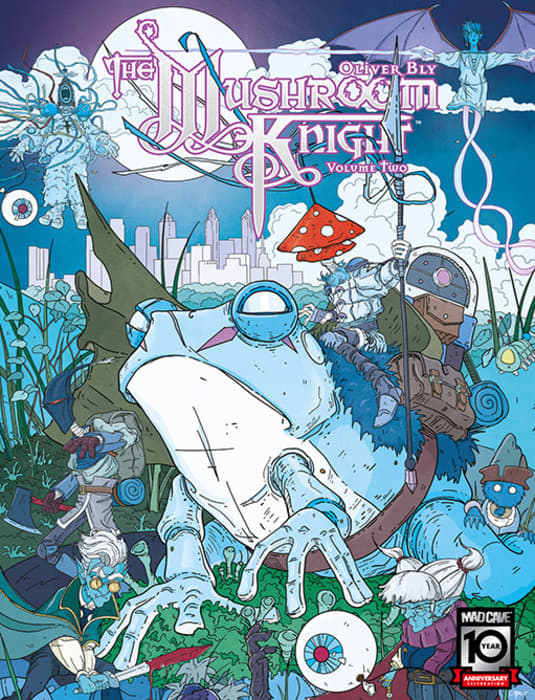
The Mushroom Knight Volume 2
From the publisher
An adolescent girl named Lem searches the deep dark woods for her missing dog, entangling her destiny with a chivalrous mushroom faerie named Gowlitrot on a mystical quest to protect the biome from catastrophic ruin.
As their friendship develops, Gowlitrot pledges to aid Lem in a quest to discover the fate of her missing dog, but as the search progresses, they uncover perilous betrayals that challenge the foundation of each of their worlds— both inner and outer. The natural world may never appear the same again.
PATREON
We have a new Patreon, CryptidCreatorCornerpod. If you like what we do, please consider supporting us. We got two simple tiers, $1 and $3. I’ll be uploading a story every Sunday about some of the crazy things I’ve gotten into over the years. The first one dropped last week about me relocating a drug lord’s sharks. Yes, it did happen, and the alligators didn’t even get in the way. Want to know more, you know what to do.
Arkenforge
Play TTRPG games? Make sure to check out our partner Arkenforge. They have everything you need to make your TTRPG more fun and immersive, allowing you to build, play, and export animated maps including in person fog of war capability that let’s your players interact with maps as the adventure unfolds while you, the DM get the full picture. Use the discount code YETI5 to get $5 off your order.
Global Comix
Save on a subscription to GlobalComix with us. Visit the link below and use the discount code COMICBOOKYETI.
[00:00:00] Your ears do not deceive you. You've just entered the Cryptid Creator Corner brought to you by your friends at Comic Book Yeti. So without further ado, let's get on to the interview. Hey everyone, this is... Hi Byron. Who is this? I'm your fairy godmother. I have a fairy godmother? Of course you do. I'm 50 years old, why haven't you shown up before? I appear when I'm needed. And I didn't need you in all these years? Do you want my help or not? Um...
[00:00:30] Sure. Exactly. I was just about to pitch our Patreon. Why would I need help with that? Because you're an idiot sometimes. That's hurtful. What were you going to put on there? We do comic stuff? So something along those lines? And this is why I'm here. You do know what people put on Patreon most of the time, right? Honestly, no. People need something a little bit spicy to entice them to support you.
[00:00:59] Nobody wants to see me shirtless. I doubt that's true. You are in pretty good shape considering your age. Thank you. Let's see. A little spicy. I've been bugging Jimmy to figure out what he's going to do. I know lately he's been playing around with his **** all the time. He loves to take it out and show it off. There's even a specific TikTok channel now. How's that sound? Not a bad start. People like Jimmy. What else you got?
[00:01:24] I told a story recently about being in a strip club with some of the four horsemen when I was working for WCW back in the day. I picked up an infection on my- WOOOOO! From the experience? I hate strip clubs. Is that better? Getting there? But maybe spicy shouldn't include infections you get in strip clubs. That's not sexy. We'll workshop it. Like I need more meating. At least tell them where to find it while we figure this out. Mother goddess, help this poor man.
[00:01:53] You can find us on Patreon at cryptidcreatorcornerpod. I'll put it in the show notes. Anything else you'd like to remind me that I'm bad at? How much time do you have? Why do you look like Rosario Dawson anyway? I appear the way you want me to look. Okay, that's disturbing. Wait, have you been showing up in my dreams? I'll never tell. And we're done here. Y'all, Jimmy the Chaos Goblin strikes again.
[00:02:20] I should have known better than to mention I was working on my DC Universe meets Ravenloft hybrid D&D campaign on social media. My bad. He goes and tags a bunch of comics creators we know, and now I have to get it in gear and whip this campaign into shape so we can start playing. Another friend chimes in, are you going to make maps? It's fair to say it's been a while since I put something together, so I guess? Question mark? It was then that I discovered Arkhamforge.
[00:02:45] If you don't know who Arkhamforge is, they have everything you need to make your TTRPG more fun and immersive. Allowing you to build, play, and export animated maps, including in-person Fog of War capability that lets your players interact with maps as the adventure unfolds while you, the DM, get the full picture. Now I'm set to easily build high-res animated maps, saving myself precious time and significantly adding nuance to our campaign. That's a win every day in my book.
[00:03:14] Check them out at arkhamforge.com and use the discount code YETI5 to get $5 off. I'll drop a link in the show notes for you, and big thanks to Arkhamforge for partnering with our show. I think I'm going to make Jimmy play a goblin warlock just to get even. Hello, everybody, and welcome to today's episode of the Cryptic Creator Corner podcast.
[00:03:33] We had an absolutely smashing 2024, and I'll take just a moment to thank you again, the listeners who support us each week with your ears, as you support these comics creators we talk to with your wallets. But there's no time to rest on our laurels because speaking of 2024, I have a returning guest on with me today.
[00:03:51] And let it be known that I have an eye for talent because since we last spoke, he's brought home a Russ Manning Promising Newcomer Award at the Eisners and the Next Generation Indie Book Award for the best graphic novel for the very book we are talking about then. And that person is microhyse maniac, Oliver Bly, and that book is The Mushroom Knight. And the second volume of it has dropped last fall, which we're going to get into today. But Oliver, how have you been?
[00:04:16] Oh, this year, since we last talked, I've been probably many things overwhelmed at times. I've been at peace at times as well. Worried and disappointed through a strange and surreal election year on top of everything. A bit apprehensive about the future, but I've also felt alive and creative and inspired. And I've also felt appreciated and celebrated, which is really nice. That's awesome. Yeah.
[00:04:45] I mean, yeah, October, that November timeframe, I think was tough for a lot of us, for sure. I mean, the 2016 election was a wake up call and, you know, I got, that was the get off my ass and get in gear. And so I did all these things and got involved in the local community. But I've just been telling people, you know, you try to make the difference where you can and the things that you're the most passionate about. And don't let the rest drive you crazy because it can, if you, if you let it in too much.
[00:05:14] So yeah, you can let your candle flicker and falter, but don't let it go out. Make sure that it doesn't. Yeah. I like that. Well, congrats on the Russ Manning Award. I mean, that's absolutely amazing. Did you get a chance to go down to San Diego and do it in person? Yeah. Um, which was really wonderful. Um, I did, uh, my wife and I were kind of able to make it happen last minute. I got the confirmation for the nomination, I think at the start of June.
[00:05:43] Um, well, I was actually taking a brief vacation up on Mount Rainier. Um, I was at the top of it hiking around and I got a little ping on my cell phone. Um, and actually looked at it and it was an email from Frank at Mad Cave Studios. I was like, Oh, I wonder what Frank's up to you and checked in and he let me know about the nomination. So it was really, really felt special because I was all alone and I was looking out at these snow topped mountains and I got to slide down on my backside going down.
[00:06:12] And there was just a beautiful moment of celebration and feeling childlike and joyful, which you only get so many of those. So I was, I was, I was quick to savor it. Um, but yeah, so then we, we decided we wanted to go for the ceremony and kind of in a whirlwind plan the trip, which San Diego Comic-Con is such a big to do that.
[00:06:36] Which I usually at that point, I think there's no room at the end, but we managed to find a place to stay and got our tickets to fly down from Washington state. Um, and, uh, we did the con as guests, which was fun. I didn't have a, uh, artist alley table or anything to set up. I wasn't lugging around prints or books or anything. So it, it was very celebratorial.
[00:06:58] And, um, then we went to the Eisner awards, which was such a surreal experience, but so beautiful and such a great life memory. I'm really, you know, if my career ends now, I will be so happy to look back on 2024 and to run my mind over and over again across that memory and walking into that ballroom and seeing so many, um, brilliant faces.
[00:07:28] That have inspired me, not just recently, but throughout my whole life, there was childhood heroes sitting at tables near me and to have walked into that room and sat amongst them for just a brief moment itself was such a great compliment and such a great heart feeling for sure. That's really cool. So did you get to meet, uh, all the Eisner judges? I was Ryan Claytor is a friend. So I was just curious if you got to meet Ryan and hang out a little bit. No, I don't think.
[00:07:58] I think, oh, I did. No, I don't believe I met Ryan. And so the Russ Manning award, I believe is adjudicated separately. Yeah. So it's awarded at the Eisners, but I believe in the history of it, it has been Russ Manning's, um, uh, previous assistants and the prior winners of the award who vote.
[00:08:25] So I believe going forward, I'll be able to vote as well. Um, but no, I don't, I don't think I, I may have met some of the Eisner judges in the drink line or something like that afterwards, but they didn't introduce themselves as such. Okay. Yeah. Tyler Cook, uh, hit me to a little bit of how it worked. Um, when I was chatting with him the other week, he said that he voted for you. So. Oh, well, thank you, Tyler. That's very sweet of you. I appreciate it.
[00:08:55] Well, I don't know if you saw it, but you also did win one of our awards. That's the, the ice or the Indie Comics Excellence Awards for the original graphic novel category. So it's not a Russ Manning, but you know, maybe I should get you a little trophy or something like that. Oh, I would love that. I'll put it on my, um, I have a little shelf of accomplishment that I, that I can go to and raise my self-esteem when it needs a little boost. So if you do, it'll surely find a home there. Well, I don't know how long it'd stay on the shelf. I was thinking about the perfect trophy for you last night.
[00:09:24] And what I came up with was find a good log, remove the bark, uh, Dremel in the, the award category and then put in mushroom dowels, like drill in mushroom dowels. And then you could throw it in the yard and then you could just decompose. Yeah. And that's just, I felt that was the most on topic thing we could come up with as a trophy. So, oh, that would be a beautiful ritual. Yeah.
[00:09:48] I mean, let your, if you, if you are serious about this, I give you my complete blessing to let your imagination run wild. Cool. Well, we'll see how time permits, um, in, in 2025. Well, to the mushroom night, volume two dropped in November. I read it when it first came out. And then again, the other night kind of refresh myself to see if I could find some more clues as there are loads of, of them that are chronicling kind of this time-spanning intertwined journey of, of Galilee.
[00:10:15] And then, and I want to dig a little bit into some of the creative processes of the book, but first I want to try to catch people up to, to what we talked about last time. So tell me a bit about where we find Galilee and Lim in book two. And we've added in what, what I'm calling kind of an ecological intrigue as the, the circle of gardens prepares for the hash cash. Am I pronouncing that correctly? Hash cash. Hash cash. Hash cash. Hash cash. Hash cash. Nice. Okay.
[00:10:46] Um, for sure. I guess maybe if you wouldn't mind, I could take a sidestep a little bit and give like a, uh, pitch of the, what the book's about in case, you know, folks haven't are unfamiliar. I didn't listen to the last interview. Um, but essentially the mushroom night, uh, the reason why I kind of want to explain it is cause it's, uh, maybe there's more to it than meets the eye.
[00:11:10] And it could be a little confusing, I think for the uninitiated, but, um, how I would explain it, I suppose is that there was a genre that was really prevalent when I was a kid. That's basically what I call kid find secret creature. Um, probably the best example of the genre or the most ubiquitous would be ET. Um, but the general gist is essentially maybe the kid's parents are getting a divorce or they are unliked at school or they moved to a new town.
[00:11:38] And it turns out there's like a dinosaur's egg in grandpa's basement and it hatches and the dinosaur can talk and you can't like tell the adults about your dinosaur because they'll ruin it or something. Um, and it could be like a monkey that escaped from the zoo or it could be a robot. Um, but they, these stories kind of follow a similar pattern a lot of the time. And the kid and the magic creature become friends. Um, and they go on adventures and the kid grows up a little bit because of the interaction. And usually the creature goes home at the end and that's it.
[00:12:08] And so the mushroom night is of that genre. It's the story of it is about a kid that finds a magic mushroom in the woods that talks to her and they go on adventures and there's going to be monsters and magic and demons and sword fighting and elf queens and fairy kings and all that kind of good stuff. But, um, it's also not just that.
[00:12:31] Um, when I was, uh, maybe 12 years old or so, my good friend Nick and I found an anime series called Neon Genesis Evangelion. Are you familiar with it by chance? I am. Yep. Yeah. It's gotten kind of like another renaissance recently.
[00:12:48] And, um, a lot of your listeners probably, or may have seen it or heard of it at least, but it's also a genre anime in that it could be kind of reduced to just saying it's a anime about giant robots that fight Kaiju. Um, you know, you've seen it with Gundam or even with Power Rangers where teenage pilots kind of, um, pilot a robot to save the world. But then Evangelion kind of starts taking acid and the genre gets bent.
[00:13:16] Like the trappings of the genre are shredded like a snake skin and there's a serpent underneath. And that serpent has a different purpose than just to entertain you with robots and Kaiju. Um, and when I was a bit older, I watched, uh, Twin Peaks, which I think we may have even talked about last time. Yeah. And Twin Peaks to me is like the idea is that it's an early nineties melodrama police procedural who done it. It's a murder mystery.
[00:13:43] Um, and it's got all these tropes of the nineties soap opera and primetime television from that era. And it's kind of the summation of the vibe of nineties television. Like it's a bit silly to watch at times because TV from that area from our lens is kind of corny, um, and dated. But as you're watching it, you know, um, Twin Peaks remains a melodrama, but, uh, and, and a police procedural, but it also kind of sheds its skin and reveals the snake.
[00:14:11] And the snake is like this piece of David Lynch art. Um, and so, you know, Evangelion can be a giant robot anime, but it's actually about the boundaries maybe between humans and human souls and the tensions between wanting independence and intimacy and total connectivity. Um, while still wanting to be your own thing and how teenagers, I think like, um, suffer emotionally because of disconnectedness. You know, that's really what the director I think was honing in on.
[00:14:40] And the genre was the canvas at which that was painted. And Twin Peaks for me, at least is kind of an exploration of how the human psyche copes with the harsh realities of our world. That includes a lot of traumatic things and how we relate to it through fantasy and make-believe. Um, we live inside of a dream is, you know, a comment that said over and over again in Twin Peaks, but it's also still a goofy soap opera.
[00:15:07] So, um, I mean, even to a degree, you could say that the Watchmen is a superhero book, but there's a snake in it. Alan Moore put a snake in it. And the people that love Watchmen love the snake more than they love the superhero stuff. But if you go in there just expecting Superman, you're going to kind of be a little confused as to what's going on in this book. Um, so using those examples to talk about Mushroom Knight, um, it is the story of this young girl named Lemuel Clemens who wanders into the woods looking for a dog.
[00:15:35] And instead she meets a magical creature, just like in the genre. And he's this little mushroom guardian of the woods and he's wounded and hurt. And he borrows a piece of her soul in order to restore himself and get back safely. And that's kind of the first book that's, you know, there's more to it than that, but that's a bit of the plot of the first book. And then in the second Gallytrot returns to find Lemuel and restores the piece of her soul that he took. Um, and as payment, he promises to help her find the missing dog.
[00:16:05] Um, but just like the examples that I used, it is this genre. Um, but there is a snake in here in disguise. And since the Mushroom Knight is an exploration of ecology, which means it's an exploration, um, of the relationships between living organisms and their environment and living organisms within an environment. And because the Mushroom is the magical creature, it's also about, um, spirituality and psychology.
[00:16:35] Because I think, um, those things in an anthropological context, but also in a maybe contemporary scientific context are deeply associated with the Mushroom. So to make a book for me about a Magic Mushroom meant exploring sort of how humans, our species, are in ecology with mushrooms. Meaning how we relate to mushrooms, the natural world in our larger environment. And it pays homage to this relationship we've had with a fungal kingdom since who knows when.
[00:17:05] So does that bring everyone up to speed? I think maybe. Yeah, I think so. I mean, I've always been fascinated by what to me is a clear link between our own neural network, you know, the way that all the neurons are connected. And, and the, the underground part of, of fungus, you know, and, um, how, how all those, they, they, as a, as an example, they're, they're, the parallels are just really, really strong.
[00:17:33] So I've, so I've always been sucked into mushrooms and I think there is a renaissance right now of people who have interest in, in mushrooms and potential healing capacity. I mean, you hear a lot of people talking about, oh, I'm now taking a reishi or a lion's mane or something like that, um, for, for cognitive, um, assistance, if you will, as, as folks get older and stuff.
[00:17:53] So, yeah, that relationship that we have with the fungal kingdom is expanding and deepening, um, as our understanding of them. I mean, they're so mysterious. It's such a mysterious world. And so many neat little tidbits are being revealed that have been, you know, sources of inspiration in the book.
[00:18:15] Um, and, you know, going back to what you're saying, the Hashkeshata, um, as the story goes by, we're going to learn, you know, more about mankind's impact on the environment. Climate change will play a role. Um, and one way is through this ritual that we see in book two, that's being prepared for by the different gnomes that inhabit Galitrot's kingdom. And the ritual is called the Hashkeshata, which, um, I'll spoil a little bit.
[00:18:42] It's where these, uh, these girdles, the, the gnomes, they, um, gather up plastic, which they call scrum from the waterways. And they perform kind of this costly magical ritual, which essentially nulls it out of existence, which is physically impossible to do. And since it is impossible, it comes at a great cost, which the reader can experience in book three.
[00:19:05] Um, but you know, like how, for me, how humans treat the world and climate change in general is a psychological and spiritual problem first and a physical problem second. Um, and it's interesting how mushrooms can relate to the inside world and the outside world in that sense. Um, I don't believe really that there's an inside or outside of the natural world.
[00:19:30] I think we are as humans, the natural world and our consciousness, our identities evolved sort of like fruit on the tree of life. Um, but our fruit might be harming the tree. So the curative might not be just repairing the tree or finding, you know, like Elon Musk and maybe another tree for us to inhabit. But on figuring out, you know, why, why are we in a hostile relationship with this tree? Um, this is our home.
[00:19:58] Um, and for me, those answers could be found in psychology and in spirituality. And that's sort of, again, the snake and the mushroom night, how humans can restore our relationship with the natural world by first restoring the individual relationships we have with ourself. And as we're learning more about mushrooms, we're finding they can restore the natural world and they can also perhaps restore or help restore our individual relationships with ourself.
[00:20:22] Yeah, well, to some extent, is that why Gali is, his, his specialization is on invasive species? I mean, it helps you kind of illustrate that metaphor in that way. Oh man, there's a spoiler in there that I can, my brain will nudge around. Um, maybe I'll just ask the question, who do you think the most invasive species on this planet is? That's a, a very, very excellent question.
[00:20:52] Um, I mean, I don't think I can act as somebody with an environmental degree. I think it is so important to, to look at the context of the ecosystem. So if you're talking about the planet, man, us, um, if you're talking about an individual space, I could go into like constrictors in the Everglades or something like that. But yeah, if you're talking about the whole planet, us, because we haven't, we don't have the same checks and balances as other species do.
[00:21:22] So. But what if we did and they were called Tridipidians and they were mushroom fairies that live just on the outside of our own perception and they've been watching us and waiting and seeing how we progress? Yes. Uh, you're going to give me nightmares all over. Yeah, there is a snake in this story.
[00:21:41] And, uh, part of the reason why I spent so long describing the snake is because I think some people, you know, they, the book does a good job hiding itself in the art and the covers and stuff like that. They look a little odd, but they could also read and clock a little, um, childlike or, um, whimsical.
[00:22:00] And there is childlike qualities to it and there is whimsy of it, but I would always, um, preface a reader that they're in for a different kind of ride maybe, um, than if they just had a straightforward fantasy genre story about a little girl that, you know, finds a mushroom. I think that's great though. I think that is the, the true attraction and talent of this series for me, uh, is that there is such a message embedded in it. Um, and it's a message as an environmental science major.
[00:22:29] I really enjoy it. And well, and anthropology because it is the sort of the nexus of those two things that is our evolving human culture and how we interact with the space that we call our planet. So, yeah. Yeah. Well, one of the things on the read as somebody who's, who's done a little bit of our teaching, as I have, I'm always looking for numerology and how in, in Western culture, that's typically in the form of a three.
[00:22:58] So if you can incorporate threes into your artwork, um, you tend to suck people in. If that is a native American, for instance, it would be four. So, you know, culturally it sort of depends, but it seems to play a big role in this. We see the repetition of threes here. You have three colors for the circle of gardens, three nights presented in this book, a glyph with three strikes on it, three boons that Gali will pay for borrowing some of them. Okay. Got to help me with the pronunciation. Ecraonic. Is it ecraonic? Yeah.
[00:23:28] Ecraonic. Okay. So that's her, her soul. Well, if you will, um, I'll leave it up to you if you want to explain the, the ecraonic well, but in, in Western culture, we have that significance of threes because of the Holy Trinity. And all that, but why did it end up playing such a significant role in this series? Cause I'm guessing it's not just as simple as, okay, people will really lock onto this three thing. Yeah. Oh, it's a good question. Um, and I could talk a lot about numerology and threes.
[00:23:56] There's other numbers of significance in the book, but of course there's even three books telling the first story, you know? Sure. Um, and it is sort of in the main symbol that Gali Trot's species, um, is represented by. Um, so I'm trying to think of how tangential I'll go, but this might be a moment where my, my brain takes a walk through the woods and we come back around to it. Sounds good.
[00:24:25] But I will say, I like, if you look at my artwork, a lot of people, something that they say is it's detailed. You know, they, there's a lot of little line works in the technique and I try to do the same thing with the writing as I do with the drawing. So that the writing and the themes are meticulous and the drawings are meticulous and the spiritual side of the book and the material side of the book both compliment each other and feel balanced. And sometimes that sort of painting thematic stuff a little bit like paint.
[00:24:52] So you build it up in layers and layers and layers, and then it becomes multidimensional and people start intuiting it, even if they don't necessarily logically understand it, they can feel it or sense it. And then when they finally logically get it, there's a catharsis or there's a really nice, um, reward there. Um, so anyway, maybe the aside would be that, you know, this, this book, one of the major themes is about realigning our species relationship to the outside world.
[00:25:22] Um, so subsequently understanding perception, I think is an important tool in that process. Um, in, from what I understand, uh, in psychodynamic therapy, um, which I almost became a psychologist. I'm sort of my career branched into comic books very strangely at a opportune time.
[00:25:46] So I took a dovetail off of that path, but in psychodynamic therapy, an intrinsic part of the process is understanding projection and transference. And a lot of people have used those terms before, understand them. Um, but the idea I guess is that to the uninitiated mind there, you know, again, is no outside world that the outside world is often perceived through your interior life or the summation of your past experiences.
[00:26:13] So the therapy kind of acts like a neutral sounding board that you can have this unique relation to relationship with that's intimate. Um, and subsequently you start seeing your therapist through your interior life and your projections might be revealed or your transferences. I guess you go through this process where you might read their neutral neutrality as hostility or judgment, or you might feel ashamed or afraid or have sort of a more complicated relationship with your therapist.
[00:26:42] Then maybe objectively that relationship is producing. And in the revelation there, you're supposed to understand that life has taught you some lessons along the way about people and what to expect from people. And oftentimes those lessons are unconscious and certain things can trigger those unconscious perceptions and you project them onto someone else that might be worthy of those projections or might not be.
[00:27:08] So the world becomes kind of this stage that your interior life is going onto. Um, you know, like an example could be maybe, you know, your boss has power over you in certain ways. Um, and that, and triggers an unconscious learned connection between you and a parent or an uncle or a teacher who had power over you while you were young. Um, and didn't use their power well. So that created a wound. And humans are filled with these wounds and unaware of them often. And these unaware wounds cause our personalities to form.
[00:27:38] Um, how we cope with stress, how we get depressed or excited, what attracts us, what jobs we prefer, we pursue or prefer. Um, a lot of this is based on unconscious stuff we learned in childhood, how to relate to the world. So that's a weird aside, a little clumsy diatribe, I guess, but what's that have to do with threes?
[00:28:00] Um, well, one, I wanted to say that because that understanding of childhood development, this is a book about a girl and she's growing up and we see her as an adult at the end of book one. Um, and that foreshadows a bit of where the series might go of how these childhood experiences are going to inform her personality. And if we want to repair the inside world by our outside world, by repairing the inside world, we need to learn how to go back to our childhood and kind of find these hurts and repair them.
[00:28:26] But with threes, all right, let me try to get back on track. We see a lot of eyes in the book. Um, eyes to me are, you know, culturally described as the doorways to the soul. Um, it's how we take things in. Um, the first picture in the entire series is an eye with a question next to it saying, what do you see when you see the wide green world?
[00:28:53] So it's already calling you to examine your preconceived notions, your projections that you might, you know, transfer onto the outside world around you. Um, scientifically, something that's interesting is we categorize the eye into three layers or tunics that includes enclosed various anatomical structures. There's also three chambers of liquid within the eye.
[00:29:17] Um, and we also have really importantly, three types of cones within the eyes that sense different colors. We have red sensing cones and blue sensing cones and green sensing cones. And so the entire world is taken into our bodies through the ecology of three colors through our eyes. So these eyes with which we receive the world and project onto it are already layered in threes.
[00:29:45] So there's already kind of like an interesting thematic, scientific, magical purpose in just how people are looking at the book.
[00:29:56] Um, and then in the mushroom knights face society to which garlic garlic is a part of it's administrated by three branches, red central command, which oversees the nights and protecting the gnome communities and green central command, which oversees the gardeners and their environment and blue central command, which oversees the magi and civil life amongst the gnomes. So they intentionally mirror the cones in humans eyes that are perceiving them. Um, and man, I, I really get at going off on diatribe.
[00:30:25] So I'm only just scratching the surface here, but you could see how that just one little question can be expounded upon. I think thematically with a lot of stuff within the book. And then we're getting more towards the snake and I won't reveal the snake yet and what the purpose is maybe for some of this, but. Maybe that at least helped give you a framework for which to kind of digest what I'm putting down. Oh, it absolutely does. And, and I will say people, I was, I will say people who haven't read this yet. Now this, this chat's amazing because now I get some right there.
[00:30:55] I got something that I didn't pick up on before, which is the circle of gardens and the RGB. Um, and I thought that was just you having trauma or something because you were trying to color all this stuff, but. I didn't give you enough credit. Yeah. Well, it's funny. The, the, there is a four color system, which is three colors in, in black, I guess, if you define that as a color or not, that the ink gets printed on and then distributed to the reader.
[00:31:23] But I work digitally with my colors on a screen that again has RGB color gamut on it. So my eyes in the screen and this whole world is being created with combinations or ecology of these three colors. And then that's how it's your eyes receiving it and subsequently your soul. And so we're connecting through this artwork with three colors. It's, I don't know that, that kind of stuff just tickles my fancy a little bit. Yeah. No, I, I'm, I'm definitely fascinated by it.
[00:31:51] Um, I think, I mean, with comics, okay, this is totally tangential, but yeah, it's, it's a, it's frustrating to me sometimes to not be able to see somebody's full vision because of course what we're actually experiencing is, is a CMYK as opposed to an RGB when they're printed. Right. But that, that's entirely something else. Yeah. And there's, you know, there's kind of a way that the computer software now speaks to your monitor to make it look like it's printed when it's not printed.
[00:32:19] But yeah, I cut my teeth in, um, animation and during like the VHS days. So doing NTSC, yeah, I believe that's right. I think they said that stands for never the same color and trying to match the animation that you're making on a computer to a television screen back then was very, very difficult. So I have a very meticulous, I guess, color process, um, that has translated into the book and way of thinking about color, I should say, in theory.
[00:32:49] Well, talking about the importance of eyes, um, they're, they're very, very memorable when, in the read through, um, especially because in, at the beginning of this book, you get one of the Knights, um, move a is that, how do I pronounce this correctly? Move a move a. So specifically with them, they have eyes in balloons and it's weird because it felt almost sort of wrong to me as an introduction.
[00:33:15] Cause you have this inorganic thing that is inherently of us, of humans, you know, placed in a story with a message about respecting the planet, you know, where you're, you're analyzing how everything is connected. Maybe, maybe that's the answer right there is this is how these two worlds are connected and that's, they're using trash. Am I reading some too much in here or? Well, the balloons are, are interesting.
[00:33:39] So to describe it to someone who hasn't, um, seen what we're talking about there in Gallytrot's world, there is a distinct kind of, um, subset of his creatures that are wizards. They're magi. And one of them is called Buve Bubaka. And he kind of cryptically floats in and out of different scenarios in the book. And he's really interesting character. Um, but we don't know too much about him right now.
[00:34:06] And he carries with him these floating eyeball balloons and he himself doesn't have eyes represented in his character design, but he carries these things around with him. Um, and there's a conflict in book two in which one bursts. It actually pops.
[00:34:20] Um, and so when I talk about thematic layering, like I do with my line work, um, people in, I guess, maybe occult communities or neo-pagan communities might readily kind of associate the element of air with intellect or the element of water with emotions. Um, the human eye is filled, I think 98% with water, which already is an interesting little poetic nugget to think about.
[00:34:50] Like what we use to see the world is made of emotions. You know, human beings are emotional creatures. Our emotions are integral to our humanity and our experience. But Muwe Bubaka's balloons, his eyes are filled with air, dry intellect. And they're external from him. So I think if you could even just sit with that, when you're looking at the artwork or giving it another read, it says something.
[00:35:20] And to me, part of how I like to create it, it's not everyone's cup of tea, but I write with those implications. And most people, maybe not most people, but there are readers that won't understand that or won't make those connections or won't know that they should be making those connections. And that's okay. Hopefully at the end of the day, the pictures are fun enough. The story is fun enough that when you read all three books together, you will have had a good experience.
[00:35:48] But I really love the idea of having a book you can reread, especially in today's transient media culture where there's always a new season of streaming stuff. There's always a video game. There's so much. To be able to sit by the fireplace with like a hardcover copy of these stories and to think about it and to flip back and to ruminate, that develops the internal life. That's how you get to know yourself, how you get to know humanity through art and poetry.
[00:36:17] And I don't know. I really, I get, I get more excited about that than the swords, you know, and the clashing of the weapons and everything like that. Although, you know, it has that too. Twin Peaks is a melodrama. You know, Neon Genesis Evangelion has the giant robots and it's really exhilarating when they fight the monsters and stuff like that. And this will give you this too. But if you want to sit down and think about what it means to have a balloon eyeball, this is also your book.
[00:36:45] Well, walk me through some of the designs and some of those choices. I mean, you said you came from the animation background. And when I think of knight, these three are, this is not what I think of, right? You think of the knights at the round table as an example where there's a uniformity to their presentation that almost creates that sense of team cohesion. And they don't really operate as per se as a team at all in my read of this.
[00:37:12] But you've got Gali, you've got Muwe, and you've got Ertigode? Or is that right? Ertigoud. Ertigoud. Okay. So my association was, I mean, I grew up in that era. So I just immediately thought, you know, Fraggle Rock and Trash Heap and that kind of thing. So what else were you pulling from in kind of putting their look together? Well, I mean, I will say I love Jim Henson.
[00:37:42] He is, what a beautiful menagerie he created. I think he really did a good job of bringing heaven to earth and foam and fur. And his contribution to, I think, our species was really remarkable. And I really love his designs. So he is both a spiritual, I think, influence as well as a character design influence to a degree.
[00:38:08] But for the characters of Mushroom Knight, I really wanted them to have an old world quality to them. Sort of a cult quality to them, but also a hyper newness. Because the books set in the 90s, I wanted, you know, the colors to sort of represent to a degree what was going on in the 80s and 90s.
[00:38:36] Not just comic books, like superhero comic books, but also comic strips and newspapers where you get Bazooka Joe gum and there'd be a Bazooka Joe strip in it. How they, the palettes that they use, which were often very bright and vibrant. And I even have, like, I think in some of the paneling and layouts, there's some quirks that speak to that. How I use panels is very strict. It's very kind of an old timey way to a degree.
[00:39:06] But Lemuel, the girl in the book, you know, it's set in the mid 90s. And I'm also trying to pay homage, I guess, to a degree of, you know, what she's taken in. What pop culture stuff she's taken into her world. You know, stories is one of the ways that we learn about the world as a kid. So her brain's going to be flooded with stuff like Ninja Turtles, like Peanuts comic strips, Calvin and Hobbes and what have you. So I kind of painted some of that in there.
[00:39:33] But again, the creatures she's encountering are supposed to be representative of ancient spiritual beings. In some cases, they could be, you know, thousands of years old. So I also needed to pull inspiration from other places. So, I mean, one of the things I like about that is it gives attention, I think, between the old and the new. But I've always liked the idea of like the sacred and profane being two sides of the same coin.
[00:39:59] What is angelic in life is often surprising or ironic. So you could find the sacred in comic books, like kind of this profane medium or that pop culture iconography, you know, doesn't have to be vacuous, especially 90s iconography, which is often celebrated for being vacuous to a degree or commercial or essentially materialistic. You know, it's in the material world that we find the soul. You find the soul and matter.
[00:40:27] So you'd find the ancient spiritual creature at the shopping mall and the video game and the TV commercial. So those things are kind of that aesthetic, I think, filtered in as well. You know, you will find the you'll find something profound in the Bazooka Joe comic strip. That's the character design ethos of Mushroom Knight, I think.
[00:40:47] Well, specific to Gali, because you talk about this in the afterwards and it made me go back and flip through because I didn't miss he has no face and I didn't miss him being emotive anyway. And you talked about using body language and the reader's intuition to go on and how that allows us to kind of connect with him in a different way than we do with a lot of characters we're presented with in comics. So it seems like you decided to do that from the very beginning.
[00:41:15] So how did you imagine that enabling people to kind of connect with him more as a choice?
[00:41:27] Yeah, I mean, I guess, you know, when I was kind of giving like in my clumsy summation of psychodynamic therapy, you know, mentioned projections or sort of the idea that it is sort of easy to unconsciously receive a neutral outside world with your own preconceived notions of what to expect.
[00:41:47] And I think in maybe denying Gali Trot a face, I think that invites the reader to imagine on their behalf what he's feeling. And one of the nice things about, you know, sending your inside world to the outside world and sending the outside world to your inside world is that's relational. You know, you're taking something outside of yourself and marrying it to yourself in a certain way.
[00:42:11] And I think when you take something out of yourself and put it on paper in a form of art or something like that, that is a relational, profound act. And so when the reader then can look at Gali Trot and put a bit of themselves onto him, something interesting, I think is really happening. That's connective and it allows them to kind of make it their own. Maybe it's a redemptive form of projecting. I'm not really sure.
[00:42:36] But it also like denying him the face, I think, keeps him on sort of the nice side of the uncanny valley. Like, I think it's better that we meet the inhuman or alien with our own humanity than try to maybe create humanity out of the inhuman and failing.
[00:42:57] Kind of like when you look at sometimes CGI missteps are a little eerie because they're, you know, or the new AI generated stuff that's trying to make stuff that's realistic. But someone has something slightly wrong in your brains, kind of like, I don't know what it is, but this is a bit creepy.
[00:43:14] I would rather go like the R2-D2 style where it's more, you know, you get those beeps and whistles through your own imagination, your own digestion, your own understanding of humanity become more alive than trying to make something, I guess, too relatable and failing. Yeah, I mean, well, R2-D2 also worked because of the roundness of his design. He's just very soft. He is, yeah. Yeah.
[00:43:40] Well, kind of it's contrasting because you have Gali and then you have Lim. You went a little bit into what her design is kind of coming off of. But the relationship between her and Gali gets way more personal in book two than it did in the first one. She actually says, I love you fairly quickly. So with her, there's kind of a profound innocence that I found myself drawn to wanting to be more open and receptive, you know, just delight.
[00:44:10] And I think we, as adults, tend to lose that. And I think that's why a lot of people are drawn even to, I think that's why YA is such a big genre now, because there's a sweet spot there of kind of capturing a little more of that innocence that a lot of us have seemingly lost. So, you know, many people are currently sort of shielding themselves from anything they can identify as other. And everything has gotten very, very tribal.
[00:44:38] So is she sort of, in effect, the message or is she just in an innocent phase? Is she in her YA phase? Because not to give a lot away, but you don't just get one version of her. And we can leave it at that. At least on my end. I'll let you elaborate how you'd like. Wow. I mean, I think what you said about like recapturing what was lost in childhood, I think is really interesting.
[00:45:07] Because I think we do, the return to childhood, I think is a psychological process that a lot of people go through. We learn so much at that time. Um, so a lot of our foibles that we either have to overcome or the joys and talents that we have to get celebrated come a lot from, you know, just simply what we learned about life at that point. But you're kind of start life with such a great well of, um, positivity and hope and imagination and curiosity.
[00:45:37] Um, and the traumas of life haven't really set in to make you world wary. Um, and, uh, I think being able to look at our reality and it's stark naked horror and grandeur and not turn away, but to see all the wars, all the horrible things that humans do to each other yet still feel beauty and still feel hope.
[00:46:06] And still feel love and still feel optimistic and to not be run over by it, but to be able to counter it, to grow with it, to engage it and accept it is the purpose of us being alive to a certain degree. So returning to YA, like, yes, I think what a lot of people are doing is following the path of their soul to find the purpose of why they're here and to help confront what we are ensconced in is dark.
[00:46:34] You know, there are a shadow and light to our reality and a shadow is fucking scary, you know? It is. Um, and it shows up, there's so many things about life, you know, death chief amongst them that, um, gosh, are traumatizing. Um, but keeping that childlike power to love in the face of it is, is crucial.
[00:46:59] So Lem is a good, and through her life, if I get to keep telling this story, we're going to be able to see how she does or doesn't be able to access, um, parts of her childhood. Um, and I will, I guess going back to her greeting Galitra, I will say she does it first when she sees him, tried to kill him with a Bible.
[00:47:22] Um, she does slam her Bible on him, which I, um, maybe I'm trying to get ahead of perhaps some wayward Christians that are quick to judge things that they don't understand fully as threats. There might be a little wry commentary there, but, um, I don't know. I think even fear is, uh, maybe an important and beautiful emotion that we should listen to our fear and learn from it, but we don't necessarily need to act out of it or from it. Um, fear can tell a story, I think.
[00:47:52] Um, and you know, as the mushroom night continues and, and people understand the snake that is being revealed in, in it more and more, um, one of the lessons might be how to learn, use fear, maybe not for tribalism, as you said, but for unification. Um, because there's things in the world that we should be afraid of that we aren't and things that we are afraid of that we shouldn't be, you know? Yeah. Riders and sharks. It's the perfect. Sorry, what was that? Ladders and sharks. Ladders and sharks.
[00:48:21] So what is everybody afraid of? Sharks. What should people be afraid of? Ladders. Oh, yes. Yep. Because there's so many more deaths. Like it's, it's, uh, orders of magnitude. I mean, like how many people actually die from shark attacks every year? Three, four? Um. Oh, if, I think. I'm not up to date, but I know that the fear of sharks is, you know, it's, it's understandable. It's rationally unrational, you know? Yeah. But yeah, sharks and ladders anyway.
[00:48:51] Sorry to interrupt you, but that's, that's the example my wife uses constantly for, for, to illustrate that point. Yes. Yeah. Um. Um, but you know, I mean, it's so much about childhood too, is learning about fear and what to be afraid of and how to overcome fear. And sometimes I think even in childhood, well-meaning adults teach us techniques to overcome fear that, um, don't necessarily work.
[00:49:15] You know, they don't always, um, cause they, they might, I think one thing, uh, I'm, I'm getting a bit ahead of myself. So I'm just going to put a cork in that, I think. Okay. Thank you. I mean, I get what you're talking about. My dad did, and I'm sure everybody has that, that example too, but my dad's way of, of dealing with what he was scared of was to suppress it.
[00:49:41] And he created a macho envelope and then he transposed that macho envelope onto me and my brother. So like to this day, I have this issue with straws because he always called them sissy sticks. So. Wow. Mm-hmm. There is so much in our humanity that we've turned into sissy straws across the board.
[00:50:07] Um, that has robbed us, I think of so much. Agreed. Well, I'm curious about you confronting fear and as an artist, as a writer, you know, this is one of those projects where you're doing almost everything. You have, I think a letter, there's another letterer who's working on the project with you and you have some flatters and stuff, but inevitably because this is taking years of your time and you're so embedded in it. And you have the creativity to, to adapt.
[00:50:37] So I'm curious from when you started to now have, obviously there's a through line, right? So we talked last time about deep ecology, having a deep imprint on you and in the story, this interconnectedness of all things. But are you finding that other things from your own life are working their way in? You know, is, is being a Russ Manning award winner changing your approach to, to even how you tell a story? Winning an award changing my approach.
[00:51:06] No, I don't think so. And it's, it is fuel. I think like if you get, um, recognized, um, one of the best uses for recognition is to keep going. Um, you know, life is a path, it's a journey. And a lot of time you go into it blind with some guidebooks, but you kind of have to learn through experience. And when you get an affirmation like that, it can be like, okay, I think like the winds are blowing in my favor.
[00:51:35] I think I should keep going with this. This sounds good. Um, as far as my own life going into the project. Yeah. Um, I mean, through my own therapeutic process, my own childhood healing, my own, um, interest in myself. Um, which I think a lot of artists have, you know, you, you do impregnate your work with your DNA, you know, at different points.
[00:52:02] Um, as far as fears go that I might have put in here or given to them or galley try. Yeah. I mean, um, like, uh, betrayal is a fear of mine. Um, but like, like being manipulated or lied to is a very personal fear that I have. And that's sort of something that is part of the fabric of the story without spoiling anything.
[00:52:30] Um, so for me, um, as a person that tends to go more airy, when I look at life, I tend to be more of a head person. Kind of when my head has been fooled or tricked or manipulated is an existential crisis for me. So you could probably see that in the book with some of the characters, galley trot suffering from a betrayal that he doesn't understand.
[00:52:58] Um, and I think as a kid, uh, lamb, well, we'll have to see, I think how lamb relates to that specific factor in book three, but, um, I'm going to put another cork in that balloon before I pop something. I shouldn't prematurely. Well, fair enough. Well, I know you're working on volume three now.
[00:53:19] So in terms of process, I noticed a couple of changes from, from book one, namely being the kind of recruitment of a cadre of flatteners to kind of help you out. I think you had one in book one and four, unless I'm missing, like missing something in this one. Yeah. I think there's a couple more. I have it next to me, but what essentially happened there and to your listeners might be savvy enough in, um, comic book creation to know what a flatter is, but just to give it, um. Um, most of them are, but yeah. Yeah. Yeah. Yeah.
[00:53:48] An explanation to the, the layman. Um, when you're coloring comics digitally, you kind of get this naked page of just black and white line art. And there's a process, a preliminary process, um, before you actually start coloring, that's called flatting and it is coloring.
[00:54:06] Um, but it's basically laying down blocks of color under the line work in a program like Photoshop, for instance, um, that are flat colors, meaning there's no special effects. There's no shadows, gradients, anything like that. It is just solid flat color.
[00:54:27] Um, with all the colors being consistent so far is if the picture is of me in a bedroom, my skin color is the same skin color throughout all my appearances in each panel on that page. My bed in the bedroom has a comforter. That comforter is the same color in each panel on the page. But oftentimes the colors that the flatters choose are nonsensical and kind of funny and fluorescent.
[00:54:56] So when you get your pages back from a flatter who does all those, you sort of look at this. Oh my gosh, Jesus. You know, the skin colors could be wild. The hair colors could be wild. They could be whatever they are. Cause the point is not to actually look colored, but to make it so I can get a magic wand tool and a program. Select my comforter duvet cover color and then change it to the one that I want. But I don't have to meticulously put in those blocks under the line work because it can kind of be time consuming.
[00:55:26] So that often gets outsourced to a flatter. The flatter is a person that does that blocking out of the color. Um, and the reason why there's so many on book two is, um, the flatter who I had used was, um, preoccupied. Um, in book one and book two, she had some other engagements and wasn't able to turn around, um, some of the pages in time for the deadline.
[00:55:54] Um, so I had to, I found another flatter who could do, do backup work, but then they had a crisis and, um, they weren't able to complete by the deadline. So then I contacted a lot of flatters just in case. Welcome to comics. Yeah. Um, and gave them, um, each some pages to work on. So it was a lot less work for one flatter to have to do, especially as they were learning my style and we're developing the relationship, but also got, um, you know, it was nice.
[00:56:22] I got to branch out a little bit and, and met some really talented flatters through that process. That's really cool. Or are you finding kind of a rhythm and flow to things that's become easier as you've continued to work on stuff? It's like three going much quicker than volume one. Um, yes. It's, uh, on one hand, yes. Uh, once I get drawing and I'm turning pages out, it feels pretty good, but I, I still always underestimate how long it takes me.
[00:56:51] And sometimes, especially at the beginning of a book, it takes me a while to crack into it and to rev up. Um, and I can really get distracted and, um, lose energy. And so, uh, I always wind up crunched no matter how well it seems that I plan. I made a production schedule for this book that's week by week and it looks like I'm slowly catching up to where I need to be, but that means working some pretty long hours until I'm set. Um, so yes and no.
[00:57:19] Hopefully at some point I'm in a, I have realistic expectations of my abilities, but I think sometimes if you in comics say like are realistic with how long it's going to take you, you're kind of like, oh man, that's a long time. Do I really want to do this? Yeah. So you might do some self trickery and be like, ah, yeah, we'll see how long this takes. And then, you know, we all do that every day in little ways. Right, right. No harm.
[00:57:48] Well, the other thing I noticed was I'm starting a video series about disability in comics and I'm paying way more attention to sensitivity readers. And I noticed Amber Williams was credited in volume two. I don't think you had a sensitivity reader in volume one that I recall, but now having read it twice, I'm, I'm sort of unsure exactly what you were concerned about. People locking onto that. You thought another opinion might be helpful, but whatever the reason, Hey, thank you for being thoughtful and, and sort of addressing whatever that issue was.
[00:58:17] But I didn't pick up on anything. Well, that probably means Amber did a great job. Yeah, that's true. That's true. Um, no, Amber actually was with the project from really early on. Um, and she was a sensitivity reader for book one, um, as well as book two and book three. Um, the reason why she wasn't credited in book one was because it actually, since I wrote the script and when I wound up at mad cave, um, a couple of years elapsed.
[00:58:47] Um, since I talked to her and when, you know, I hired her out of pocket to give the scripts a read and had asked if she wants to be credited. And she said, no, um, at the start. And then I moved forward with mad cave and we got book one was almost done when I, I signed the contract with them. So it went out to press pretty shortly after we, we signed, signed the contract.
[00:59:11] Um, and then I was thinking, I was like, I wonder if Amber still feels the same way about not, not, um, being credited. So I wrote her an email and asked her and she was like, yeah, actually you can put my name on it. Um, it's becoming more of a common thing. It doesn't feel strange. So, um, she got credited for book two, um, with the idea of book one, I told my editor, you know, if it goes back into, it goes, gets a second printing.
[00:59:36] Um, to put her name in the second printing, um, for the bound book that'll have all three volumes together. She'll be there for all of them. Um, but for using a, a sensitivity reader, um, all writers are thieves, of course, you know, and, and we appropriate everything. Um, and it's part of the job. And I think it is always good to be sensitive, um, where you can be and when you can, and, you know, especially, you know, race.
[01:00:06] This is such a, um, importance and deeply, deeply personal subject, um, that you walk into waters where sometimes there's not a right or wrong. There's feelings and there's, um, and opinions and what have you.
[01:00:24] And I think in those cases getting, um, honoring, um, the danger and honoring the, um, feelings and the importance of, of crossing those boundaries. I think by, by floating someone some money, you know, and saying, Hey, like I value your, you and your experience is different than mine. Can you keep an eye on this?
[01:00:46] And, and what you really want, I think is, you know, the cynical side is you don't want to make an asshole out of yourself, you know, and you don't want to like, whoops, I accidentally did a racist or something like that. Right. And the internet's going to point that out. And, you know, if you write for a racist, not yours, they're kind of like, you know, there's people who's almost day jobs are kind of waiting for you to fuck up in life and let you know about on the internet and try to take away your dignity or something like that.
[01:01:10] Um, so that's like the cynical self-protective way, but also you don't want to, you know, you want to reduce harm that your work can have, you know, the, you, you sit down and you work so hard in your arch. It takes you so freaking long to, to make something like this. And how sad would it be for someone to crack this open and they feel accidental pain because, um, you maybe weren't careful or didn't see something. Yeah.
[01:01:36] And that's going to happen sometimes, you know, it's, it's going to, we're, we are human. And so to err is part of the deal, but if you can't like, you know, I have a, I have an editor that, you know, reads my words to make sure that they're spelt correctly and they make sense. So I think, um, in places where there could be spiritual pain, psychological pain, having someone that reads through that and can maybe bravely aha that and talk to you about it. If that is a case is well worth, well worth the money. A hundred percent. Oh yeah.
[01:02:07] You don't want somebody to miss the message just because. Yeah, exactly. And how embarrassing and how sad. And I don't know, there's, it's just such a, as far as cost risk goes, it's, I mean, it's remarkably in favor of doing it. I think. Yeah. It was very interesting. I interviewed Peter Warren, um, and Gianna Marie, who is the sensitivity reader that worked on the Tin Can Society. I don't know if you got a chance to check out that book, but. I've not, no.
[01:02:35] As somebody who's, who's disabled and seeing a disabled character portrayed in that way was so refreshing. So I'm, I'm anyway, I'm a big advocate for, for sensitivity reading. So, so thank you for including that in the book. Yeah. And Amber was lovely to work, uh, with Amber Williams.
[01:02:53] You can Google her and I'm sure her name and contact info will come up if you're out there writing a comic and it's, you know, she does sensitivity readings, not just for race, but also for, um, other, other different aspects that might need some care. Nice. Sounds good. Yep. Well, can you give us a tease about what might be in store for book three without popping any balloons?
[01:03:22] Your newsletter tells me there's a Falcon character in there at least. Looks pretty cool. Yeah. Um, I've, I've still not fully named. I've had a couple and I've, I've flip flopped back and forth. So it's an unnamed Falcon character who's kind of like a, uh, messenger. So can, you know, uh, take little scrolls of information and deliver them through the mushroom nights, uh, fantasy world.
[01:03:48] But Gally Trot in this volume uses it to communicate with uses the Falcon to communicate with Lem. And as the story progresses, even outside of book three, um, it's the main way that they get messages back and forth together. Okay. But of course they're all really small. So Lem needs a magnifying glass to kind of open up these little scrolls and, and read what Gally Trot has written her. Which I think skew. And then she needs to figure out how to write something really small in order to send it back. I like that.
[01:04:17] So Falcon can only hold so much, but for spoilers for three, um, or. There are a clue or tidbits, I guess. Uh, let me think, uh, without getting myself in trouble. Um, there's going to be some major character deaths. So get your box of tissues ready. And if that's, um, something that's painful or scary for you, there's your, there's your warning there.
[01:04:45] Um, I think it's gonna give you the shape. Of what the snake is. Of what I'm really getting at with these books. If you start book one, which is kind of the intellect book or the air book, you're like, this is confusing. It's overly intellectual. There's a lot of terminology, a lot of, um, dobbledygook and exposition and stuff like that. Um, but it's doing the work of the head.
[01:05:14] And then I feel book two does the work of the heart. It's the emotional book. Galley trots ensconced in water. Um, in it a couple of times. Um, and then book three is the soul book. It's the intuitive book. It's the book of fire. Um, okay. And when all three of those are put together, I think you're going to have a good, oh, this is what this series is about. This is where we're heading.
[01:05:43] And this is what some of the mystery is. There's, there's still going to be ongoing mystery and intrigue and it's the, some of the stories really based on Tinker Tailor Soldier Spy, which is a favorite book of mine. I really like mystery novels. So that's going to persist. But I think when you put this down, you're going to have a sense of completion and a, hopefully a sense of, oh shit, where are we going to go now? Okay. Well, I'll throw out my, uh, my speculation then, uh, for character deaths in the ring. I have disclaimer.
[01:06:12] I have not read anything. Oliver has shown me nothing, but based upon what I have seen thus far and what is in the afterward. And I will encourage people to go check this out and obviously read it. I'm going to go with Green Chieftain Shaw and you don't have to say anything, but that that's my guess. So, um, at least one of the characters that's going to bite it. Um, but yes, if you want more clues, make sure to sign up for, for Oliver's newsletter. That's a small blue mailbox. I'll put a link in the show notes to make it easy for you.
[01:06:41] And I saw on there that you were carving gourds instead of pumpkins for Halloween. Now that I've seen it, I don't know why we all don't do something similar because pumpkins are a lot of work and they degrade really, really quickly. But okay. Okay. I do get a perverse kind of satisfaction from sort of watching their weird forms as they morph and sort of degrade and the green takes over. Um, and it reminds me of like a, uh, a darker sand mandala or something like that.
[01:07:09] Anyway, gourds will last much longer though. And after watching the video that you shared in the newsletter, I'm never carving a turnip because I don't understand why Irish people do that. And it's really, really creepy. It is very creepy. Um, the newsletter that, uh, Byron's referring to the small blue mailbox. I send it out monthly. Um, if you get any spam, it's not from me, it's from Substack, which hosts it. And you can turn that off.
[01:07:36] Um, but if you listen to this interview and you're like, this man is strange, but compelling. I kind of want to know more about his philosophies and his ideas. Because I, I don't, it's not a very long, um, newsletter, but I do have categories each month, which are a bit of nature, um, a bit of art, a bit of magic and a lovely little song.
[01:08:02] So I try to give you a little bit of nature, something magical, um, a piece of like behind the scenes art. And then I close out always with like a song that's inspiring me that month. And so what Byron was referring to was a, um, I think it was for magic. I talked about how I make jack-o'-lanterns out of dried gourds, um, which you can buy online. Um, and they're not very expensive and you can use a Dremel tool or a sharp exacto knife and some safety gloves.
[01:08:32] And you can carve a face in the dried gourd. And it's sort of a similar process basically to carving a pumpkin. Only gourds are, dry gourds are hard. Um, and you can use a stain on them afterwards. Like you would stain wood. So you can, they kind of have like a dried out look to them at the beginning, but you can use oils or stains and different, just like you would, would, uh, finishing treatments on them that can make them quite beautiful. And so I'll do that. I'll stain them. I'll paint the insides of them.
[01:09:02] And then what's nice about it is if you like Halloween, you like carving jack-o'-lanterns, you do get, um, I don't know how permanent they are, but. But they certainly last a very long time. So you can take them out year after year and they make fun gifts too. If you're like, oh man, I have a collection now of six jack-o'-lanterns. That's enough house decorations for Halloween. You'd be like, oh, I'll give this to a friend of mine or I'll give it to a kid or something like that, that I know. And it's, you know, it's fun.
[01:09:26] Um, carving pumpkins is really fun too, but I just sort of, um, liked collecting them over the years. And they sort of, um, tell a story of each, each Halloween, I suppose, when I look at them. Yeah. Well, not dissimilar to Christmas ornaments in a way. So. Yeah, exactly. There you go. Yeah. Well, I mean, screw the whole, you know, only going to pull these things out of Halloween. I'm going to make them and I'm going to like have behind me next time you'll see the gourd that has a bat symbol.
[01:09:54] You know, I'll put an LED light in it and make it fancy. Oh yeah. I mean, outside of doing a jack-o'-lantern phase, if you look at carved gourd art online, there are artists that that's their medium and the stuff that they do is phenomenal.
[01:10:10] You know, they'll do, uh, I mean, it's not just, you know, modern contemporary artists, a bunch of different, um, people groups through the world have used gourds or gourd like things to make art at different points. But, um, in that it's not depictive of like a face or something like that. They could be abstract or patterns or, um, even portraying a story or something like that through them. And then the tools that they use, you know, it doesn't necessarily even carve through the gourd.
[01:10:38] Sometimes they're carved just into the surface, but then when you put a light in them, it like illuminates them in a different way. And it's really gorgeous. Yeah. I've seen those. There was a Hawaiian artist and we were in, um, on the big Island and we went into a gallery and they had a whole bunch of things. A bunch of carved gourds like that, where they had different depths and it would bring out, you know, shadows and, um, different lines and illuminate it in different ways. It was really cool. Now I know what I'm going to be doing tonight on, on Google.
[01:11:06] So, um, what's the timeframe for volume three to be released to the mushroom ride? Do you have any indication yet? Um, I do a little bit. I don't want to step on, uh, PR's toes by announcing it too early. And again, um, it might even be a bit tentative depending on how quickly I'm able to get it done, but, um, it'll definitely be out this year. Um, in 2025. Oh, way cool. Well, I'm not kidding everybody about Oliver's talents.
[01:11:34] Um, I'm, I'm an absolute believer, you know, as I said at the beginning and the first time I laid on on his work, I knew that this was a special book. So, so make sure to pay attention to it if you haven't picked up one, pick up one and then two, you know, in this industry that is designed inherently to turn out IPs like a Starbucks barista.
[01:11:54] This is, this is a very thoughtfully crafted book that you can, as Oliver was talking about earlier, actually go back and absorb it again and pick up something each time you read it. And I've done that. So it's a testament to your work. So make sure to invest in Oliver here and his future selfishly for me, if nothing else, because everybody loves me. So, uh, volumes one and two are out now. So make sure to pick those up. Where can people find you online? Oh, um, I am on Instagram at Oliver Bly.
[01:12:24] I have a website that's not that interesting called obly.co. And then the newsletter that I mentioned is oliverbly.substack.com. Cool. You need to get some stuff up there on the website to sell to people, my friend. I know it's, you know, it's, so I'm going to finish volume three. Then I'm taking a bit of a hiatus to kind of do housekeeping.
[01:12:45] Um, and to, yeah, get some of that stuff in gear, but it's always on the back burner, but there's always a page to color, uh, something to draw. It's tough. It's tough. Yeah. Well, Oliver, it's always a pleasure, my friend. We'll have to get you back on whenever book three is released. And we'll be, have that damn. That's what he was trying to do. Chat. Finally. Yeah. I can, I can not be quite as careful as the censoring part of my mind has made me during this interview.
[01:13:15] For sure. Me neither. It is, is a challenge on my end to try to talk about a lot of these characters and not reveal things to entice people to go read it without giving too much away. So that will be a fun chat for sure to not have to, to have the walls up or barriers. So. Yes, sir. All righty. Well, this is Byron O'Neill and I'm all of us at behalf of all of us at comic book Yeti. Thanks for tuning in and we will see you next time. Take care everybody. This is Byron O'Neill.
[01:13:42] One of your hosts of the cryptic creator corner brought to you by comic book Yeti. We hope you've enjoyed this episode of our podcast. Please rate review, subscribe all that good stuff. It lets us know how we're doing and more importantly, how we can improve. Thanks for listening. If you enjoyed this episode of the cryptic creator corner, maybe you would enjoy our sister podcast into the comics cave. Listen and subscribe wherever you get your podcasts.