
It's an exciting day here on the Cryptid Creator Corner as Jimmy chats with legendary writer Peter Milligan! Peter has a new series out through Mad Cave Studios with artist Val Rodrigues. The Pale Knight #1 is out May 28th. It's a fantastic first issue. Peter chats about the series, his fascination with the time period, working with Val and Mad Cave, taking inspiration from Bergman's The Seventh Seal, and creating Sir Hugh de Grey so that he feels like a man of his time but is still relatable. This is a wonderful conversation that leads into some interesting territory and you don't want to miss it.
WATCH ON YOUTUBE
From the publisher
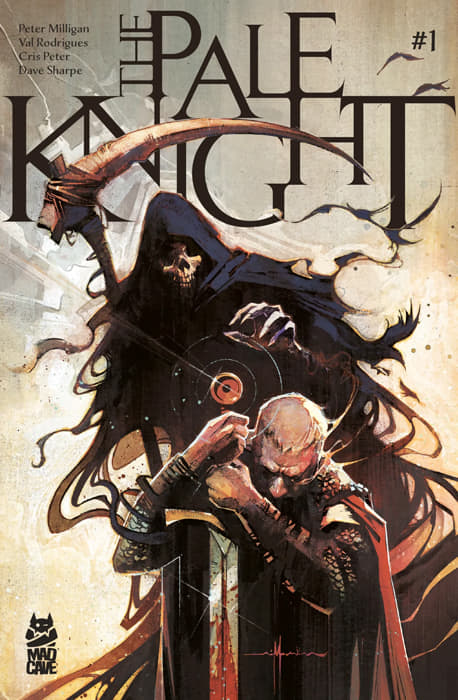
England, 1349. Sir Hugh de Grey, the Pale Knight, returns from war to find a land ravaged by the Black Death, and his son dying of the plague. When he prays to God to save his son’s life, it is not God who answers—but Death himself. And Death is willing to cut a deal.
PATREON
We have a new Patreon, CryptidCreatorCornerpod. If you like what we do, please consider supporting us. We got two simple tiers, $1 and $3. Want to know more, you know what to do.
ARKENFORGE
Play TTRPG games? Make sure to check out our partner Arkenforge. Use the discount code YETI5 to get $5 off your order.
THE LANTERN CATALOG
Created on the premise of creating light in the dark, this is the the go to resource to keep you up to date on the indy projects and the creators you love. You can find them at https://www.thelanterncatalog.com/.
Make sure to check out our sponsor 2000AD.
[00:00:00] Your ears do not deceive you. You have just entered the Cryptid Creator Corner brought to you by your friends at Comic Book Yeti. So without further ado, let's get on to the interview.
[00:00:30] Show notes and thank you for your continued support. Thanks for your donation.
[00:01:08] I'll see you next time.
[00:01:32] Subscribe now or download the 2000AD app and why wait? Start reading today. I'll put links in the show notes for you. Hello and welcome to Comic Book Yeti's Cryptid Creator Corner. I'm one of your hosts, Jimmy Gasparo, and I am absolutely honored to have the guest that I have on the podcast today.
[00:01:51] He has written so many different comics, both in the UK and in the US. He's written for 2000AD, Vertigo Comics, Marvel, DC, more recently, Vault Comics, Human Remains with Sally Cantorino was one of my favorites. But we're here to talk today because he has a brand new series out with Mad Cave with artwork by Val Rodriguez and also Christian Peter and Dave Sharp.
[00:02:20] We're talking about The Pale Knight. Please, please welcome to the podcast, Peter Milligan. Peter, how are you doing today? I'm doing good. I'm doing very pale and I'm feeling very nice. Good. Good. Yeah, because you're a little bit ahead of me. So it's approaching dusk, right? Yeah, it's a while ago. Yeah.
[00:02:41] So they sent me over, Mad Cave sent me over an advanced reader copy of The Pale Knight, which is coming out towards the end of May, issue number one. And I absolutely loved it. I'm a fan of Val Rodriguez. I'm a fan of yours. I'm also a fan of Val Rodriguez's artwork. He worked on Mezzo, A Wave Blue World and Deep Roots, another title that I that I really liked.
[00:03:09] And I thought like Val's artwork on this is like incredible to kind of ground it in that time period. That must be really difficult to kind of present, you know, some semblance of historical accuracy because it's set in 1349. How what did you have to do for the writing aspect to get kind of the setting right for a story like this?
[00:03:31] Like, was it were you feeding Val reference? Did you tell him things that kind of sparked your curiosity in the writing of it in terms of the setting during the Black Plague? And I guess also the Hundred Years War, if I'm remembering my chronology. Yeah. Well, I'm pretty. In terms of reference, here we are. There's not an awful lot from 1340. Sure. Photographic evidence is scared. Of course.
[00:03:59] But yeah, I mean, obviously, in terms of the research for me, in terms of the story, in terms of, I think when you said semblance of accuracy or serendity, I think that's the key point. I think that the most important thing is the story, the characters. And I think that you don't get, it has to come across, it has to be believable at existing in this time. It's a story that's believable in this time.
[00:04:28] And, and it has to look like it's in this time without being slavish to every single historical detail. Some of which is pretty much guesswork anyway. Right. So, I mean, in terms of, in terms of what, what the peasants were wearing, what the regular people were wearing, there are some references, which are mostly old paintings and old like murals and bits of old paintings.
[00:04:56] And I did send Val some of those just to give a general idea of this is the kind of thing so-and-so would be wearing. This is the kind of thing this guy would be wearing. So, yeah, there is material, there is visual referencing, but there's not much of it. Right. Yeah. The rest of the imagination. Yeah.
[00:05:16] I have to imagine that other, you know, outside of, you know, medieval paintings, you know, or paintings from in and around that era would, would really be the only thing. I just didn't know if there were also, you know, films or, or things that you thought would have captured that time period. But then again, when I was reading the pale night and thinking about it, I'm kind of hard pressed to think of, you know, even, even too many television shows or movies that kind of capture this time period.
[00:05:44] I mean, certainly there, there, there are a few, but. Um, or one of the, one of the, one of the problems with an accurate description of, uh, the black death is that not many people survive there. Yeah. It's, uh, there weren't that many witnesses. Uh, yeah, I think that, but of course the problem about using another film as reference, a reference source is that they have themselves had a degree of guesswork.
[00:06:12] They have themselves had to join up some big wide, um, based dots and come up with their own vision. And I think that the more you can have your own vision, pointing out some aspects of certain seminal movies. And I'll come to that in a minute. Uh, I think that the better is to have your vision or something.
[00:06:35] Otherwise you're just, you're almost becoming further removed from the historical moment, which you're now seeing it via someone else's, uh, vision. And so, yeah. So I think we tried to make it our own look.
[00:06:48] The film, I think I've said it in other interviews, um, no, no disguise that, uh, in many ways, this story was for me, uh, on homage to one of my favorite movies, which is the seventh seal by Ingmar Bergman, which if you haven't seen it, it's, it's just a work of cinema genius, you know, and, uh, always loved that film.
[00:07:11] Uh, and he captures, uh, he captures that world, uh, really well kept the night really well. How historically accurate is kind of don't care. It's enough. Yeah. It's enough for you to believe that world. And then you. Yeah. Right. Um, yeah, I mean, it's been a while since I've watched the, the seventh seal and I did read that you had, you know, said that, that that was, you know, one of your favorite favorite films.
[00:07:40] And this comic was kind of an homage to it. And for any, for any listeners who aren't familiar with the seventh seal, if you're even a little bit of a film fan, I would suggest you go watch it. Um, uh, I, I think I was actually exposed to the parody of it in Bill and Ted's bogus journey, which they, I think it's a David Keith that plays, uh, death in that, in that film.
[00:08:05] Well, that, uh, Bill and Ted, obviously they had a level of historical accuracy that we wouldn't, we weren't even aspiring to, you know? Right. Right. But, but it's just, I think I was exposed to, uh, that personification of death first in that early nineties film before I then saw, uh, Bergman's the seventh seal. So you, so you saw the, you saw the, um, the spoof before you saw what the spoof was. Right. Uh, exactly. I assume that's very modern, that's very modern, isn't it? It is.
[00:08:35] I think the spoof becomes the real, but then you look at the real one, it doesn't look believable. Right. Well, I mean the, you know, but you can appreciate it's a beautiful film and it's really about, well, not, I don't know what I mean to say. It's really about, uh, I, what I took from it. Uh, the, the night is somewhat disillusioned in the seventh seal with his, uh, with his life. I think, I think he's coming back from the crusades. Um, although I think the crusades actually would have been a little earlier than when the film is.
[00:09:05] Yeah, exactly right. I think that we do have an impression he was coming back from our crusades. And I think that historically that was slightly off, but who cares? He's coming back. He's coming for, he's coming back from a crusade and every war in a sense is a crusade, which has a religious element. And he has come back and he's lost his faith.
[00:09:28] And I think in, um, in, in, in the pale night, our night has come back from, from the slightly more historically accurate hundred years war. Uh, and he too has lost his faith, but that's not what the, that isn't the key aspect of this, uh, of this, uh, story for us. Whereas I think for the seventh seal, uh, it was the key. He, he was key. And I think that, and it must've is the key question of that time.
[00:09:57] It was the urban people, you know, and I think in the, in this middle, in these middle ages, uh, I think it's hard for us in, in our modern. And partly secularized, um, uh, world to imagine, uh, just how, just how much God played a part in their lives. And I think he, he, he was ever person.
[00:10:25] He was, he was, you know, I think, uh, as was a degree of magic, but I think he was ever person. And, and to lose your faith in God back then, it's not like losing your faith in God now, which is almost like a fashion choice. You know, uh, I think, but back then, um, back then it was, it was, it was key, particularly at this time when God seemed to be punishing us. I mean, it's a cliche and everyone knows this, that, uh, the people were told, this is your fault.
[00:10:55] Right. This is your fault. Well, actually, um, it got, it got a bit more specific than that. It was your fault, but particularly if you're a woman and particularly if you're a Jew, you know, uh, big surprise there, you know, big surprise candidates for the first people that were, I mean, the women were, apparently the women were, um, oh, and the working class people. It was their fault as well. Right.
[00:11:18] Uh, cause, uh, there was a degree of, there was, there'd been a degree of, uh, social movement, social movement light, you know, because there was very little social movement. Uh, I think some women were dressing up with slightly tighter clothes. And I think some, some peasants were trying to wear slightly different clothes because if you were a peasant, if you were a certain type of peasant, you had to wear a certain type of clothing.
[00:11:40] So if anyone saw you, they knew exactly what level of, uh, of, um, of society you, uh, you were in. And, uh, I think they'd been just slightly pushed against just a bit. And many priests really believed that's what God was upset about. Right. Yeah.
[00:11:57] And I think in the pale night, that's what you do a very good job of with, there are really a few, uh, uh, allusions to it, uh, in particular with the character, uh, with Crispin, the squire, where this link between current consequences and, and morality, which I think is.
[00:12:16] You hear tell of now, but it was so much more like prevalent in society, you know, hundreds of years ago where it was that, you know, as if God was like actively partaking to punish right. Not just segments of society, but right down to individuals for the, for the things that they were doing. And of course, most times with power structures, it's used as a cudgel to get people a little, you know, a rung down on the ladder to do what it is you want. Yeah.
[00:12:46] To keep on, to keep them in place. Uh, yeah. Yeah. So, um, so, yeah. So, um, so there, so there was, uh, as historically, um, accurate as we wanted it to be. And I think we used them, we used the, um, we used the, uh, uh, uh, the reference material that we wanted to do, but it wasn't always, uh, it wasn't always, uh, uh, old paintings that we used.
[00:13:12] So for example, there was one character, uh, there is one character called Gilbert, the good becomes very good. Or he's, he's, um, okay. Well, the pure, he's a very good person. Uh, and, um, and I wanted him to be based a bit on, um, an English actor. I forget now, but John, so John Gilgood. He's a very, yeah. Yeah. Yeah.
[00:13:33] So it's very, like, it's a very kind of, uh, aristocratic kind of English look to him and quite, you know, so I wanted, uh, I wanted this, this, this guy to have that look to him, you know? And so that was just to say, well, a photograph and well did his version of him, you know? And, uh, right. That's what he can do to say is what I'm thinking. Now it's up to you. Nice.
[00:13:57] Um, yeah, that's, it's interesting when you can, you know, pick on, uh, you know, certain individuals to kind of inhabit when you have this idea of this character and you, you think of, uh, another character or actor. It's a starting point, you know? Right. I think that it's a starting point in your head because, because the character seems to, you know, how you imagine, um, uh, Gilgood, say is quite refined, quite, as no coward will say, a little bit efficient.
[00:14:28] And, um, um, uh, uh, summed up with how I see that character. And, uh, as that comes across, it doesn't matter if the character looks like John Gilgood. It's more a mood. Right. Right. And so, I mean, this, this, to get into a little bit about the story of the Pale Knight, your, your main character, it's Sir Hugh de Grey has come back from fighting in France.
[00:14:54] It is the, the period of time in the black death, um, which for listeners who don't know, I, uh, you don't know the, I don't know how anyone wouldn't in terms of, uh, students of history, but it, it killed essentially half the population of France. And about, I don't know, like a quarter to 30% of the population of, of England. And even more, I mean, it was, uh, almost inconceivable.
[00:15:23] Um, I, I, I think at the closest thing, uh, in, in kind of recent history, uh, that had that kind of impact upon society and important cultural memory would be the first world war followed by the Spanish flu. Right. Which obviously wiped out millions and then, you know, the cruel, uh, Spanish flu, which then wiped out further a few million. I think killed more people than died in the first world war.
[00:15:48] So those two events, I think afterwards, it really had an effect on, on, uh, society or society's attitude towards life and death and society. It wiped out lots of levels of society. So I think that that's the closest thing, I think in recent, uh, historical history, um, comes close to that. Right. Yeah.
[00:16:12] It's hard to imagine now the, you know, the, the scale of that when you think like half the population of, of, of, of a country. Um, but sir, Hugh de Grey has, has returned from France. He's returned from these, he's returned and he's traumatized, uh, because, because he's been a wretched war and he's had to do wretched things. And he's traumatized and he's, and he comes back from this hell to find an even bigger hell.
[00:16:39] And goes home, he gets home and, uh, and, um, he finds a terrible event waiting for him home. All righty everybody, we're going to take a quick break. We'll be right back. Let's face it. The comics landscape is a mess right now. I'm the editor in chief of a comics journalism outlet, and I can't even keep track of it all. If you are as passionate as I am about indie comics and its creators, you should check out the Lantern Guide. Created on the premise of creating light in the dark.
[00:17:05] It's going to be the go-to resource to keep you up to date on the projects and the creators that you love. Don't take my word for it. I reached out to my friend, Brian Lovell, Poison Ivy artist and indie comics creator to get his take. Brian, what does the Lantern Project fix? I'm a dude who loves indie comics, and I know personally, like, I get very frustrated when something shows up in my social media timeline or something like that. And I feel like I can't keep track of everything.
[00:17:33] So, really, the Lantern Project was born out of that. It was an opportunity for me as a reader to kind of, like, have a place to want to consolidate all the stuff that I wanted to read. All the cool projects from cool creators that seemed interesting and kind of unique to, like, something that I would like, which is really not super represented everywhere else, but it's all over the indies.
[00:17:54] Having a spot to go to that felt like it consolidated a lot of those audiences and a lot of those places where I couldn't just get drowned out in the feed of social media seemed really valuable to me. What's the ultimate goal? It's really our hope with this project that creators feel like they're able to get in front of readers, and readers are able to get books that they actually want to read with a much easier time of keeping track of them. And accessing them.
[00:18:21] The catalog is scheduled for a quarterly release, so head over to thelanterncatalog.com to sign up now so you don't miss your next favorite thing. I'll put a link in the show notes for you. Y'all, Jimmy the Chaos Goblin strikes again. I should have known better than to mention I was working on my DC Universe meets Ravenloft hybrid D&D campaign on social media. My bad.
[00:18:45] He goes and tags a bunch of comics creators we know, and now I have to get it in gear and whip this campaign into shape so we can start playing. Another friend chimes in, are you going to make maps? It's fair to say it's been a while since I put something together, so I guess, question mark? It was then that I discovered Arkenforge. If you don't know who Arkenforge is, they have everything you need to make your TTRPG more fun and immersive.
[00:19:09] Allowing you to build, play, and export animated maps, including in-person Fog of War capability that lets your players interact with maps as the adventure unfolds while you, the DM, get the full picture. Now I'm set to easily build high-res animated maps, saving myself precious time and significantly adding nuance to our campaign. That's a win every day in my book. Check them out at arkenforge.com and use the discount code YETI5 to get $5 off.
[00:19:37] I'll drop a link in the show notes for you. And big thanks to Arkenforge for partnering with our show. I think I'm going to make Jimmy play a goblin warlock just to get even. Welcome back. At the end of the issue, really, I want to give away too much, not to spoil anything, but I found it very tense.
[00:19:58] But I was really, more so than anything else in the comic, I was really fascinated by the character of Sir Hugh de Grey himself. Because there are some great pages in this, like when they show a glimpse of what fighting was like in France. He has a little head-butting confrontation with another fellow knight. And there's just some great stuff in this.
[00:20:27] But I was really kind of fascinated by this guy who has just been fighting. He's on his way home. He's found that the Black Death has reached the shores of England. It's just him and his squire for a good bit of it, kind of, you know, making his way back to see what he's going to find when he gets back home to his wife and son.
[00:20:49] I really found it such a fascinating character study of this fellow because he's dealing with kind of a loss of faith. And all of these things he confronts, how he reacts to them. In particular, the scene where his squire, he's sick from the boat ride. And the squire tells him to go to confession. I thought that whole scene was fascinating.
[00:21:15] I think that was like my favorite little interplay of the whole first issue. I thought that told so much about the character. I was just kind of curious in terms of, you know, not just the homage to the Seventh Seal with the character of the knight and giving him some of this backstory. But, like, what was important to you to kind of flesh out this character for this story?
[00:21:40] Like, were you thinking of more of like a modern sensibility and kind of, or were you really trying to capture something from that era? Well, I think the relationship between the squire and the knight is important because in many ways the squire is a more conservative character. Sure.
[00:22:04] And he believes in much more of the current moral and religious boys. And he was changed. And I think, and by changing, he has become a more modern mind. He has acquired a more modern mindset in that challenging in his own mind the relationship between God and what's going on here.
[00:22:33] So I think he's still a man of his time, very much so. But he's someone I think we can relate to because some of his thoughts about the Black Death, some of his thoughts about what went on in the war in France, I think, resonate with us because they're very human. And I think what I wanted to try to get across was it's hopelessly distant. It's in the misty past these events took place.
[00:23:01] And sometimes they control, these people control, so alien with their relationship to God, with their relationship to the world. But at the heart, in many ways, in many of the emotions, it's still human, it's still humanity. And I think that I wanted to try to make him a character that, amid all this horror, amid all this nightmare, medieval fantasy-boy nightmare,
[00:23:27] there was someone whose reaction to this stuff is quite relatable. Yeah. Yeah, I mean, that makes a lot of, I mean, it makes sense. I just found him a very fascinating character. And, you know, I'm not someone who thinks comics have to be, comics can be whatever. They don't have to be all action or all this. But I really thought the conversations between him and the priest on the ship and him and the squire, I thought were just wonderful. Oh, good. In that case, people were successful. It was great.
[00:23:57] Yeah, I just, I, and then when we get to the end of the issue, I thought was, you know, fantastic. And, you know, you've already talked about the seventh seal. I think the character of Death, like, looks wonderful. I think Val, the rest of the team, did a fantastic job. And it's very interesting, you know, that conversation. I don't think it would be a big spoiler to say that Death is personified. I think with every drawing, I think people kind of.
[00:24:27] I think the character of Death, like, is that a person who could get that and would expect that. And I thought long and hard about how Death might be personified, how it should be. And I played around with strange, more unusual ways in which Death could be personified. And then I thought, well, what I was really interested in was seeing this story to the mindset of someone of that time, a contemporaneous mindset. And how would they imagine Death?
[00:24:54] Well, you don't need to, you don't need to guess at how they would imagine Death, because almost every drawing from this time has images of Death. Because Death was their, Death was their constant soulmate. And there's only one way Death is seen. And I thought, rather than trying to be uber clever, just say, I know, it's so difficult to be uber clever.
[00:25:22] No, it's just, but I think it works. But you're right. I mean, you know, you're talking about a time period in history. Life expectancy was not long. And there are a lot of paintings, drawings where Death is a character. Death feels ever present. Death was with us much more. Like, he didn't go to hospitals to die. And he didn't, just without the Black Death, Death was with us much more.
[00:25:49] And because, you know, Death was among us. But in the Black Death particularly, he was with us. And there are countless images of how the medieval mind of that time, during and just after the Black Death, envisaged Death. And it's just scary as hell. And Val has done an amazing job of making Death looks. I mean, you just got to look at that thing. You think, okay, that's Death. And it's scary. It is scary.
[00:26:19] I don't know why we... It absolutely is. One of the other things I wanted to talk to you about, I was kind of curious, just in terms of, you know, it's kind of tough in a podcast to spring this on you in terms of, like, big questions. But, you know, you've been writing comics for, you know, the past few years. Decades, really. Let's leave it at that. What? Let's leave it at that. Yeah. Okay.
[00:26:47] Well, I'm kind of curious, though. In terms of your writing process and writing comics, and I know you've written screenplays and you've written a bunch of different things. But has your process, like, changed to adapt to modern, you know, how comics are being done now rather than, you know, when you were writing them in the 90s? And I think there was much more of a concern in terms of not necessarily things being censored, but editorial certainly being more sensitive.
[00:27:16] Has that affected your process of how you write comics at all? I think yes and no. I think during the early days of Vertigo, I think what we were aware of and concerned about was just this platform that we suddenly had to really push the boundary, both in subject matter and in the way in which we told the stories.
[00:27:43] And I think that was perhaps not formal. I wasn't just writing stories like Enigma because they were pushing boundaries. You know, I don't know if you know, but Enigma was one of the first gay superheroes. And their story was about someone coming out. And that was really to push boundaries. But the way we told that story was pretty unique.
[00:28:10] And so they were very aware that it was a platform, an amazing platform, where you could really push some comparable boundaries and see what 3D could do for you. Yeah. I think that that need has moved on a bit. I think it's more accepted now. And I think that perhaps focusing slightly more on ideas.
[00:28:31] And I think that being the process of actually, when I have an idea, how I formulate it and how I write the comic, that hasn't changed an awful lot. Okay. I guess I've changed, as one always changes. I suppose that could change. But overall, I don't think the process is tingling for long. Okay.
[00:28:57] Yeah, I just was curious as to how some of those exterior things in the medium might have affected your approach to it. Or, you know, in terms of the stories that you want to tell. I mean, you mentioned Enigma and some of your other earlier work, like The Extremist and things along those lines. Your early run on Shade, The Changing Man.
[00:29:21] You know, I was kind of curious how the, I guess, industry functions now. If it ever affected, like, the stories you want to tell or are able to tell. Well, for sure.
[00:29:35] I think it's not a great insight to say that a lot of people are more, have more, have more than one eye on its potential for being turned into a TV or movie. And that's something which has really changed. And I think that. And the idea that this is something which has, which has maximum value of it, of what it is.
[00:30:03] And, and particularly in the early days of Burt Go, I think we were trying to say comics can be great. And I think that, and I still believe that. And I think that there are some people who think comics can be great because they can be made into a film. And I think that, I think that whether or not a comic is being turned into a film doesn't make it a greater comic. It doesn't make it a better comic.
[00:30:30] And it, I mean, there are some stories that actually work best as a comic. You know, if you take away all the glitz and you take away the Hollywood or, or the wherever, you could take away the money and the investment tax is an equally fine, an equally valid medium for telling certain stories. Yeah. Now, for example, the Pal Knight.
[00:30:57] I mean, uh, we can, we can do whatever we want. And I, we tell, it's, there's exactly a kind of story that could be made into a film or TV because there are an awful lot of special effects, but there are some special effects and, uh, and we don't need to worry about how achievable they are or how affordable they are. We just tell the story that we want to tell. And we can also be fast and quiet and sometimes just have images.
[00:31:24] And I think that's something which, and an image is the stays there. It doesn't move. And I think that's something which comics has got, which makes it extraordinary. Oh yeah. I, I mean, I agree comics for the sake of, you know, just for being comics existing in and of themselves. Um, they don't need to be anything else. And, you know, and that's the great thing. You tell whatever type of story you want. You don't have to worry about the special effects budget, you know, which can be a problem with a movie set.
[00:31:54] Yeah. I mean, for example, in, in Pal Knight, uh, I wanted, as I said, I wanted, um, it to present itself. Uh, very much from a contemporaneous point of view or a vision of the world. So there was some stuff we've talked about death, but there's some stuff that happened. And it really is, it is going into England for a huge degree.
[00:32:23] Is it descent into hell? Is it, is it, I see this as a medieval horror story and it's real horror, but also it's the horror of the medieval mind. And how it tried to encapsulate and understand what was going on. And, you know, some of the myths were kind of like as horrific as you'd imagine there would be coming, being spawned by this major horror event. Yeah.
[00:32:50] I, I, I, I'm, I, one of the things I think, uh, Hugh DeGray's wife, Matilda talks about certain, certain things that she did, you know, in terms of, uh, uh, to, to try and stop the, you know, the, the, the plague from invading. There's a, there's some of that in there as well. Not the last time he's researched. I mean, yeah. Because they didn't know. They didn't, you know, this, this was before germ theory. This was, they did not only did they not have the medication, they wouldn't have known what it was for.
[00:33:20] I mean, um, and so, yeah, there were, there were all types, all types of, uh, advised remedies. Like, I think leaving, leaving the Southern windows open and not allowing people to get too close, you know, so there was, there was all types of, uh, cause they had no idea. I think that some people saw that burning big fires instead of less hot fires could work.
[00:33:46] Now they thought, and it, in some, and actually it did sometimes have, I think, uh, some, some of the bishops, uh, build big fires and then stayed with these fires. And, uh, they thought it worked, I think, because they would sweat out the badness. But apparently it did have some effect because if you brought big fires in and around houses, the rats won away. The rats won't run away from, uh, from the flames.
[00:34:13] Uh, so, and the rats, obviously we now know, but the things which carried the fleas, which carried the, um, the plague. The plague, yeah. So, so for reasons which they hadn't understood, uh, big fires can sometimes have a good effect. Uh, but, but holy God, I mean, I mean, this is, you can't compare it, but you know, in the early days of COVID when there was nothing.
[00:34:39] Well, I suppose, um, I suppose, um, I suppose, you know, the early days of HIV and AIDS when it was a death sentence. You get it? And it was a death sentence. And, uh, of course now, I mean, I have a friend who had HIV and, and with medication. He's now clean. It's just extraordinary. Uh, you know, it's, it's, it's a, it's a treatable, serious disease now. Yeah. And, uh, and even in COVID at the beginning of the early days of COVID, you know, it was, there was, there had nothing to treat it.
[00:35:09] And so you just got it and then hoped you didn't get it too bad. Uh, obviously with the wonders of Russian science, big, big farmer, as I hear people moaning about all the time. You know what? There were times when big farmers, I'm with big farmer on this one. Yeah. I think, I think I am too. Um, you know, I'm, I'm, I'm, I'm, I'm, I'm a, I'm a lot of people. I'm a big fan of modern, modern medicine. You know, you know what? Kind of. Yeah.
[00:35:35] I mean, in the, in that we'd all be dead, like, uh, and ages and, uh, yeah. Yeah. So I wanted to, yeah. So I wanted to get across some, I wanted to start highlight without overburdening the book with bits of detail, you know, making it like a textbook. I want you just occasionally to have a bit of a glimpse of my God, this is how they were trying to treat themselves. And we now know how futile that was. Uh, and how it would just last ever just wandering around. Right. Yeah.
[00:36:05] I mean, it's such a bleak period in history for so many reasons. And I, I, I feel the comic really. Yeah. But the comic, the comic, I don't think is bleak. Uh, no, I, I, I don't think it is either. In the same way as, in the same way as, uh, a war story, you know, a story set in, in the most terrible condition. It could also have hope, it could also have joy, it could also have all these other aspects of the human experience in it. And I think that that's what we're supposed to do.
[00:36:35] I didn't want it to be just page after page of people dying with huge buboes. Bubos. Now, there was enough of that. There's quite a lot of dying. And there were quite, I don't know whether it's going to get the award for the most buboes in one, in one book. But, uh, but if it doesn't get the award, it should do. Yeah. Uh, well, I appreciate that. Um, but yeah, I, I just thought it was a fantastic first issue. Oh, I'm really, I'm really happy.
[00:37:03] You know, when, uh, you really love a book yourself, but you kind of think, is this just me or do I think this is really good? So it's really good when, uh, people respond like you, uh, positively, positively to it. So. Yeah, I, I, I do. I mean, I think there aren't, you know, I, there, there aren't a ton of comics set in this space. So I think in terms of the setting, it's very interesting.
[00:37:26] I, I, but I, more so than that, I, I think the, the type of story that I see being, you know, played out here and a very fascinating character with Hugh de Grey, I think is kind of a, um, departure from a lot of characters we see in, in, in comic books today. So I think that's, that makes it interesting. Um, yeah, I, I found it to be a very fascinating story and I can't see where it goes from here. Hugh de Grey is not your, not your average knight.
[00:37:54] You see portrayed in stories involving knights because they're very interested in, um, the brutal side of being a knight. Uh, and, uh, knights were this strange dichotomy of, or strange ballads between, you know, on one hand, there was court, they were very courtly and, and they were meant to have all this kind of courtly kind of politeness. And on the other side, there were these brutal fighting machines that from the age of seven had been taught how to kill and maim and slaughter.
[00:38:25] And so, and I think that, uh, Hugh de Grey, if you like, I strongly find that, that tension between those two, uh, worlds. Yeah. And I, I can't wait to see, you know, where it goes from here. It's a six, six issue series. Yeah, I think so. It's great. I mean, I have to say, I think it's true. Uh, um, I'm just looking at, uh, some of the layouts for number six and it's, there are some twists coming. And I think that, oh yeah, yeah, yeah.
[00:38:53] And there's some, and there's some, there's some pretty horrible stuff and there's some pretty amazing stuff. That's an amusing stuff. Good. Good. I, I, I, uh, I, I can't wait. Although I, I, I, I did read an interview. I think you had done not too many years ago with the comics journal where I think you were talking about the difference between American and UK audiences that, uh, American audiences want more of a, of a happy ending.
[00:39:22] Um, uh, I think that was when you were talking about the, the film that you had written, the Ray Liotta film, the Pilgrim. Um, so I was just, I don't know if I'm, um, I should be too hopeful for, for, for a happy ending keeping that in mind. But I thought that was a fascinating distinction. I don't think you're wrong. Yeah. But, um, uh, but obviously with the plague, um, look, um, I think what I was talking about then was there was a slight difference.
[00:39:52] Um, I mean, I think that difference is becoming less and less as, as, as particularly because of the language, I think, um, is an emerging of culture. Um, uh, I think there is more of a desire for optimism in America. I think that's what American optimism, whereas, uh, that isn't the case in England. I don't think I think England always looking for a bit more Britain, perhaps looking more for to underscore undercut and understate something.
[00:40:23] Yeah. And to wallow in abject misery, you know, uh, What, uh, what, what a way to, what a way to end the interview. I think it's wallowing, wallowing in abject misery. Um, the byline for my career. Oh, no, no, no, not at all. Uh, you think? No, no, um, no, but it's still time. Yeah, I guess there is.
[00:40:49] Um, uh, Peter, this, this has been a wonderful chance to chat with you. Um, I mean, I'm a big fan, you know, uh, of your work. Um, I, I think if listeners, if you're for some reason, not, uh, a fan of Peter's work, if you can, you know, check out anything that he's, some of his older vertigo stuff, uh, like he mentioned Enigma or, uh, the extremist. Uh, but he's done a ton of stuff for Marvel or DC.
[00:41:18] Um, more recently, as I mentioned earlier, vaults human remains with Sally Cantorino, I thought was a, uh, a really interesting. Human remains. I love that is. Yeah. That came out of the COVID experience. Yeah. I, I, I thought it was fascinating. Yeah. Well, I mean, I, I just, very quickly about human remains. I wanted to think, but I was, um, it comes from the idea that looking around how we can no longer, as people, we can no longer get too close to each other.
[00:41:47] Yeah. And I thought that being close to each other, touching and hugging, it's just a, a human, it's such a human thing. It's just a basic human tenant. And I thought that it just could be taken. How much can you take away from people? Okay. You can't, you can't touch. I'll get too close to got the down. Uh, it does. There come a point where you cease to be human as we understand it to be human, which is why the title of human remains.
[00:42:17] Right. Yeah. I, I, I, you know, from the, the first issue, I, it really felt like it spoke to part of, you know, the moment right, right now. And very interesting concept in, in terms of, you know, how you were wanting to tell that story in terms of the backdrop of what was going on in the rest of the world. But yeah, I, I, I was fascinated by human remains and I, I'm a big fan of Sally's work. So she did an amazing two of you together.
[00:42:46] It was, it was great. Yeah. Yeah. I thought it was wonderful. So yeah, human remains. If you haven't read that listeners go and, and check it out. It's absolutely wonderful. But, um, you know, we've been talking about pale night from, um, mad cave. Uh, I think issue one is going to be out the last Wednesday in may, may 28th, I believe is when issue one drops. So if you're listening to this, you're going to be able to go to your local comic book shop.
[00:43:14] I think this is going to come out on Tuesday, the 27th. So if you're listening to this, when the episode comes out, you're going to be able to go to your local comic book shop tomorrow, or you can go to the mad cave site. I'll have links in the show notes and get the pale night. I mean, I, I thought it was wonderful. I thought it was a great new comic, uh, for mad cave, especially, you know, I know if you were a fan of, um, David, uh, Hazan's and, and Shane Connery, bulks, nodding them. I think this is, you know, this is a kind of not exactly a one-to-one in terms of the time
[00:43:44] period, but this is a comic that I, I, I don't think we see a lot of like out on the shelf. And it's, it's a very interesting character study. I think of, of Hugh de Grey set in this interesting time period and, you know, kind of a terrible time period in history. But, um, you know, I think the work that you and Val have done on it and the rest of the team, Chris, John and Dave, uh, it's just really wonderful. And, um, yeah. So, uh, shout out of course to my brother, Bobby, the cryptic creator corners. Number one, most dedicated fan.
[00:44:14] Bobby listens to all my episodes. Don't worry, Bobby, I'll make sure the comic book shop sets aside a copy of the pale night for you. Cause I know you're going to want to read it. And, um, yeah, Peter, this is, this has been an honor to chat with you. Uh, uh, thank you very much for coming. It's been a pleasure. It's been a pleasure. It's been fantastic to talk about books. Uh, I really care a lot about. Well, well, I, I, I appreciate it. I appreciate you being here. So, all right, listeners rate, review us, do all those things they tell you to do about podcasts. Thank you so much for listening, listening, and I will, uh, see you next time.
[00:44:43] This is Byron O'Neill, one of your hosts of the cryptic creator corner brought to you by comic book Yeti. We hope you've enjoyed this episode of our podcast. Please rate review, subscribe all that good stuff. It lets us know how we're doing and more importantly, how we can improve. Thanks for listening.