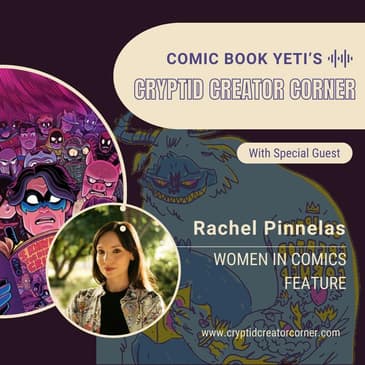
It’s becoming increasingly clear from my recent chats on the podcast and all the ones that happen in emails or DMs that a substantial part of the glass ceiling for women working in the comics medium centers around the editorial level, but is that accurate and what exactly might specific barriers be? Now I don’t know about you, but to me, you ask an expert. So, I reached out to Rachel Pinnelas. Rachel, has been an Assistant Editor at both Marvel and DC, has worked as a journeyperson across the industry spending time at Aftershock, Dynamite, and Serial Box, and was a Mad Cave Talent Search Winner in 2022 who I’m hoping can shed some light on that question we’ve been exploring throughout the month of March for the Women In Comics Feature on the show.
If you want an accurate assessment of where things stand with respect to the representation of women in the comics industry, this is as about as real talk as you are going to find. We also get to chat about Rachel's contribution as a writer to DC's I Know What You Did Last Crisis Halloween Special with her Scarcrow centered story set in a theater, and what she's up to in the near future which includes an exciting comics related museum show that hopefully I'll get to talk about in the near future.
I Know What You Did Last Crisis
From the publisher
In the blackest night, when the darkness feels infinite, the very fabric of the universe begins to tear…as every major crisis in DCU history rises once again! These eight chilling tales, set during the events of crises past, serve to warn you, dear reader: when in crisis, watch your back. In the fractured world of Flashpoint, Professor Pyg is stalking Gotham City’s nightclubs, sniffing out victims! During Blackest Night, Scarecrow lurks outside a movie theater, recruiting new test subjects to perfect his fear toxin! Even heroes like Nightwing aren’t safe when his death might just have the power to reverse the damage of Infinite Crisis! All these, plus new stories from Crisis on Infinite Earths, Millennium, Zero Hour, The Final Night, and Final Crisis are collected in DC’s I Know What You Did Last Crisis, a deadly new horror anthology coming to haunt you this fall!
PATREON
We have a new Patreon, CryptidCreatorCornerpod. If you like what we do, please consider supporting us. We got two simple tiers, $1 and $3. Want to know more, you know what to do.
ARKENFORGE
Play TTRPG games? Make sure to check out our partner Arkenforge. Use the discount code YETI5 to get $5 off your order.
THE LANTERN CATALOG
Created on the premise of creating light in the dark, this is the the go to resource to keep you up to date on the indy projects and the creators you love. You can find them at https://www.thelanterncatalog.com/.
Make sure to check out our sponsor 2000AD.
Learn more about your ad choices. Visit megaphone.fm/adchoices
[00:00:00] Your ears do not deceive you. You have just entered the Cryptid Creator Corner brought to you by your friends at Comic Book Yeti. So without further ado, let's get on to the interview.
[00:00:30] Show notes and thank you for your continued support. Thanks for your donation.
[00:01:02] Dan Abnett and so many others. Get a print subscription and it'll arrive to your door every week. And your first issue is free or subscribe digitally. Get free back issues and download DRM free copies of every issue for just $9 a month. That's 128 pages of incredible comics every month for less than $10. That's like a whole graphic novels worth. All subscribers get amazing offers like discount vouchers and exclusive product offers.
[00:01:29] Head to 2000AD.com and click on subscribe now or download the 2000AD app and why wait? Start reading today. I'll put links in the show notes for you. Well, it's becoming increasingly clear from my recent chats on the podcast and all the ones that are happening in emails and DMs that a substantial part of the glass ceiling for women working in the comics medium centers around the editorial level. But is that accurate? And what exactly might specific barriers be?
[00:01:58] So I don't know about you, but to me, you ask an expert. So I reached out to Rachel Penelos for some insight. Rachel has been an assistant editor at both Marvel and DC has worked as a journey person across the industry, spending time at Aftershock, Dynamite and Cereal Box and was the Mad Cave Talent Search winner in 2022, who I'm hoping can shed some light on the question we've been exploring through the month of March for my women in comics feature that we've been having on the show.
[00:02:26] So, Rachel, it's so nice to meet you. Thanks for coming on and hanging out with me and chatting. I'm so excited to be here. Thank you so much for having me. Of course. Well, this is the first time we've gotten to chat. So tell me a little bit about your background and how you got into this whole comics thing.
[00:02:41] So the short version of a much longer story is that I was studying architecture for my undergraduate and I switched from what was going to be a five-year degree to a four-year degree in my program. And in that program, there was room to start your professional experience to start getting intern credits at architectural firms.
[00:03:09] But since I knew that I wasn't totally sure if that was going to be the long-term path for me, I took that opportunity for an internship to explore my other interests. And top of the list were my interests in comics, which I've been interested in since I was a young kid, primarily thanks to Batman the Animated Series.
[00:03:36] And so as luck would have it, Marvel has a pretty wonderful internship program. And I applied my junior year, returned for my senior year, and was able to graduate with my first job in the bullpen before moving back into an editorial role where my second internship was. And so that's the short version.
[00:04:06] So I was going to be an architect. Then decided to go back to my comics and editorial roots because in high school, I was the editor-in-chief of a literary magazine. So even though I love design, I love architecture, graphic design, history of art, all of that, writing and words were always one of my first loves.
[00:04:32] And so working at Marvel, I was able to combine not just those interests, but those skills. Because being an architecture student, I was really good at graphic design, which really helped me in the bullpen and also helped me. I don't even know if they call it the bullpen anymore still. So that's also coming from a tradition of an older generation of comics production to begin with.
[00:05:02] Yeah. It's really cool to be able to start bridging my more modern experience with what had been such almost like pathologized to me, especially if you were up reading comics and saw the bullpen bulletin, the Montubu apart, the bullpen. Interesting. It's fascinating to me.
[00:05:28] You've kind of chosen to work in two, and your interests lie in more male-dominated fields. I was an interior design major for a while, and I sort of got out of it because I experienced sort of the inverse. I had classes where I was the only guy. So you'd have, in some cases, those seminar classes where you'd have 100 students in there. And the professor would be like, well, you girls know what I mean. Like, wait a minute.
[00:05:57] Yeah. So my program was at a tech school. So obviously, the ratio there was huge more male than women and girls. But in the architecture program, that had the highest concentration of not just women students, but also professors. And what's cool is that one of my favorite professors from that time is actually now the dean of the college.
[00:06:27] Oh, wow. Yeah. So shout out to the history of architecture professor. She was great. Oh, that's really cool. Yeah. I say Basilica way too much now. Bye. I'm an acular. So I'm always trying to compare things to Frank Geary. Like, that's just my constant go-to. Yeah. Yeah. I mean, I'm here in Los Angeles.
[00:06:50] And so I get to see the Walt Disney concert hall pretty regularly when I'm downtown, which is really cool. So yeah, love his forms and designs. And there's actually a great tradition of some comic characters at Marvel and DC that also have an architectural background. We have Thunderstrike was an architect.
[00:07:19] Kirk Masterson, as well as Green Lantern and Jon Stewart. So, and I am not shy about the fact that those are two dream characters to one day rate. Okay. Okay. Very cool. Yeah, I was going to ask later on, but like you just answered my question. There's more. There's more. But specifically for the argument, those are the ones. Well, I'm always trying to take sort of the temperature and get people's opinion.
[00:07:47] So back in 2010, you were a part of this Marvel's revival of girl comics. It was something that started in the early 1950s, had a short run, ended in 54. The 2010 version was a three-issue limited series as part of the Marvel Women Project that year. It was all female creative teams. And this was during the Obama administration. And I'm sure at that time, it felt like, yeah, things are changing. Things are happening. Fast forward to 2025.
[00:08:14] How are you feeling about things? I feel ancient. I feel what the Bilbo say in Fellowship, like, you know, butter scraped over too much bread. Oh, it's been interesting because that was a really exciting and proud and forward-moving moment.
[00:08:40] And it brought a lot of wonderful creators into the mix, some of whom are still on the stand in comic book stores and the direct market today, which is phenomenal.
[00:08:56] But what is been dispiriting, at least from my now outside view of that project, is that there hasn't been much more books that aren't that model. You know, like, once a year you get, you know, a Woman of Marvel anthology. Right.
[00:09:24] And although you have wonderful examples of, you know, Erica Schultz writing Lori Kinney now, which is amazing. Love her. Torin writing Venom, which is awesome. You had Kelly Thompson do Amazing Spider-Man, which is also was unheard of on that franchise up until that point.
[00:09:55] It's still very much stuff in 2010. And I don't think that we've advanced beyond that. And unfortunately, even back then, I remember, you know, I was so excited about that project. I'm still very proud of it. But I remember we had a signing event at.
[00:10:22] It was a forbidden planet and some pictures were taken. And the next day, I don't even know if the album is still up. It was on Flickr. People even lose Flickr anymore. And, you know, people were in the comments. We're marking on our visible appearance, which.
[00:10:44] I don't think a lot of men have to even have that on their radar when they want to promote a signing that they're going to. That people are going to be focused on that and not focused on the work. And that was 15 years ago. And that hasn't changed much.
[00:11:10] If anything, a lot of the online experience of women in comments. As some have made some really dedicated efforts to remove themselves from being accessible online. And I understand that. I've had periods of doing that myself. I wonder every day when I should close my accounts.
[00:11:36] But in a visual medium, it's important to be able to, you know, be able to show your work. And I'll link for editors to find your website, contact you, put a face to the name. But as a woman, your face is being evaluated differently than your male colleagues. And, you know, I'm not sure. So, yeah.
[00:12:04] I mean, that was a really. I didn't care. I mean, I cared that it was happening because it was upsetting that, okay, this wasn't a fashion show. This wasn't, you know, this was a comic sighting. So, you know, why does it matter?
[00:12:24] But that is how we have to move through the world and think about things differently than some of our male colleagues. And it's even some people who recognize that that's something that happened.
[00:12:48] It's hard to have those conversations and share that, hey, you know, this is something that I want to put myself out there. I want to put my work out there. But, you know, I'm not signing up to have my appearance critique. Like, critique the work. Don't critique what I chose to wear. Oh, well, yeah, absolutely.
[00:13:13] I don't know, in all honesty, many of the male creators that I know that think they give more than five seconds thought to, oh, I might wear this T-shirt because I'm promoting this book. And that's about it. Yeah. Yeah. I mean, it's, you know, it's a little bit of a double-edged sword. Because if you put in too much consideration to your appearance, then it's like, oh, perhaps she's not that serious.
[00:13:42] She cared more about what she looks like than what she's promoting. But then, unfortunately, I have had situations where if I rolled out of bed, put on her T-shirt, a little tired. Is everything okay? It's like, no, this is just me dressing like you.
[00:14:05] So, that is a very long-winded way to say that I wish that there has been more progress in the last 15 years. Because that was a really exciting starting point. And that collection, there's a beautiful hardcover edition available. So, if no one has any seen it, I really encourage people to check it out.
[00:14:31] And there's also just a lot of fun team-ups with characters that you wouldn't otherwise, you know, imagine having some stories together. Yeah. I mean, approaching it from the angle of fandom, I think there's some positives to be gleaned from this. The percentage of women that comprise the comics readership base is continuing to grow, right? I think I've seen safe estimates that are in the 40% range.
[00:14:59] And we all know how the direct market is a problem. I've been talking to retailers on my Let's Talk Shop series recently. And there's no, like, formulaic blueprint for success within a comics retail ecosystem. But, you know, superhero comics are not enough to keep the doors open. Like, we know this. So, how do we address that at the retail level?
[00:15:24] Because I'm sure some of the editorial teams bang their heads against the wall, you know, with the inertia that really is the white elephant in the room. Like, why are we not evolving to service the fan base? If nothing else, it's money. Like, this is what you really care about as a publisher. Yeah.
[00:15:43] And this is something that now on the other side of the masthead, I guess to say, you know, from editor to writer, that I've been confronted with, you know, firsthand with some of my experience pitching. And some of my experience also having these conversations with retailers at conventions about, you know, what do you want more of? What do you think will sell?
[00:16:11] Because I also have the experience of coming into a comic book store when I was on staff at a publisher and someone asked me, are you looking for something for your pipeline? Oh. Yeah.
[00:16:26] And I have to say, no, I just want an extra issue of a comic that I worked on so that, you know, because maybe I only got like two comps that month and I wanted an extra to give to a friend, give to another collaborator, you know, for whatever reason.
[00:16:46] And so, you know, that still happens, which is not great, especially in a post Barbie world, you know, Barbie made a billion dollars. And that was made by what was directed by a woman that was produced by a woman. It was made for a woman and it was successful. So what I started to experience was that I would.
[00:17:16] I started pitching some things that I thought feedback from retailers in terms of what they said that they were looking for, for their readership beyond superheroes. And some of the publishers and editors that I'd been working with and talking to, some of their response was, this is really great, but I don't think we can sell this in the direct market.
[00:17:43] And then I would have to push back a little bit and say, can you explain what you mean that you as a publisher don't think that you can sell this into the direct market because you're the publisher. You, what you choose to put your resources into, that's what you sell on the direct market.
[00:18:05] And I'm having conversations with retailers that have won the Spirit Award and have said, we want more of this for this particular readership.
[00:18:19] And what we've been getting as winners over the last couple of years because of a lot of, unfortunately, economic factors that are beyond, you know, the control of any one retailer and any one publisher. But it's a lot of the same horror readers because that's been consistent and that has sold.
[00:18:49] And that is what you also see on the production side of things with Hollywood too, that with the exception of major IP,
[00:19:00] horror is what a lot of the production and marketing is going into because it's more cost effective to create that than something wholly original, like in everything, everywhere, all at once, you know? Yeah. All right, everybody, we're going to take a quick break. We'll be right back. Let's face it. The comics landscape is a mess right now.
[00:19:26] I'm the editor-in-chief of a comics journalism outlet, and I can't even keep track of it all. If you are as passionate as I am about indie comics and its creators, you should check out The Lantern Guide. Created on the premise of creating light in the dark, it's going to be the go-to resource to keep you up to date on the projects and the creators that you love. Don't take my word for it. I reached out to my friend Brian Lovell, Poison Ivy artist and indie comics creator, to get his take. Brian, what does The Lantern Project fix?
[00:19:54] I'm a dude who loves indie comics, and I know personally, like, I get very frustrated when something shows up in my social media timeline or something like that, and I feel like I can't keep track of everything. So, really, The Lantern Project was born out of that. It was an opportunity for me as a reader to kind of, like, have a place to want to consolidate all the stuff that I wanted to read.
[00:20:18] All the cool projects from cool creators that seemed interesting and kind of unique to, like, something that I would like, which is really not super represented everywhere else, but it's all over the indies. Having a spot to go to that felt like it consolidated a lot of those audiences and a lot of those places where I couldn't just get drowned out in the feed of social media seemed really valuable to me. What's the ultimate goal?
[00:20:42] It's really our hope with this project that creators feel like they're able to get in front of readers, and readers are able to get books that they actually want to read with a much easier time of keeping track of them and accessing them. The catalog is scheduled for a quarterly release, so head over to thelanterncatalog.com to sign up now so you don't miss your next favorite thing. I'll put a link in the show notes for you. Y'all, Jimmy the Chaos Goblin strikes again.
[00:21:11] I should have known better than to mention I was working on my DC Universe meets Ravenloft hybrid D&D campaign on social media. My bad. He goes and tags a bunch of comics creators we know, and now I have to get it in gear and whip this campaign into shape so we can start playing. Another friend chimes in, are you going to make maps? It's fair to say it's been a while since I put something together, so I guess, question mark? It was then that I discovered Arkenforge.
[00:21:37] If you don't know who Arkenforge is, they have everything you need to make your TTRPG more fun and immersive, allowing you to build, play, and export animated maps, including in-person Fog of War capability that lets your players interact with maps as the adventure unfolds while you, the DM, get the full picture. Now I'm set to easily build high-res animated maps, saving myself precious time and significantly adding nuance to our campaign. That's a win every day in my book.
[00:22:05] Check them out at Arkenforge.com and use the discount code YETI5 to get $5 off. I'll drop a link in the show notes for you. And big thanks to Arkenforge for partnering with our show. I think I'm going to make Jimmy play a goblin warlock just to get even. Welcome back. It seems to me that within the ecosystem, there are way more women than men working in the YA space.
[00:22:30] Is that just where the growth in terms of the financials are directing it? Is it that simple? I think because in the YA space, it was much more of an overlap of a book market. And the traditional trad pub book market is, skews much more female.
[00:22:50] And so that's reflected there because there is the support for the YA. I'm forgetting the terminology for it.
[00:23:08] But if you go into a bookstore, for those dedicated departments within a bookstore for the categories, they're working very closely with the big five publishers. And so that's something that's always on demand. And then, of course, there's wonderful educational components there, too.
[00:23:33] Because you have book fairs, you have educators and librarians who are very dedicated and consistently looking for material for those avenues to share with new readers and to bring them in. And the direct market doesn't have that. It exists with licensing and licensed products.
[00:24:03] That's why I remember a few years ago when the first Joker, Todd Phillips film was coming out. And rated R, which was significant at the time that, oh, this is going to be the first rated R, you know, Connoissell movie or at least, you know, from Warner Brothers. And I was in Target looking for a present for a child.
[00:24:30] And at the same time that I'm getting advertisements and trailers and posters are around for this R rated film. There was a Fisher Price license. DC like Batman set with like a cheap little Joker. And that was wild to me. It's like, you know, this R rated film. And then you also have for ages, you know, three to five of the Joker. So, yeah.
[00:25:01] So. But that's all licensing, right? Because, you know, the Joker film. Is ultimately a Warner Brothers production. For a surprise. Or if it wasn't for a surprise. And I think he said it was for a surprise. I took a picture of it, but it's somewhere in the annals of my film. So, you know, that was a licensing fee that they earned to use those characters.
[00:25:30] And so with a lot of the more YA focused picture books that are sold, which are great because it also helps, you know. Great familiarity with these characters. But that's the book market. That's not the direct comical. Sure. I mean, with the direct market. And this is something. I did some number crunching. So bear with me here. I'm going to run stuff down.
[00:25:57] So looking at May's upcoming solo or two-person books at the big tube that feature female characters and or writers. So no teen books were considered. In my head, I was thinking there were a good number of female lead focused books that seem to be dropping right now. Here's what I found. At Marvel, the ratio of male characters was around 33%. Like female representation. At DC, that was 40%.
[00:26:24] The percentage of women writing books with a female lead at Marvel was around 55%. At DC, that ratio was around 60%. And here's where it got interesting to me. The percentage of women writing male characters. At Marvel, less than 1%. That's Kelly Thompson writing Jeff Lanshart, which is technically a guy. And at DC, again, less than 1%. And that's G. Willow Wilson writing a two-arc action comics project.
[00:26:54] So are women just not being considered for certain projects? Or did I just answer the question? I think you answered the question. I mean, like I said, I'm on the other side of the mask head now. So I can't speak to how these decisions are being made. But it is factually evident that you have not seen with very, very, very few exceptions, which is of course, and the SMP on Daredevil.
[00:27:24] I mentioned earlier when Kelly Thompson did some Amazing Spider-Man. It's been very, it's been the exception when you see. As far as I know, I don't think a woman has ever been the main Fantastic Four title. And that would be a great, great series to have that perspective on, I think.
[00:27:54] And part of the reason I can imagine that that exists is because those are, you know, marquee franchise characters are the most recognizable branded content for the publisher.
[00:28:18] And so, of course, you're going to want the most name recognition talent on those titles. And the data shows that there just have not been enough women creators in the pool to consider that. Okay. So let's address it from that then. Sure.
[00:28:48] So first of all, is editorial, is that the linchpin in the system, if you will? You know, is it a significant piece to change that ecosystem to provide more opportunity for women to move up that ladder in comic? Yes and no. Okay.
[00:29:09] Because from my experience, editorial has been more 50-50 in terms of distribution of, you know, women and men in those roles. But it goes to the earlier problem of the pool of talent that they're even looking to.
[00:29:36] Because in the direct market, as it is for, you know, the last couple of decades now, the prevailing advice for how do you work into the industry? Well, you know, if you want to write comics, it's a little unheard of to, you know, enter the space, email BC, and say,
[00:30:07] I have a great idea to work with a broker. Let me, you know, write Batman. You can't do that legally. That doesn't happen. You have to be asked, of course. But, you know, you're encouraged to make a comic yourself. Put it out there. Perhaps have it, you know, self-publish it. Bring it to conventions. Have your work shared. Collaborate with other upcoming, up-and-coming creators in the space.
[00:30:37] And more often than not, those spaces are not the most welcoming to young women or haven't been. And I think that pipeline is not a general piece of advice to give to up-and-coming creators.
[00:31:05] Because there's a lot of barriers to entry there. And I think that's why you see for a lot of the women who are currently writing comics in the direct market, before they were writing comics, they were traditionally published. But, you know, they've already been established as authors and are invited to work on that.
[00:31:33] But it's much less common to see. And that's why I'm just going to be a cheerleader for Erica and Kelly Thompson. Because those were women that kick-started their own books and batted out there. And, you know, showed off their talents. And now we have Diff the Line Shark, which is really exciting.
[00:32:01] But that is a more common story for their male counterparts than there are any other examples of that. Well, I'll throw in a shameless plug. Erica is one of the people that I have talked to in this series this month. So anybody who's interested, I'll just put that in the show notes. If you haven't listened to it, go back and do it.
[00:32:27] I actually sort of targeted Erica on purpose because I knew she would be very honest and candid about how the ecosystem is. And she is someone who also has the experience of writing, editorial, lettering. You know, so similarly, you know, has this soup to nuts production experience as well as the creative experience.
[00:32:56] And so it's not necessarily an editorial problem, but it's a problem for editorial because there's just the landscape is not supporting more options for them. I mean, that makes a lot of sense. How much control does editorial have with respect to specifically hiring creatives? Like assistant editor, editor, like, you know.
[00:33:25] So, you know, the hiring you go, the more control you have in that regard. Sure. But within Bergen character offices and, you know, we try, you know, you've got the hat office, Spider-Man office, hat office. So, you know, it's a lot of project management, too.
[00:33:51] That is the editorial experience of at least where work for hire is concerned because you have a certain budget. You have a certain amount of product that you want to make featuring, you know, XYV characters for a certain time of year. And so sometimes it's already in place.
[00:34:21] And, you know, of course, there's going to be more Spider-Man. But then sometimes, you know, the opportunity comes up and it's like, okay, we have space in the schedule. We have space in the budget to, you know, perhaps have a mini series for this time of year.
[00:34:38] So if you are a more senior editor, you have the opportunity to say, okay, well, you know, if this is what's available to me, let's see who's available. Let's, you know, put something together.
[00:34:54] So on the assistant level, I did not have those opportunities, but there were opportunities to grow in that, in the ranks there to perhaps when they get there.
[00:35:11] But I think it also just, you know, comes down to what they want to, they mean the wider publishing strategy, especially when you have the, you know, most globally recognized characters in the world.
[00:35:30] You know, what the focus there is going to be of, you know, how many Batman titles do we want to do and the, you know, decision tree flows from there. Well, in that decision tree, again, I went back, tried to dig up some numbers on this and I found Tim Hanley contributed to the beat for a while, kind of publishing these ratio to male to female characters within the big two.
[00:35:57] And if we're making broad generalizations, I think it's safe to say that's somewhere between 16 to 19% ish, varying a little bit is our women. Yeah. What I found really fascinating was when you drill down a little farther, the levels of editors to assistant editors. Okay. Now there's a disparity. So especially at Marvel, and these are 2018 numbers based on what Tim found out. Let's hope we've moved the needle a little bit, but editors was 86% male and 14% female.
[00:36:26] Now, when you get to assistant editors, that was 30% male and 70% female. And I'm wondering if that is an artifact of time. Like these guys were around for 40 years when they started cable. So if it's a cable book and it's part of the X office, well, okay. It makes sense to have that person just because they know the canon. I'm just trying to make sense of that. Yeah, I think an artifact of time is a great way of putting it.
[00:36:54] I think because you have, you know, the assistant role is sometimes or has more traditionally been a trainee role. And so some of the older, more senior editors that have been in those roles for a generation,
[00:37:18] generationally, they are more accustomed to young men coming through. And so I think when it comes to the opportunity to have mentorship, that's why you see more men moving up in the ring and women not going much further beyond assistant. And some cases in certain cohort years.
[00:37:49] And it is, yeah, very much an artifact of time and culture not necessarily catching up. Okay. I mean, speaking of culture, I think it's only fair to turn a lens on myself here as the person who's in charge of an outlet, you know, and I thought, hey, we're doing a pretty good job of representing, you know, women and female presenting creators on the show.
[00:38:17] So I look back at our 2024 numbers and we hit just over 20% of guests being women. I thought we were doing a decent job and we're bang average, which led me to perception. So, you know, I run a well-meaning comics journalism outfit, you know, focused on diversity. But my compass of what was good was way off. And I'll own that.
[00:38:39] So aside from the conscious awareness of men like myself who kind of work in the industry, I'm tangential, of course, trying to move away from the whole editorial thing. But how do we start to shift that consciousness? Or is it simple as just dudes need to be more aware and not to start? Awareness is absolutely a start. And you're doing a great job with this podcast.
[00:39:07] But I think it also goes back to some of the answers from some of our earlier questions in terms of the pool is just that much limited right now. And I think a way to open it up a little more is to, yes, one, awareness and to focus and highlight when and where you can.
[00:39:34] And something for me that I've started looking at myself now as a creator is that when I see the marketing begin for new books and you will ask creators for both.
[00:39:55] And then, you know, you have a nice running list of here are all the big names or, you know, that's something nice about this upcoming title. 99.99999% of the time. And this is Nafking Math. All nail creators. Interesting. Yeah. And there was one today that, you know, that I saw that I'm, you know, excited about. It's getting well reviewed.
[00:40:24] But every, every quote was from, you know, so I think trying to diversify where you can, when you can, is a key component of that.
[00:40:43] Because then it can start, you know, showing a larger readership that, you know, it, this, a quote from this person has the same amount of weight that. I don't want Mark Wade to catch any elves. I have the utmost respect for him.
[00:41:03] But, you know, Mark, Mark Wade has been a top pen writer for almost 20 years at this point. In some of my other work, I've been doing a lot of research for comics and history. And, uh, for better or for worse, I've been going through a lot of wizard magazines from the, uh, mid off.
[00:41:32] And, you know, every issue would have top 10 writers and top 10 artists. Marry a woman in sight. Maybe, maybe Amanda Connor. Maybe. But, you know, Wade has consistently been there.
[00:41:50] And so, while, yes, it gives a certain, you know, legitimacy that someone that has this longstanding presence in the direct market can, you know, provide, um, uh, a pull quote for, um, for a new series. It would be cooler if you saw, I'd love to see what more women think about this upcoming book.
[00:42:20] Because then, to me, it would make me more apt to pre-order it. Because if I just see the same handful of men, uh, echoing things, then, to me, that says, this is maybe not for you. Yeah, I mean, I think what you're illustrating are simple, relatively easy to implement, sort of subtle changes to the ecosystem.
[00:42:50] I mean, I, I experienced that recently. I go back and, uh, Spotify for creators, the relatively new thing where you can actually get some gender and age demographics on your podcast, which I think is fantastic. Got a podcast and you're listening, you better go look at that stuff because it's fascinating. And that's really what illustrated to me that we need to change something that we're doing.
[00:43:17] Because it's about 11% of women who listen to the podcast. So I, in my head, it just, it immediate light bulb goes off. I was like, what am I doing? Because my mission is diversity here. So I'm doing something wrong, you know, or maybe it's just not right enough. And so I threw it out there on blue sky. Hey, these are our numbers. Give me some feedback here. What can we do? And consistently it's, you know, it's not big shifts. It's pretty obvious. It's pretty subtle stuff.
[00:43:46] Hey, why don't you just host more women creators on the show? And this, this, this series that I'm very honored to be a part of and to be in conversation, I think is a wonderful step towards that. Because I think a lot of women in this space, and I'm speaking to myself, but, you know, want to see that this is also for you.
[00:44:14] That, you know, that something is being made for you because your feedback is valued.
[00:44:23] And I think culturally, and I'm not speaking broadly, I'm speaking specifically about, you know, what has stereotypically being presented as comics culture in the industry over the last generation is that it has valued male voices more than women.
[00:44:49] And so I think just even demonstrating more and to have a more concerted effort that this, these voices and this feedback is just as worthy is a huge step. Because I know. Well, you're out there. Go ahead. Oh, yeah. No, I'm just, you know, even, you know, from, from, from a, just even a purely marketing perspective, you know, these are the things that I'm looking at.
[00:45:19] You know, oh, you know, who, who is working on this project, who has nice things to say about this project. It, it, it goes a long way to say, hey, this is something that is also, you know, leave it like your readership as well. Well, you're doing the thing. I mean, that you've just illustrated, right? You, you, you went from that editorial level to, to being a writer.
[00:45:47] You won the, the mad cave talent shares in 2022, coming at it from the trenches of the indie market. And then there was a scarecrow story. And I know what you did last crisis, which was DC's Halloween one shot in 2024. Um, had, had writing full time always been the ultimate goal when you, when you started back when? Yes. Okay. Yeah. Yeah. Uh, yes.
[00:46:13] Um, I think for a lot of editors there is this, um, battle that you have because you want to be the best editor you can be.
[00:46:27] But if you are someone that also has a writing background and writing experience and aspiration, um, to do the same, it's professionally, you have to maybe quell that part of yourself.
[00:46:46] Um, and so I just, I think the pandemic changed a lot of things for a lot of people in terms of reevaluating what, you know, some priorities might be. And so I started to get more comfortable saying that aloud and, and actually pursuing it.
[00:47:10] And, you know, even for me and my experience, uh, professionally, I knew that it is a long uphill, uh, battle to, you know, to break in.
[00:47:27] Um, and, you know, I'm really proud of, you know, having won that talent search because it, to me, helped, you know, show that I could be recognized not just as an editor, but as a writer as well.
[00:47:45] And, you know, I had a lot of fun writing a story that ended up getting published a lot, um, is about the goddess Athena and her owl, love owls. And, um, the scarecrow story was a, was a dream come true. So, you know, that, uh, that was, that was really cool.
[00:48:07] Um, I'm really, uh, honored and still surprised of how many, um, uh, DC history Easter eggs you were able to put into that story. So that was a lot of fun, but yeah. Yeah. Yeah. I mean, I'll have to, I'll have to go back and look for more Easter eggs. I, I love that story. It felt like a no brainer to me to have him be the yellow lantern of earth, given the power to harness fear.
[00:48:34] Duh. So it was very detailed though, on the biochemical front. And we were talking before we started, you know, my wife is a trauma psychologist. So lots of this stuff is not a foreign concept to me. We, I hear us all the time. And I was happy to see the exploration of that. There was more, you know, getting into brain biology more than, okay, what is Batman doing to just kind of counteract a nerve gas this time around? Yeah.
[00:49:01] So walk me through what attracted you to writing Dr. Crane. Oh, okay. So, um, we mentioned earlier Batman, the English series. So, uh, Scarecrow was one of my favorite villains of, uh, of Gotham, uh, growing up.
[00:49:19] And for, not to pun, but for me, it was also a no brainer to explore his powers of harness and fear through the neurochemistry of fear. Because before he becomes Scarecrow, he was, he, he, he was a psychiatrist.
[00:49:40] Um, and so, uh, he, someone that even in his now more villainous identity has the, uh, clinical background.
[00:49:54] And so to explore his, you know, clinical understanding of what he's trying to accomplish with the, um, the two moviegoers that he torments for. The story was, uh, something that I thought would be really cool to delve into.
[00:50:22] Because what's fascinating to me about the Scarecrow, uh, is that the only thing that, I feel like he's a little like a Joker. And that, you know, Batman is the Joker's ultimate quarrel. And similarly for the Scarecrow, he can't feel fear anymore. The only thing that actually like strikes fear in his heart is Batman.
[00:50:46] And so he, he almost is, there's almost an addiction there of, you know, him trying to chase the high of being afraid. And figuring out what's going to make him afraid again. And, you know, studying that and other people to see if he could, you know, re-implement that for himself. I don't think re-implement is worth it, I guess.
[00:51:13] Um, but, uh, and what was so significant for that crisis event, uh, during Blackest Night, Batman was dead. Like, you know, Batman was not around when, um, when, uh, Scarecrow became D.L. And he comes back. But by the time he comes back, uh, the, the Randall cohort is off on their other adventures.
[00:51:40] So, you know, not only is he deprived of feeling fear, he's deprived of the one person that could actually make him feel it. So, um, uh, it was, it was a lot of fun to explore.
[00:51:56] And I, I could have just written a hundred pages more, but, uh, there was only so many neurochemical terminology I could fit in before maybe Quaidan would be like, what are you doing? I mean, I, I absolutely love the, uh, the theater, uh, as, as a horror backdrop, you know, I'm, I'm struggling to kind of bring to mind a lot of explorations of that, except maybe Gremlins, which scared the shit out of me when I was a kid.
[00:52:24] So it's a, it's a really clever backdrop when you're actually dropping this at a time where everybody's doing the annual Vogue thing of watching a whole bunch of horror movies.
[00:52:35] So, yeah. Yeah. So that was, that was, it was, it was a story for, for my Gotham fans. It was, and, and, and, and for the cinephiles because, um, and there was on one of the panels, we recreated the, um, there's a revival theater here in Los Angeles called the B Beverly.
[00:52:59] And each month they come out with the, a printed calendar of, you know, what they will be screening. And so I wanted to do what the Halloween version of that would be for the Monarch. And so we got to, um, recreate that as a little, uh, you know, cinematic Easter egg, uh, to, to help, you know, convey that even more, but it just, yeah. It's okay. Halloween for Scarecrow. Let's go.
[00:53:28] Yeah. I mean, it was a memory trip experience for me for sure, because I was reading it closer to bedtime actually last night. And I spent a lot of time in a theater and theaters are really one of these unique sort of amorphous places that unless you work in them, I don't think you quite understand the, the yin and yang of all these people, all this energy, this influx of life that happens over a brief period of time.
[00:53:58] And then you go to the polar opposite of that, which is this void and vacancy. And I was actually Jimmy, um, my, my cohost was talking about, um, his kids, you know, working in a school play and how much he missed it. He grew up in community theater and did all that stuff in college too. So it was, it was really nice because we got to talk about that on discord back and forth last night.
[00:54:20] And, uh, I don't think he was super comfortable with my illustration because I talked about the best feeling is going out at the end of the night and being the last person. You're the only person in the venue and you set out the ghost light on stage. And I use the word mall, you're looking out into the mall of darkness. And he's like, I don't like that word. So it's so interesting how some people are, you know, sensitive to certain words because of like full pronunciation.
[00:54:49] But I, yeah, the, the, the experience of being in a hater of it, it's like you said, like you are kind of isolated in your own mind in terms of the, uh, fear of watching it, but you're also surrounded by everyone else who's having a similar experience, but because of whatever their personal circumstances are. And, you know, that input could be different.
[00:55:19] Yeah. Well, as a writer, um, I know you won't turn work down. I'm not going to try to pin anybody to that, but does it excite you more to work on developing indie projects over like say something at the big two? Because it seems like you could flex the cerebral muscles a whole lot more when you're not burdened with, okay, all this editorial knowledge. And it's great when you can infuse something like the theater that you have a familiarity with and then Batman lore. And that's fantastic.
[00:55:48] But at the same time, that, that is stimulating a whole different, to me, part of the writing process, you know, where they're not. You can get lost in it, you know, you can, you can, you can get lost in the Easter egg in terms of like focusing on, you know, one singular paddle from, you know, something from, you know, 60 years ago, which I, so on the one hand, I think it's really exciting that there is this kind of exhaust, you know, inexhaustible.
[00:56:18] Wealth of stories to continue to return to, to find more ways to tell more of them for these characters. But I think, right. And so, yeah, any opportunity you write those characters, I'm there.
[00:56:35] But I'm also really interested in focusing on doing more creator owned, if only to be just another example of a more distinctive voice in his face.
[00:56:53] Because there's only so many different genres that you can ding with some of the licensed properties. So, you know, if I want to get like very historical and niche and, you know, do like some type of like, you know, historical fiction, noir mashup.
[00:57:22] And it's, it's, it's a little more direct to do it with a original series than it is to say, hey, we haven't seen chapter 13 in a while. And, um, can I write a series about him? That's, that's, that's another character that I would love to, uh, revisit, but is probably only really popular to me.
[00:57:48] I mean, there's always the anthologies and they seem to come, every holiday seems to have one. So I'm sure there's a niche for it. I, I have one with Papa Midnight that's near and dear to my heart that I want to tell it sometime. So maybe I'll get a chance, but we'll see. Well, what else are you working on right now that you can talk about? Yes. Um, uh, so some things I'm waiting for the solicit to, uh, to be able to comment on.
[00:58:16] So I can say I'm working on something that will be solicited seeing. So stay tuned for that. And, um, also working on a lot of more personal, uh, original, uh, creator and series, as well as a lot of, uh, comics history and research as what pertains to developing exhibits about comics history.
[00:58:40] So that is also an announcement that is coming up that I'm excited to share more as well. So working on a lot can only tease that they will be announced soon. That's okay. I'm used to that. And it is exciting to see more, more exhibit stuff, more history stuff.
[00:58:59] Um, I was talking to a friend, uh, across upon the pond, John Harris Dunning, who did some stuff over there in, in, uh, England, um, with exhibit stuff. And I don't know, I did, that is, that is something that fascinates me to no end. So very cool that you're working in that space. I, I'm, I am so inspired. I'm incredibly lucky to have the opportunity to, uh, doing some of that work.
[00:59:26] And I remember that when I was a student, there was maybe what was one of the first, um, exhibits about American comic artists.
[00:59:38] And so, and I got to see Lindsay McKay pavers of Little Mimo and Slumberland, you know, up close and, you know, to, you know, of course, I was familiar with the work, but to, you know, actually just be inches away from the, the, the actual pages was really, uh, influential.
[00:59:58] And so I'm excited to be working on things that's going to, you know, bring that opportunity to, to hopefully generations of people because it's, there's so much incredible artistry and artifacts that are out there, um, uh, for comics. Because, you know, when you think about it, like you are holding a piece of art, how cool is that? It's portable art. That's amazing.
[01:00:27] I mean, I always liken it to, I always love to draw these connections as the anthropologist brain in me of, of looking at the stories of cave paintings or paintings on a wall, you know, on the side of a cliff or something like that. And modern comics, because there, there's just this obvious through line to me. Oh, absolutely. Yeah. I mean, where storytellers, sequential storytelling has started in a cave.
[01:00:55] Well, where can people find you online to keep up with all the things you've got coming? You can find me on blue salt as well as my website, which is also a blue sky handle, wiki, rachessance.com, which is spelled R-A-C-H-E-A-I-S-S-A-N-C-E. Made that difficult for myself, but it is, it's all left in. That's okay.
[01:01:21] My personal email address is the name I had on the road, like a road name that just stuck. So, cause none of us knew what email was going to become in that at that time, it is going to be latched onto you forever. So. Oh yeah. I remember. I remember my first screen name was made to me by my father and I was in high school and enjoyed the color pink. And so, and my nickname is Ray. So it was like pink, gray, 16.
[01:01:51] Wow. Yeah. All right. Well, Rachel, thanks for coming on today, putting up with all my brother probing questions that I had. I truly believe the only, yeah, the only way forward here is to balance out this ecosystem and understanding and embracing, you know, women fandom, which has been marginalized for far too long. So thank you for your candor. I really appreciate it.
[01:02:16] I hope people that are listening to this series this month are challenged by, you know, some of the misconceptions that they have. Yeah. And I hope it gives some people something to think about and think about the ways in which they can open more avenues to the woman that they know in this space. Because I think that if we can work together, it will be a more equitable space. Yeah.
[01:02:44] Well, to sign off, this is Byron O'Neill. And on behalf of all of us at Comic Book Yeti, thanks for tuning in and we will see you next time. Take care, everybody. This is Byron O'Neill, one of your hosts of the Cryptid Creator Corner, brought to you by Comic Book Yeti. We hope you've enjoyed this episode of our podcast. Please rate, review, subscribe, all that good stuff. It lets us know how we're doing and more importantly, how we can improve. Thanks for listening. Bye. Bye. Bye. Bye.