
Mad Cave Studios has been putting out some fantastic comics as they celebrate their 10 year anniversary and today's guest's newest comic is no exception. Writer Ray Fawkes is here to chat about Sanction. This is the story of 2 very different detectives tasked with investigating a dead body in 1987 Leningrad. Ray talks about working with artist Antonio Fuso, why he wanted to set this story in the U.S.S.R. towards the closing of the Cold War, and what he hopes readers will take away from the differences between Pavel and Boris. This is an incredible first issue and I loved chatting comics with Ray. Issue #1 will be at your LCS on May 15th, but make sure to add it to your pull list now (this not only helps out you, but your LCS, and the creative team). Be sure to check out Ray's website too so you can check out some of his other work we discuss in the episode like One Soul, One Line, and The People Inside.
From the publisher:
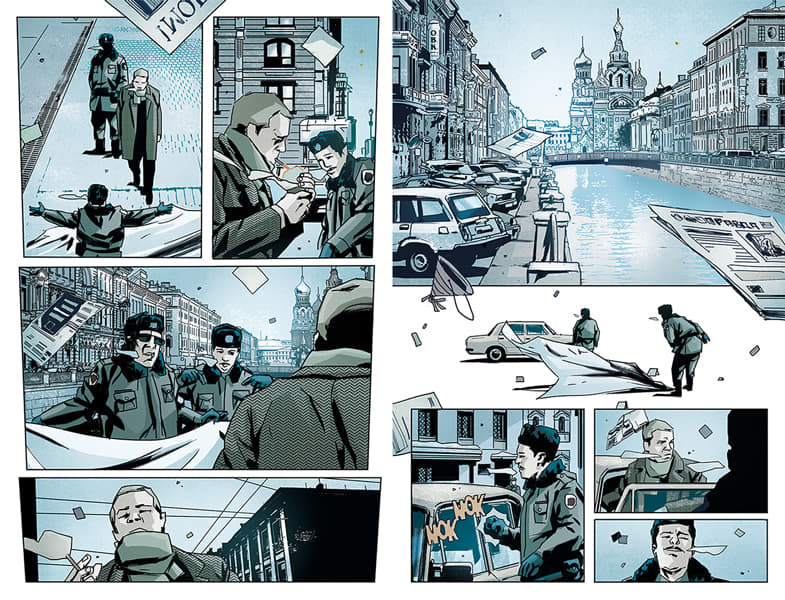
Leningrad, 1987. When a woman’s corpse is discovered on New Year’s Day, a hungover Detective Pavel Smirnoff hands off the case to his partner, Detective Boris Dimitrovich, hoping he’ll close it without fuss. Instead, Dimitrovich uncovers a connection to an old, unsolved crime, dragging them both into an investigation that puts their careers – and possibly their lives – at risk.
Preview images:
Make sure to check out our monthly crowdfunding comics feature book: Super Kaiju Rock n Roller Derby Fun Time Go!
[00:00:00] Your ears do not deceive you. You have just entered the Cryptid Creator Corner brought to you by your friends at Comic Book Yeti. So without further ado, let's get on to the interview.
[00:00:11] Skirt of Good Muts sound like something spoken by Cthulhu Cultist or the name of a weird craft beer brand, but it's actually the shorthand for this new wild crowd-finding comics project, Super Kaiju Rock and Roll Derby Fun Time Go from creator David Hedgecock.
[00:00:26] This is a mashup of Jim and the Holograms meets Roller Derby with Kaiju with a twist of 70's pop culture thrown in. Harmony, Lyra, Melody, Cadence, and Biola are a struggling 20-something band, and a Roller Derby team fleshed with talent but broke as a joke.
[00:00:43] The burnouts are thrilling concertgoers with their killer looks and vibe until a music mishap drops a curious ancient artifact into their hands. Cheeky, lighthearted and fun, it will be launching soon and there's an early bird special if you catch it in time that scores you a discount and a VIP wristband.
[00:01:00] I'll drop the link in the show notes. I read the advance for this and honestly it reminds me of my own carefree days giggling on the road in the music industry but with way better shower scenes. The only thing missing is more cowbell.
[00:01:13] Hello and welcome to Comic Book Yeti's Cryptic Creator Corner. I am one of your hosts, Jimmy Gispero, and I have a fantastic guest for the podcast today. I'm going to be speaking with Eisner Harvey and Schuster Award nominee, creator of such comics as One Soul, The People Inside, One Line, and he is also done work for DC Comics and Marvel.
[00:01:43] I'm very excited to talk to Ray Fox. Ray, welcome to the podcast.
[00:01:52] Nice to meet you.
[00:01:53] Yeah, very nice to meet you as well. So I just want to kind of like jump right in. I mean, you've been making comics for, I think at least 20 years now.
[00:02:04] Yeah, I'll say 25.
[00:02:07] 25.
[00:02:10] And so you have a new book now at Mad Cave Studios. Sanction is the one we're talking about tonight and hopefully we'll touch on some of your other work that I mentioned in the opening. Oh, you also did Black Hammer 45. I love that one.
[00:02:25] I know you've worked with Jeff before with some of the DC stuff, but in any event, I digress. Sanction is coming out by the time folks are listening to this podcast, they should be able to add it to their pull list.
[00:02:39] I think it's coming out May 15th is issue number one.
[00:02:43] Yeah, that's right.
[00:02:44] And artwork by Antonio Fuso. I think Emilio Leche is coloring, I believe Dave Sharpe's lettering. Everyone who listens to this podcast knows I'm a big Mad Cave fan. I get a lot of Mad Cave creators on and this is their 10th anniversary like celebration and I feel like they are like crushing it in terms of the stuff that they have coming out.
[00:03:08] Sanction, no exception. I was able to read issue number one.
[00:03:12] Loved it. Loved Leningrad 1987 has this Cold War element to it so you're not only dealing with what starts off in the open with like a murder mystery but there's all this type of, I'll say like regime intrigue in terms of what's really going on.
[00:03:29] There's not a ton of it in issue one but it kind of colors the whole thing.
[00:03:35] So yeah, why don't you just tell listeners a little bit about what they can expect from sanction and then maybe we'll get a little bit more into the story and why you wanted to tell it.
[00:03:46] Sure, well I mean sanction as you say it starts out with a murder mystery.
[00:03:51] But it turns into a very deep and sort of difficult case for these two police officers who are just kind of trying to get by.
[00:04:01] And it's basically very much that they get thrown into something headfirst that they were not expecting.
[00:04:09] And of course the case balloons up into something really monstrous as you start to get a hint of in the first issue.
[00:04:16] And they find themselves not only kind of at odds with each other but at odds with their own police force and with their own government as well as the killer.
[00:04:27] So it is a story of crime and a mystery and intrigue.
[00:04:33] And it gets into some pretty heavy questions about like personal integrity and corruption and such.
[00:04:43] So I'm really excited for people to see it.
[00:04:45] I think they're going to think it's really cool.
[00:04:47] Yeah, I mean I'm a big crime comic fan.
[00:04:50] Well I love all comics but crime comics have a special place in my heart.
[00:04:57] I think a lot of folks do and there's some creators out there that do, you know, a fantastic job with that.
[00:05:03] I really loved in terms of sanction number one you set up your two main characters or, you know, what I think are the two main characters when we first meet them Boris and Pavel.
[00:05:14] And, you know, to kind of see how Pavel enters the scene as, you know, juxtaposed against how Pavel or how Boris enters the scene and you see a little bit little glimpse of throughout the first issue when Pavel's on his own and kind of the things he's doing.
[00:05:33] It seems like Boris has like more of a maybe stable home life.
[00:05:38] It's very interesting to see in the visual storytelling that character development and I really like the work that Antonio Fuso does in kind of bringing those moments to life.
[00:05:51] There's a lot of little background details, a lot of great like character acting moments to kind of set these, you know, potentially set Pavel and Boris like against each other.
[00:06:02] You don't know where the story is going to go yet after, you know, where issue number one ends but I really like how everything is being, you know, set up.
[00:06:12] Yeah, well, I mean Antonio, he's exactly the kind of artist we needed for this book he's fantastic because we need these two characters we need them to do a lot of acting.
[00:06:25] We need to really have readers get to know them and hopefully get to like them each in their own way.
[00:06:32] So he really, I mean, I think the introduction of the two characters art wise he handled it beautifully because there's a lot being said about what kind of people these two detectives are visually as well as the way they behave.
[00:06:49] And as you say, you're right, like you're not sure if they're going to get set against each other or not and that's got a lot to do with what's important to them which you see a lot of especially with Antonio's art where you see a lot of how, you know, Boris is all about family and
[00:07:03] honor and truth while Pavel is more about getting by and, you know, doing what it takes to, you know, maybe do a good job or maybe just not get blamed for doing a bad job.
[00:07:18] There's definitely a lot in Pavel that seems like without spelling it out in exposition there are certain, you know, scenes or character moments or even in the look that you see that, you know, Pavel's been around a while.
[00:07:34] Like you don't have to tell me that maybe Boris is newer to being a detective.
[00:07:40] There are certain elements in terms of Boris maybe earnestness and you know you could definitely see a world where Pavel himself who knows may have been like that and he's kind of been around a while to see how things work.
[00:07:55] I mean there's one scene in particular where Pavel is kind of called into, I can't remember the rank but the captain's office or you know his supervisor let's say whatever he might be.
[00:08:08] And nothing is really like spelled out spelled out but you get the sense that like this crime is not for a long investigation, you know.
[00:08:21] Well I mean so you know, we can talk about this a bit more but part of why I really wanted to write this story is because the system that would have been in place in a place like Leningrad in the late 80s is so different from the system that we're used to seeing in most crime dramas right.
[00:08:41] We're talking about a system under an authoritarian government where you're not really supposed to report things the government doesn't want to hear about.
[00:08:53] I know that it gets mentioned in the first issue they talk about how basically no crimes don't go, like no crimes go unsolved in Leningrad which is obviously impossible but it's something that's been demanded of the police department and it's filtering down to all the officers.
[00:09:10] And the senior talking about Pavel's been around long enough he kind of knows what to say and you know maybe even more importantly he kind of knows how to avoid difficult cases and say like oh well a case like this doesn't exist it can't exist right.
[00:09:28] Whereas Boris he's a little bit more focused on actual justice or actually finding out the truth about things so it's hard for him to resist you know a scene with him and their superior officer is very different right because he insists on pursuing the truth of the matter where Pavel's a lot better at saying like whatever the party line about this is yeah that's what he's doing.
[00:09:58] And so what's going on.
[00:10:00] Oh yeah, I the moment I was looking at you know I you get different impressions when you're about to like read a comic and you know doing the podcast and just loving comics in general I you know I read a lot like you know and I listeners probably do as well and you do you know you never judge a book by its cover but you do get a certain
[00:10:22] impression when you see like the cover of a comic and there were a couple of moments in issue one that really caught me off guard and such like a good way.
[00:10:32] In terms of like some like the a bit of a the humor of it but I when when Pavel says to Boris you know how I know it's your case because it's it's have some it's still open after two years and hasn't been solved and I like that kind of like ribbing.
[00:10:50] You know goes back to Pavel telling him like just, you know do this get this done whatever whatever.
[00:10:58] I just really thought that was kind of like a great, like little bit of a lighter moment and really did.
[00:11:05] It wasn't just a throwaway kind of really shows a bit about their relationship and their dynamic that I assume is going to be in, you know important later on but I like to help play it out.
[00:11:17] Thank you.
[00:11:18] I mean the truth of the matter is Pavel of the two characters Pavel is the more immediately likable right he is a funny guy.
[00:11:25] He's clearly easy to get along with.
[00:11:28] He obviously knows how to have a good time.
[00:11:31] You know so he's the kind of guy I think everybody knows a person like this at work where things seem to go easy for them because they they kind of take it easy and they're kind of affable and friendly and and so they get maybe
[00:11:46] forgiven a lot or they get the hard work avoids them.
[00:11:50] You know what I mean?
[00:11:51] Yeah.
[00:11:52] Sure.
[00:11:53] Whereas I would say that Boris is more likable for people who are concerned about integrity.
[00:12:01] You know so one thing I'm thinking is I think when readers dig into this book, you know I hope they are surprised a couple times and and I hope one thing that maybe could be a bit of a surprise is how they get to the hard work avoids them.
[00:12:12] But maybe could be a bit of a surprise is how they feel about these two guys versus each other.
[00:12:19] And you know do you feel immediately like you like one of them more than the other or do you feel immediately like one of them is wrong more than the other where you know I'm trying to present these two guys who you know for the for the sake of the story they're perfect
[00:12:39] but they have to mesh with each other and they have to deal with each other and they're so different from each other, but not in a like a buddy comedy kind of way, more like in their both good at their job but in a different way.
[00:12:53] Yeah, oh yeah that I mean that makes a lot of sense.
[00:12:57] Because again that goes back to what you said this is not the type.
[00:13:01] You know if it was going to be like a police procedural this is not the type of thing that we're, you know we're used to seeing, you know, anything that is possible.
[00:13:08] Anything that is popular nowadays in terms of US or North American, you know, crime comic is very different.
[00:13:19] Well maybe not all North America I guess Mexico would be a little different but still, you know, they they haven't seen this type of dynamic before because they haven't seen two individuals that work under the system in Leningrad and
[00:13:37] they have to be believable as two individuals that could have developed and still be working under that system when you know when we see them in this point in time when they're trying to solve this particular crime.
[00:13:50] Yeah, well I mean and they've never encountered this particular kind of crime before at least not that they know of.
[00:13:59] So, you know, that's why this is the time to tell this story about them because when they come across something like this, they react to it differently.
[00:14:08] They deal with it differently but they ultimately do have to work to solve it together.
[00:14:13] Oh yeah.
[00:14:15] And I'm wondering to you know just set something in Leningrad 1987 like what was your research process like because I read.
[00:14:23] I think an interview you did with maybe, maybe comic B where you I think you're either talking about one line or one soul where you said you were like at the library with a huge list of like Egyptian archaeology plague doctors the American Revolution.
[00:14:40] And then you know that's one of the things that you know and especially with for anyone not familiar with comics like those where you're essentially weaving like 18 different narratives.
[00:14:50] So what was the research like for this in terms of Leningrad 1987 like what we well.
[00:14:57] In this case I may be lucked out a little bit or kind of set it up on purpose a little bit because I've always been a little bit of a Cold War history nut.
[00:15:06] I have a lot of stuff on my shelves that's about you know East versus West life during the Cold War, some spy stuff and then a pretty solid couple of books about the run up to the fall of the Soviet Union.
[00:15:25] And so I specifically wanted to set this in 87, which is just a couple of years away from the collapse of the Soviet Union where the feeling of collapse or impending collapse and rot was kind of there all around.
[00:15:42] And you know most people were denying it or struggling against it.
[00:15:48] But some people could really feel it coming.
[00:15:51] And I did a lot of reading around the events of the 80s and, and especially in the late 80s in the Soviet Union, mostly off my bookshelf mostly off the history stuff there.
[00:16:04] But I did, you know, I did pull a couple books from the library to do some research also about the appearance of things.
[00:16:13] And it was funny like I ended up having to also go down a few unexpected rabbit holes because I had to do research on like, like what would a what would an average person take with their T, you know, in in the 80s in the Soviet Union like it's not.
[00:16:34] It's not immediately obvious or like, you know what did most people drink.
[00:16:38] I mean there's cliches but it's like what were they actually drinking what were they actually doing with their time, you know.
[00:16:45] And actually so in like for instance in my research one thing that I came up against.
[00:16:50] I kept seeing it was that the majority of bartenders in certain cities were also KGB informants.
[00:17:00] That's fascinating.
[00:17:02] And that was one of the things that kept sticking in my head while I was researching and you know it ended up having to get folded into the story.
[00:17:12] But to me it also like, you know as I was doing the research I was noticing that even with the government, you know, with rumblings in the government that things might a change of some kind might be coming.
[00:17:25] They were still so intense on monitoring their own people and and the sort of obsession with security that happens in a lot of authoritarian states.
[00:17:37] So there was a lot of reading about that there was a lot of reading about secret police like that versus secret police versus you know, ordinary police like the guys who were actually on the streets.
[00:17:50] Right.
[00:17:51] Yeah, I have to imagine that setting it towards that like, you know, period of time before the collapse had to really add to or could lend itself to the paranoia of the time.
[00:18:07] Yeah.
[00:18:08] Which what a what better place to kind of put kind of a mystery crime horror comic with, you know, a cop who just wants to get along and one who is very earnest I mean, yeah, that is a backdrop great setting.
[00:18:26] And you know, for us the readers it's it's we know that the police are probably not going to be in two or three years.
[00:18:38] The police system is not going to be what it is at all and these guys have no idea these guys are trying to get by in this current system.
[00:18:46] You know, and ultimately sanction what it's about, you know, from the first discussions I had with mad cave.
[00:18:54] Sanction is about corruption and the temptations of corruption.
[00:19:00] And or how things can just slide. And as soon as we started talking about that, you know, they were talking about things sliding and corruption and dishonesty and immediately I was thinking about the last years of the Soviet state.
[00:19:17] So what was the initial idea?
[00:19:20] You know, more of like a generally a crime story and not specific to like, you know, Leningrad in the way I would say it was like a crime horror story.
[00:19:33] Okay.
[00:19:34] The initial idea was, you know, all of the seeds of the story that you see in the book were there in the initial it was an investigation of, you know, murders and the two policemen involved would have very different reactions to the investigation as it's going on.
[00:19:55] And, you know, as I say, corruption figures into the story a lot.
[00:20:00] And as we were building the story out and as I was really fleshing it out, I began to think, you know, there's, there was a really perfect setting to not only sort of have the characters embody this kind of theme that we were talking about but that would actually have it would surround them with this theme.
[00:20:23] This idea of like collapse and corruption, everything.
[00:20:28] And you know when I took it to the guys at Mad Cave and I said, listen, what if I set it at this time in this place? They were they were like, I've never seen that before. That sounds great.
[00:20:38] You know, so I was very happy to do that.
[00:20:40] Yeah, I think it's stroke a genius. I mean, I just I thought it was excellent.
[00:20:47] An excellent idea. I've kind of been not that I've ever been like a Cold War buff, but not that long ago.
[00:20:55] I think it was I want to say Apple TV did the Tetris movie.
[00:20:59] I don't know if you heard about it at all, but but you know,
[00:21:04] it's kind of when the main character has to go over to kind of like see if he can get the rights to Tetris and he's in Russia, like seeing that aspect of it.
[00:21:14] Like he meets a translator who turns out is somebody, you know, within the government who sent to kind of like spy on what he's trying to do.
[00:21:22] I'm kind of, you know, now they play a lot of it for there's some drama but, you know, laughs as well in the Tetris movie.
[00:21:31] I really enjoyed the movie, by the way, but I've kind of been fascinated with that that that period in time.
[00:21:37] I feel like when I was in school, I mean, I just turned 45.
[00:21:40] So we in grade school, we did a lot of US history, but I feel like we always got to the end of the year right as we got to like the early 80s and you know, covered us.
[00:21:54] Yeah, so that period in time in Russia, I feel like anything I mean anytime I see anything about it.
[00:21:59] I'm just kind of fascinated by like how it all worked the politics of it.
[00:22:04] So yeah, I was immediately in and thought what a what a great idea to set to set this story.
[00:22:11] Oh, thank you.
[00:22:14] I think, you know, obviously part of this nobody sets out to tell a historical story just like nobody sets out to tell a sci-fi story of the far future without having something of the current time in mind too.
[00:22:28] You know, and so definitely the discussions around this were also about the idea of truth versus lies and people with a vested interest in maintaining a fake history and, you know, things like that.
[00:22:43] Oh, yeah. Still unfortunately extraordinarily relevant.
[00:22:49] Yeah.
[00:22:52] All right, let's take a quick break.
[00:22:55] Hey, comics fam.
[00:22:56] Itty comic book publisher Banda Bars just got a level up and announced it is now a cooperative.
[00:23:02] This heralds a new era for them, including a partnership with Dallas Stories.
[00:23:06] And they added several new members to the ownership group.
[00:23:09] Marcus Jimenez is now chief operating officer Brent Fisher takes on the role of chief diversity officer and Joey Galvez is introduced as head of Kickstarter Ops and social media manager, which is sure to increase their capabilities overall as a publisher.
[00:23:24] And it further promotes their mission statement of advancing representation inclusion and diversity in the media.
[00:23:31] They also established a new board of directors to help chart the new path of their journey with new projects in the works like Alaska Box.
[00:23:38] Dropping in June, I'm broken soon launching on Kickstarter and Pond coming up with Dallas.
[00:23:43] Stay tuned to this space for more exciting news from the growing Bards family.
[00:23:51] Let's get back to the show.
[00:23:53] Another thing in terms of some of your other collaborators we already mentioned Antonio Fusos his work is fantastic but Amelia Leche like the color palette for this I just thought was on point kind of like a new
[00:24:07] You know, there were somewhat like muted colors. I felt cold and that opening scene like I just the color did so much in terms of like the mood of some of you know particular panels and Dave Sharpe's a phenomenal letter.
[00:24:24] I mean, just really, really adds a lot, especially crime comics like the pacing is kind of important lettering can affect that a lot and I just really thought great creative team.
[00:24:35] I mean really solid first issue.
[00:24:37] I couldn't be happier with the team that got put together on this. I'm thrilled. They kept sending me pages you know whether they were drawn or colored or lettered and and you know I just had all these superlatives I was just like I'd be writing to the editor saying they're just doing a fantastic job
[00:24:53] like it's it's not that I have no notes because I'm not looking it's I have no notes because they did exactly what I was hoping to do.
[00:25:01] Do you know someone who's worked as you know both a soul creator writer and artist.
[00:25:11] Is it is it ever difficult for you to kind of like sit back and let somebody else take the reins in terms of in terms of the art.
[00:25:20] Yeah totally right because you have a picture in your mind and if you're someone who sometimes is the one who realizes that picture.
[00:25:28] It can be a lot harder to sort of release a little bit and let somebody else do it, especially you know having worked at some companies like DC and Marvel and stuff and I've had the range of experiences right from stuff where things are way better than I ever could have
[00:25:44] pictured it myself and then stuff where I've disappointed so every time I start to work with somebody new I'm always a little bit you know clenched up at first because I'm like oh what's this going to look like and then
[00:25:56] when they come out with something where it's it's not just you know good or it's not just like how I hoped it would look but it's it's a fully realized like it becomes a collaboration you know what I mean like it becomes a thing where I'm saying oh man the stuff that Antonio is putting in here.
[00:26:13] I can trust him with it you know and it becomes it's one of the most like gentle reliefs a writer can feel you know when when you're suddenly you realize like I'm not going to have to be compensating for things or I'm not going to be gritting my teeth because it's not the way I pictured it it's it's the way I pictured it but but with a sort of a life of its own it's great it's a great
[00:26:43] thing. Yeah.
[00:26:47] Did the work you did on something like you know one soul.
[00:26:52] Where you're weaving all these different you know narratives did that in any way like that creative process assist with kind of weaving narratives generally with something like a crime or a mystery comic or they're just to totally different animal.
[00:27:09] Yeah well I mean.
[00:27:11] That's a that's a good question. I mean.
[00:27:15] I'm very structural in my approach to stories so certainly.
[00:27:21] You know one soul having so many simultaneous narratives was kind of like an acid test for me that let you know so structurally nothing I've done since then seems as complicated but it's certainly.
[00:27:38] It certainly takes like.
[00:27:42] I would say I do no less planning on a book like sanction than a book like one soul it's just a lot fewer cue cards on the floor at the same time.
[00:27:54] You know keeping two or three threads and making sure the structure works is still.
[00:28:02] Interesting and difficult work but it's not the same as you know monitoring 18 stories at the same time and making sure that you know everything's happening where it should.
[00:28:14] Yeah.
[00:28:16] I just want to ask you another question if I could about the about that in terms of you know kind of completing I guess that that trilogy and.
[00:28:26] It does.
[00:28:28] Do you ever like want to see like what else you could do now that you've done that or do you think you'll stick to something like sanction like more of like.
[00:28:39] Like what we're used to in terms of North American style like where Western comics.
[00:28:45] Oh man no I've got like some kind of monster in me that wants to experiment and things are possible like narratively and so you know I'm.
[00:28:58] You know I take on a book like a at a more sort of a more strict traditional structure and then it becomes all about the how can I convey things in this structure how can I operate with it.
[00:29:15] And then the boundaries it's like writing a poem with a with a traditional rhyming meter you know you're like I still want to hit as hard as I can but I have this.
[00:29:25] You know structure in place you know but sometimes I'll do a book for myself I'll do a book like under winter.
[00:29:33] Oh yeah or intersect where it's a lot more like panels are exploding all over the place and stuff like that and that's because I'm experimenting in another direction.
[00:29:43] The sanction is more like an experiment in thought whereas some of my other books are experiments in structure.
[00:29:51] It's probably the main reason I write comics actually is because I'm so into this the idea of the narrative structures and how how they're almost like a different language each time you know and and you can do something so regimented like one soul or you can do something so free like like under winter.
[00:30:12] Or then you can have a book like sanction which has its rules on how you tell the story comfortably but within those rules you can do some mind blowing stuff.
[00:30:25] Oh wow.
[00:30:29] Where do you think I mean maybe if you know that where do you think that comes from in terms of.
[00:30:36] Like wanting to work within a particular structure or maybe it's thinking you know structurally and why you write comics like what was there any one thing that kind of led you down that that path because not everyone approaches comics that way or approaches storytelling that way.
[00:30:54] Well I mean you know the first and foremost is I just have a great love of medium. I love the way pictures and words and sound effects and even things like line weight and everything can convey a story altogether it's like an orchestra right.
[00:31:14] And so that's you know first and foremost and then within that I just I'm a kind of person I always say that you know when I see a work of art the first thing that really gets a hold of my attention and my respect is if I feel like the artist is going 100% like balls to the wall like like even if it's perhaps not my favorite story or perhaps not something.
[00:31:44] I would normally watch or read if I see them they're really committed to a vision and they're really pushing it I'm always interested.
[00:31:53] And so you know because that's always my favorite stuff when I'm when I'm viewing art or media.
[00:32:02] It just filters into my thoughts about how I make stuff I never want to make something that doesn't feel like I'm committed to it 100%.
[00:32:12] And you know it can have varying levels of success depending on where and how you're doing it but I feel like if you if you manage it then then the audience can feel it there's a kind of sincerity in it and and to me those kind of works of art.
[00:32:31] Are the ones that really take hold in people you know and if if it's not your thing it's not your thing but if it connects with you and you feel that sincerity, it'll connect with you like nothing else.
[00:32:45] So I mean that's you know long answer but that's really the reason I do things that way.
[00:32:51] Yeah, no I mean I think that hearing that.
[00:32:53] I think it makes a lot of sense.
[00:32:56] But was that something that you kind of had from an early age where you gravitated towards art, you know, or media that where you really felt somebody was going forward or was that something to kind of develop later as you began your own writing and artistic journey.
[00:33:12] I think it was from early on I think it was you know that I would find even as I was sort of just beginning to have the notions of wanting to write you know when I was an early teenager.
[00:33:26] I had a lot of tastes in media that I think you know people would describe as like weird or you know I'd like a lot of like cult cinema and cult books and stuff and and I remember thinking like well why is that like why do I like books that have like a small but intense audience
[00:33:48] or comics that have a small but intense audience or even musicians or filmmakers you know why like why am I so into like like like Cronenberg and David Lynch you know whereas you have my friends are like yeah you know this is true like you know why am I so into certain bands and stuff
[00:34:10] and I think it eventually began to coalesce for me that you know obviously a lot of the stuff I'm into the people that are involved are talented and skilled, but one common feature always always is that they have this unique voice.
[00:34:26] And that that unique voice is something that they don't seem to be pulling back on or shine away from I mean in comics I think I can pretty clearly blame like Alan Moore and the Hernandez brothers, you know,
[00:34:43] you know,
[00:34:47] you know,
[00:34:48] like Dan Klaus and
[00:34:53] sure Charles Burns like like these kind of yeah black hole right yeah Charles Burns yeah yeah yeah these kind of people it was always these kind of comics that were drawing my eye and you know I'd read all call all bunch of stuff I'd read all kinds of superhero stuff and other things.
[00:35:13] But these were the books that I would read over and over again.
[00:35:16] Early Frank Miller to Holy Moly like like his daredevil stuff.
[00:35:21] Oh sure.
[00:35:22] You know, and and it's like this committed individual voice.
[00:35:30] Yeah, I just I'm just like fascinated by that type of stuff but yeah I mean I think being familiar with the work of yours that I am that makes a lot of sense.
[00:35:42] And I mean I just, I love hearing you talk about comics just now.
[00:35:47] You know, but it, it makes a lot of sense and then you know when you cite like David Cronenberg and and David Lynch in terms of I mean we're talking about directors that have a unique voice a unique vision.
[00:36:02] I mean, yeah, I'd be I mean, David Lynch I don't think is, you know, or David Cronen, not neither has ever pulled any punches in the book.
[00:36:12] And I don't think it's in any of their filmmaking, you know, and I love that even if I watch one of their films and it's not super my thing, you know.
[00:36:21] Yeah.
[00:36:22] I mean all of this.
[00:36:23] I, you know, maybe I'll say this with a bit of humor but it may be to my detriment a little bit because obviously I'm always talking about how the stuff that always hung on to me was maybe niche stuff.
[00:36:35] Right.
[00:36:36] I think it's to be like a niche creator by the fact that I, I want to be uncompromising and I want to say I don't really care if the wider audience is into this as long as the audience that does see it loves it.
[00:36:54] You know what I mean?
[00:36:55] Yeah.
[00:36:56] Yeah.
[00:36:57] But yeah, you know, there's guys carrying the torch on that now they're, you know, creators.
[00:37:05] I mean, I know you mentioned before we were on the call that, you know, I've worked with Jeff LaMere a couple times, you know, in the Black Hammer universe.
[00:37:12] I count Jeff among those people.
[00:37:14] I would count Matt Kint among those people, these people who are so committed to their vision and it just shows and it's so strong.
[00:37:23] Yeah.
[00:37:24] Yeah.
[00:37:25] I'm a big fan of Jeff's work as well.
[00:37:29] And, you know, Jeff and, what was it?
[00:37:34] Andrea Sorrentino work that they've done.
[00:37:39] Like on Gideon Falls and Gideon Falls.
[00:37:41] Yeah.
[00:37:42] Thank you.
[00:37:43] Right.
[00:37:44] It just went like right out of my head.
[00:37:45] I have every issue in a box to my left.
[00:37:47] And you're doing the bone orchard books now.
[00:37:49] Yeah, they are.
[00:37:50] And they're phenomenal.
[00:37:51] Yeah.
[00:37:52] But yeah, I just, I mean some of this stuff in Gideon Falls, I mean, I, you know, very rarely are, is it.
[00:37:58] Is anybody else doing some of the different stuff that they, you know, that Sorrentino did with like the paneling in that book and, you know, it's just wild.
[00:38:08] And it's just like, yeah, they're going for it.
[00:38:10] And you got to respect that.
[00:38:11] Like you said, even if it's not your thing, you're looking at something like, I don't know that I've seen anything like this before, you know.
[00:38:17] And I'm sure there are, you know, so many people who have like come to your work who are going to, you know, go to sanction.
[00:38:27] And love the story and then go and find something like one soul and say, I've never seen anything like this.
[00:38:35] I've never seen anything where, you know, you're looking at these panel grids and that are telling this type of story.
[00:38:43] I just think that that's one of the things I love about comics.
[00:38:47] I like to hope so.
[00:38:48] I like that.
[00:38:49] I like when somebody brings one of my books to me, say at a convention or a signing or something and says that it was really important to them and it wasn't like anything else.
[00:39:02] You know, and because that's to me like the deep satisfaction of having created something that is my own thing that means something to somebody.
[00:39:13] And it's not because I was trying to, you know, because I successfully sounded like someone I admire or because I successfully was part of a, you know, a kind of a universe that pleases people.
[00:39:29] But more because it was something that is so clearly my thing and that what I put down there, which matters so much to me, matters to a reader, you know.
[00:39:43] When you do something like the work that you've done with like Marvel or DC, is it because you're working a lot of times with different creators, different editorial staff.
[00:39:56] Is it more difficult to kind of do that to say like, hey guys, I am going to, I'm going to, I'm going to do my thing and I'm going to do this and that like is it harder to work within those constraints, I guess.
[00:40:07] Yeah, of course it is.
[00:40:08] Yes.
[00:40:10] It is more difficult, but I mean also I got to say it's worth it.
[00:40:14] It's always been worth it in my experience.
[00:40:16] I mean, there's definitely like, listen, like everyone else, you know, I'm the guy who just wants to do things a certain way and when they tell me I can't for whatever reason, you know, whether it's a business reason or a continuity reason or whatever.
[00:40:32] Yeah, sure.
[00:40:33] I sweep all my papers to the floor and whatever.
[00:40:37] But the truth of it is, you know, the reason I work for companies like Marvel or DC or, you know, Dynamite or whatever is actually because I do love the characters there.
[00:40:51] I always have.
[00:40:53] And I see so much great potential for telling stories with those characters.
[00:40:59] And just because I have to operate within certain constraints doesn't mean I can't still speak with my voice.
[00:41:07] Right.
[00:41:08] Oh yeah, that's a good point.
[00:41:09] I think that's a thing that I think people draw these boundaries between like, you know, mainstream stuff and other stuff that definitely boundaries do exist there but they don't prevent you from doing good work on either side.
[00:41:29] They just tell you that you have constraints that you have to operate within and those constraints aren't really just there because you're not allowed to do stuff.
[00:41:41] Those constraints are there because it's like you're when I do a book by myself at Image, I can do anything I want because nobody else depends on me not wrecking their stuff.
[00:41:54] You know?
[00:41:56] But if I'm like writing like, you know, Murder World then there's so many characters and it's part of a world and it's part of a thing that yeah obviously the Marvel guys have to look down at what's going on and say, you know, you can go as far as you want to but you can only go so far.
[00:42:21] Right?
[00:42:22] Yeah.
[00:42:23] It never stops you from telling a good story though.
[00:42:26] That's true.
[00:42:27] I will say I enjoyed the that entire Justice League Dark run.
[00:42:34] You were on.
[00:42:36] I really liked all of that period in time with Justice League Dark.
[00:42:41] I thought that was a fun series and I love those characters and I, you know, I'm a big Dead Man fan so.
[00:42:49] Me too.
[00:42:53] So that always helps whenever he's, you know, in a story.
[00:42:59] There are certain characters obviously that I have such a deep love for that.
[00:43:03] I mean, if people who are watching my DC career in particular could see that I was always angling towards those characters.
[00:43:14] And I mean, you know, most of them were the mystical characters.
[00:43:18] I think just because I have maybe a bit of a darker sensibility, but they were also I grew up chasing down the books those characters were in.
[00:43:27] I thought they were so cool.
[00:43:29] Yeah.
[00:43:31] That's a I mean, I guess that's that is another benefit from, you know, working with those companies being able to kind of put your mark on the characters that you, you know,
[00:43:42] searched in long bins for, you know.
[00:43:44] Yeah, definitely.
[00:43:45] I mean, you know, I mean, okay, so one thing that goes a long way to explaining my career at DC is that like one of my deep formative moments is like I was like 14 years old at a comic book convention in Toronto.
[00:43:59] And I met John Taddleman and he had most of his pages from some of the swamp thing issues there.
[00:44:09] And it was like mind blowing to see this incredible, beautiful intricate art.
[00:44:15] And to you know, I remember that being the moment that it connected in my head that there was a real person who made these pieces of art.
[00:44:25] And they were yeah, they were of dead man and Dr. Fade and swamp thing and the specter and Zatanna and John Constantine like all these characters who of course like every single one of them when I began to work at DC and the people at DC started
[00:44:43] to ask me like what kind of characters do you gravitate towards?
[00:44:47] I was just listing off most of those guys.
[00:44:51] Right.
[00:44:52] And I'm sure they were on those like, you know, big beautiful, you know, original pages that they were drawn.
[00:44:59] They were like, they were the 11 by 17 pages and I remember I was like staring at one of them forever because you know, I mean, you know, if I tell people when it was it'll show my age but it was long enough ago that these pages were basically $100 or $200 each.
[00:45:19] And it was all the money I had with me.
[00:45:23] And I stood in front of the Wenham Pages for like, maybe half an hour being like, and obviously at the end I didn't buy it to my regret because I wanted to spend my money on like you know I wanted to buy $100 worth of comics.
[00:45:38] Right.
[00:45:39] I went to go home with a stack which I did, which I loved.
[00:45:43] But of course, if you know whenever people always sit around the table, you know they're having their drinks and they're like what's your biggest regret of not purchasing and I'm like there was a page lump thing 50 out of my face and it was $100.
[00:46:02] Wow.
[00:46:03] Yeah, you had to have that now.
[00:46:07] Yeah.
[00:46:10] You know to kind of kind of kind of turn back to to talk about sanction issue ones out May 15. Is there, you know a planned number of issues for this in terms of like a complete like first dark.
[00:46:25] Yeah, it's a, oh man it just slipped my mind now it's either a five issue book or a six issue book.
[00:46:31] Okay.
[00:46:33] But you know, as is the way with these things.
[00:46:39] I have my document ready to go where things go next, but this story this case is I believe it's five issues long. Okay.
[00:46:49] Awesome.
[00:46:51] Well, yeah and folks if listeners what what Ray means by that is if it does well there could be another case.
[00:47:02] Leningrad, you know, 88 will see what we're going to see 1988.
[00:47:08] Boris and Bobble a Pavil will get up to or assuming they both survived the story.
[00:47:15] Oh, uh oh.
[00:47:18] Well, I enjoyed both of them for different reasons. So I'm pulling for both of them but yeah, I thought this was a great first issue.
[00:47:28] I'm kind of been fascinated recently with some of the things I've seen with that period in time in in Russia where the USSR I guess so I'm really excited to see where this goes a big fan of Antonio if you so so I just am very excited to see where
[00:47:46] this action goes. Thought it was a great solid just you wait. Just you wait. Yeah, I'm excited so I'm going to add it to my pull list listeners hopefully you'll do the same issue number one is out May 15 from
[00:47:58] and yeah like I said really loving what man cave has been putting out this year they've just had really solid comic after solid comic I've had a number of creators on recently.
[00:48:08] Gary Maloney was on talking about when the blood is dried I just Alex Segura's episode dropped today as we record this because he's one of the writers on Dick Tracy.
[00:48:20] So yeah and all kind of doing different things like there's I think the only thread really is that they're excellent comics so but right this has been fantastic I really appreciate coming on the podcast hopefully you enjoyed it and you know we'll come back to talk about whatever
[00:48:38] else you have coming out but this was great. Yeah sure I did I'd be happy to thank you. No thank you I really appreciate it. Oh and I before I forget I got a shout out to my brother Bobby Krypton creator
[00:48:49] corners number one most dedicated listener my brother listens to all my episodes and he likes the fact that for I don't know 50 or 60 episodes now I've been saying his name he enjoys it so
[00:49:00] and he does listen to everything and buys a lot of comics so I told him I'm going to keep doing it as long as he keeps buying comics from people listeners you know what to do contact your LCS your local comic shop let them know that you want
[00:49:13] sanction number one. I think you can go on made caves website they usually offer the comics right from the website as well it's always good though if you got a shop near you to order it from your local shop.
[00:49:23] And if you haven't yet if you're for some reason not familiar with Ray's work go out and find yourself a copy of one soul or one line and the second book was a life inside.
[00:49:37] The people inside the people inside Ray I was so close. I'm sorry about that I apologize and do yourself a favor and check those out you're not going to regret that that you did it right so for the comic book yet he's crypto creator corner Jimi
[00:49:51] Arrow Ray thank you very much really appreciate you being on the podcast got it thanks a lot have a good night everybody and I will see you next time.
[00:50:21] .