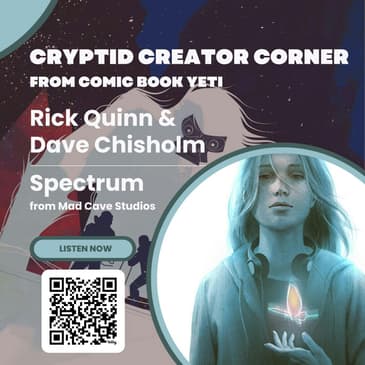

I don't often dip back much and reminisce about my time in the music business. I'm a don't look back type of guy, but I couldn't resist on today's show sharing an anecdote or three because this project is all about music. I've got two new guests on the show with me, Rick Quinn and Dave Chisholm, who are promoting their new project Spectrum from Mad Cave Studios. There's going to be nothing like this on the shelves, it has the feel of an experimental piece of music and we spend a fair bit of time talking about Dave's approach artistically to this rather unorthodox story and I get to hear all about one of the most unique antagonists I've seen in quite some time, Echo, one of the Sustained who are a group of elemental beings who can alter reality through music, and she looks like Brigitte Nielsen got hooked up with Prince's clothing designer with a Cruella Deville fetish. It's memorable as is everything else about the project. I'm a big fan of Dave's work (Enter The Blue, Chasin’ The Bird: Charlie Parker in California, and Miles Davis and the Search for Sound) and wholeheartedly believe this is his best yet. Make sure to check it out.
From the publisher
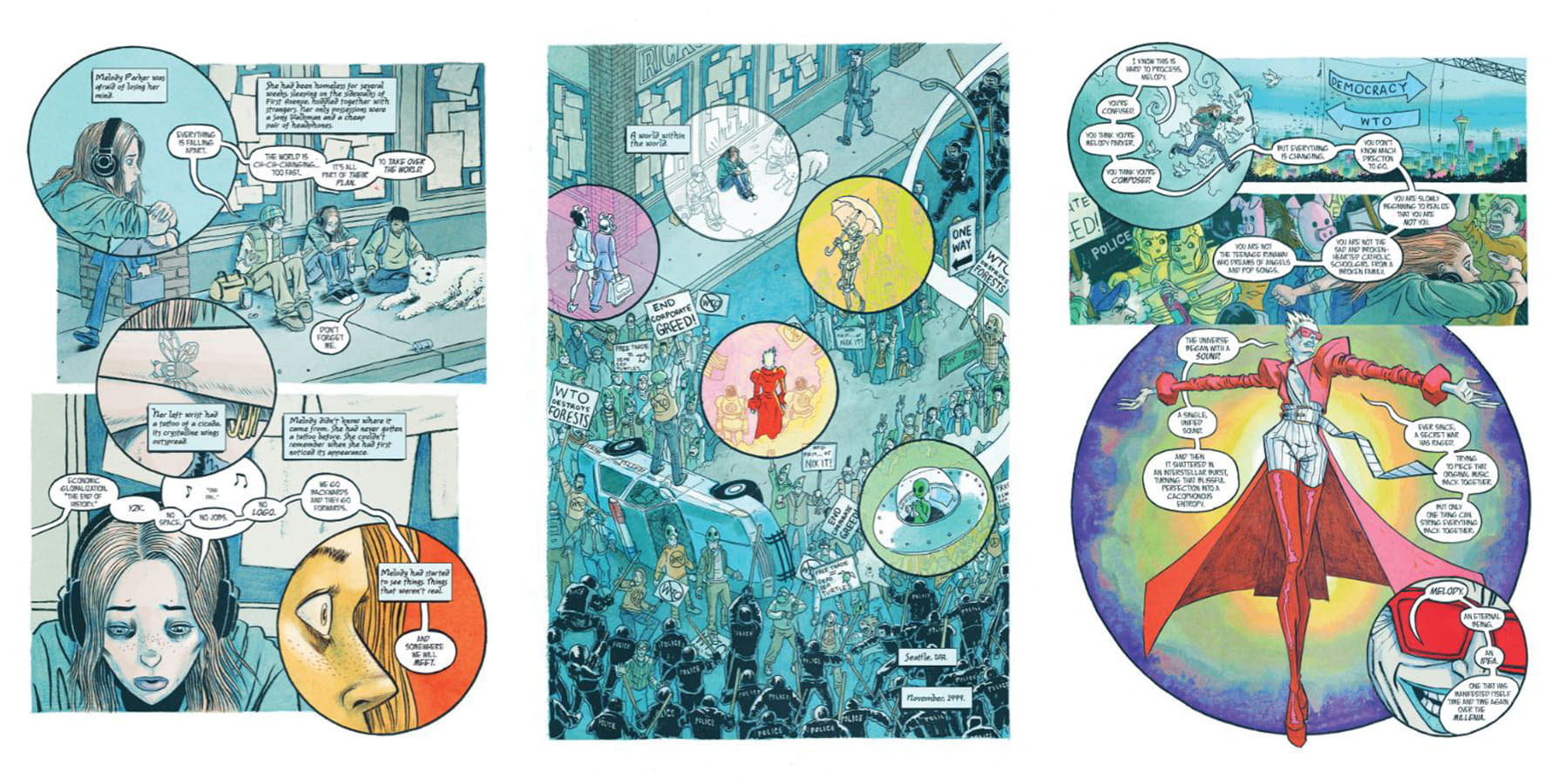
Melody Parker is losing her mind. She’s living on the streets of Seattle during the WTO protests of 1999. She is seeing things. Androids. Aliens. Pigs in high fashion. And a creature named Echo—one of the Sustained: elemental beings with the power to alter reality through music. She invites Melody to join her as she brings about the end of the world. As Melody tries to escape this strange woman, suppressed memories from across vast spans of time flood into her awareness, bringing her very identity into question. You don’t want to miss this stunning new release from writer Rick Quinn and music-comic-specialist Dave Chisholm.
Sample pages
Our episode sponsors
unSeen/unHeard: Disability and Neurodivergence Comic Anthology on Kickstarter
Don't miss this 64-page, 12 story anthology where at least 50% of each creative team is comprised of people who are neurodivergent or have a disability.
Arkenforge
Play TTRPG games? Make sure to check out our partner Arkenforge. They have everything you need to make your TTRPG more fun and immersive, allowing you to build, play, and export animated maps including in person fog of war capability that let’s your players interact with maps as the adventure unfolds while you, the DM get the full picture. Use the discount code YETI5 to get $5 off your order.
[00:00:00] [SPEAKER_01]: Your ears do not deceive you. You have just entered the Cryptid Creator Corner brought to you by your friends at Comic Book Yeti. So without further ado, let's get on to the interview
[00:00:33] [SPEAKER_08]: not likely in the cards, but this podcast is connected to me with people in ways I never would have imagined possible.
[00:00:39] [SPEAKER_08]: I know the similar challenges disabled creators face trying to get their work seen. So it's you come as no surprise that I'm excited about the new, unseen, unheard, disability and neurodivergence anthology on Kickstarter.
[00:00:51] [SPEAKER_08]: This 64 page, 12 story anthology covers a wide range of genres including slice of life, 4, sci-fi, fantasy and romance.
[00:01:01] [SPEAKER_08]: And features at least 50% of each creative team being comprised of people who are neurodivergent or have a disability.
[00:01:09] [SPEAKER_08]: I know that editors can assure you it's in good hands. And after having seen a few sample pages myself, I'm excited to see the rest of what all these amazing creators have cooked up.
[00:01:19] [SPEAKER_08]: If they do a second one, you best believe I'm submitting. I'll drop a link in the show notes for you or you can find them on Kickstarter search for unseen, unheard.
[00:01:29] [SPEAKER_08]: Please consider supporting it and our community. Everyone deserves to be seen. Thanks!
[00:01:38] [SPEAKER_08]: Y'all, Jimmy, the Chaos Goblin Strikes Again, I should have known better than I mentioned I was working on my DC Universe Me, Traveham Loft Hybrid D&D campaign on social media, my bad.
[00:01:49] [SPEAKER_08]: He goes and tags a bunch of comic creators we know, and now I have to get it in gear with this campaign into shapes a week at StarPlan.
[00:01:56] [SPEAKER_08]: Another friend, Chimeson, are you going to make baps? It's fair to say it's been a while since I put something together so I guess?
[00:02:04] [SPEAKER_08]: Question more? It was then that I discovered Arkenforge. If you don't know who Arkenforge is, they have everything you need to make your TTRPG more fun and immersive.
[00:02:13] [SPEAKER_08]: Now, allowing you to build, play and export animated maps, including in-person, fog of war capability, the Let's Your Players interact with maps as the adventure unfolds while you, the DM, get the full picture.
[00:02:26] [SPEAKER_08]: Now I'm set to easily build high-res animated maps saving myself precious time and significantly adding nuance to our campaign.
[00:02:33] [SPEAKER_08]: That's a win every day in my book. Check them out at Arkenforge.com and use the discount code Yeti5 to get $5 off.
[00:02:41] [SPEAKER_08]: I'll drop a link in the show notes for you, and big thanks to Arkenforge for partnering with our show.
[00:02:46] [SPEAKER_08]: I think I'm going to make Jimmy play a goblin warlock just to get even.
[00:02:51] [SPEAKER_08]: Hello everybody and welcome to today's episode of the Cryptic Creator Corner.
[00:02:54] [SPEAKER_08]: I'm Byron O'Neill, your host for today's comic creator chat.
[00:02:58] [SPEAKER_08]: I'm joined by newcomers Rick Quinn and Dr. David Chism, who have a simply amazing new six-issue series dropping this fall with Mad Cave Studio called Spectrum.
[00:03:07] [SPEAKER_08]: I feel like maybe I should be called a conductor over the host today because Spectrum is all about music.
[00:03:12] [SPEAKER_08]: Those of you familiar with Dave's work already, enter the blue, chase in the bird, Charlie Parker and California,
[00:03:18] [SPEAKER_08]: and Miles Davis and the search for sound shouldn't be surprised at all, and regular listeners will know all about my background working in the concert and entertainment industries for over a decade and a half.
[00:03:26] [SPEAKER_08]: So I'm super excited to dive into what, at this point I'm calling an experimental jazz approach to making comics. It's really interesting.
[00:03:34] [SPEAKER_08]: We'll get into all that in a minute first. Rick and David, thanks for joining me on the show. I already know we have a lot in common to talk about.
[00:03:41] [SPEAKER_08]: You're excited. Yeah thanks for having us.
[00:03:44] [SPEAKER_08]: Yeah of course. I want to tell first about the transformative power of music because it's really what this book is all about.
[00:03:49] [SPEAKER_08]: There's a submission form on the Mad Cave website, listing this project that asks about a song that changed your life.
[00:03:55] [SPEAKER_08]: I'll share mine first as I did on the form.
[00:03:57] [SPEAKER_08]: As I said, I spent a lot of time in the music industry on the tech management side of things.
[00:04:01] [SPEAKER_08]: I've forgotten about more shows and that have worked. The most people have ever even considered attending thousands of live shows.
[00:04:09] [SPEAKER_08]: I was very early career at this point. The assistant technical director of the B's Youth Theatre in Knoxville, Tennessee, about an 800-seat venue.
[00:04:18] [SPEAKER_08]: We said everything up.
[00:04:19] [SPEAKER_08]: Ready to kick things off. In this guy walks out on stage wearing a black IR-A hat, a black t-shirt and urban camo pants.
[00:04:27] [SPEAKER_08]: I'm assuming he's a tech or just for whatever reason I hadn't seen him yet. He picks up a violin and lays into it in a way I'd never imagine possible.
[00:04:35] [SPEAKER_08]: This is music prodigy Ashley McKiesey. He plays this song,
[00:04:39] [SPEAKER_08]: a double in the kitchen with an aggression and anger until at that moment I simply could not associate with a classical instrument.
[00:04:46] [SPEAKER_08]: During the two out, he breaks the strings on three violin bows and he was so hard that he cut in the edges of the instrument
[00:04:53] [SPEAKER_08]: and sawdust was flying everywhere. It was glorious. I've seen people smash. I don't even know how many guitars
[00:04:59] [SPEAKER_08]: but this was without a doubt my hard bar for the most metal thing I've ever seen in live music.
[00:05:04] [SPEAKER_08]: Completely transformed it for me. That was 1995 and I stayed in the business until my son was born in 2007.
[00:05:10] [SPEAKER_08]: What were yours? Rick, I know you've got Born to Run on your Twitter expio. So maybe Springsteen?
[00:05:16] [SPEAKER_03]: Yeah, so yeah, I mean that totally Springsteen wasn't early in early favorite.
[00:05:22] [SPEAKER_03]: Ironically, I mean, I kind of came late to music. You're least in my opinion.
[00:05:29] [SPEAKER_03]: Probably wasn't until I was just about getting into high school, but I started listening to music.
[00:05:36] [SPEAKER_03]: Part of the reason that I before I was in high school, I went to a Catholic school,
[00:05:43] [SPEAKER_03]: for eight years, very small class sizes, about 60 students in total.
[00:05:50] [SPEAKER_03]: And music was kind of like a big topic of conversation and a thing that like, the cool kid for into.
[00:05:59] [SPEAKER_03]: And it was not a part of that group.
[00:06:01] [SPEAKER_03]: And so I kind of always had a chip on my shoulder about music growing up and just kind of like very dismissive of it.
[00:06:09] [SPEAKER_03]: And I would say probably my first big musical revelation besides like there's some early dialances in like Christian pop and Christian rock in there, but I was home sick one day.
[00:06:25] [SPEAKER_03]: Yeah, I think this would have been an eighth grade.
[00:06:28] [SPEAKER_03]: And I'm pretty sure that I had lied my way into that sick day.
[00:06:33] [SPEAKER_03]: And so I was just at home and I was having to the TV and landed on like VH1.
[00:06:42] [SPEAKER_03]: And saw the video for Iris by the Goodols.
[00:06:46] [SPEAKER_03]: And that was a huge moment for me.
[00:06:49] [SPEAKER_03]: That was a huge song for me in kind of opening my eyes of the power of pop music, I guess, which I hadn't really allowed myself to be open to until that point.
[00:07:02] [SPEAKER_03]: I think on that same day, I also there was another program on VH1 that did have.
[00:07:09] [SPEAKER_03]: There was interviewing all these people and they were talking about this person, the songwriter who is so incredible and just the way they were talking about him, I didn't know who it was.
[00:07:17] [SPEAKER_03]: Like, man, I like on the edge of my seat, like who could be this incredible that they're talking about and then it cuts you a video for the streets of Philadelphia for springsteen.
[00:07:29] [SPEAKER_03]: So, both of those things kind of occurring on the same day.
[00:07:34] [SPEAKER_03]: And next thing I knew, I have my dad took me to the use local use record store, but you know, springsteen's Grace hits the appointed go.
[00:07:42] [SPEAKER_03]: Got on the BMG music, you know, got 12 CDs in the mail for a dollar, whatever that scam was.
[00:07:49] [SPEAKER_03]: Oh yeah, we all did it. Yeah. And that's kind of where my pop music journey started.
[00:07:57] [SPEAKER_03]: So yeah, I'd say that that was a pretty big one for me.
[00:08:01] [SPEAKER_06]: Okay, Dave, what about you?
[00:08:02] [SPEAKER_06]: Oh, man.
[00:08:05] [SPEAKER_02]: I think on the form for the mad cave thing, I did enter, I can enter for this form.
[00:08:13] [SPEAKER_02]: Yeah, I put, I put a really recent entry.
[00:08:17] [SPEAKER_02]: I put the song, Calico skies by Paul McCartney from his flaming pie album.
[00:08:23] [SPEAKER_02]: Okay, and that song became like, like I have a, I have a son who's 13 months old.
[00:08:33] [SPEAKER_02]: And when he was born, I just listened to that song like on repeat.
[00:08:39] [SPEAKER_02]: And yeah, it just became like this really beautiful, like anthem for like this new massive love in my life with this little guy.
[00:08:52] [SPEAKER_02]: And so like that's, that's what I put down. It's very fresh.
[00:08:55] [SPEAKER_02]: And you know, and also like it kind of became a real kind of like call back to sanity and then kind of sleep deprived insanity of like Aaronhood.
[00:09:05] [SPEAKER_02]: And we're still in it like my little dude was woke up at like basically like 345 this morning.
[00:09:11] [SPEAKER_02]: Oh, so we're, if anybody has any parenting advice, please keep it to yourself because everyone's wrong and nothing matters anyway.
[00:09:21] [SPEAKER_02]: So, so, but you know like I distinctly remember the first music I remember hearing as like sketches of Spain by Miles Davis when I was really little.
[00:09:33] [SPEAKER_02]: And that it's not that isn't, I mean, the form it says saved your life, you know, when a piece of music saved your life, I wouldn't say that exactly saved my life, but in a way it kind of like.
[00:09:42] [SPEAKER_02]: Obviously pointed a huge direction in my life without me even really realizing it.
[00:09:51] [SPEAKER_02]: And then you know like my first favorite band was like the talking heads and I was obsessed with stop making sense when I was like eight or nine.
[00:09:58] [SPEAKER_02]: And my mom like it with the video of the VHS was out of print like the year I was really obsessed to my mom, my mom rented it and like put up hooked up two BCRs to duplicate the rental for me for like a Christmas present which is like so crazy like that that was such an amazing.
[00:10:16] [SPEAKER_02]: And then you know like into like high school like okay computer is something that like is an album that still is sort of like a guiding light for me.
[00:10:31] [SPEAKER_02]: There's just like such a real, dramatic and musical richness to that record and I feel like I feel like it's something I can always come back to again it's sort of like if I'm feeling like really out of equilibrium I can always come back to that album and it kind of like brings me back to like.
[00:10:53] [SPEAKER_08]: Good spot so yeah yeah I completely understand the song that you attached to as a father I went through that with a 30 seconds to Mar song when when my son was young and which I couldn't believe I was like oh my god, I'm into an e-bomand that is it just absolutely my mind but.
[00:11:11] [SPEAKER_08]: You know people can connect to music in a way that transcends any other type of communication you know everyone remembers their wedding song like hell I have a funeral playlist for myself.
[00:11:21] [SPEAKER_08]: You know I'm working on writing my own music or in a comic book which surprised features a band on the road.
[00:11:27] [SPEAKER_08]: But what appeals to you both so much about integrating them as a as narrative mediums together because they're very very different seemingly anyway.
[00:11:37] [SPEAKER_06]: Hmm.
[00:11:39] [SPEAKER_02]: That's a good question.
[00:11:43] [SPEAKER_02]: For me like it's real like nerdy kind of like formalist kind of angle out I teach a class at RIT here in Rochester called comics and music and it's really all about like.
[00:11:58] [SPEAKER_02]: Like helping students develop an understanding of like all of the formal devices and formal like structural elements of music by translating pieces of music into like comics with as much specificity as possible.
[00:12:17] [SPEAKER_02]: So it becomes like a lot of like.
[00:12:21] [SPEAKER_02]: Like mining a piece of music for like as much like concrete objective like structural stuff that's happening you know like.
[00:12:30] [SPEAKER_02]: Is it in four four time with that mean for like a grid and like how does the melody fit in that grid right and this like really really like.
[00:12:40] [SPEAKER_02]: Almost like like ner super nerdy kind of stuff and I get a real kick out of that.
[00:12:47] [SPEAKER_02]: And just this idea that when you look at a blank page it's like a container for.
[00:12:53] [SPEAKER_02]: For time that is in determinant right of comics when you look at like a blank page or comic it's like comics it's like a container for time that's in that's in determinant for the reader but it's not in determinant necessarily for the characters in the story that that they're that they're experiencing and that and it's like all of these images and symbols that are intended to be read sequentially.
[00:13:19] [SPEAKER_02]: And so that's the thing that are that capture a determined amount of time for the thing like that's capturing a tournament of time it's the same description that you could make for a piece of sheet music as well right.
[00:13:30] [SPEAKER_02]: piece of sheet music is capturing a certain duration of time of music and it's all these little like symbols and stuff that are meant to be read in a particular sequence and so like for me.
[00:13:43] [SPEAKER_02]: Comics when I'm thinking about interfacing with music and comics it really becomes sort of like a challenge to like find a way to make my own personalized.
[00:13:53] [SPEAKER_02]: Little bit of music notation with the comic structure that captures some specificity or some element of the music or as many elements as I can.
[00:14:06] [SPEAKER_02]: And you know.
[00:14:09] [SPEAKER_02]: And that's where all of this like illustrating sound and sort of like drawing sound I kind of like kind of come into play where it's like I want to do that with specificity and not just put like a bunch of vague like wavy lines there like I want like real something that's like that's like.
[00:14:27] [SPEAKER_02]: deals with the specificity of music in some way.
[00:14:31] [SPEAKER_02]: I'm sure that's a different answer from Rick's answer so I like say way to.
[00:14:39] [SPEAKER_03]: I think for me the approach is a little bit more not specifically tied to the comics medium per se I think music to me is just is just an interesting subject.
[00:14:52] [SPEAKER_03]: For for any kind of project that I would work on and I think specifically what kind of interest me about it is.
[00:15:00] [SPEAKER_03]: It's kind of the way that music and memory kind of merged together and you know as they was talking I was kind of thinking you know for me.
[00:15:12] [SPEAKER_03]: more than any other art form like there's there's a scene in the movie high fidelity where character finds junkies exiting on the four of those records around him and he's like what are you doing.
[00:15:26] [SPEAKER_03]: He's like I'm reorganizing my collection and and he's like goes it like alphabetical or what and he's like it's autobiographical.
[00:15:35] [SPEAKER_03]: In this idea that he's like sequencing everything on a shelf in some kind of you know from when he was born till now and I feel like if I were to go through my music collection I mean I pretty much could.
[00:15:46] [SPEAKER_03]: Album by album song by song say the memory, the person that I you know who introduced me to it or who I listened to with or you know what job I had at the time or the friends that I was hanging out with.
[00:15:59] [SPEAKER_03]: And really there's nothing else like that to me. I mean I've been a comics fan as long as I've been longer than I'm been a music fan, but I you know if I were to go through my comic book collection I can.
[00:16:10] [SPEAKER_03]: I can tell you where it was or you know what feeling it necessarily evokes for me.
[00:16:18] [SPEAKER_03]: So yeah, I think for me.
[00:16:21] [SPEAKER_03]: As someone who you know I come to music purely almost from a fan perspective. I understand very little of.
[00:16:34] [SPEAKER_03]: Music theory I watch a lot of YouTube videos and basically while I'm watching it I'm like this is really inside have I understand it all in the same as it's over I basically completely back to square one and have no idea.
[00:16:47] [SPEAKER_03]: I'm going to get into somebody else.
[00:16:50] [SPEAKER_03]: So you know for me it's just like kind of the impact the music has had on me and kind of that like almost mystical quality that it has that I just find like really intriguing and is a reason why is something I always kind of come back to is something to write about or something to create art about because I just think it's really interesting.
[00:17:11] [SPEAKER_08]: Well as most unique truly unique creative endeavors tend to be you know Rick I was reading the the germ of spectrum started as a at a creative low point for you when you were almost ready to pack in.
[00:17:24] [SPEAKER_08]: The whole comics thing and you called this a fantastic oracle memoir about your relationship to music among other things so sounds a bit like this was almost creative salvation in a way for you.
[00:17:37] [SPEAKER_03]: Yeah I mean a little bit I mean I think you know at the time that I was working on the original script for this I've been writing comics and self publishing essentially for you know seven right years I think at that point and you know for for.
[00:18:00] [SPEAKER_03]: The.
[00:18:02] [SPEAKER_03]: Where I was at at the moment like you kind of have to when you're sitting down and work on this project you kind of had to you couldn't just sit down with a blank page and be like right to my heart's content you know.
[00:18:14] [SPEAKER_03]: Whatever I wanted because I kind of had to have an eye on like what was financially viable terms like I'm the one that's reaching out to find an artist and pay them and.
[00:18:25] [SPEAKER_03]: That it couldn't be you know 120 page book and had to be much shorter very short and so you know after doing that for quite a while which I was you know I really enjoyed doing that I still like writing short form comments or fiction.
[00:18:46] [SPEAKER_03]: But you do you know hit these moments in frustration where you're like I really wish that I did not have to you know worry about these other considerations and just.
[00:18:57] [SPEAKER_03]: Right from just the purest.
[00:19:00] [SPEAKER_03]: point of view of just like what I want to do and you know figure out the details later kind of thing and.
[00:19:10] [SPEAKER_03]: Yeah, so that's kind of the mindset that I was in when I sat down to work on it was just like you know what how about.
[00:19:18] [SPEAKER_03]: You know instead of yeah worrying about how I'm going to pay for it or you know whether it would even come out at all I just want to write something for me because I just find you know just the that acting in and itself.
[00:19:32] [SPEAKER_03]: Is satisfying and has meaning to me and you know I kind of just thought like well I'll just do this and that will be that and then I'll you know out of my system and I'll move on on the next thing.
[00:19:46] [SPEAKER_03]: And yeah ended up I mean I finished it and send it to Dave because I knew that you know I was like we we already kind of.
[00:19:55] [SPEAKER_03]: Over the years I've always traded kind of back and forth what we're working on and and sharing ideas and feedback and things like that and.
[00:20:03] [SPEAKER_03]: I knew that you know I was like almost nobody is going to understand this but they will understand it because.
[00:20:10] [SPEAKER_03]: I knew from previous conversations we come at you know.
[00:20:15] [SPEAKER_03]: These things from a pretty similar angle and then yeah I mean like within a few hours I think of having sent it he texted me and was like let's make this happen.
[00:20:27] [SPEAKER_03]: Yeah that was that.
[00:20:29] [SPEAKER_08]: I'm in no way surprised that that that this appeal to Dave because frankly I can't think of a better artist in the business better suited or this how did you know each other previously how did you originally connect.
[00:20:42] [SPEAKER_02]: I think we were like mutuals on Twitter first okay.
[00:20:47] [SPEAKER_02]: I think you're introduced by our mutual friend Milton Losson yeah yeah yeah I think we followed each other on Twitter before.
[00:20:56] [SPEAKER_02]: We were formally kind of like connected and we're part of like a slack group that is just perpetually on the brink of death.
[00:21:05] [SPEAKER_02]: Like it's always like it's the police exciting slack group of all time I think like.
[00:21:11] [SPEAKER_02]: Maybe like five posts total every week happened in this slack group but just it's just the three of us it's Milton Rick and me at this point.
[00:21:22] [SPEAKER_02]: And yeah I mean it was a little more percolating when we started working we're starting to work on spectrum and stuff but anyway yeah.
[00:21:32] [SPEAKER_02]: And then we.
[00:21:35] [SPEAKER_02]: You know I've done heroes con like three times at this point in.
[00:21:41] [SPEAKER_02]: You know hung out with Rick that always had a awesome time you know.
[00:21:46] [SPEAKER_02]: Some pattern.
[00:21:49] [SPEAKER_08]: Cool well getting into the middle of the book we kicked this thing off at the Battle of Seattle in 1999 at a world trade organization protest march against globalization.
[00:21:58] [SPEAKER_08]: I was working as a tech you know myself at that point and.
[00:22:03] [SPEAKER_08]: There's around that time that music from a live touring perspective radically shifted into the decidedly corporate realm you know clear channel had been buying up radio stations.
[00:22:12] [SPEAKER_08]: And sheds are outdoor amphitheaters around the country in a mad power grab to control the airways.
[00:22:18] [SPEAKER_08]: At that time much of the joy quirkiness and spontaneity of the business evaporated in the span of a few years time and clear channel control not only.
[00:22:27] [SPEAKER_08]: What a huge majority of people heard on the radio but also these blockbuster summer tours as they packet formulaic saccharine.
[00:22:34] [SPEAKER_08]: And in my opinion crap from maximum profit and my beloved grunge era died.
[00:22:40] [SPEAKER_08]: I'm not jaded or anything but that's my 1999 so why set the book in that moment in time.
[00:22:49] [SPEAKER_03]: Well I think I mean he reasons I mean one just kind of like thematically seem to appropriate as the book is.
[00:22:58] [SPEAKER_03]: Starts at the end of the 20th century and perhaps we visit more of the 20th century as as the series goes on.
[00:23:09] [SPEAKER_03]: So that was one piece I mean the other obvious pieces I originally from the area so I was not there I was too young to be there but I definitely remember reading about it in the newspaper and.
[00:23:23] [SPEAKER_03]: Kind of the prominence that it of that event.
[00:23:29] [SPEAKER_03]: At that time and there's also in the I mean a third is another kind of like running theme throughout the throughout the series as it goes as kind of these moments of historical unrest.
[00:23:44] [SPEAKER_03]: And so that that will kind of echo throughout.
[00:23:50] [SPEAKER_03]: As the series moves forward as well so I guess those are probably the three main reasons plus I also was like oh you know Dave needs a challenge.
[00:24:01] [SPEAKER_03]: And he's a challenge because he can pretty much do anything so my you know for me out part of the fun of you know.
[00:24:08] [SPEAKER_03]: Writing this just in total was always just like how can I push him to the left you know his limits and then he's just like whatever and just crushes it so.
[00:24:19] [SPEAKER_08]: Where were you in the future town I lived there for seven years so that's why I'm just curious now to coma.
[00:24:25] [SPEAKER_08]: Okay yeah we were in gig harbor.
[00:24:27] [SPEAKER_03]: Okay yeah when a lot of my family is out there.
[00:24:32] [SPEAKER_08]: Oh there's a repeated symbolism of medmoles in the book from butterflies to cicada tattoos you know I've been bummed out honestly this case haven't been more of a prominent thing this summer.
[00:24:44] [SPEAKER_08]: As was advertised to be a big banner year maybe not just where I am but I grew up pulling the little discarded husk stuff the back wall of our garage when I was a kid and collected them in a jar occasionally maybe wearing them to school and making my mom crazy.
[00:24:57] [SPEAKER_08]: Anyway, book meta more for says is a recurrent piece of of thematic symbolism in this so what can you tell me about their inclusion without maybe exploring everything because it seems pivotal but I haven't read it all yet.
[00:25:14] [SPEAKER_03]: I don't know how I don't know if you can still back because I was I've answered the last question Dave Dave will take the next to.
[00:25:22] [SPEAKER_08]: He's he's coming up.
[00:25:23] [SPEAKER_03]: Okay good.
[00:25:26] [SPEAKER_03]: Well yeah without giving too much away.
[00:25:30] [SPEAKER_03]: There are a lot of there are a lot of wing references.
[00:25:35] [SPEAKER_03]: A lot of wing winged winged things in particularly in the first issue and yeah part of that is there's an autobiographical element that's woven in that first issue it's definitely thematic also yeah I mean you know being here in North Carolina.
[00:25:56] [SPEAKER_03]: The cicadas all over the place you know one of the first concerts I went to when I moved out here was at the Raleigh Art Museum.
[00:26:06] [SPEAKER_03]: They have like outdoor concerts and the when said Gillian Welch and which if anyone's not familiar like folk musician herna partner Dave Rollings it's the two of them on you know usually one guitar and a band jo or two guitars and just a microphone stand and like no other amplification.
[00:26:26] [SPEAKER_03]: And so they were singing and performing but I mean you literally almost could not hear them over the you know just insanely loud drone of all the cicadas at night and you know not being from around here I you know I was kind of mind blind.
[00:26:45] [SPEAKER_03]: And yeah I mean again like in the first issue there's like references to mythology and kind of the cicadas place in history and I again just so kind of a personal obsession so kind of wrote it you know wrote that in there but yeah.
[00:27:00] [SPEAKER_03]: Like I said winged winged things are abandoned especially the first issue and beyond.
[00:27:06] [SPEAKER_08]: Okay well however the layout construction was dived up between you two it's it's absolutely gorgeous days like sometimes you get these round panels arranged in such a way that reminds me of notes on a piece of sheet of music you know music is in the DNA of everything you do so what footprint.
[00:27:23] [SPEAKER_08]: Is kind of unique in spectrum how did it how did this push you oh gosh.
[00:27:28] [SPEAKER_02]: Yeah I think with I really took a really ex kind of like experimental approach with spectrum kind of like.
[00:27:40] [SPEAKER_02]: Kind of like Rick kind of like Rick when he wrote it was like I'm just gonna do whatever I want kind of was like in between big like.
[00:27:50] [SPEAKER_02]: Music like the the Charlie Parker book and the blue notebook and then the Miles Davis book and these are all books that have like.
[00:27:59] [SPEAKER_02]: I have to have like licensure approval for every aspect of it and everyone all of those entities were wonderful to work with there was no.
[00:28:08] [SPEAKER_02]: Friction or limitation there but.
[00:28:11] [SPEAKER_02]: For this project I was like I don't have anyone who's gonna tell me that I can't do anything so I'm just gonna like.
[00:28:18] [SPEAKER_02]: Go nuts and like really I want to I want to make it.
[00:28:22] [SPEAKER_02]: Do all the weird cool things with it so like.
[00:28:28] [SPEAKER_02]: With this book I experimented a lot with like multimedia kind of like using ink washes that were like color colored ink and then manipulating those in Photoshop and colored pencils over the top of my in.
[00:28:45] [SPEAKER_02]: And then like again like manipulating those in Photoshop to get like the cool texture and mid tones.
[00:28:51] [SPEAKER_02]: I did all of the word balloons like by hand so that they looked really like.
[00:28:59] [SPEAKER_02]: Wiggly and stuff so that it wasn't looked perfect and then and then I put and then I think early on I think from like page to page one I was like I'm going to put like circular panels on like every almost every page in this book right.
[00:29:16] [SPEAKER_02]: And that continues through the whole series and um they're always kind of like and then it got to the point it didn't take very long for a Rick to kind of catch on and start putting it in the script like I'll make this panel like circular panel and it was always like circular panels are kind of.
[00:29:32] [SPEAKER_02]: Well, I don't know like notorious like in some sort comic artists circles of as being like release like silly or like like like not.
[00:29:42] [SPEAKER_02]: Like not like the best choice to make and I was like oh I really like I really love using circular panels and I remember the first time when back.
[00:29:58] [SPEAKER_02]: Ages ago when Wednesday comics was coming out the on like newspaper.
[00:30:03] [SPEAKER_02]: Um all pop strange adventures and they're always had these circular panels for like moments at emphasis and I was always like oh that's like it looks so cool in there and so it was just kind of stuff with me in the back of my head like I'm going to.
[00:30:15] [SPEAKER_02]: So now I'm going to do a project with with a lot of circular panels and for some reason that this became that project.
[00:30:24] [SPEAKER_02]: Um and and then it became part of the cover art where like the cover art has like.
[00:30:33] [SPEAKER_02]: It looks like like a CD on the bottom part of the cover art with like an melody and then her headphones make like the concentric circles of like a CD.
[00:30:43] [SPEAKER_02]: And it's the same like and so it's a bit of recurring a recurring motif like through the whole the whole book.
[00:30:51] [SPEAKER_02]: But on top of that then there's like all of these really fun like a sides through the story where like.
[00:30:58] [SPEAKER_02]: We get a little bit of like the main story and then a little aside about some thing that's like related to the main story of piece of history piece of music history or something like that and I.
[00:31:12] [SPEAKER_02]: I kind of was like all these need to look different from this. This is like the narrator speaking.
[00:31:20] [SPEAKER_02]: And it should be it has to look different so for those ones I was really.
[00:31:25] [SPEAKER_02]: Trying to like have a really simplified like strip down style.
[00:31:31] [SPEAKER_02]: Um and then there's like a code of for every issue that deals with this journalist you know this like this kind of like.
[00:31:39] [SPEAKER_02]: This story of this journalist and I was like well those have to look a particular way as well.
[00:31:44] [SPEAKER_02]: And then it sort of became like all of this like every sort of like new like movement of this through this like story every new like character like moved this part of the this like.
[00:31:57] [SPEAKER_02]: New location or new setting every new setting because they weren't just like regular settings it was like this totally it just goes like all kinds of crazy places.
[00:32:07] [SPEAKER_02]: Every new setting had to be like a new kind of like look to kind of capture the vibe of the setting and not just like I'm just going to draw the thing but instead draw the way it feels instead of the way it like looks necessarily.
[00:32:19] [SPEAKER_02]: And then also with this book.
[00:32:21] [SPEAKER_02]: I usually had use.
[00:32:25] [SPEAKER_02]: For I like to color my own work and I usually use a flat like a flatter like someone to get I hear someone don't do flats which is that really tedious part of coloring where you have to like capture and make like capture all of the little shapes.
[00:32:41] [SPEAKER_02]: And then.
[00:32:43] [SPEAKER_02]: And I didn't use a flatter for this one and the way I colored everything is that then I would flat the characters and then just paint the background like.
[00:32:53] [SPEAKER_02]: Using a lot of like transparent brushes digitally paint the background like so.
[00:32:59] [SPEAKER_02]: I think it has a real dream like quality because of that.
[00:33:05] [SPEAKER_02]: Yeah, the colors in the backgrounds are like not quite in the lines sort of like inspired by like the background art of like 101 Dalmatians or something like that not that it's that good it's not as good as that art but it's sort of inspired in a way by that sort of like purposeful.
[00:33:25] [SPEAKER_02]: Like in precision and in a lot of the background art and so this kind of stylistic shifting.
[00:33:33] [SPEAKER_02]: Continues through the whole book and and sort of like gives us some nice like threads through it that I think are like really like a kind of like a musical motif that comes back again and again.
[00:33:47] [SPEAKER_02]: It feels very much like in the same way.
[00:33:55] [SPEAKER_02]: I think Rick's writing is a lot like this to like in the same way like when you listen to like a piece like a piano sonata or symphony by like Beethoven you hear like his absolute mania and thinking one little kernel of music and then like putting it here and here and here and here and then here it is slower while it's happening faster up here and it just becomes this almost like a like a.
[00:34:18] [SPEAKER_02]: Orger in obsession or like a particular idea and so like the winged stuff from the script and the circular stuff and then they're all kind of there these all of these it's a very like interconnected story it's the kind of story that like.
[00:34:36] [SPEAKER_02]: You know I really hope that the kind of like obsessed.
[00:34:40] [SPEAKER_02]: Comic readers who want to like get out like a magnifying glass and look at like all of the interconnected bits and rereads stuff again and again, I really hope they like tap into this book and like really like take it to heart because there's a lot of like.
[00:34:54] [SPEAKER_02]: There is a there's a lot of echoes throughout the whole thing not to get too clever with my word at wording there so.
[00:35:02] [SPEAKER_08]: Yeah, I really enjoyed it. I raised my hand. I am definitely one of those comic readers who probably gets to in the weeds with those kinds of things and as an aspiring colorist and who is learning the craft.
[00:35:13] [SPEAKER_08]: I share the flattening the lemma 100% alright. Let's take a quick break.
[00:35:28] [SPEAKER_08]: After a string of unexplained disappearances in the southern parts of the United States retired detective Clint searches for his white trash brother.
[00:35:35] [SPEAKER_08]: While searching for him he ends up being abducted by aliens. He is now in the arena for big guns stupid rednecks an intergalactic cables newest hit show which puts him and he other humans in laser gun, Glatatorial combat
[00:35:50] [SPEAKER_08]: And his brother is the reigning champion with 27 kills.
[00:35:55] [SPEAKER_08]: That's the premise for a new book from Bandabarans big guns stupid rednecks.
[00:36:00] [SPEAKER_08]: I got a chance to see an advanced preview of this book and being from the south honestly,
[00:36:04] [SPEAKER_08]: I was a bit skeptical going in but they won me over and nothing is more powerful than an initially skeptic convert.
[00:36:11] [SPEAKER_08]: In Jimmy's words big guns stupid rednecks is many things but it isn't subtle. It tells you exactly what it is up front
[00:36:18] [SPEAKER_08]: Then it delivers with a great premise fantastic art and a whole mess of fun.
[00:36:22] [SPEAKER_08]: I had a great time reading big guns stupid rednecks and what I thought was going to be an indictment of redneck culture quickly showed it was actually a love letter.
[00:36:31] [SPEAKER_08]: A family mystery brother pitted against brother aliens fighting for profit and a big arena this truly has it all.
[00:36:37] [SPEAKER_08]: Issue one is now already but you can still pick up a copy on the Bandabar's website and create issues are available via your previews or lunar order form or just ask your LCS don't miss.
[00:36:47] [SPEAKER_08]: Let's get back to the show.
[00:36:49] [SPEAKER_08]: The work here is so good at leading the eyes. It's fairly reserved and muted almost a tungsten kind of color overlay for what seems are the reality moments kind of for lack of a better way of illustrating it so am I interpreting that correctly kind of the differences between.
[00:37:06] [SPEAKER_08]: Where melody is at and kind of what she's experiencing maybe in her mind.
[00:37:10] [SPEAKER_02]: Yeah, yeah, yeah, yeah, I think that's I think that's a good reading. I mean, I don't want to ever say that anyone's wrong or right.
[00:37:18] [SPEAKER_06]: Sure.
[00:37:19] [SPEAKER_02]: I like this is it's there what's there is there and you can pull what you want from it. Yeah, yeah, but there's these really gorgeous little visual moments.
[00:37:28] [SPEAKER_08]: I think there's a mocha themed illustration at one point with an arc unless I'm missing my guess and we haven't gotten to chat before so kind of what what is your artistic process look like specific to this book.
[00:37:40] [SPEAKER_08]: I know character stretches are kind of a common starting point, but every little detail is so important here that nothing feels you know immaterial. So I'm having a hard time figuring out where you even start.
[00:37:56] [SPEAKER_02]: Let me like try to remember back it feels like I started the we started this book before I did the Miles Davis book.
[00:38:03] [SPEAKER_02]: Okay, then I paused I got the first issue done in like five pages on the second issue and then I had to pause to do like the Miles Davis book.
[00:38:10] [SPEAKER_02]: And then when I finished that we came back to this right and so it was a while ago.
[00:38:18] [SPEAKER_06]: But honestly, like I.
[00:38:23] [SPEAKER_02]: I do like my thumbnails range from like so like pretty thorough to like absolute chicken scratch right and I do like to do a lot of design on the page.
[00:38:39] [SPEAKER_02]: Like I don't like love doing character turn around and character designs and vehicle design like all this stuff.
[00:38:49] [SPEAKER_02]: I feel like I just want to do that work on the page as much as I can.
[00:38:56] [SPEAKER_02]: It's like a time thing to like it that stuff just takes time and it's like chair.
[00:39:00] [SPEAKER_02]: You know.
[00:39:03] [SPEAKER_02]: And and I found maybe this is telling on myself, but I've kind of found that like doesn't really there are certain aspects of that that helped me in the long run, but like for the most part doing that stuff doesn't really help me out.
[00:39:19] [SPEAKER_02]: It doesn't really help me like keep a character consistent it doesn't really help me keep like like the stuff that helps me out in thumbnails is like, where am I going to put like dark values?
[00:39:31] [SPEAKER_02]: Where is it going to be black on the page? Where is it going to be light on the page? What are the big shapes that are happening.
[00:39:38] [SPEAKER_02]: And so.
[00:39:42] [SPEAKER_02]: I don't even I think it just a lot of it had just happens on the page, I think when I'm like working on it and thinking through it and stuff like that.
[00:39:51] [SPEAKER_02]: But I don't know it's you know I get it's not quite the same as like improvisation you know it's not.
[00:40:00] [SPEAKER_02]: It's sort of like somewhere in between where it's like I give myself like sort of a 75% like prescription for like a page and when I sit down to make the final art I have like.
[00:40:11] [SPEAKER_02]: A 75% like idea of how it's going to look and then just like a lot of like self trust like I know that I'm going to get that last 25% and maybe even change some of the 70% as I like move through it.
[00:40:27] [SPEAKER_02]: And you know thankfully like Rick is a pretty chill dude collaborator and so like when I would like come to him like hey can we make this one moment into two panels or can we like add a panel here or.
[00:40:41] [SPEAKER_02]: Can or like what if I what if I did this here instead of what you wrote in the script which was not a super regular occurrence.
[00:40:50] [SPEAKER_02]: He he was always like why are you who are you texting me.
[00:40:57] [SPEAKER_02]: This phone number and then I'm blocking you for on my phone so it was a really nice collaboration.
[00:41:05] [SPEAKER_03]: Well I have a big experience.
[00:41:08] [SPEAKER_03]: I was just going to I mean elaborate on how nice of a collaboration for real though.
[00:41:14] [SPEAKER_03]: I'm I was just going to say I'm like I think one of the things that or.
[00:41:19] [SPEAKER_03]: And that reasons are collaboration I think is works is like we balance each other out very well feel like Davis and then yeah it's not quite improvisation but he I mean very instinctual and like very.
[00:41:32] [SPEAKER_03]: Like to me very open and free and just like kind of like let's figure it as we go.
[00:41:38] [SPEAKER_03]: I am much more the opposite where I will sit and finesse over you know the punctuation on you know a description in a script that one person is going to really not even the dialogue just like.
[00:41:49] [SPEAKER_03]: You know how I'm phrasing something.
[00:41:53] [SPEAKER_03]: And so hopefully by the time the day of his reading it so I have stressed about some of those elements so much that he's able to just pick up.
[00:42:02] [SPEAKER_03]: My thought process to reading it and execute him in there.
[00:42:06] [SPEAKER_03]: So many examples throughout the whole series of the final page looks exactly like what I had my head down to like exactly how it's framed exactly how it's laid on page.
[00:42:15] [SPEAKER_03]: And I mean other than saying how many panels it was you know none of that was directly written in there so yeah I feel like you know I did I took I did a lot of the worrying for us.
[00:42:31] [SPEAKER_03]: And he took it over and was just like as fine.
[00:42:35] [SPEAKER_02]: Yeah you know I got to say like when I script my own stuff I'm like really similar to Rick in my like obsessiveness of like.
[00:42:46] [SPEAKER_02]: I'm like not a really like.
[00:42:52] [SPEAKER_02]: Instinct of writer in a lot of ways like I really have to like stop and then start and then like go back and it's like a lot of a lot of like um.
[00:43:03] [SPEAKER_02]: Second guessing and editing and stuff like that and so.
[00:43:07] [SPEAKER_02]: Thankfully that I'm not like that with the visual stuff I'm pretty.
[00:43:11] [SPEAKER_02]: Decisive with that stuff I'm not I.
[00:43:14] [SPEAKER_02]: I um.
[00:43:17] [SPEAKER_02]: I you know I teach like I this is this is like an I teach like art class that I'm an art degree right I teach like art classes at like a university to all these like illustration majors and stuff all these amazing.
[00:43:29] [SPEAKER_02]: Students these kids I say kids because they're like 20 years younger than me I think I'm allowed to say kids at this point who are like so so like skill they like they're so skilled.
[00:43:40] [SPEAKER_02]: And it does seem like.
[00:43:43] [SPEAKER_02]: The process that they they learn in school is like a really inefficient process that's the fact that they're like actually practicing inefficiency as part of their process where like.
[00:43:53] [SPEAKER_02]: They'll do like 15 thumbnails of like one page and I'm just like why don't you practice like getting right the first time instead of like.
[00:44:01] [SPEAKER_02]: Like maybe like trying to get every target except for your target before like.
[00:44:06] [SPEAKER_02]: You know you not every decision needs to be like of this massive process of elimination.
[00:44:14] [SPEAKER_02]: And you know it goes all the way down to like I'll see a student spend like.
[00:44:20] [SPEAKER_02]: Like a really long time just like especially with like digital media where they'll like draw line and then commandsy and then draw line and commandsy and draw line and commandsy and I'm just like those all those lines weren't like the same line and like maybe.
[00:44:34] [SPEAKER_02]: All of that work is.
[00:44:38] [SPEAKER_02]: Like not really making it that much better like you're doing a lot of extra labor for like not a lot of like improvement and maybe practice like making the line right the first time.
[00:44:49] [SPEAKER_02]: Kind of thing like in it and it sort of does become sort of like you have to like practice intuition you have to practice like you know it becomes like like all of this stuff becomes a practice and so for whatever reason with my work.
[00:45:04] [SPEAKER_02]: With what when I'm making comics and making pages instead.
[00:45:07] [SPEAKER_02]: I do have like at this point I've practiced this so many times and I've always been a pretty decisive guy with this stuff that like I can that I.
[00:45:19] [SPEAKER_02]: Happily like can work through stuff pretty quickly and get lay out some pretty quickly and I don't really like like labor too much over.
[00:45:27] [SPEAKER_02]: The like been a key stuff like I and I trust myself that I can like get it to the finish line when I'm actually when I actually have the page on my drawing table or scanned in the my like in the like Photoshop or whatever.
[00:45:40] [SPEAKER_08]: Okay, but I am a bit curious there's one splash page at the beginning of the book at the protest that is so detailed and.
[00:45:49] [SPEAKER_08]: For me, I was looking through all these people and looking for wall though.
[00:45:54] [SPEAKER_08]: Maybe that sounds terrible but I know you're a dad now and I've been really remember the kids days books and will will forever have a love of Eric Carl so how has the experience of being a dad change your art.
[00:46:06] [SPEAKER_08]: Aside from lack of sleep.
[00:46:09] [SPEAKER_02]: I mean you know you know the truth is I think I just have like less time to be like sort of indulgent at the table.
[00:46:18] [SPEAKER_02]: I just have like less time so I have to when I sit down to work like more than ever I have to be like super dooper efficient and super dooper like decisive and just like like I have 10 minutes and I have.
[00:46:31] [SPEAKER_02]: Twenty minutes or whatever like the little windows of pockets of time and I have to be super decisive.
[00:46:37] [SPEAKER_02]: So it's like a time management kind of exercise.
[00:46:42] [SPEAKER_02]: And I'll tell you that right now I'm drawing a book for issue series for own depress.
[00:46:50] [SPEAKER_02]: That I don't think it hasn't been announced yet or anything like that I'm almost undrolling the first issue and.
[00:46:58] [SPEAKER_02]: Like my thumbnails on it are like probably some of the more like in depth like detailed thumbnails I've done and it's really saved me a lot of talking like doing the final pages to have thumbnails that are like very clear.
[00:47:11] [SPEAKER_02]: Especially with regards to like where the shadow is our because it's like kind of this horror series and so like I'm doing a style with like a lot of black on the page.
[00:47:20] [SPEAKER_02]: And so I really don't want to like guess around with that stuff you kind of have to have a real plan for where those black shapes are going to be blocked in and everything like that.
[00:47:30] [SPEAKER_02]: And so I never really thought I'd be the kind of person who does like thumbnails that are like in ink and stuff like that and it and I've done it and it's really saved me a lot of time.
[00:47:42] [SPEAKER_02]: But in terms of the decision making and all that stuff.
[00:47:46] [SPEAKER_02]: It hasn't changed my decision making at all it's just made me have a little bit less time I would say like my my paid the rate that I can get paid is done is obviously slower because I just have like less time to do.
[00:47:59] [SPEAKER_02]: To do the work and everything but.
[00:48:02] [SPEAKER_02]: Other than that my I think I'm I think the arts pretty consistent you probably can't tell when I start when my baby was born in the book.
[00:48:11] [SPEAKER_02]: Yeah, well actually you at you will never the first two issues so right.
[00:48:15] [SPEAKER_02]: So maybe when you read the rest you should tell me when you think that little dude showed up in my life okay okay I'll do that for sure.
[00:48:23] [SPEAKER_08]: Well we're doing some hopping around in the first issue not sure if that will remain a feature throughout the rest of the series.
[00:48:29] [SPEAKER_08]: We know very early on our main character Meli Parker has found herself homeless and she's seeing things are these scenes.
[00:48:39] [SPEAKER_08]: As much as you can talk about it and alternate reality or sort of just something inner head.
[00:48:47] [SPEAKER_02]: Don't answer that Rick.
[00:48:50] [SPEAKER_02]: No, we can't answer any of these questions.
[00:48:54] [SPEAKER_02]: We can't that's up to the readers to decide what it is up to the readers it's really there's like lovely ambiguity and all of this stuff.
[00:49:03] [SPEAKER_02]: Okay we're never gonna this this project is like that to me like I love this book so much this to me it's like the epitome of like trust your reader.
[00:49:12] [SPEAKER_02]: Okay, we're there's no like or like very few moments where like things are kind of like we're like spelled out to make make anything like like obvious what's happening and I love that about.
[00:49:30] [SPEAKER_08]: Okay well I'll I'll spare you the question then and just give you an observation as someone on the spectrum myself you know I I'm seeing a potential connection with Meli and her visions as spectrum folks can experience a typical.
[00:49:42] [SPEAKER_08]: It's a very interesting and is a very interesting, a very interesting and interesting story processing and it's not uncommon actually to that music itself can create a grounding environment for them certainly does for me so.
[00:49:53] [SPEAKER_08]: I'll leave that doesn't have to be a question this an observation but.
[00:49:57] [SPEAKER_08]: The antagonist in the first issue looks absolutely amazing this is echo one of what you're calling the sustained use and elemental being who can alter reality through music such a great look she looks like.
[00:50:10] [SPEAKER_08]: with a wardrobe designed by Princess Stylist,
[00:50:14] [SPEAKER_08]: channelling their inner Creela Deville.
[00:50:16] [SPEAKER_08]: Where did she come from?
[00:50:18] [SPEAKER_08]: And I really wanted to hear about your approach
[00:50:20] [SPEAKER_08]: to her form language-dave because she looks awesome.
[00:50:26] [SPEAKER_06]: Rick, where'd she come from?
[00:50:29] [SPEAKER_03]: For me, when you mentioned one of the influences,
[00:50:34] [SPEAKER_03]: but when I think like interdimensional god-like being,
[00:50:38] [SPEAKER_03]: I think friends, David Bowie,
[00:50:41] [SPEAKER_03]: people like that maybe a little till the Swinton mix in there.
[00:50:45] [SPEAKER_03]: Pretty good measure.
[00:50:48] [SPEAKER_03]: As far as I think, I'm pretty sure when we started,
[00:50:53] [SPEAKER_03]: I did send along a few kind of fashion references,
[00:50:57] [SPEAKER_03]: but what they ended up doing was completely,
[00:51:01] [SPEAKER_03]: that was completely him.
[00:51:04] [SPEAKER_03]: And I was the very first, you talked earlier about not really doing
[00:51:08] [SPEAKER_03]: the character sketches, but you did do a few for echo.
[00:51:10] [SPEAKER_03]: And right away, you have those like,
[00:51:12] [SPEAKER_03]: yeah, the giant shoulder pad thing going on
[00:51:15] [SPEAKER_03]: and the crazy hair and the glasses.
[00:51:22] [SPEAKER_02]: Yeah, I did two sketches of echo.
[00:51:26] [SPEAKER_02]: And I have that sketchbook here,
[00:51:28] [SPEAKER_02]: it might be close in my met, let's see, office.
[00:51:34] [SPEAKER_02]: Anyway, I did do two sketches of echo before we got
[00:51:40] [SPEAKER_02]: really rolling with it.
[00:51:43] [SPEAKER_02]: But I think like,
[00:51:45] [SPEAKER_02]: I love like project runway.
[00:51:48] [SPEAKER_02]: I love like fashion.
[00:51:49] [SPEAKER_02]: I can't tell from my clothing choices.
[00:51:54] [SPEAKER_02]: I love like fashion.
[00:51:55] [SPEAKER_02]: I love like runway fashion and big shapes
[00:51:57] [SPEAKER_02]: and big dramatic, like,
[00:52:00] [SPEAKER_02]: ridiculous, like, in terms of practicality,
[00:52:04] [SPEAKER_02]: but like very expressive clothing choices and stuff like that.
[00:52:08] [SPEAKER_02]: And I saw this as an opportunity
[00:52:12] [SPEAKER_02]: to push that stuff,
[00:52:16] [SPEAKER_02]: and to kind of like let this character have a variety of
[00:52:22] [SPEAKER_02]: big runway fashion choices that they make and everything.
[00:52:34] [SPEAKER_02]: And I think even with the first,
[00:52:37] [SPEAKER_02]: I think the first outfit is in one of the sketches that I made.
[00:52:41] [SPEAKER_02]: But then from that point forward,
[00:52:43] [SPEAKER_02]: every other outfit that shows up that echo wears
[00:52:46] [SPEAKER_02]: is just like me just improvising on a page on shapes.
[00:52:52] [SPEAKER_02]: And looking for design motifs,
[00:52:54] [SPEAKER_02]: like I think in the second issue,
[00:52:56] [SPEAKER_02]: echo has like some stars on their clothing.
[00:53:02] [SPEAKER_02]: Yeah, I mean it's super fun.
[00:53:04] [SPEAKER_02]: I love that stuff.
[00:53:10] [SPEAKER_02]: I'm not going to claim to be an expert because I watched project runway,
[00:53:14] [SPEAKER_02]: but it's fun.
[00:53:15] [SPEAKER_02]: I have this app on my phone.
[00:53:20] [SPEAKER_02]: Vogue runway.
[00:53:22] [SPEAKER_02]: It's like a fashion app that you can look at all of the collections
[00:53:26] [SPEAKER_02]: from like, from like, less 40 years.
[00:53:29] [SPEAKER_02]: Oh wow, okay.
[00:53:30] [SPEAKER_02]: It's like all the fashion collections.
[00:53:32] [SPEAKER_02]: It's a free app.
[00:53:33] [SPEAKER_02]: If anyone does like character design and stuff like that,
[00:53:37] [SPEAKER_02]: it's really fun, like resource to kind of look at for inspiration
[00:53:41] [SPEAKER_02]: and everything.
[00:53:42] [SPEAKER_02]: Obviously you can Google this stuff too,
[00:53:43] [SPEAKER_02]: but it's kind of nice to open up the app
[00:53:46] [SPEAKER_02]: and find something that you would never try to get.
[00:53:48] [SPEAKER_02]: You'd never think to Google.
[00:53:50] [SPEAKER_02]: I mean like, Google is limited by your own imagination.
[00:53:53] [SPEAKER_02]: You can't just be like, show me something cool, Google.
[00:53:57] [SPEAKER_02]: So yeah.
[00:54:00] [SPEAKER_08]: Well, I keep coming back after reading through the first two issues
[00:54:03] [SPEAKER_08]: to Kepler and the music of the spheres analogy.
[00:54:08] [SPEAKER_08]: The theoretical principle that views mathematical tones
[00:54:10] [SPEAKER_08]: and how they can manifest it, patterned and dimension.
[00:54:15] [SPEAKER_08]: So there's a spiritual exploration we were tapping to in this book
[00:54:17] [SPEAKER_08]: or for me as the reader anyway.
[00:54:20] [SPEAKER_08]: You know, my dad is a mathematical genius.
[00:54:22] [SPEAKER_08]: He doesn't get on too well in the regular world,
[00:54:24] [SPEAKER_08]: but he taught me to see math as a language,
[00:54:26] [SPEAKER_08]: as the same as you would English or Spanish,
[00:54:28] [SPEAKER_08]: and for him as a Christian, mathematics and creation
[00:54:30] [SPEAKER_08]: are one of the same.
[00:54:31] [SPEAKER_08]: Which was a very interesting way to grow up
[00:54:33] [SPEAKER_08]: in the principle of it forms the blueprint
[00:54:35] [SPEAKER_08]: from my own spiritual belief structure
[00:54:37] [SPEAKER_08]: if they are quite different from his.
[00:54:41] [SPEAKER_08]: So in something that is so immersive
[00:54:43] [SPEAKER_08]: and hard to even really articulate everything
[00:54:47] [SPEAKER_08]: that's going on, how do you disconnect
[00:54:49] [SPEAKER_08]: from a project like this?
[00:54:51] [SPEAKER_08]: Because obsession is definitely something we're hitting on
[00:54:53] [SPEAKER_08]: and I'd be really frankly obsessive.
[00:54:56] [SPEAKER_08]: I do this as an artist myself, you know,
[00:54:58] [SPEAKER_08]: go down that rabbit hole
[00:54:59] [SPEAKER_08]: and you just stick with something
[00:55:00] [SPEAKER_08]: and time has just run along for five or six hours
[00:55:04] [SPEAKER_08]: and then you realize I haven't eaten,
[00:55:05] [SPEAKER_08]: I haven't talked to anybody, I haven't done anything
[00:55:08] [SPEAKER_08]: except for a immerse myself in this.
[00:55:10] [SPEAKER_07]: So how are you, how do you disconnect
[00:55:12] [SPEAKER_07]: for something that's so in?
[00:55:16] [SPEAKER_06]: Rick, what do you think, man?
[00:55:21] [SPEAKER_03]: It's first disconnecting,
[00:55:23] [SPEAKER_03]: I mean, for me it's just kind of like working on other projects.
[00:55:28] [SPEAKER_03]: You know, working on the next thing and kind of like,
[00:55:31] [SPEAKER_03]: you know, it's been kind of fun.
[00:55:33] [SPEAKER_03]: You know, one of the benefits of being the writer
[00:55:35] [SPEAKER_03]: in comics is that that's just the beginning of the process
[00:55:39] [SPEAKER_03]: but really that's like the bulk of your contribution
[00:55:42] [SPEAKER_03]: and so then the rest of it is just kind of getting to
[00:55:45] [SPEAKER_03]: watches, you know, this amazing art comes in
[00:55:48] [SPEAKER_03]: and you give feedback and yeah,
[00:55:51] [SPEAKER_03]: you know, answer questions about the script
[00:55:52] [SPEAKER_03]: or like it changes need be made all those things
[00:55:57] [SPEAKER_03]: but so that kind of gives it so like
[00:56:01] [SPEAKER_03]: because you know,
[00:56:03] [SPEAKER_03]: particularly certain issues of this,
[00:56:05] [SPEAKER_03]: especially like I think the fourth issue,
[00:56:07] [SPEAKER_03]: I mean, I mean part of my,
[00:56:11] [SPEAKER_03]: like we basically done kind of like the first two issues
[00:56:15] [SPEAKER_03]: before God officially picked up
[00:56:16] [SPEAKER_03]: and then once it was picked up,
[00:56:18] [SPEAKER_03]: it was like okay let's go.
[00:56:20] [SPEAKER_03]: And I kind of,
[00:56:23] [SPEAKER_03]: the challenge that I put to myself was
[00:56:26] [SPEAKER_03]: I'm going to write these as if this were a monthly book
[00:56:29] [SPEAKER_03]: and I just, I had to keep the pace just to prove myself
[00:56:32] [SPEAKER_03]: that I could do that.
[00:56:35] [SPEAKER_03]: And the fourth issue nearly broke
[00:56:38] [SPEAKER_03]: nearly, you know,
[00:56:41] [SPEAKER_03]: it was, I mean,
[00:56:42] [SPEAKER_03]: had it gone along my original kind of like vision
[00:56:45] [SPEAKER_03]: forward, whatever it would have been like a hundred pages
[00:56:48] [SPEAKER_03]: and I mean,
[00:56:49] [SPEAKER_03]: another kind of like guideline that I put on myself
[00:56:51] [SPEAKER_03]: is like I don't want it to be more than 20 pages.
[00:56:55] [SPEAKER_03]: Part of what I think is fun about economic form
[00:56:59] [SPEAKER_03]: is like needing to constrict yourself to that format
[00:57:04] [SPEAKER_03]: and so, you know, to me that's kind of a challenge
[00:57:08] [SPEAKER_03]: and so, you know,
[00:57:09] [SPEAKER_03]: particularly after writing that issue,
[00:57:11] [SPEAKER_03]: the fifth one was also pretty difficult.
[00:57:16] [SPEAKER_03]: You know, part of it is just sitting back
[00:57:19] [SPEAKER_03]: and letting, letting the kind of wash over you
[00:57:22] [SPEAKER_03]: and go, you know, watching movie or something.
[00:57:26] [SPEAKER_03]: But by the time the whole thing was done,
[00:57:28] [SPEAKER_03]: you know, finish all the scripts
[00:57:29] [SPEAKER_03]: and got them all the day.
[00:57:32] [SPEAKER_03]: It's kind of nice for me because
[00:57:34] [SPEAKER_03]: it's much more residual tapering off.
[00:57:36] [SPEAKER_03]: It isn't just like instantly like okay that's done
[00:57:39] [SPEAKER_03]: and move on to the next thing.
[00:57:40] [SPEAKER_03]: I could move on to the next thing while still kind of
[00:57:44] [SPEAKER_03]: the image is overcoming in the next thing.
[00:57:47] [SPEAKER_07]: Okay, Dave, what about you?
[00:57:49] [SPEAKER_07]: Is it easy to do? You just multiple priorities?
[00:57:51] [SPEAKER_07]: You gotta do it.
[00:57:53] [SPEAKER_02]: Yeah, yeah, I think it's just a,
[00:57:58] [SPEAKER_02]: I mean, I think there's a nice moment
[00:58:00] [SPEAKER_02]: when you finish a project where you're like,
[00:58:05] [SPEAKER_02]: okay, like I can breathe and done.
[00:58:08] [SPEAKER_02]: But then like comics and stuff,
[00:58:10] [SPEAKER_02]: there's always like a little thing that like hanging
[00:58:13] [SPEAKER_02]: on like one thing that Rick and I are trying to do
[00:58:18] [SPEAKER_02]: are like in-world ads for the book.
[00:58:21] [SPEAKER_02]: That will be on like the back cover.
[00:58:24] [SPEAKER_02]: And we have a couple of those done for the series
[00:58:27] [SPEAKER_02]: but we have not, haven't finished them.
[00:58:28] [SPEAKER_02]: So I know that there's a little bit of work left for me
[00:58:30] [SPEAKER_02]: to do for this book like in-for-rick too.
[00:58:33] [SPEAKER_02]: Like because he was work collaborating on them.
[00:58:40] [SPEAKER_02]: And so you know,
[00:58:43] [SPEAKER_02]: and then eventually we'll have to design like the trade paperback
[00:58:47] [SPEAKER_02]: collected edition like book design and stuff like that.
[00:58:52] [SPEAKER_02]: Talk with like the mad gay people about like,
[00:58:55] [SPEAKER_02]: what we can do for that?
[00:58:57] [SPEAKER_02]: What kind of fun like twists can we make on the book design?
[00:59:06] [SPEAKER_02]: And so these things have a way of kind of like rearing their head
[00:59:11] [SPEAKER_02]: like right now I'm like in-
[00:59:18] [SPEAKER_02]: I'm like the Miles Davis book is getting translated to like
[00:59:21] [SPEAKER_02]: French or something like that.
[00:59:23] [SPEAKER_02]: And I just kind of you know this morning
[00:59:24] [SPEAKER_02]: that like there were three pages that were missing from like
[00:59:27] [SPEAKER_02]: the files that I sent them and I'm like,
[00:59:29] [SPEAKER_02]: oh no, wow.
[00:59:31] [SPEAKER_02]: So like now I'm back in that project
[00:59:35] [SPEAKER_02]: working on that project again.
[00:59:38] [SPEAKER_02]: So anyway, so in a way like it's kind of like,
[00:59:44] [SPEAKER_02]: do you, I don't really feel like I've really finished this spectrum yet?
[00:59:48] [SPEAKER_02]: I don't feel like quite like it's like it's behind me.
[00:59:52] [SPEAKER_02]: I don't think I've really had time to reflect on it properly.
[01:00:00] [SPEAKER_02]: I always think and I guess like maybe the short answer that I probably
[01:00:05] [SPEAKER_02]: should have started with is that I think for me the project
[01:00:09] [SPEAKER_02]: is really done when I am when I have the book in print like in my hand.
[01:00:14] [SPEAKER_02]: And that's the real kind of closed loop.
[01:00:17] [SPEAKER_02]: Or when people start to read it and be like,
[01:00:19] [SPEAKER_02]: holy shit this is like a killer book you know.
[01:00:23] [SPEAKER_02]: Like that to me is like the closing the loop
[01:00:25] [SPEAKER_02]: just finishing the last page and like getting it uploaded and formatted
[01:00:29] [SPEAKER_02]: and everything.
[01:00:31] [SPEAKER_02]: It's sort of satisfying but it's not really the closing of the loop
[01:00:35] [SPEAKER_02]: that you really is the real thrilling part of it.
[01:00:39] [SPEAKER_08]: So I know your editor James Emmett and I reached out to him to see what it was like
[01:00:44] [SPEAKER_08]: to work on such a unique project.
[01:00:46] [SPEAKER_08]: And he said working on spectrum was a delight,
[01:00:49] [SPEAKER_08]: Rick and Dave are so tuned to the material and know the world that they are
[01:00:52] [SPEAKER_08]: crafting that it was easy to trust them in their creative vision.
[01:00:56] [SPEAKER_08]: I would weigh in when was necessary and I was very aware at this team knew
[01:01:00] [SPEAKER_08]: their story and the world better than anyone.
[01:01:02] [SPEAKER_08]: So normally I don't even get into the publisher but because the nature of this project
[01:01:07] [SPEAKER_08]: and it's uniqueness, having the right partner with a publisher would be absolutely pivotal.
[01:01:12] [SPEAKER_08]: So what's it been like working with Mad Cave?
[01:01:16] [SPEAKER_02]: Super easy.
[01:01:18] [SPEAKER_02]: Really, I mean really like a total, I don't even know.
[01:01:27] [SPEAKER_02]: Like it's just been really easy.
[01:01:31] [SPEAKER_02]: I mean almost to the point of like, I feel really lucky because like you said,
[01:01:38] [SPEAKER_02]: Byron this is like, to me this is like the most experimental project
[01:01:42] [SPEAKER_02]: I've been a part of.
[01:01:45] [SPEAKER_02]: This is like super boundary breaking really trust the reader.
[01:01:49] [SPEAKER_02]: Kind of like a lot of it.
[01:01:52] [SPEAKER_02]: I think I think Rick maybe feels the same way that it was like,
[01:02:00] [SPEAKER_02]: We were thrilled that Mad Cave picked it up in a little bit like,
[01:02:04] [SPEAKER_02]: Oh really this is awesome.
[01:02:06] [SPEAKER_02]: So this is happening.
[01:02:07] [SPEAKER_02]: Like it wasn't like we didn't I don't think either of us were like,
[01:02:10] [SPEAKER_02]: I was just a planned out man.
[01:02:12] [SPEAKER_02]: Like this is like we knew the quality was high enough but it's not like it's not like,
[01:02:19] [SPEAKER_02]: I don't want to scare readers away but it's not exactly like like like like
[01:02:26] [SPEAKER_02]: like like reading it's like it's like it's dense and rich and it like sticks with you
[01:02:32] [SPEAKER_02]: and everything and there's a lot like all that connective stuff, you know.
[01:02:37] [SPEAKER_02]: And and then when we I think both of us were kind of bracing ourselves for like,
[01:02:41] [SPEAKER_02]: Oh we're going to have editorial input man we got to like they're going to like make us to know
[01:02:47] [SPEAKER_02]: Like a revenge story or something like that, you know, like whatever
[01:02:50] [SPEAKER_02]: And then it was like James was just really you know,
[01:02:56] [SPEAKER_02]: Like if he said I think he just just really trusted us which was really like super,
[01:03:02] [SPEAKER_02]: super awesome super cool.
[01:03:05] [SPEAKER_03]: Yeah, I completely agree.
[01:03:07] [SPEAKER_03]: I mean yeah and I mean they have said several books published by this point I like I mentioned before
[01:03:14] [SPEAKER_03]: I mean I've only you know self published things done kick starters and that kind of thing
[01:03:18] [SPEAKER_03]: and like part of you know part of what I really enjoyed about that process is that you control
[01:03:24] [SPEAKER_03]: you control everything.
[01:03:26] [SPEAKER_03]: So there there is no answering to anybody.
[01:03:28] [SPEAKER_03]: And so I think as far as if you have to give up that control to someone else
[01:03:35] [SPEAKER_03]: like I mean honestly thus far I mean couldn't ask for a better situation.
[01:03:40] [SPEAKER_03]: I mean yeah like they've said I mean they've just been completely not only yeah and do you
[01:03:46] [SPEAKER_03]: I mean not only okay with it but like incredibly enthusiastic and like yeah particularly I mean I think
[01:03:53] [SPEAKER_03]: like again like I mentioned earlier when I was finishing the script to the fourth issue in particular
[01:04:01] [SPEAKER_03]: I mean I was so nervous sending it off because I was completely convinced I was like there's no way I did
[01:04:09] [SPEAKER_03]: I got a lot of this to do this.
[01:04:14] [SPEAKER_03]: Just because of like I mean yeah to me I was really trying to push like what we could do
[01:04:21] [SPEAKER_03]: as far as like kind of the narrative complexity of it or whatnot and I mean Jamesy
[01:04:26] [SPEAKER_03]: moment back like right away I was just like I love it here are some notes and you know and yeah
[01:04:33] [SPEAKER_03]: just total support yeah and like I said I meant like the whole team that we've met have all been
[01:04:39] [SPEAKER_03]: really cool and like really responsive and another thing like you know I have a pretty
[01:04:44] [SPEAKER_03]: big experience where you email people and you don't care back for like months which I cannot
[01:04:49] [SPEAKER_03]: I mean that's how that's what I do just to everything you know tax or emails or anything
[01:04:55] [SPEAKER_03]: so I can't complain about that but the Mac I mean yeah I'm not capable of I mean very
[01:05:03] [SPEAKER_03]: responsive yeah I mean really like no complaints.
[01:05:08] [SPEAKER_08]: It's awesome well here's my closing appeal dear listeners like this are the reason that I absolutely
[01:05:16] [SPEAKER_08]: adore talking about indie comics I've had the pleasure of reading two absolutely mind-blowing
[01:05:22] [SPEAKER_08]: projects this week spectrum and rare flavors very different topics but nowhere else except
[01:05:28] [SPEAKER_08]: this medium will you find such a unique amalgamation of pose and you know visual narrative storytelling
[01:05:34] [SPEAKER_08]: I probably you have not seen anything quite like this on shelves it is it's not going to be your
[01:05:41] [SPEAKER_08]: 22 page X men cliffhanger at the end pull you into the next book there are so many nuggets it's very
[01:05:47] [SPEAKER_08]: thought-provoking it's very cerebral very intelligent which which I respect the hell out of I think it's it's
[01:05:55] [SPEAKER_08]: it's also I've read of the day is other projects and no respect to them but I wholeheartedly believe this is your best
[01:06:01] [SPEAKER_08]: work yet visually you know and Rick has crafted a perfect sandbox for you to play in if I could draw
[01:06:08] [SPEAKER_08]: I'd be invious make sure to call your shops and get your orders and folks because you don't want to
[01:06:13] [SPEAKER_08]: miss spectrum it's great David Rick thanks for joining me on the show and talking about it today I appreciate it
[01:06:19] [SPEAKER_08]: thanks so much Byron yeah yeah yeah well this is byron on behalf of all
[01:06:24] [SPEAKER_08]: of us at comment book yeti thanks for tuning in and we will see you next time take care everybody
[01:06:54] [SPEAKER_01]: to the comics cave listen and subscribe wherever you get your podcasts the great visionary leader of
[01:07:07] [SPEAKER_00]: india Mahatmagandi said it is health that is real well and not pieces of gold and silver
[01:07:14] [SPEAKER_00]: listen to the healthy grocery radio show on your favorite podcast platform we know that health is our
[01:07:21] [SPEAKER_00]: greatest well and we'll be discussing all aspects of natural healing explore everything from supplements
[01:07:27] [SPEAKER_00]: super foods and healthy lifestyle choices to help conquer stress and boost productivity top industry expert
[01:07:34] [SPEAKER_00]: a natural health professionals join us for a deep dive into our healing journey you can find the
[01:07:39] [SPEAKER_00]: healthy grocery radio show on demand every day wherever you listen to your favorite podcast and remember
[01:07:45] [SPEAKER_00]: health is your greatest well