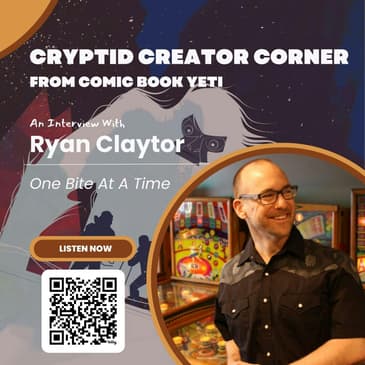

One of my favorite people in the comics business returns to the show today, Ryan Claytor. Ryan is a professor who teaches comics studio courses at Michigan State University and he's on a book tour promoting his 260 page hardcover retrospective on 20 years as an illustrator/cartoonist/tinkerer, One Bite At A Time. There's no other way to encapsulate all the varied mediums Ryan has played in over the years, and this recently crowdfunded project is guide book for the mysterious workings of the creative muse. We get to chat about his recent role as a judge of the prestigious Eisner Awards, share a few anecdotes about fatherhood, mentorship, and the weird synchronicity that ties all these mediums together.
I was a backer from the jump on this project and can assure you it's worth every penny. If you are interested in picking it up, please visit onebiteatatimebook.com.
One Bite At A Time
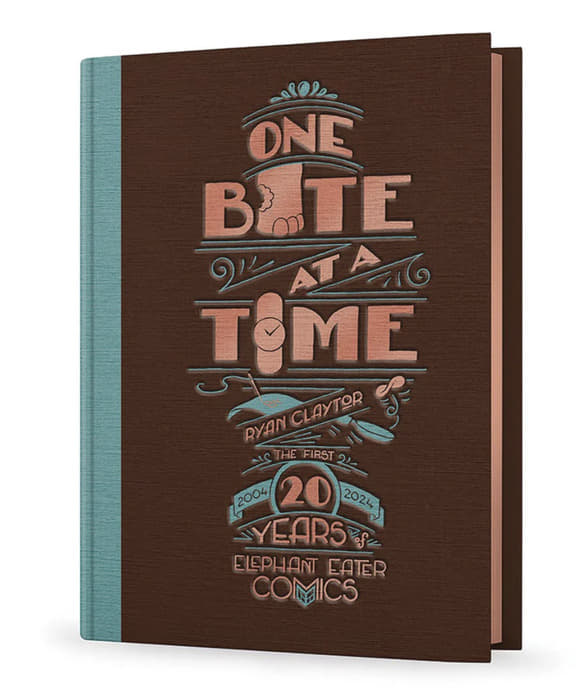
From Ryan about the project
20 years of one man's work in comics, illustration and design is showcased in this hardcover art book with oversized formatting (9" x 12" & over 250-pages) and a production-heavy attention to book design (dual cloth-bound and dual foil-stamped cover with gilded page edges, built-in ribbon bookmark and specialty formatting on a number of interior pages--gatefolds, die cuts, vellum, etc.)...
Inside you'll find a wide variety of artwork, each with behind-the-scenes detailed outlines of my process, that range from my own work in comics......as well as personal illustration projects and design inspiration......but also many pieces which have never seen print before, like my neon design work......watch designs......and even some early, never-before-seen projects from my graduate school days, like this multimedia game I illustrated and programmed.
In addition to being a comics artist and professor, I'm also a designer, and this book will be the most complex print project I've ever coordinated, pushing the theme of process in new directions with a number of production extras, like gatefold pages, vellum overlays, and die-cut reveals.
For example, this is a piece of my original artwork that will be featured in the book……reproduced from a nice high-resolution scan……and here's the spread featuring the original art shown above with some custom die-cut windows (holes) to display a "before" version of the image (rendered in raw pencil and ink on bristol paper) with an "after" version (scanned, cleaned, and colored) visible behind it: The red circles above will not be printed red, that's simply to draw your eye to the shape of those die-cut holes in the page. Rather, you'll be able to see the final colored image THROUGH the printed original art. Then when you turn the page, the holes will reveal the same before-and-after formatting for the finished page on the left.
I'm thrilled to showcase the process behind creating this work in a number of different ways throughout my art book. This is just one of them.
Additionally, there are a healthy amount of showcase images that allow the reader to get up close and personal with everything from my neon designs......to original artwork......and much, much more. :)
I'm a comics artist and university professor. My award-winning books include A Hunter's Tale, Coin-Op Carnival, my autobiographical comic series And Then One Day, and many more successfully self-published works dating back to 2004.
PATREON
We have a new Patreon, CryptidCreatorCornerpod. If you like what we do, please consider supporting us. We got two simple tiers, $1 and $3. Want to know more, you know what to do.
ARKENFORGE
Play TTRPG games? Make sure to check out our partner Arkenforge. Use the discount code YETI5 to get $5 off your order.
THE LANTERN CATALOG
Created on the premise of creating light in the dark, this is the the go to resource to keep you up to date on the indy projects and the creators you love. You can find them at https://www.thelanterncatalog.com/.
Make sure to check out our sponsor 2000AD.
[00:00:00] Your ears do not deceive you. You have just entered the Cryptid Creator Corner brought to you by your friends at Comic Book Yeti. So without further ado, let's get on to the interview. Y'all, Jimmy, the Chaos Goblin, strikes again!
[00:00:15] I should've known better than to mention I was working on my DC Universe meets Ravenloft hybrid D&D campaign on social media. My bad.
[00:00:22] He goes and tags a bunch of comics creators we know and now I have to get it in gear and whip this campaign into shape so we can start playing. Another friend chimes in, are you going to make maps?
[00:00:32] It's fair to say it's been a while since I put something together so...I guess? It was then that I discovered Ark and Forge. If you don't know who Ark and Forge is, they have everything you need to make your TTRPG more fun and immersive.
[00:00:46] Allowing you to build, play and export animated maps including in-person Fog of War capability that lets your players interact with maps as the adventure unfolds while you, the DM, get the full picture.
[00:00:59] Now I'm set to easily build high res animated maps saving myself precious time and significantly adding nuance to our campaign. That's a win every day in my book. Check them out at arkandforge.com and use the discount code YETI5 to get $5 off.
[00:01:14] I'll drop a link in the show notes for you and big thanks to Ark and Forge for partnering with our show. I think I'm going to make Jimmy play a goblin warlock just to get even. Hello and welcome to today's episode of the Cryptic Creator Corner.
[00:01:27] I'm Byron O'Neill, your host for today's Comics Creator Chat. I'm excited to welcome one of my favorite guests back on the show with me today, Ryan Claytor. Ryan is fresh off of San Diego Comic-Com where he was an Eisner judge for this year's awards.
[00:01:39] We'll get into that in a moment, but he's also on the promotional trail for his book One Bite at a Time, a 260 page hardcover that looks back at his 20 plus years of work as a cartoonist, illustrator and creative. Yes, and I have it too. Nice. Yeah. Yeah.
[00:01:56] Well, Ryan, I hope you didn't bring back home the con. It seems like it was a bit of a rough year there for that. I lucked out. I did not come back with anything.
[00:02:05] I was also masked for the vast majority of the time, but yeah, I feel pretty lucky because I was in contact with a few folks who reported COVID cases shortly thereafter. So I hope everybody is doing okay. Yeah. Yeah, me too.
[00:02:21] Well, I've had many an Eisner nominee or winner on for the show, but you are my only judge to the best of my knowledge and we're close to celebrating 250 episodes. So been a lot of people I've talked to, you know, so my curiosity is peak.
[00:02:34] So how does one first of all kind of become a judge for the Eisner? Like, how did this come about? Yeah, fine questions. First of all, thank you so much for having me back on here, Byron.
[00:02:45] Super, super appreciate your willingness to talk about my new book and helping with the crowdfunding campaign for it. That just means the world to me. But to steer things over to your Eisner question, how did that come about for me?
[00:03:00] I can't speak for all judges, but for me, I went to grad school at San Diego State University, which was very near where Eisner organizer Jackie Estrada lives. So we were like quasi neighbors, you know, just a few blocks away from each other.
[00:03:19] And one of my assignments in graduate school was to interview a person in your profession that you would like to get into. And Jackie's husband, Batten Lash, was somebody who I interviewed. He was just incredible, invited me into his studio. We really hit it off.
[00:03:37] And then, you know, many years passed and I created more comics and became a comics professor. And over the years, Jackie came to me and said, Hey, you know, you're you're really doing this comics thing. What do you think about being a judge?
[00:03:50] And I said, I would love that. Quick question. I've got something that I'm submitting for the Eisner Awards next year. Can that happen concurrently? And she said no. So I said, well, is there any chance that I could I could rain check this?
[00:04:04] And she's like, yep, no problem. Submit your thing next year and we'll talk about it for following year. Then COVID happened. More years passed. Eventually, I said, Hey, I think I'm ready to re-enter the world. Does your offer still stand? And she said yes.
[00:04:20] So here I am in 2024 having been an Eisner judge. And it was such an incredible, overwhelming, positive, exhausting, indescribable experience. I mean, there's literally thousands of books that get submitted every year.
[00:04:41] And, you know, there's a system for dividing these up among judges so that there's still multiple opinions. Cream rises to the top. And I think we can probably get into that more nitty gritty if you want to.
[00:04:54] But essentially, the judges vote at the end of a multi-day in-house period like Comic Con flies out half dozen judges to meet at Comic Con. Headquarters in San Diego and go through all these books in person.
[00:05:08] You know, you walk into a room and there's literally thousands of books. It's super, super overwhelming when you first get there.
[00:05:17] And over the course of these multiple days that we were there, I think we were there four days total, these judges and I just became very fast friends. And still to this day, we still share a group text thread that we're in contact frequently.
[00:05:37] So this was just like comics camp. Like you go away to this experience where there's all these people who are unbelievably invested in this medium that we all love and sharing our opinions.
[00:05:53] And it's not to say that we always had the same opinion, but we were always very respectful about differing opinions. And so basically the judges have a say in those five nominees for every category.
[00:06:06] Then at that point on, it's up to industry pros to vote on those nominations. Judges have another vote just like every other industry pro, but it's just one vote.
[00:06:17] So really our big hand is putting those nominees forth from the thousands of nominations that get sent into Comic Con each year. Wow. Well, thanks for kind of demystifying the process a little bit.
[00:06:31] It's fascinating to see how things shake out every year because we live in a, at least in terms of sales numbers, a capes and cows dominated industry. So it's fascinating because their expression is rarely overly highlighted.
[00:06:45] You know, that doesn't seem to be in terms of the voting typically how it shakes out. Not that I'm complaining at all, but you know, it's fascinating. Yeah. Jackie really tries to assemble a diverse group of professionals.
[00:06:59] You know, we had everyone from creators myself to academics, myself and Chris, you know, folks who have been involved in publishing and different aspects. You know, I've self published.
[00:07:12] Joe Illich has been involved in a ton of different traditional publishing avenues from, you know, Milestone Comics at DC and, you know, Heavy Metal Magazine. And I'm trying to remember the major publisher he worked for as well. I think Penguin Random House or Simon Schuster.
[00:07:30] I think it might have been the latter. He has so many credits, it's hard for me to keep track of. Sorry, Joe. But Mathias is a store owner as is Andrea Gilroy who also has ties to academia as well.
[00:07:45] And then Jillian is a librarian who has a very heavy focus on manga. So it was a really great diverse group of people that were brought together. And you know, Jackie tries to make that happen every year.
[00:08:00] So I think that's a strength of the Eisner judges that she puts together. Yeah, that's a big lift. Wow. Yeah. Well, last time we chatted, you were just starting the promotional tour to promote. This is a crowdfunding project for one bite at a time.
[00:08:14] Now the book as we have shown people is in my hands. I'll show them again. I'm presuming it's in everybody's hands who supported the crowdfunding project at this point. And I have to say, this thing is really impressive. It's a coffee table book.
[00:08:27] And the little details you were able to incorporate into it are just sublime. You know, that semi-transparent overlay page that covers the Gru pinball machine design, that is gorgeous. So how are you feeling now about finally getting this thing out into the world, out into everybody's hands?
[00:08:43] I am just over the moon with the way this book came together. You know, I had very lofty hopes and dreams for this book and put a lot of specialty formatting options into this book.
[00:08:57] There's just an absolute laundry list that I included in here from, you know, like you said, those vellum overlays, die cut reveals, gatefold pages, textured pages, foil stamping, embossing. And that doesn't even cover the outside of the book, which has a bunch of other specialty items too.
[00:09:16] And there was a lot of room for things to go wrong. And they didn't. They didn't. And that's in large part due to my printer, who I am just so thankful for because I contacted over a couple dozen printers when I was quoting this book initially
[00:09:37] and settled on this particular printer because of their customer service, their samples that they sent me. I thought were really great. Their interest in the project, which was really key because I had a lot in place when I sent out these quotes.
[00:09:56] But then over the course of over a year's time, we were in conversation. And every couple months or so, as I was finishing the design on this book, I'd come to them with a new wacky idea for what I wanted to include.
[00:10:09] Like, hey, can we make a vellum overlay or can we make a vertically gate folding page? Like, is that even possible? And every time they came to me and said, yes, we can do it. And this is how much it will cost.
[00:10:23] So putting the control in my hand so that I could decide, is that worth it? Do I want that to be included or not? They never said, ah, Ryan, this is getting too complicated or stop asking us about all this stuff.
[00:10:35] Like you gave us the quote, just do it or don't already. Like they were just incredible partners in bringing this book to fruition. So all that to say thank you for your kind words about the book and to answer your question.
[00:10:50] Yes, I'm just ecstatic at how it came out and so happy to have it in people's hands now. Yes, I've fulfilled the Kickstarter campaign.
[00:10:59] There's at the time you and I are talking, there's like half a dozen folks who opted for a high tier campaign pledge, which included a custom sketch. And so those are the final remaining books that I'm working on illustrating them as we speak right after this podcast.
[00:11:18] That's awesome. I know you have a big promotional podcasting tour that you are kind of using to promote it. So what's the next step look like? Where else would you like to see it end up?
[00:11:28] Yeah, so this tour that I'm on currently is primarily in person this time. So I've got just a few podcasts. You're one of the upper echelon of podcast folks I wanted to talk to. And so lots of in-person stops coming up. I've got a stop in Ohio.
[00:11:48] I was just in California at Comic Con, as you mentioned. Also did another hometown stop in California at a place called the Book Loft and Solving. I've got some Michigan stops. I'll be in Chicago a couple times.
[00:12:00] Just I'm trying to get everywhere I possibly can to talk to people about this book because this is a celebration of 20 years of my work. But it's also kind of an extension of Ryan Clader, the educator. I'm a professor of comics, if we haven't mentioned that already.
[00:12:20] And there's a lot of didactic behind the scenes process type of work in here that illuminates how each piece came to be.
[00:12:30] So if you're interested in making artwork on your own or understanding how artwork comes into the world, I think this book might be really interesting for you. Yeah, reading through it personally was an absolute joy. Because it's not just a creative journey. It's a life lived.
[00:12:47] You get a huge window into you as a creator and what shaped all these different moments and transition into all these different mediums. I love the segment about documenting being a young father, brought to mind all these weird experiences.
[00:13:02] For me, that was sleeping on my son Fain's bedroom floor with him for nearly two years plus on a three-inch thermopedic mattress pad. So my wife could sleep while she was in graduate school. In the mainstream comics medium, that type of autobiographical documentation isn't as widely seen.
[00:13:20] So what appeals to you so much about relating your own personal experiences as a storyteller and to your work? That's a good question.
[00:13:28] When I was getting back into comics in a big way in the early 2000s, and I say back because when I was younger, I was reading Disney comics, 8-9. 10 or so I was reading Grew the Wanderer and more satirical stuff.
[00:13:45] And then when I hit high school, I kind of left comics behind for about a decade until tail end of college. So when I got back into things and discovered a whole host of amazing books that had come out in the decade that I'd been sleeping on comics,
[00:14:01] I found myself gravitating toward true to life, nonfiction, autobiographical, historical fiction, that type of work. And I thought I'd try my hand at autobiography to begin with. And then I started branching out within that genre.
[00:14:20] It wasn't started out as like a page a day strip, but then sort of morphed into sketchbooks and discovering autobiographical theory in grad school.
[00:14:30] That really informed different approaches to autobiographical comics for me, with autobiographical documentary as well as the follow up autobiographical conversations with a graduate professor of mine, Dr. Harry Polkenhorn. So really kind of exploring that genre.
[00:14:51] And then when such a huge life change like becoming a parent happens, there were a lot of things that I wanted to document. You know, there's there's a lot of touching moments as a father. There's also a lot of trying moments as a father.
[00:15:10] There were also a lot of things that struck me as not right in the world about being a father. I would be with my son all the time and I'd be in a department store or something and try to change him in the bathroom.
[00:15:25] And there's no changing table. And that happened so frequently when I was out, I'd go into a men's restroom. There's no place to change my son. And I would end up changing him on the floor of a clothing department or something just because there was nothing around.
[00:15:39] And so thankfully that has started to shift even since I became a father 11 years ago. I'm seeing a lot more changing tables in men's bathrooms. But like there were a lot of things that I wanted to sort of highlight and bring to people's attention,
[00:15:57] even the fact that like you can get sentimental, loving type shirts for your kids if you're a mom. But if you're a dad, it's like daddy's little squirt or tough like dad. Like none of that resonates with me.
[00:16:14] And I want a shirt that says, you know, daddy loves me too or something that's meaningful. And so because of that, I wanted to put that out into the world. But unfortunately, that was a book that never came to fruition.
[00:16:27] So I was able to get some of these unpublished strips into this book. So I'm glad you highlighted that, Byron. Thank you. Yeah, absolutely. Well, the pinball section of the book was probably my favorite. There's something about creating something kinetic that either that moves. That's so appealing.
[00:16:43] I just recently helped Fain kind of with an engineering project of his at school where he's building a miniature bowling alley. And it was really complicated. He had to do this as a group. So this was a collaborative thing.
[00:16:54] And one of the things that you've been able to do with your career as far as to take in all these varied interest directions that pull you. And a big part of that is being just open to the inspiration.
[00:17:07] So in this case, that was from another cartoonist with their Drop Target comics project that I read about in the book. So talk to me about the importance of being open and receptive, if you will, to the muse and how you think that influences you.
[00:17:20] Yeah, that's that's another fine question. Sometimes I wonder if I'm too open to the news because my my interests kind of divert. But at the same time, I want to enjoy life and see everything it has to offer.
[00:17:36] Like I'm just I'm not going to live long enough to complete all the projects I want to complete and to explore all the media that I want to get into. I do. I do enjoy working in different media.
[00:17:49] But like I said in the introduction to the book, I really view each one of these as this like custom puzzle solving. It's not a puzzle that's been solved yet.
[00:18:00] Like reading a page of comics can happen an infinite number of ways or crafting neon sign or designing a watch or any of these things that are mentioned in the book.
[00:18:12] It's all it all comes back to this custom puzzle piecing, which I view as integrally related to comics.
[00:18:20] Comics are that like micro and macro effort of creating, you know, first a story and then pulling it down to beats and then pulling it down to pages and then pulling it down to panels and pulling it down to composition and pulling it down to characters and speech balloons and balancing all that within a tiny square.
[00:18:41] It's you know, it prepares you for so many different things in life. And I think that's pretty apparent in this book as I've been able to hop into these different media like pinball and watches and neon and pancakes and all kinds of weird stuff.
[00:18:56] So yeah, did that answer your question or did I get off on a tangent there? You were slightly on a tangent, but I could always ask your wife, you know, as a fellow muse traveler myself, what her opinion of is.
[00:19:09] I would. I think I already know the answer to that. I think we both do. Yeah, yeah. Well, there's a repetitive synchronicity in the book as you're bouncing around these mediums and one of them is creator creating and fostering really genuine friendships.
[00:19:25] And that's one of the things that I associate you with you. And, you know, I've talked a lot to a lot of comics creators now and by a mile, you're one of the most receptive people to that that spirit of true collaboration.
[00:19:36] So is it almost a necessity for you to engage with people to kind of foster that creative spark? Yeah, that's so funny because after going through. Elementary in high school. I didn't want anything to do with a collaborative project.
[00:19:56] I had my fill of carrying projects on my shoulders and thought, you know, why, why not do things on my own? And that's that's kind of how things worked. Initially, when I was making comics, I, of course, had help.
[00:20:12] Those first issues were all hand printed and folded and stapled.
[00:20:16] And I remember being at home and my mom helping me fold issues and she'd hand me a stack and I'd be back there stapling as we were watching, you know, some horrible reality television show and just enjoying time together.
[00:20:29] But but the creation and the writing and all that was, you know, essentially a one person show. But the more I progressed in life, the more I see opportunities to create something that I cannot create alone that others cannot create alone.
[00:20:50] But together we can make something really special like starting with coin up carnival. That book would not be what it is, would not be a shadow of what it is without Nick Baldridge.
[00:21:02] And Nick is one of my very best friends and just an absolute genius when it comes to technology. And there that book is such a pride and joy of ours, mainly because it's so gosh darn accurate. Every drawing that I handed him, it wasn't just, hey, that's nice.
[00:21:21] It was, hey, you forgot those solder tabs or this lead should be over here or, you know, and so you can actually open up that book and open up a pinball machine to have some understanding of how to work on it.
[00:21:34] So from coin up carnival to neon design, like, I don't know how to fabricate neon, but Josh Goodacre of Vermont, Michigan sure does. He doesn't really have a big interest in designing neon, but boy, how do I sure do. And so together we make this great collaborative team.
[00:21:53] Likewise with the watches. I don't want to manufacture watches, but I'm fascinated by them. And with this team up that Mr. Jones watches and I have together, we've created some really memorable timepieces.
[00:22:07] In fact, there was just a review from a very prominent YouTuber saying that it was his favorite watch to come out of Mr. Jones watches. And there's a huge history of watches there. So that was just an unimaginable thing to happen.
[00:22:21] So all that to say initially I was not Mr. collaboration as as I've aged up and I've found the right relationships. And it's all about the relationships. If you have an open, communicative, respectful relationship with someone, you can make really fantastic things happen.
[00:22:42] But if that mutual respect and drive and talent and excitement is not shared, then it gets lopsided. So it's just like any relationship. You have to you have to foster it, whether it's friendship, marriage, collaborations on art. Like there are a lot of similarities there.
[00:23:06] And I've been really lucky to find a number of folks in my life who helped me make things that I could never do on my own.
[00:23:16] My impression based upon the book is that people kind of just emerge out of the woodwork, it seems like, to support what you're doing. Hey, neon signs are cool. I'm going to play with that. And then my queen shows up with his queen's arcade project.
[00:23:30] Right. Is it is it that easy? Is it I mean, it's over simplified certainly to look at it in the book and be like, oh, yeah, it's just that easy to train neon science to pinball machines to watches.
[00:23:42] You know, I mean, I had no idea my queen was going to see what I was doing and that he was going to start this snowball rolling essentially. Because that's that's really what he did.
[00:23:54] You know, I had a hope and a dream of a neon sign of my very own and was bringing it to fruition and posting online. And he saw this. And before mine was even fabricated, I was only in the design phase.
[00:24:07] He reached out and said, I want you to do this for me. And I said, wow, I would love to because I thought the sign I'm making was going to be the only opportunity I ever had to do this. So I'm like, yes, please. Let's work together.
[00:24:21] And again, the those keep getting posted and new clients keep coming in. I just finished another one photographed two days ago, as a matter of fact. So this is still an ongoing client business that that I engage with.
[00:24:36] So is it that easy? Sometimes like the Mike Queen instance that you mentioned. Is it more complicated? Of course, there's, you know, behind the scenes conversations. And research that I do and reaching out to folks that don't go anywhere. And but, you know, those are those are boring.
[00:24:57] And if they don't lead to anything, it's hard to include those in the book. But I tried to include some ups and downs of the career as I moved forth. You know, there's unpublished things. There's a Mr. Jones watches design that never got made.
[00:25:12] I loved it. I was really excited. And they're just like, I don't think it's for us. And that's OK, because again, as I mentioned in the book, that was one I took to total and complete fruition before giving them design iterations.
[00:25:27] I just thought it looked like garbage before the final thing. So I'm like, well, I'm just going to keep iterating on this until it's done. And then hopefully they'll they'll be interested. But, you know, not not every project comes to fruition.
[00:25:41] Yeah, I mean, you never get to point D without going through A, B and C. And some of those temporary detours or outright failures are really essential. At least they have been in my work to help me learn, help me revise my craft to move forward.
[00:25:57] You know, and creativity is sloppy. It doesn't always work. You know, you just reference that mandala design, you know, and watch design. So how have those happy mistakes made you a better artist?
[00:26:10] I think it probably helps just to realize that the thing I'm working on is not the end all be all thing. Like, I think as artists, we get really wrapped up in what we're doing. Oh, this has to be just so and I'm putting my all into it.
[00:26:29] But like, for instance, creating this book has really made me kind of pull back and see things from a more macro lens and realize, OK, I see all these projects along the way. And together they make a career individually.
[00:26:46] They might not look like much in particular, but I remember being in the trenches, making each one of them and thinking, man, I just want this to be everything it can possibly be. And it's not to say I'm not going to stop doing that.
[00:27:01] But when something fails and I've put my all into it, I am more OK with the understanding. OK, it's not my career. This is a step. This is a process and I can move on to the next thing.
[00:27:19] You know, I mentioned in the book, Coinop Carnival number two, which has not come out yet that was going to come out. And I was multiple pages and illustrations and months and months of work into this when essentially all of that work was unpublishable.
[00:27:39] To put briefly, this has nothing to do with Nick Baldridge, but it was another party we were working with that things just didn't work out. And that was a big blow to my artistic psyche.
[00:27:55] And I told Nick at the time, I'm like, you know, look, man, I think I just need a break. And, you know, Nick is a saint and was so supportive. And so that led to me going off and doing a Hunter's Tale,
[00:28:08] which is a really personal project for me about a poem that my grandfather wrote about empathy over 40 years ago at this point that I turned into comic book form. And sort of steamrolled into mirror drawings and now one bite at a time.
[00:28:23] So all that to say, Nick is a very patient person with some of these setbacks. I don't want to say failures, but you know, delays. And yeah, so I think that it just getting back to your question, trying not to tangent too much.
[00:28:43] Is what happens when there's failures? I think there's less fear and trepidation and ill feelings on my part if something doesn't work out. Because now that I'm in my 40s, I'm able to kind of zoom out a little bit rather than when I was in my 20s
[00:29:05] and everything I was doing was like the first time and the first thing I did something and, you know, my whole career was a book. And now it's, you know, a lot of books and now a big old tome too. All right. Let's take a quick break.
[00:29:20] Hey, comics fam. The comic book publisher Banda Bars just got a level up and announced it is now a cooperative. This heralds a new era for them, including a partnership with Dallas stories. And they added several new members to the ownership group.
[00:29:35] Marcus Jimenez is now chief operating officer. Brent Fisher takes on the role of chief diversity officer. And Joey Galvez is introduced as head of Kickstarter Ops and social media manager, which is sure to increase their capabilities overall as a publisher.
[00:29:50] And it further promotes their mission statement of advancing representation, inclusion and diversity in the media. They also established a new board of directors to help chart the new path of their journey with new projects in the works like
[00:30:03] Alaska by dropping in June, unbroken soon launching on Kickstarter and Pond coming up with thoughtless. Stay tuned to this space for more exciting news from the growing Bards family. Let's get back to the show.
[00:30:18] Moving through these mediums and manipulate them because that that is the through line as far as I see it. Is there these these tactile things you're manipulating things consistently across mediums?
[00:30:28] You know, I think about my own creative energy and how it gets fundaled into all these various iterations that have happened and manifested in my life. It's mind boggling to think about how these things might knit, you know, from setting up aquariums to working in the music industry,
[00:30:42] getting into landscape design, transitioning to becoming a professional photographer and photography teacher. Exactly. And all of them combined to structure the DNA of how I now approach, you know, coloring comics, whether that's how light hits an object or how colors balance or work together.
[00:31:01] So everything is a step. And you talked about mirror drawings and how it gave you the fundamental basics in book design that allowed you to take the next step with one bite at a time and put all these things.
[00:31:13] I don't know if it was confidence, you know, that it gave you or what, but, you know, it feels like our approaches are similar. And I feel sorry for our parents. Sure. Right.
[00:31:22] These building blocks coalesce in a symbol into the creative self, you know, and and you jokingly when we were talking about the watch design and said, oh, that's not my career, but it's in the book, Ryan. It is your career, right?
[00:31:35] I mean, it's part of my career. It's not my entire career, but it's definitely part of it. Sure. But if a watch design doesn't hit, doesn't get manufactured, it's never going to be produced. Well, there's a lot of other things I can do too.
[00:31:50] There's a lot of other things I have done, and that makes me feel more OK about it. Not to say it wasn't a bummer when, you know, that didn't get produced. I still think it's a pretty darn good design if I do say so.
[00:32:03] But but yeah, I feel less bad if things don't work out now because I have this body of work behind me and I know that there's a lot more years to come.
[00:32:13] Yeah. Well, I'm curious about you having a mentor because comics more than other mediums that I've been involved in, especially when I relate it to music. People are very willing to help each other out. Like you're an educator, so you help each other all the time.
[00:32:30] But people even who are in education are very willing to to put a ladder down to help the people who are coming through, which is unlike a lot of other artistic expression. You know, so the curiosity about a mentor, you know, I've had very few in my lifetime.
[00:32:45] My most recent was like a truly amazing man, Hugh McMillan. He was ex CIA. You would have absolutely loved him. He had an actual train car in his front yard, like a full size real train car. That's incredible. Yeah. And that was kind of his guest house.
[00:33:02] I met him in his late 80s. He had this youthful spirit that reminded me of someone in their 20s and knowing Hugh has helped me immensely while I'm kind of going through my tough times with the autoimmune condition because he was all about service and community.
[00:33:16] He never stopped helping people. He never stopped pushing. And I use that every day. So did you have a mentor and kind of what role did they play in your career? Oh, my gosh.
[00:33:25] I feel like I've had a mountain of mentors and I'm also in a really lucky place that I teach comics at a Big Ten University and I direct an event where I get to invite heavy hitters of comics, many of whom are my heroes.
[00:33:44] And I get to hang out with them and have conversations and learn from them. But taking it way back to before I even made a comic, you may have heard of Comet Craft.
[00:33:56] They do comic book lettering and one of the folks of Comet Craft is John Rochelle or J.G. Rochelle. And it just so happened that he was about 45 minutes away from me when I was living on the central coast of California.
[00:34:10] And so I sent an email and introduced myself and said, Hey, I'd love to take you out to lunch and brought his book and had him sign it and asked him a bunch of questions about what was inside. And just had a really great time.
[00:34:25] And so like from very early on, I was reaching out to people to learn from them because there weren't really places to get a comics education like there are today. There's a lot more comics in higher education now than there used to be 20 years ago.
[00:34:43] So another really early influence of mine was Tom Luth. Tom Luth is the colorist for Sergio Aragonés on Guru the Wanderer and Stan Sikai. Unfortunately, Tom passed this past year. But very early before I was doing any work in comics, Tom again had lunch with me.
[00:35:03] I was no one. I was just some, you know, wet behind the ears kid. And he had lunch, answered a lot of my questions about digital coloring, which at the time was this kind of new thing that I was trying to wrap my head around.
[00:35:17] And I loved his coloring work. It wasn't just smack you in the face primary colors that you were used to seeing in the early 90s. It was thoughtful and considered and environmental. And man, I just I still love Tom's work to pieces to this day.
[00:35:34] So he was another really early influence and mentor of mine. But again, over the course of the years, I've met a ton of folks that I am just so privileged to say that that I've met that I've had conversations with and remain friendly with.
[00:35:50] Like, look at the back of the book. One of the best cartoonists in the world wrote a poll quote for one bite at a time. Seth, he's a Canadian cartoonist. If you're not familiar, please go look him up. His work is incredible. He's done work like Clyde fans.
[00:36:06] It's a good life if you don't weaken George Sprott, Wimbledon Green, the Great Northern Brotherhood of Canadian cartoonists. It goes on and on. Anyhow, I not only respect the heck out of Seth as a cartoonist, but also as a book designer.
[00:36:23] And so when I was crafting this book, you know, I asked him, hey, would you mind giving me a poll quote? And to my surprise and delight, he said yes. After looking at it, only a digital copy.
[00:36:35] I sent him the physical book here recently and just got back. I don't want to hold it up to the camera because I don't want to show everything that he wrote.
[00:36:43] But a very characteristically Seth typed, like on a typewriter letter on Seth letterhead with some very kind words about my book. And to hear that about my own work from somebody that I've sort of pedestalized over the course of my career and looking at his body of work.
[00:37:05] I mean, all these books on the shelf are all designed by Seth right here. Complete penis books are all designed by him. He just has such an immaculate designer's eye that he was another heavy influence on me that I'm lucky to be friendly with today.
[00:37:23] So there are a lot of folks. I wish I had more time to tell you about more folks. Well, being a mentor yourself, you know, we've talked about how being an educator is really, really important to you.
[00:37:35] So do you think you would have ended up in the same place as a creator without that element? As a teacher without what I what I end up where I am without being a teacher? Is that the question? Yeah, I I can't imagine I would.
[00:37:51] I mean, this book is so heavily focused on process and I just I love learning and I love helping people learn. And in order for them to do what they want to with that knowledge, you know, I don't want them to make Ryan Clader comics.
[00:38:08] I don't want them to make auto biocomics. I don't want them to make pinball comics. I want them to make whatever they want to make. But if I wasn't a teacher and wasn't so interested in how people do what they do,
[00:38:20] then I probably would not have made this book the way I made it with this heavy emphasis on process. And it's not just each spread that showcases some didactic imagery and some pencils and inks and process.
[00:38:35] But as you mentioned, all those specialty formatting elements are all built around showcasing process like that vellum overlay. Happens because in real life when I illustrated that pinball machine, I just overall as an artist,
[00:38:54] I have a hard time illustrating interlocking items that just like I can do it, but it breaks my brain a little bit and it takes me a long time to understand.
[00:39:03] So when I was illustrating a pinball play field, which is all interlocking parts, the only way I can conceive to do it was thinking, OK, well, maybe I draw all the ramps on a separate sheet of something.
[00:39:16] And so I grabbed a piece of tracing paper, illustrated the ramps on top. And so that's really how it is in real life. The original Bristol and then a sheet of tracing paper over time. So I wanted to showcase that as authentically as possible.
[00:39:30] So that was one of the conversations I had with my printer saying, hey, could we possibly print this on vellum? I knew that things have been printed on vellum before.
[00:39:40] Can we get this to align just so because it's a pretty tight registration they have to hit in order for it to overlay on top of the original artwork print behind it.
[00:39:50] So like that's a piece of process or the vertical gatefold elements that showcase that giant 18 by 24 inch original artwork. Like that was the original size of the original artwork as I drew it. And again, I wanted this sense of authenticity and focus on process.
[00:40:09] So like all these all these specialty formatting items in the book all go back to this theme of process. OK, OK.
[00:40:17] Yeah, I mean, I don't want to get too much in the process, but I'm a paper snob, which goes back to an end of my day as a photography person. But you know, the camera is the instrument. The print is the symphony. So that's the expression.
[00:40:30] And I love a good like 220 GSM rag paper myself. I know you're a fan of Strathmore's vellum Bristol. I think that's a that's a 125. So respect. It's not quite a 220, but you know, but you've already alluded to how good it is.
[00:40:46] You've already alluded to how complicated your workflow can be. And I'm curious if you've ever considered giving up the pen and paper to transition to digital tools for expediency for any. OK, so the answer is I already have but not completely.
[00:41:01] So my working process and you can see it in the very back of the book. It's a little maybe convoluted, but essentially I'm in and out of digital and physical throughout the process. So initially I will digitally these days. Typically, I will digitally pencil.
[00:41:20] And the reason I'm hesitating on that is because I've sort of grown a mild resentment to digital penciling. It's great because you have full editability. You can move objects around independently of one another, resize them, get everything just right.
[00:41:37] But I feel like all that possibility makes everything take a really long time. And so that was like part of mirror drawings. I'm like, ah, forget this. I'm just going to put a pen on a paper and see what comes out.
[00:41:49] And it was never planned to be a book. It was just like, I'm tired of the screen in front of my face. I just want to get back to analog stuff completely instead of having it be a part of the process.
[00:42:00] But typically my pages of comics are digitally penciled. Then I print those digital pencils out in blue line on Bristol and ink everything and then take that hand inked Bristol, scan it back into the computer to digitally color.
[00:42:17] And then it gets output as a physical object in a book. So that's kind of my in and out process. So yes, I do digital work in my process. I don't like digital inking.
[00:42:31] I have maybe it's an old man factor in me, but I just feel like there's this element of removal when I'm inking digitally. It's on glass. I know there's textured things you can get for a screen.
[00:42:45] Even then, there's like a removal of the ink mark from your stylus. Even then, there's like this lack of control that I have. And I understand there's pressure sensitivity. I understand all this stuff.
[00:42:58] But after having worked with a brush pen for so long, I understand how that works. I can get the line that I want to with it. There's a slight wobble that's like reduced away in digital processing that I don't like.
[00:43:16] I'm just I'm very persnickety and old man about inking. I really enjoy inking physically. And it has the added benefit of having another product that as a self publishing cartoonist, you can monetize. You cannot sell your digital prints.
[00:43:33] Nobody wants a digital print of a page that you made. But if you've got a physical piece of Bristol, you can monetize that. And I have. I mean, go look at the campaign for a hunter's tale. Every single page from that book is gone.
[00:43:47] It was purchased during the campaign. And, you know, if I didn't do that, that would have literally left thousands of dollars on the table. So I mentioned this to my students all the time. You can create however you want.
[00:44:02] But think about pros and cons of each way of doing things. And it's not to say that you can't integrate physical and digital. You certainly can.
[00:44:11] So I try to encourage students to think critically about about the comics they make, how they make them, what they're saying with them, et cetera. OK. Just just to clue you in that wobble that you're talking about while you're writing on paper.
[00:44:26] That's carpal tunnel. Just, you know, but it's it's it's it gives character. It's kind of your carpal tunnel. Whatever whatever gets you through the day, whatever.
[00:44:40] You just alluded to it. You know, one of the big takeaways after reading through this to me is so I always tell people considering crowdfunding campaigns who reach out to me to go study what you do.
[00:44:50] There's a meticulous nature on the surface and everyone should certainly adopt that. But the undercurrent is a sense of identity which kind of bundles into you branding your work, which is kind of strongly linked to you as a person. You know, it stands out as distinctly Ryan.
[00:45:06] So when you're talking with students and you're trying to help them develop that sense of self, especially as it pertains to marketing, because all creators now we live in a world where that's a necessity.
[00:45:18] You know, the people who don't do that are giving something away in my mind. You know, so how is an educator do you approach communicating that to your students? Branding in twenty twenty four. Yeah, branding honestly is not a topic we talk a lot about.
[00:45:38] I feel like students at that age are still trying to figure out what the heck they're doing. What is their voice? Like come come to an understanding and realization of that first.
[00:45:49] And I do help students through crowdfunding campaigns that have been 100 percent successful for the students who have taken me up on the offer to coach them through a crowdfunding campaign. It's not a necessity in my class, but it's an opportunity if they want to do it.
[00:46:05] So I'll coach them through things like budgeting. What do you need in order to print this? Do you need to print a thousand copies or would you be happy if you were able to print like 50 or 100?
[00:46:17] Like what is your audience like? What are your social media follower numbers? Well, I understand that you want to print a thousand copies. But if you have 100 followers, then how is that going to happen?
[00:46:31] So we have these realistic talks about budget and figuring out a reasonable funding goal. And then if things go well, what are reasonable steps past that? For example, I had a student who wanted a five hundred dollar ask and then she like triple or quadrupled it.
[00:46:51] I'm trying to remember. And she's like, oh my God, what do I do? So I'm like, well, what do you want to do? You can just accept this windfall of money and that's perfectly OK.
[00:47:02] Or if this book is not exactly what you want it to be, now is your opportunity to make it that. So do you want to have foil stamping? Do you want to have spot UV? Do you want to have specialty inks?
[00:47:15] Do you want to have some sort of additional formatting with this book to make it everything you want it to be? And eventually, you know, this was a story about Filipino vampires.
[00:47:26] And the final print ended up having this spot UV gloss over all the blood on the cover and make it shiny and really gave it this interesting texture and feel to it. So because of a really successful campaign, they were able to make that happen.
[00:47:43] So it's not that I coach my students through branding so much as I do initially. You cut out. You cut out your mic cut out. Right. How about now? I can now. Yeah. OK. You were you were at I don't coach my students through branding and then.
[00:48:08] OK, so it's it's not that I necessarily coach my students through branding, but I think there's more important things to focus on in these student years like mechanics of comics. How do you bring those to fruition? What do you want to say with your comics?
[00:48:24] What's important to you? And then when it's time to bring it to fruition, you don't need to go through a whole branding campaign and make your own company out of it.
[00:48:33] You can just be you. You can just set a phone up and record yourself for a minute or so and talk about why this project is important to you. And that's what's going to resonate with people.
[00:48:43] And that's what's going to bring them into your project rather than a shiny logo or a fancy header and a Kickstarter campaign. Like, that's that's not the core of what connects readers to work or to creators.
[00:49:00] Eventually down the line. Sure, you want to think about that and try to differentiate yourself as an artist from others. But right now I'm talking with folks who are 18 to 22 years old, primarily fresh out of their parents' house.
[00:49:13] And, you know, they're still trying to figure out who and what they are. So that's OK. But let's talk about the important stuff. Making a comic that people can understand and having a message that is going to resonate with you and consequently readers.
[00:49:29] Well, you've made the book. You can sit. I picture you sitting in the studio cracking it open for the first time, clipping through it, not unlike a family photo album of sorts.
[00:49:40] So is there one thing you would point out to that you're most proud of reflecting on 20 years of work? Man, I think I think I'm most proud of that last chapter.
[00:49:56] The chapter that has just a lot of collaboration in it because all of that is stuff that I couldn't do by myself. Coinop Carnival, neon signs, those watches. You know, even those pancakes that I've made would not have happened were it not for my son.
[00:50:18] You know, I was trying to figure out a way during the pandemic to give my young son something to look forward to because those early months and years of the campaign were just so isolating.
[00:50:29] And I was lucky to have a family, a wife and a son to be with. And those are the ages where I was playing with friends at their houses and having sleepovers. That was all taken. And I wanted him to have something that he could.
[00:50:47] It's OK. OK, I get it. I get it. That he could feel OK about. Yeah. During that time. So I tried this out one day and it was a beautiful expression. It's a beautiful expression. It's something you got to share with him.
[00:51:09] And it speaks to that spirit of collaboration that you that you infuse into everything you try immediately associated with you. When I think about Ryan, that is the first thing that comes to mind.
[00:51:21] You know, and I guess the obvious question is after all these things you've done after comics watches, pancakes, cross stitch, neon signs, pinball machines. I'm sure I'm forgetting something else right there. Right. But you know, like what's next?
[00:51:34] Because every time we talk it's something new has popped up. And I know what it is now. It's going to be you doing designs for toddler outfits for dads. You know, oh man. Well, thank you for talking me through that awkward moment.
[00:51:48] But of course, you know, there's there's there's always something new on the horizon right now. I'm heavily focused on this tour for the book and I've got a bunch of stops coming up. So this is like where my mind is at right now.
[00:52:01] But as I was waiting for this book to show up, I had a couple few months and I have had some experience with book design and book binding in the past. And I really like these clamshell book boxes.
[00:52:21] And I started making a few for like important books in my collection and even like some card games that my family and I play frequently. And I started thinking, man, I wonder if I could hand craft an edition of these for a book of my own.
[00:52:38] And so my next project that I'm going to focus on before the end of 2024 hopefully is a handcrafted book box for a hunter's tale. But the cover is going to have this three color screen print that essentially reproduces the cover of a hunter's tale.
[00:53:00] And this was really kind of a difficult project to get a collaborator for. I found a bunch of different screen printers in the area, some of which I'd even used before said, hey, I've got this idea for a book box.
[00:53:15] You know, it's flat on top. Can we screen print on this? I think it'll work. And everybody was like, no, not going to do that. It's got to be flat. Give us a piece of paper, a t-shirt and we'll do it.
[00:53:26] But, you know, we're not printing on a book box. But I finally found a local printer who was like, yeah, I think we could do that. And we had a lot of conversations about how that might actually work.
[00:53:39] And what we're going to do is I'm going to craft all the covers. So essentially it'll be the cover spine and back cover, but not the trays tacked onto it. We'll try to screen print on those. And before I launch a campaign, we're going to print the covers.
[00:53:56] I'm not going to assemble all the boxes, but I'm going to print the covers to make sure that is possible because I'm not sure if it is.
[00:54:04] We're pretty sure it is, but I don't want to run a campaign, promise something and then not be able to deliver because, you know, I feel like I've spent 20 years building a trustworthy relationship with my readers and I don't want to jeopardize that.
[00:54:21] So I'm going to go through about half the project and if it works out, then I'll toss it up for Kickstarter campaign for a limited run of like 50 or so. And then there's a million projects after that.
[00:54:34] I'm going to be working with Nick Baldridge on a scratch build electromechanical arcade game. We've been working on that and I've kind of been the weak link. I've been the bottleneck there. We've got some artwork for it, but I need to complete that.
[00:54:52] He's essentially got the mechanics completed and then we're going to have our own electromechanical arcade game that we designed together and and built. So that's really exciting. And then we'll be working on the second issue of coin up carnival after that.
[00:55:07] OK, but where can people buy one bite at a time? Now, of course, they've heard all these great things. Where can they pick up their own copy? Thank you for asking. They can go to one bite at a time book dot com.
[00:55:19] That's one bite at a time book dot com. That'll direct you to a page on my website and you can purchase it there. Awesome. I'll put it in the show notes to make it easy on everybody. Where can they find you online?
[00:55:31] My website is elephant eater dot com like a person who eats elephants. That's elephant eater dot com.
[00:55:38] X hates that, by the way, every time I try to look up your name, it won't pull it up because it's so hard to find people on X Twitter, whatever we're calling it this week now. Yeah, yeah. I'll put that in there too.
[00:55:50] I'm not trying to find answers for that platform anymore. I don't know that there are any. It's such a mess. Well, I'm really grateful this book.
[00:56:00] Honestly, it's beautiful and it made me feel like I'm not alone in my craziness when I get a new wild hair creative idea. Lately, that's been plant propagation when it probably should be nailing down more speed with my color.
[00:56:14] But thank you for sharing this with us, Ryan and stopping by the show again. It's been a pleasure as always. Yeah, Byron, thank you so much for giving me the time of day here.
[00:56:23] I really appreciate your willingness to chat with me and to so many creators too coming up on 250 episodes. Is that right? Yeah, well, this will be Friday, but should be our 250 should be should have been Wednesday. It'll be tomorrow's job. That's that's bonkers. Wow.
[00:56:41] Well, congratulations on all of that. And thank you for being a platform for independent creators. We don't have a ton of them. And I'm just I'm so thankful you're here and I know that so many others are too. So thank you for all that you do to.
[00:56:55] Yeah, well, you're very welcome. This is Byron O'Neill and on behalf of all of us at Comic Book Yeti, thanks for tuning in and we'll see you next time. Take care everybody.
[00:57:03] This is Byron O'Neill, one of your hosts of The Cryptic Creator Corner brought to you by Comic Book Yeti. We hope you've enjoyed this episode of our podcast. Please rate, review, subscribe, all that good stuff.
[00:57:16] It lets us know how we're doing and more importantly, how we can improve. Thanks for listening. If you enjoyed this episode of The Cryptic Creator Corner, maybe you would enjoy our sister podcast, Into the Comics Cave. Listen and subscribe wherever you get your podcasts.