
Today I’m joined by returning guest musician turned comics writer Scott Hoffman. Scott has been on twice before promoting his other projects Wag and Nostalgia and he’s got a new book hitting shelves with DSTLRY called Warm Fusion, a futuristic sci fi/horror about a bleak New York future and the pitfalls of biotech gone wrong. We talk about the motivations behind this exciting new book, getting ready for a Spring Tour in the UK with his band the Scissor Sisters, and a unique vinyl record collaboration associated with the book with DJ Hi-Tek of Die Antwoord.
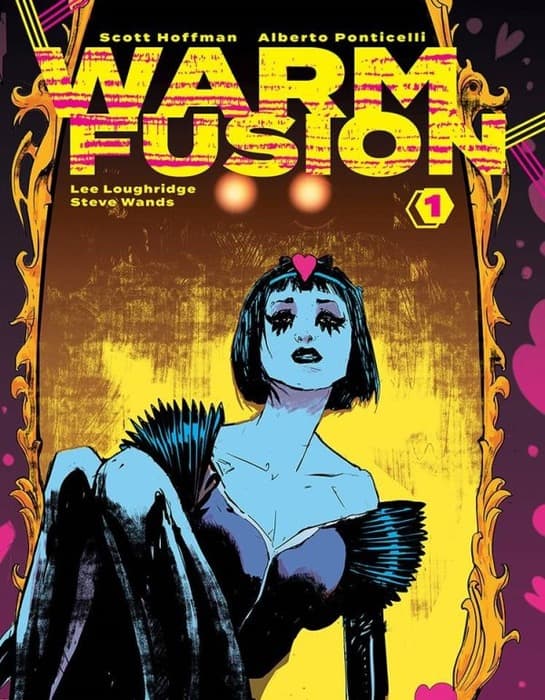
Warm Fusion #1
From the publisher
DSTLRY, the next-generation publisher redefining creator-owned comics and collectibles, is thrilled to announce Warm Fusion, a new sci-fi horror mystery series by writer Scott Hoffman (Nostalgia, Wag, member of pop icons Scissor Sisters) and artist Alberto Ponticelli (Frankenstein: Agent of S.H.A.D.E., Orc Island). The series will debut this December, plunging readers into a nightmarish vision of New York City as biotech corporations unleash atrocities to rival the serial killers stalking the night.
Half a century into the future, New York City has been devastated by crime, ongoing storms, residual radiation from a terrorist attack, and genetic mutations spurred by the medical innovations created in response. After a series of murders rip through the city’s brothels, an escort named Vin Young, who cosplays as the Brothers Grimm’s Snow White—and is one of the generation of deformed victims—pursues the killer, or killers, reluctantly joining forces with Jarrod Hannover, the lone cop assigned to the case. The two eventually arrive at a biotech megacorp developing a cellular metal called Warm Fusion—a pioneering technology meant to replace prosthetics limbs—and soon confront the sociopathic scientist Nicholas Fleischer, his monstrous alter-ego, Mr. Barnaby, and the hideous monster that he’s been secretly developing.
Warm Fusion combines the visceral body horror of David Cronenberg with the dystopian urban sprawl of Blade Runner, offering a chilling experience for fans of sci-fi benchmarks including Videodrome, The Thing, and RoboCop.
“Warm Fusion is a deep dive into the grotesque possibilities of biotechnology and its impact on humanity,” says writer Scott Hoffman. “Alberto Ponticelli’s art is transportive, blurring the lines between flesh, machine, and everyone caught in the gutters between. This is an evolution of the body horror classics I watched growing up, and perfect for a time when humanity is obsessed with (and achieving) provocative new levels of post-humanism.”
PATREON
We have a new Patreon, CryptidCreatorCornerpod. If you like what we do, please consider supporting us. We got two simple tiers, $1 and $3. I’ll be uploading a story every Sunday about some of the crazy things I’ve gotten into over the years. The first one dropped last week about me relocating a drug lord’s sharks. Yes, it did happen, and the alligators didn’t even get in the way. Want to know more, you know what to do.
Our episode sponsors
COMICS OVER TIME
Make sure to give a listen to our friends with Comics Over Time.
Arkenforge
Play TTRPG games? Make sure to check out our partner Arkenforge. They have everything you need to make your TTRPG more fun and immersive, allowing you to build, play, and export animated maps including in person fog of war capability that let’s your players interact with maps as the adventure unfolds while you, the DM get the full picture. Use the discount code YETI5 to get $5 off your order.
[00:00:00] Your ears do not deceive you. You've just entered the Cryptid Creator Corner brought to you by your friends at Comic Book Yeti. So without further ado, let's get on to the interview.
[00:00:10] Hey everyone, this is...
[00:00:13] Hi Byron.
[00:00:14] Who is this?
[00:00:15] I'm your fairy godmother.
[00:00:17] I have a fairy godmother?
[00:00:18] Of course you do.
[00:00:20] I'm 50 years old, why haven't you shown up before?
[00:00:22] I appear when I'm needed.
[00:00:24] And I didn't need you in all these years?
[00:00:27] Do you want my help or not?
[00:00:29] Um...
[00:00:30] Sure.
[00:00:31] Exactly.
[00:00:32] I was just about to pitch our Patreon. Why would I need help with that?
[00:00:36] Because you're an idiot sometimes.
[00:00:38] That's hurtful.
[00:00:40] What were you going to put on there?
[00:00:42] We do comic stuff? So something along those lines?
[00:00:45] And this is why I'm here. You do know what people put on Patreon most of the time, right?
[00:00:52] Honestly, no.
[00:00:54] People need something a little bit spicy to entice them to support you.
[00:00:59] Nobody wants to see me shirtless.
[00:01:01] I doubt that's true. You are in pretty good shape considering your age.
[00:01:06] Thank you. Let's see. A little spicy. I've been bugging Jimmy to figure out what he's going to do.
[00:01:12] I know lately he's been playing around with his **** all the time.
[00:01:16] He loves to take it out and show it off. There's even a specific TikTok channel now. How's that sound?
[00:01:21] Not a bad start. People like Jimmy. What else you got?
[00:01:24] I told a story recently about being in a strip club with some of the four horsemen when I was working for WCW back in the day.
[00:01:30] I picked up an infection on my-
[00:01:32] Woo!
[00:01:33] From the experience, I hate strip clubs. Is that better?
[00:01:37] Getting there. But maybe spicy shouldn't include infections you get in strip clubs. That's not sexy. We'll workshop it.
[00:01:46] Like I need more meating.
[00:01:47] At least tell them where to find it while we figure this out. Mother goddess, help this poor man.
[00:01:53] You can find us on Patreon at cryptidcreatorcornerpod. I'll put it in the show notes.
[00:01:58] Anything else you'd like to remind me that I'm bad at?
[00:02:01] How much time do you have?
[00:02:03] Why do you look like Rosario Dawson anyway?
[00:02:05] I appear the way you want me to look.
[00:02:07] Okay, that's disturbing. Wait, have you been showing up in my dreams?
[00:02:12] I'll never tell.
[00:02:14] And we're done here.
[00:02:16] Y'all, Jimmy the Chaos Goblin strikes again.
[00:02:20] I should have known better than to mention I was working on my DC Universe meets Ravenloft hybrid D&D campaign on social media.
[00:02:27] My bad.
[00:02:28] He goes and tags a bunch of comics creators we know, and now I have to get it in gear
[00:02:32] and whip this campaign into shape so we can start playing.
[00:02:35] Another friend chimes in, are you going to make maps?
[00:02:38] It's fair to say it's been a while since I put something together, so I guess? Question mark?
[00:02:43] It was then that I discovered Arkhamforge.
[00:02:45] If you don't know who Arkhamforge is, they have everything you need to make your TTRPG more fun and immersive.
[00:02:52] Allowing you to build, play, and export animated maps, including in-person Fog of War capability that lets your players interact with maps as the adventure unfolds while you, the DM, get the full picture.
[00:03:04] Now I'm set to easily build high-res animated maps, saving myself precious time and significantly adding nuance to our campaign.
[00:03:12] That's a win every day in my book.
[00:03:14] Check them out at arkhamforge.com and use the discount code YETI5 to get $5 off.
[00:03:20] I'll drop a link in the show notes for you.
[00:03:22] And big thanks to Arkhamforge for partnering with our show.
[00:03:25] I think I'm going to make Jimmy play a goblin warlock just to get even.
[00:03:29] Hello, everybody, and welcome to today's episode of the Cryptid Creator Corner.
[00:03:33] I'm Byron O'Neill, your host for today's Comics Creator Chat.
[00:03:36] I'm joined by returning guest musician turned comics writer Scott Hoffman.
[00:03:40] Scott has been on twice before promoting his other projects, WAG and Nostalgia,
[00:03:44] and he's got a new book hitting shelves soon with distillery called Warm Fusion, a futuristic sci-fi horror about a bleak New York future and the pitfalls of biotech gone wrong.
[00:03:53] Warm Fusion.
[00:03:54] I got a look at this already, and as is typical that I'm finding with your work, there's a lot going on.
[00:03:59] You've got a series of murders in and around the sex trade workers of New York.
[00:04:03] Brothel worker Vin Young applies her trade cosplaying as Snow White for the atrocity,
[00:04:09] who cater to a clientele with a taste for the darker shade of kink.
[00:04:14] Intercop Jared Hanover, who's tasked with trying to get to the bottom of a series of murders in the district,
[00:04:19] they wrapped up in a plot leading back to Prophetic Solutions, a biotech company trying to pioneer a new cellular metal designed to replace prosthetic limbs,
[00:04:27] which is led by a father-son duo echoing a bit of a sort of succession feel.
[00:04:32] That sort of sets the stage.
[00:04:34] And I was reading in your interview with Distillery about how this is a deep dive into the grotesque possibilities of biotechnology and its impact on humanity.
[00:04:42] So kind of walk me through what you were thinking about specifically with the kind of the biotech focus that ultimately led to Warm Fusion.
[00:04:50] Yeah, I think there's a lot of, you know, tree branches we can sort of veer down on, like thematically, as you probably know, a lot of stuff I've been thinking about.
[00:05:01] But that specifically is probably about toxicity and the toxicity of the world that we live in.
[00:05:10] I'm aware of the, you know, the thalidomide crisis of the, I believe, 60s, that I don't know if you're aware of it, but, you know,
[00:05:22] a medication gone very wrong with, with pregnant women who did not realize that they were at risk with this medication that resulted in a, in a whole host of abnormalities.
[00:05:37] And it's something that, um, oddly was, was, um, was honored, I guess you could say by, uh, an artist who, who put the, uh, sculpture of one of the victims up on the, uh, ninth plinth in Trafalgar Square when we were performing that show.
[00:05:58] And, um, I'd always kind of gone back to this idea that, um, we're living in a world that is becoming not necessarily more toxic to itself, but more and more toxic to us.
[00:06:09] Um, and what I wanted to think about was traditional body horror, which may have had it, had its problems and, and, and maybe not full awareness of where we are right now.
[00:06:23] And, and, and, and, and, and, in terms of, um, sensitivity to, to a lot of the issues it was looking at, but it was also a kind of brutal take on some of these issues that was maybe needed in that moment.
[00:06:33] I kind of wanted to return to those possibly those issues of ableism, of of misogyny, of all those things that may have colored this.
[00:06:49] This era of body horror that I grew up with in the 80s and maybe into the 90s and kind of bringing a certain empowerment to that, to those themes, if that makes sense.
[00:07:00] Yeah, absolutely.
[00:07:01] My son is going into the biomedical field.
[00:07:04] He's a junior in high school right now.
[00:07:05] And so he's trying to help people who have experienced trauma, these devastating physical injury like he did.
[00:07:12] So those kind of emergent technologies are topical around our house.
[00:07:17] So what else was influencing you?
[00:07:19] Because there's a little bit of a Terminator vibe with the idea of a liquid metal substance, too.
[00:07:24] Sure.
[00:07:26] What I found so fascinating about prosthetics in general is that a lot of the problem from from whatever, you know, I've I've learned the research I've sort of gathered is that it's the meeting of the of the synthetic in the in the organic that that poses one of the biggest problems for people that wear prosthetics.
[00:07:45] It's it's not a it's not a natural fusion.
[00:07:50] And so, like, that moment of connecting the the artificial and the natural was what was really interesting to me and how that would be overcome.
[00:07:59] So, obviously, if we need mechanics and we need something that kind of allows for, you know, an interface with the organic, that was kind of the the the way I saw things going.
[00:08:13] But of course, this is a book about what happens as technology.
[00:08:20] Kind of makes us colder in a in a certain way.
[00:08:25] And the attempts to to to add some humanity to technology that isn't always a success, as we can see from the world we live in and AI and all these things.
[00:08:39] Yeah. Yeah. Yeah. I mean, thematically, I really enjoyed kind of exploring the connected consciousness.
[00:08:45] Right. This is set in a not too distant future.
[00:08:48] And it's certainly topical today.
[00:08:49] This idea that we're all part of feeding the negativity machine.
[00:08:53] Right. This is expressed in your characters as people kind of looking to the fringes to feel something, anything to try to say a general dissatisfaction with this like void in their life.
[00:09:04] Some taking it way too far.
[00:09:06] Was sex as a narrative vehicle that kind of the obvious choice here to wrap the story around, to do a little prognostification on kind of where we might be headed or?
[00:09:15] Well, I think that I think the characters in this book deal with this sort of shared trauma in different ways.
[00:09:21] And I would say that that is one of the one of the avenues, which is Vin's Avenue, maybe Jared's Avenue of dealing with this sort of like like like you mentioned, this sort of shared the shared toxicity, the shared trauma that we all live in is to is to immerse himself in his work in a world that just doesn't really care about what he does so much anymore.
[00:09:42] And of course, we get to be able to do.
[00:09:52] Fix things in a way that may not fix things in a way.
[00:09:58] A lot of people want it, want the world to be fixed.
[00:10:00] So, yeah, I think I think I think the sexuality was interesting to me because, again, it harkened back to.
[00:10:07] Traditional body horror and these ideas of how we can look at ourselves in human ways.
[00:10:14] And that's this, you know, the the the paradox of the sex work industry is is seeing people as inhuman in some ways.
[00:10:25] Yeah. Objects.
[00:10:26] As somebody from the disability community myself, it's it's an interesting analysis of exploring deformity and sort of the aesthetics of of modern beauty, you know, as as Vin is missing limbs, which is kind of polarized by Nicholas Fleischer, who's the heir to prophetic biotech throne.
[00:10:44] Who who goes all fight club with us with the other Mr. Barnaby kind of running around in a butcher's apron, apron, hazmat suit.
[00:10:51] And he's sort of full on Cthulhu tentacles and all that.
[00:10:55] He's so these these two really contrasts.
[00:10:57] You know, she is a sex worker.
[00:10:59] It's about revealing.
[00:11:00] He is as covered and concealed as a character can be by contrast.
[00:11:05] So talk to me about that, that polarity and where you wanted to kind of develop these characters.
[00:11:10] Yeah.
[00:11:11] Again, it's it's partially that idea of how we use this trauma, how we deal, how we deal with the.
[00:11:19] The negativity in our lives.
[00:11:20] And of course, that's really bolstered by looking at the world we live in and looking at looking at victimhood to some degree, looking at people who see their victimhood as as a curse and people who see their victimhood as a as a source of power.
[00:11:34] Which I think also is a is a huge conceit in comics that has, you know, has probably gone back to the beginnings of comics themselves is the idea of how we how we deal with.
[00:11:50] Ourselves as as victims.
[00:11:53] So I think, again, they they they are taking these in two different directions.
[00:11:58] But sure, I think I think I am really interested in having two sides of the same coin.
[00:12:03] And people who are damaged in some way.
[00:12:06] And I don't want to I almost don't see the victimhood or the damage is a kind of victimhood in a way.
[00:12:11] They are products more of the world that we are.
[00:12:15] We are.
[00:12:18] Building for ourselves for better or worse, without judgment.
[00:12:30] I think.
[00:12:32] I think.
[00:12:34] I think.
[00:12:35] I think.
[00:12:49] Building toxicity in our world.
[00:12:51] I think that's a bit niche and I'd like to go more into that.
[00:12:54] Of course, we have Mad Max.
[00:12:55] We have these we have these environments that are tough to live in.
[00:12:59] But what about the actual toxicity that that is building?
[00:13:04] Yeah, I mean, it's just more of a.
[00:13:06] Blade Runner kind of overlay.
[00:13:09] I think I think psychologically to some degree, it's the it's the Blade Runner overlay.
[00:13:14] I do think about a sort of physical toxicity and you'll see you'll see in this world as we as you get into this issue and into issue two that there is a real physical toxicity to the city that they live in.
[00:13:26] And people choosing to stand their ground in places that may be trying to.
[00:13:35] But, you know, if you look at it as the as nature or trying to push us out and just saying, no, I'm going to I'm going to live through this and I'm going to endure.
[00:13:44] And Vin and and Nicholas are both two examples and Jared as well of people digging their heels in and and finding a way to way to live in that world.
[00:13:58] Well, I'm curious about with then kind of the line of disability presentation, you know, it runs it runs a risk as somebody from the disability community.
[00:14:06] I didn't have personally a problem with it.
[00:14:08] I thought it was really empowering, but it can run the risk of of coming off a little sideshow.
[00:14:13] So what was your approach to working within that space to highlight disability kind of through sex to make sure there's a balance of power in that equation to avoid ableism?
[00:14:24] I think.
[00:14:26] If there's an element of it possibly feeling like a sideshow to people, I think that's something we need to confront.
[00:14:32] Right. That's something that, you know, I would say I'm someone that that deals with certain.
[00:14:41] And psychological inadequacies.
[00:14:44] But but physically, I've been lucky to only have a, you know, a growing bald spot, really.
[00:14:51] And maybe maybe the the the extent of my physical disabilities.
[00:14:56] But I think it's something I wanted to be really sensitive to, but also really explore how people can see trauma.
[00:15:05] And again, I don't I don't believe it's it's a book that's really looking at the fetish fetishization of disability in general.
[00:15:15] But it is looking at a fetishization.
[00:15:18] I should say ableism and excuse excuse my language at times.
[00:15:24] But I think it's a book that looks at the fetishization of all kinds of trauma of the fetish the the the imprints that we grew up with that that feed our desires.
[00:15:43] And I think those can run from anything to or from a psychological interest in damaged people to.
[00:15:53] Yeah.
[00:15:55] Or, you know, an interest in psychologically damaged people to physically damaged people.
[00:15:58] I also have to imagine a future in some ways and say, what is a growing toxicity in a world look like when it comes to those imprints that we put on ourselves and are on our sexuality and desires?
[00:16:15] So it is a tough subject.
[00:16:16] I hope that I can be allowed to explore it not because of my only because of my personal background, but also because of my my empathy and my interest in these in these issues.
[00:16:35] And again, maybe looking back at representation of these issues in the past and to say how a certain maybe lack of insight or sensitivity, which I'm not claiming all those all those pieces had.
[00:16:50] But how that can be turned upside down and looked up, looked at in a in a new light and to give those things some power.
[00:16:58] And I will say, in addition to that, I think it's important to say that.
[00:17:04] When I started writing this book, Vin was one of the cops.
[00:17:07] She was she was kind of a character.
[00:17:11] Or a co-star with with Hanover in their attempt to to find out what was going on with these sex workers.
[00:17:20] And my lovely editor, Will Dennis, who maybe we can blame for everything.
[00:17:26] Read that first script and really.
[00:17:30] Gave me a hard time and wanted me to go there with it.
[00:17:33] And I think he was right.
[00:17:34] I think maybe one thing I was shying away from was the idea of putting.
[00:17:44] Maybe.
[00:17:46] Maybe.
[00:17:46] Vulnerable characters through a certain kind of hell, putting vulnerable characters through pain.
[00:17:54] But the more I thought about that, the more I thought about what the real core of.
[00:18:01] Story is.
[00:18:02] And again, it was it wasn't about her.
[00:18:06] Necessarily, you know, physical barriers that she was fighting with.
[00:18:12] It was it was about her her being a woman as well.
[00:18:16] And what does it look like to have a story in the modern age where a really misogynistic world can come down on her?
[00:18:25] And no great hero comes out of that without first going through that pain.
[00:18:32] So that's something I really, I think, struggled with a little bit as a writer to say, am I the person to do this?
[00:18:38] Sure.
[00:18:41] I think we all have to maybe explore those things and maybe even make those mistakes ourselves.
[00:18:47] But but to me, this was about it was an exercise in empathy and also how far I was comfortable taking her her pain in order for us to to kind of root for her and see her as as a hero.
[00:19:01] And that was a little bit difficult.
[00:19:03] I was very difficult to think about what what I want this character to go through.
[00:19:08] But that's also, I think, where readers empathy really.
[00:19:13] Is activated.
[00:19:16] Is seeing characters that go through adversity.
[00:19:19] It's a real it's the paradox of writing.
[00:19:21] And I think I don't know that there are any great answers to it except to say the modern the modern world doesn't always line up exactly with.
[00:19:33] The.
[00:19:35] The real fundamentals of what of what strong writing can be and strong heroism can be, because heroism can be very painful to witness.
[00:19:46] Yes.
[00:19:48] And yeah, no, go ahead.
[00:19:50] Go ahead.
[00:19:51] No, I was just saying I found it very refreshing because I don't expect everything I read to be comfortable.
[00:19:57] Right.
[00:19:57] You know, right.
[00:19:58] That's where the challenge comes in.
[00:20:00] And that's a good thing.
[00:20:00] I think it was important for me writing for distillery as well to kind of look at look at what they're doing and say, if this is going to be a groundbreaking publisher and this is going to be someone who really takes chances.
[00:20:14] I think I think Will's instincts were right.
[00:20:16] And I think it's the right thing to do to take some chances with this and make some people a little bit uncomfortable.
[00:20:23] Um, I think people will enjoy where it goes.
[00:20:26] I hope they do enjoy where it goes.
[00:20:28] Um, it's not a book that exists to inflict pain on on the characters and on the readers.
[00:20:35] I think it's really a book that may be about pain and it may be about, um, again, the.
[00:20:41] Uh, I probably have repeated myself already a few too many times, but it's like it's the pain that we're willing to, to, to share with each other in the world that we live in where I don't know if it's some kind of reaction to the, to the toxicity of the world that we live in.
[00:20:56] I don't know if it's we're being trained by this world to be harder and colder.
[00:21:00] And that's obviously, you know, this, this, this, um, coldness is something that this book is really about is how, how we can be so cold and mechanical to each other.
[00:21:10] And us thinking that maybe there's some technological solution to make us, uh, more human, which I don't know that we're, we're going down a, uh, a positive path there, but it is, it's a book that's, that really is about a lot of, a lot of kinds of pain that we, that we endure and that we, that we, um, push on to other people.
[00:21:30] All right, let's take a quick break.
[00:21:32] I love comic books.
[00:21:33] Hey, children of the algorithm.
[00:21:35] I wanted to tell you about another great comics related podcast.
[00:21:38] Our friends, Dan, Dwayne, and Sienna with Comics Over Time have a great show that you should definitely check out.
[00:21:43] Dan has been a comic book yet a contributor since before I was around and the show delves deep into comics history, analyzing it from the wider cultural landscape at the time.
[00:21:52] I learned a lot just listening in and they are keeping it fresh too with Sienna reporting in about the current Marvel offerings.
[00:21:58] I love seeing the next generation excited about comics and it's cool to see a family participating in comics journalism together.
[00:22:04] This season, they are focused on the history of everyone's favorite Hell's Kitchen vigilante daredevil.
[00:22:10] It's a fantastic show that you're going to want to add to your rotation.
[00:22:14] You can find them at Comics Over Time on your favorite podcasting platform or at their website, comicsovertime.podbean.com.
[00:22:21] I'll drop a link in the show notes to make it easy for you.
[00:22:24] He's a daredevil, Ned.
[00:22:26] After a string of unexplained disappearances in the southern parts of the United States, retired Detective Clint searches for his white trash brother.
[00:22:42] While searching for him, he ends up being abducted by aliens.
[00:22:46] He is now in the arena for Big Gun's Stupid Rednecks, an intergalactic cable's newest hit show,
[00:22:52] which puts him and other humans in laser gun gladiatorial combat.
[00:22:56] And his brother is the reigning champion with 27 kills.
[00:23:01] That's the premise for a new book from Band of Bards, Big Gun's Stupid Rednecks.
[00:23:06] I got a chance to see an advanced preview of this book and being from the south, honestly, I was a bit skeptical going in.
[00:23:12] But they won me over and nothing is more powerful than an initially skeptic convert in my book.
[00:23:17] In Jimmy's words, Big Gun's Stupid Rednecks is many things, but it isn't subtle.
[00:23:22] It tells you exactly what it is up front, then it delivers with a great premise, fantastic art, and a whole mess of fun.
[00:23:28] I had a great time reading Big Gun's Stupid Rednecks, and what I thought was going to be an indictment of redneck culture quickly showed it was actually a love letter.
[00:23:36] A family mystery, brother pitted against brother, aliens, fighting for profit in a big arena.
[00:23:42] This truly has it all.
[00:23:43] Issue 1 is out already, but you can still pick up a copy on the Band of Bards website.
[00:23:48] And current issues are available via your previews or lunar order form.
[00:23:51] Or just ask your LCS.
[00:23:53] Don't miss it.
[00:23:53] Let's get back to the show.
[00:23:55] You have Nicholas, who is kind of the counterpoint.
[00:24:00] And the appearance there with the tentacles.
[00:24:04] Are you going to, without giving anything away, right?
[00:24:08] Are you going to lean more into a cosmic horror angle here?
[00:24:13] Oh, the tentacles are funny, actually, because Alberto Ponticelli, who is the artist on this book, who I'm so lucky to have.
[00:24:23] Killed it.
[00:24:24] He was so good.
[00:24:24] I'm so glad you said that.
[00:24:26] I just, again, feel like I just won the lottery with him.
[00:24:31] Stalked him on Instagram long enough.
[00:24:32] But I went to him with some ideas about, again, toxicity, about plagues.
[00:24:41] We were kind of going through the end of the pandemic, if we're at the end of the pandemic.
[00:24:47] When I was, when, you know, I started coming up with this, I should say, with my friend Sam Stewart, who's a fellow writer.
[00:24:55] And we were, and he helped me kind of get some of the original ideas together.
[00:25:02] But we were looking at, I wanted a really scary mask.
[00:25:06] And we were looking at old plague masks.
[00:25:09] And this was a pandemic mask.
[00:25:11] And this was based on design.
[00:25:14] And actually, you can look up some of these.
[00:25:18] They sometimes had these one or two tentacles that I believe were meant to, I mean, they look like tentacles.
[00:25:23] But they were meant to keep the air, I believe, away from your mouth.
[00:25:28] And they believed that the bad air would kind of get filtered through if it was, if you were breathing through air that was further from your face or something like that.
[00:25:35] So these were actually, they had nothing really lovecraft about them, really.
[00:25:42] Okay.
[00:25:42] Except that they sort of led to this, led to this history of these really kind of like badly conceived but amazing looking plague masks.
[00:25:51] And I kind of wanted it to be a reference to that.
[00:25:54] Gotcha.
[00:25:55] I don't know how supernatural we're really going to go.
[00:25:57] But it's, there's some, there's some weird shit coming, I think.
[00:26:03] Sweet.
[00:26:12] Sweet.
[00:26:38] Oh, my God.
[00:26:41] and more kind of surreal, and I think he nailed that.
[00:26:46] But he's so good with those really, like you said,
[00:26:50] like candy color palettes,
[00:26:51] and I think that's the kind of world that I would see.
[00:26:55] It's maybe trying to offset some of the darkness of that world
[00:27:04] with color in a kind of incongruous way.
[00:27:11] Well, it really encapsulates the inviting nature
[00:27:15] of just club spaces in general, you know,
[00:27:18] because they're typically urban and there's a transition point.
[00:27:23] Having been in many of those spaces over the years,
[00:27:26] and you have to get that right or it just doesn't sell.
[00:27:29] Yeah, I'm so glad to hear that, and I think he really did.
[00:27:33] And yeah, it's that sort of idea of perceived fun or decadence
[00:27:37] that it kind of brings to you.
[00:27:38] But also, I really like how that mixed with the idea
[00:27:41] of this sort of candy colored toxicity
[00:27:44] and those colors we think about when we think about radioactivity
[00:27:47] and we think about, you know,
[00:27:51] the glow of toxic sludge maybe or something like that.
[00:27:56] So it's all kind of there.
[00:27:58] Yeah, yeah.
[00:27:59] Well, it's a strange dichotomy for me as a fan of your music
[00:28:04] and in your comics writing, which your music is an overwhelmingly positive tone
[00:28:10] and you explore these as you explore other forms of media.
[00:28:15] What's drawing you to these kind of darker dystopian themes
[00:28:18] with your comics writing?
[00:28:19] Is it, it's, there's a polarity there.
[00:28:22] It's fun.
[00:28:23] It's funny.
[00:28:23] There is in a way, but also I think we were forward facing
[00:28:27] a really colorful and kind of fun band.
[00:28:30] But Jake and I started this band as real fans of horror
[00:28:33] and of sci-fi more for me maybe than for him.
[00:28:41] But, you know, we're big.
[00:28:42] I remember he went to see, every time Blade Runner comes out
[00:28:46] and, you know, re-released in the theater,
[00:28:48] he'll go see it on the big screen.
[00:28:49] You know, we're just big fans of, I think, building worlds in a way.
[00:28:55] That's kind of the way I look at Scissor Sisters
[00:28:57] was sort of building a world.
[00:28:58] And we had to do a little less of that work
[00:29:01] because we felt like the people that came to our shows
[00:29:03] and the people that were a part of that, you know,
[00:29:06] whatever scene was around us kind of built that world partly for us.
[00:29:10] But if you dig into our albums, I mean, we just did a post
[00:29:13] on our Instagram about Return to Oz,
[00:29:15] which is the last song on our debut.
[00:29:19] And, you know, that was a song about New York City
[00:29:21] really turning into almost a fantasy world of meth use and despair.
[00:29:29] And I think we were all things.
[00:29:33] I think we were interested in that.
[00:29:35] And I would maybe dare to say there's a bit of fun in this book too,
[00:29:45] but maybe I'm deluding myself.
[00:29:47] But yeah, it's a mix of all things.
[00:29:50] I think there's a little bit of dark humor.
[00:29:52] But yeah, that was always a part of the band.
[00:29:54] I do think like when you saw us on award shows
[00:29:56] and we were performing with Muppets, it was one thing.
[00:29:59] But you could dig into our albums and things got a little bit dark there too.
[00:30:02] So it's just us just exploring our loves.
[00:30:06] And maybe it's also like it's a medium-based thing.
[00:30:09] It's a what we love and what's right for the moment.
[00:30:13] You know, I really think when we went out to start performing music,
[00:30:17] I mean, also it's really funny because I'm going through some old demos and B-sides
[00:30:23] to put together hopefully, you know, a little package of some of our old songs of the era.
[00:30:28] And the first song we ever wrote and performed was called Bicycle of the Devil.
[00:30:35] And it was, I can't even explain that song to you, but it was real dark.
[00:30:41] And I don't even know what's going on.
[00:30:43] You may just have to hear it for yourself.
[00:30:44] But we always played with that.
[00:30:46] I think we played with the light and dark.
[00:30:48] And I've written a couple comedic books too.
[00:30:53] Hopefully those will see the light of day.
[00:30:55] I just think people seem to like the darker side of what I do.
[00:31:00] I do.
[00:31:01] I'm wondering how it's going to play out because you've also got a limited edition 12-inch vinyl
[00:31:07] kind of sidecar, I'm going to call it that, to this project.
[00:31:09] You're collaborating with Diane Wears DJ Hitech on that.
[00:31:13] This is one of the coolest things I've seen dropping lately.
[00:31:15] I'm a big Diane Wears fan.
[00:31:17] So is this new material that you two cooked up or like, what is this?
[00:31:21] Yeah, it's just a couple things that were sort of inspired by this book.
[00:31:25] And he's a friend and I asked him if he'd put something together.
[00:31:27] So we didn't actually collab.
[00:31:28] He put a track forward.
[00:31:30] I put a track forward.
[00:31:31] And they're both going to vinyl.
[00:31:32] And it's kind of like stuff that I feel like is sort of in the world of this book.
[00:31:36] So yeah, just, you know, Distillery brought up the idea.
[00:31:39] And I think, again, another super exciting thing about Distillery is it just seems like,
[00:31:44] oh, this seems like a cool idea.
[00:31:46] Okay, let's do it.
[00:31:47] And then like a week later, like the plan is in place.
[00:31:49] So why not, right?
[00:31:51] Like put out some really cool looking vinyl and put my friend on it and see what happens.
[00:31:57] I mean, it's, I think, I don't know.
[00:32:03] The idea of someone reading the book and putting on some of these tracks and adding to the experience
[00:32:08] is kind of cool to me.
[00:32:10] I love comic soundtracks.
[00:32:13] It's a really cool thing when people put those things together.
[00:32:16] Yeah, I think it's a rarity.
[00:32:18] And it's something that, you know, Chip, who is one of the co-founders of Distillery,
[00:32:24] he was working at Comixology and brought me over to Comixology when I was writing for them.
[00:32:31] And I think we got really excited about the possibility of maybe adding some music
[00:32:35] to what we were doing from day one with those other books.
[00:32:38] Then Nostalgia sort of had like the music theme.
[00:32:40] And in a way, I kind of resisted that a little bit.
[00:32:43] And maybe the powers that be made it a little more difficult to kind of do that in that bigger
[00:32:49] sort of Amazon system.
[00:32:51] But I kind of resisted the idea of a book that was about music where you were able to imagine
[00:33:00] what that music might sound like without it being force-fed to you.
[00:33:07] Or maybe because it was such a high-tech look at what music could be and the experience of music
[00:33:13] could be, I didn't feel like it was really representative of what the kind of music he
[00:33:17] would be making in that book would be.
[00:33:19] This seemed like a really great one where it just felt like a really evocative world where I'm like,
[00:33:23] okay, I think I can see what this could sound like.
[00:33:27] Yeah, it feels like a good fit.
[00:33:30] Excellent.
[00:33:30] Excellent.
[00:33:31] Thank you.
[00:33:32] Well, have you seen the Diane Ward documentary yet?
[00:33:34] I have not seen it yet.
[00:33:36] Oh, okay.
[00:33:37] I believe Justin, who is high-tech, I believe he makes some appearances in it, which is kind
[00:33:43] of funny because he's always been very in the shadows.
[00:33:48] I think he actually, they used to take press shots with other people as him.
[00:33:53] It wasn't even him.
[00:33:54] Oh, I didn't know that.
[00:33:55] And people didn't even really know what he looked like.
[00:33:58] So I kind of, I appreciate that the mask is off, so to speak.
[00:34:03] And literally.
[00:34:04] Yeah, it was nice.
[00:34:05] It went into a little bit more of his story and even some of what he was going through.
[00:34:10] Not a lot, but emotionally with the mask.
[00:34:13] And, you know, the, when you're working with a band and you have people who are so out there
[00:34:21] and are so comfortable with the limelight and you're not, it was really nice to just kind
[00:34:27] of see that reflected and portrayed and how they mix, you know, how that, how those dynamics
[00:34:34] worked as a band and for what they were doing.
[00:34:37] And the downfall and rise and, and just, it's, it's a great story.
[00:34:42] You know, it's not just a docu.
[00:34:44] I, I, I, it's, it's on my list and I've got to do it.
[00:34:47] And it's, it's funny because I've just had like such a, such a interesting kinship with
[00:34:52] him because our situations in a way were so similar, kind of these two front people and
[00:34:56] kind of in the back.
[00:34:58] And, um, I obviously was a bit more, uh, in the front than, than he was, but I think
[00:35:05] I don't know.
[00:35:06] It'll be interesting to see what he says about the discomfort, um, of, of being in the spotlight.
[00:35:11] What I've always gathered from him that I felt that, um, familiarity with was just the,
[00:35:17] the kind of lack of interest and, uh, being a focus, uh, for other people.
[00:35:22] And I, I think, um, he loves what he does as I, as I do as well.
[00:35:27] But the, the extra addition of, of having to kind of be out there and put on some kind
[00:35:33] of character for the world, I think probably interests him about as much as it does me,
[00:35:39] which is not much at all.
[00:35:43] Fortunately, I'm like, I'm comfortable enough getting out there, but, um, uh, but otherwise
[00:35:48] it's like, I'd rather just be, I'd rather be home making music or writing or doing stuff
[00:35:52] like that.
[00:35:53] How boring is that?
[00:35:54] Yeah.
[00:35:54] It's, it's interesting over the years to see the different people that I have worked in music
[00:35:58] and the composition of bands and just how it all works or doesn't because I've seen
[00:36:04] and been involved in many a project that just, they had the legs, they had backing, they had
[00:36:10] just some crazy stuff and super, super talented people.
[00:36:14] And yeah, it just, it, it's so dynamic.
[00:36:19] It's so difficult.
[00:36:20] I mean, I do think we live in the age of the solo artists for a very, um, obvious reasons
[00:36:26] that it's just very hard to keep these relationships up.
[00:36:29] I, I, um, used to listen to Howard Stern a lot or on and off and he would always talk about
[00:36:33] his favorite bands.
[00:36:34] Like, you know, I, I forget who he might've been talking about hollow notes or something
[00:36:38] in their kind of rivalry.
[00:36:39] And when, you know, they were not touring for a while or whatever, he would say, just kind
[00:36:43] of, you know, get your shit together.
[00:36:44] We want to hear the music, you know, just like, you know, deal with your shit.
[00:36:47] And it's like, um, when there is a dynamic like that and you're in a band, you're not
[00:36:53] just coming together like coworkers at an office.
[00:36:55] You are probably living on the same bus together and you are spending every moment together.
[00:37:00] And it is a, an extended family vacation, um, that may never end.
[00:37:05] So I, I do have a lot of, um, sympathy for those bands that really, um, have a tough time
[00:37:11] keeping those dynamics together.
[00:37:13] Fortunately, um, you know, we've, we've had a pretty good run, but it's always, it's, it's
[00:37:18] you're, you're, you're dealing with strong-minded people in the best of bands.
[00:37:22] You're dealing with really strong-minded people that are as opinionated as you.
[00:37:25] So that's, that's what that dynamic is.
[00:37:27] I kind of thought I'd escape it with comics, but, uh, seems that it's a collaborative process
[00:37:32] too.
[00:37:32] Yeah.
[00:37:33] Yeah.
[00:37:34] You definitely got yourself in another collaborative medium for sure.
[00:37:36] I love it.
[00:37:37] I love it though.
[00:37:38] I, what I love about comics is the egos just can't usually can't be as big.
[00:37:44] That's definitely been my experience of it.
[00:37:46] I'm, I'm really surprised coming from, from music and now into comics and everybody as a
[00:37:51] community, it is very, very supportive.
[00:37:55] And not, I'm not going to say music isn't because it is, but at some level, especially
[00:38:02] with bands there, there tends to be the, the rivalry that drive and, and somebody getting
[00:38:07] attention and somebody getting butt hurt about it.
[00:38:10] Exactly.
[00:38:10] In such a massive industry, I think, relatively speaking, um, you know, maybe the, the, the
[00:38:16] Hollywood side of comics is, you know, rivals, rivals what happens in music, but really,
[00:38:22] um, the, the, the pure creative, um, people, the people making books, comic books themselves
[00:38:28] are such a tight knit community.
[00:38:31] And I think have to, you know, I've noticed in, in my relatively short time doing this
[00:38:36] is that people are really excited to, to, to band together.
[00:38:40] And, and that's really nice.
[00:38:42] There's a different kind of, you know, maybe it's more like show girls in the music world,
[00:38:45] you know, it's people pushing each other down the stairs to get where they go.
[00:38:48] But like, you know, if you push someone down the stairs in comics, everyone sees you do
[00:38:51] it.
[00:38:51] So it's probably not the best.
[00:38:53] Well, all the, all the, all creative mediums are small communities ultimately.
[00:38:59] So yeah, yeah, that, that is true.
[00:39:01] I think, um, I think the, the players in the music industry are just so much bigger.
[00:39:10] The record labels, you have the touring industry, you have all those things.
[00:39:13] And it's such a giant machine that, that, you know, you never see every, every side of
[00:39:18] it.
[00:39:18] The comics, I feel like, you know, you go to, you go to San Diego.
[00:39:22] I think they're all there.
[00:39:23] I think for the most part, the industry is, you know, shows up.
[00:39:27] Yeah.
[00:39:28] Well, I'm not buttering you up, but I'm officially proclaiming you one of the most talented newer
[00:39:33] writers in the comics game.
[00:39:35] That's my personal opinion.
[00:39:37] I think you definitely got another hit on your hand.
[00:39:40] Um, warm fusion to me pushes the boundaries, taking you into these uncomfortable mental
[00:39:45] recesses that has you fumbling for the safety work.
[00:39:47] How's, how's that for a pitch?
[00:39:49] I love it.
[00:39:50] I love it.
[00:39:50] And, and, and I really do appreciate that, that, that anyone that approaches this book
[00:39:54] approaches it with, uh, the sort of open mind that, that, that you have about, um, about
[00:40:01] again, my sensitivity to what's going on in this book, but also, um, the way we look
[00:40:06] at heroes and the way that, um, we can, we can build heroes from, from very tough situations.
[00:40:14] So I think it's exciting.
[00:40:16] And thank you again.
[00:40:17] Yeah, of course.
[00:40:18] Well, remind me when it's hitting shelves.
[00:40:20] I think it's soon.
[00:40:21] It's very soon.
[00:40:22] Is that a week from today?
[00:40:23] It's December 11th, maybe a week from tomorrow.
[00:40:25] So, um, that's what I was thinking.
[00:40:26] I'll be out there.
[00:40:27] I'm doing, uh, uh, uh, signing at collector's paradise and, um, in LA.
[00:40:36] I believe that's, uh, I believe that's on the day on the 11th, um, flying colors, capes
[00:40:46] and cows on the, on the neck, on that following weekend.
[00:40:49] And, uh, and, uh, the, the Bay area.
[00:40:53] So nice.
[00:40:54] Well, anything else you got cooking aside from getting ready for a spring tour, which
[00:40:57] I, at my age, I can't imagine trying to do that again, but.
[00:41:03] Um, those thoughts have gone through our, my head and our heads.
[00:41:08] Um, aside from that, it's a really, it's a really funny one.
[00:41:13] I was so blessed.
[00:41:14] This is a terrible thing to say, but I really was blessed by the pandemic to, to sit back
[00:41:19] and focus on something I really wanted to learn and something I really wanted to do, which
[00:41:24] was writing.
[00:41:25] Now that stuff is ramping up, it's, I'm learning the balance.
[00:41:29] I'm never good.
[00:41:30] I've never good.
[00:41:31] I'm an obsessive person.
[00:41:32] I've never been good at, uh, uh, juggling obsessions.
[00:41:36] It's usually one, you know, either I'm having a conversation in my head about the next book,
[00:41:41] or I'm having a conversation in my head about what's, you know, uh, what my parts are on the,
[00:41:46] on the show and how we're putting the, the, the stage together.
[00:41:49] So, um, it's going to be a funny juggle, but, um, have a couple more scripts in the works.
[00:41:58] And I just really want to keep doing this for as long as people will continue to allow me to make books.
[00:42:04] So yeah, I'm working on stuff.
[00:42:06] There's, uh, there's, there's always, there's a backlog of scripts and there's still stuff, stuff coming.
[00:42:13] I want to see you do Batman.
[00:42:14] Cause I think given the, the, the little noir beats and stuff that are in here, I was like, oh, okay.
[00:42:21] Scott could do this.
[00:42:22] So let's get you on Batman.
[00:42:24] I appreciate that.
[00:42:25] I'm really bad with, with, uh, kind of comics lore and history and knowing all the different beats.
[00:42:33] But yeah, like a, like a kind of one shot where I can maybe just, just go there.
[00:42:39] I mean, that's a dream.
[00:42:40] Batman is, is, uh.
[00:42:42] Is definitely a favorite of mine.
[00:42:45] Yeah, me too.
[00:42:46] I mean, people can see behind me.
[00:42:47] I think they hear to hear.
[00:42:49] I see a lot of, I see a lot of bees there.
[00:42:51] Yeah.
[00:42:52] Yeah.
[00:42:52] There's, it's weird.
[00:42:53] Cause people will say, Hey, who's your favorite character?
[00:42:55] And certainly I would never say Batman, but if you look on my shelves, it's, there's a
[00:43:00] lot of, isn't it?
[00:43:01] It's like, because, because he allows for so much story and he allows for so much variation,
[00:43:06] right?
[00:43:06] Like, uh, it's noir, it can be action.
[00:43:09] It can be super dark.
[00:43:10] And, you know, I love where he pops up in the, in the Constantine stuff and all that,
[00:43:15] you know, it's like, he, he kind of can be anywhere.
[00:43:18] Um, so yeah, he's a, he's a great, he's a great, uh, a great one to play with.
[00:43:23] I understand why a lot of people want to play in that, in that, you know, sandbox.
[00:43:29] But it's not just person.
[00:43:31] It's also place because Gotham has so much you can do with it too.
[00:43:34] So.
[00:43:35] Absolutely.
[00:43:36] Absolutely.
[00:43:37] Maybe one day.
[00:43:38] All right, Scott.
[00:43:38] All right, Scott.
[00:43:39] Well, thanks for coming on.
[00:43:40] It's always been a pleasure to have you on the show.
[00:43:42] I appreciate it.
[00:43:42] Byron.
[00:43:43] I appreciate it.
[00:43:44] And, uh, let's hopefully do this again with the, uh, with the next book that, um,
[00:43:49] still in the ether somewhere.
[00:43:51] Sounds good.
[00:43:51] Well, this is Byron O'Neill on behalf of all of us at comic book Yeti.
[00:43:55] Thanks for tuning in and we will see you next time.
[00:43:57] Take care, everybody.
[00:43:58] This is Byron O'Neill.
[00:43:59] One of your hosts of the cryptic creator corner brought to you by comic book Yeti.
[00:44:03] We hope you've enjoyed this episode of our podcast.
[00:44:07] Please rate review, subscribe, all that good stuff.
[00:44:11] It lets us know how we're doing and more importantly, how we can improve.
[00:44:15] Thanks for listening.
[00:44:17] If you enjoyed this episode of the cryptic creator corner,
[00:44:21] maybe you would enjoy our sister podcast into the comics cave.
[00:44:24] Listen and subscribe wherever you get your podcasts.