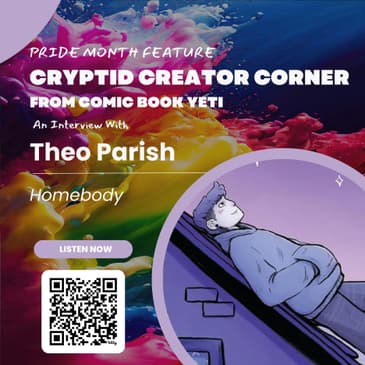
We are kicking off my second year of Pride Month Specific coverage in the month of June with a new guest on the show today, Theo Parish. Theo is a UK based nonbinary illustrator and author with an amazing new autobiographical graphic novel called Homebody from Harper Alley. Homebody is a compelling depiction of Theo's own experience of self discovery as a nonbinary person using an honest and heartfelt storytelling approach. It's out in stores now so make sure to pick yourself up a copy.
From the publisher
In their comics debut, Theo Parish masterfully weaves an intimate and defiantly hopeful memoir about the journey one nonbinary person takes to find a home within themself. Combining traditional comics with organic journal-like interludes, Theo takes us through their experiences with the hundred arbitrary and unspoken gender binary rules of high school, from harrowing haircuts and finally the right haircut to the intersection of gender identity and sexuality—and through tiny everyday moments that all led up to Theo finding the term “nonbinary,” which finally struck a chord.
A whole spectrum of people will be drawn to Theo’s storytelling, from trans or questioning teens and adults, to folks who devoured Gender Queer by Maia Kobabe or The Fire Never Goes Out by ND Stevenson, to any person looking to dive a little deeper into the way gender can shape identity. Throughout the book, Theo’s crystal-clear voice reminds the reader that it’s okay not to know, it’s okay to change your mind, and it’s okay to take your time finding your way home.
Our episode sponsors
Transphoria Kickstarter
Make sure to check out the Kickstarter campaign for Transphoria, a new new 90 page graphic novel that collects 19 new short storeis about trans and non-binary experiences of gender euphoria.
Arkenforge
Play TTRPG games? Make sure to check out our partner Arkenforge. They have everything you need to make your TTRPG more fun and immersive, allowing you to build, play, and export animated maps including in person fog of war capability that let’s your players interact with maps as the adventure unfolds while you, the DM get the full picture. Use the discount code YETI5 to get $5 off your order.
Learn more about your ad choices. Visit megaphone.fm/adchoices
[00:00:00] Your ears do not deceive you. You've just entered the Cryptid Creator Corner brought to you by your friends at Comic Book Yeti.
[00:00:07] So without further ado, let's get on to the interview.
[00:00:11] Hey comics fam! Whether you are a longtime listener or a veteran catching the show today, all are welcome here.
[00:00:17] When we started this podcast, inclusion and diversity were at the forefront of what we wanted to cover and promote with it.
[00:00:23] So in June, we'll be celebrating Pride Month for our second year in a row featuring an amazing group of queer creators and their projects.
[00:00:31] One of those projects is from our friends at Lifeline Comics.
[00:00:34] Following their success with bi-visibility still by, Heralogy and Rainbow Canvas, Lifeline Comics is launching their newest queer anthology,
[00:00:42] Transphoria, a trans and non-binary anthology on May the 30th.
[00:00:47] The 90-page graphic novel will contain 19 stories all about trans and non-binary experiences of gender euphoria,
[00:00:54] crossing all genres like slice of life, supernatural, romance, science fiction, anime and beyond.
[00:01:01] Featuring a vibrant display of artistic styles and storytelling techniques,
[00:01:05] Transphoria is a testament to the creativity and talent of its contributors.
[00:01:10] From sci-fi striking stories to endearing romantic ventures,
[00:01:14] this graphic novel celebrates trans stories while delivering a powerful message of empowerment and affirmation.
[00:01:20] I'll put a link in the show notes so you can check it out.
[00:01:23] As always, thanks for listening and have a glorious Pride Month helping us celebrate.
[00:01:31] Y'all, Jimmy, the Chaos Goblin strikes again!
[00:01:34] I should've known better than to mention that I was working on my DC Universe meets Ravenloft's hybrid D&D campaign on social media.
[00:01:41] My bad.
[00:01:42] He goes and tags a bunch of comics creators we know and now I have to get it in gear
[00:01:46] and whip this campaign into shape so we can start playing.
[00:01:49] Another friend chimes in, are you gonna make maps?
[00:01:52] It's fair to say it's been a while since I put something together so I guess?
[00:01:56] Question mark?
[00:01:57] It was then that I discovered Archonforge.
[00:01:59] If you don't know who Archonforge is, they have everything you need to make your TTRPG more fun and immersive.
[00:02:06] Allowing you to build, play and export animated maps including in-person fog of war capability that lets your players interact with maps as the adventure unfolds while you, the DM, get the full picture.
[00:02:19] Now I'm set to easily build high res animated maps saving myself precious time and significantly adding nuance to our campaign.
[00:02:26] That's a win every day in my book.
[00:02:28] Check them out at archonforge.com and use the discount code Yeti5 to get $5 off.
[00:02:34] I'll drop a link in the show notes for you and big thanks to Archonforge for partnering with our show.
[00:02:39] I think I'm going to make Jimmy play a Goblin Warlock just to get even.
[00:02:44] Hello everybody and welcome to the Crypto Creator Corner.
[00:02:46] I'm Byron O'Neill, your host for today's Comics Creator Chat and we're kicking off my second year of Pride 1 specific coverage today with a new guest on the show.
[00:02:55] I'm delighted to introduce Comics Illustrator and author Theo Parrish on with me to discuss their new autobiographical graphic novel, Homebody from Harper Alley.
[00:03:04] Theo, welcome to the show.
[00:03:05] You having a good week so far?
[00:03:07] Yeah, I am.
[00:03:08] Thank you so much for having me.
[00:03:09] It's great to be here.
[00:03:11] Yeah, yeah.
[00:03:12] Well, thanks so much for coming on.
[00:03:13] I got a chance to read an advanced copy of Homebody and I really enjoyed it.
[00:03:17] I did a quick check of Goodreads Reviews which is kind of, I don't know how big it is over there in the UK, but it's a big website in the US for such
[00:03:25] things.
[00:03:25] And there's over 400 reviews and we're sitting at over four and a half stars.
[00:03:30] So has to be considered a solid start here anyway.
[00:03:34] How are you feeling about now?
[00:03:35] You know, surprised, excited, you know, with how everything's been received so far?
[00:03:40] Yeah, pleasantly surprised.
[00:03:42] Excited.
[00:03:45] It's kind of been a bit of a whirlwind journey for me.
[00:03:48] So it still sort of doesn't feel like it's really happening, even though the book is out and I can physically hold it.
[00:03:57] Yeah, yeah.
[00:03:58] That's the nature of those things.
[00:04:00] Well, let's start with your comics journey to kind of give everyone a little bit of a background.
[00:04:04] I know you're a graduate of Norwich.
[00:04:06] I'm hoping I'm pronouncing that correctly.
[00:04:08] There's no W in there, right?
[00:04:10] So Norwich University Arts.
[00:04:12] But I'm imagining comics was fairly foundational to you prior to that.
[00:04:16] Is that a safe statement?
[00:04:18] Yeah, I've always read comics for sort of as long as I can remember.
[00:04:25] We have a set of comic strips here in the UK called The Beano, which has Dennis the Menace in it.
[00:04:32] I don't know if you guys are familiar with that and as much in the States.
[00:04:36] But yeah, that's kind of the foundational first kind of comics that I remember reading was getting The Beano every week.
[00:04:45] But yeah, I've always, always enjoyed reading comics.
[00:04:48] I actually studied, I didn't study illustration per se at university.
[00:04:55] I actually studied video game design.
[00:04:57] OK.
[00:04:59] So I kind of left illustration for a little while,
[00:05:05] focusing more on designing for games.
[00:05:08] But what really inspires me and kind of binds all of it together is like just a love of storytelling in all of the different different ways that you can tell stories.
[00:05:19] And at the moment, it's comics.
[00:05:22] OK. So you have designs to do video game stuff later on or?
[00:05:27] I would love to do video game stuff.
[00:05:29] Yeah.
[00:05:31] OK.
[00:05:32] Yeah, one day maybe.
[00:05:33] I would love to.
[00:05:34] I want to write more comics.
[00:05:38] I guess that's where my focus is at the moment, but I'm open to anything really.
[00:05:44] OK.
[00:05:46] Homebody is a very positive narrative voice.
[00:05:50] Perhaps it's kind of my own recent experience bias and exposure bias.
[00:05:53] But you know, many of the trans specific stories that I've read recently kind of focus on trauma and working through it.
[00:06:00] And and I'm by no means saying this looked easy, right?
[00:06:04] But it comes off as you know, you got this, right?
[00:06:07] That's the overall sort of tone.
[00:06:09] Was that kind of your own experience or just the best way you thought to kind of present this story?
[00:06:17] I want I really wanted to make something that was hopeful.
[00:06:23] Obviously, I didn't want to stray too much into kind of that toxic positivity thing of like everything's fine.
[00:06:30] Yeah.
[00:06:31] Because that's not the reality.
[00:06:34] But as you say, there are a lot of stories out there already that focus on maybe the harder things.
[00:06:42] And I think just in general, the kind of political climate that we're in at the moment,
[00:06:49] there is a lot of negativity, particularly surrounding trans identity.
[00:06:56] So I just really wanted this book to be a sort of positive light amongst some of the more negative things.
[00:07:05] Because I mean, I try not to get bogged down in thinking about it all too much.
[00:07:13] And but it does affect me.
[00:07:15] And but it does affect me.
[00:07:18] And I'm an adult, so I can't imagine how much kind of pressure and like what kind of effect that might have for someone who is sort of early teens
[00:07:32] and beginning to struggle with their identity or to question their identity.
[00:07:37] And so I really want to be a voice of saying, hey, like it is it might be hard, but it is possible to have a joyful and successful
[00:07:49] and happy existence as someone who is non-binary or trans.
[00:07:54] Because I think if we if you don't see people kind of happily living queer people happily living their lives,
[00:08:02] you don't really know that that's possible for you.
[00:08:04] So I wanted to kind of be that person for someone.
[00:08:08] OK, well, did you start out originally with kind of the reader in mind or was it more of a, you know, a cathartic self reflective exercise?
[00:08:17] You know, obviously, like these things tend to morph right as you go on.
[00:08:21] But so it could be both.
[00:08:25] Yeah, it's definitely both.
[00:08:27] And I think it's changed a little bit throughout the process.
[00:08:30] I think initially so homebody actually at the very beginning started as it was a poem that I wrote really just to express my own feelings towards the relationship
[00:08:47] that I have with my body.
[00:08:50] And that's where the kind of metaphor for the difference between a house and a home and finding some some way to exist within yourself that feels more like home.
[00:09:06] And so in the beginning, it was just kind of for me, really, it was a cathartic exercise of expressing those feelings.
[00:09:15] And so I wrote this poem and then I realized that I could see some images that I thought went well with wide written.
[00:09:25] So I made just a short four or five panel comic.
[00:09:31] And I posted that online, not really expecting much to come of it.
[00:09:37] But it did sort of get some traction and a lot of people seem to identify with what I'd written.
[00:09:46] And I had some interest from literary agents here in the UK who asked me if I thought I could extend into like a full graphic novel.
[00:09:59] So I worked with my agent to kind of make a plan for how we could make my story into more of a full length graphic novel.
[00:10:08] So then I began to think about like who I was writing it for other than for me.
[00:10:14] And when I'm asked this question, it feels kind of cheesy to say, but I do think that I did write it for myself at that age.
[00:10:26] So if I could, if I had a time machine, I would love to go back in time and give it to, you know, the 14 year of me.
[00:10:34] Because I think it's the kind of thing that I would have really benefited from reading.
[00:10:41] Yeah, I get that all the time actually on interviews and in talking to queer creators is I wanted to make the book that I didn't have access to when I was that age.
[00:10:50] Constantly, I hear that so makes a lot of sense for sure.
[00:10:54] Yeah, I think it's so great that we're seeing so many of those books now.
[00:10:58] Like there's so many more options for queer and trans stories.
[00:11:04] So it's amazing to see.
[00:11:06] Yeah, and it's changing so fast.
[00:11:08] Like I'm amazed.
[00:11:09] Like we've just had this podcast like maybe two and a half years at this point.
[00:11:14] And at the beginning of it, the landscape looked entirely different.
[00:11:18] I was asking entirely different questions, you know, like we've had to march on, which is which is fantastic.
[00:11:23] I feel like I feel like we're in a better place.
[00:11:26] Yeah, for sure.
[00:11:27] Yeah. Well, I have to admit, I've never seen cosplay personally as a liberator.
[00:11:33] But maybe that's because it doesn't appeal to me all that much.
[00:11:35] But, you know, kind of as a lifelong player of Dungeons and Dragons, you know, which can do much the same thing.
[00:11:41] It's not a big leap between those two things.
[00:11:43] It seems like both were kind of pillidally you along this journey.
[00:11:47] So how are you introduced to them and kind of what did they help you unlock?
[00:11:53] I think they both sort of unlocked different parts of me slightly, but sort of in the same vein.
[00:12:01] Cosplay came into my life first.
[00:12:05] And yeah, I still remember very vividly the first comic book convention that I went to
[00:12:12] and just the feeling of like walking into a space with that many people who were all
[00:12:20] like we were all there for the same kind of reasons.
[00:12:23] And we all had the same sort, like maybe not in particular the same interests,
[00:12:27] but we all had this love and appreciation of something.
[00:12:32] And I feel like at comic conventions, there's just a really nice atmosphere
[00:12:38] of like belonging and welcoming.
[00:12:42] I think a lot of fans of Comic Con are probably people who have perhaps been
[00:12:50] pushed to the outskirts of society.
[00:12:53] So I think that does make us more kind of welcoming and inclusive just by default.
[00:13:00] And yeah, I started to Cosplay, which was kind of one of my first
[00:13:09] more grown up experiences of sort of becoming someone else and getting the chance
[00:13:14] to dress as someone else.
[00:13:17] And yeah, that was my first experience of kind of dressing as a male character
[00:13:24] and getting to kind of look in the mirror and see something
[00:13:31] which more aligned with how I felt inside and having people
[00:13:38] kind of refer to me as the character I was playing.
[00:13:43] And yeah, having that just what felt like a safe space and a welcoming
[00:13:51] space to kind of experiment with the way I presented myself and the way
[00:13:56] I saw my gender identity.
[00:13:59] And I know that I have a lot of friends who have the same kind of experience.
[00:14:05] So a lot of my trans friends who are also into comics and stuff also say
[00:14:10] that like Cosplay was something that kind of gave them the opportunity
[00:14:16] to maybe experiment a little bit and kind of unlock those feelings
[00:14:22] and realise what those feelings were.
[00:14:26] And I guess in a similar way Dungeons and Dragons, it kind of allows
[00:14:30] you to be another person.
[00:14:33] And again, in a safe space where it's OK to do that and it's quite normal
[00:14:38] to do that to play a character who's a different gender to you or to experiment
[00:14:44] with playing a character who's maybe a different sexuality to you
[00:14:48] or from a different background.
[00:14:52] So I think again, that's a really safe space to experiment
[00:14:58] and try those things on in a way that feels
[00:15:02] yeah, just accepted and safe.
[00:15:07] Yeah, I need to know more about your your D&D Twitch group to some other heroes.
[00:15:12] I checked out the channel and I've got a pen to watch it later.
[00:15:15] You know, I'm dipping my toe doesn't quite encapsulate what I'm trying
[00:15:20] to do personally at D&D because I'm it's been a while.
[00:15:23] So I'm trying to learn fifth edition rules and I'm DMing a campaign on Twitch.
[00:15:28] Probably with a group of comics creators that myself and my co-host Jimmy know.
[00:15:32] So tell me about the campaign that you're in.
[00:15:35] And I need to know all these details because I'm trying to light speed
[00:15:39] myself back up into being a little less off.
[00:15:42] Sure, sure.
[00:15:43] So yeah, we we are called some other heroes
[00:15:48] and we play every Sunday on Twitch and we have past episodes on YouTube.
[00:15:55] And it's a it's a D&D fifth edition game.
[00:15:59] It's a homebrew world made by RDM Chris
[00:16:04] and it's set in a world where kind of a big magical war calamity happens
[00:16:13] and there was no other way to save the world than to kind of break it up
[00:16:18] and send it into the sky.
[00:16:20] So now everyone lives on islands in the sky
[00:16:24] and there's lots of sky ships and magic and mystery.
[00:16:28] It's very cool.
[00:16:29] Yeah, that sounds pretty cool.
[00:16:31] I definitely have to check this out.
[00:16:33] Well, one of the things that I love is your willingness to experiment
[00:16:37] with with all these different things, be they games, cosplay or words
[00:16:42] in this kind of progression towards finding your true self.
[00:16:46] You know, words have a tremendous amount of power when you when you let them
[00:16:49] for good or for ill.
[00:16:51] I know I've had quite a bit of difficulty personally embracing the concept
[00:16:54] and we're disabled, which is something relatively new to me.
[00:16:59] I was terrified to ground myself in it at first.
[00:17:02] You know, let's say, you know, younger queer
[00:17:05] the questioning reader is listening to this or even a parent, you know,
[00:17:09] like your own who they see as positive and supportive.
[00:17:12] You know, what do you say to them
[00:17:13] to help them move through those words that can be challenging?
[00:17:16] Right.
[00:17:17] Gay, queer, trans, you know, all these things that
[00:17:21] sometimes can feel quite loaded, especially when you you utter them to somebody else.
[00:17:27] Yeah.
[00:17:29] Yeah, it's a complicated one.
[00:17:31] I think I talk about this a little bit in the book.
[00:17:36] But I think we generally as a society have this idea
[00:17:40] that calming out as a queer person means
[00:17:45] like sharing your identity with everyone around you.
[00:17:49] And it's seen as this like big one off thing.
[00:17:53] I think the process of coming out really starts with
[00:17:58] coming out to yourself and starting to acknowledge
[00:18:02] and find those terms that you feel like fit you
[00:18:07] and come to accept those terms,
[00:18:11] because I think all of us have this kind of degree of
[00:18:16] internalised homophobia, transphobia, ableism.
[00:18:22] So I think sometimes it is difficult to.
[00:18:25] Overcome that and come to terms with those terms.
[00:18:32] I know I fairly recently have been
[00:18:38] diagnosed with ADHD and autism.
[00:18:42] And I had to unpack a lot of kind of internalised ableism about
[00:18:48] yeah, using the term neurodivergent or disabled or thinking of myself
[00:18:54] differently, and it is a process.
[00:18:57] But I would say the best thing to do is probably to talk to other people
[00:19:02] in your community.
[00:19:04] And I think the best advice I could give anyone is to kind of find
[00:19:10] your people and find people who are either going through
[00:19:14] the same thing as you or who have gone through the same thing as you
[00:19:18] and just have find people you can have open conversations with.
[00:19:23] And it's OK to feel, I think it's normal to feel those kind of
[00:19:29] feelings of internalised shame or yeah, it's not necessarily it doesn't
[00:19:34] make you a bad person.
[00:19:36] I think we all have those kind of walls that we have to break down
[00:19:39] and that's not our fault.
[00:19:41] That's just the product of society as it is today, I think.
[00:19:46] Yeah, it's interesting to see for me, because I'm a spectrum person
[00:19:50] myself, but had a friend online who was talking about
[00:19:54] his child was just diagnosed and he put something out there on Twitter
[00:19:58] kind of like this help.
[00:19:59] Right? I need some positive reinforcement here, but it's so amazing
[00:20:06] now these differences between when I was growing up.
[00:20:09] We just didn't have the words for it.
[00:20:12] And it was so nice to just be able to be like, yes, here is me.
[00:20:16] This is who I am.
[00:20:17] You're going to be fine.
[00:20:18] They're going to be fine.
[00:20:19] There's helps.
[00:20:20] There's help there.
[00:20:21] Right?
[00:20:21] You just seek it out.
[00:20:23] And those people that help us along the ways, it's funny how
[00:20:28] when you read something, you know, Homebody for me, the odd thing
[00:20:31] that I kind of stuck on was your mom singing Annie Lennox in the
[00:20:37] kitchen because Little Bird is one of those things that I don't
[00:20:41] belt out myself, you know, very softly.
[00:20:45] And I'm sure in comparison to your mom and really anyone else
[00:20:48] for that matter, I do a real poor job because I can't sing
[00:20:52] and we didn't have much music playing when I was a kid.
[00:20:55] And then it's funny, then I heavily respond the other direction to it
[00:20:58] and ran off to work in the music industry for a decade and a half at 21.
[00:21:02] So but how much did having the support along the way help you?
[00:21:12] Yeah, immeasurably, I think I'm quite lucky in that I have
[00:21:19] a supportive family who have not always known the right thing to say
[00:21:28] immediately, but they are always very willing to learn.
[00:21:33] And I think at the bottom, the bottom line is that they love me
[00:21:40] and want me to be happy.
[00:21:41] So whatever, whatever, however I do that, that's what's important to them.
[00:21:50] And I also have a lot of supportive friends who are also LGBT or neurodivergent.
[00:21:59] So I'm lucky to have had those kind of communities to support me.
[00:22:07] All right, let's take a quick break.
[00:22:09] Hey, comics fam.
[00:22:11] Itty Comic Book publisher Banda Bar has just got a level up
[00:22:14] and announced it is now a cooperative.
[00:22:17] This heralds a new era for them, including a partnership with Dallas Stories.
[00:22:21] And they added several new members to the ownership group.
[00:22:24] Marcus Jimenez is now chief operating officer Brent Fisher takes on
[00:22:28] the role of chief diversity officer and Joey Galvez is introduced as head
[00:22:33] of Kickstarter Ops and social media manager, which is sure to
[00:22:36] increase their capabilities overall as a publisher.
[00:22:39] And it further promotes their mission statement of advancing
[00:22:42] representation, inclusion and diversity in the media.
[00:22:46] They also established a new board of directors to help chart the new
[00:22:49] path of their journey with new projects in the works like Alaska by dropping
[00:22:53] in June, unbroken soon launching on Kickstarter and pond coming up with
[00:22:57] Dallas. Stay tuned to this space for more exciting news from the growing
[00:23:01] Bards family.
[00:23:06] Let's get back to the show.
[00:23:08] I want to get into kind of how you structure things as an artist.
[00:23:12] The layouts were very interesting in the book.
[00:23:14] They're very open.
[00:23:16] You know, there's a flow to them that your eye doesn't get
[00:23:19] stuck on any one thing for too long.
[00:23:21] And it flows the analogy I would make is there's like, there's
[00:23:25] like a water, you know, it's very organic in terms of how it moves.
[00:23:29] So you use, yeah, we use squirrels and you use these horizontal waves
[00:23:33] a lot across the page.
[00:23:35] You know, is that a feature of your own style or something you kind
[00:23:37] of gravitated towards for this project specifically?
[00:23:41] Um, I think it's a little bit of both.
[00:23:46] I often do have like the little sparklies and like the the wavy lines
[00:23:54] are good ways to like fill space that I don't really know what to do with.
[00:23:58] Okay, okay.
[00:23:59] Good cheat. Gotcha.
[00:24:01] No problem.
[00:24:01] It looks good.
[00:24:03] In the book, I did want to use that sort of as a running.
[00:24:07] There's several kind of running visual themes in the book.
[00:24:11] So there's kind of the main one of like the theo character with the house as the body.
[00:24:22] So throughout the book, there are several times when either I will look in the mirror
[00:24:28] or sometimes other people will be represented as houses as well.
[00:24:32] And it's just kind of to like a visual metaphor of moments where I'm starting
[00:24:36] to kind of feel more become more at home or when I start to like the first time I get
[00:24:43] like a gender affirming haircut.
[00:24:46] The end scene is me looking in the mirror with my good haircut and like the body of a house.
[00:24:53] And I think like the kind of wavy line sort of rainbow buckles.
[00:25:00] I wanted to use that throughout as well in a kind of similar way just to show kind of emphasis
[00:25:07] to those moments of like either being supported by the people around me or coming into my own
[00:25:14] kind of power and my identity.
[00:25:17] Okay, is the background in more game design?
[00:25:22] How do you see that play itself out in the panels?
[00:25:24] Because it's very a lot of people especially I've noticed with more of their
[00:25:30] first big project, right?
[00:25:31] I don't know why everybody seems to want to take on graphic novels but that's what y'all do.
[00:25:37] So it seems like terrifying to me.
[00:25:39] But it kind of was honestly.
[00:25:42] Yeah, I can't imagine it.
[00:25:43] Like I'm trying to get a little bit of do a little bit of comics writing and oh my,
[00:25:49] how do I fill out 22 pages let alone 200.
[00:25:52] But anyway, not trying to cause more anxiety.
[00:25:54] The layouts, I'm just curious about how that game design plays itself out structurally because
[00:26:02] there's not like a five or six panel five or six panel in your work.
[00:26:08] That's like think where that organic read comes in.
[00:26:12] Because you move quickly because you don't get locked into this rhythm of sequence,
[00:26:18] sequence, sequence, sequence, I guess.
[00:26:20] Yeah, I actually also took a lot of inspiration from picture books.
[00:26:29] So I really love picture books.
[00:26:31] I think the design and the illustration for picture books is really cool.
[00:26:36] And I don't think we should stop reading things like that just because we're not children anymore.
[00:26:42] I agree.
[00:26:44] I really was inspired by the way that Fond is used in picture books.
[00:26:51] And often it's instead of being like here's a picture and here's some words,
[00:26:57] they're kind of much more tied together in their design.
[00:27:03] So I think there were a lot of, there's a lot of pages in Homebody
[00:27:08] that don't have any panels at all.
[00:27:11] And I really wanted the words to be sort of part of the image rather than to be
[00:27:18] separate because I think there's a lot you can add in terms of like tone or impact just by the
[00:27:24] way that you arranged the words on the page.
[00:27:29] So I'd say yeah, probably my main influence was picture books actually.
[00:27:36] Okay, okay.
[00:27:37] That's funny how the throw up will let you.
[00:27:40] No, no, that's okay.
[00:27:42] Eric Carle is, I love Eric Carle.
[00:27:45] I will never tire of Eric Carle's work ever.
[00:27:47] Yeah.
[00:27:48] It's just absolutely amazing stuff.
[00:27:51] Well, the coloring aids to your layout choices as well unless I'm way off,
[00:27:56] the palette is restricted to the color of the trans flag.
[00:27:59] Am I on there?
[00:28:00] Okay.
[00:28:01] Okay.
[00:28:01] That's why I bought it.
[00:28:02] Hooray, it worked.
[00:28:03] Yeah.
[00:28:04] Well, as a student of color myself and as an aspiring comics colorist, I'm always curious
[00:28:08] about kind of motivations behind restricted color palettes.
[00:28:13] Obviously here, motivation is pretty straightforward.
[00:28:15] But when did you decide on it?
[00:28:17] Did you first draw things out or?
[00:28:20] Very early on we had discussions about in terms of production I guess quite boringly.
[00:28:28] There was questions about whether it was going to be in full color or in just black and white.
[00:28:36] And I think from the get go, I wasn't really sure what I wanted to do in terms of the color scheme,
[00:28:43] but I knew I didn't want it to be just black and white because I am a very colorful person.
[00:28:52] I love color, especially in my artwork.
[00:28:55] I love the relationships between different colors and the differences that that can have on an image.
[00:29:02] It's really fascinating to me.
[00:29:04] So I knew I wanted to have colors, but I really do enjoy working in a limited palette.
[00:29:13] I think kind of in what may seem counterintuitive, I think it gives a lot of freedom by having
[00:29:21] limitations because if you have some restrictions, you're then kind of forced to find ways to work
[00:29:28] around them. And I think that gives, well, I find it inspiring in terms of creativity because
[00:29:36] I think I just like to creatively solve problems.
[00:29:40] And one of the big things that I had a lot of fun trying to figure out was how to render
[00:29:47] pride flags in just two colors.
[00:29:52] So yeah, I ended up taking a lot of inspiration from...
[00:29:57] There's a printing process called rice graph printing. I don't know if you're familiar.
[00:30:02] So I took a lot of inspiration from that. I've done some rice graph printing before,
[00:30:08] but basically it's just a way of getting more than two colors by using only two colors.
[00:30:17] In terms of the opacity that you layer each color on top of each other, you can get
[00:30:21] additional tones. So although the two colors we used were pink and blue, the overlay of those
[00:30:29] can produce different shades of purple, darker pinks and lighter blues, etc.
[00:30:36] It was really cool to kind of figure out how to do all those things.
[00:30:40] Yeah, my brain was going back and being like, I've never asked that question before,
[00:30:44] but can you... Does the pride flag translate into CMYK? Like I've never tried that.
[00:30:53] Yeah, it was fun to try and... Because obviously contextually, if you're reading a book like Homebody
[00:31:04] and you see a flag with several stripes that are different colors, you're going to assume
[00:31:07] that's the rainbow pride flag, right? But then there are scenes like there's a scene
[00:31:13] at my local pride where myself and a friend paint pride flags on each other's faces.
[00:31:20] And so there's like a picture that we had with all of the different pride flags,
[00:31:26] so like the non-binary flag, the bisexual flag. So trying to make them all look like
[00:31:33] they're retrospective, like different flags, but only using those two colors was fun,
[00:31:39] but kind of challenging. I'm picturing more challenging than fun in the moment.
[00:31:46] Maybe it's just me.
[00:31:49] Yeah, the layout and the color and everything like that compositionally, it's great because
[00:31:56] you're able to focus on what matters. If that makes sense, you know, you don't have a lot of
[00:32:02] topography in the background, that kind of busy thing. And I think that really is what made it
[00:32:08] feel so organic and it flows and the ideas connect in a really nice way. I enjoyed it.
[00:32:16] Thank you. Well, towards the end there's a statement that reads,
[00:32:20] there's no one way to be transgender. And I've asked this before about kind of the
[00:32:25] pressure of writing queer characters. And we alluded to before even like when we started
[00:32:30] the podcast, you know, how much things have changed over two and a half years just in what I'm reading
[00:32:35] and stuff. It takes several years to make a graphic novel. Did you ever feel any of that pressure,
[00:32:41] you know? Or did you feel a need to check a box of any kind, if you will, with how you're writing it?
[00:32:47] I guess not in a way that this is my story and it's about me. So I'm only writing it from my
[00:33:02] perspective. So I did kind of want to, I think I do reference quite a lot in the book that,
[00:33:13] you know, there's no one way to be non-binary. There's no one way to be transgender. Like this is
[00:33:18] how it is for me, but it's not necessarily like this for everyone. And it's okay if you don't
[00:33:25] feel the way that everyone else feels. I think particularly as trans people, there's,
[00:33:33] I think I do feel or I have felt pressure to prove myself in certain ways. And I think there's a pressure
[00:33:47] on trans people certainly to feel a certain way about their body or to have a certain level of
[00:33:55] discomfort or dislike for their own body. And that's not true for everyone, particularly non-binary
[00:34:02] people because a lot of non-binary people kind of existing in this gray area. And so I wanted to just
[00:34:12] be careful about making sure that that was the message that I put across like this is my
[00:34:19] experience, but this isn't necessarily the only experience. Okay. And going, opening the lens
[00:34:29] up, you know, you're a younger creative. I've asked this before, like have we broken the glass
[00:34:35] ceiling where queer writers and artists don't need to modify anymore for this straight readers?
[00:34:45] Yeah, hopefully. Okay. I think the more types and varieties of queer stories that we see
[00:34:57] is only going to benefit everyone, not just people in the LGBT community, but also cis and
[00:35:05] straight readers as well. I think that comics and books in general are a great way to
[00:35:13] kind of put yourself in someone else's shoes. I think it's Philip Pullman that says that
[00:35:18] the books are like an empathy engine. So yeah, it's not just important for obviously it's very
[00:35:27] important for LGBT people to be able to see themselves represented in stories, but I think
[00:35:31] it's just as important for cis and straight readers to have access to that as well,
[00:35:36] to allow them to kind of empathize with experiences that they may not have
[00:35:43] come across in their own lives. Yeah. Okay. Well, lately I've gotten away from asking for advice
[00:35:53] because it's always gone dark places, but I'm going to return to that today because, you know,
[00:35:57] homebody in effect is like a blueprint, you know, in a way for questioning young person or an ally,
[00:36:03] a friend or a parent, you know, they just finished the book and set it on the desk. And
[00:36:07] are there any additional, like words of advice or, you know, pieces of wisdom that you'd
[00:36:12] like to share beyond what's in the pages themselves? I think my main one for this book,
[00:36:22] I think I had two kind of main motivators in mind. And one of them was for trans and
[00:36:35] non-binary or questioning young people to read and see themselves and feel understood
[00:36:43] in those pages. But I also really wanted it to be accessible for people who are cisgender,
[00:36:50] who are perhaps supporting a family member, a friend or just generally want to know more about
[00:36:59] the kinds of things that queer people may be going through. And I just really hope that the book
[00:37:09] allows people to kind of start those conversations. So yeah, my advice would be
[00:37:18] to have conversations, to use the book as a starting point for a conversation. If there's
[00:37:25] things that you don't, you still don't understand or you're unsure about, yeah, use the book to
[00:37:32] start some conversations, I think that would be really cool. Okay. Yeah, I mean, there were
[00:37:37] things in there, despite the fact that my best friend is trans or things that I didn't. I wasn't
[00:37:42] aware of it. And I guess I'd never put a name on them, like a dead name. We went through that,
[00:37:51] but I didn't have a word for it and it added a lot of context for me just to be,
[00:37:55] oh, I should know this. Well, what have you been up to lately? Any new projects on the
[00:38:02] horizon that you could talk about? Yeah, I am starting to write my second graphic novel,
[00:38:11] which will be out in 2026. I think yes. So yeah, that's going to be another sort of personal
[00:38:23] book I'm going to be writing based on my experiences as someone who is autistic and ADHD.
[00:38:32] But late diagnosed. So I guess it's kind of a similar thing, like growing up, I didn't really
[00:38:38] understand why I thought the way I did or why I had problems doing things in the same way as other
[00:38:47] people. And for a long time, I thought that that was because there was something wrong with me.
[00:38:52] But yeah, turns out I just didn't have this kind of integral knowledge about myself.
[00:38:59] And again, I'm writing it for sort of similar reasons to writing Homebody really just to
[00:39:06] A, kind of get those experiences out into the world just in case someone else
[00:39:13] needs to hear them and then realizes, you know, oh, that kind of sounds like me actually.
[00:39:18] Because I didn't know the only reason I discovered that I had ADHD and autism is because
[00:39:26] of other people sharing their experiences. I think I had like a lot of us, I had a very
[00:39:32] and a limited understanding of what being neurodivergent was and what that looked like.
[00:39:38] So I think it's really important for us to share our experiences because that will help other
[00:39:45] people. And yeah, to help people who aren't neurodivergent who want to understand what
[00:39:52] that might be like. Okay, well, where can people find you online?
[00:39:58] You can find me. My website is theobluelistration.com and that has links to all the places you
[00:40:07] can find me on social media if you wish to. All right, we'll throw it up in the show notes
[00:40:12] so everybody can easily find that and track you down if you want them to.
[00:40:15] You know, lately social media is a dumpster fire. Yeah, yeah.
[00:40:22] Well, Homebody is out on shelves now. I encourage you to pick this one up. Everybody
[00:40:26] who's listening is quite compelling. You know, this personal story of self-discovery and hope.
[00:40:31] And I'll thank you Theo for being brave enough to put yourself out there into the world
[00:40:36] and living your most authentic self. I appreciate it. Thank you very much.
[00:40:40] Thanks for having me. Yeah, absolutely. Thanks for coming on today.
[00:40:43] Well, this is Byron O'Neill on behalf of all of us at Comic Book Yeti. Happy Pride Month
[00:40:48] and which I'll continue to beat my drum again and say if you want more diversity and representation
[00:40:52] in comics and beyond, you need to show the corporations that you need it and you need to
[00:40:58] buy it. So do that and thanks everyone for tuning in and we will see you next time. Take care,
[00:41:03] everybody. This is Byron O'Neill, one of your hosts of the Cryptid Creator Corner,
[00:41:08] brought to you by Comic Book Yeti. We hope you've enjoyed this episode of our podcast.
[00:41:14] Please rate, review, subscribe, all that good stuff. It lets us know how we're doing and,
[00:41:20] more importantly, how we can improve. Thanks for listening.