
Bouncer union unite! To the best of my knowledge, this is the second time we've hosted a former bouncer on the show. It's not something I normally get to discuss and definitely the first time I've ever gotten to ask the question, "What was your Marvel bouncer personality?" But this isn't a podcast about bouncing, it's actually all about one of my favorite graphic novels of 2024, it's just that bouncing actually can be applied to the book. That book is Medusa from Dark Horse Comics created by writer/illustrator Tony Parker who is today's show guest. If you aren't yet familiar with the project, it's one of the most creative reimaginings of Greek mythology I've ever seen. Show topics include the unique character designs of a silent protagonist, collaborating with colorist extraordinaire Tamra Bonvillain, and the use of pacing and kinesics in storytelling which is something I've been increasingly mindful of in the medium.
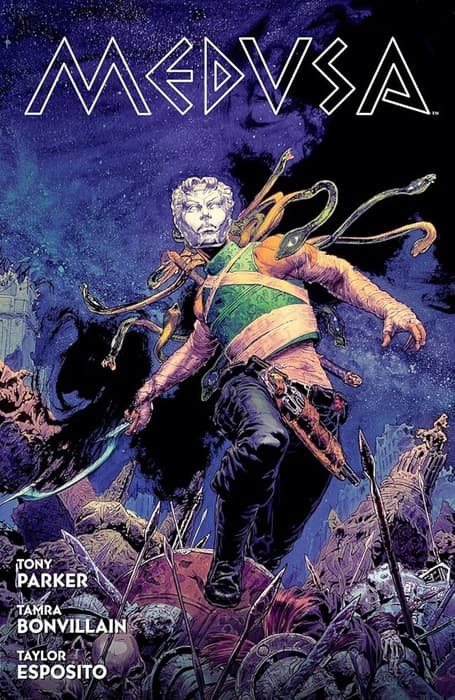
Medusa from Dark Horse Comics
From the publisher
Everything you know about Medusa is a lie.
Forever cursed to be remembered as a monster, this ageless yet very mortal hero has spent millennia saving humanity from the horrors of legend.
But now, today, in Scotland, she has met a foe that makes even the gods hide in fear. Armed with unwavering resolve, will the mighty Medusa be able to save mankind one last time?
PATREON
We have a new Patreon, CryptidCreatorCornerpod. If you like what we do, please consider supporting us. We got two simple tiers, $1 and $3. I’ll be uploading a story every Sunday about some of the crazy things I’ve gotten into over the years. The first one dropped last week about me relocating a drug lord’s sharks. Yes, it did happen, and the alligators didn’t even get in the way. Want to know more, you know what to do.
Arkenforge
Play TTRPG games? Make sure to check out our partner Arkenforge. They have everything you need to make your TTRPG more fun and immersive, allowing you to build, play, and export animated maps including in person fog of war capability that let’s your players interact with maps as the adventure unfolds while you, the DM get the full picture. Use the discount code YETI5 to get $5 off your order.
Global Comix
Save on a subscription to GlobalComix with us. Visit the link below and use the discount code COMICBOOKYETI.
[00:00:00] Your ears do not deceive you. You've just entered the Cryptid Creator Corner brought to you by your friends at Comic Book Yeti. So without further ado, let's get on to the interview. Hey everyone, this is... Hi Byron. Who is this? I'm your fairy godmother. I have a fairy godmother? Of course you do. I'm 50 years old, why haven't you shown up before? I appear when I'm needed. And I didn't need you in all these years? Do you want my help or not? Um...
[00:00:30] Sure. Exactly. I was just about to pitch our Patreon. Why would I need help with that? Because you're an idiot sometimes. That's hurtful. What were you going to put on there? We do comic stuff? So something along those lines? And this is why I'm here. You do know what people put on Patreon most of the time, right? Honestly, no. People need something a little bit spicy to entice them to support you.
[00:00:59] Nobody wants to see me shirtless. I doubt that's true. You are in pretty good shape considering your age. Thank you. Let's see. A little spicy. I've been bugging Jimmy to figure out what he's going to do. I know lately he's been playing around with his **** all the time. He loves to take it out and show it off. There's even a specific TikTok channel now. How's that sound? Not a bad start. People like Jimmy. What else you got?
[00:01:24] I told a story recently about being in a strip club with some of the four horsemen when I was working for WCW back in the day. I picked up an infection on my- Woo! From the experience, I hate strip clubs. Is that better? Getting there. But maybe spicy shouldn't include infections you get in strip clubs. That's not sexy. We'll workshop it. Like I need more meating. At least tell them where to find it while we figure this out. Mother goddess, help this poor man.
[00:01:53] You can find us on Patreon at cryptidcreatorcornerpod. I'll put it in the show notes. Anything else you'd like to remind me that I'm bad at? How much time do you have? Why do you look like Rosario Dawson anyway? I appear the way you want me to look. Okay, that's disturbing. Wait, have you been showing up in my dreams? I'll never tell. And we're done here. Y'all, Jimmy the Chaos Goblin strikes again.
[00:02:20] I should have known better than to mention I was working on my DC Universe meets Ravenloft hybrid D&D campaign on social media. My bad. He goes and tags a bunch of comics creators we know, and now I have to get it in gear and whip this campaign into shape so we can start playing. Another friend chimes in, are you going to make maps? It's fair to say it's been a while since I put something together, so I guess? Question mark? It was then that I discovered Arkhamforge.
[00:02:45] If you don't know who Arkhamforge is, they have everything you need to make your TTRPG more fun and immersive. Allowing you to build, play, and export animated maps, including in-person Fog of War capability that lets your players interact with maps as the adventure unfolds while you, the DM, get the full picture. Now I'm set to easily build high-res animated maps, saving myself precious time and significantly adding nuance to our campaign. That's a win every day in my book.
[00:03:14] Check them out at arkhamforge.com and use the discount code YETI5 to get $5 off. I'll drop a link in the show notes for you, and big thanks to Arkhamforge for partnering with our show. I think I'm going to make Jimmy play a goblin warlock just to get even. Hello, everybody, and welcome to today's episode of the Cryptid Creator Corner. I'm Byron Neal, recovering awkward person and your host for our Comics Creator Chat.
[00:03:37] Joining me today is Eisner-nominated comics illustrator and writer who also apparently happens to be a fellow member of the Bouncers Union. That's Tony Parker. Hi. That is absolutely correct, actually. Yeah. Okay. So tell me about this. So bouncing, I'm genuinely stoked. So I have another former bouncer on the show, which I think has only happened one other time. So within any individual tribe of them, everyone has a role, right? Maybe not a superpower.
[00:04:07] That's probably a stretch, but some unique identifying marker. There's somebody like the thing always, and you must have a charmer, like a gambit. I'll maintain a Marvel equivalence here and say I was like the pyro of the group. You know, when we announced closing time, the inevitable stragglers who wouldn't leave, I'd start hurtling chairs across the room, which of course quickly encourages people to vacate. I was always the first to take it to the next level, which probably still holds true. So, so, okay. So what was your Marvel bouncer personality?
[00:04:36] I have to, for Marvel, I was the, um, I was the piece. I was, I was the one that talked everyone down. I was the one that, um, I was the deescalator, which isn't a superhero. I know that, but I was the one and that's like, who am I? What superhero actually has power is to reduce the harm. I mean, it's everything. You should, cause everything else, superheroes usually like that. Talk with the fat talk with fist, but I was, I was the one like everyone's take it. Let's take it down a level. It's a step up. I mean, always been a big guy, but one of my degrees is, is in psychology. Okay.
[00:05:05] So I know that the worst thing you can have the other ones in criminal justice. So therefore between those two things, like the worst thing I can do is escalate the situation. Let's deescalate. Let's calm everything down. Let's get around the parking lot. There's one thing that counts is as long as they're not on property, they're not our problem. Sure. So for let's get them out the door, get them in the public area of the parking lot. And then it's, I mean, it's not like, okay, go away with knives, knock yourself out. But that was my job is make sure there were just got, um, again, so, um, was just get one off property.
[00:05:35] Okay. Yeah. I mean, I, I ran a cruise doing security for wrap acts for, for years while I was on the road working, uh, doing production manager stuff for said wrap acts. Um, so you always end up doing double duty and stuff. Yeah. It was never the deescalator. That was not me. I was big enough that people aren't going to immediately go to like, start shoving me, but not so big that people will try to pick a fight in order to, um, try to prove themselves.
[00:06:30] Okay. Yeah. And it wasn't, I never had a line. I never had a specific segue. It was always depending on the individual, but trying to just keep them calm. And, um, if it necessary, I almost scored them out. Cause that's probably some of the places I worked at the security there. Cause we don't use bouncer anymore or didn't have stopped using that a while ago. Apparently was, um, you're the door person or security was some people joined it so they can get in fights at a day job. They just got there so they could beat people up.
[00:06:58] So they knew which door didn't open there. So they tried to put their head through that. Oops. Sorry. Sorry. Wrong door. And through that way, you know, the people are straight up. They love throwing people down or I always hated them. The people who wanted to be bouncers. So they, you know, the ones that they go to the club, like, Hey, if you have any problems, you need anything, I got your back. Like, Oh no, that's the last thing I need right now. Yeah. It's going to try to jump in and like, try to, um, um, try to just make this situation worse.
[00:07:27] Even though they're, they've got their fancy, well, it can be, I'm gonna be Patrick Swayze in my way of the highway. And it's like, no, no, that's not how this works. This is, I'm a professional. This is my job to make sure that everyone has a good time. That includes the people that are having a bad time so that we've still want as long as, unless they're repeatedly destructive, disruptive, sometimes they're just having a bad day. So I want them to make sure they can still feel that they're welcome to come back as long as they behave. Not that I'm here to beat people up.
[00:07:56] So that's, and that's the fun thing is, um, I worked like the old gamut of clubs from like, sometimes it's like New Year's Eve at your local, um, TGI McFinnegans, where it's, oh, we can't afford a door person. We need an extra person here. Can you come over? He's all catching on the table. Done those. And this is past seven years, more than seven years ago. So I'm not worried about statute of limitations. And other places, like I worked in one place, which was in like the one, one of the worst neighborhoods.
[00:08:22] It was two venues, one entrance, larger venue was heavy, heavy, uh, country Western. Okay. And the smaller venue was, um, stripper slash, um, techno. Okay. Through, uh, same, shared parking lot, shared building, shared entrance, a large, small venues on each side. So with two, basically diametric opposite crowds sharing a parking lot. So as usual, like, Hey, someone just threw a beer, um, beer bottle into my windshield.
[00:08:51] Call insurance. Yeah. But having that work and having that kind of stuff there is, was not fun. I did not stay there long. It was like, this job sucks. The hours suck. And I have to be able to hear a work in here because they want to get in fights. I'm going to find somewhere else. So it's don't miss it. Cause you know how it is when you're, when you work security, you're, you've got a six, seven, eight, uh, four, six, eight, or whatever your shift is. Wait, you're just high attention waiting for something to happen.
[00:09:22] Even everything is like threat assessment. I still can't, I still have trouble going to bars or clubs. Cause that's, you may have the same thing. Oh yeah. You're looking around. Absolutely. You see all the stuff around. You're like, Oh no, I can't. All you're looking at is you're looking for the tells. You're looking for this, the, the symptoms. You're looking for the different archetypes. Cause not everyone's bad. Not everyone's good, but it's like, Oh God, that's all I see. Whenever I go out to any like that, that's, that's all I see. Yeah.
[00:09:49] My magic was being able to move through a crowd quicker than anybody else. And yeah, I don't know. I don't know how I was that guy, but it was just like, how did you get here so fast? And it was, Hey, that's a useful skill at San Diego Comic-Con as well. Okay. Cause I've used, I was the same way where it's like, this is the best pathway forward. Cause it's yes, I could bulldoze through people, but that makes things worse. How can I slide through people? And it's great. We're trying to get through crowds at San Diego as well. I'm just, just saying it is a useful after job skill.
[00:10:20] No, hopefully I'll get a chance to, to polish up my skills sometime soon. Yeah. No, it's, as I said, I hate, yeah, I hated that job. Not the worst one I had, but it was still like, Oh, it was so. It was so annoying. So, which is, it makes me appreciate what I do now so much more because I've had those jobs. I'll talk to other people who work security and it's like, they'll start talking about like how many of the teeth they original teeth they still have left. Oh wow. And stuff like that.
[00:10:47] Or it's like, well, you, or like little stories, like I can handle the loud crowds. Those bludgering three, four bludgering, three or four or five guys are like, Oh yeah, we're going to do this. We're going to do that. Okay. We can deal with that. But the scary ones are one of the quiet ones where it's the small group there. Oh yeah. And they're not saying anything. They're just looking, they're quiet and they're kind of, they have to be able to that shamble there. The handsome maybe doing a little bit of that or kind of warm, warming stuff up. Like just like start calling other people.
[00:11:15] Like, Hey, just that who were the local law enforcement officer who's off duty right now. Just, Hey, this is just keep an eye out and stuff like that. But yep. Don't miss it. Yeah. I mean, there, there's definitely a little part of me that does, but I get that. I get my, my nuggets of wisdom into my, my son occasionally. And it's, it's cause the misconception is it's always look out for the big guy, you know? And I was like, no, no, no, no, no, no, no. No, it's the little dudes. Those are the ones you really got to work out.
[00:11:44] The little drunk guys who had a bad day, got dumped, got rejected, or just feels like they got to prove something. Or the, um, um, a lot of the, uh, both men and women who have like that false sense of egos. Like I can do anything. Don't you know who my partner is? Or I will mess you up no matter what, cause I'm drunk and I have no societal control over that. So it's not just, it used to be, Oh, that crazy woman. Or like, no guys did it as well.
[00:12:10] It's just, they may have a separate, a different type of tack or tack to it, but it's still that, Oh boy, this is, this is not gonna be fun. Let's keep distance and, um, and get, um, and get and engage at a distance. If we need to, um, restrain, restraining groups, um, polite and talk through the entire time and, you know, yeah. Well, getting into what you're actually doing here with the comic books, you know, I think there is actually a parallel.
[00:12:38] Um, I think we've totally dispelled any mystique about, uh, bouncing door, doorman, doorman, security. Yeah. Yeah. Whatever we're calling it now, as clearly illustrates me as a dinosaur. Um, I'm using outdated terms as well, but this, this image of, uh, a century, right? Yeah. A protector is, is ageless. Yes. You know, that is a representing order amongst the chaos, which is not dissimilar to your main protagonist in your book, Medusa.
[00:13:09] Yeah. You've inverted it from the classic Greek root. So unlike the manifestation of primal fear, which we would normally associate with the mythical Gorgon, she's a cursed monster and said, saving humanity, John Wick style from her fellows and echoed a little bit of Hellboy to me in there. Absolutely. Absolutely. Hellboy was definitely, in fact, when I pitched it to dark horse, I was a little worried, like, is this too close? Is this too much of a, the same gun with the serial numbers, um, shaved off? Or it's like, Oh no, I don't want to do this.
[00:13:39] So when I did that, I tried to make sure that Hellboy was definitely an inspiration. How you can have a singer, um, a singular human, um, or humanized, um, hero monster for lack of a better term. Yeah. Yeah. And that's definitely something that went when I did or, um, that I went with because it's, cause initially with this, um, I'm going to do a lecture in a roundabout way. If it's okay, can we do a little backstory with this?
[00:14:05] Because initially when I did it, I did, um, my initial picture was for, um, Emerald city comic con used to do a charity called monsters and dames. It's a charity book where, um, you could submit and not everyone made it in to a book where it's had to have a monster and a dame. It could do whatever you want. Just those were the things. And so I looked like I've done a couple of them before that. And I'm like, wait a minute. What if I, what the monster is a dame? What if the monster is the hero? And it's like, just somehow don't know how it came to it.
[00:14:34] What if it was Medusa? What if she was a hero? And I've got the monster in the background. So I just kind of drew it up, had a lot of fun doing it. And thankfully it posted. I saved that piece. Um, cause usually you can, uh, they'll auction off the original arm. Like, no, this one I'm keeping, I've got to keep this one. This means a lot to me. So I donated another beautiful piece and that sold well, but did that. And when I'm working the regular day comics job and I was working on a different book
[00:15:01] and a couple of years, um, a year or two later, uh, if we, sometimes we work on a book scripts can get delayed for whatever reason, not good or bad. It just happens. I realized, okay, I've got an eight, eight, nine day period. They've warned me like, I've got a little time here. So like, you know what? I'm going to do a story with her. So I did a little eight page story. And as I'm trying to figure this, the character, I'm like, how would I, um, what is Medusa? Medusa.
[00:15:29] And once I realized that what if Medusa was not what we know, but was actually the victim of 2000 years of patriarchy. We have a hero who have 2000 years of men talking bad about her, especially gods talking like, and the people, they tell the story throughout the era, throughout the era is where it's not, Oh yeah, she was a good person. It's like, yeah, but we don't, um, we need to keep that on track. So we'll turn her from a hero and a hero into a villain. And from there I shifted over from the, um, like, okay, well then we'll do the cheese.
[00:15:58] Uh, here I'm like, well, let's, let's have go. In that case, let's take all the guardrails off. Okay. Let's just go with it where it's like, she is her own thing. Everything you know about Medusa is a lie. And I shifted over and I, this, I tell basically in the first couple pages of the story. So it's not a spoiler for the book. What if she's cursed so that everything she does, humanity cannot remember all the good she does. Humanity can't remember. And so she goes from place to place all over the world.
[00:16:26] And she's still doing the right thing. Cause that's the right thing to do. And she helps people out. And I just love that where it was that sentinel, but it's sometimes you have sentinels where it's a point of honor for, um, or pride for a certain area where it's, I must protect this place or must protect this person or this thing. And for it's, I need to protect everyone because it's the right thing to do. And if it gets out of the ability and I don't want to say anything about that.
[00:16:51] Cause I, there's some fun reveals in the story, but I really want that again, that protect that protector where with Hellboy, it's, and I love it. And it's nothing against Hellboy, but he's like kind of throws in cause there's nothing else to do. Or he's got his other ways beyond that, but there, it's not that. And there's, there are some, um, writers who say you can't have a hero who just does the right thing. It's boring. And I can get that. I totally get that. But I run into two things.
[00:17:18] One where it's, what if you can, what you can someone's like, I want to help people out. You don't help someone on the side of the road just because you've got trauma from, um, not getting help them when you need to change tires. Sometimes it's that person needs help. I have the ability to help them out. I want to help them. The other part of that is I'm not a strong writer. This is the first thing I've ever written since probably college to have that build it right with that nuance and skill and to a point where people are actually going to enjoy it.
[00:17:44] And I do not have that capability, not saying I went down the road, but at this point I have also very much acknowledging not just what I do, but what my editor for this book, Stephanie Cook, who's amazing, what, what she can help suss out of me. So it's very much like, um, there's a huge difference between scrambling eggs and, um, like making a croissant. There, there's, there's a skill level there where we're missing right and the dinners do it
[00:18:14] on the clock, you're going to scramble legs. You know, I can go through and try to fumble through her croissant. I mean, you're being very humble here, but defaulting to what you very much are clearly good at, you have a beautiful character language that you've crafted with her. Like the silhouette is immediately memorable. Thank you. Covering her face with a mask and then having this gorgeous, massive writhing monocled cobras is what would otherwise be a prosaic soldier's outline, kind of a unique dimension, you know, which really carries it for me. Thank you.
[00:18:43] So talk to me about that character design, kind of how you wanted to, to, to use it and manipulate it in the book. Well, first off, I was like, she's a hero. It's there are other people have done Medusa as the, um, the flowing robes and the large breasts and all those things, which nothing wrong with that. That is a definite, excuse me, definitely one of the concepts you can work with. I'm not going to be grudging other people going that way, but I looked at her as a hero. It wasn't a, what is a woman going to wear? What is a hero going to wear?
[00:19:12] A hero is going to wear practical, um, outfits and applications as much as possible. She's wearing BD, uh, battle dress uniform pants because they've got pockets. They're ripstop, uh, their ripstop material. They're pragmatic. They're very practical. Her boots, which are actually, I'll spoil this one. The book's been out for a bit, are actually the, um, the sandals of Hermes. Okay. But they're also boots. They're not these, like open-door tablets and you can stab.
[00:19:39] These are steel-toed boots that are, have good traction, good control. They're what you don't want to wear if you're a hero. Her belt is basically the D&D pouch of many, a belt of many things where she can pull stuff in and out of that because if you're a hero, you're gonna want, you want Batman's got that backpack, that belt. You want something you can pull stuff in and out of. The breastplate is something I'll get to if I can tell a future story, but it's very much,
[00:20:05] uh, um, helps to echo back to, oh yeah, she, um, she is something of the ages and ancient bronze breastplate. There is a purpose for that. That shows there. And she's got the wraps, which help protect, but also don't get in the way of everything. There is nothing that's cumbersome. There's no like flowing robes, no capes. That classic animal or modes, no capes thing. There's nothing there that'll get in the way. Everything she has, she has a purpose for it. The weapon she's had, she has, she's picked up over the millennia from different areas
[00:20:34] and cultures because that's when you're out there doing a job, you learn like what tools work best for you and keep those tools with you. And so I worked on that one, worked it straight up. It was solely a, what would a hero wear and work it from there. It wasn't like, oh, she's got a breastplate. Yeah. But it's not something where it's like, she's got the molded in boobs. A lot of women out there, one don't have breasts so large that you need something to stand that it's not an object of part of the fun of the male gaze.
[00:21:04] It's something, this is something that's practical. When a female police officer, when police officers are out there, they don't have specially molded on body armor that have the boobs that stick out. Great. They have something that is very practical for it. And they may strap down with extra sports for our two to make sure that if things stay with, they don't stay with ours, they're supposed to. I could be way wrong in that. I don't know. I'm guessing, but it's something where, um, boob armor doesn't define her.
[00:21:32] It's something that everything she has is practical, is pragmatic. Does the silver mask means that she can look at people without people looking at her. Okay. Great thing where the mask comes from in the book, which I love, but I don't, that'll leave for it for the field. They get to read the book. But with that, it was solely a, and sometimes I will admit the arm bands just look kind of cool. The wrist straps, they just look kind of cool. I like it. That was a lot. It looks like fun. Yeah. Cause you gotta have fun with it, but everything there has a reason, has a purpose.
[00:22:02] The bands around them, which were so help keep the breastplate on the bands underneath her, keep the chafing down. So everything has, has a purpose with that. When I started realizing that I may, I love the character that much more because if you had a male character out there in that same outfit, you wouldn't think twice about it's like, yeah, no tape makes total sense. And there's some people out there that was like, but where boobs? And it's like, well, they're there. They're not important to the story.
[00:22:33] Sure. They're not something like that is dependent upon the character or the abilities or anything with that. They exist, but they're not, they're not, they're not just, they don't define who she is. So everything's very practical. Absolutely. Again, if you're a warrior for 2000 years, you're going to, it's going to be practical way. Unless you're watching, that's an anime, then that's the different design sense. And I love those things as well, but it's a different visual iconography that allows you
[00:23:00] to go away with, um, incredibly not pragmatic, um, outfits. Okay. Well, looking at the practical and for me reading in metaphor. So on my read, the mythology of Medusa centers around this concept of ideal feminine beauty and men's desire and sometimes hatred of it. And you've talked about kind of how you're playing that down. Yeah. The, the mass, the coldness of a mass acts as sort of a mirror.
[00:23:26] And for me, what that did was challenge my own or a reader's notion of what gender roles could be. So it sounds like this is most certainly embedded into what you wanted to portray with her. Absolutely. Not just that, but usually when they do, um, Medusa character, she may be thin, but you see almost wave-like or, um, light of trim. But if you're fighting stuff, you, you, you, you, if you're fighting a lot, you can have an MMA body. You're going to have a CrossFit body. You're going to have a very, that's why she has a muscular body.
[00:23:55] It is not a steroidal body and it's not the, uh, and it's not the female bodybuilder body, which there's nothing wrong with that. It's his own form of beauty. I have a tremendous amount of respect for those women out there that can put on that much mass. It is not easy. It takes a lot of dedication, a lot of skill. But when I looked at her, I wanted much more of a lean, uh, muscular, leaner body where it's more multi, uh, it's more adaptable. Okay. So again, like we look a lot at MMA fighter, female MMA fighters, the women MMA fighters,
[00:24:25] the women's out there, they're strong, they're muscular, but it's different physique than the bodybuilding physique. And so I'm builders. That's why she's got the strong shoulders and strong arms because I'll, I'll say it as women can be strong. They're, I'm really tired of that. Women have to have a very, especially in comic books, have to have the very specific body type. They can't have try. They can have tricep definitions, a little hint. No, actually she's got triceps. She can have like, if you look back here, like she's got shoulders, she's, she's muscular.
[00:24:54] She still has feminine proportions and feminine aspects, but she has to have that. Um, for fighting monsters, you need strength. She needs strength as well. Of course. Yeah. Well, you've got three of the components there with good character design already. You've got a, a memorable silhouette. Uh, you have the exaggeration that's happening with the monocle cobras. Now you need a color palette. So you enlisted Tamara to help you out there who I consider to be one of the top colorists
[00:25:23] working in the game. Not a bad choice. How did you recruit them? How'd you work together on this? Well, um, I will say for Medusa's palette, that was actually me. Cause I, um, why did the pitch to dark horse and I did the, the prints there the first and I, you know, I've actually patterned two of the monsters in the game. I, I cleared that myself and doing all that. It's like, I need to get a professional because my, my colors are mediocre. They do the job, but they're not great. And I don't know again.
[00:25:52] Oh, it's, it's, um, I see as being honest cause it's, they're not bad. They're not horrible. I'm not like, I'm a horrible person. It's like, you know, they're very functional, but I want this book to do well. And so I'm the one that funded everything. So I was like, I'd almost worked with, I've known Tamara for a while. I've always loved her work and I almost worked with her on a project, um, years before this. And I was like, you know what? I love work. This is amazing. She's giving exactly what I need to the book. So I contacted her well in advance, like a year and a half, two years before.
[00:26:19] Like, Hey, can I, um, can hire that? Uh, can we do this? Here's a schedule. Here's when it's going to come out. Does this fit with you? She's like, yeah. I'm like, okay, here's this. What you wrote you quoted last time. It's like, yeah, but that's, that's not my price anymore. This is my price now. I'm like, okay, give me a minute to think about it. Cause I wasn't ready for that. And our writer. Yes. Cause well, I mean there were, which is in comics, like no time at all. It was just me making sure that I could afford that. Like, cause she is who I wanted. She was absolutely amazing.
[00:26:49] And she was great to work with. And all my editor friends are mad at me because they're always trying to get, she is so in demand that I was able to get her before, um, from other, uh, before other people could. And they were happy for me, but it's like, I've been trying to get her for years. And there you are. You got her. I'm like, I know. And she is amazing. And I sent her the pages and, um, very few notes. I gave her almost no notes. And most of it was like, excuse me. Can you make this purple? Because it's important for storytelling.
[00:27:19] Sure. Like very, a few very specific items. Like here's what these needs to be, or this is the time of day outside of that. Go for it. I'm hiring her so that she can do her job, her magic. And the more notes I gave her to try to constrain that, the less it's not gonna be as good. That what's the point of her doing it? I should just going, if she on her to do my way, I should have done it. Like, no, I want her to do it. And let me tell you, when I got pages in, I cried. Just happy cries.
[00:27:49] Because there were, I mean, just like hand over mouth. Look in the pan of the screen. Just stunning. Just absolutely beautiful. Oh yeah. Well, I'm a former theatrical lighting designer and the lighting work on this is gorgeous. Just gorgeous. The color theory and all that, how she makes it all work. Cause like, like when I, cause I'm going to dry, like it's going to look kind of like this, like this, when I draw it. And I saw like, no, this is absolutely amazing. This is so much better than what I picture.
[00:28:16] And even though there are a couple of times I'd get something like, Oh, I kind of visualize this, but I didn't tell her that. I sat back, I would sit on it a day or two or maybe three. And like, she's absolutely correct. Cause that's something I learned with the writing part. This is the first time I wrote. I used to, I made, um, I learned so much from Stephanie and Stephanie, like saints aspire to have the patience that Stephanie cook has with had with me. Cause I would like, when right.
[00:28:44] Well, the first time I did the script, I sent it into Stephanie and, um, she, uh, she would say like, first I was like, yeah, rewrite the whole thing. This isn't working at all. I'm like, okay. And I did. We wrote the whole thing completely different. I mean, the character is still the same, but the story itself was a completely different story. And, um, it would start off like, I would try to lawyer my, um, her notes like, Oh, this isn't working. Like, but you see what I'm trying to do this. Like, no, it's not working. And I was, again, she had so much patience for me. So incredibly, uh, Stephanie's amazing.
[00:29:14] And then I realized, Nope, you can't really respond. You gotta give it three days and then you respond back. Cause 99.9% of the time she was absolutely correct. And at 0.1% was like, uh, me, um, actually that was how she was a hundred percent correct. When I think about it. And towards the end, it was like, if you know, she was like, this could work either way. It's your choice. I think it's fair this way. And like, no, I need us here for the, uh, for seeds for future stories. Like, Oh, that's your call.
[00:29:45] But no, having Tamara was, Oh, and I'm, I still like, I'll send Tamara, Stephanie and Taylor who did the amazing letters. I'll send them all. Like when I get good reviews, I'll send them those like, thank you. This is you. And I'll make sure to tag them and like, or refer to them whenever I get the note, the reviews as well. Because this is a team. Yes. I did draw it and I did, uh, did pencil and ink it, but Stephanie kept me so honest and was so right with that.
[00:30:12] And Tamara with the colors and Taylor Taylor with his letters. It's a team effort. And they were all amazing. I was so lucky to be able to, to punch up when I got people as a team around me. Do you feel like it's a tendency with people who are just starting out to question that collaborative process more? Were you ever personally at a point where you would have just jumped at that and been like, no, no, no. It's gotta be this way as opposed to, okay, now you've done this long enough and you're just comfortable being like, oh, they've got this.
[00:30:43] I don't know. Okay. Because it's something where I was like, my initial response is, oh yeah. Like my, my sheer ego. But I'm thinking back throughout my career, it's like at every point in my career, when I got editorial notes back, it was all right, let's take care of that. In fact, the worst part is the most I argued with was over the, um, the writing because it's such a personal thing for me. This is very much a per, I mean, very much a personal story about helping people because the story, the core of the story is helping people out.
[00:31:10] And, and so much of my problem was I had so many things I wanted to put into it. It's like, yeah, you're as it is. It's a very fast, very, very tightly, very densely packed story. And I had so much more that had to be taken out. But in the end, Stephanie was absolutely right. And have I, well, has it always been that way? I don't know. I would like to think I would.
[00:31:33] I would like to think I would, but I can also see back starting out how much ego, I mean, ego I have, but I'm also remembering like my very first books back in the day. Like when I did my first books were Warhammer books, when boom studios had that. And I would like try to sneak the like, um, Easter eggs in there and the editor would catch like, no, you can't do that. I'm like, okay, it's out. Whereas, um, like they had, um, well, a readout of one of, um, one of the factions there with like, it was Tao with like the Tao language there.
[00:32:02] I'm like, it's like, what if I wrote in like a fun little, like a Bruce Campbell, like army of darkness line in there? It's like, no, you can't do that. Do we translate that? Yeah. Uh, okay. So I'd like to think that I wouldn't have been, but it's almost like you never, it's as pure, pure suppositions, pure guesswork. So. Well, yeah. If anybody else could go back and look at our younger selves with a true, uh, a true lens and see who we authentically are, we, it probably scare us.
[00:32:32] It would be. And it's, and even that it's where a period of our time, but it's also those mistakes that we made back then make us who we are now. Right. And it's, it's, it's one of those like tough things. Like if you'd go back, like before, before we went along, we're talking about like, we, um, like different pieces of artwork we missed out on. Yeah. And, but there'll always be something like that. It's like, we got this, that would just be our victory. Then we have found something else that we would have missed on. You know, that would have been our focus for that. Cause we've all got pieces that we have now. Like, oh yes, I got it.
[00:33:01] And like, but there were never a hundred percent. So it's always. That's my classic example of this is, uh, back in the day when I was working with wrestling, um, Hulk Hogan got the opportunity, got the phone call and I hate using a Hulk Hogan reference now, but it's okay. Anyway, he, uh, he got the phone call about the, what would be the George Foreman grill. So he got the first phone call and missed it.
[00:33:25] So it could have been the Hulk Hogan grill, but instead he got the little hand mixer that nobody remembers that broke down after you used it two times, you know, for your smoothie. Yeah, I don't remember that at all. But yeah, it was just cause he didn't answer the phone. Yep. And that's when we've all got those and the other times we've also like, wow, that could have been me. Cause there were other times there, like I've had projects that were incredibly useful for me and promoted myself. I was not the first person they called.
[00:33:53] And it's like the other person either didn't want to, or they fought too much or whatever. And all of a sudden I've got these projects as well. And I've missed stuff as well. And it's part of the fun of life. Oh, absolutely. What's this? Well, this is one of the most memorable books of 2024 for me. And the primary reason is the atmosphere you created using kinesics in the storytelling. So let me step back a moment. I get a lot of submissions asking for feedback prior to publication from people.
[00:34:21] One of the things I always suggest to newer comics writers is, can you tell your story concisely without needing words, right? Will the story alone convey the message? This is one of the best I've ever seen in that department. Medusa moves through much of the book in a shroud of silence, which lends her a confidence without that annoying internal monologue that usually happens. And it adds to the mystery and the tension of the surroundings you're putting her in. So where did that blueprint come from?
[00:34:51] Um, it was, I mean, it was always there. One, it made me really appreciate why the doctor always has companions in Doctor Who. Okay. Because that way it's, um, those companions are great for exposition. Where it's like, what's this? Well, this is right here. So it's a natural form of exposition with this. I was never allowed that. She has no psychic. There's no reason for her to have a psychic. So I had to make sure that every exposition had to come naturally from other conversations.
[00:35:16] And the other thing is I actually got rid of a lot of dialogue throughout there, like their pages were, there was like a full thing of dialogue. Like after, um, I don't know if I split, but after the end, after the big, um, confrontation, there's an interaction. I mean, if you read this, you see what I'm talking about and it's all silent. And people that read this know exactly what we're talking about. There was actually dialogue. There's actually a lot of dialogue for that. And I've started following a lot of like writer Instagram pages that this year and a half ago.
[00:35:44] And they started talking about how there are all these scenes that are silent scenes that weren't written that way, but they were allowed the motion and the action to convey the story. Like they're absolutely right. And there was another time, like as much as I love the matrix movies, I can't stand the part where, uh, Leo and Trinity crest the clouds and they see the sky and it's beautiful scene. And the Trinity says, it's so beautiful. And she ruins everything by saying that. Yes. We don't need that. It slows it out. It stops the scene.
[00:36:14] We can tell, uh, Karen Moss is a great actor and she can carry that. We don't need that. But by her saying that it stops everything. And so I had so many scenes with it, try to see so many scenes within the book that, um, do we need words here? And part of it is also, I'm horrible at dialogue. And, um, sometimes it's best to lean on my strengths of the visual storytelling.
[00:36:36] And so I really wanted to push that and allow this, uh, allow the scenes, um, speak for themselves, pardon the pun. And so there was, sometimes it was that insecurity of a big new writer and, but other times like this isn't needed. This isn't necessary. We can let this go. And so much of the writing was comic writing is editing. Yeah. Because when you write TVs and movies, you can spit the word dialogue quickly. You're gonna have a whole speech in 30 seconds. You're good.
[00:37:05] When you have 20, 40, 60, 80 pages, you have to be incredibly concise. You almost like you're not speaking in dialogue. You're speaking in nuanced keywords. And so, so much of my writing was, um, a lot of it was also Stephanie saying, you got too many words. You got to trim this down. This has taken way too much space. And I was like, oh my God, you're right. Yep. You're right. And it wasn't tell Taylor showed me the letters. I was like, Stephanie, you're absolutely right. Thank you for keeping it on that because you are amazing.
[00:37:33] But so, um, as I was writing, I was realizing as well, it's like, no, we don't need this. This isn't necessary. It's almost like, um, the, the knock in the darkness or alien where you don't see the alien, where it's like, allow the reader to create those images in their head. I mean, sometimes you got to show the monster. That's what this book got. Okay. Here's the monster. Here's the big bad. Here are these things. You need that.
[00:37:58] Other times, if you allow the reader to assign those emotions, allow the reader to assign the feelings, assign what they're afraid of or happy to see. It's great. That said, you also can't do. And she looked like the, she looked there and she saw things she could not comprehend. Like we'll show those. This is a comic. Exactly what you're supposed to do. And yes, I did not want to do the, um, the narrator captions. I tried to avoid those as much as possible.
[00:38:23] Where it was solely Scotland, 8 31 AM that we've got, we've got our time. That's kind of important. And I think after that one was, I think we had a caption, the last page. Moving on that. Um, I tried to avoid captions at all costs there because, uh, for me, that's captions are wonderful for noir stories and 1960s comics. Because they're that narrative that tells you the story with my story. If you're a child, you don't need that. You are the narrator. The story is the narrator.
[00:38:52] And to have those things in there, um, I try to avoid them as much as possible. Well, it's one of the best examples of pacing. And I think that's why I enjoyed it so much. Cause I come from a music background. Yeah. I'm always looking for beats in a comic, a cadence with the panels that helps, you know, pace the reader's experience of it. So Medusa moves through these moments switching from what for me was quiet to cacophony. There's a scene where she's walking through an archeological site into what looks like a tomb.
[00:39:22] You can almost hear the crunch underfoot of her steps, dust moving, like walking through an old barn, right? Yeah. And then it gets really frenetic with these oval panel breaks that traverse the page like water droplets on a window pane after the rain. Yeah. So how is a storyteller? Do you connect with a reader with using the pace in this? Cause I absolutely love that part of it. Well, thank you. I really appreciate that. It's, there's no, I mean, it'd be great if there's like, it's iceberg method or something like that.
[00:39:51] It was so like, well, how does this need to be told? Do I need to expand it out? Do I need to slow it down? Do I need wider panels? Do I need to, um, to give it more space? Do I need to collapse panels in, in order to create a bit of, um, claustrophobia? Do I need, um, unique panel shapes in order to, um, over on the sides, whatever the emotion is going through? Do I need them to go off the panel, off the page in order to give it that timelessness or really space out as well. And when I was pacing it out, it was start basically starting. Okay. I've got 80 pages.
[00:40:21] I've got to tell the story in 80 pages. I need a set up. I need to stop down. It wasn't like a three act. I didn't treat it as a three act play. It was silly. I need to get from here to here. And what points are the most important emotionally? What are the greatest emotional content? Because it, uh, if you may look at this, like, oh, wow, you got a fight scene. I want to do five pages or 10 pages on the fight scene. Just them beating stuff up. Cause it looks cool. I'm like, I don't have that energy. I don't have that time. I need every page needs a purpose. Every panel needs a purpose. Every line needs a purpose.
[00:40:50] And that purpose is to make the reader care about what's going on. And so that's why I love, I mean, there could be, that's why there wasn't as much action as there was. There's so much more dialogue because I needed to make sure that people care what was happening. No one can tell you really what the, what the plot of like the emotion, the plot of the Mission Impossible movies were. No one can tell you really what, like, oh, what was the character growth here? They can tell you, oh man, that was really cool. Where even, um, jumped over this thing.
[00:41:20] Cause that's what that story is. I love those stories. That's not the story I wanted to tell here. I want to tell the story about emotional growth, about caring about the character, caring why and, um, wanting them to do well, wanting to do well. And so therefore it was all basic. Well, you touched on emotional growth there.
[00:41:40] So walk me through the challenges of depicting Medusa as a character, because you've given away two of the primary methods of emotive expression with, with a reduced amount of words and certainly her mask. Yeah. Sorry, what was the first part of that? Yeah. So, so just like walk me through the challenges of depicting her as a character. Oh yeah. Because you've given away that emotive, all these, uh, these normal things that people use to connote emotion or acting or, you know, expression. She has none.
[00:42:08] Well, actually I use the snakes. Okay. You go back to the snakes. I use the snakes. I'm like, um, up for tension. She's tired or scared or worn out. The snakes droop down. Okay. She use them like she can use them to crest or to look around or give people space. So I'd use those as an additional, um, emotive thing. But a lot of that was, and I used a lot of more dynamic gestures with her when she's pleading, she's pleading, arms are coming out.
[00:42:36] And when she's trying to give people space, the hands are back. So therefore she's much more gestural, which she had learned over thousands of years of, Hey, people will always see as a monster. Let me make sure that people create my body language. But then after that, it was trying to make sure that the concise, um, dialect, whatever word she used. That, um, try to make sure, um, sure that like those keywords pop when those popped up, that's where it carried it forward. Gotcha. But it was, yeah, no, it was incredible.
[00:43:05] That was incredibly challenging because without the mask, you can use facial expressions and it wasn't me trying to hide using facial expressions. Cause it's just as hard to maintain the exact same facial expression at all the different angles as, um, or the head moves around. Yeah. So what's interesting circling back to security and talking about the hand gestures and how much that's actually used in de-escalation. Yeah. Same thing.
[00:43:28] It's, uh, it was probably subconscious on my account, but it's very much a, um, working with her, making sure that every part of her body helped convey what, what the expression was. And as she's getting worn and exhausted, try the thing, her shoulders are slumping. She's leaning on an object, which is shown in the story. And as she goes on, I really try to push that forward. When, if she has resolved and lava was also, um, using the camera to frame, um, frame the angle. So that, that conveys it forward.
[00:43:57] But it was, it was incredibly challenging because again, the doctor who companion she had, um, she had no companion to explain what she's wanting to explain why she's doing it. So everything that popped up had to be done in a partial paragraph, which she's talking to other people. So although like, as you're learning more about her throughout the story, which some people have, I've expressed frustration with where if she's not exposed, uh, it's not exposition down the beginning.
[00:44:25] We don't find out like who she is or why she wear the mask or the mask comes from or different story elements show up throughout the story. And actually got that from, um, I was able to talk with, um, or joining a, uh, a little, a Ted, not Ted talk, but a little, um, interview with Mark Wade. And he's like, yeah, you don't have to do that all at once. You can do that throughout the story. I'm like, Oh, you can. And so that's why I would drop things throughout the story. Like, okay, that's where that comes from. That's why she does that.
[00:44:50] And it's much, I, anyways, it's much more organic because I had a lot of people complain, um, congratulations on me that I didn't, um, do an exposition in the very beginning. There was like, this is a Medusa, this is what she does. And now with her story, like a 1930 serial, there's something you learn about her as you go along. So things that she said in the beginning make more sense at the end. And now in a second, read through like, Oh wow. That's where that is. Cause I wanted a much more emotionally strong story.
[00:45:16] I love the story. So you can go back and you can watch again, like, Oh, read again. Like, Oh, I totally missed that the first time through. I love those Easter eggs. And if I'm looking to do more stories with this, I've planted Easter eggs within the first issue that make no sense. There are, you won't even notice, but do carry out, will carry on for stuff in the future. I hope. Well, the nucleus of the story itself, you have all these different pantheons to play with here beyond just that of the Greeks, but we start in Scotland and I'm not complaining.
[00:45:44] Right. The vast majority of my ancestry is Scottish. So, um, but, but thank you for avoiding like leprechauns or similar British Island fae that is just hackneyed and overdone at this point. They're there. They're just, they're hinted. But, but why Scotland? What was specific appeal to that? Don't know. Okay. It was something like I didn't, I was not going to do it cause I was not gonna have her like, Oh, and she's so Roman briefs for 2000 years. Like it's a very small place. It's beautiful. People are incredibly friendly, but it's a very small place.
[00:46:13] So she is something of the, uh, the creature of the world. Yeah. Because at this point, it'd be ludicrous to think that, I mean, I'm sure you can tell stories where everything's out. Like they're hard. They do have their hard borders, but people still roam around. They're still. So, I mean, it is a wide world. It's incredibly large, incredibly small world. I mean, she uses a cell phone. Yeah. Which I love to do. And I'm putting that stuff in where it's like, yeah, she's, of course it's 2024, 2025. Of course she's gonna have a cell phone.
[00:46:41] But, uh, but she also has friends in different cultures, different pantheons. And I love that where everything is much more interconnected, but it was solely as I want to do, take her in different places.
[00:46:52] And this was usually when they do stuff, it's either, um, New York, LA or London. It's one of those three places. And even when I did my pitch story, I did it in Kenya, if I remember correctly. I did it in, um, when the nations of Africa, because I didn't want that. Oh, it's one of these, it's, or she's a Greek, Greek person. We'll do it in, um, Greece.
[00:47:15] I wanted to do so to show that she is something of the world. And so with that, I think, um, I don't remember exactly how I got there, but it was something, you know, we're going to start, uh, we'll do it here in a different place. And it just ended up that way. And I want to do future stories. Some of them may end up there, excuse me, but it's something where there's a big, wonderful, beautiful world out there.
[00:47:40] And I have no intent of having anything to extend for a long period of time in New York, London, or LA. Those have been overdone. It's very Eurocentric as well. Like there's so many wonderful places in the world to see.
[00:47:53] I also love to expose, um, Western eyes to different cultures, different come different gods, different pantheons. That's where in the beginning of the story, when she texts all texts up all her friends, I do research, like what other gods or mythic heroes would she communicate with what she asked these questions to.
[00:48:12] And that's why it's very important for me to put those text messages in there because I want to show that wide scope of the world that she lives in, where she is not, she is alone, but she's not solo. There are other things. She has other resources.
[00:48:24] And I think that was something, I think a lot of modern, um, storytellers, when they talk about, um, uh, reinvent mythic creatures, they don't really do that. They don't have that interaction. Usually it's like every, every, um, deity, uh, is a fiefdom. Everything just kind of locks in there. There is no, and I'm sure the last stories do, and I'm just not aware of them, but there has, I really want there to be that.
[00:48:49] I love that potential for interconnection where like they may jump on Xbox and play a Fortnite or they go on PS5 and they're out there, they're, um, playing a ball of skate three where they do have that interconnected thing there, but also having the, they do have their separate fiefdoms or different kingdoms or land areas as well.
[00:49:12] Yeah. I love the moment. I can't remember which Pantheon it was, but the, to paraphrase and it was the humanistic moment of, oh, I'm sorry. I was busy. I had this other thing going on via text messages. So.
[00:49:26] Oh yeah. No, it's yeah. That's, uh, yeah. The beginning is when she was trying to contact the local, like the local deities, if I remember correctly, but it was like, yeah, where it's like people, they text, they're kind of keeping contact. And I just, I love being able to put that in there where she does have, yeah, she's got a cell phone and she, well, you, when she does research, that's part of it. She uses the internet. It's not just like she's, uh, whenever they do these ancient stories, it's always, we need to find the old books. Well, a lot of those old books are digitized for one.
[00:49:56] Right. And two, there are things out there that, um, that are current. You, it's like, if you go through and you try to look through a code, use a code from 1944, there's some recipes you can't exactly duplicate because those things don't exist anymore. You need to find ways to update them. Like, okay. Um, they talk about this location. Like, where is that now though? Okay. Well there's, um, let's go to Reddit. See on Reddit, like went through and updated all these things up. There it is. And it's been upvoted.
[00:50:25] So it's, it's a combination. It's, um, a hero that is from the past, but lives in the present. And maybe think of my, um, my grandmother's recipes. My mom sent me her recipe book not that long ago as part of that trove of stuff that, that they brought over from Tennessee. And I was just thinking some of those recipes, if you tried to put that stuff in there would kill you because for instance, lard is in everything.
[00:50:53] Every single one of my grandmother's recipes that I would be so sick, sick to death. Oh, absolutely. But it's something like that where I tried to, I would have like, I, um, when I walk my dog, I don't have like special writing. I'd have like all these notes I'd emailed to myself. Like, wait a minute. I, what if I do this? Like send myself with like the head, like the header M. So I know, okay, this is for Medusa. And like one line, two, three lines, maybe a piece of dialogue. Hey, wait a minute. Why don't we tie this in or does this work?
[00:51:21] So it was always with that, which was, I mean, it was fun for me because most comic writers, it's okay. You got, you've got a week to do 20 pages. There you go. And for me, since I was doing, I wrote a lot of this while I was working on a regular, um, a different regular book, I was able to kind of like allow things to settle in the back of my mind. I was like, let's figure this stuff out. Not, this is going to be done in a week. This will be close enough. Fire and forget. I wanted this to do what I'm going to do, obviously do well, but I wanted, this is my all.
[00:51:52] Excuse me. You never know when you're going to have an opportunity to do something like this again. I was, my first book ever was published by one of the top indie, uh, the largest, one of the largest independent book, uh, comic publishers in North America distributed by one of the largest, um, book public book distributors in North America through Penguin Random House. And have my, something like this is such an amazing opportunity. I wouldn't, I had to do everything I could to make sure that I could earn that or show that I earned it.
[00:52:22] And it's, well, go ahead. Go ahead. No, I was going to say, um, one of the things I thought was curious is you must have a love of irony because you pitted Medusa against somebody with an infectious bite of all things, which is hilarious. Given the number of cobras around her head. Yeah, no, for me, it was, that was my thing. One of the reasons I did that was because, um, one of the epiphanies that was given to me that I had, it was like, you need to have, you need to put the main character in danger.
[00:52:52] You have a reason for people to care about the main character. And so like, okay, she's, it's like, oh, she doesn't go off. And if she doesn't succeed, oh, well, not a big thing. This is, if she doesn't make this work, she dies. So, yeah, it's tough to push, uh, introduce a new character with like, you're good. Here's a new character. You're going to die. But yeah, they did that in DOA. It was like, hi, I'm dead. Here's my story. So you can still do that.
[00:53:15] But I wanted something not just put, she's not just trying to save other people, but she, like, and she's even offered, hey, you can save yourself and let these people go. You're good. Don't worry. These are humans. They're just human. They die all the time. We're just like, no, I'm willing to put myself, this is who I am. I'm willing to sacrifice myself to try to save them. It's not about me. It's about making sure that they're okay. That they're okay. That's because obviously none of you all are going to do that because you don't care. You're gods. You don't care what happens to humanity.
[00:53:45] I still do. So is this to some degree because of her mortality? Because historically her other two sisters are immortal. Of the three Medusae, she's the one that's mortal. Yeah. No, this is, and that's the thing with this is I, I mean, wiped all that stuff off the table. I'm not going to say we're going to revisit things like the sisters, stuff like that.
[00:54:08] I've got story seats for that, but she is long lived, but she can still cause damage. She can still die. So it's not that, oh no, I've had my head put off. I'll put it back on. We're good. Or I've been set through the heart. Oh, I'll put that back. So she is still, she's a very long lived mortal. And she's obviously been through scrapes, which maybe I'll tell them, maybe I won't. Not as a threat.
[00:54:33] It's like, oh, but it's not part of the narrative working on now, but she is very, I mean, she can still die. And I think that's important to have that mortality to a character. Because if your character is immortal, if they're put in trouble, who cares? It's kind of like watching a main character in a prequel. Like, you know, they're going to live. Oh no, they got the gun. They had their strapped to a bomb and a planet is falling on them. Yeah, but they're in the next book. I know that there's not that worry.
[00:55:01] Which is also why I didn't do like any real flashbacks of times past. It's like, the audience will care more if permanent damage can happen to the character. Sure. Absolutely. And so I really kind of make sure to work with that as well. So if you get an opportunity to develop this further, will there be something of a rolling antagonist? Like similar, like I'm thinking in my Hellboy illustration again, right?
[00:55:29] So there was a lot of things that he's always doing constantly to type, but it's always building up to this big bad, you know, if you will. Yeah. Don't know. I mean, yes and no. Okay. There was always something behind the scenes. These stories are more fun with something behind the scenes. Yeah. Pulling the strings. Yeah. But it's also to what degree and does it really matter? I'm working on the second, I'm kind of working on a second story now, but I don't know if what will happen with it, but I wouldn't.
[00:55:58] Things are always more fun with that protagonist, but also have that be wary of that superhero trope of where everyone knows everyone, where it's like a group of eight people that somehow, oh, you're my brother's cousin. Of course you're the big bad because we knew each other in college and everything intertwines a key. It can seem kind of contrived if you do it too often. Fair. I've got ideas for something that could happen. There is the potential for overarching stuff, but I'm also worried about what if I say yes
[00:56:28] and then all the people like, oh yeah, we knew this gap and we saw this way back. And I would say, no, like you lied to us because you said there was and there isn't. So it's very much, um, and it's not, I'm trying to hide from the answer. It's like, I don't really know right now. Let's see where this, I've got a lot of, let's see where the story takes me. Yes. I planted seeds, but there's so many ways those seeds can go. So I'm not sure. I don't want to get locked into, I finished, I've got my story figured, my very end of
[00:56:58] the story. Everything has to go here. But I say everything for that. And the rise might get, you know, like it, this is wrong. Can't end this way. It went this way. Then I've painted myself in the corner. So I'd be very careful. Like, yes, I got a few things there that, yes, there are some recurring stuff that I would love to revisit or I'd love to ring back or stuff like that. But it's also, I want to make sure, I don't want to become locked into it. I don't want to trap myself with it. If that makes sense. I mean, it makes perfect sense. Okay, good.
[00:57:26] So it sounds like you're already working on some iteration of it. Do you have anything else forthcoming in 2025? I do. I've got a, um, actually that's what we're working right now, but I've got the first two covers. I'm making the first issue of a book that I can't, that hasn't been announced yet. Okay. I will say it is an amazing book. It is. And I've had some, I worked with some amazing writers like Alex DeCampy and Greg Pock. And, um, I can't mind this basic, mind this damn band, um, Paul Cornell for
[00:57:55] utterly study, uh, utterly stunning writers. And I'm the person I work with now is at, is at least on that level. So I'm very lucky to work with that. Just amazing, stunning writer, great stuff. And I can't wait to announce it because I hate keeping things quiet. I'm not one of those being mysterious for mysterious sake. I love being able to like share these things, but never get ahead of your editor, the editor and the team have a whole, like, here's our marketing plan for a rollout for release.
[00:58:24] And the last thing I want to do is screw that up because I like working with them. Yeah. I need to internalize this because if I ever do get anything out there, I will be the worst at being able to, to keep a secret and not talk about it because you get excited about it. It's your baby. Yeah. Uh, my partner knows about it and I think she's the only one beyond that. It's, and for her, she does a new comic. So it's like, okay, cool. And I guess man, well, this person is also doing these things. Okay.
[00:58:52] I vaguely heard of that because it's some people say when you, um, if you're, um, you know, the comic center, you need to have your partner be your fan. I'm going the exact opposite direction because it's, it's important to have that bubble where it's like, we're like, Oh, I'm working on something like good for you. She's very proud and supportive, but it's not that she, she doesn't follow that stuff. And part of the problem is what if the person that you're partnered with is only with you because they're a fan of your work?
[00:59:22] Like I've seen that happen as well. That person falls out of the industry or falls out of favor. All of a sudden that person is gone as well. The person who you love and care about all of a sudden it's like, they're not there anymore because they're attracted to what you did and not who you are. Sure. And the other, um, and sometimes it's good. They can also grant you very much with like, here's this crazy stuff. Here's this, um, industry politics thing going on. And she'll, she'll look like, oh, it's just this. Yeah. That's it. Yeah. You're right. That's it.
[00:59:52] I mean, it's big, but it's also helps you give a really great sense of scope and scale. Yeah. And it's, it's really important to have those perspectives that are outside it because the industry does have a tendency to exaggerate things, blow things up, maybe more than they materially really are, but yeah. And it's, yeah. Scope and scale is the best way to put it for that. Absolutely. Yeah. Yeah. I'll never have to worry about that. My wife hates comics, so it'll be all good. It'll be all good. Yeah. No, I get it. It's, I totally get that.
[01:00:22] Yeah. Well, I wanted to follow up on our blue sky conversation from a couple of days ago and to fill everyone in, I noticed the storm shadow sketch that Tony had done. He was planning on getting signed by Keone Young, who is the voice actor for the storm shadow character on the GI Joe cartoon series in the eighties. You were planning on hitting up superhero Saturday in Phoenix, I believe. It was, I was actually guest on superhero Saturday. Okay. So it was like, I, um, for that, I, past couple of years, I've been lucky enough to do the, um, promotional work for it.
[01:00:50] So what if you were in Phoenix and went to quick trip, which is like the local, like, um, gas stations, like flash convenience store there. They'd have my artwork up there or my artwork with Val makes the colors by Val Huckberg and she, she colored it. But so I was very much the product of the promotional face for it. And I went down there and I would sign stuff, do little sketches for charity. And so I did that. And yes, I did get it signed. And, um, I'm trying to see it's around here somewhere back here.
[01:01:19] While you're looking, it looked like that was a fairly heavy cosplay event. It was, it's, they've got a lot of cosplayers there and they've got, um, the different performers, like they, not just, not just cosplay, but they had like one of those suspension rings where people slide down on it and, um, spin around and. Oh, cool. So yeah, it's, it's cosplay. They had like a couple of baseball players there and looking up the side, see if that's in the scanner. Nope. Not on the scanner.
[01:01:49] But yeah, I actually got him to sign it. He was the nicest guy. And so I definitely, yeah, this is all the artwork that you can't see. So sorry. The video version people will be able to check it out. Oh, absolutely. Yeah. And I actually got him to sign it, but he did say, don't, um, he actually wrote down storm shadow and sharp. And he was like, don't show this to anyone that knows Japanese. Cause it, he's like, he wasn't proud of his premiership. So I'll block that up. But yeah, um, I'll be posting that up probably the next day or two. Oh, wait, cool. He was nice.
[01:02:16] Oh, the thing I got from him was the same actor was also the star baseball player in, um, deep space nine. I didn't know that. Me neither. Until I got there, I'm like, Oh, actually, let me take it out of the sheet. I'm like, cause like when voice actors will have the, um, the, uh, little prints you can buy, they can sign. Yeah. Like, okay, that's cool. Look, I'm like, what? I'm a huge DS nine fan.
[01:02:39] And he was the actor who was, um, play the shortstop that was, um, within the episode. So they actually, apparently they gave him where he asked, Hey, can I have the car? Um, the current, like, yeah, they gave it. So it's like, I actually have all the stats on the back as well. And so he prints those out and he signs those like, that's amazing. You got him to sign it. Hopefully they gave him a decent batting average. Well, he was like one of the top players of the league. So I have to look. Yeah. I don't know baseball enough.
[01:03:09] No, actually his averages were like 300, 304, 317, 336, 361, 368. And then final season 2025, 390. That is high. That is very high. That I do know. So, um, but yeah, so without that, like the full card, he got that. So I, yeah, had to get one of those as well. And he signed it and totally worth it. So if you see him, talk to him, buy some room. He's wonderful as well. That's awesome. Yeah. It's, it's an understatement to say that that show is foundational for me.
[01:03:38] I don't know if you remember it, but there was an episode where spirit and storm shadow end up saving each other. It's called the Island of no return. I actually did have to look that up, but I'll never forget that line. When next we meet, we be as enemies. And it was a absolute light bulb moment of realization for me as a kid that good and evil were not these binary things. It just, this shattered that illusion for me. So. Yeah. That's okay. The episode that always broke my brain with that is where they went to alternate dimension
[01:04:05] and, um, they're like, Oh, there, there's like breaker, um, stealer. And I maybe could think it was close. It wasn't close to someone else. Like they're dead there. Like you see like the uniform and the bones and like some of those people would go back and realize it was so that way they push the toy characters. Like, Oh, look at these, where these characters, we can bring these new characters to take their spot and sell more toys. No, I know. Don't care. But yeah, the alternate universe one, like I still remember that line where they're trying to get stuff from this whole, like, um, shack store. They put the money down, they leave.
[01:04:34] And the guy runs like, what are you doing? You can't, I can't use these. These are American. Like throwing that cash, the money at them as they run away. And I was like, what? It just broke my brain. We need to get you, we need to get you hooked up doing some GI Joe coverage for schools for sure. So we should contact Skybound and do whatever we need to do here. I would love to. Um, it's one of those things right now. I, I have those things. I would love to sneak into cover too or some backup stuff. I am so busy right now because right now I'm working on a monthly and doing the covers
[01:05:04] for it. So it's one of those things I would love to when I, hopefully in a couple months I'll hit them up again. Actually, I haven't even hit them. I've yet to hit them up once. It's a weird thing where I'm lucky enough right now to be busy, where I want to make sure that all my focus on this, because back in the day you said, I'll work a hundred hours a week. That's not a problem. Now it's like, that's not healthy. It's important to have that balance. Yeah. And so it's like one of those things where I would love to, and I've turned out how to
[01:05:30] turn out other projects as well with some really big companies, but it's like, yeah, I would love to. I just can't do this right now. I've got to focus on this because I've done that where I've worked on two to three books at the same time and it never works out well. It's a great short term for the bank account, but it's so the product is never good enough. And the editors are like, always, are you just working on this? Are you relying on other stuff? I'm getting your full thing or just hacking it out. And there can be an issue with respect and rehiring with stuff like that.
[01:06:00] So, yeah. But no, I would absolutely, that's always been on one of my, my dream lists. I'll be posting occasionally like, Hey, GI, like GI Joe, like, Hey, Skybound or at Skybound Entertainment and down the road. But I also, the thing is when I want to be really serious about that, I know who the, I don't know the editor, but I've, I know how to get ahold of the editor. I'm like, Hey, my name is Tony Parker. This is stuff I've done. I would love to play in your sandbox and take it from there.
[01:06:26] But I also will say, if they're like, Hey, Tony, you want to do a storm shadow cover? Yes. Want something to go to the roadblock? Absolutely. Or you got this do thing? Yes, please. Make the time. I will find, um, I'll find the time so that doesn't interfere with my regular scheduled work. So. I mean, good for you for setting boundaries. It's really important. It's, it's learned. I've done that where I've done two books at the same time and it is miserable. It is exhausting. We've all been that. I think at one point I was doing three books at one time and it was, I mean, they're all
[01:06:56] different schedules and I was able to barely make it work, but none of them were great. And it was exhausting. It's like, you know what? You got to learn just because you can't, doesn't mean you should. And because in the end it does, it just doesn't work out. And no one, no one's happy except for your bank. And even then. No artist ever wants to lament putting out anything that is not their best work. Well, not just that. It's you are always based off your realized project.
[01:07:24] And that's the biggest thing with it is like, so what'd you do last? Like, oh, I had to act something out. It looks like crap, but I'm much better now. Like no editor wants to hear that. And every editor can see that. Yeah. So it's always about an act. Well, as I've stated, Medusa is a remarkable piece of serial art. It's on the short list of jaw-dropping visual treats of 2024 for me. Thank you. Fans of Hellboy, Once and Future will absolutely love this. So do yourself a favor and track it down.
[01:07:51] I always get on people who are on the show to pitch more. And I saw on Instagram, you have very reasonable commissions open for Emerald City Comic Con, I believe. That is correct. In March. So tell the people what you're doing. For Emerald City, I'm doing commissions, 9 inch by 12 inch. I've got four different price structures with it. So therefore, try to make sure it fits everyone's budget and what they're looking for. They're all pre-show commissions. So you contact me online. I get paid in advance. And when you show up, I give it to you.
[01:08:19] And if you can't make it, then I will give it to a representative. But it's got to be at show. I don't want anyone like, oh, you just mail to me. Like, no, I'm very specific because I want to make it equal and fair for everyone. That can make it or can have a friend that make it. But it's $100 for a crisp, clean line art. $200, if I remember correctly, $200 for details. Actually, I've got it right over here. So detailed line art. $300 for a line in ink wash. It's a gray scale.
[01:08:48] And $400 more for ink with color. So I want just a one-color background, a multicolor painting, or even an acrylic painting, 9 by 12. And yeah, I actually prefer to do pre-show commissions versus at-show commissions. They look much better. They're the same price either way. That includes, like, if you want a sketch cover, let me know what kind you want. And I'll pick one up and do it. Because I won't have people send me the sketch covers. Because that's a lot of expense in case the paper is crap. Yeah.
[01:09:15] Because that's a problem with a lot of sketch covers. It's wildly dynamic on the quality of the paper. Some are great. Some are absolutely horrible. And usually the company has no control over it. Just that batch of paper for that print run. But that's, yeah. So I'm doing that for Emerald City Comic Con. And please send me before shows. Because I would much prefer to do your commission at home. Or I'm at my studio. Where I can take all the time. Do all the reference. I'm not distracted or splitting focus. I'm going to rush it out. You'll get a much better product for it.
[01:09:44] And then we can sit and talk for a while. Because I love talking to people at shows. So where's the easiest place to catch you online? I'm on all the places. Blue Sky is probably my favorite one right now. Which you can hit me with the chat. But I'm also on Facebook and Instagram. Which also have instant messages. Excuse me. You can also check my website. TonyParkerArt.com It's a very bare bones website. It's basically there's a placeholder. But it does have messaging there. But I don't know how accurate it is.
[01:10:14] So I definitely suggest either Blue Sky, Instagram, or Facebook to get a hold of me. And if I usually respond within a day. And so if you contact me. I don't hear back from within a day. Ping me on any post I put up. Because sometimes filters will filter stuff out. Sure. But I try to be very respectful and contact back. And usually for the more expensive ones. I'll send a version of the pencil before I ink it. Like, hey, here's what I'm looking at.
[01:10:43] The $100 ones are like, yeah, well, this will just work. Trust me on this one. Anything above that. It will be a, here are the pencils. You can make a quick correction. Beyond that. It's. I'm so, I will always try to do my best. But I also don't read minds. So I try to do very much. Because I've had warranty commissions where it's like, I could tell they wanted me to read their mind. And then I'm not going to make them happy. No matter what. I've got a lot on my wall downstairs now. And I've never been disappointed. Yeah. So.
[01:11:11] And it's, and it's, everyone's had stuff where it's like, dad, it's all about managing expectations. Some people like, well, want to go through like, this is exactly what I want. If you know exactly what it is. They're frustrated. And I get that. And it's a lot of money. I respect that as well. But I assure you, whenever I do a commission, I'm always trying to do my very best within the situation as it is. But that's also why I want to do them at home. Because when I'm doing my shows, I'm not just drawing. I'm having to watch my table and make sure no one steals anything.
[01:11:40] I'll watch people come by in case they want to talk or interact or if they have questions. And now with Medusa, it's going to be a lot of talking like, hey, buy my book. Or here's something. Because what I'll do now is when I do shows. I'll have a flyer with Medusa on the front. On the back will be all the local comic shops and books, comic shops and hopefully bookstores in the area that you can get it at. Because almost every comic shop will are happy to pre-order or order a book for you. Sure. All of them do. They've got the reasons. I respect that.
[01:12:09] But it's like, yeah, I'd love to, but I can get it. Now, well, here you go. Next to your local shop or a month down the road. Here's the ISB number. Here is the diamond order code. Not diamond anymore, but here's the ISB number. So that way you can order it. That way you can get it when you're ready. Because the other thing is, and I'm wrapping it up. Not that you're pressuring me, but it's... No, you're good. I want this book to sell, I want to sell many copies of this book through vendors as possible. Especially bookshops and comic shops.
[01:12:41] Because the more it sells, the greater chance I have, you know, Dark Horse, now I'm going to do another one. Yeah. Instead of like, oh, I put this book out. I want it done. I don't care about this. So just buy it through me because I get more of an immediate return. I make less money in the foreground or the forefront of it because I take a smaller cut if it goes through comic shops or bookstores. But I want to do more. I would love to tell more stories with her. But for me to do that, it's a business.
[01:13:09] There need to be certain sales numbers that need to be met before they can justify doing and printing it all out. So therefore, that's why I've always done the big push of, hey, buy local. Not just because we should be buying local anyways, but that's the numbers that Dark Horse looks at. Well, it's the added benefit, too, of exposure. Because anything that comes across through a comic book shop, you don't know. The owner might know your work, but the other person who handled it may not.
[01:13:38] And they may go, wow, this is really cool. I didn't know this was out there. Exactly. And that was the tough part with this book out. I hit all the hard bumps in the election cycle. So, yeah. With the exception of the release, which was on February 29th, which was a wonderful day to release on. Like, one of my big promotional things was the same weekend as an assassination attempt. Another one was the same time when they switched, a major party switched, they're not, were they nominated.
[01:14:06] So all these things, so it's like, and don't begrudge any of those things, they exist on their own. But it's like all this, the vacuum with that, and the book came out two weeks before the election. So with all these things, all the oxygen is being picked up by those things. So it's like, ah. But that's why I pushed as much as I could. I make sure, even now, when I see other people promoting stuff, like, I'm trying to help other people promote as well. Because it is very difficult right now to get any type of traction out there, as you well know as well. Ah, seriously.
[01:14:35] It is so hard right now. It's gotten worse. And I get it. I mean, I understand completely people tuning out and wanting to just kind of shut down social media. 100%. Totally get it. But it's a challenge. So I feel your pain. But it's community. We all help each other out, do what we can to support it, and we build up from there. Well, I'll put all the links to the socials in the show notes to make it easy for everybody to find you. Tony, thanks for carving out the time to chat with me today.
[01:15:05] I really enjoyed it. I've had a wonderful time. Thank you for having me. I truly appreciate it. Absolutely. Well, when you actually can talk about whatever you're working on down the road, we'll have you back on. I would absolutely love that, please. I would absolutely love to do that. Awesome. Well, this is Byron O'Neill, and on behalf of all of us here at Comic Book Yeti, thanks for tuning in. And please, as we just alluded to, these are difficult times. Make sure to take care of your mental health and turn down the volume when you need to. So take care, everybody. See you next time.
[01:15:33] This is Byron O'Neill, one of your hosts of the Cryptid Creator Corner, brought to you by Comic Book Yeti. We hope you've enjoyed this episode of our podcast. Please rate, review, subscribe, all that good stuff. It lets us know how we're doing, and more importantly, how we can improve. Thanks for listening. If you enjoyed this episode of the Cryptid Creator Corner, maybe you would enjoy our sister podcast, Into the Comics Cave.
[01:16:01] Listen and subscribe wherever you get your podcasts. Thanks for listening. Thanks for listening.