

I'd really like everyone to listen to this episode with my new best friend T.S. Luther as we discuss his newest comic The Digger. T.S. and artist Sam Gudilin have created a fantastic new series published by Invader Comics that T.S. pitched as "What if Indiana Jones hunted Short Round". I read the first 3 issues and loved it, especially Sam's artwork. T.S. and I discuss The Digger, as well as indie comics in general and T.S.'s other comic work. Plus we talk about comedic influences with high praise for Rick Moranis and lamenting that we both watched Eddie Murphy's RAW at too young an age. We wrap up discussing chicken wings. Did you know Pizza Hut sells chicken wings? I didn't. Buckle up, because this is a fun one. Oh and go make sure you tell your LCS that you want The Digger.
Follow Invader Comics on Bluesky
Check out Invader Comics' website
WATCH THE VIDEO VERSION ON YOUTUBE!
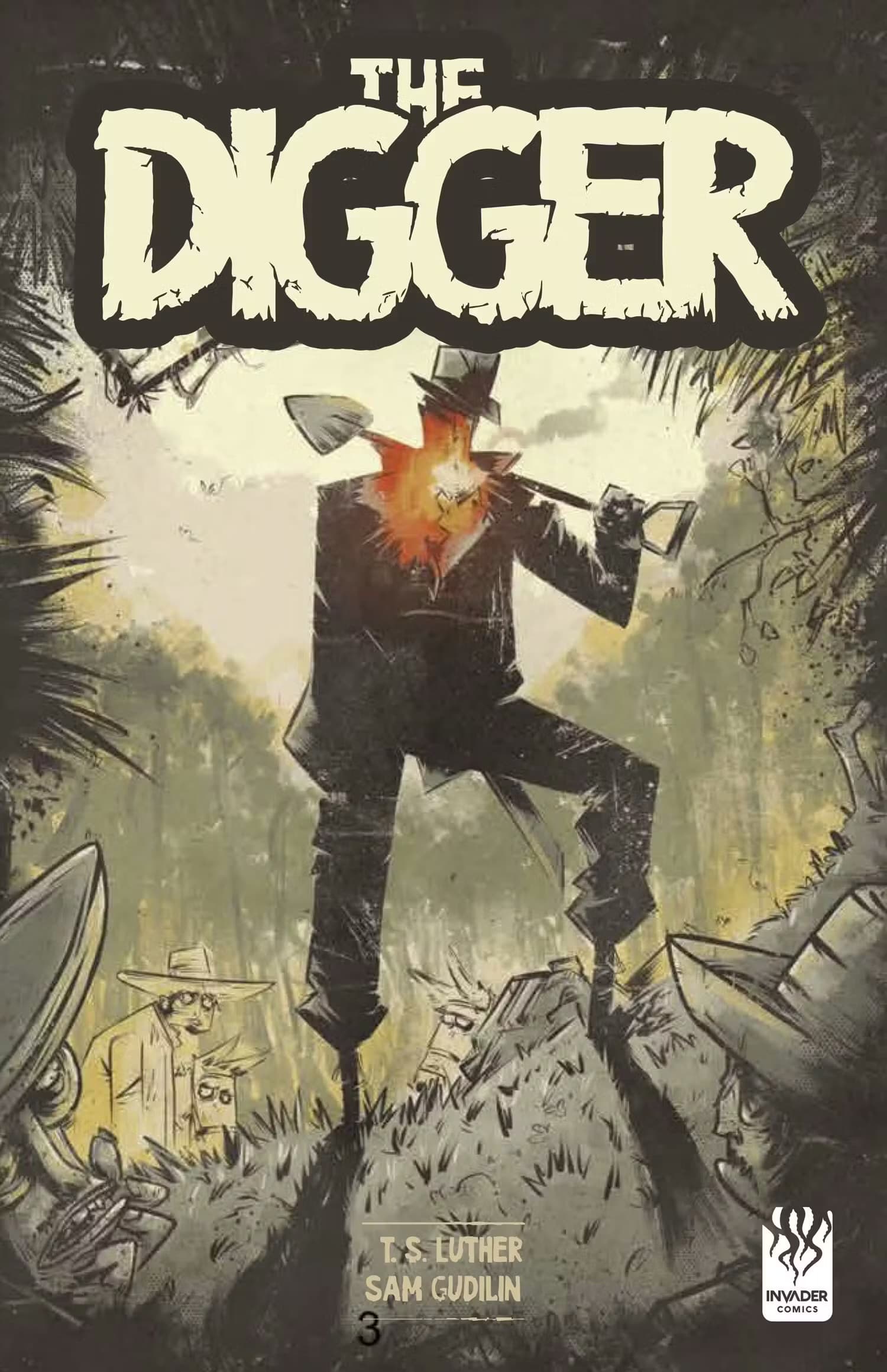
From the publisher
In 1930s Veracruz Mexico, along the Gulf Coast, lie Olmec ruins, all but hidden to anyone from the outside world. Locals make money guiding academics and scholars through the region. But there is one name that is spoken in hushed tones, one name guides stay away from, they call him “El Excavador”. But The Boy doesn’t listen to whispers, he hasn’t seen that no one returns from guiding The American in the hat. No, The Boy doesn’t know the man with the eyes of the devil. But, The Boy knows he needs money for his sick grandma, and The Boy knows The American has money, and The Boy KNOWS where the ruins are. What begins as guide and treasure hunter, turns into cat and mouse.
Artist: Sam Gudilin
Follow Comic Book Yeti
🔗 Comic Book Yeti LinkTree: https://linktr.ee/ComicBookYeti
For partnership and ad inquiries, please contact: thecomicsyeti@gmailcom
Follow your hosts
🔗 Jimmy Gaspero: https://bsky.app/profile/jimmygaspero.bsky.social
🔗 Byron O’Neal: https://bsky.app/profile/byrononeal.com
PATREON
We have a new Patreon, CryptidCreatorCornerpod. If you like what we do, please consider supporting us. We got two simple tiers, $1 and $3. Want to know more, you know what to do.
ARKENFORGE
Play TTRPG games? Make sure to check out our partner Arkenforge. Use the discount code YETI5 to get $5 off your order.
Make sure to check out our sponsor 2000AD.

[00:00:00] Your ears do not deceive you. You have just entered the Cryptid Creator Corner brought to you by your friends at Comic Book Yeti. So without further ado, let's get on to the interview. Do you love sci-fi? Are you a horror fan? Maybe you prefer action or fantasy? 2000AD has it all and should be on your radar. With a whole universe of characters from Judge Dredd, Astronium Dog to Rogue Trooper, Shakara Halo Jones and many more,
[00:00:28] every weekly issue you get five action-packed thrills from incredible creators such as Garth Ennis, Rob Williams, Alex DeCampi, Dan Abnett and so many others. Get a print subscription and it'll arrive to your door every week. And your first issue is free or subscribe digitally. Get free back issues and download DRM-free copies of every issue for just $9 a month.
[00:00:51] That's 128 pages of incredible comics every month for less than $10. That's like a whole graphic novel's worth. All subscribers get amazing offers like discount vouchers and exclusive product offers. Head to 2000AD.com and click on subscribe now. Or download the 2000AD app and why wait? Start reading today. I'll put links in the show notes for you. Hello and welcome to Comic Book Yeti's Cryptid Creator Corner. I am one of your hosts, Jimmy Gasparo, and I'm excited tonight.
[00:01:19] I have a first-time guest and they sent over the first three issues of their comic book, The Digger, and I loved it. I cannot wait to talk about it and tell you why. But please, welcome to the podcast, T.S. Luther. T.S., how are you doing tonight? I'm doing great. My name is T.S. and I rate comics. Thank you so much for having me on, dude. This is awesome. I get to be on the show that I listen to all the time. I'm a little bit starstruck, so I'll try to calm down a little bit.
[00:01:47] I haven't been drinking caffeine this entire time, so I should be able to keep it calm and even keeled. All right. Well, thank you. I appreciate that. I appreciate you listening to the podcast. That's very nice. I read the three issues you sent over. Thank you so much. It's always helpful to have something to actually take a look at and talk about. I mean, I can talk about stuff just seeing preview pages. It's fine. But you sent over three issues.
[00:02:13] And so I'll let you describe the comic and what The Digger is all about, and we'll get into that. I just want to say, though, I really appreciated the nods to Indiana Jones is in this blood. 1930s is when it's set and those type of pulp books that influenced Lucas and Spielberg when they made Indiana Jones, which I really like. But it has a darker edge to it. I don't think it's dark just for the sake of being dark.
[00:02:42] Like, it's not, hey, we're going to make an edgy Indiana Jones. Like, there's some real purpose behind it. The other real revelation to this was your collaborator, Sam Goodlin. This artwork is so kinetic, so shadowy without ever being murky. It just feels, especially in the first issue when we first meet the kid from when we first get that scene with the character. And it looks like he steals something from somebody else in the little town square.
[00:03:11] Like, it is off, and it feels like we are constantly moving, moving, moving. I just, I love Sam's artwork. And that marriage between your writing and his artwork. And I really want to kind of get into, like, some of the paneling in this. Like, how much was that in the script? How much of that was Sam? Because there were some really interesting things that were done with it. But, yeah, I was all over it today.
[00:03:36] I read the three issues after I prepared for an arbitration I had before the arbitration started, just to kind of, like, get into something different and, like, have a little bit of time to myself. Those three issues flew. So I want to talk about all that stuff. But why don't you tell listeners what, you know, The Digger is all about? For sure. I mean, first off, thank you so much for reading it. I know I sent it last minute. And the fact that you have a big boy job and you still found the time to read the comics,
[00:04:05] I really appreciate it in all the kind words. But to describe to the folks at home what The Digger is, it's basically what if Indiana Jones hunted Short Round? That's how I pitch it. That's how I pitched it to Sam. That's how I pitched it to Invader Comics. And that is the top-level pitch. But really, it's about this kid who's desperate for money because his grandmother's sick. Like, he's poor. He's been born in the 1930s, Veracruz, Mexico. There's not a lot of help for him because he's an orphaned kid. So it's just him and his grandma.
[00:04:35] And this American rolls into town with cash, and he needs to know where the ruins are. And the kid knows. And the kid doesn't know how dangerous this man really is. And he doesn't know that not a lot of people return from going off with the American in the hat. So that's the whole pitch for the story. And it goes from there. It's only four issues because no one will give me 50. So we made it, you know, a tight four issues so we could get in and out before they canceled the series because no one's ever heard of me. So it's a really easy read.
[00:05:05] Sam's art is the reason to pick up the book. I happen to write a good story, I think, in my opinion. But really, Sam is an incredible artist. He marries stuff like the old Addams Family serials and Genndy Tartakovsky from the 90s. If you're looking at, like, the Cartoon Network influence, his artwork is so unique. It's what spoke to me when I found him. I found his artwork on Behance years ago. And I was like, I need to work with this guy so bad.
[00:05:32] But, yeah, that's the main pitch for the book and how I sell it to everybody is what if Indiana Jones hunted short round. Well, great pitch. And, yeah, Sam's artwork is, I mean, it is so perfect for this. And it's really difficult, I think, to kind of do what Sam does. Because, as I said, it's very kinetic. It's very kind of sketchy and shadowy. But without ever feeling like it's too messy or murky or that you don't know what's going on.
[00:06:00] And because it's set in the 30s and it has these pulp influences, I'm very curious in terms of, like, some of the characters. If Sam based them on some real people. Because I think it's, I think it might be issue two in particular. There's a character who has a very, like, Peter Lorre, like, look and feel to him.
[00:06:20] And I was just, you know, it was almost like a bit of, like, when some of those stars from, like, the 30s and 40s would show up in, like, the, I guess, the Warner Brothers cartoons. But there were a couple of nods to, I thought, maybe some real actors. But, yeah, I really, really loved it. And it's so great to go into something. And it's one of the things I love about indie comics.
[00:06:47] It is great to go into something with no expectations, you know, whatsoever. You're just like, hey, this is an indie comic. Sometimes they're great. Sometimes they're just okay. Sometimes they can be bad. But, look, no matter what they are, a lot of work went into them. So I try and always just go in and, you know, with an open mind. I truly loved this story. That means so much, man. Thank you. I loved how it all played out. I loved the look of it.
[00:07:17] I loved the ending of it where we kind of get a little flash to, like, way back in time that kind of maybe gives us a little hint as to what these ruins are all about that the American is looking for. There was just so many fantastic moments in it. And I really love, like, the paddling choices. Like, there's some things where when the American is kind of enticing the kid, like, oh, maybe this kid can help me and I can because he tried to steal my wallet. I can give him some money.
[00:07:45] But, like, there's little, like, but, like, the boxes and the arrows to kind of, like, show you what is going on was really cool. There's a couple of pages where we see, like, a wide shot. And then at the bottom, it's, like, six or so little inset panel boxes that give us, like, a little glimpse of, like, all around to kind of really give us a feel for the life of, you know, the village or the jungle or wherever they are.
[00:08:11] Like, all of those little touches were just very different and interesting. There's a million different ways you can tell a story in comics. There's a million different things you can do with panels. And I just, I really love, you know, all of that. Was that you? Was that Sam? Like, how did that, like, the actual development in terms of the script writing play out? Well, I mean, like you were mentioning before, like, when we draw inspiration from actors and stuff is that on purpose, everything in the book is very intentional. Me and Sam did a lot of research.
[00:08:40] We do a lot of concept art stuff. There's a lot of designs, if you like, like, The Sorcerer, like that old movie. There's a lot of stuff in there that we use as inspiration because we wanted it to feel like an old pulp adventure. We wanted it to feel like one of those old books. So everything in there is very intentional and very collaborative. I might have written the script and Sam draws the pictures, but it's co-created by both of us. It's our book, and we work heavily together on all of it. But when it comes to paneling, I write full scripts, you know, panel to panel.
[00:09:11] This is what I want to see to happen. And then Sam interprets it as we go. We do some shifting, but a lot of that stuff is in the script from the get-go. Like that double-page spread that you're talking about, that was to invoke those Indiana Jones map sequences, right? As you see them travel across. And, you know, so I came to Sam, I was like, hey, do you know what I'm talking about? And he sends me back this quick sketch of the map, and he's like, but I want to see action at the bottom. So then I write up the action that goes at the bottom so we can see everything happening.
[00:09:41] And we made that a staple throughout the book. Every issue has one of those travel sequences because we found working together, hey, we really like those. Just like the chapter pages. That was the thing that we threw in there just for the first one because we didn't know how to start the story after the cold open. And then we found that we really liked doing that, so it was a process of learning how to write for Sam specifically, and then leading into it. By the time we got to issue four, it was so simple to do, I knew exactly what he would draw.
[00:10:09] I knew exactly what he was going to pop up, so when I put a panel in there, there was no changes because that's already what he was thinking about doing at that point. It's been a blast finding a collaborator like Sam because we work so well together and we understand what each other are going for. And we have all these same references, like I mentioned Sorcerer and Indiana Jones and all those old pulp adventures. We read, I don't know, 200 some old magazines that were just called like Pulp and Thief and Adventure.
[00:10:36] And it's like these pulp things that I had to get from a museum because they were so delicate and old and a lot of them aren't even in English. And so, yeah, to answer the actual question before I go off on too many diatribes, it was all very intentional. It was in the script and we worked very closely together for all four issues for it. I mean, it really has that, you know, that pulp feel.
[00:10:56] And it's very interesting to read something like this now, you know, growing up and watching Indiana Jones and realizing that, you know, as I'm older and thinking about that story and, you know, Indiana Jones in particular was, you know, in the 80s trying to capture that. There's 30 pulp books that I never really experienced, but that the makers of it did.
[00:11:21] And now we have, you know, in a place where you probably grew up watching and liking Indiana Jones, probably just like me, never really experienced like pulp novels, you know, at an early age. But now kind of running that story through all the other things that you've been influenced by and now kind of cranking out something that evokes it a little bit.
[00:11:46] You know, you've done your research. So it also evokes the the original and you've created something that that I don't think it has nods to it. But it doesn't feel like it's something that's just like derivative, like, hey, we're doing this Indiana Jones type of thing just for the sake of of doing it. Right. It's not just evil Indiana Jones, right? Right. Right. I mean, you really either there's a lot of gray here in terms of what is really going on.
[00:12:13] You put some additional stakes to it because you've kind of centered it not on the indie like character, not on the American, but it really it's centered on on the kid. And I feel like that was such a smart choice in terms of the storytelling of it, which kind of adds a whole other other layer to this to this really whole new thing. Yeah. So I really appreciated that. I mean, I love stories with kids in it.
[00:12:39] You know, I grew up with the kids on bike genre, obviously huge in the 80s and 90s. So that's always something I'm going to gravitate towards. I'm a father, so I like the idea of being able to relate to these kids and put a little piece of my children into that story. But also I grew up as a kid without a good male role model. And like, how bad do you want to impress this guy that could change your life, even if it's at a you know, it's a big mistake, even if it's at a detriment to yourself, because you don't know better as a kid and you don't always think through those decisions.
[00:13:08] And then you channel that through an indie lens. You know, we never find out exactly how short round meets indie. And so this is a version of that type of story is like, how do these two get mixed up with each other? Like, how does that actually work? And then you just you just kind of tighten the lens just a little bit on reality. Well, they did actually meet, you know, white academia, steal stuff. That's what it means to belong in a museum. It's not going in a museum in Mexico, that's for sure.
[00:13:34] So you hide the vegetables in with the ice cream a little bit and you touch on the nostalgia without it being member berries the whole time. Because you want to invoke those things. You want to use that imagery that people recognize. But they've already seen Indiana Jones. If you want a good Indiana Jones comic, Marvel's going to put one out. You can get that elsewhere. I'm an indie creator. Like we talked about, sometimes you pick up an indie book and you expect amateur. Well, I want to surprise you when you pick up a book that says T.S. Luther. I don't want it to feel amateurish.
[00:14:04] You just haven't heard of me yet. So I pride myself in going, OK, how can I tell them a story that they're not going to get anywhere else? That's my main goal. So you're not going to get an Indiana Jones story like this. And I wouldn't tell an Indiana Jones story like this because I love Indiana Jones. And I don't want to ruin that memory of him for you. I don't want to ruin your childhood. Let Indiana Jones be this folk hero, even though he also steals stuff and puts it in a white museum. But the digger isn't Indiana Jones. He's legally distinct, as the publisher says.
[00:14:34] So he can be a little bit more grimy. He can do what needs to be done and he can take the treasure and not have to share it. And we can think about that and make that the dissection that you see in the book without going, isn't Indiana Jones swell? This is great. This kid is probably not in danger at all. I say Indiana Jones because, you know, that it has that feel. But like the American, the American is 100 percent in his off days, not a professor at any accredited institution.
[00:15:03] Yeah, like not. You only play him with children. That's definitely true. Definitely not. In terms of your, you know, writing indie comics, what is it like when you have something like, you know, a story like this and working with Sam? Like, what is the experience like either like pitching this or getting a publisher interested in it?
[00:15:23] Like, because this is kind of, you know, I talked to a ton of indie creators and it's a weird time because in the past five years with the pandemic, pencils down for a lot of folks and the industry upheaval with the pandemic. And then with Diamond declaring bankruptcy and you have like a lot of indie publishers having some issues and also declaring bankruptcy or going away. But then you also have like crowdfunding.
[00:15:51] And to a certain extent, there's no better time that you can, if you have the money, make your own comic or try and crowdfund your own comic. So, like, what has that experience been like for you for, as you said earlier, just someone who wants to tell your little stories? I don't mean to be demeaning. Those are the words you use, I think. So, but what has that been like for you right now?
[00:16:13] I mean, it's a roller coaster because when I decided to get into comics, I knew going in that nobody needs my stories and nobody wants my stories. And that's not because I don't have good stories to tell. We're in a very saturated market. Luckily, and it's not perfect, but it is much better than it used to be for a professional comic book writer. They don't chew them up and spit them out the same way that they used to. And that's a good thing if you like really good stories. The fact that I can still pick up a Matt Fraction book right now is something that would not have happened in the 70s or 80s.
[00:16:43] So I love that there isn't as much need for new talent. I think that that's good for storytelling and those people's job opportunities keep opening up. But Mad Cave Studios doesn't need to find an unknown person when they can hire people who are working right now in comic books who are looking for a job. Right. So that means an up and comer like T.S. Luther is not exactly a commodity.
[00:17:06] And the same thing could be said even in indie comics, because a lot of people can't afford to hire somebody to be the other half of a duo. If you write comics, you can't always afford an artist. If you're an artist, you can't always afford to be a writer. And so most people will just do both themselves whether or not they want to. So it was tough for me to try to find collaborators and get in. And what if Indiana Jones Hunted Short Round is the embodiment of that for me? Because I pitched Sam. I said, I like your artwork.
[00:17:36] Have you seen my stuff? He had seen a few of my indie books. He liked them. He said I could pitch him. And I pitched him 12 stories. And he basically came back with Eastern European grit saying, I don't like these. These are bad. And so I thought I had to hang up my hat. I was not going to work with Sam. And he said, no, no, pitch me again. And I remembered what Kirkman said back in the day on a different podcast because I'm obsessed with comic podcasts. And he said that if you want to work with an artist, you should just write what they want to draw.
[00:18:04] And that's how I get people to say yes to me. And so I took that and ran with it. I said, Sam, what do you want to draw? And he said, I want something pulpy. I want something Mesoamerican. And I eventually started saying really specific things. Like, I want to draw people in hats. And I want it to be like the pulp fibers and super sketchy. And he's sending me all these notes. And I'm writing them down. And I said, I have the story for you, which was a lie. I didn't. I made that up. But I went home.
[00:18:31] And I wrote three pitches. And one of those was just one sentence. What if Indiana Jones hunted short round? And partly because that encompasses everything that he was talking about. And partly because I know working backwards, that's a sentence I can say to a customer to get them to buy the book. That's a sentence I can say to a publisher to make them go, ah, maybe this kid has something. And that's a sentence that they can then pitch to whatever producer they sell their scripts to.
[00:18:58] Because that's how the publishers make money is by getting options for movies. And that's a really simple one sentence pitch. And then I had to write a story based on that. So it was all working backwards from that one sentence. And that's been my whole career in comics is just trying to convince people to give me a shot. Because they don't need me. They don't want me. And that's not an indictment of them. And that's not anything to say about my character or my skills. There's just a lot of stuff out there. There's a lot of comic books. There's a lot of comic book creators.
[00:19:26] And they don't need new blood. So I have to do everything I can to break in that way. Because I do want to work with bigger publishers. I do want to exist in mainstream comics. So mostly it's just been a fight. I get a lot of no's. And even more, I get a lot of silence from other podcasts, from creators and collaborators, from publishers. It's just been getting used to the silence. Working in a vacuum. Making stuff. And throwing it out there. And not being offended when nobody is interested.
[00:19:56] That's most of working in indie comics right now. If you can do that, if you can exist in that vacuum, you can eventually make it. And what is it when working in that silence or that vacuum? What is it for you that keeps you going? You have these stories you know you want to tell? I mean, I want to tell stories, period. That's always been the thing. So I have a production company. It's called Can't Be Killed. And it's called Can't Be Killed because when I decided to do this, I told myself I was going to do it no matter what it takes.
[00:20:25] Even if I never make it, I'm never going to give up on it. I can't be killed. I'm going to do this no matter what. Even if I'm losing the entire time. I can't fail unless I quit. So that's what keeps me going. I have two little ones here at home and an amazing wife who supports all of this. And for a long time, that's all I ever wanted for my life. When I met my wife, I was living in a van, living down by a river, literally. And all I wanted to do was play Magic the Gathering and eat chicken wings. And living in a van facilitated that.
[00:20:54] But then I met a pretty girl at college, and I didn't want her to have to live in a van. She wanted to eat other things other than chicken wings, and she didn't play Magic the Gathering. So I went and got a big boy job. And then we had kids, and I didn't want them to ever have to live in a van. I was so deathly afraid of ever having that life for them. So I made sure to get an even bigger boy job and do that so they never had to. So I never did anything for myself because I didn't want that. I wanted a family, and I got it. And when COVID hit, I wrote a small anthology because I was bored.
[00:21:24] There was nothing to do. I was getting paid to write about car parts, but there was no car parts to write about. And all the automotive companies were basically shut down. So I was just sitting there. And so I wrote an anthology and got it made, published it myself. Nobody read it. But it was really scary because I realized for the first time that I wanted something for myself. I wanted to be a comic book writer. And I knew that everything that I did from that point on had to be working towards that goal.
[00:21:53] So that's what keeps me going in the vacuum is I'm not going to give up. I eventually I have to pay for those kids again. They eat every day, and they keep growing into new sizes of shoes. So I got to keep selling books, man. So that's the perfect sell right there to buy T.S. Luther comics. His kids depend on it. They don't need to buy the books. I mean, that's a great slogan, you know, at a convention. Have that on the banner. Buy T.S. Luther's books. His kids need to eat. It's true, man.
[00:22:22] But that's what keeps me going. I couldn't have done this in my 20s, the thing. I didn't want it bad enough. And being in my 30s, there's a ticking clock, right? There's I can't afford health care. I'm a poor dude. I eat way too many chicken wings still. So there's a little bit of like, I do all this hustle. I put out all these books. I pitch all this stuff. The vacuum doesn't scare me because it can't hurt me, right? There's no criticism that can bother me because I'm going to keep doing it anyways.
[00:22:48] Hopefully, I keep getting better, and I'm getting more yeses so it's working. But yeah, the vacuum can't hurt me because I am going to do this no matter what happens. So I'm just going to keep throwing stuff out there until something sticks. Awesome. Let's talk about some of your other books then because I want to talk about some of the other things that you've done. And just listeners know that I will put links in the show notes so they can check out your website. They can follow you on social media.
[00:23:15] If I didn't say it, The Digger No. 1 will be out January 14th. That's correct. So let's talk about some of the other books and some of the other things you've done. I just pulled up your website here on Can't Be Killed, Creations, some of the other things on here, Tokyo Fire, Hellion, and Bash. So why don't you tell me about some of the other books that you've written so that listeners, if they like The Digger, that they can go check out. Yeah.
[00:23:42] So a little after COVID, I started pitching all of these books because I thought that's how you break in, right? You make a pitch packet, five or six, seven pages, and you pitch them to publishers. And they say yes. And then you're hired and you work at Boom. And then you do a series at Marvel. And then you go back and you do a book at Image. And they make a movie about it. That's what I thought would happen. And it turns out that's not at all what happens. You do all that stuff and you burn through your life savings. And then they go, no, you're supposed to self-publish a book.
[00:24:11] So you desperately have to come up with a way to self-publish a book even though now you're broke and you no longer work at those automotive companies because you stupidly quit your automotive job to write comic books, which I tell you kids at home, don't do that. That's a bad idea. There's no money here. So I took one of those pitches. It was a seven-page pitch called Tokyo Fire. It's basically cyberpunk Scott Pilgrim. A bunch of kids see something that they shouldn't see. They're living on the streets.
[00:24:38] They're just trying to steal kind of a high-priced hover bike to make ends meet and maybe get out of this irradiated slum that they're living in. Very Akira-like. And they steal the wrong bike. They see something they shouldn't have seen. And they get roped in between a revolution basically between pyrokinetic madmen, super-powered cops, super-powered criminals. The city's going to burn down and they're just there, two goobers trying to steal stuff.
[00:25:03] And the co-creator on that book, Sky Hawkins, an amazing artist and writer herself, she agreed on consignment. She'd start working on the full issue if I could kickstart it, if I could do something with crowdfunding. So she gets paid eventually. And so we did that. We went to Zoop because Zoop offered to teach me how to kickstart a book basically. And we raised a little over $3,000. I gave that all to Sky. I said, go with God. Please draw this book. And that's Tokyo Fire, issue one.
[00:25:32] And it sold well enough for us to make a few other books. And now Tokyo Fire is being published by my buddy's publishing company, Professional Entropy. Full disclosure, I own a piece of that company because I gave him all my books. And he said, I guess you own some of this now. And Volume 1 is coming out this year, next year, 2026. We're doing issues one through four, finally. We're still working on distribution. We were talking about that a little bit offline. So hopefully you'll see it in stores.
[00:25:59] If The Digger sells well, you'll see my name all over the place. If it doesn't, remember my kids, the van. Buy some of my books. Throw me some coffee at some point. Hellion and Bash is a little bit more of a passion project. It's a superhero story. It's basically, what if Batman was abusing Robin? And all the superheroes turn a blind eye because Batman is scary. And he saves the world from people like Darkseid. Who's going to save it if we turn in Batman for being a bad dad? So the supervillains step up, save the kid.
[00:26:28] And they all go on the run from the superhero community. That's Hellion and Bash. And I wrote that. That was the first thing that I had ever written, technically. Because I read The Victories from Michael Oming, a hero of mine. And I saw what you could do with a superhero story. Saw that you didn't need to build an entire universe with a thousand issues. You could just tell the stories that mattered and that were heavy. But not just overly mature and just gore and violence. But just an adult story with superheroes. So I wrote that story.
[00:26:56] And eventually, because Tokyo Fire sold well enough, I was able to team with an artist and get that made. That one didn't sell as well because it's hard to sell indie superhero comics. There's a lot of them. I don't know if you've ever heard of them. But there's quite a few out there. So we only did two issues of that. That's also at Professional Entropy. You might see in issue three at some point in the future. But I'd self-publish those. And then they went to a publisher. I do a lot of work for other indie comics. A lot of for hire stuff.
[00:27:22] I do freelance work for Mr. Fish Comics, which is an indie legend. He does about 200 books a year because he's a madman. I write his series Alice Lost in Wonderland, which is an adult Alice getting lost in Wonderland. She stays there so long she becomes a Deadpool-esque bounty hunter. And it's really funny and madcap and very Kickstarter-y. If you know indie comics on Kickstarter, they're lewd and blue quite often. So, yeah, I write lots of indie stuff for a lot of people.
[00:27:51] And a lot of stuff that you'll never see because I'll get hired to write a script. And indie comics are hard and expensive. And sometimes they don't ever come to fruition. So I'm doing my best to exist in those trenches right now. Yeah, I mean, it is tough. I, you know, 100% agree with you. It absolutely is. Yeah, I really like Tokyo Fire. And, I mean, Hellion and Bash. I mean, looking at your website and looking at some of the preview art that's out there. I mean, that's the thing. Like, there's so many comics out there.
[00:28:20] But it's amazing the stuff that you can still discover. And it just looks great. Indie comics, you know, It doesn't mean amateur. I know that some people do think that, unfortunately. But, yeah, there's so many amazing indie comics. Yeah, like sometimes it does mean that. Because everyone's comic is their, everybody has their first comic, right? The first one they worked on, they drew themselves with a green crayon in their bedroom and stuck it up on Webtoon. That is a rite of passage for indie comics. I mentioned that anthology I worked on.
[00:28:50] It's not the best book I've ever written. And I don't know who needs to hear that. But you'll have to start somewhere. And so it does get put in that same bucket. And I'm okay with that. I'm never offended when people see indie comics and we're all lumped together. But it does run the gamut. And I try for mine. I love when people are surprised when they pick up one of my books. I get a lot of messages that goes, actually, it was really good. And they always start with actually. And it used to offend me. But now I wear it like a badge of honor.
[00:29:20] I'm like, you expected this to be terrible. And now you believe it's worth whatever you paid for it, you know? And that's special to me. And that's the thing that I think I can bring to the table when I pitch to publishers. I've been, because The Digger has sold well enough in pre-orders, the publisher in Vader Comics is very happy. But I'm getting really interesting messages from stores that had a lot of pre-orders for it. And they all come back with the same sentiment, basically, is who the hell are you? I've never heard of you. We've never seen a T.S.
[00:29:50] Luther book on ourselves before. We've only ever sold one or two other Invader books. Why did 50 people come in and pre-order your book from our store? And that's really cool. I love that they're surprised by it and then happy once they read it themselves. Because I always send them a copy because I go, this is who I am on T.S. And I write comics. Check it out. And I like that it can be surprising. I rue the day that they're like, yeah, it was fine. I do worry about that. And I know it'll happen eventually. But for now, I'm happy with the surprise.
[00:30:19] The low expectations I will use to my advantage. Yeah, the surprise. The surprise, actually, it was good, is much better than it was. It was fine. I agree. I agree with that. All right, everybody. We're going to take a quick break. We'll be right back. Y'all, Jimmy, the Chaos Goblin strikes again. I should have known better than to mention I was working on my DC Universe meets Ravenloft hybrid D&D campaign on social media. My bad. He goes and tags a bunch of comics creators we know.
[00:30:49] And now I have to get it in gear and whip this campaign into shape so we can start playing. Another friend chimes in. Are you going to make maps? It's fair to say it's been a while since I put something together. So I guess? Question mark? It was then that I discovered Arkenforge. If you don't know who Arkenforge is, they have everything you need to make your TTRPG more fun and immersive.
[00:31:11] Allowing you to build, play, and export animated maps, including in-person Fog of War capability that lets your players interact with maps as the adventure unfolds while you, the DM, get the full picture. Now I'm set to easily build high-res animated maps, saving myself precious time and significantly adding nuance to our campaign. That's a win every day in my book. Check them out at arkenforge.com and use the discount code YETI5 to get $5 off. I'll drop a link in the show notes for you.
[00:31:41] And big thanks to Arkenforge for partnering with our show. I think I'm going to make Jimmy play a goblin warlock just to get even. Welcome back. Since you mentioned chicken wings, I haven't been able right now because it's late at night to stop thinking about chicken wings. Chicken wings are one of my favorite things too. Let's just take a quick chicken wing break. What's your favorite chicken wing? What's your go-to place? That is tough because I'm always on the lookout for like a good wing place.
[00:32:10] I'm in North Wilmington in Delaware and I'm always kind of looking for like a great wing place. And it just really, it just depends. There's a place right around the corner from me that's just like a, you know, a pizza place, sandwich joint. And they make really good wings. They have a couple of different sauces that they put on them and they're fine. They're okay.
[00:32:33] My favorite chicken wings actually are a buddy of mine who I used to work with at a different firm. Made his, had like a smoker and made his own smoked chicken wings. They were the best wings I have ever had in my life. They were like a top three wing. And I'll, you know, unless I don't work at that firm anymore. So I don't know if I'll ever have them. And they were the best. You're going to go head to head. He's going to be opposing counsel.
[00:33:03] And you're going to be like, listen, listen, those wings though. Right? Like no matter how this shakes out, let's talk. Let's talk wings after this. If I win, if I win this case, you pay my client X and you give me chicken wings. X is the amount of money where Y is chicken wings. Yes. I'm from Michigan. So, you know, wings are in our blood. Okay. I'm more of a fan of like a dry rub type of wing. I'm not, I don't, I don't like them heavily sauced. How about you?
[00:33:32] See, that's again, the Michigan, they'll cover it in sauce. I need a slather. Okay. And I have to my roommate, but you know, my brother-in-law, I love him dearly. He also smokes chicken wings and they're the best chicken wings on the planet, but it's bone on. Sometimes I'm a trash monster and I just need the most like McDonald's version of wings. And for that, I go to pizza hut wings. When I was living in the van, I was getting pizza hut wings at the time. I think it's like they had wing street and they incorporated it or whatever.
[00:34:01] And I would buy 50 of them and go play magic together and eat 50 chicken wings every week. And so that's my go-to is these crappy pizza hut chicken wings that let me, you could basically microwave them and get the same consistency, but that's what I need in my life. Sometimes as a monster who writes comic books for a living, sometimes you just need the worst possible food in a pile next to you. And what better to facilitate that than pizza hut chicken wings? I didn't even know pizza hut had chicken wings. Are they boneless? Like, are they boneless wings?
[00:34:31] They do bone in and boneless, but they're boneless is what you want. You want the like, is this for sure chicken meat? I'm not sure it's, but it's been deep fried and then smothered in sauce. So maybe you wouldn't like them because of all the sauce, but that's, I, you know what? I'm going to leave this interview. I'm going to go get 50 of them. It's frozen outside. Everything is sheer ice and I'm going to make the 30 minute drive because I live in the middle of nowhere, Michigan. I'm going to go get some wings. So thank you for this. Or how dare you? I don't know. It depends on how well my heart does afterwards. Yeah.
[00:34:58] I, I have not really eaten at wing stop a lot. Um, I've actually, I've only ever had wing stop once. Um, my brother, my brother, Bobby, uh, cryptid creator corners, number one, most dedicated fan. Bobby listens to all my episodes. Hey, Bob, how you doing? My brother and I had to, we flew down to Florida. This was maybe two years ago. We flew down to Florida on a Thursday night had to, and my, my mom's older brother had passed away. He was cremated.
[00:35:28] So we flew down on a Thursday night, picked up his ashes in Florida and we had to drive them back so that my brother could go to work in Wilmington on Saturday afternoon. Day trip. And yeah, basically it was less than 48 hours. So we flew down on Thursday night. We stayed at a cousin's house who lives in Florida. We drove to the place Friday morning, picked up the ashes, and then we're driving to stay
[00:35:55] at another buddy of mine's in North Carolina, uh, before we completed our trip. But as, uh, we hit North Florida in the afternoon and my brother wanted to stop at a wing stop and we were in, I think Jacksonville, Florida at, uh, at a wing stop. And he's like, I'll be real quick. An hour later, he comes out with just a bag of wings with a bunch of sauces.
[00:36:24] I left him in there because my brother asked too many questions like, uh, your golden sauce. How spicy is it? I'm like, Bob, I'm, I can't be here for this. Just there are wings and sauce. Let's what are you doing? It's called wing stop. It's not complicated, Bob. All right. There's only going to be so many sauces. It's a wing. I mean, well, you didn't do it. This isn't a delicatessen. You know what I mean? Like this is, it's in the name. You know what you're going to get.
[00:36:53] Uh, so he got in the car, he got in the car, he apologized. And then as we continued to drive to North Carolina, we ate a bunch of messy wings in the car. I mean, that's beautiful. That's what I go to wing stop for is a sheer volume because their wings are huge and you can get a lot of them. So when me and my friends need to eat way too many chicken wings, uh, that's what we do is we'll hit up wing stop because I'm the only person I think on at least in this state, there
[00:37:22] might be a few others that appreciate pizza hut wings. Everybody looks at me like I'm a monster, but I grew up in Northern Michigan where to put it in comic books, to bring it all back around. There was no comic books. The only thing you could get was Archie comics because that was available at the drug store. You know, you get the double digest. So there definitely wasn't wings. You know what I mean? There was, there was nothing. A pizza hut opened 30 minutes away and about a decade later after it opened, then they got wings.
[00:37:51] And that was the one place you could go to for chicken wings that were somewhat serviceable and to a dude living in a van who, you know, reading Archie comics, pizza hut wings are still this like golden memory for me. So I will shit on them because, you know, I understand the quality. I've seen better movies, but I still love, uh, you know, face off. That's, that's always been my thing. Like I will, I will appreciate the really fancy stuff, but sometimes you need trash. Yeah.
[00:38:19] Face off is a masterpiece by the way. Thank you. Okay. So I knew that you were cool. So you get it. If you do, if you do listen to non-comic interview podcast, the, and to shout out another podcast, the, how did this get made? Love how to do podcast. On face off is one of my favorite episodes that they ever did. I asked them to advertise for me because of that episode. And they said, no, we don't want to advertise this other show that you're on.
[00:38:49] What are you talking about? And I was like, oh, we mostly talk about chicken wings. And they said, no, uh, this is not going to happen. But, uh, but they didn't respond to the email, which was cool. Oh, that was nice. Um, what else I want to ask you before, you know, we, you know, to dive back into not just your and my, uh, shared interest in chicken wings, but some of the other things that, you know, have, have influenced you. You mentioned, you know, magic, the gathering.
[00:39:16] Um, and obviously, you know, from some of the influences that I see in the digger and some of your other, your comics, I kind of get a sense of some of the, maybe some of the movies or things that have influenced you. But I'm just curious, like, what are some of your other influences? And in terms of magic, the gathering, like me and my friend, my friend, shout out to my friend, uh, Dan, who is our DM and owns more board games than probably any adult male should.
[00:39:42] Um, we play it, we have a game night, we play a ton of games and we, we go to PAX unplugged every year. So what, what kind of is, is your, uh, like TTRPG branched out beyond magic and what kind of other things are you into? I mean, I, I love everything nerdy, like nerdom is my home. So, and I, I dip my toes into everything because I'm kind of, uh, uh, addicted to stories. So if it can tell a story, I'm interested. I love board games for the strategy. I played magic, the gathering for a long time.
[00:40:11] I love all TCGs, Digimon, Pokemon, Gundam, uh, anything I can get my hands on. I love all of them. Uh, but when it comes to board games, I appreciate all of them. Um, I play a lot of Dungeons and Dragons and other TTRPGs. Call it Cthulhu. GURPS is a big one for me, which is like the nerdiest thing that you can do. GURPS has a rule for everything possible. It's the generic universal role-playing system. Um, it's the nerdiest thing that you've never heard of. Go look it up.
[00:40:40] And it's, it's so crazy, but I, I play a lot of those to the point where professional entropy, the, the publisher that I work with for Hellion and Bash and Tokyo Fire, it's owned by a guy that works at or plays at my table. And all of the stories that we publish over there are based on games that we played. Hellion and Bash was a D&D game before. Uh, so was Tokyo Fire, uh, like all of the books that we publish over there. So TTRPGs are a huge thing for me.
[00:41:06] Before I got on this call, I was arguing with my buddy, John, shout out to John, um, about, uh, when are we going to play soon? He's like, we haven't played in several weeks because I was the forever GM. That was my outlet for telling stories. And when I started to get work in comic books, I had to pull away from running a game every single week or sometimes two games per week. And a lot of my creative juices went to telling stories in comic books. So they're always a little bit salty just slightly because I can GM a lot less for them
[00:41:34] because, you know, I got to sell those stories. I get it. There was a Tik TOK I saw. I can't remember the name of the creator, but it was about D&D. And they said the biggest D&D villain is scheduling. Oh man, it's, it's so true. Like a bunch of adults in the joke always was because like, I was this boring dude who worked at automotive companies. I was in meetings to schedule more meetings with a CEO who's really concerned about our numbers of meetings. And so like, I would just sit there all day and I bored him and write, you know, new
[00:42:03] D&D stories or new games. And once I started working in comic books, those ideas went into the comics. And I, now I am also an adult who has jobs. Once I started to get a little bit successful in comics, I, you know, I'm busy now too. Cause before it was like, ah, TS doesn't have a real job. He writes comics. He's just at home. It's fine. But now I have things I'm on podcasts. I'm, I'm, you know, doing these marketing tours for books and I have signings coming up in January. And they're like, what do you mean? You're not just going to be at home for us to roll a dice.
[00:42:33] Where are you traveling to? You don't leave your house. And I'm like, no, no, no. People are buying the book. I have to leave now. And now I'm like a unicorn. They never see me, you know, once in a while they'll try to catch me and it's more of like a quest for them now. You have a, a very on the, on the, on the right now talking you, you can tell you're a good storyteller. Not just from, not just from the three issues of the digger I've read, but just talking to you right now.
[00:43:02] Look, I've interviewed, I've done over 200 some episodes of here. I can tell you're a fast talker, but you have, you know exactly what you want to say. You can tell you're a good storyteller. You're, you're also, you have somewhat of a self-deprecating sense of humor and very funny. I'm curious, what are some of your humor influences?
[00:43:23] Like what is the stuff that really has molded TS into the person sitting before me? I mean, I watched a lot of Eddie Murphy growing up when I shouldn't have like way, way too early. Like I had, I had, right. Right. Like I had like raw on VHS. I'm like, I shouldn't have been watching that. But then like the other one was Rick Moranis and you know, you know, second city and SNL and a lot of those, uh, in because they were okay with themselves.
[00:43:53] Like Rick Moranis is a goofy dude. He's tiny and he didn't care. He could walk into a room with confidence and do all the improv, but he could also crap on himself because he didn't care about what other people thought. I have an amazingly hot wife at home who loves me. Who's nerdy, who loves that. I write comics. She reads just as many comics as I do. So, uh, you know, back to the, the criticism and working in the vacuum, as long as she likes me, I can crap on myself all day.
[00:44:21] So I can lean into those comedy, you know, tropes of being self deprecating because I know that her opinion is the only one that matters. So, you know, growing up with Rick Moranis and people like that, I'm like, ah, I can crap on myself. It's a good time. It makes people laugh, but also it's a little bit of, of, of a truthful thing. And I'm okay with that part of myself and telling stories. It's easy to get people to laugh at yourself, but also it's so, you know, that I'm not too serious that you can take a jab at me and it's not going to hurt.
[00:44:49] You can joke around and have fun too. Like I might not make fun of you, but I might make fun of Bob for his choices at that restaurant. You know what I mean? Like, yeah, we should, he's going to be so mad when he hears this episode. And I'm going to, I'm going to be like, that's what he gets. But that's what he gets up at Wingstop. That's what you get. No, that's great. I love that you said Rick Moranis. Like, I don't think anytime I've ever asked that question, which every once in a while when I feel like I have somebody who has a really good sense of humor and I'm always kind of
[00:45:19] curious, but I don't think I've ever heard anybody say Rick Moranis, which is great. Cause I, I, I mean, I like idolize like Rick Moranis, whether or not it was Spaceballs or Honey, I Shrunk the Kids. Strange Brew was one of my favorite movies. And it was one of those movies that it felt like me and maybe two or three of my friends knew about and nobody else did. It's so good. I have the DVD right, right over here in the basement, but I just felt like it came out on DVD.
[00:45:48] I had like a pirated copy from Canada that had French, you know, subtitles on the bottom. Like that's so wild, but no, I grew up on that. My parents were a little bit older for my generation. Like my mom had me when she was like 35. So, you know, she grew up in the seventies. So SNL was huge in my house and she showed me all those stuff probably a little too early. Little Shop of Horrors is like my favorite movie of all time. So Rick Moranis was always going to be big. And then Bill Murray, you know, Ghostbusters, all of that stuff. It's always going to be an influence.
[00:46:17] And hopefully it comes across sometimes in my writing. The Digger obviously is a very serious book. There isn't a ton of levity in there, but a lot of the stuff I write is at least a little bit comedic because that's what I grew up on. Yeah, it is interesting. Like, you know, cause the Digger is darker, but I mean, it's just, sometimes I have a sense that folks, you know, I don't want to criticize anybody's media literacy, but I feel like people, maybe it's the internet. Maybe it's just, I don't know.
[00:46:46] I don't want to draw any conclusions, but every one in a while you'll read a conversation or you'll hear a conversation where someone is attributing the things that happen in a book to the author as if every, you know, as if everything they're putting out in the book is like, they're, they're stamping it with their seal of approval. And it's like, that's not how stories always work. And just because you tell a serious story or a dramatic story or whatever it might be,
[00:47:14] doesn't, doesn't mean that that is your whole, you know, personality or your whole shtick or, or, you know, whatever it is. I mean, cause I think this has been a wonderful, fun, live conversation. And that's not what the Digger is at all, but you have this passion for storytelling and you have really, along with Sam, the two of you have created, you know, something like fantastic. And it's not that that's your whole personality.
[00:47:43] You have a lot of other, you know, facets to you and it's just fun kind of figuring out what they are. And I mean, cause I would love to see like what you would do with a book that's more, you know, comedic. But right now we have the Digger coming out with Invader Comics, January 14th. And I encourage everybody to check it out. I think what TS has written is wonderful. Sam's art is fantastic. And I, I hadn't heard of Sam before.
[00:48:11] I don't think, but I mean, this was stopped me like in my tracks when I was reading it. I just thought it, it just a really great collaboration between the two of you. Thank you, man. I appreciate it. And we had a blast writing it. I hope everyone sees that when it comes out. I know, uh, you know, I make a lot of jokes here, but we took the book very seriously. And this is our big break book. If you want to support a smaller, you know, creator jokes aside, go and talk to your comic book shop about it.
[00:48:40] Even if you don't want to pre-order it, that's okay. Mentioning us, it gets the buzz out there. A lot of shops haven't heard of us. So in a lot of shops haven't heard of Invader Comics. And just talking about it at your local shop, mentioning it's something that you're interested in. And if you do pick it up January 14th, let people know how you liked it because it does go a long way. Because again, if you don't buy this book, my kids don't eat. I don't get to go work for Marvel someday and I'm going to go back to living in a van. So if you don't want that to happen, go and pick up The Digger on January 14th.
[00:49:09] It's a good time and pick it up before I get sued by Disney. Yeah, I'll have links to the show notes. But as TS just said, and I've mentioned it a million times on this podcast, if you like indie comics, if you like one of these interviews, and if you like the person who I'm interviewing, whether or not it's a writer or an artist, if you want to support them, the best thing to do is to pre-order it though at your local shop.
[00:49:35] To give issue number one a chance, let your local shop know because that drives like how many, not to get too in the weeds, but how many comics are ordered, tells the publisher whether or not they're going to be able to go on and make more. So it's so helpful to order it, you know, through your local shop. If you have a pull list, tell them that you want it there or, you know, go in and ask for it. It's the best thing to do.
[00:50:03] But I'll have links to the show notes so you can check out TS's stuff. You can follow him on social media and you can, I'll put a link for Invader comic stuff as well. So you can check out some of their other books. Please do. They have some amazing books. They're, they're awesome. And I mark my words, me aside, even if you don't pick up the digger invader is going to be where mad cave was a few years ago. You know, mad cave is blown up and you see people it's breaking into the mainstream in a way that people hadn't heard of.
[00:50:30] That's going to be invader because they are growing immensely and they've done really well since switching to lunar from diamond. Like they're going places. They're going to leave me behind, but on their way, they're going to get to some really awesome places. So don't sleep on them. Check out invader comics. Well, I think they'd be silly if they left you behind because I think they have something really special with, with the digger. I, I, I truly, I really do. Well, you know, like you're only doing four issues right now, but if it sells well, you
[00:50:57] know, you know, the, the digger returns, the digger takes Manhattan, the digger in space, you know, uh, invader. If you're listening, I know I only sold you four issues, but if we sell those movie rights, we can keep it going. Uh, you know, there's tons of places that you can dig. You can even dig in outer space. So just hear me out. I have pitches for days. The digger to diggers, two shovels. He's got two shovels this time. He's got two shovels. He's got two shovels. Listeners. Thank you so much. This has been a wonderful conversation with T.S. Luther.
[00:51:26] Um, yeah, the digger invader comics, January 14th. Thank you so much for listening. And let me know what, what comics you're reading. If you pick up the digger and read it, you can find me on blue sky. You can find me on Tik TOK. Let me know what it is you're reading. Let me know if you liked it and let me know what other indie comics or whatever it might be. Big two. Let me know what you're reading and what you're checking out. Uh, thank you so much for listening. Rate, review us, do all those things they tell you about podcasts. It really does help. Yeah. Do it. Thank you. Do it. Thank you.
[00:51:55] Thank you so much for listening. Uh, good night. And I'll see you next time. This is Byron O'Neill. One of your hosts of the cryptic creator corner brought to you by comic book Yeti. We hope you've enjoyed this episode of our podcast. Please rate, review, subscribe, all that good stuff. It lets us know how we're doing and more importantly, how we can improve. Thanks for listening.
[00:52:20] If you enjoyed this episode of the cryptic creator corner, maybe you would enjoy our sister podcast into the comics cave. Listen and subscribe wherever you get your podcasts. Bye. Bye. Bye.