
I've got a family history with moonshine. It started when I was a little kid riding around on my grandfather's tractor. He always had a half gallon Mayfield milk jug full of something or other he'd periodically take a swig from and, yes, more often than not the later on in the day it got, the more likely we were to end up in a ditch but that was all part of the fun of our time together. Later I learned he was a part of the illicit trade selling homebrew supplies out the back of his grocery store and was investigated by the AFT, the revenuers to us. We've got a locally famous peach brandy recipe made with a touch of molasses, ok maybe more than a touch. So, you couple that with the fact that I'm the Editor-In-Chief of Comic Book Yeti where we are all about those cryptids and it felt like a no brainer to reach out to the creative team of the new Image Comics series Moonshine Bigfoot. I wrangled industry vet Zach Howard and his protégé Clara Meath on with me to hear all about it. I've been trying to cover more comedy comics projects lately, and this is by far one of the best I've seen in some time. I adore this book. Where else is a bigfoot the normal guy as he navigates aliens, clandestine Illuminati, cryptid hunters, and drunken Smerfs hangining out in a bar with Fantasy Island's Tattoo. You read that right. Make sure to snag yourself a copy of this southern fried gem of a book.
Moonshine Bigfoot
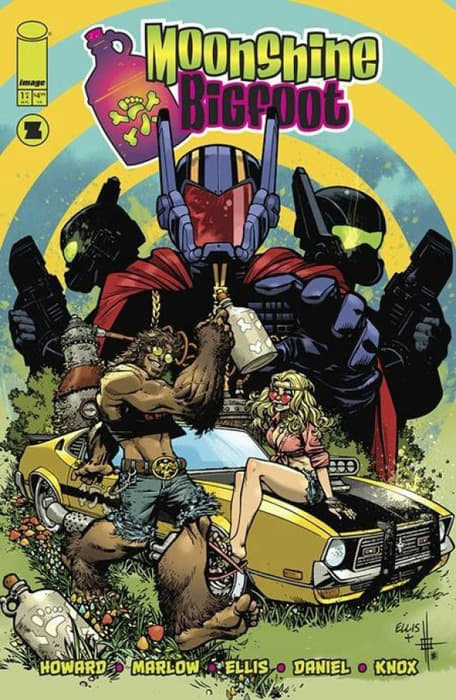
From the publisher
Buzzard County, 1981—Moonshine Bigfoot spends his days making a living while outwitting clueless cops, reckless rivals, and buffoonish Bigfoot Hunters. All is hunky-dory until he draws the attention of an Illuminati-esque cabal. With his partner in life and crime, Amethyst, our hairy hero is about to learn that some problems can’t be handled just by jumping them in a souped-up Mach 1.
PATREON
We have a new Patreon, CryptidCreatorCornerpod. If you like what we do, please consider supporting us. We got two simple tiers, $1 and $3. Want to know more, you know what to do.
ARKENFORGE
Play TTRPG games? Make sure to check out our partner Arkenforge. Use the discount code YETI5 to get $5 off your order.
THE LANTERN CATALOG
Created on the premise of creating light in the dark, this is the the go to resource to keep you up to date on the indy projects and the creators you love. You can find them at https://www.thelanterncatalog.com/.
Make sure to check out our sponsor 2000AD.
[00:00:00] Your ears do not deceive you. You have just entered the Cryptid Creator Corner brought to you by your friends at Comic Book Yeti. So without further ado, let's get on to the interview.
[00:00:30] Show notes and thank you for your continued support. Thanks for your donation. Do you love sci-fi? Are you a horror fan? Maybe you prefer action or fantasy? 2000AD has it all and should be on your radar with a whole universe of characters from Judge Dredd, Astronium Dog to Rogue Trooper, Shakara Halo Jones and many more.
[00:00:54] Every weekly issue you get five action-packed thrills from incredible creators such as Garth Ennis, Rob Williams, Alex DeCampi, Dan Abnett and so many others. Get a print subscription and it'll arrive to your door every week. And your first issue is free or subscribe digitally. Get free back issues and download DRM free copies of every issue for just $9 a month.
[00:01:17] That's 128 pages of incredible comics every month for less than $10. That's like a whole graphic novel's worth. All subscribers get amazing offers like discount vouchers and exclusive product offers. Head to 2000AD.com and click on subscribe now or download the 2000AD app. And why wait? Start reading today. I'll put links in the show notes for you. I've got a family history with moonshine.
[00:01:43] One of my earliest memories is riding around with my grandfather on an old John Deere tractor on my grandparents farm. He had a yellow Mayfield half gallon milk jug sitting on his left hand side and me propped up on the oversized wheel hub on the right hand side. And over the course of any outing around the farm, he would periodically take a drink from it as we were driving around. One day he offered me a sip. No idea what it was. I was maybe six at the time.
[00:02:08] What proceeded to hit my throat was homemade Tennessee fire, also known as moonshine. It became a secret. I was never supposed to tell my Nana or heaven forbid my mom. And years later, I learned that my grandfather had been part of the illicit trade selling supplies off the books and out the back of his grocery store. The only one on that side of Monroe County, Tennessee. He sold it to the local shining community and had investigated for years by, as my family called it, the quote, revenuers.
[00:02:36] And thus began the peeling of the onion that was my family's history with the now infamous brew. Couple all that with the fact that I'm the editor in chief of comic book Yeti. And you've got the basis for what I'm so excited to talk about today's book. A new four issue series from image comics called moonshine Bigfoot. Joining me today is Eisner nominated comics creator and first time show ghost guest Zach Howard and his protege, Clara Mee. I think you're overwatch on the project or something like that, if I'm not mistaken. Is that true, Clara?
[00:03:06] I'm sort of managing the project and assisting like with whatever logistics are needed, but I am an artist in my own right as well. Yeah, she's actually, uh, uh, yeah, she runs project management for almost everything I do now, just because we got, uh, we got, I'm like a mental butterfly and we got a nice type a person that likes making charts. So we work really well together as far as creating. Um, that's cool. Yeah. So, and that's kind of how we built our business on pretty much. Yeah.
[00:03:36] Um, first, what a crazy, awesome, serendipitous story you had about, uh, moonshine Bigfoot. I did the universe had us make this for you. I suspect. Um, but, uh, uh, yeah, yeah. I happy to be here. Thank you very much. And I don't even remember what the first question was. Oh, I didn't throw, I didn't even throw one out yet. So I guess moonshine is the best place to start. Do either of y'all have a history with it?
[00:04:04] Uh, I, not quite as extensive as yours, but when I, I play ball for Mississippi State College and, uh, you go around the South a lot, you're playing in the SEC. Uh, so I've had many sips of people's, uh, home brewed potato and corn, uh, things that they've made. Um, all of them. The reason I have no eyebrows, I think because after I sipped it, they just blew off. That happened. It was a pretty, pretty impressive. So.
[00:04:34] I have no history with moonshine. I am a boring focused person. She still has eyebrows. Yeah. I, I have my human eyebrows. So. That's all good. I think my, my most interesting moonshine story is, uh, precursor to, uh, Bonnaroo. Um, so it was the year before Bonnaroo became official. Um, I think it was called deer fear and it was in outside of Asheville, North Carolina. And we'd work days and days and days of shows and we just need to blow off some steam.
[00:05:02] So we got ahold of a court that was strawberry moonshine is me and my buddy. I don't, I don't remember a lot that night, but I remember there was a drum circle and we had a skid steer tractor and we had a four D cell mag light and we were smashing pumpkins and driving through the drum circle fire to try to scatter those people so we could sleep. That's about the extent of what I remember. Well, that's great. I don't think we have any fun or comparable moonshine stories.
[00:05:32] So I've had my, uh, fair share of, uh, wild partying without it. Uh, uh, uh, uh, but though it's been a while. Um, but yeah, moonshine just seemed to come about naturally, uh, uh, just to, uh, uh, tangent into the genesis of moonshine Bigfoot. Um, it, it just, it, it literally was just a combination of ideas from the universe.
[00:05:56] Uh, nothing, no initial, uh, uh, thrust of trying to come up with some other than, uh, me, myself, uh, the writer, uh, Mike Marlowe and Claire Meath were coming back from Vegas on a business trip. And it was about midnight, 2 AM in the morning. We're driving through the mountains, uh, and we're trying to keep each other awake. So we're just joking. Also kind of bitching. Cause, uh, uh, the writer, Mike Marlowe is also a professional theater actor and screenwriter.
[00:06:26] So we're, we're crapping on, uh, the normal Hollywood and how, uh, nothing feels original. We just take an old thing and, and, uh, uh, basically just repackage it like the Duke's ahead of endless reboots, endless reboots. And it's a cowardice. There's no new Indiana Jones. There's just Indiana Jones, except now he's old and we'll throw a couple shitty CGI faces of Harrison Ford in there. Right.
[00:06:55] Um, we've somewhere lost the thread of creating new IP part of that society right now. Isn't looking for new stuff very often. They want to find comfort in their old favorites. I get that. So it's hard to spend $200 million on a new IP that, uh, may go nowhere just because people want to see their old stuff again, done in new graphics like Star Wars or something like that. And that seems to be kind of like the thrust right now.
[00:07:24] So in bitching about this, I said, if you're going to make Dukes of hazard seven, instead of making the same fucking thing, why don't you have Bigfoot driving the car or something? Let's add some interest to it. And, uh, don't know where that thought came from. But then we started making fun of laughing about what if you replace, you know, the characters of Dukes of hazard, like Bigfoot and things like that. What, what would that reality be within that, that story and or world building?
[00:07:54] And, uh, we had fun the rest of the night, got home, didn't talk about it for a while, but about six months later, I was, I just couldn't get it out of my head. Just the thought moonshine Bigfoot, uh, and, uh, talk to the writer, talk to Clara. We all decided there's something here wouldn't get out of our minds. So that's, thus we developed it. And, uh, it's kind of a shotgun ride from there.
[00:08:18] It was, uh, uh, it's been pretty wild taking a while, but it's, uh, I'm really happy with the quality of the book. If people can get to issue three, I promise them there'll be, uh, I'll curl your toes off your stupid fucking feet. Um, uh, because it's one of the best things I ever made. It's one of the most beautiful things you'll ever make or see. Uh, and we're extreme by, by issue three, the story's kind of riding itself.
[00:08:45] We've kind of really understand each character of the world that we're building. Um, and let most, those characters exist in it. It takes a little while. It's like the pilot for a TV show is always the weakest one. Uh, they kind of are kind of figuring out what the F they're doing. And then it gets better each episode after that. Not that I want to poo poo issue one. We're pretty damn proud with it. It's 29 pages of madness. And we're very happy.
[00:09:10] I was just trying to say within the contrast, uh, of issue one to issue three, that progression is substantial. I don't think I've ever worked on a project where it started out good, went to great and now I'm in territory. I don't think I've done in my career before. And that's highly entertaining. It'll make you laugh visually stunning. It'll, it'll make you slow down and look at the pages and really absorb the world, which I think helps bring you into the story. Yeah. Any good story.
[00:09:40] You're more than just a voyeur. You're going on a journey with the protagonists. And, uh, that's what we're trying to create. The world feels lived in. It's its own reality. It's in, and, uh, we spent a lot of time on world building. So silly as this is, we think we created, uh, a really fun world where big foot's the straight man and the rest of the world is batshit crazy. And, uh, that's kind of our, our inverse of the theme of big foot.
[00:10:09] And, uh, on top of that, he's driving the best hot rod and in, in that County and, uh, can drive it like no other person. Um, he has rivals crank, uh, uh, crank Torkelson. Yeah. Cranks is a in town rival his whole life that can never keep up with them. Um, you have the sheriff just like in, uh, any old, you know, small town.
[00:10:34] Uh, hot rod story, but most, most notable, the Dukes of hazard, um, with the police presence there is basically the, the, the main antagonist. Um, you know, just things like our boss hog is actually the Illuminati. So we kind of set it up, you know, echoes it, but then like all good things, they take on their own, you know, thrust and become their own entity, no matter what inspired you in the beginning. So we're very happy with that.
[00:11:03] I've been blathering. How about you go, sir? No, no, it's all good. Like I, I wanted to thank you first of all, because the, uh, the sheriff is, is one of the things that I locked onto is a character as justice P. Worrell. So at some, somebody from the South, I have to thank you from the bottom of my heart for a Jim Varney reference. There you go. So, uh, we have a lot of these tricks that way. Yeah. So I almost, I almost expect like turtle paratroopers to come down, you know, that's some way.
[00:11:33] I got to file that one away. Um, I will just throw in dude, if the sheriff is your favorite character, you have no idea what's going. You're absolutely going to be plugged away. We're, uh, just doing the backstory of uncle pineapple. So, uh, in issue four here, so, uh, our, our final issue. So we're, we, I, I'm, I think every month I fall in love with a new character more than, you know, I didn't think I was going to amethyst. His girlfriend was just set up as a sounding board.
[00:12:03] She was going to be the dumb stripper girlfriend is a initial idea. And now she's become basically the crux of the universe. Uh, she's, she's the, the rock that big foot kind of leans on and, uh, uh, it's, it keeps some kind of, uh, on track, you know? Uh, so some of these characters have come so far, I guess I've fallen in love with a lot of them. In fact, even the sheriff, wait till you see him come back.
[00:12:32] Uh, what's going to happen with the sheriff, what you've seen at the end of issue two. So, so is, is she, is she in effect, she's kind of like a Dolly Parton clone in my mind. Anyway, is she in effect going to be sort of the Sally field to his Burt Reynolds sort of deal? That's how she started out. But we, we went the other way from our original plan. We took Sally field and just kind of, we were making everybody just stupider versions of everything on.
[00:13:00] That's how, when the last time I did a comedy was outer orbit for dark horse with, uh, Sean Murphy and I did it, uh, 2005. So back when the earth was cooling, uh, that was the last time I did, uh, uh, a comedy. Um, uh, shit. I don't even know what was the question again. I apologize. It is. No, it's all good. It's early. So yes, we took that Sally field and we wanted to make her something stupid.
[00:13:28] Like, uh, she sells pictures of her feet in the back of magazines and is a hippie in the crystal strip or just kind of the, we needed an antithesis, a yang to a yin and yang with that relationship. Big foot is a very straight. He thinks he has everything figured out as young men do. Very confident, uh, uh, et cetera. But we needed some, we needed, we were going to have just somebody that's just kind of like
[00:13:56] a flighty butterfly, you know, like a, like a weird college girlfriend that, uh, the relationship wasn't going to work, but you're having fun right now. And eventually it became kind of a coming of age story for both of them because, you know, they, they've kind of found each other in difficult circumstances and now they've reduced their life to just them, you know, stuck in the woods, um, in this very myopic life, but they're very happy together.
[00:14:23] Um, and turning what we did, we found out we wanted to make amethyst far more substantial. She just started writing herself and became a very dynamic character. And we came up with her background that she's from, uh, the circus of criminality, um, a traveling circus across the U S and, uh, uh, that's where she got her skill sets.
[00:14:46] And it just became a lot of fun to have her as a more solidly introspective and intelligent person to help Bigfoot in the relationship became more endearing. And you could kind of feel that these characters loved each other then and supported each other, which I think became a far stronger story than just having these wackadoo characters that come in and out of a person's life.
[00:15:14] Um, Bigfoot makes lifelong relationships with people. He's a substantial person, uh, though guarded. He also, I think his kind of purity of self and character and also. He's so endearing, I think makes him attractive for other people wanting to be as from, uh, and I think that's an important part of the story because he's this crazy creature that everybody
[00:15:42] loves and not because he's a creature, because he's a good man and he's a fun person and, and, uh, playing with those types of themes where you take the surface element and almost burn off that surface simplistic layer that people assume with like a Bigfoot or this or that or comedy story. How often do you get comedies nowadays where you fall in love with the character and want to see him and her win or hit whatever.
[00:16:09] It's mostly, you're just kind of watching it in this abstract state waiting for pratfalls and, and, uh, uh, the piano to fall in their head and stuff like that. And I, there's a place for slapstick, but I think it's a story, whether comedy, horror, whatever you want to do, uh, genre, it doesn't matter. The character has to be endearing, whether it's a bad guy, good guy, or whatever.
[00:16:37] There has to be something that people become very attentive to them. Uh, and they very curious too. When I did wobbly yonder, some of our biggest fan mails for the villain in it, the judge, they did not want to see him die. He had to die. That was part of the story before the complete, uh, the hero's character.
[00:16:59] However, that's when, you know, you write something good is when now Mike Rach wrote that I was the, the, the visual storyteller, but all good stories in more than in general. It almost always is when I needed to get a new camera. Apologies. This thing keeps focusing in and out. It's because I keep moving. Sorry. Jerk. Uh, so Claren are moving again. Um, but, uh, anyways, just to circle back, put a pin on it.
[00:17:27] Amethyst, Bigfoot, even the sheriff becomes more dynamic. We brought in his great, great grandfather to tie in the end of the story, uh, that fought, you know, for the South and the civil war. And he has a statue built in his honor and all these things like that, that seem very simple on the surface become like most human beings, very dynamic.
[00:17:49] And you just don't know what's under there, what's causing their motivations, why they feel the way that they do, why they obsess the way that they do with all the, uh, uh, you know, it's, it's genes plus environment. People, people's motivations become highly dynamic throughout their lifetimes and how they apply themselves both right and wrongly.
[00:18:12] And I think that's so important to put in every character, even something that most people think moonshine Bigfoot's just a slapstick comedy. It's not, it's a, it's a Miyazaki coming of age story. He just happens to be a big, so. Yeah. I mean, no, no, comedy is something that I've been trying to cover a lot more in comics because I think it's something sorely missed in the landscape and the market right now as we become obsessed kind of with trauma-based.
[00:18:42] Horror and or deconstructing these darker side of superhero monomyths. And there's nothing wrong with those, but we could use more humor in our lives right now. And this totally delivers on that, this front, not in the way I anticipated because I expected it to be very Bigfoot central. And it's not, it has become much more of in my mind, an X book for lack of a better way of describing it. Yeah.
[00:19:10] The scope of the world and people struggling within it, I think does echo the most classic X-Men stories. You know, the outcast trying to fit in just exists. And there's a beauty in that type of story, whether comedy or tragedy. To your point, I think the world right now, this is one of the reasons I'm, I was working on another book with, uh, uh, the Mike Raich who did Wildly Yonder with, um, and, and, uh, very serious, long, long epic.
[00:19:40] It's going to be my opus. And we're a ways into it. And this moonshine Bigfoot idea kind of started percolating in my head. And the reason why I put the other book on hold and went to this one is there's nothing funny out there anymore. It's very, and when you do see humor, it's very trite and surface level. It's a zinger or a turn of a phrase, which is all good and stuff. But when I watch like a Michael or what's his gun? Who's that? James Gunn.
[00:20:08] Uh, the, that dude, um, that makes films that people seem to resonate to. It really confuses me because you see the humor in it. It's all, I always call it. That's, uh, that's what she said type of humor. There's always like when you're around a bunch of guys, there's always that one dickhead that thinks he's funny. And all he says is are the catchphrases like the perfectly time. That's what she said. And stuff like that. And that's what I see in movies nowadays.
[00:20:36] Baby Groot saying something, just a funny thing. There's no substance to it. It's just trying to get a quick smile from the, the, uh, uh, audience rather than having a true character moment that creates a funny comedy. If you have good characters, you can have characters tying their shoes and it will be a funny scene for an hour. Doesn't matter. Um, it's whatever you want to mine out of it. And that's where I think we've kind of fallen off the rails. The, Oh, go.
[00:21:05] I would just add that it's, it's very much a fast food versus, you know, gourmet meal. Yeah. Arguments. Like we're trying to make something with substance and nutrition with here with Moonshine Bigfoot. Most people are doing the dollar menu bacon double cheeseburger. Nothing wrong with that. You do what you want in your life. But whenever, when the world becomes tilted, especially art and all the energy is going into one thing, let's do another version of Batman.
[00:21:33] This time he has seven new lines on his costume and he punches people in the gun. Uh, that's how he solves crying. It's always something retarded like that. Uh, and in between killing Robbins, uh, which is fine. Batman's there's a reason Batman's a traditional character that's going to be around forever. I'm not crapping on that, but they'd rather retread a tire. Uh, uh, okay. Batman's established. I want to be known for a cool Batman story.
[00:21:59] And then the fans just eat it up and it's very transient. There you go. As opposed to a Michelin chef, that's giving you a five course meal. It's a work of art within itself and an experience. And that's going to be tangible, you know, rather than waiting in line for a McRib. Um, and this whole industry has kind of become waiting in line for McRib and who can make the fastest McRib, the biggest McRib. Hey, here's a McRib with a little bit more spice in it.
[00:22:28] Here's why don't we just make something new that's new that that's going to be substantial for the person that they won't forget. Can everybody do that? No, I don't think I can do it, but I'm sure shit going to try. And I mean, every fucking line on every page I try, if you see my work, love it or hate it, if you don't like my story, there's one thing I can say every single line. Every single page, a hundred percent of myself was into it. And that no hyperbole. I work countless hours trying to make, I love this medium. I, I fucking love it.
[00:22:58] I fucking love it. And that's what makes me so unhappy, I guess, in the industry is. So riddle me this then. No, really, really this, right? I have a hard time thinking of a comic book that makes me feel quite as personally seen as, as, as moonshine Bigfoot does, because you've got cryptids and aliens, the propaganda machine, the muscle cars that you've talked about. And it's all wrapped up in that nostalgic glamour of the eighties with a lens on the south.
[00:23:27] And you're talking about making something new. So I feel like I need a Waylon Jennings soundtrack playing in the background when I'm, when I'm reading this. So what, what made those two things make sense? Like we want to create Michelin star, but Hey, let's use the Dukes of hazard to do it, you know? And it's, it's, it's brilliant. But what, what, what was the thought process there? Could say it's more happenstance than just the universe. I'm always trying to entertain myself.
[00:23:56] I get really bored, really easy. So I'm always just finding humor in the moment. So when I'm driving down a mountain road, I'm just trying to keep myself awake and make my buddy laugh. Um, and, and that's how it came about. Um, normally I like to be a little bit more, uh, the Genesis is usually a little bit more original. We're coming up with a character in our world or what are we trying to say? Moonshine Bigfoot's the first story ever came up with where I'm just like,
[00:24:26] I'm just joking around with a buddy and a story happened. So that's why I'd say the Genesis was a little bit different on this one. Although it echoes all those things you were saying when we bring in aliens, are there really aliens? I don't know. Uh, but you saw what you saw in the comic book. Um, we're trying not to make the book about being a Bigfoot about cryptids, aliens, all those things like that.
[00:24:53] It's about a guy that's stuck in his very simple life and he's very comfortable and he thinks that's his life and purpose in life. And the universe shows them it's not. And he no longer has a choice. He has to confront. He has to confront this comfortability and how it's limiting his life and his place in, in this world. And that's his crucible. He doesn't want to get out of this comfortable life where he's the star in.
[00:25:21] And now he has to go fight things that he didn't even know existed and he doesn't have a choice and in doing so he goes on that hero's journey and it's more of a journey of self discovery. Um, uh, so as opposed to say like Duke's a hazard, very simple conflict. These boys are out of prison. They can't use guns. They're the best drivers in the County. And, uh, the sheriff's always after him because board and aptitude, et cetera, legacy, all these
[00:25:51] things like that fun, but there's not a lot of character development, you know? Um, so you gotta be careful when you're deriving things from a source that they don't become that source that you're not just saying, Hey, Duke's a hazard. You like Duke's a hazard. You like us get the burnout. No matter what you base it on, turn it into what it is now. And when people say, Hey, where did this come from? You say, Hey man, I was joking about Duke's a hazard.
[00:26:19] Next thing I knew I was drawn big foot, uh, uh, with a hot girlfriend and, uh, jumping loop diddy loops like a hot wheels car. Okay. So the beginning almost doesn't matter. It's when people marry themselves to the source material, if that makes sense, because it becomes an anchor and you don't really get creative. You don't really tell a story. All you really do. It's like new star Wars.
[00:26:46] It's just jerk off fuel for, for star Wars fans. There's nothing there. It's just saying, Hey, you like lightsaber fights. Here you go. Here's 30 minutes of it. Hey, you like what? What? Pick a subject that they're, they're covering. I guarantee it's done by committee and Hey, we can't get people to watch star Wars. Let's make a baby Yoda. People like Yoda. People like babies. Let's just end all of our creative thought for the rest of our lives and make baby fucking Yoda. It worked for a while, but that's how it always does.
[00:27:15] If you make baby Deadpool, that'll work for a while. It's all short term. It's band-aids on a bullet one. You're not really being a creator at that point. There might be a story with baby Yoda where he needs to be a baby. Come up with the fucking story first and, and evolve the character. And if it, the need is a baby Yoda, then that's where you go. But we're, we're building stories backwards. We're like, I want X, Y, Z in it. Fans like X, Y, Z.
[00:27:44] And I see my own fellow peers. They, uh, what I call chasing the dragon, like heroin. You, you see, okay, well this guy drew a picture of Batman's head and posted online and got 7,000 likes and a hundred new followers. So that's what they do. Next thing you know, I got 50, my fucking peers a day drawing Batman heads. And I'm like, why? If you like drawing Batman heads, great.
[00:28:10] But if your motivation is to appease other people, you stop being an artist. You can be nice. You can be likable. But if you make art for other people, it's not art. It's not art. It's come, it's a commercial product at that point where you're trying to angle in to get something specifically from somebody else. This feeds into something I've been, I've been wanting to toss in there about the, like the nature of originality and how you actually make something that is enduring.
[00:28:38] And they'll tell you in like creative writing classes and marketing classes and things like that. You know, you have to know, you have to have your target audience. You have to work for that particular type of person. Otherwise it's not marketable and all that. But what you realize on the other side of actually working in this, and many people have said this is your target audience is, is you, you need to speak from the heart. You need to make something that you want because that genuineness will come through. I always use the Lovecraft analogy.
[00:29:08] There's nothing inherently scary about sea life per se. He himself was very scared of fish. He just found them scary. And that comes across because that was genuine to him. Yeah. So you have to be genuine with yourself. And then you're actually making something enduring that is not just marketable. That's how we got things like Lord of the Rings, like which, you know, is still a huge industry today. And all Tolkien wanted to do was write the kind of book that he wanted to read.
[00:29:36] So there's a, there's a certain beautiful selfishness to creativity. If you could be honest with yourself about what you want, it will be such a pure product if you could stay true to that. So that's kind of what we're trying to do here. They're making just what they want and it's beautiful and it's rich and it's, it's deep. It's just industry. It's, it's putting spindles in box. I did Batman. I did Wolverine. I did Spider-Man. I did all that shit and nothing wrong with it.
[00:30:05] Hell, if a good story came along, I'd still draw a Spider-Man or a Hulk, but it'd be story based, not character based. And that's, I think a lot of my peers and part of it's desperation. We're poor as shit. Yeah. Work 70 hours a week. We're already insecure, fucked up people. That's why we draw for a living. Um, there's no well-to-do person that has all their shit figured out that became a good artist. Right. It's not possible.
[00:30:31] Does the, or how you become good at art is trying to fix something in you and have a voice in this world to try and make sense of it in some way, whether profoundly small, personable, uh, personal, um, doesn't matter. But the Genesis of all, all good art in any media comes from with you, not external. That's why I don't, people are like, what comic books are you influenced by? Literally fucking nothing. I've already been influenced by them my whole life.
[00:31:00] I just listened to music and podcasts and history shows. I don't even, you know, not that I don't, I love comics. It's my life. But I think everybody kind of chases the same thing. You see the lines start looking like the popular guy, James Heron draws speed. Well, everybody's just ripping off. Everybody just rips off James Heron. When I was a kid, Jim Lee drew hatch lines that made no sense, but they look good in a pattern. Uh, everybody started fucking doing it.
[00:31:30] Cause that's, you know, I, that's why I say quit chasing the dragon. I get job offers and I'm not a superstar. I can't get through a day without a job offer. So all these desperate fucks, why don't you start believing in yourself, figure out what you're trying to do and then create something with it. May just be a drawing. You may just like pin up people like Adam Hughes, you know? Um, and it doesn't have to be one thing, but when the majority of the industry
[00:31:57] is chasing fame and the last few shekels that are, are, are in the coffers of these comic book companies, uh, and I mean the last few shekels, if any, two, two, two shekels, two and a half shekel and a hate, a Buffalo nickel, uh, made from wood. Um, quit trying to squeeze, squeeze water from a rock, squeeze excellence from yourself. Yeah. Do what you want, do what you want. It's kind of that simple at the end of the day.
[00:32:26] No, it's Alan Watts. If money were no object and you want to do it, then do that. The money will come. And if there wasn't a convention for these things, if there wasn't a standard, you don't need to worry about those standards. You make your own standards and that's when you stand out. Truly. And, uh, uh, so that's where moonshine Bigfoot came from. I want, I miss, remember grew. Yeah. Oh yeah. I favorite comic book of all fucking time for one reason.
[00:32:55] Every month I wanted to read it and I'd read it a second time. It always made me laugh out loud. And it also engaged me psychologically. Like, cause grew was always dealing with in his own myopic myopic way, dealing with gigantic sociological, uh, uh, uh, just vast societal issues and governance and, and personability and things like that. But it grew was the simple one that just kind of wandered into this, this world did what
[00:33:25] he did and went out, but it always made me laugh. It always gave me a philosophical mesh message and it entertained me while doing it. So I think we, there's a huge chasm where that just doesn't happen. And even good writers just now want to zing you or here's my, here's my, my little version of something you already like. And, and, and then you get people are in, in our industry that I want to put my stink
[00:33:55] on Wolverine forever. Cause I grew up with Wolverine and I can do it better. And you get those assholes and then you get the multiverse and then you get before you know, it's just the convoluted mess of everybody ripping each other off, playing King of the shit. It's a mountain of nothing. And it's, uh, I've always been very repulsed by that. Good, good end dad. There's, I should have played the game more when I was earlier in my career.
[00:34:24] I'd probably have a bigger fan base right now, but ultimately I'm not, I'm not making art for everybody. I'm making art for me and hoping people find something in it that they appreciate. That makes sense. Yeah, absolutely. Yeah. I mean, I was going to ask a question about propaganda as the moonshine, actually that Amethyst and, and MB are actually brewing is dispelling propaganda.
[00:34:49] So it feels like in a way, this is sort of a response to the propaganda machine of laying out a blueprint of this is what's successful. Or if you do this and then we'll follow, if you will, is, is that where the propaganda thing came from? Cause I didn't know if that was just a statement about modern conspiracy theory and the media and what is real, or if that just happened to be window dressing.
[00:35:17] Kind of, I'd say a mix happened pretty organically. Okay. I would, having seen it develop, I would say there are no intentional statements, but things did evolve into statements, you know? And once they exist, you say, okay, I have this, what can I build out of it? And that's where, you know, as you notice, we don't, we don't go deep into conspiracies. However, there's characters in the book that certainly do. And that's how we use them. Okay.
[00:35:45] Here's our fanatics and what are their motivations and how do they affect our, our protagonist? Um, but as far as a big level in the Illuminati that we used, we just tried to get as abstractly huge as possible because if you have cryptids, you got to have something comparable that needs to get rid of the cryptids. That wouldn't be something equally crazy. That would be Ronald Reagan with a gun.
[00:36:10] It would be something bigger that the lofty and a bit more nebulous that the people don't know about, but know about. So when you use the Illuminati, you can kind of turn it into your Illuminati. So that's why that evolved into that. Now, propaganda, obviously that's always been a humongous problem in, in our species. Uh, and it gets even more convoluted in governance. Uh, so using that topic, of course, the Illuminati has been controlling the world for why the
[00:36:40] fuck do they exist if they're not controlling everything? Well, it's the perfect foil to Bigfoot in a way, because the question is always people sort of know or think they know, or what is, what is the mythology here? And it's the same on the other side of the coin. Exactly. Yeah, exactly. They're just as dumb. They just happen to be in power. They're just idiots like you and me, you know, with fucked up motivation, you know, and or resource. So that's why Big Level has unbelievable amount of power.
[00:37:09] Bigfoot has no power. And that's why it's going to be an interesting fight. How do you, how do you survive the all knowing, uh, uh, force that indomitable force that can control everything in the world? So you put him in a position. Okay. I have no power over these people. How do I succeed in my own life? Because they're my conflict. They're the ones standing in the way of life and love, uh, uh, as a character from Moonshound. Yeah.
[00:37:38] So Bigfoot kind of became a funny abstraction of, you know, you have your inherited leader, the silver spoon leader that's incompetent. Um, but he himself is not, I love this though. Cause he's such a good contrast to Bigfoot because he is not, he's not evil per se. He just inherited this role and he's just very incompetent and it's like insecurity is his biggest issue. Yes. So it's just like the danger of insecurity and leadership. He has no self-worth. Yeah.
[00:38:06] So he's looking for that second father as Joseph Campbell would say. Validation. Yeah, exactly. Someone that can kind of take you to the next level of your life and he doesn't have it. Yeah. But he has all the resources on planet earth. So it's just, it's a, basically a baby with a flamethrower, you know, it's just like, it's like, what's going to happen? Um, but we, he's actually becoming a character. I really liked him. I mean, no, he genuinely become my favorite character.
[00:38:35] Cause he's so sincere and he's so desperate for this ideal that he's not going to reach, but he's so incompetent too. It's, it's kind of a beautiful combination. All these falsehoods that he's convinced himself that we all do when we're younger. The world's a lot more black and white when you're younger. He has that because he has zero resistance and zero guidance. Um, and he has a desperate need to validate, have others validate himself, uh, by exuding
[00:39:02] false confidence and kind of, uh, uh, a lot of energy he spends into kind of useless endeavors to be mighty. I, I, IE cyborg justice when it, why didn't he just blow the whole town up? No, we're going to build like, and this is where we echo back into my childhood. Uh, uh, like when, uh, so say around 1980 or so when I was a young kid, um, you had the
[00:39:31] first influx of anime, uh, anime from Japan. Uh, so you had speed racer and you had battle of the planets, gotcha, man. Um, so you first had that, then you had things like Dukes of hazard. When you watch Dukes of hazard as a kid, did you care about the flag on the roof? It didn't mean anything political to you're just rooting for the good old boys. And that's kind of what I miss in a story. I wanted to make a story where you don't have preconceived notions about right and wrong.
[00:39:59] You, you, you become a, you go on a journey with this character that exists within this world and you just enjoy their journey rather than saying, okay, that's the Dixie flag on the car. Obviously it's a symbol of just a troubled shit past of the South and all the evils that came with it. Um, so we can just kind of forego that stuff and then just enjoy the character, get rid of
[00:40:24] the geopolitical positioning and, and, um, everybody, all the stringent idealism that everybody's kind of lost in right now. And just come watch this guy have fun and laugh, uh, as the guy goes on his own personal struggle, but it's comedic or along the way, even though the story, his story is serious.
[00:40:46] And, uh, so I guess to zip that up, I, I want to tell a story for people that just want to have fun. Go back to Gru. I never had my political views changed by Gru and say, oh, geez, you know, Stalin really X, Y, Z or something like that. No, I, I got the overview of the politics in the humanistic sense that the, the king is
[00:41:14] being a ridiculous, uh, uh, xenophobe or hoarding money or all the things that are ubiquitous with leaders throughout history. Um, but they don't say this is this country, just like X, Y, Z. And this is how these people, this political persuasion. And we, we forgo all that stuff. Come on or Juni. It doesn't matter. It's your political makeup, the, how much melanin you have in your skin, the color of your eye.
[00:41:44] It doesn't matter any of that shit because Bigfoot doesn't exist. And he's not black, white, Asian, and none of those things. He's just a cryptid and the only one. And he doesn't care. He's just trying to have a happy life like you and me. That's it. That's it. But the universe has something else for him in mind. All right, everybody. We're going to take a quick break. We'll be right back. Let's face it. The comics landscape is a mess right now. I'm the editor in chief of a comics journalism outlet, and I can't even keep track of it all.
[00:42:13] If you are as passionate as I am about indie comics and its creators, you should check out the Lantern Guide. Created on the premise of creating light in the dark, it's going to be the go-to resource to keep you up to date on the projects and the creators that you love. Don't take my word for it. I reached out to my friend Brian Lovell, Poison Ivy artist and indie comics creator, to get his take. Brian, what does the Lantern Project fix? I'm a dude who loves indie comics.
[00:42:38] And I know personally, like, I get very frustrated when something shows up in my social media timeline or something like that. And I feel like I can't keep track of everything. So really, the Lantern Project was born out of that. It was an opportunity for me as a reader to kind of like have a place to want to consolidate all the stuff that I wanted to read. All the cool projects from cool creators that seemed interesting and kind of unique to like
[00:43:05] something that I would like, which is really not super represented everywhere else, but it's all over the indies. Having a spot to go to that felt like it consolidated a lot of those audiences and a lot of those places where I couldn't just get drowned out in the feed of social media seemed really valuable to me. What's the ultimate goal? It's really our hope with this project that creators feel like they're able to get in front of readers and readers are able to get books that they actually want to read with a much
[00:43:34] easier time of keeping track of them and accessing them. Catalog is scheduled for a quarterly release. So head over to thelanterncatalog.com to sign up now so you don't miss your next favorite thing. I'll put a link in the show notes for you. Y'all, Jimmy, the Chaos Goblin strikes again. I should have known better than to mention I was working on my DC Universe meets Ravenloft hybrid D&D campaign on social media. My bad.
[00:44:01] He goes and tags a bunch of comics creators we know and now I have to get it in gear and whip this campaign into shape so we can start playing. Another friend chimes in, are you going to make maps? It's fair to say it's been a while since I put something together, so I guess, question mark? It was then that I discovered Arkenforge. If you don't know who Arkenforge is, they have everything you need to make your TTRPG more fun and immersive.
[00:44:25] Allowing you to build, play, and export animated maps, including in-person Fog of War capability that lets your players interact with maps as the adventure unfolds while you, the DM, get the full picture. Now I'm set to easily build high-res animated maps, saving myself precious time and significantly adding nuance to our campaign. That's a win every day in my book. Check them out at Arkenforge.com and use the discount code YETI5 to get $5 off. I'll drop a link in the show notes for you.
[00:44:55] And big thanks to Arkenforge for partnering with our show. I think I'm going to make Jimmy play a goblin warlock just to get even. Welcome back. I'm curious about how the team sort of synthesized down all the various elements of the book, because it's not a genre piece, and if anything, it feels sort of Frankenstein, right? You've got a little bit of mysticism with the tarot thing. There's muscle cars. They have great lines, so let's pull them in.
[00:45:23] You've got Bigfoot's silhouette, but we've got to somehow mash him into a car, so we're not going to have this big dude. We're going to have big, like, forearms and cat. Right? To get away with that. You've got drunk Smurfs. You've got tattoos showing up, right? Everybody loves a trucker hat. Somebody saw a tattoo! Yay! So it feels like this mood board that's sort of comprised of these visual elements that, okay, we love this shit, so let's cram that in here.
[00:45:52] So how did you guys synthesize all this down? Oh, man. Wow. How did we decide to start putting... Well, what I would say, again, having been on the outside and kind of like, I know Zach very well, obviously. I know Mike Marlowe fairly well. And they have a very good rapport in what they're able to bounce off each other creatively. So I would say the start of that synthesis was just that those two understand each other
[00:46:20] and speak the same language in terms of, you know, the creative genesis of something. And I think from there on out, it was just a process of everyone bringing to the table a bunch of ideas and being responsible and diligent and, you know, amenable to each other to include and strike things as the narrative needed. And that just allows for it to turn into the weirdest thing that it can be while still being functional.
[00:46:50] But I think a lot of it is just like you need to be willing to work with each other and understand each other's vibe, creative vibe. What is it like for you then? Because a lot of these touchstones are not really of your generation. I mean, they are for Zach and I. That's not a question because this is very, very important. This is actually a fun one that I kind of hoped you would ask. Some of this stuff I'm familiar with. And like I... So I'm 35. So I know of Dukes of Hazzard.
[00:47:19] I understand it as a cultural touchpoint. And you can make... I can make a functional Dukes of Hazzard joke. But I really wasn't familiar. And when they first started working on this project, we actually watched some Dukes of Hazzard episodes just here in the studio. Just to kind of keep the vibe and introduce me to it so I could be more help. And yeah, it was really very eye-opening. Honestly, my favorite thing, and this is unrelated to anything really, but because back with the... You know what I'm getting at? Back with the square screens,
[00:47:47] the shots had to be so much tighter than they are now. So everyone in the shot stands... Literally stands like this. And they talk at each other like this. It's so strange. It's so strange. And it's just like... And now I know to look for that in older media. And you grew up with widescreen forms. Yeah, so I... Yeah, widescreen was standard by the time I was watching movies. Well, you're still in a shitty black and white square. Yeah, they grew so close together. But anyway, that's neither here nor there, but... To circle back... Yeah. Thanks, Clara. Thanks, Clara.
[00:48:19] We... That was one of the things we didn't want to get caught in the weeds and the mire of... When you do the pop culture icons and cameos and things like that, I knew... Like when I watched or read Top Ten by... My buddy Xander Cannon worked on that book with Alan Moore. Xander would go in and do the breakdowns. And it's not too different from how we do this book right here.
[00:48:44] And then Gene Howard would come over and do finishes on top of those breakdowns. Pencil and ink it. It's kind of what I do on this book. Um... So... Uh... In that, we kind of start with the foundation of the story. But never lean on... Yeah, you saw Clint Eastwood gambling on dead Smurfs. Um... You saw a tattoo being led away by, uh... Clyde from Every Which Way From Loose. Who knows what they're gonna do tonight. Uh... You have fucking Mac and Me in it.
[00:49:13] I guarantee I'm the only comic book ever with fucking Mac and Me in it. I don't have Mac and Me in the title. I wanna... I wanna stand on that hill when I die. I have fucking Mac and Me in my, uh... 100 Tombstone. Yes. I was just gonna say Mac and Me. Just a picture. There you go. It's no nothing. Bad. Just a picture of his butthole mouth. Yeah. Just a mouth. But, uh... Anyways, uh... When you do things that, uh... Or little Easter eggs like that, what you have to... One, it's always entertaining.
[00:49:43] Tiddily. So you're like, ooh, ooh, what else is in there? And I guarantee you can read Moonshine Bigfoot 20 times before you even start seeing all of them. Right. You know, uh... Uh... Wait till you see the crowd shot in issue three. But, uh... You saw the bar scene. And what we tried to do, if we've had this magic... A lot of things. You go out. It's just a shitty old gas station in a shitty old county. In a shitty part of the country with nobody in it. But you go to... The speakeasy. Clint Eastwood's there.
[00:50:13] Farrah Fawcett. You know, all these characters throughout history. And you're mixed with cartoon characters. It almost becomes Roger Rabbit. Yes. To where the characters are interacting with each other in this safe space. Right. It's not part of the story. And when you have Easter eggs like that, you gotta be very careful you don't lean on Baby Yoda. Because then people aren't really caring about the fucking story. They just think Baby Yoda's cute. Oh man, they got the Dukes of Hazzard in there. That's so cool.
[00:50:42] We gotta make sure that we don't put things right on the nose. Right front center. Their background. They're superfluous to the story. And that's how you work those in. It enhances. It embellishes the story. It's not the Christmas tree. It's the... It's the ornament on the Christmas tree. Don't make it about it. And that's the key of putting in these little callbacks and references and Easter eggs throughout history, throughout pop culture.
[00:51:09] So we want to express how fun... Like... There was their own constraints back in, say, 1980 media. But people didn't take it so fucking seriously. They just wanted a fun, tangible distraction that enhanced their lives and brought a little color to their lives. And if you get too heavy in the member berries from South Park... Hey, remember Dukes of Hazzard? Remember this? Remember that?
[00:51:38] If you start leaning on that too much, you're no longer... The story doesn't matter. You're just saying, hey, I like that. Do you like that too? Right. And what are you doing there? You're not storytelling. So you gotta make sure that they satellite around the story. You don't see the Smurfs dead in the center. You see them passed out, possibly dead on a table, being gambled on. You know? And then within that, we make it really fun.
[00:52:06] We had to do a Kickstarter to kind of get the first half of this book paid for. Right. And we did well. I wish we got enough for the whole damn thing. But we're selling pages. We're getting there. Dead Nuts even by the time this book comes out, which I'm very happy about. Shit, I lost my thread here for a second. No, you're good. Yeah, the splash page... I can't remember. I can't remember. It's still working. I apologize. I need 72 cups of coffee to get the day going.
[00:52:35] Well, that establishing shot with all those characters in it, I think also did a really good job in terms of establishing the vehicle of the book and the heart of it. Because then, Bigfoot, you're not quite so locked on to the mythology of Bigfoot and the fact that he's an outsider. You are pulled into, he lives in an outside world and he's the normal one. Correct. He's the straight man of our story. Yeah. Right.
[00:53:04] He's the Scully in X-Files. Yeah, just constantly incredulous. Everybody's wanting to believe fantastical things and here's Bigfoot telling you, no, no, no. Where's the evidence? You know? Right. Yep. There's a fun polarity in that character and I think that's fun to put in characters that go on adventures because it makes them a little unpredictable, makes them a little complicated, just like you and me.
[00:53:27] When people become just dead nuts on, laser focused in their, you know, it's great to see the Punisher, but you have a very myopic character. Right. So the story and characters around them have to be more dynamic to bring the story a lot. Well, sorry. Nobody in real life is just one thing, you know? If you want your characters to have depth, they need to have some contrast. Psychologists and like, even like dating coaches will tell you this.
[00:53:55] The thing that makes a person interesting is contrast and contradiction, is a variety of traits. Dude, just this one note Batman. Oh, my parents died. Right. I'm 75 years old and I still can't get over my parents died. You're a 70 year old orphan. I'm the 70 year old guy in the night. I am the night. Slowly. Oh, my fingers hurt. Where's Robin? Is he dead? Right. So. Again.
[00:54:24] Now that I got out of 20 years of jail for child endangerment. Well, yeah, it's so, you know, there are, there are good stories where a character has this kind of like laser focused single polarity. Or it's not a polarity then, just a singular focus. And they don't veer from it. Of course, there's stories that do that, but they're not the ones that do anything to me, man.
[00:54:53] I like characters that go on a journey. Like Alien, Ripley. She just goes from just a, basically a blue collar worker on this shitty ship doing nothing to, you know, being able to self-actualize and save the day and become the hero that somebody needed. But, um, that's where the beauty in it is.
[00:55:18] I don't find, you know, uh, characters that just know everything bug the shit out of them. Um, and we have a lot of that right now. Their conflict is just the problems they have with the world, not inside. And, uh, uh, that doesn't do anything for me. And I don't think it has any legs. Look at the stories that stand the test of time. Watchmen. A lot of shit there. And none of the characters are good.
[00:55:47] Like they're all very flawed. They're all complicated. And they're all very flawed. They're just within their own reasoning have figured things out. Sometimes haven't. Um, and, but they still have to do things in the world and create their own conflict. Uh, good or bad. Uh, intentions. Uh, uh, you know, so I guess moonshine, we're kind of cloaking a, again, a Miyazaki coming of age story in this kind of fantastical goofball setting.
[00:56:17] So you have a very serious story about self actual realizing big foot has to realize he's too big for the world or too big for the County that he's living in there. His world. He he's happy in this cloistered little myopic little setting. He can control everything. He's good. He doesn't have any real conflict. You can't grow as a person. Then if you don't have con, you can't become the person you were quote unquote meant to be.
[00:56:44] Uh, if you don't have that conflict, you have to have a crucible in your life. You have to overcome that crucible to have any substance to your character, any resolve or stoicism, any application of all your characteristics. You have to survive a crucible. At least one, I would say you have to overcome it because that's where the character, that's where the person is built is in that fire of the crucible.
[00:57:14] So I noticed in your bio, you were talking about working with younger artists and its importance to you. The journey of moonshine Bigfoot is one of discovering as you just alluded to kind of the best version of yourself. And it feels like there's some synchronicity between the book and sort of your own journey and what you two are trying to do here. So do you do, do either or both of you have advice for, you know, younger creators who are starting out and listening to navigate the industry?
[00:57:43] Because a lot of the focus has been here on ills of the industry and how. Yeah. Let's, you know, let's flip it then. Yeah, that's fair. Yeah. I'll briefly go first, but I'm curious about Clara's perspective because I started out mentoring her and now we're studio mate business partner, you know? So she doesn't always happen, but, uh, uh, our journey worked together.
[00:58:06] Um, so I, when I was trying to become a professional, anything, I had zero help. I didn't know anybody is there. Internet was still just basically email. Um, I, I didn't know how, what step one was. I was, I was a fucking Potter. I have two degrees in sculptural ceramics, which made me a mint in college, made me unbelievable. I didn't want to do it for career.
[00:58:36] I was burnt out and, uh, I always wanted to do comic books. So I tried to do that. It sucked. I slept on benches outside of San Diego convention center and shit like that stole bread off of tables. And, and I felt very alone. And, uh, and the goodwill in this industry seldom feels like goodwill. It always comes. It's like, uh, they're fishing, you know, a little bit.
[00:59:04] Here's a shiny piece of bait or tasty piece of bait, or they're, they're going to be nice enough to you in case you hit that they can then, you know, have a foundational relationship with you to make, you become the golden goose and everybody's trying to become the golden goose without realizing that that's a prison in itself. And, uh, I played that part in my career many times and it's always left me near suicidal.
[00:59:31] Um, now not everybody's as dramatic or as crazy as me, but it really brought into focus a need to not put myself in a position to where I wanted to kill myself doing what I quote unquote love to do. And, um, I, I don't need to get too heavy here. I, I really, it really became a focus in my life to helping others.
[00:59:57] Um, and, uh, uh, I think most artists, most artists that make it, we're going to make it anyways, but, uh, I don't want them to be so scarred and beat up that I am that they become bitter and jaded and or all they're doing is drawing the new incarnation of Batman. If you got something to fucking say, get the fuck away from Batman for a little while. Cause again, that's just retreading attire.
[01:00:27] No, no, no crapping on people that do it for a living. You do, everybody's their own journey. That's commercial art. We do have to make commercial art. Correct. We're trying to do a step beyond that. I have no interest in that. It again, if money were no object, I'd still be doing this. I'd still be telling fun stories and whatever medium. Uh, but, uh, unfortunately in this world, we do need a little bit of money, but when people become focused on the money and not the result or the execution and application of what's inside
[01:00:56] you, there's going to be a convoluted pollution in it. So you got to be able to survive making money while creating your, yourself in the vision of an artist. That's going to be able to achieve what you've desired your whole life. And that, that may change as you go along. Cause you'd be become more dynamic people and you got to be open to letting the path change.
[01:01:21] Not erratically, but you know, when I first started, I was told you have to draw Batman. If you want to be a successful artist, a shit four years in, I was drawing detective comics and I hated fucking everybody. I was, didn't respect shit about it because everybody was just cashing a paycheck. Didn't care about a fucking thing else except getting that paycheck and have their name on a Batman book. Well, fuck guy. I'm trying to do this.
[01:01:47] I'm trying to say some, and I'm trying to make my mark in history, whether matters or not, we're all transit and we'll be forgotten. But art is one of the few things in the world that can be a, a true image piece of immortality that you added. You actually added something to our species and put something new into the world and that cannot be overstated its value.
[01:02:13] Like that's, that's such an incredible concept, much less a thing to be able to do. And that's the power of art. It's incredible. Yes. And history will tell you if you're successful or not. A lot of that's just happenstance and serendipity and uncontrollable, but you got to do what you got to do to even have the opportunity to have a legacy. Um, uh, and I don't even know where I've figured out or where I've settled in my own thoughts on that because they're constantly evolving and rotating.
[01:02:41] But I think it's very important. Mentorship is very important not to make people think like you and which you have to, there are, uh, uh, many ideologies in, in humanity that try to force you to think a certain way. Um, from indoctrination all the way up to fucking old people are, I watched them be manipulated mentally, uh, having family, family members just with propaganda.
[01:03:10] So, um, I, I just think it's so important to help young people develop the tools so they can self-actualize and become what they need to be inside here. And, and a lot of that is not, I T like I, I taught Claire some, some things on how to draw things correctly or think about this and that, especially with visual storytelling.
[01:03:35] However, it's more just teaching them how to be a strong-minded, well-educated person. Because once you have that, once you learn how to learn, it doesn't end. It doesn't end. It's that teach a man how to fish axiom, you know? Um, and that's what I try to do with kids. Set your ego aside. The only time your ego matters is when you get really quiet and you ask yourself, what the fuck do I want to do with this life?
[01:04:04] And once you can answer that, and it's your voice, not echoing somebody else's voice, shit gets really simple because the work's the easy part. Just show up. Getting your mind right is the hard thing. And not that I have my mind right. I'm still a fragile artist. But one thing I do notice is, uh, I had a shit journey and I don't want other people
[01:04:28] to have that shit journey, uh, I want them to be able to get to a platform, a stable foundation of where they can start building themselves and their career on. Um, and then you can survive. You're insulated from, for the most part, insulated from things like the volatility of comic book industry. Yeah. We're basically a niche industry now. There's not a lot of money. It's, it's sad watching everybody fight over that bullshit. Yeah. Um. That's not coming back.
[01:04:54] But if you make your own stuff, you know, no one can take that away from you. You can make money from it forever. And people want the fame and fame does matter. It's a weird thing. You can get famous, then go do your own book. And many friends do that. I have many people that do their own book and then go the other way and then draw Spider-Man or some shit like that. So don't get married to something, get married to your goal.
[01:05:20] And, and what it's going to take to achieve that and be willing to get off the rails and track just a little bit to re-vector as you climb that mountain to your goal. There might be a boulder in your path. You don't just give up. You've got to fucking find a way around that boulder. You know, if the river's washed out the path, well, he may have to climb the mountain on the side of the cliff a little bit to get over to the other path. You've got to find your own fucking way. But I don't think we teach kids to do that on any level, really.
[01:05:50] But art, it's, it's paramount that you learn to be able, again, to self-actualize in a way that you can trust your thoughts. You have the skill sets needed to achieve your dreams and you have the integrity slash stoicism to keep it going during dark times because they're going to have dark times. Shit's going to get desperate. And I've had to take jobs.
[01:06:15] I was drawing Flash Gordon to help me pay for bills while I draw Moonshine Bigfoot. But my goal isn't Flash Gordon. Yeah, I loved it as a kid. It was fun to do some covers and I love the people I work with. We're good buddies. It's not my goal. It's an, it's, it's just fuel I'm putting into my rocket ship to get, keep going to where I'm going, you know? And I think that's an important thing to learn.
[01:06:44] There's some people, I got buddies that all they want to do is draw Batman. They don't care about the fucking story. They just love drawing Batman. There's nothing wrong with that, but know that about yourself. He's not drawing it to be famous. He's drawing it because it sates his soul. It's where he wants to put his creative thrust into. So it's very important to figure that out about yourself. And that may evolve as you get better and go farther along in this industry.
[01:07:11] My goals are radically different than they were 10 years ago, much less 25 years ago when I started. So be, don't be married to who you are, but know, know thyself and know your flaws and your weaknesses and what matters and doesn't matter what you need to get better at and what is superfluous. And once you can, you will never be perfect on that, but only you, whoever's trapped behind
[01:07:37] those eyeballs really knows when things get quiet, who's in there. So fucking become friends with yourself and move forward. So, uh, uh, I think that's my thrust for mentorship. I don't, I want people to have, I think it's greatly lacking in our society mentorship. We just dictate and expect people to be exactly how you want them to be and, uh, or else.
[01:08:07] And I believe in, in free will, man, we only get one shot at life. What the fuck do you want to do and go do it? Time's going to run out. You know, you know, it's, and then it's done. And then you're, I don't want to be sitting in the bed when I'm 75, kicking myself in the ass for not doing something. And you hear all these people, you know, uh, failure is just part of, uh, uh, the process. Yes, it is.
[01:08:36] So get comfortable with failure. Doesn't mean you like it or accept it, but you got to learn from that failure. It's part of succeeding. So we got to teach things like that. People just, their egos seem most important to people. Uh, what I noticed everybody, not just artists, artists are just fragile, expressive versions of, of everyone else. And when you put your, your thrust into your ego, uh, you're not achieving anything.
[01:09:03] You're just trying to validate yourself through words and existing people that validate themselves, usually achieve shit. You know, you're like, Oh, well that person, you know, actually achieved something. They did something. Um, you're not going to see many detractors from that because most people don't have the testicular fortitude to do such.
[01:09:27] Uh, they mostly just want to go with the flow, the way the river's going to show up in their factory job, put the spindle in the box. Everything's comfortable. They got the weekend off. They're going to go to the Disney world and we're going to get fat happy. Okay. That's your life, but it has, it's not a life worth living in my eyes. Not that I mean that I personally would find worth living if I was in their shoes. Um, everybody has their own right to be however they are.
[01:09:57] And they're not going to hear any judgment from me, but if you're going to achieve something in your life, if whether an engineer or a musician, uh, uh, uh, biologist, you got to get really smart and knowledgeable in that field. Not assume. And we get a lot of people in my industry like to pretend they know stuff like perspective or storytelling. Cause they say a couple of buzzwords that they've heard throughout their career. Actually learn the shit, learn perspective. It's just simple math. Learn it.
[01:10:25] Well, how the hell do you draw for 30 years? Not no perspective. There's a lot of my fucking peers that are like that, you know, cause they've just been copying shit their whole life. Um, so I think it's very important. I, I'm not, I'll help anybody that's well, that's available for help. Uh, and, um, I try to do that with very few strings attached or judgment.
[01:10:50] I think you can say I'm a very altruistic person, but I try to focus instead of it just pissing in the wind. And I try to do it focusing on when a person's brain is still wet. It's not cement, you know? And I'm not trying to make them into visions of me. I'm trying to make them the best possible version of themselves. Nick Rungi, one of my best friends, one of the best gallery painters on planet earth out of LA. He was a young comic book artist here in Colorado.
[01:11:18] When I first met him, he didn't need me to teach him how to draw shit. He's a better artist than me. I needed him to teach him how to be a strong, confident young man. So basically I just brought him over and worked out with him every day. Then I'd have him ink with me and things like that. So he saw how I do that. But his part of his process of gaining confidence as an artist was teaching him to trust his body and his mind and stop saying you're fucking weak and you don't like it.
[01:11:48] Well, let's change that. I've been working on my whole life. You know how you get big arms and, and, or whatever you want it be physically healthy is your ply yourself towards it. That's it. We all have limitations. I have many health issues that I'd look like the fucking Hulk if my body wasn't this broken and shitty and full of chemotherapy, but it's not that I just do the best I can with the body I have. And most people don't even know him on these horrible men just from being healthy, as healthy
[01:12:18] as I can be. And I think if other people applied that, that have less restrictions or more, we all have issues. If you become strong in your mind and your body, there's literally nothing you can do because there's almost no humans like that on planet Earth. Almost none. Almost none. So just make your vessel is the best version of your muscle moonshine muscle car that you can make. That's what your body is and your mind.
[01:12:47] It's your, your personal vehicle. So make it the best vehicle possible. You know, keep it in tip top shape. Doesn't mean you have to be an Olympic athlete, but do what you can to be physical health, physically healthy. So it doesn't interfere with your mind to create things. Doesn't, doesn't, uh, erode your resolves. So you stop sitting at your chair working because, uh, your toes hurt from eating too many cheeseburgers. So, uh, figure yourself out and, uh,
[01:13:19] that's why I say when I'm mentoring people, sometimes it's just to help them realize that they're not as limited as they think they are. And that can be mind body and, and anything in between philosophy. Um, the key is just not trying to change them. It's trying to get them to change themselves. Cause again, once you teach somebody how to do that, it's like a door opens. You're like, Oh my God, there's no, there's no fences. There's no corral. I can do anything I want.
[01:13:48] I can go anywhere I want. And until people walk through that door, they have no clue it exists. It's a fantasy. Does it, it's not even a fantasy because they just don't know it exists. And that, you know, somebody talks in that way. They think that they're, they're an alien, you know, either making it up or you're just some weird alien anomaly. Sorry. I'm boring. No. Yes. No. Uh, so let's, let's bring her in. So what's the crotch of the old guy here taught you?
[01:14:20] I mean, my, um, I mean, I think to put it in a nutshell and, you know, to second what he's saying, what, what I have settled on both from my personal experience, um, the challenges I've been through and also what he has taught me is that really waste no energy trying to be someone else or fitting into whatever convention the society is currently setting up.
[01:14:50] Now that's that in and of itself, you can't stop there. You can't stop there because then that's just self-esteem and you're just going to sit around liking yourself and you're not going to get anywhere. That energy you're saving goes into becoming the best version of yourself. And like I was saying earlier, doing what you want, make the things you want to make and understand when to be suspicious of your own brain, your own nervous system, your own
[01:15:18] motives, because your body is designed to keep you safe and doing hard work doesn't feel safe. So you have to know when to push through that and when your body is going to want you to avoid success because that is stressful and challenging. The, the, the solution, the best way I've ever heard it phrased was the solution is in the work you're avoiding and you will know once you, and like when I start a page, when
[01:15:43] I start a comic book page, when I start really any creative project, I zero in on what am I least looking forward to in this project? What do I most, what do I most wish I didn't have to do? What's the, what's the pain? What's the grunt part of this? And focus on that. The, I think the strongest thing, you know, do that first, make that. And one of the, my favorite things he says is make your weaknesses, your strength. Like, so when you, you know, when you know those parts of your life that are weak, when
[01:16:13] you're something you're bad at creatively, interpersonally, hey, this goes for your whole life. You zero in on that. You focus on that. You fix that. And you don't realize till you start doing that just how much power you have over your own existence. And if you, if you want to, you don't just have to hear a worship and look at these people and put them on pedestals. You can just climb up that pedestal yourself. It's going to take a lot of time and effort, but life is long and there's no reason to not make something of it. Yeah. And well, good.
[01:16:42] Thanks for that. And, and to come back on make your weaknesses, your strength. That's basically all it boils down to identify your obstacles in your own life that you are creating. Can't get them all at once. What's the immediate one that's killing you right now? You know, well, let's figure it the fuck out. It is a discipline. Do you not sit in your chair? Are you using the wrong tools? Is your mind wrong when you're doing it? Are you doing something you don't actually love and wish you were doing something else,
[01:17:11] but you feel obligated to do this for X, Y, Z, uh, external pressures, um, uh, which come in, you know, a variety of things from money to family to any, um, those are valid and, but you find solutions. True. But you know, people like to look up to others, which is important. I look up to somebody like David Gaga. Could I ever be him? No, I don't have his body or mind, but by seeing him achieve things, it takes the fear
[01:17:41] out of me trying to push myself to certain limits because I saw this person that only get over the summit. He stood on the mountain, went, ha ha, and then went and ramp another mountain. He didn't revel in his success. And I get that so well, because the only mentor I've ever had in my life when I met him was 89 and he was ex CIA.
[01:18:08] He was the most vibrant human being I've ever met. Um, this is Hugh. Thank you, Hugh. And I didn't even know he was mentoring me at the time. It's not like we had a conversation and he put his arm around me and he's like, I'm going to pull you in and teach you how to do this. But he did. And it's only been eight years later, really after his passing that I really understood what he truly instilled in me, which was service, service, service, service, service to other
[01:18:37] human beings is the single greatest thing you can do. Um, so it's, this has been really, really cool to just hear both of you talk about that because I've been thinking about him so much recently. Beautiful. And, and the gratitude is overwhelming and I'll never get a chance to tell him thank you, but I can say thank you, Zach, for, for taking that role and the ownership and doing
[01:19:02] that to people who are coming up in the industry because it's, it's a hard industry. Almost impossible. It's the worst. It's terrible. And it's getting worse. People are getting more deaths. Fuck. My old Batman anchor wrote me. He's like, Oh, can you hire me for a job? This is the guy that told me that I, my career was over when I quit Batman, you know, is now telling, asking me for work. Why do I, why am I position in a position where I can hire other people? Right.
[01:19:32] Cause I make my own shit. You know, I'm not rich. All of that lifts back into just doing what you want, you know, have your own thing, be your own industry. This, this industry is not going to support or help you. They're going to try to drag you down cause they're drowning too. Yeah. They're going to grab you and sink you as well. You gotta swim on your own. You're the one with talent. You're in charge. Yeah. That's what people need to remember. The talent isn't beholden to other people.
[01:19:59] Now there's a lot of shitheads as we know that are talented folks. So you have to make certain you're not that, you know, i.e. taking advantage of other people. But after that, just do what you want, but have the courage to get great at it. Yeah. I don't care if you're, you're making quilts, be the best fucking quilt maker that ever walked the earth, you know, and just try.
[01:20:28] It doesn't mean if you're going to get there, who gives a shit, but know what matters? Just trying. Yeah. That's where, what really matters. And then we have this gift of being a sentient animal with opposable thumbs and can do all this dynamic shit. You just see people eating Arby's burgers sitting in traffic. And I'm like, and then the, the, on top of that, now we're living the world of AI. Hey, all you, uh, Marvel and Warner brothers and Disney artists, guess what?
[01:20:57] None of your shit is sacred. You think they're going to pay you 300 a page? It's pathetic in itself to draw Batman when they have a legacy of a billion pieces of art of Batman from every artist that ever lived. And now they can just write a code, uh, that says make a new Jack Kirby Batman. That is very close. Yes. How useful you're going to be when that comes out. The most anti-human thing we've done so far. It's going to happen.
[01:21:25] Whether you think of it, I don't care what Marvel, Disney, or any of those fucks say they care about one thing and that's the bottom line. Yeah. So everything else just kind of gets boiled away. What do they want? Money and sustainability. What does AI produce? Money and sustainability. Sustainability. Exceptionally fast with no, almost no overhead. And exceptionally poorly. At least right now. And it's only getting by shit. Let's get the Studio Ghibli filter. Shit's coming.
[01:21:53] There's going to be someone that can say, hey, you want Zach Howard to draw your shit? Uh, and you don't have to wait two years. We can now do it in 20 minutes. I can't compete with that. So to go back onto the mainstream, if all you're doing, you think all that shit matters, just DC and Marvel are going to hire you afterwards. They don't fucking care about you. No.
[01:22:20] They do not care about, they do not care about you. Forget it. They do not care about you. Forget it. They're worse than a desperate politician at this point. Yeah. You know, so. You do better joining the mob. I mean, they would suck the skin off Satan's dick to have another day as boss and money coming in. Okay. So just know that about them. Doesn't mean you can't work with them. Just know that about them. You know, and AI is coming.
[01:22:50] It's already here. AI is going to get really good. There's going to be a lot of cabinets. Well, they can never do X, Y, Z. They're gone. They're gone. They're going to be able to mimic every human tree. Every single fucking thing a human does, eventually. So, it's more important to make your own stuff than an AI can't make.
[01:23:10] AI can only mimic and extrapolate and re-aggregate whatever these ideas and concepts that they're doing. I was just going to say, it does not have a human thought process. Like, when you are making a comic, every single thing about it is thought through by you, with your logic, for your reasons. And I don't know that that's something that can be imitated. Styles can be imitated, but you can't replicate that. It can't be replicated.
[01:23:38] You can't replicate that thought process with a human intention in making an individual story. I agree with you, but still, it's an unknown. We don't know where this is going. But that is your strength. That's what you can do. That's what you can do is make your own shit. Yes. You know? AI can't make a new Jimi Hendrix. Only the universe can make a Jimi Hendrix. And Jimi Hendrix did his fucking thing. So all you can do is do your thing.
[01:24:03] But it has to come from inside you because the external world is getting very repetitive, echoing, and kind of, it's pulling itself away from any humanistic traits and the revelry of such. I mean... Humans really hate their own species right now, and it's a really dark time. Humans hate humans right now. Well, I'm a trained anthropologist. So yeah, you're preaching to fire on me. There you go.
[01:24:33] I'd love to talk with you because history and biology are two of my favorite subjects. So I'd love to speak with you on that. But if you... I don't know. This is this generation's crucible, moral crucible, and that's AI. And it's going to get really, really, really dark. And if we survive it, we'll come out on the other side of better species.
[01:24:57] But people that think they're going to commercialize their artwork, you're competing against the history of art in a machine. You can't win that fight. You know? It doesn't matter how hard I want to be a professional basketball player. I'm a 50-year-old man that can't dunk the ball. So I'm not going to. It's... Now, it doesn't mean I can't be part of the NBA. I could work on the team. I could be part of the NBA.
[01:25:27] But I'm not going to be the next Michael Jordan, no matter how hard I try. Because the individual person and all the ingredients that make up that individual are where the greatness comes from. The things that transcend what we thought a human could do before. Michael Jordan looked like he defied gravity. I've seen men jump crazy jumps, but there's just some about Michael Jordan that just look magical.
[01:25:57] It's hard to explain to people, especially nowadays. Didn't look like anything else out there. He wasn't just the best. It just felt like he was another species. And that's because he's taking what he is obsessed about and wants to do to the highest possible level that that person can. And they don't compare themselves to the other. They compare themselves to themselves yesterday. And that's how you get better. Quit looking at Artist X. Oh, they're so famous.
[01:26:25] And they draw Superman's chest emblem and nipples so well. Get away from that shit. Be inspired by it, but get away from that shit. Make your own thing. That might be your own Batman story, but make it your own. Quit retreading attire. Quit chasing what other people have done. Your originality is your greatest asset. Learn from other people. Become the best version of yourself.
[01:26:54] And it's going to be completely original. Yeah. It's going to be completely original. There's no possible way, if I do what I do, that my work would ever look like Todd McFarlane. You know, so your art's like a language. You're going to develop your own. I always say comic books are like a language that you invent that somebody else can understand this foreign language, if that makes sense. You're creating your own singular language. Somehow everybody has a universal translator for it.
[01:27:24] That's what really good art does. Whether it be music, theater, a comic book, a Mona Lisa on a wall. It takes you on a journey inside your own mind. And you're learning things along with them. And seeing them create mistakes you wouldn't. And what happens. Or mistakes you have made and how they got out of it. And their feelings about it. It's... The human journey is so cool.
[01:27:51] So if you get lost in the commercialistic side of it, the fame side of it, hell. What does fame matter? She has a hundred and... I have 143,000 Instagram followers. And it does almost nothing for me. She lies about that. It's more intangible. Because if somebody can just show their ass and get a million followers, what's that really worth? It's not worth anything. Is it worth something? Yes. What's it really worth, though? Not what you think it is.
[01:28:21] It's transient. Again, it's fast food. You're just getting french fries now. So things like social... Where I suck at social media. And she laughs at me a lot. And that's one of the reasons she's helping me. He's better than he says. I just don't have any appetite for it. So I have to grudgingly do it. You're better for that, though. You're better for that. It's... I have to do it. But... Stop worrying about chasing likes and stuff.
[01:28:51] Start chasing your own personal greatness. And those likes will come. They will. They will. There's people that'll get ahead of you because they use their platform better than you. Or... Or... Or... Look. You could be the shittiest artist on earth. If you're drawing the next issue of Batman, you're already going to be exposed to more people than I have in half my career. So there is a platforming that matters. But that's why I need to know your goal. That fame means nothing.
[01:29:19] The few times I've gotten a little juice in my life. The cape with Joe Hill or Hellboy or just pick whatever alien when they did the 30th anniversary of aliens. I got a little bit of juice. I was like allergic to it with all the attention. Because it distracted me from what I wanted to do and how I felt about myself and my goals. Where they just want to hold a person up on a chair like in a bar mitzvah right now. And everybody goes singing around them.
[01:29:49] And then they just put the chair down and that person's forgotten. I mean... It's going to create pollution in your head. And you're going to want more of it. Like a bump of cocaine. And then you start chasing that. And I see many guys do that in my career. And I've been very repulsed by it to the point where it's probably hurt my career in a lot of ways. But not enough for me to give a shit.
[01:30:17] Well, I want to pull it back to Moonshine Bigfoot. Because you guys have indeed done something very original here. I mean, I feel like I've done what I usually do. Which is pull back some of the heart of creators in all my interviews. And I tend to go places that are somber. But I want to tell and communicate to people that this book is an entertaining ride. It is really, really funny. And I've got three now.
[01:30:47] 10 out of 10 no-notes projects thus far in 2025. And this is one of them. And I had two last year. And I read, last year I probably read 40,000 pages of comics. So it's not a normal thing. So it's off to a fantastic start. I've read the first two issues already. There are a few other guest characters on deck that I'm happy that people are going to get to see. I won't move into spoiler territory here.
[01:31:13] But Flange Nut immediately took me back to another story when I was a kid with my grandpa. I was in my early teens. And he said, we're going to a buddy's house. And I want you to meet him. Remember how... That was great. Remember how we go and don't touch anything. And if that doesn't stick in your brain as a child and kick it into overdrive, I don't know what does.
[01:31:36] We pulled up in this drive where there, I'm not kidding, two howitzers that were flanking either side of this heavily gated entrance. We met this dude who was a, quote, gunsmith. And he owed Papa a favor. And for whatever reason, that favor became me. And I was told, if you ever really get into trouble, come here. And he'd help me get out of it, no matter what it was. I never... And I never needed it. Yeah.
[01:32:05] But I never needed it. But Flange Nut reminds me of that. Minus grenade toting squirrels. So... Well, it's not his fault they steal all those grenades. Yeah, it's not his fault he doesn't talk them up correctly. But good. I'm glad he liked Flange Nut. He came... One thing we do, like we said, we give Kickstarter backers a chance to be in the comic book. And the bartender's actually paid to have a speaking role in the book. So we try to bring fans in. And I learned that in Wild Blue Yonder.
[01:32:34] And it kind of endears them to the book. And they got this legacy piece. Hey, you want to see me in a comic book? You know, and if it's a good comic book, even cooler, right? And he got my little cameo. Well, that's how Flange Nut came about. As one of our backers, our highest tier backers, that was paying us quite a bit of money, wanted to be an actual functional character in the story. So we had to come up... We had a need for kind of Bigfoot's mechanic.
[01:33:02] But we knew we wanted to do something fun with him that wasn't really story-oriented. He was just kind of like this, to your point, this profound, good, weird character in a situation that you can rely upon. And it'll be backstory for Flange Nut and stuff like that. But it was going to be this guy that paid to be in it.
[01:33:25] But then that person had, while we were working on it, he had to pull out due to his own life reason, stuff like that. So we had to... Well, shit. We have this story element. We had to turn... Because Flange Nut was originally that person that paid to be in it. He was a musclehead guy that wanted to be in the book. It didn't work out, but we had already written it. So we made him a more fun version of him. I turned him into... Doomsday Preppers always cracked me up. There's being prepared, and then there's being psychotic.
[01:33:55] You know? Oh, yeah. You know, overprepared is a problem after a point. And it fucks you up psychologically, too. You start seeing problems in everything, I think. And potential doom everywhere you look. Which, obviously, when you become unbalanced in any way, you're not going to make proper decisions. So we wanted to make him somebody that has a lifelong, endearing relationship with Moonshine, but he is absolute fucking crazy.
[01:34:25] And he might be harmful in the wrong situations, but in the situations that we find him in with Moonshine, he's this affable, fun-loving nut. You know? He doesn't come across as dangerous. And I think that was really important to show. And then on top of it, you just make him a recently divorced, gone-obsessed doomsday prepper. There's nothing but humor in there, especially with a straight man next to him. Right.
[01:34:53] You know, a guy that really doesn't care. He just has a relationship with this guy. Kind of lets him be himself around him, if that makes sense. Yeah. Oh, yeah. Oh, good friend. Huh? Yeah. Good stuff. He's the, he's the, he's cooter, right? From the Deezer Hazard. He was initially our cooter. And that kind of became his own, own fun little thing. He has a moment in issue three, which I think everybody will love. So we see him again.
[01:35:21] So, uh, though he, we seem very little in the series, the times we do seems pretty fun. To your point. You know, somebody still, if squirrels are stealing your toilet paper and grenades, it's an issue you got to deal with. So who among us has not dealt with that after all? Yeah. I love that lens. Cause, uh, my, the mentor Hugh that I spoke of earlier actually got me on the board of an emergency preparedness organization. So I, I know firsthand what you're talking about.
[01:35:51] It's an unbalanced thing. People think subject matters are the problem. It's, it's becoming unbalanced. You can learn about anything. It's just, uh, or you can be concerned with anything. And there is a point to doomsday preppers where you want to ultimately protect your house and home. Well, that's a paramount thing that we all have to address in some way. However, if you go too far into an extremist thing, you get wildly unbalanced and life's about becoming balanced so you can operate.
[01:36:21] Um, so it's fun playing with these highly unbalanced things. Inherently imbalanced people, but not necessarily show them as shithead crazy people. They can still be fun and harmless. And that's what we did in flange. Uh, yeah. You know, people can be nuts and still just make the world a more colorful place. So, well, I always like to end these things with a shout out and this is to end things on a positive note.
[01:36:49] This can be someone who deserves thanks for a kindness in your life. Somebody that inspired you recently. And I'll go first to kind of give you guys a moment to think. The other night I was watching YouTube and the algorithm actually did me right because it was the, uh, the Danish orchestra. And I got sort of lost because they were doing covers for the, the introductory songs in all the James Bond movie. And it's just like the weirdest thing to get sort of locked into.
[01:37:18] But I was like, skyfall, I'm checking this out. This looks so cool. Um, so yeah, that, that's my shout out. It was just this nice moment of very unexpected bliss. And my mind was in a very busy place and it just kind of helped condense it down. And, you know, I was back into art and people who really love and making art and that was their expression. And it was, it was just a happy place for a moment. That's wonderful. I remember gave you a little moment there. Exactly. Claire, what do you, who do you want to shout out?
[01:37:47] Well, um, I mean, it's redundant to the conversation we've already had in this podcast, but I just wanted to thank Zach for, you know, letting me, letting me so much into his world and this, you know, this creative process that I would have no other reason to see and everything I've learned from that and everything I'm going to be able to take from this experience going forward in my own creative career. And I'm really looking forward to that. Like I feel very equipped at this point.
[01:38:14] And that's, I think, I think especially in this industry, that's, I think a rare feeling unless you're lying to yourself. So, um, yeah. Thank you, Zach. You're welcome. You still owe me money. Whatever. Um, I don't know. Uh, I want to thank, um, uh, red sauce based mushroom spaghetti for bringing such joy to me after a long day at work. Uh, fresh pot pot of, uh, uh, red sauce spaghetti mushroom based.
[01:38:44] We made it last night. I want to give a shout out to, uh, mushroom based Italian food fooderies. Okay. Uh, I don't hate that. There we go. Thank you, spaghetti. Um, so, uh, I don't know in real life. Shout out to my wife. She's the shit. Um, shout out to Clara for working hard. Couldn't do this project without her. Cause she's even in one of our books, we credit her as mom. Cause we need a mom on the project.
[01:39:12] Cause I'm, I'm more of like a special forces Sergeant rather than a general. If that makes sense. Sure. I can get a small group in and we can go do some wild shit, but, uh, we need somebody either with the overall keeping us fighting the correct war. I just know how to make lists. That's all it is. She's the queen of lists. She's a list maker. So, Hey, you gotta have them. You gotta have them. Somebody has got to do it. Yeah. Yeah. Just know your team. That's another thing. Yep.
[01:39:41] Try to get teammates that amplify, uh, your vision, but also, uh, a fill in. Yeah. Phil needs that you don't, you can't do yourself. A lot of people just like to bring their best buds on or superstar or something like that. No, you need somebody that fits the position you need that, uh, that you're trying to solve a deficit for that makes sense. And I'm, I'm rambling again. I'll just circle back. Thank you.
[01:40:10] Mushroom spaghetti and moonshine. No, you're good. You're good. Speaking of which, did you ever decide what the plural of big foot is? Is it big feet or big foot? We keep changing it throughout the book. Cause that can't decide calls them the foot, the big feats, the big. I, the official stance is big foot. Yes. Actual, in actual cryptozoological terms. Um, but yes, in the book, there is a lot of contention on what the plural is. Yeah. No, I get it.
[01:40:39] We're always back and forth. Is it yeti? As in, you know, or is it yeti? Is it a plural? Like fish. Is it a plural? Right. Yeah. Yeah. I do like yetis. Like, uh. Yetis is always good. Like, I always use minions. That's always good. Minions is a good one. Yeah. Yeah. I dig it. I dig it. So, uh, uh, but yeah, thank you very much for doing this with us. So this has been brilliant. I really enjoyed it.
[01:41:05] It's, uh, you, uh, uh, adjusted as we started jabbering, which is a good sign for a host that they can, uh, jujitsu while you're, uh, talking and having a fun conversation a little bit. No, I really appreciate it. Thank you both for coming on. It's a lot of fun. Appreciate it, man. Uh, you're very welcome. This is Byron O'Neill. And on behalf of all of us at Comic Book Yeti, thanks for tuning in and we will see you next time. Take care, everybody.
[01:41:32] This is Byron O'Neill, one of your hosts of the Cryptid Creator Corner brought to you by Comic Book Yeti. We hope you've enjoyed this episode of our podcast. Please rate, review, subscribe, all that good stuff. It lets us know how we're doing and more importantly, how we can improve. Thanks for listening.