
Editor-in-Chief of Tripwire Joel Meadows joins Jimmy on the podcast to discuss Sherlock Holmes and the Empire Builders: The Gene Genie, being published by Mad Cave Studios on April 21st. Joel breaks down the story and its alternate history timeline as well as working with Andy Bennett. They discuss different versions of Sherlock Holmes over the years and what makes Joel's version of Holmes unique. Jimmy and Joel also discuss Joel's work with Tripwire and what makes for a good interview.

WATCH THE VIDEO INTERVIEW ON YOUTUBE!
Follow Joel Meadows on Bluesky
Check out an article about Sherlock Holmes and the Empire Builders: The Gene Genie on Tripwire
Pre-order a copy of Sherlock Holmes and the Empire Builders: The Gene Genie
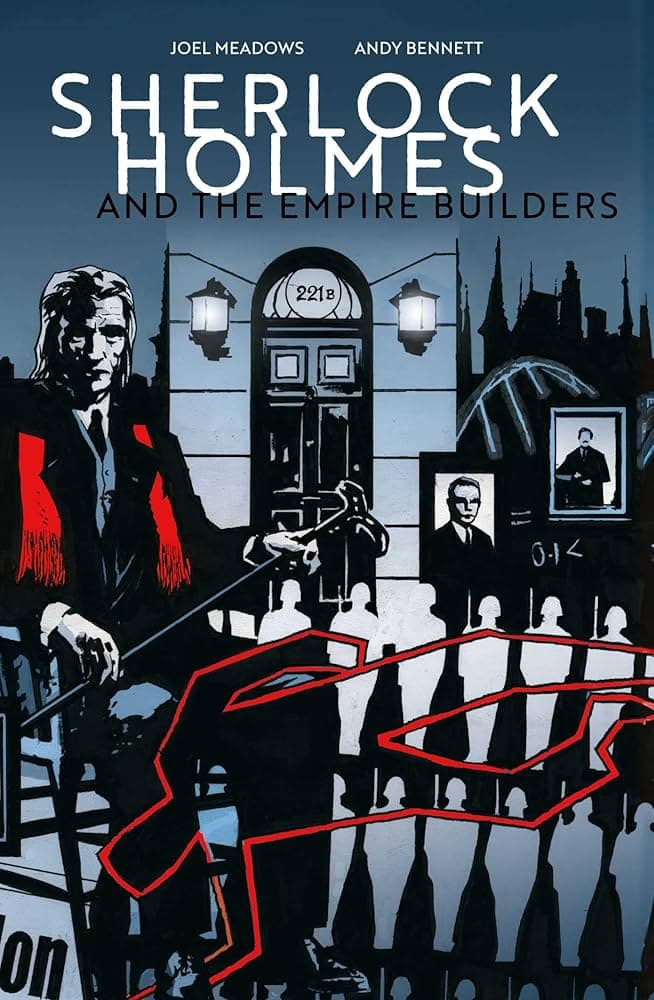
From the publisher
Sherlock Holmes and The Empire Builders is an epic alternate world sci-fi adventure featuring the World’s Greatest Detective as people have never seen him before.
When Watson leaves Holmes to help Crick unravel the DNA helix and finds himself in the employ of England’s most evil man, Holmes is forced to team up with an unlikely group to defeat this monstrous figure and return England to its status quo. But can he defeat the machinations of the man at the rudder of the country?
Sherlock Holmes and The Empire Builders: The Gene Genie is perfect for fans of Michael Moorcock (Elric, Jerry Cornelius) and Bryan Talbot (The Adventures Of Luther Arkwright, Grandville). Winning a Comic Scene award for Best Crowdfunder in 2025, it has already garnered quite a following since its debut in 2020 as a short comic story in the pages of Tripwire. This complete collection features a brand new introduction by award winning writer JM DeMatteis (Moonshadow, Spider-man: Kraven’s Last Hunt), and a brand new wraparound cover by Eisner award winning artist Laurence Campbell (Hellboy)
Follow Comic Book Yeti
🔗 Comic Book Yeti LinkTree: https://linktr.ee/ComicBookYeti
For partnership and ad inquiries, please contact: thecomicsyeti@gmailcom
Follow your hosts
🔗 Jimmy Gaspero: https://bsky.app/profile/jimmygaspero.bsky.social
🔗 Byron O’Neal: https://bsky.app/profile/byrononeal.com
ARKENFORGE
Play TTRPG games? Make sure to check out our partner Arkenforge. Use the discount code YETI5 to get $5 off your order.
Make sure to check out our sponsor 2000AD.

[00:00:00] Your ears do not deceive you. You have just entered the Cryptid Creator Corner brought to you by your friends at Comic Book Yeti. So without further ado, let's get on to the interview. The future is calling! 2000AD is the galaxy's greatest comic with new issues published every single week. Every 32-page issue of 2000AD brings you the best in sci-fi and horror featuring characters like Judge Dredd, Rogue Trooper, and more.
[00:00:28] Get a print subscription to 2000AD and it'll arrive to your mailbox every week. And your first issue is free. Or subscribe digitally and you can download DRM-free copies of each issue for only $9 a month. That's 128 pages of incredible comics every month for less than $10. Head to 2000AD and click on subscribe now or download the 2000AD app and start reading today.
[00:00:54] Hello and welcome to Comic Book Yeti's Cryptid Creator Corner. I'm one of your hosts, Jimmy Gasparro. And man, am I excited for today's guest. He is a co-founder, editor in chief of Tripwire magazine. He has been a journalist for several decades. And he is now the co-creator and writer of Sherlock Holmes and the Empire Builders, The Gene Genie, which has been kickstarted.
[00:01:21] It's now coming out through Mad Cave on April 21st, 2026. And what I think is going to be a really beautiful graphic novel format. We're going to talk all about it. Please welcome to the podcast, Joel Meadows. Joel, how are you doing today? I'm very well, thanks, Jimmy. Thanks for having me on. It's a pleasure. I'm doing very well, thank you. Yeah, I'm a huge Sherlock Holmes fan. I mean, to the point where I learned about Sherlock Holmes, I mean, I was probably six or seven.
[00:01:49] I know this because when I was in the first grade, I used to like to sign my name to test Sherlock Holmes rather than my own name, which much to the I think the frustration of Mrs. Owens, who was my first grade teacher.
[00:02:05] But I very early on learned about Sherlock Holmes. And I'm sure it was probably some reference to a cartoon that then led me to going to the library and getting some of Sir Arthur Conan Doyle's original stories. And I mean, there's been so many, you know, iterations of Holmes over the years.
[00:02:28] And it's something I've always enjoyed returning to those original stories, to everything like the Benedict Cumberbatch, Martin Freeman television show. And there's been some really great comics as well with Sherlock Holmes and the Empire Builders, the Gene Genie. Like what was what started you in terms of wanting to tell a Sherlock Holmes story?
[00:02:54] Well, it goes back a long way. I mean, the genesis of this series started 25 years ago, amazingly. So I had one artist on board who unfortunately didn't quite work out. And I won't name him because it's ancient history and we moved on. But so I was introduced to Andy Bennett through somebody, I can't remember who. And we got talking and we put this proposal together and we went out to Dark Horse into Vertigo around 2002 or so. And nobody bit. So I put it down and I ignored it.
[00:03:22] And then the website has a thing called Lost Tales that one of our writers, Scott Braden, does. Hasn't done that many recently talking about series that never were. And he said, have you got anything? And I said, you know, the Sherlock Holmes thing will be perfect. So around about 2018, I picked it up again and I thought, you know what? Maybe we should have another go at this. And so in 2020, when we brought the magazine back, we did the first of our shorts and we did different shorts each year.
[00:03:48] And we built up, we published three of them and we published them together in the 30th anniversary book. And then we thought, you know what? The next step is to do a fully fledged Sherlock Holmes graphic novel. So it's taken a hell of a long time. It's had, you know, a 25 year gestation period. And it's I really I get so much out of it. And I am pleased I went back to it. And the response has been unbelievable. I mean, really loads of people whose work, you know, I admire that I've either seen their films or read their comics.
[00:04:17] Or, you know, the response has been absolutely phenomenal. People like Guillermo del Toro, Ian Rankin, Jeff Loeb, Frank Quietly, Richard Taylor, who works for Weta, Brunt, Talbot, Michael Moorcock. The list is unbelievable. And we got, as you saw yourself, we have a new introduction from Jem DeMattis in the collected edition. It's unbelievable because I used to read his stuff as a kid. I remember reading his Defenders as a kid and reading Moon Shadow and reading all this. He's got an incredible body of work.
[00:04:45] And he said the most incredibly flattering things about myself and the artist Andy. So, yeah, it's been 25 years in the making, I guess. And it's really amazing to think that now it's coming. I mean, it's been out before, as you say, in two separate volumes. But having it in a single volume with a new cover from Eisner award-winning Lawrence Campbell as well, as well as the Dem DeMattis thing. And having it in a single volume is very, very exciting. Oh, yeah. I mean, I can't imagine something with such, as you said, such a long gestation period.
[00:05:15] And I mean, and the other thing about it, you have so many wonderful creators that, you know, you just mentioned to have said great things about it. And they're all true. I mean, having gotten to take a look at it and read through it, Andy Bennett's line work, and it's all in black and white, which I really love for this. Because it gives it a feel to it that I kind of associate with Sherlock Holmes.
[00:06:10] Yes. And I think that's a fall from grace, so to speak. Oh, yes, totally. You know, Watson is now off, like, doing another thing. So all these familiar elements are in the graphic novel. They're all things that we associate with Holmes. But we see, like, a very different Holmes than, you know, the Rathbone Holmes that we might remember from, you know, from those being on the TV. I remember it.
[00:06:38] And J.M. talks about it in his intro, how it was on TV, like, all the time. And it's true. I wanted a different portrayal of Holmes because he's, as you say, he's now no longer fitting in. And I guess the last few years, I was thinking about the Pennyworth series where I interviewed the two creators of that. And they talked about sort of stepping off the pavement into kind of a slightly different world. And, you know, the back of the first book, the tagline is history can turn on a penny.
[00:07:08] So it's about things changing. It's about one thing changes. So, you know, Holmes, as you say, is formed from grace. He's not the, you know, highly regarded figure he was. And so his life has totally changed. And then it's all to do with, it's called the Gene Genie because it's all to do with DNA and the helix. And the people who unraveled that were Watson and Crick. And I thought it was a really nice little, little Easter egg for one of them to be, you know, James Watson. And Craig. So, and they discover it a lot earlier. So there is, there was so much fun to be handled with that.
[00:07:38] And, you know, Holmes is, I mean, I like to think that Andy's drawn Holmes almost kind of like a Peter, I mean, obviously Peter Cushing played Holmes, but it's almost like a Cushing figure, kind of a slightly physically degraded figure who's not as confident as he was. And he's not as comfortable as he was in the world that he's now living in. The world has changed because of this, this real life, you know, basically kind of like 20th century neo-Nazi. Oswald Mosley was a real historical figure and he's a major part of the villain, obviously in the piece.
[00:08:06] And I thought it was nice to mix it up, to throw in, because the second book's got George V in it. And we've got one of the women whose name completely escapes me. He was one of the main women. I think it was something, Rosemary, Franklin or something. Apologies if I got that wrong to all of our sort of history buffs listening to this. But so I wanted to put some real characters in there as well as mix it up with some fictional ones. And I think it's given it a really different flavor, hopefully, to any other Holmes story. Yeah, I was fascinated by that.
[00:08:36] You know, I read some of the blurbs about it, but I like to go in when I read a story, especially when I'm going to be talking to one of the creators. I don't want to read too much beforehand. I want to kind of just like experience the story. And so, yeah, when Oswald mostly is referenced, I was like, oh, like, wow. Like that's the, you know, because it immediately centers you in the time period.
[00:09:00] He's probably, at least in my mind, Britain's most well-known, you know, fascist in terms of like, you know, unfortunately, whether or not you, you know, you started this so many years ago, whether or not you intended it, it weirdly is, and maybe sadly, very precious. It's relevant now. It's sad, but you're not wrong. Sadly, the behavior of your current government, unfortunately, has some echoes with Mosley and his behavior.
[00:09:29] And, you know, which is unfortunate, but it's very true. Yeah. And so to have that element in it, I was really, you know, fascinated by it because it seems somewhat bigger in scale and scope than, you know, some of the typical Holmes stories we're used to. But I was very fascinated by it.
[00:09:52] And there's a couple of pages in particular that Andy, just to talk about Andy's work for a little bit, does so well. Because we see Holmes is now out of 221B. Yes. And we see him go back to it. He has to get something. And he is hoping that he still has some of the old tricks of the trade.
[00:10:15] And he gives a little, at one point, he gives like a little look like over his shoulder to see if anybody, you know, else is around. And it just feels very Holmesian. And Andy does such a good job. And what's interesting is that's the first story that we created. That was the first short. It was called The House That Crime Built. And we obviously, we didn't bother with the subtitles in the book, but when it ran in the magazine and in the book, the anniversary book, that was the very first.
[00:10:45] I mean, prior to that, there was a short Andy drew, which I wrote, which is very, very primitive, which we ran a few pages of in the paperback book of the first volume. But the short was pretty much, it was the first proper attempt at creating the story. And it was created as self-contained. And the page where he's got Holmes on his own, the splash page in the street, I still think that's one of the most magnificent pages that I've ever seen.
[00:11:10] I mean, I've asked Andy, I'm getting the Limehouse opium den page at some point from the first book because I want it on my wall. I want to frame it.
[00:11:30] I want to frame it. And I want to frame it.
[00:12:18] It's incredible. Yes. Yeah, absolutely. So you said that the genesis of the story started 20 years ago. Did you have a love of Holmes growing up? Were you always a fan of the character? Oh, definitely. I mean, I remember watching, it was a little bit later, I guess it was in my teens, watching things like the Jeremy Brett TV series, which I still think is amazing.
[00:12:47] And I didn't see it at the time. I watched Young Shark Holmes a little bit later. And I thought that's an amazing, even though I interviewed Nicholas Meyer, who wrote Roth of Khan. He's written a number of Holmes books. And he actually says that it contradicts canon, which is probably correct because they never met. They never met as kids. They met years later. But I still think it's a really sweet and very clever and inventive portrayal of the two characters. And I think the two actors are perfect. And there's the stuff with, you know, his teacher supposed to become Morial.
[00:13:15] They were setting it up for a series, but they only made the one. But there was things like that. I mean, I read a few. I did read some Holmes stuff kind of as a kid and in my teens and beyond. In more recent years, the last 10 to 15 years, I quite like, even though they are very contrary to Doyle. I actually have a soft spot for the two Robert Downey Jr. films. The guy, Richie, ones, because I think they're fun. I mean, they're not necessarily that faithful, you know, to the original source material.
[00:13:43] But I think that they're good for what they do. So, and I have a film called Mr. Holmes with Ian McKellen, which I saw not that long, a couple of years ago, when he plays an older Holmes who's living by the South Coast. And it's well worth checking out. And I do like, I mean, I admit, I was never a Sherlock fan, I admit. I like Elementary, though. The Johnny Miller series, I thought they did a really good job of taking the character and moving into the States and turning Watson, you know, into a female cyber.
[00:14:11] I thought there was a really good chemistry between the two of them. And I thought that was a great film. Yeah, I liked Elementary as well. I like that interpretation of it. You know, the focus on Holmes' addiction, you know, I thought was interesting. And so, yeah, I enjoyed it. I enjoyed it. And there was also a show called The Murder, which was based on the man that Doyle based Holmes on, who was a teacher at Edinburgh University.
[00:14:40] It was a BBC drama that was out. It must be 10, 15 years ago, it might be longer, which was fascinating. We showed about this man who was a forensic scientist. That's what he was a teacher up in Edinburgh. And he used him as the basis for Holmes. I mean, Holmes is, the thing I like about Holmes is you can argue that, as with something like James Bond or Batman or Scarlet Pimpernel, these universal characters who are, or someone like the three, even someone like the three Musketeers, because you can argue that these are characters that were created.
[00:15:08] Three Musketeers is, you know, 400 years ago. But there is a universality about the characters that means that you can take them and you can put your own interpretation on them. And you can create something which feels kind of modern, but also hopefully faithful, you know, to Doyle's original concepts. Oh, yes. Yeah. I mean, I think it's tricky to do, but when it's done well, it's remarkable.
[00:15:31] I always find it interesting with different iterations of Holmes as to what the writer is focusing on, because I feel like the Sherlock show, like, for example, with Benedict Cumberbatch, like there's such a focus on his knowledge and his ability to observe. But I feel like, obviously, his arrogance, right. Outside, which is, you know, fair play. So that was part of his makeup as a character.
[00:16:01] Yeah. I feel like they turned it up, though, from like the original Doyle stories, you know. I mean, we don't emphasize that. I mean, with us, it's because he's kind of a figure who's sort of a little bit deflated. But I want to show, you know, moments where the spark is still there. Just, I mean, you know, the one of the other short stories, which is called The Private Files of Oswald Mosley, which was almost like a nod to the. I remember the new Team Tysons did this thing with Deathstroke. I remember when I was a kid. And so basically, Logan, do you know if you remember that?
[00:16:30] But Mosley is talking about and it introduces the second volume because it's a really good way because it talks about the characters. I mean, apart from Holmes, we've got Six, who is a Gherker agent who switches sides. Franklin Miller, who is a Mohawk. Like Mohawks, it was a gang, it was a regency gang in London who caused all kinds of mayhem. And he's kind of like the last of the Mohawks. So he's kind of changed sides. So he's a guy that Mosley's government, they fear him because he's, you know, he's a guy with a motorbike.
[00:17:00] I mean, I said to Andy, can you give him a Triumph motorbike? And I gave him a particular gun and it was kind of fun. I mean, you know, sometimes I wonder if Andy cursed me for some of the reference because there was some very specific, like there's a thing called a Webley. Webley was a, it was a pistol that the British army used in the First World War. Well, I think little details are important. I feel like it adds a little bit of extra color to a story if you have details. It's like the knife, you know, the Gherkers, they always carry the cookery knife. In fact, the other thing we haven't talked about is that for the two volumes,
[00:17:29] perhaps it's for the, yeah, for the two volumes, we had two different covers. And one was a Walt Simonson cover and one had a cookery knife. And there's a thing with the Gherkers that once you draw the blades, it has to draw blood. This is part of their thing. So they always carry the knife, you know, they're part of the British army in Nepal. And so Six has it as a cookery knife. And it's just, these are little details, but I think they're kind of fun to include in the story. Oh, absolutely.
[00:17:54] Yeah, the scene where Six is, I guess, in a church and he makes mention of that with the knife. Like that was, that was so well done, was very suspenseful. Thank you. And I wanted that to be very dramatic, you know. Yeah. Again, that was another short. That was the third short. It was called Prey. And it was, and it works self-contained. And I'm quite pleased we managed to weave these in.
[00:18:21] Although the fact is that we, the Moseley short, I moved into the second volume because a retailer friend of mine said it contradicts the knowledge with the characters. That there are certain things that the characters wouldn't have known. So I had to move it because it was originally designed just as a short. But it works really well as an introduction to the second volume now. Because it introduces the characters without saying, I originally wrote a previously whole page, which I was going to get Andy to draw. But I said, you know what?
[00:18:48] The Moseley short works just as well as an introduction for people who didn't pick up the first volume. Or they were kind of like, you know, just to remind them what happened. So no, I'm very pleased. You know, the shorts work really well, kind of peppered throughout the story. And they do fit in really nicely into the overall story. Yeah, it's interesting. That choice, you know, trying to string the shorts together can be tough. Like you want to make sure it has connective tissue.
[00:19:18] So narratively, it all makes sense. But the choice to put the Moseley story where you did, I think works great because you have the build in the beginning where he's really only mentioned a little bit. So then when you kind of get to the meat of Moseley in book two, it really works much better because we've only heard this individual's name mentioned. And it does really work to build to a nice place.
[00:19:48] Thank you. No, I think it fits really nicely. One thing I haven't done, I haven't sat and read it as if I was a reader. I mean, I might do that when I get my copies in of the collection. I might try, but it's very hard because it is my writing and I'm trying, I'm spotting the old dialogue that I'm thinking is a bit clunky, but it has to stand as it is because it's a reflection of the work as we created it. And there's no point trying to play with it because who knows, in another year, I might find something else that I'm not happy with. So it just has to stand as it is.
[00:20:17] It's just, you know, it's just, it's not the end of the world. It's just sometimes you think I could have done that a little bit more elegantly, but you know, I'm sure Andy probably may feel the same about some of his work as well. Cause it should have the two volumes together. Cause I think even though the first book was amazing, I think the second book flows even better. I think visually there's some incredible pages and some incredible panels and he's broken out. Some of the pages are in a really nice way. Like you've got kind of like some thin panels in some of the pages as well. So he likes to play.
[00:20:46] And there's one page, I think we has a panel in the middle of the other panels. Like when, when Watson's son comes to visit homes, I think it is, or maybe it's six. I can't remember which was one of the pages, but there's a panel in the middle. And I think, wow, that's so inventive. That's such a great way, you know, to break up. So otherwise every page obviously looks the same. So you're looking to create something that's a bit more inventive and to kind of mix it up a little. Yeah. I mean, I think the paneling work is great. Andy's full pages, whenever he like does like a full page. They're magnificent. They're incredible. Absolutely.
[00:21:17] Yeah. Absolutely magnificent. Yeah. And the story has a great flow to it. And I mean, it's, it's a, it's a great story. It's like, it's a great story. I try not to have millions of splash pages. No, I don't, I don't want to feel like, you know, I've run out of things to say. I want, you know, I want to become a slightly lazy, you know, get Andy's draw. Yes. Another splash page. They are there for a purpose. They are there for a dramatic purpose.
[00:21:38] And things like that in the first part of the story, when, when you see, you know, him, you know, with the rifle, which was designed to be very cinematic as like an introduction to the story. And then you have like the four portholes, which I drew in a very sort of childish, right? I said, Andy, a very rough sketch. And I said, can you, can you do it in this way? And I think it's a really, and it, and I wanted it to start not with Holmes. I actually wanted to introduce one of the new characters in there. And I think it's quite good because it throws you right into the action. And again, I want it to be quite cinematic.
[00:22:08] You know, I wanted it to feel almost like a film. I mean, hopefully playing to all of the strengths of comics, but also to feel quite cinematic at the same time. Yeah. I mean, it's as a, as like a, you know, a cold open or introduction. It works. It works very well. You're right in the middle of the story. You're trying to figure out like. Who's this guy? What is going on? Who, who are these players? Yeah. And then when it, when we, we get to Holmes and yeah, I, the Holmes introduction works really well.
[00:22:33] Like we, we, you know, there's some great comic booking in terms of like, well, what, what state do we find Holmes in? Like what is, you know, happening with him? All of that works, you know, really well. So with your career being, you know, a journalist for 30 some years, Tripwire, all the different things you've done. And I mean, listeners, if you don't know, you know, everything that, that Joel has, has done in his career, not just Tripwire,
[00:23:02] all the other publications that he's written for. I mean, photography, you can go and find some of like some wonderful portraits of comic book creators. There were two books about comic artists in their studios. There was Studio Space and Masters of Comics as well. So two of those talking to people about how they work in their, in their studios. So yeah, I mean, I've done a lot of different things. Yeah. And so when you, when you're now doing a comic and you mentioned it earlier about, because I'm a huge Walt Simonson fan.
[00:23:30] What is that like when you're like, oh, I'm, I'm now I've interviewed so many people. I've written these books. I'm making a comic and oh, is there still that excitement of like Walt Simonson is doing a cover? Oh yeah. It's incredible. I mean, when I got it, the first two covers, we had Walt Simonson and my friend Mark Cirillo did the other cover as well. And then there's the pinups. So for the two volumes of your pinups from people like John K. Slider, the third Sean Martin, bro. There's a Liam Sharpen built in Kervich one in there.
[00:23:57] Second book has got George Pratt because we're working with him on an art book as well at the moment. I, at least his home speech is amazing. It's part analog part digital. It's a beautiful pinup. So no, it does feel quite weird. I mean, if I look at the four books now, because the second one's had Dan Panossian, who obviously is rather ubiquitous, but he did an incredible cover for us. Dan's work is like immaculate. But Dan's work is so great. And he also designed it as well. He placed the logo, he designed the typography.
[00:24:26] He put it in the place and I think it's an incredibly arresting looking cover. But then obviously the collection's got Lawrence Campbell. Again, that was a new commission. And I have the original piece of art for that as well, which Lawrence kindly, obviously I paid for the piece, but these days a lot of times you just get the digital file. But Lawrence gave me the original, which is amazing. And it's a wraparound and it's so beautiful. But seeing color, I love the cover, the new cover. I think it looks incredible.
[00:24:55] And the whole point of it is it's designed to look more like a general book cover. You know, that's the thing. The others are, they're really cool. I'm not knocking them. I wanted something that would sell in bookshops. And I think Lawrence's cover will really draw people in when they see on the bookshelves, I think. I mean, yeah. Composition is lovely. You look at the little details. There's so many Easter eggs on these arts. It's just incredible in a different color scheme. It just works so well. It's really exciting to see that in the flesh.
[00:25:24] Oh, yeah. A hundred percent. A hundred percent. It's, there's like a sparse use of color, but like the bright red and that cover. And it just, it pops. It looks so good. Yeah. I mean, if you look at all five covers so far, they've all got a certain kind of tone to them, a certain kind of feel. But I don't, I didn't say, I didn't give people much art direction. I mean, we'll see the finished book, which is why there's loads of interesting details. Not necessarily that important, but it's still a really cool piece.
[00:25:53] And Mark's one was more, it's more of a graphic design cover. You know, it's very simple with the oranges and then the sort of the handwriting at the bottom. And then, you know, it was interesting is that both the Dan Panossian and the Fraser Irving cover, they both use a lot of green and that was a pure coincidence. And then Lawrence's cover is kind of blues and reds, but it's a very graphic cover and it's very simple, but it's hopefully enough. It's eye-catching enough. I think people look at it and go, but what I want to find out more about this because it's
[00:26:21] thought-provoking and it, you know, hopefully will arouse kind of interest with people just browsing in bookshops and plumbing shops as well, of course. Absolutely. I think it will. I'll be talking to some other artists for the third book, which I haven't started yet. But when you finish the collection, you'll see there is a nod. There is a little kind of like a James Bond in a post-credit sequence with a character who has appeared in Doyle. So I've decided to use an existing Doyle villain.
[00:26:50] I brought back Sebastian Moran, who was the sharpshooter. He was from Afghanistan that Doyle used as like the greatest shot in the world. And he comes out of prison and said that the next book is going to be called, at the moment I work inside this shoot to kill, I think. Okay. And then the third book is going to be, it's going to be a chase. So it's pretty much going to be like, there's going to be lots of scenes on the train. I mean, it's going to be a shorter story. It's going to be about 48 pages. I haven't started the scripts or anything yet.
[00:27:19] I mean, Andy has put a hell of a lot of work into these books. So I want to give us a little bit of a break before we get started with this. But I would like, I want to do it. And I've been talking to tour three incredible artists for some new covers as well, which is, which is really exciting. So the momentum, and also I'm finishing the novella, which I'm doing, which is set after Doyle's stories and before the graphic novels. So Holmes has lost the house. He's, he's kind of homeless for some of it. I've created a new villain in there, but there are characters in there. You've got Mycroft in there.
[00:27:47] You've got John Clay, who was from the Red Headed League. You also got Shunwell Johnson, who was a snitch, who was in a couple of Doyle's stories. So I've, I've made it closer to Doyle's stories. It's more of an, it's a little bit more investigative story in a way. So I'm working on the second draft of that. I'm using Jeff Marat, who's giving me some incredible feedback as editor, we're an editor on the script as well, we're an editor on the novella and he's giving me some incredible pointers. So I'm going to be diving back into that in the next few days. So that'll be out. So that's really exciting.
[00:28:17] And I'm very pleased with it. It's very difficult. It's very different to writing the comic because if you're writing prose, it's just me. I can't rely on, you know, Andy's flourishes as an artist. If something doesn't work, then it's my fault. All right, everybody. We're going to take a quick break. We'll be right back. Y'all, Jimmy, the Chaos Goblin strikes again. I should have known better than to mention I was working on my DC Universe meets Ravenloft hybrid D&D campaign on social media. My bad.
[00:28:45] He goes and tags a bunch of comics creators we know. And now I have to get it in gear and whip this campaign into shape so we can start playing. Another friend chimes in. Are you going to make maps? It's fair to say it's been a while since I put something together. So I guess, question mark? It was then that I discovered Arkenforge. If you don't know who Arkenforge is, they have everything you need to make your TTRPG more fun and immersive.
[00:29:10] Allowing you to build, play, and export animated maps, including in-person Fog of War capability that lets your players interact with maps as the adventure unfolds while you, the DM, get the full picture. Now I'm set to easily build high-res animated maps, saving myself precious time and significantly adding nuance to our campaign. That's a win every day in my book. Check them out at arkenforge.com and use the discount code YETI5 to get $5 off. I'll drop a link in the show notes for you.
[00:29:40] And big thanks to Arkenforge for partnering with our show. So I think I'm going to make Jimmy play a goblin warlock just to get even. Welcome back. But it has been exciting. So we're doing one with my photographs of London scattered throughout it. And then we're going to do a different version that's going to have Andy's. Andy's going to create 20 standalone images for an illustrated version of the novella, which will be coming later in the year, which is exciting. Oh, I love that. Yeah, that sounds great. Really nice.
[00:30:09] It's easier than creating a comic image as well. I said to him, would you like to do this? And he said yes. So I'm really pleased that he's agreed to do that. So that's going to be really nice. Yeah, that sounds really great. I love that in terms of illustrated novella. Did you always want to do, you know, not that what you do isn't creative. I mean, in terms of like your journalism work and the interviews that you've done and everything with Chipwire.
[00:30:34] But did you always want to write stories or was it a point where you were interviewing so many people and you were like, I kind of want to try my hand at this? Like, had you always been writing like, you know, fiction or writing creatively all along with your journalism work or what? What made you want to do this, too? I had I had to go at some comic proposals very early on in my sort of late teens. And they were they were pretty terrible, to be honest.
[00:31:02] So I'd written some scripts and come up with some plots. And I worked with Charlie Adelaide before he got his work at the magazine. And but as I said, they weren't really very good. And I hold my hand up and they were pretty terrible, to be honest. So I thought I was always experimenting with stuff. But as I said, Holmes, I put it down to sort of 15 years. I mean, the plot hadn't changed that much. But I obviously I'd like to think I'd got better at the writing by that point.
[00:31:31] But I guess I had always been writing, but not necessarily for other people's consumption. Oh, OK. I had a go at it, but I thought the stuff wasn't. I know that the Holmes stuff is strong now. And I'm looking at possibly some other stuff which is not Holmes related. I am considering developing some other comic work which have nothing to do with Holmes. I'm thinking about developing like a London crunch. I have no idea anything about character or plot or setting or anything.
[00:31:59] But I know that I'd like to build on, you know, the momentum. And I've enjoyed creating the Holmes comics. So I think the next step would be to come up with something else, basically. Oh, yeah, that'd be pretty cool. You know, I was a little intimidated because of doing this, you know, because of all the interviews you have done. And, you know, not just in the comics world. Yes.
[00:32:22] And I was just like, what do you think having done all this makes like a good interview, specifically in the field of comics, when you're talking to creators, when you're talking to artists, writers, whatever it might be? Like, what has been your approach to that you felt? Oh, this makes a really good interview. Is it a case-by-case basis? Is there like some tips or tricks of the trade, Joel? Well, I mean, I think that what I like to do is I like to talk to creators about stuff outside of comics.
[00:32:52] You know, I like to talk about their work. But for example, I interviewed Pete Milligan a few years ago. I haven't talked to him in a while. But we talked about class, you know, and I think it's interesting because when I first met him, he lived in like a council flat, you know, which is funded by the council. And now he lives in, you know, like a private house. And then I talked to him about how that's informed his work. And then there are other people like Tim Bradstreet, when I interviewed him for the studio, but we talked about photography because we both love photography.
[00:33:19] And he talked about, he did a job in Italy and we were Jim Lee years ago. We talked about the catacombs underneath Paris. We talked about photography. So I like, and I went to Jim Lee also for the same book. He talked about being taught by a guy called Frank Stella, who was an abstract artist. And like when I interviewed Adam Hughes, he talked about going to the Louvre and looking at, you know, and I went to interview Joe Kubrick, he talked about the old masters, talking about Rembrandt and talking about influences. And I think it's interesting to see where these people come from.
[00:33:48] And I try, if I'm interviewing people to talk about, it's like when I interviewed Ed Brubaker quite a few years ago now for the magazine, his uncle wrote two quite well-known noir screenplays. I think it was Crossfire and Out of the Past. And so he said, you know, like writing is in a flood. So I think it's interesting to get into kind of like the DNA of the people that you interview, whatever that entails.
[00:34:09] So I think it's interesting to dig a little bit deeper, not just to ask them about drawing Hulk or Thor or whatever, which is, I guess, I'm not, you know, criticizing that. There's nothing wrong with that, but there is more to these people. And it's interesting to get kind of under their skin, basically a little bit more. And I try and do that whenever I can. Yeah. I mean, that's, that is kind of the trick, I guess. It does make for a much more fascinating interview.
[00:34:34] I do, I like talking, I like talking about the work, but it is interesting whenever you can chat about something else that isn't comics. Cause I, you know, I, I've, I want listeners to, to know who these creators are. So yeah, it is. And I think it's important to pull an influence from elsewhere. You know, I've talked about how it's been quite cinematic and, and I think that, you know, I love comics as well, but I feel like if you expose yourself to other things,
[00:35:00] like the last couple of years, I've been watching quite a lot of sort of French new wave films from people like, you know, Melville. These are army of shadows and the samurai, which I've seen before. And I think it's important to draw stuff in because if it's good, then it's good. If it's in another medium and you can bring new things into your comic work and it makes things a bit more interesting, you know, rather than just recycling, you know, like a Wolverine story that you enjoyed reading, you know, as a kid, why not? Excuse me.
[00:35:28] You want to go to a gallery and look at some sculpture or, or why not, you know, watch some, some, some film and, and read some novels and, you know, read some plays and just expose yourself to other things. Which I think is really, really important. I mean, the introduction to the Holmes book is a little bit like the day of the jackal because it's a chase. And in fact, the next story will be a little bit like that because it's going to be a chase.
[00:35:51] So you look at, you watch things like the French connection and you look at, there's that wonderful chase, you know, but on the train and, and things like Godfather part two, like there's the bit when he kills the guy in the market, you know, the, the, is it the, the, what? Is it that red hand, the guy that, you know, he kills a gangster. So you've got Robert De Niro walking on the rooftop and he's following this man in the market and then he shoots him, he finds him. So it's just picking up stuff, which works. And as I said, you still need to play to comic strengths, but you could pull in stuff from, from other medium.
[00:36:19] And it's made, it just kind of enriches things and makes it more interesting, hopefully as a story, but you could pull stuff in, you know, like there's a lot of history in this book. You know, there's George V and then you've got, you've got the Mohawks and then you've got this different sort of kind of London, but you've got stuff in it, which kind of ties in into, into history. And that's where you got Mosley because, you know, it ties into real history. And then I had to think about if Mosley is prime minister, they wouldn't, there wouldn't have been a second world war.
[00:36:44] So it's things like the church when he goes to visit the church, the real church is a ruin because it was formed in the second world war in the blitz, but no, no second world war, no blitz. How should the church look now? So I had to go to Andy and say, I found some, you know, images that you could use. So it's about playing with history and while tapping into it at the same time. And I find it endlessly fascinating. And sometimes you get too stuck into the research and you think I've got to write this thing.
[00:37:12] And how do I write it? So it's still interesting. So it's not too bogged down with the details, but you put little details in like the white horse. They call it the white horse. The white horse was the Hanoverian animal. And there are quite a few chalk drawings around England that were there. So they created these horses on hillsides and around the country. And it was, for some reason, it was the animal of the Hanoverian. And Hanoverian obviously was, you know, George the first and George the third and George the fourth and George the second.
[00:37:40] So I throw in little things, they're little throwaway things. And kind of like the Air Force place that they go to down in Biggin Hill. And things like the subterra. Subterra is literally underground. It's underground in Latin. So the tube is called the subterra here, just to check things a little. And I even played with the logo. I took the old tube logo and I put the word subterra on it. And it was kind of fun, these little throwaway details.
[00:38:05] But I really enjoy using them just as a little extra Easter egg to put in the story. Yeah. Well, you not only have like a good Holmes, you know, mystery, you know, the things we're used to from Holmes. But because of, you know, what you've done with Mosley, you now have, you know, also all those elements you've just mentioned of like an alternate history. Yeah. Because at first, like I didn't realize I'm like, is that I'm like looking it up. I'm like, is that a real is that a real station? Is the subterra a real station?
[00:38:33] I think that's the tube. You know, where Miller has his headquarters, the monument was created after the Great Fire of London. And it has a giant flaming pineapple on it. But in this world, it has Mosley's head. And there's a little bit of dramatic irony there in that the rebels headquarters is based in this place that has Oswald Mosley's head in it. So it's like a triumphalist sort of tribute to the, you know, to the man who's, you know, controlling the country, but they are there to undermine it. So there's a little bit of extra sort of dramatic irony there.
[00:39:03] So there are, there are lots of little touches, you know, in the story, which I really enjoy putting in. And as I said, St. Pancras is a real station. It was built in the Victorian period. It was closed because it was structurally unsafe, but it was saved. It wasn't, it wasn't demolished. And so now, you know, the Eurostar goes from St. Pancras and it's a really elegant station. But turning it into a fortress, I thought was again, another nice bit of dramatic irony. And I haven't written a Bible, but I could write a Bible for the world that Holmes inhabits to create service.
[00:39:33] Things for other stories. And it is so much fun. I mean, it's always too much because I could do what I want with this, you know, because I changed history now. And so I can make things different. I can play around with history and I can play around with geography and, and just the terrain and the different architecture of the city. You know, what would the city be like with this other man in control? They said no second world war and the blitz destroyed the loss of buildings.
[00:39:59] So a lot of things that would have been destroyed during the bombings would still possibly be standing. And as this is a sort of, this is like an alternate Edwardian period based, like an alternate sort of 1920s. And it didn't unravel the DNA until the 1950s. So this is already, I've already taken a lot of liberties with history, but it's so much fun to do because why not? I mean, you know, I've set this thing up. I've set my own parameters. There's no reason why I can't do things like this. You know, I haven't taken a place. Oh, absolutely. It was a palace.
[00:40:28] It was never a place, you know, where they kept, you know, royals, but why not? Yeah. I think that that added element of it is great. So now I got to go back and read it a second time and see some of the stuff I've missed. I've only ever been to London once. Okay. And back in 2012. So it's been a while, but I loved it. And I wanted to put different things in there as well. I mean, I wanted to put slightly different architectural things in there and just to make it a little bit different.
[00:40:57] So there's no, there's no tower London in there because I'm so fed up with seeing that building. I want something a bit different. And so Bankris is a wonderfully Gothic building. I mean, it was saved by John Betjeman, who was a writer, but it was going to be leveled. And it's one of those elegant buildings that would have been an absolute tragedy if it had been. So it's been saved, but in this world, it's, it's a fortress. So it's created, you know, I've created a different purpose and a different use for it. And it's just so much fun to do this stuff.
[00:41:25] And I'll do something similar and there'll be a train in the third story. So we have to think about, I'm thinking about other train stations. There'll be lots of things that Andy will no doubt curse me for. Or with lots of reference, you'll have to play with, have to come up with something new to make it look like the existing station. But something a little bit different, you know, like you've got things like Victoria Station, which are named after Queen Victoria. But she was still around, but you know, maybe Mosley, although Mosley obviously is, well, I'm not going to spoil it too much, but things may have changed, you know, in the third story.
[00:41:53] But there will be things I'll be able to play with. And it's, it's endless fun, to be honest. There's so much, but there were things they were talking about doing in London, which they never built, which we could include these ridiculous springs that were architecturally credible. They were going to build like an Eiffel Tower in Wembley, which they built. I think they built the base, but they never finished it. So there's, there's lots of really weird shit to be honest. A bit like League of Thrones Gentlemen in a way. We're not quite as outlandish as that.
[00:42:19] I mean, I like to think that the story is influenced by, I mentioned, I think on the back of the book by Michael Moorcock and by Brian Talbot. Again, Talbot's work is much more lyrical and it's a bit more out there. It's much trippier. You know, ours is grounded a bit more reality. Moorcock's stuff is extremely trippy and very out there. But, you know, without these stories, Holmes probably wouldn't have happened. So that's why I mentioned them as touch marks for one of the things that influenced the story. Oh, that's awesome.
[00:42:47] Yeah, I love seeing that too. Like what, what influenced you and what stuff that you love. But I, I think, you know, the story is fantastic. I think Andy's work is incredible. And yeah, for the, the covers, the, the, the pinups that are going to be in it. Yes. I'm very excited that Mad Cave is putting this out. And yeah, it's going to be out listeners. It's going to be on April 21st. So let your local comic shop know that you want it.
[00:43:17] The other, the other influences are things like the three musketeers and Scarlet Pimpernel. Cause I, I, it's got a, like a sense of adventure to it as a story. So it is, I wish it was, which was important because I really enjoyed that. I thought that would create a different flavor for a home story to have that kind of sense of adventure. Rather than just a, Oh yeah. Applicative thing. So to make it like a sting pump, I call it a sci-fi steampunk adventure, which I think is a good encapsulation of what the story is. Yeah. Yeah.
[00:43:44] I like seeing a slightly, you know, desperate, like an older, slightly desperate, but still wily Holmes. I think it makes for an interesting characterization of Holmes at this stage in his life. So, and I'm trying to incorporate some humor as well. You know, there's like the scene when he meets, you know, in the beginning of the second book, when, you know, he gets a visit. He doesn't, isn't expecting. And there were some kind of funny throwaway lines, which I was quite pleased, you know, throwing it in.
[00:44:12] So it's not a laugh out loud comedy, but there are moments of humor, which I wanted to put in there. And there's some dark moments as well. Like in the first book, you know, like the visits to my home house, which is deliberately quite dark. And that's why I don't think it's suitable for people. I mean, kind of under 16 probably, because there are some, and there's quite a lot of violence in it, as well as people being shot quite a few times. I thought that was important, but not to, you know, overdo that, but I thought it was important to have some interesting and dramatic fight scenes. Yeah.
[00:44:40] And they are Andy's work in the fight scenes are great. Yes. So, yeah, there are a lot of interesting, as you said, interesting and dramatic fight scenes. And, yeah, I do like home still has a very, you know, dry. Yes. Somewhat sarcastic sense of humor. It is at play here. So, yes, absolutely. Well, Joel, this has been wonderful. I keep having me on.
[00:45:10] I've really enjoyed chatting about homes. So I'm a huge Sherlock Holmes fan. I, I think this is great. I appreciate you sending the PDF, but I think you probably enjoy the novella as well, because the novella is a slightly different take because it's closer to a Doyle story than the comic is because it's more of a straight investigative story in a way. So if you're a Holmes fan, you probably, you probably enjoy that as well. Yeah. I want to, I want to read it.
[00:45:39] I, but I want a physical copy. I'm going to make sure that my local comic shop is that I want a copy of this book. So listeners, it's the best thing to do. Let your local comic shop know, or, you know, I'll have a link in the show notes so you can go to mad cave site. Um, but it'll, it'll, I think it's going to be distributed probably through lunar. That's where me as well, which is great for awesome for the mainstream bookshops and it'll be in lunas. So it's like, it's, it's effectively like a co-publication.
[00:46:07] So mad cave of basic publishing is and printing it, but it's going to be a trip where comics presents a book. So it's, it's an interesting, you know, synthesis. I mean, they've been amazing. Mad cave been very, very supportive of the other books that we've been doing. So this was like a natural next step, to be honest. I talked to Mark Owen about this and I'm really pleased that we managed, you know, to make this happen because I've, I've a lot of time. It's a great company and, you know, Mark London who runs it and everyone from Mark Owen to Mike Martin.
[00:46:35] So I have to say that, that they are, that they're a very cool company and they've got some great people working for them. Um, so I feel pleased that we can be like a small pass of their list as I said, cause it is a co-publication, but obviously they managed to sort out the distribution for us. And they'll be, and they also, they designed it. It's the first thing that I haven't designed. They, their team of designers have put together. So, but it is a co-production between a trip where in mad cave, but it is the best of both worlds. I think. Yeah.
[00:47:05] I'm a big fan of mad cave. So I think they're a great company. Um, I, I interview a lot of mad cave creators. So you're very, very excited for you. I think it's going to be part of their list. You know, it's great. Yeah. Yeah. I think this is going to be great. So April 21st listeners. Um, so thank you so much for listening. Also links in the show notes. I'm sorry. What'd you say? Thanks for having me on. Oh yeah. Um, uh, I'll have a link in the shows for, for trip wire to check out all the great stuff that they do at trip wire.
[00:47:34] Um, and you can check out some of Joel's other books, like the, the, the idea of seeing other comic creators, especially if you're a huge comic fan. And I assume you are, if you're listening to this podcast, like the, you know, seeing creators work in their, in their space, I think is, is really interesting. Uh, a fascinating approach to, to seeing how things are done. So yeah. Thank you very much for listening. Um, rate and review us and do all that stuff they tell you to do for podcasts. It really helps.
[00:48:03] Thank you to, to Joel for coming on the podcast. Um, all right, listeners. Uh, I will see you. Thanks so much for listening. I will see you next time. Uh, good night. This is Byron O’Neal. One of your hosts of the cryptic creator corner brought to you by comic book Yeti. We hope you've enjoyed this episode of our podcast. Please rate review, subscribe all that good stuff. It lets us know how we're doing and more importantly, how we can improve. Thanks for listening.
[00:48:33] If you enjoyed this episode of the cryptic creator corner, maybe you would enjoy our sister podcast Into the Comics Cave. Listen and subscribe wherever you get your podcasts. Sag mal, Nicola, hast du auch immer dieses Gefühl bei der Steuererklärung mit einem Bein schon im Knast zu stehen? Boah, nee, gar nicht. Wieso Steuer ist so die Steuer-App, mit der ich wirklich nichts falsch machen kann? Wow, das heißt, damit ist alles sicher? Ja, genau. Wieso Steuer ist die Steuer-App, die dich versteht. Weil Steuer betrifft ja dein ganzes Leben.
[00:49:03] Arbeit, Kinder, Partner. Du kannst nichts falsch machen. Stimmt, nice. Fühlt sich gar nicht wie Steuern an. Steuern erledigt? Safe. Mit Wieso Steuer. Jetzt kostenlos testen.